

ISO 16063-1:1998/Amd 2:2025
(Amendment)Methods for the calibration of vibration and shock transducers — Part 1: Basic concepts — Amendment 2
General Information
- Abstract
- Status
- Published
- Publication Date
- 01-Jun-2025
- Technical Committee
- ISO/TC 108 - Mechanical vibration, shock and condition monitoring
- Drafting Committee
- ISO/TC 108 - Mechanical vibration, shock and condition monitoring
- Current Stage
- 6060 - International Standard published
- Start Date
- 02-Jun-2025
- Due Date
- 19-Sep-2025
- Completion Date
- 02-Jun-2025

Overview
ISO 16063-1:1998/Amd 2:2025 is an amendment to the international standard ISO 16063-1, which establishes basic concepts for the calibration of vibration and shock transducers. Published by ISO Technical Committee ISO/TC 108 (Mechanical vibration, shock and condition monitoring), this document addresses foundational practices for ensuring the accuracy, reliability, and consistency of vibration and shock transducer calibrations. Amendment 2 introduces an updated methodology for assessing magnetic field sensitivity, enhancing measurement accuracy in environments where electromagnetic interference may affect transducer performance.
Key Topics
- Calibration of Vibration and Shock Transducers: Outlines general principles for calibrating sensors that measure dynamic mechanical quantities, such as acceleration, velocity, or displacement caused by vibration or shock.
- Magnetic Field Sensitivity: Updates procedures for evaluating how vibration and shock transducers respond to magnetic fields, ensuring reliable operation even in electromagnetically noisy environments.
- Specifies the use of Helmholtz coils to generate known magnetic fields for controlled sensitivity tests.
- Details methods for determining maximum transducer output in response to varying field orientations and frequencies (e.g., 50 Hz, 60 Hz).
- Equipment Requirements: Highlights the apparatus necessary, including single or orthogonally arranged Helmholtz coil pairs for precise magnetic field generation and measurement.
- Reference to ISO 16063-33: Cites ISO 16063-33 for detailed procedures on testing transducer magnetic field sensitivity.
Applications
Implementing ISO 16063-1:1998/Amd 2:2025 supports enhanced quality control and reliability in various sectors:
- Industrial Calibration Laboratories: Ensures consistent, repeatable calibration of vibration and shock transducers in alignment with international standards.
- Manufacturing: Supports quality assurance for equipment that relies on accurate vibration or shock measurements, including automotive, aerospace, and heavy machinery.
- Condition Monitoring and Predictive Maintenance: Improves the reliability of sensors used in monitoring systems for rotating machinery, structures, or electronic devices sensitive to vibration and shock.
- Research and Testing Facilities: Provides a repeatable framework for calibrating transducers during experimental setups where electromagnetic fields may influence measurements.
The revised approach to magnetic field sensitivity is crucial for environments where external magnetic interference could compromise the accuracy of vibration and shock measurements. By adhering to this amendment, organizations can reduce measurement uncertainty and enhance trust in transducer readings across varied operating conditions.
Related Standards
Several ISO standards complement ISO 16063-1:1998/Amd 2:2025 in the field of vibration and shock transducer calibration:
- ISO 16063-1: Methods for the calibration of vibration and shock transducers – Part 1: Basic concepts (foundation standard).
- ISO 16063-33: Methods for the calibration of vibration and shock transducers – Part 33: Testing of magnetic field sensitivity (detailed procedures for magnetic testing as referenced in the amendment).
- Other parts of the ISO 16063 series: Cover a wide range of calibration methods and application-specific requirements for vibration and shock transducers.
Referencing and implementing these standards ensures comprehensive calibration practices and reliability for vibration and shock measurement systems worldwide. For more detailed information and additional resources, the full ISO 16063 series is available on the ISO website.
Keywords: vibration transducer calibration, shock transducer, ISO 16063-1, magnetic field sensitivity, Helmholtz coils, industrial calibration, condition monitoring, ISO 16063-33, vibration measurement, shock measurement, sensor calibration standards.
Relations
- Effective Date
- 24-Sep-2022
Get Certified
Connect with accredited certification bodies for this standard

BSMI (Bureau of Standards, Metrology and Inspection)
Taiwan's standards and inspection authority.
Sponsored listings
Frequently Asked Questions
ISO 16063-1:1998/Amd 2:2025 is a standard published by the International Organization for Standardization (ISO). Its full title is "Methods for the calibration of vibration and shock transducers — Part 1: Basic concepts — Amendment 2". This standard covers: Methods for the calibration of vibration and shock transducers — Part 1: Basic concepts — Amendment 2
Methods for the calibration of vibration and shock transducers — Part 1: Basic concepts — Amendment 2
ISO 16063-1:1998/Amd 2:2025 is classified under the following ICS (International Classification for Standards) categories: 17.160 - Vibrations, shock and vibration measurements. The ICS classification helps identify the subject area and facilitates finding related standards.
ISO 16063-1:1998/Amd 2:2025 has the following relationships with other standards: It is inter standard links to ISO 16063-1:1998. Understanding these relationships helps ensure you are using the most current and applicable version of the standard.
ISO 16063-1:1998/Amd 2:2025 is available in PDF format for immediate download after purchase. The document can be added to your cart and obtained through the secure checkout process. Digital delivery ensures instant access to the complete standard document.
Standards Content (Sample)
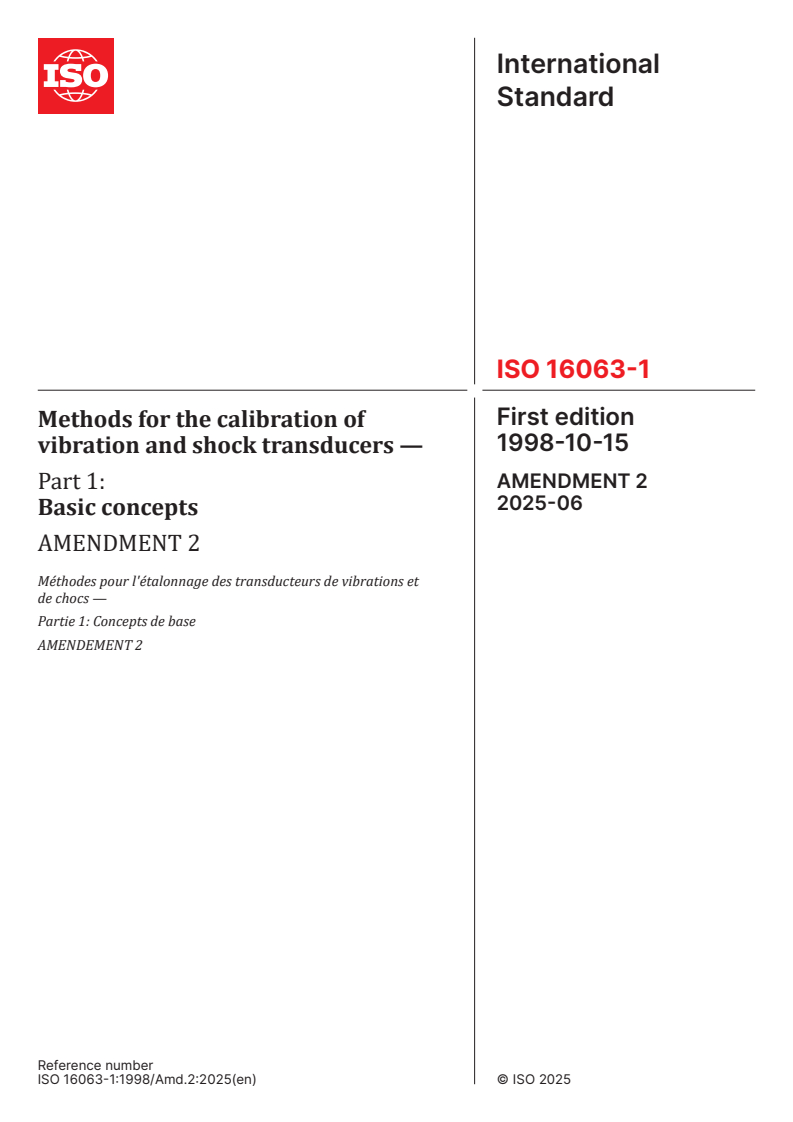
International
Standard
ISO 16063-1
First edition
Methods for the calibration of
1998-10-15
vibration and shock transducers —
AMENDMENT 2
Part 1:
2025-06
Basic concepts
AMENDMENT 2
Méthodes pour l'étalonnage des transducteurs de vibrations et
de chocs —
Partie 1: Concepts de base
AMENDEMENT 2
Reference number
ISO 16063-1:1998/Amd.2:2025(en) © ISO 2025
ISO 16063-1:1998/Amd.2:2025(en)
© ISO 2025
All rights reserved. Unless otherwise specified, or required in the context of its implementation, no part of this publication may
be reproduced or utilized otherwise in any form or by any means, electronic or mechanical, including photocopying, or posting on
the internet or an intranet, without prior written permission. Permission can be requested from either ISO at the address below
or ISO’s member body in the country of the requester.
ISO copyright office
CP 401 • Ch. de Blandonnet 8
CH-1214 Vernier, Geneva
Phone: +41 22 749 01 11
Email: copyright@iso.org
Website: www.iso.org
Published in Switzerland
ii
ISO 16063-1:1998/Amd.2:2025(en)
Foreword
ISO (the International Organization for Standardization) is a worldwide federation of national standards
bodies (ISO member bodies). The work of preparing International Standards is normally carried out through
ISO technical committees. Each member body interested in a subject for which a technical committee
has been established has the right to be represented on that committee. International organizations,
governmental and non-governmental, in liaison with ISO, also take part in the work. ISO collaborates closely
with the International Electrotechnical Commission (IEC) on all matters of electrotechnical standardization.
The procedures used to develop this document and those intended for its further maintenance are described
in the ISO/IEC Directives, Part 1. In particular, the different approval criteria needed for the different types
of ISO document should be noted. This document was drafted in accordance with the editorial rules of the
ISO/IEC Directives, Part 2 (see www.iso.org/directives).
ISO draws attention to the possibility that the implementation of this document may involve the use of (a)
patent(s). ISO takes no position concerning the evidence, validity or applicability of any claimed patent
rights in respect thereof. As of the date of publication of this document, ISO had not received notice of (a)
patent(s) which may be required to implement this docume
...