

ISO/DTS 21385
(Main)Requirements and recommendations for the implementation of emerging technology in medical laboratories
- Abstract
This document provides general requirement and guidance on identification, design and development of emerging technologies with potential use in medical laboratories and their preparation for clinical use. This document is applicable to laboratories transitioning emerging technologies utilizing human samples into medical laboratory examinations for the purpose of providing information for the diagnosis, monitoring, management, prevention, and treatment of disease. This document does not apply to medical laboratory examinations undergoing validation at which point the technology has become an in-house (laboratory developed) test or in-vitro diagnostic medical device.
- Status
- Not Published
- Technical Committee
- ISO/TC 212 - Medical laboratories and in vitro diagnostic systems
- Drafting Committee
- ISO/TC 212/WG 1 - Quality and competence in the medical laboratory
- Current Stage
- 5020 - Proof sent to secretariat or FDIS ballot initiated: 8 weeks - 50 Approval
- Start Date
- 06-Oct-2026
- Due Date
- 06-Oct-2026
- Completion Date
- 06-Oct-2026
Buy Documents
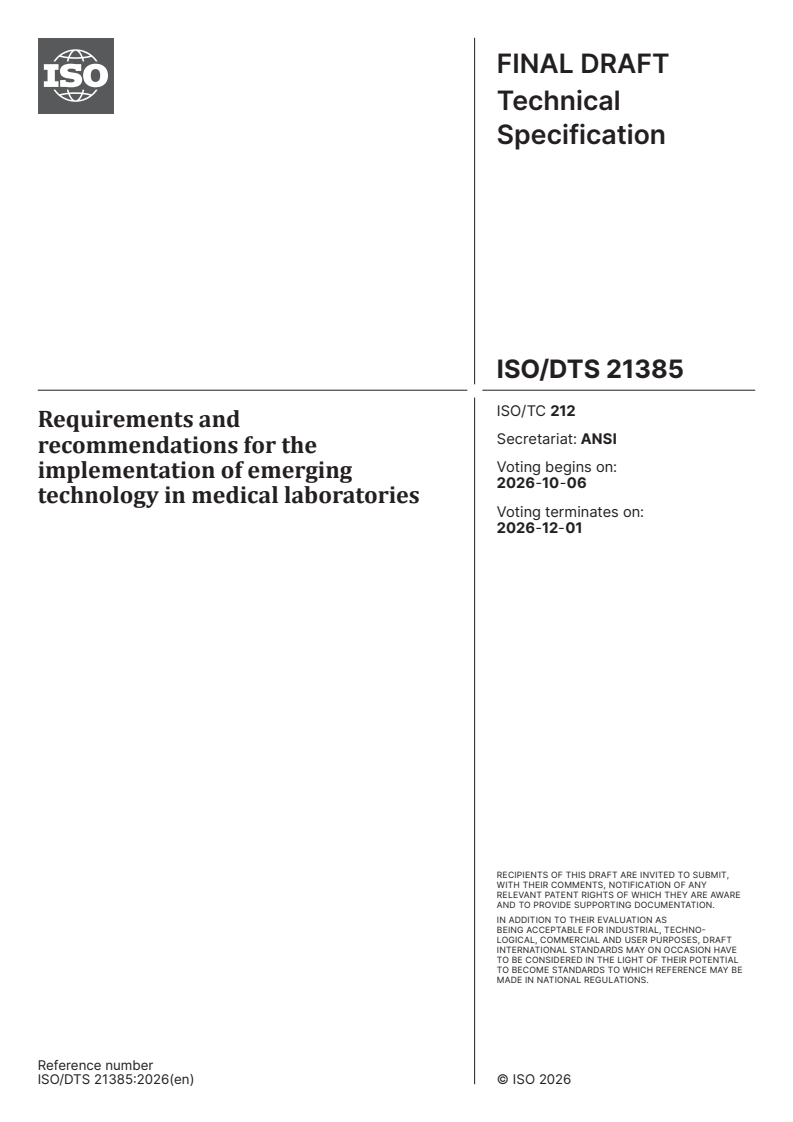

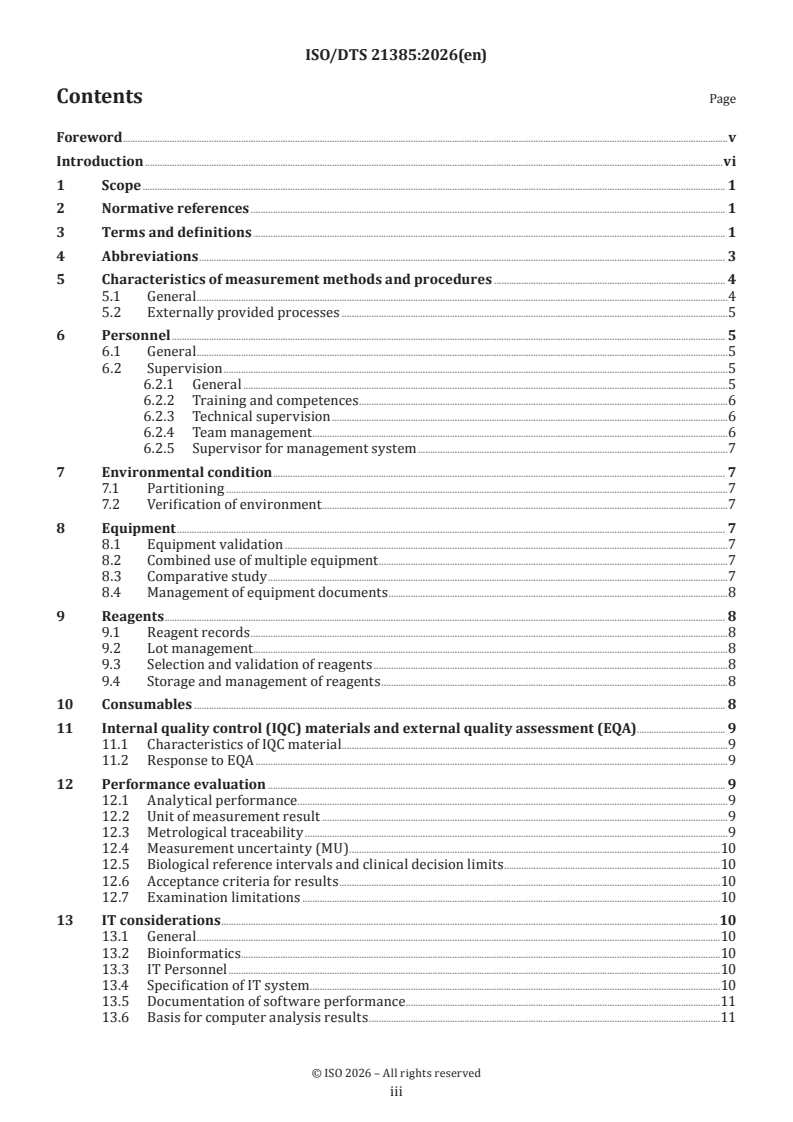
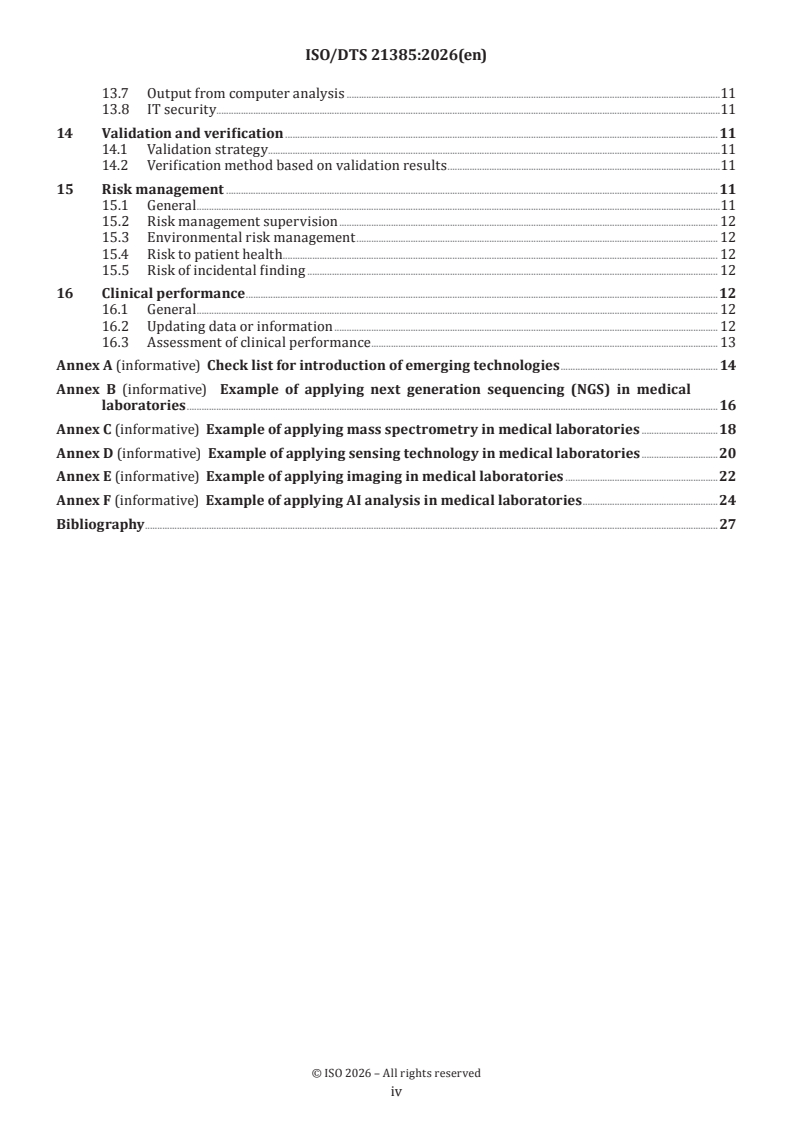
ISO/DTS 21385 - Requirements and recommendations for the implementation of emerging technology in medical laboratories
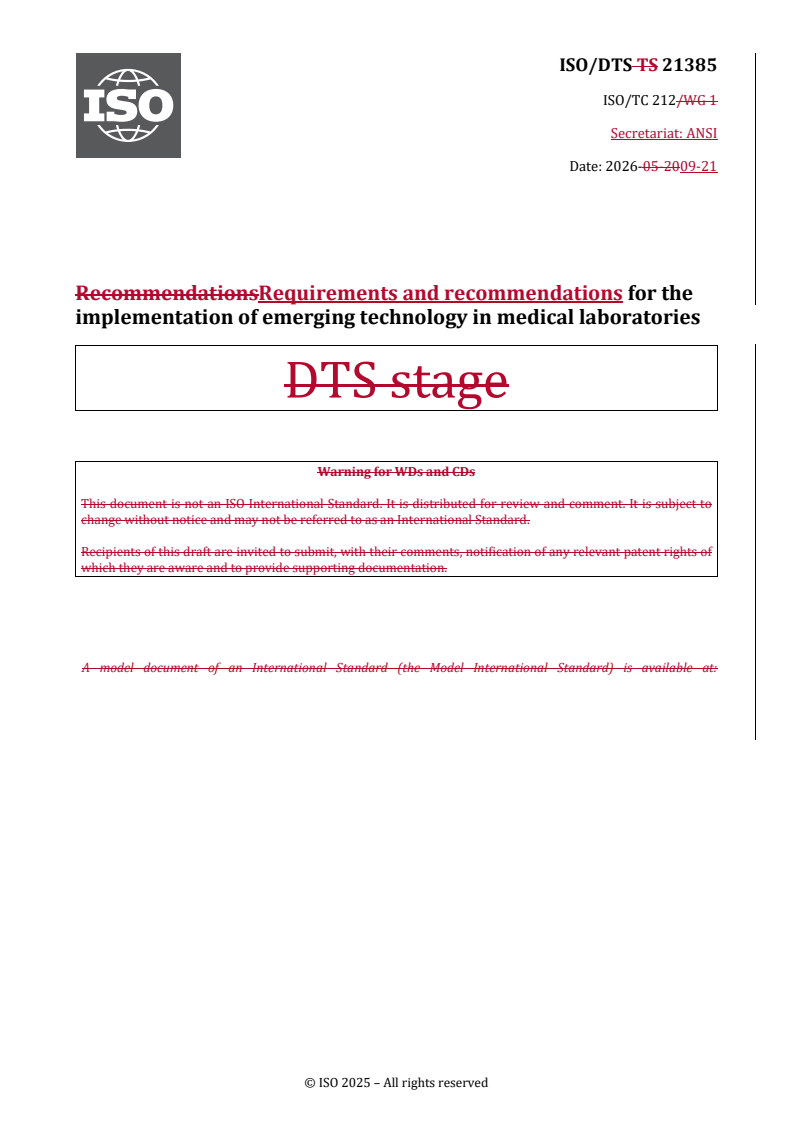

REDLINE ISO/DTS 21385 - Requirements and recommendations for the implementation of emerging technology in medical laboratories
ISO/DTS 21385 is an ISO draft technical specification for medical laboratories. It gives requirements and recommendations for identifying, designing, developing, and preparing emerging technologies for clinical use when they are used with human samples. It is aimed at laboratories that are moving technologies such as NGS, mass spectrometry, sensing, imaging, and AI-based analysis from research into routine medical testing.
What does ISO/DTS 21385 specify?
ISO/DTS 21385 specifies how medical laboratories should introduce emerging technologies (ETs) into clinical testing and what they should document and control along the way. The scope includes laboratories using human samples for screening, diagnosis, monitoring, prediction of treatment response, management, and prevention, while excluding tests that have already been clinically validated and are being used as in-house tests or IVD medical devices.
The document is organized into clauses on scope, references, terms, abbreviations, method characteristics, personnel, environment, equipment, reagents, consumables, IQC and EQA, performance evaluation, IT considerations, validation and verification, risk management, and clinical performance. Annex A is a checklist, and Annexes B-F give technology examples.
| Annex | What it covers |
|---|---|
| Annex A | Checklist for introducing ETs into medical laboratories |
| Annex B | Example of applying NGS in medical laboratories |
| Annex C | Example of applying mass spectrometry in medical laboratories |
| Annex D | Example of applying sensing technology in medical laboratories |
| Annex E | Example of applying imaging in medical laboratories |
| Annex F | Example of applying AI analysis in medical laboratories |
What are the key requirements of ISO/DTS 21385?
ISO/DTS 21385 focuses on keeping ET implementation controlled from the first decision to the final report. In practice, the laboratory has to define the intended use, validate the whole workflow, manage software and data, and show that the technology is fit for clinical reporting.
Define the intended use and document the workflow
Clause 5.1 requires the laboratory to define requirements from implementation through interpretation of results. The laboratory also has to set performance specifications and keep supporting procedures and documents available to staff.
This matters because ETs often combine sample preparation, instrument measurement, and computer analysis. If the intended use is not fixed early, it becomes hard to know what to validate and how to explain the result to clinicians.
Control outsourced steps
Clause 5.2 allows parts of the process, such as robotic pretreatment or software analysis, to be outsourced. The laboratory that receives the sample and issues the final report remains responsible for the whole process and has to control the external provider by audit or acceptable third-party accreditation.
In practice, this means outsourcing does not transfer responsibility. The reporting laboratory still has to know that the external step is reliable and suitable for the method.
Use trained personnel with supervision
Clause 6 requires competent personnel, documented qualification procedures, and training for healthcare professionals. It also requires a supervisor for ET examinations, with knowledge of the technology, quality control, workflow, and risk management.
This matters because ETs are often high-complexity tests. The supervisor is expected to keep the full workflow under control, not only the analytical step.
Control environment, equipment, reagents, and consumables
Clauses 7 to 10 require the laboratory to document partitioning and contamination control, verify the environment, validate equipment that was not already validated by the manufacturer, and manage combinations of equipment used together. Reagents need records, lot control, validation, and storage conditions, while consumables need clear specifications for contamination and adsorption risks.
In practice, these clauses help the laboratory prevent cross-contamination, performance drift, and incorrect results caused by storage or material problems.
Manage IQC, EQA, and analytical performance
Clause 11 requires IQC materials to be homogeneous, stable, and as close as possible to patient samples, and it requires the laboratory to check whether suitable EQA is available. Clause 12 requires evaluation of analytical performance such as LOD, LOQ, trueness, precision, analytical specificity, linearity, MU, units of measurement, metrological traceability, biological reference intervals, clinical decision limits, acceptance criteria, and examination limitations.
This matters because ETs may not fit conventional quality tools. The laboratory has to prove that results can be measured, compared, and interpreted in a clinically meaningful way.
Control IT, validation, risk, and clinical performance
Clause 13 covers LIS, HIS, bioinformatics, software provenance, validation of software, documentation of processing logic, FAIR output, ALCOA or ALCOA+ records, and IT security. Clause 14 requires validation and verification according to ISO 15189. Clause 15 requires risk management across pre-examination, examination, and post-examination phases, including environmental risk, patient risk, and incidental findings. Clause 16 requires clinical performance assessment, ongoing updating of data, and transparent communication of clinical decision limits and reference intervals where applicable.
For the laboratory, this means the ET is not finished when the software works. The laboratory also has to show that the result is clinically useful, maintainable, and safe over time.
What terms does ISO/DTS 21385 define?
- Emerging technology (ET) - Newly recognised, high-complexity technologies, often used as laboratory developed tests, including informatics-based methods and imaging technologies for medical laboratories.
- Laboratory developed test (LDT) - A test or examination designed, developed, manufactured, or modified and used within a single laboratory or laboratory network.
- Clinical performance - The ability of an examination procedure to produce results that correlate with a specific clinical condition or physiological state.
- Measurement uncertainty (MU) - A non-negative parameter that describes the dispersion of values that may be attributed to a measurand.
- Real world data (RWD) - Data routinely collected from patient health status or healthcare delivery.
- Real world evidence (RWE) - Evidence obtained from analysis of RWD.
- Artificial intelligence (AI) - A capability to acquire, process, create, and apply knowledge held in the form of a model to perform tasks.
- Massive parallel sequencing (MPS) - A sequencing technique that determines many independent DNA molecules simultaneously.
Who uses ISO/DTS 21385?
ISO/DTS 21385 is for medical laboratories, laboratory directors, supervisors, quality managers, and technical staff who are introducing new technologies into clinical testing. It is also relevant to buyers and assessors who need to understand what has to be in place before an ET can be used routinely.
The document is especially relevant to laboratories working with NGS, mass spectrometry, sensing technologies, imaging, and AI analysis. It also matters to personnel handling bioinformatics, LIS and HIS integration, quality control, risk management, and clinical reporting.
Which standards are used with ISO/DTS 21385?
ISO/DTS 21385 relies on ISO 15189:2022 for the core quality and competence framework for medical laboratories. It also points to related standards and guidance that support specific parts of ET implementation.
- ISO 5649:2024 - Design, development, implementation, and use of LDTs.
- ISO 14971:2019 - Risk management for medical devices, used here for structured risk control.
- ISO 22367:2020 - Risk management in medical laboratories.
- ISO 17511:2020 - Metrological traceability of values assigned to calibrators, trueness control materials, and human samples.
- ISO/TS 20914:2019 - Practical guidance for estimating MU.
- ISO 20691:2022 - Data formatting and description in the life sciences.
- IEC 62304:2006 - Software life cycle processes for medical device software.
- ISO 24480:2024 - Validation of databases used for nucleotide sequence evaluation.
- ISO/TS 16766:2024 - Considerations for IVD medical devices in a public health emergency.
- ISO/TS 24069 and ISO/TS 25646 - Training and analytical performance specification guidance, respectively.
- ISO 24051 series - Noted for AI-related examination applications.
What does the ISO/DTS 21385 document contain?
ISO/DTS 21385 contains a checklist in Annex A for reviewing ET introduction against the main clauses. It also contains worked examples for NGS, mass spectrometry, sensing technology, imaging, and AI analysis in Annexes B-F.
The body of the document includes a table of highly complex tests and their process steps, such as sample extraction, sequencing, computer analysis, database search, feature extraction, and interpretation. It also includes methods and procedures for validation, verification, lot management, IQC, EQA, IT control, risk analysis, and clinical performance assessment, which are the parts laboratories need when turning an emerging method into a routine clinical service.
Buy Documents
ISO/DTS 21385 - Requirements and recommendations for the implementation of emerging technology in medical laboratories
REDLINE ISO/DTS 21385 - Requirements and recommendations for the implementation of emerging technology in medical laboratories
Get Certified
Connect with accredited certification bodies for this standard

BSI Group
BSI (British Standards Institution) is the business standards company that helps organizations make excellence a habit.

TÜV Rheinland
TÜV Rheinland is a leading international provider of technical services.

TÜV SÜD
TÜV SÜD is a trusted partner of choice for safety, security and sustainability solutions.
Sponsored listings
Frequently Asked Questions
ISO/DTS 21385 is a draft published by the International Organization for Standardization (ISO). Its full title is "Requirements and recommendations for the implementation of emerging technology in medical laboratories". This standard covers: This document provides general requirement and guidance on identification, design and development of emerging technologies with potential use in medical laboratories and their preparation for clinical use. This document is applicable to laboratories transitioning emerging technologies utilizing human samples into medical laboratory examinations for the purpose of providing information for the diagnosis, monitoring, management, prevention, and treatment of disease. This document does not apply to medical laboratory examinations undergoing validation at which point the technology has become an in-house (laboratory developed) test or in-vitro diagnostic medical device.
This document provides general requirement and guidance on identification, design and development of emerging technologies with potential use in medical laboratories and their preparation for clinical use. This document is applicable to laboratories transitioning emerging technologies utilizing human samples into medical laboratory examinations for the purpose of providing information for the diagnosis, monitoring, management, prevention, and treatment of disease. This document does not apply to medical laboratory examinations undergoing validation at which point the technology has become an in-house (laboratory developed) test or in-vitro diagnostic medical device.
ISO/DTS 21385 is classified under the following ICS (International Classification for Standards) categories: 11.100.01 - Laboratory medicine in general. The ICS classification helps identify the subject area and facilitates finding related standards.
ISO/DTS 21385 is available in PDF format for immediate download after purchase. The document can be added to your cart and obtained through the secure checkout process. Digital delivery ensures instant access to the complete standard document.
Standards Content (Sample)
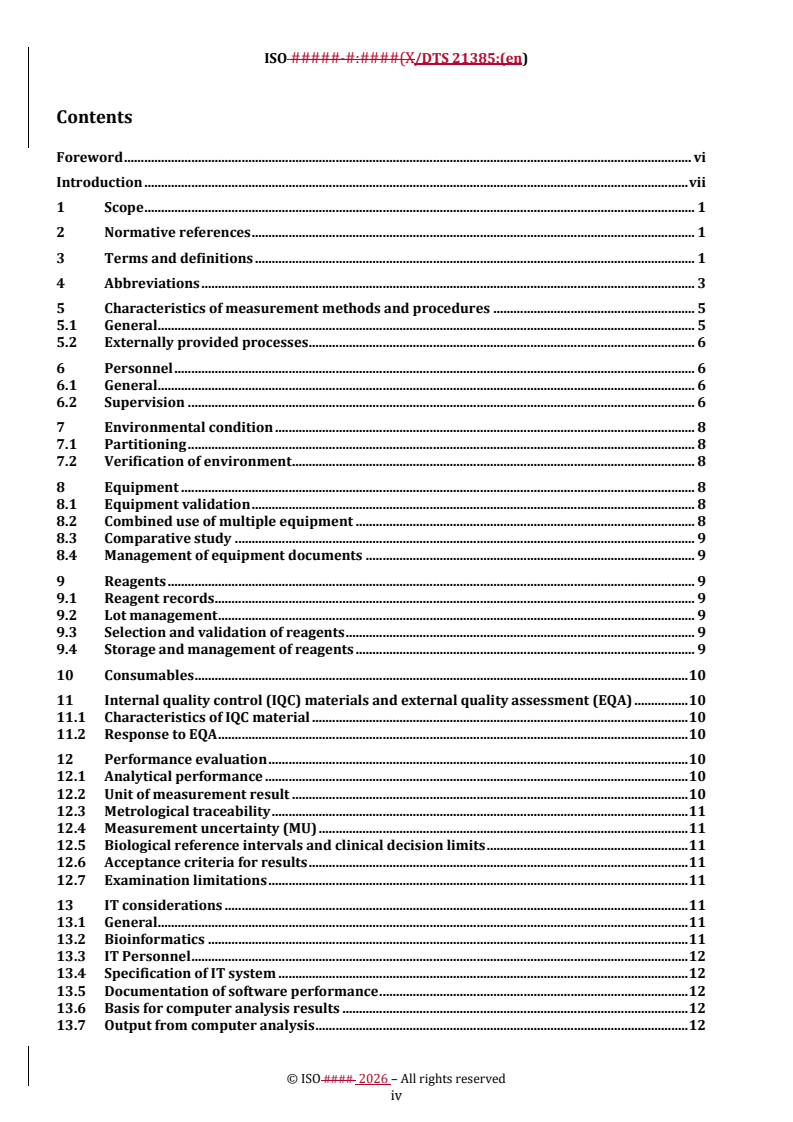
Contents
- Introduction
- 1 Scope
- 2 Normative references
- 3 Terms and definitions
- 3.1 artificial intelligence
- 3.2 computer-aided diagnosis
- 3.3 clinical performance
- 3.4 emerging technology
- 3.5 high complexity test
- 3.6 laboratory developed test
- 3.7 massive parallel sequencing
- 3.8 measurement uncertainty
- 3.9 real world data
- 3.10 real world evidence
- 4 Abbreviations
- 5 Characteristics of measurement methods and procedures
- 5.1 General
- 5.2 Externally provided processes
- 6 Personnel
- 6.1 General
- 6.2 Supervision
- 7 Environmental condition
- 7.1 Partitioning
- 7.2 Verification of environment
- 8 Equipment
- 8.1 Equipment validation
- 8.2 Combined use of multiple equipment
- 8.3 Comparative study
- 8.4 Management of equipment documents
- 9 Reagents
- 9.1 Reagent records
- 9.2 Lot management
- 9.3 Selection and validation of reagents
- 9.4 Storage and management of reagents
- 10 Consumables
- 11 Internal quality control (IQC) materials and external quality assessment (EQA)
- 11.1 Characteristics of IQC material
- 11.2 Response to EQA
- 12 Performance evaluation
- 12.1 Analytical performance
- 12.2 Unit of measurement result
- 12.3 Metrological traceability
- 12.4 Measurement uncertainty (MU)
- 12.5 Biological reference intervals and clinical decision limits
- 12.6 Acceptance criteria for results
- 12.7 Examination limitations
- 13 IT considerations
- 13.1 General
- 13.2 Bioinformatics
- 13.3 IT Personnel
- 13.4 Specification of IT system
- 13.5 Documentation of software performance
- 13.6 Basis for computer analysis results
- 13.7 Output from computer analysis
- 13.8 IT security
- 14 Validation and verification
- 14.1 Validation strategy
- 14.2 Verification method based on validation results
- 15 Risk management
- 15.1 General
- 15.2 Risk management supervision
- 15.3 Environmental risk management
- 15.4 Risk to patient health
- 15.5 Risk of incidental finding
- 16 Clinical performance
- 16.1 General
- 16.2 Updating data or information
- 16.3 Assessment of clinical performance
- Annex A
- 5.2 Are any parts of the examination process outsourced? Are the outsourced pro-
- 7.1 Are the rules and zoning clear regarding the process to prevent cross-contam-
- 8.2 Have validation policies and procedures been established for the use of multiple
- 9.2 Is it possible to purchase and prepare kits for the entire assay process of a highly
- 9.3 Is it possible to control the quality of reagents for the entire high complexity
- 11.1 Can IQC material be prepared that is close to the patient sample, including the
- 12.3 Has traceability been considered? Have alternative methods for conformity with
- 12.5 Limitations of the test should be clarified as much as possible. Are the clarified
- 13.3 Are documents and records maintained for required maintenance and calibra-
- 13.4 Is the rationale for the results of the analysis documented as an indicator of the
- 13.5 Do the outputs of the computer analysis take into account the necessary princi-
Introduction
Measurement methods traditionally used in medical examinations were originally developed for this purpose, and their evolution has been focused on ensuring valid, accurate, and reproducible measurements. In recent decades, there has been a strong demand for new biomarkers for drug discovery and treatment selection across a variety of diseases and patient genetic backgrounds, including variants related to tumour driver and tumour suppressor genes, genetic variants causing inherited disorders, and variants in drug [37] metabolism genes, which influence clinical decisions. The FDA Critical Path Report (2006) pointed out [38] the importance of developing new biomarkers for drug discovery. The development of new biomarkers has accelerated the use of measurement methods based on new principles, such as next-generation sequencing (NGS), since the number of biomarkers that can be measured has been limited using conventional measurement principles. Once a biomarker is identified, it can be applied to “precision medicine”, which aims to realize appropriate medical care based on the patient’s biological background and condition. Therefore, after technological development and marker search at the research level, new methods are rapidly being introduced into medical laboratories.
Emerging technologies (ETs) are those that are well known in research laboratory, have begun to be recognized by industry, and are expected to be, or have begun to be, applied to clinical testing. ETs are developed in research laboratories, their metrological validities are evaluated and then introduced into medical laboratories, while accumulating knowledge about medical applications (Figure 1). Figure 1 — Emerging processes of technologies Modern measurement methods used in basic life science research to discover biomarkers are often not developed with clinical applications in mind. NGS, for example, was used for basic research and did not originally measure specific disease characteristics. Based on the relationship between the genome sequence and the disease that has been accumulated so far, the results of NGS will ultimately be used for diagnosis and selection of therapies by medical doctors. This situation makes it difficult to identify the intended use, namely the disease to be diagnosed, and the requirements for the measurement methods used are often difficult to specify, making the introduction of ETs into medical laboratories challenging. Two key issues that make the introduction of ETs difficult is that many of them are introduced into medical laboratories as laboratory developed tests (LDTs), and another is that many of them are highly complex tests. [34][35] [23] In many cases, they are disseminated as LDTs, in which case manufacturers do not validate them. [27][31][32] . Therefore, medical laboratories define their own intended use and requirements, then conduct validation themselves. Many ETs present difficulties for establishing internal quality control due to the lack
ISO/DTS 21385:2026(en) of availability of corresponding certified reference materials (CRMs). Furthermore, participation in external quality assessment (EQA) is often challenging due to the lack of an established services infrastructure. Therefore, when these technologies are used for routine testing, alternative methods for routine quality control procedures, reference substances to replace CRMs, and inter-laboratory comparison programs need [2] to be designed and implemented (see ISO 5649) .
Table 1 — Examples of highly complex tests Technologies Required process NGS Sample extraction, library construction, sequencing, computer analysis Mass spectrometry (MS) Sample extraction, MS measurement, database search, interpretation of results Sensing technologies Sample extraction, calibration, reaction, measurement Imaging Taking images, feature extraction In addition, ETs often including the process of computer analysis. Unlike traditional tests that obtain a single [33] result based on relatively simple and specialized measurement principles, most tests are highly complex, combining many processes, including the analytical process of computer analysis, in addition to the basic requirements of the examination, namely sample preparation and measurement with equipment (Table 1). The additional computer processes are often needed to provide credible results to the medical doctors, rather than the series of numbers resulting from the measurements. Against this background, more research laboratory-derived validation and quality control data are needed before ETs are introduced into medical laboratories and used for routine testing. Therefore, there is concern that variation in such selection and decision can occur between laboratories. The intention of this document is to provide a set of considerations and examples for medical laboratories when implementing ETs as guidance, to reduce such variability.
While it is not appropriate for a standard document to predict future individual ETs, it is useful to provide responses to technologies identified as emerging, as a reference for future introduction of ETs. In this document, the examples of NGS, mass spectrometry (MS), sensing technology, and AI analysis are also shown as reference information for early responses when ETs are introduced to medical laboratories. The purpose of this document is to assist with the transition from research to clinical applications in medical laboratories to provide a framework for medical laboratories to aid in the selection and evaluation of ETs so that many patients can safely receive diagnoses and treatment options based on data from state-of-the-art methods that are validated. This document will also be helpful in the use of ETs in developing countries, including in response to pandemics.
FINAL DRAFT Technical Specification ISO/DTS 21385:2026(en) Requirements and recommendations for the implementation of emerging technology in medical laboratories
1 Scope
This document provides requirements and recommendations on identification, design and development of emerging technologies (ETs) with potential use in medical laboratories and their preparation for clinical use.
This document is applicable to laboratories transitioning ETs utilizing human samples into medical laboratory examinations for the purpose of providing information for the screening, diagnosis, monitoring, prediction of treatment response, management, and prevention.
This document does not apply to a test that is clinically validated and is generally used as an in-house (laboratory developed) test or in-vitro diagnostic (IVD) medical device.
2 Normative references
The following documents are referred to in the text in such a way that some or all of their content constitutes requirements of this document. For dated references, only the edition cited applies. For undated references, the latest edition of the referenced document (including any amendments) applies. ISO 15189:2022, Medical laboratories — Requirements for quality and competence
3 Terms and definitions
For the purposes of this document, the following terms and definitions apply. ISO and IEC maintain terminology databases for use in standardization at the following addresses:
- ISO Online browsing platform: available at https:// www .iso .org/ obp
- IEC Electropedia: available at https:// www .electropedia .org/
3.1 artificial intelligence
AI capability to acquire, process, create and apply knowledge, held in the form of a model, to conduct one or more given tasks [SOURCE: ISO/TR 5255-2:2023, 3.1]
3.2 computer-aided diagnosis
CAD software or systems that provide reference information for physicians in clinical settings when performing diagnostic imaging using various imaging devices Note 1 to entry: The system has a function of CADe or CADx.
Note 2 to entry: The system helps the users including first reader, second reader, and concurrent reader.
ISO/DTS 21385:2026(en)
3.3 clinical performance
ability of an in vitro diagnostic examination procedure to yield results that are correlated with a specific clinical condition or physiological state in accordance with the target population and intended user [SOURCE: ISO 17822:2020, 3.9, modified — Notes to entry have been deleted.]
3.4 emerging technology
ET newly recognised technologies that are high complexity tests and in many cases are laboratory developed tests, including informatics-based methods or imaging technologies for use in medical laboratories Note 1 to entry: The technology includes next-generation sequencing (NGS), mass spectrometry (MS), sensing pointof-care testing (POCT), artificial intelligence (AI) (3.1) and imaging.
3.5 high complexity test
test assessed as complex in consideration of required knowledge, training and experience, characteristics of reagents, materials preparation and operational steps, intricacy in calibration, quality control and proficiency testing materials, strenuous test system troubleshooting and equipment maintenance, required interpretation and judgment Note 1 to entry: Adapted from Reference [35].
3.6 laboratory developed test
LDT laboratory-developed examination in-house IVD laboratory-designed method laboratory-developed method test or examination which is designed, developed, manufactured (or modified) and used within a single laboratory or laboratory network to carry out testing on samples, where the results are intended to assist in clinical diagnosis or be used in making decisions concerning clinical management [SOURCE: ISO 5649:2024, 3.25, modified — Note to entry has been removed]
3.7 massive parallel sequencing
MPS sequencing technique based on the determination of incremental template-based polymerization of many independent DNA molecules simultaneously Note 1 to entry: Massively parallel sequencing technology can provide millions or billions of short reads per run. [SOURCE: ISO 20397-2:2021, 3.30]
3.8 measurement uncertainty
MU non-negative parameter characterizing the dispersion of the quantity values being attributed to a measurand, based on the information used Note 1 to entry: MU includes components arising from systematic effects, as in the case of corrections to the assigned quantity values of measurement standards. Sometimes estimated systematic effects are not corrected for, but instead, the associated MU components are incorporated.
Note 2 to entry: The parameter may be, for example, a standard deviation (SD) called standard MU (or a specified multiple of it), or the half-width of an interval, having a stated coverage probability.
ISO/DTS 21385:2026(en) Note 3 to entry: MU comprises, in general, many components. Some of these may be evaluated by Type A evaluation of MU from the statistical distribution of the quantity values from series of measurements and can be characterized by SD. The other components, which may be evaluated by Type B evaluation of MU, can also be characterized by SD or evaluated from probability density functions based on experience or other information. Note 4 to entry: In general, for a given set of information, it is understood that the MU is associated with a stated quantity value attributed to the measurand. A modification of this value may result in a modification of the associated uncertainty.
Note 5 to entry: All measurements have bias and imprecision. For example, replicate measurements of a sample performed under repeatability conditions generally produce different values for the same measurand. Because the different values could all be reasonably attributed to the same amount of measurand, there is uncertainty as to which value should be reported as the value of the measurand.
Note 6 to entry: Based on available data about the analytical performance of a given measurement procedure, an estimation of MU provides an interval of values that is believed to include the actual value of the measurand, with a stated level of confidence.
Note 7 to entry: Available data about the analytical performance of a given measurement procedure typically comprise uncertainty of calibrator assigned values and long-term imprecision of internal quality control (IQC) materials. Note 8 to entry: In medical laboratories, most measurements are performed in singleton, and are taken to be an acceptable estimate of the value of the measurand, while the MU interval indicates other results that are also possible. [SOURCE: ISO 15189:2022, 3.19]
3.9 real world data
RWD data relating to the patient -s health status and/or the provision of health care routinely collected from a variety of sources
3.10 real world evidence
RWE evidence from real world data (RWD) (3.9) analysis
4 Abbreviations
ACMG The American College of Medical Genetics and Genomics ALCOA attributable, legible, contemporaneous, original, accurate CRM certified reference material CT computed tomography DQ design qualification EQA external quality assessment FAIR findable, accessible, interoperable, reusable HIS hospital information system IQ installation qualification IQC internal quality control IT information technology IVD in vitro diagnostics
ISO/DTS 21385:2026(en) LIS laboratory information system LOD limit of detection LOQ limit of quantification MRI magnetic resonance imaging MS mass spectrometry NGS next generation sequencing OQ operational qualification OTS off-the-shelf PET positron emission tomography POCT point-of-care testing PQ performance qualification RM reference material SI international system of units VIM international vocabulary of metrology
5 Characteristics of measurement methods and procedures
5.1 General
Most ETs are very complex tests. Therefore, the requirements ranging from implementation, purpose, standards, applicable governance, measurements, and interpretation of results shall be defined and documented.
Medical laboratories shall determine the intended use and performance specifications for the technology to be implemented.
The medical laboratory shall provide information to the extent possible, about the use of ET methodologies to obtain test results and the reliability of their interpretation. References to clinical research data are helpful in defining the intended use. Examples of clinical research data to be used include RWD and RWE, see Clause 16.
In this document, requirements and recommendations for the introduction of ETs into clinical laboratories are given. Annex A contains a checklist that is useful for verifying conformity with each clause. Annex B provides examples of technologies that have hitherto been treated as ETs, including the performance characteristics and points to be considered that have clarified during the implementation of each technology. Annex B shows an example of applying NGS in medical laboratories, Annex C shows an example of mass spectrometry, Annex D shows an example of sensing technology, Annex E shows an example of imaging, and Annex F shows an example of AI analysis. The information provided in these examples is expected to be useful when introducing future ETs.
Requirements related to the LDT aspect of ET technology are described in detail in the LDT document [2] (ISO 5649) . For selecting examination methods, even if ET, procedures and supporting documentation shall be managed, and readily available for staff, in accordance with ISO 15189.
ISO/DTS 21385:2026(en)
5.2 Externally provided processes
In some cases, one laboratory is not able to perform the entire examination processes because of the complexity of ET examination procedures. Therefore, a part of the measurement processes, such as robotic pretreatment process, software analysis process or both, can be outsourced to outside laboratories. The sample reception and issuing the final report shall be performed by the laboratory assuming responsibility for the entire process. The responsible laboratory shall ensure the quality of service provided by the external providers either by conducting an audit of the external provider or relying on accreditation of the external provider by an acceptable third party. External providers performing software analysis or robotics are not necessarily a medical laboratory. In such cases, the primary laboratory shall be responsible for ensuring the quality of the entire testing process.
NOTE Responsibility measures include bilateral audits based on International Standards including ISO 15189, [6] [3] ISO/IEC 17025, and ISO 9001 .
6 Personnel
6.1 General
In ET, the entire process of validation, especially the validation plan, requires a high level of expertise in ET in addition to knowledge of medical laboratories in general. Laboratories shall have access to personnel with such expertise.
ET examinations shall be performed by trained and competent personnel. A procedure for the qualifications of personnel shall be documented. Healthcare professionals shall be trained on the technologies involved in ET.
1) Personnel training is detailed in ISO/TS 24069 .
6.2 Supervision
6.2.1 General
For introducing and operating of ETs, the personnel, at least, responsible for their implementation shall understand the technology to be introduced. They should also have specialist knowledge in the relevant technical fields. In the early stages of a novel technology, such understanding and expertise are rarely possessed by the majority persons. It is often limited to a small number of specialists, but these specialists alone cannot operate the ETs. Consequently, supervision by appropriately competent personnel is crucial for the implementation of ET in medical laboratories.
The medical laboratory shall assign a supervisor for performing ET-based examinations. The supervisor shall be internal personnel or external personnel formally contracted by the laboratory. When a supervisor is assigned to external personnel, the formal contract shall include confidentiality provisions, taking into account the confidential information to be handled in the ET. As an integral part of the healthcare team, the main role of the supervisor is to contribute to the delivery of quality patient care with the expertise and leadership skills. In some cases, specialised education and training are required. The supervisor is expected to oversee the functioning of the laboratory. The overall function should cover all stages of the ET laboratory lifecycle, including supervision of laboratory personnel, quality assurance, oversight of the collection, the measurement and the eventual use of laboratory data, as well as risk management.
1) Under preparation. Stage at the time of balloting: ISO/AWI TS 24069:2026.
ISO/DTS 21385:2026(en)
6.2.2 Training and competences
The supervisor shall be trained in terms of knowledge of the procedure, management of group planning, and conducting ET examination. When the supervisor is not a medical director, the supervisor shall collaborate with the medical director.
The supervisor should have the following:
- educational background as well as experience in ET or other high-complexity testing;
- knowledge of ET methodology, equipment and quality control procedures;
- in-depth understanding of ET-implemented laboratory operations and workflow optimisation;
- strong leadership and management skills to effectively supervise and motivate laboratory staff;
- in-depth knowledge of laboratory regulations, standards and safety protocols;
- measurement and problem-solving skills for troubleshooting and quality control;
- commitment to continuous learning and professional development in maintaining knowledge of fast advancing ET.
...
Contents
- Introduction
- 1 Scope
- 2 Normative references
- 3 Terms and definitions
- 3.1 artificial intelligence
- 4 Abbreviations
- 5 Characteristics of measurement methods and procedures
- 5.1 General
- 5.2 Externally provided processes
- 6 Personnel
- 6.1 General
- 6.2 Supervision
- 7 Environmental condition
- 7.1 Partitioning
- 7.2 Verification of environment
- 8 Equipment
- 8.1 Equipment validation
- 8.2 Combined use of multiple equipment
- 8.3 Comparative study
- 8.4 Management of equipment documents
- 9 Reagent
- 9 Reagents
- 9.1 Reagent records
- 9.2 Lot management
- 9.3 Selection and validation of reagents
- 9.4 Storage and management of reagents
- 10 Consumables
- 11 Internal quality control (IQC material) materials and external quality assessment
- 11.1 Characteristics of IQC material
- 11.2 Response to EQA
- 12 Performance evaluation
- 12.1 Analytical performance
- 12.2 Unit of measurement result
- 12.3 Metrological Traceabilitytraceability
- 12.4 Measurement Uncertaintyuncertainty (MU)
- 12.5 Biological reference intervals and clinical decision limits
- 12.6 Acceptance criteria for results
- 12.7 Examination limitations
- 13 IT considerations
- 13.1 General
- 13.2 Bioinformatics
- 13.3 IT Personnel
- 13.4 Specification of IT system
- 13.5 Documentation of software performance
- 13.6 Basis for computer analysis results
- 13.7 Output from computer analysis
- 13.8 IT security
- 14 Validation and verification
- 14.1 Validation strategy
- 14.2 Verification method based on validation results
- 15 Risk management
- 15.1 General
- 15.2 Risk management supervision
- 15.3 Environmental risk management
- 15.4 Risk to patient health
- 15.5 Risk of incidental finding
- 16 Clinical performance
- 16.1 General
- 16.2 Updating data or information
- 16.3 Assessment of clinical performance
- Annex A
- Annex B
- Annex C
- Annex D
- Annex E
- Annex F
- Bibliography
Introduction
Measurement methods traditionally used in medical examinations were originally developed for this purpose, and their evolution has been focused on ensuring valid, accurate, and reproducible measurements. In recent decades, there has been a strong demand for new biomarkers for drug discovery and treatment selection across a variety of diseases and patient genetic backgrounds, including variants related to tumour driver and tumour suppressor genes, genetic variants causing inherited disorders, and variants in drug metabolism [37] [37] genes, which influence clinical decisions. . The FDA Critical Path Report (2006) pointed out the [38] [38] importance of developing new biomarkers for drug discovery. . The development of new biomarkers has accelerated the use of measurement methods based on new principles, such as next-generation sequencing (NGS), since the number of biomarkers that can be measured has been limited using conventional measurement principles. Once a biomarker is identified, it can be applied to "“precision medicine,"”, which aims to realize appropriate medical care based on the patient'spatient’s biological background and condition. Therefore, after technological development and marker search at the research level, new methods are rapidly being introduced into medical laboratories.
Emerging technologies (ETs) are those that are well known in research laboratory, have begun to be recognized by industry, and are expected to be, or have begun to be, applied to clinical testing. ETs are developed in research laboratories, their metrological validities are evaluated and then introduced into medical laboratories, while accumulating knowledge about medical applications (Figure 1(Fig. 1).).
ISO #####-#:####(X/DTS 21385:(en)
Figure 1 — Emerging processes of technologies Modern measurement methods used in basic life science research to discover biomarkers are often not developed with clinical applications in mind. NGS, for example, was used for basic research and did not originally measure specific disease characteristics. Based on the relationship between the genome sequence and the disease that has been accumulated so far, the results of NGS will ultimately be used for diagnosis and selection of therapies by medical doctors. This situation makes it difficult to identify the intended use, namely the disease to be diagnosed, and the requirements for the measurement methods used are often difficult to specify, making the introduction of ETs into medical laboratories challenging. Two key issues that make the introduction of ETs difficult is that many of them are introduced into medical laboratories as laboratory developed tests (LDTs), and another is that many of them are highly complex [34]-[35] [34] [35] tests. . In many cases, they are disseminated as LDTs, in which case manufacturers do not validate [23] [27] [31] [32] [23],[27],[31]-[32] them. . . Therefore, medical laboratories define their own intended use and requirements, then conduct validation themselves. Many ETs present difficulties for establishing internal quality control due to the lack of availability of corresponding certified reference materials (CRMs). Furthermore, participation in external quality assessment (EQA) is often challenging due to the lack of an established services infrastructure. Therefore, when these technologies are used for routine testing, alternative methods for routine quality control procedures, reference substances to replace CRMs, and inter- [2] [2] laboratory comparison programs need to be designed and implemented (see ISO 5649) ). . Table 1 — Examples of Highlyhighly complex tests Technologies Required process NGS Sample extraction, Librarylibrary construction, Sequencing, Computersequencing, computer analysis Mass spectrometry (MS) Sample extraction, MS measurement, Databasedatabase search, Interpretationinterpretation of results Sensing technologies Sample extraction, calibration, reaction, measurement Imaging Taking images, feature extraction
ISO TS PWI/DTS 21385 (E:(en) In addition, ETs often including the process of computer analysis. Unlike traditional tests that obtain a single [33] [33] result based on relatively simple and specialized measurement principles, , most tests are highly complex, combining many processes, including the analytical process of computer analysis, in addition to the basic requirements of the examination, namely sample preparation and measurement with equipment (Table 1(Table 1).). The additional computer processes are often needed to provide credible results to the medical doctors, rather than the series of numbers resulting from the measurements. Against this background, more research laboratory-derived validation and quality control data are needed before ETs are introduced into medical laboratories and used for routine testing. Therefore, there is concern that variation in such selection and decision can occur between laboratories. The intention of this document is to provide a set of considerations and examples for medical laboratories when implementing ETs as guidance, to reduce such variability.
While it is not appropriate for a standardsstandard document to predict future individual ETs, it is useful to provide responses to technologies identified as emerging, as a reference for future introduction of ETs. In this document, the examples of NGS, mass spectrometry (MS), sensing technology, and AI analysis are also shown as reference information for early responses when ETs are introduced to medical laboratories. The purpose of this document is to assist with the transition from research to clinical applications in medical laboratories to provide a framework for medical laboratories to aid in the selection and evaluation of ETs so that many patients can safely receive diagnoses and treatment options based on data from state-of-the-art methods that are validated. This document will also be helpful in the use of ETs in developing countries, including in response to pandemics.
ISO/DTS 21385:(en) RecommendationsRequirements and recommendations for the implementation of emerging technology in medical laboratories
1 Scope
This document provides requirements and recommendations on identification, design and development of emerging technologies (ETs) with potential use in medical laboratories and their preparation for clinical use. This document is applicable to laboratories transitioning ETs utilizing human samples into medical laboratory examinations for the purpose of providing information for the screening, diagnosis, monitoring, prediction of treatment response, management, and prevention.
This document does not apply to a test that is clinically validated and is generally used as an in-house (laboratory developed) test or in-vitro diagnostic (IVD) medical device.
2 Normative references
The following documents are referred to in the text in such a way that some or all of their content constitutes requirements of this document. For dated references, only the edition cited applies. For undated references, the latest edition of the referenced document (including any amendments) applies. ISO 15189:2022, Medical laboratories — Requirements for quality and competence
3 Terms and definitions
For the purposes of this document, the following terms and definitions apply. ISO and IEC maintain terminology databases for use in standardization at the following addresses:
- ISO Online browsing platform: available at https://www.iso.org/obp3.1
- IEC Electropedia: available at https://www.electropedia.org/
3.1 artificial intelligence
AI capability to acquire, process, create and apply knowledge, held in the form of a model, to conduct one or more given tasks [SOURCE: ISO/TR 5255-2:2023, 3.1] 3.2 3.2 computer-aided diagnosis CAD software or systems that provide reference information for physicians in clinical settings when performing diagnostic imaging using various imaging devices Note 1 to entry: The system has a function of CADe or CADx.
Note 2 to entry: The system helps the users including first reader, second reader, and concurrent reader.
ISO/DTS 21385:(en) 3.3 3.3 clinical performance ability of an in vitro diagnostic examination procedure to yield results that are correlated with a specific clinical condition or physiological state in accordance with the target population and intended user [SOURCE: ISO 17822:2020, 3.9, modified — Notes to entry have been deleted.] 3.4 3.4 emerging technology ET newly recognised technologies that are high complexity tests and in many cases are laboratory developed tests, including informatics-based methods or imaging technologies for use in medical laboratories Note 1 to entry: The technology includes next-generation sequencing (NGS, Mass), mass spectrometry, Sensing (MS), sensing point-of-care testing (POCT), artificial intelligence (AI) (3.1) and imaging. 3.5 3.5 high complexity test test assessed as complex in consideration of required knowledge, training and experience, characteristics of reagents, materials preparation and operational steps, intricacy in calibration, quality control, and proficiency testing materials, strenuous test system troubleshooting and equipment maintenance, required interpretation and judgment [35][35] Note 1 to entry: Adapted from Reference ..
3.6 3.6 laboratory developed test LDT laboratory-developed examination in-house IVD laboratory-designed method laboratory-developed method test or examination which is designed, developed, manufactured (or modified) and used within a single laboratory or laboratory network to carry out testing on samples, where the results are intended to assist in clinical diagnosis or be used in making decisions concerning clinical management Note 1 to entry: LDT is also called as “laboratory-developed examination”, “in-house IVD”, “laboratory designed or developed method”.
[SOURCE: ISO 5649:2024, 3.25, modified — Note to entry has been removed] 3.7 3.7 massive parallel sequencing MPS sequencing technique based on the determination of incremental template-based polymerization of many independent DNA molecules simultaneously Note 1 to entry: Massively parallel sequencing technology can provide millions or billions of short reads per run. [SOURCE: ISO 20397-2:2021, 3.30] 3.8 3.8 measurement uncertainty MU non-negative parameter characterizing the dispersion of the quantity values being attributed to a measurand, based on the information used
ISO/DTS 21385:(en) Note 1 to entry: MU includes components arising from systematic effects, as in the case of corrections to the assigned quantity values of measurement standards. Sometimes estimated systematic effects are not corrected for, but instead, the associated MU components are incorporated.
Note 2 to entry: The parameter may be, for example, a standard deviation (SD) called standard MU (or a specified multiple of it), or the half-width of an interval, having a stated coverage probability. Note 3 to entry: MU comprises, in general, of many components. Some of these may be evaluated by Type A evaluation of MU from the statistical distribution of the quantity values from series of measurements and can be characterized by SD. The other components, which may be evaluated by Type B evaluation of MU, can also be characterized by SD or evaluated from probability density functions based on experience or other information. Note 4 to entry: In general, for a given set of information, it is understood that the MU is associated with a stated quantity value attributed to the measurand. A modification of this value may result in a modification of the associated uncertainty. Note 5 to entry: All measurements have bias and imprecision. For example, replicate measurements of a sample performed under repeatability conditions generally produce different values for the same measurand. Because the different values could all be reasonably attributed to the same amount of measurand, there is uncertainty as to which value should be reported as the value of the measurand.
Note 6 to entry: Based on available data about the analytical performance of a given measurement procedure, an estimation of MU provides an interval of values that is believed to include the actual value of the measurand, with a stated level of confidence.
Note 7 to entry: Available data about the analytical performance of a given measurement procedure typically comprise uncertainty of calibrator assigned values and long-term imprecision of internal quality control (IQC) materials. Note 8 to entry: In medical laboratories, most measurements are performed in singleton, and are taken to be an acceptable estimate of the value of the measurand, while the MU interval indicates other results that are also possible. [SOURCE: ISO 15189:2022, 3.19] 3.9 3.9 real world data RWD data relating to the patient'spatient--s health status and/or the provision of health care routinely collected from a variety of sources 3.10 3.10 real world evidence RWE evidence from real world data (RWD) (3.9 (3.9)) analysis
4 Abbreviations
ACMG The American College of Medical Genetics and Genomics ALCOA Attributable, legible, contemporaneous, original, accurate CRM Certified reference material CT Computed tomography DQ Design qualification EQA External quality assessment
ISO/DTS 21385:(en) FAIR Findable, accessible, interoperable, reusable HIS Hospital information system IQ Installation qualification IQC Internal quality control IT Information technology IVD In vitro diagnostics LIS Laboratory information system LOD Limit of detection LOQ Limit of quantification MRI Magnetic resonance imaging MS Mass Spectrometry NGS Next generation sequencing OQ Operational qualification OTS Off-the-shelf PET Positron emission tomography POCT Point-of-care testing PQ Performance qualification RM Reference material SI SI international system of units VIM International vocabulary of metrology ACMG The American College of Medical Genetics and Genomics ALCOA attributable, legible, contemporaneous, original, accurate CRM certified reference material CT computed tomography DQ design qualification EQA external quality assessment FAIR findable, accessible, interoperable, reusable HIS hospital information system IQ installation qualification IQC internal quality control IT information technology
ISO/DTS 21385:(en) IVD in vitro diagnostics LIS laboratory information system LOD limit of detection LOQ limit of quantification MRI magnetic resonance imaging MS mass spectrometry NGS next generation sequencing OQ operational qualification OTS off-the-shelf PET positron emission tomography POCT point-of-care testing PQ performance qualification RM reference material SI international system of units VIM international vocabulary of metrology
5 Characteristics of measurement methods and procedures
5.1 General
Most ETs are very complex tests. Therefore, the requirements ranging from implementation, purpose, standards, applicable governance, measurements, and interpretation of results shall be defined and documented.
Medical laboratories shall determine the intended use and performance specifications for the technology to be implemented.
The medical laboratory shall provide information to the extent possible, about the use of ET methodologies to obtain test results and the reliability of their interpretation. References to clinical research data are helpful in defining the intended use. Examples of clinical research data to be used include RWD and RWE, see Clause 16clause 16..
In this document, requirements and recommendations for the introduction of ETs into clinical laboratories are described. Annex Agiven. Annex A contains a checklist that is useful for verifying complianceconformity with each chapter. Annex B onwardsclause. Annex B provides examples of technologies that have hitherto been treated as ETs, including the performance characteristics and points to be considered that have clarified during the implementation of each technology. Annex BAnnex B shows an example of applying NGS in medical laboratories, Annex CAnnex C shows an example of mass spectrometry, Annex DAnnex D shows an example of sensing technology, Annex EAnnex E shows an example of imaging, and Annex FAnnex F shows an example of AI analysis similarly. The information provided in these examples is expected to be useful when introducing future ETs.
Requirements related to the LDT aspect of ET technology are described in detail in the LDT document (ISO [2] [2] 5649) ). . For selecting examination methods, even if ET, procedures and supporting documentation shall be managed, and readily available for staff, in accordance with ISO 15189.
ISO/DTS 21385:(en)
5.2 Externally provided processes
In some cases, one laboratory is not able to perform the entire examination processes because of the complexity of ET examination procedures. Therefore, a part of the measurement processes, such as robotic pretreatment process, software analysis process or both, can be outsourced to outside laboratories. The sample reception and issuing the final report shall be performed by the laboratory assuming responsibility for the entire process. The responsible laboratory shall ensure the quality of service provided by the external providers either by conducting an audit of the external provider or relying on accreditation of the external provider by an acceptable third party. External providers performing software analysis or robotics are not necessarily a medical laboratory. In such cases, the primary laboratory shall be responsible for ensuring the quality of the entire testing process.
NOTE Responsibility measures include bilateral audits based on International Standards including ISO 15189, [6] [6] [3][3] ISO/IEC 17025 ,, and ISO 9001 ..
6 Personnel
6.1 General
In ET, the entire process of validation, especially the validation plan, requires a high level of expertise in ET in addition to knowledge of medical laboratories in general. Laboratories shall have access to personnel with such expertise.
ET examinations shall be performed by trained and competent personnel. A procedure for the qualifications of personnel shall be documented. Healthcare professionals shall be trained on the technologies involved in ET.
1) 1) Personnel training is detailed in ISO/AWI TS 24069 . TS 24069 .
1) Under preparation. Stage at the time of publication: ISO/AWI TS 24069:2026.
6.2 Supervision
6.2.1 General
For introducing and operating of ETs, the personnel, at least, responsible for their implementation shall understand the technology to be introduced. They should also have specialist knowledge in the relevant technical fields. In the early stages of a novel technology, such understanding and expertise are rarely possessed by the majority persons. It is often limited to a small number of specialists, but these specialists alone cannot operate the ETs. Consequently, supervision by appropriately competent personnel is crucial for the implementation of ET in medical laboratories.
The medical laboratory shall assign a supervisor for performing ET-based examinations. The supervisor shall be internal personnel or external personnel formally contracted by the laboratory. When a supervisor is assigned to external personnel, the formal contract shall include confidentiality provisions, taking into account the confidential information to be handled in the ET. As an integral part of the healthcare team, the main role of the supervisor is to contribute to the delivery of quality patient care with the expertise and leadership skills. In some cases, specialised education and training are required. The supervisor is expected to oversee the functioning of the laboratory. The overall function should cover all stages of the ET laboratory lifecycle, including supervision of laboratory personnel, quality assurance,
...