


ISO 24443:2021/Amd 1
(Amendment)Cosmetics — Determination of sunscreen UVA photoprotection in vitro — Amendment 1
Cosmetics — Determination of sunscreen UVA photoprotection in vitro — Amendment 1
Cosmétiques — Détermination in vitro de la photoprotection des produits de protection solaire aux UVA — Amendement 1
General Information
- Status
- Not Published
- Technical Committee
- ISO/TC 217 - Cosmetics
- Drafting Committee
- ISO/TC 217/WG 7 - Sun protection test methods
- Current Stage
- 6000 - International Standard under publication
- Start Date
- 16-Jan-2026
- Completion Date
- 17-Jan-2026
Relations
- Effective Date
- 07-Jan-2025
Overview
ISO 24443:2021/FDAmd 1 is the latest 2025 amendment to the international standard for determining sunscreen UVA photoprotection in vitro. Developed by ISO Technical Committee ISO/TC 217 with collaboration from CEN/TC 392, this amendment updates procedures to ensure consistency, accuracy, and repeatability in measuring the UVA protection efficacy of cosmetic sunscreen products. The document introduces refined requirements for sample preparation, product application, robot-assisted spreading, and environmental conditions, significantly enhancing laboratory testing protocols.
This standard provides precise guidelines for the in vitro evaluation of UVA photoprotection performance, crucial for sunscreen manufacturers, cosmetic regulators, research laboratories, and quality assurance professionals aiming for reliable SPF and UVA protection assessments.
Key Topics
Sample Handling and Preparation
Sunscreen products must be stored in the dark between 27 (±2) °C and 32 (±2) °C for at least 12 hours prior to testing. Sandblasted PMMA plates used as substrates should be carefully cleaned with a dry, antistatic microfiber cloth and handled by edges to avoid contamination.Application and Spreading Methodology
The amendment specifies precise application dosages: 1.3 mg/cm² for moulded plates and 1.2 mg/cm² for sandblasted plates, ensuring homogeneity and repeatability. Application should be performed quickly and evenly, using at least 12 small droplets dispersed over the plate surface.Manual vs Automated Spreading
Manual spreading utilizes human fingertips without finger cots, involving two-phase strokes-initial circular motions followed by alternating horizontal and vertical strokes with increasing pressure. For automated spreading, a robot equipped with a silicon finger tool applies the sunscreen consistently, adhering to defined pressure, speed, and movement cycles to replicate manual spreading precision.Robotic Spreading Specifications
Detailed requirements for the robotic system include:- Positional repeatability of ±0.1 mm on all axes
- Minimum 6 degrees of freedom
- Payload capacity of at least 0.5 kg
- Vertical force of (6.0 ± 0.5) N applied during spreading
The robot’s finger tool must be checked and replaced regularly, ensuring operational integrity over time.
Drying and Environmental Conditions
Post-application, samples must dry for 30 to 60 minutes in controlled dark conditions matching UV exposure temperature settings, critical for consistent photoprotective testing.Technical Parameters for Test Plates
Surface roughness and texture specifications for sandblasted PMMA plates have been updated to ensure uniformity and reliable UV measurement.
Applications
ISO 24443:2021/FDAmd 1 is essential for:
- Sunscreen Product Development: Ensures accurate in vitro UVA protection measurement for formulation optimization and regulatory compliance.
- Quality Control Laboratories: Standardizes test methods to verify batch-to-batch consistency of sunscreen products.
- Regulatory Bodies: Provides a harmonized testing framework to assess sunscreens’ UVA efficacy claims supporting product labeling and consumer safety.
- Research and Innovation: Facilitates advanced testing methodologies, including robot-assisted spreading, to improve reliability and reduce operator variability.
This amendment enhances the comparability of test results globally, supporting safer, more effective cosmetic sunscreen products trusted by consumers.
Related Standards
- ISO 24443:2021 – Base standard for in vitro determination of sunscreen UVA photoprotection, detailing general test methods and measurement principles.
- ISO 24442 – Standard for determination of sunscreen UVA photoprotection in vivo (human testing).
- CEN EN 17037 – Standard related to daylight provision and UV protection in built environments, complementary for UV safety standards.
- ISO/IEC Directives, Part 1 & 2 – Governing rules for developing international standards and editorial requirements.
These standards collectively build the framework for robust, evidence-based evaluation of sunscreen efficacy and photoprotection standards worldwide.
For comprehensive sunscreen UVA photoprotection testing protocols, ISO 24443:2021/FDAmd 1 amendment embodies the latest best practices in sample preparation, robotic application, and evaluation criteria-bolstering the scientific integrity and practical reproducibility of in vitro cosmetic testing.

ISO 24443:2021/FDAmd 1 - Cosmetics — Determination of sunscreen UVA photoprotection in vitro — Amendment 1 Released:6. 11. 2025

REDLINE ISO 24443:2021/FDAmd 1 - Cosmetics — Determination of sunscreen UVA photoprotection in vitro — Amendment 1 Released:6. 11. 2025

ISO 24443:2021/FDAmd 1 - Cosmétiques — Détermination in vitro de la photoprotection des produits de protection solaire aux UVA — Amendement 1 Released:15. 12. 2025
Frequently Asked Questions
ISO 24443:2021/Amd 1 is a draft published by the International Organization for Standardization (ISO). Its full title is "Cosmetics — Determination of sunscreen UVA photoprotection in vitro — Amendment 1". This standard covers: Cosmetics — Determination of sunscreen UVA photoprotection in vitro — Amendment 1
Cosmetics — Determination of sunscreen UVA photoprotection in vitro — Amendment 1
ISO 24443:2021/Amd 1 is classified under the following ICS (International Classification for Standards) categories: 11.100.10 - In vitro diagnostic test systems; 71.100.70 - Cosmetics. Toiletries. The ICS classification helps identify the subject area and facilitates finding related standards.
ISO 24443:2021/Amd 1 has the following relationships with other standards: It is inter standard links to ISO 24443:2021. Understanding these relationships helps ensure you are using the most current and applicable version of the standard.
ISO 24443:2021/Amd 1 is available in PDF format for immediate download after purchase. The document can be added to your cart and obtained through the secure checkout process. Digital delivery ensures instant access to the complete standard document.
Standards Content (Sample)
FINAL DRAFT
Amendment
ISO 24443:2021/
FDAM 1
ISO/TC 217
Cosmetics — Determination of
Secretariat: INSO
sunscreen UVA photoprotection in
Voting begins on:
vitro
2025-11-20
AMENDMENT 1
Voting terminates on:
2026-01-15
Cosmétiques — Détermination in vitro de la photoprotection des
produits de protection solaire aux UVA
AMENDEMENT 1
RECIPIENTS OF THIS DRAFT ARE INVITED TO SUBMIT,
WITH THEIR COMMENTS, NOTIFICATION OF ANY
RELEVANT PATENT RIGHTS OF WHICH THEY ARE AWARE
AND TO PROVIDE SUPPOR TING DOCUMENTATION.
IN ADDITION TO THEIR EVALUATION AS
BEING ACCEPTABLE FOR INDUSTRIAL, TECHNO
ISO/CEN PARALLEL PROCESSING LOGICAL, COMMERCIAL AND USER PURPOSES, DRAFT
INTERNATIONAL STANDARDS MAY ON OCCASION HAVE
TO BE CONSIDERED IN THE LIGHT OF THEIR POTENTIAL
TO BECOME STAN DARDS TO WHICH REFERENCE MAY BE
MADE IN NATIONAL REGULATIONS.
Reference number
ISO 24443:2021/FDAM 1:2025(en) © ISO 2025
FINAL DRAFT
ISO 24443:2021/FDAM 1:2025(en)
Amendment
ISO 24443:2021/
FDAM 1
ISO/TC 217
Cosmetics — Determination of
Secretariat: INSO
sunscreen UVA photoprotection
Voting begins on:
in vitro
AMENDMENT 1
Voting terminates on:
Cosmétiques — Détermination in vitro de la photoprotection des
produits de protection solaire aux UVA
AMENDEMENT 1
RECIPIENTS OF THIS DRAFT ARE INVITED TO SUBMIT,
WITH THEIR COMMENTS, NOTIFICATION OF ANY
RELEVANT PATENT RIGHTS OF WHICH THEY ARE AWARE
AND TO PROVIDE SUPPOR TING DOCUMENTATION.
© ISO 2025
IN ADDITION TO THEIR EVALUATION AS
All rights reserved. Unless otherwise specified, or required in the context of its implementation, no part of this publication may
BEING ACCEPTABLE FOR INDUSTRIAL, TECHNO
ISO/CEN PARALLEL PROCESSING
LOGICAL, COMMERCIAL AND USER PURPOSES, DRAFT
be reproduced or utilized otherwise in any form or by any means, electronic or mechanical, including photocopying, or posting on
INTERNATIONAL STANDARDS MAY ON OCCASION HAVE
the internet or an intranet, without prior written permission. Permission can be requested from either ISO at the address below
TO BE CONSIDERED IN THE LIGHT OF THEIR POTENTIAL
or ISO’s member body in the country of the requester.
TO BECOME STAN DARDS TO WHICH REFERENCE MAY BE
MADE IN NATIONAL REGULATIONS.
ISO copyright office
CP 401 • Ch. de Blandonnet 8
CH-1214 Vernier, Geneva
Phone: +41 22 749 01 11
Email: copyright@iso.org
Website: www.iso.org
Published in Switzerland Reference number
ISO 24443:2021/FDAM 1:2025(en) © ISO 2025
ii
ISO 24443:2021/FDAM 1:2025(en)
Foreword
ISO (the International Organization for Standardization) is a worldwide federation of national standards
bodies (ISO member bodies). The work of preparing International Standards is normally carried out through
ISO technical committees. Each member body interested in a subject for which a technical committee
has been established has the right to be represented on that committee. International organizations,
governmental and non-governmental, in liaison with ISO, also take part in the work. ISO collaborates closely
with the International Electrotechnical Commission (IEC) on all matters of electrotechnical standardization.
The procedures used to develop this document and those intended for its further maintenance are described
in the ISO/IEC Directives, Part 1. In particular, the different approval criteria needed for the different types
of ISO document should be noted. This document was drafted in accordance with the editorial rules of the
ISO/IEC Directives, Part 2 (see www.iso.org/directives).
ISO draws attention to the possibility that the implementation of this document may involve the use of (a)
patent(s). ISO takes no position concerning the evidence, validity or applicability of any claimed patent
rights in respect thereof. As of the date of publication of this document, ISO had not received notice of (a)
patent(s) which may be required to implement this document. However, implementers are cautioned that
this may not represent the latest information, which may be obtained from the patent database available at
www.iso.org/patents. ISO shall not be held responsible for identifying any or all such patent rights.
Any trade name used in this document is information given for the convenience of users and does not
constitute an endorsement.
For an explanation of the voluntary nature of standards, the meaning of ISO specific terms and expressions
related to conformity assessment, as well as information about ISO's adherence to the World Trade
Organization (WTO) principles in the Technical Barriers to Trade (TBT), see www.iso.org/iso/foreword.html.
This document was prepared by Technical Committee ISO/TC 217 Cosmetics, in collaboration with the
European Committee for Standardization (CEN) Technical Committee CEN/TC 392, Cosmetics, in accordance
with the Agreement on technical cooperation between ISO and CEN (Vienna Agreement).
Any feedback or questions on this document should be directed to the user’s national standards body. A
complete listing of these bodies can be found at www.iso.org/members.html.
iii
ISO 24443:2021/FDAM 1:2025(en)
Cosmetics — Determination of sunscreen UVA
photoprotection in vitro
AMENDMENT 1
5.6
Add the following text at the end of the subclause:
The product should be stored, in the dark, between (27 ±2) °C and (32 ±2) °C for at least twelve hours
before the start of the test.
The surface of sandblasted plates should be cleaned with a dry, antistatic microfibre cloth.
The plates should be handled carefully by holding them by the edges, avoiding finger contact with the
surface. A reference mark should be made on each plate to ensure the whole measurement process
proceeds in the same order and direction each time. The plates shall be used without additional
treatment on surface (chemical and/or physical). The plates shall be used only once.
5.7
Add a new clause 5.7 “Robot”:
5.7 Robot
5.7.1 General
The robot shall be in accordance with Annex H and shall have:
a) positional repeatability of at least ±0,1 mm in x, y and z axes,
b) degrees of freedom equal to at least 6 rotating joints,
c) a payload of at least 0,5 kg,
d) a vertical force (z axis), measured in the centre of the plate (with the finger tool and finger cot,
without X and y axis movement), of (6,0 ± 0,5) N.
The robotic appliance shall be checked by a suitably qualified expert at regular intervals (at least every
twelve months) to ensure conformance to the mechanical and spreading specifications given in 5.7.3.
The finger tool shall be replaced after every cycle of 400 spreading operations or when damaged (e.g.
cracks, etc.).
5.7.2 Specifications
The robot shall be in accordance with Annex H and shall have:
ISO 24443:2021/FDAM 1:2025(en)
a) positional repeatability of at least ±0,1 mm in x, y and z axes,
b) degrees of freedom equal to at least 6 rotating joints,
c) a payload of at least 0,5 kg,
d) a vertical force (z axis), measured in the centre of the plate (with the finger tool and finger cot, with-
out x and y axis movement), of (6,0 ± 0,5) N.
5.7.3 Monitoring
The robotic appliance shall be checked by a suitably qualified expert at regular intervals (at least every
twelve months) to ensure conformance to the mechanical and spreading specifications given in 5.7.3.
The finger tool shall be replaced after every cycle of 400 spreading operations or when damaged (e.g.
cracks, etc.).
6.4
Reorganise the clause into four subclauses:
6.4 Sample application
6.4.1 Preparation
Before application of the product, the temperatu
...
ISO 24443:2021/DAMFDAmd 1:2025(en)
AMENDMENT 1
ISO/TC 217/WG 7
Secretariat: INSO
Date: 2025-07-1411-06
Cosmetics — Determination of sunscreen UVA photoprotection in
vitro
AMENDMENT 1
Cosmétiques — Détermination in vitro de la photoprotection des produits de protection solaire aux UVA
AMENDEMENT 1
FDIS stage
ISO 24443:2021/Amd1:2025FDAmd 1(en)
All rights reserved. Unless otherwise specified, or required in the context of its implementation, no part of this publication
may be reproduced or utilized otherwise in any form or by any means, electronic or mechanical, including photocopying,
or posting on the internet or an intranet, without prior written permission. Permission can be requested from either ISO
at the address below or ISO'sISO’s member body in the country of the requester.
ISO Copyright Officecopyright office
CP 401 • Ch. de Blandonnet 8
CH-1214 Vernier, Geneva
Phone: + 41 22 749 01 11
Email: copyright@iso.org
E-mail: copyright@iso.org
Website: www.iso.orgwww.iso.org
Published in Switzerland.
ii © ISO 2025 – All rights reserved
ii
ISO 24443:2021/DAMFDAmd 1:2025(en)
Foreword
ISO (the International Organization for Standardization) is a worldwide federation of national standards
bodies (ISO member bodies). The work of preparing International Standards is normally carried out through
ISO technical committees. Each member body interested in a subject for which a technical committee has been
established has the right to be represented on that committee. International organizations, governmental and
non-governmental, in liaison with ISO, also take part in the work. ISO collaborates closely with the
International Electrotechnical Commission (IEC) on all matters of electrotechnical standardization.
The procedures used to develop this document and those intended for its further maintenance are described
in the ISO/IEC Directives, Part 1. In particular, the different approval criteria needed for the different types of
ISO document should be noted. This document was drafted in accordance with the editorial rules of the
ISO/IEC Directives, Part 2 (see www.iso.org/directives).
ISO draws attention to the possibility that the implementation of this document may involve the use of (a)
patent(s). ISO takes no position concerning the evidence, validity or applicability of any claimed patent rights
in respect thereof. As of the date of publication of this document, ISO had not received notice of (a) patent(s)
which may be required to implement this document. However, implementers are cautioned that this may not
represent the latest information, which may be obtained from the patent database available at
www.iso.org/patents.www.iso.org/patents. ISO shall not be held responsible for identifying any or all such
patent rights.
Any trade name used in this document is information given for the convenience of users and does not
constitute an endorsement.
For an explanation of the voluntary nature of standards, the meaning of ISO specific terms and expressions
related to conformity assessment, as well as information about ISO's adherence to the World Trade
Organization (WTO) principles in the Technical Barriers to Trade (TBT), see
www.iso.org/iso/foreword.htmlwww.iso.org/iso/foreword.html.
This document was prepared by Technical Committee ISO/TC 217 Cosmetics, in collaboration with the
European Committee for Standardization (CEN) Technical Committee CEN/TC 392, Cosmetics, in accordance
with the Agreement on technical cooperation between ISO and CEN (Vienna Agreement).
Any feedback or questions on this document should be directed to the user’s national standards body. A
complete listing of these bodies can be found at www.iso.org/members.html.
© ISO 2025 – All rights reserved
iii
ISO 24443:2021/DAM 1:2025(en)
Cosmetics — Determination of sunscreen UVA photoprotection in
vitro — Amendment
AMENDMENT 1
5.6
Add the following text at the end of the subclause:
ProductThe product should be stored, in the dark, between (27 (± ±2) °C) and (32 (± ±2) °C) for at least
twelve hours before the start of the test.
The surface of sandblasted plates should be cleaned with a dry, antistatic microfibre cloth.
The plates should be handled carefully by holding them by the edges, avoiding finger contact with the
surface. A reference mark should be made on each plate to ensure the whole measurement process
proceeds in the same order and direction each time. The plates shall be used without additional treatment
on surface (chemical and/or physical). The plates shall be used only once.
5.7
Add a new clause 5.7 “Robot”:
5.7 Robot
5.7.1 General
The robot shall be in accordance with Annex F H and shall have:
a) positional repeatability of at least ±0,1 mm in x, y and z axes,
b) degrees of freedom equal to at least 6 rotating joints,
c) a payload of at least 0,5 kg,
d) a vertical force (z axis), measured in the centre of the plate (with the finger tool and finger cot, without
X and y axis movement), of (6,0 ± ± 0,5) N.
The robotic appliance shall be checked by a suitably qualified expert at regular intervals (at least every
twelve months) to ensure complianceconformance to the mechanical and spreading specifications given
in 5.7.23. The finger tool shall be replaced after every cycle of 400 spreading operations or when damaged
(e.g. cracks, etc.).
5.7.1 2 Specifications
The robot shall be in accordance with Annex F H and shall have:
a) positional repeatability of at least ±0,1 mm in x, y and z axes,
ISO 24443:2021/Amd1:2025(EFDAmd 1(en)
b) degrees of freedom equal to at least 6 rotating joints,
c) a payload of at least 0,5 kg,
d) a vertical force (z axis), measured in the centre of the plate (with the finger tool and finger cot, without
x and y axis movement), of (6,0 ± 0,5) N.
a) positional repeatability of at least ±0,1 mm in x, y and z axes,
b) degrees of freedom equal to at least 6 rotating joints,
c) a payload of at least 0,5 kg,
d) a vertical force (z axis), measured in the centre of the plate (with the finger tool and finger cot,
without x and y axis movement), of (6,0 ± 0,5) N.
5.7.2 3 Monitoring
The robotic appliance shall be checked by a suitably qualified expert at regular intervals (at least every
twelve months) to ensure complianceconformance to the mechanical and spreading specifications given
in 5.7.23. The finger tool shall be replaced after every cycle of 400 spreading operations or when damaged
(e.g. cracks, etc.).
6.4
Reorganise the clause into four subclauses:
6.4 Sample application
6.4.1 Preparation
Before application of the product, the temperature of the surface of the plate should be between (27
(± ±2) °C) and (32 (± ±2) °C) and should be the same during the different steps of the process implying
at least the weighing, the product application, the spreading, the drying and the UV exposure steps.
The sunscreen product is applied to a new untreated roughened PMMA plate (with the roughened side
2 2
uppermost) by mass, at an application rate of 1,3 mg/cm (±1,6 %) for moulded plates and 1,2 mg/cm
(±1,5 %) for sandblasted plates.
To ensure dose accuracy and repeatability, the application area should be not less than 16 cm .
The application dose may be determined by measuring the mass loss of the pipette before and after
application of the product; alternatively, it may be applied based on volumetric measurements with
consideration of th
...
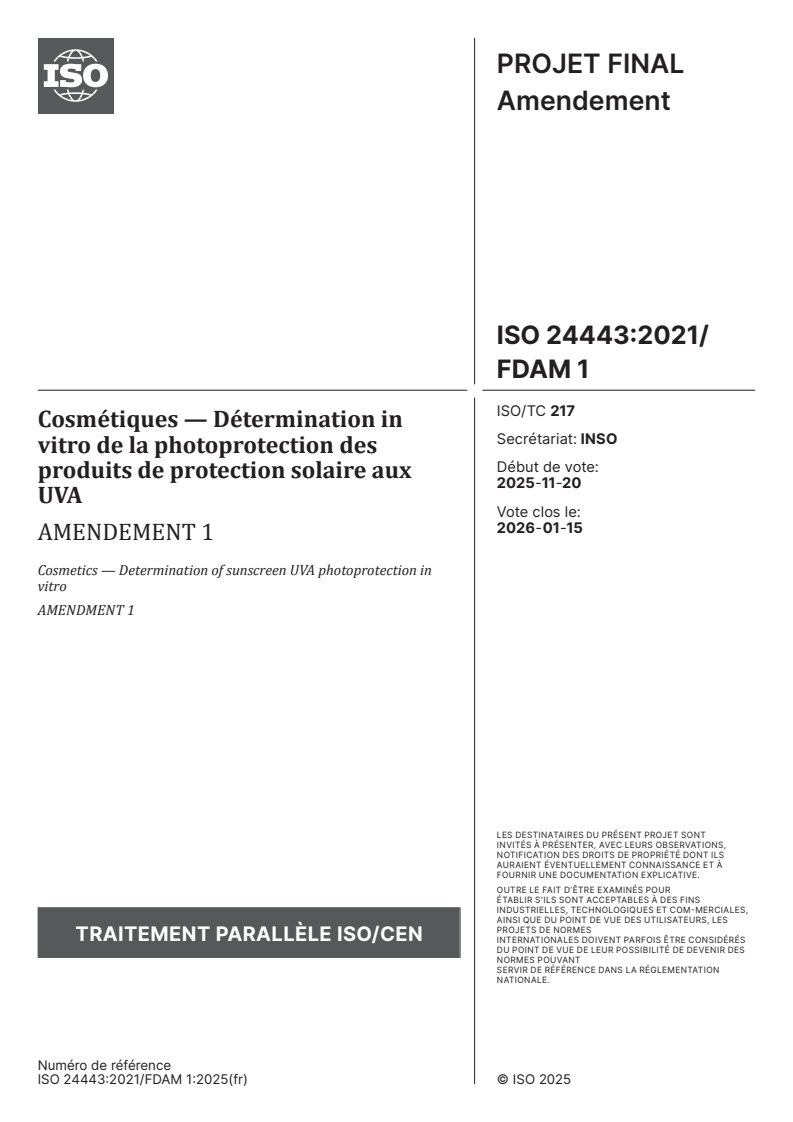
PROJET FINAL
Amendement
ISO 24443:2021/
FDAM 1
ISO/TC 217
Cosmétiques — Détermination in
Secrétariat: INSO
vitro de la photoprotection des
Début de vote:
produits de protection solaire aux
2025-11-20
UVA
Vote clos le:
2026-01-15
AMENDEMENT 1
Cosmetics — Determination of sunscreen UVA photoprotection in
vitro
AMENDMENT 1
LES DESTINATAIRES DU PRÉSENT PROJET SONT
INVITÉS À PRÉSENTER, AVEC LEURS OBSERVATIONS,
NOTIFICATION DES DROITS DE PROPRIÉTÉ DONT ILS
AURAIENT ÉVENTUELLEMENT CONNAISSANCE ET À
FOURNIR UNE DOCUMENTATION EXPLICATIVE.
OUTRE LE FAIT D’ÊTRE EXAMINÉS POUR
ÉTABLIR S’ILS SONT ACCEPTABLES À DES FINS
INDUSTRIELLES, TECHNOLOGIQUES ET COM-MERCIALES,
AINSI QUE DU POINT DE VUE DES UTILISATEURS, LES
PROJETS DE NORMES
TRAITEMENT PARALLÈLE ISO/CEN
INTERNATIONALES DOIVENT PARFOIS ÊTRE CONSIDÉRÉS
DU POINT DE VUE DE LEUR POSSI BILITÉ DE DEVENIR DES
NORMES POUVANT
SERVIR DE RÉFÉRENCE DANS LA RÉGLEMENTATION
NATIONALE.
Numéro de référence
ISO 24443:2021/FDAM 1:2025(fr) © ISO 2025
PROJET FINAL
ISO 24443:2021/FDAM 1:2025(fr)
Amendement
ISO 24443:2021/
FDAM 1
ISO/TC 217
Cosmétiques — Détermination in
Secrétariat: INSO
vitro de la photoprotection des
Début de vote:
produits de protection solaire aux
2025-11-20
UVA
Vote clos le:
2026-01-15
AMENDEMENT 1
Cosmetics — Determination of sunscreen UVA photoprotection in
vitro
AMENDMENT 1
LES DESTINATAIRES DU PRÉSENT PROJET SONT
INVITÉS À PRÉSENTER, AVEC LEURS OBSERVATIONS,
NOTIFICATION DES DROITS DE PROPRIÉTÉ DONT ILS
AURAIENT ÉVENTUELLEMENT CONNAISSANCE ET À
FOURNIR UNE DOCUMENTATION EXPLICATIVE.
DOCUMENT PROTÉGÉ PAR COPYRIGHT
OUTRE LE FAIT D’ÊTRE EXAMINÉS POUR
ÉTABLIR S’ILS SONT ACCEPTABLES À DES FINS
© ISO 2025 INDUSTRIELLES, TECHNOLOGIQUES ET COM-MERCIALES,
AINSI QUE DU POINT DE VUE DES UTILISATEURS, LES
Tous droits réservés. Sauf prescription différente ou nécessité dans le contexte de sa mise en œuvre, aucune partie de cette
PROJETS DE NORMES
TRAITEMENT PARALLÈLE ISO/CEN
INTERNATIONALES DOIVENT PARFOIS ÊTRE CONSIDÉRÉS
publication ne peut être reproduite ni utilisée sous quelque forme que ce soit et par aucun procédé, électronique ou mécanique,
DU POINT DE VUE DE LEUR POSSI BILITÉ DE DEVENIR DES
y compris la photocopie, ou la diffusion sur l’internet ou sur un intranet, sans autorisation écrite préalable. Une autorisation peut
NORMES POUVANT
être demandée à l’ISO à l’adresse ci-après ou au comité membre de l’ISO dans le pays du demandeur.
SERVIR DE RÉFÉRENCE DANS LA RÉGLEMENTATION
NATIONALE.
ISO copyright office
Case postale 401 • Ch. de Blandonnet 8
CH-1214 Vernier, Genève
Tél.: +41 22 749 01 11
E-mail: copyright@iso.org
Web: www.iso.org
Publié en Suisse Numéro de référence
ISO 24443:2021/FDAM 1:2025(fr) © ISO 2025
ii
ISO 24443:2021/FDAM 1:2025(fr)
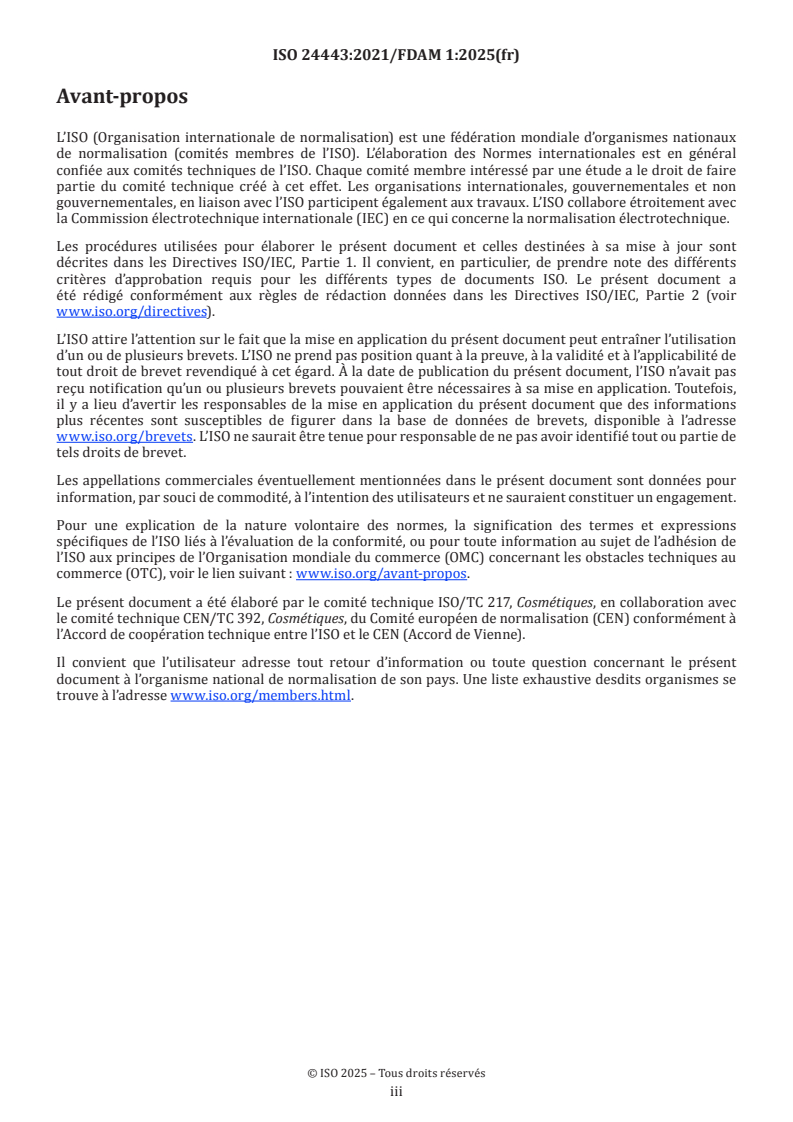
Avant-propos
L’ISO (Organisation internationale de normalisation) est une fédération mondiale d’organismes nationaux
de normalisation (comités membres de l’ISO). L’élaboration des Normes internationales est en général
confiée aux comités techniques de l’ISO. Chaque comité membre intéressé par une étude a le droit de faire
partie du comité technique créé à cet effet. Les organisations internationales, gouvernementales et non
gouvernementales, en liaison avec l’ISO participent également aux travaux. L’ISO collabore étroitement avec
la Commission électrotechnique internationale (IEC) en ce qui concerne la normalisation électrotechnique.
Les procédures utilisées pour élaborer le présent document et celles destinées à sa mise à jour sont
décrites dans les Directives ISO/IEC, Partie 1. Il convient, en particulier, de prendre note des différents
critères d’approbation requis pour les différents types de documents ISO. Le présent document a
été rédigé conformément aux règles de rédaction données dans les Directives ISO/IEC, Partie 2 (voir
www.iso.org/directives).
L’ISO attire l’attention sur le fait que la mise en application du présent document peut entraîner l’utilisation
d’un ou de plusieurs brevets. L’ISO ne prend pas position quant à la preuve, à la validité et à l’applicabilité de
tout droit de brevet revendiqué à cet égard. À la date de publication du présent document, l’ISO n’avait pas
reçu notification qu’un ou plusieurs brevets pouvaient être nécessaires à sa mise en application. Toutefois,
il y a lieu d’avertir les responsables de la mise en application du présent document que des informations
plus récentes sont susceptibles de figurer dans la base de données de brevets, disponible à l’adresse
www.iso.org/brevets. L’ISO ne saurait être tenue pour responsable de ne pas avoir identifié tout ou partie de
tels droits de brevet.
Les appellations commerciales éventuellement mentionnées dans le présent document sont données pour
information, par souci de commodité, à l’intention des utilisateurs et ne sauraient constituer un engagement.
Pour une explication de la nature volontaire des normes, la signification des termes et expressions
spécifiques de l’ISO liés à l’évaluation de la conformité, ou pour toute information au sujet de l’adhésion de
l’ISO aux principes de l’Organisation mondiale du commerce (OMC) concernant les obstacles techniques au
commerce (OTC), voir le lien suivant : www.iso.org/avant-propos.
Le présent document a été élaboré par le comité technique ISO/TC 217, Cosmétiques, en collaboration avec
le comité technique CEN/TC 392, Cosmétiques, du Comité européen de normalisation (CEN) conformément à
l’Accord de coopération technique entre l’ISO et le CEN (Accord de Vienne).
Il convient que l’utilisateur adresse tout retour d’information ou toute question concernant le présent
document à l’organisme national de normalisation de son pays. Une liste exhaustive desdits organismes se
trouve à l’adresse www.iso.org/members.html.
iii
ISO 24443:2021/FDAM 1:2025(fr)
Cosmétiques — Détermination in vitro de la photoprotection
des produits de protection solaire aux UVA
AMENDEMENT 1
5.6
Ajouter ce qui suit à la fin du paragraphe :
Il convient que le produit soit stocké, à l’abri de la lumière, entre (27 ±2 °C) et (32 ±2 °C) pendant au
moins douze heures avant le début de l’essai.
Il convient que la surface des plaques sablées soit nettoyée à l’aide d’un chiffon en
microfibre sec et antistatique.
Il convient de manipuler les plaques avec précaution en les tenant par les bords et
en évitant tout contact des doigts avec la surface. Il convient d’apposer une marque de référence sur
chaque plaque pour s’assurer que l’ensemble du processus de mesure se déroule dans le même ordre et
la même direction à chaque fois. Les plaques doivent être utilisées sans traitement supplémentaire de la
surface (chimique et/ou physique). Les plaques doivent être utilisées une seule fois.
5.7
Ajouter un nouveau paragraphe 5.7 « Robot » :
5.7 Robot
5.7.1 Généralités
Le robot doit être conforme à l’Annexe H et doit comporter les caractéristiques suivantes :
a) répétabilité de position d’au moins ±0,1 mm dans les axes x, y et z ;
b) degrés de liberté égaux à au moins 6 joints rotatifs ;
c) charge utile d’au moins 0,5 kg ;
d) effort vertical (axe z), mesuré au centre de la plaque (avec le doigt mécanique et le doigtier, sans
déplacement des axes x et y), de (6,0 ± 0,5) N.
Le dispositif robotique doit être contrôlé à intervalles réguliers (au moins tous les douze mois) par un
expert qualifié afin de garantir sa conformité aux spécifications mécaniques et d'étalement indiquées
en 5.7.3. Le doigt mécanique doit être remplacé après chaque cycle de 400 opérations d'étalement ou
lorsqu'il est endommagé (par exemple, fissures, etc.)
5.7.2 Spécifications
Le robot doit être conforme à l’Annexe H et doit comporter les caractéristiques suivantes :
ISO 24443:2021/FDAM 1:2025(fr)
a) répétabilité de position d’au moins ±0,1 mm dans les axes x, y et z ;
b) degrés de liberté égaux à au moins 6 joints rotatifs ;
c) charge utile d’au moins 0,5 kg ;
d) effort vertical (axe z), mesuré au centre de la plaque (avec le doigt mécanique et le doigtier, sans
déplacement des axes x et y), de (6,0 ± 0,5) N.
5.7.3 Surveillance
Le dispositif robotique doit être contrôlé à intervalles réguliers (au moins tous les douze mois) par un
expert dûment qualifié afin de garantir sa conformité aux spécifications mécaniques et d'étalement
indiquées en 5.7.3. Le doigt mécanique doit être remplacé après chaque cycle de 400 opérations
d'étalement ou lorsqu'il est endommagé (par exemple, fissures, etc.).
6.4
Réorganiser l'Article en quatre paragraphes :
6.4 Application de l’échantillon
6.4.1 Préparation
Avant l'application du produit, il convient que la température de la surfa
...
Questions, Comments and Discussion
Ask us and Technical Secretary will try to provide an answer. You can facilitate discussion about the standard in here.
Loading comments...