

ISO/TR 6030:2022
(Main)Smart community infrastructures – Disaster risk reduction – Survey results and gap analysis
General Information
- Abstract
This document identifies existing global smart community infrastructures that enhance disaster risk reduction, the key purposes served by these global examples, gaps in coverage, and the need for standardization activities, which establishes the basis for the next steps for standardization. This document is intended to be a basis for the future standardization of smart community infrastructures for disaster risk reduction through the identification of areas for potential standardization. This includes, but is not limited to, infrastructures related to energy, waste and water, transportation, information and communication technologies (ICT), and the general built environment. It does not address specifications or requirements already covered by other relevant international standards. This document primarily addresses disasters caused by natural hazards, such as geological and hydrometeorological hazards, and does not focus on human-induced disasters such as terrorism or biological hazards such as pandemics.
- Status
- Published
- Publication Date
- 05-Jul-2022
- Technical Committee
- ISO/TC 268/SC 1 - Smart community infrastructures
- Drafting Committee
- ISO/TC 268/SC 1 - Smart community infrastructures
- Current Stage
- 6060 - International Standard published
- Start Date
- 06-Jul-2022
- Completion Date
- 06-Jul-2022

Overview
ISO/TR 6030:2022 - Smart community infrastructures - Disaster risk reduction - Survey results and gap analysis is a technical report from ISO/TC 268 (Sustainable cities and communities). It documents a global survey of smart community infrastructure examples that enhance disaster risk reduction (DRR), identifies gaps in current practice, and establishes areas for potential standardization. The report focuses on natural hazards (geological and hydrometeorological) and covers infrastructures such as energy, water and waste, transportation, ICT, and the built environment. It is a foundation for future standards to improve interoperability and resilience of smart community systems.
Key Topics and Requirements
- Scope and purpose: Maps where smart infrastructures currently support DRR and where standardization is needed.
- DRR functions covered: Disaster risk reduction planning, safer infrastructure design, recovery planning and action, evacuation support and facilities, stockpiling and supply chains, rescue and emergency services, medical and health support, livelihood recovery, and data collection/dissemination.
- Infrastructure focus areas: Energy systems, water and wastewater, waste management, transportation networks, ICT and communications, and general built environment resilience.
- Survey and gap analysis: Literature review, survey design, examples of global initiatives, issues and solution landscape, common functional areas, and gap analysis by community infrastructure functions and by hazard/infrastructure types.
- Standardization recommendations: Identification of possible actions for standards bodies to address interoperability, data exchange, resilience metrics, and cross-sector coordination.
- Document characteristics: Informative technical report (no normative references) - intended to inform development of future normative standards rather than setting technical specifications itself.
Practical Applications and Who Would Use It
- City and regional planners: Use the gap analysis to prioritize resilient infrastructure investments and align smart-city initiatives with DRR needs.
- Infrastructure owners/operators (utilities, transport agencies): Identify interoperability and resilience gaps across energy, water, transport and ICT.
- Emergency managers and public safety agencies: Improve evacuation planning, communication resilience and observation-data flows.
- Standards developers and policymakers: Use identified areas for action to draft new ISO/IEC standards or national regulations.
- Vendors and system integrators: Guide product design toward scalable, interoperable smart infrastructure solutions that support disaster resilience.
- Researchers: Reference the survey results and annexed examples for comparative studies and pilot projects.
Related Standards (applicable references)
- ISO 37100, ISO 37120 and ISO 37123 are cited in definitions and provide complementary city/community indicators.
For full technical detail and annex examples, consult the published ISO/TR 6030:2022 document via ISO or your national standards body.
Get Certified
Connect with accredited certification bodies for this standard

BSI Group
BSI (British Standards Institution) is the business standards company that helps organizations make excellence a habit.

Bureau Veritas
Bureau Veritas is a world leader in laboratory testing, inspection and certification services.

DNV
DNV is an independent assurance and risk management provider.
Sponsored listings
Frequently Asked Questions
ISO/TR 6030:2022 is a technical report published by the International Organization for Standardization (ISO). Its full title is "Smart community infrastructures – Disaster risk reduction – Survey results and gap analysis". This standard covers: This document identifies existing global smart community infrastructures that enhance disaster risk reduction, the key purposes served by these global examples, gaps in coverage, and the need for standardization activities, which establishes the basis for the next steps for standardization. This document is intended to be a basis for the future standardization of smart community infrastructures for disaster risk reduction through the identification of areas for potential standardization. This includes, but is not limited to, infrastructures related to energy, waste and water, transportation, information and communication technologies (ICT), and the general built environment. It does not address specifications or requirements already covered by other relevant international standards. This document primarily addresses disasters caused by natural hazards, such as geological and hydrometeorological hazards, and does not focus on human-induced disasters such as terrorism or biological hazards such as pandemics.
This document identifies existing global smart community infrastructures that enhance disaster risk reduction, the key purposes served by these global examples, gaps in coverage, and the need for standardization activities, which establishes the basis for the next steps for standardization. This document is intended to be a basis for the future standardization of smart community infrastructures for disaster risk reduction through the identification of areas for potential standardization. This includes, but is not limited to, infrastructures related to energy, waste and water, transportation, information and communication technologies (ICT), and the general built environment. It does not address specifications or requirements already covered by other relevant international standards. This document primarily addresses disasters caused by natural hazards, such as geological and hydrometeorological hazards, and does not focus on human-induced disasters such as terrorism or biological hazards such as pandemics.
ISO/TR 6030:2022 is classified under the following ICS (International Classification for Standards) categories: 13.020.20 - Environmental economics. Sustainability. The ICS classification helps identify the subject area and facilitates finding related standards.
ISO/TR 6030:2022 is available in PDF format for immediate download after purchase. The document can be added to your cart and obtained through the secure checkout process. Digital delivery ensures instant access to the complete standard document.
Standards Content (Sample)
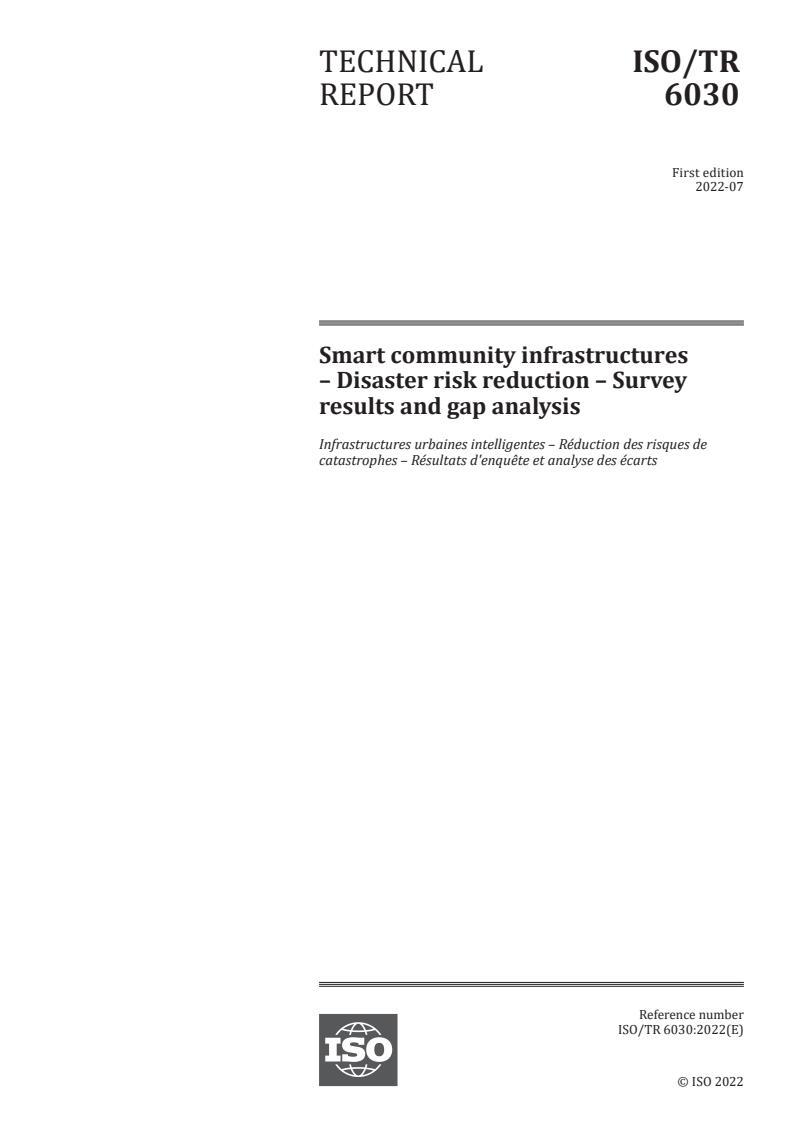
TECHNICAL ISO/TR
REPORT 6030
First edition
2022-07
Smart community infrastructures
– Disaster risk reduction – Survey
results and gap analysis
Infrastructures urbaines intelligentes – Réduction des risques de
catastrophes – Résultats d'enquête et analyse des écarts
Reference number
© ISO 2022
All rights reserved. Unless otherwise specified, or required in the context of its implementation, no part of this publication may
be reproduced or utilized otherwise in any form or by any means, electronic or mechanical, including photocopying, or posting on
the internet or an intranet, without prior written permission. Permission can be requested from either ISO at the address below
or ISO’s member body in the country of the requester.
ISO copyright office
CP 401 • Ch. de Blandonnet 8
CH-1214 Vernier, Geneva
Phone: +41 22 749 01 11
Email: copyright@iso.org
Website: www.iso.org
Published in Switzerland
ii
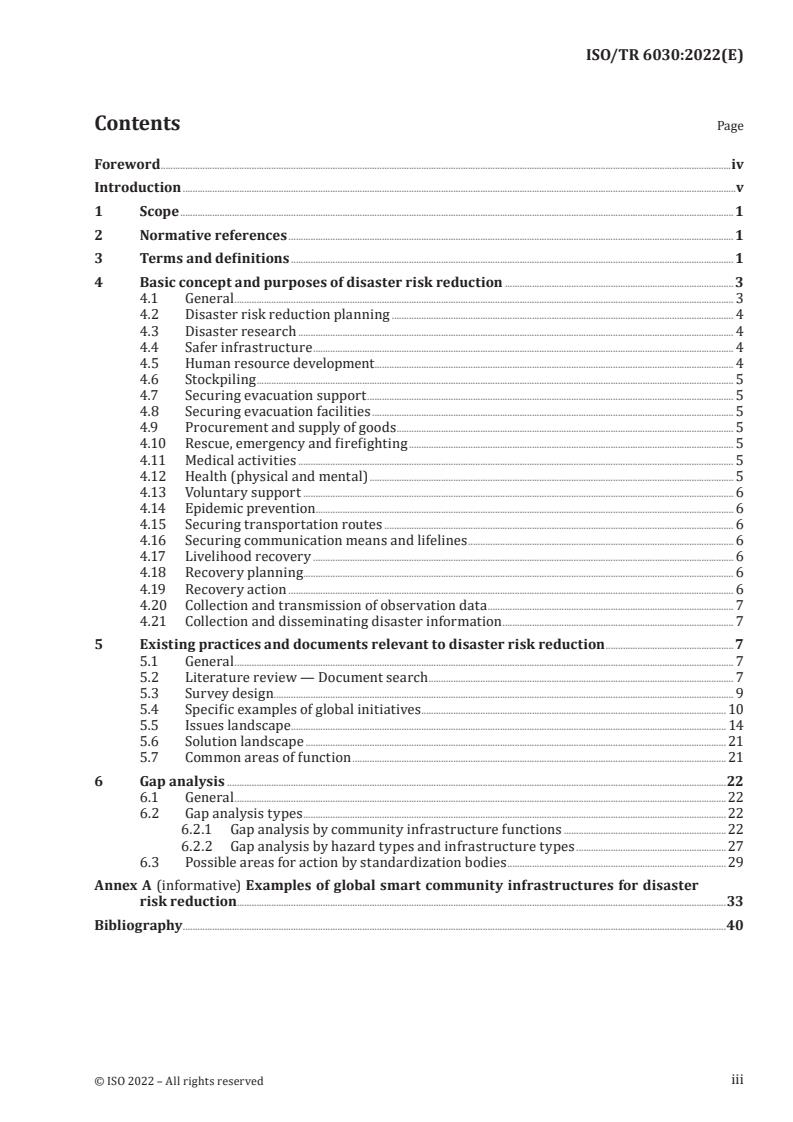
Contents Page
Foreword .iv
Introduction .v
1 Scope . 1
2 Normative references . 1
3 Terms and definitions . 1
4 Basic concept and purposes of disaster risk reduction . 3
4.1 General . 3
4.2 Disaster risk reduction planning . 4
4.3 Disaster research . 4
4.4 Safer infrastructure . 4
4.5 Human resource development . . 4
4.6 Stockpiling . 5
4.7 Securing evacuation support . 5
4.8 Securing evacuation facilities . 5
4.9 Procurement and supply of goods . 5
4.10 Rescue, emergency and firefighting . 5
4.11 Medical activities . 5
4.12 Health (physical and mental) . 5
4.13 Voluntary support . 6
4.14 Epidemic prevention . . 6
4.15 Securing transportation routes . 6
4.16 Securing communication means and lifelines . 6
4.17 Livelihood recovery . 6
4.18 Recovery planning . . 6
4.19 Recovery action . 6
4.20 Collection and transmission of observation data . 7
4.21 Collection and disseminating disaster information . 7
5 Existing practices and documents relevant to disaster risk reduction .7
5.1 General . 7
5.2 Literature review — Document search . 7
5.3 Survey design . . . 9
5.4 Specific examples of global initiatives . 10
5.5 Issues landscape . . 14
5.6 Solution landscape . 21
5.7 Common areas of function . 21
6 Gap analysis .22
6.1 General .22
6.2 Gap analysis types . 22
6.2.1 Gap analysis by community infrastructure functions .22
6.2.2 Gap analysis by hazard types and infrastructure types . 27
6.3 Possible areas for action by standardization bodies .29
Annex A (informative) Examples of global smart community infrastructures for disaster
risk reduction . .33
Bibliography .40
iii
Foreword
ISO (the International Organization for Standardization) is a worldwide federation of national standards
bodies (ISO member bodies). The work of preparing International Standards is normally carried out
through ISO technical committees. Each member body interested in a subject for which a technical
committee has been established has the right to be represented on that committee. International
organizations, governmental and non-governmental, in liaison with ISO, also take part in the work.
ISO collaborates closely with the International Electrotechnical Commission (IEC) on all matters of
electrotechnical standardization.
The procedures used to develop this document and those intended for its further maintenance are
described in the ISO/IEC Directives, Part 1. In particular, the different approval criteria needed for the
different types of ISO documents should be noted. This document was drafted in accordance with the
editorial rules of the ISO/IEC Directives, Part 2 (see www.iso.org/directives).
Attention is drawn to the possibility that some of the elements of this document may be the subject of
patent rights. ISO shall not be held responsible for identifying any or all such patent rights. Details of
any patent rights identified during the development of the document will be in the Introduction and/or
on the ISO list of patent declarations received (see www.iso.org/patents).
Any trade name used in this document is information given for the convenience of users and does not
constitute an endorsement.
For an explanation of the voluntary nature of standards, the meaning of ISO specific terms and
expressions related to conformity assessment, as well as information about ISO's adherence to
the World Trade Organization (WTO) principles in the Technical Barriers to Trade (TBT), see
www.iso.org/iso/foreword.html.
This document was prepared by Technical Committee ISO/TC 268, Sustainable cities and communities,
Subcommittee SC 1, Smart community infrastructures.
Any feedback or questions on this document should be directed to the user’s national standards body. A
complete listing of these bodies can be found at www.iso.org/members.html.
iv
Introduction
Over the last decade, global communities have made great progress towards reducing disaster risk
through strengthening resilience against natural hazards. However, in addition to geological hazards,
ongoing climate changes can exacerbate existing hydrometeorological hazard risks by increasing the
frequency and intensity of these hazards, in either unprecedented combinations and/or unexpected
locations. As a result, more communities and assets can be exposed to these hazards, leading to greater
damage by disasters.
In order to protect communities against natural hazard risks, infrastructures can play a key role in
strengthening resilience. Critical infrastructures that communities rely on, such as energy, information
and communication technologies (ICT), transportation, waste and water, and other infrastructures
affect vital community functions such as livelihoods, medical activities, financial services. This results
in an increasing cost of disasters for all sectors of the community whether it is governments, businesses,
and individuals. These costs include not only direct costs but also indirect ones such as costs from flow-
on effects from disasters. Through the implementation of infrastructure that can strengthen resilience,
communities can recover from the impacts of disasters quickly and effectively.
The demand for smart community infrastructures, as scalable and integrable products, will continue
to grow in the decades ahead. However, it is imperative that such infrastructures can also be designed
in a way that reduces disaster risk and strengthens disaster resilience. Through an analysis of
existing documents on smart community infrastructure for disaster risk reduction and a survey of
global examples, this document is intended to identify existing gaps in the implementation of smart
community infrastructure for disaster risk reduction, and to identify topics for potential areas in
the standardization of smart community infrastructures for disaster risk reduction. Through the
accumulation of global best practices, this document identifies areas for potential standardization,
which includes but is not limited to, the strengthening of disaster risk reduction technologies utilized in
critical infrastructures such as energy, waste and water, transportation, ICT, and the built environment.
This document seeks to provide the foundation for future standardization deliverables which promote
the interoperability of disaster risk reduction technologies globally.
v
TECHNICAL REPORT ISO/TR 6030:2022(E)
Smart community infrastructures – Disaster risk reduction
– Survey results and gap analysis
1 Scope
This document identifies existing global smart community infrastructures that enhance disaster
risk reduction, the key purposes served by these global examples, gaps in coverage, and the need for
standardization activities, which establishes the basis for the next steps for standardization.
This document is intended to be a basis for the future standardization of smart community
infrastructures for disaster risk reduction through the identification of areas for potential
standardization. This includes, but is not limited to, infrastructures related to energy, waste and water,
transportation, information and communication technologies (ICT), and the general built environment.
It does not address specifications or requirements already covered by other relevant international
standards.
This document primarily addresses disasters caused by natural hazards, such as geological and
hydrometeorological hazards, and does not focus on human-induced disasters such as terrorism or
biological hazards such as pandemics.
2 Normative references
There are no normative references in this document.
3 Terms and definitions
For the purposes of this document, the following terms and definitions apply.
ISO and IEC maintain terminology databases for use in standardization at the following addresses:
— ISO Online browsing platform: available at https:// www .iso .org/ obp
— IEC Electropedia: available at https:// www .electropedia .org/
3.1
community
group of people with an arrangement of responsibilities, activities and relationships
Note 1 to entry: In many, but not all, contexts, a community has a defined geographical boundary.
Note 2 to entry: A city is a type of community.
[SOURCE: ISO 37120:2018, 3.3]
3.2
community infrastructure
systems of facilities, equipment and services that support the operations and activities of communities
Note 1 to entry: Such community infrastructures include, but are not limited to, energy, water, transportation,
waste and information and communication technologies (ICT).
[SOURCE: ISO 37100:2016, 3.6.1]
3.3
critical infrastructure
physical structures, facilities, networks and other assets which provide services that are essential to
the social and economic functioning of a community (3.1) or society
Note 1 to entry: Examples of critical infrastructure can include, but are not limited to, power generation,
transmission and distribution, water treatment, distribution and drainage, wastewater and stormwater
infrastructure, transportation, gas supply and distribution, telecommunications infrastructure, educational
facilities, hospitals and other health facilities.
[SOURCE: ISO 37123: 2019, 3.1]
3.4
disaster
serious disruption to a city or community (3.1) due to hazardous events interacting with conditions
of exposure, vulnerability and capacity, leading to human, material, economic and/or environmental
losses and impacts
Note 1 to entry: Disasters can be frequent or infrequent, depending on the probability of occurrence and the
return period of the relevant hazard (3.5). A slow-onset disaster is one that emerges gradually over time, for
example through drought, desertification, sea level rise, subsidence or epidemic disease. A sudden-onset disaster
is one triggered by a hazardous event that emerges quickly or unexpectedly, often associated with earthquakes,
volcanic eruptions, flash floods, chemical explosions, critical infrastructure (3.3) failures or transport accidents.
[SOURCE: ISO 37123:2019, 3.2]
3.5
hazard
phenomenon, human activity or process that can cause loss of life, injury or other health impacts,
property damage, social and economic disruption or environmental degradation
Note 1 to entry: Hazards include biological, environmental, geological, hydrometeorological and technological
processes and phenomena. Biological hazards include pathogenic microorganisms, toxins and bioactive
substances (e.g. bacteria, viruses, parasites, venomous wildlife and insects, poisonous plants, mosquitoes
carrying disease-causing agents). Environmental hazards can be chemical, natural, radiological or biological,
and are created by environmental degradation, physical or chemical pollution in the air, water and soil. However,
many of the processes and phenomena that fall into this category can be “drivers” of hazard and risk rather than
hazards themselves (e.g. soil degradation, deforestation, biodiversity loss, sea level rise). With respect to drinking
water, ‘hazard’ can be understood as a microbiological, chemical, physical or radiological agent that causes harm
to human health. Geological or geophysical hazards originate from internal earth processes (e.g. earthquakes,
volcanic activity, landslides, rockslides, mud flows). Hydrometeorological hazards are of atmospheric,
hydrological or oceanographic origin (e.g. cyclones, typhoons, hurricanes, floods, drought, heatwaves, cold
spells, and coastal storm surges). Hydrometeorological conditions can also be a factor in other hazards such
as landslides, wildland fires and epidemics. Technological hazards originate from industrial or technological
conditions, dangerous procedures, infrastructure failures or specific human activities (e.g. industrial pollution,
nuclear radiation, toxic waste, dam failures, transport accidents, factory explosions, fires, chemical spills).
[SOURCE: ISO 37123:2019, 3.3]
3.6
resilience
ability to absorb and adapt in a changing environment
Note 1 to entry: In the context of urban resilience the ability to absorb and adapt to a changing environment is
determined by the collective capacity to anticipate, prepare and respond to threats and opportunities by each
individual component of an urban system.
[SOURCE: ISO 22300:2021, 3.1.206]
3.7
smart community infrastructure
community infrastructure (3.2) with enhanced technological performance that is designed, operated
and maintained to contribute to sustainable development and resilience (3.6) of the community (3.1)
[SOURCE: ISO 37156:2020, 3.1.4]
4 Basic concept and purposes of disaster risk reduction
4.1 General
Adopted at the UN World Conference on Disaster Risk Reduction in Sendai, Japan, in 2015, the Sendai
Framework for Disaster Risk Reduction (SFDRR) is an agreement that provides communities with
concrete actions to protect themselves from the risk of disasters. Four priorities for actions are
identified in the SFDRR:
— understanding disaster risk,
— strengthening disaster risk governance to manage disaster risk,
— investing in disaster risk reduction for resilience,
— enhancing disaster preparedness for effective response, and to “Build Back Better” a term that
emerged during the SFDRR which refers to the recovery, rehabilitation and reconstruction phase.
The SFDRR identifies the need to incorporate the use of technologies that can collect information and
assist in disaster risk governance at various disaster phases. “In order to reduce disaster risk, there is
a need to address existing challenges and prepare for future ones by focusing on monitoring, assessing
and understanding disaster risk and sharing such information and on how it is created; strengthening
disaster risk governance and coordination across relevant institutions and sectors and the full and
meaningful participation of relevant stakeholders at appropriate levels; investing in the economic,
social, health, cultural and educational resilience of persons, communities and countries and the
environment, as well as through technology and research; and enhancing multi-hazard early warning
systems, preparedness, response, recovery, rehabilitation and reconstruction. To complement national
action and capacity, there is a need to enhance international cooperation between developed and
developing countries and between States and international organizations" (SFDRR P.11).
By investing in these technologies, the SFDRR indicates that smart community infrastructure for
disaster risk reduction can lead to the reduction of casualties and damages during a disaster event
strengthen the resilience of the community’s livelihoods. “Public and private investment in disaster risk
prevention and reduction through structural and non-structural measures are essential to enhance the
economic, social, health and cultural resilience of persons, communities, countries and their assets, as
well as the environment. These can be drivers of innovation, growth and job creation. Such measures
are cost-effective and instrumental to save lives, prevent and reduce losses and ensure effective
recovery and rehabilitation" (SFDRR P.18).
The importance of standardization is highlighted in the SFDRR. “Strengthening, as appropriate, disaster-
resilient public and private investments, particularly through structural, non-structural and functional
disaster risk prevention and reduction measures in critical facilities, in particular schools and hospitals
and physical infrastructures; building better from the start to withstand hazards through proper
design and construction, including the use of the principles of universal design and the standardization
of building materials; retrofitting and rebuilding; nurturing a culture of maintenance; and taking into
account economic, social, structural, technological and environmental impact assessments" (SFDRR
P.19). “Promoting the further development and dissemination of instruments, such as standards,
codes, operational guides and other guidance instruments, to support coordinated action in disaster
preparedness and response and facilitate information sharing on lessons learned and best practices for
policy practice and post-disaster reconstruction programmes" (SFDRR P.22).
Through the creation of standards, this document hopes to disseminate information on global best
practices which can lead to the sharing and exchange of information between communities and
countries. “Promoting the further development of and investment in effective, nationally compatible,
regional multi-hazard early warning mechanisms, where relevant, in line with the Global Framework
for Climate Services, and facilitate the sharing and exchange of information across all countries (SFDRR
P.22). Promoting cooperation between academic, scientific and research entities and networks and the
private sector to develop new products and services to help to reduce disaster risk, in particular those
that would assist developing countries and their specific challenges (SFDRR P.20), and to disseminate
and share good practices internationally" (SFDRR P.16).
In order to guide the survey to identify global best practices in regard to smart community
infrastructure for disaster risk reduction, this document identifies key themes identified within the
SFDRR.
4.2 Disaster risk reduction planning
Disasters have demonstrated that the recovery, rehabilitation and reconstruction phase, which needs
to be prepared ahead of a disaster, is a critical opportunity to “Build Back Better”, including through
integrating disaster risk reduction into development measures, making nations and communities
resilient to disasters (SFDRR P.21). However, addressing underlying disaster risk factors through
disaster risk-informed public and private investments is more cost-effective than primary reliance
on post-disaster response and recovery, and contributes to sustainable development (SFDRR P.13).
To encourage the establishment of necessary mechanisms and incentives to ensure high levels of
compliance with the existing safety-enhancing provisions of sectoral laws and regulations, including
those addressing land use and urban planning, building codes, environmental and resource management
and health and safety standards, and update them, where needed, to ensure an adequate focus on
disaster risk management (SFDRR P.17). To apply risk information in all its dimensions of vulnerability,
capacity and exposure of persons, communities, countries and assets, as well as hazard characteristics,
to develop and implement disaster risk reduction policies (SFDRR P.15).
4.3 Disaster research
Promoting investments in innovation and technology development in long-term, multi-hazard and
solution-driven research in disaster risk management to address gaps, obstacles, interdependencies
and social, economic, educational and environmental challenges and disaster risks (SFDRR P.15).
Enhancing the development and dissemination of science-based methodologies and tools to record and
share disaster losses and relevant disaggregated data and statistics, as well as to strengthen disaster
risk modelling, assessment, mapping, monitoring and multi-hazard early warning systems (SFDRR
P.16).
4.4 Safer infrastructure
Strengthening, as appropriate, disaster-resilient public and private investments, particularly through
structural, non-structural and functional disaster risk prevention and reduction measures in critical
facilities, in particular schools and hospitals and physical infrastructures; building better from the
start to withstand hazards through proper design and construction, including the use of the principles
of universal design and the standardization of building materials; retrofitting and rebuilding; nurturing
a culture of maintenance; and taking into account economic, social, structural, technological and
environmental impact assessments (SFDRR P.19).
4.5 Human resource development
Building the knowledge of government officials at all levels, civil society, communities and volunteers,
as well as the private sector, through sharing experiences, lessons learned, good practices and
training and education on disaster risk reduction, including the use of existing training and education
mechanisms and peer learning (SFDRR P.15).
Training the existing workforce and voluntary workers in disaster response and strengthen technical
and logistical capacities to ensure better response in emergencies (SFDRR P.21).
4.6 Stockpiling
Establishing community centres for the promotion of public awareness and the stockpiling of necessary
materials to implement rescue and relief activities (SFDRR P.21).
4.7 Securing evacuation support
Strengthening the capacity of local authorities to evacuate persons living in disaster-prone areas
(SFDRR P.22).
4.8 Securing evacuation facilities
Promoting regular disaster preparedness, response and recovery exercises, including evacuation
drills, training and the establishment of area-based support systems, with a view to ensuring rapid and
effective response to disasters and related displacement, including access to safe shelter, essential food
and non-food relief supplies, as appropriate to local needs (SFDRR P.21).
4.9 Procurement and supply of goods
Increasing business resilience and protection of livelihoods and productive assets throughout the
supply chains, ensure continuity of services and integrate disaster risk management into business
models and practices (SFDRR P.20).
4.10 Rescue, emergency and firefighting
Establishing community centres for the promotion of public awareness and the stockpiling of necessary
materials to implement rescue and relief activities; To adopt public policies and actions that support
the role of public service workers to establish or strengthen coordination and funding mechanisms and
procedures for relief assistance and plan and prepare for post-disaster recovery and reconstruction; To
train the existing workforce and voluntary workers in disaster response and strengthen technical and
logistical capacities to ensure better response in emergencies (SFDRR P.21).
4.11 Medical activities
Enhancing the resilience of national health systems, including by integrating disaster risk management
into primary, secondary and tertiary health care, especially at the local level; developing the capacity of
health workers in understanding disaster risk and applying and implementing disaster risk reduction
approaches in health work; promoting and enhancing the training capacities in the field of disaster
medicine; and supporting and training community health groups in disaster risk reduction approaches
in health programmes, in collaboration with other sectors, as well as in the implementation of the
International Health Regulations (2005) of the World Health Organization (SFDRR P.19).
4.12 Health (physical and mental)
Enhancing cooperation between health authorities and other relevant stakeholders to strengthen
country capacity for disaster risk management for health, the implementation of the International
Health Regulations (2005) of the World Health Organization and the building of resilient health systems
(SFDRR P.20).
Enhancing recovery schemes to provide psychosocial support and mental health services for all people
in need (SFDRR P.22).
4.13 Voluntary support
Training the existing workforce and voluntary workers in disaster response and strengthen technical
and logistical capacities to ensure better response in emergencies (SFDRR P.21).
4.14 Epidemic prevention
Establishing a mechanism of case registry and a database of mortality caused by disaster in order
to improve the prevention of morbidity and mortality (SFDRR P.22). To promote transboundary
cooperation to enable policy and planning for the implementation of ecosystem-based approaches with
regard to shared resources, such as within river basins and along coastlines, to build resilience and
reduce disaster risk, including epidemic and displacement risk (SFDRR P.18).
4.15 Securing transportation routes
Promoting the resilience of new and existing critical infrastructure, including water, transportation
and telecommunications infrastructure, educational facilities, hospitals and other health facilities, to
ensure that they remain safe, effective and operational during and after disasters in order to provide
live-saving and essential services (SFDRR P.21).
4.16 Securing communication means and lifelines
Investing in, develop, maintain and strengthen people-centred multi-hazard, multisectoral forecasting
and early warning systems, disaster risk and emergency communications mechanisms, social
technologies and hazard-monitoring telecommunications systems; develop such systems through a
participatory process; tailor them to the needs of users, including social and cultural requirements,
in particular gender; promote the application of simple and low-cost early warning equipment and
facilities; and broaden release channels for natural disaster early warning information (SFDRR P.21).
4.17 Livelihood recovery
Increasing business resilience and protection of livelihoods and productive assets throughout the
supply chains, ensure continuity of services and integrate disaster risk management into business
models and practices (SFDRR P.20).
4.18 Recovery planning
Promoting the incorporation of disaster risk management into post-disaster recovery and rehabilitation
processes, facilitate the link between relief, rehabilitation and development, use opportunities during
the recovery phase to develop capacities that reduce disaster risk in the short, medium and long term,
including through the development of measures such as land-use planning, structural standards
improvement and the sharing of expertise, knowledge, post-disaster reviews and lessons learned
and integrate post-disaster reconstruction into the economic and social sustainable development of
affected areas. It is advisable that this also applies to temporary settlements for persons displaced by
disasters (SFDRR P.22).
4.19 Recovery action
Addressing underlying disaster risk factors through disaster risk-informed public and private
investments is more cost-effective than primary reliance on post-disaster response and recovery, and
contributes to sustainable development (SFDRR P.13).
Ensuring the continuity of operations and planning, including social and economic recovery, and the
provision of basic services in the post-disaster phase (SFDRR P.21).
4.20 Collection and transmission of observation data
Promoting the collection, analysis, management and use of relevant data and practical information and
ensure its dissemination, taking into account the needs of different categories of users, as appropriate
(SFDRR P.14).
4.21 Collection and disseminating disaster information
Developing and periodically update and disseminate, as appropriate, location-based disaster risk
information, including risk maps, to decision makers, the general public and communities at risk of
exposure to disaster in an appropriate format by using, as applicable, geospatial information technology
(SFDRR P.15).
Promoting real time access to reliable data, make use of space and in situ information, including
geographic information systems (GIS), and use ICT innovations to enhance measurement tools and the
collection, analysis and dissemination of data (SFDRR P.15).
5 Existing practices and documents relevant to disaster risk reduction
5.1 General
This clause gives an overview of existing concepts and initiatives relevant to disaster risk reduction. Due
to common risks to natural hazards occurring globally, the standardization for disaster risk reduction in
smart community infrastructure can help communities better anticipate and prepare for hazard events
and reduce vulnerabilities. Subclause 5.2 examines what has been published thus far in international
documents, on disaster risk reduction. As many international organizations such as the United Nations
and World Economic Forum, have published documents in the English language, the document review
is limited to publications produced in English. However, in some cases, national level documents that
were published in English are also considered. Subclause 5.3 describes the survey design developed by
this document which was used to acquire information on current and planned implementation of smart
community infrastructure for disaster risk reduction. Subclause 5.4 analyses the survey results and
compares it with the results of the document search as well as how these examples meet the key themes
in disaster risk reduction as outlined in Clause 4. Subclause 5.5 is an issue landscape which categorizes
the key themes identified in the Basic Concept in Disaster Risk Reduction in Clause 4 and aligns them
with existing publications developed by the United Nations, national governments, and with other ISO
deliverables. Finally, 5.6 provides a solution landscape, which utilizes the examples provided by the
survey and categorizes them in terms of how they can be used by disaster phase and hazard type.
5.2 Literature review — Document search
431 documents in the English language were analysed. This included 230 documents published by the
United Nations Office for Disaster Risk Reduction, 104 documents and presentations presented at the
2017 and 2019 World Bosai Forum, 49 documents published by the US National Institute of Standards
and Technology, 18 documents published by the Global Facility for Disaster Reduction and Recovery,
15 documents published by United Nations Economic and Social Commission for Asia and the Pacific,
10 documents published by the International Recovery Platform, and 1 document each published by
Elsevier, the Japanese Ministry of Land, Infrastructure, Transport and Tourism (MLIT), the World
Economic Forum, the International Federation of Red Cross and Red Crescent Societies, and the
Association of Pacific Rim Universities and Tohoku University's APRU-IRIDeS Program. Out of the 431
documents researched, 243 relevant items were identified. Tables 1 and 2 summarize the results of
this document search into key areas. First by region, based on the categorization by the UNDRR which
includes the Asia and Pacific, Europe, Americas and the Caribbean, Arab States, Africa, and examples
that were applied globally rather than by a specific region. Second, the results were categorized by
infrastructure type concentrating on transportation, energy, waste and water, ICT, food security, and
the built environment (e.g. hospitals, schools, homes, offices), food security, which refer to infrastructure
that does not fall within the aforementioned categories. Disaster phases were categorized into three
groups: the prevention and preparedness phases which occur prior to a disaster event, the response
phase which occurs immediately after the event, and Build Back Better, which the SFDRR refers to as
the recovery and reconstruction phases that follows the response phase. Finally, the items are also
broken down by hazard types that are caused either by hydrometeorological or geological events.
Table 1 — Region and infrastructure type from the document search
Region Items Percentage Infrastructure type Items Percentage
Asia and Pacific 96 40 % Transportation 18 7 %
Europe 29 12 % Energy 14 6 %
Americas and the Caribbean 56 23 % Waste and Water 30 12 %
Arab States 18 7 % ICT/ Communication 110 45 %
Africa 17 7 % Built Environment 49 20 %
Global 27 11 % Food Security 6 2 %
Total 243 Others 18 7 %
Total 245
NOTE If an item spans multiple regions or infrastructure types, it is counted multiple times.
Table 2 — Hazard type and disaster phase from the document search
Hazard type Items Percentage Disaster phase type Items Percentage
Flood 72 21 % Prevention and Preparedness 151 57 %
Earthquake 45 13 % Response 37 14 %
Tropical Cyclone 40 12 % Build Back Better 30 11 %
Heavy Rain 40 12 % General 49 18 %
Drought 17 5 % Total 267
Tsunami 16 5 %
Wildfire 11 3 %
Volcanic Activity 11 3 %
Landslide 7 2 %
Tornado 6 1 %
Heatwave 4 1 %
General 72 22 %
Other (e.g. coastal erosion) 3 1 %
Total 344
NOTE If an item spans multiple hazard types or disaster phases types, it is counted multiple times.
An analysis of the document search revealed that nearly two-thirds of the literature focused on the Asia
and Pacific Region and the Americas and Caribbean Region. This can be explained by the proximity of
the western coast of the Americas, and the Asia and Pacific Region to the Ring of Fire, a region known
for significant geological activity, such as earthquakes and volcanoes which can generate powerful
tsunamis. Additionally, the Asia and Pacific Region and the eastern coastline of the Americas and the
Caribbean experience significant hydrometeorological activity which leads to tropical cyclones and
heavy rain. Europe is the third most commonly mentioned area behind the Asia and Pacific and Americas
and Caribbean Regions. European communities are exposed to hazard risks caused by flooding due to
the presence of multiple large rivers, while the communities around the Mediterranean and Caucasus
are vulnerable to geological risks due to seismic activity in the region. The document search revealed
that Arab States and Africa came in roughly equally with 7 % of the results. Although these two
regions were not often cited in the document search, issues with droughts, heatwaves, flooding and
earthquakes are frequent in these two regions. 11 % of the items discovered in the literature review
focused on more general disaster-related infrastructure that can be referred to more globally.
In regard to the breakdown of infrastructure type, nearly half of the items focused on the role ICT
plays in disaster risk reduction. This reflects the importance ICT infrastructure plays in the collection
and dissemination of data to community stakeholders, which can be utilized at various disaster
phases and strengthen resiliency. At 20 %, the next most common infrastructure focused on the built
environment, which includes homes, buildings, and other facilities. Aspects of the built environment,
such as their design and construction, location, and use cases can influence the survivability of the
community and its economy. Waste and water were the next key infrastructure listed with 12 %,
which includes sewer systems, ponds and other forms of water management, waste such as garbage,
and wastewater infrastructure, which deals with water that has been contaminated by human activity,
surface runoff, or stormwater. Transportation infrastructure was listed at 7 % of the review items,
as maintaining accessibility serves a critical function in resiliency. Energy infrastructure was listed
at 6 %, which focused on the resiliency of the facilities such as power plants, energy grids, and other
energy-producing and managing facilities whose continued operation is vital for the community. Food
security had the fewest comments at 2 %, despite the key role it plays during the recovery and Build
Back Better process.
In terms of hazard types, general multi-hazard related literature comprised 22 % of the total documents,
or nearly one-quarter of all literature research. However, in terms of specific hazards, floods were
the most common, comprising 21 % of the results, followed by earthquakes at 13 % and tropical
storms, which include typhoons, hurricanes, and cyclones, and heavy rain came at 12 %. Droughts
and tsunamis came at 5 %, highlighting that although tsunamis are generated by seismic activities
such as earthquakes, not all earthquakes necessarily lead to the creation of tsunamis. Wildfires and
volcanic activities consisted of 3 % of the results, and landslides at 2 %. The remaining hazards such as
tornadoes, heatwa
...