

ISO 37190:2025
(Main)Guidance for practical implementation of ISO 37155 series for supervising at each life cycle phase of smart community infrastructures
General Information
- Abstract
This document provides guidance on identifying risks that can hinder the proper functioning of smart community infrastructures in smart cities, in accordance with the ISO 37155 guideline series, and on implementing mitigation measures. The guidance is particularly for regulatory authorities at both national and community supervisory levels. Authorities can check that the adoption of appropriate measures and the assignment of specification requirements in each component of the system is ensures in the life cycle of smart community infrastructure. To accomplish this, the framework and perspectives on what (documents, sites, etc.) can be used to ensure accountability for the implementation and its adequacy are presented. The framework ensures the interactions of smart community infrastructures are managed by adequate specification requirements and the adoption of adequate measures for planning and operation, as described in ISO 37155-1. Additionally, it aims for consistency between different systems of smart community infrastructures by allocating specification requirements to each component of a system and validating the allocating procedures, as described in ISO 37155-2. NOTE This document describes a management case (not a management system), i.e. specific processes that an organization follows to meet specific objectives of this document.
- Status
- Published
- Publication Date
- 02-Oct-2025
- Technical Committee
- ISO/TC 268/SC 1 - Smart community infrastructures
- Drafting Committee
- ISO/TC 268/SC 1 - Smart community infrastructures
- Current Stage
- 6060 - International Standard published
- Start Date
- 03-Oct-2025
- Due Date
- 01-Jun-2026
- Completion Date
- 03-Oct-2025

Overview
ISO 37190:2025 provides essential guidance for the practical implementation of the ISO 37155 series, focusing on supervision at every life cycle phase of smart community infrastructures within smart cities. The document is tailored for regulatory authorities at national and community supervisory levels. It empowers authorities to systematically identify risks that may affect the operation of smart community infrastructures and to ensure that appropriate mitigation measures and specification requirements are allocated and maintained throughout each infrastructure component and phase.
Designed as a framework, ISO 37190:2025 offers clear perspectives on documenting processes, checking site activities, and ensuring accountability. It emphasizes the importance of managing the interactions between diverse smart community infrastructure systems, maintaining consistency, and verifying that measures and requirements are sustained across planning, operation, and system integration processes. This standard is not a management system but rather a set of actionable processes aimed at meeting specific supervisory objectives in smart city development.
Key Topics
Risk Identification and Mitigation
Offers structured methodology to identify and address risks across the life cycle of smart community infrastructures in line with the ISO 37155 series.Supervisory Guidance for Authorities
Provides national and community regulatory bodies with frameworks to check compliance, assign specification requirements, and validate implementation.Life Cycle Phase Supervision
Covers all life cycle stages from conceptualization, planning, and design through construction, operation, redevelopment, and decommissioning.Accountability and Documentation
Advises on the use of documentation and site checks to ensure ongoing accountability and adequacy of applied measures.Interaction Management and Consistency
Emphasizes the management of interactions among infrastructure components and consistency of specification requirements across the system.Stakeholder Facilitation
Encourages effective communication and information sharing among a wide group of stakeholders, including citizens, service providers, regulators, investors, and infrastructure owners.
Applications
Implementing ISO 37190:2025 offers practical benefits for a broad range of smart city stakeholders:
Regulatory Authorities:
- Enhance the effectiveness and efficiency of planning, development, and operation.
- Facilitate risk-based regulatory development and collaborative supervision.
- Assure the integration of specification requirements and risk management protocols.
- Support regulatory oversight through every development phase.
Investors and Lenders:
- Make informed investment decisions based on early risk identification.
- Monitor project progress for investment control and risk management.
- Identify new funding opportunities by understanding project and systemic risks.
Developers, Operators, and Owners:
- Achieve higher efficiency and quality across smart community infrastructures.
- Streamline project management, reduce inconsistencies, and enhance accountability.
- Optimize operation, maintenance, and procurement processes.
Service Providers:
- Clarify requirements and procurement guidelines.
- Strengthen accountability and contribute effectively to smart city objectives.
Citizens:
- Encourage active engagement and transparency in planning and operations.
- Improve quality of life through more reliable, efficient infrastructure.
- Foster public trust through demonstrable accountability and risk mitigation.
Related Standards
ISO 37155-1:2020
Framework for integration and operation of smart community infrastructures – Recommendations for considering opportunities and challenges from interactions through the life cycle.ISO 37155-2:2021
Framework for integration and operation of smart community infrastructures – Holistic approach and strategy for development, operation, and maintenance.ISO/TR 37152
Provides foundational concepts for information sharing, communication, and a holistic system-of-systems approach in smart community infrastructures.ISO/IEC 27001, ISO/IEC TS 27570, and ISO/IEC 29100
Referenced for information security, data management, and privacy considerations when supervising smart infrastructures.
ISO 37190:2025 is a key resource for smart city authorities and stakeholders striving for effective risk management and seamless life cycle supervision in smart community infrastructure projects.
Relations
- Consolidated By
ISO 4210-8:2023 - Cycles — Safety requirements for bicycles — Part 8: Pedal and drive system test methods - Effective Date
- 06-Mar-2023
Get Certified
Connect with accredited certification bodies for this standard

BSI Group
BSI (British Standards Institution) is the business standards company that helps organizations make excellence a habit.

Bureau Veritas
Bureau Veritas is a world leader in laboratory testing, inspection and certification services.

DNV
DNV is an independent assurance and risk management provider.
Sponsored listings
Frequently Asked Questions
ISO 37190:2025 is a standard published by the International Organization for Standardization (ISO). Its full title is "Guidance for practical implementation of ISO 37155 series for supervising at each life cycle phase of smart community infrastructures". This standard covers: This document provides guidance on identifying risks that can hinder the proper functioning of smart community infrastructures in smart cities, in accordance with the ISO 37155 guideline series, and on implementing mitigation measures. The guidance is particularly for regulatory authorities at both national and community supervisory levels. Authorities can check that the adoption of appropriate measures and the assignment of specification requirements in each component of the system is ensures in the life cycle of smart community infrastructure. To accomplish this, the framework and perspectives on what (documents, sites, etc.) can be used to ensure accountability for the implementation and its adequacy are presented. The framework ensures the interactions of smart community infrastructures are managed by adequate specification requirements and the adoption of adequate measures for planning and operation, as described in ISO 37155-1. Additionally, it aims for consistency between different systems of smart community infrastructures by allocating specification requirements to each component of a system and validating the allocating procedures, as described in ISO 37155-2. NOTE This document describes a management case (not a management system), i.e. specific processes that an organization follows to meet specific objectives of this document.
This document provides guidance on identifying risks that can hinder the proper functioning of smart community infrastructures in smart cities, in accordance with the ISO 37155 guideline series, and on implementing mitigation measures. The guidance is particularly for regulatory authorities at both national and community supervisory levels. Authorities can check that the adoption of appropriate measures and the assignment of specification requirements in each component of the system is ensures in the life cycle of smart community infrastructure. To accomplish this, the framework and perspectives on what (documents, sites, etc.) can be used to ensure accountability for the implementation and its adequacy are presented. The framework ensures the interactions of smart community infrastructures are managed by adequate specification requirements and the adoption of adequate measures for planning and operation, as described in ISO 37155-1. Additionally, it aims for consistency between different systems of smart community infrastructures by allocating specification requirements to each component of a system and validating the allocating procedures, as described in ISO 37155-2. NOTE This document describes a management case (not a management system), i.e. specific processes that an organization follows to meet specific objectives of this document.
ISO 37190:2025 is classified under the following ICS (International Classification for Standards) categories: 13.020.20 - Environmental economics. Sustainability. The ICS classification helps identify the subject area and facilitates finding related standards.
ISO 37190:2025 has the following relationships with other standards: It is inter standard links to ISO 4210-8:2023. Understanding these relationships helps ensure you are using the most current and applicable version of the standard.
ISO 37190:2025 is available in PDF format for immediate download after purchase. The document can be added to your cart and obtained through the secure checkout process. Digital delivery ensures instant access to the complete standard document.
Standards Content (Sample)
International
Standard
ISO 37190
First edition
Guidance for practical
2025-10
implementation of ISO 37155
series for supervising at each life
cycle phase of smart community
infrastructures
Reference number
© ISO 2025
All rights reserved. Unless otherwise specified, or required in the context of its implementation, no part of this publication may
be reproduced or utilized otherwise in any form or by any means, electronic or mechanical, including photocopying, or posting on
the internet or an intranet, without prior written permission. Permission can be requested from either ISO at the address below
or ISO’s member body in the country of the requester.
ISO copyright office
CP 401 • Ch. de Blandonnet 8
CH-1214 Vernier, Geneva
Phone: +41 22 749 01 11
Email: copyright@iso.org
Website: www.iso.org
Published in Switzerland
ii
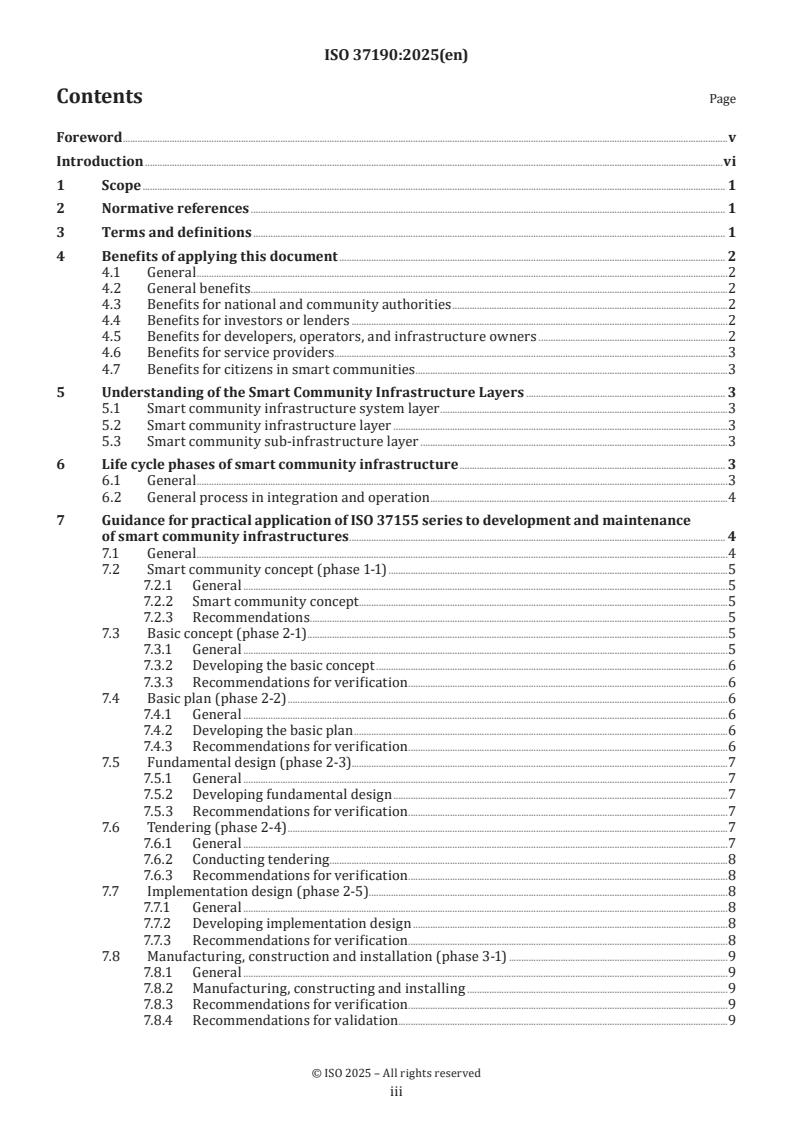
Contents Page
Foreword .v
Introduction .vi
1 Scope . 1
2 Normative references . 1
3 Terms and definitions . 1
4 Benefits of applying this document . 2
4.1 General .2
4.2 General benefits . .2
4.3 Benefits for national and community authorities .2
4.4 Benefits for investors or lenders .2
4.5 Benefits for developers, operators, and infrastructure owners .2
4.6 Benefits for service providers .3
4.7 Benefits for citizens in smart communities .3
5 Understanding of the Smart Community Infrastructure Layers . 3
5.1 Smart community infrastructure system layer .3
5.2 Smart community infrastructure layer .3
5.3 Smart community sub-infrastructure layer .3
6 Life cycle phases of smart community infrastructure . 3
6.1 General .3
6.2 General process in integration and operation .4
7 Guidance for practical application of ISO 37155 series to development and maintenance
of smart community infrastructures . 4
7.1 General .4
7.2 Smart community concept (phase 1-1) .5
7.2.1 General .5
7.2.2 Smart community concept .5
7.2.3 Recommendations.5
7.3 Basic concept (phase 2-1) .5
7.3.1 General .5
7.3.2 Developing the basic concept .6
7.3.3 Recommendations for verification .6
7.4 Basic plan (phase 2-2) .6
7.4.1 General .6
7.4.2 Developing the basic plan .6
7.4.3 Recommendations for verification .6
7.5 Fundamental design (phase 2-3).7
7.5.1 General .7
7.5.2 Developing fundamental design .7
7.5.3 Recommendations for verification .7
7.6 Tendering (phase 2-4) .7
7.6.1 General .7
7.6.2 Conducting tendering . .8
7.6.3 Recommendations for verification .8
7.7 Implementation design (phase 2-5).8
7.7.1 General .8
7.7.2 Developing implementation design .8
7.7.3 Recommendations for verification .8
7.8 Manufacturing, construction and installation (phase 3-1) .9
7.8.1 General .9
7.8.2 Manufacturing, constructing and installing .9
7.8.3 Recommendations for verification .9
7.8.4 Recommendations for validation.9
iii
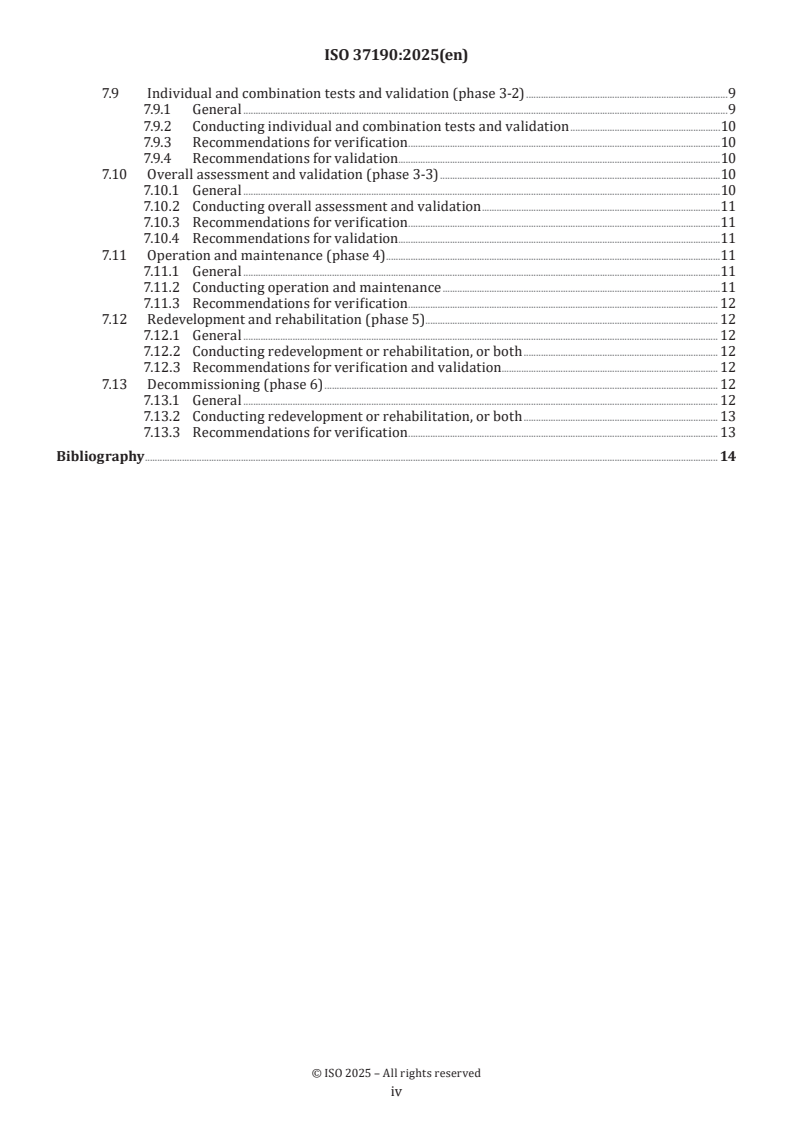
7.9 Individual and combination tests and validation (phase 3-2) .9
7.9.1 General .9
7.9.2 Conducting individual and combination tests and validation .10
7.9.3 Recommendations for verification .10
7.9.4 Recommendations for validation.10
7.10 Overall assessment and validation (phase 3-3) .10
7.10.1 General .10
7.10.2 Conducting overall assessment and validation .11
7.10.3 Recommendations for verification .11
7.10.4 Recommendations for validation.11
7.11 Operation and maintenance (phase 4) .11
7.11.1 General .11
7.11.2 Conducting operation and maintenance .11
7.11.3 Recommendations for verification . 12
7.12 Redevelopment and rehabilitation (phase 5). 12
7.12.1 General . 12
7.12.2 Conducting redevelopment or rehabilitation, or both . 12
7.12.3 Recommendations for verification and validation. 12
7.13 Decommissioning (phase 6) . 12
7.13.1 General . 12
7.13.2 Conducting redevelopment or rehabilitation, or both . 13
7.13.3 Recommendations for verification . 13
Bibliography . 14
iv
Foreword
ISO (the International Organization for Standardization) is a worldwide federation of national standards
bodies (ISO member bodies). The work of preparing International Standards is normally carried out through
ISO technical committees. Each member body interested in a subject for which a technical committee
has been established has the right to be represented on that committee. International organizations,
governmental and non-governmental, in liaison with ISO, also take part in the work. ISO collaborates closely
with the International Electrotechnical Commission (IEC) on all matters of electrotechnical standardization.
The procedures used to develop this document and those intended for its further maintenance are described
in the ISO/IEC Directives, Part 1. In particular, the different approval criteria needed for the different types
of ISO document should be noted. This document was drafted in accordance with the editorial rules of the
ISO/IEC Directives, Part 2 (see www.iso.org/directives).
ISO draws attention to the possibility that the implementation of this document may involve the use of (a)
patent(s). ISO takes no position concerning the evidence, validity or applicability of any claimed patent
rights in respect thereof. As of the date of publication of this document, ISO had not received notice of (a)
patent(s) which may be required to implement this document. However, implementers are cautioned that
this may not represent the latest information, which may be obtained from the patent database available at
www.iso.org/patents. ISO shall not be held responsible for identifying any or all such patent rights.
Any trade name used in this document is information given for the convenience of users and does not
constitute an endorsement.
For an explanation of the voluntary nature of standards, the meaning of ISO specific terms and expressions
related to conformity assessment, as well as information about ISO's adherence to the World Trade
Organization (WTO) principles in the Technical Barriers to Trade (TBT), see www.iso.org/iso/foreword.html.
This document was prepared by Technical Committee ISO/TC 268, Sustainable cities and communities,
Subcommittee SC 1, Smart community infrastructures.
Any feedback or questions on this document should be directed to the user’s national standards body. A
complete listing of these bodies can be found at www.iso.org/members.html.
v
Introduction
In the foreseeable future, urban density is likely to increase, resulting in further urbanization complexity.
From this perspective, a “smart community” approach is an important concept to address the urban
challenges by integrating different forms of infrastructures in a rational and efficient manner.
An important aspect of a smart community is integrating infrastructures as “a system of systems”. A
system of systems (SoS) is the collection of multiple, independent systems in context as part of a larger,
more complex system. A system is a group of interacting, interrelated and interdependent components that
form a complex and unified whole. In addition to that, smart community has various stakeholders including
users, and each smart community infrastructure has an extended scope lifecycle (See Figure 1). A major
benefit of a system of systems is that the sector specific performance of all infrastructures can be validated
with regard to their contribution to the overall goals of a community. As a result of this validation, these
goals can be adapted and improvement targets for each infrastructure can be derived. Thus, an intended
concept of a smart community being validated and updated through its lifecycle concerning the integration
and operation of smart community infrastructures is realized efficiently at all times.
There are three major issues in developing and operating smart community infrastructures (see Figure 2):
Element (A): allocation of specification requirements to each component of a system and validation of the
allocating procedures;
Element (B): specification requirements associated with interaction and adoption of countermeasures into
planning and operation;
Element (C): process to facilitate information sharing and communication among stakeholders.
To provide guidelines for the common framework comprised of those three elements that ISO/TR 37152
identifies, the ISO 37155 series has been developed. The series is composed of two documents, ISO 37155-1
and ISO 37155-2. ISO 37155-1 is about the element (B), providing specification requirements to manage
interactions and to adopt adequate measures into planning and operation whereas ISO 37155-2 is focusing
on the element (A), providing guidelines for specification to ensure consistency of smart community
infrastructure and to adopt adequate measures into planning and operation. The element (C), information
sharing and communication among stakeholders, is described in both documents.
More and more smart cities are being built and planned across the globe. This has increased the demand
to utilize existing guidelines and platforms to develop and operate smart cities and smart community
infrastructures efficiently and practically. Experts and government officials responsible for developing
smart cities and infrastructures, particularly in developing countries, have argued the benefits of guidelines
which enable utilizing ISO/TR 37152 and the ISO 37155 series in a practical manner.
vi
NOTE The infrastructures, stakeholders and lifecycle phases pictured in this figure are only some of the examples.
Other infrastructure, such as urban agricultural system, can also be included.
Figure 1 — Characteristics of smart community infrastructure
vii
Figure 2 — Three elements of the framework
viii
International Standard ISO 37190:2025(en)
Guidance for practical implementation of ISO 37155 series
for supervising at each life cycle phase of smart community
infrastructures
1 Scope
This document provides guidance on identifying risks that can hinder the proper functioning of smart
community infrastructures in smart cities, in accordance with the ISO 37155 guideline series, and on
implementing mitigation measures. The guidance is particularly for regulatory authorities at both national
and community supervisory levels.
Authorities can check that the adoption of appropriate measures and the assignment of specification
requirements in each component of the system is ensures in the life cycle of smart community infrastructure.
To accomplish this, the framework and perspectives on what (documents, sites, etc.) can be used to ensure
accountability for the implementation and its adequacy are presented.
The framework ensures the interactions of smart community infrastructures are managed by adequate
specification requirements and the adoption of adequate measures for planning and operation, as described
in ISO 37155-1. Additionally, it aims for consistency between different systems of smart community
infrastructures by allocating specification requirements to each component of a system and validating the
allocating procedures, as described in ISO 37155-2.
NOTE This document describes a management case (not a management system), i.e. specific processes that an
organization follows to meet specific objectives of this document.
2 Normative references
The following documents are referred to in the text in such a way that some or all of their content constitutes
requirements of this document. For dated references, only the edition cited applies. For undated references,
the latest edition of the referenced document (including any amendments) applies.
ISO 37155-1:2020, Framework for integration and operation of smart community infrastructures — Part
1: Recommendations for considering opportunities and challenges from interactions in smart community
infrastructures from relevant aspects through the life cycle
ISO 37155-2:2021, Framework for integration and operation of smart community infrastructures — Part
2: Holistic approach and the strategy for development, operation and maintenance of smart community
infrastructures
3 Terms and definitions
For the purposes of this document, the terms and definitions given in ISO 37155-1 and ISO 37155-2 apply.
ISO and IEC maintain terminology databases for use in standardization at the following addresses:
— ISO Online browsing platform: available at https:// www .iso .org/ obp
— IEC Electropedia: available at https:// www .electropedia .org/
4 Benefits of applying this document
4.1 General
This clause describes the main benefits that each stakeholder has through applying this document.
4.2 General benefits
Application of this document helps stakeholders to:
a) identify and determine required systems, and achieve higher efficiency in planning, development,
operation, and monitoring of smart cities and smart community infrastructures;
b) promote deeper understanding and practical application of facilitating the allocation and understanding
of responsibility related to the issues and activities among stakeholders identified in the ISO 37155 series;
c) achieve efficient allocation and optimization of resources such as capital, energy, material, and human
resources;
d) reduce CO2 emission and environmental load, as result of efficient allocation and optimization of energy
and material resources.
4.3 Benefits for national and community authorities
Regulators such as national and community authorities are the main target of this document. Application of
this document helps stakeholders to:
a) achieve more practicality and efficiency in planning, developing, and operating smart cities and smart
community infrastructures utilizing ISO 37155 series and related document;
b) facilitate identifying opportunities for synergies and identifying risks associated with interactions
between multiple smart community infrastructures in smart city;
c) facilitate developing regulations, which are related to infrastructure and community activities, by
utilizing risk information, for ensuring safety and security of the community;
d) utilize collaborative regulation capacity to facilitate regulatory development.
4.4 Benefits for investors or lenders
Application of this document helps stakeholders to:
a) decide to invest/loan based on identification of risks at earlier point;
b) monitor project status to watch for investment/loan control;
c) identify new investment opportunities.
4.5 Benefits for developers, operators, and infrastructure owners
Application of this document helps stakeholders to:
a) achieve high efficiency and quality of the entire smart community infrastructures;
b) facilitate effective procurement management and efficient project management by preventing reworks
due to inconsistency or mismatches among components;
c) facilitate accountability for conformity with objectives and needs for infrastructure development;
d) achieve efficient operation and maintenance of smart community infrastructures;
e) provide effective risk management from perceived hazards and disruptions;
f) cooperate in infrastructure development.
4.6 Benefits for service providers
Application of this document helps stakeholders to:
a) clarify system requirements for the service providers;
b) provide a means for efficient project management as well as accomplishing accountability for how
much the system contributes to meeting the objectives and needs for smart community infrastructures
development;
c) utilize collaborative and integrated services to enhance smart community’s efficiency.
4.7 Benefits for citizens in smart communities
Application of this document will help citizens to:
a) facilitate active engagement as an important stakeholder in planning and operating processes through,
e.g. data sharing and user data acquisition;
b) achieve cost effective smart community infrastructure financially acceptable for the users;
c) enhance the quality of life due to more effective and reliable infrastructure performance as a whole;
d) avoid disruptions to citizens’ lives when constructing smart community infrastructure, which can be
achieved by optimizing construction plans in which interactions between the construction and citizens
are considered;
e) utilize citizen investment in infrastructure development.
5 Understanding of the Smart Community Infrastructure Layers
5.1 Smart community infrastructure system layer
For the smart community infrastructure system layer, users should refer to ISO 37155-1:2020, 4.1.
5.2 Smart community infrastructure layer
For the smart community infrastructure layer, users should refer to ISO 37155-1:2020, 4.2.
5.3 Smart community sub-infrastructure layer
For the community sub-infrastructure layer, users should refer to ISO 37155-1:2020, 4.3.
6 Life cycle phases of smart com
...