

ISO 37153:2024
(Main)Smart community infrastructures — Maturity model for assessment and improvement
General Information
- Abstract
This document provides the basis, requirements and guidance for assessing the level of performance, process and interoperability of community infrastructure(s) as well as its contribution to the community using a CIMM. It also helps stakeholders set targets for improvement that will guide investment by identifying gaps in the current level of community infrastructure. This document is applicable to: a) all types of community infrastructure, including, but not limited to, energy, water, transportation, waste and ICT; b) single types of community infrastructure or multiple types of community infrastructure; c) all types of communities, regardless of geographical location, size, economic structure, or stage of economic development; d) all applicable stages of the infrastructure life cycle (e.g. planning, design, construction, operation and decommissioning). NOTE The use of natural systems, such as green infrastructure, is considered a type of infrastructure.
- Status
- Published
- Publication Date
- 22-Aug-2024
- Technical Committee
- ISO/TC 268/SC 1 - Smart community infrastructures
- Drafting Committee
- ISO/TC 268/SC 1 - Smart community infrastructures
- Current Stage
- 6060 - International Standard published
- Start Date
- 23-Aug-2024
- Due Date
- 29-Nov-2024
- Completion Date
- 23-Aug-2024


Overview
ISO 37153:2024 - Smart community infrastructures - Maturity model for assessment and improvement - defines a Community Infrastructure Maturity Model (CIMM) to assess and improve the performance, processes and interoperability of community infrastructure. Applicable to all infrastructure types (including energy, water, transportation, waste, ICT and green/natural systems), to single or multiple infrastructures, and to communities of any size or development stage, the standard supports all life‑cycle stages (planning, design, construction, operation, decommissioning).
Keywords: ISO 37153, smart community infrastructures, maturity model, CIMM, assessment, improvement, interoperability, performance metrics.
Key topics and requirements
- Community Infrastructure Maturity Model (CIMM): A phased maturity framework with five reference levels that build progressively to characterize infrastructure maturity.
- Assessment aspects: Focus on measurable performance, structured processes, and interoperability between systems and services.
- Achievement Criteria Table (ACT): A central tool populated with predefined requirements for characteristics to be achieved at each maturity level.
- Guidance for development and use: Requirements and recommendations for defining assessment purpose, identifying characteristics and setting criteria, including attributes of characteristics.
- Assessment and improvement methodology: Guidance on conducting assessments, analysing gaps, setting improvement targets and implementing continuous improvement (linked to PDCA - Plan, Do, Check, Act).
- Scope across life cycle and infrastructure types: Explicit applicability to planning through decommissioning and to natural/green infrastructure as infrastructure types.
Practical applications
ISO 37153:2024 is practical for:
- City planners and government decision‑makers assessing infrastructure priorities and guiding capital allocation.
- Infrastructure owners and operators benchmarking current performance, identifying technical priorities and improving processes.
- Suppliers and technology providers aligning products and services with maturity criteria and interoperability needs.
- Investors and financiers evaluating where investment will most effectively raise maturity and reduce life‑cycle costs.
- Community stakeholders and citizens seeking transparent, measurable improvement in service quality and accessibility.
Use cases include cross‑community comparisons, single‑community baseline vs. target assessments, gap analysis to guide investments, and integrating maturity assessment into PDCA cycles for continuous improvement.
Related standards
- ISO 37151 - Smart community infrastructures: principles and requirements for performance metrics (normative reference).
- ISO 37101, ISO 37100 - other ISO documents addressing community sustainability and related terminology referenced throughout the standard.
ISO 37153:2024 provides a structured, interoperable approach to assess and improve smart community infrastructure maturity - supporting sustainable development goals and resilient, efficient urban services.
Relations
- Revises
ISO 37153:2017 - Smart community infrastructures — Maturity model for assessment and improvement - Effective Date
- 06-Jun-2022
Get Certified
Connect with accredited certification bodies for this standard

BSI Group
BSI (British Standards Institution) is the business standards company that helps organizations make excellence a habit.

Bureau Veritas
Bureau Veritas is a world leader in laboratory testing, inspection and certification services.

DNV
DNV is an independent assurance and risk management provider.
Sponsored listings
Frequently Asked Questions
ISO 37153:2024 is a standard published by the International Organization for Standardization (ISO). Its full title is "Smart community infrastructures — Maturity model for assessment and improvement". This standard covers: This document provides the basis, requirements and guidance for assessing the level of performance, process and interoperability of community infrastructure(s) as well as its contribution to the community using a CIMM. It also helps stakeholders set targets for improvement that will guide investment by identifying gaps in the current level of community infrastructure. This document is applicable to: a) all types of community infrastructure, including, but not limited to, energy, water, transportation, waste and ICT; b) single types of community infrastructure or multiple types of community infrastructure; c) all types of communities, regardless of geographical location, size, economic structure, or stage of economic development; d) all applicable stages of the infrastructure life cycle (e.g. planning, design, construction, operation and decommissioning). NOTE The use of natural systems, such as green infrastructure, is considered a type of infrastructure.
This document provides the basis, requirements and guidance for assessing the level of performance, process and interoperability of community infrastructure(s) as well as its contribution to the community using a CIMM. It also helps stakeholders set targets for improvement that will guide investment by identifying gaps in the current level of community infrastructure. This document is applicable to: a) all types of community infrastructure, including, but not limited to, energy, water, transportation, waste and ICT; b) single types of community infrastructure or multiple types of community infrastructure; c) all types of communities, regardless of geographical location, size, economic structure, or stage of economic development; d) all applicable stages of the infrastructure life cycle (e.g. planning, design, construction, operation and decommissioning). NOTE The use of natural systems, such as green infrastructure, is considered a type of infrastructure.
ISO 37153:2024 is classified under the following ICS (International Classification for Standards) categories: 13.020.20 - Environmental economics. Sustainability. The ICS classification helps identify the subject area and facilitates finding related standards.
ISO 37153:2024 has the following relationships with other standards: It is inter standard links to ISO 37153:2017. Understanding these relationships helps ensure you are using the most current and applicable version of the standard.
ISO 37153:2024 is available in PDF format for immediate download after purchase. The document can be added to your cart and obtained through the secure checkout process. Digital delivery ensures instant access to the complete standard document.
Standards Content (Sample)
International
Standard
ISO 37153
Second edition
Smart community infrastructures —
2024-08
Maturity model for assessment and
improvement
Infrastructures communautaires intelligentes — Modèle de
maturité pour l’évaluation et l’amélioration
Reference number
© ISO 2024
All rights reserved. Unless otherwise specified, or required in the context of its implementation, no part of this publication may
be reproduced or utilized otherwise in any form or by any means, electronic or mechanical, including photocopying, or posting on
the internet or an intranet, without prior written permission. Permission can be requested from either ISO at the address below
or ISO’s member body in the country of the requester.
ISO copyright office
CP 401 • Ch. de Blandonnet 8
CH-1214 Vernier, Geneva
Phone: +41 22 749 01 11
Email: copyright@iso.org
Website: www.iso.org
Published in Switzerland
ii
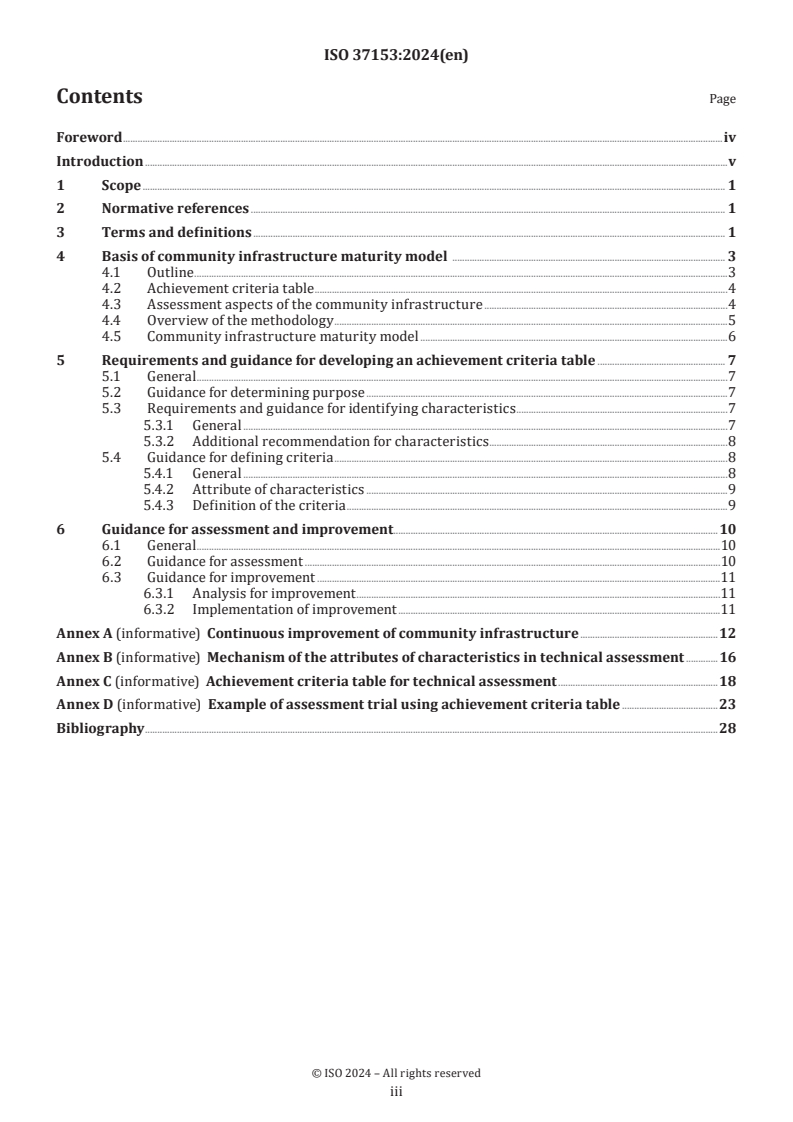
Contents Page
Foreword .iv
Introduction .v
1 Scope . 1
2 Normative references . 1
3 Terms and definitions . 1
4 Basis of community infrastructure maturity model . 3
4.1 Outline .3
4.2 Achievement criteria table .4
4.3 Assessment aspects of the community infrastructure .4
4.4 Overview of the methodology .5
4.5 Community infrastructure maturity model .6
5 Requirements and guidance for developing an achievement criteria table . 7
5.1 General .7
5.2 Guidance for determining purpose .7
5.3 Requirements and guidance for identifying characteristics .7
5.3.1 General .7
5.3.2 Additional recommendation for characteristics .8
5.4 Guidance for defining criteria .8
5.4.1 General .8
5.4.2 Attribute of characteristics .9
5.4.3 Definition of the criteria .9
6 Guidance for assessment and improvement . 10
6.1 General .10
6.2 Guidance for assessment .10
6.3 Guidance for improvement .11
6.3.1 Analysis for improvement .11
6.3.2 Implementation of improvement .11
Annex A (informative) Continuous improvement of community infrastructure .12
Annex B (informative) Mechanism of the attributes of characteristics in technical assessment .16
Annex C (informative) Achievement criteria table for technical assessment .18
Annex D (informative) Example of assessment trial using achievement criteria table .23
Bibliography .28
iii
Foreword
ISO (the International Organization for Standardization) is a worldwide federation of national standards
bodies (ISO member bodies). The work of preparing International Standards is normally carried out through
ISO technical committees. Each member body interested in a subject for which a technical committee
has been established has the right to be represented on that committee. International organizations,
governmental and non-governmental, in liaison with ISO, also take part in the work. ISO collaborates closely
with the International Electrotechnical Commission (IEC) on all matters of electrotechnical standardization.
The procedures used to develop this document and those intended for its further maintenance are described
in the ISO/IEC Directives, Part 1. In particular, the different approval criteria needed for the different types
of ISO document should be noted. This document was drafted in accordance with the editorial rules of the
ISO/IEC Directives, Part 2 (see www.iso.org/directives).
ISO draws attention to the possibility that the implementation of this document may involve the use of (a)
patent(s). ISO takes no position concerning the evidence, validity or applicability of any claimed patent
rights in respect thereof. As of the date of publication of this document, ISO had not received notice of (a)
patent(s) which may be required to implement this document. However, implementers are cautioned that
this may not represent the latest information, which may be obtained from the patent database available at
www.iso.org/patents. ISO shall not be held responsible for identifying any or all such patent rights.
Any trade name used in this document is information given for the convenience of users and does not
constitute an endorsement.
For an explanation of the voluntary nature of standards, the meaning of ISO specific terms and expressions
related to conformity assessment, as well as information about ISO's adherence to the World Trade
Organization (WTO) principles in the Technical Barriers to Trade (TBT), see www.iso.org/iso/foreword.html.
This document was prepared by Technical Committee ISO/TC 268, Sustainable cities and communities,
Subcommittee SC 1, Smart community infrastructures.
This second edition cancels and replaces the first edition (ISO 37153:2017), which has been technically
revised.
The main changes are as follows:
— Annexes B, C, and D replaced Annexes A, B, and C to the first edition.
Any feedback or questions on this document should be directed to the user’s national standards body. A
complete listing of these bodies can be found at www.iso.org/members.html.
iv
Introduction
The United Nations (UN) sustainable development agenda, “Transforming Our World: The 2030 Agenda
for Sustainable Development”, adopted in 2015, aims to end poverty, promote prosperity and well-being,
while reducing environmental impact by 2030. It includes 17 Sustainable Development Goals (SDGs), of
which Goal 11 focuses on “Make cities inclusive, safe, resilient and sustainable”. As cities and communities
grow, they face challenges in meeting the needs of citizens in an equitable and sustainable way. The
demand for community infrastructure(s) such as energy, water, transportation, waste and information and
communication technology (ICT) will increase with the growth of urban populations and urbanization.
Appropriate development of community infrastructure(s) is crucial to support the operations and activities
of communities to overcome urban challenges and make progress towards achieving the SDGs. It also needs
to be economically efficient and aims to reduce the environmental impact of urban activities.
For the efficient development of community infrastructure(s) and continuous performance improvement,
communities can benefit from a tool that measures the current level of maturity of the community
infrastructure(s) relative to the desired future improvements. In this context, a maturity model is widely
recognized as an efficient and effective tool. This model describes the necessary practices and processes at
each level to achieve the desired level of performance in a reliable and sustainable manner. For example, the
capability maturity model (CMM) presented in the ISO/IEC 15504 series provides this function in software
development. Documents such as ISO 18091 and ISO 37101 also promote a CMM-like framework for local
governments or communities.
This document provides the basis, requirements and guidance for assessment and improvement of
community infrastructure(s) using a community infrastructure maturity model (CIMM). The CIMM assesses
the level of performance, process and interoperability of the community infrastructure(s) as well as its
contribution to the community. It also helps stakeholders set improvement targets to guide investment by
identifying gaps in the current level of community infrastructure.
The CIMM can be expressed conceptually as a series of levels, each building on the previous one as shown in
Figure 1. See Clauses 4 and 5 for more information.
Figure 1 — Conceptual expression of CIMM
Decisions are made on the basis of a systematic overall picture of the characteristics of the community
infrastructure in order to promote continuous improvement. The CIMM is a systematic assessment
framework that includes the five reference levels of maturity for each of the community infrastructure
characteristics.
An assessment using the CIMM can be used to compare different communities, but can also be used to
compare the current and future state of infrastructure in a single community by defining the object and
scope of the assessment. For example, see Annex A for an overview of the “Plan-Do-Check-Action (PDCA)”
cycle for developing community infrastructure(s), where this document is particularly helpful in the “Plan”
v
and “Check” phases. This document can help users assess current levels of performance, process and
interoperability, and to monitor progress towards achieving desired improvements.
More specifically, this document supports the following stakeholders:
— citizens:
— to improve their quality of life;
— to make community infrastructure accessible for a wide range of people, regardless of their individual
language, disability, etc.;
— owners of community infrastructure:
— to identify which performance characteristics of the infrastructure should be prioritized;
— to identify what technical performance aspects should be prioritized for improvement;
— suppliers of community infrastructure:
— to determine which community infrastructure products meet the specified requirements;
— to identify a direction for the development of future community infrastructure products and
services;
— operators of community infrastructure:
— to determine the current level of performance of the community infrastructure they operate;
— to determine the appropriate processes to improve performance;
— investors:
— to determine which types of infrastructure investment will best achieve the desired level of
performance;
— city planners or government decision makers:
— to assess city planning and identify infrastructure priorities;
— all stakeholders:
— to ensure that investment in community infrastructure maximizes performance and minimizes life
cycle costs;
— to promote the harmonization of the needs of residents, community managers and the environment;
— to promote the sustainable development and community resilience.
vi
International Standard ISO 37153:2024(en)
Smart community infrastructures — Maturity model for
assessment and improvement
1 Scope
This document provides the basis, requirements and guidance for assessing the level of performance, process
and interoperability of community infrastructure(s) as well as its contribution to the community using a
CIMM. It also helps stakeholders set targets for improvement that will guide investment by identifying gaps
in the current level of community infrastructure.
This document is applicable to:
a) all types of community infrastructure, including, but not limited to, energy, water, transportation, waste
and ICT;
b) single types of community infrastructure or multiple types of community infrastructure;
c) all types of communities, regardless of geographical location, size, economic structure, or stage of
economic development;
d) all applicable stages of the infrastructure life cycle (e.g. planning, design, construction, operation and
decommissioning).
NOTE The use of natural systems, such as green infrastructure, is considered a type of infrastructure.
2 Normative references
The following documents are referred to in the text in such a way that some or all of their content constitutes
requirements of this document. For dated references, only the edition cited applies. For undated references,
the latest edition of the referenced document (including any amendments) applies.
ISO 37151, Smart community infrastructures — Principles and requirements for performance metrics
3 Terms and definitions
For the purposes of this document, the following terms and definitions apply.
ISO and IEC maintain terminology databases for use in standardization at the following addresses:
— ISO Online browsing platform: available at https:// www .iso .org/ obp
— IEC Electropedia: available at https:// www .electropedia .org/
3.1
maturity model
model derived from one or more specified assessment model(s), that identifies the set of phased development
or progress levels showing the assessment categories for community infrastructure(s)
3.2
maturity level
point on an ordinal scale of community infrastructure maturity that characterizes the maturity of the
community infrastructure assessed within the scope of the maturity model used
3.3
impact
change to the economy, environment and other community issues, either adverse or beneficial, resulting
from community infrastructure(s)
3.4
achievement criteria table
ACT
table populated with predefined requirements for characteristics to be achieved at each maturity level, as
specified in the community infrastructure maturity model (CIMM)
3.5
community infrastructure maturity model
CIMM
maturity model applied to community infrastructure, which defines maturity levels in order to assess the
level of maturity of community infrastructure
3.6
performance
measurable result
Note 1 to entry: Performance can relate to either quantitative or qualitative findings.
Note 2 to entry: Performance can relate to the management of activities, processes, products (including strategies,
programmers, projects, plans and services), systems or organizations.
[SOURCE: ISO 37101:2016, 3.29]
3.7
process
series of actions or events taking place in a defined manner leading to the accomplishment of an expected result
Note 1 to entry: “Defined” in this context does not necessarily mean documented. A defined process includes, but is not
limited to, adaptive means.
[SOURCE: ISO/IEC 15944-1:2011, 3.53, modified — Note 1 to entry has been added.]
3.8
interoperability
ability of systems to provide services to and accept services from other systems and to use the services so
exchanged to enable them to operate effectively together
Note 1 to entry: “Systems” in this context means community infrastructures.
Note 2 to entry: “Services” in this context includes information such as data and knowledge.
[SOURCE: ISO 21007-1:2005, 2.30, modified — Notes 1 and 2 to entry have been added.]
3.9
community
group of people with an arrangement of responsibilities, activities and relationships
Note 1 to entry: In many, but not all, contexts, a community has a defined geographical boundary.
Note 2 to entry: A city is a type of community.
[SOURCE: ISO 37100:2016, 3.2.2]
3.10
community infrastructure
system of facilities, equipment and services that support the operations and activities of communities
Note 1 to entry: Such community infrastructures include, but are not limited to, energy, water, transportation, waste
and information and communication technologies (ICT).
[SOURCE: ISO 37100:2016, 3.6.1]
3.11
smart community infrastructure
community infrastructure with enhanced technological performance that is designed, operated, and
maintained to contribute to sustainable development and resilience of the community
[SOURCE: ISO 37151:2024, 3.3]
3.12
sustainable development
development that meets the environmental, social and economic needs of the present without compromising
the ability of future generations to meet their own needs
Note 1 to entry: Derived from the Brundtland Report.
[SOURCE: ISO Guide 82:2019, 3.2]
3.13
life cycle
consecutive and interlinked stages of a product system, from raw material acquisition or generation from
natural resources to final disposal
[SOURCE: ISO 14044:2006, 3.1]
3.14
metric
defined measurement method and the measurement scale
[SOURCE: ISO 37100:2016, 3.5.2]
3.15
characteristic
distinguishing feature
[SOURCE: ISO 17566:2011, 2.2]
4 Basis of community infrastructure maturity model
4.1 Outline
This document provides requirements and guidance for the development of a methodology to assess the
performance, process and interoperability of community infrastructure(s) and their contribution to
community-wide priorities in relation to five maturity levels based on the CIMM. This methodology is also
used to identify improvement points for the levels.
For this purpose, an achievement criteria table (ACT) shall be developed and utilized.
Clause 4 provides an overview of the whole methodology, including definitions and requirements. Clause 5
specifies how to develop the ACT. Clause 6 specifies how to utilize the table for assessment and improvement.
4.2 Achievement criteria table
The ACT comprises:
— characteristics to assess their attributes, i.e., performance, process and interoperability of the community
infrastructure(s) or their contribution to the community;
— objectives justifying the inclusion of each characteristic;
— five levels of maturity for each characteristic;
— descriptions or definitions of the criteria for the characteristics that define each level.
The CIMM provides reference maturity levels for the community infrastructure(s). See 4.5 and 5.4.3 for
details.
Table 1 outlines the basic structure of an ACT. Note that this basic structure can be customized to meet
the needs of each assessment. An example of a customized ACT structure for the assessment of community
infrastructure(s) is provided in Annex C. Annex D then provides an example of an assessment trial using the
ACT structure from Annex C.
Table 1 — Basic structure of an ACT
Characteristics Objectives Level
1 2 3 4 5
CH1 Objective of CH1 Def. Def. Def. Def. Def.
CH2 Objective of CH2 Def. Def. Def. Def. Def.
CH3 Objective of CH3 Def. Def. Def. Def. Def.
… … … … … … …
Key
“CH1”: characteristic 1.
“CH2”: characteristic 2.
“CH3”: characteristic 3.
“Def.”: definition. Represents a description of the criteria for the characteristics to be met at each level of the CIMM. These
definitions can be expressed in quantitative, qualitative or descriptive measures.
4.3 Assessment aspects of the community infrastructure
This document provides two aspects for the assessment of the community infrastructure(s).
— Technical assessment: Assessment of the performance, process and interoperability of the community
infrastructure(s), e.g. the capacity of a power generation plant.
— Contribution assessment: Assessment of the contribution of the community infrastructure(s) to
community-wide priorities, e.g. the unemployment rate of a community affected by a road construction
project.
A technical assessment can be useful as an assessment tool for operators, supervisory authorities and
community infrastructure vendors.
A contribution assessment can be useful as an assessment tool for government decision-makers and
development agencies.
Table 2 outlines the conceptual relationship between the two assessment aspects. It is a modified version of
ISO 37151:2024, Table 1.
NOTE 1 For details of the relationship between community issues and community infrastructure performance, see
ISO 37151:2024, 5.3.
NOTE 2 Annex B provides a detailed description of the technical assessment. Many stakeholders show more interest
in the technical assessment than the contribution assessment. This is because a contribution assessment takes longer
to measure complex causal relationships, which involves data collection and data analysis.
NOTE 3 Community issues are the challenges facing the community. The issues and their prioritization vary
between different communities.
Table 2 — Relationship between the two assessment aspects
Technical assess- Contribution assessment
ment
Characteristics Impact 1 Impact 2 […] Impact N
(e.g. gross product of (e.g. (any other impacts)
a community) unemployment rate of
a community)
Characteristic A *** *
(e.g. capacity of ser-
vices)
Characteristic B ** **
(e.g. investment effi-
ciency of services)
[…]
Characteristic N * ***
(any other character-
istics)
NOTE 1 The number of “*” indicates the degree of relationship between each characteristic listed in the row and impact listed in
the column. “***” means largely relevant, “**” means relevant, “*” means slightly relevant, and a blank means not relevant.
NOTE 2 The empty row and column marked with [.] indicate that there can be more characteristics and impacts up to any value
of N.
4.4 Overview of the methodology
The methodology involves the development of:
— an ACT;
— a procedure for assessing the target community infrastructure(s);
— a procedure for improving the maturity level of the target community infrastructure.
Figure 2 provides an overview of the methodology (see Clauses 5 and 6 for details). An assessment and
improvement procedure is described in Clause 6.
Key
a
Improvement measures for filling the gaps. IO2 interoperability characteristic 2
PF1 performance characteristic 1 IO3 interoperability characteristic 3
PF2 performance characteristic 2 Def definition, see Table 1
PF3 performance characteristic 3 L1 maturity level 1
PR1 process characteristic 1 L2 maturity level 2
PR2 process characteristic 2 L3 maturity level 3
PR3 process characteristic 3 L4 maturity level 4
IO1 interoperability characteristic 1 L5 maturity level 5
Figure 2 — Overview of the methodology
4.5 Community infrastructure maturity model
The CIMM provides an overall picture of the maturity of the community infrastructure(s) with five reference
levels. Table 3 provides general definitions and descriptions of the maturity levels in the CIMM.
NOTE Each level assumes that the requirements of the lower levels have been fulfilled.
Table 3 — General definition of the CIMM
Level Definition Description
5 Sustainably optimizing Continuously improving to satisfy future needs
4 Improving Partially beginning to fulfil future needs
3 Fulfilled Satisfies current needs in a defined manner
2 Partially fulfilled Needs are identified but not satisfied
1 Initial Not yet started
5 Requirements and guidance for developing an achievement criteria table
5.1 General
To develop an ACT, the following steps should be taken:
a) determining the purpose, assessment aspect and target community infrastructure(s);
b) selecting characteristics that fit the purpose (see 5.3 for details);
c) defining the characteristics for each of the five maturity levels in accordance with the CIMMs (see 5.4
for details);
d) organizing the characteristics and the maturity levels into a table.
Once the ACT has been developed, the table may be used for different assessment needs.
The selection of the target infrastructure(s) may range from a single infrastructure to multiple
infrastructures.
5.2 Guidance for determining purpose
To determine the purpose of the assessment, the following steps should be taken:
a) identifying the target community (e.g. city, state, nation or region);
b) identifying and prioritizing the community issues in the target community (e.g. unemployment, poverty
or congestion);
c) identifying and analysing the relevant community infrastructure(s) and their impact on the prioritized
community issues;
d) defining the purpose of the assessment and the improvement of the community infrastructure(s) by
addressing the community issues identified in b) in the community identified in a).
In order to prioritize community issues, depending on the target community, the following may be referred to:
— for a nation, the SDGs or a specific national development plan;
— for a region, the SDGs or a specific regional development plan;
— for a city, the SDGs or a specific urban development plan.
5.3 Requirements and guidance for identifying characteristics
5.3.1 General
The characteristics of the community infrastructure(s) shall be selected in accordance with the purpose of
the assessment and the aspect to be assessed.
For a technical assessment of the community infrastructure(s), technical characteristics shall be selected in
accordance with the requirements given in ISO 37151.
For a contribution assessment, community-wide characteristics (preferably indicators or metrics) with
societal benefits shall be selected, taking into account the overall functioning of multiple community
infrastructures.
For such characteristics, the SDGs or the national development goals of each nation should be consulted.
Additional characteristics can be derived from regulations, industry standards and specifications.
Table 4 outlines an example of how to identify the characteristics.
Table 4 — Example of how to identify characteristics
Purpose Key stakeholders Key stakeholders’ cate- Characteristics Objectives of
gories of needs characteristics
Assessment and im- Citizens (e.g. residents), Availability, accessibility, Characteristic 1 Objective 1
provement of maturity owners, sponsors, affordability, economic
Characteristic 2 Objective 2
of the target community planners, operators, and efficiency, maintainabil-
… …
infrastructures (e.g. suppliers ity, resilience, mitigation
energy, water, transpor- of climate change, and,
tation, waste, and ICT) conservation of ecosys-
tem
5.3.2 Additional recommendation for characteristics
In order to assist users in selecting appropriate characteristics to define the maturity level classification, a
characteristic should:
— be a metric, i.e. measurable through monitoring, surveying or some other type of assessment method;
— be easy to use for scoring (“YES/NO” or other “either/or” classifications should be avoided as they are
difficult to place on a five-level scale);
— allow for the ability to obtain accurate and precise results.
NOTE Reviewing and revising the selected characteristics on the basis of practical verification can help users
continuously improve characteristics, which can then better meet their needs.
5.4 Guidance for defining criteria
5.4.1 General
Descriptions of the criteria for the five different maturity levels should be developed for each identified
characteristic in accordance with the general descriptions given in the following subclauses. These
descriptions should be compiled in the ACT.
To define the maturity levels, the following steps should be taken:
a) classifying each identified characteristic into one of three attributes: performance, process or
interoperability (see 5.4.2 for details);
NOTE 1 It can be inappropriate to develop characteristics for all three attributes.
b) developing the five-level criteria for each characteristic based on the reference CIMM for each
classification (see 5.4.3 for details).
NOTE 2 The classification of the attributes depends on the identified community issues (see 5.2), such as the
interoperability of water infrastructure.
5.4.2 Attribute of characteristics
When developing an ACT for community infrastructure(s), maturity levels should be defined according to
the characteristics of their attributes, i.e., performance, process and interoperability.
Performance characteristics are those used to assess the performance of the community infrastructure(s),
for example:
— the level of maturity of the community infrastructure service;
— the effect on the environment or other aspects of the community directly attributable to the operation of
the infrastructure.
Process characteristics are those used to assess, for example:
— the levels of maturity of process for the community infrastructure such as introduction, maintenance
and operation carried out by community managers, administrators, or operators;
— the activities for planning, managing and monitoring community infrastructure services.
Interoperability characteristics are those used to assess how well different infrastructure elements can
work together or support each other, for example:
— the cooperation, alignment and harmonization of multiple community infrastructures;
— the cooperation, alignment and harmonization of infrastructure services, as well as the various services
and issues within a community;
— relationships with other communities.
5.4.3 Definition of the criteria
5.4.3.1 General
The five-level criteria of maturity levels should be defined for each characteristic, depending on its attribute
(see 5.4.3.2 for details).
In addition, this guidance should be used in developing the characteristics for all attributes:
— If it is difficult to describe a criterion with a single constant value, variables should be utilized.
— If a characteristic is not clearly classifiable as either performance, process or interoperability, it should
be designated to the classification most appropriate to the purpose of the assessment.
5.4.3.2 Maturity levels by attributes of characteristics
Depending on the attribute, the five-level criteria for each characteristic should be developed on the basis of
the CIMM given in Tables 5, 6 and 7 for each attribute.
Tables 5, 6 and 7 correspond to the CIMM for performance, process and interoperability characteristics,
respectively. In these tables, “needs” includes both the technical and the contribution assessment aspects.
NOTE Annex C provides examples of practical criteria for the description of the five reference levels, focusing
on the technical assessment, which are developed on the basis of Tables 5, 6, and 7, and insights gained from some
assessment trials.
The CIMM for performance characteristics is defined in Table 5, which is derived from the general CIMM in
Table 3.
Table 5 — CIMM for performance characteristics
Level Definition Description
5 Sustainably opti- Satisfies quality and capacity for future needs
mizing
4 Improving Under development to satisfy future needs
3 Fulfilled Satisfies quality and capacity for current needs
2 Partially fulfilled Physically functioning but does not satisfy current needs
1 Initial No functioning infrastructure
The CIMM for process characteristics is defined in Table 6, which is derived from the general CIMM in Table 3.
Table 6 — CIMM for process characteristics
Level Definition Description
5 Sustainably opti- Procedures for continuous improvement of processes are implemented with appro-
mizing priate resources (e.g. human, financial and natural resources)
4 Improving Processes are implemented quantitatively
3 Defined Processes are defined and implemented
2 Managed Process needs are identified but processes are not defined
1 Initial No established processes
The CIMM for interoperability characteristics is defined in Table 7, which is derived from the general CIMM
in Table 3.
Table 7 — CIMM for interoperability characteristics
Level Definition Description
5 Sustainably opti- Continuous improvement of interoperability is in place
mizing
4 Improving Common platform for achieving interoperability is established
3 Fulfilled Connection and collaboration needs are defined and established across community
infrastructures
2 Assessed Connection and collaboration needs are assessed but not defined across community
infrastructures
1 Initial Infrastructures are operated independently
6 Guidance for assessment and improvement
6.1 General
This clause provides guidance on assessing the maturity of the target community infrastructure(s) with an
ACT, as well as improving the performance, process and interoperability of community infrastructure(s)
and their contribution to community-wide priorities.
6.2 Guidance for assessment
For assessment, the following procedures should be taken at a minimum:
a) preparing necessary document(s), e.g. an analysis of policies relevant to the target community
infrastructure(s) or records of the current situation of the target community infrastructure(s);
b) selecting an appropriate ACT in accordance with Clause 5 or the target infrastructure(s);
c) assessing the target community infrastructure(s) according to each characteristic in the ACT and
categorizing them into the appropriate assessment level;
d) recording the results of the assessment.
If no ACTs exist, an appropriate ACT should be created in accordance with Clause 5.
6.3 Guidance for improvement
6.3.1 Analysis for improvement
For improvement, the following procedures should be taken:
a) setting a target level for each characteristic desired to be improved;
b) identifying and analysing the gaps between the target level and the assessed current situation;
c) developing a plan or measures to close the gaps and achieve the target level.
Procedures based on the PDCA cycle described in Annex A should be implemented periodically.
NOTE The same ACT is used for assessment and improvement. The metric that indicates the target for
improvement can be the whole indicator, a part of an indicator or a group of indicators. This depends on the future
vision of the community infrastructure(s).
In developing an improvement plan, the feasibility, operability and effect of the plan should be evaluated. A
benchmark to judge if the plan has been successfully implemented should also be included in the plan. The
effect should be compared to the cost of the plan.
6.3.2 Implementation of improvement
There are various means for implementing the improvement plans, such as:
— improving the performance characteristics by either replacing or repairing the hardware or physical
equipment;
— improving the process characteristics by implementing an advanced maintenance activity based on the
data monitoring, which serves to extend the life cycle of community infrastructure(s);
— improving the interoperability characteristics by enhancing data sharing and practical use between
different types of infrastructure.
After the implementation of the improvement plan, an evaluation should be carried out to verify that the
desired effect has been achieved.
Documents detailing the improvement plan at each assessment stage should be retained for future analysis.
NOTE Annex A provides a basic example of practical implementation for continuous improvement of community
infrastructure(s).
Annex A
(informative)
Continuous improvement of community infrastructure
A.1 General
This annex provides a basic overview of the practical implementation of continuous improvement of
community infrastructure(s), which consists of two methodologies.
a) CIMM: A tool to determine the current level and the target level of the community infrastructure(s), i.e.
used to define “AS-IS” and “TO-BE”.
b) PDCA cycle: A tool for continuous improvement from the current maturity level to the target maturity
level, i.e. used to show “HOW-TO”.
Understanding the relationship between the CIMM and the PDCA cycle helps users to implement the
continuous improvement activities effectively and efficiently.
A.2 The PDCA cycle and the community infrastructure maturity model
A.2.1 PDCA cycle
ISO 9001, a quality management standard, defines the PDCA cycle. This cycle can be described as the
following steps when applied to the community infrastructure(s) for a continuous improvement activity:
— Plan: Establishing objectives and making a plan for delivering results in accordance with the desired
performance of the community infrastructure(s).
— Do: Carrying out the activities defined in the plan.
— Check: Monitoring and measuring processes against the performance of the community infrastructure(s)
and verifying that the process has achieved the desired results.
— Act: Extracting key points for improving the performance of the infrastructure(s) and taking action.
The PDCA cycle can be used to continuously improve the suitability, adequacy and effectiveness of the
community infrastructure(s) and, ultimately, to upgrade the maturity level of the infrastructure(s).
A.2.2 Community infrastructure maturity model
A CIMM is usually designed as a tool to serve three purposes.
— Descriptive purpose: Used to assess the current maturity level of the community infrastructure.
— Prescriptive purpose: Indicates how to identify the desired maturity level for the community
infrastructure.
— Comparative purpose: Based on benchmark results.
A.2.3 Relationship between the PDCA cycle and the community infrastructure maturity model
The relationship between the PDCA cycle and the CIMM can be described as follows:
— The PDCA cycle is an iterative, four-step, performance improvement method to increase maturity levels.
— A CIMM is an assessment tool which is used to assess community infrastructure(s) based on five maturity
levels. It can be used to set the right target level, identify the gap and decide how much the metrics should
be improved.
— Repeating the PDCA cycle leads to continuous improvement and upgrading of the maturity level of the
community infrastructure(s).
Figure A.1 shows an example of how to use the PDCA cycle to improve the maturity level of the community
infrastructure(s).
Key
Plan E.g. determine the well-suited maturity level for the target infrastructure(s).
E.g. help identify the minimum resources needed to get the maximum results for the desired maturity level.
Do E.g. construction and rebuilding of infrastructure(s).
Check E.g. check if the improved infrastructure(s) has reached the desired maturity level by monitoring and
measurement.
E.g. help detect the weakness in the infrastructure(s).
Action E.g. improvement action including updating equipment, conducting repairs, introducing advanced maintenance
technologies, and providing human training.
NOTE Each ellipse represents one level of maturity.
Figure A.1 — PDCA cycle for improvement activities
A.3 How to use the PDCA cycle for improvement activities
A.3.1 Procedures
The following is a general procedure for using the PDCA cycle to improve activities for community
infrastructure(s):
a) identifying the weaknesses of the target infrastructure(s) based on an ACT;
b) identifying which infrastructure(s) performance needs to be improved based on the ACT;
c) defining what changes will lead to effective improvement for users’ needs;
d) modifying actions to facilitate improvement;
e) verifying if the actions are appropriate.
A.3.2 Implementation of the PDCA cycle
A.3.2.1 Focus on the changes
All improvement requires change. The ability to develop, test and implement change is necessary for
performance improvement.
The following actions can be taken when implementing the PDCA cycle for change:
— using substitution;
— finding and removing bottlenecks;
— using automation;
— using proper measurements;
— focusing on the core processes and purposes;
— coaching operators to improve their operational ability;
— optimizing maintenance;
— improving predictions.
A.3.2.2 Data collection
A better understanding of the objectives of data collection makes it easier to reach consensus among
stakeholders.
Data collection consists of the following:
— developing a collection strategy, methods and tools prior to data collection;
— developing a plan with detailed steps for collecting each data element;
— validating the data
...