

ISO 37173:2023
(Main)Smart community infrastructure — Guidance for the development of smart building information systems
General Information
- Abstract
This document provides guidance for the development of smart building information systems as part of the infrastructure of smart communities. It does not include civil engineering and construction processes.
- Status
- Published
- Publication Date
- 02-Oct-2023
- Technical Committee
- ISO/TC 268/SC 1 - Smart community infrastructures
- Current Stage
- 6060 - International Standard published
- Start Date
- 03-Oct-2023
- Due Date
- 07-Nov-2023
- Completion Date
- 03-Oct-2023


Overview - ISO 37173:2023 (Smart community infrastructure)
ISO 37173:2023 provides guidance for the development of smart building information systems (SBIS) as part of smart community infrastructure. The standard focuses on information architecture, data management, security and privacy, and subsystem interconnection for smart buildings. It explicitly excludes civil engineering and construction processes and is intended as a reference for governments, enterprises, organizations and individuals responsible for developing SBIS.
Key topics and technical requirements
- Principles: Emphasizes four core principles - reliability, trustworthiness, maintainability, and security - as foundations for SBIS design and operation.
- System recommendations: Calls for design features such as extensibility, stability, security, operability, maintainability, and compatibility for long-term, resilient deployments.
- Layers and subsystems: Recommends a layered SBIS architecture including the physical sensing layer (equipment records, spare parts), application layer, and interaction layer, plus subsystem interconnection.
- Visualization and data compression: Addresses fidelity requirements and trade-offs when compressing and visualizing building data to balance accuracy and bandwidth/storage.
- Data security: Provides principles and measures for protecting data and service actors, threat identification, and safe operation and maintenance.
- Data privacy: Defines privacy strategy, governance, accountability, notification and procedural requirements for handling personal and sensitive information.
- Use cases: Supports building operation & management, data exchange with smart communities, monitoring (mobility, energy, environment, security), decision support and emergency management (e.g., integration with a city-wide ISAC).
Practical applications and who uses ISO 37173
- Building owners and facility managers: Improve operations, preventive maintenance, and energy efficiency through structured SBIS design.
- System integrators and vendors: Design interoperable, extensible platforms that integrate sensors, BMS, access control and analytics.
- City planners and smart city program managers: Align building systems with broader smart community infrastructures and situational awareness centers.
- IT, cybersecurity and data governance teams: Implement data security and privacy controls, threat identification and operational resilience.
- Consultants and standards professionals: Use the guidance to specify requirements, procurement criteria and governance policies.
Related standards (if applicable)
- ISO 37173 is developed by ISO/TC 268 (Sustainable cities and communities).
- The document references terminology and concepts consistent with other ISO work (for example, ISO 16781:2021 for fidelity definitions).
- Note: ISO 37173:2023 contains no normative references; it is intended as guidance rather than a prescriptive technical specification.
Keywords: ISO 37173, smart building information systems, smart community infrastructure, data security, data privacy, system architecture, subsystems, visualization, data compression, maintainability, interoperability.
Get Certified
Connect with accredited certification bodies for this standard

BSI Group
BSI (British Standards Institution) is the business standards company that helps organizations make excellence a habit.

Bureau Veritas
Bureau Veritas is a world leader in laboratory testing, inspection and certification services.

DNV
DNV is an independent assurance and risk management provider.
Sponsored listings
Frequently Asked Questions
ISO 37173:2023 is a standard published by the International Organization for Standardization (ISO). Its full title is "Smart community infrastructure — Guidance for the development of smart building information systems". This standard covers: This document provides guidance for the development of smart building information systems as part of the infrastructure of smart communities. It does not include civil engineering and construction processes.
This document provides guidance for the development of smart building information systems as part of the infrastructure of smart communities. It does not include civil engineering and construction processes.
ISO 37173:2023 is classified under the following ICS (International Classification for Standards) categories: 13.020.20 - Environmental economics. Sustainability. The ICS classification helps identify the subject area and facilitates finding related standards.
ISO 37173:2023 is available in PDF format for immediate download after purchase. The document can be added to your cart and obtained through the secure checkout process. Digital delivery ensures instant access to the complete standard document.
Standards Content (Sample)
INTERNATIONAL ISO
STANDARD 37173
First edition
2023-10
Smart community infrastructure —
Guidance for the development of
smart building information systems
Infrastructures urbaines intelligentes — Lignes directrices pour le
développement du système d'information des bâtiments intelligents
Reference number
© ISO 2023
All rights reserved. Unless otherwise specified, or required in the context of its implementation, no part of this publication may
be reproduced or utilized otherwise in any form or by any means, electronic or mechanical, including photocopying, or posting on
the internet or an intranet, without prior written permission. Permission can be requested from either ISO at the address below
or ISO’s member body in the country of the requester.
ISO copyright office
CP 401 • Ch. de Blandonnet 8
CH-1214 Vernier, Geneva
Phone: +41 22 749 01 11
Email: copyright@iso.org
Website: www.iso.org
Published in Switzerland
ii
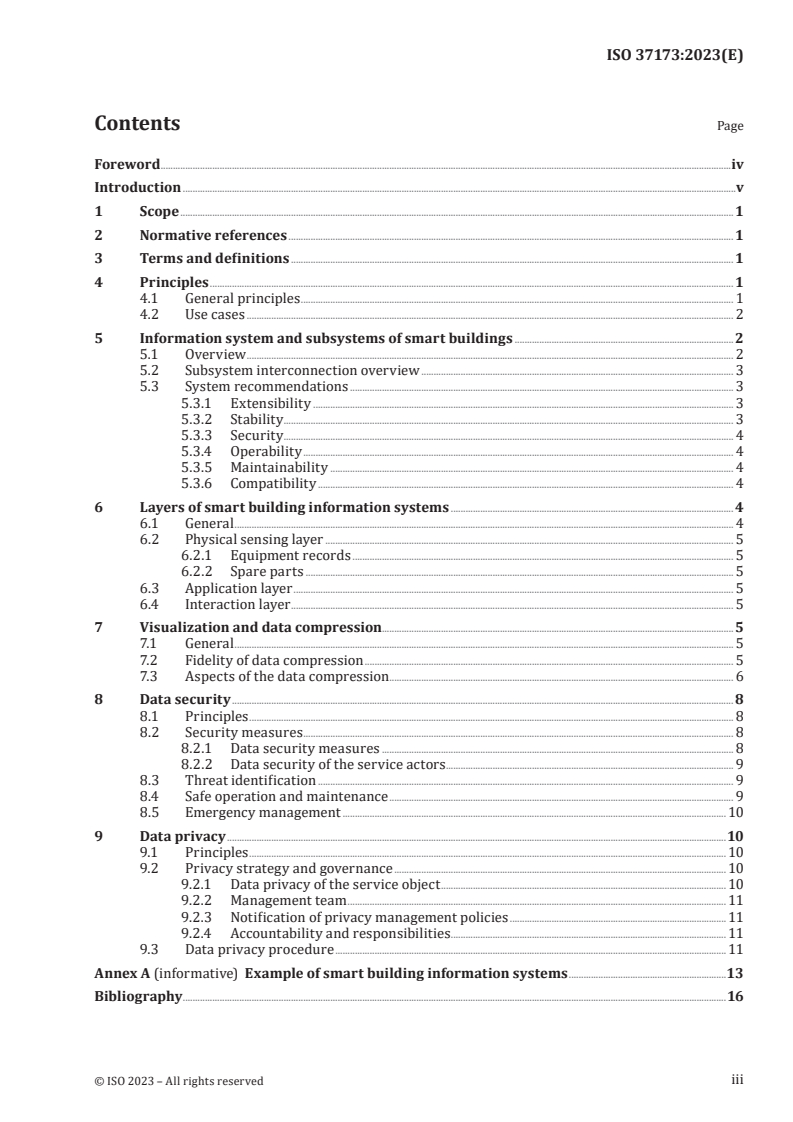
Contents Page
Foreword .iv
Introduction .v
1 Scope . 1
2 Normative references . 1
3 Terms and definitions . 1
4 Principles . 1
4.1 General principles . 1
4.2 Use cases . 2
5 Information system and subsystems of smart buildings . 2
5.1 Overview . 2
5.2 Subsystem interconnection overview . 3
5.3 System recommendations . 3
5.3.1 Extensibility . 3
5.3.2 Stability . 3
5.3.3 Security . . . 4
5.3.4 Operability . 4
5.3.5 Maintainability . 4
5.3.6 Compatibility . 4
6 Layers of smart building information systems . 4
6.1 General . 4
6.2 Physical sensing layer . 5
6.2.1 Equipment records . 5
6.2.2 Spare parts . 5
6.3 Application layer . 5
6.4 Interaction layer . 5
7 Visualization and data compression.5
7.1 General . 5
7.2 Fidelity of data compression . 5
7.3 Aspects of the data compression . 6
8 Data security . 8
8.1 Principles . 8
8.2 Security measures . 8
8.2.1 Data security measures . 8
8.2.2 Data security of the service actors . 9
8.3 Threat identification . 9
8.4 Safe operation and maintenance . 9
8.5 Emergency management . 10
9 Data privacy .10
9.1 Principles . 10
9.2 Privacy strategy and governance . 10
9.2.1 Data privacy of the service object . 10
9.2.2 Management team . 11
9.2.3 Notification of privacy management policies . 11
9.2.4 Accountability and responsibilities . 11
9.3 Data privacy procedure . 11
Annex A (informative) Example of smart building information systems .13
Bibliography .16
iii
Foreword
ISO (the International Organization for Standardization) is a worldwide federation of national standards
bodies (ISO member bodies). The work of preparing International Standards is normally carried out
through ISO technical committees. Each member body interested in a subject for which a technical
committee has been established has the right to be represented on that committee. International
organizations, governmental and non-governmental, in liaison with ISO, also take part in the work.
ISO collaborates closely with the International Electrotechnical Commission (IEC) on all matters of
electrotechnical standardization.
The procedures used to develop this document and those intended for its further maintenance are
described in the ISO/IEC Directives, Part 1. In particular, the different approval criteria needed for the
different types of ISO documents should be noted. This document was drafted in accordance with the
editorial rules of the ISO/IEC Directives, Part 2 (see www.iso.org/directives).
ISO draws attention to the possibility that the implementation of this document may involve the use
of (a) patent(s). ISO takes no position concerning the evidence, validity or applicability of any claimed
patent rights in respect thereof. As of the date of publication of this document, ISO had not received
notice of (a) patent(s) which may be required to implement this document. However, implementers are
cautioned that this may not represent the latest information, which may be obtained from the patent
database available at www.iso.org/patents. ISO shall not be held responsible for identifying any or all
such patent rights.
Any trade name used in this document is information given for the convenience of users and does not
constitute an endorsement.
For an explanation of the voluntary nature of standards, the meaning of ISO specific terms and
expressions related to conformity assessment, as well as information about ISO's adherence to
the World Trade Organization (WTO) principles in the Technical Barriers to Trade (TBT), see
www.iso.org/iso/foreword.html.
This document was prepared by Technical Committee ISO/TC 268, Sustainable cities and communities,
Subcommittee SC 1, Smart community infrastructures.
Any feedback or questions on this document should be directed to the user’s national standards body. A
complete listing of these bodies can be found at www.iso.org/members.html.
iv
Introduction
As the urban population grows, problems such as a shortage of resources, pollution, traffic congestion,
and potential safety hazards are becoming increasingly common. In order to solve the problems of
urban construction and governance, smart communities are developing. As one of the most critical
components in the functioning of a city, the development of smart building information systems has
been put on the agenda. A smart building is a new model for the sustainable development of cities,
by making intelligent responses to the needs of urban activities through the use of information and
communication technology to sense, analyse and integrate the key information of the core system of
urban operations.
The development of smart building information systems is an important way to enhance building
management and create a liveable built environment. While leading the application of information
technology and improving the social comprehensive competitiveness of the construction industry, the
development of smart building information systems contributes significantly to the changing industrial
structure and industrial economic development.
This document is intended as a reference for government and enterprises, organizations and individuals
who are responsible for, or need to develop, smart building information systems. This document helps
to provide an important description of the principles for the construction of smart building information
systems and the interconnections of subsystems. Recommendations are proposed for the layers of
information systems and data management.
v
INTERNATIONAL STANDARD ISO 37173:2023(E)
Smart community infrastructure — Guidance for the
development of smart building information systems
1 Scope
This document provides guidance for the development of smart building information systems as part
of the infrastructure of smart communities. It does not include civil engineering and construction
processes.
2 Normative references
There are no normative references in this document.
3 Terms and definitions
For the purposes of this document, the following terms and definitions apply.
ISO and IEC maintain terminology databases for use in standardization at the following addresses:
— ISO Online browsing platform: available at https:// www .iso .org/ obp
— IEC Electropedia: available at https:// www .electropedia .org/
3.1
data compression
process of encoding, restructuring or otherwise modifying data in order to reduce its size
3.2
fidelity
degree to which a model or simulation reproduces the state and behaviour of a real-world object or the
perception of a real-world object, feature, condition, or chosen standard in a measurable or perceivable
manner
[SOURCE: ISO 16781:2021, 3.1.4]
3.3
smart building
building that can identify and adapt to both expected and unexpected changes by effective use of data,
information and communication technology and which continually improves predictions and action in
response to the various needs of building values, urban activities and urban operations
4 Principles
4.1 General principles
Smart building information systems help to achieve security, applicability, durability and energy
efficiency of buildings. It can reduce the operational costs and provide an efficient, comfortable,
convenient and personalized building environment. The realization of a smart building information
system should consider the following four principles:
a) Reliability
A smart building information system should adopt mature technologies and reliable equipment. Backup
or redundant measures should apply to critical equipment (with redundant and extensible capacity).
System software should have the backup and security maintenance capacities and robust fault tolerance
and system recovery capacities.
b) Trustworthiness
A smart building information system should operate using authentic, credible and unmodified data,
and not violate intellectual property rights and privacy.
c) Maintainability
A smart building information system should be equipped with self-inspection, fault diagnosis, and fault
weakening functions. In case of any fault, the information system will be able to position the fault point
quickly, feed it back to the central system and recover it in a timely manner.
d) Security
Effective security protection measures should be taken for smart building information systems,
preventing the system from illegal access, illegal attack, and virus infection. The system should be
equipped with comprehensive security measures, including lightning protection, overload protection
and power outage protection.
4.2 Use cases
Smart building information systems should meet the following use cases:
a) To meet the effective recommendations of the operation and management of buildings and provide
support and guarantee for the operations of smart buildings. As an important part of building
intelligent systems, it ensures and supports the normal operation of the whole building system.
b) To realize the provision, exchange, sharing, and updating of data with smart communities.
c) To guarantee the security and privacy of data.
d) Smart building information systems can have the capability of monitoring and tracking the
mobility, security, energy, environment and smart building services, and support smart decision-
making. The system can make a preliminary analysis according to the current collected data and
provide reference processing opinions for decision-makers, such as the automatic system prompt
"power off” when the circuit is faulty.
e) The design of smart building information systems can ensure the effective interconnection of
functions within the system, each subsystem and equipment in smart buildings.
f) The design of smart building information systems can add convenient ways to ensure the timely
access to users to authorized buildings, environment, equipment, energy and other information, as
well as emergency warning and operation guidance.
g) The design of the smart building information system will consider the interconnection of the
building safety and security systems to a city-wide integrated awareness and situational centre
(ISAC) for a city-wide emergency response as part of a smart city management system.
5 Information system and subsystems of smart buildings
5.1 Overview
Smart building information systems refers to the comprehensive system designed for city
administrators, service providers and citizens. Information monitoring, data collection and analysis,
sharing and guidance, intelligent regulation, and management of the whole smart building can be
realized through the interaction between each subsystem of the smart buildings.
Internet of things (IoT) information systems for smart buildings can be involved in the rapid deployment
of preferential applications and service. Various building information systems are digitized during the
construction phase using building information modelling (BIM) software and modelled with the level of
detail (LOD) required for future operation and maintenance. IOT sensors will convey all the connected
building systems to the BIM model establishing what is called a digital twin platform. In addition, the
system can interconnect various cloud services, meet the demands of different scenes, businesses, and
users in digital architectural spaces and realize the interconnection of smart building systems.
NOTE An example of smart building information systems is contained in Annex A.
5.2 Subsystem interconnection overview
Smart building information systems include multiple subsystems with different functions (e.g.
mobility, security, energy, service and environment). The subsystems process the data and realize the
information link management of the whole building. See Figure 1.
Figure 1 — Overview of the information systems and subsystems of smart buildings
5.3 System recommendations
5.3.1 Extensibility
After upgrade and extension, system functions meet the current service environment demands.
Software and databases can be properly and stably updated. The whole system should be easy to
manage, maintain and operate. The system's security, data flow, performance, and other indicators can
be monitored in real-time, and the remote fault handling and daily maintenance management should be
supported through technical means.
5.3.2 Stability
Rational design and advanced, mature, and practical technologies and products should be adopted.
5.3.3 Security
System design and development follow the principles of security, confidentiality and sharing. The
relationship between data resource sharing and data security confidentiality should be appropriately
handled to realize data sharing under the premise of security and confidentiality. With full consideration
of the security of the server environment and network security, failure of a single point should be
avoided. Redundant backup and disaster recovery should be fully taken into consideration to prevent
the occurrence of faults and ensure secure and stable operation of all systems.
5.3.4 Operability
The database control panel provides the administrator with an intuitive graphical user interface,
enabling centralised control and management of the entire database operating environment.
5.3.5 Maintainability
System analysis and multi-layer design can prevent disruptions to business and irrelevant interference.
5.3.6 Compatibility
Good interoperability and portability of the system can be enabled in terms of the architecture,
hardware, software and data exchange protocol by making full use of subsystem interconnections.
6 Layers of smart building information systems
6.1 General
The layers of smart building information systems consist of a physical sensing layer, an application
layer and an interaction layer (see Figure 2). The creation and maintenance of equipment records
allows an evidence-based smart building information operating system to support smart building data
management and smart decision-making.
Figure 2 — Layers of smart building information systems
6.2 Physical sensing layer
6.2.1 Equipment records
A comprehensive statistical analysis of the equipment maintenance, service and expenses can be
realized in terms of the equipment records. The actual situation should be checked regularly to ensure
the consistency of the record with the actual situation.
6.2.2 Spare parts
A record should be established for spare parts. Incoming and outgoing materials should be strictly
recorded to ensure conformity among the record, card and object.
6.3 Application layer
The application layer should meet the following:
a) Secondary development can be carried out in the buildings to realize the construction of the
application layer and provide data management and analysis services to the users.
b) The application layer meets the functions of packaging, curing and reusing the resources from
different subsystems, to quickly build a customized application of smart buildings.
6.4 Interaction layer
The interaction layer of information systems focuses on providing multi-level data and interactive
means for the target people. It creates information communication and provides information support
to assist information services.
7 Visualization and data compression
7.1 General
Smart buildings can use 3D models as bearers to realize multiple data visualization.
...