

ISO 7202:2018
(Main)Fire protection — Fire extinguishing media — Powder
General Information
- Abstract
This document specifies requirements for the chemical and physical properties, and for minimum performance in defined test methods, of fire extinguishing powders suitable for use against fires of classes A, B, C and D. Requirements are also given for the information and data to be declared by the manufacturer. NOTE The classification of fires is given in ISO 3941.
- Status
- Published
- Publication Date
- 15-Aug-2018
- Technical Committee
- ISO/TC 21/SC 6 - Foam and powder media and firefighting systems using foam and powder
- Drafting Committee
- ISO/TC 21/SC 6/WG 2 - Extinguishing powders
- Current Stage
- 9092 - International Standard to be revised
- Start Date
- 13-Nov-2025
- Completion Date
- 29-Aug-2026
Buy Documents

ISO 7202:2018 - Fire protection -- Fire extinguishing media -- Powder
ISO 7202:2018 - Fire protection — Fire extinguishing media — Powder/16/2018
Overview
ISO 7202:2018 - Fire protection - Fire extinguishing media - Powder - specifies requirements for the chemical and physical properties and minimum performance of fire extinguishing powders intended for use on fires of Classes A, B, C and D. The standard establishes test methods, manufacturer declaration requirements (a characterization statement), sampling rules and performance criteria to ensure powders sold for firefighting have a validated extinguishing capability. (Fire classification reference: ISO 3941.)
Key topics and technical requirements
ISO 7202:2018 addresses a comprehensive set of technical topics and test methods, including:
- Characterization statement and manufacturer data: information manufacturers must declare about powder composition and properties.
- Sampling procedures for acceptance and verification testing.
- Physical properties: bulk density, sieve analysis (particle size distribution), fluidity.
- Chemical content: declaration and testing of constituents, including requirements for mono ammonium phosphate (MAP) content in ABC-type powders.
- Performance tests: defined fire test methods for suitability on Class A, B, C and D fires.
- Durability and handling properties: resistance to caking and lumping, water repellence, moisture content and moisture absorption.
- Electrical properties: electrical insulation value testing to assess safety for Class C (electrical) fires.
- Test method specifications: detailed apparatus, procedures and evaluation rules (bulk density, sieve analysis, fluidity, moisture tests, MAP titration, etc.).
- Informative annexes: guidance on compatibility with foam agents, suitability and equivalence in equipment, sampling methods and alternative test methods (including a Japanese titration method for MAP in Annex E).
Notable updates in the 2018 edition include new requirements and test methods for MAP content (subclause 5.5 and 13.10) and the addition of Annex E.
Applications - who uses this standard
ISO 7202:2018 is used by:
- Manufacturers of dry chemical and powder extinguishing media for product specification, quality control and labeling.
- Testing and certification laboratories performing compliance testing and performance verification.
- Fire protection engineers and system designers selecting powders for portable extinguishers or fixed systems.
- Procurement, regulators and safety officers specifying compliant extinguishing powders for facilities and firefighting equipment.
- Equipment manufacturers (extinguishers, powder delivery systems) assessing compatibility and suitability (see Annexes A and B).
Practical uses include product development, batch acceptance testing, supplier qualification, and ensuring powders meet safety and performance expectations for specific fire classes.
Related standards
- ISO 3941 - Fire classification (referenced for fire classes)
- ISO 3310-1 - Test sieves (sieve analysis)
- ISO 4788 - Lab glassware (measuring cylinders)
- ISO 7165 - Portable fire extinguisher performance and construction
Keywords: ISO 7202:2018, fire extinguishing powder, fire protection, Class A B C D, mono ammonium phosphate (MAP), powder testing, fluidity, caking resistance, moisture content, electrical insulation.
Relations
- Effective Date
- 19-Dec-2015
Buy Documents
ISO 7202:2018 - Fire protection -- Fire extinguishing media -- Powder
ISO 7202:2018 - Fire protection — Fire extinguishing media — Powder/16/2018
Get Certified
Connect with accredited certification bodies for this standard

CIS Institut d.o.o.
Personal Protective Equipment (PPE) certification body. Notified Body NB-2890 for EU Regulation 2016/425 PPE.

Kiwa BDA Testing
Building and construction product certification.
Kmetijski inštitut Slovenije
Agricultural Institute of Slovenia. Soil testing, plant health, agricultural product analysis.
Sponsored listings
Frequently Asked Questions
ISO 7202:2018 is a standard published by the International Organization for Standardization (ISO). Its full title is "Fire protection — Fire extinguishing media — Powder". This standard covers: This document specifies requirements for the chemical and physical properties, and for minimum performance in defined test methods, of fire extinguishing powders suitable for use against fires of classes A, B, C and D. Requirements are also given for the information and data to be declared by the manufacturer. NOTE The classification of fires is given in ISO 3941.
This document specifies requirements for the chemical and physical properties, and for minimum performance in defined test methods, of fire extinguishing powders suitable for use against fires of classes A, B, C and D. Requirements are also given for the information and data to be declared by the manufacturer. NOTE The classification of fires is given in ISO 3941.
ISO 7202:2018 is classified under the following ICS (International Classification for Standards) categories: 13.220.10 - Fire-fighting. The ICS classification helps identify the subject area and facilitates finding related standards.
ISO 7202:2018 has the following relationships with other standards: It is inter standard links to ISO 7202:2012. Understanding these relationships helps ensure you are using the most current and applicable version of the standard.
ISO 7202:2018 is associated with the following European legislation: EU Directives/Regulations: TP288. When a standard is cited in the Official Journal of the European Union, products manufactured in conformity with it benefit from a presumption of conformity with the essential requirements of the corresponding EU directive or regulation.
ISO 7202:2018 is available in PDF format for immediate download after purchase. The document can be added to your cart and obtained through the secure checkout process. Digital delivery ensures instant access to the complete standard document.
Standards Content (Sample)
SLOVENSKI STANDARD
01-november-2026
Požarna zaščita - Gasila - Prah (ISO 7202:2018)
Fire protection — Fire extinguishing media — Powder (ISO 7202:2018)
Protection contre l'incendie — Agents extincteurs — Poudres (ISO 7202:2018)
Ta slovenski standard je istoveten z: ISO 7202:2018
ICS:
13.220.10 Gašenje požara Fire-fighting
2003-01.Slovenski inštitut za standardizacijo. Razmnoževanje celote ali delov tega standarda ni dovoljeno.
INTERNATIONAL ISO
STANDARD 7202
Third edition
2018-08
Fire protection — Fire extinguishing
media — Powder
Protection contre l'incendie — Agents extincteurs — Poudres
Reference number
©
ISO 2018
© ISO 2018
All rights reserved. Unless otherwise specified, or required in the context of its implementation, no part of this publication may
be reproduced or utilized otherwise in any form or by any means, electronic or mechanical, including photocopying, or posting
on the internet or an intranet, without prior written permission. Permission can be requested from either ISO at the address
below or ISO’s member body in the country of the requester.
ISO copyright office
CP 401 • Ch. de Blandonnet 8
CH-1214 Vernier, Geneva
Phone: +41 22 749 01 11
Fax: +41 22 749 09 47
Email: copyright@iso.org
Website: www.iso.org
Published in Switzerland
ii © ISO 2018 – All rights reserved
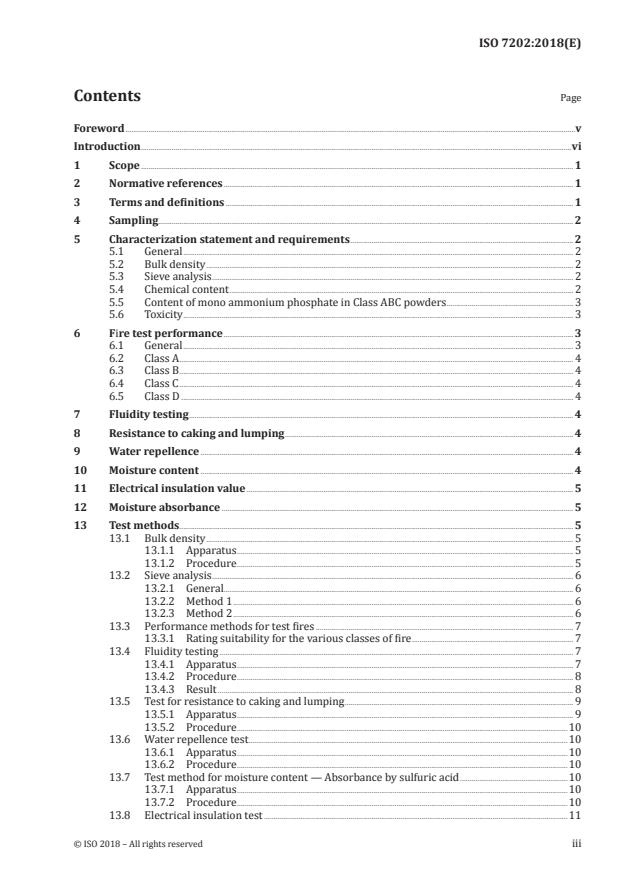
Contents Page
Foreword .v
Introduction .vi
1 Scope . 1
2 Normative references . 1
3 Terms and definitions . 1
4 Sampling . 2
5 Characterization statement and requirements . 2
5.1 General . 2
5.2 Bulk density . 2
5.3 Sieve analysis . 2
5.4 Chemical content . 2
5.5 Content of mono ammonium phosphate in Class ABC powders . 3
5.6 Toxicity . 3
6 Fire test performance . 3
6.1 General . 3
6.2 Class A . 4
6.3 Class B . 4
6.4 Class C . 4
6.5 Class D . 4
7 Fluidity testing . 4
8 Resistance to caking and lumping . 4
9 Water repellence . 4
10 Moisture content . 4
11 Electrical insulation value . 5
12 Moisture absorbance . 5
13 Test methods . 5
13.1 Bulk density . 5
13.1.1 Apparatus . 5
13.1.2 Procedure . 5
13.2 Sieve analysis . 6
13.2.1 General. 6
13.2.2 Method 1 . 6
13.2.3 Method 2 . 6
13.3 Performance methods for test fires . 7
13.3.1 Rating suitability for the various classes of fire . 7
13.4 Fluidity testing . 7
13.4.1 Apparatus . 7
13.4.2 Procedure . 8
13.4.3 Result . 8
13.5 Test for resistance to caking and lumping . 9
13.5.1 Apparatus . 9
13.5.2 Procedure .10
13.6 Water repellence test .10
13.6.1 Apparatus .10
13.6.2 Procedure .10
13.7 Test method for moisture content — Absorbance by sulfuric acid .10
13.7.1 Apparatus .10
13.7.2 Procedure .10
13.8 Electrical insulation test .11
13.8.1 Apparatus .11
13.8.2 Procedure .11
13.9 Moisture absorption testing .12
13.9.1 Apparatus .12
13.9.2 Procedure .12
13.10 Analysis for content of mono ammonium phosphate .12
13.10.1 Sample taking .12
13.10.2 Apparatus .12
13.10.3 Chemicals .13
13.10.4 Preparation of sample .13
13.10.5 Titration .13
13.10.6 Evaluation of the result .13
Annex A (informative) Compatibility between extinguishing powders and foams .15
Annex B (informative) Suitability and equivalence of extinguishing powders in equipment .22
Annex C (informative) Sampling method .23
Annex D (informative) Moisture content testing — Vacuum drying .24
Annex E (informative) Alternate testing for mono ammonium phosphate content.25
Bibliography .27
iv © ISO 2018 – All rights reserved
Foreword
ISO (the International Organization for Standardization) is a worldwide federation of national standards
bodies (ISO member bodies). The work of preparing International Standards is normally carried out
through ISO technical committees. Each member body interested in a subject for which a technical
committee has been established has the right to be represented on that committee. International
organizations, governmental and non-governmental, in liaison with ISO, also take part in the work.
ISO collaborates closely with the International Electrotechnical Commission (IEC) on all matters of
electrotechnical standardization.
The procedures used to develop this document and those intended for its further maintenance are
described in the ISO/IEC Directives, Part 1. In particular the different approval criteria needed for the
different types of ISO documents should be noted. This document was drafted in accordance with the
editorial rules of the ISO/IEC Directives, Part 2 (see www. iso. org/directives).
Attention is drawn to the possibility that some of the elements of this document may be the subject of
patent rights. ISO shall not be held responsible for identifying any or all such patent rights. Details of
any patent rights identified during the development of the document will be in the Introduction and/or
on the ISO list of patent declarations received (see www. iso.o rg/patents).
Any trade name used in this document is information given for the convenience of users and does not
constitute an endorsement.
For an explanation on the voluntary nature of standards, the meaning of ISO specific terms and
expressions related to conformity assessment, as well as information about ISO's adherence to the
World Trade Organization (WTO) principles in the Technical Barriers to Trade (TBT) see the following
URL: www. iso. org/iso/foreword. html.
This document was prepared by Technical Committee ISO/TC 21, Equipment for fire protection and
firefighting, Subcommittee SC 6, Foam and powder media and firefighting systems using foam and powder.
This third edition cancels and replaces the second edition (ISO 7202:2012), which has been technically
revised.
The main changes compared to the previous edition are as follows:
— A new subclause 5.5 was introduced requesting the testing of the content of MAP in dry chemical
powders of the ABC-type.
— A new subclause 13.10 was introduced with the description of the method to evaluate the MAP
content in Class ABC powders.
— A NOTE was added to subclause 13.10 referring to an alternate method described in Annex E.
— A new Annex E was added introducing the Japanese titration method for MAP testing in ABC-type
powders.
Any feedback or questions on this document should be directed to the user’s national standards body. A
complete listing of these bodies can be found at www. iso. org/members. html.
Introduction
This document is one of a series giving specifications for fire extinguishing media in common use
and which are in need of specification for firefighting purposes. These specifications are designed to
establish that the medium in question has at least a minimum useful fire extinguishing capability and
can therefore be reasonably sold for fire extinguishing purposes.
Requirements for media used in particular equipment will form the subject of future International
Standards.
Annexes A to D provide important information and give recommendations relating to the use of
extinguishing powders, and they should be read carefully by all concerned with the use of extinguishing
powders. They do not, however, form part of the document.
vi © ISO 2018 – All rights reserved
INTERNATIONAL STANDARD ISO 7202:2018(E)
Fire protection — Fire extinguishing media — Powder
1 Scope
This document specifies requirements for the chemical and physical properties, and for minimum
performance in defined test methods, of fire extinguishing powders suitable for use against fires of
classes A, B, C and D. Requirements are also given for the information and data to be declared by the
manufacturer.
NOTE The classification of fires is given in ISO 3941.
2 Normative references
The following documents are referred to in the text in such a way that some or all of their content
constitutes requirements of this document. For dated references, only the edition cited applies. For
undated references, the latest edition of the referenced document (including any amendments) applies.
ISO 3310-1, Test sieves — Technical requirements and testing — Part 1: Test sieves of metal wire cloth
ISO 4788, Laboratory glassware — Graduated measuring cylinders
ISO 7165, Fire fighting — Portable fire extinguishers — Performance and construction
3 Terms and definitions
For the purposes of this document, the following terms and definitions apply.
ISO and IEC maintain terminological databases for use in standardization at the following addresses:
— ISO Online browsing platform: available at https: //www .iso .org/obp
— IEC Electropedia: available at http: //www .electropedia .org/
3.1
batch
single charge of material in the processing equipment that has been made homogeneous by subjection
to the same unit and physical processing
Note 1 to entry: This is for the purposes of acceptance and verification testing by an inspecting authority.
3.2
characterization statement
information and data declared by the manufacturer regarding the chemical and physical properties of
the powder
3.3
extinguishing powder
extinguishing medium composed of finely divided solid chemical products consisting of one or more
principal components, which are combined with additives to improve its characteristics
Note 1 to entry: The term “dry powder” is sometimes used to denote special metal fire extinguishing agents and
the term “dry chemical extinguishing agent” refers to the extinguishing medium covered by this document.
Note 2 to entry: When it is useful to indicate the class of fire for which a particular powder is designed, capital
letters may be added before the term. The letters used in this document are those defined in ISO 3941.
EXAMPLE “BC” powder is designed to extinguish class B (liquids or liquefiable solids) and class C (gases)
fires; “ABC” powder is designed to extinguish class A (solids that normally form glowing embers), class B and
class C fires; “D” powder is designed to extinguish metal fires.
3.4
lot
one or more batches but not more than 25 t of powder, manufactured to the same formulation by the
same manufacturing process and under the same environmental conditions
Note 1 to entry: Any substantial change in production personnel, manufacturing process, source of raw materials,
or change in environmental conditions may justify identifying the material as a different lot.
4 Sampling
Samples for testing in accordance with this document shall be taken using a method which will
provide a sample which is as representative as possible. In order to avoid any risk of condensation, it is
essential that the temperature of the powder in its original container is not lower than the ambient air
temperature when the sample is being taken. Sample containers should not be opened until temperature
equilibrium with the laboratory air has been reached.
When sampling a lot, not less than 12 kg of material shall be taken at random from a batch. For batch
testing, not less than 2,5 kg selected from a container shall be taken at random. Suitably identified
samples shall be stored in individual, clean, dry, airtight, non-reactive containers.
In addition to these samples, an inspecting authority may require additional samples for verification
testing.
NOTE One suitable method of sampling is suggested in Annex C.
5 Characterization statement and requirements
5.1 General
The manufacturer shall declare, on demand, the information and data specified in 5.2 to 5.5. The
manufacturer should conduct statistical measurements to ensure that the values declared correspond
to the mean values of the range of values inherent to the manufacturing process.
NOTE The characterization statement is primarily for identification and information purposes and to provide
the reference values for the tolerance requirements of 5.2, 5.3 and 5.4, but particular attention is drawn to 5.5.
5.2 Bulk density
The bulk density of the powder shall be determined in accordance with 13.1. The bulk density shall be
within ±0,07 g/ml of the value declared by the manufacturer.
5.3 Sieve analysis
When tested using the method specified in 13.2.2 or 13.2.3, the quantity retained on the 40 μm sieve
and on the 63 μm sieve shall not differ from the declared value by more than ±8 % of the total mass of
the sample, and the quantity retained on the 125 μm sieve shall not differ from the declared value by
more than ±5 % of the total mass of the sample. The test method shall be declared with the results.
5.4 Chemical content
Characteristic values for chemical content shall be expressed as percentages (mass fraction) of the total
content.
2 © ISO 2018 – All rights reserved
The characteristic values for chemical content shall include all constituents present in the powder at
a concentration representing 10 % or more of the total content. The sum of the characteristic values
for chemical content shall be 90 % or more of the total content. Each constituent given a characteristic
value shall be identified by its chemical name, or as the reaction product of a chemical process between
reactants identified by their chemical names.
In the latter case, the chemical process shall be specified, for example by reference to a published
patent. The content of a declared constituent shall be as follows:
— within ±1,0 % of the total chemical content for constituents of characteristic value more than 10 %
but not more than 15 %;
— within ±1,5 % of the total chemical content for constituents of characteristic value more than 15 %
but not more than 25 %;
— within ±2,0 % of the total chemical content for constituents of characteristic value more than 25 %
but not more than 65 %;
— within ±3,0 % of the total chemical content for constituents of characteristic value more than 65 %
and above.
NOTE 1 For example, a constituent with a characteristic value of 20 % has tolerance limits of 18,5 % and
21,5 % and a constituent with a characteristic value of 80 % has tolerance limits of 77 % and 83 %.
NOTE 2 The compatibility of the powder with foam depends on the powder’s chemical content. The test
described in Annex A can allow a determination of foam/powder compatibility to be made.
WARNING — It is important that under normal conditions of use the various materials and
additives used to produce powders be generally recognized as being non-toxic to humans. In
some countries there may be a legal obligation to disclose to designated authorities the complete
chemical content, and any proposed changes of chemical content, with documented details of
non-toxicity.
WARNING — The mixing of different types of powders (e.g. ABC and BC) consisting of certain
compounds (e.g. NH H PO , NaHCO or CaCO ) and/or the mixing of these compounds as raw
4 2 4 3 3
materials into one powder may result in caking, and the production of gas which will increase
pressure in the container to an unsafe level. Such increases in pressure have been known to
cause containers to rupture, and to cause bodily injury and damage.
WARNING — Recovered powder may have been previously contaminated, and may have absorbed
moisture. If it is then recycled, the powder may eventually become lumpy and interrupt the flow
of powder when used on a fire.
5.5 Content of mono ammonium phosphate in Class ABC powders
The content of ammonium phosphate in Class ABC powders shall be determined in accordance to 13.10.
5.6 Toxicity
It is important that, under normal conditions of use for fire extinguishing, the various materials and
additives used to produce extinguishing powders shall be generally recognized as being non-toxic to
humans per material safety data sheet according to local jurisdictional requirements.
6 Fire test performance
6.1 General
The fire performance of extinguishing powders shall be evaluated following the procedures given in
ISO 7165.
6.2 Class A
When tested using the method specified in 13.3.1.1, extinguishing powders claimed by the manufacturer
to be suitable for class A fires shall comply with ISO 7165 for one of the minimum class A ratings,
specified therein.
6.3 Class B
When tested using the method specified in 13.3.1.2, extinguishing powders claimed by the
manufacturer to be suitable for class B fires shall comply with ISO 7165 for one of the minimum class B
ratings, specified therein.
6.4 Class C
Extinguishing powders claimed by the manufacturer to be suitable for class C fires shall comply with 6.3.
NOTE There are no fire test requirements for the performance of extinguishing powders against class C fires
included in this document. Suitability for use against class C can claimed for class B or class AB extinguishing
powders only.
6.5 Class D
When tested using the method specified in 13.3.1.3, extinguishing powders claimed by the manufacturer
to be suitable for class D fires shall comply with ISO 7165.
Extinguishing powders suitable for class D fires are typically not suitable for use on fires of other
classes. Specialized media and applicators are typically used.
7 Fluidity testing
When tested using the method specified in 13.4, extinguishing powders shall not exceed an average
flow time of 8 s taken as an average of 20 single measurements.
8 Resistance to caking and lumping
Any lumps formed shall not be retained on the 425 m sieve when the powder is tested in accordance
with 13.5.
9 Water repellence
There shall be no complete absorption of the water droplets when the powder is tested in accordance
with 13.6.
10 Moisture content
The moisture content shall not exceed a mass fraction of 0,25 % when determined in accordance
with 13.7.
NOTE 1 An alternative method is to analyse the moisture by use of an infrared moisture meter which has been
adjusted to provide results equal to the method described in 13.7.
NOTE 2 A second alternative testing method is described in Annex D.
4 © ISO 2018 – All rights reserved
11 Electrical insulation value
The powder shall have a dielectric strength of not less than 5 kV, when measured using the method
specified in 13.8.
This requirement shall not apply to class D powders.
12 Moisture absorbance
The rate of weight increase of a saturated dry powder agent attained by exposing it to an environment
with a temperature of 30 °C and 60 % relative humidity for 48 h shall be less than 2 % upon exposure
to an environment with a temperature of 30 °C and 80 % relative humidity for 48 h when t
...
INTERNATIONAL ISO
STANDARD 7202
Third edition
2018-08
Fire protection — Fire extinguishing
media — Powder
Protection contre l'incendie — Agents extincteurs — Poudres
Reference number
©
ISO 2018
© ISO 2018
All rights reserved. Unless otherwise specified, or required in the context of its implementation, no part of this publication may
be reproduced or utilized otherwise in any form or by any means, electronic or mechanical, including photocopying, or posting
on the internet or an intranet, without prior written permission. Permission can be requested from either ISO at the address
below or ISO’s member body in the country of the requester.
ISO copyright office
CP 401 • Ch. de Blandonnet 8
CH-1214 Vernier, Geneva
Phone: +41 22 749 01 11
Fax: +41 22 749 09 47
Email: copyright@iso.org
Website: www.iso.org
Published in Switzerland
ii © ISO 2018 – All rights reserved
Contents Page
Foreword .v
Introduction .vi
1 Scope . 1
2 Normative references . 1
3 Terms and definitions . 1
4 Sampling . 2
5 Characterization statement and requirements . 2
5.1 General . 2
5.2 Bulk density . 2
5.3 Sieve analysis . 2
5.4 Chemical content . 2
5.5 Content of mono ammonium phosphate in Class ABC powders . 3
5.6 Toxicity . 3
6 Fire test performance . 3
6.1 General . 3
6.2 Class A . 4
6.3 Class B . 4
6.4 Class C . 4
6.5 Class D . 4
7 Fluidity testing . 4
8 Resistance to caking and lumping . 4
9 Water repellence . 4
10 Moisture content . 4
11 Electrical insulation value . 5
12 Moisture absorbance . 5
13 Test methods . 5
13.1 Bulk density . 5
13.1.1 Apparatus . 5
13.1.2 Procedure . 5
13.2 Sieve analysis . 6
13.2.1 General. 6
13.2.2 Method 1 . 6
13.2.3 Method 2 . 6
13.3 Performance methods for test fires . 7
13.3.1 Rating suitability for the various classes of fire . 7
13.4 Fluidity testing . 7
13.4.1 Apparatus . 7
13.4.2 Procedure . 8
13.4.3 Result . 8
13.5 Test for resistance to caking and lumping . 9
13.5.1 Apparatus . 9
13.5.2 Procedure .10
13.6 Water repellence test .10
13.6.1 Apparatus .10
13.6.2 Procedure .10
13.7 Test method for moisture content — Absorbance by sulfuric acid .10
13.7.1 Apparatus .10
13.7.2 Procedure .10
13.8 Electrical insulation test .11
13.8.1 Apparatus .11
13.8.2 Procedure .11
13.9 Moisture absorption testing .12
13.9.1 Apparatus .12
13.9.2 Procedure .12
13.10 Analysis for content of mono ammonium phosphate .12
13.10.1 Sample taking .12
13.10.2 Apparatus .12
13.10.3 Chemicals .13
13.10.4 Preparation of sample .13
13.10.5 Titration .13
13.10.6 Evaluation of the result .13
Annex A (informative) Compatibility between extinguishing powders and foams .15
Annex B (informative) Suitability and equivalence of extinguishing powders in equipment .22
Annex C (informative) Sampling method .23
Annex D (informative) Moisture content testing — Vacuum drying .24
Annex E (informative) Alternate testing for mono ammonium phosphate content.25
Bibliography .27
iv © ISO 2018 – All rights reserved
Foreword
ISO (the International Organization for Standardization) is a worldwide federation of national standards
bodies (ISO member bodies). The work of preparing International Standards is normally carried out
through ISO technical committees. Each member body interested in a subject for which a technical
committee has been established has the right to be represented on that committee. International
organizations, governmental and non-governmental, in liaison with ISO, also take part in the work.
ISO collaborates closely with the International Electrotechnical Commission (IEC) on all matters of
electrotechnical standardization.
The procedures used to develop this document and those intended for its further maintenance are
described in the ISO/IEC Directives, Part 1. In particular the different approval criteria needed for the
different types of ISO documents should be noted. This document was drafted in accordance with the
editorial rules of the ISO/IEC Directives, Part 2 (see www. iso. org/directives).
Attention is drawn to the possibility that some of the elements of this document may be the subject of
patent rights. ISO shall not be held responsible for identifying any or all such patent rights. Details of
any patent rights identified during the development of the document will be in the Introduction and/or
on the ISO list of patent declarations received (see www. iso.o rg/patents).
Any trade name used in this document is information given for the convenience of users and does not
constitute an endorsement.
For an explanation on the voluntary nature of standards, the meaning of ISO specific terms and
expressions related to conformity assessment, as well as information about ISO's adherence to the
World Trade Organization (WTO) principles in the Technical Barriers to Trade (TBT) see the following
URL: www. iso. org/iso/foreword. html.
This document was prepared by Technical Committee ISO/TC 21, Equipment for fire protection and
firefighting, Subcommittee SC 6, Foam and powder media and firefighting systems using foam and powder.
This third edition cancels and replaces the second edition (ISO 7202:2012), which has been technically
revised.
The main changes compared to the previous edition are as follows:
— A new subclause 5.5 was introduced requesting the testing of the content of MAP in dry chemical
powders of the ABC-type.
— A new subclause 13.10 was introduced with the description of the method to evaluate the MAP
content in Class ABC powders.
— A NOTE was added to subclause 13.10 referring to an alternate method described in Annex E.
— A new Annex E was added introducing the Japanese titration method for MAP testing in ABC-type
powders.
Any feedback or questions on this document should be directed to the user’s national standards body. A
complete listing of these bodies can be found at www. iso. org/members. html.
Introduction
This document is one of a series giving specifications for fire extinguishing media in common use
and which are in need of specification for firefighting purposes. These specifications are designed to
establish that the medium in question has at least a minimum useful fire extinguishing capability and
can therefore be reasonably sold for fire extinguishing purposes.
Requirements for media used in particular equipment will form the subject of future International
Standards.
Annexes A to D provide important information and give recommendations relating to the use of
extinguishing powders, and they should be read carefully by all concerned with the use of extinguishing
powders. They do not, however, form part of the document.
vi © ISO 2018 – All rights reserved
INTERNATIONAL STANDARD ISO 7202:2018(E)
Fire protection — Fire extinguishing media — Powder
1 Scope
This document specifies requirements for the chemical and physical properties, and for minimum
performance in defined test methods, of fire extinguishing powders suitable for use against fires of
classes A, B, C and D. Requirements are also given for the information and data to be declared by the
manufacturer.
NOTE The classification of fires is given in ISO 3941.
2 Normative references
The following documents are referred to in the text in such a way that some or all of their content
constitutes requirements of this document. For dated references, only the edition cited applies. For
undated references, the latest edition of the referenced document (including any amendments) applies.
ISO 3310-1, Test sieves — Technical requirements and testing — Part 1: Test sieves of metal wire cloth
ISO 4788, Laboratory glassware — Graduated measuring cylinders
ISO 7165, Fire fighting — Portable fire extinguishers — Performance and construction
3 Terms and definitions
For the purposes of this document, the following terms and definitions apply.
ISO and IEC maintain terminological databases for use in standardization at the following addresses:
— ISO Online browsing platform: available at https: //www .iso .org/obp
— IEC Electropedia: available at http: //www .electropedia .org/
3.1
batch
single charge of material in the processing equipment that has been made homogeneous by subjection
to the same unit and physical processing
Note 1 to entry: This is for the purposes of acceptance and verification testing by an inspecting authority.
3.2
characterization statement
information and data declared by the manufacturer regarding the chemical and physical properties of
the powder
3.3
extinguishing powder
extinguishing medium composed of finely divided solid chemical products consisting of one or more
principal components, which are combined with additives to improve its characteristics
Note 1 to entry: The term “dry powder” is sometimes used to denote special metal fire extinguishing agents and
the term “dry chemical extinguishing agent” refers to the extinguishing medium covered by this document.
Note 2 to entry: When it is useful to indicate the class of fire for which a particular powder is designed, capital
letters may be added before the term. The letters used in this document are those defined in ISO 3941.
EXAMPLE “BC” powder is designed to extinguish class B (liquids or liquefiable solids) and class C (gases)
fires; “ABC” powder is designed to extinguish class A (solids that normally form glowing embers), class B and
class C fires; “D” powder is designed to extinguish metal fires.
3.4
lot
one or more batches but not more than 25 t of powder, manufactured to the same formulation by the
same manufacturing process and under the same environmental conditions
Note 1 to entry: Any substantial change in production personnel, manufacturing process, source of raw materials,
or change in environmental conditions may justify identifying the material as a different lot.
4 Sampling
Samples for testing in accordance with this document shall be taken using a method which will
provide a sample which is as representative as possible. In order to avoid any risk of condensation, it is
essential that the temperature of the powder in its original container is not lower than the ambient air
temperature when the sample is being taken. Sample containers should not be opened until temperature
equilibrium with the laboratory air has been reached.
When sampling a lot, not less than 12 kg of material shall be taken at random from a batch. For batch
testing, not less than 2,5 kg selected from a container shall be taken at random. Suitably identified
samples shall be stored in individual, clean, dry, airtight, non-reactive containers.
In addition to these samples, an inspecting authority may require additional samples for verification
testing.
NOTE One suitable method of sampling is suggested in Annex C.
5 Characterization statement and requirements
5.1 General
The manufacturer shall declare, on demand, the information and data specified in 5.2 to 5.5. The
manufacturer should conduct statistical measurements to ensure that the values declared correspond
to the mean values of the range of values inherent to the manufacturing process.
NOTE The characterization statement is primarily for identification and information purposes and to provide
the reference values for the tolerance requirements of 5.2, 5.3 and 5.4, but particular attention is drawn to 5.5.
5.2 Bulk density
The bulk density of the powder shall be determined in accordance with 13.1. The bulk density shall be
within ±0,07 g/ml of the value declared by the manufacturer.
5.3 Sieve analysis
When tested using the method specified in 13.2.2 or 13.2.3, the quantity retained on the 40 μm sieve
and on the 63 μm sieve shall not differ from the declared value by more than ±8 % of the total mass of
the sample, and the quantity retained on the 125 μm sieve shall not differ from the declared value by
more than ±5 % of the total mass of the sample. The test method shall be declared with the results.
5.4 Chemical content
Characteristic values for chemical content shall be expressed as percentages (mass fraction) of the total
content.
2 © ISO 2018 – All rights reserved
The characteristic values for chemical content shall include all constituents present in the powder at
a concentration representing 10 % or more of the total content. The sum of the characteristic values
for chemical content shall be 90 % or more of the total content. Each constituent given a characteristic
value shall be identified by its chemical name, or as the reaction product of a chemical process between
reactants identified by their chemical names.
In the latter case, the chemical process shall be specified, for example by reference to a published
patent. The content of a declared constituent shall be as follows:
— within ±1,0 % of the total chemical content for constituents of characteristic value more than 10 %
but not more than 15 %;
— within ±1,5 % of the total chemical content for constituents of characteristic value more than 15 %
but not more than 25 %;
— within ±2,0 % of the total chemical content for constituents of characteristic value more than 25 %
but not more than 65 %;
— within ±3,0 % of the total chemical content for constituents of characteristic value more than 65 %
and above.
NOTE 1 For example, a constituent with a characteristic value of 20 % has tolerance limits of 18,5 % and
21,5 % and a constituent with a characteristic value of 80 % has tolerance limits of 77 % and 83 %.
NOTE 2 The compatibility of the powder with foam depends on the powder’s chemical content. The test
described in Annex A can allow a determination of foam/powder compatibility to be made.
WARNING — It is important that under normal conditions of use the various materials and
additives used to produce powders be generally recognized as being non-toxic to humans. In
some countries there may be a legal obligation to disclose to designated authorities the complete
chemical content, and any proposed changes of chemical content, with documented details of
non-toxicity.
WARNING — The mixing of different types of powders (e.g. ABC and BC) consisting of certain
compounds (e.g. NH H PO , NaHCO or CaCO ) and/or the mixing of these compounds as raw
4 2 4 3 3
materials into one powder may result in caking, and the production of gas which will increase
pressure in the container to an unsafe level. Such increases in pressure have been known to
cause containers to rupture, and to cause bodily injury and damage.
WARNING — Recovered powder may have been previously contaminated, and may have absorbed
moisture. If it is then recycled, the powder may eventually become lumpy and interrupt the flow
of powder when used on a fire.
5.5 Content of mono ammonium phosphate in Class ABC powders
The content of ammonium phosphate in Class ABC powders shall be determined in accordance to 13.10.
5.6 Toxicity
It is important that, under normal conditions of use for fire extinguishing, the various materials and
additives used to produce extinguishing powders shall be generally recognized as being non-toxic to
humans per material safety data sheet according to local jurisdictional requirements.
6 Fire test performance
6.1 General
The fire performance of extinguishing powders shall be evaluated following the procedures given in
ISO 7165.
6.2 Class A
When tested using the method specified in 13.3.1.1, extinguishing powders claimed by the manufacturer
to be suitable for class A fires shall comply with ISO 7165 for one of the minimum class A ratings,
specified therein.
6.3 Class B
When tested using the method specified in 13.3.1.2, extinguishing powders claimed by the
manufacturer to be suitable for class B fires shall comply with ISO 7165 for one of the minimum class B
ratings, specified therein.
6.4 Class C
Extinguishing powders claimed by the manufacturer to be suitable for class C fires shall comply with 6.3.
NOTE There are no fire test requirements for the performance of extinguishing powders against class C fires
included in this document. Suitability for use against class C can claimed for class B or class AB extinguishing
powders only.
6.5 Class D
When tested using the method specified in 13.3.1.3, extinguishing powders claimed by the manufacturer
to be suitable for class D fires shall comply with ISO 7165.
Extinguishing powders suitable for class D fires are typically not suitable for use on fires of other
classes. Specialized media and applicators are typically used.
7 Fluidity testing
When tested using the method specified in 13.4, extinguishing powders shall not exceed an average
flow time of 8 s taken as an average of 20 single measurements.
8 Resistance to caking and lumping
Any lumps formed shall not be retained on the 425 m sieve when the powder is tested in accordance
with 13.5.
9 Water repellence
There shall be no complete absorption of the water droplets when the powder is tested in accordance
with 13.6.
10 Moisture content
The moisture content shall not exceed a mass fraction of 0,25 % when determined in accordance
with 13.7.
NOTE 1 An alternative method is to analyse the moisture by use of an infrared moisture meter which has been
adjusted to provide results equal to the method described in 13.7.
NOTE 2 A second alternative testing method is described in Annex D.
4 © ISO 2018 – All rights reserved
11 Electrical insulation value
The powder shall have a dielectric strength of not less than 5 kV, when measured using the method
specified in 13.8.
This requirement shall not apply to class D powders.
12 Moisture absorbance
The rate of weight increase of a saturated dry powder agent attained by exposing it to an environment
with a temperature of 30 °C and 60 % relative humidity for 48 h shall be less than 2 % upon exposure
to an environment with a temperature of 30 °C and 80 % relative humidity for 48 h when tested in
accordance with 13.9.
13 Test methods
13.1 Bulk density
13.1.1 Apparatus
13.1.1.1 250 ml stoppered glass measuring cylinder, conforming to ISO 4788, having an approximate
height of 320 mm and an approximate internal diameter of 40 mm.
13.1.1.2 Scale, accurate to 0,001
...
INTERNATIONAL ISO
STANDARD 7202
Third edition
2018-08
Fire protection — Fire extinguishing
media — Powder
Protection contre l'incendie — Agents extincteurs — Poudres
Reference number
©
ISO 2018
© ISO 2018
All rights reserved. Unless otherwise specified, or required in the context of its implementation, no part of this publication may
be reproduced or utilized otherwise in any form or by any means, electronic or mechanical, including photocopying, or posting
on the internet or an intranet, without prior written permission. Permission can be requested from either ISO at the address
below or ISO’s member body in the country of the requester.
ISO copyright office
CP 401 • Ch. de Blandonnet 8
CH-1214 Vernier, Geneva
Phone: +41 22 749 01 11
Fax: +41 22 749 09 47
Email: copyright@iso.org
Website: www.iso.org
Published in Switzerland
ii © ISO 2018 – All rights reserved
Contents Page
Foreword .v
Introduction .vi
1 Scope . 1
2 Normative references . 1
3 Terms and definitions . 1
4 Sampling . 2
5 Characterization statement and requirements . 2
5.1 General . 2
5.2 Bulk density . 2
5.3 Sieve analysis . 2
5.4 Chemical content . 2
5.5 Content of mono ammonium phosphate in Class ABC powders . 3
5.6 Toxicity . 3
6 Fire test performance . 3
6.1 General . 3
6.2 Class A . 4
6.3 Class B . 4
6.4 Class C . 4
6.5 Class D . 4
7 Fluidity testing . 4
8 Resistance to caking and lumping . 4
9 Water repellence . 4
10 Moisture content . 4
11 Electrical insulation value . 5
12 Moisture absorbance . 5
13 Test methods . 5
13.1 Bulk density . 5
13.1.1 Apparatus . 5
13.1.2 Procedure . 5
13.2 Sieve analysis . 6
13.2.1 General. 6
13.2.2 Method 1 . 6
13.2.3 Method 2 . 6
13.3 Performance methods for test fires . 7
13.3.1 Rating suitability for the various classes of fire . 7
13.4 Fluidity testing . 7
13.4.1 Apparatus . 7
13.4.2 Procedure . 8
13.4.3 Result . 8
13.5 Test for resistance to caking and lumping . 9
13.5.1 Apparatus . 9
13.5.2 Procedure .10
13.6 Water repellence test .10
13.6.1 Apparatus .10
13.6.2 Procedure .10
13.7 Test method for moisture content — Absorbance by sulfuric acid .10
13.7.1 Apparatus .10
13.7.2 Procedure .10
13.8 Electrical insulation test .11
13.8.1 Apparatus .11
13.8.2 Procedure .11
13.9 Moisture absorption testing .12
13.9.1 Apparatus .12
13.9.2 Procedure .12
13.10 Analysis for content of mono ammonium phosphate .12
13.10.1 Sample taking .12
13.10.2 Apparatus .12
13.10.3 Chemicals .13
13.10.4 Preparation of sample .13
13.10.5 Titration .13
13.10.6 Evaluation of the result .13
Annex A (informative) Compatibility between extinguishing powders and foams .15
Annex B (informative) Suitability and equivalence of extinguishing powders in equipment .22
Annex C (informative) Sampling method .23
Annex D (informative) Moisture content testing — Vacuum drying .24
Annex E (informative) Alternate testing for mono ammonium phosphate content.25
Bibliography .27
iv © ISO 2018 – All rights reserved
Foreword
ISO (the International Organization for Standardization) is a worldwide federation of national standards
bodies (ISO member bodies). The work of preparing International Standards is normally carried out
through ISO technical committees. Each member body interested in a subject for which a technical
committee has been established has the right to be represented on that committee. International
organizations, governmental and non-governmental, in liaison with ISO, also take part in the work.
ISO collaborates closely with the International Electrotechnical Commission (IEC) on all matters of
electrotechnical standardization.
The procedures used to develop this document and those intended for its further maintenance are
described in the ISO/IEC Directives, Part 1. In particular the different approval criteria needed for the
different types of ISO documents should be noted. This document was drafted in accordance with the
editorial rules of the ISO/IEC Directives, Part 2 (see www. iso. org/directives).
Attention is drawn to the possibility that some of the elements of this document may be the subject of
patent rights. ISO shall not be held responsible for identifying any or all such patent rights. Details of
any patent rights identified during the development of the document will be in the Introduction and/or
on the ISO list of patent declarations received (see www. iso.o rg/patents).
Any trade name used in this document is information given for the convenience of users and does not
constitute an endorsement.
For an explanation on the voluntary nature of standards, the meaning of ISO specific terms and
expressions related to conformity assessment, as well as information about ISO's adherence to the
World Trade Organization (WTO) principles in the Technical Barriers to Trade (TBT) see the following
URL: www. iso. org/iso/foreword. html.
This document was prepared by Technical Committee ISO/TC 21, Equipment for fire protection and
firefighting, Subcommittee SC 6, Foam and powder media and firefighting systems using foam and powder.
This third edition cancels and replaces the second edition (ISO 7202:2012), which has been technically
revised.
The main changes compared to the previous edition are as follows:
— A new subclause 5.5 was introduced requesting the testing of the content of MAP in dry chemical
powders of the ABC-type.
— A new subclause 13.10 was introduced with the description of the method to evaluate the MAP
content in Class ABC powders.
— A NOTE was added to subclause 13.10 referring to an alternate method described in Annex E.
— A new Annex E was added introducing the Japanese titration method for MAP testing in ABC-type
powders.
Any feedback or questions on this document should be directed to the user’s national standards body. A
complete listing of these bodies can be found at www. iso. org/members. html.
Introduction
This document is one of a series giving specifications for fire extinguishing media in common use
and which are in need of specification for firefighting purposes. These specifications are designed to
establish that the medium in question has at least a minimum useful fire extinguishing capability and
can therefore be reasonably sold for fire extinguishing purposes.
Requirements for media used in particular equipment will form the subject of future International
Standards.
Annexes A to D provide important information and give recommendations relating to the use of
extinguishing powders, and they should be read carefully by all concerned with the use of extinguishing
powders. They do not, however, form part of the document.
vi © ISO 2018 – All rights reserved
INTERNATIONAL STANDARD ISO 7202:2018(E)
Fire protection — Fire extinguishing media — Powder
1 Scope
This document specifies requirements for the chemical and physical properties, and for minimum
performance in defined test methods, of fire extinguishing powders suitable for use against fires of
classes A, B, C and D. Requirements are also given for the information and data to be declared by the
manufacturer.
NOTE The classification of fires is given in ISO 3941.
2 Normative references
The following documents are referred to in the text in such a way that some or all of their content
constitutes requirements of this document. For dated references, only the edition cited applies. For
undated references, the latest edition of the referenced document (including any amendments) applies.
ISO 3310-1, Test sieves — Technical requirements and testing — Part 1: Test sieves of metal wire cloth
ISO 4788, Laboratory glassware — Graduated measuring cylinders
ISO 7165, Fire fighting — Portable fire extinguishers — Performance and construction
3 Terms and definitions
For the purposes of this document, the following terms and definitions apply.
ISO and IEC maintain terminological databases for use in standardization at the following addresses:
— ISO Online browsing platform: available at https: //www .iso .org/obp
— IEC Electropedia: available at http: //www .electropedia .org/
3.1
batch
single charge of material in the processing equipment that has been made homogeneous by subjection
to the same unit and physical processing
Note 1 to entry: This is for the purposes of acceptance and verification testing by an inspecting authority.
3.2
characterization statement
information and data declared by the manufacturer regarding the chemical and physical properties of
the powder
3.3
extinguishing powder
extinguishing medium composed of finely divided solid chemical products consisting of one or more
principal components, which are combined with additives to improve its characteristics
Note 1 to entry: The term “dry powder” is sometimes used to denote special metal fire extinguishing agents and
the term “dry chemical extinguishing agent” refers to the extinguishing medium covered by this document.
Note 2 to entry: When it is useful to indicate the class of fire for which a particular powder is designed, capital
letters may be added before the term. The letters used in this document are those defined in ISO 3941.
EXAMPLE “BC” powder is designed to extinguish class B (liquids or liquefiable solids) and class C (gases)
fires; “ABC” powder is designed to extinguish class A (solids that normally form glowing embers), class B and
class C fires; “D” powder is designed to extinguish metal fires.
3.4
lot
one or more batches but not more than 25 t of powder, manufactured to the same formulation by the
same manufacturing process and under the same environmental conditions
Note 1 to entry: Any substantial change in production personnel, manufacturing process, source of raw materials,
or change in environmental conditions may justify identifying the material as a different lot.
4 Sampling
Samples for testing in accordance with this document shall be taken using a method which will
provide a sample which is as representative as possible. In order to avoid any risk of condensation, it is
essential that the temperature of the powder in its original container is not lower than the ambient air
temperature when the sample is being taken. Sample containers should not be opened until temperature
equilibrium with the laboratory air has been reached.
When sampling a lot, not less than 12 kg of material shall be taken at random from a batch. For batch
testing, not less than 2,5 kg selected from a container shall be taken at random. Suitably identified
samples shall be stored in individual, clean, dry, airtight, non-reactive containers.
In addition to these samples, an inspecting authority may require additional samples for verification
testing.
NOTE One suitable method of sampling is suggested in Annex C.
5 Characterization statement and requirements
5.1 General
The manufacturer shall declare, on demand, the information and data specified in 5.2 to 5.5. The
manufacturer should conduct statistical measurements to ensure that the values declared correspond
to the mean values of the range of values inherent to the manufacturing process.
NOTE The characterization statement is primarily for identification and information purposes and to provide
the reference values for the tolerance requirements of 5.2, 5.3 and 5.4, but particular attention is drawn to 5.5.
5.2 Bulk density
The bulk density of the powder shall be determined in accordance with 13.1. The bulk density shall be
within ±0,07 g/ml of the value declared by the manufacturer.
5.3 Sieve analysis
When tested using the method specified in 13.2.2 or 13.2.3, the quantity retained on the 40 μm sieve
and on the 63 μm sieve shall not differ from the declared value by more than ±8 % of the total mass of
the sample, and the quantity retained on the 125 μm sieve shall not differ from the declared value by
more than ±5 % of the total mass of the sample. The test method shall be declared with the results.
5.4 Chemical content
Characteristic values for chemical content shall be expressed as percentages (mass fraction) of the total
content.
2 © ISO 2018 – All rights reserved
The characteristic values for chemical content shall include all constituents present in the powder at
a concentration representing 10 % or more of the total content. The sum of the characteristic values
for chemical content shall be 90 % or more of the total content. Each constituent given a characteristic
value shall be identified by its chemical name, or as the reaction product of a chemical process between
reactants identified by their chemical names.
In the latter case, the chemical process shall be specified, for example by reference to a published
patent. The content of a declared constituent shall be as follows:
— within ±1,0 % of the total chemical content for constituents of characteristic value more than 10 %
but not more than 15 %;
— within ±1,5 % of the total chemical content for constituents of characteristic value more than 15 %
but not more than 25 %;
— within ±2,0 % of the total chemical content for constituents of characteristic value more than 25 %
but not more than 65 %;
— within ±3,0 % of the total chemical content for constituents of characteristic value more than 65 %
and above.
NOTE 1 For example, a constituent with a characteristic value of 20 % has tolerance limits of 18,5 % and
21,5 % and a constituent with a characteristic value of 80 % has tolerance limits of 77 % and 83 %.
NOTE 2 The compatibility of the powder with foam depends on the powder’s chemical content. The test
described in Annex A can allow a determination of foam/powder compatibility to be made.
WARNING — It is important that under normal conditions of use the various materials and
additives used to produce powders be generally recognized as being non-toxic to humans. In
some countries there may be a legal obligation to disclose to designated authorities the complete
chemical content, and any proposed changes of chemical content, with documented details of
non-toxicity.
WARNING — The mixing of different types of powders (e.g. ABC and BC) consisting of certain
compounds (e.g. NH H PO , NaHCO or CaCO ) and/or the mixing of these compounds as raw
4 2 4 3 3
materials into one powder may result in caking, and the production of gas which will increase
pressure in the container to an unsafe level. Such increases in pressure have been known to
cause containers to rupture, and to cause bodily injury and damage.
WARNING — Recovered powder may have been previously contaminated, and may have absorbed
moisture. If it is then recycled, the powder may eventually become lumpy and interrupt the flow
of powder when used on a fire.
5.5 Content of mono ammonium phosphate in Class ABC powders
The content of ammonium phosphate in Class ABC powders shall be determined in accordance to 13.10.
5.6 Toxicity
It is important that, under normal conditions of use for fire extinguishing, the various materials and
additives used to produce extinguishing powders shall be generally recognized as being non-toxic to
humans per material safety data sheet according to local jurisdictional requirements.
6 Fire test performance
6.1 General
The fire performance of extinguishing powders shall be evaluated following the procedures given in
ISO 7165.
6.2 Class A
When tested using the method specified in 13.3.1.1, extinguishing powders claimed by the manufacturer
to be suitable for class A fires shall comply with ISO 7165 for one of the minimum class A ratings,
specified therein.
6.3 Class B
When tested using the method specified in 13.3.1.2, extinguishing powders claimed by the
manufacturer to be suitable for class B fires shall comply with ISO 7165 for one of the minimum class B
ratings, specified therein.
6.4 Class C
Extinguishing powders claimed by the manufacturer to be suitable for class C fires shall comply with 6.3.
NOTE There are no fire test requirements for the performance of extinguishing powders against class C fires
included in this document. Suitability for use against class C can claimed for class B or class AB extinguishing
powders only.
6.5 Class D
When tested using the method specified in 13.3.1.3, extinguishing powders claimed by the manufacturer
to be suitable for class D fires shall comply with ISO 7165.
Extinguishing powders suitable for class D fires are typically not suitable for use on fires of other
classes. Specialized media and applicators are typically used.
7 Fluidity testing
When tested using the method specified in 13.4, extinguishing powders shall not exceed an average
flow time of 8 s taken as an average of 20 single measurements.
8 Resistance to caking and lumping
Any lumps formed shall not be retained on the 425 m sieve when the powder is tested in accordance
with 13.5.
9 Water repellence
There shall be no complete absorption of the water droplets when the powder is tested in accordance
with 13.6.
10 Moisture content
The moisture content shall not exceed a mass fraction of 0,25 % when determined in accordance
with 13.7.
NOTE 1 An alternative method is to analyse the moisture by use of an infrared moisture meter which has been
adjusted to provide results equal to the method described in 13.7.
NOTE 2 A second alternative testing method is described in Annex D.
4 © ISO 2018 – All rights reserved
11 Electrical insulation value
The powder shall have a dielectric strength of not less than 5 kV, when measured using the method
specified in 13.8.
This requirement shall not apply to class D powders.
12 Moisture absorbance
The rate of weight increase of a saturated dry powder agent attained by exposing it to an environment
with a temperature of 30 °C and 60 % relative humidity for 48 h shall be less than 2 % upon exposure
to an environment with a temperature of 30 °C and 80 % relative humidity for 48 h when tested in
accordance with 13.9.
13 Test methods
13.1 Bulk density
13.1.1 Apparatus
13.1.1.1 250 ml stoppered glass measuring cylinder, conforming to ISO 4788, having an approximate
height of 320 mm and an approximate internal diameter of 40 mm.
13.1.1.2 Scale, accurate to 0,001
...