

ISO 7076-3:2016
(Main)Fire protection — Foam fire extinguishing systems — Part 3: Medium expansion foam equipment
General Information
- Abstract
ISO 7076-3:2016 specifies requirements and test methods for medium expansion foam equipment of fixed-foam extinguishing systems for indoor or outdoor use or both.
- Status
- Published
- Publication Date
- 29-Jun-2016
- Current Stage
- 9093 - International Standard confirmed
- Start Date
- 18-Mar-2022
- Completion Date
- 29-Aug-2026
Buy Documents

ISO 7076-3:2016 - Fire protection -- Foam fire extinguishing systems
ISO 7076-3:2016 - Fire protection — Foam fire extinguishing systems — Part 3: Medium expansion foam equipment/30/2016
Overview
ISO 7076-3:2016 - Fire protection - Foam fire extinguishing systems - Part 3: Medium expansion foam equipment specifies requirements and test methods for medium expansion foam equipment used in fixed foam extinguishing systems for indoor and/or outdoor applications. The standard defines performance, materials, durability and testing criteria to ensure reliable operation with foam concentrates and foam solutions.
Key topics and technical requirements
- Scope and definition
- Covers medium expansion foam (expansion ratio 21 to 200).
- Materials and corrosion resistance
- Metal parts exposed to foam concentrate/solution must resist corrosion; moving parts must be corrosion-resistant (bronze given as a typical example).
- Elastomeric joint rings
- Minimum tensile strength, elongation and hardness criteria for silicone, fluoroelastomers and other rubbers (examples: silicone ≥ 3.4 MPa tensile; fluoroelastomers ≥ 6.9 MPa; others ≥ 8.3 MPa).
- Ageing and liquid‑exposure requirements (e.g., oven ageing and exposure tests specified).
- Plastics and reinforced resins
- Requirements for resistance to ageing and liquid exposure - retained tensile, elongation or impact strength ≥ 50% of original and no cracking.
- Mechanical strength and leak resistance
- Hydrostatic strength: withstand 4× maximum working pressure for 5 minutes (sample testing rules apply).
- Leak test: withstand 1.5× maximum working pressure for 5 minutes without leakage.
- Performance metrics
- Discharge coefficient (K factor) tolerance: ±5% of manufacturer’s stated value.
- Foam quality: expansion and drainage time must meet manufacturer-stated values when tested with recommended foam concentrate.
- Design, maintenance and marking
- Requirements for connections, removable parts for routine maintenance, correct re‑assembly design, marking and manufacturer instructions.
- Test methods
- Includes ageing, liquid exposure, pressurization, leak, K-factor measurement, expansion/drainage measurement, water flow, operational reliability, stress corrosion, salt-spray, light/water exposure, heat and fire resistance.
Applications and users
- Who uses it
- Foam equipment manufacturers, fire protection engineers, testing and certification labs, specifiers, procurement teams, and authorities having jurisdiction.
- Practical applications
- Design and qualification of fixed medium expansion foam systems for warehouses, process areas, fuel‑related hazards and other indoor/outdoor installations.
- Verifying material compatibility with foam concentrates, ensuring reliable discharge performance, and establishing maintenance and marking practices.
Related standards
- ISO 7076 series: Part 1 (proportioning), Part 2 (low expansion), Part 5 (fixed compressed air foam) and other parts in development.
- Normative references include ISO 7203-2 (foam concentrates), ISO 9227 (salt spray), ISO 7-1/228-1 (threads), ISO 188 (rubber ageing), among others.
Relations
- Consolidated By
ISO 3924:2019 - Petroleum products — Determination of boiling range distribution — Gas chromatography method - Effective Date
- 06-Jun-2022
Buy Documents
ISO 7076-3:2016 - Fire protection -- Foam fire extinguishing systems
ISO 7076-3:2016 - Fire protection — Foam fire extinguishing systems — Part 3: Medium expansion foam equipment/30/2016
Get Certified
Connect with accredited certification bodies for this standard

CIS Institut d.o.o.
Personal Protective Equipment (PPE) certification body. Notified Body NB-2890 for EU Regulation 2016/425 PPE.

Kiwa BDA Testing
Building and construction product certification.
Kmetijski inštitut Slovenije
Agricultural Institute of Slovenia. Soil testing, plant health, agricultural product analysis.
Sponsored listings
Frequently Asked Questions
ISO 7076-3:2016 is a standard published by the International Organization for Standardization (ISO). Its full title is "Fire protection — Foam fire extinguishing systems — Part 3: Medium expansion foam equipment". This standard covers: ISO 7076-3:2016 specifies requirements and test methods for medium expansion foam equipment of fixed-foam extinguishing systems for indoor or outdoor use or both.
ISO 7076-3:2016 specifies requirements and test methods for medium expansion foam equipment of fixed-foam extinguishing systems for indoor or outdoor use or both.
ISO 7076-3:2016 is classified under the following ICS (International Classification for Standards) categories: 13.220.10 - Fire-fighting. The ICS classification helps identify the subject area and facilitates finding related standards.
ISO 7076-3:2016 has the following relationships with other standards: It is inter standard links to ISO 3924:2019. Understanding these relationships helps ensure you are using the most current and applicable version of the standard.
ISO 7076-3:2016 is available in PDF format for immediate download after purchase. The document can be added to your cart and obtained through the secure checkout process. Digital delivery ensures instant access to the complete standard document.
Standards Content (Sample)
INTERNATIONAL ISO
STANDARD 7076-3
First edition
2016-07-01
Fire protection — Foam fire
extinguishing systems —
Part 3:
Medium expansion foam equipment
Protection contre l’incendie — Systèmes d’extinction d’incendie à
mousse —
Partie 3: Équipement pour mousse à moyen foisonnement
Reference number
©
ISO 2016
© ISO 2016, Published in Switzerland
All rights reserved. Unless otherwise specified, no part of this publication may be reproduced or utilized otherwise in any form
or by any means, electronic or mechanical, including photocopying, or posting on the internet or an intranet, without prior
written permission. Permission can be requested from either ISO at the address below or ISO’s member body in the country of
the requester.
ISO copyright office
Ch. de Blandonnet 8 • CP 401
CH-1214 Vernier, Geneva, Switzerland
Tel. +41 22 749 01 11
Fax +41 22 749 09 47
copyright@iso.org
www.iso.org
ii © ISO 2016 – All rights reserved
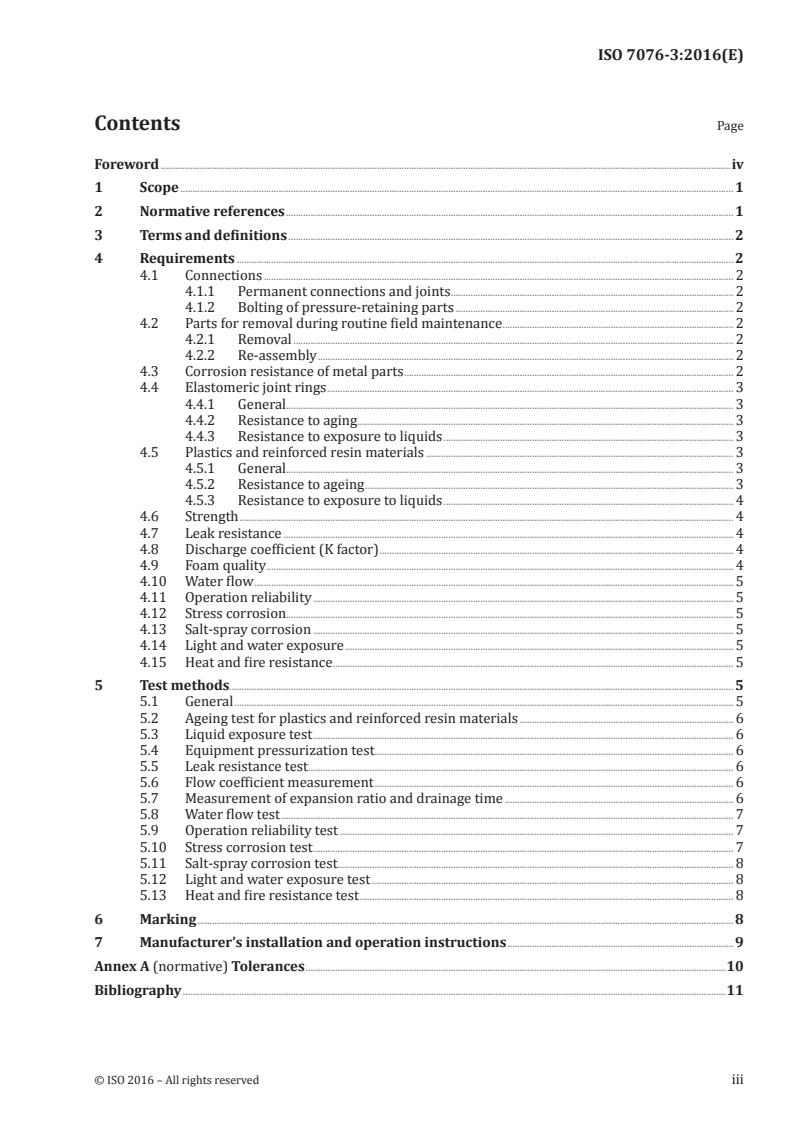
Contents Page
Foreword .iv
1 Scope . 1
2 Normative references . 1
3 Terms and definitions . 2
4 Requirements . 2
4.1 Connections . 2
4.1.1 Permanent connections and joints . 2
4.1.2 Bolting of pressure-retaining parts . 2
4.2 Parts for removal during routine field maintenance . 2
4.2.1 Removal . 2
4.2.2 Re-assembly . 2
4.3 Corrosion resistance of metal parts . 2
4.4 Elastomeric joint rings . 3
4.4.1 General. 3
4.4.2 Resistance to aging . . 3
4.4.3 Resistance to exposure to liquids . 3
4.5 Plastics and reinforced resin materials . 3
4.5.1 General. 3
4.5.2 Resistance to ageing . 3
4.5.3 Resistance to exposure to liquids . 4
4.6 Strength . 4
4.7 Leak resistance . 4
4.8 Discharge coefficient (K factor) . 4
4.9 Foam quality . 4
4.10 Water flow . 5
4.11 Operation reliability . 5
4.12 Stress corrosion. 5
4.13 Salt-spray corrosion . 5
4.14 Light and water exposure . 5
4.15 Heat and fire resistance . 5
5 Test methods . 5
5.1 General . 5
5.2 Ageing test for plastics and reinforced resin materials . 6
5.3 Liquid exposure test . 6
5.4 Equipment pressurization test . 6
5.5 Leak resistance test . 6
5.6 Flow coefficient measurement . 6
5.7 Measurement of expansion ratio and drainage time . 6
5.8 Water flow test . 7
5.9 Operation reliability test . 7
5.10 Stress corrosion test . 7
5.11 Salt-spray corrosion test . 8
5.12 Light and water exposure test . 8
5.13 Heat and fire resistance test . 8
6 Marking . 8
7 Manufacturer’s installation and operation instructions . 9
Annex A (normative) Tolerances .10
Bibliography .11
Foreword
ISO (the International Organization for Standardization) is a worldwide federation of national standards
bodies (ISO member bodies). The work of preparing International Standards is normally carried out
through ISO technical committees. Each member body interested in a subject for which a technical
committee has been established has the right to be represented on that committee. International
organizations, governmental and non-governmental, in liaison with ISO, also take part in the work.
ISO collaborates closely with the International Electrotechnical Commission (IEC) on all matters of
electrotechnical standardization.
The procedures used to develop this document and those intended for its further maintenance are
described in the ISO/IEC Directives, Part 1. In particular the different approval criteria needed for the
different types of ISO documents should be noted. This document was drafted in accordance with the
editorial rules of the ISO/IEC Directives, Part 2 (see www.iso.org/directives).
Attention is drawn to the possibility that some of the elements of this document may be the subject of
patent rights. ISO shall not be held responsible for identifying any or all such patent rights. Details of
any patent rights identified during the development of the document will be in the Introduction and/or
on the ISO list of patent declarations received (see www.iso.org/patents).
Any trade name used in this document is information given for the convenience of users and does not
constitute an endorsement.
For an explanation on the meaning of ISO specific terms and expressions related to conformity assessment,
as well as information about ISO’s adherence to the World Trade Organization (WTO) principles in the
Technical Barriers to Trade (TBT) see the following URL: www.iso.org/iso/foreword.html.
The committee responsible for this document is ISO/TC 21, Equipment for fire protection and fire fighting,
Subcommittee SC 6, Foam and powder media and firefighting systems using foam and powder.
ISO 7076 consists of the following parts, under the general title Fire protection — Foam fire extinguishing
systems:
— Part 1: Foam proportioning equipment
— Part 2: Low expansion foam equipment
— Part 3: Medium expansion foam equipment
— Part 4: High expansion foam equipment
— Part 5: Fixed compressed air foam equipment
— Part 6: Vehicle mounted compressed air foam systems
iv © ISO 2016 – All rights reserved
INTERNATIONAL STANDARD ISO 7076-3:2016(E)
Fire protection — Foam fire extinguishing systems —
Part 3:
Medium expansion foam equipment
1 Scope
This part of ISO 7076 specifies requirements and test methods for medium expansion foam equipment
of fixed-foam extinguishing systems for indoor or outdoor use or both.
2 Normative references
The following documents, in whole or in part, are normatively referenced in this document and are
indispensable for its application. For dated references, only the edition cited applies. For undated
references, the latest edition of the referenced document (including any amendments) applies.
ISO 7-1, Pipe threads where pressure-tight joints are made on the threads — Part 1: Dimensions, tolerances
and designation
ISO 37, Rubber, vulcanized or thermoplastic — Determination of tensile stress-strain properties
ISO 48, Rubber, vulcanized or thermoplastic — Determination of hardness (hardness between 10 IRHD and
100 IRHD)
ISO 175, Plastics — Methods of test for the determination of the effects of immersion in liquid chemicals
ISO 179-1, Plastics — Determination of Charpy impact properties — Part 1: Non-instrumented impact test
ISO 180, Plastics — Determination of Izod impact strength
ISO 188, Rubber, vulcanized or thermoplastic — Accelerated ageing and heat resistance tests
ISO 228-1, Pipe threads where pressure-tight joints are not made on the threads — Part 1: Dimensions,
tolerances and designation
ISO 272, Fasteners — Hexagon products — Widths across flats
ISO 527-1, Plastics — Determination of tensile properties — Part 1: General principles
ISO 885, General purpose bolts and screws — Metric series — Radii under the head
ISO 898-1, Mechanical properties of fasteners made of carbon steel and alloy steel — Part 1: Bolts, screws
and studs with specified property classes — Coarse thread and fine pitch thread
ISO 898-2, Mechanical properties of fasteners made of carbon steel and alloy steel — Part 2: Nuts with
specified property classes — Coarse thread and fine pitch thread
ISO 1179-1, Connections for general use and fluid power — Ports and stud ends with ISO 228-1 threads with
elastomeric or metal-to-metal sealing — Part 1: Threaded ports
ISO 1817, Rubber, vulcanized or thermoplastic — Determination of the effect of liquids
ISO 4759-1, Tolerances for fasteners — Part 1: Bolts, screws, studs and nuts — Product grades A, B and C
ISO 7005-1, Pipe flanges — Part 1: Steel flanges for industrial and general service piping systems
ISO 7005-2, Metallic flanges — Part 2: Cast iron flanges
ISO 7203-2:2011, Fire extinguishing media — Foam concentrates — Part 2: Specification for medium- and
high-expansion foam concentrates for top application to water-immiscible liquids
ISO 9227, Corrosion tests in artificial atmospheres — Salt spray tests
ASTM D638, Standard test method for tensile properties of plastics
ASTM G155, Standard practice for operating xenon arc light apparatus for exposure of non-metallic
materials
3 Terms and definitions
For the purposes of this document, the following terms and definitions apply.
3.1
medium expansion foam
foam with 21 to 200 expansion ratio range
4 Requirements
4.1 Connections
4.1.1 Permanent connections and joints
Permanent joints shall conform to ISO 7-1, ISO 228-1, ISO 1179-1, ISO 7005-1 or ISO 7005-2, as applicable,
or shall conform to other technical specifications valid in the place of use where International Standards
are not applicable.
4.1.2 Bolting of pressure-retaining parts
Bolts, nuts or studs or both used to fasten pressure-retaining parts shall conform to ISO 272, ISO 885
and ISO 4759-1 or shall conform to other technical specifications valid in the place of use where
International Standards are not applicable.
4.2 Parts for removal during routine field maintenance
4.2.1 Removal
Parts intended for removal during routine field maintenance shall be accessible, removable and
replaceable without damage using appropriate tools normally used by the trade or special tools
recommended by the component manufacturer.
4.2.2 Re-assembly
The design and construction of any part intended for removal during routine field maintenance shall be
such that it cannot be re-assembled in a manner other than as intended.
4.3 Corrosion resistance of metal parts
Parts of components that are exposed to foam concentrate or foam solution shall be resistant to
corrosion from that exposure.
2 © ISO 2016 – All rights reserved
Parts of components that are intended to freely move during operation or bear against, rotate within,
or slide on stationary parts shall be of a corrosion-resistant material.
NOTE Bronze is a typical material that has corrosion-resistant properties when exposed to foam concentrate
or foam solution.
4.4 Elastomeric joint rings
4.4.1 General
Elastomeric joint rings shall have the following properties when tested in accordance with ISO 37
and ISO 48.
a) For as-received silicone rubber with basic constituent of poly-organo-siloxane, a minimum tensile
strength of 3,4 MPa, a minimum ultimate elongation of 100 %, and a hardness within ±5 units of
the manufacturer’s specification.
b) For as-received fluoroelastomers, a minimum tensile of 6,9 MPa, a minimum ultimate elongation of
150 %, and a hardness within ±5 units of the manufacturer’s specification.
c) For as-received natural rubber and as-received synthetic rubber other than silicone or
fluoroelastomers, a minimum tensile of 8,3 MPa, a minimum ultimate elongation of 150 % and a
hardness within ±5 units of the manufacturer’s specification.
4.4.2 Resistance to aging
When tested in acco
...
INTERNATIONAL ISO
STANDARD 7076-3
First edition
2016-07-01
Fire protection — Foam fire
extinguishing systems —
Part 3:
Medium expansion foam equipment
Protection contre l’incendie — Systèmes d’extinction d’incendie à
mousse —
Partie 3: Équipement pour mousse à moyen foisonnement
Reference number
©
ISO 2016
© ISO 2016, Published in Switzerland
All rights reserved. Unless otherwise specified, no part of this publication may be reproduced or utilized otherwise in any form
or by any means, electronic or mechanical, including photocopying, or posting on the internet or an intranet, without prior
written permission. Permission can be requested from either ISO at the address below or ISO’s member body in the country of
the requester.
ISO copyright office
Ch. de Blandonnet 8 • CP 401
CH-1214 Vernier, Geneva, Switzerland
Tel. +41 22 749 01 11
Fax +41 22 749 09 47
copyright@iso.org
www.iso.org
ii © ISO 2016 – All rights reserved
Contents Page
Foreword .iv
1 Scope . 1
2 Normative references . 1
3 Terms and definitions . 2
4 Requirements . 2
4.1 Connections . 2
4.1.1 Permanent connections and joints . 2
4.1.2 Bolting of pressure-retaining parts . 2
4.2 Parts for removal during routine field maintenance . 2
4.2.1 Removal . 2
4.2.2 Re-assembly . 2
4.3 Corrosion resistance of metal parts . 2
4.4 Elastomeric joint rings . 3
4.4.1 General. 3
4.4.2 Resistance to aging . . 3
4.4.3 Resistance to exposure to liquids . 3
4.5 Plastics and reinforced resin materials . 3
4.5.1 General. 3
4.5.2 Resistance to ageing . 3
4.5.3 Resistance to exposure to liquids . 4
4.6 Strength . 4
4.7 Leak resistance . 4
4.8 Discharge coefficient (K factor) . 4
4.9 Foam quality . 4
4.10 Water flow . 5
4.11 Operation reliability . 5
4.12 Stress corrosion. 5
4.13 Salt-spray corrosion . 5
4.14 Light and water exposure . 5
4.15 Heat and fire resistance . 5
5 Test methods . 5
5.1 General . 5
5.2 Ageing test for plastics and reinforced resin materials . 6
5.3 Liquid exposure test . 6
5.4 Equipment pressurization test . 6
5.5 Leak resistance test . 6
5.6 Flow coefficient measurement . 6
5.7 Measurement of expansion ratio and drainage time . 6
5.8 Water flow test . 7
5.9 Operation reliability test . 7
5.10 Stress corrosion test . 7
5.11 Salt-spray corrosion test . 8
5.12 Light and water exposure test . 8
5.13 Heat and fire resistance test . 8
6 Marking . 8
7 Manufacturer’s installation and operation instructions . 9
Annex A (normative) Tolerances .10
Bibliography .11
Foreword
ISO (the International Organization for Standardization) is a worldwide federation of national standards
bodies (ISO member bodies). The work of preparing International Standards is normally carried out
through ISO technical committees. Each member body interested in a subject for which a technical
committee has been established has the right to be represented on that committee. International
organizations, governmental and non-governmental, in liaison with ISO, also take part in the work.
ISO collaborates closely with the International Electrotechnical Commission (IEC) on all matters of
electrotechnical standardization.
The procedures used to develop this document and those intended for its further maintenance are
described in the ISO/IEC Directives, Part 1. In particular the different approval criteria needed for the
different types of ISO documents should be noted. This document was drafted in accordance with the
editorial rules of the ISO/IEC Directives, Part 2 (see www.iso.org/directives).
Attention is drawn to the possibility that some of the elements of this document may be the subject of
patent rights. ISO shall not be held responsible for identifying any or all such patent rights. Details of
any patent rights identified during the development of the document will be in the Introduction and/or
on the ISO list of patent declarations received (see www.iso.org/patents).
Any trade name used in this document is information given for the convenience of users and does not
constitute an endorsement.
For an explanation on the meaning of ISO specific terms and expressions related to conformity assessment,
as well as information about ISO’s adherence to the World Trade Organization (WTO) principles in the
Technical Barriers to Trade (TBT) see the following URL: www.iso.org/iso/foreword.html.
The committee responsible for this document is ISO/TC 21, Equipment for fire protection and fire fighting,
Subcommittee SC 6, Foam and powder media and firefighting systems using foam and powder.
ISO 7076 consists of the following parts, under the general title Fire protection — Foam fire extinguishing
systems:
— Part 1: Foam proportioning equipment
— Part 2: Low expansion foam equipment
— Part 3: Medium expansion foam equipment
— Part 4: High expansion foam equipment
— Part 5: Fixed compressed air foam equipment
— Part 6: Vehicle mounted compressed air foam systems
iv © ISO 2016 – All rights reserved
INTERNATIONAL STANDARD ISO 7076-3:2016(E)
Fire protection — Foam fire extinguishing systems —
Part 3:
Medium expansion foam equipment
1 Scope
This part of ISO 7076 specifies requirements and test methods for medium expansion foam equipment
of fixed-foam extinguishing systems for indoor or outdoor use or both.
2 Normative references
The following documents, in whole or in part, are normatively referenced in this document and are
indispensable for its application. For dated references, only the edition cited applies. For undated
references, the latest edition of the referenced document (including any amendments) applies.
ISO 7-1, Pipe threads where pressure-tight joints are made on the threads — Part 1: Dimensions, tolerances
and designation
ISO 37, Rubber, vulcanized or thermoplastic — Determination of tensile stress-strain properties
ISO 48, Rubber, vulcanized or thermoplastic — Determination of hardness (hardness between 10 IRHD and
100 IRHD)
ISO 175, Plastics — Methods of test for the determination of the effects of immersion in liquid chemicals
ISO 179-1, Plastics — Determination of Charpy impact properties — Part 1: Non-instrumented impact test
ISO 180, Plastics — Determination of Izod impact strength
ISO 188, Rubber, vulcanized or thermoplastic — Accelerated ageing and heat resistance tests
ISO 228-1, Pipe threads where pressure-tight joints are not made on the threads — Part 1: Dimensions,
tolerances and designation
ISO 272, Fasteners — Hexagon products — Widths across flats
ISO 527-1, Plastics — Determination of tensile properties — Part 1: General principles
ISO 885, General purpose bolts and screws — Metric series — Radii under the head
ISO 898-1, Mechanical properties of fasteners made of carbon steel and alloy steel — Part 1: Bolts, screws
and studs with specified property classes — Coarse thread and fine pitch thread
ISO 898-2, Mechanical properties of fasteners made of carbon steel and alloy steel — Part 2: Nuts with
specified property classes — Coarse thread and fine pitch thread
ISO 1179-1, Connections for general use and fluid power — Ports and stud ends with ISO 228-1 threads with
elastomeric or metal-to-metal sealing — Part 1: Threaded ports
ISO 1817, Rubber, vulcanized or thermoplastic — Determination of the effect of liquids
ISO 4759-1, Tolerances for fasteners — Part 1: Bolts, screws, studs and nuts — Product grades A, B and C
ISO 7005-1, Pipe flanges — Part 1: Steel flanges for industrial and general service piping systems
ISO 7005-2, Metallic flanges — Part 2: Cast iron flanges
ISO 7203-2:2011, Fire extinguishing media — Foam concentrates — Part 2: Specification for medium- and
high-expansion foam concentrates for top application to water-immiscible liquids
ISO 9227, Corrosion tests in artificial atmospheres — Salt spray tests
ASTM D638, Standard test method for tensile properties of plastics
ASTM G155, Standard practice for operating xenon arc light apparatus for exposure of non-metallic
materials
3 Terms and definitions
For the purposes of this document, the following terms and definitions apply.
3.1
medium expansion foam
foam with 21 to 200 expansion ratio range
4 Requirements
4.1 Connections
4.1.1 Permanent connections and joints
Permanent joints shall conform to ISO 7-1, ISO 228-1, ISO 1179-1, ISO 7005-1 or ISO 7005-2, as applicable,
or shall conform to other technical specifications valid in the place of use where International Standards
are not applicable.
4.1.2 Bolting of pressure-retaining parts
Bolts, nuts or studs or both used to fasten pressure-retaining parts shall conform to ISO 272, ISO 885
and ISO 4759-1 or shall conform to other technical specifications valid in the place of use where
International Standards are not applicable.
4.2 Parts for removal during routine field maintenance
4.2.1 Removal
Parts intended for removal during routine field maintenance shall be accessible, removable and
replaceable without damage using appropriate tools normally used by the trade or special tools
recommended by the component manufacturer.
4.2.2 Re-assembly
The design and construction of any part intended for removal during routine field maintenance shall be
such that it cannot be re-assembled in a manner other than as intended.
4.3 Corrosion resistance of metal parts
Parts of components that are exposed to foam concentrate or foam solution shall be resistant to
corrosion from that exposure.
2 © ISO 2016 – All rights reserved
Parts of components that are intended to freely move during operation or bear against, rotate within,
or slide on stationary parts shall be of a corrosion-resistant material.
NOTE Bronze is a typical material that has corrosion-resistant properties when exposed to foam concentrate
or foam solution.
4.4 Elastomeric joint rings
4.4.1 General
Elastomeric joint rings shall have the following properties when tested in accordance with ISO 37
and ISO 48.
a) For as-received silicone rubber with basic constituent of poly-organo-siloxane, a minimum tensile
strength of 3,4 MPa, a minimum ultimate elongation of 100 %, and a hardness within ±5 units of
the manufacturer’s specification.
b) For as-received fluoroelastomers, a minimum tensile of 6,9 MPa, a minimum ultimate elongation of
150 %, and a hardness within ±5 units of the manufacturer’s specification.
c) For as-received natural rubber and as-received synthetic rubber other than silicone or
fluoroelastomers, a minimum tensile of 8,3 MPa, a minimum ultimate elongation of 150 % and a
hardness within ±5 units of the manufacturer’s specification.
4.4.2 Resistance to aging
When tested in acco
...