

ISO 7076-6:2024
(Main)Fire protection — Foam fire extinguishing systems — Part 6: Vehicle-mounted compressed air foam systems
General Information
- Abstract
This document specifies requirements for compressed air foam systems (CAFS) in which foam concentrate and compressed air are continuously added to the water being discharged from the fire-fighting pump. This document is applicable to CAFS that can be permanently installed in fire-fighting vehicles, or that are transportable or mobile. This document specifies requirements for CAFS which are used at ambient temperatures ranging from –10 °C to +40 °C. This document does not apply to stationary CAFS. This document does not apply to requirements for hazards related to handling foam concentrates, noise generated by CAFS, drives, auxiliary equipment, power sources, or pumps connected to the CAFS. This document does not specify requirements for special hazards arising from particular conditions under which CAFS are used, for example: — immunity against electromagnetic fields and electrostatic discharge; — operation without supervision; — events specific to the location where the CAFS is set up (e.g. on public roads); — handling of any equipment, devices, etc. which have to be connected to the CAFS or are joined to it (e.g. branch pipes, nozzles and pressure hoses); — decommissioning and disposal.
- Status
- Published
- Publication Date
- 06-Jun-2024
- Current Stage
- 6060 - International Standard published
- Start Date
- 07-Jun-2024
- Due Date
- 28-Feb-2025
- Completion Date
- 07-Jun-2024
Overview
ISO 7076-6:2024 establishes internationally recognized requirements for vehicle-mounted compressed air foam systems (CAFS) used in fire protection. Designed to ensure consistent safety, performance, and operational efficiency, this standard is applicable to CAFS permanently installed, transportable, or mobile within fire-fighting vehicles. The systems addressed by ISO 7076-6:2024 operate effectively within ambient temperatures ranging from –10 °C to +40 °C. The standard focuses on safeguarding personnel, enhancing fire suppression capabilities, and supporting the reliable operation of CAFS in emergency situations.
By providing clear requirements for design, installation, operation, and maintenance, ISO 7076-6:2024 supports manufacturers, fire departments, and regulatory authorities in ensuring the safe and effective deployment of foam extinguishing systems in mobile fire-fighting applications.
Key Topics
Scope and Applicability:
- Requirements for CAFS integrated into or used with fire-fighting vehicles
- Ambient operation temperature of –10 °C to +40 °C
- Does not apply to stationary CAFS
System Design and Safety:
- Mechanical and electrical safety measures in line with ISO and IEC standards
- Prevention of over-pressurization and protection against overheating and over-speed
- Safeguarding personnel from moving and hot parts
Performance and Operation:
- Criteria for proportioning ratio and foam solution/air volume ratios
- Provisions for continuous delivery of compressed air foam during operation
- Performance endurance requirements, including uninterrupted six-hour operation
Testing and Assessment:
- Defined procedures for visual inspection, engineering assessment, and testing
- Conformance assessments for type and individual CAFS models
- Measurement and verification of delivery rates, pressure, and system marking
Marking and User Instructions:
- Durable marking for identification and operational guidance
- Short-form operating instructions and data provided at operator’s panel
- Clear instructions for maintenance, servicing, and troubleshooting
Applications
Vehicle-mounted compressed air foam systems specified in ISO 7076-6:2024 serve a broad range of fire-fighting applications, including:
Municipal and Industrial Fire Services: CAFS-equipped fire engines and response units benefit from faster, more effective fire suppression, especially in areas with challenging topography or infrastructure.
Rural and Wildland Firefighting: Enhanced foam coverage and adhesion make these systems ideal for combating wildfires and agricultural fires.
Emergency Response: Mobile foam systems can be quickly deployed to fire incidents at chemical plants, storage facilities, and transportation accidents, supporting rapid intervention and minimizing property damage.
Specialized Rescue Vehicles: Transportable or mobile CAFS can be mounted on a variety of emergency vehicles, including those operating in remote or hazardous environments.
Organizations adhering to ISO 7076-6:2024 can help ensure higher levels of personnel safety, system longevity, and reliable fire suppression performance in demanding, real-world conditions.
Related Standards
- ISO 7000: Graphical symbols for use on equipment
- ISO 12100: Safety of machinery - General principles for design
- ISO 13943: Fire safety - Vocabulary
- ISO 14120: Safety of machinery - Guards
- IEC 60068-1: Environmental testing - General and guidance
- IEC 60204-1: Safety of machinery - Electrical equipment
- IEC 61310-2: Indication, marking and actuation requirements
Compliance with ISO 7076-6:2024 and its related standards ensures interoperability, safety, and reliability of vehicle-mounted compressed air foam systems across global fire protection applications. Fire and rescue organizations, equipment manufacturers, and regulatory authorities are encouraged to align with these standards to advance fire safety and operational excellence.
Relations
- Effective Date
- 02-Sep-2023
- Effective Date
- 02-Sep-2023
Get Certified
Connect with accredited certification bodies for this standard

CIS Institut d.o.o.
Personal Protective Equipment (PPE) certification body. Notified Body NB-2890 for EU Regulation 2016/425 PPE.

Kiwa BDA Testing
Building and construction product certification.
Kmetijski inštitut Slovenije
Agricultural Institute of Slovenia. Soil testing, plant health, agricultural product analysis.
Sponsored listings
Frequently Asked Questions
ISO 7076-6:2024 is a standard published by the International Organization for Standardization (ISO). Its full title is "Fire protection — Foam fire extinguishing systems — Part 6: Vehicle-mounted compressed air foam systems". This standard covers: This document specifies requirements for compressed air foam systems (CAFS) in which foam concentrate and compressed air are continuously added to the water being discharged from the fire-fighting pump. This document is applicable to CAFS that can be permanently installed in fire-fighting vehicles, or that are transportable or mobile. This document specifies requirements for CAFS which are used at ambient temperatures ranging from –10 °C to +40 °C. This document does not apply to stationary CAFS. This document does not apply to requirements for hazards related to handling foam concentrates, noise generated by CAFS, drives, auxiliary equipment, power sources, or pumps connected to the CAFS. This document does not specify requirements for special hazards arising from particular conditions under which CAFS are used, for example: — immunity against electromagnetic fields and electrostatic discharge; — operation without supervision; — events specific to the location where the CAFS is set up (e.g. on public roads); — handling of any equipment, devices, etc. which have to be connected to the CAFS or are joined to it (e.g. branch pipes, nozzles and pressure hoses); — decommissioning and disposal.
This document specifies requirements for compressed air foam systems (CAFS) in which foam concentrate and compressed air are continuously added to the water being discharged from the fire-fighting pump. This document is applicable to CAFS that can be permanently installed in fire-fighting vehicles, or that are transportable or mobile. This document specifies requirements for CAFS which are used at ambient temperatures ranging from –10 °C to +40 °C. This document does not apply to stationary CAFS. This document does not apply to requirements for hazards related to handling foam concentrates, noise generated by CAFS, drives, auxiliary equipment, power sources, or pumps connected to the CAFS. This document does not specify requirements for special hazards arising from particular conditions under which CAFS are used, for example: — immunity against electromagnetic fields and electrostatic discharge; — operation without supervision; — events specific to the location where the CAFS is set up (e.g. on public roads); — handling of any equipment, devices, etc. which have to be connected to the CAFS or are joined to it (e.g. branch pipes, nozzles and pressure hoses); — decommissioning and disposal.
ISO 7076-6:2024 is classified under the following ICS (International Classification for Standards) categories: 13.220.10 - Fire-fighting. The ICS classification helps identify the subject area and facilitates finding related standards.
ISO 7076-6:2024 has the following relationships with other standards: It is inter standard links to ISO 7076-6:2016/Amd 1:2020, ISO 7076-6:2016. Understanding these relationships helps ensure you are using the most current and applicable version of the standard.
ISO 7076-6:2024 is available in PDF format for immediate download after purchase. The document can be added to your cart and obtained through the secure checkout process. Digital delivery ensures instant access to the complete standard document.
Standards Content (Sample)
International
Standard
ISO 7076-6
Second edition
Fire protection — Foam fire
2024-06
extinguishing systems —
Part 6:
Vehicle-mounted compressed air
foam systems
Reference number
© ISO 2024
All rights reserved. Unless otherwise specified, or required in the context of its implementation, no part of this publication may
be reproduced or utilized otherwise in any form or by any means, electronic or mechanical, including photocopying, or posting on
the internet or an intranet, without prior written permission. Permission can be requested from either ISO at the address below
or ISO’s member body in the country of the requester.
ISO copyright office
CP 401 • Ch. de Blandonnet 8
CH-1214 Vernier, Geneva
Phone: +41 22 749 01 11
Email: copyright@iso.org
Website: www.iso.org
Published in Switzerland
ii
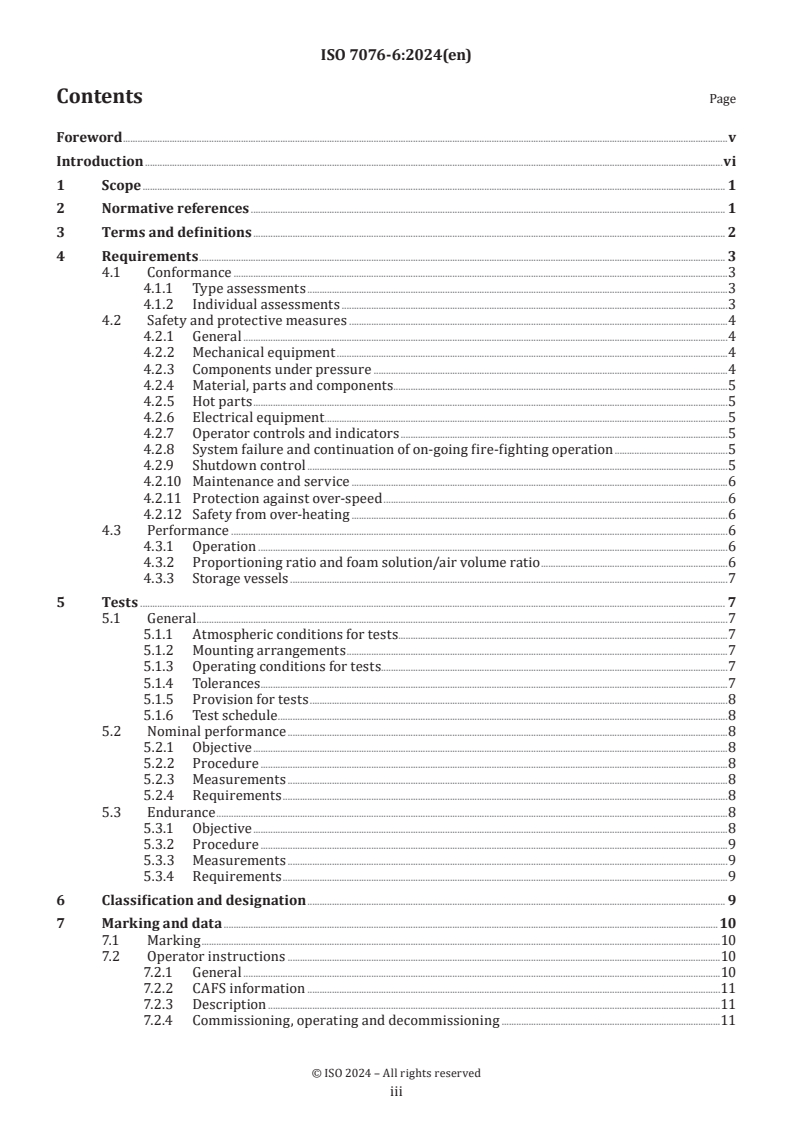
Contents Page
Foreword .v
Introduction .vi
1 Scope . 1
2 Normative references . 1
3 Terms and definitions . 2
4 Requirements . 3
4.1 Conformance .3
4.1.1 Type assessments .3
4.1.2 Individual assessments .3
4.2 Safety and protective measures .4
4.2.1 General .4
4.2.2 Mechanical equipment .4
4.2.3 Components under pressure .4
4.2.4 Material, parts and components.5
4.2.5 Hot parts .5
4.2.6 Electrical equipment .5
4.2.7 Operator controls and indicators .5
4.2.8 System failure and continuation of on-going fire-fighting operation .5
4.2.9 Shutdown control .5
4.2.10 Maintenance and service .6
4.2.11 Protection against over-speed .6
4.2.12 Safety from over-heating .6
4.3 Performance .6
4.3.1 Operation .6
4.3.2 Proportioning ratio and foam solution/air volume ratio .6
4.3.3 Storage vessels .7
5 Tests . 7
5.1 General .7
5.1.1 Atmospheric conditions for tests.7
5.1.2 Mounting arrangements .7
5.1.3 Operating conditions for tests.7
5.1.4 Tolerances .7
5.1.5 Provision for tests .8
5.1.6 Test schedule .8
5.2 Nominal performance .8
5.2.1 Objective .8
5.2.2 Procedure .8
5.2.3 Measurements .8
5.2.4 Requirements .8
5.3 Endurance .8
5.3.1 Objective .8
5.3.2 Procedure .9
5.3.3 Measurements .9
5.3.4 Requirements .9
6 Classification and designation . 9
7 Marking and data .10
7.1 Marking .10
7.2 Operator instructions .10
7.2.1 General .10
7.2.2 CAFS information .11
7.2.3 Description .11
7.2.4 Commissioning, operating and decommissioning .11
iii
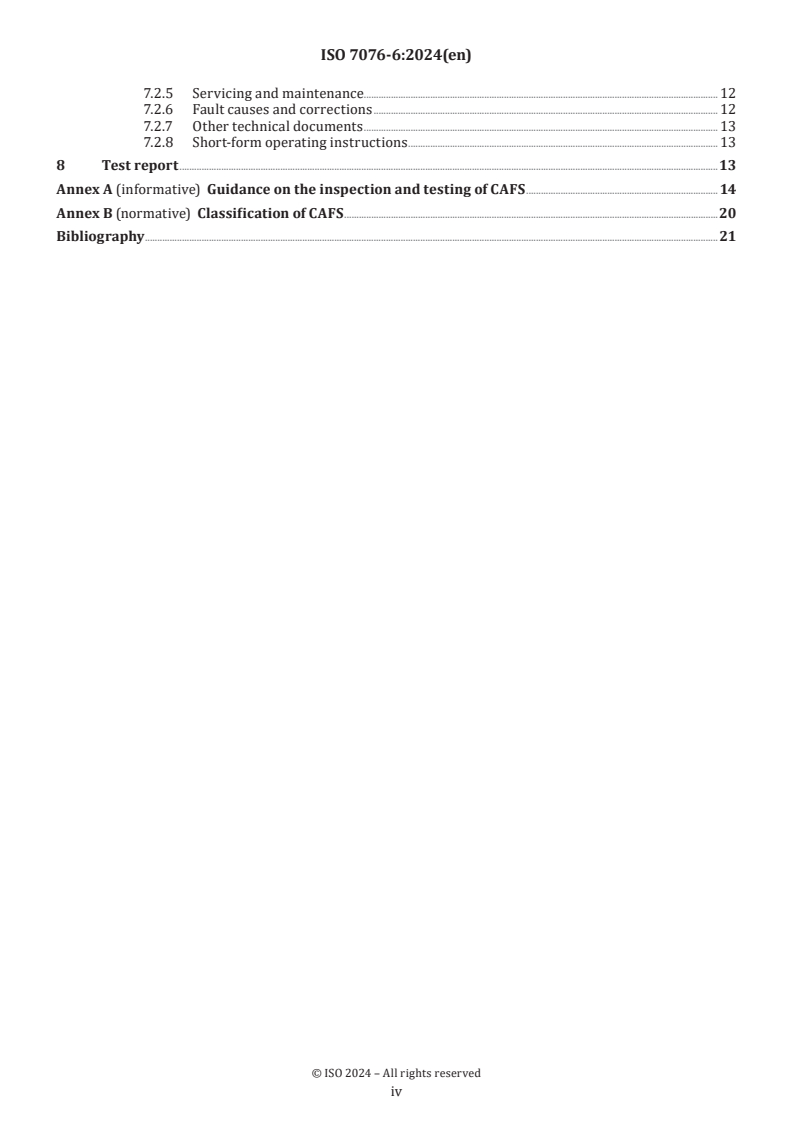
7.2.5 Servicing and maintenance. 12
7.2.6 Fault causes and corrections . 12
7.2.7 Other technical documents . 13
7.2.8 Short-form operating instructions . 13
8 Test report .13
Annex A (informative) Guidance on the inspection and testing of CAFS . 14
Annex B (normative) Classification of CAFS .20
Bibliography .21
iv
Foreword
ISO (the International Organization for Standardization) is a worldwide federation of national standards
bodies (ISO member bodies). The work of preparing International Standards is normally carried out through
ISO technical committees. Each member body interested in a subject for which a technical committee
has been established has the right to be represented on that committee. International organizations,
governmental and non-governmental, in liaison with ISO, also take part in the work. ISO collaborates closely
with the International Electrotechnical Commission (IEC) on all matters of electrotechnical standardization.
The procedures used to develop this document and those intended for its further maintenance are described
in the ISO/IEC Directives, Part 1. In particular, the different approval criteria needed for the different types
of ISO document should be noted. This document was drafted in accordance with the editorial rules of the
ISO/IEC Directives, Part 2 (see www.iso.org/directives).
ISO draws attention to the possibility that the implementation of this document may involve the use of (a)
patent(s). ISO takes no position concerning the evidence, validity or applicability of any claimed patent
rights in respect thereof. As of the date of publication of this document, ISO had not received notice of (a)
patent(s) which may be required to implement this document. However, implementers are cautioned that
this may not represent the latest information, which may be obtained from the patent database available at
www.iso.org/patents. ISO shall not be held responsible for identifying any or all such patent rights.
Any trade name used in this document is information given for the convenience of users and does not
constitute an endorsement.
For an explanation of the voluntary nature of standards, the meaning of ISO specific terms and expressions
related to conformity assessment, as well as information about ISO's adherence to the World Trade
Organization (WTO) principles in the Technical Barriers to Trade (TBT), see www.iso.org/iso/foreword.html.
This document was prepared by Technical Committee ISO/TC 21, Equipment for fire protection and fire
fighting, Subcommittee SC 6, Foam and powder media and firefighting systems using foam and powder.
This second edition cancels and replaces the first edition (ISO 7076-6:2016), which has been technically
revised. It also incorporates the Amendment ISO 7076-6:2016/Amd. 1:2020.
The main changes are as follows:
— in 4.3.2.5, the deviation from the set proportioning ratio has been modified;
— the title of Clause 6 has been modified; within the clause, a citation to Annex B has been added.
— in Table A.1, the rows for 4.2.3.3 and 4.2.4.1, the descriptions in the “individual assessment” column have
been modified;
— Annex B has been added;
— editorial corrections have been made throughout the document.
A list of all parts in the ISO 7076 series can be found on the ISO website.
Any feedback or questions on this document should be directed to the user’s national standards body. A
complete listing of these bodies can be found at www.iso.org/members.html.
v
Introduction
Compressed air foam systems (CAFS) conforming to this document are installed in fire-fighting vehicles,
or used in conjunction with fire-fighting vehicles, to improve the efficiency of fire-extinguishing processes.
CAFS improve the adhesion, penetration and retention time of the fire-extinguishing agent on the burning
material, thereby transferring more energy and improving the cooling effect of the applied foam. This is
achieved by adding foam concentrates and compressed air, to be delivered into water under pressure by the
fire-fighting pump, to the fire.
CAFS generate homogeneous foam that increases the effective contact area of the foam on the burning
material. This improves the adhesion and penetration of the foam to non-horizontal surfaces of the burning
material, thereby increasing the period in which heat is effectively transferred.
It is assumed that systems defined in this document are only operated by suitably trained personnel.
For CAFS to be used at a temperature outside the temperature range defined in this document (i.e. from
–10 °C to +40 °C), the particular temperature range is specified by the user. The manufacturer should
determine any need for additional precautions by means of a risk assessment.
vi
International Standard ISO 7076-6:2024(en)
Fire protection — Foam fire extinguishing systems —
Part 6:
Vehicle-mounted compressed air foam systems
1 Scope
This document specifies requirements for compressed air foam systems (CAFS) in which foam concentrate
and compressed air are continuously added to the water being discharged from the fire-fighting pump.
This document is applicable to CAFS that can be permanently installed in fire-fighting vehicles, or that are
transportable or mobile.
This document specifies requirements for CAFS which are used at ambient temperatures ranging from
–10 °C to +40 °C.
This document does not apply to stationary CAFS.
This document does not apply to requirements for hazards related to handling foam concentrates, noise
generated by CAFS, drives, auxiliary equipment, power sources, or pumps connected to the CAFS.
This document does not specify requirements for special hazards arising from particular conditions under
which CAFS are used, for example:
— immunity against electromagnetic fields and electrostatic discharge;
— operation without supervision;
— events specific to the location where the CAFS is set up (e.g. on public roads);
— handling of any equipment, devices, etc. which have to be connected to the CAFS or are joined to it (e.g.
branch pipes, nozzles and pressure hoses);
— decommissioning and disposal.
2 Normative references
The following documents are referred to in the text in such a way that some or all of their content constitutes
requirements of this document. For dated references, only the edition cited applies. For undated references,
the latest edition of the referenced document (including any amendments) applies.
ISO 7000, Graphical symbols for use on equipment — Registered symbols
ISO 12100:2010, Safety of machinery — General principles for design — Risk assessment and risk reduction
ISO 13854, Safety of machinery — Minimum gaps to avoid crushing of parts of the human body
ISO 13857, Safety of machinery — Safety distances to prevent hazard zones being reached by upper and lower limbs
ISO 13943, Fire safety — Vocabulary
ISO 14120, Safety of machinery — Guards — General requirements for the design and construction of fixed and
movable guards
IEC 60068-1, Environmental testing — Part 1: General and guidance
IEC 60204-1, Safety of machinery — Electrical equipment of machines — Part 1: General requirements
IEC 61310-2, Safety of machinery — Indication, marking and actuation — Part 2: Requirements for marking
3 Terms and definitions
For the purposes of this document, the terms and definitions given in ISO 13943 and the following apply.
ISO and IEC maintain terminology databases for use in standardization at the following addresses:
— ISO Online browsing platform: available at https:// www .iso .org/ obp
— IEC Electropedia: available at https:// www .electropedia .org/
3.1
air delivery rate
volume of air, in ambient conditions, that is fed into the compressed air foam systems (3.5), per unit of time
Note 1 to entry: The measurement unit is l/min.
3.2
compressed air foam
mixture of water, foam concentrate and compressed air
3.3
compressed air foam delivery pressure
pressure of compressed air foam (3.2) at the delivery outlet of the compressed air foam systems (3.5)
Note 1 to entry: The measurement unit is MPa.
3.4
compressed air foam delivery rate
volume of compressed air foam (3.2) at the delivery outlet of the compressed air foam systems (3.5), converted
at atmospheric pressure, per unit of time
Note 1 to entry: The measurement unit is l/min.
3.5
compressed air foam system
CAFS
system in which a foam concentrate and air are continuously added under pressure to the water being
discharged from a fire-fighting pump
3.6
dry foam
compressed air foam (3.2) defined by a nominal foam solution/air volume ratio (3.9) greater than 1:10, being
mixed in the compressed air foam systems (3.5)
3.7
flushing procedure
process to ensure that pipework associated to the foam proportioning system is adequately cleaned of foam
concentrate and solution up to the discharge connection to avoid any damage
EXAMPLE Procedure to avoid damage by corrosion.
3.8
foam concentrate delivery rate
volume of foam concentrate fed into compressed air foam systems (3.5), per unit of time
Note 1 to entry: The measurement unit is l/min.
3.9
foam solution/air volume ratio
relationship between parts of liquid (foam solution) and air (at atmospheric pressure) being mixed together
in a compressed air foam system (3.5) mixing device
3.10
foam solution delivery rate
volume of foam solution delivered per unit of time by a system
Note 1 to entry: The measurement unit is l/min.
Note 2 to entry: At proportioning ratios (3.12) of up to 1 %, the difference between water delivery rate (3.13) and foam
solution delivery rate can be neglected.
3.11
operating range
range (of conditions) specified by the manufacturer of a system and within which the CAFS can be operated
without limitations while achieving the intended performance characteristics
3.12
proportioning ratio
amount of foam concentrate added to water given as a percentage in the foam solution
3.13
water delivery rate
volume of water fed into compressed air foam systems (3.5) per unit of time
Note 1 to entry: The measurement unit is l/min.
3.14
wet foam
compressed air foam (3.2) defined by a nominal foam solution/air volume ratio (3.9) between 1:3 and 1:10,
being mixed in the compressed air foam systems (3.5)
4 Requirements
4.1 Conformance
4.1.1 Type assessments
In order to conform to this document, the CAFS representative of normal manufacture shall meet the
requirements of Clauses 4, 6 and 7. The CAFS shall be verified by visual inspection or engineering assessment.
It shall be tested as described in Clause 5 and it shall meet the requirements of the tests (see Annex A for
guidance on conducting the assessments).
It is recognized that minor variations can occur in the design of CAFS (e.g. to ensure compatibility with
multiple truck types). Where minor variations occur and in the interests of economy, only one variant of each
model need undergo type assessments. The CAFS should undergo new type assessments where a design
change is likely to affect a requirement of this document. The extent of the re-assessment can be limited,
depending on the type of design change that has been made to the CAFS. In all cases, the manufacturer
should maintain appropriate documentation.
4.1.2 Individual assessments
In addition to the requirements of 4.1.1, each CAFS produced by the manufacturer shall meet the
requirements of the subclauses listed in Table 1, which shall be verified by visual inspection, engineering
assessment or test, and shall meet the requirements of the tests (see Annex A for guidance on conducting the
assessments).
Table 1 — Individual assessment schedule
Assessment Subclause number
Installation of the CAFS on the vehicle 4.2.2.1
Moving parts 4.2.2.2
Over-pressurization prevention 4.2.3.3
Accumulated water removal 4.2.4.1
Hot parts safety 4.2.5.1
Hot parts notice 4.2.5.2
Electrical equipment safety 4.2.6.2
Operator controls and indicators 4.2.7
Shutdown control 4.2.9
Maintenance and service 4.2.10
Protection against over-speed 4.2.11
Safety from over-heating 4.2.12
Drainage 4.3.1.3
Proportioning ratio and foam solution/air volume ratio 4.3.2.1
Maintenance of proportioning ratio 4.3.2.5
Maintenance of foam solution/air volume ratio 4.3.2.7
Storage vessels 4.3.3
Nominal performance 5.2
Marking 7.1
4.2 Safety and protective measures
4.2.1 General
Safety of machinery shall conform to the requirements of ISO 12100.
4.2.2 Mechanical equipment
4.2.2.1 Installation of CAFS on the vehicle
CAFS shall be so designed and constructed as to be installed on the vehicle, in such a way as to prevent
malfunction, disconnection or damage caused by vibration during the operation of the vehicle.
4.2.2.2 Moving parts
4.2.2.2.1 Personnel shall be protected from injury by moving parts during inspection, operation and
service. Where applicable, the following shall be provided:
a) fixed guards in accordance with ISO 14120, conforming to the safety distances defined in ISO 13857;
b) minimum clearance at the end of a motion sequence in accordance with ISO 13854.
4.2.2.2.2 A cautionary notice shall be fitted to, or adjacent to moving parts that are accessed during
inspection, operation and service and may cause injury.
4.2.3 Components under pressure
4.2.3.1 The maximum operation pressure while using CAFS from the designated delivery outlets shall not
exceed 1,0 MPa.
NOTE Higher pressures for specific applications can be agreed between users and a manufacturer.
4.2.3.2 A device shall be provided to relieve the internal pressure of the CAFS after operation.
4.2.3.3 Prevention of over-pressurization shall be ensured.
4.2.4 Material, parts and components
4.2.4.1 If water can accumulate in the air system, a means of removing it shall be provided.
4.2.4.2 Material, parts and components shall be resistant to corrosion by the foam concentrate, foam
solution and compressed air foam.
4.2.5 Hot parts
4.2.5.1 Personnel shall be protected from injury by hot parts during inspection, operation and service.
For further information, see ISO 13732-1.
4.2.5.2 A cautionary notice shall be fitted to, or adjacent to hot parts that are accessed during inspection,
operation and service and may cause injury.
4.2.6 Electrical equipment
4.2.6.1 Electrical equipment shall meet the requirements of IEC 60204-1.
4.2.6.2 Design measures shall be taken to protect electrical equipment from damage by water, foam
concentrate, and foam solution during filling of storage vessels and operation.
4.2.7 Operator controls and indicators
4.2.7.1 Controls and indicators used by the operator during fire-fighting actions shall be adequately
arranged and operated for the purpose of safety, visibility and easier operation. See the IEC 61310 series.
4.2.7.2 Manual operating equipment and other control elements shall be easy to reach and to operate
when wearing protective gloves for fire-fighters, without having to apply excessive force.
4.2.7.3 The number of switching operations shall be kept to a minimum. Control elements shall be
arran
...