

ISO 7204:2023
(Main)Specification for wetting agents for application on Class A fires
General Information
- Abstract
This document specifies the essential properties and performance of liquid wetting agent concentrates used to make wetting agents for the extinction and inhibition of reignition of fires of Class A fuels. This document specifies the minimum performance on certain test fires.
- Status
- Published
- Publication Date
- 01-Nov-2023
- Current Stage
- 6060 - International Standard published
- Start Date
- 02-Nov-2023
- Due Date
- 14-Jan-2024
- Completion Date
- 02-Nov-2023
Overview
ISO 7204:2023 - Specification for wetting agents for application on Class A fires - sets minimum performance, composition and marking requirements for liquid wetting agent concentrates used to extinguish and inhibit reignition of Class A fires (solid organic materials such as wood, vegetation, cloth and paper). The standard defines essential physical and chemical properties, test-fire performance and required manufacturer information so users and procurers can assess suitability and safety.
Key technical topics and requirements
- Scope and purpose: Defines wetting agent concentrates and wetting agent solutions for Class A fuels; specifies minimum performance on designated test fires (Annex F).
- Conditioning and stability: Sampling and temperature conditioning procedures are given (Annex A). Concentrates claimed resistant to freezing/thawing must show no visual stratification after cycling per Annex B.
- Sediment limits: Sediment must be dispersible through a 180 µm sieve; maximum sediment volumes are ≤ 0.25% before conditioning and ≤ 1.0% after conditioning (Annex C).
- Viscosity:
- Newtonian concentrates - viscosity determined per ISO 3104; containers must note if viscosity exceeds the specified threshold (marking for special proportioning equipment).
- Pseudo‑plastic concentrates - measured per Annex D; specific shear-rate dependent viscosity limits apply (example: marking requirement if ≥ 120 mPa·s at 375 s⁻¹).
- pH: Concentrate pH shall be 6.0 to 8.5 at (20 ± 2) °C; change after conditioning ≤ 1.0 pH unit.
- Surface tension: Wetting-agent solution surface tension at recommended concentration must be within ±10% of the characteristic value before conditioning and within 0.95–1.05× of that value after conditioning (Annex E).
- Fire testing: Solutions must extinguish a wood crib fire and pass deep‑seated fire tests (Annex F).
- Toxicology and environmental information: Manufacturers must supply toxicological and ecotoxicological data at highest recommended concentration (Annex G).
- Marking & packaging: Required container marking includes product designation, recommended concentration and any handling notes (Clause 13 and annexes).
Practical applications and users
- Who uses it: wetting‑agent manufacturers, testing laboratories, fire services (airport/industrial/municipal), procurement/specification engineers, safety officers and equipment manufacturers.
- Applications: Formulation control, batch acceptance testing, procurement specification, compliance for firefighting equipment and systems used to suppress or prevent reignition of Class A fires. Also used when assessing compatibility with seawater use or corrosion‑sensitive environments.
Related standards
Normative references include ISO 304 (surface tension), ISO 3104 (viscosity), ISO 7165 (portable extinguishers), EN 1568‑3 and other ISO firefighting standards cited in the document. For full test procedures and annex details refer to ISO 7204:2023.
Get Certified
Connect with accredited certification bodies for this standard

CIS Institut d.o.o.
Personal Protective Equipment (PPE) certification body. Notified Body NB-2890 for EU Regulation 2016/425 PPE.

Kiwa BDA Testing
Building and construction product certification.
Kmetijski inštitut Slovenije
Agricultural Institute of Slovenia. Soil testing, plant health, agricultural product analysis.
Sponsored listings
Frequently Asked Questions
ISO 7204:2023 is a standard published by the International Organization for Standardization (ISO). Its full title is "Specification for wetting agents for application on Class A fires". This standard covers: This document specifies the essential properties and performance of liquid wetting agent concentrates used to make wetting agents for the extinction and inhibition of reignition of fires of Class A fuels. This document specifies the minimum performance on certain test fires.
This document specifies the essential properties and performance of liquid wetting agent concentrates used to make wetting agents for the extinction and inhibition of reignition of fires of Class A fuels. This document specifies the minimum performance on certain test fires.
ISO 7204:2023 is classified under the following ICS (International Classification for Standards) categories: 13.220.10 - Fire-fighting. The ICS classification helps identify the subject area and facilitates finding related standards.
ISO 7204:2023 is available in PDF format for immediate download after purchase. The document can be added to your cart and obtained through the secure checkout process. Digital delivery ensures instant access to the complete standard document.
Standards Content (Sample)
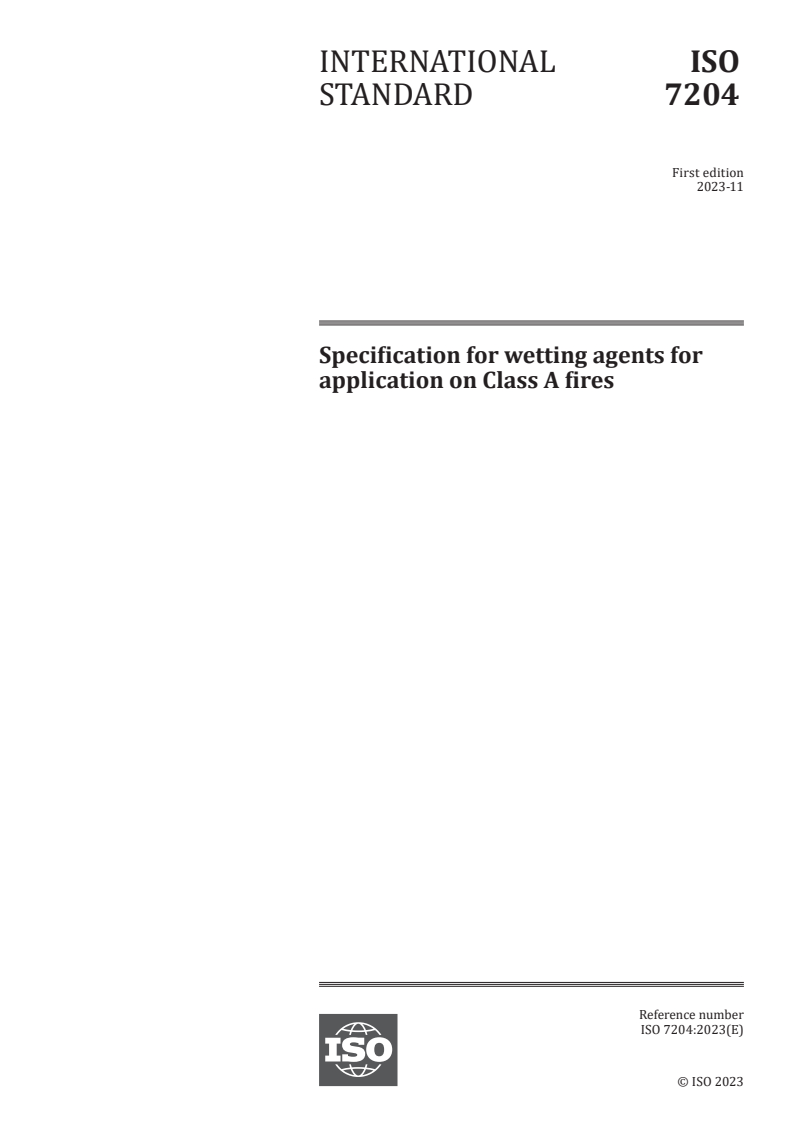
INTERNATIONAL ISO
STANDARD 7204
First edition
2023-11
Specification for wetting agents for
application on Class A fires
Reference number
© ISO 2023
All rights reserved. Unless otherwise specified, or required in the context of its implementation, no part of this publication may
be reproduced or utilized otherwise in any form or by any means, electronic or mechanical, including photocopying, or posting on
the internet or an intranet, without prior written permission. Permission can be requested from either ISO at the address below
or ISO’s member body in the country of the requester.
ISO copyright office
CP 401 • Ch. de Blandonnet 8
CH-1214 Vernier, Geneva
Phone: +41 22 749 01 11
Email: copyright@iso.org
Website: www.iso.org
Published in Switzerland
ii
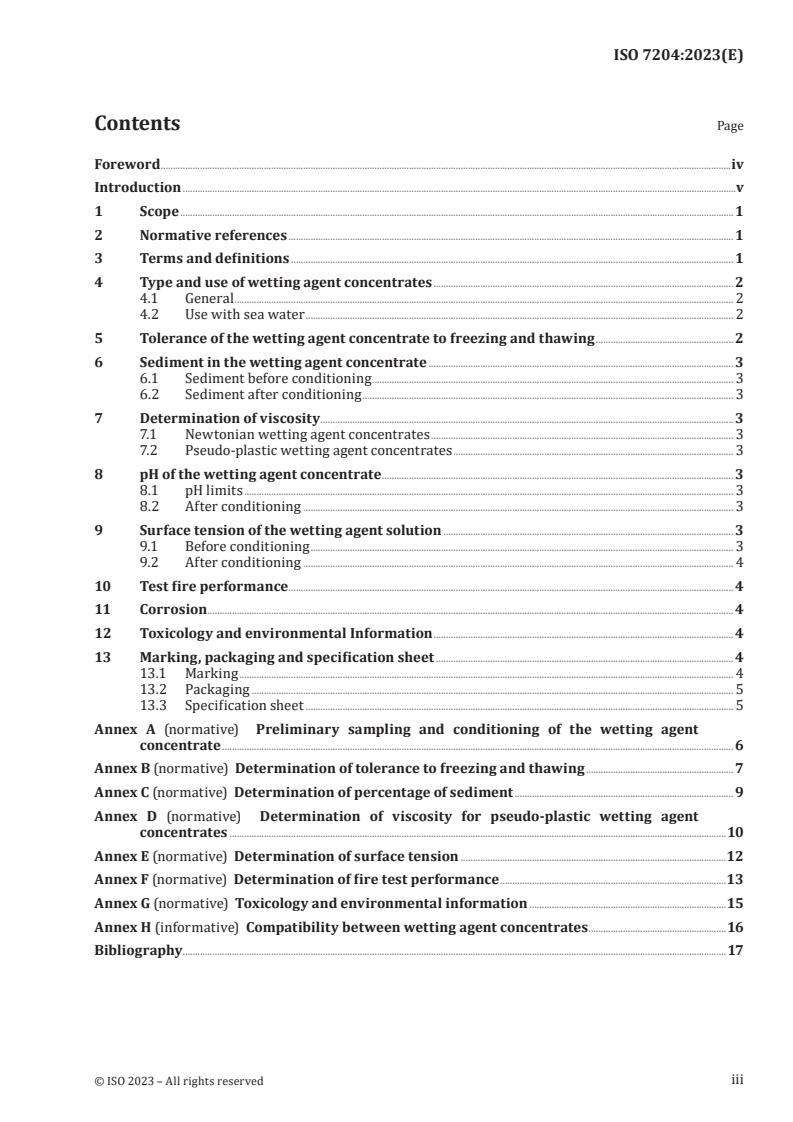
Contents Page
Foreword .iv
Introduction .v
1 Scope .1
2 Normative references .1
3 Terms and definitions .1
4 Type and use of wetting agent concentrates .2
4.1 General . 2
4.2 Use with sea water . 2
5 Tolerance of the wetting agent concentrate to freezing and thawing .2
6 Sediment in the wetting agent concentrate . 3
6.1 Sediment before conditioning . 3
6.2 Sediment after conditioning . 3
7 Determination of viscosity .3
7.1 Newtonian wetting agent concentrates . 3
7.2 Pseudo-plastic wetting agent concentrates . 3
8 pH of the wetting agent concentrate . 3
8.1 pH limits . 3
8.2 After conditioning . 3
9 Surface tension of the wetting agent solution . 3
9.1 Before conditioning . 3
9.2 After conditioning . 4
10 Test fire performance . .4
11 Corrosion .4
12 Toxicology and environmental Information .4
13 Marking, packaging and specification sheet .4
13.1 Marking . 4
13.2 Packaging . 5
13.3 Specification sheet . 5
Annex A (normative) Preliminary sampling and conditioning of the wetting agent
concentrate .6
Annex B (normative) Determination of tolerance to freezing and thawing .7
Annex C (normative) Determination of percentage of sediment .9
Annex D (normative) Determination of viscosity for pseudo-plastic wetting agent
concentrates .10
Annex E (normative) Determination of surface tension .12
Annex F (normative) Determination of fire test performance .13
Annex G (normative) Toxicology and environmental information .15
Annex H (informative) Compatibility between wetting agent concentrates .16
Bibliography .17
iii
Foreword
ISO (the International Organization for Standardization) is a worldwide federation of national standards
bodies (ISO member bodies). The work of preparing International Standards is normally carried out
through ISO technical committees. Each member body interested in a subject for which a technical
committee has been established has the right to be represented on that committee. International
organizations, governmental and non-governmental, in liaison with ISO, also take part in the work.
ISO collaborates closely with the International Electrotechnical Commission (IEC) on all matters of
electrotechnical standardization.
The procedures used to develop this document and those intended for its further maintenance are
described in the ISO/IEC Directives, Part 1. In particular, the different approval criteria needed for the
different types of ISO document should be noted. This document was drafted in accordance with the
editorial rules of the ISO/IEC Directives, Part 2 (see www.iso.org/directives).
ISO draws attention to the possibility that the implementation of this document may involve the use
of (a) patent(s). ISO takes no position concerning the evidence, validity or applicability of any claimed
patent rights in respect thereof. As of the date of publication of this document, ISO had not received
notice of (a) patent(s) which may be required to implement this document. However, implementers are
cautioned that this may not represent the latest information, which may be obtained from the patent
database available at www.iso.org/patents. ISO shall not be held responsible for identifying any or all
such patent rights.
Any trade name used in this document is information given for the convenience of users and does not
constitute an endorsement.
For an explanation of the voluntary nature of standards, the meaning of ISO specific terms and
expressions related to conformity assessment, as well as information about ISO's adherence to
the World Trade Organization (WTO) principles in the Technical Barriers to Trade (TBT), see
www.iso.org/iso/foreword.html.
This document was prepared by Technical Committee ISO/TC 21, Equipment for fire protection and fire
fighting, Subcommittee SC 6, Foam and powder media and firefighting systems using foam and powder.
Any feedback or questions on this document should be directed to the user’s national standards body. A
complete listing of these bodies can be found at www.iso.org/members.html.
iv
Introduction
Firefighting wetting agents are widely used to control and extinguish Class A fires and for inhibiting
reignition.
Wetting agents can be used in combination with other extinguishing media, particularly halocarbons,
carbon dioxide and powders, which are the subject of other International Standards including ISO 6183,
ISO 7201-1, ISO 7201-2 and ISO 7202. A specification for foam systems can be found in the ISO 7076
series.
A specification for portable extinguishers can be found in ISO 7165.
v
INTERNATIONAL STANDARD ISO 7204:2023(E)
Specification for wetting agents for application on Class A
fires
1 Scope
This document specifies the essential properties and performance of liquid wetting agent concentrates
used to make wetting agents for the extinction and inhibition of reignition of fires of Class A fuels.
This document specifies the minimum performance on certain test fires.
2 Normative references
The following documents are referred to in the text in such a way that some or all of their content
constitutes requirements of this document. For dated references, only the edition cited applies. For
undated references, the latest edition of the referenced document (including any amendments) applies.
EN 1568-3:2018, Fire extinguishing media — Foam concentrates — Part 3: Specification for low expansion
foam concentrates for surface application to water-immiscible liquids
ISO 304, Surface active agents — Determination of surface tension by drawing up liquid films
ISO 3104, Petroleum products — Transparent and opaque liquids — Determination of kinematic viscosity
and calculation of dynamic viscosity
ISO 3219, Rheology
ISO 3310-1, Test sieves — Technical requirements and testing — Part 1: Test sieves of metal wire cloth
ISO 3696:1987, Water for analytical laboratory use — Specification and test methods
ISO 7165, Fire fighting — Portable fire extinguishers — Performance and construction
3 Terms and definitions
For the purposes of this document, the following terms and definitions apply.
ISO and IEC maintain terminology databases for use in standardization at the following addresses:
— ISO Online browsing platform: available at https:// www .iso .org/ obp
— IEC Electropedia: available at https:// www .electropedia .org/
3.1
characteristic value
value declared by the wetting agent (3.6) concentrate (3.2) manufacturer for the chemical and physical
properties and the performances of the wetting agent solution (3.9), and wetting agent concentrate
3.2
concentrate
wetting agent (3.6) liquid that, when mixed with water in the appropriate concentration, gives a wetting
agent solution (3.9)
3.3
sediment
insoluble particles in the wetting agent (3.6) concentrate (3.2)
3.4
temperature for use
maximum and minimum temperature claimed by the manufacturer between which the wetting agent
(3.6) concentrate (3.2) is ready for use
3.5
Class A fire
fire involving solid materials, usually of an organic nature, in which combustion normally takes place
with the formation of glowing embers
Note 1 to entry: See ISO 3941:2007, Clause 2 for the classification of fires.
3.6
wetting agent
liquid added to water to produce a solution with a surface tension less than that of water alone, which is
capable of readily spreading across and penetrating into Class A fuels (3.7)
Note 1 to entry: Wetting agents are not required to produce foam.
3.7
Class A fuel
solid material, usually of an organic nature (such as vegetation, wood, cloth, paper, rubber, and some
plastics), in which combustion can occur at or below the surface of the material with or without the
formation of glowing embers
3.8
freezing point
temperature at which the first ingredient of a mixture starts to solidify or freeze out
3.9
wetting agent solution
solution of wetting agent (3.6) concentrate (3.2) and water
4 Type and use of wetting agent concentrates
4.1 General
Wetting agent concentrates shall be capable of providing positive fire testing results if tested in
accordance with Annex F. See also Annex H.
4.2 Use with sea water
If a wetting agent concentrate is marked as suitable for use with sea water, the recommended
concentrations for use with fresh water and sea water shall be identical.
NOTE Increased corrosiveness can occur on equipment used if a wetting agent solution is prepared using
sea water.
5 Tolerance of the wetting agent concentrate to freezing and thawing
The wetting agent concentrate shall be preliminarily sampled and conditioned in accordance with
Annex A.
Before and after temperature conditioning in accordance with Clause A.2, the wetting agent concentrate,
if claimed by the supplier not to be adversely affected by freezing and thawing, shall show no visual
sign of stratification and non-homogeneity when tested in accordance with Annex B.
Wetting agent concentrates in conformance with Annex B shall be tested for conformance with the
appropriate requirements given in other clauses and subclauses of this document (indicated by the
term “conditioning” in their respective headlines) after freezing and thawing in accordance with A.2.1.
6 Sediment in the wetting agent concentrate
6.1 Sediment before conditioning
Any sediment in the concentrate sampled in accordance with Clause A.1 shall be dispersible through a
180 µm sieve, and the percentage volume of the sediment shall be not more than 0,25 % when tested in
accordance with Annex C.
6.2 Sediment after conditioning
Any sediment in the concentrate aged in accordance with Clause A.2 shall be dispersible through a
180 µm sieve, and the percentage volume of sediment shall be not more than 1,0 % when tested in
accordance with Annex C.
7 Determination of viscosity
7.1 Newtonian wetting agent concentrates
The viscosity of the wetting agent concentrate at the lowest temperature for use claimed by the
2 −1
manufacturer shall be determined in accordance with ISO 3104. If the viscosity is > 200 mm s , the
container shall be marked: “This concentrate can require special proportioning equipment.”.
7.2 Pseudo-plastic wetting agent concentrates
The viscosity of the wetting agent concentrate shall be determined in accordance with Annex D. If the
−1
viscosity at the lowest temperature for use is greater than or equal to 120 mPa⋅s at 375 s , the container
shall be marked: “This concentrate can require special proportioning equipment.”.
NOTE Pseudo-plastic wetting agent concentrates are a particular class of non-Newtonian wetting agent
concentrates and have a viscosity that decreases with increasing shear rate at constant temperature.
8 pH of the wetting agent concentrate
8.1 pH limits
The pH of the wetting agent concentrate, before and after conditioning in accordance with Clause A.2,
shall be not less than 6,0 and not more than 8,5 at (20 ± 2) °C.
8.2 After conditioning
The difference in pH between before and after conditioning according to Clause A.2 shall not be greater
than 1,0 pH units.
9 Surface tension of the wetting agent solution
9.1 Before conditioning
The surface tension of the wetting agent solution prepared from the concentrate, before conditioning in
accordance with Clause A.2 at the supplier's recommended concentration, shall be within ±10 % of the
characteristic value when determined in accordance with Annex E.
9.2 After conditioning
The surface tension of the wetting agent solution prepared from the concentrate, after conditioning
in accordance with Clause A.2 at the supplier's recommended con
...