

ISO 7076-5:2014
(Main)Fire protection — Foam fire extinguishing systems — Part 5: Fixed compressed air foam equipment
General Information
- Abstract
ISO 7076-5:2014 specifies requirements, test and assessment methods, and performance criteria for fixed compressed air foam equipment of fixed foam extinguishing systems for indoor or outdoor utilization, or both. Technical safety requirements concerning the design and manufacturing of drives, auxiliary equipment, sources of energy, or pumps are outside the scope of ISO 7076-5:2014. Special hazards arising from the particular conditions under which these systems are used are outside the scope of ISO 7076-5:2014. Hazards relating to any kind of mechanical, electrical, hydraulic, pneumatic, and other equipment dealt with by the respective standards for such equipment are outside the scope of ISO 7076-5:2014. Hazards arising from the noise of systems are outside the scope of ISO 7076-5:2014.
- Status
- Published
- Publication Date
- 06-May-2014
- Current Stage
- 9093 - International Standard confirmed
- Start Date
- 24-Apr-2026
- Completion Date
- 29-Aug-2026
Overview - ISO 7076-5:2014 (Fixed compressed air foam equipment)
ISO 7076-5:2014 is the International Standard that specifies requirements, test and assessment methods, and performance criteria for fixed compressed air foam (CAF) equipment used in fixed foam fire extinguishing systems for indoor and/or outdoor use. It applies to CAF generation, proportioning, foam quality, discharge devices and related performance testing, while explicitly excluding technical safety requirements for drives, pumps, energy sources and other equipment covered by their own standards. The standard supports improved suppression effectiveness for both Class A and Class B fires by defining how compressed air foam systems (CAFS) should perform and be tested.
Key topics and technical requirements
- Scope & exclusions: Covers fixed compressed air foam equipment; excludes drives, pumps, special hazard-specific requirements, noise and hazards addressed by other equipment standards.
- Foam definitions: Wet foam (foam solution/air ratio 1:3 to 1:10) and dry foam (>1:10). Foam quality assessed by expansion ratio and 25% drainage time.
- Performance requirements:
- Systems shall generate at least wet foam of homogeneous, finely pored quality.
- No compressed air pulses at system outlet during start/stop.
- Proportioning ratio deviation limits at foam solution pressures 0.4–1 MPa:
- 0 to +20% for proportioning ratios ≤ 1%
- 0 to +30% for proportioning ratios >1% to 3%
- Pressure drop at nominal delivery rate ≤ 0.2 MPa.
- Air pressure regulation that prevents air flow if liquid discharge is interrupted.
- Design in accordance with Chapter 7 of NFPA 11-2010 (where specified).
- Testing and environmental requirements:
- CAF fire extinguishment tests (Class B) and foam quality measurements.
- Tests for discharge devices, generation and proportioning performance.
- Durability tests including salt fog corrosion (ASTM B117), thermal shock, and environmental stabilization per IEC 60068-1 (15–35 °C, 25–75 % RH, 86–106 kPa).
- Normative annexes: conductivity procedure (A) and low expansion foam test configurations/chronology (B, C).
Practical applications and users
ISO 7076-5 is used by:
- Fire protection engineers and system designers specifying fixed CAFS.
- Manufacturers of mixing chambers, nozzles and CAF discharge devices for product development and certification.
- Testing laboratories performing CAF performance, corrosion and thermal tests.
- Authorities having jurisdiction (AHJs), facility managers, insurers and integrators validating system compliance for commercial, industrial and specialized facilities that require fixed foam fire protection (indoor/outdoor).
Related standards and keywords
- Related / referenced: NFPA 11-2010, IEC 60068-1, ASTM B117.
- SEO keywords: ISO 7076-5, compressed air foam, CAF, CAFS, fixed compressed air foam equipment, foam fire extinguishing systems, foam quality, proportioning ratio, fire protection standard, NFPA 11.
Get Certified
Connect with accredited certification bodies for this standard

CIS Institut d.o.o.
Personal Protective Equipment (PPE) certification body. Notified Body NB-2890 for EU Regulation 2016/425 PPE.

Kiwa BDA Testing
Building and construction product certification.
Kmetijski inštitut Slovenije
Agricultural Institute of Slovenia. Soil testing, plant health, agricultural product analysis.
Sponsored listings
Frequently Asked Questions
ISO 7076-5:2014 is a standard published by the International Organization for Standardization (ISO). Its full title is "Fire protection — Foam fire extinguishing systems — Part 5: Fixed compressed air foam equipment". This standard covers: ISO 7076-5:2014 specifies requirements, test and assessment methods, and performance criteria for fixed compressed air foam equipment of fixed foam extinguishing systems for indoor or outdoor utilization, or both. Technical safety requirements concerning the design and manufacturing of drives, auxiliary equipment, sources of energy, or pumps are outside the scope of ISO 7076-5:2014. Special hazards arising from the particular conditions under which these systems are used are outside the scope of ISO 7076-5:2014. Hazards relating to any kind of mechanical, electrical, hydraulic, pneumatic, and other equipment dealt with by the respective standards for such equipment are outside the scope of ISO 7076-5:2014. Hazards arising from the noise of systems are outside the scope of ISO 7076-5:2014.
ISO 7076-5:2014 specifies requirements, test and assessment methods, and performance criteria for fixed compressed air foam equipment of fixed foam extinguishing systems for indoor or outdoor utilization, or both. Technical safety requirements concerning the design and manufacturing of drives, auxiliary equipment, sources of energy, or pumps are outside the scope of ISO 7076-5:2014. Special hazards arising from the particular conditions under which these systems are used are outside the scope of ISO 7076-5:2014. Hazards relating to any kind of mechanical, electrical, hydraulic, pneumatic, and other equipment dealt with by the respective standards for such equipment are outside the scope of ISO 7076-5:2014. Hazards arising from the noise of systems are outside the scope of ISO 7076-5:2014.
ISO 7076-5:2014 is classified under the following ICS (International Classification for Standards) categories: 13.220.10 - Fire-fighting. The ICS classification helps identify the subject area and facilitates finding related standards.
ISO 7076-5:2014 is available in PDF format for immediate download after purchase. The document can be added to your cart and obtained through the secure checkout process. Digital delivery ensures instant access to the complete standard document.
Standards Content (Sample)
INTERNATIONAL ISO
STANDARD 7076-5
First edition
2014-05-01
Fire protection — Foam fire
extinguishing systems —
Part 5:
Fixed compressed air foam equipment
Protection contre l’incendie — Installations fixes d’extinction par
mousse physique —
Partie 5: Équipement fixe pour mousse physique à air comprimé
Reference number
©
ISO 2014
© ISO 2014
All rights reserved. Unless otherwise specified, no part of this publication may be reproduced or utilized otherwise in any form
or by any means, electronic or mechanical, including photocopying, or posting on the internet or an intranet, without prior
written permission. Permission can be requested from either ISO at the address below or ISO’s member body in the country of
the requester.
ISO copyright office
Case postale 56 • CH-1211 Geneva 20
Tel. + 41 22 749 01 11
Fax + 41 22 749 09 47
E-mail copyright@iso.org
Web www.iso.org
Published in Switzerland
ii © ISO 2014 – All rights reserved
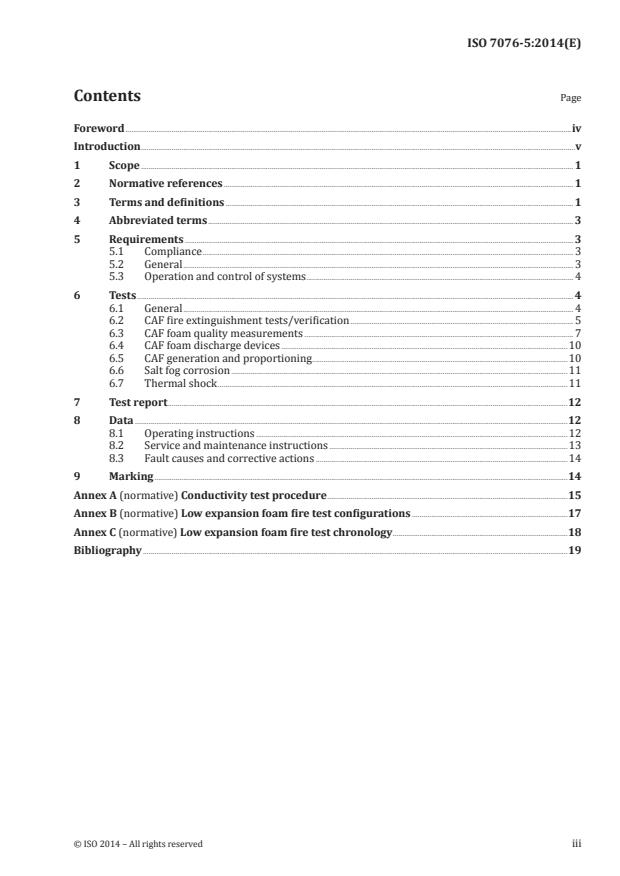
Contents Page
Foreword .iv
Introduction .v
1 Scope . 1
2 Normative references . 1
3 Terms and definitions . 1
4 Abbreviated terms . 3
5 Requirements . 3
5.1 Compliance . 3
5.2 General . 3
5.3 Operation and control of systems . 4
6 Tests . 4
6.1 General . 4
6.2 CAF fire extinguishment tests/verification . 5
6.3 CAF foam quality measurements . 7
6.4 CAF foam discharge devices .10
6.5 CAF generation and proportioning.10
6.6 Salt fog corrosion .11
6.7 Thermal shock .11
7 Test report .12
8 Data .12
8.1 Operating instructions .12
8.2 Service and maintenance instructions .13
8.3 Fault causes and corrective actions .14
9 Marking .14
Annex A (normative) Conductivity test procedure .15
Annex B (normative) Low expansion foam fire test configurations .17
Annex C (normative) Low expansion foam fire test chronology
...........................................................................................18
Bibliography .19
Foreword
ISO (the International Organization for Standardization) is a worldwide federation of national standards
bodies (ISO member bodies). The work of preparing International Standards is normally carried out
through ISO technical committees. Each member body interested in a subject for which a technical
committee has been established has the right to be represented on that committee. International
organizations, governmental and non-governmental, in liaison with ISO, also take part in the work.
ISO collaborates closely with the International Electrotechnical Commission (IEC) on all matters of
electrotechnical standardization.
The procedures used to develop this document and those intended for its further maintenance are
described in the ISO/IEC Directives, Part 1. In particular the different approval criteria needed for the
different types of ISO documents should be noted. This document was drafted in accordance with the
editorial rules of the ISO/IEC Directives, Part 2 (see www.iso.org/directives).
Attention is drawn to the possibility that some of the elements of this document may be the subject of
patent rights. ISO shall not be held responsible for identifying any or all such patent rights. Details of
any patent rights identified during the development of the document will be in the Introduction and/or
on the ISO list of patent declarations received (see www.iso.org/patents).
Any trade name used in this document is information given for the convenience of users and does not
constitute an endorsement.
For an explanation on the meaning of ISO specific terms and expressions related to conformity
assessment, as well as information about ISO’s adherence to the WTO principles in the Technical Barriers
to Trade (TBT) see the following URL: Foreword - Supplementary information
The committee responsible for this document is ISO/TC 21, Equipment for fire protection and fire fighting,
Subcommittee SC 6, Foam and powder media and firefighting systems using foam and powder.
ISO 7076 consists of the following parts, under the general title Fire protection — Foam fire extinguishing
systems:
— Part 1: Foam proportioning equipment
— Part 2: Low expansion foam equipment
— Part 5: Fixed compressed air foam equipment
The following parts are under preparation:
— Part 3: Medium expansion foam equipment
— Part 4: High expansion foam equipment
— Part 6: Vehicle mounted compressed air foam systems
iv © ISO 2014 – All rights reserved
Introduction
This part of ISO 7076 is prepared by ISO/TC 21/SC 6, and is based on FM Global Class 5130 Approval
Standard on Foam Extinguishing Systems.
Fixed compressed air foam equipment is required to function satisfactorily not only in the event of fire,
but also during and after exposure to conditions it is likely to meet in practice, including corrosion,
vibration, direct impact, and indirect shock. Specific tests are intended to assess the performance of the
equipment under such conditions.
The aim of using such systems is to improve the fire suppression effectiveness of the fire extinguishing
agent on the burning materials for both Class A and Class B fires, by producing uniform and more stable
bubbles, which improves the cooling effect of the applied media.
This part of ISO 7076 is not intended to place any other restrictions on the design and construction of
fixed compressed air foam equipment.
INTERNATIONAL STANDARD ISO 7076-5:2014(E)
Fire protection — Foam fire extinguishing systems —
Part 5:
Fixed compressed air foam equipment
1 Scope
This part of ISO 7076 specifies requirements, test and assessment methods, and performance criteria
for fixed compressed air foam equipment of fixed foam extinguishing systems for indoor or outdoor
utilization, or both.
Technical safety requirements concerning the design and manufacturing of drives, auxiliary equipment,
sources of energy, or pumps are outside the scope of this part of ISO 7076.
Special hazards arising from the particular conditions under which these systems are used are outside
the scope of this part of ISO 7076.
Hazards relating to any kind of mechanical, electrical, hydraulic, pneumatic, and other equipment dealt
with by the respective standards for such equipment are outside the scope of this part of ISO 7076.
Hazards arising from the noise of systems are outside the scope of this part of ISO 7076.
2 Normative references
The following documents, in whole or in part, are normatively referenced in this document and are
indispensable for its application. For dated references, only the edition cited applies. For undated
references, the latest edition of the referenced document (including any amendments) applies.
IEC 60068-1, Environmental testing — Part 1: General and guidance
ASTM B117, Standard practice for operating salt spray (fog) apparatus
NFPA 11-2010, Standard for Low-, Medium-, and High-Expansion Foam
3 Terms and definitions
For the purposes of this document, the following terms and definitions apply.
3.1
air delivery rate
volume of air, in normal condition, that is fed into a fixed compressed air foam system per unit of time
Note 1 to entry: While inside the system, the air volume will be compressed according to the pressure applied.
Once it leaves the system from the nozzle to the atmosphere, the air will expand to its normal volume again.
3.2
air/foam solution volume ratio
ratio stating how many parts of air (at normal condition) are mixed with one part of the foam solution
in a fixed compressed air foam system
Note 1 to entry: The ratio is expressed as the pair of values one part foam solution to x parts air (1:x).
3.3
approved
acceptable to the authority having jurisdiction
3.4
authority having jurisdiction
AHJ
organization, office, or individual responsible for enforcing the requirements of a code or standard, or
for approving equipment, materials, an installation, or a procedure
3.5
compressed air foam
CAF
homogenous foam produced by the combination of water, foam concentrate, and air or nitrogen under
pressure
3.6
compressed air foam generating method
method of generating compressed air foam recognized in this part of ISO 7076 using a mixing chamber
to combine air or nitrogen under pressure, water, and foam concentrate in the correct proportions
Note 1 to entry: The resulting compressed air foam flows through piping to the hazard being protected.
3.7
compressed air foam discharge device
device specifically designed to discharge compressed air foam in a predetermined pattern
3.8
fixed compressed air foam system
fixed CAFS
system employing compressed air foam discharge devices attached to a piping system through which
foam is transported from a mixing chamber
Note 1 to entry: Discharge of fixed CAFS begins with automatic actuation of a detection system, or manual
actuation that opens valves permitting compressed air foam, generated in the mixing chamber, to flow through a
piping system and discharged over the area served by the discharge devices.
3.9
drainage time 25 %
time taken for 25 % of the foam to collapse into solution
3.10
wet foam
foam produced by a fixed compressed air foam system and which has a foam solution/air volume ratio
of between 1:3 to 1:10
3.11
dry foam
foam produced by a fixed compressed air foam system and which has a foam solution/air volume ratio
of more than 1:10
3.12
foam expansion ratio
ratio of the volume of expanded foam and its solution
3.13
foam solution
mixture of water and foam concentrate
2 © ISO 2014 – All rights reserved
3.14
(foam solution) delivery rate
Q
W
volume (of water plus foam concentrate) delivered per unit of time by a system
Note 1 to entry: At proportioning ratios of up to 1 %, the difference between water delivery rate and foam solution
delivery rate can be neglected.
3.15
foam quality
quality of foam based on foam expansion ratio and 25 % drainage time
3.16
nozzle
specially designed device that can discharge foam in a predetermined pattern
3.17
operation pressure of the fixed CAF system
pressure at the system input connection at which all performance and safety requirements are met and
which shall be specified by the fixed compressed air foam system
3.18
operation range
range (of conditions) specified by the manufacturer of a system and within which the system can be
operated without limitations while achieving the intended performance characteristics
3.19
proportioning ratio
volume of foam concentrate added to water by volume, given as a percentage of the solution
3.20
listed
equipment, materials, or services included in a list published by an organization that is acceptable to
the authority having jurisdiction and concerned with evaluation of production of listed equipment or
materials or periodic evaluation of services, and whose listing states that either the equipment, material,
or service meets appropriate designated standards or has been tested and found suitable for a specified
purpose
4 Abbreviated terms
CAF compressed air foam
CAFS compressed air foam system
5 Requirements
5.1 Compliance
In order to comply with this part of ISO 7076, the fixed CAF system shall meet the requirements of this
clause, which shall be verified by technical inspection or engineering assessment, shall be tested as
specified in Clause 6, and shall meet the requirements of the tests.
5.2 General
5.2.1 The fixed CAF system shall be designed in accordance with the requirements of Chapter 7 of
NFPA 11-2010 and of this clause.
5.2.2 A fixed CAF system shall generate at least wet foam.
5.2.3 A homogeneous, finely pored foam shall be discharged at the nozzles.
5.3 Operation and control of systems
5.3.1 The operating range(s) for dry foam and wet foam shall be specified by the system manufacturer.
5.3.2 There shall be no compressed air pulses at the fixed CAF system outlet cross section when the
system is switched on and off.
5.3.3 Within the operating range and at a foam solution delivery pressure of between 0,4 MPa and
1 MPa, the deviation from the set proportioning ratio shall not exceed
a) 0 to +20 % for proportioning ratios up to 1 % and
b) 0 to +30 % for proportioning ratios between 1 % and 3 %.
5.3.4 The pressure drop across the fixed CAF system when operated at the nominal delivery rate shall
not exceed 0,2 MPa.
5.3.5 The CAF unit shall be equipped with an air pressure regulating system that prevents the flow of
air when the liquid discharge is interrupted.
5.3.6 System controls shall be designed in accordance with 4.9 of NFPA 11-2010.
6 Tests
6.1 General
6.1.1 CAF shall demonstrate extinguishing performance in Class B fire tests. Fires shall be extinguished
by the end of the allowable discharge time and shall not reignite during the post-extinguishment
observation period.
6.1.2 Atmospheric conditions for tests
6.1.2.1 Unless otherwise stated in a test procedure, conduct the testing after the test specimen has
been allowed to stabilize in the standard atmospheric conditions for testing as specified in IEC 60068-
1 as follows:
— temperature: (15 to 35) °C;
— relative humidity: (25 to 75) %;
— air pressure: (86 to 106) kPa.
6.1.2.2 The temperature and humidity shall be substantially constant for each test where the standard
atmospheric conditions are applied.
6.1.3 Operating conditions for tests
6.1.3.1 If a test method requires a specimen, such as nozzle or mixing chamber, to be operational,
then connect the specimen to a suitable water supply and foam concentrate having the characteristics
required by the manufacturer’s data. Unless otherwise specified in the test method, the fixed CAF system
4 © ISO 2014 – All rights reserved
parameters applied to the specimen shall be set within the manufacturer’s specified range(s) and shall
remain substantially constant throughout the tests. The value chosen for each parameter shall normally
be the nominal value, or the mean of the specified range.
6.1.3.2 The details of the water supply and foam concentrate used shall be given in the test report (see
Clause 7).
6.2 CAF fire extinguishment tests/verification
6.2.1 The fire test pan (see Figure 1) shall be square and fabricated of steel with a minimum thickness
of 4,8 mm. The inside dimensions shall be 2,16 m by a minimum of 305 mm deep. All surfaces shall meet
at 90° angles and shall be joined by continuous, liquid-tight welds. The upper edge of the pan shall be
reinforced by an externally attached 38 mm steel angle of 4,8 mm minimum thickness. The angle shall
be attached to the pan by continuously welding its outside corner to the top edge of the pan, so that
the upper surface of one leg of the angle is flush with the top of the pan and the other leg of the angle
is tight against the outside wall of the pan. The lower leg of the angle shall be attached to the pan by
approximately 12-mm-long tack welds spaced approximately every 50 mm. The pan can be fitted with
a drain connection and lifting lugs below the reinforcing angle, if desired. Other equivalent construction
shall be allowed, provided that minimum section thicknesses are met or exceeded.
Dimensions in millimetres
Key
1 typical location for stovepipe insertion
Figure 1 — Low expansion fire test pan
6.2.2 The fire test shall be conducted with the pan resting on a flat surface or elevated no more than
305 mm above that surface. If the pan is to be so elevated, then a continuous skirt shall be used to prevent
air circulation below the pan during the test.
6.2.3 At minimum, the concentrate shall be tested with commercial grade heptane for the test fuel.
After the pan has been levelled, heptane shall be added to a minimum depth of 50 mm. Then water shall
be added to raise the heptane level to provide a minimum freeboard of 203 mm. For water-miscible fuels,
water cannot be used to adjust the fuel level in the pan. Therefore, a shallower pan can be used if the
manufacturer does not wish to test with a freeboard greater than 203 mm.
6.2.4 Tests shall be conducted inside or outside under conditions of calm air and no precipitation, and
at ambient air, premix, and fuel temperatures between 10 °C and 32 °C.
6.2.5 Foam solution shall be prepared by mixing the specified amount of concentrate with water, either
in a premixed solution or continuously by use of suitable proportioning equipment. Volume measuring,
weighing, or flow measuring equipment shall be of sufficient accuracy to ensure that concentration is
within ±5 % of the specified value. If conductivity measurements are to be used as a proxy for direct
measurements of volume, weight, or flow to determine concentration, the procedure of Annex A shall be
used to validate the correlation of conductivity to concentration.
6.2.6 The discharge device and application rate to be used in test shall be selected by the manufacturer.
The application rate used shall define the minimum rate for the concentrate, unless an additional
successful test is conducted at a lower application rate. Authorities having jurisdiction can mandate
higher application rates for specific hazards.
6.2.7 CAF fire extinguishment tests shall be conducted using four nozzles installed on the manufacturer’s
maximum specified square spacing and at the manufacturer’s minimum recommended foam application
rate. Nozzle height shall be the manufacturer’s specified minimum. A second set of tests shall be conducted
using the manufacturer’s maximum area of coverage asymmetry, if other than square spacing is specified
for the system. After review of the test results, the worst performing combinations of concentrates,
hardware, and installation geometries shall also be tested at the manufacturer’s maximum recommended
installation height. Tests shall be conducted with each concentrate and at the manufacturer’s specified
concentration(s).
6.2.8 For non-water-miscible fuels, including commercial grade heptanes, the test fuel shall be ignited
and allowed to burn for the preburn time indicated in Annex B prior to the application of foam. CAF
discharge duration shall be 5 min with 5 min of subsequent water discharge. Since CAF discharge devices
are typically not sprinklers, this will require overlaying of the CAF piping grid with a second sprinkler grid.
The sprinkler grid shall be with a minimum water application rate of 0,3 gal/min/ft (12,2 mm/min). A
maximum water application rate for foam breakdown as specified by the manufacturer shall be tested. The
maximum water application rate can be selected by the manufacturer from 0,3 gal/min/ft to 1,0 gal/min/
2 2
ft (12,2 mm/min to 40,8 mm/min) at even 0,1 gal/min/ft (4,1 mm/min) steps. The timing for reignition
attempts and the burn-back resistance evaluation shall be as specified for foam-water sprinklers and the
type of concentrate, as shown in Annex B.
For water-miscible fuels, the test method is the same, except CAF discharge duration shall be 5 min
with no subsequent water discharge. The timing for reignition attempts and the burn-back resistance
evaluation shall be as specified for foam-water sprinklers and the type of concentrate, as shown in
Annex B. If a premixed solution is not used, concentration shall be verified by appropriate instrumentation
to measure water and concentrate flow rates or weight or volume changes.
6.2.9 The pan surface shall be completely covered by the foam blanket and the fire completely
extinguished by the end of foam discharge. If the discharge device is a foam-water sprinkler, or a device
which can be installed under a fire protection sprinkler system, then water-only discharge shall continue
for an additional 5 min to verify that the foam blanket cannot be easily degraded by subsequent water
discharge. The water application rate shall be the same as used for the foam for a foam-water sprinkler
with a minimum 0,2 gal/min/ft (8,1 mm/min) rate. A subsequent maximum water application rate for
foam breakdown, as specified by the manufacturer, shall be tested. This maximum application rate can
2 2
be selected by the manufacturer from 0,3 gal/min/ft to 1,0 gal/min/ft (12,2 mm/min to 40,8 mm/min)
at even steps of 0,1 gal/min/ft (4,1 mm/min). If the test fuel is water miscible, the water-only discharge
will not be used for that fuel, because the mixing of water with the fuel will prejudice the reignition and
sealing evaluations. All concentrates and concentrations submitted for use on water-miscible fuels shall
also be tested on heptane fuel with subsequent water-only discharge.
6.2.10 As for reignition resistance, after the completion of discharge, the foam blanket shall remain
undisturbed for an observation period, as indicated in Annex C. During this time, the fuel shall not reignite
when a lighted torch is passed within 25 mm of the surface of the foam blanket. Reignition attempts shall
6 © ISO 2014 – All rights reserved
be made within 1 min after the end of discharge and within 1 min before the end of the observation period.
Reignition attempts shall be 1 min in duration, during which time the entire surface of the blanket shall be
probed, including the corners. The torch shall consist of an approximately 100-mm-diameter by 100-mm-
long tightly wrapped roll of heptane-soaked cotton cloth at the end of a steel rod approximately 1,2 m
long. Alternatively, a propane torch can be used for this purpose if provided with a non-air-aspirating
tip at the end of a minimum length 1,2 m wand and adjusted to produce a yellow flame a minimum of
100 mm long. The propane container shall be at the operator end of the wand and shall not be extended
over the pan surface.
6.2.11 As for burn-back resistance, at the end of the observation period, the foam blanket shall be
deliberately broken and the fuel shall be reignited in the rift. The rift shall be created by placing a vertical
pipe in the pan, removing the foam blanket from within the pipe, reigniting the fuel within the pipe, and
slowly removing the pipe. The pipe shall be fabricated from steel sheet of 0,38 mm to 1,23 mm thickness
and a minimum of 305 mm inside diameter and approximately 355 mm long. The pipe shall be placed
with its outer surface approximately 0,76 m from both walls of the pan in the corner where the foam
blanket appears to be weakest. The foam blanket captured within the pipe shall be removed as thoroughly
as possible without agitating the surface of the fuel. The fire within the pipe shall be allowed to burn for
1 min prior to removing the pipe. Subsequently, the burning rift shall e
...