

ISO/TR 19441:2018
(Main)Petroleum products — Density versus temperature relationships of current fuels, biofuels and biofuel components
General Information
- Abstract
ISO/TR 19441:2018 lists and describes recent density measurements at different temperatures for biofuel components and biofuel blends such as gasoline E5, E10, E85 and biodiesel B100, B7, as well as domestic heating oils and paraffinic diesel fuels. ISO/TR 19441:2018 can be used to calculate , the thermal expansion coefficient from a given temperature to 15 °C. This document can also serve to compare several aspects of density/temperature modelling and to check for compliance with and limitations in relation to existing calibration requirements. It can help in the determination of specific necessities for the grouping of fuels into common product family classes, also suggesting ways to treat fuels or components with an unusual behaviour. In addition, this document proposes possible steps for an internationally harmonized handling of new components coming into the market.
- Status
- Published
- Publication Date
- 08-Feb-2018
- Current Stage
- 6060 - International Standard published
- Start Date
- 09-Feb-2018
- Due Date
- 11-Nov-2016
- Completion Date
- 11-Nov-2016
Buy Documents
ISO/TR 19441:2018 - Petroleum products -- Density versus temperature relationships of current fuels, biofuels and biofuel components
ISO/TR 19441:2018 - Petroleum products — Density versus temperature relationships of current fuels, biofuels and biofuel components/9/2018
Overview
ISO/TR 19441:2018 - "Petroleum products - Density versus temperature relationships of current fuels, biofuels and biofuel components" - is a technical report that compiles recent density-versus-temperature measurements for modern fuel types and biofuel components. It focuses on how density changes with temperature and provides guidance to calculate the thermal expansion coefficient (α15) to convert measured density or volume to the standard reference temperature of 15 °C. The scope includes gasoline blends (E5, E10, E85), biodiesel/FAME and blends (B100, B7), domestic heating oils, paraffinic diesel (GTL/XTL/HVO) and other market fuels.
Key topics and technical contents
- Density vs temperature data: Measured results for current fuels and biofuel components across temperature ranges.
- Thermal expansion coefficient (α15): Procedures and examples to calculate α from measurement temperature to 15 °C.
- Volume Correction Factor (VCF) models: Discussion of applicable VCF approaches including exponential, linear and constant-value models for product families.
- Comparison with API Petroleum Measurement Tables (PMT): Evaluation of PMT constants and group constants (K0, K1, K2) and their suitability for new fuel types.
- Experimental methodology and precision: Guidance on density determination methods, participating laboratory protocols, measurement ranges and precision requirements relevant to calibration and trade.
- Treatment of atypical fuels: Recommendations for handling fuels with unusual density/temperature behavior and steps for harmonized introduction of new components.
- Supporting annexes: Worked examples, density/temperature tables and calculation examples (Annex A–E), and bibliography for further study.
Practical applications - who uses this standard
ISO/TR 19441:2018 is practical for:
- Fuel producers and blenders evaluating product families and designing blends (E-series, B-series, HVO, GTL/XTL).
- Test and calibration laboratories establishing density–temperature curves and calculating α15 for certificate issuance.
- Metrology and verification bodies ensuring compliance with calibration requirements and the EC Measuring Instruments Directive for volume meters.
- Retailers and fiscal/trade stakeholders needing accurate standard-volume calculations for invoicing and custody transfer.
- Standards committees and regulators deciding whether existing PMT models apply to new fuel components or when new group constants are needed.
Related standards and keywords
Related specifications and standards referenced include API MPMS chapters 11.1 / PMT, EN 228, EN 590, EN 14214, EN 15940, and DIN 51603-1.
Relevant keywords: ISO/TR 19441:2018, density versus temperature, thermal expansion coefficient, VCF, biofuels, biodiesel B100/B7, ethanol blends E5/E10/E85, paraffinic diesel, API PMT, fuel calibration, volume meters.
Note: The report finds PMT predictions acceptable for most fuels but identifies limitations for high-CME biodiesel blends, high-ethanol E85 variants and some paraffinic diesel products - recommending targeted testing when new fuel types enter the market.
Relations
- Consolidates
ISO/TR 9210:2017 - Hydrometry — Measurement in meandering river and in streams with unstable boundaries - Effective Date
- 06-Jun-2022
Buy Documents
ISO/TR 19441:2018 - Petroleum products -- Density versus temperature relationships of current fuels, biofuels and biofuel components
ISO/TR 19441:2018 - Petroleum products — Density versus temperature relationships of current fuels, biofuels and biofuel components/9/2018
Get Certified
Connect with accredited certification bodies for this standard

Element Materials Technology
Materials testing and product certification.

ABS Group Brazil
ABS Group certification services in Brazil.

ABS Quality Evaluations Inc.
American Bureau of Shipping quality certification.
Sponsored listings
Frequently Asked Questions
ISO/TR 19441:2018 is a technical report published by the International Organization for Standardization (ISO). Its full title is "Petroleum products — Density versus temperature relationships of current fuels, biofuels and biofuel components". This standard covers: ISO/TR 19441:2018 lists and describes recent density measurements at different temperatures for biofuel components and biofuel blends such as gasoline E5, E10, E85 and biodiesel B100, B7, as well as domestic heating oils and paraffinic diesel fuels. ISO/TR 19441:2018 can be used to calculate , the thermal expansion coefficient from a given temperature to 15 °C. This document can also serve to compare several aspects of density/temperature modelling and to check for compliance with and limitations in relation to existing calibration requirements. It can help in the determination of specific necessities for the grouping of fuels into common product family classes, also suggesting ways to treat fuels or components with an unusual behaviour. In addition, this document proposes possible steps for an internationally harmonized handling of new components coming into the market.
ISO/TR 19441:2018 lists and describes recent density measurements at different temperatures for biofuel components and biofuel blends such as gasoline E5, E10, E85 and biodiesel B100, B7, as well as domestic heating oils and paraffinic diesel fuels. ISO/TR 19441:2018 can be used to calculate , the thermal expansion coefficient from a given temperature to 15 °C. This document can also serve to compare several aspects of density/temperature modelling and to check for compliance with and limitations in relation to existing calibration requirements. It can help in the determination of specific necessities for the grouping of fuels into common product family classes, also suggesting ways to treat fuels or components with an unusual behaviour. In addition, this document proposes possible steps for an internationally harmonized handling of new components coming into the market.
ISO/TR 19441:2018 is classified under the following ICS (International Classification for Standards) categories: 75.080 - Petroleum products in general. The ICS classification helps identify the subject area and facilitates finding related standards.
ISO/TR 19441:2018 has the following relationships with other standards: It is inter standard links to ISO/TR 9210:2017. Understanding these relationships helps ensure you are using the most current and applicable version of the standard.
ISO/TR 19441:2018 is available in PDF format for immediate download after purchase. The document can be added to your cart and obtained through the secure checkout process. Digital delivery ensures instant access to the complete standard document.
Standards Content (Sample)
TECHNICAL ISO/TR
REPORT 19441
First edition
2018-02
Petroleum products — Density versus
temperature relationships of current
fuels, biofuels and biofuel components
Produits pétroliers — Densité contre température relations des
carburants actuels, les biocarburants et leur composants
Reference number
©
ISO 2018
© ISO 2018, Published in Switzerland
All rights reserved. Unless otherwise specified, no part of this publication may be reproduced or utilized otherwise in any form
or by any means, electronic or mechanical, including photocopying, or posting on the internet or an intranet, without prior
written permission. Permission can be requested from either ISO at the address below or ISO’s member body in the country of
the requester.
ISO copyright office
Ch. de Blandonnet 8 • CP 401
CH-1214 Vernier, Geneva, Switzerland
Tel. +41 22 749 01 11
Fax +41 22 749 09 47
copyright@iso.org
www.iso.org
ii © ISO 2018 – All rights reserved
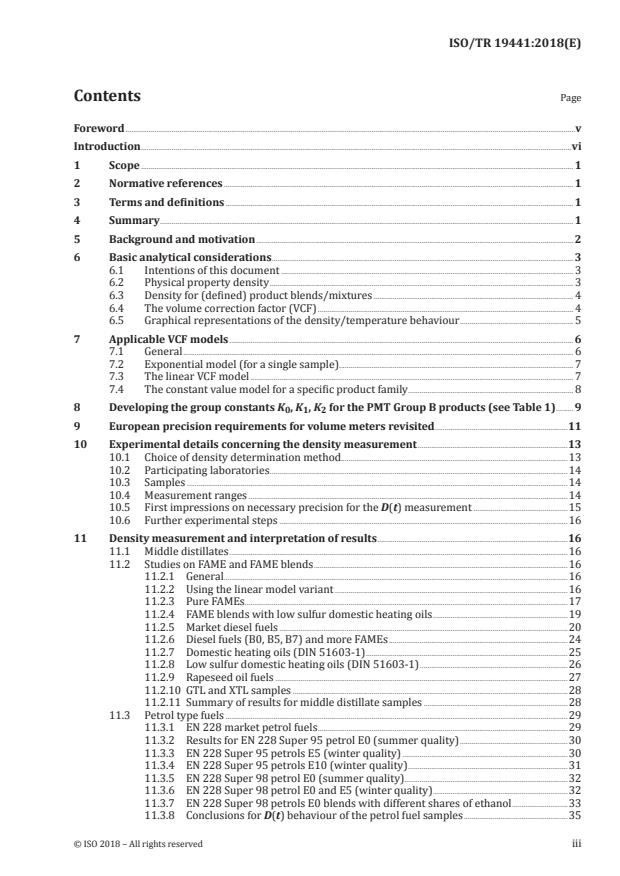
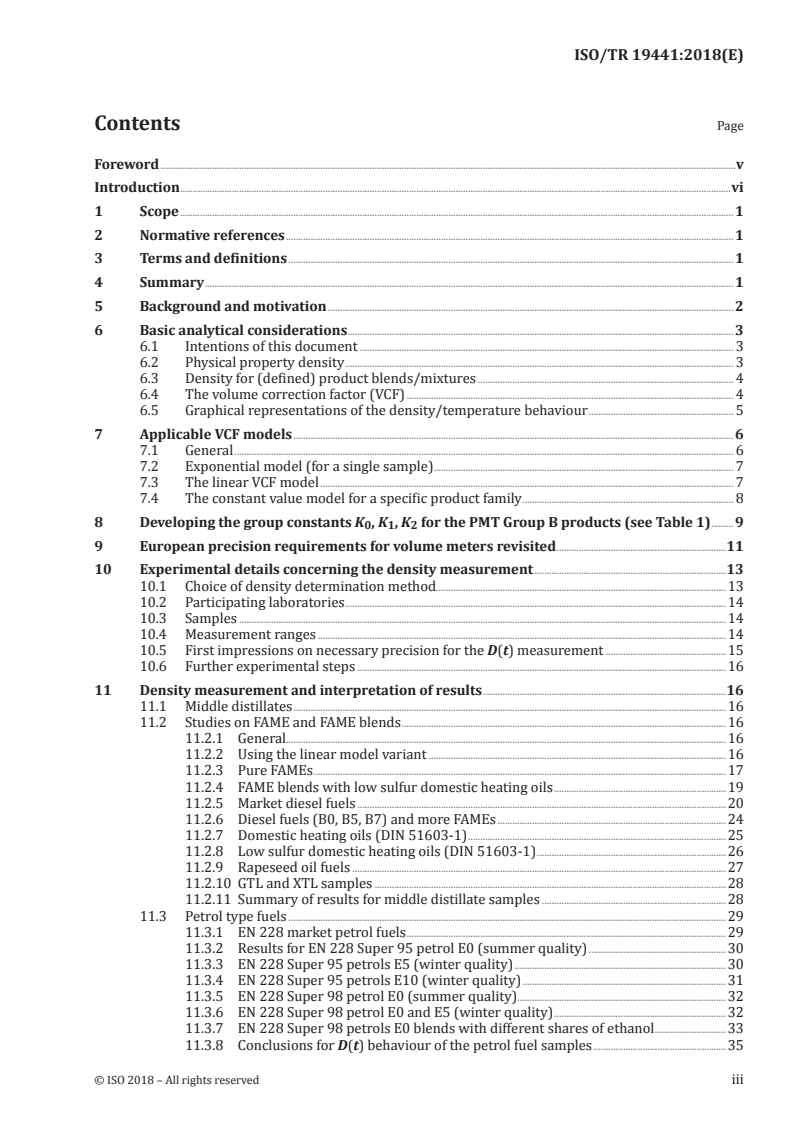
Contents Page
Foreword .v
Introduction .vi
1 Scope . 1
2 Normative references . 1
3 Terms and definitions . 1
4 Summary . 1
5 Background and motivation . 2
6 Basic analytical considerations . 3
6.1 Intentions of this document . 3
6.2 Physical property density . 3
6.3 Density for (defined) product blends/mixtures . 4
6.4 The volume correction factor (VCF) . 4
6.5 Graphical representations of the density/temperature behaviour . 5
7 Applicable VCF models . 6
7.1 General . 6
7.2 Exponential model (for a single sample) . 7
7.3 The linear VCF model . 7
7.4 The constant value model for a specific product family . 8
8 Developing the group constants K , K , K for the PMT Group B products (see Table 1) .9
0 1 2
9 European precision requirements for volume meters revisited .11
10 Experimental details concerning the density measurement .13
10.1 Choice of density determination method.13
10.2 Participating laboratories .14
10.3 Samples .14
10.4 Measurement ranges .14
10.5 First impressions on necessary precision for the D(t) measurement .15
10.6 Further experimental steps .16
11 Density measurement and interpretation of results .16
11.1 Middle distillates .16
11.2 Studies on FAME and FAME blends .16
11.2.1 General.16
11.2.2 Using the linear model variant .16
11.2.3 Pure FAMEs . .17
11.2.4 FAME blends with low sulfur domestic heating oils .19
11.2.5 Market diesel fuels .20
11.2.6 Diesel fuels (B0, B5, B7) and more FAMEs .24
11.2.7 Domestic heating oils (DIN 51603-1) .25
11.2.8 Low sulfur domestic heating oils (DIN 51603-1) .26
11.2.9 Rapeseed oil fuels .27
11.2.10 GTL and XTL samples .28
11.2.11 Summary of results for middle distillate samples .28
11.3 Petrol type fuels .29
11.3.1 EN 228 market petrol fuels .29
11.3.2 Results for EN 228 Super 95 petrol E0 (summer quality) .30
11.3.3 EN 228 Super 95 petrols E5 (winter quality) .30
11.3.4 EN 228 Super 95 petrols E10 (winter quality) .31
11.3.5 EN 228 Super 98 petrol E0 (summer quality).32
11.3.6 EN 228 Super 98 petrol E0 and E5 (winter quality) .32
11.3.7 EN 228 Super 98 petrols E0 blends with different shares of ethanol .33
11.3.8 Conclusions for D(t) behaviour of the petrol fuel samples .35
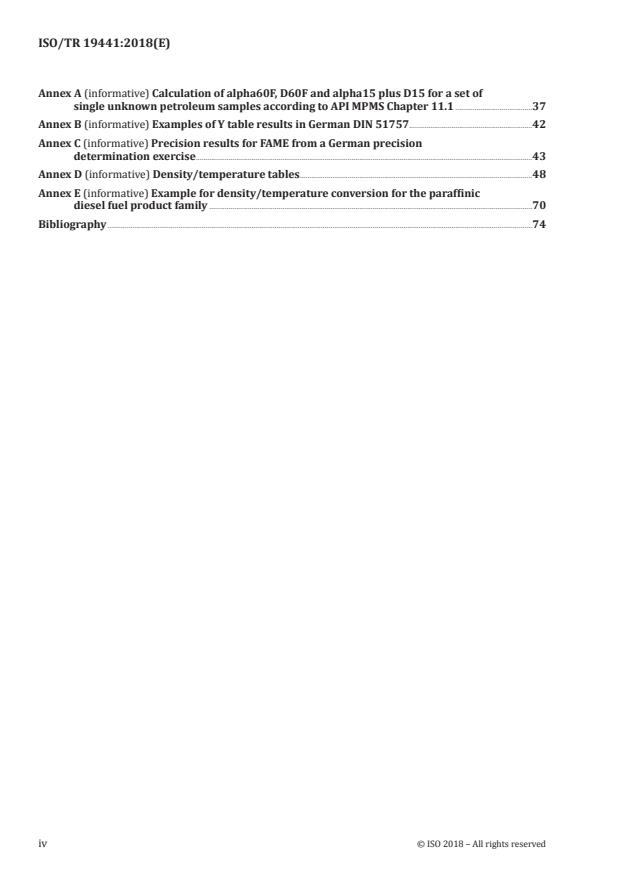
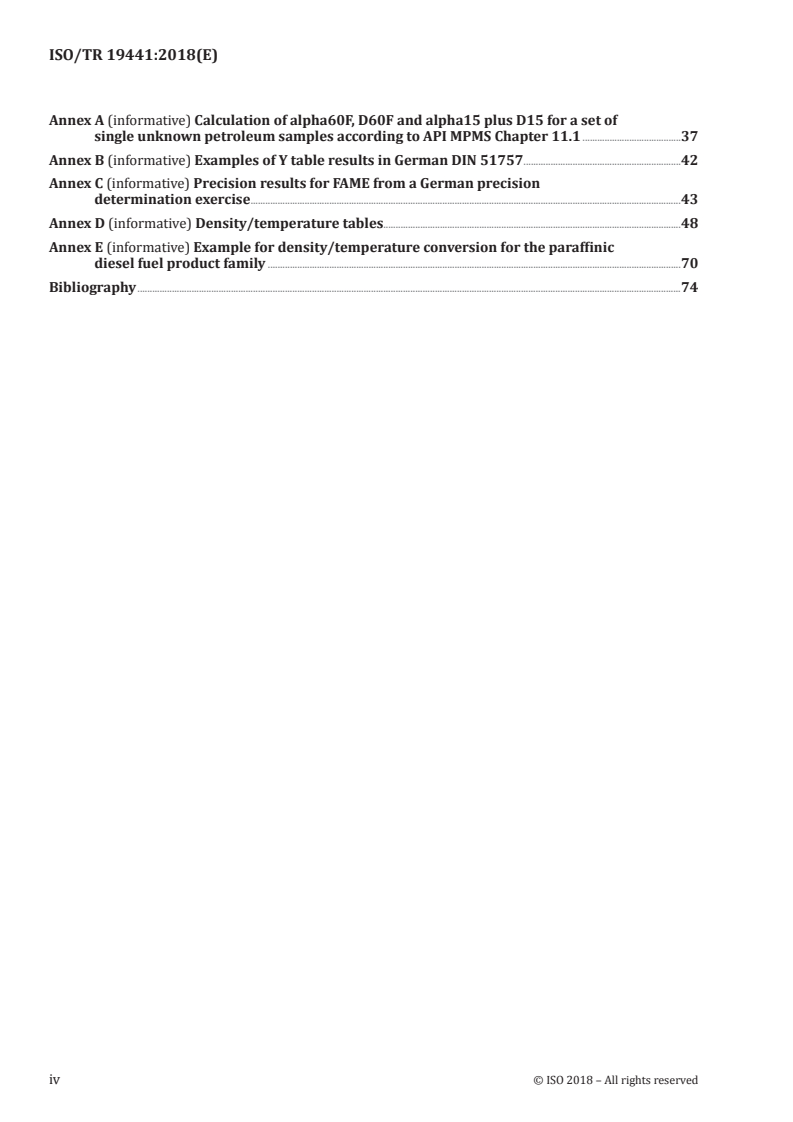
Annex A (informative) Calculation of alpha60F, D60F and alpha15 plus D15 for a set of
single unknown petroleum samples according to API MPMS Chapter 11.1 .37
Annex B (informative) Examples of Y table results in German DIN 51757 .42
Annex C (informative) Precision results for FAME from a German precision
determination exercise .43
Annex D (informative) Density/temperature tables.48
Annex E (informative) Example for density/temperature conversion for the paraffinic
diesel fuel product family .70
Bibliography .74
iv © ISO 2018 – All rights reserved
Foreword
ISO (the International Organization for Standardization) is a worldwide federation of national standards
bodies (ISO member bodies). The work of preparing International Standards is normally carried out
through ISO technical committees. Each member body interested in a subject for which a technical
committee has been established has the right to be represented on that committee. International
organizations, governmental and non-governmental, in liaison with ISO, also take part in the work.
ISO collaborates closely with the International Electrotechnical Commission (IEC) on all matters of
electrotechnical standardization.
The procedures used to develop this document and those intended for its further maintenance are
described in the ISO/IEC Directives, Part 1. In particular the different approval criteria needed for the
different types of ISO documents should be noted. This document was drafted in accordance with the
editorial rules of the ISO/IEC Directives, Part 2 (see www .iso .org/ directives).
Attention is drawn to the possibility that some of the elements of this document may be the subject of
patent rights. ISO shall not be held responsible for identifying any or all such patent rights. Details of
any patent rights identified during the development of the document will be in the Introduction and/or
on the ISO list of patent declarations received (see www .iso .org/ patents).
Any trade name used in this document is information given for the convenience of users and does not
constitute an endorsement.
For an explanation on the voluntary nature of standards, the meaning of ISO specific terms and
expressions related to conformity assessment, as well as information about ISO's adherence to the
World Trade Organization (WTO) principles in the Technical Barriers to Trade (TBT) see the following
URL: www .iso .org/ iso/ foreword .html.
This document was prepared by ISO/TC 28, Petroleum and related products, fuels and lubricants from
natural or synthetic sources.
Introduction
The density of hydrocarbon fuels at a standard condition of temperature and pressure is used to
define the quantity (standard volume) of the product during trade and fiscal transactions. To ensure
standardization in the calculation of standard volume and density from actual conditions the thermal
and pressure expansion factors are calculated through the application of standardized methods and
algorithms.
In the advent of new fuel compositions like HVO (“Hydrogenated Vegetable Oil”) as well as blends with
bio products like ethanol and FAME (“Fatty Acid Methyl Esters”) in the markets, the question was
raised whether the density/temperature relationships, which have been applied for more than 60 years
to transform the density or volume of a petroleum product, are a temperature measured at transport
time or a “reduced” density or volume value at a standard temperature (15°C and in some areas 60 °F).
In order to identify potential differences for these new products, the German petroleum standardization
committee (DIN-FAM) started as early as 2003 to make extensive density/temperature measurements
starting with FAME. Examination of additional products followed, and other associations like AFNOR
and the Energy Institute (EI) also shared their results of similar investigations.
This document also recommends procedural steps to obtain data which will determine the thermal
expansion of new or alternative fuels and blends hence allowing a comparison to accepted and
standardized correction factors (e.g. Petroleum Measurement Tables - ISO 91, IP 200 and API MPMS
chapters 11.1, 11.2.4 and 11.5).
This document collates the executed measurements, modelling procedures and results in order to keep
measured data available for later reference, including some recommendations for further work and a
list of possibly unresolved questions.
For a number of reasons the work has been restricted to fuels, bio fuel components, and their blends
and to some burner fuels and components. The majority of these examined products followed European
Fuel Specifications such as EN 228, EN 590, EN 14214, EN 15376, and the reference temperature was
kept at 15 °C. The work only covers the thermal expansion of the products at a standard condition of
pressure and has not been extended to compressibility.
This document also recommends procedural steps to obtain data which allows a decision to be made on
whether any completely new fuel composition can or cannot use the published internationally accepted
API Petroleum Measurement Tables (“PMT”) which are also the basis of several international and
national petroleum measurement standards.
In addition, this document contains an extensive list of publications which can yield further in-depth
information about this complex and interesting petroleum measurement topic.
vi © ISO 2018 – All rights reserved
TECHNICAL REPORT ISO/TR 19441:2018(E)
Petroleum products — Density versus temperature
relationships of current fuels, biofuels and biofuel
components
1 Scope
This document lists and describes recent density measurements at different temperatures for biofuel
components and biofuel blends such as gasoline E5, E10, E85 and biodiesel B100, B7, as well as domestic
heating oils and paraffinic diesel fuels.
It can be used to calculate , the thermal expansion coefficient from a given temperature to
15 °C. This document can also serve to compare several aspects of density/temperature modelling and
to check for compliance with and limitations in relation to existing calibration requirements. It can
help in the determination of specific necessities for the grouping of fuels into common product family
classes, also suggesting ways to treat fuels or components with an unusual behaviour. In addition, this
document proposes possible steps for an internationally harmonized handling of new components
coming into the market.
2 Normative references
There are no normative references in this document.
3 Terms and definitions
No terms and definitions are listed in this document.
ISO and IEC maintain terminological databases for use in standardization at the following addresses:
— ISO Online browsing platform: available at https:// www .iso .org/ obp
— IEC Electropedia: available at http:// www .electropedia .org/
4 Summary
Several extensive sample sets comprising artificial blends as well as market fuels were analysed with
respect to their temperature-dependent densities. The purpose of these analyses was to find out if the
density, as well as the volume, at a certain temperature can be predicted using the constants, group
constants and regression models of the internationally used API Petroleum Measurement Tables (PMT)
[13]
published in 1960 and revised in 1980 .
The examined products were:
[28]
— diesel fuels (B0, B5, B7) according to the European standard fuel specification EN 590 ,
supplemented by some additional blends with FAME;
— fatty acid methyl esters (biodiesel) of different compositions and origins which are in the market
[31]
today ;
[27]
— petrol (E0, E5, E10) according to the European standard fuel specification EN 228 , supplemented
by some additional blends with ethanol up to E100;
[29]
— domestic heating fuels according to DIN 51603-1 , also as low sulfur grade;
— several samples of paraffinic diesel fuels (GTL, XTL) for which an European standard fuel specification
[30]
is established as EN 15940 .
The main intention of this study was to find out if individually calculated thermal expansion coefficients
α and their corresponding densities (or volumes) at 15 °C are close enough to the values predicted by
the published PMT values, taking into consideration the precision requirements of the EC Measuring
Instruments Directive. This directive is of particular importance e.g. for the calibration of volume
metering equipment.
The executed studies indicate that although some small biases were found in most cases, the predictions
described in the PMT may still be used, except for a smaller number of cases being:
— MD/diesel blends with more than about 50 %(V/V) of coconut methyl ester (CME);
— automotive E85 fuels with more than about 40 %(V/V) ethanol content;
— some new products like paraffinic diesel fuel.
Since it not possible to extrapolate such findings to any other kind of new product types, a
recommendation is given to investigate such temperature versus density/volume behaviour when new
fuel specifications are under development.
In any case it is strongly recommended to decide before any such investigation if the resulting model
should be just good enough to fulfil the requirement or if best possible precision is wanted. This decision
can have some influence about the choice of the best suited regression model.
As a long term perspective, a full revision of the PMT models and constants should be considered
especially if it is expected that there will be much more variation in fuel composition as compared to
the last, say 50 years.
5 Background and motivation
It is common knowledge that the density of a product in its liquid phase depends mainly on product
composition; temperature, due to extra- and intermolecular motion.
In addition, pressure can also affect density, but this effect was not investigated here because the
changes caused by pressure are orders of magnitude smaller than those from temperature changes.
For trading and transport, the density-temperature function of a product is a very important product
property for the determination of the product amount because the temperature of a liquid fuel can be
as high as 50 °C, whereas, e.g. for tax reasons, almost all regulatory requirements demand that product
densities are reported at a standard temperature of 15 °C (or, like in the US, also at 60 °F) as a prediction
using these density-temperature procedures.
The internationally accepted procedures for the determination and application of density and volume
transformation from one temperature to another or to a standard temperature have been developed
and standardized by the API and ASTM and are commonly referred to as the Petroleum Measurement
[14]
Tables (PMT). These tables have been adopted by ISO (ISO 91) and by OIML by referring to ISO 91 .
The tables and the procedures within them have been have been applied successfully and with
satisfactory precision for more than 60 to 70 years and provide a standardized and accepted basis for
[1][2][3][4]
trade .
NOTE 1 This report refers to the three latest version of the API tables, published in 1960, 1980 and 2000. The
version from 2000 is a computer adoption of the 1980 version, including pressure correction.
It is evident that this success is mainly based on the existence of comparatively small compositional
changes across a specific product family. The advent of biofuels and biofuel components like FAME
(Fatty Acid Methyl Esters) in the market raised the question of whether the PMT tables could still be
applied with acceptable precision for the predicted density at reference temperature. This question
2 © ISO 2018 – All rights reserved
led to several series of FAME density measurements at different institutions in Germany, the UK and
France, and probably also in many other countries.
Later this campaign was extended to ethanol, petrol blends (E0, E5, E10, … E85, E100) and to several
other products like Hydrogenated Vegetable Oil (HVO), paraffinic Diesel fuels (GTL, XTL).
NOTE 2 Most of the mentioned calculations and procedures and their background are documented at least in
part in the available standards, publications and regulatory documents, so a large portion of the described detail
is supposed to be common knowledge for the experts working with petroleum measurement regularly. It is the
intention of this document to describe everything to such a degree of detail that also people new to this field of
expertise have a chance to follow and understand all of the contained reasoning.
Although the latest version of the PMT and ISO 91 are recommended, older versions are sometimes still
employed as defined in local regulation, practice or commercial agreements.
These facts might be able to explain some differences which could not be explained otherwise.
6 Basic analytical considerations
6.1 Intentions of this document
In order to fully comprehend the discussions and arguments presented in this document, the following
clauses set out the relevant definitions, procedures, facts, calculations and consequences.
It is not the intention of this document to copy already existing content from other existing publications
or standards, but it was found essential to compile all relevant facts in one place. For further information,
see the Bibliography.
6.2 Physical property density
The physical property density is defined as the ratio of mass over volume as shown in Formulae (1)
and (2). It is important to note that the density depends to a large extent on the product temperature
such that with increasing temperature density decreases (volume increase e.g. due to more molecular
motion) while mass remains constant. As this document only deals with (liquid) fuels, phase transitions
to the gaseous or solid state are not discussed. Such transitions can become a problem at extreme
product temperatures.
NOTE 1 While density is normally represented by the Greek letter ρ, this document uses a capital D for density
for easier and more clear writing. Further information is often added as an index or given in brackets. This means
that e.g. D15 and D(15) will mean the same thing:
ρρ==mV/1 m*V (1)
()
tt tt
Dt =mV/ t (2)
() ()
where
ρ, D is the sample density; usually in g/ml or kg/m ;
m is the sample mass (NOT the weight); usually in g or kg;
V is the sample volume; usually in ml or m ;
t is the sample’s temperature; usually in °C.
The numerator of the density definition is mass and not, as sometimes wrongly stated, weight, which is the
property when gravity acts on the mass of a product. Therefore, constructs like density in air or density in
vacuum simply do not exist. For cases where weight is required, a correction for the air buoyancy mass can be
applied.
NOTE 2 There are several incarnations of a reported density value, depending on the fact if this value was
obtained by direct measurement at the required temperature; or if it was predicted from measurement at a
different temperature using PMT procedures for appropriate conversion to standard temperature. In cases
where this can become relevant, corresponding mention is made in this document.
NOTE 3 There are several test methods, all using different physical principles for the determination of the
density of petroleum products/fuels (see experimental section). Only the quartz oscillator test method has been
used in this report as prescribed in ISO 12185. This is currently the most used density test method for liquid fuels.
6.3 Density for (defined) product blends/mixtures
For many product blends density follows a linear regime, i.e. the density/volume of the blend has a
linear relationship with the volumes and densities of the components when measured at the same
temperature.
However exceptions to this rule are known from literature and recent work which show that for blends
of some components the relationship can be far from linear. Examples include:
— temperature of mixture changes during blending;
— molecular and compositional structures of blend components are significantly different;
— other physical effects occur such as modified molecular solvent cages e.g. for alcohols (OH bonding).
6.4 The volume correction factor (VCF)
The definition for the volume correction factor (VCF) is given in Formulae (3) and (4). The VCF is simply
the ratio of density at the temperature t of interest over density at standard temperature (normally
15 °C). It is therefore the basic proportionality function for the calculation (prediction) of density (or
volume) at standard temperature from a density (or volume) measured at another temperature t or vice
versa. Elaborate models like the PMT and several others have been developed for construction of this
VCF function for single products as well as for commonly used product families. The following sections
of this document will give more detail about these models and their modelling strategies. But first we
should have a look at the basic definitions.
VCFrtt,/ef ⋅ =Dt Dtref ⋅ (3)
() () ()
VCFrtt,/ef ⋅ =⋅Vtref Vt (4)
() () ()
where
VCF being volume/volume or density/density ratios (dimensionless);
D, V being density and volume as explained in Formula (1);
ref·t being the sample’s reference temperature; usually 15 °C;
t being the sample’s temperature; usually in °C.
It is evident that the VCF has the value 1,000 0 at the reference temperature (usually 15 °C). Also,
individual VCF(t) functions for different products will by default always intersect at the reference
temperature. It is also important to note that each single VCF function has been derived for a specific
sample of a product family for limited temperature or density ranges which should not be extrapolated.
The form of the VCF function can range from nonlinear/exponential, linear, and even constant (like for
some products with little variation in composition and density/temperature range). The models used
for petroleum metering should reflect such different functional behaviours.
For products of similar/comparable density, temperature and composition, the PMT allow some
grouping into product families. Here, a hopefully large and representative number of product family
4 © ISO 2018 – All rights reserved
members is investigated. This investigation results in a set of constants K , K , K , from which
0 1 2
the thermal expansion coefficient α can be calculated with inclusion of the density at reference
ref
temperature (see modelling section for more detail).
6.5 Graphical representations of the density/temperature behaviour
Figure 1 shows a commonly used and typical graphical representation of the D(t) behaviour for a
selection of six gas oils.
Key
X temperature in °C
Y density change in kg/m per °C
Figure 1 — Density/temperature function
Key
X temperature in °C
Y density in kg/m
Figure 2 — K E/temperature function
The graphs display a number of issues to remember.
— Densities for members of one product family can stretch over a large range.
— The slopes for members of a product family are often very similar (but not necessarily identical
(depending on the required prediction quality).
— From a superficial viewpoint, the D(t) curves seem to be (almost) linear. However, this can be quite
different for other product families. Therefore, a nonlinear (exponential) modelling approach has
been (and still is) used traditionally in the international PMT community.
Figure 2 indicates that the temperature range for the D(t) modelling can also be quite important. The
displayed case for six gas oils suggests that irregular behaviour can occur at lower temperatures where
there is a good chance of crystal formation or even solidification. A model has to consider these phase
transition effects when a reliable and most precise prediction is wanted (same is true for extreme high
temperatures (bubbles, evaporation, boiling).
Current experience from field transport experts suggest that for the petrol, diesel and biofuels
investigated in this document, a temperature range of about −5 °C to about 50 °C is usually sufficient.
Figure 3 displays the VCF(t) plot for the same six gas oils. At X = 0 (i.e. at standard temperature of 15 °C)
all curves intersect in the same point (at y = 1,00) by definition, and potential differences between
product family members become more visible the farther the temperature is away from the standard
temperature.
NOTE The VCF(t) curve shown in Figure 3 is simply constructed by division of each D(t) value by the sample’s
reference D(15) value. These curves do not represent the results from the PMT procedures, for which the use of
a specific PMT regression model is assumed. Nevertheless, the plot shows nicely the similarities and differences
between similar samples of one gasoil family.
Key
X (t−15) in °C
Y VCF(t,15)
Figure 3 — VCF(t,15) plot for the same six gasoil samples
7 Applicable VCF models
7.1 General
Several models have been developed over the years for petroleum measurement of diverse petroleum
products. For an in-depth sight and some important history, see the Bibliography. Since the focus of
6 © ISO 2018 – All rights reserved
this document is on fuels, bio fuels and their components (i.e. Tables B of the petroleum measurement
tables), the list of useful and common models is reduced to the following:
— exponential model — the mainly used model in the PMT for fuels of group B;
— linear models — a simplified model derived from the exponential model;
— constant value model — promoted by some government chemist associations.
Other sometimes proposed models like third order parabolic regression do not, at least in Europe, play
any important role in the trading of conventional and bio-based fuels and their components.
7.2 Exponential model (for a single sample)
Used and published in the PMT, it represents clearly the most often applied and internationally accepted
VCF model. The definition is given in Formula (5). The two constants α and K describe the slope
and curvature of the VCF function. For all fuel related products of mineral oil group B, a fixed valued
of K = 0,8 has emerged over the years and is still used in the PMT. The development of group family
constants for α is explained in the next clause.
VCFe=−xp αα**dt 1−Kd** t (5)
()
()
15 15
where
α is the thermal expansion coefficient at reference temperature (normally 15 °C, but some coun-
tries also use 60F as ref. temperature, in which case α is given as α );
60F
K is a constant describing the curvature. Normally this value is always fixed at K = 0,8;
dt is the difference between measured and reference temperature (normally 15 °C).
The α is calculated and used for only the specific sample for which at minimum 10 densities at
different temperatures have been measured. This temperature range should include the temperatures
of interest used during transport, but some care should be taken at extreme temperatures to avoid
solidification or bubbling in the sample. These measured data pairs D(t) and t are then submitted to a
regression procedure specified in API MPMS Chapter 11.1. Annex A contains a script using the public
domain statistical scripting language R, which may be used for the determination of α .
IMPORTANT — It should be noticed that the 60 °F reference temperature equals to 15,666 67 °C
(i.e. 15 °C = 59 °F and not 60 °F), and that in the PMT, given α values are in reality values for
15,666 67 °C. It is an obvious international agreement to ignore this difference for “α” because
the slopes at 15 °C and 15,666 67 °C should be quite similar. To avoid any doubts, this TR will
give D(15), D(60 °F), α and α wherever possible. The difference between D(15 °C) and
15 60 °F
D(6 °F) can amount to more than 0,5 kg/m . This should be considered when precision issues
are discussed.
[17]
NOTE DIN 51757 has a section for pure petrochemical products (demonstrated Y-Table), for which also
different values for K have been developed which to minimize the residuals between measured and predicted
values. More information, including some example data, about this Y-table is given in Annex B.
7.3 The linear VCF model
The linear VCF model can best be described as a derivative/simplification of the exponential model via
a Taylor series as described in Formula (6) – simplification 1) and Formula (7) – simplification 2). It
may be used when curvature of the VCF function is minimal and when differences between linear and
exponential model are tolerably small.
VCF=−10αα*,dt− 3**dt (6)
refref
VCF=−1 α *dt (7)
ref
Introducing the densities from the VCF definition then leads to:
Dt =Dd15 **1−α t (8a)
() () ()
or VV15 = td**1−α t (8b)
() () ()
where
VCF is the volume correction factor for temperature t;
D(t) is the density at temperature t;
D(15) is the density at the reference temperature (15 °C);
α is the thermal expansion factor at reference temperature (15 °C);
ref
dt is the temperature difference (t – 15) in °C.
The linear model produces a straight line, forfeiting the chance to detect and incorporate any nonlinear
behaviour of the VCF-function. One well-noticed advantage is that the needed regression for the
detection of α from minimal 10 density/temperature pairs can be done with any regular regression
function like those provided by Excel or other off the shelf statistical software.
As will be shown in the experimental section, this linear model can be applied to FAME, where the
thermal expansion coefficients do not vary so very much over the FAMES’ density ranges, but it is
strongly recommended to check the residuals and compare them with those from the exponential
models before decisions to use the linear model are made.
It is important to notice that, just like for the exponential model, the regression result α is in principle
only valid for the examined sample. There is not much procedural documentation about how to arrive at
a (possibly D(15) independent) “α ” group product family value like they can be found in the literature
and published standards for petrol.
[31]
A variation of the Linear Model is also applied in the European FAME specification, EN 14214, as
specified in Formula (9). The slope of 0,723, and a mean density of D(15) = 886,3 kg/m , averaged over
[9]
seven different FAME samples has been developed in a research project lead by J. Rathbauer .
DD15°C,= tt+−0 723* 15 (9)
() () ()
7.4 The constant value model for a specific product family
This model is best explained by Formula (10). It is mainly promoted by the metrology institutes, such
as PTB (Physikalisch-Technische Bundesanstalt, German Metrology Institute), for the calibration of
volume meters, taking into consideration the allowable prediction tolerance of max. ±0,2 % as specified
in the EC machine directive.
Other than using a still density/sample dependent thermal expansion coefficient α like in the
exponential and linear model, a mean slope k is used obtained from the slopes of a number of samples
0E
from the product family under examination. Values for k are generally prescribed in regulations for
0E
volume meter calibrations. For more details about this model see [10]. Figure 4 shows some k values
0E
8 © ISO 2018 – All rights reserved
suggested by the PTB (German government chemist) for commonly traded products. It should be noted
that these averaged k values do no longer depend on the sample’s density.
0E
Dt V 15
() ()
VCF= = =−11kt* − 5 (10)
()
0E
D 15 Vt
() ()
The maximum temperature difference of 35 °C and the precision requirement of maximum ±0,2 % then
−5
leads to a permissible tolerance band of |Δk| ≤ 5 * 10 . Individual slopes k from which the mean k
0E
is calculated have to fall inside the range (k ± Δk), otherwise the average value model cannot use the
prescribed k for that particular product or sample.
0E
This is also reflected by the fact that e.g. in Germany, the k values have been updated in different
0E
editions of the volume meter calibration regulations (see e.g. Figure 4) along with several product
composition changes over the years. It is also important to note that this mean k is not influenced by
0E
the product reference density as will be shown is the case to the PMT exponential model.
Table 1 — k -values for the constant value model as promoted by the PTB
0E
Date of PTB ±Δk (in 1/K)
Product group k (1/K) Remarks
0E
publication for Δt = 35 °C
For E0,E10,
−3 −5
Group B,1 2004 1,21 * 10 5 * 10
E80, E100
For Diesel, FAME (RME and
−3 −5
Group B,3 and B,4 2004 0,84 * 10 5 * 10
SME) and Heating oil (HEL)
For Diesel, HEL, CME
−3 −5
Group B,3 and B,4 2011 0,84 * 10 5 * 10
from B0 to B40
−3 −5
Group B,1 - petrol 2011 1,27 * 10 5 * 10 For E0 . E40
−3 −5
Group B,1 - ethanol 2011 1,14 * 10 5 * 10 For E60 . E100
Some additional aspects concerning the constant volume model should get some special attention:
— the major use is for the calibration of volume meters as prescribed by (e.g. national) regulators;
— use of a specific k value can only cover a small variety of samples inside just one product family,
0E
and when there is too much variation in product composition or slopes of the D(t) curves, the
constant value model could no longer comply to the pre-set precision requirements;
— the constant value model is, of course, easy to use, but also using up most of the permissible
measurement uncertainty, leaving little to no room for other measurement uncertainties like those
coming from the determination of density and temperature. In the analytical community, this is
sometimes seen as a contrast to the wish for best possible precision in the modelling of results.
NOTE Since this document does not intend to interfere with any regulated issues, the constant value model
is not discussed any further here.
8 Developing the group constants K , K , K for the PMT Group B products (see
0 1 2
Table 1)
In the previous clauses we have described the development α and D(15) for just one product. Much
effort has been put into the measurement of these values for the different product families over the
past decades to determine some sort of common model for a complete product family. ASTM and IP, for
example, explain such measurements and additional regression work from several hundred product
family members in their standards, and indeed, a useable and rather robust regression model for the
group B product family has been established, as described in Formula (11). This regression model is
still in use today and has been the reference PMT routine for many decades.
α =+KD//KD +K (11)
15 015 1152
Table 2 presents the corresponding values for α , D(15) and the regression constants K , K , K for the
15 0 1 2
individual members of the PMT Group B Products.
Table 2 — Group constants for PMT Group B product family
Petrol Naphtha Jet/Kerosene Fuel Oil
Const. K 346,422 80 K 2 680,320 6 K 594,541 80 K 186,969 60
0 0 0 0
Const, K 0,438 80 K 0,000 00 K 0,000 00 K 0,486 20
1 1 1 1
Const, K 0,000 00 K −0,003 363 12 K 0,000 00 K 0,000 0
2 2 2 2
D(15) Lo 600,0 Lo 770,5 Lo 787,6 Lo 838,6
D(15) Hi 770,4 Hi 787,5 Hi 838,8 Hi 1 200,0
NOTE 1 In some older publications and regulations, regression constants A and B have been used in the case of
naphtha instead of K and K . Constant K could then be deleted which was quite important in earlier times when
0 1 2
computer memory was sparse.
This so-called α /D(15) data space is in use for more than 50 years now. It also constitutes an
international reference for the Petroleum Measurement of fuels. The graph in Figure 4 shows clearly
four adjacent different sections, and Table 3 explains that, for example, EC fuel specifications cover
only parts of the whole density/α range. It is also easy to recognize that PMT product D(15) limits
are not identical with the limits from the EC fuel specifications, as e.g. Diesel fuel spans over parts of
jet/kerosene and fuel oil.
Figure 4 — Graphical display of the α15 <> D(15) PMT model for Group B products
10 © ISO 2018 – All rights reserved
Table 3 — density ranges from EC Fuel specifications
Petrol Diesel FAME
(EN 228) (EN 590) (EN 14214)
D(15) Lo 720,0 Lo 820,0 Lo 860,0
D(15) Hi 775,0 Hi 845,0 Hi 900,0
NOTE 2 The graphical representation is simply the regression function for several hundred “conventional”
fuel samples (dissected into four groups, see Figure 4), where the individual points [D(15),α ] will lie a bit above
or below the regression function. Since the original data point from which the models have been developed were
not available for this project work, only some summary statements to be found in the ASTM and API papers are
available for judging how well the individual group family members fit into the models.
Although the original data points used for setting up the regression are quite old, ASTM D 1250 and
API both explain some more detail about the quality of this regression which is working surprisingly
well considering all the changes to product compositions ov
...
TECHNICAL ISO/TR
REPORT 19441
First edition
2018-02
Petroleum products — Density versus
temperature relationships of current
fuels, biofuels and biofuel components
Produits pétroliers — Densité contre température relations des
carburants actuels, les biocarburants et leur composants
Reference number
©
ISO 2018
© ISO 2018, Published in Switzerland
All rights reserved. Unless otherwise specified, no part of this publication may be reproduced or utilized otherwise in any form
or by any means, electronic or mechanical, including photocopying, or posting on the internet or an intranet, without prior
written permission. Permission can be requested from either ISO at the address below or ISO’s member body in the country of
the requester.
ISO copyright office
Ch. de Blandonnet 8 • CP 401
CH-1214 Vernier, Geneva, Switzerland
Tel. +41 22 749 01 11
Fax +41 22 749 09 47
copyright@iso.org
www.iso.org
ii © ISO 2018 – All rights reserved
Contents Page
Foreword .v
Introduction .vi
1 Scope . 1
2 Normative references . 1
3 Terms and definitions . 1
4 Summary . 1
5 Background and motivation . 2
6 Basic analytical considerations . 3
6.1 Intentions of this document . 3
6.2 Physical property density . 3
6.3 Density for (defined) product blends/mixtures . 4
6.4 The volume correction factor (VCF) . 4
6.5 Graphical representations of the density/temperature behaviour . 5
7 Applicable VCF models . 6
7.1 General . 6
7.2 Exponential model (for a single sample) . 7
7.3 The linear VCF model . 7
7.4 The constant value model for a specific product family . 8
8 Developing the group constants K , K , K for the PMT Group B products (see Table 1) .9
0 1 2
9 European precision requirements for volume meters revisited .11
10 Experimental details concerning the density measurement .13
10.1 Choice of density determination method.13
10.2 Participating laboratories .14
10.3 Samples .14
10.4 Measurement ranges .14
10.5 First impressions on necessary precision for the D(t) measurement .15
10.6 Further experimental steps .16
11 Density measurement and interpretation of results .16
11.1 Middle distillates .16
11.2 Studies on FAME and FAME blends .16
11.2.1 General.16
11.2.2 Using the linear model variant .16
11.2.3 Pure FAMEs . .17
11.2.4 FAME blends with low sulfur domestic heating oils .19
11.2.5 Market diesel fuels .20
11.2.6 Diesel fuels (B0, B5, B7) and more FAMEs .24
11.2.7 Domestic heating oils (DIN 51603-1) .25
11.2.8 Low sulfur domestic heating oils (DIN 51603-1) .26
11.2.9 Rapeseed oil fuels .27
11.2.10 GTL and XTL samples .28
11.2.11 Summary of results for middle distillate samples .28
11.3 Petrol type fuels .29
11.3.1 EN 228 market petrol fuels .29
11.3.2 Results for EN 228 Super 95 petrol E0 (summer quality) .30
11.3.3 EN 228 Super 95 petrols E5 (winter quality) .30
11.3.4 EN 228 Super 95 petrols E10 (winter quality) .31
11.3.5 EN 228 Super 98 petrol E0 (summer quality).32
11.3.6 EN 228 Super 98 petrol E0 and E5 (winter quality) .32
11.3.7 EN 228 Super 98 petrols E0 blends with different shares of ethanol .33
11.3.8 Conclusions for D(t) behaviour of the petrol fuel samples .35
Annex A (informative) Calculation of alpha60F, D60F and alpha15 plus D15 for a set of
single unknown petroleum samples according to API MPMS Chapter 11.1 .37
Annex B (informative) Examples of Y table results in German DIN 51757 .42
Annex C (informative) Precision results for FAME from a German precision
determination exercise .43
Annex D (informative) Density/temperature tables.48
Annex E (informative) Example for density/temperature conversion for the paraffinic
diesel fuel product family .70
Bibliography .74
iv © ISO 2018 – All rights reserved
Foreword
ISO (the International Organization for Standardization) is a worldwide federation of national standards
bodies (ISO member bodies). The work of preparing International Standards is normally carried out
through ISO technical committees. Each member body interested in a subject for which a technical
committee has been established has the right to be represented on that committee. International
organizations, governmental and non-governmental, in liaison with ISO, also take part in the work.
ISO collaborates closely with the International Electrotechnical Commission (IEC) on all matters of
electrotechnical standardization.
The procedures used to develop this document and those intended for its further maintenance are
described in the ISO/IEC Directives, Part 1. In particular the different approval criteria needed for the
different types of ISO documents should be noted. This document was drafted in accordance with the
editorial rules of the ISO/IEC Directives, Part 2 (see www .iso .org/ directives).
Attention is drawn to the possibility that some of the elements of this document may be the subject of
patent rights. ISO shall not be held responsible for identifying any or all such patent rights. Details of
any patent rights identified during the development of the document will be in the Introduction and/or
on the ISO list of patent declarations received (see www .iso .org/ patents).
Any trade name used in this document is information given for the convenience of users and does not
constitute an endorsement.
For an explanation on the voluntary nature of standards, the meaning of ISO specific terms and
expressions related to conformity assessment, as well as information about ISO's adherence to the
World Trade Organization (WTO) principles in the Technical Barriers to Trade (TBT) see the following
URL: www .iso .org/ iso/ foreword .html.
This document was prepared by ISO/TC 28, Petroleum and related products, fuels and lubricants from
natural or synthetic sources.
Introduction
The density of hydrocarbon fuels at a standard condition of temperature and pressure is used to
define the quantity (standard volume) of the product during trade and fiscal transactions. To ensure
standardization in the calculation of standard volume and density from actual conditions the thermal
and pressure expansion factors are calculated through the application of standardized methods and
algorithms.
In the advent of new fuel compositions like HVO (“Hydrogenated Vegetable Oil”) as well as blends with
bio products like ethanol and FAME (“Fatty Acid Methyl Esters”) in the markets, the question was
raised whether the density/temperature relationships, which have been applied for more than 60 years
to transform the density or volume of a petroleum product, are a temperature measured at transport
time or a “reduced” density or volume value at a standard temperature (15°C and in some areas 60 °F).
In order to identify potential differences for these new products, the German petroleum standardization
committee (DIN-FAM) started as early as 2003 to make extensive density/temperature measurements
starting with FAME. Examination of additional products followed, and other associations like AFNOR
and the Energy Institute (EI) also shared their results of similar investigations.
This document also recommends procedural steps to obtain data which will determine the thermal
expansion of new or alternative fuels and blends hence allowing a comparison to accepted and
standardized correction factors (e.g. Petroleum Measurement Tables - ISO 91, IP 200 and API MPMS
chapters 11.1, 11.2.4 and 11.5).
This document collates the executed measurements, modelling procedures and results in order to keep
measured data available for later reference, including some recommendations for further work and a
list of possibly unresolved questions.
For a number of reasons the work has been restricted to fuels, bio fuel components, and their blends
and to some burner fuels and components. The majority of these examined products followed European
Fuel Specifications such as EN 228, EN 590, EN 14214, EN 15376, and the reference temperature was
kept at 15 °C. The work only covers the thermal expansion of the products at a standard condition of
pressure and has not been extended to compressibility.
This document also recommends procedural steps to obtain data which allows a decision to be made on
whether any completely new fuel composition can or cannot use the published internationally accepted
API Petroleum Measurement Tables (“PMT”) which are also the basis of several international and
national petroleum measurement standards.
In addition, this document contains an extensive list of publications which can yield further in-depth
information about this complex and interesting petroleum measurement topic.
vi © ISO 2018 – All rights reserved
TECHNICAL REPORT ISO/TR 19441:2018(E)
Petroleum products — Density versus temperature
relationships of current fuels, biofuels and biofuel
components
1 Scope
This document lists and describes recent density measurements at different temperatures for biofuel
components and biofuel blends such as gasoline E5, E10, E85 and biodiesel B100, B7, as well as domestic
heating oils and paraffinic diesel fuels.
It can be used to calculate , the thermal expansion coefficient from a given temperature to
15 °C. This document can also serve to compare several aspects of density/temperature modelling and
to check for compliance with and limitations in relation to existing calibration requirements. It can
help in the determination of specific necessities for the grouping of fuels into common product family
classes, also suggesting ways to treat fuels or components with an unusual behaviour. In addition, this
document proposes possible steps for an internationally harmonized handling of new components
coming into the market.
2 Normative references
There are no normative references in this document.
3 Terms and definitions
No terms and definitions are listed in this document.
ISO and IEC maintain terminological databases for use in standardization at the following addresses:
— ISO Online browsing platform: available at https:// www .iso .org/ obp
— IEC Electropedia: available at http:// www .electropedia .org/
4 Summary
Several extensive sample sets comprising artificial blends as well as market fuels were analysed with
respect to their temperature-dependent densities. The purpose of these analyses was to find out if the
density, as well as the volume, at a certain temperature can be predicted using the constants, group
constants and regression models of the internationally used API Petroleum Measurement Tables (PMT)
[13]
published in 1960 and revised in 1980 .
The examined products were:
[28]
— diesel fuels (B0, B5, B7) according to the European standard fuel specification EN 590 ,
supplemented by some additional blends with FAME;
— fatty acid methyl esters (biodiesel) of different compositions and origins which are in the market
[31]
today ;
[27]
— petrol (E0, E5, E10) according to the European standard fuel specification EN 228 , supplemented
by some additional blends with ethanol up to E100;
[29]
— domestic heating fuels according to DIN 51603-1 , also as low sulfur grade;
— several samples of paraffinic diesel fuels (GTL, XTL) for which an European standard fuel specification
[30]
is established as EN 15940 .
The main intention of this study was to find out if individually calculated thermal expansion coefficients
α and their corresponding densities (or volumes) at 15 °C are close enough to the values predicted by
the published PMT values, taking into consideration the precision requirements of the EC Measuring
Instruments Directive. This directive is of particular importance e.g. for the calibration of volume
metering equipment.
The executed studies indicate that although some small biases were found in most cases, the predictions
described in the PMT may still be used, except for a smaller number of cases being:
— MD/diesel blends with more than about 50 %(V/V) of coconut methyl ester (CME);
— automotive E85 fuels with more than about 40 %(V/V) ethanol content;
— some new products like paraffinic diesel fuel.
Since it not possible to extrapolate such findings to any other kind of new product types, a
recommendation is given to investigate such temperature versus density/volume behaviour when new
fuel specifications are under development.
In any case it is strongly recommended to decide before any such investigation if the resulting model
should be just good enough to fulfil the requirement or if best possible precision is wanted. This decision
can have some influence about the choice of the best suited regression model.
As a long term perspective, a full revision of the PMT models and constants should be considered
especially if it is expected that there will be much more variation in fuel composition as compared to
the last, say 50 years.
5 Background and motivation
It is common knowledge that the density of a product in its liquid phase depends mainly on product
composition; temperature, due to extra- and intermolecular motion.
In addition, pressure can also affect density, but this effect was not investigated here because the
changes caused by pressure are orders of magnitude smaller than those from temperature changes.
For trading and transport, the density-temperature function of a product is a very important product
property for the determination of the product amount because the temperature of a liquid fuel can be
as high as 50 °C, whereas, e.g. for tax reasons, almost all regulatory requirements demand that product
densities are reported at a standard temperature of 15 °C (or, like in the US, also at 60 °F) as a prediction
using these density-temperature procedures.
The internationally accepted procedures for the determination and application of density and volume
transformation from one temperature to another or to a standard temperature have been developed
and standardized by the API and ASTM and are commonly referred to as the Petroleum Measurement
[14]
Tables (PMT). These tables have been adopted by ISO (ISO 91) and by OIML by referring to ISO 91 .
The tables and the procedures within them have been have been applied successfully and with
satisfactory precision for more than 60 to 70 years and provide a standardized and accepted basis for
[1][2][3][4]
trade .
NOTE 1 This report refers to the three latest version of the API tables, published in 1960, 1980 and 2000. The
version from 2000 is a computer adoption of the 1980 version, including pressure correction.
It is evident that this success is mainly based on the existence of comparatively small compositional
changes across a specific product family. The advent of biofuels and biofuel components like FAME
(Fatty Acid Methyl Esters) in the market raised the question of whether the PMT tables could still be
applied with acceptable precision for the predicted density at reference temperature. This question
2 © ISO 2018 – All rights reserved
led to several series of FAME density measurements at different institutions in Germany, the UK and
France, and probably also in many other countries.
Later this campaign was extended to ethanol, petrol blends (E0, E5, E10, … E85, E100) and to several
other products like Hydrogenated Vegetable Oil (HVO), paraffinic Diesel fuels (GTL, XTL).
NOTE 2 Most of the mentioned calculations and procedures and their background are documented at least in
part in the available standards, publications and regulatory documents, so a large portion of the described detail
is supposed to be common knowledge for the experts working with petroleum measurement regularly. It is the
intention of this document to describe everything to such a degree of detail that also people new to this field of
expertise have a chance to follow and understand all of the contained reasoning.
Although the latest version of the PMT and ISO 91 are recommended, older versions are sometimes still
employed as defined in local regulation, practice or commercial agreements.
These facts might be able to explain some differences which could not be explained otherwise.
6 Basic analytical considerations
6.1 Intentions of this document
In order to fully comprehend the discussions and arguments presented in this document, the following
clauses set out the relevant definitions, procedures, facts, calculations and consequences.
It is not the intention of this document to copy already existing content from other existing publications
or standards, but it was found essential to compile all relevant facts in one place. For further information,
see the Bibliography.
6.2 Physical property density
The physical property density is defined as the ratio of mass over volume as shown in Formulae (1)
and (2). It is important to note that the density depends to a large extent on the product temperature
such that with increasing temperature density decreases (volume increase e.g. due to more molecular
motion) while mass remains constant. As this document only deals with (liquid) fuels, phase transitions
to the gaseous or solid state are not discussed. Such transitions can become a problem at extreme
product temperatures.
NOTE 1 While density is normally represented by the Greek letter ρ, this document uses a capital D for density
for easier and more clear writing. Further information is often added as an index or given in brackets. This means
that e.g. D15 and D(15) will mean the same thing:
ρρ==mV/1 m*V (1)
()
tt tt
Dt =mV/ t (2)
() ()
where
ρ, D is the sample density; usually in g/ml or kg/m ;
m is the sample mass (NOT the weight); usually in g or kg;
V is the sample volume; usually in ml or m ;
t is the sample’s temperature; usually in °C.
The numerator of the density definition is mass and not, as sometimes wrongly stated, weight, which is the
property when gravity acts on the mass of a product. Therefore, constructs like density in air or density in
vacuum simply do not exist. For cases where weight is required, a correction for the air buoyancy mass can be
applied.
NOTE 2 There are several incarnations of a reported density value, depending on the fact if this value was
obtained by direct measurement at the required temperature; or if it was predicted from measurement at a
different temperature using PMT procedures for appropriate conversion to standard temperature. In cases
where this can become relevant, corresponding mention is made in this document.
NOTE 3 There are several test methods, all using different physical principles for the determination of the
density of petroleum products/fuels (see experimental section). Only the quartz oscillator test method has been
used in this report as prescribed in ISO 12185. This is currently the most used density test method for liquid fuels.
6.3 Density for (defined) product blends/mixtures
For many product blends density follows a linear regime, i.e. the density/volume of the blend has a
linear relationship with the volumes and densities of the components when measured at the same
temperature.
However exceptions to this rule are known from literature and recent work which show that for blends
of some components the relationship can be far from linear. Examples include:
— temperature of mixture changes during blending;
— molecular and compositional structures of blend components are significantly different;
— other physical effects occur such as modified molecular solvent cages e.g. for alcohols (OH bonding).
6.4 The volume correction factor (VCF)
The definition for the volume correction factor (VCF) is given in Formulae (3) and (4). The VCF is simply
the ratio of density at the temperature t of interest over density at standard temperature (normally
15 °C). It is therefore the basic proportionality function for the calculation (prediction) of density (or
volume) at standard temperature from a density (or volume) measured at another temperature t or vice
versa. Elaborate models like the PMT and several others have been developed for construction of this
VCF function for single products as well as for commonly used product families. The following sections
of this document will give more detail about these models and their modelling strategies. But first we
should have a look at the basic definitions.
VCFrtt,/ef ⋅ =Dt Dtref ⋅ (3)
() () ()
VCFrtt,/ef ⋅ =⋅Vtref Vt (4)
() () ()
where
VCF being volume/volume or density/density ratios (dimensionless);
D, V being density and volume as explained in Formula (1);
ref·t being the sample’s reference temperature; usually 15 °C;
t being the sample’s temperature; usually in °C.
It is evident that the VCF has the value 1,000 0 at the reference temperature (usually 15 °C). Also,
individual VCF(t) functions for different products will by default always intersect at the reference
temperature. It is also important to note that each single VCF function has been derived for a specific
sample of a product family for limited temperature or density ranges which should not be extrapolated.
The form of the VCF function can range from nonlinear/exponential, linear, and even constant (like for
some products with little variation in composition and density/temperature range). The models used
for petroleum metering should reflect such different functional behaviours.
For products of similar/comparable density, temperature and composition, the PMT allow some
grouping into product families. Here, a hopefully large and representative number of product family
4 © ISO 2018 – All rights reserved
members is investigated. This investigation results in a set of constants K , K , K , from which
0 1 2
the thermal expansion coefficient α can be calculated with inclusion of the density at reference
ref
temperature (see modelling section for more detail).
6.5 Graphical representations of the density/temperature behaviour
Figure 1 shows a commonly used and typical graphical representation of the D(t) behaviour for a
selection of six gas oils.
Key
X temperature in °C
Y density change in kg/m per °C
Figure 1 — Density/temperature function
Key
X temperature in °C
Y density in kg/m
Figure 2 — K E/temperature function
The graphs display a number of issues to remember.
— Densities for members of one product family can stretch over a large range.
— The slopes for members of a product family are often very similar (but not necessarily identical
(depending on the required prediction quality).
— From a superficial viewpoint, the D(t) curves seem to be (almost) linear. However, this can be quite
different for other product families. Therefore, a nonlinear (exponential) modelling approach has
been (and still is) used traditionally in the international PMT community.
Figure 2 indicates that the temperature range for the D(t) modelling can also be quite important. The
displayed case for six gas oils suggests that irregular behaviour can occur at lower temperatures where
there is a good chance of crystal formation or even solidification. A model has to consider these phase
transition effects when a reliable and most precise prediction is wanted (same is true for extreme high
temperatures (bubbles, evaporation, boiling).
Current experience from field transport experts suggest that for the petrol, diesel and biofuels
investigated in this document, a temperature range of about −5 °C to about 50 °C is usually sufficient.
Figure 3 displays the VCF(t) plot for the same six gas oils. At X = 0 (i.e. at standard temperature of 15 °C)
all curves intersect in the same point (at y = 1,00) by definition, and potential differences between
product family members become more visible the farther the temperature is away from the standard
temperature.
NOTE The VCF(t) curve shown in Figure 3 is simply constructed by division of each D(t) value by the sample’s
reference D(15) value. These curves do not represent the results from the PMT procedures, for which the use of
a specific PMT regression model is assumed. Nevertheless, the plot shows nicely the similarities and differences
between similar samples of one gasoil family.
Key
X (t−15) in °C
Y VCF(t,15)
Figure 3 — VCF(t,15) plot for the same six gasoil samples
7 Applicable VCF models
7.1 General
Several models have been developed over the years for petroleum measurement of diverse petroleum
products. For an in-depth sight and some important history, see the Bibliography. Since the focus of
6 © ISO 2018 – All rights reserved
this document is on fuels, bio fuels and their components (i.e. Tables B of the petroleum measurement
tables), the list of useful and common models is reduced to the following:
— exponential model — the mainly used model in the PMT for fuels of group B;
— linear models — a simplified model derived from the exponential model;
— constant value model — promoted by some government chemist associations.
Other sometimes proposed models like third order parabolic regression do not, at least in Europe, play
any important role in the trading of conventional and bio-based fuels and their components.
7.2 Exponential model (for a single sample)
Used and published in the PMT, it represents clearly the most often applied and internationally accepted
VCF model. The definition is given in Formula (5). The two constants α and K describe the slope
and curvature of the VCF function. For all fuel related products of mineral oil group B, a fixed valued
of K = 0,8 has emerged over the years and is still used in the PMT. The development of group family
constants for α is explained in the next clause.
VCFe=−xp αα**dt 1−Kd** t (5)
()
()
15 15
where
α is the thermal expansion coefficient at reference temperature (normally 15 °C, but some coun-
tries also use 60F as ref. temperature, in which case α is given as α );
60F
K is a constant describing the curvature. Normally this value is always fixed at K = 0,8;
dt is the difference between measured and reference temperature (normally 15 °C).
The α is calculated and used for only the specific sample for which at minimum 10 densities at
different temperatures have been measured. This temperature range should include the temperatures
of interest used during transport, but some care should be taken at extreme temperatures to avoid
solidification or bubbling in the sample. These measured data pairs D(t) and t are then submitted to a
regression procedure specified in API MPMS Chapter 11.1. Annex A contains a script using the public
domain statistical scripting language R, which may be used for the determination of α .
IMPORTANT — It should be noticed that the 60 °F reference temperature equals to 15,666 67 °C
(i.e. 15 °C = 59 °F and not 60 °F), and that in the PMT, given α values are in reality values for
15,666 67 °C. It is an obvious international agreement to ignore this difference for “α” because
the slopes at 15 °C and 15,666 67 °C should be quite similar. To avoid any doubts, this TR will
give D(15), D(60 °F), α and α wherever possible. The difference between D(15 °C) and
15 60 °F
D(6 °F) can amount to more than 0,5 kg/m . This should be considered when precision issues
are discussed.
[17]
NOTE DIN 51757 has a section for pure petrochemical products (demonstrated Y-Table), for which also
different values for K have been developed which to minimize the residuals between measured and predicted
values. More information, including some example data, about this Y-table is given in Annex B.
7.3 The linear VCF model
The linear VCF model can best be described as a derivative/simplification of the exponential model via
a Taylor series as described in Formula (6) – simplification 1) and Formula (7) – simplification 2). It
may be used when curvature of the VCF function is minimal and when differences between linear and
exponential model are tolerably small.
VCF=−10αα*,dt− 3**dt (6)
refref
VCF=−1 α *dt (7)
ref
Introducing the densities from the VCF definition then leads to:
Dt =Dd15 **1−α t (8a)
() () ()
or VV15 = td**1−α t (8b)
() () ()
where
VCF is the volume correction factor for temperature t;
D(t) is the density at temperature t;
D(15) is the density at the reference temperature (15 °C);
α is the thermal expansion factor at reference temperature (15 °C);
ref
dt is the temperature difference (t – 15) in °C.
The linear model produces a straight line, forfeiting the chance to detect and incorporate any nonlinear
behaviour of the VCF-function. One well-noticed advantage is that the needed regression for the
detection of α from minimal 10 density/temperature pairs can be done with any regular regression
function like those provided by Excel or other off the shelf statistical software.
As will be shown in the experimental section, this linear model can be applied to FAME, where the
thermal expansion coefficients do not vary so very much over the FAMES’ density ranges, but it is
strongly recommended to check the residuals and compare them with those from the exponential
models before decisions to use the linear model are made.
It is important to notice that, just like for the exponential model, the regression result α is in principle
only valid for the examined sample. There is not much procedural documentation about how to arrive at
a (possibly D(15) independent) “α ” group product family value like they can be found in the literature
and published standards for petrol.
[31]
A variation of the Linear Model is also applied in the European FAME specification, EN 14214, as
specified in Formula (9). The slope of 0,723, and a mean density of D(15) = 886,3 kg/m , averaged over
[9]
seven different FAME samples has been developed in a research project lead by J. Rathbauer .
DD15°C,= tt+−0 723* 15 (9)
() () ()
7.4 The constant value model for a specific product family
This model is best explained by Formula (10). It is mainly promoted by the metrology institutes, such
as PTB (Physikalisch-Technische Bundesanstalt, German Metrology Institute), for the calibration of
volume meters, taking into consideration the allowable prediction tolerance of max. ±0,2 % as specified
in the EC machine directive.
Other than using a still density/sample dependent thermal expansion coefficient α like in the
exponential and linear model, a mean slope k is used obtained from the slopes of a number of samples
0E
from the product family under examination. Values for k are generally prescribed in regulations for
0E
volume meter calibrations. For more details about this model see [10]. Figure 4 shows some k values
0E
8 © ISO 2018 – All rights reserved
suggested by the PTB (German government chemist) for commonly traded products. It should be noted
that these averaged k values do no longer depend on the sample’s density.
0E
Dt V 15
() ()
VCF= = =−11kt* − 5 (10)
()
0E
D 15 Vt
() ()
The maximum temperature difference of 35 °C and the precision requirement of maximum ±0,2 % then
−5
leads to a permissible tolerance band of |Δk| ≤ 5 * 10 . Individual slopes k from which the mean k
0E
is calculated have to fall inside the range (k ± Δk), otherwise the average value model cannot use the
prescribed k for that particular product or sample.
0E
This is also reflected by the fact that e.g. in Germany, the k values have been updated in different
0E
editions of the volume meter calibration regulations (see e.g. Figure 4) along with several product
composition changes over the years. It is also important to note that this mean k is not influenced by
0E
the product reference density as will be shown is the case to the PMT exponential model.
Table 1 — k -values for the constant value model as promoted by the PTB
0E
Date of PTB ±Δk (in 1/K)
Product group k (1/K) Remarks
0E
publication for Δt = 35 °C
For E0,E10,
−3 −5
Group B,1 2004 1,21 * 10 5 * 10
E80, E100
For Diesel, FAME (RME and
−3 −5
Group B,3 and B,4 2004 0,84 * 10 5 * 10
SME) and Heating oil (HEL)
For Diesel, HEL, CME
−3 −5
Group B,3 and B,4 2011 0,84 * 10 5 * 10
from B0 to B40
−3 −5
Group B,1 - petrol 2011 1,27 * 10 5 * 10 For E0 . E40
−3 −5
Group B,1 - ethanol 2011 1,14 * 10 5 * 10 For E60 . E100
Some additional aspects concerning the constant volume model should get some special attention:
— the major use is for the calibration of volume meters as prescribed by (e.g. national) regulators;
— use of a specific k value can only cover a small variety of samples inside just one product family,
0E
and when there is too much variation in product composition or slopes of the D(t) curves, the
constant value model could no longer comply to the pre-set precision requirements;
— the constant value model is, of course, easy to use, but also using up most of the permissible
measurement uncertainty, leaving little to no room for other measurement uncertainties like those
coming from the determination of density and temperature. In the analytical community, this is
sometimes seen as a contrast to the wish for best possible precision in the modelling of results.
NOTE Since this document does not intend to interfere with any regulated issues, the constant value model
is not discussed any further here.
8 Developing the group constants K , K , K for the PMT Group B products (see
0 1 2
Table 1)
In the previous clauses we have described the development α and D(15) for just one product. Much
effort has been put into the measurement of these values for the different product families over the
past decades to determine some sort of common model for a complete product family. ASTM and IP, for
example, explain such measurements and additional regression work from several hundred product
family members in their standards, and indeed, a useable and rather robust regression model for the
group B product family has been established, as described in Formula (11). This regression model is
still in use today and has been the reference PMT routine for many decades.
α =+KD//KD +K (11)
15 015 1152
Table 2 presents the corresponding values for α , D(15) and the regression constants K , K , K for the
15 0 1 2
individual members of the PMT Group B Products.
Table 2 — Group constants for PMT Group B product family
Petrol Naphtha Jet/Kerosene Fuel Oil
Const. K 346,422 80 K 2 680,320 6 K 594,541 80 K 186,969 60
0 0 0 0
Const, K 0,438 80 K 0,000 00 K 0,000 00 K 0,486 20
1 1 1 1
Const, K 0,000 00 K −0,003 363 12 K 0,000 00 K 0,000 0
2 2 2 2
D(15) Lo 600,0 Lo 770,5 Lo 787,6 Lo 838,6
D(15) Hi 770,4 Hi 787,5 Hi 838,8 Hi 1 200,0
NOTE 1 In some older publications and regulations, regression constants A and B have been used in the case of
naphtha instead of K and K . Constant K could then be deleted which was quite important in earlier times when
0 1 2
computer memory was sparse.
This so-called α /D(15) data space is in use for more than 50 years now. It also constitutes an
international reference for the Petroleum Measurement of fuels. The graph in Figure 4 shows clearly
four adjacent different sections, and Table 3 explains that, for example, EC fuel specifications cover
only parts of the whole density/α range. It is also easy to recognize that PMT product D(15) limits
are not identical with the limits from the EC fuel specifications, as e.g. Diesel fuel spans over parts of
jet/kerosene and fuel oil.
Figure 4 — Graphical display of the α15 <> D(15) PMT model for Group B products
10 © ISO 2018 – All rights reserved
Table 3 — density ranges from EC Fuel specifications
Petrol Diesel FAME
(EN 228) (EN 590) (EN 14214)
D(15) Lo 720,0 Lo 820,0 Lo 860,0
D(15) Hi 775,0 Hi 845,0 Hi 900,0
NOTE 2 The graphical representation is simply the regression function for several hundred “conventional”
fuel samples (dissected into four groups, see Figure 4), where the individual points [D(15),α ] will lie a bit above
or below the regression function. Since the original data point from which the models have been developed were
not available for this project work, only some summary statements to be found in the ASTM and API papers are
available for judging how well the individual group family members fit into the models.
Although the original data points used for setting up the regression are quite old, ASTM D 1250 and
API both explain some more detail about the quality of this regression which is working surprisingly
well considering all the changes to product compositions ov
...