

ISO 4628-1:2016
(Main)Paints and varnishes — Evaluation of degradation of coatings — Designation of quantity and size of defects, and of intensity of uniform changes in appearance — Part 1: General introduction and designation system
General Information
- Abstract
ISO 4628-1:2016 defines a system for designating the quantity and size of defects and the intensity of changes in appearance of coatings and outlines the general principles of the system used throughout ISO 4628. This system is intended to be used, in particular, for defects caused by ageing and weathering, and for uniform changes, for example yellowing. The other parts of ISO 4628 provide pictorial standards or other means for evaluating particular types of defect. As far as possible, already existing evaluation schemes have been used as the basis. ISO 4628-1:2016 is also used for assessing defects not covered by the other parts of ISO 4628.
- Status
- Published
- Publication Date
- 11-Jan-2016
- Technical Committee
- ISO/TC 35/SC 9 - General test methods for paints and varnishes
- Drafting Committee
- ISO/TC 35/SC 9/WG 31 - Properties after application
- Current Stage
- 9060 - Close of review
- Completion Date
- 02-Dec-2031
Buy Documents
ISO 4628-1:2016 - Paints and varnishes -- Evaluation of degradation of coatings -- Designation of quantity and size of defects, and of intensity of uniform changes in appearance
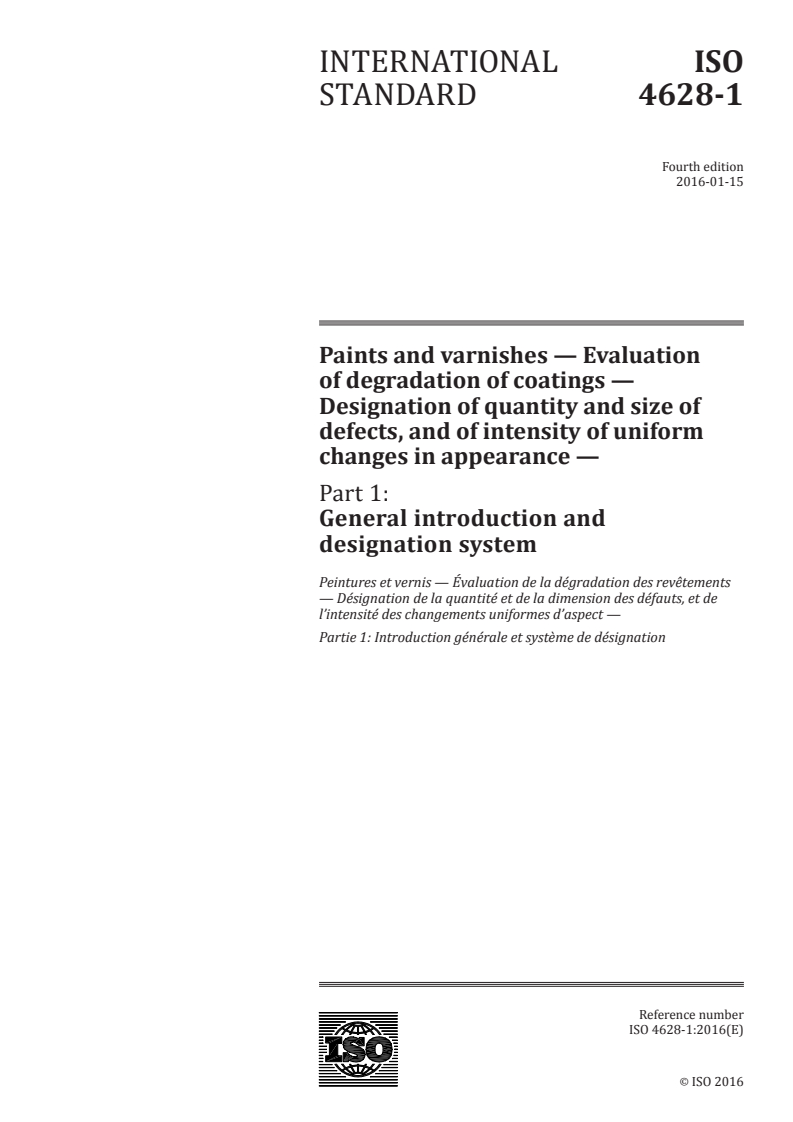
ISO 4628-1:2016 - Paints and varnishes — Evaluation of degradation of coatings — Designation of quantity and size of defects, and of intensity of uniform changes in appearance — Part 1: General introduction and designation system/12/2016
ISO 4628-1:2016 - Peintures et vernis -- Évaluation de la dégradation des revêtements -- Désignation de la quantité et de la dimension des défauts, et de l'intensité des changements uniformes d'aspect
ISO 4628-1:2016 - Peintures et vernis — Évaluation de la dégradation des revêtements — Désignation de la quantité et de la dimension des défauts, et de l'intensité des changements uniformes d'aspect — Partie 1: Introduction générale et système de désignation/12/2016
Overview
ISO 4628-1:2016 establishes a standardized system for evaluating the degradation of paints and varnishes by designating the quantity and size of defects, as well as the intensity of uniform changes in coating appearance. This part provides a general introduction and designation system used throughout the ISO 4628 series, which focuses on defects caused primarily by ageing, weathering, and uniform appearance alterations like yellowing.
The standard helps professionals in the coatings industry quantify and report observable defects consistently, offering a numerical rating scale from 0 (no defects) to 5 (severe defects). It serves as the foundation for more specific evaluations covered in subsequent parts of ISO 4628.
Key Topics
Defect Quantification: ISO 4628-1 designates the quantity of defects such as discontinuities and local imperfections using a numeric scale from 0 (none) to 5 (dense pattern). This enables objective comparisons of defect prevalence across products and test surfaces.
Defect Size Classification: The size of coating defects is rated from 0 (not visible under 10x magnification) to 5 (larger than 5 mm), providing clarity on the severity and visual impact of each defect.
Intensity of Uniform Changes: This includes changes in color or surface appearance intensity, such as yellowing or chalking, rated on a scale from 0 (no perceptible change) to 5 (very marked change).
Assessment Guidelines: Evaluations should be performed under controlled illumination conditions per ISO 13076 to ensure consistency. Initial assessments are conducted visually without magnification.
Expression of Results: Defect type, quantity, size, and affected area proportions must be clearly documented. For example, blistering with a quantity rating of 2 and size rating of 2 is expressed as "blistering; degree of blistering 2(S2)."
Test Reporting: Comprehensive test reports must include coating details, test surface specifics, assessment results, illumination conditions, anomalies observed, and date of examination.
Applications
ISO 4628-1:2016 is essential for quality control, research, and development in industries involving protective and decorative coatings on various substrates. Its practical applications include:
Quality Assurance: Manufacturers can assess and document coating degradation uniformly, ensuring compliance with industry standards and customer requirements.
Product Development: Enables systematic evaluation of coating aging and weathering performance for improved formulations.
Maintenance and Inspection: Facilitates reliable monitoring of coatings on infrastructure, vehicles, and equipment to schedule repairs and extend service life.
Comparative Studies: Supports consistent defect rating across laboratories and studies, improving communication and benchmarking in coating performance.
Related Standards
ISO 4628-1:2016 is part of the ISO 4628 series addressing coating degradation evaluation:
- ISO 4628-2: Assessment of degree of blistering
- ISO 4628-3: Assessment of degree of rusting
- ISO 4628-4: Assessment of degree of cracking
- ISO 4628-5: Assessment of degree of flaking
- ISO 4628-6 & 7: Assessment of degree of chalking (tape and velvet methods)
- ISO 4628-8: Assessment around scribe or artificial defects
- ISO 4628-10: Assessment of degree of filiform corrosion
Additionally, ISO 13076 provides important guidelines for lighting and visual assessment procedures critical to defect evaluation accuracy.
Keywords: ISO 4628-1, paint degradation evaluation, coatings defect assessment, defect quantity and size, uniform appearance changes, paint weathering standards, quality control coatings, coating defect designation system, ISO 13076 illumination, paint inspection standard.
Relations
- Effective Date
- 17-Jun-2026
- Effective Date
- 09-Feb-2026
- Effective Date
- 09-Feb-2026
- Effective Date
- 09-Feb-2026
- Effective Date
- 09-Feb-2026
- Effective Date
- 09-Feb-2026
- Effective Date
- 09-Feb-2026
- Effective Date
- 09-Feb-2026
- Effective Date
- 09-Feb-2026
- Referred By
EN ISO 9227:2017 - Corrosion tests in artificial atmospheres - Salt spray tests (ISO 9227:2017) - Effective Date
- 09-Feb-2026
- Effective Date
- 09-Feb-2026
- Effective Date
- 09-Feb-2026
- Effective Date
- 09-Feb-2026
- Effective Date
- 09-Feb-2026
- Effective Date
- 09-Feb-2026
Buy Documents
ISO 4628-1:2016 - Paints and varnishes -- Evaluation of degradation of coatings -- Designation of quantity and size of defects, and of intensity of uniform changes in appearance
ISO 4628-1:2016 - Paints and varnishes — Evaluation of degradation of coatings — Designation of quantity and size of defects, and of intensity of uniform changes in appearance — Part 1: General introduction and designation system/12/2016
ISO 4628-1:2016 - Peintures et vernis -- Évaluation de la dégradation des revêtements -- Désignation de la quantité et de la dimension des défauts, et de l'intensité des changements uniformes d'aspect
ISO 4628-1:2016 - Peintures et vernis — Évaluation de la dégradation des revêtements — Désignation de la quantité et de la dimension des défauts, et de l'intensité des changements uniformes d'aspect — Partie 1: Introduction générale et système de désignation/12/2016
Frequently Asked Questions
ISO 4628-1:2016 is a standard published by the International Organization for Standardization (ISO). Its full title is "Paints and varnishes — Evaluation of degradation of coatings — Designation of quantity and size of defects, and of intensity of uniform changes in appearance — Part 1: General introduction and designation system". This standard covers: ISO 4628-1:2016 defines a system for designating the quantity and size of defects and the intensity of changes in appearance of coatings and outlines the general principles of the system used throughout ISO 4628. This system is intended to be used, in particular, for defects caused by ageing and weathering, and for uniform changes, for example yellowing. The other parts of ISO 4628 provide pictorial standards or other means for evaluating particular types of defect. As far as possible, already existing evaluation schemes have been used as the basis. ISO 4628-1:2016 is also used for assessing defects not covered by the other parts of ISO 4628.
ISO 4628-1:2016 defines a system for designating the quantity and size of defects and the intensity of changes in appearance of coatings and outlines the general principles of the system used throughout ISO 4628. This system is intended to be used, in particular, for defects caused by ageing and weathering, and for uniform changes, for example yellowing. The other parts of ISO 4628 provide pictorial standards or other means for evaluating particular types of defect. As far as possible, already existing evaluation schemes have been used as the basis. ISO 4628-1:2016 is also used for assessing defects not covered by the other parts of ISO 4628.
ISO 4628-1:2016 is classified under the following ICS (International Classification for Standards) categories: 87.040 - Paints and varnishes. The ICS classification helps identify the subject area and facilitates finding related standards.
ISO 4628-1:2016 has the following relationships with other standards: It is inter standard links to EN ISO 11997-1:2026, EN ISO 11997-1:2017, EN ISO 2812-4:2017, EN ISO 11997-2:2025, EN ISO 2812-1:2017, EN ISO 12944-4:2017, EN ISO 2812-3:2019, CEN ISO/TS 19392-3:2022, EN ISO 4628-3:2016, EN ISO 9227:2017, EN ISO 12944-1:2017, EN ISO 22553-13:2021, EN ISO 22553-10:2023, EN ISO 22553-15:2023, CEN ISO/TS 19392-2:2022. Understanding these relationships helps ensure you are using the most current and applicable version of the standard.
ISO 4628-1:2016 is available in PDF format for immediate download after purchase. The document can be added to your cart and obtained through the secure checkout process. Digital delivery ensures instant access to the complete standard document.
Standards Content (Sample)
INTERNATIONAL ISO
STANDARD 4628-1
Fourth edition
2016-01-15
Paints and varnishes — Evaluation
of degradation of coatings —
Designation of quantity and size of
defects, and of intensity of uniform
changes in appearance —
Part 1:
General introduction and
designation system
Peintures et vernis — Évaluation de la dégradation des revêtements
— Désignation de la quantité et de la dimension des défauts, et de
l’intensité des changements uniformes d’aspect —
Partie 1: Introduction générale et système de désignation
Reference number
©
ISO 2016
© ISO 2016, Published in Switzerland
All rights reserved. Unless otherwise specified, no part of this publication may be reproduced or utilized otherwise in any form
or by any means, electronic or mechanical, including photocopying, or posting on the internet or an intranet, without prior
written permission. Permission can be requested from either ISO at the address below or ISO’s member body in the country of
the requester.
ISO copyright office
Ch. de Blandonnet 8 • CP 401
CH-1214 Vernier, Geneva, Switzerland
Tel. +41 22 749 01 11
Fax +41 22 749 09 47
copyright@iso.org
www.iso.org
ii © ISO 2016 – All rights reserved
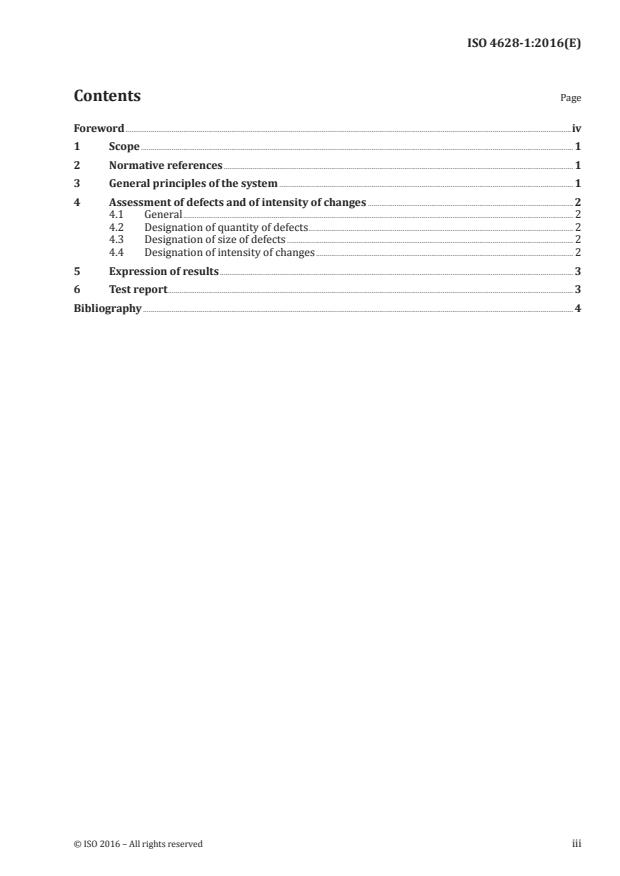
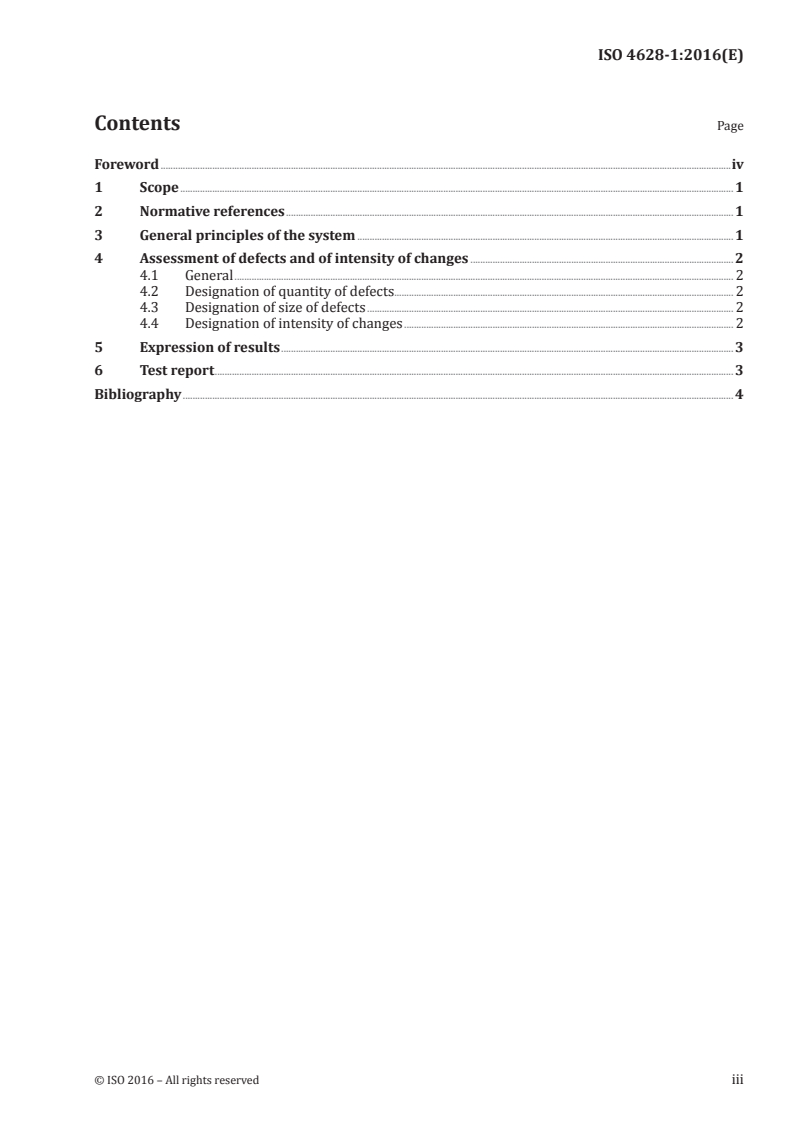
Contents Page
Foreword .iv
1 Scope . 1
2 Normative references . 1
3 General principles of the system . 1
4 Assessment of defects and of intensity of changes . 2
4.1 General . 2
4.2 Designation of quantity of defects . 2
4.3 Designation of size of defects . 2
4.4 Designation of intensity of changes . 2
5 Expression of results . 3
6 Test report . 3
Bibliography . 4
Foreword
ISO (the International Organization for Standardization) is a worldwide federation of national standards
bodies (ISO member bodies). The work of preparing International Standards is normally carried out
through ISO technical committees. Each member body interested in a subject for which a technical
committee has been established has the right to be represented on that committee. International
organizations, governmental and non-governmental, in liaison with ISO, also take part in the work.
ISO collaborates closely with the International Electrotechnical Commission (IEC) on all matters of
electrotechnical standardization.
The procedures used to develop this document and those intended for its further maintenance are
described in the ISO/IEC Directives, Part 1. In particular the different approval criteria needed for the
different types of ISO documents should be noted. This document was drafted in accordance with the
editorial rules of the ISO/IEC Directives, Part 2 (see www.iso.org/directives).
Attention is drawn to the possibility that some of the elements of this document may be the subject of
patent rights. ISO shall not be held responsible for identifying any or all such patent rights. Details of
any patent rights identified during the development of the document will be in the Introduction and/or
on the ISO list of patent declarations received (see www.iso.org/patents).
Any trade name used in this document is information given for the convenience of users and does not
constitute an endorsement.
For an explanation on the meaning of ISO specific terms and expressions related to conformity
assessment, as well as information about ISO’s adherence to the WTO principles in the Technical
Barriers to Trade (TBT) see the following URL: Foreword - Supplementary information
The committee responsible for this document is ISO/TC 35, Paints and varnishes, Subcommittee SC 9,
General test methods for paints and varnishes.
This fourth edition cancels and replaces the third edition (ISO 4628-1:2003), which has been technically
revised with the following changes:
a) a lower limit for visual assessment of defects has been introduced in Table 2;
b) a normative reference to ISO 13076 for illumination for the assessment has been added.
ISO 4628 consists of the following parts, under the general title Paints and varnishes — Evaluation of
degradation of coatings — Designation of quantity and size of defects, and of intensity of uniform changes
in appearance:
— Part 1: General introduction and designation system
— Part 2: Assessment of degree of blistering
— Part 3: Assessment of degree of rusting
— Part 4: Assessment of degree of cracking
— Part 5: Assessment of degree of flaking
— Part 6: Assessment of degree of chalking by tape method
— Part 7: Assessment of degree of chalking by velvet method
— Part 8: Assessment of degree of delamination and corrosion around a scribe or other artificial defect
— Part 10: Assessment of degree of filiform corrosion
iv © ISO 2016 – All rights reserved
INTERNATIONAL STANDARD ISO 4628-1:2016(E)
Paints and varnishes — Evaluation of degradation of
coatings
...
INTERNATIONAL ISO
STANDARD 4628-1
Fourth edition
2016-01-15
Paints and varnishes — Evaluation
of degradation of coatings —
Designation of quantity and size of
defects, and of intensity of uniform
changes in appearance —
Part 1:
General introduction and
designation system
Peintures et vernis — Évaluation de la dégradation des revêtements
— Désignation de la quantité et de la dimension des défauts, et de
l’intensité des changements uniformes d’aspect —
Partie 1: Introduction générale et système de désignation
Reference number
©
ISO 2016
© ISO 2016, Published in Switzerland
All rights reserved. Unless otherwise specified, no part of this publication may be reproduced or utilized otherwise in any form
or by any means, electronic or mechanical, including photocopying, or posting on the internet or an intranet, without prior
written permission. Permission can be requested from either ISO at the address below or ISO’s member body in the country of
the requester.
ISO copyright office
Ch. de Blandonnet 8 • CP 401
CH-1214 Vernier, Geneva, Switzerland
Tel. +41 22 749 01 11
Fax +41 22 749 09 47
copyright@iso.org
www.iso.org
ii © ISO 2016 – All rights reserved
Contents Page
Foreword .iv
1 Scope . 1
2 Normative references . 1
3 General principles of the system . 1
4 Assessment of defects and of intensity of changes . 2
4.1 General . 2
4.2 Designation of quantity of defects . 2
4.3 Designation of size of defects . 2
4.4 Designation of intensity of changes . 2
5 Expression of results . 3
6 Test report . 3
Bibliography . 4
Foreword
ISO (the International Organization for Standardization) is a worldwide federation of national standards
bodies (ISO member bodies). The work of preparing International Standards is normally carried out
through ISO technical committees. Each member body interested in a subject for which a technical
committee has been established has the right to be represented on that committee. International
organizations, governmental and non-governmental, in liaison with ISO, also take part in the work.
ISO collaborates closely with the International Electrotechnical Commission (IEC) on all matters of
electrotechnical standardization.
The procedures used to develop this document and those intended for its further maintenance are
described in the ISO/IEC Directives, Part 1. In particular the different approval criteria needed for the
different types of ISO documents should be noted. This document was drafted in accordance with the
editorial rules of the ISO/IEC Directives, Part 2 (see www.iso.org/directives).
Attention is drawn to the possibility that some of the elements of this document may be the subject of
patent rights. ISO shall not be held responsible for identifying any or all such patent rights. Details of
any patent rights identified during the development of the document will be in the Introduction and/or
on the ISO list of patent declarations received (see www.iso.org/patents).
Any trade name used in this document is information given for the convenience of users and does not
constitute an endorsement.
For an explanation on the meaning of ISO specific terms and expressions related to conformity
assessment, as well as information about ISO’s adherence to the WTO principles in the Technical
Barriers to Trade (TBT) see the following URL: Foreword - Supplementary information
The committee responsible for this document is ISO/TC 35, Paints and varnishes, Subcommittee SC 9,
General test methods for paints and varnishes.
This fourth edition cancels and replaces the third edition (ISO 4628-1:2003), which has been technically
revised with the following changes:
a) a lower limit for visual assessment of defects has been introduced in Table 2;
b) a normative reference to ISO 13076 for illumination for the assessment has been added.
ISO 4628 consists of the following parts, under the general title Paints and varnishes — Evaluation of
degradation of coatings — Designation of quantity and size of defects, and of intensity of uniform changes
in appearance:
— Part 1: General introduction and designation system
— Part 2: Assessment of degree of blistering
— Part 3: Assessment of degree of rusting
— Part 4: Assessment of degree of cracking
— Part 5: Assessment of degree of flaking
— Part 6: Assessment of degree of chalking by tape method
— Part 7: Assessment of degree of chalking by velvet method
— Part 8: Assessment of degree of delamination and corrosion around a scribe or other artificial defect
— Part 10: Assessment of degree of filiform corrosion
iv © ISO 2016 – All rights reserved
INTERNATIONAL STANDARD ISO 4628-1:2016(E)
Paints and varnishes — Evaluation of degradation of
coatings
...
NORME ISO
INTERNATIONALE 4628-1
Quatrième édition
2016-01-15
Peintures et vernis — Évaluation de
la dégradation des revêtements —
Désignation de la quantité et de la
dimension des défauts, et de l’intensité
des changements uniformes d’aspect —
Partie 1:
Introduction générale et système de
désignation
Paints and varnishes — Evaluation of degradation of coatings —
Designation of quantity and size of defects, and of intensity of uniform
changes in appearance —
Part 1: General introduction and designation system
Numéro de référence
©
ISO 2016
DOCUMENT PROTÉGÉ PAR COPYRIGHT
© ISO 2016, Publié en Suisse
Droits de reproduction réservés. Sauf indication contraire, aucune partie de cette publication ne peut être reproduite ni utilisée
sous quelque forme que ce soit et par aucun procédé, électronique ou mécanique, y compris la photocopie, l’affichage sur
l’internet ou sur un Intranet, sans autorisation écrite préalable. Les demandes d’autorisation peuvent être adressées à l’ISO à
l’adresse ci-après ou au comité membre de l’ISO dans le pays du demandeur.
ISO copyright office
Ch. de Blandonnet 8 • CP 401
CH-1214 Vernier, Geneva, Switzerland
Tel. +41 22 749 01 11
Fax +41 22 749 09 47
copyright@iso.org
www.iso.org
ii © ISO 2016 – Tous droits réservés
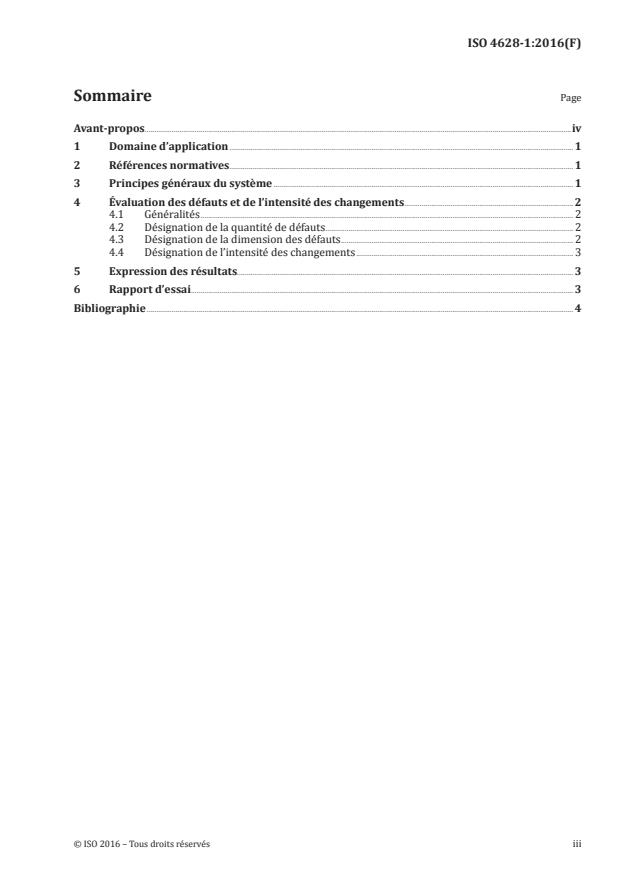
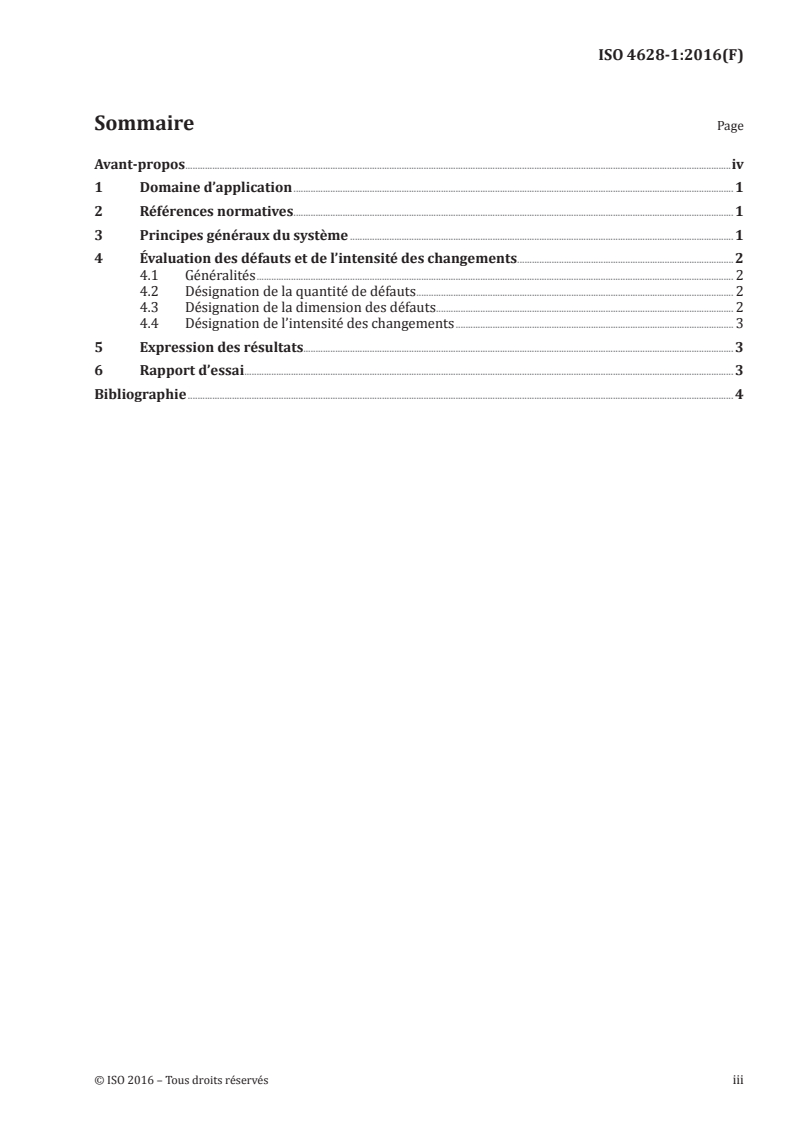
Sommaire Page
Avant-propos .iv
1 Domaine d’application . 1
2 Références normatives . 1
3 Principes généraux du système . 1
4 Évaluation des défauts et de l’intensité des changements . 2
4.1 Généralités . 2
4.2 Désignation de la quantité de défauts . 2
4.3 Désignation de la dimension des défauts . 2
4.4 Désignation de l’intensité des changements . 3
5 Expression des résultats. 3
6 Rapport d’essai . 3
Bibliographie . 4
Avant-propos
L’ISO (Organisation internationale de normalisation) est une fédération mondiale d’organismes
nationaux de normalisation (comités membres de l’ISO). L’élaboration des Normes internationales est
en général confiée aux comités techniques de l’ISO. Chaque comité membre intéressé par une étude
a le droit de faire partie du comité technique créé à cet effet. Les organisations internationales,
gouvernementales et non gouvernementales, en liaison avec l’ISO participent également aux travaux.
L’ISO collabore étroitement avec la Commission électrotechnique internationale (IEC) en ce qui
concerne la normalisation électrotechnique.
Les procédures utilisées pour élaborer le présent document et celles destinées à sa mise à jour sont
décrites dans les Directives ISO/IEC, Partie 1. Il convient, en particulier de prendre note des différents
critères d’approbation requis pour les différents types de documents ISO. Le présent document a été
rédigé conformément aux règles de rédaction données dans les Directives ISO/IEC, Partie 2 (voir www.
iso.org/directives).
L’attention est appelée sur le fait que certains des éléments du présent document peuvent faire l’objet de
droits de propriété intellectuelle ou de droits analogues. L’ISO ne saurait être tenue pour responsable
de ne pas avoir identifié de tels droits de propriété et averti de leur existence. Les détails concernant
les références aux droits de propriété intellectuelle ou autres droits analogues identifiés lors de
l’élaboration du document sont indiqués dans l’Introduction et/ou dans la liste des déclarations de
brevets reçues par l’ISO (voir www.iso.org/brevets).
Les appellations commerciales éventuellement mentionnées dans le présent document sont données
pour information, par souci de commodité, à l’intention des utilisateurs et ne sauraient constituer
un engagement.
Pour une explication de la signification des termes et expressions spécifiques de l’ISO liés à
l’évaluation de la conformité, ou pour toute information au sujet de l’adhésion de l’ISO aux principes
de l’OMC concernant les obstacles techniques au commerce (OTC), voir le lien suivant: Avant-propos —
Informations supplémentaires.
Le comité chargé de l’élaboration du présent document est l’ISO/TC 35, Peintures et vernis, sous-comité
SC 9, Méthodes générales d’essais des peintures et vernis.
Cette quatrième édition annule et remplace la troisième édition (ISO 4628-1:2003), qui a fait l’objet
d’une révision technique en vue d’apporter les modifications suivantes:
a) une limite plus basse pour l’évaluation visuelle des défauts a été introduite dans le Tableau 2;
b) une référence normative à l’ISO 13076 a été ajoutée concernant les conditions d’éclairage pour
l’évaluation visuelle.
L’ISO 4628 comprend les parties suivantes, présentées sous le titre général Peintures et vernis —
Évaluation de la dégradation des revêtements — Désignation de la quantité et de la dimension des défauts,
et de l’intensité des changements uniformes d’aspect:
— Partie 1: Introduction générale et système de désignation
— Partie 2: Évaluation du degré de cloquage
— Partie 3: Évaluation du degré d’enrouillement
— Partie 4: Évaluation du degré de craquelage
— Partie 5: Évaluation du degré d’écaillage
— Partie 6: Évaluation du degré de farinage par la méthode du ruban adhésif
— Partie 7: Évaluation du degré de farinage selon la méthode du morceau de velours
iv © ISO 2016 – Tous droits réservés
— Partie 8: Évaluation du degré de décollement et de corrosion autour d’une rayure ou d’un autre
défaut artificiel
— Partie 10: Évaluation du degré de corrosion filiforme
NORME INTERNATIONALE ISO 4628-1:2016(F)
Peintures et vernis — Évaluation de la dégradation
des revêtements — Désignation de la quantité et de la
dimension des défauts, et de l’intensité des changements
uniformes d’aspect —
Partie 1:
Introduction générale et système de désignation
1 Domaine d’applica
...
NORME ISO
INTERNATIONALE 4628-1
Quatrième édition
2016-01-15
Peintures et vernis — Évaluation de
la dégradation des revêtements —
Désignation de la quantité et de la
dimension des défauts, et de l’intensité
des changements uniformes d’aspect —
Partie 1:
Introduction générale et système de
désignation
Paints and varnishes — Evaluation of degradation of coatings —
Designation of quantity and size of defects, and of intensity of uniform
changes in appearance —
Part 1: General introduction and designation system
Numéro de référence
©
ISO 2016
DOCUMENT PROTÉGÉ PAR COPYRIGHT
© ISO 2016, Publié en Suisse
Droits de reproduction réservés. Sauf indication contraire, aucune partie de cette publication ne peut être reproduite ni utilisée
sous quelque forme que ce soit et par aucun procédé, électronique ou mécanique, y compris la photocopie, l’affichage sur
l’internet ou sur un Intranet, sans autorisation écrite préalable. Les demandes d’autorisation peuvent être adressées à l’ISO à
l’adresse ci-après ou au comité membre de l’ISO dans le pays du demandeur.
ISO copyright office
Ch. de Blandonnet 8 • CP 401
CH-1214 Vernier, Geneva, Switzerland
Tel. +41 22 749 01 11
Fax +41 22 749 09 47
copyright@iso.org
www.iso.org
ii © ISO 2016 – Tous droits réservés
Sommaire Page
Avant-propos .iv
1 Domaine d’application . 1
2 Références normatives . 1
3 Principes généraux du système . 1
4 Évaluation des défauts et de l’intensité des changements . 2
4.1 Généralités . 2
4.2 Désignation de la quantité de défauts . 2
4.3 Désignation de la dimension des défauts . 2
4.4 Désignation de l’intensité des changements . 3
5 Expression des résultats. 3
6 Rapport d’essai . 3
Bibliographie . 4
Avant-propos
L’ISO (Organisation internationale de normalisation) est une fédération mondiale d’organismes
nationaux de normalisation (comités membres de l’ISO). L’élaboration des Normes internationales est
en général confiée aux comités techniques de l’ISO. Chaque comité membre intéressé par une étude
a le droit de faire partie du comité technique créé à cet effet. Les organisations internationales,
gouvernementales et non gouvernementales, en liaison avec l’ISO participent également aux travaux.
L’ISO collabore étroitement avec la Commission électrotechnique internationale (IEC) en ce qui
concerne la normalisation électrotechnique.
Les procédures utilisées pour élaborer le présent document et celles destinées à sa mise à jour sont
décrites dans les Directives ISO/IEC, Partie 1. Il convient, en particulier de prendre note des différents
critères d’approbation requis pour les différents types de documents ISO. Le présent document a été
rédigé conformément aux règles de rédaction données dans les Directives ISO/IEC, Partie 2 (voir www.
iso.org/directives).
L’attention est appelée sur le fait que certains des éléments du présent document peuvent faire l’objet de
droits de propriété intellectuelle ou de droits analogues. L’ISO ne saurait être tenue pour responsable
de ne pas avoir identifié de tels droits de propriété et averti de leur existence. Les détails concernant
les références aux droits de propriété intellectuelle ou autres droits analogues identifiés lors de
l’élaboration du document sont indiqués dans l’Introduction et/ou dans la liste des déclarations de
brevets reçues par l’ISO (voir www.iso.org/brevets).
Les appellations commerciales éventuellement mentionnées dans le présent document sont données
pour information, par souci de commodité, à l’intention des utilisateurs et ne sauraient constituer
un engagement.
Pour une explication de la signification des termes et expressions spécifiques de l’ISO liés à
l’évaluation de la conformité, ou pour toute information au sujet de l’adhésion de l’ISO aux principes
de l’OMC concernant les obstacles techniques au commerce (OTC), voir le lien suivant: Avant-propos —
Informations supplémentaires.
Le comité chargé de l’élaboration du présent document est l’ISO/TC 35, Peintures et vernis, sous-comité
SC 9, Méthodes générales d’essais des peintures et vernis.
Cette quatrième édition annule et remplace la troisième édition (ISO 4628-1:2003), qui a fait l’objet
d’une révision technique en vue d’apporter les modifications suivantes:
a) une limite plus basse pour l’évaluation visuelle des défauts a été introduite dans le Tableau 2;
b) une référence normative à l’ISO 13076 a été ajoutée concernant les conditions d’éclairage pour
l’évaluation visuelle.
L’ISO 4628 comprend les parties suivantes, présentées sous le titre général Peintures et vernis —
Évaluation de la dégradation des revêtements — Désignation de la quantité et de la dimension des défauts,
et de l’intensité des changements uniformes d’aspect:
— Partie 1: Introduction générale et système de désignation
— Partie 2: Évaluation du degré de cloquage
— Partie 3: Évaluation du degré d’enrouillement
— Partie 4: Évaluation du degré de craquelage
— Partie 5: Évaluation du degré d’écaillage
— Partie 6: Évaluation du degré de farinage par la méthode du ruban adhésif
— Partie 7: Évaluation du degré de farinage selon la méthode du morceau de velours
iv © ISO 2016 – Tous droits réservés
— Partie 8: Évaluation du degré de décollement et de corrosion autour d’une rayure ou d’un autre
défaut artificiel
— Partie 10: Évaluation du degré de corrosion filiforme
NORME INTERNATIONALE ISO 4628-1:2016(F)
Peintures et vernis — Évaluation de la dégradation
des revêtements — Désignation de la quantité et de la
dimension des défauts, et de l’intensité des changements
uniformes d’aspect —
Partie 1:
Introduction générale et système de désignation
1 Domaine d’applica
...