


ISO 8513:2023
(Main)Plastics piping systems - Glass-reinforced thermosetting plastics (GRP) pipes - Test methods for the determination of the initial longitudinal tensile strength
Plastics piping systems - Glass-reinforced thermosetting plastics (GRP) pipes - Test methods for the determination of the initial longitudinal tensile strength
This document specifies two test methods (method A and method B) for determining the longitudinal tensile properties of glass-reinforced thermosetting plastics (GRP) pipes. The properties which can be determined are: - the longitudinal tensile strength, and - the percentage ultimate elongation. Method A uses, for the test piece(s), a longitudinal strip cut from a pipe. Method B uses a specified length of the full cross-section of the pipe. Method A is applicable to pipes with a nominal size of DN 50 or greater with circumferentially-wound filaments, with or without chopped glass and/or woven rovings and/or fillers, and to centrifugally-cast pipes. It is applicable to pipes with helically wound filaments with a nominal size of DN 200 or greater. Method B is applicable to all types of GRP pipe. It is usually used for pipes with a nominal size up to and including DN 150. Results from one method are not necessarily equal to the results derived from any of the alternative methods. However, all methods have equal validity. Annex A describes additional considerations for method B that have been found useful for the testing of thin-walled helically-wound pipes and can be used to supplement the basic text. NOTE This document does not address the determination of longitudinal tensile modulus. Due to the multi-layer construction of many GRP pipes, the accurate measurement of strain, necessary for modulus determination, can be very difficult. If it is desired to determine longitudinal modulus, see ISO 527-4 and/or ISO 527-5.
Systèmes de canalisations en plastiques — Tubes en plastiques thermodurcissables renforcés de verre (PRV) — Méthodes d'essai pour la détermination de la force en traction longitudinale
General Information
- Status
- Published
- Publication Date
- 20-Jul-2023
- Current Stage
- 6060 - International Standard published
- Start Date
- 21-Jul-2023
- Due Date
- 08-May-2023
- Completion Date
- 21-Jul-2023
Relations
- Effective Date
- 06-Jun-2022
Overview
ISO 8513:2023 specifies standardized test methods for determining the initial longitudinal tensile strength of glass-reinforced thermosetting plastics (GRP) pipes. It defines two valid procedures-Method A (strip test) and Method B (pipe section test)-and the properties measured: longitudinal tensile strength and percentage ultimate elongation. The edition clarifies applicability by pipe construction and nominal diameter (DN) and includes Annex A with supplemental guidance for thin‑walled helically‑wound pipes.
Key Topics
- Test methods
- Method A (strip): longitudinal strip or dumbbell-shaped specimen cut from the pipe wall; applicable for circumferentially‑wound pipes (DN ≥ 50), centrifugally‑cast pipes, and helically‑wound pipes with DN ≥ 200.
- Method B (pipe section): full cross‑section length of pipe; applicable to all GRP pipe types and commonly used for pipes up to DN 150.
- Measured properties
- Longitudinal tensile strength (expressed in N/mm of mean circumference).
- Ultimate elongation (%) determined from cross‑head movement.
- Specimen geometry & key dimensions
- Total specimen length: (300 ± 15) mm.
- Gauge length: typically 100–150 mm.
- Example gauge widths (method A): 10 ± 1 mm for DN ≤ 150, 25 ± 1 mm for DN > 150; total widths 18 ± 2 mm and 40 ± 2 mm respectively.
- Radius for shaped strips: 50–70 mm.
- Apparatus & procedure
- Constant cross‑head speed tensile tester with aligned grips, accurate force measurement (±1 % recommended) and cross‑head displacement recording.
- Grips must avoid slip or crushing; pipe‑section grips often use mandrels, segmented grips, sleeves and reinforcing bands.
- Limitations
- Results from Methods A and B are not necessarily numerically equivalent though both are valid.
- ISO 8513:2023 does not address longitudinal tensile modulus; see ISO 527‑4 and ISO 527‑5 for modulus determination.
Applications
ISO 8513:2023 is used by:
- GRP pipe manufacturers for product development, quality control and production verification.
- Independent test laboratories performing type testing or certification tests.
- Civil, water and wastewater engineers specifying mechanical performance for buried and pressure piping systems.
- Procurement, conformity assessment bodies and standards committees for compliance and performance comparison. Practical uses include acceptance testing, material verification, failure analysis and comparing different winding or layup methods (circumferential, helical, centrifugal).
Related Standards
- ISO 527‑4 and ISO 527‑5 - guidance for tensile modulus measurement of plastics (for modulus, not covered by ISO 8513).
- This 2023 fourth edition replaces ISO 8513:2016 and includes updated provisions on specimen end reinforcement and grip handling.
Keywords: ISO 8513:2023, GRP pipes, glass‑reinforced thermosetting plastics, longitudinal tensile strength, test methods, Method A, Method B, tensile testing, pipe testing, DN sizes.

Frequently Asked Questions
ISO 8513:2023 is a standard published by the International Organization for Standardization (ISO). Its full title is "Plastics piping systems - Glass-reinforced thermosetting plastics (GRP) pipes - Test methods for the determination of the initial longitudinal tensile strength". This standard covers: This document specifies two test methods (method A and method B) for determining the longitudinal tensile properties of glass-reinforced thermosetting plastics (GRP) pipes. The properties which can be determined are: - the longitudinal tensile strength, and - the percentage ultimate elongation. Method A uses, for the test piece(s), a longitudinal strip cut from a pipe. Method B uses a specified length of the full cross-section of the pipe. Method A is applicable to pipes with a nominal size of DN 50 or greater with circumferentially-wound filaments, with or without chopped glass and/or woven rovings and/or fillers, and to centrifugally-cast pipes. It is applicable to pipes with helically wound filaments with a nominal size of DN 200 or greater. Method B is applicable to all types of GRP pipe. It is usually used for pipes with a nominal size up to and including DN 150. Results from one method are not necessarily equal to the results derived from any of the alternative methods. However, all methods have equal validity. Annex A describes additional considerations for method B that have been found useful for the testing of thin-walled helically-wound pipes and can be used to supplement the basic text. NOTE This document does not address the determination of longitudinal tensile modulus. Due to the multi-layer construction of many GRP pipes, the accurate measurement of strain, necessary for modulus determination, can be very difficult. If it is desired to determine longitudinal modulus, see ISO 527-4 and/or ISO 527-5.
This document specifies two test methods (method A and method B) for determining the longitudinal tensile properties of glass-reinforced thermosetting plastics (GRP) pipes. The properties which can be determined are: - the longitudinal tensile strength, and - the percentage ultimate elongation. Method A uses, for the test piece(s), a longitudinal strip cut from a pipe. Method B uses a specified length of the full cross-section of the pipe. Method A is applicable to pipes with a nominal size of DN 50 or greater with circumferentially-wound filaments, with or without chopped glass and/or woven rovings and/or fillers, and to centrifugally-cast pipes. It is applicable to pipes with helically wound filaments with a nominal size of DN 200 or greater. Method B is applicable to all types of GRP pipe. It is usually used for pipes with a nominal size up to and including DN 150. Results from one method are not necessarily equal to the results derived from any of the alternative methods. However, all methods have equal validity. Annex A describes additional considerations for method B that have been found useful for the testing of thin-walled helically-wound pipes and can be used to supplement the basic text. NOTE This document does not address the determination of longitudinal tensile modulus. Due to the multi-layer construction of many GRP pipes, the accurate measurement of strain, necessary for modulus determination, can be very difficult. If it is desired to determine longitudinal modulus, see ISO 527-4 and/or ISO 527-5.
ISO 8513:2023 is classified under the following ICS (International Classification for Standards) categories: 23.040.20 - Plastics pipes. The ICS classification helps identify the subject area and facilitates finding related standards.
ISO 8513:2023 has the following relationships with other standards: It is inter standard links to ISO 8513:2016. Understanding these relationships helps ensure you are using the most current and applicable version of the standard.
ISO 8513:2023 is available in PDF format for immediate download after purchase. The document can be added to your cart and obtained through the secure checkout process. Digital delivery ensures instant access to the complete standard document.
Standards Content (Sample)
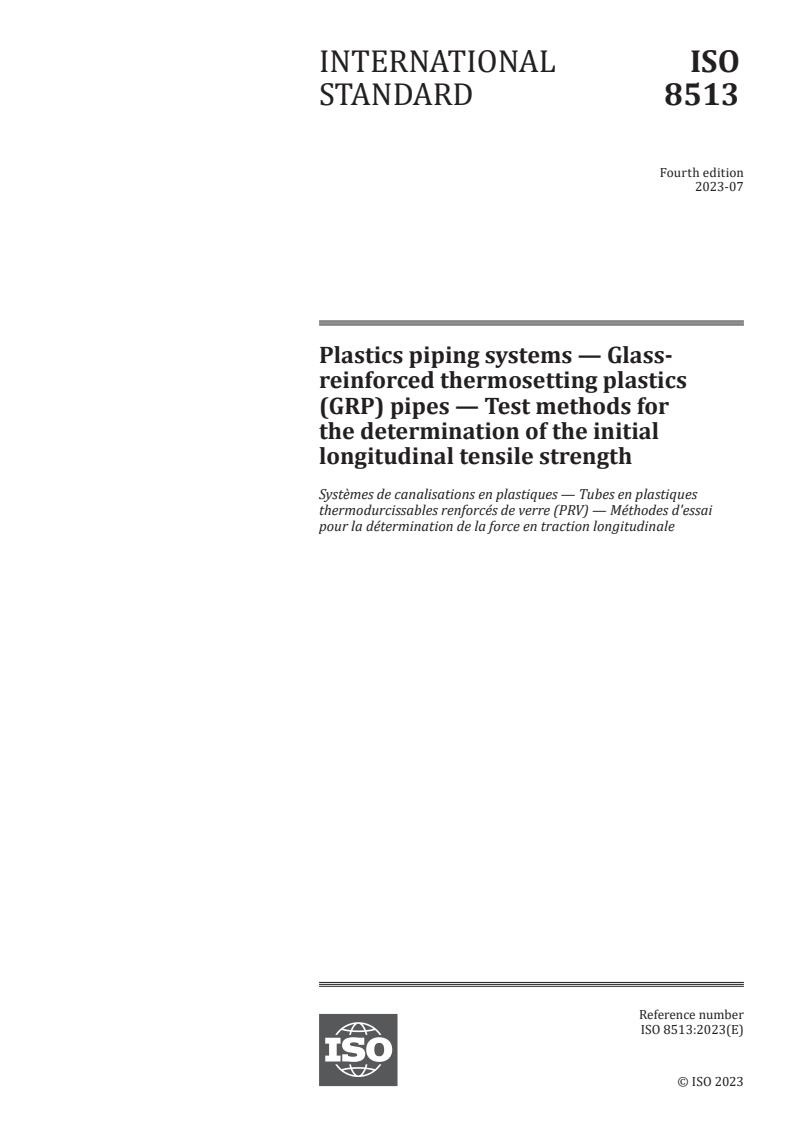
INTERNATIONAL ISO
STANDARD 8513
Fourth edition
2023-07
Plastics piping systems — Glass-
reinforced thermosetting plastics
(GRP) pipes — Test methods for
the determination of the initial
longitudinal tensile strength
Systèmes de canalisations en plastiques — Tubes en plastiques
thermodurcissables renforcés de verre (PRV) — Méthodes d'essai
pour la détermination de la force en traction longitudinale
Reference number
© ISO 2023
All rights reserved. Unless otherwise specified, or required in the context of its implementation, no part of this publication may
be reproduced or utilized otherwise in any form or by any means, electronic or mechanical, including photocopying, or posting on
the internet or an intranet, without prior written permission. Permission can be requested from either ISO at the address below
or ISO’s member body in the country of the requester.
ISO copyright office
CP 401 • Ch. de Blandonnet 8
CH-1214 Vernier, Geneva
Phone: +41 22 749 01 11
Email: copyright@iso.org
Website: www.iso.org
Published in Switzerland
ii
Contents Page
Foreword .iv
1 Scope . 1
2 Normative references . 1
3 Terms and definitions . 1
4 Principle . 2
5 Apparatus . 3
5.1 Tensile-testing machine . 3
5.2 Grips . 3
5.3 Dimension measurement devices . 4
6 Test pieces .4
6.1 General . 4
6.2 Strip test piece (method A) . 4
6.2.1 Shape . 4
6.2.2 Dimensions . 4
6.2.3 Use of built-up ends . 6
6.3 Pipe section test pieces (method B) . 6
6.4 Number of test pieces . 6
7 Conditioning . 7
8 Test temperature . 7
9 Procedure (methods A and B) .7
10 Calculation . 7
10.1 For strip test pieces (method A) . 7
10.2 For pipe test pieces (method B) . 8
11 Test report . 8
Annex A (informative) Determination of longitudinal properties for helically filament-
wound thin wall pipe .10
Bibliography .12
iii
Foreword
ISO (the International Organization for Standardization) is a worldwide federation of national standards
bodies (ISO member bodies). The work of preparing International Standards is normally carried out
through ISO technical committees. Each member body interested in a subject for which a technical
committee has been established has the right to be represented on that committee. International
organizations, governmental and non-governmental, in liaison with ISO, also take part in the work.
ISO collaborates closely with the International Electrotechnical Commission (IEC) on all matters of
electrotechnical standardization.
The procedures used to develop this document and those intended for its further maintenance are
described in the ISO/IEC Directives, Part 1. In particular, the different approval criteria needed for the
different types of ISO document should be noted. This document was drafted in accordance with the
editorial rules of the ISO/IEC Directives, Part 2 (see www.iso.org/directives).
ISO draws attention to the possibility that the implementation of this document may involve the use
of (a) patent(s). ISO takes no position concerning the evidence, validity or applicability of any claimed
patent rights in respect thereof. As of the date of publication of this document, ISO had not received
notice of (a) patent(s) which may be required to implement this document. However, implementers are
cautioned that this may not represent the latest information, which may be obtained from the patent
database available at www.iso.org/patents. ISO shall not be held responsible for identifying any or all
such patent rights.
Any trade name used in this document is information given for the convenience of users and does not
constitute an endorsement.
For an explanation of the voluntary nature of standards, the meaning of ISO specific terms and
expressions related to conformity assessment, as well as information about ISO's adherence to
the World Trade Organization (WTO) principles in the Technical Barriers to Trade (TBT), see
www.iso.org/iso/foreword.html.
This document was prepared by Technical Committee ISO/TC 138, Plastics pipes, fittings and valves for
the transport of fluids, Subcommittee SC 6, Reinforced plastics pipes and fittings for all applications.
This fourth edition cancels and replaces the third edition (ISO 8513:2016), which has been technically
revised.
The main changes are as follows:
— subclause 6.2.3 has been modified to allow the manufacturer to choose to utilize built-up ends on
the samples, independent of the grips holding the test piece (see 6.2.3).
Any feedback or questions on this document should be directed to the user’s national standards body. A
complete listing of these bodies can be found at www.iso.org/members.html.
iv
INTERNATIONAL STANDARD ISO 8513:2023(E)
Plastics piping systems — Glass-reinforced thermosetting
plastics (GRP) pipes — Test methods for the determination
of the initial longitudinal tensile strength
1 Scope
This document specifies two test methods (method A and method B) for determining the longitudinal
tensile properties of glass-reinforced thermosetting plastics (GRP) pipes. The properties which can be
determined are:
— the longitudinal tensile strength, and
— the percentage ultimate elongation.
Method A uses, for the test piece(s), a longitudinal strip cut from a pipe.
Method B uses a specified length of the full cross-section of the pipe.
Method A is applicable to pipes with a nominal size of DN 50 or greater with circumferentially-wound
filaments, with or without chopped glass and/or woven rovings and/or fillers, and to centrifugally-cast
pipes. It is applicable to pipes with helically wound filaments with a nominal size of DN 200 or greater.
Method B is applicable to all types of GRP pipe. It is usually used for pipes with a nominal size up to and
including DN 150.
Results from one method are not necessarily equal to the results derived from any of the alternative
methods. However, all methods have equal validity.
Annex A describes additional considerations for method B that have been found useful for the testing of
thin-walled helically-wound pipes and can be used to supplement the basic text.
NOTE This document does not address the determination of longitudinal tensile modulus. Due to the multi-
layer construction of many GRP pipes, the accurate measurement of strain, necessary for modulus determination,
can be very difficult. If it is desired to determine longitudinal modulus, see ISO 527-4 and/or ISO 527-5.
2 Normative references
There are no normative references in this document.
3 Terms and definitions
For the purposes of this document, the following terms and definitions apply.
ISO and IEC maintain terminology databases for use in standardization at the following addresses:
— ISO Online browsing platform: available at https:// www .iso .org/ obp
— IEC Electropedia: available at https:// www .electropedia .org/
3.1
helically filament-wound
cross wound
filament-wound pipes made with a balanced winding angle
3.2
longitudinal tensile strength
σ *
LA
σ *
LB
maximum tensile force in the longitudinal direction per unit mean circumference at failure
Note 1 to entry: It is expressed in newtons per millimetre of the circumference (N/mm).
Note 2 to entry: The subscripts A and B denote the method of test used.
3.3
mean circumference
circumference corresponding to the mean diameter multiplied by π
Note 1 to entry: π ≈ 3,141 6.
Note 2 to entry: It is expressed in millimetres (mm).
3.4
mean diameter
d
m
diameter of the circle corresponding with the middle of the pipe wall cross-section
Note 1 to entry: It is given by any of the following:
a) the average of the external diameter of the pipe minus the average of the wall thickness;
b) the external circumference of the pipe divided by π (π ≈ 3,141 6) minus the average of the wall thickness;
c) the average of the internal diameter of the pipe plus the average of the wall thickness.
Note 2 to entry: It is expressed in millimetres (mm).
3.5
ultimate elongation
ε
L
elongation coincident with the ultimate longitudinal tensile strength.
Note 1 to entry: For the purposes of this document, the measurement of elongation is limited to measurement of
the movement of the tensile testing machine cross-heads.
Note 2 to entry: It is expressed as a percentage of an initial gauge length or free length of a test piece.
4 Principle
Test pieces comprising of either strips cut longitudinally from a pipe wall segment (method A) or a
specified length of pipe (method B) are subjected to extension in the longitudinal direction at a constant
speed such that fracture occurs within a specified time.
The tensile properties are determined usin
...
Questions, Comments and Discussion
Ask us and Technical Secretary will try to provide an answer. You can facilitate discussion about the standard in here.
Loading comments...