

ISO/TS 11619:2014
(Main)Polyurethane tubing for use primarily in pneumatic installations — Dimensions and specification
General Information
- Abstract
ISO/TS 11619:2014 specifies the requirements for flexible thermoplastic polyurethane tubing conveying compressed air, for use in the ambient temperature range from 23 °C to 60 °C, in sizes from 3 mm to 12 mm outside diameter. Working pressure depends on the tube size and the service temperature. Tubing may be used with push on connectors which are specified in ISO 14743.
- Status
- Withdrawn
- Publication Date
- 10-Feb-2014
- Technical Committee
- ISO/TC 131/SC 4 - Connectors and similar products and components
- Drafting Committee
- ISO/TC 131/SC 4/WG 9 - Pneumatic tubing and connectors
- Current Stage
- 9599 - Withdrawal of International Standard
- Start Date
- 23-Jul-2024
- Completion Date
- 29-Aug-2026
Buy Documents

ISO/TS 11619:2014 - Polyurethane tubing for use primarily in pneumatic installations -- Dimensions and specification
ISO/TS 11619:2014 - Polyurethane tubing for use primarily in pneumatic installations — Dimensions and specification/11/2014
Overview
ISO/TS 11619:2014 specifies dimensions, materials, performance and testing requirements for flexible thermoplastic polyurethane (PU) tubing used primarily in pneumatic installations. It covers tubing with outside diameters from 3 mm to 12 mm and wall thicknesses typically from 0.5 mm to 2.0 mm, intended to convey compressed air in ambient service temperatures between 23 °C and 60 °C. Tubing manufactured to this Technical Specification may be used with push-on connectors specified in ISO 14743.
Key topics and technical requirements
- Materials & construction: Tubing shall be polyester- or polyether-based polyurethane, homogeneous and free from surface defects. Users must specify hydrolysis-resistant materials for moist/high-temperature (>40 °C) environments.
- Dimensions & tolerances: Outside diameter tolerances are tight (±0.10 mm to ±0.15 mm depending on size); wall thickness tolerances are specified per size. Cut-length tolerances follow ISO 1307.
- Hydrostatic (burst) testing: Burst tests are specified per ISO 1402 at both 23 °C ±2 °C and 60 °C ±2 °C. Minimum burst pressures vary by size/wall thickness (e.g., several MPa values listed per tube size).
- Maximum working pressure (MWP): Defined for 23 °C and 60 °C and derived using a 4:1 safety factor on minimum burst pressure (values given by size).
- Bend radius & flexibility: Minimum bend radii are given (measured per ISO 10619-1); example: 3 mm OD with 0.5 mm wall has a minimum bend radius of 13 mm.
- Testing regime: Type, routine and production testing frequencies are defined (see Annex A & B); production batch defined as up to 6 000 m.
- Marking & traceability: Tubing must be marked with manufacturer/trade mark, ISO/TS reference, OD×wall thickness, MWP at 23 °C, and manufacture quarter/year.
Applications and who uses this standard
- Pneumatic system designers and integrators selecting tubing for control and power lines.
- Tubing manufacturers specifying extrusion, materials and QA/test procedures.
- Procurement and specification writers ensuring component compatibility (e.g., with ISO 14743 push-in connectors).
- Quality, test laboratories and maintenance teams conducting hydrostatic, burst and bend tests.
- Industries: automation, robotics, manufacturing lines, packaging, and any pneumatic fluid-power applications where reliable compressed-air tubing is required.
Related standards
- ISO 14743 - Push-in connectors for thermoplastic tubes (compatibility)
- ISO 1402 - Hydrostatic testing of hoses and tubing
- ISO 10619-1 - Flexibility / bending tests
- ISO 1307, ISO 8330, ISO 8331 - Size, vocabulary, storage/handling guidance
Keywords: ISO/TS 11619:2014, polyurethane tubing, thermoplastic polyurethane, pneumatic installations, dimensions and specification, hydrostatic testing, burst pressure, maximum working pressure, bend radius, ISO 14743.
Relations
- Effective Date
- 06-Jun-2022
Buy Documents
ISO/TS 11619:2014 - Polyurethane tubing for use primarily in pneumatic installations -- Dimensions and specification
ISO/TS 11619:2014 - Polyurethane tubing for use primarily in pneumatic installations — Dimensions and specification/11/2014
Get Certified
Connect with accredited certification bodies for this standard

Institut za varilstvo d.o.o. (Welding Institute)
Slovenia's leading welding institute since 1952. ISO 3834, EN 1090, pressure equipment certification, NDT personnel, welder qualification. Only IIW Au
Sponsored listings
Frequently Asked Questions
ISO/TS 11619:2014 is a technical specification published by the International Organization for Standardization (ISO). Its full title is "Polyurethane tubing for use primarily in pneumatic installations — Dimensions and specification". This standard covers: ISO/TS 11619:2014 specifies the requirements for flexible thermoplastic polyurethane tubing conveying compressed air, for use in the ambient temperature range from 23 °C to 60 °C, in sizes from 3 mm to 12 mm outside diameter. Working pressure depends on the tube size and the service temperature. Tubing may be used with push on connectors which are specified in ISO 14743.
ISO/TS 11619:2014 specifies the requirements for flexible thermoplastic polyurethane tubing conveying compressed air, for use in the ambient temperature range from 23 °C to 60 °C, in sizes from 3 mm to 12 mm outside diameter. Working pressure depends on the tube size and the service temperature. Tubing may be used with push on connectors which are specified in ISO 14743.
ISO/TS 11619:2014 is classified under the following ICS (International Classification for Standards) categories: 23.040.20 - Plastics pipes. The ICS classification helps identify the subject area and facilitates finding related standards.
ISO/TS 11619:2014 has the following relationships with other standards: It is inter standard links to ISO 11619:2024. Understanding these relationships helps ensure you are using the most current and applicable version of the standard.
ISO/TS 11619:2014 is available in PDF format for immediate download after purchase. The document can be added to your cart and obtained through the secure checkout process. Digital delivery ensures instant access to the complete standard document.
Standards Content (Sample)
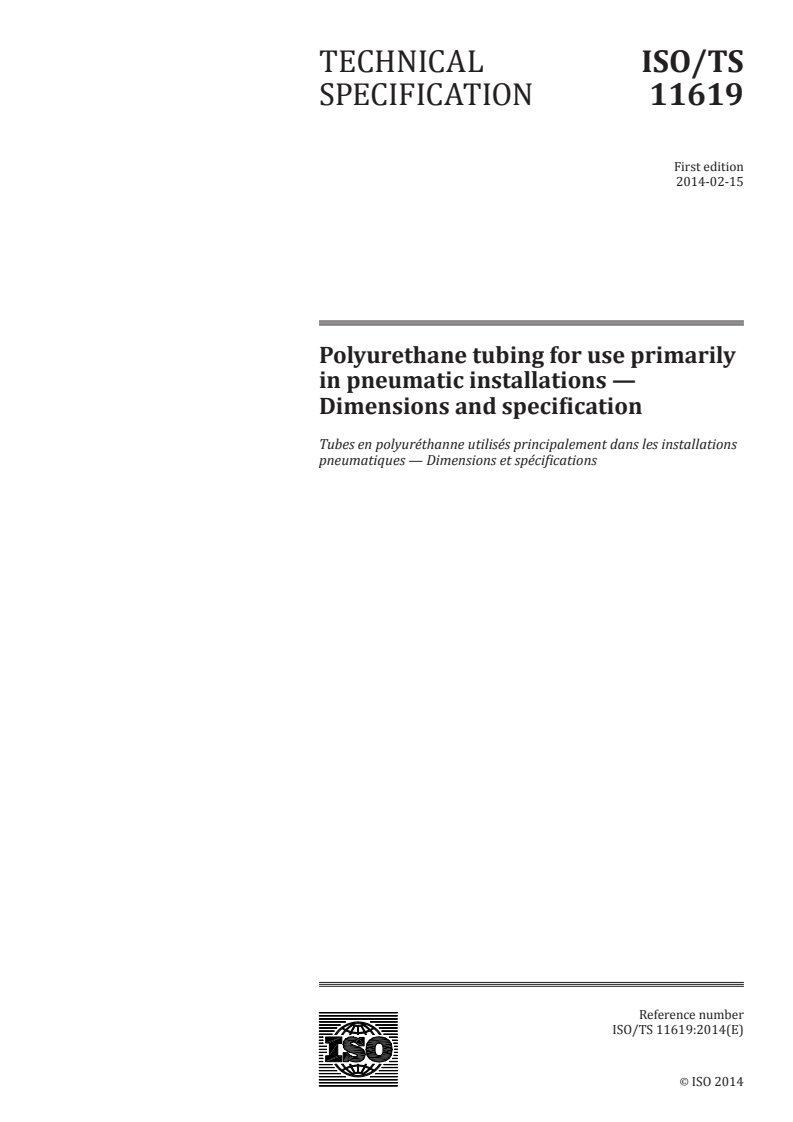
TECHNICAL ISO/TS
SPECIFICATION 11619
First edition
2014-02-15
Polyurethane tubing for use primarily
in pneumatic installations —
Dimensions and specification
Tubes en polyuréthanne utilisés principalement dans les installations
pneumatiques — Dimensions et spécifications
Reference number
©
ISO 2014
© ISO 2014
All rights reserved. Unless otherwise specified, no part of this publication may be reproduced or utilized otherwise in any form
or by any means, electronic or mechanical, including photocopying, or posting on the internet or an intranet, without prior
written permission. Permission can be requested from either ISO at the address below or ISO’s member body in the country of
the requester.
ISO copyright office
Case postale 56 • CH-1211 Geneva 20
Tel. + 41 22 749 01 11
Fax + 41 22 749 09 47
E-mail copyright@iso.org
Web www.iso.org
Published in Switzerland
ii © ISO 2014 – All rights reserved
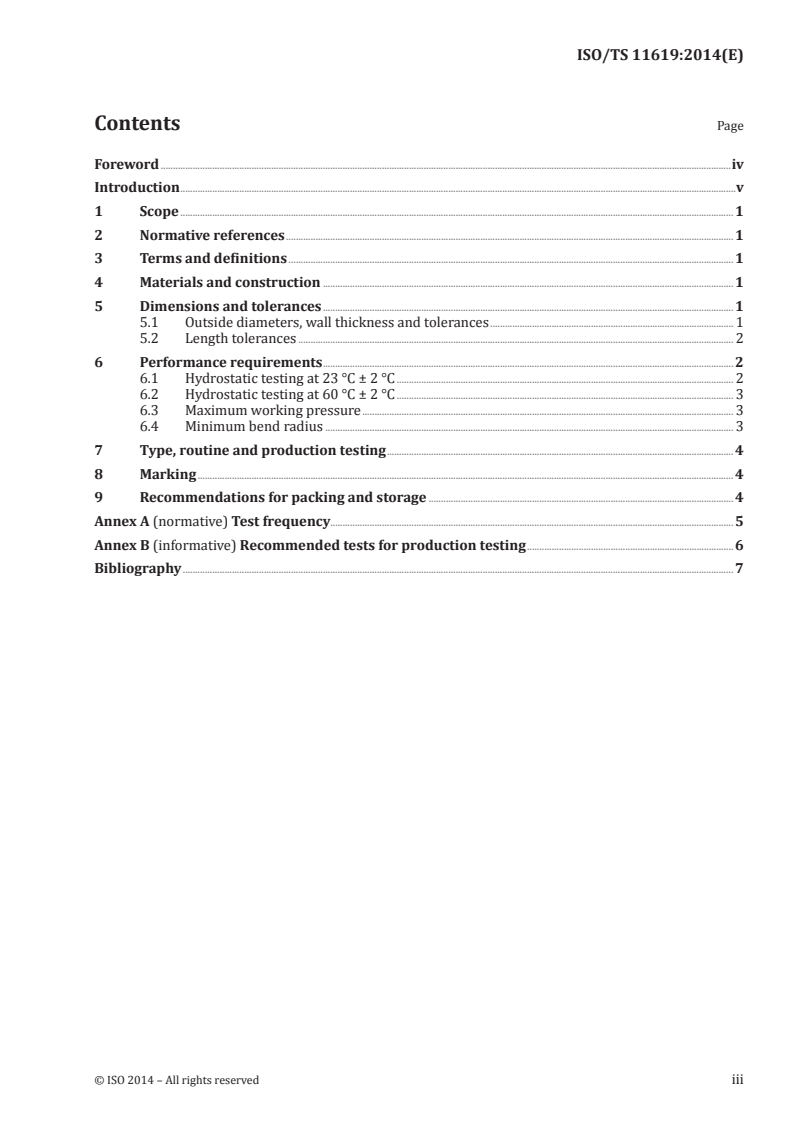
Contents Page
Foreword .iv
Introduction .v
1 Scope . 1
2 Normative references . 1
3 Terms and definitions . 1
4 Materials and construction . 1
5 Dimensions and tolerances . 1
5.1 Outside diameters, wall thickness and tolerances . 1
5.2 Length tolerances . 2
6 Performance requirements . 2
6.1 Hydrostatic testing at 23 °C ± 2 °C . 2
6.2 Hydrostatic testing at 60 °C ± 2 °C . 3
6.3 Maximum working pressure . 3
6.4 Minimum bend radius . 3
7 Type, routine and production testing . 4
8 Marking . 4
9 Recommendations for packing and storage . 4
Annex A (normative) Test frequency. 5
Annex B (informative) Recommended tests for production testing . 6
Bibliography . 7
Foreword
ISO (the International Organization for Standardization) is a worldwide federation of national standards
bodies (ISO member bodies). The work of preparing International Standards is normally carried out
through ISO technical committees. Each member body interested in a subject for which a technical
committee has been established has the right to be represented on that committee. International
organizations, governmental and non-governmental, in liaison with ISO, also take part in the work.
ISO collaborates closely with the International Electrotechnical Commission (IEC) on all matters of
electrotechnical standardization.
The procedures used to develop this document and those intended for its further maintenance are
described in the ISO/IEC Directives, Part 1. In particular the different approval criteria needed for the
different types of ISO documents should be noted. This document was drafted in accordance with the
editorial rules of the ISO/IEC Directives, Part 2 (see www.iso.org/directives).
Attention is drawn to the possibility that some of the elements of this document may be the subject of
patent rights. ISO shall not be held responsible for identifying any or all such patent rights. Details of any
patent rights identified during the development of the document will be in the Introduction and/or on
the ISO list of patent declarations received (see www.iso.org/patents).
Any trade name used in this document is information given for the convenience of users and does not
constitute an endorsement.
For an explanation on the meaning of ISO specific terms and expressions related to conformity
assessment, as well as information about ISO’s adherence to the WTO principles in the Technical Barriers
to Trade (TBT) see the following URL: Foreword - Supplementary information
The committee responsible for this document is ISO/TC 45, Rubber and rubber products, Subcommittee
SC 1, Rubber and plastics hoses and hose assemblies.
iv © ISO 2014 – All rights reserved
Introduction
This Technical Specification has been prepared to provide minimum acceptable requirements for the
satisfactory performance of thermoplastic polyurethane tubing used mainly in pneumatic applications.
The tubing conveys compressed air which controls and powers pneumatic systems.
This Technical Specification will be revised to an International Standard when ISO 14743 has been
revised and published in ISO/TC 131.
TECHNICAL SPECIFICATION ISO/TS 11619:2014(E)
Polyurethane tubing for use primarily in pneumatic
installations — Dimensions and specification
WARNING — Persons using this document should be familiar with normal laboratory practice.
This document does not purport to address all of the safety problems, if any, associated with its
use. It is the responsibility of the user to establish appropriate health and safety practices and to
ensure compliance with any national
...
TECHNICAL ISO/TS
SPECIFICATION 11619
First edition
2014-02-15
Polyurethane tubing for use primarily
in pneumatic installations —
Dimensions and specification
Tubes en polyuréthanne utilisés principalement dans les installations
pneumatiques — Dimensions et spécifications
Reference number
©
ISO 2014
© ISO 2014
All rights reserved. Unless otherwise specified, no part of this publication may be reproduced or utilized otherwise in any form
or by any means, electronic or mechanical, including photocopying, or posting on the internet or an intranet, without prior
written permission. Permission can be requested from either ISO at the address below or ISO’s member body in the country of
the requester.
ISO copyright office
Case postale 56 • CH-1211 Geneva 20
Tel. + 41 22 749 01 11
Fax + 41 22 749 09 47
E-mail copyright@iso.org
Web www.iso.org
Published in Switzerland
ii © ISO 2014 – All rights reserved
Contents Page
Foreword .iv
Introduction .v
1 Scope . 1
2 Normative references . 1
3 Terms and definitions . 1
4 Materials and construction . 1
5 Dimensions and tolerances . 1
5.1 Outside diameters, wall thickness and tolerances . 1
5.2 Length tolerances . 2
6 Performance requirements . 2
6.1 Hydrostatic testing at 23 °C ± 2 °C . 2
6.2 Hydrostatic testing at 60 °C ± 2 °C . 3
6.3 Maximum working pressure . 3
6.4 Minimum bend radius . 3
7 Type, routine and production testing . 4
8 Marking . 4
9 Recommendations for packing and storage . 4
Annex A (normative) Test frequency. 5
Annex B (informative) Recommended tests for production testing . 6
Bibliography . 7
Foreword
ISO (the International Organization for Standardization) is a worldwide federation of national standards
bodies (ISO member bodies). The work of preparing International Standards is normally carried out
through ISO technical committees. Each member body interested in a subject for which a technical
committee has been established has the right to be represented on that committee. International
organizations, governmental and non-governmental, in liaison with ISO, also take part in the work.
ISO collaborates closely with the International Electrotechnical Commission (IEC) on all matters of
electrotechnical standardization.
The procedures used to develop this document and those intended for its further maintenance are
described in the ISO/IEC Directives, Part 1. In particular the different approval criteria needed for the
different types of ISO documents should be noted. This document was drafted in accordance with the
editorial rules of the ISO/IEC Directives, Part 2 (see www.iso.org/directives).
Attention is drawn to the possibility that some of the elements of this document may be the subject of
patent rights. ISO shall not be held responsible for identifying any or all such patent rights. Details of any
patent rights identified during the development of the document will be in the Introduction and/or on
the ISO list of patent declarations received (see www.iso.org/patents).
Any trade name used in this document is information given for the convenience of users and does not
constitute an endorsement.
For an explanation on the meaning of ISO specific terms and expressions related to conformity
assessment, as well as information about ISO’s adherence to the WTO principles in the Technical Barriers
to Trade (TBT) see the following URL: Foreword - Supplementary information
The committee responsible for this document is ISO/TC 45, Rubber and rubber products, Subcommittee
SC 1, Rubber and plastics hoses and hose assemblies.
iv © ISO 2014 – All rights reserved
Introduction
This Technical Specification has been prepared to provide minimum acceptable requirements for the
satisfactory performance of thermoplastic polyurethane tubing used mainly in pneumatic applications.
The tubing conveys compressed air which controls and powers pneumatic systems.
This Technical Specification will be revised to an International Standard when ISO 14743 has been
revised and published in ISO/TC 131.
TECHNICAL SPECIFICATION ISO/TS 11619:2014(E)
Polyurethane tubing for use primarily in pneumatic
installations — Dimensions and specification
WARNING — Persons using this document should be familiar with normal laboratory practice.
This document does not purport to address all of the safety problems, if any, associated with its
use. It is the responsibility of the user to establish appropriate health and safety practices and to
ensure compliance with any national
...