


ISO/FDIS 19008
(Main)Oil and gas industries including lower carbon energy — Standard cost coding system
Oil and gas industries including lower carbon energy — Standard cost coding system
ISO 19008:2016 describes the standard cost coding system (SCCS) that classifies costs and quantities related to exploration, development, operation and removal of oil and gas production and processing facilities and to the petroleum, petrochemical and natural gas industry. Upstream, midstream, downstream and petrochemical business categories are included. The SCCS for coding of costs is applicable to: - cost estimating; - actual cost monitoring and reporting; - collection of final quantities and cost data; - standardized exchange of cost data among organizations; - implementation in cost systems. ISO 19008:2016 is intended for users such as the following: a) owner/operator/company (individual or grouped entity that is entitled or contributes to operations in the exploitation of oil and gas fields); b) industry/trade associations; c) manufacturers/contractors; d) cost engineering service contractors, cost system providers, benchmarking providers, etc.; e) authorities/regulatory bodies. ISO 19008:2016 does not apply to the following: 1) cost classification relevant to cost accounting rules, specific contractual agreements, local requirements for cost reporting to national bodies, government rules and tax regulations, authorization for expenditure (AFE), billing purposes etc.; 2) specific project breakdown structures (e.g. work breakdown structures, contract breakdown structures, organizational breakdown structure) or asset breakdowns (e.g. TAG/system codes, area/module breakdown structure) which are and will remain unique. However, this International Standard can provide a basis for the establishment of such specific classification systems.
Industries du pétrole et du gaz, y compris les énergies à faible teneur en carbone — Système de codage des coûts standard
ISO 19008:2016 décrit le système de codage des coûts standard (SCCS) qui classe les coûts et les quantités liés à la prospection, au développement, à l'exploitation et au retrait des installations de production et de traitement de pétrole et de gaz, et ceux liés à l'industrie du pétrole, de la pétrochimie et du gaz naturel. Les catégories d'activité amont, intermédiaire, aval et pétrochimique sont incluses. Le SCCS destiné au codage des coûts s'applique: - à l'estimation de coûts; - au contrôle et à la présentation des coûts réels; - à la collecte des quantités finales et des données relatives aux coûts; - à l'échange normalisé, entre les organismes, de données relatives aux coûts; - à la mise en ?uvre dans les systèmes de gestion des coûts. La présente Norme internationale est destinée, entre autres, aux utilisateurs suivants: a) propriétaires/exploitants/sociétés (individuelles ou groupes autorisés/contribuant à l'exploitation des gisements de pétrole et de gaz); b) associations professionnelles; c) fabricants/sous-traitants; d) sous-traitants de services d'ingénierie des coûts, fournisseurs de systèmes de gestion des coûts, fournisseurs d'analyse comparative, etc.; e) autorités/organismes de réglementation. ISO 19008:2016 ne couvre pas les aspects suivants: 1) la classification des coûts qui relève de règles de comptabilité analytique, des ententes contractuelles spécifiques, des exigences locales relatives à la présentation des coûts auprès des institutions nationales, des règles gouvernementales et de la règlementation fiscale, des autorisations d'engagement de dépenses (AFE), de la facturation, etc.; 2) les organigrammes spécifiques à un projet (par exemple: les organigrammes techniques des tâches, la structure de répartition des contrats, les organigrammes organisationnels) ou les répartitions d'actifs (par exemple: codes de systèmes/TAG, organigramme de secteur/module) qui sont et resteront uniques au projet. Toutefois, la présente Norme internationale peut servir de base pour l'établissement de ce type de système de classification spécifique.
General Information
- Status
- Not Published
- Technical Committee
- ISO/TC 67 - Materials, equipment and offshore structures for petroleum, petrochemical and natural gas industries
- Drafting Committee
- ISO/TC 67/WG 4 - Reliability Engineering and technology
- Current Stage
- 5020 - FDIS ballot initiated: 2 months. Proof sent to secretariat
- Start Date
- 19-Feb-2026
- Completion Date
- 19-Feb-2026
Relations
- Effective Date
- 12-Feb-2026
- Effective Date
- 15-Mar-2025
- Revises
ISO 19008:2016 - Standard cost coding system for oil and gas production and processing facilities - Effective Date
- 16-Dec-2023
Overview
ISO/FDIS 19008:2026 specifies the Standard Cost Coding System (SCCS) for the oil and gas industry, including lower carbon energy and petrochemical sectors. Developed by the International Organization for Standardization (ISO), this standard provides a unified and systematic approach to classify costs, work hours, and quantities across all life cycle phases-exploration, development, operation, and removal-of oil, gas, and related energy facilities. The SCCS supports enhanced data consistency, transparency, and exchange for stakeholders such as operators, contractors, authorities, benchmarking providers, and cost engineering specialists.
By adopting ISO 19008, organizations can improve project cost estimation, enable reliable benchmarking practices, monitor actual costs efficiently, and facilitate streamlined reporting and data sharing across organizational boundaries.
Key Topics
1. Faceted Hierarchical Classification
- The SCCS uses three main coding structures (facets) for comprehensive cost classification:
- Physical Breakdown Structure (PBS): Codes for physical or functional aspects of assets and facilities, independent of specific project configurations.
- Standard Activity Breakdown (SAB): Activity-oriented coding, using life cycle phase prefixes to distinguish project phases from exploration to abandonment.
- Code of Resource (COR): Classifies resources engaged in a project (such as labor, equipment, bulk materials, and overheads).
2. Extended Scope for Lower Carbon Energy
- Updated to include costs related to decarbonization projects and lower carbon energy, such as CCUS, hydrogen facilities, and wind energy.
- Addresses both CAPEX (Capital Expenditure) and OPEX (Operational Expenditure), reflecting sustainability and climate change considerations.
3. Flexible Expansion and Integration
- Codes can be customized for unique project or organizational needs, provided extensions are clearly documented and integrated.
- Facilitates internal and external cost breakdown structures without compromising standardization.
4. Standardized Exchange and Reporting
- SCCS facilitates the standardized exchange of cost data among owners, contractors, suppliers, regulators, and consultants.
- Enables tailored reporting levels to align with contractual and regulatory requirements.
Applications
ISO/FDIS 19008:2026 is essential for a variety of practical applications in the energy sector:
- Project Cost Estimation: Supports capital and operational cost forecasting across life cycle phases and project types.
- Cost Monitoring and Reporting: Enables ongoing tracking of actual costs compared to estimates, improving project controls and financial transparency.
- Benchmarking and Performance Analysis: Standardized codes make it possible to compare costs across projects, organizations, or regions for performance improvement and cost reduction.
- Data Exchange Between Parties: Establishes a common cost language and format, simplifying collaboration between operators, EPC contractors, regulators, and others.
- Regulatory and Compliance Reporting: Assists in structuring cost information to comply with industry standards and regulator expectations.
- Life Cycle Costing: Facilitates integration with asset management and reliability standards (such as ISO 15663 and ISO 55000) for informed decision-making throughout an asset’s life.
Related Standards
For broader implementation and integration, the following ISO standards are closely associated with ISO/FDIS 19008:
- ISO 15663: Petroleum, petrochemical, and natural gas industries – Life cycle costing
- ISO 14224: Reliability and maintenance data collection and exchange
- ISO 20815: Production assurance and reliability management
- ISO 55000: Asset management – Vocabulary, overview, and principles
- ISO Guide 84: Guidelines for addressing climate change in standards
Adoption of ISO 19008 alongside these standards ensures compatibility, enhances best practices, and supports sustainability within the evolving oil, gas, and lower carbon energy industries.
Keywords: standard cost coding system, ISO 19008, oil and gas industry, lower carbon energy, project cost estimation, cost management, CAPEX, OPEX, petrochemical, energy transition, benchmarking, asset management, data exchange, cost codes, sustainability, SCCS
Buy Documents

ISO/FDIS 19008 - Oil and gas industries including lower carbon energy — Standard cost coding system Released:5. 02. 2026
REDLINE ISO/FDIS 19008 - Oil and gas industries including lower carbon energy — Standard cost coding system Released:5. 02. 2026

ISO/FDIS 19008 - Industries du pétrole et du gaz, y compris les énergies à faible teneur en carbone — Système de codage des coûts standard
Get Certified
Connect with accredited certification bodies for this standard

ABS Quality Evaluations Inc.
American Bureau of Shipping quality certification.

Element Materials Technology
Materials testing and product certification.

ABS Group Brazil
ABS Group certification services in Brazil.
Sponsored listings
Frequently Asked Questions
ISO/FDIS 19008 is a draft published by the International Organization for Standardization (ISO). Its full title is "Oil and gas industries including lower carbon energy — Standard cost coding system". This standard covers: ISO 19008:2016 describes the standard cost coding system (SCCS) that classifies costs and quantities related to exploration, development, operation and removal of oil and gas production and processing facilities and to the petroleum, petrochemical and natural gas industry. Upstream, midstream, downstream and petrochemical business categories are included. The SCCS for coding of costs is applicable to: - cost estimating; - actual cost monitoring and reporting; - collection of final quantities and cost data; - standardized exchange of cost data among organizations; - implementation in cost systems. ISO 19008:2016 is intended for users such as the following: a) owner/operator/company (individual or grouped entity that is entitled or contributes to operations in the exploitation of oil and gas fields); b) industry/trade associations; c) manufacturers/contractors; d) cost engineering service contractors, cost system providers, benchmarking providers, etc.; e) authorities/regulatory bodies. ISO 19008:2016 does not apply to the following: 1) cost classification relevant to cost accounting rules, specific contractual agreements, local requirements for cost reporting to national bodies, government rules and tax regulations, authorization for expenditure (AFE), billing purposes etc.; 2) specific project breakdown structures (e.g. work breakdown structures, contract breakdown structures, organizational breakdown structure) or asset breakdowns (e.g. TAG/system codes, area/module breakdown structure) which are and will remain unique. However, this International Standard can provide a basis for the establishment of such specific classification systems.
ISO 19008:2016 describes the standard cost coding system (SCCS) that classifies costs and quantities related to exploration, development, operation and removal of oil and gas production and processing facilities and to the petroleum, petrochemical and natural gas industry. Upstream, midstream, downstream and petrochemical business categories are included. The SCCS for coding of costs is applicable to: - cost estimating; - actual cost monitoring and reporting; - collection of final quantities and cost data; - standardized exchange of cost data among organizations; - implementation in cost systems. ISO 19008:2016 is intended for users such as the following: a) owner/operator/company (individual or grouped entity that is entitled or contributes to operations in the exploitation of oil and gas fields); b) industry/trade associations; c) manufacturers/contractors; d) cost engineering service contractors, cost system providers, benchmarking providers, etc.; e) authorities/regulatory bodies. ISO 19008:2016 does not apply to the following: 1) cost classification relevant to cost accounting rules, specific contractual agreements, local requirements for cost reporting to national bodies, government rules and tax regulations, authorization for expenditure (AFE), billing purposes etc.; 2) specific project breakdown structures (e.g. work breakdown structures, contract breakdown structures, organizational breakdown structure) or asset breakdowns (e.g. TAG/system codes, area/module breakdown structure) which are and will remain unique. However, this International Standard can provide a basis for the establishment of such specific classification systems.
ISO/FDIS 19008 is classified under the following ICS (International Classification for Standards) categories: 75.020 - Extraction and processing of petroleum and natural gas. The ICS classification helps identify the subject area and facilitates finding related standards.
ISO/FDIS 19008 has the following relationships with other standards: It is inter standard links to FprEN ISO 19008, ISO 22733-2:2023, ISO 19008:2016. Understanding these relationships helps ensure you are using the most current and applicable version of the standard.
ISO/FDIS 19008 is available in PDF format for immediate download after purchase. The document can be added to your cart and obtained through the secure checkout process. Digital delivery ensures instant access to the complete standard document.
Standards Content (Sample)
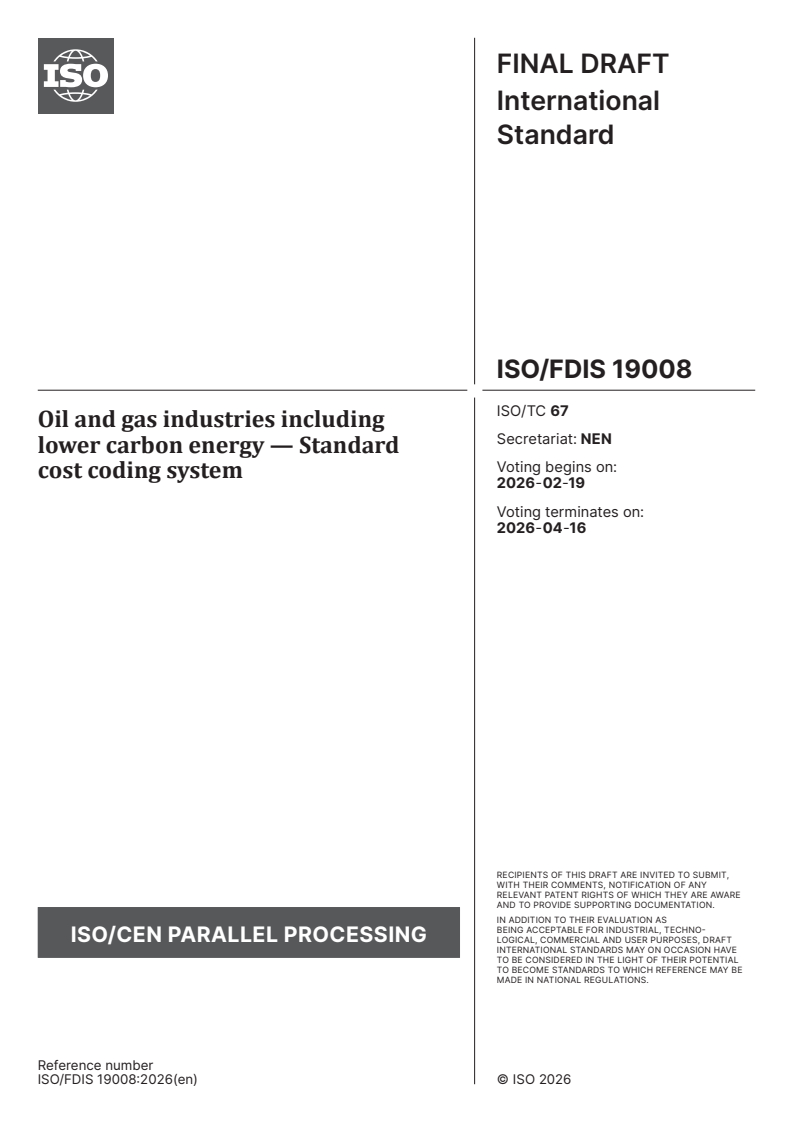
FINAL DRAFT
International
Standard
ISO/TC 67
Oil and gas industries including
Secretariat: NEN
lower carbon energy — Standard
Voting begins on:
cost coding system
2026-02-19
Voting terminates on:
2026-04-16
RECIPIENTS OF THIS DRAFT ARE INVITED TO SUBMIT,
WITH THEIR COMMENTS, NOTIFICATION OF ANY
RELEVANT PATENT RIGHTS OF WHICH THEY ARE AWARE
AND TO PROVIDE SUPPOR TING DOCUMENTATION.
IN ADDITION TO THEIR EVALUATION AS
BEING ACCEPTABLE FOR INDUSTRIAL, TECHNO
ISO/CEN PARALLEL PROCESSING LOGICAL, COMMERCIAL AND USER PURPOSES, DRAFT
INTERNATIONAL STANDARDS MAY ON OCCASION HAVE
TO BE CONSIDERED IN THE LIGHT OF THEIR POTENTIAL
TO BECOME STAN DARDS TO WHICH REFERENCE MAY BE
MADE IN NATIONAL REGULATIONS.
Reference number
FINAL DRAFT
International
Standard
ISO/TC 67
Oil and gas industries including
Secretariat: NEN
lower carbon energy — Standard
Voting begins on:
cost coding system
Voting terminates on:
RECIPIENTS OF THIS DRAFT ARE INVITED TO SUBMIT,
WITH THEIR COMMENTS, NOTIFICATION OF ANY
RELEVANT PATENT RIGHTS OF WHICH THEY ARE AWARE
AND TO PROVIDE SUPPOR TING DOCUMENTATION.
© ISO 2026
IN ADDITION TO THEIR EVALUATION AS
All rights reserved. Unless otherwise specified, or required in the context of its implementation, no part of this publication may
BEING ACCEPTABLE FOR INDUSTRIAL, TECHNO
ISO/CEN PARALLEL PROCESSING
LOGICAL, COMMERCIAL AND USER PURPOSES, DRAFT
be reproduced or utilized otherwise in any form or by any means, electronic or mechanical, including photocopying, or posting on
INTERNATIONAL STANDARDS MAY ON OCCASION HAVE
the internet or an intranet, without prior written permission. Permission can be requested from either ISO at the address below
TO BE CONSIDERED IN THE LIGHT OF THEIR POTENTIAL
or ISO’s member body in the country of the requester.
TO BECOME STAN DARDS TO WHICH REFERENCE MAY BE
MADE IN NATIONAL REGULATIONS.
ISO copyright office
CP 401 • Ch. de Blandonnet 8
CH-1214 Vernier, Geneva
Phone: +41 22 749 01 11
Email: copyright@iso.org
Website: www.iso.org
Published in Switzerland Reference number
ii
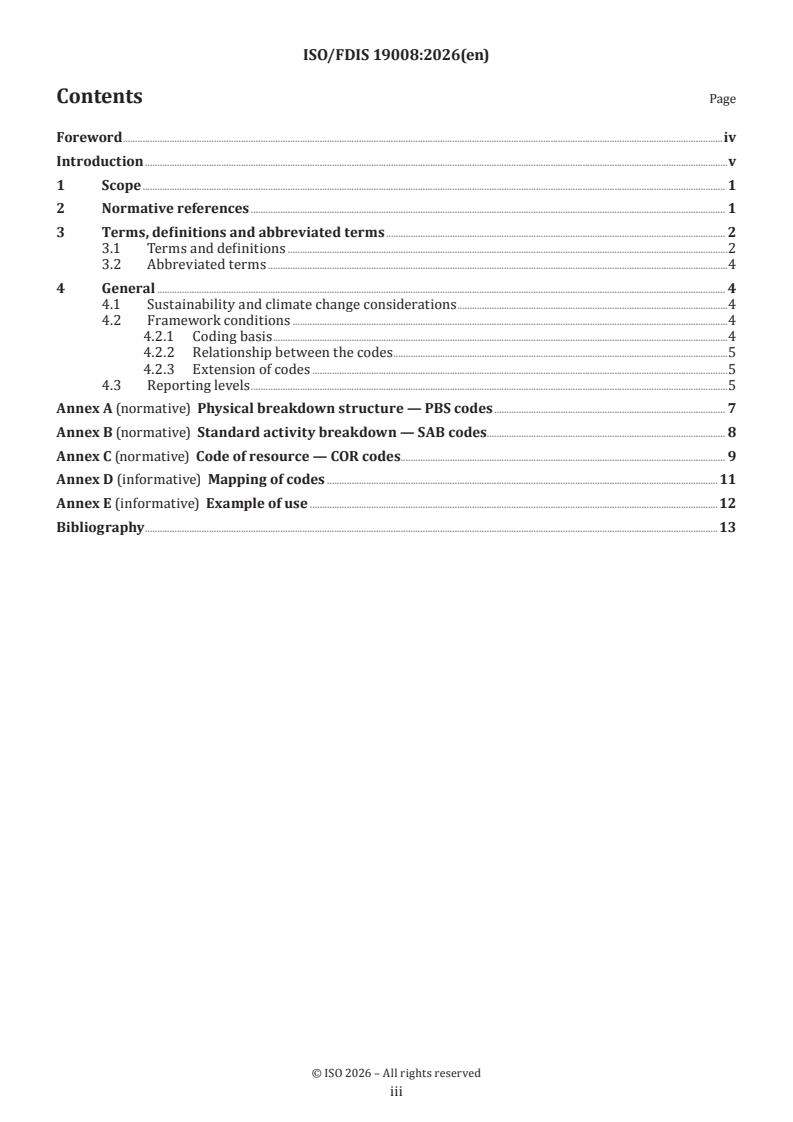
Contents Page
Foreword .iv
Introduction .v
1 Scope . 1
2 Normative references . 1
3 Terms, definitions and abbreviated terms . 2
3.1 Terms and definitions .2
3.2 Abbreviated terms .4
4 General . 4
4.1 Sustainability and climate change considerations .4
4.2 Framework conditions .4
4.2.1 Coding basis .4
4.2.2 Relationship between the codes .5
4.2.3 Extension of codes .5
4.3 Reporting levels .5
Annex A (normative) Physical breakdown structure — PBS codes . 7
Annex B (normative) Standard activity breakdown — SAB codes. 8
Annex C (normative) Code of resource — COR codes . 9
Annex D (informative) Mapping of codes .11
Annex E (informative) Example of use .12
Bibliography .13
iii
Foreword
ISO (the International Organization for Standardization) is a worldwide federation of national standards
bodies (ISO member bodies). The work of preparing International Standards is normally carried out through
ISO technical committees. Each member body interested in a subject for which a technical committee
has been established has the right to be represented on that committee. International organizations,
governmental and non-governmental, in liaison with ISO, also take part in the work. ISO collaborates closely
with the International Electrotechnical Commission (IEC) on all matters of electrotechnical standardization.
The procedures used to develop this document and those intended for its further maintenance are described
in the ISO/IEC Directives, Part 1. In particular, the different approval criteria needed for the different types
of ISO documents should be noted. This document was drafted in accordance with the editorial rules of the
ISO/IEC Directives, Part 2 (see www.iso.org/directives).
ISO draws attention to the possibility that the implementation of this document may involve the use of (a)
patent(s). ISO takes no position concerning the evidence, validity or applicability of any claimed patent
rights in respect thereof. As of the date of publication of this document, ISO had not received notice of (a)
patent(s) which may be required to implement this document. However, implementers are cautioned that
this may not represent the latest information, which may be obtained from the patent database available at
www.iso.org/patents. ISO shall not be held responsible for identifying any or all such patent rights.
Any trade name used in this document is information given for the convenience of users and does not
constitute an endorsement.
For an explanation of the voluntary nature of standards, the meaning of ISO specific terms and expressions
related to conformity assessment, as well as information about ISO's adherence to the World Trade
Organization (WTO) principles in the Technical Barriers to Trade (TBT), see www.iso.org/iso/foreword.html.
This document was prepared by the Technical Committee ISO/TC 67, Oil and gas industries including
lower carbon energy, in collaboration with the European Committee for Standardization (CEN) Technical
Committee CEN/TC 12, Oil and gas industries including lower carbon energy, in accordance with the Agreement
on technical cooperation between ISO and CEN (Vienna Agreement).
This second edition cancels and replaces the first edition (ISO 19008:2016), which has been technically
revised.
The main changes are as follows:
— Clause 1: previous Clause 1 extended to also cover lower carbon energy;
— Clause 2: new clause added with normative references;
— Clause 3: previous Clause 2, clause extended with new terms, definitions and abbreviated terms;
— Clause 4: new subclause 4.1 added, addressing sustainability and climate change considerations;
— Annex A: new PBS codes added to cover lower carbon energy;
— Annex B: new SAB codes added to cover lower carbon energy and OPEX;
— Annex C: new COR codes added to cover lower carbon energy and OPEX;
— Annex D and Annex E: text revised to become two separate annexes.
Any feedback or questions on this document should be directed to the user’s national standards body. A
complete listing of these bodies can be found at www.iso.org/members.html.
iv
Introduction
The oil and gas industries including petrochemical and lower carbon energy activities involve large capital
expenditure (CAPEX) as well as operating expenditure (OPEX).
The purpose of the standard cost coding system (SCCS) is to enable collecting, organizing and reporting
the costs of project development and operations, allowing for the analysis and comparison across projects
and assets. The SCCS can also be utilized to capture additional data like physical quantities, contextual
information or cost classification information. This facilitates the development and benchmarking of unit
costs and cost metrics.
The SCCS is composed of three complementary and disjoint sub-classifications, known as facets:
a) physical assets, coded by the physical breakdown structure (PBS);
b) activities, coded by the standard activity breakdown structure (SAB);
c) resources, coded by the code of resource structure (COR).
This document contains the principles and usage of the SCCS. It also includes implementation requirements
for the expansion of the coding system by individual organizations.
The annexes include:
— Annexes A, B and C specify the SCCS codes, their names and descriptions;
— Annex D specifies typical relationships between the SCCS facets;
— Annex E provides examples of use of the codes.
Application of this document can also be useful when performing production assurance, reliability
management, and life cycle costing; see ISO 20815, ISO 14224 and ISO 15663.
v
FINAL DRAFT International Standard ISO/FDIS 19008:2026(en)
Oil and gas industries including lower carbon energy —
Standard cost coding system
1 Scope
This document specifies the standard cost coding system (SCCS) that classifies costs, work hours and
quantities for the assets and operations associated with the oil and gas industries including lower carbon
energy activities. This document covers all life cycle phases of the assets and operations.
The SCCS is applicable to:
— cost estimation;
— benchmarking;
— cost monitoring and reporting;
— collection of quantities, work hours and cost data;
— exchange of cost data among organizations;
— implementation in cost systems.
This document also provides a basis for the establishment of:
— cost classification relevant to cost accounting rules, specific contractual agreements, local requirements
for cost reporting to national bodies, government rules and tax regulations, authorization for expenditure,
billing purposes, etc.;
— unique project breakdown structures (e.g. work breakdown structures, contract breakdown structures
and organizational breakdown structures) or asset breakdown structures (e.g. tag or system codes and
area or module breakdown structures).
This document is intended for the following users:
— operators or owners;
— contractors;
— vendors, manufacturers or suppliers;
— authorities or regulatory bodies;
— benchmarking companies;
— consultants.
2 Normative references
The following document is referred to in the text in such a way that some or all their content constitutes
requirements of this document. For dated references, only the edition cited applies. For undated references,
the latest edition of the referenced document (including any amendments) applies.
ISO 15663:2021, Petroleum, petrochemical and natural gas industries — Life cycle costing
3 Terms, definitions and abbreviated terms
3.1 Terms and definitions
For the purposes of this document, the following terms and definitions apply.
ISO and IEC maintain terminology databases for use in standardization at the following addresses:
— ISO Online browsing platform: available at https:// www .iso .org/ obp
— IEC Electropedia: available at https:// www .electropedia .org
3.1.1
asset
item, thing or entity that has potential or actual value to an organization
Note 1 to entry: Physical assets usually refer to equipment, inventory and properties owned by the organization.
Physical assets are the opposite of intangible assets, which are non-physical assets such as leases, brands, digital
assets, licenses, intellectual property rights, reputation or agreements.
Note 2 to entry: A grouping of assets referred to as an asset system can also be considered as an asset.
[SOURCE: ISO 55000:2024, 3.1.1, modified — Note 1 to entry has been expanded.]
3.1.2
capital expenditure
CAPEX
investment used to purchase, install and commission an asset (3.1.1)
Note 1 to entry: See further information regarding estimation of CAPEX in ISO 15663:2021, Clause C.2.
[SOURCE: ISO 15663:2021, 3.1.7]
3.1.3
code of resource
COR
hierarchical structure of the standard cost coding system (3.1.15) that classifies all project resources
according to the type of contract or resource that is involved in the activity and has an associated set of rates
Note 1 to entry: COR codes can be found at https:// standards .iso .org/ iso/ 19008/ ed -2/ en.
3.1.4
cost breakdown structure
structure related to the methods that an organization employs to record and report costs
3.1.5
cost data
cost information associated with a defined cost element (3.1.6)
Note 1 to entry: Cost data can be qualitative or quantitative cost information.
3.1.6
cost element
subset at any level of the total cost for a cost breakdown structure (3.1.4)
Note 1 to entry: The cost of an object or item, resource, activity or a combination of those.
Note 2 to entry: For cost elements coded accordi
...
ISO/TC 67/WG 4
ISO/TC 67
Secretariat: NEN
Date: 2026-01-0902-04
Oil and gas industries including lower carbon energy — Standard
cost coding system
FDIS stage
This draft is submitted to a parallel vote in ISO, CEN.
All rights reserved. Unless otherwise specified, or required in the context of its implementation, no part of this publication
may be reproduced or utilized otherwise in any form or by any means, electronic or mechanical, including photocopying,
or posting on the internet or an intranet, without prior written permission. Permission can be requested from either ISO
at the address below or ISO’s member body in the country of the requester.
ISO copyright office
CP 401 • Ch. de Blandonnet 8
CH-1214 Vernier, Geneva
Phone: + 41 22 749 01 11
EmailE-mail: copyright@iso.org
Website: www.iso.org
Published in Switzerland
ii
Contents Page
Foreword . iv
Introduction . vi
1 Scope . 1
2 Normative references . 1
3 Terms, definitions and abbreviated terms . 2
3.1 Terms and definitions . 2
3.2 Abbreviated terms . 4
4 General . 4
4.1 Sustainability and climate change considerations . 4
4.2 Framework conditions . 4
4.3 Reporting levels . 6
Annex A (normative) Physical breakdown structure — PBS codes . 9
Annex B (normative) Standard activity breakdown — SAB codes . 11
Annex C (normative) Code of resource — COR codes . 12
Annex D (informative) Mapping of codes . 15
Annex E (informative) Example of use . 16
Bibliography . 17
iii
Foreword
ISO (the International Organization for Standardization) is a worldwide federation of national standards
bodies (ISO member bodies). The work of preparing International Standards is normally carried out through
ISO technical committees. Each member body interested in a subject for which a technical committee has been
established has the right to be represented on that committee. International organizations, governmental and
non-governmental, in liaison with ISO, also take part in the work. ISO collaborates closely with the
International Electrotechnical Commission (IEC) on all matters of electrotechnical standardization.
The procedures used to develop this document and those intended for its further maintenance are described
in the ISO/IEC Directives, Part 1. In particular, the different approval criteria needed for the different types of
ISO documents should be noted. This document was drafted in accordance with the editorial rules of the
ISO/IEC Directives, Part 2 (see www.iso.org/directives).
ISO draws attention to the possibility that the implementation of this document may involve the use of (a)
patent(s). ISO takes no position concerning the evidence, validity or applicability of any claimed patent rights
in respect thereof. As of the date of publication of this document, ISO had not received notice of (a) patent(s)
which may be required to implement this document. However, implementers are cautioned that this may not
represent the latest information, which may be obtained from the patent database available at
www.iso.org/patents. ISO shall not be held responsible for identifying any or all such patent rights.
Any trade name used in this document is information given for the convenience of users and does not
constitute an endorsement.
For an explanation of the voluntary nature of standards, the meaning of ISO specific terms and expressions
related to conformity assessment, as well as information about ISO's adherence to the World Trade
Organization (WTO) principles in the Technical Barriers to Trade (TBT), see www.iso.org/iso/foreword.html.
This document was prepared by the Technical Committee ISO/TC 67, Oil and gas industries including lower
carbon energy., in collaboration with the European Committee for Standardization (CEN) Technical Committee
CEN/TC 12, Oil and gas industries including lower carbon energy, in accordance with the Agreement on
technical cooperation between ISO and CEN (Vienna Agreement).
This second edition cancels and replaces the first edition (ISO 19008:2016), which has been technically
revised.
The main changes are as follows:
— Clause 1— Clause 1:: previous Clause 1Clause 1 extended to also cover lower carbon energy;
— Clause 2— Clause 2:: new clause added with normative references;
— Clause 3— Clause 3:: previous Clause 2Clause 2,, clause extended with new terms, definitions and
abbreviated terms;
— Clause 4— Clause 4:: new subclause 4.1subclause 4.2 added, addressing sustainability and climate change
considerations;
— Annex A— Annex A:: new PBS codes added to cover lower carbon energy;
— Annex B— Annex B:: new SAB codes added to cover lower carbon energy and OPEX;
— Annex C— Annex C:: new COR codes added to cover lower carbon energy and OPEX;
— Annex D— Annex D and Annex EAnnex E:: text revised to become two separate annexes.
iv
Any feedback or questions on this document should be directed to the user’s national standards body. A
complete listing of these bodies can be found at www.iso.org/members.html.
v
Introduction
The oil and gas industries including petrochemical and lower carbon energy activities involve large capital
expenditure (CAPEX) as well as operating expenditure (OPEX).
The purpose of the standard cost coding system (SCCS) is to enable collecting, organizing and reporting the
costs of project development and operations, allowing for the analysis and comparison across projects and
assets. The SCCS can also be utilized to capture additional data like physical quantities, contextual information
or cost classification information. This facilitates the development and benchmarking of unit costs and cost
metrics.
The SCCS is composed of three complementary and disjoint sub-classifications, known as facets:
a) a) physical assets, coded by the physical breakdown structure (PBS);
b) b) activities, coded by the standard activity breakdown structure (SAB);
c) c) resources, coded by the code of resource structure (COR).
This document contains the principles and usage of the SCCS. It also includes implementation requirements
for the expansion of the coding system by individual organizations.
The annexes include:
— Annexes A— annex A, B, B and CC specify the SCCS codes, their names and descriptions;
— Annex D— annex D specifies typical relationships between the SCCS facets;
— Annex E— annex E provides examples of use of the codes.
Application of this document can also be useful when performing production assurance, reliability
management, and life cycle costing; see ISO 20815, ISO 14224 and ISO 15663.
vi
Oil and gas industries including lower carbon energy — Standard cost
coding system
1 Scope
This document specifies the standard cost coding system (SCCS) that classifies costs, work hours and
quantities for the assets and operations associated with the oil and gas industries including lower carbon
energy activities. This document covers all life cycle phases of the assets and operations.
The SCCS is applicable to:
— — cost estimation;
— — benchmarking;
— — cost monitoring and reporting;
— — collection of quantities, work hours and cost data;
— — exchange of cost data among organizations;
— — implementation in cost systems.
This document also provides a basis for the establishment of:
— — cost classification relevant to cost accounting rules, specific contractual agreements, local
requirements for cost reporting to national bodies, government rules and tax regulations, authorization
for expenditure, billing purposes, etc.;
— — unique project breakdown structures (e.g. work breakdown structures, contract breakdown
structures and organizational breakdown structures) or asset breakdown structures (e.g. tag or system
codes and area or module breakdown structures).
This document is intended for the following users:
— — operators or owners;
— — contractors;
— — vendors, manufacturers or suppliers;
— — authorities or regulatory bodies;
— — benchmarking companies;
— — consultants.
2 Normative references
The following document is referred to in the text in such a way that some or all their content constitutes
requirements of this document. For dated references, only the edition cited applies. For undated references,
the latest edition of the referenced document (including any amendments) applies.
ISO 15663:2021, Petroleum, petrochemical and natural gas industries — Life cycle costing
3 Terms, definitions and abbreviated terms
3.1 Terms and definitions
For the purposes of this document, the following terms and definitions apply.
ISO and IEC maintain terminology databases for use in standardization at the following addresses:
— — ISO Online browsing platform: available at https://www.iso.org/obp
— — IEC Electropedia: available at https://www.electropedia.org
3.1.1 3.1.1
asset
item, thing or entity that has potential or actual value to an organization
Note 1 to entry: Physical assets usually refer to equipment, inventory and properties owned by the organization. Physical
assets are the opposite of intangible assets, which are non-physical assets such as leases, brands, digital assets, licenses,
intellectual property rights, reputation or agreements.
Note 2 to entry: A grouping of assets referred to as an asset system can also be considered as an asset.
[SOURCE: ISO 55000:2024, 3.1.1, modified — Note 1 to entry has been expanded.]
3.1.2 3.1.2capital
capital expenditure
CAPEX
investment used to purchase, install and commission an asset (3.1.1(3.1.1))
Note 1 to entry: See further information regarding estimation of CAPEX in ISO 15663:2021, Clause C.2.
[SOURCE: ISO 15663:2021, 3.1.7]
3.1.23.1.3 3.1.3
code of resource
COR
hierarchical structure of the standard cost coding system (3.1.15(3.1.15)) that classifies all project resources
according to the type of contract or resource that is involved in the activity and has an associated set of rates
Note 1 to entry: COR codes can be found at https://standards.iso.org/iso/19008/ed-2/en.
3.1.33.1.4 3.1.4
cost breakdown structure
structure related to the methods that an organization employs to record and report costs
.
3.1.43.1.5 3.1.5
cost data
cost information associated with a defined cost element (3.1.6(3.1.6))
Note 1 to entry: Cost data can be qualitative or quantitative cost information.
3.1.53.1.6 3.1.6
cost element
subset at any level of the total cost for a cost breakdown structure (3.1.4(3.1.4))
Note 1 to entry: The cost of an object or item, resource, activity or a combination of those.
Note 2 to entry: For cost elements coded according to the standard cost coding system, the term cost item (3.1.7(3.1.7))
is used.
[SOURCE: ISO 15663:2021, 3.1.14, modified — Note 2 to entry has been modified.]
3.1.63.1.7 3.1.7
cost item
particular part or level that is coded using the standard cost coding system (3.1.15(3.1.15))
3.1.73.1.8 3.1.8
cost time resource
CTR
document that specifies each major element in the work breakdown structure, including a statement of work
describing the work content, resources required, the time frame of the work element and a cost estimate
3.1.83.1.9 3.1.9
faceted classification system
collection of facet classifications that allows the classification of an object
EXAMPLE This document specifies a faceted classification system for objects used in cost estimation for oil and gas
production and processing facilities including lower carbon solutions.
3.1.93.1.10 3.1.10
life cycle phase
discrete stage in the life cycle with a specified purpose
Note 1 to entry: The different life cycle phases are further described in ISO 15663:2021, 4.5.
[SOURCE: ISO 15663:2021, 3.1.28]
3.1.103.1.11 3.1.11
operating expenditure
OPEX
expenses used for operation and maintenance, including associated costs such as logistics and spares
Note 1 to entry: See further information regarding estimation of OPEX in ISO 15663:2021, Clause C.3.
[SOURCE: ISO 15663:2021, 3.1.31]
3.1.113.1.12 3.1.12
physical breakdown structure
PBS
hierarchical structure of the standard cost coding system (3.1.15(3.1.15)) tha
...
PROJET FINAL
Norme
internationale
ISO/TC 67
Industries du pétrole et du gaz, y
Secrétariat: NEN
compris les énergies à faible teneur
Début de vote:
en carbone — Système de codage
2026-02-19
des coûts standard
Vote clos le:
2026-04-16
Oil and gas industries including lower carbon energy — Standard
cost coding system
LES DESTINATAIRES DU PRÉSENT PROJET SONT
INVITÉS À PRÉSENTER, AVEC LEURS OBSERVATIONS,
NOTIFICATION DES DROITS DE PROPRIÉTÉ DONT ILS
AURAIENT ÉVENTUELLEMENT CONNAISSANCE ET À
FOURNIR UNE DOCUMENTATION EXPLICATIVE.
OUTRE LE FAIT D’ÊTRE EXAMINÉS POUR
ÉTABLIR S’ILS SONT ACCEPTABLES À DES FINS
INDUSTRIELLES, TECHNOLOGIQUES ET COM-MERCIALES,
AINSI QUE DU POINT DE VUE DES UTILISATEURS, LES
PROJETS DE NORMES
TRAITEMENT PARALLÈLE ISO/CEN
INTERNATIONALES DOIVENT PARFOIS ÊTRE CONSIDÉRÉS
DU POINT DE VUE DE LEUR POSSI BILITÉ DE DEVENIR DES
NORMES POUVANT
SERVIR DE RÉFÉRENCE DANS LA RÉGLEMENTATION
NATIONALE.
Numéro de référence
PROJET FINAL
Norme
internationale
ISO/TC 67
Industries du pétrole et du gaz, y
Secrétariat: NEN
compris les énergies à faible teneur
Début de vote:
en carbone — Système de codage
2026-02-19
des coûts standard
Vote clos le:
2026-04-16
Oil and gas industries including lower carbon energy — Standard
cost coding system
LES DESTINATAIRES DU PRÉSENT PROJET SONT
INVITÉS À PRÉSENTER, AVEC LEURS OBSERVATIONS,
NOTIFICATION DES DROITS DE PROPRIÉTÉ DONT ILS
AURAIENT ÉVENTUELLEMENT CONNAISSANCE ET À
FOURNIR UNE DOCUMENTATION EXPLICATIVE.
DOCUMENT PROTÉGÉ PAR COPYRIGHT
OUTRE LE FAIT D’ÊTRE EXAMINÉS POUR
ÉTABLIR S’ILS SONT ACCEPTABLES À DES FINS
© ISO 2026 INDUSTRIELLES, TECHNOLOGIQUES ET COM-MERCIALES,
AINSI QUE DU POINT DE VUE DES UTILISATEURS, LES
Tous droits réservés. Sauf prescription différente ou nécessité dans le contexte de sa mise en œuvre, aucune partie de cette
PROJETS DE NORMES
TRAITEMENT PARALLÈLE ISO/CEN
INTERNATIONALES DOIVENT PARFOIS ÊTRE CONSIDÉRÉS
publication ne peut être reproduite ni utilisée sous quelque forme que ce soit et par aucun procédé, électronique ou mécanique,
DU POINT DE VUE DE LEUR POSSI BILITÉ DE DEVENIR DES
y compris la photocopie, ou la diffusion sur l’internet ou sur un intranet, sans autorisation écrite préalable. Une autorisation peut
NORMES POUVANT
être demandée à l’ISO à l’adresse ci-après ou au comité membre de l’ISO dans le pays du demandeur.
SERVIR DE RÉFÉRENCE DANS LA RÉGLEMENTATION
NATIONALE.
ISO copyright office
Case postale 401 • Ch. de Blandonnet 8
CH-1214 Vernier, Genève
Tél.: +41 22 749 01 11
E-mail: copyright@iso.org
Web: www.iso.org
Publié en Suisse Numéro de référence
ii
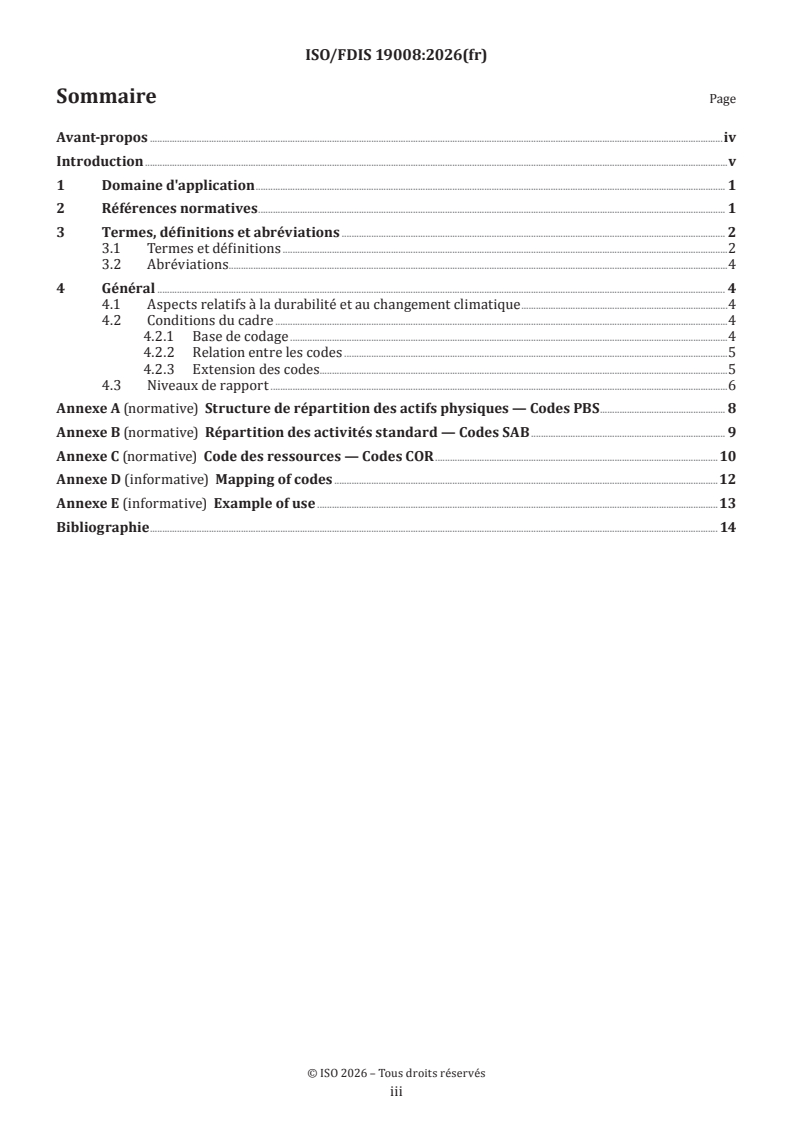
Sommaire Page
Avant-propos .iv
Introduction .v
1 Domaine d'application . 1
2 Références normatives . 1
3 Termes, définitions et abréviations . 2
3.1 Termes et définitions .2
3.2 Abréviations.4
4 Général . 4
4.1 Aspects relatifs à la durabilité et au changement climatique .4
4.2 Conditions du cadre .4
4.2.1 Base de codage .4
4.2.2 Relation entre les codes .5
4.2.3 Extension des codes.5
4.3 Niveaux de rapport .6
Annexe A (normative) Structure de répartition des actifs physiques — Codes PBS . 8
Annexe B (normative) Répartition des activités standard — Codes SAB . 9
Annexe C (normative) Code des ressources — Codes COR . 10
Annexe D (informative) Mapping of codes .12
Annexe E (informative) Example of use .13
Bibliographie . 14
iii
Avant-propos
L'ISO (Organisation internationale de normalisation) est une fédération mondiale d'organismes nationaux
de normalisation (comités membres de l'ISO). L'élaboration des Normes internationales est en général
confiée aux comités techniques de l'ISO. Chaque comité membre intéressé par une étude a le droit de faire
partie du comité technique créé à cet effet. Les organisations internationales, gouvernementales et non
gouvernementales, en liaison avec l'ISO participent également aux travaux. L'ISO collabore étroitement avec
la Commission électrotechnique internationale (IEC) en ce qui concerne la normalisation électrotechnique.
Les procédures utilisées pour élaborer le présent document et celles destinées à sa mise à jour sont
décrites dans les Directives ISO/IEC, Partie 1. Il convient, en particulier, de prendre note des différents
critères d'approbation requis pour les différents types de documents ISO. Le présent document
a été rédigé conformément aux règles de rédaction données dans les Directives ISO/IEC, Partie 2
(voir www.iso.org/directives).
L'ISO attire l'attention sur le fait que la mise en application du présent document peut entraîner l'utilisation
d'un ou de plusieurs brevets. L'ISO ne prend pas position quant à la preuve, à la validité et à l'applicabilité de
tout droit de propriété revendiqué à cet égard. À la date de publication du présent document, l'ISO n'avait pas
reçu notification qu'un ou plusieurs brevets pouvaient être nécessaires à sa mise en application. Toutefois,
il y a lieu d'avertir les responsables de la mise en application du présent document que des informations
plus récentes sont susceptibles de figurer dans la base de données de brevets, disponible à l'adresse
www.iso.org/brevets. L'ISO ne saurait être tenue pour responsable de ne pas avoir identifié tout ou partie de
tels droits de brevet.
Les appellations commerciales éventuellement mentionnées dans le présent document sont données pour
information, par souci de commodité, à l'intention des utilisateurs et ne sauraient constituer un engagement.
Pour une explication de la nature volontaire des normes, la signification des termes et expressions
spécifiques de l'ISO liés à l'évaluation de la conformité, ou pour toute information au sujet de l'adhésion de
l'ISO aux principes de l'Organisation mondiale du commerce (OMC) concernant les obstacles techniques au
commerce (OTC), voir www.iso.org/avant-propos.
Le présent document a été élaboré par le comité technique ISO/TC 67, Industries du pétrole et du gaz, y compris
les énergies à faible teneur en carbone, en collaboration avec le comité technique CEN/TC 12, Industries du
pétrole et du gaz, y compris les énergies à faible teneur en carbone du Comité européen de normalisation
(CEN), conformément à l'Accord de coopération technique entre l'ISO et le CEN (Accord de Vienne).
Cette deuxième édition annule et remplace la première édition (ISO 19008:2016), qui a fait l'objet d'une
révision technique.
Les principales modifications sont les suivantes:
— Article 1: l'ancien Article 1 a été étendu pour couvrir également les énergies à faible teneur en carbone;
— Article 2: ajout d'un nouvel article avec des références normatives;
— Article 3: anciennement Article 2, article étendu avec de nouveaux termes, définitions et termes abrégés;
— Article 4: ajout du nouveau paragraphe 4.1, traitant des aspects relatifs à la durabilité et au changement
climatique;
— Annexe A: ajout de nouveaux codes PBS pour couvrir les énergies à faible teneur en carbone;
— Annexe B: ajout de nouveaux codes SAB pour couvrir les énergies à faible teneur en carbone et les OPEX;
— Annexe C: ajout de nouveaux codes COR pour couvrir les énergies à faible teneur en carbone et les OPEX;
— Annexe D et Annexe E: texte révisé pour devenir deux annexes distinctes.
Il convient que l'utilisateur adresse tout retour d'information ou toute question concernant le présent
document à l'organisme national de normalisation de son pays. Une liste exhaustive desdits organismes se
trouve à l'adresse www.iso.org/fr/members.html.
iv
Introduction
Les industries pétrolières et gazières, y compris les activités pétrochimiques et les activités liées à l'énergie
à faible teneur en carbone, impliquent d'importantes dépenses d'investissement (CAPEX) et de charges
d'exploitation (OPEX).
L'objectif du système de codage des coûts standard (SCCS) est de permettre la collecte, l'organisation et
la communication des coûts de développement et d'exploitation des projets, afin de faciliter l'analyse et
la comparaison entre les projets et les actifs. Le SCCS peut également être utilisé pour saisir des données
supplémentaires telles que des quantités physiques, des informations contextuelles ou des informations
relatives à la classification des coûts. Cela facilite le développement et l'étalonnage des coûts unitaires et des
mesures de coûts.
Le SCCS est composé de trois sous-classifications complémentaires et disjointes, appelées «facettes»:
a) les actifs physiques, codés par la structure de répartition des actifs physiques (PBS);
b) les activités, codées par la structure de répartition des activités standard (SAB);
c) les ressources, codées par la structure du code des ressources (COR).
Ce document contient les principes et l'utilisation du SCCS. Il comprend également des exigences de mise en
œuvre pour l'extension du système de codage par les organisations individuelles.
Les annexes comprennent:
— Les Annexes A, B et C spécifient les codes SCCS, leurs noms et leurs descriptions;
— L'Annexe D spécifie les relations types entre les facettes SCCS;
— L'Annexe E fournit des exemples d'utilisation des codes.
L'application du présent document peut également être utile pour l'assurance de la production, la gestion de
la fiabilité et le calcul du coût du cycle de vie; voir l'ISO 20815, l'ISO 14224 et l'ISO 15663.
v
PROJET FINAL Norme internationale ISO/FDIS 19008:2026(fr)
Industries du pétrole et du gaz, y compris les énergies à faible
teneur en carbone — Système de codage des coûts standard
1 Domaine d'application
Le présent document spécifie le système de codage des coûts standard (SCCS) qui classifie les coûts, les
heures de travail et les quantités pour les actifs et les opérations associés aux industries pétrolières et
gazières, y compris les activités énergétiques à faible teneur en carbone. Ce document couvre toutes les
phases du cycle de vie des actifs et des opérations.
Le SCCS s'applique à:
— l'estimation des coûts;
— l'étalonnage des coûts;
— le suivi des coûts et l'établissement de rapports;
— la collecte des quantités, des heures de travail et des données relatives aux coûts;
— l'échange de données relatives aux coûts entre les organisations;
— la mise en œuvre dans les systèmes de coûts.
Le présent document fournit également une base pour l'établissement des éléments suivants:
— la classification des coûts en fonction des règles de comptabilité analytique, des accords contractuels
spécifiques, des exigences locales en matière de déclaration des coûts aux organismes nationaux, des
règles gouvernementales et des réglementations fiscales, des autorisations de dépenses, des objectifs de
facturation, etc.;
— des structures de décomposition des projets uniques (par exemple, des structures de décomposition
des travaux, des structures de décomposition des contrats et des structures de décomposition
organisationnelle) ou des structures de décomposition des actifs (par exemple, des codes d'étiquettes ou
de système et des structures de décomposition par zone ou module).
Le présent document est destiné aux utilisateurs suivants:
— les opérateurs ou propriétaires;
— les maîtres d'œuvre;
— les fournisseurs, les fabricants;
— les autorités ou les organismes règlementaires;
— les entreprises de benchmarking;
— les consultants.
2 Références normatives
Le document suivant est cité dans le texte de sorte qu'il constitue, pour tout ou partie de son contenu, des
exigences du présent document. Pour les références datées, seule l'édition citée s'applique. Pour les références
non datées, la dernière édition du document de référence s'applique (y compris les éventuels amendements).
ISO 15663:2021, Industries du pétrole et du gaz naturel — Estimation des coûts globaux de production et de
traitement
3 Termes, définitions et abréviations
3.1 Termes et définitions
Pour les besoins du présent document, les termes et définitions suivants s'appliquent.
L'ISO et l'IEC tiennent à jour des bases de données terminologiques destinées à être utilisées en normalisation,
consultables aux adresses suivantes:
— ISO Online browsing platform: disponible à l'adresse https:// www .iso .org/ obp
— IEC Electropedia: disponible à l'adresse https:// www .electropedia .org/
3.1.1
actif
item, chose ou entité qui a une valeur potentielle ou réelle pour un organisme
Note 1 à l'article: Les actifs corporels renvoient généralement à des équipements, stocks et propriétés détenus par
l'organisation. Les actifs corporels sont le contraire des actifs incorporels, qui désignent des actifs non corporels tels
que des baux, des marques, des actifs numériques, des licences, des droits de propriété intellectuelle, la réputation ou
des accords.
Note 2 à l'article: Un groupement d'actifs désigné par système d'actifs peut également être considéré comme un actif.
[SOURCE: ISO 55000:2024, 3.1.1, modifié — La Note 1 à l'article a été développée.]
3.1.2
dépenses d'investissement
CAPEX
investissement utilisé pour acheter, installer et mettre en service un actif (3.1.1)
Note 1 à l'article: Pour plus d'informations concernant l'estimation des CAPEX, voir l'ISO 15663:2021, paragraphe C.2.
[SOURCE: ISO 15663:2021, 3.1.7]
3.1.3
code des ressources
COR
structure hiérarchique du système de codage des coûts standard (3.1.15) qui classe l'ensemble des ressources
du projet en fonction du type de contrat ou de ressource impliqué(e) dans l'activité et qui dispose d'un
ensemble de tarifs associés
Note 1 à l'article: Les codes COR peuvent être consultés à l'adresse https:// standards .iso .org/ iso/ 19008/ ed -2/ en.
3.1.4
structure de ventilation des coûts
structure liée aux méthodes employées par une organisation pour enregistrer et comptabiliser des coûts
3.1.5
données relatives aux coûts
informations sur les coûts associés à une composante de coût (3.1.6)
Note 1 à l'article: Les données relatives aux coûts peuvent être des informations qualitatives ou quantitatives sur les
coûts.
3.1.6
composante de coût
sous-ensemble à un quelconque niveau du coût total dans une structure de ventilation des coûts (3.1.4)
Note 1 à l'article: Le coût d'un objet ou d'une entité, d'une ressource, d'une activité ou d'une combinaison de ces
éléments.
Note 2 à l'article: Pour les composantes de coût codées conformément au système de codage des c
...
Questions, Comments and Discussion
Ask us and Technical Secretary will try to provide an answer. You can facilitate discussion about the standard in here.
Loading comments...