

ISO/TS 3250:2021
(Main)Petroleum, petrochemical and natural gas industries — Calculation and reporting production efficiency in the operating phase
General Information
- Abstract
This document provides requirements and guidance for reporting of production performance data and production loss data in the operating phase by use of production loss categorization. It supplements the principles of ISO 20815:2018, Clause E.3 and Annex G by providing additional details. This document focusses on installations and asset elements within the upstream business category. Business categories and associated installations and plants/units, systems and equipment classes are used in line with ISO 14224:2016, Annex A. The production loss categories given in Annex A are given at a high taxonomic level and supplements the reporting of failure and maintenance parameters as defined in ISO 14224:2016, Annex B.
- Status
- Published
- Publication Date
- 30-Aug-2021
- Technical Committee
- ISO/TC 67 - Materials, equipment and offshore structures for petroleum, petrochemical and natural gas industries
- Drafting Committee
- ISO/TC 67/WG 4 - Reliability Engineering and technology
- Current Stage
- 9093 - International Standard confirmed
- Start Date
- 27-Jun-2025
- Completion Date
- 29-Aug-2026
Buy Documents

ISO/TS 3250:2021 - Petroleum, petrochemical and natural gas industries — Calculation and reporting production efficiency in the operating phase Released:8/31/2021

ISO/TS 3250:2021 - Petroleum, petrochemical and natural gas industries — Calculation and reporting production efficiency in the operating phase/31/2021
Overview
ISO/TS 3250:2021 provides requirements and guidance for calculating and reporting production efficiency (PE) and production loss during the operating phase in the petroleum, petrochemical and natural gas industries. Focused on the upstream business category, this Technical Specification supplements ISO 20815:2018 and aligns taxonomy and equipment classes with ISO 14224:2016. It standardizes how operators quantify actual produced volumes versus reference production potential and how production losses are categorized for consistent performance reporting and benchmarking.
Key Topics
- Production efficiency (PE): Guidance on forecasting, measurement, calculation and reporting of historic and forecasted PE.
- Production potential: Methods for determining reference production potential (structural maximum and achieved potential) and rules for adjusting potential for constraints.
- Production loss categorization: Harmonized taxonomy for planned/unplanned events, turnarounds, modifications, pre‑production, flaring/venting, injection and accounting-period considerations (Annex A normative).
- PE calculation methodology: Boundary conditions, reporting periods, and formulae for PE and injection efficiency (methodology described; formulae referenced).
- Material balance and product flows: Treatment of exports, injection, disposal (flaring/venting), fuel and imports for consistent production accounting.
- Data quality and exchange: Framework conditions covering quality assurance, HSE, sustainability/climate considerations and guidelines for PE data exchange between operators.
- Supporting annexes: Taxonomy classification, loss subdivisions by system/equipment class, sample calculations and informative examples.
Applications
ISO/TS 3250:2021 is practical for organizations and roles that need consistent, auditable production performance information:
- Upstream operators and asset managers tracking historic availability and forecasting production performance.
- Reliability, maintenance and performance engineers implementing loss categorization and linking to ISO 14224 failure/maintenance data.
- Commercial and production planners using standardized PE metrics for revenue impact, export/transport constraints and market planning.
- Benchmarking and partner reporting across joint ventures where consistent PE definitions enable comparable operator reporting.
- Regulatory, HSE and sustainability teams requiring uniform treatment of flaring, venting and disposal in production accounting.
Related Standards
- ISO 20815:2018 - Production assurance and reliability management (principles supplemented by ISO/TS 3250).
- ISO 14224:2016 - Collection and exchange of reliability and maintenance data (taxonomy and equipment classes referenced).
ISO/TS 3250:2021 helps deliver consistent, transparent production performance reporting-enabling better operational decisions, financial accuracy and cross‑operator benchmarking in the oil, gas and petrochemical upstream sector.
Buy Documents
ISO/TS 3250:2021 - Petroleum, petrochemical and natural gas industries — Calculation and reporting production efficiency in the operating phase Released:8/31/2021
ISO/TS 3250:2021 - Petroleum, petrochemical and natural gas industries — Calculation and reporting production efficiency in the operating phase/31/2021
Get Certified
Connect with accredited certification bodies for this standard

Element Materials Technology
Materials testing and product certification.

ABS Group Brazil
ABS Group certification services in Brazil.

ABS Quality Evaluations Inc.
American Bureau of Shipping quality certification.
Sponsored listings
Frequently Asked Questions
ISO/TS 3250:2021 is a technical specification published by the International Organization for Standardization (ISO). Its full title is "Petroleum, petrochemical and natural gas industries — Calculation and reporting production efficiency in the operating phase". This standard covers: This document provides requirements and guidance for reporting of production performance data and production loss data in the operating phase by use of production loss categorization. It supplements the principles of ISO 20815:2018, Clause E.3 and Annex G by providing additional details. This document focusses on installations and asset elements within the upstream business category. Business categories and associated installations and plants/units, systems and equipment classes are used in line with ISO 14224:2016, Annex A. The production loss categories given in Annex A are given at a high taxonomic level and supplements the reporting of failure and maintenance parameters as defined in ISO 14224:2016, Annex B.
This document provides requirements and guidance for reporting of production performance data and production loss data in the operating phase by use of production loss categorization. It supplements the principles of ISO 20815:2018, Clause E.3 and Annex G by providing additional details. This document focusses on installations and asset elements within the upstream business category. Business categories and associated installations and plants/units, systems and equipment classes are used in line with ISO 14224:2016, Annex A. The production loss categories given in Annex A are given at a high taxonomic level and supplements the reporting of failure and maintenance parameters as defined in ISO 14224:2016, Annex B.
ISO/TS 3250:2021 is classified under the following ICS (International Classification for Standards) categories: 75.020 - Extraction and processing of petroleum and natural gas. The ICS classification helps identify the subject area and facilitates finding related standards.
ISO/TS 3250:2021 is available in PDF format for immediate download after purchase. The document can be added to your cart and obtained through the secure checkout process. Digital delivery ensures instant access to the complete standard document.
Standards Content (Sample)
TECHNICAL ISO/TS
SPECIFICATION 3250
First edition
2021-08
Petroleum, petrochemical and natural
gas industries — Calculation and
reporting production efficiency in the
operating phase
Industries du pétrole, de la pétrochimie et du gaz naturel — Calcul et
rapport d’efficacité de la production dans la phase d’exploitation
Reference number
©
ISO 2021
© ISO 2021
All rights reserved. Unless otherwise specified, or required in the context of its implementation, no part of this publication may
be reproduced or utilized otherwise in any form or by any means, electronic or mechanical, including photocopying, or posting
on the internet or an intranet, without prior written permission. Permission can be requested from either ISO at the address
below or ISO’s member body in the country of the requester.
ISO copyright office
CP 401 • Ch. de Blandonnet 8
CH-1214 Vernier, Geneva
Phone: +41 22 749 01 11
Email: copyright@iso.org
Website: www.iso.org
Published in Switzerland
ii © ISO 2021 – All rights reserved
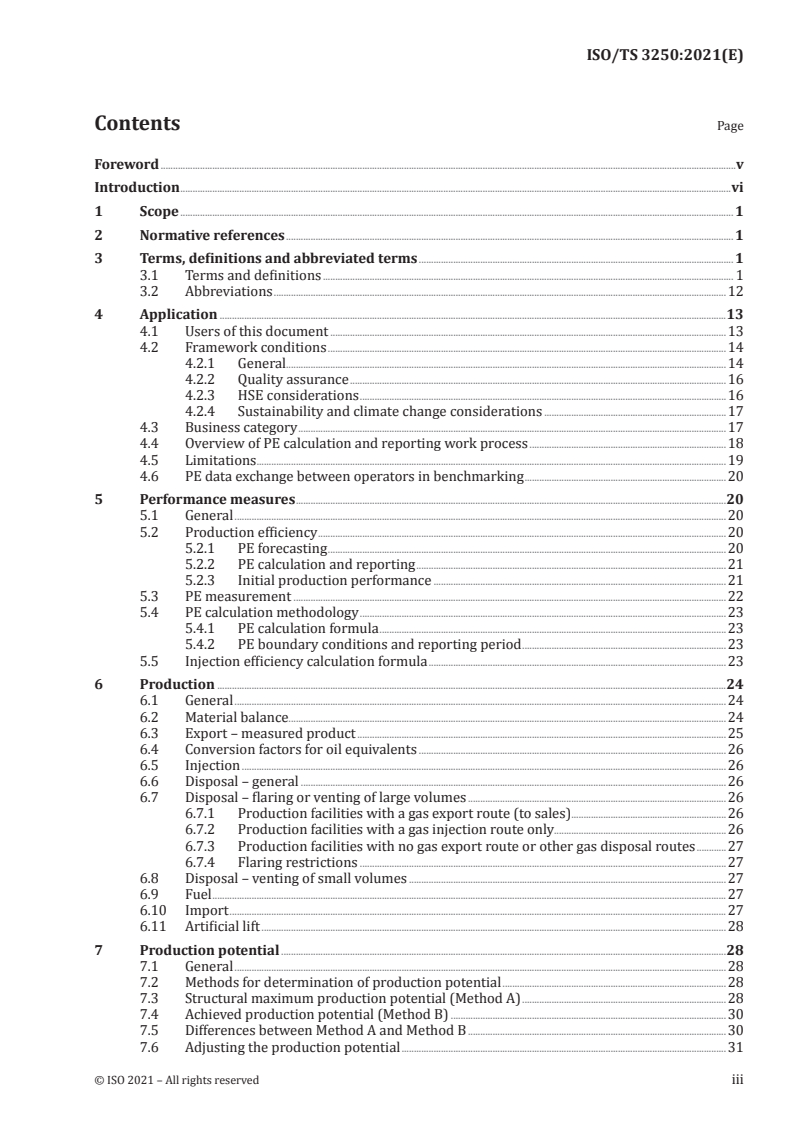
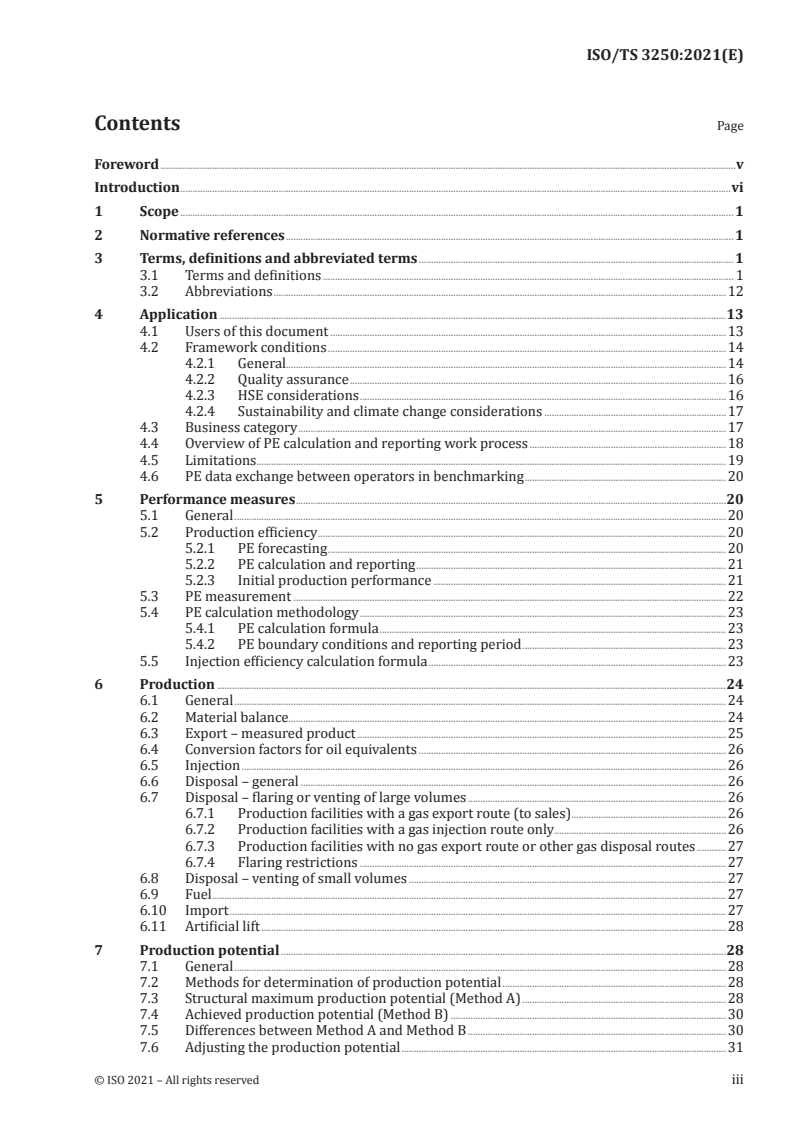
Contents Page
Foreword .v
Introduction .vi
1 Scope . 1
2 Normative references . 1
3 Terms, definitions and abbreviated terms . 1
3.1 Terms and definitions . 1
3.2 Abbreviations .12
4 Application .13
4.1 Users of this document .13
4.2 Framework conditions .14
4.2.1 General.14
4.2.2 Quality assurance .16
4.2.3 HSE considerations .16
4.2.4 Sustainability and climate change considerations .17
4.3 Business category .17
4.4 Overview of PE calculation and reporting work process .18
4.5 Limitations .19
4.6 PE data exchange between operators in benchmarking .20
5 Performance measures .20
5.1 General .20
5.2 Production efficiency .20
5.2.1 PE forecasting .20
5.2.2 PE calculation and reporting .21
5.2.3 Initial production performance .21
5.3 PE measurement .22
5.4 PE calculation methodology .23
5.4.1 PE calculation formula .23
5.4.2 PE boundary conditions and reporting period .23
5.5 Injection efficiency calculation formula .23
6 Production .24
6.1 General .24
6.2 Material balance.24
6.3 Export – measured product .25
6.4 Conversion factors for oil equivalents .26
6.5 Injection .26
6.6 Disposal – general .26
6.7 Disposal – flaring or venting of large volumes .26
6.7.1 Production facilities with a gas export route (to sales) .26
6.7.2 Production facilities with a gas injection route only.26
6.7.3 Production facilities with no gas export route or other gas disposal routes .27
6.7.4 Flaring restrictions .27
6.8 Disposal – venting of small volumes .27
6.9 Fuel .27
6.10 Import .27
6.11 Artificial lift .28
7 Production potential .28
7.1 General .28
7.2 Methods for determination of production potential .28
7.3 Structural maximum production potential (Method A) .28
7.4 Achieved production potential (Method B) .30
7.5 Differences between Method A and Method B .30
7.6 Adjusting the production potential .31
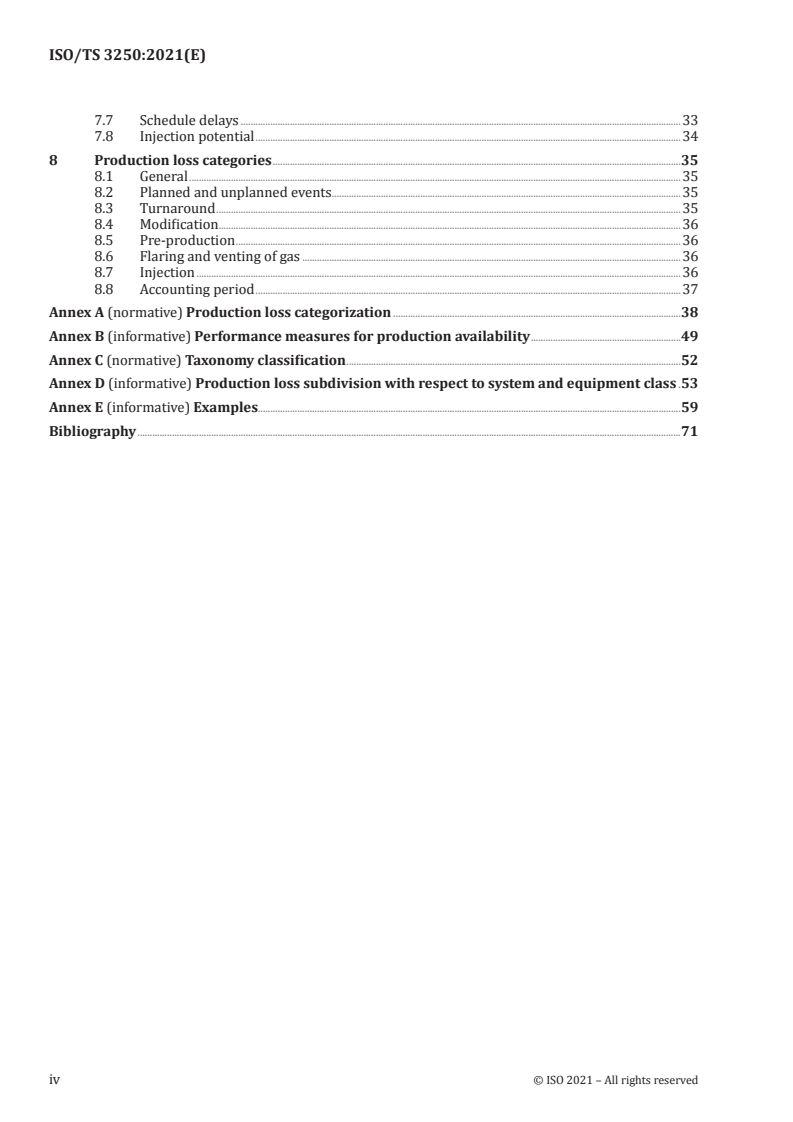
7.7 Schedule delays .33
7.8 Injection potential .34
8 Production loss categories .35
8.1 General .35
8.2 Planned and unplanned events .35
8.3 Turnaround .35
8.4 Modification.36
8.5 Pre-production .36
8.6 Flaring and venting of gas .36
8.7 Injection .36
8.8 Accounting period .37
Annex A (normative) Production loss categorization .38
Annex B (informative) Performance measures for production availability .49
Annex C (normative) Taxonomy classification .52
Annex D (informative) Production loss subdivision with respect to system and equipment class .53
Annex E (informative) Examples.59
Bibliography .71
iv © ISO 2021 – All rights reserved
Foreword
ISO (the International Organization for Standardization) is a worldwide federation of national standards
bodies (ISO member bodies). The work of preparing International Standards is normally carried out
through ISO technical committees. Each member body interested in a subject for which a technical
committee has been established has the right to be represented on that committee. International
organizations, governmental and non-governmental, in liaison with ISO, also take part in the work.
ISO collaborates closely with the International Electrotechnical Commission (IEC) on all matters of
electrotechnical standardization.
The procedures used to develop this document and those intended for its further maintenance are
described in the ISO/IEC Directives, Part 1. In particular, the different approval criteria needed for the
different types of ISO documents should be noted. This document was drafted in accordance with the
editorial rules of the ISO/IEC Directives, Part 2 (see www .iso .org/ directives).
Attention is drawn to the possibility that some of the elements of this document may be the subject of
patent rights. ISO shall not be held responsible for identifying any or all such patent rights. Details of
any patent rights identified during the development of the document will be in the Introduction and/or
on the ISO list of patent declarations received (see www .iso .org/ patents).
Any trade name used in this document is information given for the convenience of users and does not
constitute an endorsement.
For an explanation of the voluntary nature of standards, the meaning of ISO specific terms and
expressions related to conformity assessment, as well as information about ISO's adherence to the
World Trade Organization (WTO) principles in the Technical Barriers to Trade (TBT), see www .iso .org/
iso/ foreword .html.
This document was prepared by Technical Committee ISO/TC 67, Materials, equipment and offshore
structures for petroleum, petrochemical and natural gas industries.
Any feedback or questions on this document should be directed to the user’s national standards body. A
complete listing of these bodies can be found at www .iso .org/ members .html.
Introduction
The petroleum, petrochemical and natural gas industries involve large capital expenditure as well
as operating expenditure. Revenue loss caused by production loss will affect the profitability of such
industry and for a specific plant operatorship.
Production efficiency (PE) is a term often used by operators for historic production availability in the
operating phase. PE is a reported measure, and it can be compared with the predicted (or targeted)
production availability made during a project development stage. Furthermore, PE is forecasted and
tracked during the operating phase to allow tracking of performance. ISO 20815:2018 addresses
production assurance activities including analytical methods for predicting production availability,
and also includes a production loss categorization.
This document supports this production loss categorization with a harmonized approach for calculating
and reporting production loss and production efficiency in the operating phase, including forecasting
during this life cycle phase. This will enable precise and consistent feedback of production performance
for use in production and operational planning to achieve optimal PE for the operators and associated
industry stakeholders. Focus is given to actual produced volume and reference production volume, e.g.
production potential that will depend on reservoir and well constraints, plant/process constraints,
export/transportation constraints and market constraints. Standardization of PE reporting across
the industry will drive consistency and provide better quality PE information and communication for
operators and partners.
vi © ISO 2021 – All rights reserved
TECHNICAL SPECIFICATION ISO/TS 3250:2021(E)
Petroleum, petrochemical and natural gas industries —
Calculation and reporting production efficiency in the
operating phase
1 Scope
This document provides requirements and guidance for reporting of production performance data and
production loss data in the operating phase by use of production loss categorization. It supplements the
principles of ISO 20815:2018, Clause E.3 and Annex G by providing additional details.
This document focusses on installations and asset elements within the upstream business category.
Business categories and associated installations and plants/units, systems and equipment classes are
used in line with ISO 14224:2016, Annex A.
The production loss categories given in Annex A are given at a high taxonomic level and supplements
the reporting of failure and maintenance parameters as defined in ISO 14224:2016, Annex B.
2 Normative references
The following documents are referred to in the text in such a way that some or all of their content
constitutes requirements of this document. For dated references, only the edition cited applies. For
undated references, the latest edition of the referenced document (including any amendments) applies.
ISO 14224:2016, Petroleum, petrochemical and natural gas industries — Collection and exchange of
reliability and maintenance data for equipment
ISO 20815:2018, Petroleum, petrochemical and natural gas industries — Production assurance and
reliability management
3 Terms, definitions and abbreviated terms
For the purposes of this document, the following terms and definitions apply.
ISO and IEC maintain terminological databases for use in standardization at the following addresses:
— ISO Online browsing platform: available at https:// www .iso .org/ obp
— IEC Electropedia: available at http:// www .electropedia .org/
3.1 Terms and definitions
3.1.1
achieved production potential
production potential (3.1.43) that in retrospect can be verified as the maximum achievable production
in a given time period
Note 1 to entry: Achieved production potential is the sum of the achieved production and the estimated
production loss (3.1.40) occurring in the four production potential elements: well production potential (3.1.58),
plant production capacity (3.1.34), export capacity (3.1.12) and market potential (3.1.26).
Note 2 to entry: Achieved production potential can vary over time.
3.1.2
asset
item (3.1.21), thing or entity that has potential or actual value to an organization
Note 1 to entry: Physical assets usually refer to equipment, inventory and properties owned by the organization.
Physical assets are the opposite of intangible assets, which are non-physical assets such as leases, brands, digital
assets, licenses, intellectual property rights, reputation or agreements.
Note 2 to entry: A grouping of assets referred to as an asset system (see ISO 55000:2014, 3.2.5) could also be
considered as an asset.
Note 3 to entry: In this document, 'asset' only refers to the physical assets, which are tangible assets. An
organization can also operate assets that are wholly owned or partly owned through joint ventures or other
arrangements. Typically, an asset is a facility or an installation, or a group of facilities. The facility corresponds
to an installation category in ISO 14224:2016, Table A.1. These installations can be subdivided into plant/units,
systems (3.1.50), equipment classes (3.1.11), subunits, components, etc. as described in ISO 14224:2016, Table 2. In
this document, asset element (3.1.3) is used to group these as shown in Table A.2.
[SOURCE: ISO 55000:2014, 3.2.1, modified — Notes 2 and 3 to entry have become Notes 1 and 2 to entry,
respectively, new Note 3 to entry has been added.]
3.1.3
asset element
underlying item (3.1.21) for the asset (3.1.2) that is needed for the asset to deliver its product
Note 1 to entry: In this document, which is applicable for upstream business category, the asset elements are
wells (including reservoir), subsea installations, production facilities (including process and utilities), and export
and import facilities as shown in Table A.2. For other business categories, the asset elements will be different.
Note 2 to entry: The underlying items of the individual asset element will be systems (3.1.50) and relevant
equipment classes (3.1.11) as defined in ISO 14224:2016, and as shown in Table D.1.
3.1.4
availability
ability to be in a state to perform as required
Note 1 to entry: Various availability terms are defined in ISO 14224:2016, ISO 20815:2018 and ISO/TR 12489:2013.
[SOURCE: IEC 60050-192:2015, 192-01-23, modified — Note 1 to entry has been modified, Note 2 to
entry has been deleted.]
3.1.5
conventional resources
oil and gas resources where the reservoir rock characteristics and fluid trapping mechanisms permit
reservoir fluids to readily flow into the wellbore
Note 1 to entry: This usually includes conventional, reasonably permeable and connected, sandstone and
carbonate reservoirs.
3.1.6
corrective maintenance
maintenance (3.1.24) carried out after fault detection to effect restoration
[SOURCE: IEC 60050-192:2015, 192-06-06, modified — Note 1 to entry has been deleted.]
3.1.7
deliverability
ratio of deliveries to planned deliveries over a specified period of time, when the effect of compensating
elements, such as substitution from other producers and downstream buffer storage, is included
Note 1 to entry: See Figure B.1 for further information.
[SOURCE: ISO 20815:2018, 3.1.8]
2 © ISO 2021 – All rights reserved
3.1.8
down time
time interval during which an item (3.1.21) is in a down state
Note 1 to entry: The down time includes all the delays between the item failure and the restoration of its service.
Down time can be either planned or unplanned (see ISO 14224:2016, Table 4).
Note 2 to entry: Down time can be equipment down time (see Figure 4 and Table 4 in ISO 14224:2016) or
production down time (see Figures I.1 and I.2 in ISO 20815:2018). Down time for other operations such as drilling
is not addressed in this document but can affect production or prolong the production down time. It is important
to distinguish between the equipment down time itself and the down time of the plant to which the equipment
belongs; this document focusses on down time of the latter.
[SOURCE: IEC 60050-192:2015, 192-02-21, modified — New Notes 1 and 2 to entry have been added,
figure has been deleted.]
3.1.9
downstream
business category most commonly used in the petroleum industry to describe post-production
processes
Note 1 to entry: See ISO 14224:2016, A.1.4 for further details.
Note 2 to entry: The term ‘downstream’ is sometimes used in this document to reflect installations to which
products from installations within upstream business category are transported whereas these installations do
not necessarily belong to the downstream business category.
[SOURCE: ISO 14224:2016, 3.17, modified — Note 2 to entry has been added.]
3.1.10
enhanced oil recovery
EOR
reservoir process involving the injection of materials not normally present in the reservoir to enhance
the overall oil recovery from such reservoir
Note 1 to entry: Also denoted tertiary oil recovery processes; includes chemical, thermal and gas miscible
processes, among others.
3.1.11
equipment class
class of similar type of equipment units (e.g. all pumps)
Note 1 to entry: See ISO 14224:2016, Annex A for equipment specific data.
[SOURCE: ISO 14224:2016, 3.18]
3.1.12
export capacity
maximum volume rate that can be exported
Note 1 to entry: The export capacity can be limited by oil or gas or any other product (e.g. produced water and
CO ). Both the capacity of the export systems (e.g. pipeline) and the downstream receiving facilities needs to be
considered.
Note 2 to entry: The export capacity is a volume rate applicable for the product exported. Restrictions in the
flowrate to storage caused by limitations in the capacity of export pumps, pipeline capacity, etc., will affect export
capacity. Limited storage volume resulting in reduced or no production due to insufficient offtake capacity (e.g.
shuttle tanker delay) is an event and will not affect the export capacity but it is a production loss (3.1.40).
Note 3 to entry: The plant export capacity can vary over time.
3.1.13
failure
loss of ability to perform as required
Note 1 to entry: A failure of an item (3.1.21) is an event that results in a fault (i.e. a state) of that item. This is
illustrated in the figure in ISO 20815:2018, 3.1.50 for a binary system S comprising two redundant components
A and B.
[SOURCE: IEC 60050-192:2015, 192-03-01, modified — Note 1 to entry has been modified, Notes 2 and
3 to entry have been deleted.]
3.1.14
failure data
data characterizing the occurrence of a failure event
Note 1 to entry: See also ISO 14224:2016, Table 6.
[SOURCE: ISO 14224:2016, 3.25]
3.1.15
failure impact
effect of a failure (3.1.13) on an equipment’s function(s) or on the plant
Note 1 to entry: On the equipment level, failure impact can be classified in three classes (critical, degraded,
incipient); see definitions of ‘critical failure’ (ISO 14224:2016, 3.9), ‘degraded failure’ (ISO 14224:2016, 3.11)
and ‘incipient failure’ (ISO 14224:2016, 3.40). Classification of failure impact on taxonomy levels 3 to 5 (see
ISO 14224:2016, Figure 3) is shown in ISO 14224:2016, Table 3.
Note 2 to entry: Classification of failure impact on taxonomy levels 4 and 5 (see ISO 14224:2016, Figure 3) is
shown in ISO 14224:2016, Table 3. See also ISO 14224:2016, C.1.10.
[SOURCE: ISO 14224:2016, 3.28]
3.1.16
human error
discrepancy between the human action taken or omitted and that intended
Note 1 to entry: See further information in ISO 14224:2016, 3.36.
[SOURCE: IEC 60050-192:2015, 192-03-14, modified — "or required" has been deleted from the
definition, example has been deleted, Note 1 to entry has been added.]
3.1.17
improved oil recovery
IOR
process used to improve the overall oil recovery from a reservoir, including but not limited to enhanced
oil recovery (3.1.10)
Note 1 to entry: IOR includes not only reservoir recovery processes (secondary and tertiary), but also other
techniques such as infill drilling and artificial lift.
Note 2 to entry: Secondary recovery processes refer to processes involving the injection of gas and/or water,
mostly for maintaining reservoir pressure.
3.1.18
injection efficiency
IE
I
E
ratio of injected volume to the injection potential (3.1.19) over a specified period of time
Note 1 to entry: This is a volume-based performance measure similar to production efficiency (3.1.39).
Note 2 to entry: Injection availability is a time-based measure.
4 © ISO 2021 – All rights reserved
3.1.19
injection potential
V
IP
maximum volume that can be injected in a reservoir within a given time period, considering the
capacity of injection systems and injection wells
Note 1 to entry: Injection potential can be related to injection of gas, water, CO or other products.
Note 2 to entry: The maximum volume that can be injected may be taken to mean the ‘optimum’ volume that
is injected to achieve optimal reservoir management. The optimum volume is often the one that maximizes
economic recovery from the field. This optimum volume can be less than the maximum volume defined by the
physical system capacity of the injection system, wells or reservoir.
3.1.20
integrity
ability of a barrier to function as required when needed
Note 1 to entry: See ISO/TR 12489:2013, 3.1.2 for definition of safety integrity.
Note 2 to entry: There are different definitions of integrity: plant, asset (3.1.2), system (3.1.50), pipeline (see
DNVGL -ST -F101: 2017), well (see ISO 16530-1:2017, 3.73), mechanical, safety (see ISO/TR 12489:2013, 3.1.2),
structural (see ISO 19900:2019, 3.50) and technical.
[SOURCE: ISO 20815:2018, 3.1.22]
3.1.21
item
subject being considered
Note 1 to entry: The item can be an individual part, component, device, functional unit, equipment, subsystem, or
system (3.1.50).
Note 2 to entry: The item may consist of hardware, software, people or any combination thereof.
Note 3 to entry: In this document, item can also be plant/unit and installation. See also ISO 14224:2016, Figure 3.
[SOURCE: IEC 60050-192:2015, 192-01-01, modified — Notes 3, 4 and 5 to entry have been deleted, new
Note 3 to entry has been added.]
3.1.22
life cycle phase
discrete stage in the life cycle with a specified purpose
Note 1 to entry: The different life cycle phases ‘Explore’, ‘Appraise’, ‘Select’, ‘Define’, ‘Execute’, ‘Operate’ and
‘Abandon’ are further described in ISO 15663:2021, 4.5.
Note 2 to entry: This document focusses on the life cycle phase ‘Operate’ and uses the term ‘operating phase’ in
this respect.
[SOURCE: ISO 15663:2021, 3.1.28, modified — Note 2 to entry has been added.]
3.1.23
lost revenue
total cost of lost or deferred production due to down time (3.1.8)
Note 1 to entry: See further information regarding estimation of lost revenue in ISO 15663:2021, Clause C.4, and
a more general definition of lost revenue is given in ISO 15663:2021, 3.1.29.
[SOURCE: ISO 20815:2018, 3.1.25, modified — Note 1 to entry has been added.]
3.1.24
maintenance
combination of all technical and management actions intended to retain an item (3.1.21) in, or restore it
to, a state in which it can perform as required
[SOURCE: IEC 60050-192:2015, 192-06-01, modified — Note 1 to entry has been deleted.]
3.1.25
maintenance impact
effect of the maintenance (3.1.24) on the plant or equipment’s function(s)
Note 1 to entry: On the equipment level, two classes of impact are defined: critical and non-critical. On plant level,
three classes are defined: total, partial or zero impact.
Note 2 to entry: For the calculation of PE data, it can be beneficial to separate the production loss (3.1.40) arising
from the failure event and from the maintenance impact on production, into two different production loss
categories. See further guidance in A.3.2.
[SOURCE: ISO 14224:2016, 3.52, modified — Note 2 to entry has been added.]
3.1.26
market potential
maximum volume rate that can be received by the market
Note 1 to entry: A sales contract can limit the market potential.
Note 2 to entry: The market potential can vary over time.
Note 3 to entry: The market potential reflects market constraints when determining the structural maximum
production potential (3.1.49). When determining the structural maximum injection potential (3.1.48) market
potential means the maximum volume that can be delivered by the market.
3.1.27
midstream
business category involving the processing, storage and transportation sectors of the petroleum
industry
Note 1 to entry: See ISO 14224:2016, A.1.4 for further details.
[SOURCE: ISO 14224:2016, 3.65, modified — Example has been deleted.]
3.1.28
modification
combination of all technical and administrative actions intended to change an item (3.1.21)
Note 1 to entry: Modification is not normally part of maintenance (3.1.24) but is frequently performed by
maintenance personnel. This is typically the maintenance activity ‘Modify’ as defined in ISO 14224:2016,
Table B.5.
Note 2 to entry: In this document, the use of the term modification is primarily meant to cover major modification
activities. See further details in 8.2.2 with respect to how such major modifications are reflected in PE reporting.
[SOURCE: ISO 14224:2016, 3.67, modified — Notes 2 and 3 to entry have been deleted, new Note 2 to
entry has been added.]
3.1.29
operative well
well that it is economically warrantable to operate
Note 1 to entry: The individual well potential is part of the well production potential (3.1.58) even if the well is
temporarily shut down due to equipment failure, well intervention, valve testing, reservoir monitoring, etc. See
also Table 4.
6 © ISO 2021 – All rights reserved
Note 2 to entry: Economic warrantability will be defined by the operator. Various economic subject matters will
determine this economic margin, e.g. CAPEX, OPEX and revenue factors.
3.1.30
performance objective
indicative level for the desired performance
Note 1 to entry: Objectives are expressed in qualitative or quantitative terms. Objectives are not absolute
requirements and may be modified based on cost or technical constraints. See further details in ISO 20815:2018,
Annex F.
[SOURCE: ISO 20815:2018, 3.1.41]
3.1.31
performance requirement
required minimum level for the performance of the system (3.1.50)
Note 1 to entry: Requirements are normally expressed in quantitative terms, but may also be expressed in
qualitative terms.
[SOURCE: ISO 20815:2018, 3.1.42, modified — Note 1 to entry has been modified.]
3.1.32
petrochemical
business category producing the chemicals derived from petroleum and used as feedstock for the
manufacture of a variety of plastics and other related products
Note 1 to entry: See ISO 14224:2016, A.1.4 for further details.
[SOURCE: ISO 14224:2016, 3.75, modified — Example has been deleted.]
3.1.33
planned event
event that is intentional, the start and end time is determined, and the effect of the event in terms of
consequences is predictable
Note 1 to entry: See further information in 8.2.
Note 2 to entry: See production loss categories associated with planned events in Table A.1.
3.1.34
plant production capacity
maximum processed volume through the plant that can be achieved in the absence of any failure,
interruption or any other event
Note 1 to entry: The plant production capacity is related to the product used for production efficiency calculation
(see 7.3). The plant production capacity can be limited by the capacity of systems handling other product streams,
e.g. condensate, gas or produced water, or by the capacity of utility systems.
Note 2 to entry: The plant production capacity can vary over time.
Note 3 to entry: The plant represents the systems (3.1.50) between the elements well and export as illustrated in
Figure 5.
3.1.35
preventive maintenance
maintenance (3.1.24) carried out to mitigate degradation and reduce the probability of failure (3.1.13)
Note 1 to entry: See also condition-based maintenance and planned (scheduled) maintenance.
Note 2 to entry: Preventive maintenance can be categorized as shown in ISO 14224:2016, Figure 6.
[SOURCE: IEC 60050-192:2015, 192-06-05 — Note 2 to entry has been added]
3.1.36
primary product
hydrocarbon product that is the main contributor to the production target from an asset (3.1.2)
Note 1 to entry: The primary product can be crude oil, condensate or gas. The primary product from an asset (e.g.
an individual upstream field or field infrastructure consisting of various installations) will be a result of reservoir
characteristics, field development planning and facility design as determined by the production strategy of the
field or installation in question.
Note 2 to entry: The primary product can change throughout the operating phase of the asset.
3.1.37
production assurance
activities implemented to achieve and maintain a performance that is at its optimum in terms of the
overall economy and at the same time consistent with applicable framework conditions
Note 1 to entry: Production assurance activities relate closely to the integrity management of the installations.
See definition of integrity (3.1.20).
Note 2 to entry: See further information in ISO 20815:2018 with respect to production assurance (3.1.37) for a
variety of oil and gas activities.
[SOURCE: ISO 20815:2018, 3.1.45, modified — Note 2 to entry has become Note 1 to entry, new Note 2
to entry has been added.]
3.1.38
production availability
P
A
ratio of production to planned production, or any other reference level, over a specified period of time
Note 1 to entry: This measure is used in conjunction with analysis of delimited systems without compensating
elements such as substitution from other producers and downstream buffer storage. Battery limits need to be
defined in each case.
Note 2 to entry: See ISO 20815:2018, Clause G.1 and Figure G.1 for further information.
[SOURCE: ISO 20815:2018, 3.1.46, modified — Notes 1, 3, 4 and 5 to entry have been deleted, Note 2 to
entry has become Note 1 to entry, new Note 2 to entry has been added.]
3.1.39
production efficiency
PE
P
E
ratio of production to production potential (3.1.43) over a specified period of time
Note 1 to entry: PE calculation methodology is described in 5.4.1. There are two methods for PE calculations as
described in in 7.2 to 7.4.
Note 2 to entry: PE is normally considered as a historically reported measure, but can also be expressed as a
forecast.
Note 3 to entry: With production is meant the actual production for historical reporting or forecast production
for PE forecast. The actual production used for calculation of PE is not necessarily the fiscal metered production,
see also 6.3.
Note 4 to entry: Production efficiency (3.1.39) is a term often used by operators for historic production availability
(3.1.38) in the operating phase and is a reported measure, but in principle the same measure as predicted
production availability that is a modelled measure. See also 3.1.38.
Note 5 to entry: The operator will need to have a production performance system to enable report and calculation
of PE data. Such systems can be part of other organization business performance systems and can be related to
CMMIS. See further information in Annex A.
8 © ISO 2021 – All rights reserved
3.1.40
production loss
difference between production potential (3.1.43) and actual production
Note 1 to entry: Production loss is caused by planned or unplanned activities or events. Annex A defines
production the loss categories that shall be used in the upstream business category.
Note 2 to entry: The term production deferment is sometimes used to indicate that the oil/gas constituting the
production loss is not totally lost but can be produced at a later stage. Production loss is the term used for PE
calculation and reporting since the production loss is actually a loss within the time period considered.
Note 3 to entry: Examples of lost revenue elements as a result of production loss are described in ISO 15663:2021,
C.4.1.
3.1.41
production performance
capacity of a system (3.1.50) to meet demand for deliveries or performance
Note 1 to entry: Production availability (3.1.38), deliverability (3.1.7) or other appropriate measures can be used
to express production performance.
Note 2 to entry: The use of production performance terms should specify whether it represents a predicted or
historic production performance.
Note 3 to entry: In this document, production efficiency (3.1.39) is used as the measure for production
performance.
[SOURCE: ISO 20815:2018, 3.1.47, modified — Note 3 to entry has been added.]
3.1.42
production performance analysis
systematic evaluations and calculations carried out to assess the production performance (3.1.41)
Note 1 to entry: Various measures used in production performance analysis to address various parts of the
hydrocarbon production chain are shown in Annex B. Production availability analysis is an analysis that normally
covers the entire asset (3.1.2); see ISO 20815:2018, Clause I.5.
[SOURCE: ISO 20815:2018, 3.1.48, modified — 'of a system' has been removed from the definition, Notes
1 and 2 to entry have been deleted, new Note 1 to entry has been added.]
3.1.43
production potential
V
PP
maximum volume that can be produced through wells, plant and export installations, also considering
market restrictions, within a given time period
Note 1 to entry: Production potential can vary over time.
Note 2 to entry: Production potential can be expressed as structural maximum production potential (3.1.49) or
achieved production potential (3.1.1).
Note 3 to entry: Production potential is the maximum production potential that is technically feasible and
economically acceptable and is the minimum of the four production potential elements: well production potential
(3.1.58), plant production capacity (3.1.34), export capacity (3.1.12) and market potential (3.1.26). See also
Figure 5.
Note 4 to entry: For business categories midstream (3.1.27), downstream (3.1.9) and petrochemical (3.1.32) where
there is not a continuous flow from the reservoir to the plant, reservoir and wells might not be relevant for the
production potential. However, limitations on import capacity are still to be considered when determining the
production potential.
Note 5 to entry: In this document, production efficiency (3.1.39) is calculated using ‘production potential’ instead
of the more general ‘reference production volume’. See Clause B.2.
3.1.44
reliability
ability of an item (3.1.21) to perform a required function under given conditions for a given time interval
[SOURCE: ISO 14224:2016, 3.81 modified — Notes to entry have been deleted.]
3.1.45
reliability management
activities undertaken to achieve reliability related performance objectives (3.1.30) and performance
requirements (3.1.31)
[SOURCE: ISO 20815:2018, 3.1.52 modified — Notes to entry have been deleted.]
3.1.46
safety critical equipment
equipment and items (3.1.21) of permanent, temporary and portable equipment playing an important
role in safety systems/functions
[SOURCE: ISO 14224:2016, 3.84]
3.1.47
secondary product
hydrocarbon product that is produced from an asset (3.1.2) as a result of processing a primary product
(3.1.36)
Note 1 to entry: The secondary product can be crude oil, condensate or gas. The secondary product from an asset
(e.g. an individual upstream field or field infrastructure consisting of various installati
...
TECHNICAL ISO/TS
SPECIFICATION 3250
First edition
2021-08
Petroleum, petrochemical and natural
gas industries — Calculation and
reporting production efficiency in the
operating phase
Industries du pétrole, de la pétrochimie et du gaz naturel — Calcul et
rapport d’efficacité de la production dans la phase d’exploitation
Reference number
©
ISO 2021
© ISO 2021
All rights reserved. Unless otherwise specified, or required in the context of its implementation, no part of this publication may
be reproduced or utilized otherwise in any form or by any means, electronic or mechanical, including photocopying, or posting
on the internet or an intranet, without prior written permission. Permission can be requested from either ISO at the address
below or ISO’s member body in the country of the requester.
ISO copyright office
CP 401 • Ch. de Blandonnet 8
CH-1214 Vernier, Geneva
Phone: +41 22 749 01 11
Email: copyright@iso.org
Website: www.iso.org
Published in Switzerland
ii © ISO 2021 – All rights reserved
Contents Page
Foreword .v
Introduction .vi
1 Scope . 1
2 Normative references . 1
3 Terms, definitions and abbreviated terms . 1
3.1 Terms and definitions . 1
3.2 Abbreviations .12
4 Application .13
4.1 Users of this document .13
4.2 Framework conditions .14
4.2.1 General.14
4.2.2 Quality assurance .16
4.2.3 HSE considerations .16
4.2.4 Sustainability and climate change considerations .17
4.3 Business category .17
4.4 Overview of PE calculation and reporting work process .18
4.5 Limitations .19
4.6 PE data exchange between operators in benchmarking .20
5 Performance measures .20
5.1 General .20
5.2 Production efficiency .20
5.2.1 PE forecasting .20
5.2.2 PE calculation and reporting .21
5.2.3 Initial production performance .21
5.3 PE measurement .22
5.4 PE calculation methodology .23
5.4.1 PE calculation formula .23
5.4.2 PE boundary conditions and reporting period .23
5.5 Injection efficiency calculation formula .23
6 Production .24
6.1 General .24
6.2 Material balance.24
6.3 Export – measured product .25
6.4 Conversion factors for oil equivalents .26
6.5 Injection .26
6.6 Disposal – general .26
6.7 Disposal – flaring or venting of large volumes .26
6.7.1 Production facilities with a gas export route (to sales) .26
6.7.2 Production facilities with a gas injection route only.26
6.7.3 Production facilities with no gas export route or other gas disposal routes .27
6.7.4 Flaring restrictions .27
6.8 Disposal – venting of small volumes .27
6.9 Fuel .27
6.10 Import .27
6.11 Artificial lift .28
7 Production potential .28
7.1 General .28
7.2 Methods for determination of production potential .28
7.3 Structural maximum production potential (Method A) .28
7.4 Achieved production potential (Method B) .30
7.5 Differences between Method A and Method B .30
7.6 Adjusting the production potential .31
7.7 Schedule delays .33
7.8 Injection potential .34
8 Production loss categories .35
8.1 General .35
8.2 Planned and unplanned events .35
8.3 Turnaround .35
8.4 Modification.36
8.5 Pre-production .36
8.6 Flaring and venting of gas .36
8.7 Injection .36
8.8 Accounting period .37
Annex A (normative) Production loss categorization .38
Annex B (informative) Performance measures for production availability .49
Annex C (normative) Taxonomy classification .52
Annex D (informative) Production loss subdivision with respect to system and equipment class .53
Annex E (informative) Examples.59
Bibliography .71
iv © ISO 2021 – All rights reserved
Foreword
ISO (the International Organization for Standardization) is a worldwide federation of national standards
bodies (ISO member bodies). The work of preparing International Standards is normally carried out
through ISO technical committees. Each member body interested in a subject for which a technical
committee has been established has the right to be represented on that committee. International
organizations, governmental and non-governmental, in liaison with ISO, also take part in the work.
ISO collaborates closely with the International Electrotechnical Commission (IEC) on all matters of
electrotechnical standardization.
The procedures used to develop this document and those intended for its further maintenance are
described in the ISO/IEC Directives, Part 1. In particular, the different approval criteria needed for the
different types of ISO documents should be noted. This document was drafted in accordance with the
editorial rules of the ISO/IEC Directives, Part 2 (see www .iso .org/ directives).
Attention is drawn to the possibility that some of the elements of this document may be the subject of
patent rights. ISO shall not be held responsible for identifying any or all such patent rights. Details of
any patent rights identified during the development of the document will be in the Introduction and/or
on the ISO list of patent declarations received (see www .iso .org/ patents).
Any trade name used in this document is information given for the convenience of users and does not
constitute an endorsement.
For an explanation of the voluntary nature of standards, the meaning of ISO specific terms and
expressions related to conformity assessment, as well as information about ISO's adherence to the
World Trade Organization (WTO) principles in the Technical Barriers to Trade (TBT), see www .iso .org/
iso/ foreword .html.
This document was prepared by Technical Committee ISO/TC 67, Materials, equipment and offshore
structures for petroleum, petrochemical and natural gas industries.
Any feedback or questions on this document should be directed to the user’s national standards body. A
complete listing of these bodies can be found at www .iso .org/ members .html.
Introduction
The petroleum, petrochemical and natural gas industries involve large capital expenditure as well
as operating expenditure. Revenue loss caused by production loss will affect the profitability of such
industry and for a specific plant operatorship.
Production efficiency (PE) is a term often used by operators for historic production availability in the
operating phase. PE is a reported measure, and it can be compared with the predicted (or targeted)
production availability made during a project development stage. Furthermore, PE is forecasted and
tracked during the operating phase to allow tracking of performance. ISO 20815:2018 addresses
production assurance activities including analytical methods for predicting production availability,
and also includes a production loss categorization.
This document supports this production loss categorization with a harmonized approach for calculating
and reporting production loss and production efficiency in the operating phase, including forecasting
during this life cycle phase. This will enable precise and consistent feedback of production performance
for use in production and operational planning to achieve optimal PE for the operators and associated
industry stakeholders. Focus is given to actual produced volume and reference production volume, e.g.
production potential that will depend on reservoir and well constraints, plant/process constraints,
export/transportation constraints and market constraints. Standardization of PE reporting across
the industry will drive consistency and provide better quality PE information and communication for
operators and partners.
vi © ISO 2021 – All rights reserved
TECHNICAL SPECIFICATION ISO/TS 3250:2021(E)
Petroleum, petrochemical and natural gas industries —
Calculation and reporting production efficiency in the
operating phase
1 Scope
This document provides requirements and guidance for reporting of production performance data and
production loss data in the operating phase by use of production loss categorization. It supplements the
principles of ISO 20815:2018, Clause E.3 and Annex G by providing additional details.
This document focusses on installations and asset elements within the upstream business category.
Business categories and associated installations and plants/units, systems and equipment classes are
used in line with ISO 14224:2016, Annex A.
The production loss categories given in Annex A are given at a high taxonomic level and supplements
the reporting of failure and maintenance parameters as defined in ISO 14224:2016, Annex B.
2 Normative references
The following documents are referred to in the text in such a way that some or all of their content
constitutes requirements of this document. For dated references, only the edition cited applies. For
undated references, the latest edition of the referenced document (including any amendments) applies.
ISO 14224:2016, Petroleum, petrochemical and natural gas industries — Collection and exchange of
reliability and maintenance data for equipment
ISO 20815:2018, Petroleum, petrochemical and natural gas industries — Production assurance and
reliability management
3 Terms, definitions and abbreviated terms
For the purposes of this document, the following terms and definitions apply.
ISO and IEC maintain terminological databases for use in standardization at the following addresses:
— ISO Online browsing platform: available at https:// www .iso .org/ obp
— IEC Electropedia: available at http:// www .electropedia .org/
3.1 Terms and definitions
3.1.1
achieved production potential
production potential (3.1.43) that in retrospect can be verified as the maximum achievable production
in a given time period
Note 1 to entry: Achieved production potential is the sum of the achieved production and the estimated
production loss (3.1.40) occurring in the four production potential elements: well production potential (3.1.58),
plant production capacity (3.1.34), export capacity (3.1.12) and market potential (3.1.26).
Note 2 to entry: Achieved production potential can vary over time.
3.1.2
asset
item (3.1.21), thing or entity that has potential or actual value to an organization
Note 1 to entry: Physical assets usually refer to equipment, inventory and properties owned by the organization.
Physical assets are the opposite of intangible assets, which are non-physical assets such as leases, brands, digital
assets, licenses, intellectual property rights, reputation or agreements.
Note 2 to entry: A grouping of assets referred to as an asset system (see ISO 55000:2014, 3.2.5) could also be
considered as an asset.
Note 3 to entry: In this document, 'asset' only refers to the physical assets, which are tangible assets. An
organization can also operate assets that are wholly owned or partly owned through joint ventures or other
arrangements. Typically, an asset is a facility or an installation, or a group of facilities. The facility corresponds
to an installation category in ISO 14224:2016, Table A.1. These installations can be subdivided into plant/units,
systems (3.1.50), equipment classes (3.1.11), subunits, components, etc. as described in ISO 14224:2016, Table 2. In
this document, asset element (3.1.3) is used to group these as shown in Table A.2.
[SOURCE: ISO 55000:2014, 3.2.1, modified — Notes 2 and 3 to entry have become Notes 1 and 2 to entry,
respectively, new Note 3 to entry has been added.]
3.1.3
asset element
underlying item (3.1.21) for the asset (3.1.2) that is needed for the asset to deliver its product
Note 1 to entry: In this document, which is applicable for upstream business category, the asset elements are
wells (including reservoir), subsea installations, production facilities (including process and utilities), and export
and import facilities as shown in Table A.2. For other business categories, the asset elements will be different.
Note 2 to entry: The underlying items of the individual asset element will be systems (3.1.50) and relevant
equipment classes (3.1.11) as defined in ISO 14224:2016, and as shown in Table D.1.
3.1.4
availability
ability to be in a state to perform as required
Note 1 to entry: Various availability terms are defined in ISO 14224:2016, ISO 20815:2018 and ISO/TR 12489:2013.
[SOURCE: IEC 60050-192:2015, 192-01-23, modified — Note 1 to entry has been modified, Note 2 to
entry has been deleted.]
3.1.5
conventional resources
oil and gas resources where the reservoir rock characteristics and fluid trapping mechanisms permit
reservoir fluids to readily flow into the wellbore
Note 1 to entry: This usually includes conventional, reasonably permeable and connected, sandstone and
carbonate reservoirs.
3.1.6
corrective maintenance
maintenance (3.1.24) carried out after fault detection to effect restoration
[SOURCE: IEC 60050-192:2015, 192-06-06, modified — Note 1 to entry has been deleted.]
3.1.7
deliverability
ratio of deliveries to planned deliveries over a specified period of time, when the effect of compensating
elements, such as substitution from other producers and downstream buffer storage, is included
Note 1 to entry: See Figure B.1 for further information.
[SOURCE: ISO 20815:2018, 3.1.8]
2 © ISO 2021 – All rights reserved
3.1.8
down time
time interval during which an item (3.1.21) is in a down state
Note 1 to entry: The down time includes all the delays between the item failure and the restoration of its service.
Down time can be either planned or unplanned (see ISO 14224:2016, Table 4).
Note 2 to entry: Down time can be equipment down time (see Figure 4 and Table 4 in ISO 14224:2016) or
production down time (see Figures I.1 and I.2 in ISO 20815:2018). Down time for other operations such as drilling
is not addressed in this document but can affect production or prolong the production down time. It is important
to distinguish between the equipment down time itself and the down time of the plant to which the equipment
belongs; this document focusses on down time of the latter.
[SOURCE: IEC 60050-192:2015, 192-02-21, modified — New Notes 1 and 2 to entry have been added,
figure has been deleted.]
3.1.9
downstream
business category most commonly used in the petroleum industry to describe post-production
processes
Note 1 to entry: See ISO 14224:2016, A.1.4 for further details.
Note 2 to entry: The term ‘downstream’ is sometimes used in this document to reflect installations to which
products from installations within upstream business category are transported whereas these installations do
not necessarily belong to the downstream business category.
[SOURCE: ISO 14224:2016, 3.17, modified — Note 2 to entry has been added.]
3.1.10
enhanced oil recovery
EOR
reservoir process involving the injection of materials not normally present in the reservoir to enhance
the overall oil recovery from such reservoir
Note 1 to entry: Also denoted tertiary oil recovery processes; includes chemical, thermal and gas miscible
processes, among others.
3.1.11
equipment class
class of similar type of equipment units (e.g. all pumps)
Note 1 to entry: See ISO 14224:2016, Annex A for equipment specific data.
[SOURCE: ISO 14224:2016, 3.18]
3.1.12
export capacity
maximum volume rate that can be exported
Note 1 to entry: The export capacity can be limited by oil or gas or any other product (e.g. produced water and
CO ). Both the capacity of the export systems (e.g. pipeline) and the downstream receiving facilities needs to be
considered.
Note 2 to entry: The export capacity is a volume rate applicable for the product exported. Restrictions in the
flowrate to storage caused by limitations in the capacity of export pumps, pipeline capacity, etc., will affect export
capacity. Limited storage volume resulting in reduced or no production due to insufficient offtake capacity (e.g.
shuttle tanker delay) is an event and will not affect the export capacity but it is a production loss (3.1.40).
Note 3 to entry: The plant export capacity can vary over time.
3.1.13
failure
loss of ability to perform as required
Note 1 to entry: A failure of an item (3.1.21) is an event that results in a fault (i.e. a state) of that item. This is
illustrated in the figure in ISO 20815:2018, 3.1.50 for a binary system S comprising two redundant components
A and B.
[SOURCE: IEC 60050-192:2015, 192-03-01, modified — Note 1 to entry has been modified, Notes 2 and
3 to entry have been deleted.]
3.1.14
failure data
data characterizing the occurrence of a failure event
Note 1 to entry: See also ISO 14224:2016, Table 6.
[SOURCE: ISO 14224:2016, 3.25]
3.1.15
failure impact
effect of a failure (3.1.13) on an equipment’s function(s) or on the plant
Note 1 to entry: On the equipment level, failure impact can be classified in three classes (critical, degraded,
incipient); see definitions of ‘critical failure’ (ISO 14224:2016, 3.9), ‘degraded failure’ (ISO 14224:2016, 3.11)
and ‘incipient failure’ (ISO 14224:2016, 3.40). Classification of failure impact on taxonomy levels 3 to 5 (see
ISO 14224:2016, Figure 3) is shown in ISO 14224:2016, Table 3.
Note 2 to entry: Classification of failure impact on taxonomy levels 4 and 5 (see ISO 14224:2016, Figure 3) is
shown in ISO 14224:2016, Table 3. See also ISO 14224:2016, C.1.10.
[SOURCE: ISO 14224:2016, 3.28]
3.1.16
human error
discrepancy between the human action taken or omitted and that intended
Note 1 to entry: See further information in ISO 14224:2016, 3.36.
[SOURCE: IEC 60050-192:2015, 192-03-14, modified — "or required" has been deleted from the
definition, example has been deleted, Note 1 to entry has been added.]
3.1.17
improved oil recovery
IOR
process used to improve the overall oil recovery from a reservoir, including but not limited to enhanced
oil recovery (3.1.10)
Note 1 to entry: IOR includes not only reservoir recovery processes (secondary and tertiary), but also other
techniques such as infill drilling and artificial lift.
Note 2 to entry: Secondary recovery processes refer to processes involving the injection of gas and/or water,
mostly for maintaining reservoir pressure.
3.1.18
injection efficiency
IE
I
E
ratio of injected volume to the injection potential (3.1.19) over a specified period of time
Note 1 to entry: This is a volume-based performance measure similar to production efficiency (3.1.39).
Note 2 to entry: Injection availability is a time-based measure.
4 © ISO 2021 – All rights reserved
3.1.19
injection potential
V
IP
maximum volume that can be injected in a reservoir within a given time period, considering the
capacity of injection systems and injection wells
Note 1 to entry: Injection potential can be related to injection of gas, water, CO or other products.
Note 2 to entry: The maximum volume that can be injected may be taken to mean the ‘optimum’ volume that
is injected to achieve optimal reservoir management. The optimum volume is often the one that maximizes
economic recovery from the field. This optimum volume can be less than the maximum volume defined by the
physical system capacity of the injection system, wells or reservoir.
3.1.20
integrity
ability of a barrier to function as required when needed
Note 1 to entry: See ISO/TR 12489:2013, 3.1.2 for definition of safety integrity.
Note 2 to entry: There are different definitions of integrity: plant, asset (3.1.2), system (3.1.50), pipeline (see
DNVGL -ST -F101: 2017), well (see ISO 16530-1:2017, 3.73), mechanical, safety (see ISO/TR 12489:2013, 3.1.2),
structural (see ISO 19900:2019, 3.50) and technical.
[SOURCE: ISO 20815:2018, 3.1.22]
3.1.21
item
subject being considered
Note 1 to entry: The item can be an individual part, component, device, functional unit, equipment, subsystem, or
system (3.1.50).
Note 2 to entry: The item may consist of hardware, software, people or any combination thereof.
Note 3 to entry: In this document, item can also be plant/unit and installation. See also ISO 14224:2016, Figure 3.
[SOURCE: IEC 60050-192:2015, 192-01-01, modified — Notes 3, 4 and 5 to entry have been deleted, new
Note 3 to entry has been added.]
3.1.22
life cycle phase
discrete stage in the life cycle with a specified purpose
Note 1 to entry: The different life cycle phases ‘Explore’, ‘Appraise’, ‘Select’, ‘Define’, ‘Execute’, ‘Operate’ and
‘Abandon’ are further described in ISO 15663:2021, 4.5.
Note 2 to entry: This document focusses on the life cycle phase ‘Operate’ and uses the term ‘operating phase’ in
this respect.
[SOURCE: ISO 15663:2021, 3.1.28, modified — Note 2 to entry has been added.]
3.1.23
lost revenue
total cost of lost or deferred production due to down time (3.1.8)
Note 1 to entry: See further information regarding estimation of lost revenue in ISO 15663:2021, Clause C.4, and
a more general definition of lost revenue is given in ISO 15663:2021, 3.1.29.
[SOURCE: ISO 20815:2018, 3.1.25, modified — Note 1 to entry has been added.]
3.1.24
maintenance
combination of all technical and management actions intended to retain an item (3.1.21) in, or restore it
to, a state in which it can perform as required
[SOURCE: IEC 60050-192:2015, 192-06-01, modified — Note 1 to entry has been deleted.]
3.1.25
maintenance impact
effect of the maintenance (3.1.24) on the plant or equipment’s function(s)
Note 1 to entry: On the equipment level, two classes of impact are defined: critical and non-critical. On plant level,
three classes are defined: total, partial or zero impact.
Note 2 to entry: For the calculation of PE data, it can be beneficial to separate the production loss (3.1.40) arising
from the failure event and from the maintenance impact on production, into two different production loss
categories. See further guidance in A.3.2.
[SOURCE: ISO 14224:2016, 3.52, modified — Note 2 to entry has been added.]
3.1.26
market potential
maximum volume rate that can be received by the market
Note 1 to entry: A sales contract can limit the market potential.
Note 2 to entry: The market potential can vary over time.
Note 3 to entry: The market potential reflects market constraints when determining the structural maximum
production potential (3.1.49). When determining the structural maximum injection potential (3.1.48) market
potential means the maximum volume that can be delivered by the market.
3.1.27
midstream
business category involving the processing, storage and transportation sectors of the petroleum
industry
Note 1 to entry: See ISO 14224:2016, A.1.4 for further details.
[SOURCE: ISO 14224:2016, 3.65, modified — Example has been deleted.]
3.1.28
modification
combination of all technical and administrative actions intended to change an item (3.1.21)
Note 1 to entry: Modification is not normally part of maintenance (3.1.24) but is frequently performed by
maintenance personnel. This is typically the maintenance activity ‘Modify’ as defined in ISO 14224:2016,
Table B.5.
Note 2 to entry: In this document, the use of the term modification is primarily meant to cover major modification
activities. See further details in 8.2.2 with respect to how such major modifications are reflected in PE reporting.
[SOURCE: ISO 14224:2016, 3.67, modified — Notes 2 and 3 to entry have been deleted, new Note 2 to
entry has been added.]
3.1.29
operative well
well that it is economically warrantable to operate
Note 1 to entry: The individual well potential is part of the well production potential (3.1.58) even if the well is
temporarily shut down due to equipment failure, well intervention, valve testing, reservoir monitoring, etc. See
also Table 4.
6 © ISO 2021 – All rights reserved
Note 2 to entry: Economic warrantability will be defined by the operator. Various economic subject matters will
determine this economic margin, e.g. CAPEX, OPEX and revenue factors.
3.1.30
performance objective
indicative level for the desired performance
Note 1 to entry: Objectives are expressed in qualitative or quantitative terms. Objectives are not absolute
requirements and may be modified based on cost or technical constraints. See further details in ISO 20815:2018,
Annex F.
[SOURCE: ISO 20815:2018, 3.1.41]
3.1.31
performance requirement
required minimum level for the performance of the system (3.1.50)
Note 1 to entry: Requirements are normally expressed in quantitative terms, but may also be expressed in
qualitative terms.
[SOURCE: ISO 20815:2018, 3.1.42, modified — Note 1 to entry has been modified.]
3.1.32
petrochemical
business category producing the chemicals derived from petroleum and used as feedstock for the
manufacture of a variety of plastics and other related products
Note 1 to entry: See ISO 14224:2016, A.1.4 for further details.
[SOURCE: ISO 14224:2016, 3.75, modified — Example has been deleted.]
3.1.33
planned event
event that is intentional, the start and end time is determined, and the effect of the event in terms of
consequences is predictable
Note 1 to entry: See further information in 8.2.
Note 2 to entry: See production loss categories associated with planned events in Table A.1.
3.1.34
plant production capacity
maximum processed volume through the plant that can be achieved in the absence of any failure,
interruption or any other event
Note 1 to entry: The plant production capacity is related to the product used for production efficiency calculation
(see 7.3). The plant production capacity can be limited by the capacity of systems handling other product streams,
e.g. condensate, gas or produced water, or by the capacity of utility systems.
Note 2 to entry: The plant production capacity can vary over time.
Note 3 to entry: The plant represents the systems (3.1.50) between the elements well and export as illustrated in
Figure 5.
3.1.35
preventive maintenance
maintenance (3.1.24) carried out to mitigate degradation and reduce the probability of failure (3.1.13)
Note 1 to entry: See also condition-based maintenance and planned (scheduled) maintenance.
Note 2 to entry: Preventive maintenance can be categorized as shown in ISO 14224:2016, Figure 6.
[SOURCE: IEC 60050-192:2015, 192-06-05 — Note 2 to entry has been added]
3.1.36
primary product
hydrocarbon product that is the main contributor to the production target from an asset (3.1.2)
Note 1 to entry: The primary product can be crude oil, condensate or gas. The primary product from an asset (e.g.
an individual upstream field or field infrastructure consisting of various installations) will be a result of reservoir
characteristics, field development planning and facility design as determined by the production strategy of the
field or installation in question.
Note 2 to entry: The primary product can change throughout the operating phase of the asset.
3.1.37
production assurance
activities implemented to achieve and maintain a performance that is at its optimum in terms of the
overall economy and at the same time consistent with applicable framework conditions
Note 1 to entry: Production assurance activities relate closely to the integrity management of the installations.
See definition of integrity (3.1.20).
Note 2 to entry: See further information in ISO 20815:2018 with respect to production assurance (3.1.37) for a
variety of oil and gas activities.
[SOURCE: ISO 20815:2018, 3.1.45, modified — Note 2 to entry has become Note 1 to entry, new Note 2
to entry has been added.]
3.1.38
production availability
P
A
ratio of production to planned production, or any other reference level, over a specified period of time
Note 1 to entry: This measure is used in conjunction with analysis of delimited systems without compensating
elements such as substitution from other producers and downstream buffer storage. Battery limits need to be
defined in each case.
Note 2 to entry: See ISO 20815:2018, Clause G.1 and Figure G.1 for further information.
[SOURCE: ISO 20815:2018, 3.1.46, modified — Notes 1, 3, 4 and 5 to entry have been deleted, Note 2 to
entry has become Note 1 to entry, new Note 2 to entry has been added.]
3.1.39
production efficiency
PE
P
E
ratio of production to production potential (3.1.43) over a specified period of time
Note 1 to entry: PE calculation methodology is described in 5.4.1. There are two methods for PE calculations as
described in in 7.2 to 7.4.
Note 2 to entry: PE is normally considered as a historically reported measure, but can also be expressed as a
forecast.
Note 3 to entry: With production is meant the actual production for historical reporting or forecast production
for PE forecast. The actual production used for calculation of PE is not necessarily the fiscal metered production,
see also 6.3.
Note 4 to entry: Production efficiency (3.1.39) is a term often used by operators for historic production availability
(3.1.38) in the operating phase and is a reported measure, but in principle the same measure as predicted
production availability that is a modelled measure. See also 3.1.38.
Note 5 to entry: The operator will need to have a production performance system to enable report and calculation
of PE data. Such systems can be part of other organization business performance systems and can be related to
CMMIS. See further information in Annex A.
8 © ISO 2021 – All rights reserved
3.1.40
production loss
difference between production potential (3.1.43) and actual production
Note 1 to entry: Production loss is caused by planned or unplanned activities or events. Annex A defines
production the loss categories that shall be used in the upstream business category.
Note 2 to entry: The term production deferment is sometimes used to indicate that the oil/gas constituting the
production loss is not totally lost but can be produced at a later stage. Production loss is the term used for PE
calculation and reporting since the production loss is actually a loss within the time period considered.
Note 3 to entry: Examples of lost revenue elements as a result of production loss are described in ISO 15663:2021,
C.4.1.
3.1.41
production performance
capacity of a system (3.1.50) to meet demand for deliveries or performance
Note 1 to entry: Production availability (3.1.38), deliverability (3.1.7) or other appropriate measures can be used
to express production performance.
Note 2 to entry: The use of production performance terms should specify whether it represents a predicted or
historic production performance.
Note 3 to entry: In this document, production efficiency (3.1.39) is used as the measure for production
performance.
[SOURCE: ISO 20815:2018, 3.1.47, modified — Note 3 to entry has been added.]
3.1.42
production performance analysis
systematic evaluations and calculations carried out to assess the production performance (3.1.41)
Note 1 to entry: Various measures used in production performance analysis to address various parts of the
hydrocarbon production chain are shown in Annex B. Production availability analysis is an analysis that normally
covers the entire asset (3.1.2); see ISO 20815:2018, Clause I.5.
[SOURCE: ISO 20815:2018, 3.1.48, modified — 'of a system' has been removed from the definition, Notes
1 and 2 to entry have been deleted, new Note 1 to entry has been added.]
3.1.43
production potential
V
PP
maximum volume that can be produced through wells, plant and export installations, also considering
market restrictions, within a given time period
Note 1 to entry: Production potential can vary over time.
Note 2 to entry: Production potential can be expressed as structural maximum production potential (3.1.49) or
achieved production potential (3.1.1).
Note 3 to entry: Production potential is the maximum production potential that is technically feasible and
economically acceptable and is the minimum of the four production potential elements: well production potential
(3.1.58), plant production capacity (3.1.34), export capacity (3.1.12) and market potential (3.1.26). See also
Figure 5.
Note 4 to entry: For business categories midstream (3.1.27), downstream (3.1.9) and petrochemical (3.1.32) where
there is not a continuous flow from the reservoir to the plant, reservoir and wells might not be relevant for the
production potential. However, limitations on import capacity are still to be considered when determining the
production potential.
Note 5 to entry: In this document, production efficiency (3.1.39) is calculated using ‘production potential’ instead
of the more general ‘reference production volume’. See Clause B.2.
3.1.44
reliability
ability of an item (3.1.21) to perform a required function under given conditions for a given time interval
[SOURCE: ISO 14224:2016, 3.81 modified — Notes to entry have been deleted.]
3.1.45
reliability management
activities undertaken to achieve reliability related performance objectives (3.1.30) and performance
requirements (3.1.31)
[SOURCE: ISO 20815:2018, 3.1.52 modified — Notes to entry have been deleted.]
3.1.46
safety critical equipment
equipment and items (3.1.21) of permanent, temporary and portable equipment playing an important
role in safety systems/functions
[SOURCE: ISO 14224:2016, 3.84]
3.1.47
secondary product
hydrocarbon product that is produced from an asset (3.1.2) as a result of processing a primary product
(3.1.36)
Note 1 to entry: The secondary product can be crude oil, condensate or gas. The secondary product from an asset
(e.g. an individual upstream field or field infrastructure consisting of various installati
...