

ISO 22733-2:2023
(Main)Road vehicles — Test method to evaluate the performance of autonomous emergency braking systems — Part 2: Car to pedestrian
General Information
- Abstract
This document specifies test methods to evaluate performance of the autonomous emergency braking system (AEBS) in car to pedestrian collision situations. Forward collision warning system (FCWS) is part of AEBS when it provides warning before braking intervention. Vehicle to pedestrian accidents occur when a vehicle under test (VUT) drives in straight line and either a pedestrian walks longitudinal on the same road or the pedestrian is approaching perpendicular the road. A system requiring a driver intervention is not in scope of this document. NOTE Depending on accidentology only a part of the scenarios can be used for an evaluation of performance.
- Status
- Published
- Publication Date
- 01-Nov-2023
- Technical Committee
- ISO/TC 22/SC 33 - Vehicle dynamics and chassis components
- Drafting Committee
- ISO/TC 22/SC 33 - Vehicle dynamics and chassis components
- Current Stage
- 6060 - International Standard published
- Start Date
- 02-Nov-2023
- Due Date
- 16-Apr-2024
- Completion Date
- 02-Nov-2023

Overview
ISO 22733-2:2023 - "Road vehicles - Test method to evaluate the performance of autonomous emergency braking systems - Part 2: Car to pedestrian" defines standardized test methods for assessing autonomous emergency braking (AEBS) performance in car-to-pedestrian collision scenarios. The standard focuses on situations where a Vehicle Under Test (VUT) travels in a straight line and a pedestrian either walks longitudinally on the same road or approaches the road perpendicularly. Systems that require driver intervention are out of scope. Forward Collision Warning Systems (FCWS) are treated as part of AEBS when they provide warning prior to autonomous braking.
Key Topics and Requirements
- Test scenarios: Defined pedestrian approach geometries (longitudinal and perpendicular) to replicate realistic car-to-pedestrian encounters; note that only a subset of scenarios may be used depending on accidentology.
- Measured variables: Includes VUT speed and impact speed, AEBS/FCW activation times, mean longitudinal acceleration, maximum yaw rate, lateral path error, and steering wheel velocity.
- Test conditions: Requirements for test track, weather, surroundings, and general data; vehicle-specific conditions such as AEBS settings, deployable pedestrian protection systems, tyres, braking system, other influencing systems, and loading conditions.
- Measuring equipment and calibration: Specification for instrument description, transducer installation, calibration and data processing to ensure repeatable, traceable test results.
- Test procedures and conduct: Preparation steps (brake and tyre conditioning), test execution, validity criteria, and end-of-test conditions.
- Performance metrics: Metrics for tests leading to collision avoidance, designated maximum speeds without collision, and cases where collision occurs - enabling objective evaluation across different situations.
Applications and Who Uses It
ISO 22733-2:2023 is essential for:
- Vehicle manufacturers validating AEBS and pedestrian protection features during development.
- ADAS suppliers and system integrators measuring sensor/algorithm performance and tuning AEBS/FCW behavior.
- Independent test laboratories and certification bodies conducting repeatable, standards-compliant safety assessments.
- Regulatory agencies and policymakers referencing harmonized test methods for safety regulations and compliance.
- Safety engineers and vehicle dynamics teams analyzing interaction between automated braking performance and vehicle dynamic behavior.
Practical use cases include pre‑production validation, homologation testing, comparative benchmarking of AEBS performance, and post‑incident forensic analysis.
Related Standards
- ISO 22733-1:2022 - Part 1: Car-to-car (complementary test methods for vehicle-to-vehicle scenarios)
- ISO 8855 - Vehicle dynamics vocabulary
- ISO 15037-1:2019 - Vehicle dynamics test methods - General conditions for passenger cars
ISO 22733-2:2023 provides a structured, repeatable framework for evaluating car-to-pedestrian AEBS performance, helping stakeholders improve pedestrian safety through consistent testing and measurable performance metrics.
Relations
- Consolidated By
ISO 19008:2026 - Oil and gas industries including lower carbon energy — Standard cost coding system - Effective Date
- 15-Mar-2025
Get Certified
Connect with accredited certification bodies for this standard

TÜV Rheinland
TÜV Rheinland is a leading international provider of technical services.

TÜV SÜD
TÜV SÜD is a trusted partner of choice for safety, security and sustainability solutions.

DEKRA Certification Inc.
DEKRA US certification services.
Sponsored listings
Frequently Asked Questions
ISO 22733-2:2023 is a standard published by the International Organization for Standardization (ISO). Its full title is "Road vehicles — Test method to evaluate the performance of autonomous emergency braking systems — Part 2: Car to pedestrian". This standard covers: This document specifies test methods to evaluate performance of the autonomous emergency braking system (AEBS) in car to pedestrian collision situations. Forward collision warning system (FCWS) is part of AEBS when it provides warning before braking intervention. Vehicle to pedestrian accidents occur when a vehicle under test (VUT) drives in straight line and either a pedestrian walks longitudinal on the same road or the pedestrian is approaching perpendicular the road. A system requiring a driver intervention is not in scope of this document. NOTE Depending on accidentology only a part of the scenarios can be used for an evaluation of performance.
This document specifies test methods to evaluate performance of the autonomous emergency braking system (AEBS) in car to pedestrian collision situations. Forward collision warning system (FCWS) is part of AEBS when it provides warning before braking intervention. Vehicle to pedestrian accidents occur when a vehicle under test (VUT) drives in straight line and either a pedestrian walks longitudinal on the same road or the pedestrian is approaching perpendicular the road. A system requiring a driver intervention is not in scope of this document. NOTE Depending on accidentology only a part of the scenarios can be used for an evaluation of performance.
ISO 22733-2:2023 is classified under the following ICS (International Classification for Standards) categories: 43.040.40 - Braking systems. The ICS classification helps identify the subject area and facilitates finding related standards.
ISO 22733-2:2023 has the following relationships with other standards: It is inter standard links to ISO 19008:2026. Understanding these relationships helps ensure you are using the most current and applicable version of the standard.
ISO 22733-2:2023 is available in PDF format for immediate download after purchase. The document can be added to your cart and obtained through the secure checkout process. Digital delivery ensures instant access to the complete standard document.
Standards Content (Sample)
INTERNATIONAL ISO
STANDARD 22733-2
First edition
2023-11
Road vehicles — Test method
to evaluate the performance of
autonomous emergency braking
systems —
Part 2:
Car to pedestrian
Véhicules routiers — Méthode d'essai pour évaluer la performance
des systèmes automatiques de freinage d'urgence —
Partie 2: Voiture à piéton
Reference number
© ISO 2023
All rights reserved. Unless otherwise specified, or required in the context of its implementation, no part of this publication may
be reproduced or utilized otherwise in any form or by any means, electronic or mechanical, including photocopying, or posting on
the internet or an intranet, without prior written permission. Permission can be requested from either ISO at the address below
or ISO’s member body in the country of the requester.
ISO copyright office
CP 401 • Ch. de Blandonnet 8
CH-1214 Vernier, Geneva
Phone: +41 22 749 01 11
Email: copyright@iso.org
Website: www.iso.org
Published in Switzerland
ii
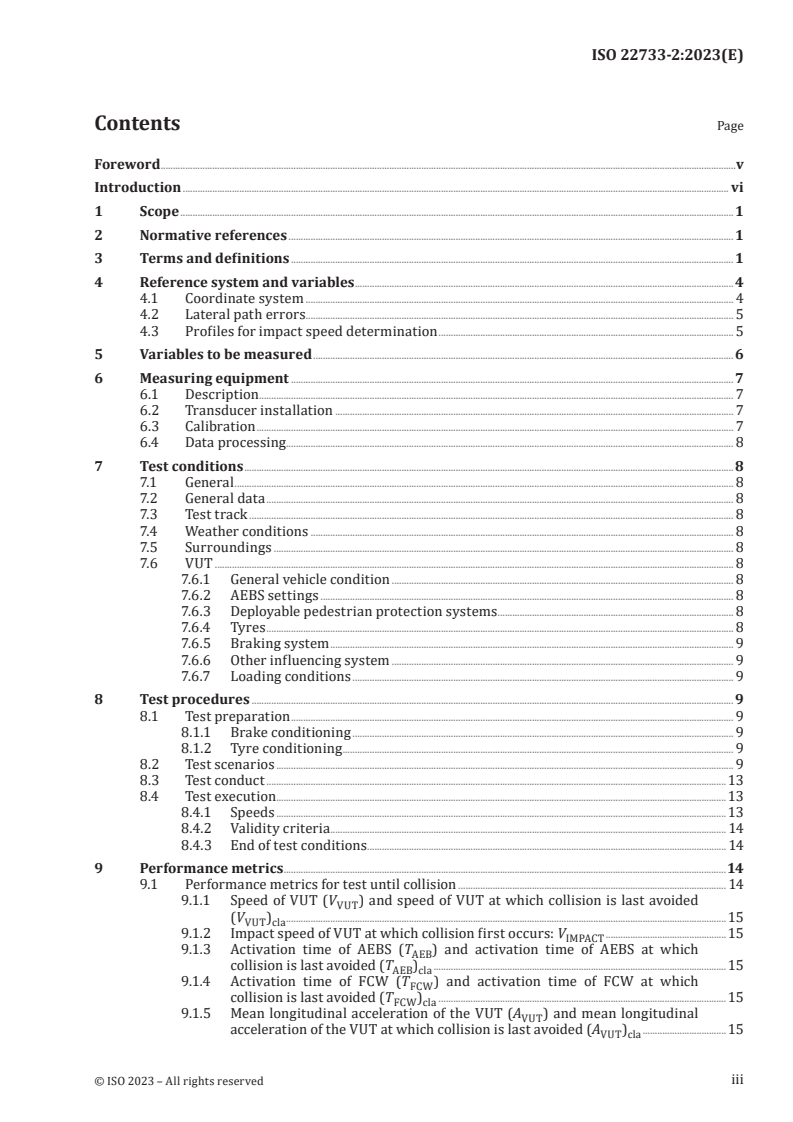
Contents Page
Foreword .v
Introduction . vi
1 Scope . 1
2 Normative references . 1
3 Terms and definitions . 1
4 Reference system and variables .4
4.1 Coordinate system . 4
4.2 Lateral path errors . . 5
4.3 Profiles for impact speed determination . 5
5 Variables to be measured . 6
6 Measuring equipment . 7
6.1 Description . 7
6.2 Transducer installation . 7
6.3 Calibration . 7
6.4 Data processing. 8
7 Test conditions .8
7.1 General . 8
7.2 General data . 8
7.3 Test track . 8
7.4 Weather conditions . 8
7.5 Surroundings . 8
7.6 VUT . 8
7.6.1 General vehicle condition . 8
7.6.2 AEBS settings . 8
7.6.3 Deployable pedestrian protection systems . 8
7.6.4 Tyres . 8
7.6.5 Braking system . 9
7.6.6 Other influencing system . 9
7.6.7 Loading conditions . 9
8 Test procedures . 9
8.1 Test preparation . 9
8.1.1 Brake conditioning . 9
8.1.2 Tyre conditioning . 9
8.2 Test scenarios . 9
8.3 Test conduct .13
8.4 Test execution . .13
8.4.1 Speeds .13
8.4.2 Validity criteria . . 14
8.4.3 End of test conditions . . 14
9 Performance metrics .14
9.1 Performance metrics for test until collision . 14
9.1.1 Speed of VUT (V ) and speed of VUT at which collision is last avoided
VUT
(V ) .15
VUT cla
9.1.2 Impact speed of VUT at which collision first occurs: V .15
IMPACT
9.1.3 Activation time of AEBS (T ) and activation time of AEBS at which
AEB
collision is last avoided (T ) . 15
AEB cla
9.1.4 Activation time of FCW (T ) and activation time of FCW at which
FCW
collision is last avoided (T ) . 15
FCW cla
9.1.5 Mean longitudinal acceleration of the VUT (A ) and mean longitudinal
VUT
acceleration of the VUT at which collision is last avoided (A ) .15
VUT cla
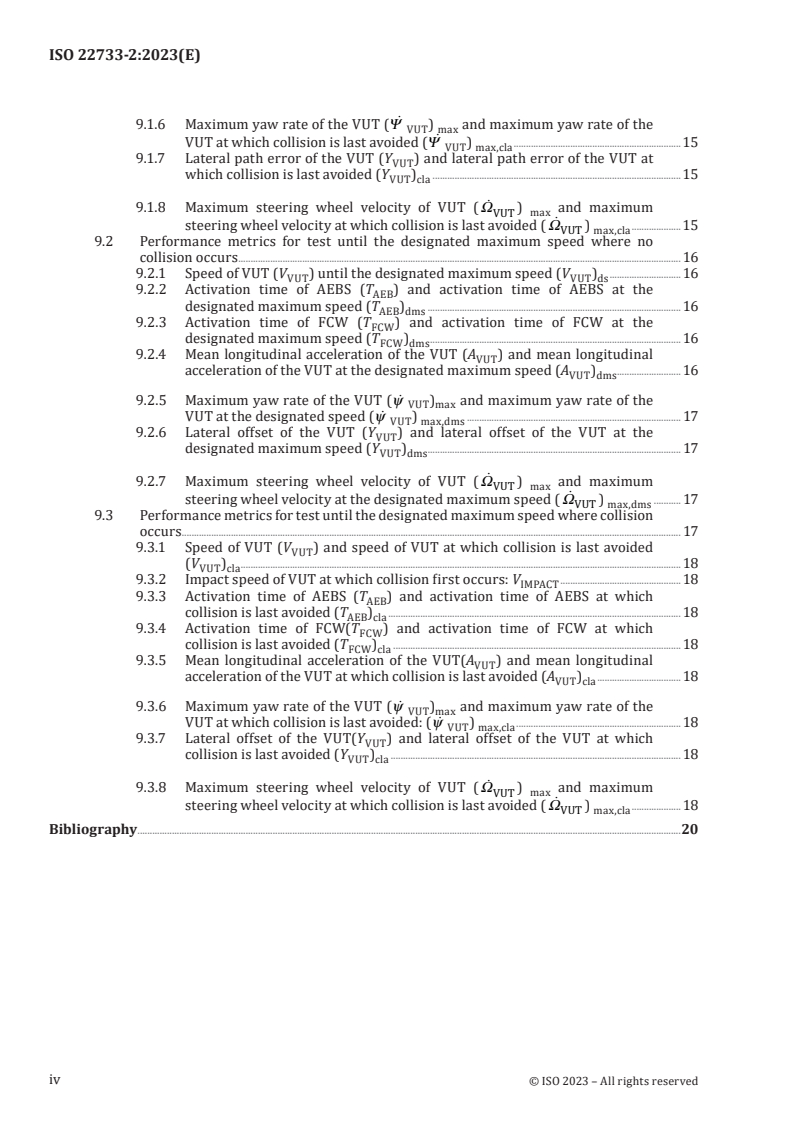
iii
9.1.6 Maximum yaw rate of the VUT (Ψ ) and maximum yaw rate of the
VUT max
VUT at which collision is last avoided (Ψ ) .15
VUT max,cla
9.1.7 Lateral path error of the VUT (Y ) and lateral path error of the VUT at
VUT
which collision is last avoided (Y ) . 15
VUT cla
9.1.8 Maximum steering wheel velocity of VUT (Ω ) and maximum
VUT max
steering wheel velocity at which collision is last avoided (Ω ) .15
VUT max,cla
9.2 Performance metrics for test until the designated maximum speed where no
collision occurs . 16
9.2.1 Speed of VUT (V ) until the designated maximum speed (V ) . 16
VUT VUT ds
9.2.2 Activation time of AEBS (T ) and activation time of AEBS at the
AEB
designated maximum speed (T ) . 16
AEB dms
9.2.3 Activation time of FCW (T ) and activation time of FCW at the
FCW
designated maximum speed (T ) . 16
FCW dms
9.2.4 Mean longitudinal acceleration of the VUT (A ) and mean longitudinal
VUT
acceleration of the VUT at the designated maximum speed (A ) . 16
VUT dms
9.2.5 Maximum yaw rate of the VUT (ψ ) and maximum yaw rate of the
VUT max
VUT at the designated speed (ψ ) . 17
VUT max,dms
9.2.6 Lateral offset of the VUT (Y ) and lateral offset of the VUT at the
VUT
designated maximum speed (Y ) . 17
VUT dms
9.2.7 Maximum steering wheel velocity of VUT (Ω ) and maximum
VUT max
steering wheel velocity at the designated maximum speed (Ω ) . 17
VUT max,dms
9.3 Performance metrics for test until the designated maximum speed where collision
occurs . . . 17
9.3.1 Speed of VUT (V ) and speed of VUT at which collision is last avoided
VUT
(V ) . 18
VUT cla
9.3.2 Impact speed of VUT at which collision first occurs: V . 18
IMPACT
9.3.3 Activation time of AEBS (T ) and activation time of AEBS at which
AEB
collision is last avoided (T ) . 18
AEB cla
9.3.4 Activation time of FCW(T ) and activation time of FCW at which
FCW
collision is last avoided (T ) . 18
FCW cla
9.3.5 Mean longitudinal acceleration of the VUT(A ) and mean longitudinal
VUT
acceleration of the VUT at which collision is last avoided (A ) . 18
VUT cla
9.3.6 Maximum yaw rate of the VUT (ψ ) and maximum yaw rate of the
VUT max
VUT at which collision is last avoided: (ψ ) . 18
VUT max,cla
9.3.7 Lateral offset of the VUT(Y ) and lateral offset of the VUT at which
VUT
collision is last avoided (Y ) . 18
VUT cla
9.3.8 Maximum steering wheel velocity of VUT (Ω ) and maximum
VUT max
steering wheel velocity at which collision is last avoided (Ω ) . 18
VUT max,cla
Bibliography .20
iv
Foreword
ISO (the International Organization for Standardization) is a worldwide federation of national standards
bodies (ISO member bodies). The work of preparing International Standards is normally carried out
through ISO technical committees. Each member body interested in a subject for which a technical
committee has been established has the right to be represented on that committee. International
organizations, governmental and non-governmental, in liaison with ISO, also take part in the work.
ISO collaborates closely with the International Electrotechnical Commission (IEC) on all matters of
electrotechnical standardization.
The procedures used to develop this document and those intended for its further maintenance are
described in the ISO/IEC Directives, Part 1. In particular, the different approval criteria needed for the
different types of ISO documents should be noted. This document was drafted in accordance with the
editorial rules of the ISO/IEC Directives, Part 2 (see www.iso.org/directives).
Attention is drawn to the possibility that some of the elements of this document may be the subject of
patent rights. ISO shall not be held responsible for identifying any or all such patent rights. Details of
any patent rights identified during the development of the document will be in the Introduction and/or
on the ISO list of patent declarations received (see www.iso.org/patents).
Any trade name used in this document is information given for the convenience of users and does not
constitute an endorsement.
For an explanation of the voluntary nature of standards, the meaning of ISO specific terms and
expressions related to conformity assessment, as well as information about ISO's adherence to
the World Trade Organization (WTO) principles in the Technical Barriers to Trade (TBT), see
www.iso.org/iso/foreword.html.
This document was prepared by Technical Committee ISO/TC 22, Road vehicles, Subcommittee SC 33,
Vehicle dynamics, chassis components and driving automation systems testing.
A list of all parts in the ISO 22733 series can be found on the ISO website.
Any feedback or questions on this document should be directed to the user’s national standards body. A
complete listing of these bodies can be found at www.iso.org/members.html.
v
Introduction
The capacity to avoid or mitigate a collision during -potential accident - is an important part of the
performance of an autonomous braking system fitted in a road vehicle. This document is intended to
assess performance of an autonomous braking under defined test scenario only.
NOTE Moreover, insufficient knowledge is available concerning the relationship between overall vehicle
dynamic properties and accident avoidance. A substantial amount of work is necessary to acquire sufficient and
reliable data on the correlation between accident avoidance and vehicle dynamic properties in general and the
results of these tests in particular.
vi
INTERNATIONAL STANDARD ISO 22733-2:2023(E)
Road vehicles — Test method to evaluate the performance
of autonomous emergency braking systems —
Part 2:
Car to pedestrian
1 Scope
This document specifies test methods to evaluate performance of the autonomous emergency braking
system (AEBS) in car to pedestrian collision situations. Forward collision warning system (FCWS) is
part of AEBS when it provides warning before braking intervention.
Vehicle to pedestrian accidents occur when a vehicle under test (VUT) drives in straight line and either
a pedestrian walks longitudinal on the same road or the pedestrian is approaching perpendicular the
road.
A system requiring a driver intervention is not in scope of this document.
NOTE Depending on accidentology only a part of the scenarios can be used for an evaluation of performance.
2 Normative references
The following documents are referred to in the text in such a way that some or all of their content
constitutes requirements of this document. For dated references, only the edition cited applies. For
undated references, the latest edition of the referenced document (including any amendments) applies.
ISO 8855, Road vehicles — Vehicle dynamics and road-holding ability — Vocabulary
ISO 15037-1:2019, Road vehicles — Vehicle dynamics test methods — Part 1: General conditions for
passenger cars
ISO 22733-1:2022, Road vehicles — Test method to evaluate the performance of autonomous emergency
braking systems — Part 1: Car-to-car
3 Terms and definitions
For the purposes of this document, the terms and definitions given in ISO 8855 and ISO 15037-1 and the
following apply.
ISO and IEC maintain terminology databases for use in standardization at the following addresses:
— ISO Online browsing platform: available at https:// www .iso .org/ obp
— IEC Electropedia: available at https:// www .electropedia .org/
3.1
AEB
autonomous emergency braking
braking applied automatically by the vehicle in response to the detection of a likely collision to reduce
the vehicle speed and potentially avoid the collision
Note 1 to entry: For a complete definition refer to ISO 22839.
3.2
CPFA-50
car-to-pedestrian farside adult 50 %
collision in which a vehicle travels forwards towards an adult pedestrian crossing its path running
from the farside and the frontal structure of the vehicle strikes the pedestrian at 50 % of the vehicle's
width when no braking action is applied
[SOURCE: Reference [4], Clause 2]
3.3
CPNA-25
car-to-pedestrian nearside adult 25 %
collision in which a vehicle travels forwards towards an adult pedestrian crossing its path walking
from the nearside and the frontal structure of the vehicle strikes the pedestrian at 25 % of the vehicle’s
width when no braking action is applied
[SOURCE: Reference [4], Clause 2]
3.4
CPNA-75
car-to-pedestrian nearside adult 75 %
collision in which a vehicle travels forwards towards an adult pedestrian crossing its path walking
from the nearside and the frontal structure of the vehicle strikes the pedestrian at 75 % of the vehicle’s
width when no braking action is applied
[SOURCE: Reference [4], Clause 2]
3.5
CPNC-50
car-to-pedestrian nearside child 50 %
collision in which a vehicle travels forwards towards a child pedestrian crossing its path running from
behind and obstruction from the nearside and the frontal structure of the vehicle strikes the pedestrian
at 50 % of the vehicle's width when no braking action is applied
[SOURCE: Reference [4], Clause 2]
3.6
CPLA-25
car-to-pedestrian longitudinal adult 25 %
collision in which a vehicle travels forwards towards an adult pedestrian walking in the same direction
in front of the vehicle where the vehicle strikes the pedestrian at 25 % of the vehicle’s width when
no braking action is applied or an evasive steering action is initiated after a forward collision warning
(FCW) (3.8)
[SOURCE: Reference [4], Clause 2]
3.7
CPLA-50
car-to-pedestrian longitudinal adult 50 %
collision in which a vehicle travels forwards towards an adult pedestrian walking in the same direction
in front of the vehicle where the vehicle strikes the pedestrian at 50 % of the vehicle’s width when no
braking action is applied
[SOURCE: Reference [4], Clause 2]
3.8
FCW
forward collision warning
audio-visual warning provided automatically by the vehicle in response to the detection of a likely
collision to alert the driver
3.9
PTa
pedestrian target adult
test device representing an adult pedestrian used to test active safety systems
[SOURCE: ISO 19206-2:2018, 3.2, modified — "Adult" has been added to the term and the definition.]
3.10
PTc
pedestrian target child
test device representing a child pedestrian used to test active safety systems
[SOURCE: ISO 19206-2:2018, 3.2, modified — "Child" has been added to the term and the definition.]
3.11
TTC
time to collision
remaining time before the vehicle under test (VUT) (3.15) strikes the pedestrian target (PT), assuming
that the VUT and PT would continue to travel with the speed it is travelling
3.12
T
AEB
time where the autonomous emergency braking (AEB) (3.1) system activates
Note 1 to entry: Activation time is determined by identifying the last data point where the filtered acceleration
2 2
signal is below -1,0 m/s , and then going back to the point in time where the acceleration first crossed -0,3 m/s .
3.13
T
FCW
time where the audible warning of the forward collision warning (FCW) (3.8) starts
Note 1 to entry: The starting point is determined by audible recognition or video analysis.
3.14
T
impact
speed at which the profiled line around the front end of the vehicle under test (VUT) (3.15) coincides
with the square box around the pedestrian target adult (PTa) (3.9), pedestrian target child (PTc) (3.10) as
shown in the Figure 1
Figure 1 — Definition of impact
3.15
VUT
vehicle under test
vehicle tested according to this document with a pre-crash collision mitigation or avoidance system on
board
3.16
vehicle width
widest point of the vehicle ignoring the rear-view mirrors, side marker lamps, tyre pressure indicators,
direction indicator lamps, position lamps, flexible mud-guards and the deflected part of the tyre side-
walls immediately above the point of contact with the ground
4 Reference system and variables
4.1 Coordinate system
For VUT and PT use the convention specified in ISO 8855 in which the x-axis points towards the front
of the vehicle, the y-axis towards the left and the z-axis upwards (right hand system), with the origin
at the most forward point on the centreline of the VUT for dynamic data measurements as shown in
Figure 2.
Viewed from the origin, roll, pitch and yaw rotate clockwise around the x, y and z axes respectively.
Longitudinal refers to the component of the measurement along the x-axis, lateral refers the component
along the y-axis and vertical refers the component along the z-axis.
This reference system should be used for both left (LHD) and right-hand drive (RHD) vehicles tested.
The nearside is swapped as per LHD and RHD vehicles. Figure 2 shows the near and farside of the
vehicle for an LHD vehicle.
The reference earth frame according to ISO 8855:2011, 2.8 is defined as:
— X axis: intended straight line path projected on the ground to front;
E
— Y axis: perpendicular to X axis on the ground to left;
E
— Z axis: perpendicular to the ground to the top.
E
Key
X longitudinal(X) Y lateral(Y)
Z vertical(Z) 1 NEAR SIDE
2 FAR SIDE 3 roll (φ)
4 pitch (θ) 5 yaw (Ψ)
Figure 2 — Coordinate system and notation (LHD and RHD), nearside and farside for LHD
vehicle
4.2 Lateral path errors
Vehicle lateral path error is determined as the lateral distance between the centre of the front of the
VUT when measured in parallel to the intended straight-lined path as shown in Figure 3.
Pedestrian perpendicular lateral path error is determined as the lateral distance between pedestrian
hip point when measured in parallel to the intended straight-lined path as shown in Figure 3.
For longitudinal test scenarios such as CPLA-25 and CPLA-50 shown in Figure 9, pedestrian
perpendicular lateral path error is determined as the lateral distance between pedestrian hip point
when meas
...