

ISO 22574:2023
(Main)Road vehicles — Brake linings friction materials — Visual inspection
General Information
- Abstract
This document defines visual aspects for the identification and assessment of product characteristics for friction materials in terms of quality and for commercial and technical agreements. The sequence of the product characteristics represents no order of priority. Inspection is carried out in unused, “as supplied” condition. In some characteristic features, there are differences between brake linings with an effective lining pad area less than 120 cm2 and larger than 120 cm2. The acceptance criteria ensure exclusion of any characteristics that could impact the function and performance of brake linings and applies unless other agreements between the customer and the supplier.
- Status
- Published
- Publication Date
- 23-Aug-2023
- Technical Committee
- ISO/TC 22/SC 33 - Vehicle dynamics and chassis components
- Drafting Committee
- ISO/TC 22/SC 33 - Vehicle dynamics and chassis components
- Current Stage
- 6060 - International Standard published
- Start Date
- 24-Aug-2023
- Due Date
- 24-Sep-2023
- Completion Date
- 24-Aug-2023
Overview
ISO 22574:2023 - Road vehicles - Brake linings friction materials - Visual inspection defines the visual criteria used to identify and assess product characteristics of brake friction materials for quality control and for commercial and technical agreements. Inspection is performed on unused, “as supplied” products. The standard covers disc brake pads, drum brake linings and bonded lined shoes, and for the first edition includes product characteristics of metal lining carriers (backing plates, bonded shoes). Acceptance criteria are intended to exclude any visual defects that could affect the function or performance of brake linings, unless alternate customer–supplier agreements are made.
Key Topics and Requirements
- Scope and intent: Visual aspects for identification and assessment of friction materials; sequence of characteristics is not a priority order.
- Inspection condition: Visual inspection in the unused, “as supplied” state.
- Size-based differences: Some criteria differ for disc pads with effective lining area < 120 cm² versus ≥ 120 cm².
- Acceptance principle: Criteria exclude any characteristics likely to impact function or safety of brake linings.
- Characteristic features detailed (examples extracted from the standard):
- Gapping between friction material and plate; edge chipping limits.
- Splits, deep splits and minor splits.
- Defects around spigots, holes and drill locations (plucked/indented spigots, pinholes, burrs).
- Excess adhesive, material flash, abrasive/anti-noise coating defects.
- Surface issues: blisters, porosity, grinding marks, cold laps, contamination and foreign-matter inclusion.
- Carrier/plate defects: scratched plates, dents, spring holder defects and deformation from blanking.
- Drum lining specifics: chip/corner damage, moulding skin, rivet/drill-hole cracks, pitted surfaces.
- Bonded lined shoe specifics: lining overhang, excess adhesive exudation, gaps between lining and shoe platform, restricted lever movement.
- No normative references are listed within ISO 22574:2023 (the document itself cites no mandatory external standards).
Applications and Who Uses It
- Manufacturers of brake linings and backing plates: set production and incoming quality inspection criteria.
- Automotive OEMs and tier suppliers: define acceptance for commercial and technical agreements, supplier audits and draw-offs.
- Quality engineers and laboratory inspectors: implement standardized visual inspection procedures to ensure safety and interchangeability.
- Purchasing and conformity teams: use acceptance criteria in contracts to prevent delivery of components with functional visual defects.
- Aftermarket and remanufacturing operations: apply the standard to verify components meet minimum visual quality for safe service.
Related Standards (if applicable)
- ISO 22574:2023 contains no normative references. For complementary requirements, consult other ISO road-vehicle and braking system standards produced by ISO/TC 22 (e.g., standards covering performance, testing and materials for braking systems).
Keywords: ISO 22574:2023, brake linings, friction materials, visual inspection, disc brake pads, drum brake linings, bonded lined shoes, acceptance criteria, backing plates, metal lining carriers.
Relations
- Effective Date
- 06-Jun-2022
Get Certified
Connect with accredited certification bodies for this standard

TÜV Rheinland
TÜV Rheinland is a leading international provider of technical services.

TÜV SÜD
TÜV SÜD is a trusted partner of choice for safety, security and sustainability solutions.

DEKRA Certification Inc.
DEKRA US certification services.
Sponsored listings
Frequently Asked Questions
ISO 22574:2023 is a standard published by the International Organization for Standardization (ISO). Its full title is "Road vehicles — Brake linings friction materials — Visual inspection". This standard covers: This document defines visual aspects for the identification and assessment of product characteristics for friction materials in terms of quality and for commercial and technical agreements. The sequence of the product characteristics represents no order of priority. Inspection is carried out in unused, “as supplied” condition. In some characteristic features, there are differences between brake linings with an effective lining pad area less than 120 cm2 and larger than 120 cm2. The acceptance criteria ensure exclusion of any characteristics that could impact the function and performance of brake linings and applies unless other agreements between the customer and the supplier.
This document defines visual aspects for the identification and assessment of product characteristics for friction materials in terms of quality and for commercial and technical agreements. The sequence of the product characteristics represents no order of priority. Inspection is carried out in unused, “as supplied” condition. In some characteristic features, there are differences between brake linings with an effective lining pad area less than 120 cm2 and larger than 120 cm2. The acceptance criteria ensure exclusion of any characteristics that could impact the function and performance of brake linings and applies unless other agreements between the customer and the supplier.
ISO 22574:2023 is classified under the following ICS (International Classification for Standards) categories: 43.040.40 - Braking systems. The ICS classification helps identify the subject area and facilitates finding related standards.
ISO 22574:2023 has the following relationships with other standards: It is inter standard links to ISO/PAS 22574:2007. Understanding these relationships helps ensure you are using the most current and applicable version of the standard.
ISO 22574:2023 is available in PDF format for immediate download after purchase. The document can be added to your cart and obtained through the secure checkout process. Digital delivery ensures instant access to the complete standard document.
Standards Content (Sample)
INTERNATIONAL ISO
STANDARD 22574
First edition
2023-08
Road vehicles — Brake linings friction
materials — Visual inspection
Véhicules routiers — Matériaux de friction des garnitures de freins —
Inspection visuelle
Reference number
© ISO 2023
All rights reserved. Unless otherwise specified, or required in the context of its implementation, no part of this publication may
be reproduced or utilized otherwise in any form or by any means, electronic or mechanical, including photocopying, or posting on
the internet or an intranet, without prior written permission. Permission can be requested from either ISO at the address below
or ISO’s member body in the country of the requester.
ISO copyright office
CP 401 • Ch. de Blandonnet 8
CH-1214 Vernier, Geneva
Phone: +41 22 749 01 11
Email: copyright@iso.org
Website: www.iso.org
Published in Switzerland
ii
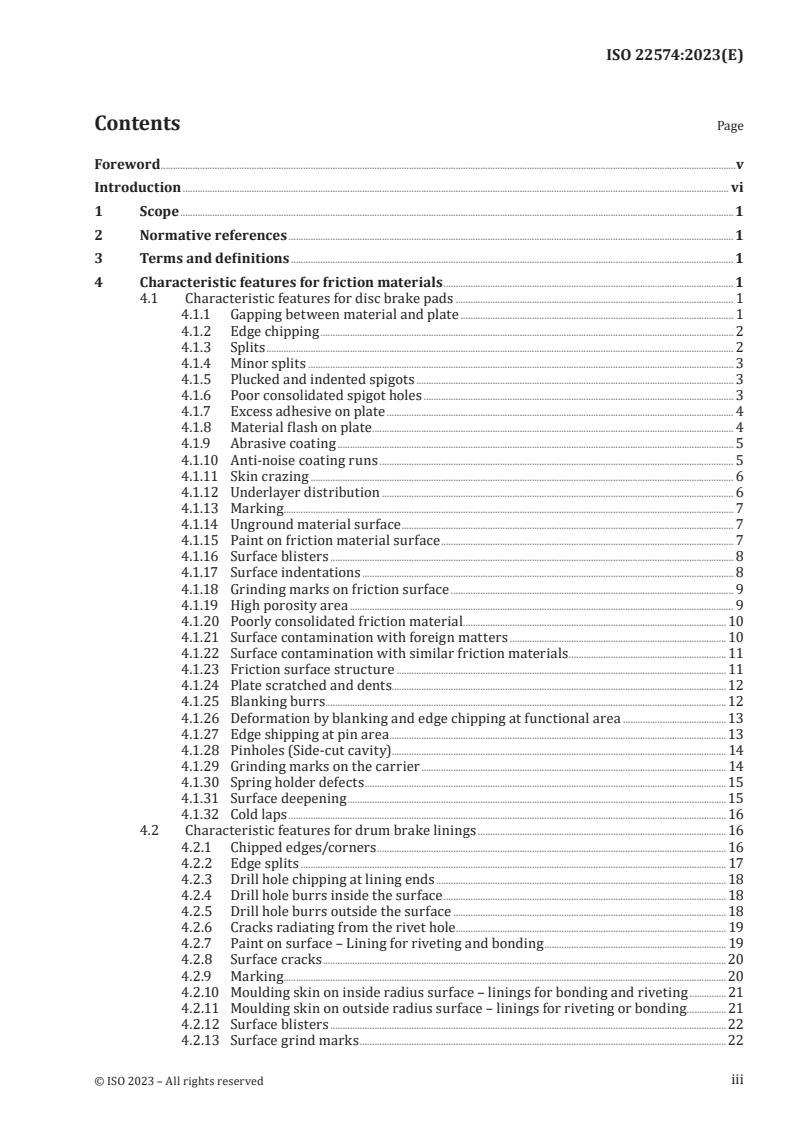
Contents Page
Foreword .v
Introduction . vi
1 Scope . 1
2 Normative references . 1
3 Terms and definitions . 1
4 Characteristic features for friction materials . 1
4.1 Characteristic features for disc brake pads . 1
4.1.1 Gapping between material and plate . 1
4.1.2 Edge chipping . 2
4.1.3 Splits . 2
4.1.4 Minor splits . 3
4.1.5 Plucked and indented spigots . 3
4.1.6 Poor consolidated spigot holes . 3
4.1.7 Excess adhesive on plate . 4
4.1.8 Material flash on plate . . 4
4.1.9 Abrasive coating . 5
4.1.10 Anti-noise coating runs . 5
4.1.11 Skin crazing . 6
4.1.12 Underlayer distribution . 6
4.1.13 Marking . . . 7
4.1.14 Unground material surface . 7
4.1.15 Paint on friction material surface . 7
4.1.16 Surface blisters . 8
4.1.17 Surface indentations . 8
4.1.18 Grinding marks on friction surface . 9
4.1.19 High porosity area . 9
4.1.20 Poorly consolidated friction material . 10
4.1.21 Surface contamination with foreign matters . 10
4.1.22 Surface contamination with similar friction materials . 11
4.1.23 Friction surface structure . 11
4.1.24 Plate scratched and dents.12
4.1.25 Blanking burrs.12
4.1.26 Deformation by blanking and edge chipping at functional area .13
4.1.27 Edge shipping at pin area . 13
4.1.28 Pinholes (Side-cut cavity) . 14
4.1.29 Grinding marks on the carrier . 14
4.1.30 Spring holder defects . 15
4.1.31 Surface deepening .15
4.1.32 Cold laps . 16
4.2 Characteristic features for drum brake linings . 16
4.2.1 Chipped edges/corners . 16
4.2.2 Edge splits . 17
4.2.3 Drill hole chipping at lining ends . 18
4.2.4 Drill hole burrs inside the surface . 18
4.2.5 Drill hole burrs outside the surface . 18
4.2.6 Cracks radiating from the rivet hole . 19
4.2.7 Paint on surface – Lining for riveting and bonding . 19
4.2.8 Surface cracks .20
4.2.9 Marking . . 20
4.2.10 Moulding skin on inside radius surface – linings for bonding and riveting . 21
4.2.11 Moulding skin on outside radius surface – linings for riveting or bonding . 21
4.2.12 Surface blisters .22
4.2.13 Surface grind marks .22
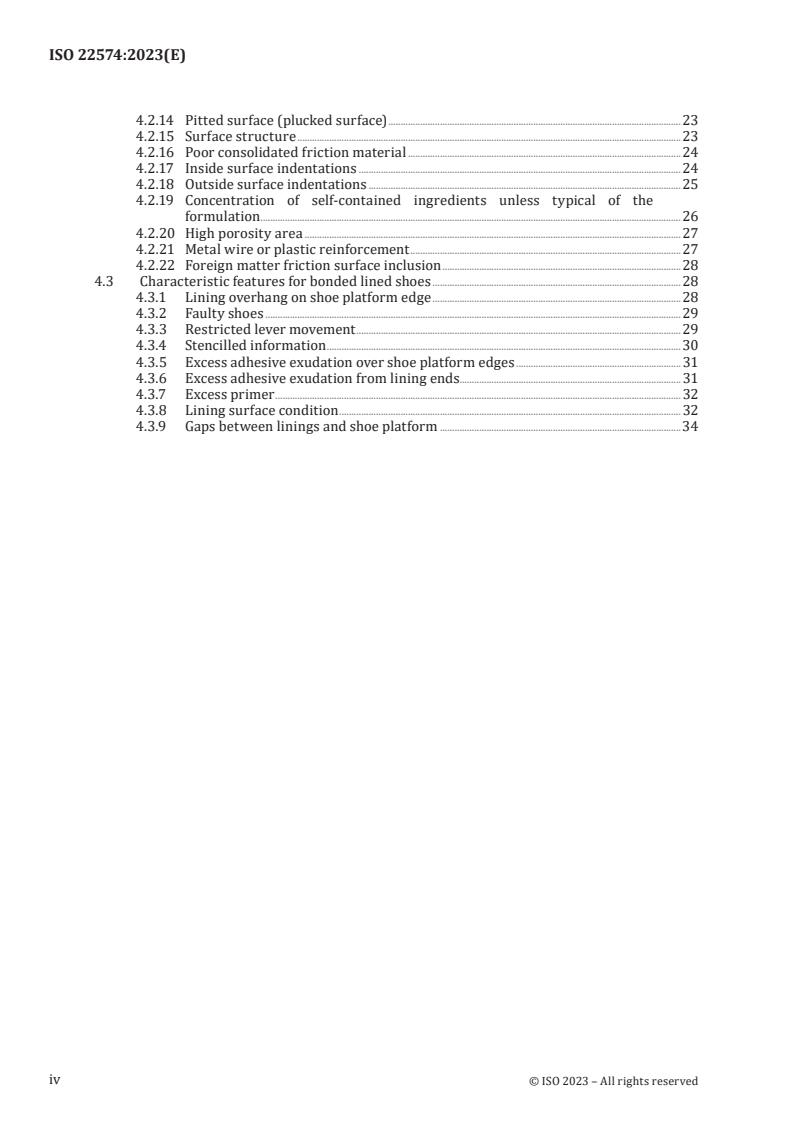
iii
4.2.14 Pitted surface (plucked surface) . 23
4.2.15 Surface structure .23
4.2.16 Poor consolidated friction material . 24
4.2.17 Inside surface indentations . 24
4.2.18 Outside surface indentations . 25
4.2.19 Concentration of self-contained ingredients unless typical of the
formulation . 26
4.2.20 High porosity area . 27
4.2.21 Metal wire or plastic reinforcement . 27
4.2.22 Foreign matter friction surface inclusion .28
4.3 Characteristic features for bonded lined shoes .28
4.3.1 Lining overhang on shoe platform edge .28
4.3.2 Faulty shoes .29
4.3.3 Restricted lever movement .29
4.3.4 Stencilled information .30
4.3.5 Excess adhesive exudation over shoe platform edges . 31
4.3.6 Excess adhesive exudation from lining ends. 31
4.3.7 Excess primer . 32
4.3.8 Lining surface condition . 32
4.3.9 Gaps between linings and shoe platform .34
iv
Foreword
ISO (the International Organization for Standardization) is a worldwide federation of national standards
bodies (ISO member bodies). The work of preparing International Standards is normally carried out
through ISO technical committees. Each member body interested in a subject for which a technical
committee has been established has the right to be represented on that committee. International
organizations, governmental and non-governmental, in liaison with ISO, also take part in the work.
ISO collaborates closely with the International Electrotechnical Commission (IEC) on all matters of
electrotechnical standardization.
The procedures used to develop this document and those intended for its further maintenance are
described in the ISO/IEC Directives, Part 1. In particular, the different approval criteria needed for the
different types of ISO document should be noted. This document was drafted in accordance with the
editorial rules of the ISO/IEC Directives, Part 2 (see www.iso.org/directives).
ISO draws attention to the possibility that the implementation of this document may involve the use
of (a) patent(s). ISO takes no position concerning the evidence, validity or applicability of any claimed
patent rights in respect thereof. As of the date of publication of this document, ISO had not received
notice of (a) patent(s) which may be required to implement this document. However, implementers are
cautioned that this may not represent the latest information, which may be obtained from the patent
database available at www.iso.org/patents. ISO shall not be held responsible for identifying any or all
such patent rights.
Any trade name used in this document is information given for the convenience of users and does not
constitute an endorsement.
For an explanation of the voluntary nature of standards, the meaning of ISO specific terms and
expressions related to conformity assessment, as well as information about ISO's adherence to
the World Trade Organization (WTO) principles in the Technical Barriers to Trade (TBT), see
www.iso.org/iso/foreword.html.
This document was prepared by Technical Committee ISO/TC 22, Road vehicles, Subcommittee SC 33,
Vehicle dynamics, chassis components and driving automation systems testing.
This first edition cancels and replaces the first edition (ISO/PAS 22574:2007), which has been
technically revised.
The main changes are as follows:
— product characteristics of metal lining carriers have been included.
Any feedback or questions on this document should be directed to the user’s national standards body. A
complete listing of these bodies can be found at www.iso.org/members.html.
v
Introduction
Friction linings are composite materials with complex structure. Due to their composition and their
production process, visual appearance characteristics can occur which in a precisely defined design
are to be regarded as specific to the product. In this document, the product characteristics of metal
lining carriers, for example, of bonded lined brake shoes or backing plates for disc brake linings, have
been included.
This document is based on the “Catalogue of characteristic features for friction materials” of the
Federation of European Manufacturers of Friction Materials (FEMFM) issued for the first time in 1980.
The FEMFM is a European organization of national associations formed by companies engaged in the
development and production of friction materials of various product forms. The description of the
characteristic features and their design was reviewed in 1996 when technological processes, especially
safety aspects and the demands made by the brake and automobile industry, were given careful
consideration.
vi
INTERNATIONAL STANDARD ISO 22574:2023(E)
Road vehicles — Brake linings friction materials — Visual
inspection
1 Scope
This document defines visual aspects for the identification and assessment of product characteristics
for friction materials in terms of quality and for commercial and technical agreements. The sequence
of the product characteristics represents no order of priority. Inspection is carried out in unused, “as
supplied” condition.
In some characteristic features, there are differences between brake linings with an effective lining
2 2
pad area less than 120 cm and larger than 120 cm . The acceptance criteria ensure exclusion of any
characteristics that could impact the function and performance of brake linings and applies unless
other agreements between the customer and the supplier.
2 Normative references
There are no normative references in this document.
3 Terms and definitions
No terms and definitions are listed in this document.
ISO and IEC maintain terminology databases for use in standardization at the following addresses:
— ISO Online browsing platform: available at https:// www .iso .org/ obp
— IEC Electropedia: available at https:// www .electropedia .org/
4 Characteristic features for friction materials
4.1 Characteristic features for disc brake pads
4.1.1 Gapping between material and plate
Gaps as shown in Figure 1 are not acceptable.
a) Photo view b) Schematic view
Figure 1 — Example for gapping
4.1.2 Edge chipping
In the case of a disc brake pad [see Figure 2 a)] with an area less than 120 cm , a maximum of 1 % of the
edge may chip.
In the case of a disc brake pad [Figure 2 b)] with an area equal or more than 120 cm , a maximum of
0,5 % of the edge may chip.
2 2
a) Example less than 120 mm b) Example larger than 120 mm
Figure 2 — Example for edge chipping
4.1.3 Splits
Splits having a length of more than 30 mm or more than 10 mm on corners or deeper than 1,5 mm shall
not be accepted [see Figure 3 a) and b)].
a) Example of length split b) Example of deep split
Figure 3 — Example for splits
4.1.4 Minor splits
Splits having a length of less than 30 mm or less than 10 mm on corners or with a depth less than
1,5 mm may be accepted (see Figure 4).
Figure 4 — Example for minor split
4.1.5 Plucked and indented spigots
The disc brake pad shown in Figure 5 is acceptable on each spigot up to 50 % of area and 0,5 mm deep.
NOTE Spigots physically indented in the pad design are included in this description.
Figure 5 — Example for plucked and indented spigots
4.1.6 Poor consolidated spigot holes
The disc brake pad shown in Figure 6 is acceptable if only one spigot is affected with up to 20 % of the
volume being low density. This definition also applies where spigots have been physically indented in
the pad design.
Figure 6 — Poor consolidated spigot holes
4.1.7 Excess adhesive on plate
Excess adhesive on plate is acceptable provided the fitment of the part is not affected [see Figure 7 a)
and b)].
a) Example 1 b) Example 2
Figure 7 — Example for adhesive on plate
4.1.8 Materia
...