

ISO 23745:2024
(Main)Ships and marine technology — General specification for shipborne meteorological instruments
General Information
- Abstract
This document specifies the technical requirements and test methods for shipborne meteorological instruments (SMIs). This document applies to shipborne meteorological instruments installed on ships that shares marine meteorological data with other ships, national meteorological services or other users.
- Status
- Published
- Publication Date
- 22-Feb-2024
- Technical Committee
- ISO/TC 8/SC 13 - Marine technology
- Drafting Committee
- ISO/TC 8/SC 13 - Marine technology
- Current Stage
- 6060 - International Standard published
- Start Date
- 23-Feb-2024
- Due Date
- 22-Feb-2024
- Completion Date
- 23-Feb-2024
Overview
ISO 23745:2024 - Ships and marine technology - General specification for shipborne meteorological instruments - is the first-edition ISO standard that defines technical requirements and test methods for shipborne meteorological instruments (SMIs). It covers SMIs installed on ships that share marine meteorological data with other ships, national meteorological services or other users. The standard aims to ensure consistent measurement quality, interoperability and reliable data exchange to support safe navigation, weather forecasting and climatological applications.
Key topics and technical requirements
ISO 23745:2024 addresses the full lifecycle of SMIs, including functional, environmental and interoperability requirements:
- General requirements
- Appearance, installation guidance and material selection
- Cable, battery and enclosure protection considerations
- Meteorological measurement parameters
- Performance and test methods for atmospheric pressure, air temperature, relative humidity, apparent/true wind speed and direction, visibility and sea‑surface temperature
- True wind calculation
- Principles and component-based calculation to derive true wind from apparent wind and ship motion
- Sampling, algorithms and data quality
- Sampling rate expectations, algorithm and meteorological data quality control procedures
- Data handling
- Data storage integrity, transmission, communication interfaces and transmission formats
- Timing and synchronization
- Clock accuracy, allowable time error and synchronized-time requirements for timestamping observations
- Safety, EMC and environmental robustness
- Safety checks, electromagnetic compatibility (EMC) and environmental condition tests relevant to ship installations
- Test methods and verification
- Test ambient conditions, standard apparatus and parameter-specific tests (see clauses 5 and 6)
- Supporting documentation
- Annexes for installation requirements, ship motion information and observation data/metadata (Annexes A–C)
Practical applications and users
ISO 23745:2024 is intended for stakeholders involved in the design, manufacture, installation, operation and use of shipborne meteorological systems:
- Shipbuilders and marine integrators specifying onboard instrumentation
- Instrument manufacturers and test laboratories developing and certifying SMIs
- Shipping companies and vessel operators ensuring compliance and data quality
- National meteorological services and networks (including Voluntary Observing Ship - VOS - schemes) that ingest ship observations
- Researchers, port authorities, offshore wind operators and weather service providers relying on standardized marine observations
By following ISO 23745, organizations can improve interoperability of ship-sourced meteorological data, enhance quality control, and facilitate data exchange for navigation safety, forecasting and climatology.
Related standards and references
ISO 23745 references relevant maritime and meteorological standards and guides, including:
- ISO 10596 (marine wind vane and anemometers)
- IEC 60092 series (ship electrical installations)
- IEC 60533 (EMC on ships with metallic hulls)
- WMO Guides (WMO‑No. 8 and WMO‑No. 488)
Keywords: ISO 23745:2024, shipborne meteorological instruments, SMIs, ship meteorological data, marine meteorological instruments, true wind calculation, sampling rate, data quality control, EMC, VOS.
Relations
- Effective Date
- 22-Oct-2022
Get Certified
Connect with accredited certification bodies for this standard

DNV
DNV is an independent assurance and risk management provider.

Lloyd's Register
Lloyd's Register is a global professional services organisation specialising in engineering and technology.

FSC International
Forest Stewardship Council certification.
Sponsored listings
Frequently Asked Questions
ISO 23745:2024 is a standard published by the International Organization for Standardization (ISO). Its full title is "Ships and marine technology — General specification for shipborne meteorological instruments". This standard covers: This document specifies the technical requirements and test methods for shipborne meteorological instruments (SMIs). This document applies to shipborne meteorological instruments installed on ships that shares marine meteorological data with other ships, national meteorological services or other users.
This document specifies the technical requirements and test methods for shipborne meteorological instruments (SMIs). This document applies to shipborne meteorological instruments installed on ships that shares marine meteorological data with other ships, national meteorological services or other users.
ISO 23745:2024 is classified under the following ICS (International Classification for Standards) categories: 47.020.99 - Other standards related to shipbuilding and marine structures. The ICS classification helps identify the subject area and facilitates finding related standards.
ISO 23745:2024 has the following relationships with other standards: It is inter standard links to ISO 25178-605:2025. Understanding these relationships helps ensure you are using the most current and applicable version of the standard.
ISO 23745:2024 is available in PDF format for immediate download after purchase. The document can be added to your cart and obtained through the secure checkout process. Digital delivery ensures instant access to the complete standard document.
Standards Content (Sample)
International
Standard
ISO 23745
First edition
Ships and marine technology —
2024-02
General specification for shipborne
meteorological instruments
Reference number
© ISO 2024
All rights reserved. Unless otherwise specified, or required in the context of its implementation, no part of this publication may
be reproduced or utilized otherwise in any form or by any means, electronic or mechanical, including photocopying, or posting on
the internet or an intranet, without prior written permission. Permission can be requested from either ISO at the address below
or ISO’s member body in the country of the requester.
ISO copyright office
CP 401 • Ch. de Blandonnet 8
CH-1214 Vernier, Geneva
Phone: +41 22 749 01 11
Email: copyright@iso.org
Website: www.iso.org
Published in Switzerland
ii
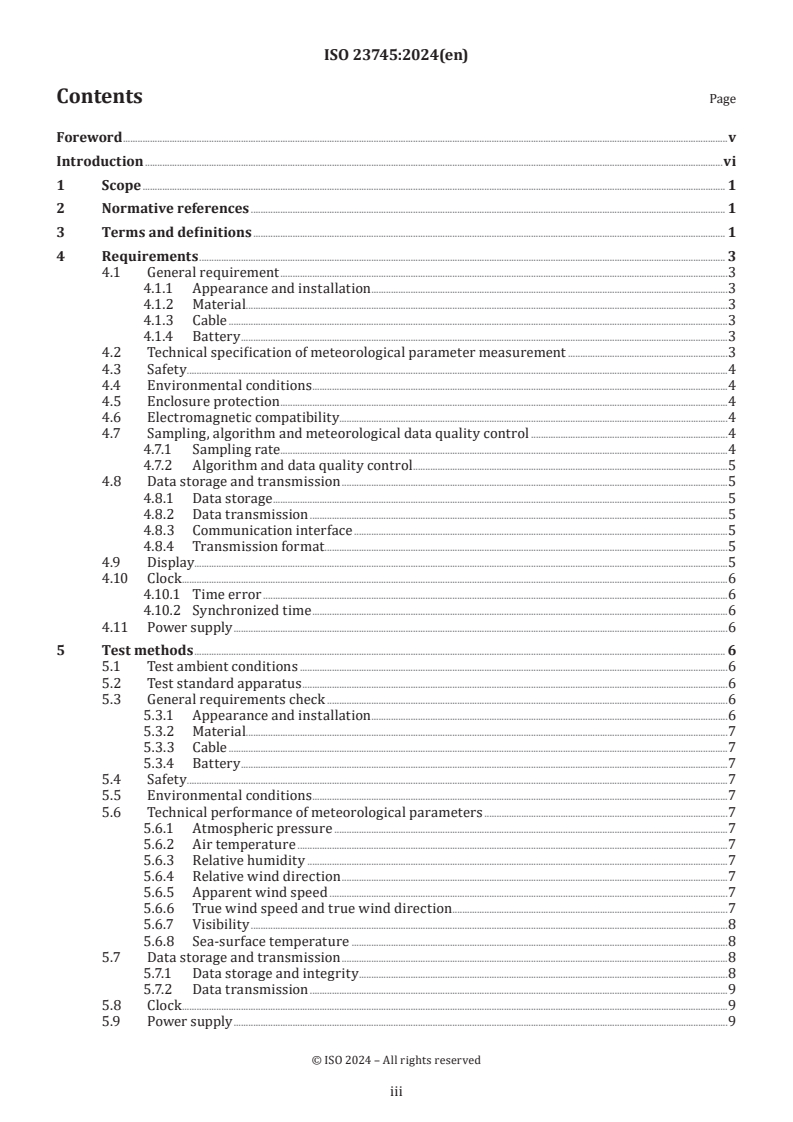
Contents Page
Foreword .v
Introduction .vi
1 Scope . 1
2 Normative references . 1
3 Terms and definitions . 1
4 Requirements . 3
4.1 General requirement .3
4.1.1 Appearance and installation . .3
4.1.2 Material.3
4.1.3 Cable .3
4.1.4 Battery .3
4.2 Technical specification of meteorological parameter measurement .3
4.3 Safety.4
4.4 Environmental conditions .4
4.5 Enclosure protection .4
4.6 Electromagnetic compatibility.4
4.7 Sampling, algorithm and meteorological data quality control .4
4.7.1 Sampling rate.4
4.7.2 Algorithm and data quality control .5
4.8 Data storage and transmission .5
4.8.1 Data storage .5
4.8.2 Data transmission .5
4.8.3 Communication interface .5
4.8.4 Transmission format . .5
4.9 Display.5
4.10 Clock .6
4.10.1 Time error .6
4.10.2 Synchronized time .6
4.11 Power supply .6
5 Test methods . 6
5.1 Test ambient conditions .6
5.2 Test standard apparatus .6
5.3 General requirements check .6
5.3.1 Appearance and installation . .6
5.3.2 Material.7
5.3.3 Cable .7
5.3.4 Battery .7
5.4 Safety.7
5.5 Environmental conditions .7
5.6 Technical performance of meteorological parameters .7
5.6.1 Atmospheric pressure .7
5.6.2 Air temperature .7
5.6.3 Relative humidity .7
5.6.4 Relative wind direction .7
5.6.5 Apparent wind speed .7
5.6.6 True wind speed and true wind direction .7
5.6.7 Visibility .8
5.6.8 Sea-surface temperature .8
5.7 Data storage and transmission .8
5.7.1 Data storage and integrity .8
5.7.2 Data transmission .9
5.8 Clock .9
5.9 Power supply .9
iii
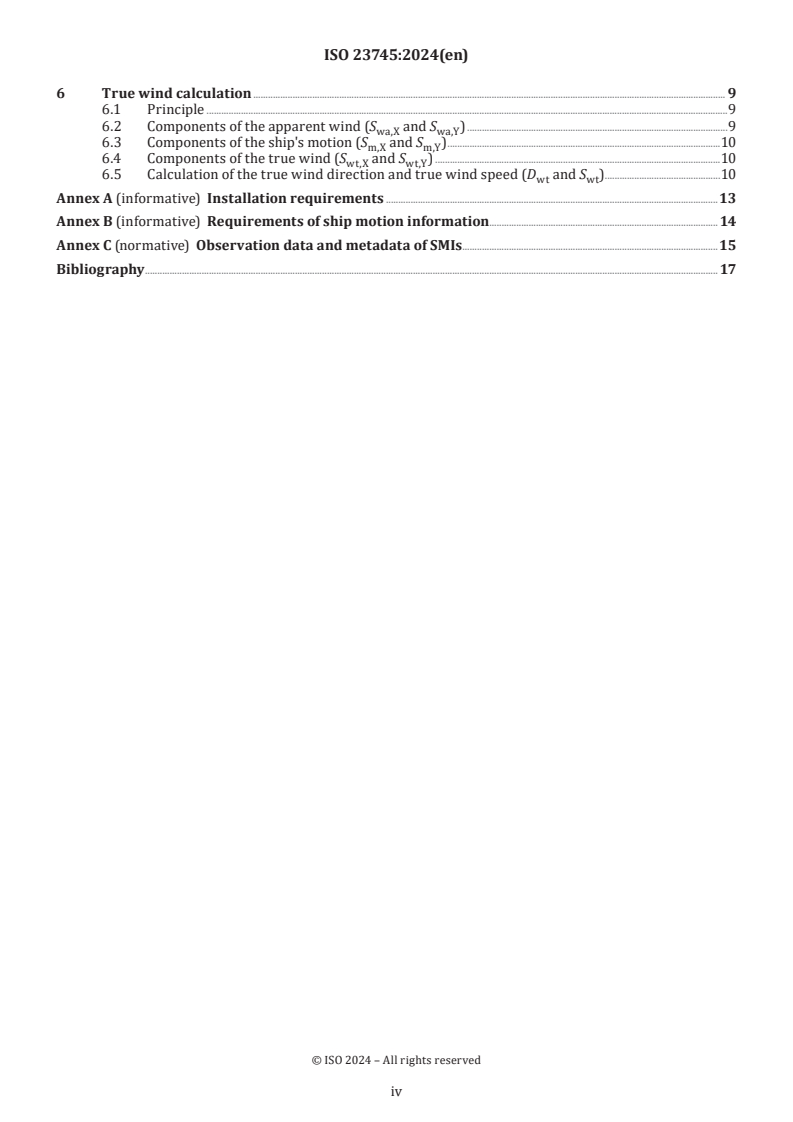
6 True wind calculation . 9
6.1 Principle .9
6.2 Components of the apparent wind (S and S ) .9
wa,X wa,Y
6.3 Components of the ship's motion (S and S ) .10
m,X m,Y
6.4 Components of the true wind (S and S ) .10
wt,X wt,Y
6.5 Calculation of the true wind direction and true wind speed (D and S ) .10
wt wt
Annex A (informative) Installation requirements .13
Annex B (informative) Requirements of ship motion information. 14
Annex C (normative) Observation data and metadata of SMIs.15
Bibliography . 17
iv
Foreword
ISO (the International Organization for Standardization) is a worldwide federation of national standards
bodies (ISO member bodies). The work of preparing International Standards is normally carried out through
ISO technical committees. Each member body interested in a subject for which a technical committee
has been established has the right to be represented on that committee. International organizations,
governmental and non-governmental, in liaison with ISO, also take part in the work. ISO collaborates closely
with the International Electrotechnical Commission (IEC) on all matters of electrotechnical standardization.
The procedures used to develop this document and those intended for its further maintenance are described
in the ISO/IEC Directives, Part 1. In particular, the different approval criteria needed for the different types
of ISO document should be noted. This document was drafted in accordance with the editorial rules of the
ISO/IEC Directives, Part 2 (see www.iso.org/directives).
ISO draws attention to the possibility that the implementation of this document may involve the use of (a)
patent(s). ISO takes no position concerning the evidence, validity or applicability of any claimed patent
rights in respect thereof. As of the date of publication of this document, ISO had not received notice of (a)
patent(s) which may be required to implement this document. However, implementers are cautioned that
this may not represent the latest information, which may be obtained from the patent database available at
www.iso.org/patents. ISO shall not be held responsible for identifying any or all such patent rights.
Any trade name used in this document is information given for the convenience of users and does not
constitute an endorsement.
For an explanation of the voluntary nature of standards, the meaning of ISO specific terms and expressions
related to conformity assessment, as well as information about ISO's adherence to the World Trade
Organization (WTO) principles in the Technical Barriers to Trade (TBT), see www.iso.org/iso/foreword.html.
This document was prepared by Technical Committee ISO/TC 8, Ships and marine technology, Subcommittee
SC 13, Marine technology.
Any feedback or questions on this document should be directed to the user’s national standards body. A
complete listing of these bodies can be found at www.iso.org/members.html.
v
Introduction
A shipborne meteorological instrument (SMI) forms a combined system installed on a ship and is used
to measure meteorological elements at the ship's position. The meteorological information acquired by
the system can be used as input for meteorological applications that support forecasts, warning and
climatological services, with a view to ensuring for safe navigation. This meteorological information can
also be used for commercial or scientific needs.
Information sharing is an important feature at the time of publication of this document. The importance of
exchanging or sharing meteorological information is also evident.
The number of ships that carry shipborne meteorological instruments with diverse sensors is extensive and
in flux. It is generally desirable that the meteorological data measured by ship meteorological instruments
can be exchanged and shared with other ships, land-based meteorological information platforms or global
meteorological observation systems such as the Voluntary Observing Ship (VOS) Scheme of the World
Meteorological Organization (WMO).
This document establishes a set of general technical specifications for all shipborne meteorological
instruments, including terms, definitions and test methods, to ensure the quality of different shipborne
meteorological instruments and the efficiency in exchanging or sharing meteorological information. In
doing so, this document aims to help shipborne meteorological instruments play a more important role in
safe navigation, weather forecast and other climatological services, such as wind energy or commercial or
technical research.
vi
International Standard ISO 23745:2024(en)
Ships and marine technology — General specification for
shipborne meteorological instruments
1 Scope
This document specifies the technical requirements and test methods for shipborne meteorological
instruments (SMIs).
This document applies to shipborne meteorological instruments installed on ships that shares marine
meteorological data with other ships, national meteorological services or other users.
2 Normative references
The following documents are referred to in the text in such a way that some or all of their content constitutes
requirements of this document. For dated references, only the edition cited applies. For undated references,
the latest edition of the referenced document (including any amendments) applies.
ISO 10596:2009, Ships and marine technology — Marine wind vane and anemometers
IEC 60092-101:2018, Electrical installations in ships — Part 101: Definitions and general requirements
IEC 60092-305, Electrical installations in ships — Part 305: Equipment — Accumulator (storage) batteries
IEC 60092-376, Electrical installations in ships — Part 376: Cables for control and instrumentation circuits
150/250 V (300 V)
IEC 60092-504:2016, Electrical installations in ships — Part 504: Automation, control and instrumentation
IEC 60533, Electrical and electronic installations in ships — Electromagnetic compatibility (EMC) — Ships with
a metallic hull
WMO-No. 8, Guide to Instruments and Methods of Observation (2021 Edition)
WMO-No. 488, Guide to the Global Observing System (2010 Edition, Updated in 2017)
3 Terms and definitions
For the purposes of this document, the following terms and definitions apply.
ISO and IEC maintain terminology databases for use in standardization at the following addresses:
— ISO Online browsing platform: available at https:// www .iso .org/ obp
— IEC Electropedia: available at https:// www .electropedia .org/
3.1
shipborne meteorological instrument
SMI
system installed on a ship that includes one or more meteorological sensors to measure meteorological
parameters, and components to process, store and transmit the meteorological data
Note 1 to entry: The meteorological parameters include air temperature, relative humidity, wind direction, wind
speed, atmospheric pressure, visibility, sea-surface temperature, etc.
3.2
true north
northerly direction of the meridian
Note 1 to entry: See ISO 19018:2020, 5.1.1 for further information.
3.3
true wind
vector with a speed referenced to the fixed earth and a direction referenced to true north (3.2)
Note 1 to entry: The true wind is calculated from the relative wind speed (3.4.2) and direction (3.4.1), the ship’s motion
(speed and course over ground), and true heading (3.8).
3.3.1
true wind direction
TWD
direction relative to true north (3.2) from which the wind is blowing
3.3.2
true wind speed
TWS
magnitude of the true wind (3.3) vector
3.4
relative wind
wind vector measured relative to the ship
3.4.1
relative wind direction
RWD
direction relative to the bow of the ship from which the wind is blowing
Note 1 to entry: The direction conventions are 0° for wind from the bow, 90° for wind from the starboard side, 180° for
wind from the stern, and 270° for wind from the port side.
3.4.2
relative wind speed
RWS
speed of the wind relative to the ship
3.5
apparent wind
wind vector measured on the vessel with a direction relative to the true north (3.2) instead of the bow of the
ship
3.5.1
apparent wind direction
equal to the relative wind direction (3.4.1) adjusted from the true north (3.2)
3.5.2
apparent wind speed
equal to the relative wind speed (3.4.2)
3.6
speed over the ground
SOG
speed of the ship relative to the Earth, measured on board of the ship
Note 1 to entry: See ISO 19018:2020, 6.3.4 for further information.
3.7
course over the ground
COG
direction of the ship’s movement relative to the Earth, measured on board the ship, expressed in angular
units from true north (3.2)
Note 1 to entry: See ISO 19018:2020, 6.1.14 for further information.
3.8
true heading
HDT
horizontal direction at which the bow of a ship is pointing, expressed as an angular displacement from true
north (3.2)
Note 1 to entry: See ISO 19018:2020, 6.1.5 for further information.
4 Requirements
4.1 General requirement
4.1.1 Appearance and installation
4.1.1.1 The coated surface of an SMI shall be uniform and free of peeling. The structural parts of an SMI
shall be free of mechanical damage or cracks.
4.1.1.2 Signs or marks of an SMI shall be clear and correct.
4.1.1.3 All parts of an SMI shall be installed correctly
...