

ISO 20679:2025
(Main)Ships and marine technology — Marine environment protection — Testing of ship biofouling in-water cleaning systems
General Information
- Abstract
This document provides detailed and rigorous procedures for the independent performance testing of all forms of ship in-water cleaning (IWC), including on all types of biofouling (i.e. biofilms/microfouling and macrofouling), all external submerged surfaces (i.e. hull and niche areas), and both proactive and reactive IWC systems with or without the capture, processing, and disposal of debris. This document also includes testing protocols and describes how to produce data and report on the efficacy and safety of IWC systems to clean various ship surfaces and for the capture and disposal of cleaning debris. The development of specific IWC performance requirements, criteria, or standards is outside the scope of this document and is the responsibility of individual authorities, agencies, or administrations. Similarly, while some methods and approaches described in this document can apply to other ship biofouling management approaches, systems designed to kill or prevent biofouling on external surfaces without removal (i.e. without in-water cleaning), and systems that remove or treat biofouling on internal surfaces (e.g. seawater pipes) or external surfaces of intricate mechanical components (e.g. external parts of propeller shaft seal), are also outside the scope of this document.
- Status
- Published
- Publication Date
- 09-Jan-2025
- Technical Committee
- ISO/TC 8/SC 2 - Marine environment protection
- Drafting Committee
- ISO/TC 8/SC 2 - Marine environment protection
- Current Stage
- 6060 - International Standard published
- Start Date
- 10-Jan-2025
- Due Date
- 11-May-2025
- Completion Date
- 10-Jan-2025
Overview
ISO 20679:2025 - Ships and marine technology - Marine environment protection - Testing of ship biofouling in‑water cleaning systems - establishes rigorous, repeatable procedures for independent performance testing of in‑water cleaning (IWC) systems. The standard addresses testing across all forms of biofouling (microfouling and macrofouling), all external submerged ship surfaces (hull and niche areas), and both proactive and reactive IWC systems, including systems with or without debris capture, processing and disposal. ISO 20679:2025 defines how to produce, analyse and report data on the efficacy and safety of hull cleaning and biofouling removal while clarifying which systems and performance-setting activities are outside its scope.
Key technical topics and requirements
- Fundamental test data: identification of factors that affect IWC performance and the core parameters required before testing.
- Experimental design: classification of IWC systems for testing, test duration and extent for proactive vs reactive systems.
- Quantification methods: standardized approaches to measure biofouling removal/prevention, fouling ratings, control vs treated locations, and sampling techniques for hull and niche areas.
- Survey procedures: dive and low‑visibility survey protocols and environmental characterisation to contextualize results.
- Water quality and debris: procedures to quantify changes to water quality, debris processing unit sampling, effluent and solid waste disposal metrics.
- Coating impact assessment: methods to detect and record IWC effects on ship coatings (optional additional determinations included).
- Data management and QA/QC: data recording, archiving, quality objectives, measurement uncertainty, technical audits, corrective action and reporting requirements.
- Health & environmental safety: provisions to assess and mitigate human health and environmental risks during testing.
The document provides detailed test report content and annexes with example survey methods.
Practical applications and who uses this standard
ISO 20679:2025 is intended for organizations involved in the validation, acceptance and oversight of IWC technologies:
- IWC manufacturers and test laboratories conducting independent performance validation.
- Shipowners and operators evaluating cleaning options and environmental compliance.
- Classification societies, port authorities and regulators that require consistent performance data for approvals and environmental protection.
- Shipyards, marine environmental consultants and insurers assessing coating integrity, debris handling and liability.
Using ISO 20679 helps demonstrate reliable, comparable evidence of biofouling removal efficacy, minimize invasive species transfer risk, and document environmental safety and coating integrity.
Related standards and guidance
ISO 20679:2025 complements broader marine environment protection guidance and maritime regulations (including IMO and national biofouling/antifouling guidance) and was prepared by ISO/TC 8 Ships and marine technology. For projects requiring regulatory compliance, pair ISO 20679 test reports with applicable local or international biofouling management requirements.
Get Certified
Connect with accredited certification bodies for this standard

DNV
DNV is an independent assurance and risk management provider.

BSI Group
BSI (British Standards Institution) is the business standards company that helps organizations make excellence a habit.

Bureau Veritas
Bureau Veritas is a world leader in laboratory testing, inspection and certification services.
Sponsored listings
Frequently Asked Questions
ISO 20679:2025 is a standard published by the International Organization for Standardization (ISO). Its full title is "Ships and marine technology — Marine environment protection — Testing of ship biofouling in-water cleaning systems". This standard covers: This document provides detailed and rigorous procedures for the independent performance testing of all forms of ship in-water cleaning (IWC), including on all types of biofouling (i.e. biofilms/microfouling and macrofouling), all external submerged surfaces (i.e. hull and niche areas), and both proactive and reactive IWC systems with or without the capture, processing, and disposal of debris. This document also includes testing protocols and describes how to produce data and report on the efficacy and safety of IWC systems to clean various ship surfaces and for the capture and disposal of cleaning debris. The development of specific IWC performance requirements, criteria, or standards is outside the scope of this document and is the responsibility of individual authorities, agencies, or administrations. Similarly, while some methods and approaches described in this document can apply to other ship biofouling management approaches, systems designed to kill or prevent biofouling on external surfaces without removal (i.e. without in-water cleaning), and systems that remove or treat biofouling on internal surfaces (e.g. seawater pipes) or external surfaces of intricate mechanical components (e.g. external parts of propeller shaft seal), are also outside the scope of this document.
This document provides detailed and rigorous procedures for the independent performance testing of all forms of ship in-water cleaning (IWC), including on all types of biofouling (i.e. biofilms/microfouling and macrofouling), all external submerged surfaces (i.e. hull and niche areas), and both proactive and reactive IWC systems with or without the capture, processing, and disposal of debris. This document also includes testing protocols and describes how to produce data and report on the efficacy and safety of IWC systems to clean various ship surfaces and for the capture and disposal of cleaning debris. The development of specific IWC performance requirements, criteria, or standards is outside the scope of this document and is the responsibility of individual authorities, agencies, or administrations. Similarly, while some methods and approaches described in this document can apply to other ship biofouling management approaches, systems designed to kill or prevent biofouling on external surfaces without removal (i.e. without in-water cleaning), and systems that remove or treat biofouling on internal surfaces (e.g. seawater pipes) or external surfaces of intricate mechanical components (e.g. external parts of propeller shaft seal), are also outside the scope of this document.
ISO 20679:2025 is classified under the following ICS (International Classification for Standards) categories: 13.020.99 - Other standards related to environmental protection; 47.020.99 - Other standards related to shipbuilding and marine structures. The ICS classification helps identify the subject area and facilitates finding related standards.
ISO 20679:2025 is available in PDF format for immediate download after purchase. The document can be added to your cart and obtained through the secure checkout process. Digital delivery ensures instant access to the complete standard document.
Standards Content (Sample)
International
Standard
ISO 20679
First edition
Ships and marine technology —
2025-01
Marine environment protection —
Testing of ship biofouling in-water
cleaning systems
Navires et technologie maritime — Protection de
l'environnement marin — Essais des systèmes de nettoyage des
salissures biologiques sans sortir le navire de l'eau
Reference number
© ISO 2025
All rights reserved. Unless otherwise specified, or required in the context of its implementation, no part of this publication may
be reproduced or utilized otherwise in any form or by any means, electronic or mechanical, including photocopying, or posting on
the internet or an intranet, without prior written permission. Permission can be requested from either ISO at the address below
or ISO’s member body in the country of the requester.
ISO copyright office
CP 401 • Ch. de Blandonnet 8
CH-1214 Vernier, Geneva
Phone: +41 22 749 01 11
Email: copyright@iso.org
Website: www.iso.org
Published in Switzerland
ii
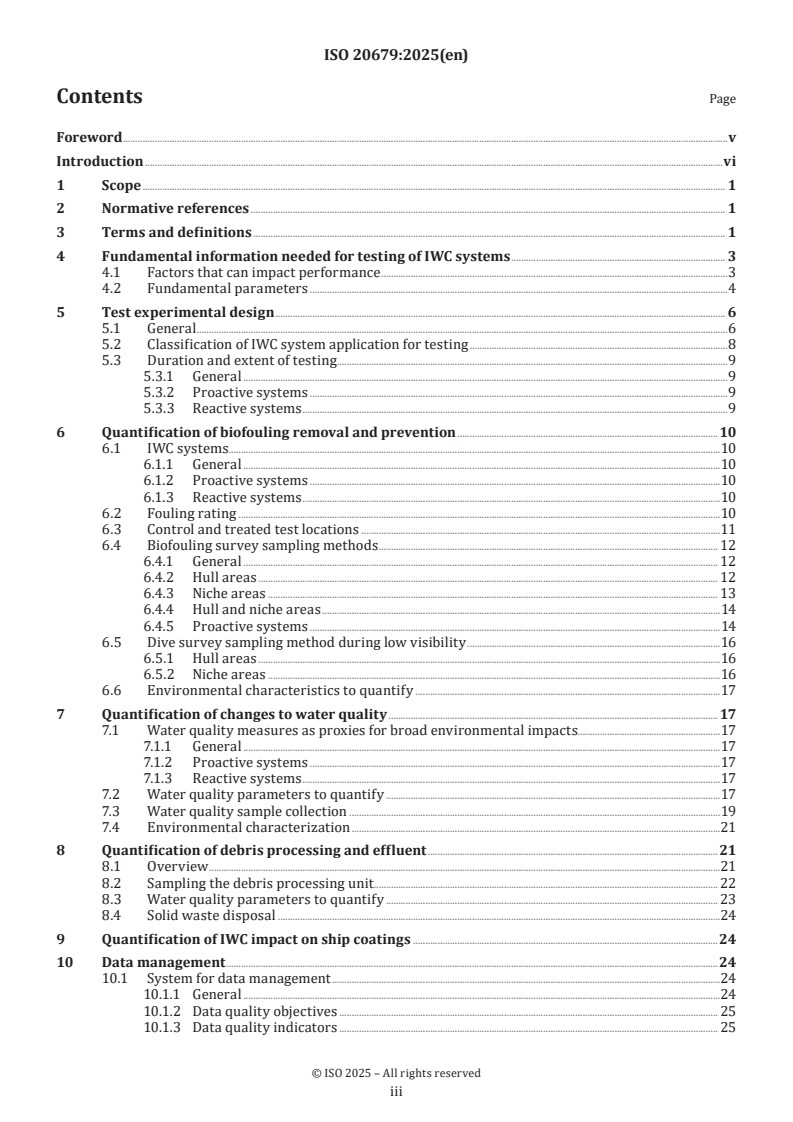
Contents Page
Foreword .v
Introduction .vi
1 Scope . 1
2 Normative references . 1
3 Terms and definitions . 1
4 Fundamental information needed for testing of IWC systems . 3
4.1 Factors that can impact performance .3
4.2 Fundamental parameters .4
5 Test experimental design . 6
5.1 General .6
5.2 Classification of IWC system application for testing .8
5.3 Duration and extent of testing.9
5.3.1 General .9
5.3.2 Proactive systems .9
5.3.3 Reactive systems .9
6 Quantification of biofouling removal and prevention .10
6.1 IWC systems.10
6.1.1 General .10
6.1.2 Proactive systems .10
6.1.3 Reactive systems .10
6.2 Fouling rating .10
6.3 Control and treated test locations .11
6.4 Biofouling survey sampling methods . 12
6.4.1 General . 12
6.4.2 Hull areas . 12
6.4.3 Niche areas . 13
6.4.4 Hull and niche areas .14
6.4.5 Proactive systems .14
6.5 Dive survey sampling method during low visibility .16
6.5.1 Hull areas .16
6.5.2 Niche areas .16
6.6 Environmental characteristics to quantify .17
7 Quantification of changes to water quality . 17
7.1 Water quality measures as proxies for broad environmental impacts.17
7.1.1 General .17
7.1.2 Proactive systems .17
7.1.3 Reactive systems .17
7.2 Water quality parameters to quantify .17
7.3 Water quality sample collection .19
7.4 Environmental characterization .21
8 Quantification of debris processing and effluent .21
8.1 Overview .21
8.2 Sampling the debris processing unit. 22
8.3 Water quality parameters to quantify . 23
8.4 Solid waste disposal .24
9 Quantification of IWC impact on ship coatings .24
10 Data management .24
10.1 System for data management .24
10.1.1 General .24
10.1.2 Data quality objectives . 25
10.1.3 Data quality indicators . 25
iii
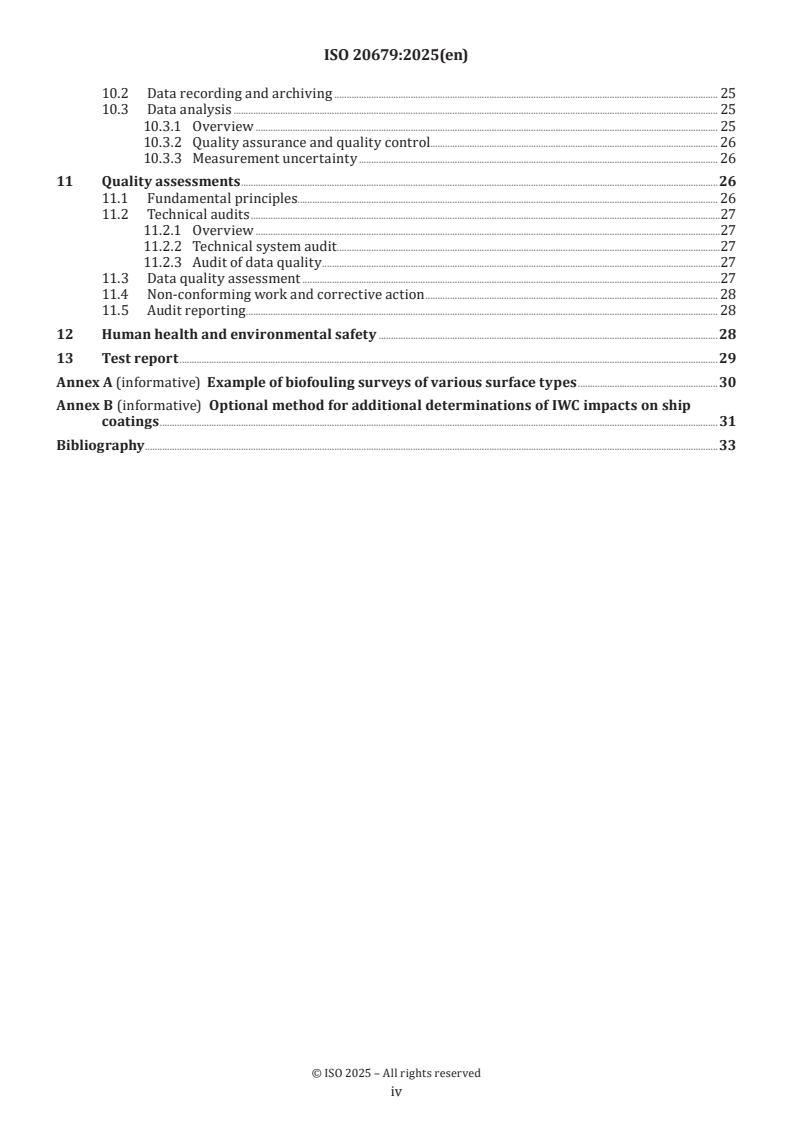
10.2 Data recording and archiving . 25
10.3 Data analysis . 25
10.3.1 Overview . 25
10.3.2 Quality assurance and quality control. 26
10.3.3 Measurement uncertainty . 26
11 Quality assessments .26
11.1 Fundamental principles. 26
11.2 Technical audits .27
11.2.1 Overview .27
11.2.2 Technical system audit .27
11.2.3 Audit of data quality .27
11.3 Data quality assessment .27
11.4 Non-conforming work and corrective action . 28
11.5 Audit reporting . . 28
12 Human health and environmental safety .28
13 Test report .29
Annex A (informative) Example of biofouling surveys of various surface types .30
Annex B (informative) Optional method for additional determinations of IWC impacts on ship
coatings .31
Bibliography .33
iv
Foreword
ISO (the International Organization for Standardization) is a worldwide federation of national standards
bodies (ISO member bodies). The work of preparing International Standards is normally carried out through
ISO technical committees. Each member body interested in a subject for which a technical committee
has been established has the right to be represented on that committee. International organizations,
governmental and non-governmental, in liaison with ISO, also take part in the work. ISO collaborates closely
with the International Electrotechnical Commission (IEC) on all matters of electrotechnical standardization.
The procedures used to develop this document and those intended for its further maintenance are described
in the ISO/IEC Directives, Part 1. In particular, the different approval criteria needed for the different types
of ISO document should be noted. This document was drafted in accordance with the editorial rules of the
ISO/IEC Directives, Part 2 (see www.iso.org/directives).
ISO draws attention to the possibility that the implementation of this document may involve the use of (a)
patent(s). ISO takes no position concerning the evidence, validity or applicability of any claimed patent
rights in respect thereof. As of the date of publication of this document, ISO had not received notice of (a)
patent(s) which may be required to implement this document. However, implementers are cautioned that
this may not represent the latest information, which may be obtained from the patent database available at
www.iso.org/patents. ISO shall not be held responsible for identifying any or all such patent rights.
Any trade name used in this document is information given for the convenience of users and does not
constitute an endorsement.
For an explanation of the voluntary nature of standards, the meaning of ISO specific terms and expressions
related to conformity assessment, as well as information about ISO's adherence to the World Trade
Organization (WTO) principles in the Technical Barriers to Trade (TBT), see www.iso.org/iso/foreword.html.
This document was prepared by Technical Committee ISO/TC 8, Ships and marine technology, Subcommittee
SC 2, Marine environment protection.
Any feedback or questions on this document should be directed to the user’s national standards body. A
complete listing of these bodies can be found at www.iso.org/members.html.
v
Introduction
Like all substrates placed in coastal waters, the wetted surfaces of ships are quickly colonized by a succession
[1][2][3]
of diverse sessile or sedentary micro- and macro-organisms, collectively known as biofouling. The
adverse effects of biofouling on ships and their operations are well known and there is a long history of
[4]
attempting various biofouling management approaches.
Negative impacts of biofouling on the shipping industry include:
[5][6][7][8]
— reduced ship performance and fuel efficiency;
[9][10]
— corrosion and decreased durability;
[11][12]
— increased greenhouse gas emissions;
[13][14]
— failure to meet associated legal/contractual requirements;
[15]
— increased underwater noise;
[16][17][18]
— unintended translocation of aquatic species.
In recent decades, the importance of ship biofouling as a pathway for invasive aquatic species translocations
[17][18][19][20][21]
has become increasingly apparent. Entire biological communities can be moved around the
world by oceangoing ships and a substantial number of species, including pathogens, can be introduced
[22][23][24]
as a result. While not all invasive aquatic species have immediate noticeable or significant
impacts, a subset of invasive aquatic species have a broad range of effects on the aquatic environment and
[25][26][27]
the communities reliant upon local ecosystem services. Guidelines and regulations to prevent
invasive aquatic species introductions via ship biofouling are beginning to emerge to protect environmental,
economic, social, and cultural values (e.g. see References [12] [28] [29]).
The International Maritime Organization (IMO) defines antifouling systems (AFS) as various approaches
[30]
used on a ship to control or prevent the attachment of unwanted organisms. The primary AFS are coatings,
applied during dry-docking to surfaces below the maximum waterline of ships, which are designed to either
[31]
prevent macrofouling attachment (using biocides) or reduce adhesion (foul-release) to wetted surfaces.
[32]
In some areas (e.g. Baltic Sea), non-ablative or non-polishing hard coatings are used in combination with
[33]
regular cleaning as a fouling prevention strategy.
The service life of modern coatings for commercial ships is typically five years (e.g. see Reference [32] [34]).
Despite substantial improvements over the past 40 years, surface coatings do not consistently prevent
[35][36]
biofouling accumulation on all ship surfaces over the course of their service lives. Accumulations tend
[37][38] [13][14][39][40]
to occur as coatings age and when ships have extended stationary periods.
Even when antifouling coatings are used, there are also substantial areas of ships’ immersed surfaces that
[41][42][43][44]
are more prone to biofouling because they:
— cannot be painted (e.g. anodes);
— are prone to damage (e.g. bulbous bow, tug and fender points, areas below anchor chain);
— are challenging to coat (e.g. dry-dock blocking areas); or
— are sub-optimal for coating performance (e.g. gratings, rudders, propellers, and sea chests).
Given the existing limitations of coatings, especially during extended periods between dry-docking, in-water
[12]
cleaning (IWC) of ship biofouling (within a coating's service life) is often required or advantageous.
IWC of biofouling – used to either maintain or reset ship immersed surfaces to a hydrodynamically smooth
[8][45]
state – is a common approach to increase ship performance and fuel efficiency between dry-dockings.
[11][12][46]
IWC is also recognized as beneficial for reducing both greenhouse gas emissions and biosecurity
[47][48]
risks.
vi
IWC systems typically involve the use of diver- or remotely-operated cleaning units (i.e. cleaning carts) that
[49][50] [47]
remove biofouling from hull surfaces. IWC is generally described as either proactive or reactive.
Proactive IWC is the periodic removal or reduction of biofilm growth (i.e. microfouling or slime layer) on
ship surfaces. Proactive IWC also removes newly settled or attached microscopic stages of macrofouling
[47][51]
organisms, to ultimately minimize or prevent macrofouling growth. Reactive IWC is typically used
[47][52]
to remove already established macrofouling organisms. Both proactive and reactive IWC can include
[48][52]
debris capture, treatment and disposal.
While IWC has the potential to provide significant ship operations and biosecurity benefits, there are two
main IWC processes that can result in inadvertent environmental harm:
a) lack of, or incomplete, capture of dislodged debris by the cleaning unit; and
[47][48]
b) release of untreated, or incompletely treated, effluent from debris processing.
Potential environmental impacts from these two IWC processes include:
[52][53][54][55]
— increased discharge of coating biocides and microplastics to ambient waters;
[24][52][54]
— release of live biofouling organisms, their propagules, or pathogens, into local habitats;
— diminished coating condition (e.g. dry film thickness [DFT] or scuffs and chips) that reduces antifouling
[45][56]
performance and longevity.
Given the potential for environmental harm, independent, transparent, and predictive testing of efficacy
is needed to evaluate the performance of both proactive and reactive IWC systems. Such robust and
standardized testing is critical for the responsible use of IWC systems and the success of biofouling-related
[48]
policies and regulations.
This document aims to provide standardized, science-based test procedures that produce the data (and level
of confidence) needed by relevant stakeholders when assessing the development and use of IWC systems.
This document is based on recent, related international efforts to develop IWC system testing protocols (e.g.
see References [50] [57] [58]). It describes how to produce data and report on the efficacy and safety of IWC
systems to clean various ship surfaces and for the capture and disposal of cleaning debris. The impartial
data and reporting from testing under this document are intended to inform IWC service providers, ship
operators, and relevant authorities on the performance of IWC. The procedures and methods in this
document can also serve as a resource for technology developers, environmental regulators, and other
stakeholders interested in the safe and effective use of IWC systems.
The methods and approaches presented in this document represent consensus among international
technical experts on best scientific practices. However, it is also expected that some test methods will evolve
or improve over time as collective knowledge of this complex issue grows. Performance and safety of IWC
systems is context-dependent with many sources of variation across ships, environments, and associated
biota. As a result, the use of this document does not guarantee that a specific IWC system will always, or
under circumstances other than those used in testing, operate at the levels reported.
This document was developed so that all forms of IWC systems can be tested in a comprehensive and
standardized way. However, this document also provides flexibility for conducting evaluations that are
customized and appropriate for individual IWC system designs, operational requirements or limits,
and providers’ claims. It is expected that end-users will select appropriate aspects of this document to
incorporate in any individual testing effort, depending on the specifics of the IWC system being evaluated,
the function of the IWC system evaluation, and the resources available.
vii
International Standard ISO 20679:2025(en)
Ships and marine technology — Marine environment protection
— Testing of ship biofouling in-water cleaning systems
1 Scope
This document provides detailed and rigorous procedures for the independent performance testing of all
forms of ship in-water cleaning (IWC), including on all types of biofouling (i.e. biofilms/microfouling and
macrofouling), all external submerged surfaces (i.e. hull and niche areas), and both proactive and reactive
IWC systems with or without the capture, processing, and disposal of debris. This document also includes
testing protocols and describes how to produce data and report on the efficacy and safety of IWC systems to
clean various ship surfaces and for the capture and disposal of cleaning debris.
The development of specific IWC performance requirements, criteria, or standards is outside the scope of this
document and is the responsibility of individual authorities, agencies, or administrations. Similarly, while
some methods and approaches described in this document can apply to other ship biofouling management
approaches, systems designed to kill or prevent biofouling on external surfaces without removal (i.e. without
in-water cleaning), and systems that remove or treat biofouling on internal surfaces (e.g. seawater pipes) or
external surfaces of intricate mechanical components (e.g. external parts of propeller shaft seal), are also
outside the scope of this document.
2 Normative references
There are no normative references for this document.
3 Terms and definitions
For the purposes of this document, the following terms and definitions apply.
ISO and IEC maintain terminology databases for use in standardization at the following addresses:
— ISO Online browsing platform: available at https:// www .iso .org/ obp
— IEC Electropedia: available at https:// www .electropedia .org/
3.1
antifouling system
AFS
coating, paint, surface treatment, surface or device that is used on a ship (3.18) to control or prevent the
attachment of organisms
3.2
antifouling coating
surface coating or paint designed to prevent, repel, or facilitate the detachment of biofouling (3.3) from hull
and niche areas (3.16) that are typically or occasionally submerged
3.3
biofouling
accumulation of aquatic organisms such as microorganisms, plants, and animals on surfaces and structures
immersed in or exposed to the aquatic environment
3.4
capture
process of containment, collection, and removal of biofouling (3.3) material, debris, and waste substances
(3.20) from surfaces during cleaning in water or in drydock
3.5
cleaning system
equipment used for, or the process of, removal of biofouling (3.3) from the ship (3.18) surface, with or without
capture (3.4)
3.6
data quality objective
qualitative and quantitative statement that clarifies study objectives, defines the appropriate types of data
and specifies the tolerable levels of potential decision errors that will be used as the basis for establishing
the quality and quantity of data needed to support decisions
3.7
dry film thickness
DFT
non-destructive means to measure the total coating thickness and wear on submerged ship surfaces through
repeated measures using a digital DFT sensor
3.8
fouling rating
FR
allocation of a number for a defined inspection area of the ship (3.18) surface based on a visual assessment,
including a description of biofouling (3.3) present and the percentage of macrofouling (3.13) coverage
3.9
hull area
largest proportion of ship (3.18) submerged surfaces, which are relatively flat or planar locations, have
well-understood hydrodynamic conditions and employ common or traditional biofouling (3.3) management
systems (e.g. antifouling coating (3.2))
3.10
independent testing organization
independent TO
appropriately independent (e.g. with no conflicts of interest), qualified, scientific contractor accepted to
conduct third-party testing
3.11
invasive aquatic species
non-native or non-indigenous species to a particular ecosystem that can pose threats to human, animal, and
plant life, economic and cultural activities, and the aquatic environment
3.12
in-water cleaning
IWC
intentional removal of biofouling (3.3) from a ship's (3.18) hull or niche areas (3.16) while in the water
3.13
macrofouling
biofouling (3.3) caused by the attachment and subsequent growth of visible plants and animals on structures
and ships (3.18) exposed to water
Note 1 to entry: Macrofouling are large, distinct multicellular individual or colonial organisms visible to the human eye
such as barnacles, tubeworms, mussels, fronds/filaments of algae, bryozoans, sea squirts, and other large attached,
encrusting or mobile organisms.
3.14
microfouling
biofouling (3.3) caused by bacteria, fungi, microalgae, protozoans, and other microscopic organisms that
create a biofilm
3.15
multicomponent in-water cleaning system
multicomponent IWC system
system reliant on two or more individual components to achieve the required in-water cleaning (3.12)
Note 1 to entry: The use of each component shall be specified in the system standard operating procedures (SOP), e.g.
the use of a hand tool for addressing niche areas (3.16) after the use of the main cleaning unit on hull surfaces.
3.16
niche area
subset of the submerged surface areas on a ship (3.18) that can be more susceptible to biofouling (3.3) than
the main hull owing to structural complexity, different or variable hydrodynamic forces, susceptibility to
antifouling coating (3.2) wear or damage, or inadequate or no protection by antifouling systems (3.1)
3.17
proactive in-water cleaning
proactive IWC
periodic removal of microfouling (3.14) on ship (3.18) surfaces to prevent or minimize attachment of
macrofouling (3.13)
3.18
ship
vessel of any type operating in the aquatic environment, including hydrofoil boats, air-cushion vehicles,
submersibles, floating craft, fixed or floating platforms, floating storage units, and floating production
storage and off-loading units
3.19
reactive in-water cleaning
reactive IWC
corrective action during which biofouling (3.3) is removed from a ship's (3.18) hull and niche areas (3.16),
either in water with capture (3.4) or in drydock
3.20
waste
dissolved and particulate materials or debris that can be released or produced during cleaning or
maintenance, and can include biocides, metals, organic substances, removed biofouling (3.3), pigments,
microplastics, or other contaminants that could have a negative impact on the environment
3.21
waste processing
treatment designed to remove or deactivate any particulate, dissolved material, or debris captured (3.4)
during any form of in-water cleaning (3.12)
Note 1 to entry: Treatment can be a single stage such as physical separation (e.g. settling tanks, filtration, flocculation),
selective media binding of compounds of concern, or disinfection of biological constituents of concern (e.g. biocides,
UV, ultrasound) or a multi-staged, combined treatment approach.
4 Fundamental information needed for testing of IWC systems
4.1 Factors that can impact performance
Numerous factors can impact IWC system performance and the means by which comprehensive,
[48][52]
standardized testing is performed. These include, but are not limited to:
— ship [e.g. type, design, coating(s), ship and coating ages, operational profile, and routes];
— biofouling (e.g. life history stage, type, coverage, location);
— environmental conditions (e.g. visibility, swell, current, ambient water quality);
— the IWC system (e.g. unique design features, operational requirements and limits, cleaning procedures); and
— IWC system operator training and experience.
4.2 Fundamental parameters
Testing IWC systems is most appropriate and informative when performed under real-world conditions.
However, the cost and complexity of full-scale operations on ships can prohibit extensive experimental
replication, controls, and the isolation of single factors to measure their impact on overall performance
and safety. Given the complexity of these variables, it is not feasible to examine all possible factors
(singularly or in combination) that can impact IWC system performance and safety. Therefore, a list of
fundamental parameters that shall be either documented, characterized, or specifically tested for, as part
of any independent evaluation, is provided in Table 1. The listed parameters allow for linking test results
to performance under specifically known (or measured) ship, biofouling, environmental, and IWC system
characteristics. The experimental design and specific performance parameters for IWC system testing are
described in Clauses 5 to 9.
Reporting for these parameters falls into three general categories:
— Documenting: information that shall be provided either by the ship owner, operator, IWC system service
provider, or all three, which appropriately describes test conditions;
— Monitoring: information that shall be observed, measured or collected (e.g. direct observations of
cleaning mobilization, operations, demobilization and environmental test conditions) and reported by
the independent testing organization (TO) conducting the testing; and
— Testing: factors that shall be directly targeted or manipulated as fundamental test variables (e.g. a direct
test of IWC system claims).
Table 1 — Test parameters and data required to assess IWC system performance
Ship parameters Documenting Monitoring Testing
Ship type/function, age, size, and
design drawings, with any relevant
X
modifications (including complexi-
ties and niche areas)
Ship recent routes/voyages and oper-
ational history over at least the past
X
12 months (including dry-docking,
long idle periods, lay-up, and repairs)
X Designates data or information required through documenting, monitoring, or testing for each parameter listed.
a
Proprietary, or commercially sensitive, information on specific IWC technologies or approaches can be held confidential,
provided enough basic information on system specifications, design, function, and operations are available to allow for an
adequate understanding of performance and safety.
b
For example, testing the IWC system service provider's claims on coating type (biocidal or fouling release), age or damage,
which can influence environmental results.
c
For example, testing the IWC system service provider's claims on fouling type/level/location and results from recent/
relevant in-water biofouling inspections.
d
For example, testing within specifications or to limits, including fouling (e.g. type, stage, and coverage), ship (e.g. size,
materials, curvature, niche areas), coating type and appropriateness for cleaning, and environmental parameters (e.g. currents
and visibility).
e
For example, testing within specifications or efficacy limits.
f
For example, testing within specifications or limits.
TTabablele 1 1 ((ccoonnttiinnueuedd))
Ship availability/access for either
cleaning, testing, or both (including
X
dates, ports, time at dock or anchor-
age, any access restrictions)
Ship coating(s) type (or uncoated),
age, expected service life, applied
b
X X X
location, and history (including prior
cleaning, damage, or repair)
Ship fouling rating prior to testing
(including type and percentage
c
X X
cover) and distribution on various
surfaces
Environmental parameters Documenting Monitoring Testing
Water visibility/clarity X
Tides, currents, wind, and waves X
Water quality at location of testing
and during testing, at minimum: (a)
salinity, (b) temperature, (c) total
suspended solids, (d) particle size X
distribution, (e) dissolved organic
carbon, and (f) particulate organic
carbon
Ambient levels of biocides during
testing, if applicable (e.g. back-
ground levels of copper and zinc) and
X
other contaminants of interest (e.g.
microplastics) in water column at
location of testing
a
IWC system parameters Documenting Monitoring Testing
IWC system design and function, and X X
IWC mobilization, operations and
demobilization
d
IWC system specifications, require- X X
ments and limits
Mode of cleaning unit operations (e.g. X X
diver-, remotely-, or autonomously-
operated)
Mode of cleaning unit attachment to, X X
and movement on, ship surfaces
Operator/diver skill and experience X X
(as described by the IWC service
provider)
X Designates data or information required through documenting, monitoring, or testing for each parameter listed.
a
Proprietary, or commercially sensitive, information on specific IWC technologies or approaches can be held confidential,
provided enough basic information on system specifications, design, function, and operations are available to allow for an
adequate understanding of performance and safety.
b
For example, testing the IWC system service provider's claims on coating type (biocidal or fouling release), age or damage,
which can influence environmental results.
c
For example, testing the IWC system service provider's claims on fouling type/level/location and results from recent/
relevant in-water biofouling inspections.
d
For example, testing within specifications or to limits, including fouling (e.g. type, stage, and coverage), ship (e.g. size,
materials, curvature, niche areas), coating type and appropriateness for cleaning, and environmental parameters (e.g. currents
and visibility).
e
For example, testing within specifications or efficacy limits.
f
For example, testing within specifications or limits.
TTabablele 1 1 ((ccoonnttiinnueuedd))
Mode of biofouling (biofilms or X X
macrofouling) removal (e.g. brushes,
blades, or water jets, with details on
type, amount, configuration)
Rate and pattern of individual clean- X X X
ing operations (e.g. speed of cleaning
unit, number and overlap of passes)
If applicable, frequency of cleaning X X
operations
e
If applicable, debris capture methods X X X
(e.g. cleaning unit shroud and suc-
tion)
If applicable, flow rate of debris/ X X
wastewater capture
f
If applicable, debris and wastewa- X X X
ter transport and processing (e.g.
particle settlement processes, type
and level of filtration/separation,
secondary treatment of biological
waste such as UV or chlorination,
type media for removal of metals)
and maximum load capacity
If applicable, waste disposal process- X X
es (including volumes and mass)
Various pre-set modes of operations X X
and adjustments during cleaning,
including contingency plans and
response to unexpected conditions
(e.g. presence of macrofouling during
proactive IWC) and system failures
X Designates data or information required through documenting, monitoring, or testing for each parameter listed.
a
Proprietary, or commercially sensitive, information on specific IWC technologies or approaches can be held confidential,
provided enough basic information on system specifications, design, function, and operations are available to allow for an
adequate understanding of performance and safety.
b
For example, testing the IWC system service provider's claims on coating type (biocidal or fouling release), age or damage,
which can influence environmental results.
c
For example, testing the IWC system service provider's claims on fouling type/level/location and results from recent/
relevant in-water biofouling inspections.
d
For example, testing within specifications or to limits, including fouling (e.g. type, stage, and coverage), ship (e.g. size,
materials, curvature, niche areas), coating type and appropriateness for cleaning, and environmental parameters (e.g. currents
and visibility).
e
For example, testing within specifications or efficacy limits.
f
For example, testing within specifications or limits.
5 Test experimental design
5.1 General
The full IWC system shall be tested on a minimum of three distinct ships (i.e. n ≥ 3). This level of replication is
meant to provide fundamental information on system performance, environmental safety, and applicability
across different conditions within the operational claims and parameters of the individual IWC system. A
single test ship will not be able to provide multiple relevant challenge conditions for predictive IWC system
testing. While such independent testing scenarios are not always possible, they represent the experimental
replication required for an acceptable level of confidence in the safety and efficacy of any IWC system.
Any deviation from this design, and this document more broadly, shall be noted in test results and reporting
(see Clause 13).
The test ships and conditions chosen shall capture as much relevant variability in the key parameters listed
in Table 1 as feasible. While the overall IWC system test unit of replication is the number of test ships (i.e. n
≥ 3), additional sample replication within individual test trials of biofouling removal/prevention, changes
to water quality, debris capture/processing, and ship coatings impacts, are provided in Figures 1 and 2 and
Clauses 5 to 9.
Figure 1 — Basic testing components for a proactive IWC system
Figure 2 — Basic testing components for a reactive IWC system
The ships selected and specific tests conducted shall align with the claims of the IWC service provider. For
example, if it is claimed the IWC system can be used on all coating types, then ships with different biocidal
and non-biocidal coatings shall be included in testing to verify that claim. If the IWC system is claimed to be
appropriate for use on large cargo ships with extensive macrofouling, then testing shall include these ship
types that have close to the upper limit of biofouling type and coverage, to verify that claim. Likewise, if the
IWC system is intended for use on both relatively flat hulls as well as angular niche areas, then examples of
both ship surface types and distinct equipment used for different surface types shall be included in testing
to verify that claim.
While it is possible that it is not feasible to directly examine all IWC service provider claims in one set of
independent tests, extrapolation or prediction of performance and safety (beyond the specific conditions
and parameters tested) shall be avoided.
5.2 Classification of IWC system application for testing
Test trials, on diverse replicate test ships (n ≥ 3, varying in size, age, routes, operational pr
...