

ISO 17185-1:2014
(Main)Intelligent transport systems — Public transport user information — Part 1: Standards framework for public information systems
General Information
- Abstract
ISO 17185-1:2014 defines the framework for the realization of efficient public transport user information provision to surface public transport users including international worldwide travellers. In the surface public transport user information provision area, a set of regional and national standards have already been established by related regional and national standardizing bodies. ISO 17185-1:2014 defines basic framework for user information provision for surface public transport users, from the viewpoint that the surface public transport users should be provided with proper static and real-time information when it is most desired and effective. In order to realize the desirable information provision, surface public transport information has to be efficiently gathered, processed, and provided to surface public transport users in an appropriate way by using currently available regional standards. ISO 17185-1:2014 does not aim to define a new part of ISO 17185 that supersede current regional and national standards related to surface public transport. It aims to define the basic framework of surface public transport user information provision by esteeming existing regional standards and wisely using them. ISO 17185-1:2014 does not aim to define specific information interfaces such as data format or a stop point numbering system. The currently available regional standards established by regional and national groups are suggested to be applied in that scope.
- Status
- Published
- Publication Date
- 18-Mar-2014
- Technical Committee
- ISO/TC 204 - Intelligent transport systems
- Drafting Committee
- ISO/TC 204/WG 8 - Public transport/emergency
- Current Stage
- 9093 - International Standard confirmed
- Start Date
- 08-Aug-2022
- Completion Date
- 29-Aug-2026

Overview
ISO 17185-1:2014 - part of the ISO 17185 series on Intelligent Transport Systems (ITS) - defines a high-level standards framework for public transport user information. It sets out principles and structure for providing efficient static and real‑time information to surface public transport users, including international travellers, without superseding established regional or national standards. The document focuses on how information should be gathered, processed and delivered so that passengers receive the right information at the right time.
Key Topics
- Framework scope and objectives: Establishes the basic framework for surface public transport user information provision, emphasizing usability, timeliness and international traveller needs.
- Roles and responsibilities: Defines primary actors (PT service operators, regional/inter‑regional information providers, information aggregators) and their responsibilities in information collection, processing and dissemination.
- High‑level use cases: Describes when and how user information should be provided (static schedules, real‑time updates, journey planning) to support stress‑free travel.
- Functional areas: Identifies basic functions such as operations monitoring and control, passenger information, scheduling and management information required to support user information systems.
- Interoperability approach: Recommends using existing regional and national standards rather than defining new data formats, stop numbering systems, or interface specifications.
- Normative structure: Part 1 complements ISO 17185-2 (data and interface catalogue) and ISO 17185-3 (journey planning use cases and interoperation).
Practical Applications and Who Uses It
- Public transport operators: To align information provisioning policies and ensure timely static and real‑time passenger information.
- ITS system integrators and vendors: To design system architectures that gather, process and present PT user information while leveraging regional standards.
- Transport authorities and planners: For policy, procurement and to harmonize cross‑border information services for international travellers.
- Standards bodies and consultants: To map local/regional standards into a consistent high‑level framework that supports interoperability and reuse.
Benefits include reduced duplication of effort, faster deployment of PT information systems, and improved passenger experience through consistent, timely information.
Related Standards
ISO 17185-1 explicitly complements and recommends using established standards rather than replacing them. Relevant referenced standards and profiles include:
- ISO 17185-2 and ISO 17185-3 (other parts of the series)
- TRANSMODEL (CEN EN 12896)
- TCIP (APTA)
- SIRI (CEN TS 15531)
- NeTEx / NEPTUNE, NaPTAN, IFOPT
Using ISO 17185-1 helps organizations integrate these regional standards into a coherent, international framework for public transport user information.
Relations
- Consolidated By
ISO 20339:2017 - Non-destructive testing — Equipment for eddy current examination — Array probe characteristics and verification - Effective Date
- 06-Jun-2022
Get Certified
Connect with accredited certification bodies for this standard

BSI Group
BSI (British Standards Institution) is the business standards company that helps organizations make excellence a habit.

Great Wall Tianjin Quality Assurance Center
Established 1993, first batch to receive national accreditation with IAF recognition.
Hong Kong Quality Assurance Agency (HKQAA)
Hong Kong's leading certification body.
Sponsored listings
Frequently Asked Questions
ISO 17185-1:2014 is a standard published by the International Organization for Standardization (ISO). Its full title is "Intelligent transport systems — Public transport user information — Part 1: Standards framework for public information systems". This standard covers: ISO 17185-1:2014 defines the framework for the realization of efficient public transport user information provision to surface public transport users including international worldwide travellers. In the surface public transport user information provision area, a set of regional and national standards have already been established by related regional and national standardizing bodies. ISO 17185-1:2014 defines basic framework for user information provision for surface public transport users, from the viewpoint that the surface public transport users should be provided with proper static and real-time information when it is most desired and effective. In order to realize the desirable information provision, surface public transport information has to be efficiently gathered, processed, and provided to surface public transport users in an appropriate way by using currently available regional standards. ISO 17185-1:2014 does not aim to define a new part of ISO 17185 that supersede current regional and national standards related to surface public transport. It aims to define the basic framework of surface public transport user information provision by esteeming existing regional standards and wisely using them. ISO 17185-1:2014 does not aim to define specific information interfaces such as data format or a stop point numbering system. The currently available regional standards established by regional and national groups are suggested to be applied in that scope.
ISO 17185-1:2014 defines the framework for the realization of efficient public transport user information provision to surface public transport users including international worldwide travellers. In the surface public transport user information provision area, a set of regional and national standards have already been established by related regional and national standardizing bodies. ISO 17185-1:2014 defines basic framework for user information provision for surface public transport users, from the viewpoint that the surface public transport users should be provided with proper static and real-time information when it is most desired and effective. In order to realize the desirable information provision, surface public transport information has to be efficiently gathered, processed, and provided to surface public transport users in an appropriate way by using currently available regional standards. ISO 17185-1:2014 does not aim to define a new part of ISO 17185 that supersede current regional and national standards related to surface public transport. It aims to define the basic framework of surface public transport user information provision by esteeming existing regional standards and wisely using them. ISO 17185-1:2014 does not aim to define specific information interfaces such as data format or a stop point numbering system. The currently available regional standards established by regional and national groups are suggested to be applied in that scope.
ISO 17185-1:2014 is classified under the following ICS (International Classification for Standards) categories: 03.220.01 - Transport in general; 35.240.60 - IT applications in transport. The ICS classification helps identify the subject area and facilitates finding related standards.
ISO 17185-1:2014 has the following relationships with other standards: It is inter standard links to ISO 20339:2017. Understanding these relationships helps ensure you are using the most current and applicable version of the standard.
ISO 17185-1:2014 is available in PDF format for immediate download after purchase. The document can be added to your cart and obtained through the secure checkout process. Digital delivery ensures instant access to the complete standard document.
Standards Content (Sample)
INTERNATIONAL ISO
STANDARD 17185-1
First edition
2014-04-01
Intelligent transport systems — Public
transport user information —
Part 1:
Standards framework for public
information systems
Systèmes intelligents de transport — Informations destinées aux
utilisateurs des transports publics —
Partie 1: Cadre pour les normes relatives aux systèmes d’information
publique
Reference number
©
ISO 2014
© ISO 2014
All rights reserved. Unless otherwise specified, no part of this publication may be reproduced or utilized otherwise in any form
or by any means, electronic or mechanical, including photocopying, or posting on the internet or an intranet, without prior
written permission. Permission can be requested from either ISO at the address below or ISO’s member body in the country of
the requester.
ISO copyright office
Case postale 56 • CH-1211 Geneva 20
Tel. + 41 22 749 01 11
Fax + 41 22 749 09 47
E-mail copyright@iso.org
Web www.iso.org
Published in Switzerland
ii © ISO 2014 – All rights reserved
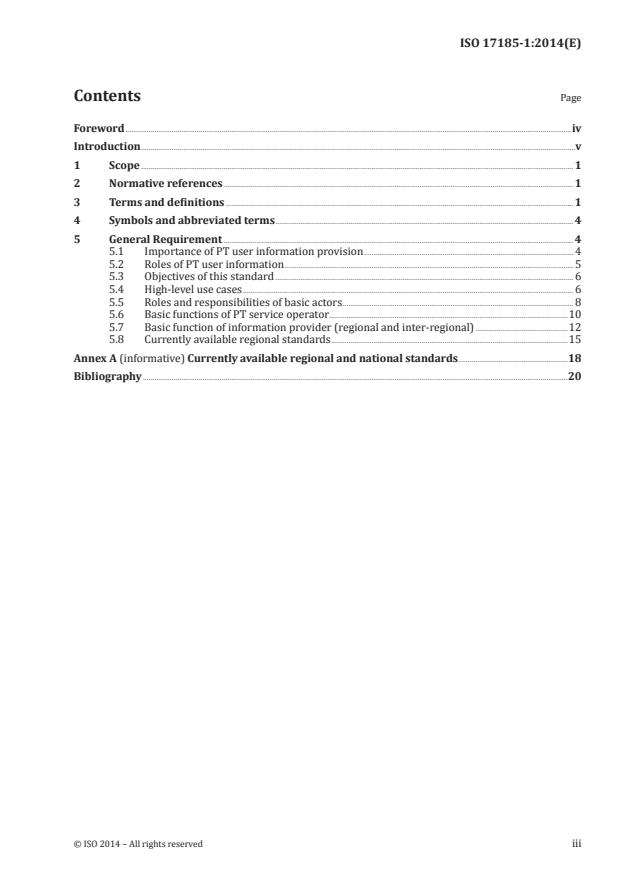
Contents Page
Foreword .iv
Introduction .v
1 Scope . 1
2 Normative references . 1
3 Terms and definitions . 1
4 Symbols and abbreviated terms . 4
5 General Requirement . 4
5.1 Importance of PT user information provision . 4
5.2 Roles of PT user information . 5
5.3 Objectives of this standard . 6
5.4 High-level use cases . 6
5.5 Roles and responsibilities of basic actors . 8
5.6 Basic functions of PT service operator .10
5.7 Basic function of information provider (regional and inter-regional) .12
5.8 Currently available regional standards .15
Annex A (informative) Currently available regional and national standards .18
Bibliography .20
Foreword
ISO (the International Organization for Standardization) is a worldwide federation of national standards
bodies (ISO member bodies). The work of preparing International Standards is normally carried out
through ISO technical committees. Each member body interested in a subject for which a technical
committee has been established has the right to be represented on that committee. International
organizations, governmental and non-governmental, in liaison with ISO, also take part in the work.
ISO collaborates closely with the International Electrotechnical Commission (IEC) on all matters of
electrotechnical standardization.
The procedures used to develop this document and those intended for its further maintenance are
described in the ISO/IEC Directives, Part 1. In particular the different approval criteria needed for the
different types of ISO documents should be noted. This document was drafted in accordance with the
editorial rules of the ISO/IEC Directives, Part 2 (see www.iso.org/directives).
Attention is drawn to the possibility that some of the elements of this document may be the subject of
patent rights. ISO shall not be held responsible for identifying any or all such patent rights. Details of
any patent rights identified during the development of the document will be in the Introduction and/or
on the ISO list of patent declarations received (see www.iso.org/patents).
Any trade name used in this document is information given for the convenience of users and does not
constitute an endorsement.
For an explanation on the meaning of ISO specific terms and expressions related to conformity
assessment, as well as information about ISO’s adherence to the WTO principles in the Technical Barriers
to Trade (TBT) see the following URL: Foreword - Supplementary information
The committee responsible for this document is ISO/TC 204, Intelligence transport systems.
ISO 17185 consists of the following parts, under the general title Intelligent transport systems — Public
transport user information:
— Part 1: Standards framework for public information systems
— Part 2: Data and interface standards catalogue and cross reference
— Part 3: Use cases for journey planning systems and their interoperation
iv © ISO 2014 – All rights reserved
Introduction
TC204 Intelligent Transport Systems, WG8, Public Transport and Emergency Services, have been
discussing enhancement of surface public transport information provision to surface public transport
users including international travellers around the world by using ITS technology.
WG8, Public Transport and Emergency Services, have been trying to harmonize current surface public
transport information provision interface national and regional standards, mainly, the TRANSMODEL
standard developed by CEN and the TCIP standard developed by the American Public Transportation
Association in the USA. However, because these surface public transport information standards are
widely accepted and used for system implementation in their regions, there is no perceived need or
demand to harmonize them.
Because WG8’s responsibility is to make surface public transport more convenient by realizing stress-
free surface public transport user information provision, WG8 has reached the conclusion that it has
to establish one International Standard (but not a technical report which has no binding rules) which
is defining basic framework that will fit above current national and regional standards. The accepted
national and regional standards (at this point in time, TCIP and TRANSMODEL) will be allowed to define
the specific information interfaces such as data format, stop point numbering system, etc. that are
necessary to the implementation of surface public transport information systems.
This part of ISO 17185 will be beneficial for all ISO/CEN member countries, as well as non-ISO/CEN
member countries, because this part of ISO 17185 will be a valuable “text book” to detail basic framework,
as well as highlight and encourage use of currently available national and regional standards such as
TRANSMODEL, TCIP, and possibly others. The intention is that, by deploying these national and regional
standards by other countries or regions, duplication of cost and time is avoidable. For those countries
that do not have surface public transport information standards, this approach allows more rapid
development and deployment of public transport systems that enhance usability and convenience.
This part of ISO 17185 is specifically set at a higher level and not aiming to harmonize currently
available national and regional standards to allow the use of these robust standards which are set at
various levels (for example, implementation specifications versus application level standards) but which
also experience widespread acceptance in their regional standards. This part of ISO 17185 intends to
establish a basic solid foundation for surface public transport user information provision framework and
is specifically limited to this scope to avoid conflict with those currently available regional standards.
This part of ISO 17185 is intended to be fully consistent with those currently available national and
regional standards which might be related to international surface public transport. In fact, in the
case of international surface public transport, surface public transport operators already have
transport-related information systems. However, it is not often the case that surface public transport
users, including international travellers, are provided with static and real-time information including
bus/train/tram locations appropriately and timely. This part of ISO 17185, and its scope and approach,
will solve this issue by setting basic framework for surface public transport information provision while
embracing existing national and regional standards.
INTERNATIONAL STANDARD ISO 17185-1:2014(E)
Intelligent transport systems — Public transport user
information —
Part 1:
Standards framework for public information systems
1 Scope
This part of ISO 17185 defines the framework for the realization of efficient public transport user
information provision to surface public transport users including international worldwide travellers.
In the surface public transport user information provision area, a set of regional and national standards
have already been established by related regional and national standardizing bodies.
This part of ISO 17185 defines basic framework for user information provision for surface public
transport users, from the viewpoint that the surface public transport users should be provided with
proper static and real-time information when it is most desired and effective. In order to realize the
desirable information provision, surface public transport information has to be efficiently gathered,
processed, and provided to surface public transport users in an appropriate way by using currently
available regional standards.
This part of ISO 17185 does not aim to define a new part of ISO 17185 that supersedes current regional
and national standards related to surface public transport. It aims to define the basic framework of
surface public transport user information provision by esteeming existing regional standards and
wisely using them.
This part of ISO 17185 does not aim to define specific information interfaces such as data format or a
stop point numbering system. The currently available regional standards established by regional and
national groups are suggested to be applied in that scope.
2 Normative references
The following documents, in whole or in part, are normatively referenced in this document and are
indispensable for its application. For dated references, only the edition cited applies. For undated
references, the latest edition of the referenced document (including any amendments) applies.
ISO 17185-2, Intelligent transport system — Public transport user information — Part 2: Data and interface
standards catalogue and cross reference
ISO 17185-3, Intelligent transport system — Public transport user information — Part 3: Use cases for
journey planning systems and their inter-operation
3 Terms and definitions
For the purposes of this document, the following terms and definitions apply.
3.1
data
reinterpretable representation of information in a formalized manner suitable for communication,
interpretation, or processing
Note 1 to entry: Data can be processed by humans or by automatic means. [ISO/IEC 2382-1:1993, (01.01.02)]
Note 2 to entry: Adapted from ISO/IEC 15944.
3.2
database
collection of electronically stored descriptive records or content units (including facts, full texts,
pictures, and sound) with a common user interface and software for the retrieval and manipulation of
the data
Note 1 to entry: The units or records are usually collected with a particular intent and are related to a defined
topic. A database can be issued on CD-ROM, diskette, or other direct-access method, or as a computer file accessed
through dial-up methods or through the Internet.
Note 2 to entry: Licensed databases are counted separately even if access to several licensed database products is
effected through the same interface.
Note 3 to entry: A common interface providing access to a packet of serials or digital documents, usually offered
by a publisher or vendor, is also to be counted as database. Additionally, the single serials or digital documents are
counted as serials or digital documents. [ISO 2789:2013, 2.3.10]
Note 4 to entry: Adapted from ISO 9707.
3.3
data model
graphical and/or lexical representation of data, specifying their properties, structure, and inter-
relationships
Note 1 to entry: Adapted from ISO/IEC 11179.
3.4
entity
concrete or abstract thing that exists, did exist, or might exist, including associations among these things
EXAMPLE A person, object, event, idea, process, etc.
Note 1 to entry: An entity exists whether data about it are available or not. [ISO/IEC 2382-17:1999, (17.02.05)]
Note 2 to entry: Adapted from ISO/IEC 15944.
3.5
fare collection
all activities related to the collection of money from passengers
3.6
framework
structure expressed in diagrams, text, and formal rules which relates the components of a conceptual
entity to each other
Note 1 to entry: Adapted from ISO 19439:2006, 3.3.
3.7
function
intended effect of a system, subsystem, product, or part
[SOURCE: EN 1325-1:1997]
Note 1 to entry: Functions should have a single definite purpose. Function names should have a declarative
structure (e.g. “Validate telecommands”) and say “what” is to be done rather than “how”. Good naming allows
design components with strong cohesion to be easily derived.
Note 2 to entry: Adapted from ISO 16091.
2 © ISO 2014 – All rights reserved
3.8
functional area
combination of groups and/or elements in a unit that can be used independently
Note 1 to entry: Adapted from ISO 16952.
3.9
IC
small piece of semiconductive material that contains interconnected electronic elements
Note 1 to entry: Adapted from ISO/IEC 2382-1.
3.10
logical data model
data design that takes into account the type of database to be used, but does not consider means of
utilization of space or access
3.11
management information
information utilized by management or produced to serve a management function
Note 1 to entry: Adapted from ISO 6707-2.
Note 2 to entry: In this part of ISO 17185, this term means all activities allowing the company management to
collect the information necessary to meet problem-solving needs. Data of operational systems are filtered and
aggregated for this purpose and made available to the user interactively or in form of pre-defined reports and
summaries. Such functions are, in principle, related to all functional areas of a company, with particular reference
to the management of statistical results.
3.12
operations monitoring and control
all activities related to the transportation process, i.e. real-time functions related to the driving and
transportation of passengers according to given instructions, including the monitoring of the driving
process and its control in case of deviations, as well as all activities that support the driving process
(traffic light priority, track switching, bay selection, advance/delay advice etc.)
Note 1 to entry: Such functions are often assisted by computer-aided tools known as Automated Vehicle Monitoring
(AVM).
3.13
passenger information
activities related to informing the users either on the planned or on the actual transportation services
3.14
personnel disposition
activities related to the mid-term and short-term management of drivers
3.15
scheduling
method of controlling the timing of the execution of a scheduled activity within or represented by a
managed object
Note 1 to entry: Adapted from ISO/IEC 10164.
Note 2 to entry: In this part of ISO 17185, this term means all activities related to the tactical planning of
transportation, splitting into vehicle scheduling, driver scheduling, and rostering.
3.16
use case
sequence of actions that an actor (usually a person, but perhaps an external entity, such as another
system) performs within a system to achieve a particular goal
Note 1 to entry: Adapted from ISO/TR 25102.
4 Symbols and abbreviated terms
AVL automatic vehicle location
BISON Beheer Informatie Standaarden OV Nederland, Netherlands public transport infor-
mation standards management platform
CEN European Committee for Standardization
DE Germany
EU European Union
GPS global navigation system
IEC international Electrotechnical Commission
IFOPT identification of fixed objects in public transport, CEN published standard EN 28701
ISO International Organization for Standardization
ITS intelligent transport systems
NaPTAN national public transport access nodes, GB national system for uniquely identifying
all the points of access to public transport in GB
NEPTUNE French standard (PR NF 99–506) for format describing public transport routes
NeTEx network exchange, CEN TC278 WG3 standard currently in development with the goal
to provide efficient European-wide standard for exchanging public transport sched-
ules and related data
PT public transport
RTPI real-time passenger information
SIRI service interface for real-time information, CEN technical specification (TS 15531)
TCIP transit communications interface profiles, US standard developed by APTA for intro-
ducing advanced ITS technologies into PT to improve safety, security, and efficiency
Transmodel CEN standard (EN 12896) for reference data model for public transport information
which provides an abstract model of common public transport concepts and data
structures that can be used to build many different kind of public transport infor-
mation system, including for timetabling, fares, operational management, real-time
data, journey planning, etc.
TransXChange exchanging bus schedules and related data, GB nationwide standard
5 General Requirement
5.1 Importance of PT user information provision
PT service operator shall play an important role in surface transport as society fully depend upon
privately owned cars that has their own limitations such as high environmental impact, increasing
number of accidents related to aged drivers, and shrinking economy due to scattered population.
The issue of the current PT to be solved varies country to country or city to city, however, the following
common vision can be observed. From the PT service operator’s point of view, benefit/cost factor can
4 © ISO 2014 – All rights reserved
be kept high by deploying ITS technologies such as simple and efficient fare transaction device and
priority traffic control signal system. From the PT user’s (customer) point of view, PT use shall be more
attractive than driving his/her own car by improving PT transport speed and reducing PT fare and by
providing attractive PT user information to PT users.
When providing PT user information, it is important to understand that there are various types of
customers and their needs vary between customer types. In local residents, there are two types of
customers, one who does not know how to use PT and the the other who knows basic information and
understands that PT is reliable transport that is on time and safe. Usually, a visitor is not familiar with
local PT and expects physically and mentally friendly PT services. Therefore, PT user information
provision framework shall be designed to accommodate those various needs.
Various PT information provision projects are under practical use, and the project status reports
are commonly shared internationally to improve PT user information provision system continuously
throughout the world.
There are several key issues concerning PT when creating “PT user”-friendly society, namely,
— attractive PT user information provision to potential PT users,
— attractive PT IC fare card system,
— efficient and attractive PT service timetabling and service routes,
— fare relationship between regional transit regulator and PT service operator, and
— reliable relationship between PT drivers and PT service operator by deploying ITS technologies.
Defining basic PT user information provision framework, which is commonly acceptable internationally,
is indispensable for both of advanced and emerging countries where PT user information provision
system improvements are needed.
The PT user information provision service architecture and required standards needed varies country
to country. This part of ISO 17185 provides basic framework guidelines which shall be referred when
such PT information provision system is implemented.
This part of ISO 17185 describes high-level basic framework requirements for PT user information
provisions. For the detailed use cases and data and interface standards catalogues and cross reference,
refer to ISO 17185-2 and ISO 17185-3.
5.2 Roles of PT user information
The functional roles of PT user information are summarized as follows. Although the scope of this
part of ISO 17185 is PT user information provisions, all of the potential roles are listed for the reader’s
educational purposes.
— provide PT services using PT vehicles (track vehicles)
— provide planned service information
— provide passenger facility/infrastructure information
— provide real-time service information
— provide topographic and geographic information
— provide PT network information
— provide trip plans to customers
— provide information about disruptions to PT service
— detours
— delays
— incidents
— provide (coordinated) transfer information (real-time, schedule)
— create data (data provider)
— collect data (e.g. asset information)
— process data (data processor)
— provide predictions
— translate data from one format to another/ or from one channel to another
— collate data (data collator)
— disseminate data
— validate data
— apply data to application
— fund information provision
— measure performance
— interface to other modes of transport
— integration of PT costumer information into intermodal travel planners
— other areas such as information use, access, service performance, quality, etc. can be added to this
list.
5.3 Objectives of this standard
The objectives of ISO 17185 are defined as follows:
— Part 1 defines the high-level stakeholder roles and responsibilities and their PT user information
exchanges.
— Part 2 defines data interface message comparison.
— Part 3 defines use cases for journey planning systems and their inter-operation where in the
worldwide standards apply and it may include exchange of information using nomadic devices.
Overall, this part of ISO 17185 describes a framework to facilitate inter-operability of public transport-
related information using different national/regional standards (The off-the-shelf use of standards).
This is accomplished by defining the high-level stakeholder roles and responsibilities and PT user
information exchange, data, and interface message comparisons use cases.
5.4 High-level use cases
In this part of ISO 17185, the high-level use cases are defined to describe commonly applicable
basic framework. The detailed use cases and translation between existing standards are defined in
ISO 17185-2 and ISO 17185-3. For the basic actors of these high-level use cases, see 5.5.
6 © ISO 2014 – All rights reserved
5.4.1 Use case 1 - PT service operator to monitor, control, and inf
...