

ISO 8100-7:2024
(Main)Lifts for the transport of persons and goods — Part 7: Accessibility to lifts for persons including persons with disability
General Information
- Abstract
This document specifies the minimum requirements for the safe and independent access and use of lifts by persons, including persons with disabilities. It covers the needs of persons with disabilities according to Annex A. NOTE For guidance on solutions for increased accessibility and usability, see Annex D. This document is not applicable to lifts installed before the date of its publication.
- Status
- Published
- Publication Date
- 22-Oct-2024
- Technical Committee
- ISO/TC 178 - Lifts, escalators and moving walks
- Drafting Committee
- ISO/TC 178 - Lifts, escalators and moving walks
- Current Stage
- 9092 - International Standard to be revised
- Start Date
- 18-Jun-2025
- Completion Date
- 29-Aug-2026


Overview
ISO 8100-7:2024 - "Lifts for the transport of persons and goods - Part 7: Accessibility to lifts for persons including persons with disability" specifies minimum requirements for the safe and independent access and use of lifts by all people, including persons with disabilities. It defines design, control and signalling requirements, car dimensions and door operation rules to eliminate barriers and reduce hazards. This edition applies to lifts installed after its publication date and complements ISO 8100-1 and ISO 12100.
Key topics and technical requirements
- Scope and principles
- Sets minimum accessibility and safety requirements; addresses hazards and ergonomic barriers identified by risk assessment.
- Entrances and doors
- Automatic horizontally sliding doors with adjustable dwell time (2–20 s); recommended minimum dwell of 6 s for reduced mobility.
- Minimum clear opening widths: typically 800 mm, 900 mm or 1 100 mm depending on car type.
- Car dimensions and internal fittings
- Prescribed minimum car widths and depths for different accessibility types (e.g., Type 1: 1 000 × 1 300 mm; Type 2: 1 100 × 1 400 mm; Type 3: 1 100 × 2 100 mm), measured between structural walls.
- Restrictions on fittings below 800 mm to allow wheelchair turning and maneuvering.
- Control devices and signals
- Requirements for tactile, visual and audible indicators; collective vs destination control systems defined.
- Audible announcements adjustable between 35–65 dB(A) (up to 80 dB(A) in noisy environments); adjustment restricted to authorized personnel.
- Luminance contrast and light reflectance requirements for buttons, faces and symbols (see Table 2); guidance in Annex E.
- Safety verification and information for use
- Procedures for verifying compliance and providing user information and signage.
Practical applications and users
ISO 8100-7:2024 is essential for:
- Architects and building designers specifying lifts for inclusive design
- Lift manufacturers and component suppliers designing cars, doors and controls
- Accessibility consultants, occupational health and safety professionals
- Facility managers, building owners and installers ensuring compliance in new installations
- Regulators and code officials integrating accessibility standards into national regulations
Use cases include public buildings, transport hubs, healthcare facilities, offices and residential developments where independent lift access is required.
Related standards and annexes
- Related: ISO 8100-1:2019, ISO 12100:2010, ISO 4190-5:2006
- Annexes in ISO 8100-7:
- Annex A: categories of disability considered (normative)
- Annex B: extra-large control devices (normative)
- Annex C: touch screen devices for destination control (normative)
- Annex D: guidance for increased accessibility (informative)
- Annex E: luminance contrast determination (informative)
Keywords: ISO 8100-7:2024, lift accessibility, elevator accessibility standard, car dimensions, door dwell time, luminance contrast, destination control system, accessibility for persons with disability.
Relations
- Effective Date
- 12-Feb-2026
Get Certified
Connect with accredited certification bodies for this standard

BSI Group
BSI (British Standards Institution) is the business standards company that helps organizations make excellence a habit.

TÜV Rheinland
TÜV Rheinland is a leading international provider of technical services.

TÜV SÜD
TÜV SÜD is a trusted partner of choice for safety, security and sustainability solutions.
Sponsored listings
Frequently Asked Questions
ISO 8100-7:2024 is a standard published by the International Organization for Standardization (ISO). Its full title is "Lifts for the transport of persons and goods — Part 7: Accessibility to lifts for persons including persons with disability". This standard covers: This document specifies the minimum requirements for the safe and independent access and use of lifts by persons, including persons with disabilities. It covers the needs of persons with disabilities according to Annex A. NOTE For guidance on solutions for increased accessibility and usability, see Annex D. This document is not applicable to lifts installed before the date of its publication.
This document specifies the minimum requirements for the safe and independent access and use of lifts by persons, including persons with disabilities. It covers the needs of persons with disabilities according to Annex A. NOTE For guidance on solutions for increased accessibility and usability, see Annex D. This document is not applicable to lifts installed before the date of its publication.
ISO 8100-7:2024 is classified under the following ICS (International Classification for Standards) categories: 11.180.99 - Other standards related to aids for disabled and handicapped people; 91.140.90 - Lifts. Escalators. The ICS classification helps identify the subject area and facilitates finding related standards.
ISO 8100-7:2024 has the following relationships with other standards: It is inter standard links to EN 81-70:2021+A1:2022. Understanding these relationships helps ensure you are using the most current and applicable version of the standard.
ISO 8100-7:2024 is available in PDF format for immediate download after purchase. The document can be added to your cart and obtained through the secure checkout process. Digital delivery ensures instant access to the complete standard document.
Standards Content (Sample)
International
Standard
ISO 8100-7
First edition
Lifts for the transport of persons
2024-10
and goods —
Part 7:
Accessibility to lifts for persons
including persons with disability
Elévateurs pour le transport de personnes et d'objets —
Partie 7: Accessibilité aux ascenseurs pour toutes les personnes y
compris les personnes avec handicap
Reference number
© ISO 2024
All rights reserved. Unless otherwise specified, or required in the context of its implementation, no part of this publication may
be reproduced or utilized otherwise in any form or by any means, electronic or mechanical, including photocopying, or posting on
the internet or an intranet, without prior written permission. Permission can be requested from either ISO at the address below
or ISO’s member body in the country of the requester.
ISO copyright office
CP 401 • Ch. de Blandonnet 8
CH-1214 Vernier, Geneva
Phone: +41 22 749 01 11
Email: copyright@iso.org
Website: www.iso.org
Published in Switzerland
ii
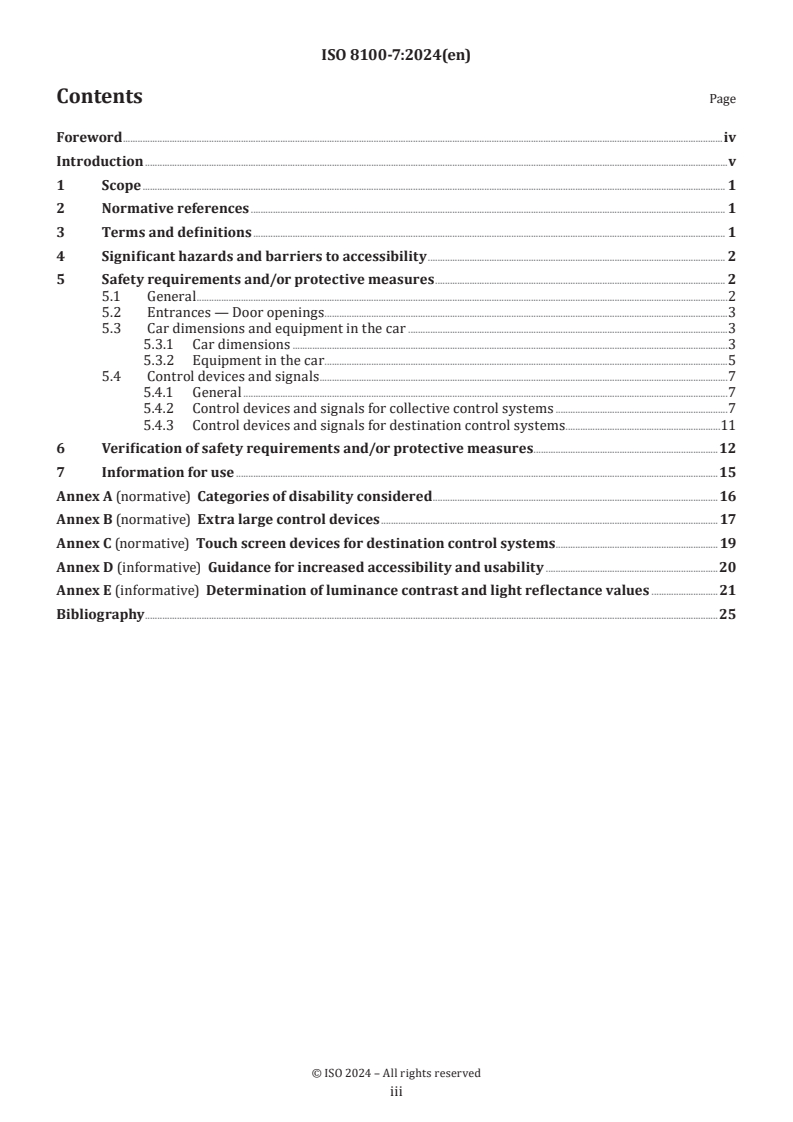
Contents Page
Foreword .iv
Introduction .v
1 Scope . 1
2 Normative references . 1
3 Terms and definitions . 1
4 Significant hazards and barriers to accessibility . 2
5 Safety requirements and/or protective measures . 2
5.1 General .2
5.2 Entrances — Door openings .3
5.3 Car dimensions and equipment in the car .3
5.3.1 Car dimensions .3
5.3.2 Equipment in the car .5
5.4 Control devices and signals . .7
5.4.1 General .7
5.4.2 Control devices and signals for collective control systems .7
5.4.3 Control devices and signals for destination control systems .11
6 Verification of safety requirements and/or protective measures .12
7 Information for use .15
Annex A (normative) Categories of disability considered .16
Annex B (normative) Extra large control devices . 17
Annex C (normative) Touch screen devices for destination control systems . 19
Annex D (informative) Guidance for increased accessibility and usability .20
Annex E (informative) Determination of luminance contrast and light reflectance values .21
Bibliography .25
iii
Foreword
ISO (the International Organization for Standardization) is a worldwide federation of national standards
bodies (ISO member bodies). The work of preparing International Standards is normally carried out through
ISO technical committees. Each member body interested in a subject for which a technical committee
has been established has the right to be represented on that committee. International organizations,
governmental and non-governmental, in liaison with ISO, also take part in the work. ISO collaborates closely
with the International Electrotechnical Commission (IEC) on all matters of electrotechnical standardization.
The procedures used to develop this document and those intended for its further maintenance are described
in the ISO/IEC Directives, Part 1. In particular, the different approval criteria needed for the different types
of ISO document should be noted. This document was drafted in accordance with the editorial rules of the
ISO/IEC Directives, Part 2 (see www.iso.org/directives).
ISO draws attention to the possibility that the implementation of this document may involve the use of (a)
patent(s). ISO takes no position concerning the evidence, validity or applicability of any claimed patent
rights in respect thereof. As of the date of publication of this document, ISO had not received notice of (a)
patent(s) which may be required to implement this document. However, implementers are cautioned that
this may not represent the latest information, which may be obtained from the patent database available at
www.iso.org/patents. ISO shall not be held responsible for identifying any or all such patent rights.
Any trade name used in this document is information given for the convenience of users and does not
constitute an endorsement.
For an explanation of the voluntary nature of standards, the meaning of ISO specific terms and expressions
related to conformity assessment, as well as information about ISO's adherence to the World Trade
Organization (WTO) principles in the Technical Barriers to Trade (TBT), see www.iso.org/iso/foreword.html.
This document was prepared by the European Committee for Standardization (CEN) (as EN 81-
70:2021+A1:2022) and was adopted, without modification other than those given below by Technical
Committee ISO/TC 178, Lifts, escalators, passenger conveyors, and adopted under the "fast-track procedure".
— EN ISO 12100 references have been changed to ISO 12100;
— "this standard" has been replaced with "this document".
A list of all parts in the ISO 8100 series can be found on the ISO website.
Any feedback or questions on this document should be directed to the user’s national standards body. A
complete listing of these bodies can be found at www.iso.org/members.html.
iv
Introduction
0.1 General
This document is a type C standard as stated in ISO 12100:2010.
The lifts concerned and the extent to which hazards, hazardous situations or hazardous events are covered
is indicated in the scope of this document.
When requirements of this type C standard are different from those which are stated in type A or B
standards, the provisions of this type C standard take precedence over the provisions of the other standards
for lifts that have been designed and built according to the provisions of this type C standard.
0.2 Principles
For the revision of this document the following have been considered:
a) practical experience with the first version of this document;
b) market demand for including new technology;
c) CEN-CENELEC Guide 6;
d) current legal framework for accessibility and usability, in particular:
The UN Convention on the Rights of Persons with Disabilities with reference also to accessibility in the built
environment – considering human diversity, social inclusion and equality for all people - is ratified also by
most Member States.
It is also the first international legally binding instrument on human rights setting minimum standards for
the rights for people with disabilities around the world.
v
International Standard ISO 8100-7:2024(en)
Lifts for the transport of persons and goods —
Part 7:
Accessibility to lifts for persons including persons with
disability
1 Scope
This document specifies the minimum requirements for the safe and independent access and use of lifts by
persons, including persons with disabilities. It covers the needs of persons with disabilities according to
Annex A.
NOTE For guidance on solutions for increased accessibility and usability, see Annex D.
This document is not applicable to lifts installed before the date of its publication.
2 Normative references
The following documents are referred to in the text in such a way that some or all of their content constitutes
requirements of this document. For dated references, only the edition cited applies. For undated references,
the latest edition of the referenced document (including any amendments) applies.
ISO 8100-1:2019, Lifts for the transport of persons and goods — Part 1: Safety rules for the construction and
installation of passenger and goods passenger lifts
ISO 12100:2010, Safety of machinery — General principles for design — Risk assessment and risk reduction
ISO 4190-5:2006, Lift (Elevator) installation — Part 5: Control devices, signals and additional fittings
3 Terms and definitions
For the purposes of this document, the following terms and definitions apply.
ISO and IEC maintain terminology databases for use in standardization at the following addresses:
— ISO Online browsing platform: available at https:// www .iso .org/ obp
— IEC Electropedia: available at https:// www .electropedia .org/
3.1
collective control system
lift control system where required direction of travel is registered on the landing and the destination floor
is registered in the car.
3.2
destination control system
lift control system where the destination floor is registered on the landing
3.3
accessibility button
means to activate enhanced accessibility features or services for a single trip
4 Significant hazards and barriers to accessibility
This clause contains all significant hazards, hazardous situations and events as far as they are dealt with
in this document, identified by risk assessment as significant for this type of machinery and which require
actions to eliminate or reduce the risk (see Table 1).
In this document, barriers to accessibility and additional risks encountered by the person with disability or
by the devices used by that person are identified particularly in Table 1, No 8 (ergonomic hazards).
Table 1 — List of significant hazards
No Hazards listed in ISO 12100:2010, Annex B Relevant clauses
1 Mechanical hazards due to:
Crushing 5.3.2.3
Impact 5.3.2.3
Slip, trip, fall 5.3.2.4
8 Ergonomic hazards due to:
Access 5.2.1, 5.2.2, 5.3.1, 5.3.2.3
Design or location of indicators, visual and audible display units 5.1.3, 5.4.2.4, 5.4.2.5, 5.4.3.3,
5.4.3.4
Design, location or identification of control devices 5.1.2, 5.4.2.1, 5.4.2.2, 5.4.2.3,
5.4.3.1,
5.4.3.2
Effort 5.3.2.1, 5.3.2.2
5 Safety requirements and/or protective measures
5.1 General
5.1.1 Passenger and goods passenger lifts shall comply with the safety requirements and/or protective
measures of the following clauses. In addition, lifts shall be designed according to the principles of ISO 12100
for relevant but not significant hazards which are not dealt with by this document.
5.1.2 Where luminance contrast between adjacent surfaces is required, it shall comply with Table 2.
Table 2 — Requirements for luminance contrast
Minimum light Minimum light
Minimum lumi-
reflectance value reflectance value
Clause Item nance contrast Viewing angle
point difference of lighter surface
C [%]
M
LRV – LRV LRV
1 2 1
Table 4, item c) Active part of push 30 - - 45° above hori-
buttons to their zontal
surrounding
Table 4, item d) Face plates to their 30 - - Horizontal
surrounding
Table 4, item j) Symbols on push - 50 50 45° above hori-
buttons to active zontal
areas
5.4.3.3 c) Lift designation - 50 50 Horizontal
markings to back-
ground
NOTE 1 For determination of luminance contrast and light reflectance values, see informative Annex E. For further
guidance on contrast, see ISO 21542:2021, 10.3 and Annex E.
NOTE 2 On shiny and direct reflective surfaces, unfavourable reflections can reduce luminance contrast. Light
colour tones for ceiling and wall surfaces, diffuse reflective materials and a wide light distribution prevent disturbing
reflections on the control devices.
5.1.3 When an audible signal or voice announcement is required, the sound level shall be adjustable
between 35 dB(A) and at least 65 dB(A) to suit the site conditions. In noisy environments (e.g. on landings in
train stations), the maximum sound level shall be adjustable up to 80 dB(A). The means of adjustment shall
be accessible only to authorized persons.
5.2 Entrances — Door openings
5.2.1 The landing and car doors shall be automatic power operated horizontally sliding doors. The clear
opening width shall be at least 800 mm for type 1 cars, 900 mm for type 2, type 3 and type 4 cars and 1 100 mm
for type 5 cars. In existing buildings, the clear opening width shall be at least 800 mm for type 2 cars.
5.2.2 The door dwell time shall be adjustable at least between 2 s and 20 s to suit the conditions where the
lift is installed. The means of adjustment shall be accessible only to authorized persons.
NOTE A door dwell time of at least 6 s is needed for persons with reduced mobility (see also 5.4.2.2.3).
A door close button may be provided to reduce the door dwell time.
5.3 Car dimensions and equipment in the car
5.3.1 Car dimensions
The inside dimensions of cars with a single entrance or with two opposite or two adjacent entrances shall be
chosen in accordance with Table 3.
Car dimensions shall be measured between the structural car walls. Decorative finishes on each wall that
reduce the minimum car dimensions given by Table 3 shall not exceed 15 mm in thickness.
There shall be no additional features attached to the car walls below a height of 800 mm which may restrict
the accommodation and turning of passengers using wheelchairs or passengers with other walking aids.
This would particularly be the case for type 1 and type 2 cars restricting the minimum depth and for type 4
cars restricting the smaller minimum dimension.
Table 3 — Minimum car dimensions for cars with a single entrance or two entrances
Type of Minimum car Accessibility
Building types, usage Remarks
a
car dimensions level
1 Car width: This car accom- Shall only be used in existing Type 1 provides only limit-
1 000 mm modates one buildings where building con- ed accessibility for persons
wheelchair user straints do not permit the instal- using a manual wheelchair as
Car depth:
without an accom- lation of a type 2 car. described in EN 12183:2014 or
1 300 mm
panying person. an electrically powered wheel-
(450 kg)
chair of class A described in
EN 12184:2014.
This type also provides accessi-
bility for persons using walking
aids (e.g. a walking stick) and
for persons with sensory and
intellectual disabilities.
2 Car width: This car accom- Shall be the minimum size for Type 2 provides accessibility
1 100 mm modates one new buildings. for persons using a manual
wheelchair user wheelchair as described in
Car depth:
and an accompa- EN 12183:2014 or an electri-
1 400 mm
nying person. cally powered wheelchair of
(630 kg)
class A or B as described in
EN 12184:2014.
This type also provides accessi-
bility for persons using walking
aids (e.g. walking sticks, crutch-
es or rollators).
Passengers with wheelchairs or
walking aids are unlikely to be
able to turn around in this type
of car and have to leave the car
backwards.
3 Car width: This car accom- Recommended size for cars in Type 3 provides accessibility
1 100 mm modates one user public areas (e.g. outdoor facil- for persons using a manual
with a wheel- ities, stations, etc.) and for cars wheelchair as described in
Car depth:
chair of class C where transport of wheelchairs EN 12183:2014 or an electri-
2 100 mm
and some other of class C shall be provided cally powered wheelchair of
(1 000 kg)
passengers. It also class A, B or C described in
allows transport EN 12184:2014.
of stretchers.
It also provides accessibility
for persons using a manual
wheelchair with tractor unit
(propulsion attachment).
When cars of this type are
configured with two opposite
entrances this can provide
straight through circulation
from the main entrance to dif-
ferent floor levels.
a
The car width is defined as the horizontal distance between the inner surface of the structural walls of the car, measured
parallel to the front entrance. The car depth is defined as the horizontal distance between the inner surfaces of the structural
walls of the car, measured perpendicular to the width.
b
The distances between doors and adjacent car walls as shown in Figure 1 should be as large as possible.
TTabablele 3 3 ((ccoonnttiinnueuedd))
Type of Minimum car Accessibility
Building types, usage Remarks
a
car dimensions level
4 Car width: This car accom- Shall be the minimum size for Type 4 provides accessibility
1 600 mm modates one cars with doors on adjacent for persons using a manual
b
wheelchair user walls . wheelchair as described in
Car depth:
and a few other EN 12183:2014 or an electri-
1 400 mm
passengers. It also cally powered wheelchair of
or
allows a wheel- class A or B as described in
Car width:
chair to be rotated EN 12184:2014.
1 400 mm
within the car.
Type 4 provides sufficient space
Car depth:
for most wheelchairs users and
1 600 mm
for passengers with walking
(1 000 kg)
aids.
5 Car width: This car accom- Type 5 provides accessibility
2 000 mm modates one for persons using a manual
wheelchair user wheelchair as described in
Car depth:
and several other EN 12183:2014 or an electri-
1 400 mm
passengers. It also cally powered wheelchair of
or
allows a wheel- class A, B or C as described in
Car width:
chair to be rotated EN 12184:2014.
1 400 mm
within the car.
Type 5 provides sufficient
Car depth:
turning space for persons using
2 000 mm
wheelchairs of class A or B and
(1 275 kg)
for persons using walking aids
(e.g. walking frames, rollators,
etc.).
a
The car width is defined as the horizontal distance between the inner surface of the structural walls of the car, measured
parallel to the front entrance. The car depth is defined as the horizontal distance between the inner surfaces of the structural
walls of the car, measured perpendicular to the width.
b
The distances between doors and adjacent car walls as shown in Figure 1 should be as large as possible.
a
Distance between door and adjacent car wall.
Figure 1 — Cars with doors on adjacent walls
5.3.2 Equipment in the car
5.3.2.1 A handrail shall be installed on the side wall where the car operating panel is located as follows:
a) the handrail shall be interrupted where the car operating panel is located in order to avoid obstructing
control devices;
b) the handrail may only be installed on one side of the car operating panel if the shorter side would not
accommodate a handrail with an overall length of at least 400 mm;
c) the gripping part of the handrail shall have cross-sectional dimensions between 30 mm and 45 mm with
a minimum radius of 10 mm (see Figure 2);
d) the distance between the wall and the gripping part of the handrail shall be at least 35 mm;
e) the height of the top edge of the gripping part of the handrail shall be 900 mm ± 25 mm from the finished
floor level;
f) the ends of the handrails shall be closed. Where there is a risk of collision with the projecting ends, e.g.
where the handrail is interrupted in front of the car operating panel, the handrail shall return towards
the wall.
For car types 1, 2 and 3, the handrail may be installed on the opposite side wall if the handrail would restrict
the car entrance width.
For car types 4 and 5 a second handrail shall be installed on the opposite side wall or on the rear wall.
Dimensions in millimetres
Key
1 maximum outer circle for handrail profile
2 minimum inner circle for handrail profile
Figure 2 — Cross sectional dimensions of handrails
5.3.2.2 Where a tip-up seat is provided in the car it shall have the following characteristics:
a) a height from the finished floor level of 500 mm ± 25 mm;
b) a depth of 300 mm to 400 mm;
c) a width of 400 mm to 500 mm;
d) an ability to support a load of at least 120 kg.
5.3.2.3 For car types 1, 2 and 3, a device shall be installed to enable passengers to observe obstacles
behind them when moving backwards out of the car.
5.3.2.4 The car floor shall be slip-resistant, taking into consideration the environment in which the lift is
installed, in particular where passengers with wet shoes are regularly expected to enter the car. The same
material as used in the lift lobbies may be used for the lift car floor.
5.3.2.5 Lighting shall provide a minimum illuminance of 100 lx in the plane of the item in Table 2 which
can be vertical or tilted.
5.4 Control devices and signals
5.4.1 General
5.4.1.1 Control devices for collective control systems
Collective control systems shall be used in general applications.
The following control devices according to 5.4.2 shall be used:
— push buttons on landings and in the car; or
— extra large push buttons on landings and in the car; or
— push buttons on landings, keypads in the car for floor selection and push buttons in the car for other
control operations.
NOTE For buildings with many landings, keypad-devices can help to fulfil the requirements of Table 5.
5.4.1.2 Control devices for destination control systems
Destination control systems may only be used where guidance to passengers about the specific operational
features of the lift can be ensured.
NOTE Due to their complexity, destination control systems provide a lower level of accessibility for some
passengers than collective control systems, particularly where a touch screen with an accessibility button and
associated acoustic menu is used. When using the acoustic menu, passengers are required to listen, understand and
react to audible information within a specific time period.
The following control devices according to 5.4.3 shall be used:
— keypads and if applicable accessibility buttons on landings, and push buttons in the car; or
— touch screens and accessibility buttons on landings, and push buttons in the car.
5.4.2 Control devices and signals for collective control systems
5.4.2.1 Requirements for design and arrangement of control devices
Requirements for the design of control devices are given in Table 4 and requirements for the arrangement of
control devices are given in Table 5.
Table 4 — Control devices — Requirements for design
# Subject Landing controls devices Car controls devices
a) Minimum area of active part of 490 mm
push buttons
b) Minimum dimension of active Inscribed circle with a diameter of 20 mm
part of push buttons
c) Identification of active part of Identifiable visually (by contrast, see 5.1.2) and by touch (protruded)
push buttons from face plate or immediate surrounds
d) Identification of face plate Luminance contrast to its sur- Luminance contrast to its sur-
a
rounds (see 5.1.2) rounds (see 5.1.2) in case of less
than 5 buttons
e) Operating force 2,5 N to 5,0 N
f) Operating feedback Required to inform passengers that the button, once pushed, has been
operated (e.g. button possesses perceivable movement or is provided
with a system of mechanical feedback)
g) Registration feedback Required to inform passengers that the call or function has been regis-
tered by visible and audible signal. The audible signal shall comply with
5.1.3 and shall be given on every individual operation of button even if
the call is already registered.
h) Button for building exit floor Not applicable Protruded 5 mm ± 1 mm beyond the
other buttons (preferably green)
i) Position of symbol When provided, on active part or On active part or 10 mm to 15 mm
10 mm to 15 mm to the left of it to the left of it
j) Symbol When provided, in relief, lumi- In relief, luminance contrast to the
nance contrast to the background background (see 5.1.2), 15 mm to
(see 5.1.2), 15 mm to 40 mm high 40 mm high
k) Height of relief of active part (c) Minimum 0,8 mm (recommended 1,0 mm)
and symbol (j)
l) Distance between active parts Minimum 10 mm
of call buttons or floor selection
buttons
m) Distance between group of call or Not applicable Minimum twice the distance between
floor selection buttons and other active parts of floor selection buttons
b
group of buttons
a
Only required for collective controls where the control devices are not mounted in the door frame.
b
E.g. between alarm-/ door buttons and floor selection buttons.
Table 5 — Control devices - Requirements for arrangement
# Subject Landing controls devices Car controls devices
a) Minimum height between the finished floor level 850 mm
and the centreline of the lowest button (door
close button and additional control devices may
be located at different height)
b) Maximum height between the finished floor level 1 100 mm 1 200 mm
and the centreline of the highest button
(preferably 1 100 mm)
c) Arrangement of buttons Vertical See 5.4.2.3.1,5.4.2.3.3
d) Minimum lateral distance between the centreline 500 mm 400 mm
of any button to the corner of any adjacent walls
(Preferably 700 mm)
The depth of any recess where
the button may be located
shall be limited to 250 mm
(see Figure 3)
Dimensions in millimetres
Key
1 landing button
a
Preferably 700.
Figure 3 — Arrangement of landing buttons
5.4.2.2 Landing control devices
5.4.2.2.1 Where call buttons are used, they shall meet the requirements in Table 4 and Table 5 and where
symbols are provided, they should comply with ISO 4190-5:2006, Table C.1, No. 6. Additional buttons shall be
marked according to 5.4.2.3.2 a).
5.4.2.2.2 Where extra-large call buttons are used, they shall comply with Annex B.
5.4.2.2.3 Where an accessibility button is provided (e.g., for increasing the door dwell time, assigning the
call to a larger car, etc.) it shall comply with 5.4.3.1.2.
5.4.2.2.4 In the case of a single lift one set of landing control devices shall be mounted adjacent to the
landing doors.
For two or more lifts, having common management of landing calls, at least one set of control devices for
each wall shall be arranged between two landing doors.
5.4.2.3 Car control devices
5.4.2.3.1 Car control devices shall meet the requirements in Table 4 and Table 5 and shall be arranged as
...