


ISO 3838:2004/Amd 1:2023
(Amendment)Crude petroleum and liquid or solid petroleum products — Determination of density or relative density — Capillary-stoppered pyknometer and graduated bicapillary pyknometer methods — Amendment 1
Crude petroleum and liquid or solid petroleum products — Determination of density or relative density — Capillary-stoppered pyknometer and graduated bicapillary pyknometer methods — Amendment 1
Pétrole brut et produits pétroliers liquides ou solides — Détermination de la masse volumique ou de la densité — Méthodes du pycnomètre à bouchon capillaire et du pycnomètre bicapillaire gradué — Amendement 1
General Information
- Status
- Published
- Publication Date
- 05-Dec-2023
- Technical Committee
- ISO/TC 28/SC 2 - Measurement of petroleum and related products
- Drafting Committee
- ISO/TC 28/SC 2 - Measurement of petroleum and related products
- Current Stage
- 6060 - International Standard published
- Start Date
- 06-Dec-2023
- Due Date
- 18-Oct-2024
- Completion Date
- 06-Dec-2023
Relations
- Effective Date
- 12-Feb-2026
- Effective Date
- 22-Apr-2023
Overview
ISO 3838:2004/Amd 1:2023 is an important amendment to the internationally recognized standard for determining the density or relative density of crude petroleum and liquid or solid petroleum products. This standard specifies updated methods using capillary-stoppered pyknometers and graduated bicapillary pyknometers, enhancing precision in density measurement essential for quality control, trading, and regulatory compliance within the petroleum industry.
This amendment modernizes the formulas and procedures to improve accuracy and reliability, aligning with current technological and analytical advancements. As petroleum products vary widely in physical characteristics, the standardized approach ensures consistent international practices in petroleum density measurement.
Key Topics
Scope of Measurement
The standard focuses on measuring the density or relative density of crude petroleum and various petroleum products, whether in liquid or solid form.Measurement Methods
- Capillary-stoppered pyknometer: A precise volumetric glassware method used for density determination that minimizes vapor loss and contamination.
- Graduated bicapillary pyknometer: An advanced pyknometer variant with two capillaries, designed for enhanced volume determination and reproducibility.
Updated Measurement Formulas
Amendment 1 introduces revised formulas correcting and refining calculations related to density at varying temperatures, improving the reliability of measurement results.Technical Collaboration
Developed by ISO Technical Committee ISO/TC 28 and Subcommittee SC 2, in collaboration with the European Committee for Standardization (CEN/TC 19), ensuring harmonization across international and European standards bodies.Standardization Principles
Adheres to ISO/IEC Directives and recognizes potential patent considerations, ensuring transparent and accessible implementation globally.
Applications
Petroleum Industry Quality Control
Accurate density determination is critical for verifying product specifications, blending operations, and process control.Trade and Commercial Transactions
Density measurements directly impact volume and mass calculations, affecting pricing and contract fulfillment in crude oil and refined petroleum commodity trading.Regulatory Compliance
Supports adherence to environmental and safety regulations by enabling precise characterization of petroleum products.Laboratory and Research
Provides standardized procedures for petroleum laboratories conducting physical property testing and research into new petroleum-based materials.Fuel and Lubricant Production
Accurate density measurement guides formulation and performance benchmarking for fuels and lubricants derived from petroleum.
Related Standards
ISO 3675 - Crude Petroleum and Liquid Petroleum Products - Density Determination by Hydrometer Method
Complements ISO 3838 by providing alternative density measurement techniques.ISO 12185 - Crude Petroleum and Liquid Petroleum Products - Density Determination by Oscillating U-tube Method
Offers a digital, automated alternative to pyknometer-based density measurement.ISO/IEC Directives Part 1 and Part 2
Governs the editorial rules and procedures for ISO standard development ensuring clarity and consistency.CEN/TC 19 Standards on Petroleum and Related Products
Reflect European standards aligning with ISO 3838 to maintain cross-regional consistency.
Keywords: ISO 3838 amendment, petroleum density measurement, capillary-stoppered pyknometer, bicapillary pyknometer, crude petroleum testing, petroleum product standards, density determination, petroleum quality control, ISO petroleum standards, petroleum industry compliance.


ISO 3838:2004/Amd 1:2023 - Crude petroleum and liquid or solid petroleum products — Determination of density or relative density — Capillary-stoppered pyknometer and graduated bicapillary pyknometer methods — Amendment 1 Released:6. 12. 2023
Get Certified
Connect with accredited certification bodies for this standard

ABS Quality Evaluations Inc.
American Bureau of Shipping quality certification.

Element Materials Technology
Materials testing and product certification.

ABS Group Brazil
ABS Group certification services in Brazil.
Sponsored listings
Frequently Asked Questions
ISO 3838:2004/Amd 1:2023 is a standard published by the International Organization for Standardization (ISO). Its full title is "Crude petroleum and liquid or solid petroleum products — Determination of density or relative density — Capillary-stoppered pyknometer and graduated bicapillary pyknometer methods — Amendment 1". This standard covers: Crude petroleum and liquid or solid petroleum products — Determination of density or relative density — Capillary-stoppered pyknometer and graduated bicapillary pyknometer methods — Amendment 1
Crude petroleum and liquid or solid petroleum products — Determination of density or relative density — Capillary-stoppered pyknometer and graduated bicapillary pyknometer methods — Amendment 1
ISO 3838:2004/Amd 1:2023 is classified under the following ICS (International Classification for Standards) categories: 75.080 - Petroleum products in general. The ICS classification helps identify the subject area and facilitates finding related standards.
ISO 3838:2004/Amd 1:2023 has the following relationships with other standards: It is inter standard links to EN ISO 3838:2004/A1:2023, ISO 3838:2004. Understanding these relationships helps ensure you are using the most current and applicable version of the standard.
ISO 3838:2004/Amd 1:2023 is available in PDF format for immediate download after purchase. The document can be added to your cart and obtained through the secure checkout process. Digital delivery ensures instant access to the complete standard document.
Standards Content (Sample)
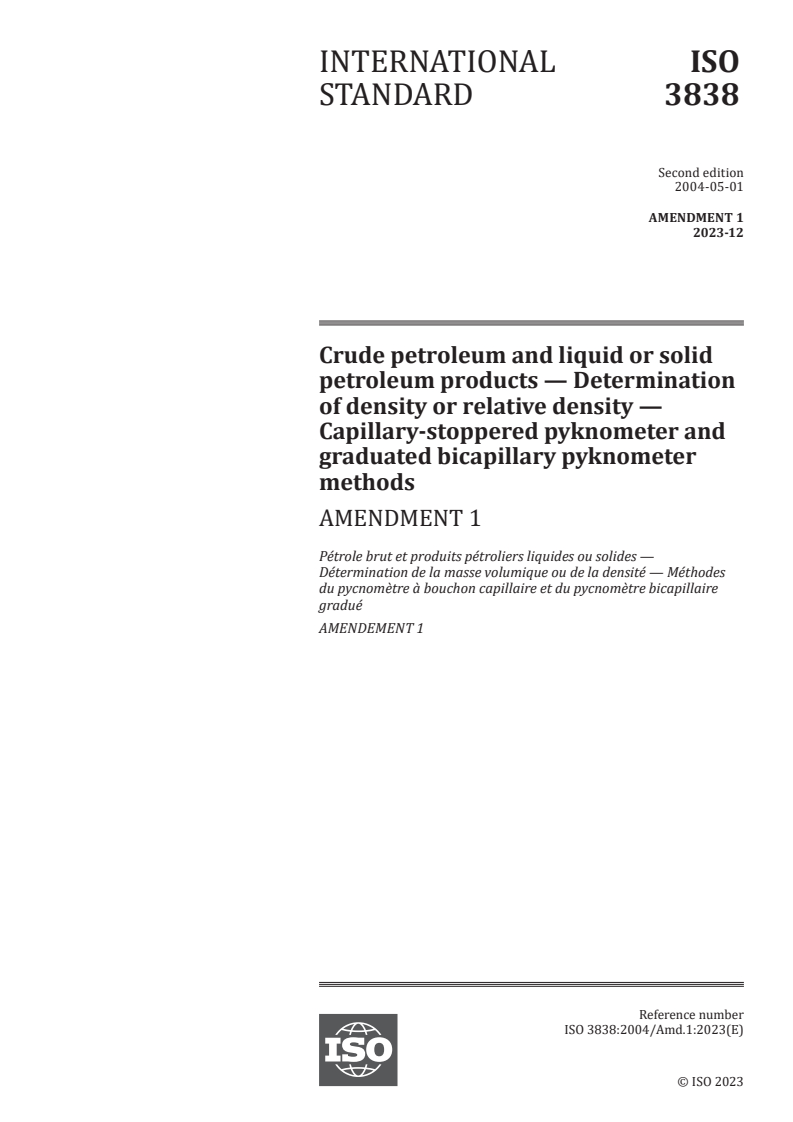
INTERNATIONAL ISO
STANDARD 3838
Second edition
2004-05-01
AMENDMENT 1
2023-12
Crude petroleum and liquid or solid
petroleum products — Determination
of density or relative density —
Capillary-stoppered pyknometer and
graduated bicapillary pyknometer
methods
AMENDMENT 1
Pétrole brut et produits pétroliers liquides ou solides —
Détermination de la masse volumique ou de la densité — Méthodes
du pycnomètre à bouchon capillaire et du pycnomètre bicapillaire
gradué
AMENDEMENT 1
Reference number
ISO 3838:2004/Amd.1:2023(E)
ISO 3838:2004/Amd.1:2023(E)
© ISO 2023
All rights reserved. Unless otherwise specified, or required in the context of its implementation, no part of this publication may
be reproduced or utilized otherwise in any form or by any means, electronic or mechanical, including photocopying, or posting on
the internet or an intranet, without prior written permission. Permission can be requested from either ISO at the address below
or ISO’s member body in the country of the requester.
ISO copyright office
CP 401 • Ch. de Blandonnet 8
CH-1214 Vernier, Geneva
Phone: +41 22 749 01 11
Email: copyright@iso.org
Website: www.iso.org
Published in Switzerland
ii
ISO 3838:2004/Amd.1:2023(E)
Foreword
ISO (the International Organization for Standardization) is a worldwide federation of national standards
bodies (ISO member bodies). The work of preparing International Standards is normally carried out
through ISO technical committees. Each member body interested in a subject for which a technical
committee has been established has the right to be represented on that committee. International
organizations, governmental and non-governmental, in liaison with ISO, also take part in the work.
ISO collaborates closely with the International Electrotechnical Commission (IEC) on all matters of
electrotechnical standardization.
The procedures used to develop this document and those intended for its further maintenance are
described in the ISO/IEC Directives, Part 1. In particular, the different approval criteria needed for the
different types of ISO document should be noted. This document was drafted in accordance with the
editorial rules of the ISO/IEC Directives, Part 2 (see www.iso.org/directives).
ISO draws attention to the possibility that the implementation of this document may involve the use
of (a) patent(s). ISO takes no position concerning the evidence, validity or applicability of any claimed
patent ri
...
Questions, Comments and Discussion
Ask us and Technical Secretary will try to provide an answer. You can facilitate discussion about the standard in here.
Loading comments...