

ISO 17427-1:2018
(Main)Intelligent transport systems — Cooperative ITS — Part 1: Roles and responsibilities in the context of co-operative ITS architecture(s)
General Information
- Abstract
This document contains a detailed description of the (actor invariant) roles (3.22) and responsibilities (3.21) required to deploy and operate Cooperative-ITS (C-ITS) (3.8). The organization/organization of actors / roles described in this document are designed to be appropriate for any fully operational system that uses the C-ITS concepts and techniques in order to achieve its service provision. This document is presented in terms of an organizational or enterprise viewpoint (3.10) as defined in ISO/IEC 10746-1. This document is for all types of road traffic of all classes, and for any other actors involved in the provision of applications and services which use C-ITS techniques to achieve service provision. The description of roles is technology agnostic and, in terms of C-ITS, agnostic in respect of communication modes and embraces vehicle-vehicle communications, vehicle-infrastructure communications and infrastructure-infrastructure communications. This document provides a methodology for the identification of service specific roles and their corresponding responsibilities based on a process oriented approach. Additionally, the methodology is used to identify the roles and responsibilities for C-ITS in general. Both the methodology as well as the roles and responsibilities for C-ITS are deduced from ISO/IEC 10746-1, ISO/IEC 10746-2, ISO/IEC 10746-3, the reference model of Open Distributed Processing. Open Distributed Processing offers five viewpoints of which the enterprise viewpoint corresponds with the organizational architecture and its roles and responsibilities. To limit the scope of the document to the core of C-ITS, the roles are separated into external and internal. Considered to be internal are all roles that are highly relevant for the purpose of achieving service provision by means of C-ITS. Considered to be external are all roles involved in C-ITS, but not set up only for the purpose of C-ITS. This document provides a description of a high-level architectural viewpoint on C-ITS. It is designed to be used as a blueprint when implementing service provision systems that use C-ITS, and the corresponding organizational structures. The characteristics of C-ITS entail a huge number of data/ information exchanges. Therefore the implementation stringently respects privacy and data protection as it is defined in ISO/TR 12859 and in national laws and regulations (where instantiated). Privacy and data protection affects all roles defined in this document due to these characteristics and all actors occupying roles in C-ITS respects the corresponding standards and regulations.
- Status
- Published
- Publication Date
- 14-Jun-2018
- Technical Committee
- ISO/TC 204 - Intelligent transport systems
- Drafting Committee
- ISO/TC 204/WG 18 - Cooperative systems
- Current Stage
- 9093 - International Standard confirmed
- Start Date
- 31-Oct-2023
- Completion Date
- 29-Aug-2026
Buy Documents

ISO 17427-1:2018 - Intelligent transport systems -- Cooperative ITS

REDLINE ISO 17427-1:2018 - Intelligent transport systems — Cooperative ITS — Part 1: Roles and responsibilities in the context of co-operative ITS architecture(s) Released:6/15/2018

ISO 17427-1:2018 - Intelligent transport systems — Cooperative ITS — Part 1: Roles and responsibilities in the context of co-operative ITS architecture(s)/15/2018

ISO 17427-1:2018 - Systemes de transport intelligents -- Systemes de transport coopératifs intelligents

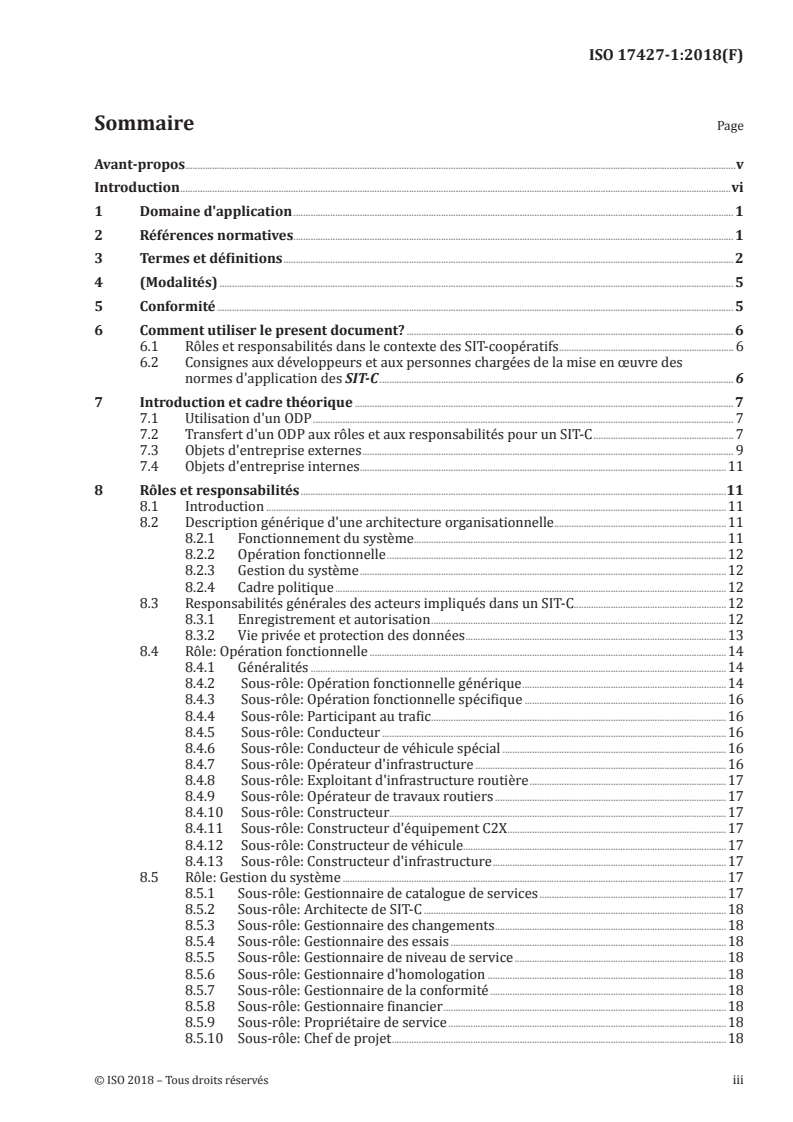
ISO 17427-1:2018 - Systèmes de transport intelligents — Systèmes de transport coopératifs intelligents — Partie 1: Rôles et responsabilités dans le contexte des STI fondés sur l'architecture/6/2019
Overview - ISO 17427-1:2018 (Cooperative ITS roles and responsibilities)
ISO 17427-1:2018 provides a technology‑agnostic, organizational blueprint for deploying and operating Cooperative Intelligent Transport Systems (C-ITS). The standard defines actor‑invariant roles and responsibilities required to deliver C-ITS services across all road classes and for any actors involved in service provision. Presented from an enterprise (organizational) viewpoint based on the Open Distributed Processing (ODP) reference model (ISO/IEC 10746 series), it supports vehicle‑to‑vehicle, vehicle‑to‑infrastructure and infrastructure‑to‑infrastructure communications without prescribing specific communication modes or technologies.
Key topics and technical requirements
- Roles and responsibilities: Defines internal (C-ITS‑specific) and external (non‑C‑ITS but involved) roles required to achieve service provision.
- Enterprise viewpoint: Uses ODP’s enterprise viewpoint to map organizational structures, processes and information exchanges to roles.
- Methodology: Provides a process‑oriented methodology to identify service‑specific roles and assign responsibilities (see Annex A example: hazard location warning).
- Role examples: Describes roles such as Functional operation, System management, System operation and Policy framework, and how they interact.
- Profiles and scenarios: Includes guidance on creating profiles and sample scenarios to apply roles across services (Annex B).
- Privacy & data protection: Emphasizes compliance with privacy requirements (ISO/TR 12859 and national laws) due to high volumes of C-ITS data exchanges.
- Compliance guidance: Outlines how to use the standard for developers and implementers of C‑ITS application standards.
Practical applications - who uses ISO 17427-1
This standard is intended as a blueprint for organizations that design, deploy or regulate C‑ITS services:
- Transport authorities and road operators designing organizational structures for C‑ITS service delivery
- System integrators and ITS solution providers mapping functional responsibilities across stakeholders
- Vehicle OEMs and infrastructure vendors aligning interfaces and operational roles
- Standards developers and test bodies using the methodology to derive service‑specific roles
- Policy makers and regulators defining governance, privacy, and operational requirements
How it helps implement C‑ITS
- Helps translate technical architectures into executable organizational models.
- Enables clear assignment of responsibilities across multi‑stakeholder C‑ITS ecosystems.
- Supports interoperability and governance planning while respecting privacy and legal constraints.
- Provides reusable patterns (profiles, scenarios) to accelerate service rollout.
Related standards
- ISO/IEC 10746‑1, ‑2, ‑3 (ODP reference model) - foundational enterprise viewpoints
- ISO/TR 12859 - privacy and data protection guidance for ITS implementations
Keywords: ISO 17427-1, Cooperative ITS, C-ITS, roles and responsibilities, intelligent transport systems, cooperative intelligent transport, vehicle-to-vehicle, vehicle-to-infrastructure, ITS architecture.
Relations
- Effective Date
- 12-Feb-2026
- Effective Date
- 05-Nov-2015
Buy Documents
ISO 17427-1:2018 - Intelligent transport systems -- Cooperative ITS
REDLINE ISO 17427-1:2018 - Intelligent transport systems — Cooperative ITS — Part 1: Roles and responsibilities in the context of co-operative ITS architecture(s) Released:6/15/2018
ISO 17427-1:2018 - Intelligent transport systems — Cooperative ITS — Part 1: Roles and responsibilities in the context of co-operative ITS architecture(s)/15/2018
ISO 17427-1:2018 - Systemes de transport intelligents -- Systemes de transport coopératifs intelligents
ISO 17427-1:2018 - Systèmes de transport intelligents — Systèmes de transport coopératifs intelligents — Partie 1: Rôles et responsabilités dans le contexte des STI fondés sur l'architecture/6/2019
Get Certified
Connect with accredited certification bodies for this standard

BSI Group
BSI (British Standards Institution) is the business standards company that helps organizations make excellence a habit.

Great Wall Tianjin Quality Assurance Center
Established 1993, first batch to receive national accreditation with IAF recognition.
Hong Kong Quality Assurance Agency (HKQAA)
Hong Kong's leading certification body.
Sponsored listings
Frequently Asked Questions
ISO 17427-1:2018 is a standard published by the International Organization for Standardization (ISO). Its full title is "Intelligent transport systems — Cooperative ITS — Part 1: Roles and responsibilities in the context of co-operative ITS architecture(s)". This standard covers: This document contains a detailed description of the (actor invariant) roles (3.22) and responsibilities (3.21) required to deploy and operate Cooperative-ITS (C-ITS) (3.8). The organization/organization of actors / roles described in this document are designed to be appropriate for any fully operational system that uses the C-ITS concepts and techniques in order to achieve its service provision. This document is presented in terms of an organizational or enterprise viewpoint (3.10) as defined in ISO/IEC 10746-1. This document is for all types of road traffic of all classes, and for any other actors involved in the provision of applications and services which use C-ITS techniques to achieve service provision. The description of roles is technology agnostic and, in terms of C-ITS, agnostic in respect of communication modes and embraces vehicle-vehicle communications, vehicle-infrastructure communications and infrastructure-infrastructure communications. This document provides a methodology for the identification of service specific roles and their corresponding responsibilities based on a process oriented approach. Additionally, the methodology is used to identify the roles and responsibilities for C-ITS in general. Both the methodology as well as the roles and responsibilities for C-ITS are deduced from ISO/IEC 10746-1, ISO/IEC 10746-2, ISO/IEC 10746-3, the reference model of Open Distributed Processing. Open Distributed Processing offers five viewpoints of which the enterprise viewpoint corresponds with the organizational architecture and its roles and responsibilities. To limit the scope of the document to the core of C-ITS, the roles are separated into external and internal. Considered to be internal are all roles that are highly relevant for the purpose of achieving service provision by means of C-ITS. Considered to be external are all roles involved in C-ITS, but not set up only for the purpose of C-ITS. This document provides a description of a high-level architectural viewpoint on C-ITS. It is designed to be used as a blueprint when implementing service provision systems that use C-ITS, and the corresponding organizational structures. The characteristics of C-ITS entail a huge number of data/ information exchanges. Therefore the implementation stringently respects privacy and data protection as it is defined in ISO/TR 12859 and in national laws and regulations (where instantiated). Privacy and data protection affects all roles defined in this document due to these characteristics and all actors occupying roles in C-ITS respects the corresponding standards and regulations.
This document contains a detailed description of the (actor invariant) roles (3.22) and responsibilities (3.21) required to deploy and operate Cooperative-ITS (C-ITS) (3.8). The organization/organization of actors / roles described in this document are designed to be appropriate for any fully operational system that uses the C-ITS concepts and techniques in order to achieve its service provision. This document is presented in terms of an organizational or enterprise viewpoint (3.10) as defined in ISO/IEC 10746-1. This document is for all types of road traffic of all classes, and for any other actors involved in the provision of applications and services which use C-ITS techniques to achieve service provision. The description of roles is technology agnostic and, in terms of C-ITS, agnostic in respect of communication modes and embraces vehicle-vehicle communications, vehicle-infrastructure communications and infrastructure-infrastructure communications. This document provides a methodology for the identification of service specific roles and their corresponding responsibilities based on a process oriented approach. Additionally, the methodology is used to identify the roles and responsibilities for C-ITS in general. Both the methodology as well as the roles and responsibilities for C-ITS are deduced from ISO/IEC 10746-1, ISO/IEC 10746-2, ISO/IEC 10746-3, the reference model of Open Distributed Processing. Open Distributed Processing offers five viewpoints of which the enterprise viewpoint corresponds with the organizational architecture and its roles and responsibilities. To limit the scope of the document to the core of C-ITS, the roles are separated into external and internal. Considered to be internal are all roles that are highly relevant for the purpose of achieving service provision by means of C-ITS. Considered to be external are all roles involved in C-ITS, but not set up only for the purpose of C-ITS. This document provides a description of a high-level architectural viewpoint on C-ITS. It is designed to be used as a blueprint when implementing service provision systems that use C-ITS, and the corresponding organizational structures. The characteristics of C-ITS entail a huge number of data/ information exchanges. Therefore the implementation stringently respects privacy and data protection as it is defined in ISO/TR 12859 and in national laws and regulations (where instantiated). Privacy and data protection affects all roles defined in this document due to these characteristics and all actors occupying roles in C-ITS respects the corresponding standards and regulations.
ISO 17427-1:2018 is classified under the following ICS (International Classification for Standards) categories: 03.220.01 - Transport in general; 35.240.60 - IT applications in transport. The ICS classification helps identify the subject area and facilitates finding related standards.
ISO 17427-1:2018 has the following relationships with other standards: It is inter standard links to EN ISO 17427-1:2018, ISO/TS 17427:2014. Understanding these relationships helps ensure you are using the most current and applicable version of the standard.
ISO 17427-1:2018 is available in PDF format for immediate download after purchase. The document can be added to your cart and obtained through the secure checkout process. Digital delivery ensures instant access to the complete standard document.
Standards Content (Sample)
INTERNATIONAL ISO
STANDARD 17427-1
First edition
2018-06
Intelligent transport systems —
Cooperative ITS —
Part 1:
Roles and responsibilities in
the context of co-operative ITS
architecture(s)
Systèmes intelligents de transport — Systèmes intelligents de
transport coopératifs —
Partie 1: Rôles et responsabilités dans le contexte des ITS fondés sur
l'architecture
Reference number
©
ISO 2018
© ISO 2018
All rights reserved. Unless otherwise specified, or required in the context of its implementation, no part of this publication may
be reproduced or utilized otherwise in any form or by any means, electronic or mechanical, including photocopying, or posting
on the internet or an intranet, without prior written permission. Permission can be requested from either ISO at the address
below or ISO’s member body in the country of the requester.
ISO copyright office
CP 401 • Ch. de Blandonnet 8
CH-1214 Vernier, Geneva
Phone: +41 22 749 01 11
Fax: +41 22 749 09 47
Email: copyright@iso.org
Website: www.iso.org
Published in Switzerland
ii © ISO 2018 – All rights reserved
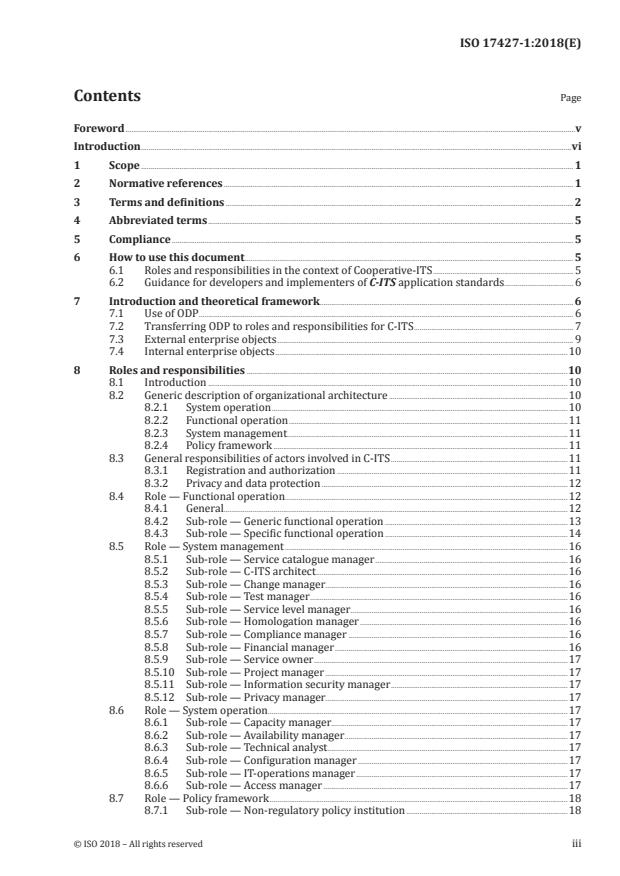
Contents Page
Foreword .v
Introduction .vi
1 Scope . 1
2 Normative references . 1
3 Terms and definitions . 2
4 Abbreviated terms . 5
5 Compliance . 5
6 How to use this document . 5
6.1 Roles and responsibilities in the context of Cooperative-ITS . 5
6.2 Guidance for developers and implementers of C-ITS application standards . 6
7 Introduction and theoretical framework. 6
7.1 Use of ODP. 6
7.2 Transferring ODP to roles and responsibilities for C-ITS . 7
7.3 External enterprise objects . 9
7.4 Internal enterprise objects .10
8 Roles and responsibilities .10
8.1 Introduction .10
8.2 Generic description of organizational architecture .10
8.2.1 System operation .10
8.2.2 Functional operation .11
8.2.3 System management.11
8.2.4 Policy framework .11
8.3 General responsibilities of actors involved in C-ITS .11
8.3.1 Registration and authorization .11
8.3.2 Privacy and data protection .12
8.4 Role — Functional operation .12
8.4.1 General.12
8.4.2 Sub-role — Generic functional operation .13
8.4.3 Sub-role — Specific functional operation .14
8.5 Role — System management .16
8.5.1 Sub-role — Service catalogue manager .16
8.5.2 Sub-role — C-ITS architect .16
8.5.3 Sub-role — Change manager .16
8.5.4 Sub-role — Test manager .16
8.5.5 Sub-role — Service level manager .16
8.5.6 Sub-role — Homologation manager .16
8.5.7 Sub-role — Compliance manager .16
8.5.8 Sub-role — Financial manager .16
8.5.9 Sub-role — Service owner .17
8.5.10 Sub-role — Project manager .17
8.5.11 Sub-role — Information security manager .17
8.5.12 Sub-role — Privacy manager.17
8.6 Role — System operation.17
8.6.1 Sub-role — Capacity manager.17
8.6.2 Sub-role — Availability manager .17
8.6.3 Sub-role — Technical analyst .17
8.6.4 Sub-role — Configuration manager .17
8.6.5 Sub-role — IT-operations manager .17
8.6.6 Sub-role — Access manager .17
8.7 Role — Policy framework .18
8.7.1 Sub-role — Non-regulatory policy institution .18
8.7.2 Sub-role —Cooperative ITS Credential Management system (CCMS).18
8.7.3 Privacy body .18
8.7.4 Information security body .18
8.7.5 Sub-role — Authority.18
8.8 Profiles .18
Annex A (informative) Methodology and its sample application .19
Annex B (informative) Profiles .30
Bibliography .43
iv © ISO 2018 – All rights reserved
Foreword
ISO (the International Organization for Standardization) is a worldwide federation of national standards
bodies (ISO member bodies). The work of preparing International Standards is normally carried out
through ISO technical committees. Each member body interested in a subject for which a technical
committee has been established has the right to be represented on that committee. International
organizations, governmental and non-governmental, in liaison with ISO, also take part in the work.
ISO collaborates closely with the International Electrotechnical Commission (IEC) on all matters of
electrotechnical standardization.
The procedures used to develop this document and those intended for its further maintenance are
described in the ISO/IEC Directives, Part 1. In particular the different approval criteria needed for the
different types of ISO documents should be noted. This document was drafted in accordance with the
editorial rules of the ISO/IEC Directives, Part 2 (see www .iso .org/directives).
Attention is drawn to the possibility that some of the elements of this document may be the subject of
patent rights. ISO shall not be held responsible for identifying any or all such patent rights. Details of
any patent rights identified during the development of the document will be in the Introduction and/or
on the ISO list of patent declarations received (see www .iso .org/patents).
Any trade name used in this document is information given for the convenience of users and does not
constitute an endorsement.
For an explanation on the meaning of ISO specific terms and expressions related to conformity assessment,
as well as information about ISO's adherence to the World Trade Organization (WTO) principles in the
Technical Barriers to Trade (TBT) see the following URL: www .iso .org/iso/foreword .html.
The committee responsible for this document is ISO/TC 204, Intelligent transport.
This first edition cancels and replaces ISO/TS 17427:2014 which has been technically revised.
A list of all the parts in the ISO 17427 series can be found on the ISO website.
Introduction
Cooperative Intelligent Transport Systems (C-ITS) (3.8) are a promising advancement of Intelligent
Transport Systems (ITS). Numerous applications, made possible only, or most efficiently, by the
cooperation of actors (3.2) (other vehicles, the infrastructure (3.12), service (3.25) providers, even
bystanders), are being devised that open up new possibilities to make traffic safer, more efficient and
smarter. Technologies are being developed and improved to realize and support those new services
and applications (3.3). But, to finally implement C-ITS and to achieve the benefits of greater safety and
better mobility, multiple actors will have to cooperate with each other in a completely new way. Actors
that have to date worked in isolation, i.e. in so called “silos”, will have to find a way to achieve these
possibilities. New actors may also be required for the provision of some services. This requires a clear
definition and assignment of behaviours (3.4), responsibilities (3.21) and liabilities. Therefore a general,
abstract organizational architecture with the description of the single roles (3.22), their behaviour, and
the corresponding responsibilities, is an essential prerequisite for the deployment of C-ITS.
The organizational relationships with the description of roles and responsibilities, is a crucial part of
the whole C-ITS architecture. C-ITS is not an objective in itself, it is a means to achieve the potential
of service provision through the cooperation of actors involved in the ITS sector. The architectural
viewpoint comprising the organizational architecture has extensive influences on the deployment and
implementation of C-ITS.
This document describes the high level roles and responsibilities of a C-ITS service provider and aligns
it with other C-ITS standards and specifications.
vi © ISO 2018 – All rights reserved
INTERNATIONAL STANDARD ISO 17427-1:2018(E)
Intelligent transport systems — Cooperative ITS —
Part 1:
Roles and responsibilities in the context of co-operative ITS
architecture(s)
1 Scope
This document contains a detailed description of the (actor invariant) roles (3.22) and responsibilities
(3.21) required to deploy and operate Cooperative-ITS (C-ITS) (3.8). The organization/organization
of actors / roles described in this document are designed to be appropriate for any fully operational
system that uses the C-ITS concepts and techniques in order to achieve its service provision. This
document is presented in terms of an organizational or enterprise viewpoint (3.10) as defined in ISO/
IEC 10746-1.
This document is for all types of road traffic of all classes, and for any other actors involved in the
provision of applications and services which use C-ITS techniques to achieve service provision. The
description of roles is technology agnostic and, in terms of C-ITS, agnostic in respect of communication
modes and embraces vehicle-vehicle communications, vehicle-infrastructure communications and
infrastructure-infrastructure communications.
This document provides a methodology for the identification of service specific roles and their
corresponding responsibilities based on a process oriented approach. Additionally, the methodology
is used to identify the roles and responsibilities for C-ITS in general. Both the methodology as well
as the roles and responsibilities for C-ITS are deduced from ISO/IEC 10746-1, ISO/IEC 10746-2, ISO/
IEC 10746-3, the reference model of Open Distributed Processing. Open Distributed Processing offers
five viewpoints of which the enterprise viewpoint corresponds with the organizational architecture and
its roles and responsibilities.
To limit the scope of the document to the core of C-ITS, the roles are separated into external and internal.
Considered to be internal are all roles that are highly relevant for the purpose of achieving service
provision by means of C-ITS. Considered to be external are all roles involved in C-ITS, but not set up only
for the purpose of C-ITS.
This document provides a description of a high-level architectural viewpoint on C-ITS. It is designed
to be used as a blueprint when implementing service provision systems that use C-ITS, and the
corresponding organizational structures. The characteristics of C-ITS entail a huge number of data/
information exchanges. Therefore the implementation stringently respects privacy and data protection
as it is defined in ISO/TR 12859 and in national laws and regulations (where instantiated). Privacy and
data protection affects all roles defined in this document due to these characteristics and all actors
occupying roles in C-ITS respects the corresponding standards and regulations.
2 Normative references
The following documents are referred to in the text in such a way that some or all of their content
constitutes requirements of this document. For dated references, only the edition cited applies. For
undated references, the latest edition of the referenced document (including any amendments) applies.
ISO/TR 12859:2009, Intelligent transport systems — System architecture — Privacy aspects in ITS
standards and systems
ISO 14817-2, Intelligent transport systems — ITS central data dictionaries — Part 2: Governance of the
Central ITS Data Concept Registry
3 Terms and definitions
For the purposes of this document, the following terms and definitions apply.
ISO and IEC maintain terminological databases for use in standardization at the following addresses:
— IEC Electropedia: available at https: //www .electropedia .org/
— ISO Online browsing platform: available at https: //www .iso .org/obp
3.1
action
something which happens; the fact or process (3.18) of doing something
EXAMPLE Typically to achieve an aim.
[SOURCE: ISO/IEC 10746-2, 8.3]
3.2
actor
person or organizational unit playing a coherent set of roles (3.22) when interacting with the system
within a particular use case
[SOURCE: ISO 24014-1:2015, 2.2]
3.3
application
app
software based mechanism of delivering some or all parts of a service (3.25)
[SOURCE: ISO 14813-1, 3.2]
3.4
behaviour
collection of actions (3.1) with a set of constraints on when they may occur
[SOURCE: ISO/IEC 10746-2, 8.7]
3.5
bounded secure managed domain
BSMD
ITS-S (3.15) application (3.3) processes (3.18) which function within a controlled environment comprised
of an ITS-S facilities layer, ITS-S networking & transport layer, ITS-S access layer, ITS-S management
entity and ITS-S security entity, which adhere to a minimum set of security principles and procedures
so as to establish a level of trust between itself and other similar ITS stations (3.15) with which it
communicates
3.6
client
party which instigates/authorizes the provision of an ITS service (3.14)
3.7
community
configuration of objects (3.17) formed to meet an objective
[SOURCE: ISO 10746-3, 5.1.1]
2 © ISO 2018 – All rights reserved
3.8
Cooperative-ITS
C-ITS
subset of overall ITS that communicates and shares information between ITS stations (3.15) to provide,
exchange, or receive, data, give advice or facilitate actions with the objective of improving safety,
sustainability, efficiency and comfort beyond the scope of stand-alone systems
Note 1 to entry: As an alternative to a “subset”, Cooperative-ITS could be viewed as a “paradigm” in overall ITS.
[SOURCE: ISO/TR 17465-1, 2.1]
3.9
enterprise object
object (3.17) in enterprise viewpoint (3.10)
3.10
enterprise viewpoint
viewpoint on an open distributed processing (ODP) system and its environment that focuses on the
purpose, scope and policies for that system
[SOURCE: ISO/IEC 10746-3, 4.1.1.1]
3.11
external enterprise object
enterprise object (3.9) involved in C-ITS but not set up for the only purpose of C-ITS
3.12
infrastructure
system of facilities, equipment and services (3.25) needed for the operation of an organization
Note 1 to entry: C-ITS specific: static part of C-ITS incorporating sensors, actuators, static ITS Station(s) (3.15).
[SOURCE: ISO 9000:2015, 3.5.2]
3.13
internal enterprise object
enterprise object (3.9) within C-ITS set up only as an internal C-ITS mechanism to enable or support the
provision of an ITS service (3.14) via C-ITS
3.14
ITS service
provides benefits to its service recipient (3.28)
3.15
ITS Station
ITS-S
entity in a communication network, comprised of applications (3.3), facilities, networking and access
layer components that operate using regular wireless communications interface security, or may
operate within a bounded secure management domain (3.5)
3.16
data lifecycle process
process (3.18) based on data element transformation
3.17
object
model of an entity, characterized by its behaviour (3.4) and dually by its state, distinct from any other
object, encapsulated, i.e. any change in its state can only occur as a result of an internal action (3.1) or
as a result of an interaction with its environment
[SOURCE: ISO/IEC 10746-2, 8.1]
3.18
process
sequence of tasks (3.32) or set of interrelated tasks which transform inputs into outputs
[SOURCE: ISO 9000:2015, 3.4.1]
3.19
process chain
sequence of processes (3.18) that wait in the background for an event, with some of these processes
triggering a separate event that can start other processes in turn
[SOURCE: SAP Help Portal]
3.20
public key infrastructure
PKI
hierarchy of “certification authorities” to allow individuals and organizations to identify each other for
the purpose of doing business electronically
3.21
responsible
responsibility
responsibilities
state of being accountable or answerable, as for an entity, function, system, security service or obligation
Note 1 to entry: A responsibility might be a legally backed assignment of actions (3.1) to a role (3.22).
3.22
role
described by tasks (3.32), a behaviour (3.4) and responsibilities (3.21) and to be associated with an actor
3.23
scenario
general description of activities between (possible) participating actors (3.2)
3.24
sequential process
process (3.18) based on sequence of actions (3.1) executed
3.25
service
defined functionality to the system which requires a defined set of data as input, processes this data
and delivers a defined output
3.26
service in pull mode
ITS service (3.14) actively requesting the data that is required for the service operation
3.27
service in push mode
ITS service (3.14) operating on data delivered without request by an actor or its system
3.28
service recipient
user
actor (3.2) who receives a service (3.25)
3.29
stakeholder
individual or organisation having a right, share, claim or interest in a system or in its possession of
characteristics that meet their needs and expectations
4 © ISO 2018 – All rights reserved
3.30
sub-role
subordinate role (3.22) consisting of a defined fragment of the superior role (3.22)
3.31
system
set of interacting or interdependent components forming an integrated whole
Note 1 to entry: Every system is delineated by its organizational and/or spatial and/or temporal boundaries,
surrounded and influenced by its environment, described by its structure and purpose and expressed in its
functioning.
3.32
task
action that is fulfilled by a role
4 Abbreviated terms
C-ITS Cooperative ITS
GNSS Global Navigation Satellite System
HMI Human Machine Interface
ITS Intelligent Transport Systems
ITS-S ITS Station
LDM Local Dynamic Map
PKI Public Key Infrastructure
ODP Open Distributed Processing
5 Compliance
It is recommended that any implementation of an organizational architecture for C-ITS (3.8) should
comply with this document. Compliance with this document is achieved when all roles (3.22) and sub-
roles (3.30) described in Clause 8 are assigned to corresponding actors (3.2) in C-ITS.
6 How to use this document
6.1 Roles and responsibilities in the context of Cooperative-ITS
In order for C-ITS (3.8) to work cohesively and interoperably, it shall be specified and implemented
consistently.
The instantiations of C-ITS that will appear over the coming years and decades will vary according to
their specific applications and requirements, and will vary in their technology, particularly over time,
as the capabilities for these technologies evolve and develop.
While it is not possible today to predetermine future applications in precise detail, it is important that
such applications will operate, and most importantly for C-ITS, interoperate, within a collaborative
environment.
It is therefore necessary, and desirable, to understand the roles (3.22) and responsibilities (3.21) of C-ITS
at a general abstracted level, (above that for any particular application) in order to be able to achieve
such consistency of approach, and by so doing, achieve interoperability and indeed, achieve the basic
elements required for successful cooperation.
Clauses 7 to 8 provide an explanation of the methodology in this document. This is achieved using an
architecture description and analysis technique known as open distributed processing (ODP) (the
reasons for which are explained at the beginning of Clause 7).
Annexes A and B provide informative examples of the methodology and its sample application
(Annex A), and profiles (Annex B) for different implementation scenarios (3.23) for the identified roles
and responsibilities.
This document should be read in concert with ISO/TR 17427-2 to ISO/TR 17427-10, which are a series
of complementary Technical Reports which explain and debate the context of many specific aspects of
C-ITS such as the “Core System”, liability, privacy, risk management etc. These aspects are therefore not
defined or explained in detail within this document.
Subclause 6.2 uses the context and roles and responsibilities determined in this document, and provides
checklists that are recommended to be used when developing C-ITS standards deliverables, or when
implementing a C-ITS application.
6.2 Guidance for developers and implementers of C-ITS application standards
When developing C-ITS application standards or implementing C-ITS applications and systems, an
architecture should be prepared to ensure that all of the relevant roles and responsibilities involved in
C-ITS, relevant to the application standards deliverable or the system under development have been
considered, and, where appropriate, specified.
Such a process/recommendation does not imply or require any particular form or format to be imposed
on a C-ITS (3.8) application standard, C-ITS application or system, but is designed to ensure that all
of the relevant aspects of roles (3.22) and responsibilities (3.21) have been considered, and where
appropriate are clearly identified and specified within that application standard’s deliverable or system
specification and implementation.
7 Introduction and theoretical framework
7.1 Use of ODP
For the description of an organisational architecture as one of the viewpoints of C-ITS, the concept and
terminology of ODP according to ISO 10746 (Parts 1 to 3) is applied in this document.
The organisational architecture described corresponds with the enterprise viewpoint (3.10) in ODP,
defining the purpose, scope and policies governing the activities of the specified system within the
organization of which it is part.
Following the concept and terminology of ODP for the description of the roles and responsibilities,
C-ITS can be described as a community (3.7) composed of external and internal enterprise objects
(3.11/3.13) with the objective of providing C-ITS with its benefits regarding safety, efficiency, comfort
and sustainability to the user (3.28) and minimization of pollution and other adverse ecological effects.
External enterprise objects are involved in C-ITS but are not set up for the sole purpose of C-ITS. Therefore
this document only includes aspects of external enterprise objects and their roles and responsibilities if
they are relevant in respect of C-ITS. The roles (3.22) within the internal enterprise objects are specified
in detail in this document.
The ODP reference model provides abstract language for the relevant concepts. It does not prescribe
particular notations to be used in the individual viewpoints. The viewpoint languages defined in this
reference model of C-ITS roles and responsibilities are abstract languages in the sense that they define
what concepts should be used, not how they should be represented. Precise notations are not specified
in this high level overview. The approaches of this deliverable are consciously defined in a notation-
and representation-neutral manner, to increase their use and flexibility. However, it is recognized that
6 © ISO 2018 – All rights reserved
further bridging work will be required in the architecture specifications of the individual services
(3.25) to enable the development of industrial tools for modelling the viewpoint specifications, the
formal analysis of the specifications produced, and the possible derivation of implementations for their
system specifications.
Within ITS and its projects, and as recommended in ISO 14814, UML (ISO/IEC 19501) is frequently used
to describe architecture aspects of ITS for system modelling. However, while UML is proving to be very
useful for the specification of specific systems (3.31), it proved unnecessarily challenging to present and
succinctly analyse the overall C-ITS roles and responsibilities, and use UML views, for the overarching
description of C-ITS roles and responsibilities.
For applications and standards which need to map between this ODP overview, and more specific UML
application specifications, refer to ISO/IEC 19793.
NOTE ISO/IEC 19793 (usually referred to as UML4 (ODP) defines use of the Unified Modelling Language 2
(UML 2; ISO/IEC 19505-1 and ISO/IEC 19505-2), for expressing the specifications of open distributed systems
in terms of the viewpoint specifications defined by the RM-ODP. It defines a set of UML Profiles, one for each
viewpoint language and one to express the correspondences between viewpoints, and an approach for structuring
them according to the RM-ODP principles. The purpose of UML 4 ODP is to allow ODP modellers to use the UML
notation for expressing their ODP specifications in a standard graphical way; to allow UML modellers to use the
RM-ODP concepts and mechanisms to structure their large UML system specifications according to a mature and
standard proposal; and to allow UML tools to be used to process viewpoint specifications, thus facilitating the
software design process and the enterprise architecture specification of large software systems.
7.2 Transferring ODP to roles and responsibilities for C-ITS
C-ITS features the characteristics of a distributed system with its partition of service (3.25) delivery
via multiple ITS stations (3.15), therefore methodologies for the description of distributed systems are
consulted when describing the overall architecture of C-ITS (3.8) and its different viewpoints. Conveyed
to this standard, it is part of the organizational architecture for C-ITS and focuses on the description of
C-ITS specific roles (3.22) and responsibilities (3.21).
Following the concept and terminology of ODP for the description of the roles and responsibilities, C-ITS
can be described as a community (3.7) composed of external and internal enterprise objects (3.11, 3.13)
(see Figure 1) with the objective of providing C-ITS with its benefits regarding traffic safety, traffic
efficiency, comfort and ecological mobility to the user. External enterprise objects are involved in C-ITS
but are not set up for the sole purpose of C-ITS. Therefore this document limits itself to the identification
of roles and responsibilities of external enterprise objects.
Figure 1 — Relationship between community, internal and external enterprise objects and roles
Internal enterprise object is connected with various external enterprise objects. The diagram (Figure 2)
illustrates both the external enterprise objects, and internal enterprise objects in a similar representation
as described in Figure 1, and shows the key relationships in the context of C-ITS between the internal
enterprise object and the external enterprise objects.
Figure 2 — External and internal enterprise objects in a C-ITS community
C-ITS “enterprise” role and responsibilities
The large oval in the centre of Figure 2 represents the “enterprise” domain of C-ITS (in Figure 1, the
“internal object”).
C-ITS Sensors and actuators
This term comprises equipment specifically installed to support C-ITS service provision (examples
might be lidar, radar, video sensing equipment, etc.).
In the context of ODP, these are “internal objects”.
C-ITS applications
These are the specific application services that use C-ITS information to provide their service (examples
might be cooperative ice alert, obstacle alert, blind spot warning, ramp access, collision avoidance, etc.).
In the context of ODP, these are “internal objects”.
ITS-Station communications (wireless or wired)
This is the means by which one ITS-station interacts with another ITS-station. In the case of
communications between vehicles or between vehicles and the infrastructure, this is a wireless
communication. In the case of an infrastructure-to-infrastructure C-ITS service provision, this may be
wired or wireless.
As these are the essential functions of the “internal object” which enables it to communicate with other
objects, in the context of ODP, these communications capabilities are “internal objects”.
8 © ISO 2018 – All rights reserved
7.3 External enterprise objects
The following are external enterprise objects (3.11) and must meet and pass through the C-ITS (3.8)
security firewall before their data can be used. In some cases this may be simply the security provisions
of the wireless medium, but in some cases will require full BSMD security:
a) ITS service recipient
This is the actor who receives the service.
In the context of Figure 1, the service recipient is by definition an external object.
b) Other ITS systems
These are other ITS systems, which may well use the vehicle’s communications capabilities, but do
not provide or use C-ITS data or processes (examples might be, service monitoring/reservation,
temperature monitoring, fleet management etc.).
In the context of Figure 1, other ITS applications are an external object.
c) Sensors, actuators, vehicle systems and common equipment
This ODP object comprises common equipment in the vehicle that may be used for C-ITS or non-
C-ITS service provision (for example gyroscopes, accelerometers, clock, GNSS etc. are used both
for non-C-ITS service provision, such as advanced driver assistance systems, and for C-ITS service
provision, location based services).
In the context of Figure 1 sensor, actuators, vehicle systems and common equipment are an
“external object”.
d) Infrastructure sensors and actuators/infrastructure sourced data
Many C-ITS services may rely on infrastructure sourced information, much of which may come
from embedded sensors and actuators (but could also come from the output from other systems,
e.g. temperature gauges and received meteorology service information).
In the context of Figure 1, infrastructure sensors and actuators as well as infrastructure sourced
data are an external object.
e) Jurisdictions/authorities
C-ITS service provision has to take place within the legal framework of a jurisdiction.
In the context of Figure 1, jurisdictions are an external object.
f) Standardization bodies
C-ITS can only operate in an interoperable environment. Such interoperability is most commonly
achieved by “standards” developed in standardization bodies to which all actors agree to/comply.
In the context of Figure 1, standards bodies are an external object.
g) Commercial/financial systems
Many C-ITS services will be paid for by service event or subscription (examples might be parking
fees, route optimization, etc.).
In the context of Figure 1, commercial / financial systems are an “external object”.
It is essential to understand that C-ITS is not an end objective in itself, but is a means of achieving
application service (3.25) delivery.
NOTE The relations of external and internal enterprise objects for C-ITS as it is shown in Figure 2 could
also be mapped to other ITS subsystems. This implies that the arrangement of objects and their assignment to
internal and external might change in other paradigms.
7.4 Internal enterprise objects
C-ITS as internal enterprise objects (3.13), consist of a set of specific roles (3.22) identified and described
in the subsequent clauses of this document. The methodology that describes how these roles and
responsibilities (3.21) originally were identified and verified can be found in Annex A.
8 Roles and responsibilities
8.1 Introduction
All roles (3.22) and the corresponding responsibilities (3.21) identified through use of the methodology
described in Annex A are described in the following paragraphs.
8.2 Generic description of organizational architecture
In the generic view of the organizational architecture four major roles (3.22) were identified (Figure 3):
Figure 3 — Global description of organisational architecture
8.2.1 System operation
The role “system operation” is responsible for the proper execution of the applications (3.3) that provide
the end-to-end ITS service(s) (3.14). This includes the reliability for the coordination, organization and
execution of the whole process (3.18). One of the major interfaces of this role is with the actor(s) (3.2) of
the role “functional operation” who uses the system.
Relationships with other roles:
The role system operation is connected with the role “system management”. In this relationship
denominated with the term “managed by” in Figure 3, the actor(s) with the role system management
provides supporting functionalities to the actor(s) with the role “system operation”. This mainly includes
functionalities enabling and facilitating the “System management” behaviour (3.4) and responsibilities.
The role “system operation” is connected with the role “policy framework”. In this relationship
denominated with the term “governed by” in Figure 3, the actor(s) with the role policy framework
provides policies and regulations as well as their enforcement to the actor(s) with the role system
operation.
The role system operation is connected with the role “functional operation”. In this relationship
denominated with the term “used by” in Figure 3, the actor(s) (3.2) with the role system operation
provides the system to the actor(s) with the role functional operation. The role functional operation
uses this system.
10 © ISO 2018 – All rights reserved
8.2.2 Functional operation
The role (3.22) “functional operation” is responsible (3.21) for the proper functional operation of its
particular sub-role. To perform an appropriate operation an actor (3.2) of the role functional operation
uses the system provided by actor(s) of the role system operation.
8.2.3 System management
The role “system management” is responsible to fulfil all required management activities within the
system. This especially includes activities supporting system operation. Additional actions (3.1) are the
management of the policy framework activities.
Relationship with other roles:
The role “system management” is connected with the role policy framework. In this relationship
denominated with the term “managed by” in Figure 3, the actor(s) with role system management
provides supporting functionalities to the actor(s) with the role policy framework. This mainly includes
functionalities enabling and facilitating the policy framework behaviour (3.4) and responsibilities.
Additionally, the actor(s) with the role policy framework provide(s) policies and regulations as well as
their enforcement to the actor(s) with the role system management. This is denominated with the term
“governed by” in Figure 3.
8.2.4 Policy framework
The role “Policy framework” is responsible for all governing and institutional activities required in the
system (3.31).
Relationship with other roles:
Relationships of role policy framework with role system operation and role system management have
already been given in 8.2.1 and 8.2.3.
All main roles “system operation”, “system management”, “policy framework” and “functional operation”
are detailed with sub-roles. Those are described in the following subclauses.
8.3 General responsibilities of actors involved in C-ITS
8.3.1 Registration and authorization
Prior to the use of the system each role and therefore each actor shall be responsible to participate in
activities related to the request of access permission. This includes both registration and authorization:
— Registration — defined as registration to the system itself, necessary prior to the first use of
the system:
— issue request for registration to the system;
— receive certificates for registered ITS Stations (3.15);
— Authorization — defined as authorization prior to every system usage:
— issue request for authorization;
— receive confirmation of authorization.
Details of the activities following the registration or authorization request and leading to the reception
of a permission or confirmation shall be based on the standard registration and authorization
mechanisms described in ISO 14817-2.
8.3.2 Privacy and data protection
The definition of C-ITS as stated in ISO/TR 17465-1 mentions two core characteristics of C-ITS:
— The distributed implementation of ITS services (3.14), which requires a huge number of data and
information exchanges between ITS Stations (3.15) to realize the respective end-to-end ITS service.
— The sharing of data and information between ITS Stati
...
ISO/TC 204/SC
Date: 2018-02-0106-15
ISO/FDIS 17427-1:2018(E)
ISO/TC 204/SC /WG 18
Secretariat: ANSI
Intelligent transport systems — Cooperative ITS — Part 1: Roles and
responsibilities in the context of co-operative ITS architecture(s)
Systèmes intelligents de transport — Systèmes intelligents de transport coopératifs —
Partie 1: Rôles et responsabilités dans le contexte des ITS fondés sur l'architecture
All rights reserved. Unless otherwise specified, no part of this publication may be reproduced or
utilized otherwise in any form or by any means, electronic or mechanical, including photocopying,
or posting on the internet or an intranet, without prior written permission. Permission can be
requested from either ISO at the address below or ISO’s member body in the country of the
requester.
ISO copyright office
Ch. de Blandonnet 8 • CP 401
CH-1214 Vernier, Geneva, Switzerland
Tel. + 41 22 749 01 11
Fax + 41 22 749 09 47
copyright@iso.org
www.iso.org
ii
Contents Page
Foreword . iv
Introduction . vi
1 Scope .1
2 Normative references .2
3 Terms and definitions .3
4 Symbols (and abbreviated terms) .6
5 How to use this Standard .7
5.1 Roles and responsibilities in the context of Cooperative-ITS .7
5.2 Guidance for developers and implementers of C-ITS application standards .7
6 Introduction and theoretical framework.8
6.1 Use of ODP .8
6.2 Transferring ODP to roles and responsibilities for C-ITS .9
6.3 External enterprise objects . 11
6.4 Internal enterprise objects . 12
7 Roles and responsibilities . 12
7.1 Introduction. 12
7.2 Generic description of organizational architecture . 12
7.3 General responsibilities of actors involved in C-ITS . 14
7.4 Role: Functional operation . 15
7.5 Role: System management . 19
7.6 Role: System operation . 20
7.7 Role: Policy framework . 21
7.8 Profiles. 22
8 Compliance . 22
Annex A (informative) Methodology and its sample application . 23
A.1 Methodology to identify Cooperative-ITS roles, behaviour and responsibilities . 23
A.2 Sample application of methodology – hazard location warning . 31
Annex B (informative) Profiles . 35
B.1 Profiles. 35
Bibliography . 50Foreword
................................................................................................................................................................................6
Introduction .7
1 Scope .1
2 Normative references .1
3 Terms and definitions .2
4 Abbreviated terms .5
5 Compliance .5
6 How to use this document .5
6.1 Roles and responsibilities in the context of Cooperative-ITS .5
6.2 Guidance for developers and implementers of C-ITS application standards .6
7 Introduction and theoretical framework.6
7.1 Use of ODP .6
7.2 Transferring ODP to roles and responsibilities for C-ITS .7
iii
7.3 External enterprise objects . 9
7.4 Internal enterprise objects . 10
8 Roles and responsibilities . 10
8.1 Introduction . 10
8.2 Generic description of organizational architecture . 10
8.3 General responsibilities of actors involved in C-ITS . 11
8.4 Role — Functional operation . 13
8.5 Role — System management . 16
8.6 Role — System operation . 17
8.7 Role — Policy framework . 17
8.8 Profiles . 18
Annex A (informative) Methodology and its sample application . 19
A.1 Methodology to identify Cooperative-ITS (C-ITS) roles, behaviour and
responsibilities . 19
A.1.1 Introduction . 19
A.1.2 Stakeholders . 19
A.1.2.1 Actors . 19
A.1.3 Basic service independent process descriptions . 21
A.1.3.1 Applied approach . 21
A.1.3.2 Sequential process description . 21
A.1.3.2.1 Push and pull mode. 21
A.1.3.3 Modules . 23
A.1.3.4 Lifecycle process description . 23
A.1.3.5 Transformation of sequential to lifecycle process description . 24
A.1.3.6 From the lifecycle process description to a basic organisational model . 25
A.1.4 Basic organisational model . 25
A.2 Sample application of methodology — Hazard location warning . 26
A.2.1 General — Hazard location warning . 26
A.2.2 Identification of stakeholders and actors . 26
A.2.2.1 Stakeholders . 26
A.2.2.2 Actors . 26
A.2.3 Basic service independent process descriptions . 27
A.2.3.1 Sequential process description — Push and pull . 27
A.2.3.2 Lifecycle process description . 28
A.2.4 Transformation of sequential to lifecycle process description . 29
A.2.5 From the lifecycle process description to a basic organisational model . 29
A.2.6 Basic organisational model . 29
Annex B (informative) Profiles . 30
B.1 Profiles . 30
B.1.1 General description . 30
B.1.1.1 Actors . 30
iv
B.1.1.2 Scenarios . 30
B.1.1.3 Complex scenarios. 31
B.1.1.4 Example of a complex scenario . 32
B.1.1.5 Supporting actions — System management and policy framework . 33
B.1.2 Hazard location warning — Example scenarios . 33
B.1.2.1 Definition of hazard location warning . 33
B.1.2.2 Scenario 1 . 34
B.1.2.2.1 Figurative description . 34
B.1.2.2.2 Assignment of actor groups to roles . 34
B.1.2.3 Scenario 2 . 35
B.1.2.3.1 Figurative description . 35
B.1.2.3.2 Assignment of “actor groups” to “roles” . 35
B.1.2.4 Scenario 3 . 35
B.1.2.4.1 Figurative description . 36
B.1.2.4.2 Assignment of actor groups to roles . 36
B.1.2.5 Scenario 4 . 36
B.1.2.5.1 Figurative description . 37
B.1.2.5.2 Assignment of actor groups to roles . 37
B.1.2.6 Scenario 5 . 37
B.1.2.6.1 Figurative description . 38
B.1.2.6.2 Assignment of “Actor Groups” to “Roles" . 38
B.1.2.7 Scenario 6 . 38
B.1.2.7.1 Assignment of “actor groups” to “roles” . 39
B.1.2.8 Scenario 7 . 40
B.1.2.8.1 Figurative description . 40
B.1.2.8.2 Assignment of “actor groups” to “roles” . 40
B.1.2.9 Scenario 8 . 41
B.1.2.9.1 Figurative description . 41
B.1.2.9.2 Assignment of “actor groups” to “roles” . 41
Bibliography . 42
v
Foreword
ISO (the International Organization for Standardization) is a worldwide federation of national standards
bodies (ISO member bodies). The work of preparing International Standards is normally carried out
through ISO technical committees. Each member body interested in a subject for which a technical
committee has been established has the right to be represented on that committee. International
organizations, governmental and non-governmental, in liaison with ISO, also take part in the work. ISO
collaborates closely with the International Electrotechnical Commission (IEC) on all matters of
electrotechnical standardization.
The procedures used to develop this document and those intended for its further maintenance are
described in the ISO/IEC Directives, Part 1. In particular the different approval criteria needed for the
different types of ISO documents should be noted. This document was drafted in accordance with the
editorial rules of the ISO/IEC Directives, Part 2 (see www.iso.org/directives).
Attention is drawn to the possibility that some of the elements of this document may be the subject of
patent rights. ISO shall not be held responsible for identifying any or all such patent rights. Details of any
patent rights identified during the development of the document will be in the Introduction and/or on
the ISO list of patent declarations received (see www.iso.org/patents).
Any trade name used in this document is information given for the convenience of users and does not
constitute an endorsement.
For an explanation on the meaning of ISO specific terms and expressions related to conformity
assessment, as well as information about ISO's adherence to the World Trade Organization (WTO)
principles in the Technical Barriers to Trade (TBT) see the following URL:
www.iso.org/iso/foreword.html.
The committee responsible for this document is ISO/TC 204, Intelligent transport.
This first edition cancels and replaces ISO/TS 17427:2014 which has been technically revised.
A list of all the parts in the ISO 17427 series can be found on the ISO website.
vi
Introduction
Cooperative Intelligent Transport Systems (C-ITS) (3.8) are a promising advancement of Intelligent
Transport Systems (ITS). Numerous applications, made possible only, or most efficiently, by the
cooperation of actors (3.2) (other vehicles, the infrastructure (3.12), service (3.25) providers, even
bystanders), are being devised that open up new possibilities to make traffic safer, more efficient and
smarter. Technologies are being developed and improved to realize and support those new services and
applications (3.3). But, to finally implement C-ITS and to achieve the benefits of greater safety and better
mobility, multiple actors will have to cooperate with each other in a completely new way. Actors that have
to date worked in isolation, i.e. in so called “silos”, will have to find a way to achieve these possibilities.
New actors may also be required for the provision of some services. This requires a clear definition and
assignment of behaviours (3.4), responsibilities (3.21) and liabilities. Therefore a general, abstract
organizational architecture with the description of the single roles (3.22), their behaviour, and the
corresponding responsibilities, is an essential prerequisite for the deployment of C-ITS.
The organizational relationships with the description of roles and responsibilities, is a crucial part of the
whole C-ITS architecture. C-ITS is not an objective in itself, it is a means to achieve the potential of service
provision through the cooperation of actors involved in the ITS sector. The architectural viewpoint
comprising the organizational architecture has extensive influences on the deployment and
implementation of C-ITS.
This document describes the high level roles and responsibilities of a C-ITS service provider and aligns it
with other C-ITS standards and specifications.
vii
Intelligent transport systems — Cooperative ITS — Part 1:
Roles and responsibilities in the context of co-operative ITS
architecture(s)
1 Scope
This document contains a detailed description of the (actor invariant) roles (3.22) and responsibilities
(3.21) required to deploy and operate Cooperative-ITS (C-ITS) (3.8). The organization/organization of
actors / roles described in this document are designed to be appropriate for any fully operational system
that uses the C-ITS concepts and techniques in order to achieve its service provision. This document is
presented in terms of an organizational or enterprise viewpoint (3.10) as defined in ISO/IEC 10746-1.
This document is for all types of road traffic of all classes, and for any other actors involved in the
provision of applications and services which use C-ITS techniques to achieve service provision. The
description of roles is technology agnostic and, in terms of C-ITS, agnostic in respect of communication
modes and embraces vehicle-vehicle communications, vehicle-infrastructure communications and
infrastructure-infrastructure communications.
This document provides a methodology for the identification of service specific roles and their
corresponding responsibilities based on a process oriented approach. Additionally, the methodology is
used to identify the roles and responsibilities for C-ITS in general. Both the methodology as well as the
roles and responsibilities for C-ITS are deduced from ISO/IEC 10746-1, ISO/IEC 10746-2, ISO/IEC 10746-
3, the reference model of Open Distributed Processing. Open Distributed Processing offers five
viewpoints of which the enterprise viewpoint corresponds with the organizational architecture and its
roles and responsibilities.
To limit the scope of the document to the core of C-ITS, the roles are separated into external and internal.
Considered to be internal are all roles that are highly relevant for the purpose of achieving service
provision by means of C-ITS. Considered to be external are all roles involved in C-ITS, but not set up only
for the purpose of C-ITS.
This document provides a description of a high-level architectural viewpoint on C-ITS. It is designed to
be used as a blueprint when implementing service provision systems that use C-ITS, and the
corresponding organizational structures. The characteristics of C-ITS entail a huge number of data/
information exchanges. Therefore the implementation stringently respects privacy and data protection
as it is defined in ISO/TR 12859 and in national laws and regulations (where instantiated). Privacy and
data protection affects all roles defined in this document due to these characteristics and all actors
occupying roles in C-ITS respects the corresponding standards and regulations.
2 Normative references
The following documents are referred to in the text in such a way that some or all of their content
constitutes requirements of this document. For dated references, only the edition cited applies. For
undated references, the latest edition of the referenced document (including any amendments) applies.
ISO/TR 12859:2009, Intelligent transport systems — System architecture — Privacy aspects in ITS
standards and systems
ISO 14817-2, Intelligent transport systems — ITS central data dictionaries — Part 2: Governance of the
Central ITS Data Concept Registry
3 Terms and definitions
For the purposes of this document, the following terms and definitions apply.
ISO and IEC maintain terminological databases for use in standardization at the following addresses:
— IEC Electropedia: available at https://www.electropedia.org/
— ISO Online browsing platform: available at https://www.iso.org/obp
3.1
action
something which happens; the fact or process (3.18) of doing something
EXAMPLE Typically to achieve an aim.
[SOURCE: ISO/IEC 10746-2, 8.3]
3.2
actor
person or organizational unit playing a coherent set of roles (3.22) when interacting with the system
within a particular use case
[SOURCE: ISO 24014-1:2015, 2.2]
3.3
application
app
software based mechanism of delivering some or all parts of a service (3.25)
[SOURCE: ISO 14813-1, 3.2]
3.4
behaviour
collection of actions (3.1) with a set of constraints on when they may occur
[SOURCE: ISO/IEC 10746-2, 8.7]
3.5
bounded secure managed domain
BSMD
ITS-S (3.15) application (3.3) processes (3.18) which function within a controlled environment comprised
of an ITS-S facilities layer, ITS-S networking & transport layer, ITS-S access layer, ITS-S management entity
and ITS-S security entity, which adhere to a minimum set of security principles and procedures so as to
establish a level of trust between itself and other similar ITS stations (3.15) with which it communicates
3.6
client
party which instigates/authorizes the provision of an ITS service (3.14)
3.7
community
configuration of objects (3.17) formed to meet an objective
[SOURCE: ISO 10746-3, 5.1.1]
3.8
Cooperative-ITS
C-ITS
subset of overall ITS that communicates and shares information between ITS stations (3.15) to provide,
exchange, or receive, data, give advice or facilitate actions with the objective of improving safety,
sustainability, efficiency and comfort beyond the scope of stand-alone systems
Note 1 to entry: As an alternative to a “subset”, Cooperative-ITS could be viewed as a “paradigm” in overall ITS.
[SOURCE: ISO/TR 17465-1, 2.1]
3.9
enterprise object
object (3.17) in enterprise viewpoint (3.10)
3.10
enterprise viewpoint
viewpoint on an open distributed processing (ODP) system and its environment that focuses on the
purpose, scope and policies for that system
[SOURCE: ISO/IEC 10746-3, 4.1.1.1]
3.11
external enterprise object
enterprise object (3.9) involved in C-ITS but not set up for the only purpose of C-ITS
3.12
infrastructure
system of facilities, equipment and services (3.25) needed for the operation of an organization
Note 1 to entry: C-ITS specific: static part of C-ITS incorporating sensors, actuators, static ITS Station(s) (3.15).
[SOURCE: ISO 9000:2015, 3.5.2]
3.13
internal enterprise object
enterprise object (3.9) within C-ITS set up only as an internal C-ITS mechanism to enable or support the
provision of an ITS service (3.14) via C-ITS
3.14
ITS service
provides benefits to its service recipient (3.28)
3.15
ITS Station
ITS-S
entity in a communication network, comprised of applications (3.3), facilities, networking and access
layer components that operate using regular wireless communications interface security, or may operate
within a bounded secure management domain (3.5)
3.16
data lifecycle process
process (3.18) based on data element transformation
3.17
object
model of an entity, characterized by its behaviour (3.4) and dually by its state, distinct from any other
object, encapsulated, i.e. any change in its state can only occur as a result of an internal action (3.1) or as
a result of an interaction with its environment
[SOURCE: ISO/IEC 10746-2, 8.1]
3.18
process
sequence of tasks (3.32) or set of interrelated tasks which transform inputs into outputs
[SOURCE: ISO 9000:2015, 3.4.1]
3.19
process chain
sequence of processes (3.18) that wait in the background for an event, with some of these processes
triggering a separate event that can start other processes in turn
[SOURCE: SAP Help Portal]
3.20
public key infrastructure
PKI
hierarchy of “certification authorities” to allow individuals and organizations to identify each other for
the purpose of doing business electronically
3.21
responsible
responsibility
responsibilities
state of being accountable or answerable, as for an entity, function, system, security service or obligation
Note 1 to entry: A responsibility might be a legally backed assignment of actions (3.1) to a role (3.22).
3.22
role
described by tasks (3.32), a behaviour (3.4) and responsibilities (3.21) and to be associated with an actor
3.23
scenario
general description of activities between (possible) participating actors (3.2)
3.24
sequential process
process (3.18) based on sequence of actions (3.1) executed
3.25
service
defined functionality to the system which requires a defined set of data as input, processes this data and
delivers a defined output
3.26
service in pull mode
ITS service (3.14) actively requesting the data that is required for the service operation
3.27
service in push mode
ITS service (3.14) operating on data delivered without request by an actor or its system
3.28
service recipient
user
actor (3.2) who receives a service (3.25)
3.29
stakeholder
individual or organisation having a right, share, claim or interest in a system or in its possession of
characteristics that meet their needs and expectations
3.30
sub-role
subordinate role (3.22) consisting of a defined fragment of the superior role (3.22)
3.31
system
set of interacting or interdependent components forming an integrated whole
Note 1 to entry: Every system is delineated by its organizational and/or spatial and/or temporal boundaries,
surrounded and influenced by its environment, described by its structure and purpose and expressed in its
functioning.
3.32
task
action that is fulfilled by a role
4 Abbreviated terms
C-ITS Cooperative ITS
GNSS Global Navigation Satellite System
HMI Human Machine Interface
ITS Intelligent Transport Systems
ITS-S ITS Station
LDM Local Dynamic Map
PKI Public Key Infrastructure
ODP Open Distributed Processing
5 Compliance
It is recommended that any implementation of an organizational architecture for C-ITS (3.8) should
comply with this document. Compliance with this document is achieved when all roles (3.22) and sub-
roles (3.30) described in Clause 8 are assigned to corresponding actors (3.2) in C-ITS.
6 How to use this document
6.1 Roles and responsibilities in the context of Cooperative-ITS
In order for C-ITS (3.8) to work cohesively and interoperably, it shall be specified and implemented
consistently.
The instantiations of C-ITS that will appear over the coming years and decades will vary according to their
specific applications and requirements, and will vary in their technology, particularly over time, as the
capabilities for these technologies evolve and develop.
While it is not possible today to predetermine future applications in precise detail, it is important that
such applications will operate, and most importantly for C-ITS, interoperate, within a collaborative
environment.
It is therefore necessary, and desirable, to understand the roles (3.22) and responsibilities (3.21) of C-ITS
at a general abstracted level, (above that for any particular application) in order to be able to achieve
such consistency of approach, and by so doing, achieve interoperability and indeed, achieve the basic
elements required for successful cooperation.
Clauses 7 to 8 provide an explanation of the methodology in this document. This is achieved using an
architecture description and analysis technique known as open distributed processing (ODP) (the
reasons for which are explained at the beginning of Clause 7).
Annexes A and B provide informative examples of the methodology and its sample application (Annex A),
and profiles (Annex B) for different implementation scenarios (3.23) for the identified roles and
responsibilities.
This document should be read in concert with ISO/TR 17427-2 to ISO/TR 17427-10, which are a series
of complementary Technical Reports which explain and debate the context of many specific aspects of C-
ITS such as the “Core System”, liability, privacy, risk management etc. These aspects are therefore not
defined or explained in detail within this document.
Subclause 6.2 uses the context and roles and responsibilities determined in this document, and provides
checklists that are recommended to be used when developing C-ITS standards deliverables, or when
implementing a C-ITS application.
6.2 Guidance for developers and implementers of C-ITS application standards
When developing C-ITS application standards or implementing C-ITS applications and systems, an
architecture should be prepared to ensure that all of the relevant roles and responsibilities involved in C-
ITS, relevant to the application standards deliverable or the system under development have been
considered, and, where appropriate, specified.
Such a process/recommendation does not imply or require any particular form or format to be imposed
on a C-ITS (3.8) application standard, C-ITS application or system, but is designed to ensure that all of the
relevant aspects of roles (3.22) and responsibilities (3.21) have been considered, and where appropriate
are clearly identified and specified within that application standard’s deliverable or system specification
and implementation.
7 Introduction and theoretical framework
7.1 Use of ODP
For the description of an organisational architecture as one of the viewpoints of C-ITS, the concept and
terminology of ODP according to ISO 10746 (Parts 1 to 3) is applied in this document.
The organisational architecture described corresponds with the enterprise viewpoint (3.10) in ODP,
defining the purpose, scope and policies governing the activities of the specified system within the
organization of which it is part.
Following the concept and terminology of ODP for the description of the roles and responsibilities, C-ITS
can be described as a community (3.7) composed of external and internal enterprise objects (3.11/3.13)
with the objective of providing C-ITS with its benefits regarding safety, efficiency, comfort and
sustainability to the user (3.28) and minimization of pollution and other adverse ecological effects.
External enterprise objects are involved in C-ITS but are not set up for the sole purpose of C-ITS. Therefore
this document only includes aspects of external enterprise objects and their roles and responsibilities if
they are relevant in respect of C-ITS. The roles (3.22) within the internal enterprise objects are specified
in detail in this document.
The ODP reference model provides abstract language for the relevant concepts. It does not prescribe
particular notations to be used in the individual viewpoints. The viewpoint languages defined in this
reference model of C-ITS roles and responsibilities are abstract languages in the sense that they define
what concepts should be used, not how they should be represented. Precise notations are not specified
in this high level overview. The approaches of this deliverable are consciously defined in a notation- and
representation-neutral manner, to increase their use and flexibility. However, it is recognized that further
bridging work will be required in the architecture specifications of the individual services (3.25) to enable
the development of industrial tools for modelling the viewpoint specifications, the formal analysis of the
specifications produced, and the possible derivation of implementations for their system specifications.
Within ITS and its projects, and as recommended in ISO 14814, UML (ISO/IEC 19501) is frequently used
to describe architecture aspects of ITS for system modelling. However, while UML is proving to be very
useful for the specification of specific systems (3.31), it proved unnecessarily challenging to present and
succinctly analyse the overall C-ITS roles and responsibilities, and use UML views, for the overarching
description of C-ITS roles and responsibilities.
For applications and standards which need to map between this ODP overview, and more specific UML
application specifications, refer to ISO/IEC 19793.
NOTE This documentISO/IEC 19793 (usually referred to as UML4 (ODP) defines use of the Unified Modelling
Language 2 (UML 2; ISO/IEC 19505-1 and ISO/IEC 19505-2), for expressing the specifications of open distributed
systems in terms of the viewpoint specifications defined by the RM-ODP. It defines a set of UML Profiles, one for
each viewpoint language and one to express the correspondences between viewpoints, and an approach for
structuring them according to the RM-ODP principles. The purpose of UML 4 ODP is to allow ODP modellers to use
the UML notation for expressing their ODP specifications in a standard graphical way; to allow UML modellers to
use the RM-ODP concepts and mechanisms to structure their large UML system specifications according to a mature
and standard proposal; and to allow UML tools to be used to process viewpoint specifications, thus facilitating the
software design process and the enterprise architecture specification of large software systems.
7.2 Transferring ODP to roles and responsibilities for C-ITS
C-ITS features the characteristics of a distributed system with its partition of service (3.25) delivery via
multiple ITS stations (3.15), therefore methodologies for the description of distributed systems are
consulted when describing the overall architecture of C-ITS (3.8) and its different viewpoints. Conveyed
to this standard, it is part of the organizational architecture for C-ITS and focuses on the description of C-
ITS specific roles (3.22) and responsibilities (3.21).
Following the concept and terminology of ODP for the description of the roles and responsibilities, C-ITS
can be described as a community (3.7) composed of external and internal enterprise objects (3.11, 3.13)
(see Figure 1) with the objective of providing C-ITS with its benefits regarding traffic safety, traffic
efficiency, comfort and ecological mobility to the user. External enterprise objects are involved in C-ITS
but are not set up for the sole purpose of C-ITS. Therefore this document limits itself to the identification
of roles and responsibilities of external enterprise objects.
Figure 1 — Relationship between community, internal and external enterprise objects and roles
Internal enterprise object is connected with various external enterprise objects. The diagram (Figure 2)
illustrates both the external enterprise objects, and internal enterprise objects in a similar representation
as described in Figure 1, and shows the key relationships in the context of C-ITS between the internal
enterprise object and the external enterprise objects.
Figure 2 — External and internal enterprise objects in a C-ITS community
C-ITS “enterprise” role and responsibilities
The large oval in the centre of Figure 2 represents the “enterprise” domain of C-ITS (in Figure 1, the
“internal object”).
C-ITS Sensors and actuators
This term comprises equipment specifically installed to support C-ITS service provision (examples might
be lidar, radar, video sensing equipment, etc.).
In the context of ODP, these are “internal objects”.
C-ITS applications
These are the specific application services that use C-ITS information to provide their service (examples
might be cooperative ice alert, obstacle alert, blind spot warning, ramp access, collision avoidance, etc.).
In the context of ODP, these are “internal objects”.
ITS-Station communications (wireless or wired)
This is the means by which one ITS-station interacts with another ITS-station. In the case of
communications between vehicles or between vehicles and the infrastructure, this is a wireless
communication. In the case of an infrastructure-to-infrastructure C-ITS service provision, this may be
wired or wireless.
As these are the essential functions of the “internal object” which enables it to communicate with other
objects, in the context of ODP, these communications capabilities are “internal objects”.
7.3 External enterprise objects
The following are external enterprise objects (3.11) and must meet and pass through the C-ITS (3.8)
security firewall before their data can be used. In some cases this may be simply the security provisions
of the wireless medium, but in some cases will require full BSMD security:
a) ITS service recipient
This is the actor who receives the service.
In the context of Figure 1, the service recipient is by definition an external object.
b) Other ITS systems
These are other ITS systems, which may well use the vehicle’s communications capabilities, but do
not provide or use C-ITS data or processes (examples might be, service monitoring/reservation,
temperature monitoring, fleet management etc.).
In the context of Figure 1, other ITS applications are an external object.
c) Sensors, actuators, vehicle systems and common equipment
This ODP object comprises common equipment in the vehicle that may be used for C-ITS or non-C-
ITS service provision (for example gyroscopes, accelerometers, clock, GNSS etc. are used both for
non-C-ITS service provision, such as advanced driver assistance systems, and for C-ITS service
provision, location based services).
In the context of Figure 1 sensor, actuators, vehicle systems and common equipment are an “external
object”.
d) Infrastructure sensors and actuators/infrastructure sourced data
Many C-ITS services may rely on infrastructure sourced information, much of which may come from
embedded sensors and actuators (but could also come from the output from other systems, e.g.
temperature gauges and received meteorology service information).
In the context of Figure 1, infrastructure sensors and actuators as well as infrastructure sourced data
are an external object.
e) Jurisdictions/authorities
C-ITS service provision has to take place within the legal framework of a jurisdiction.
...
INTERNATIONAL ISO
STANDARD 17427-1
First edition
2018-06
Intelligent transport systems —
Cooperative ITS —
Part 1:
Roles and responsibilities in
the context of co-operative ITS
architecture(s)
Systèmes intelligents de transport — Systèmes intelligents de
transport coopératifs —
Partie 1: Rôles et responsabilités dans le contexte des ITS fondés sur
l'architecture
Reference number
©
ISO 2018
© ISO 2018
All rights reserved. Unless otherwise specified, or required in the context of its implementation, no part of this publication may
be reproduced or utilized otherwise in any form or by any means, electronic or mechanical, including photocopying, or posting
on the internet or an intranet, without prior written permission. Permission can be requested from either ISO at the address
below or ISO’s member body in the country of the requester.
ISO copyright office
CP 401 • Ch. de Blandonnet 8
CH-1214 Vernier, Geneva
Phone: +41 22 749 01 11
Fax: +41 22 749 09 47
Email: copyright@iso.org
Website: www.iso.org
Published in Switzerland
ii © ISO 2018 – All rights reserved
Contents Page
Foreword .v
Introduction .vi
1 Scope . 1
2 Normative references . 1
3 Terms and definitions . 2
4 Abbreviated terms . 5
5 Compliance . 5
6 How to use this document . 5
6.1 Roles and responsibilities in the context of Cooperative-ITS . 5
6.2 Guidance for developers and implementers of C-ITS application standards . 6
7 Introduction and theoretical framework. 6
7.1 Use of ODP. 6
7.2 Transferring ODP to roles and responsibilities for C-ITS . 7
7.3 External enterprise objects . 9
7.4 Internal enterprise objects .10
8 Roles and responsibilities .10
8.1 Introduction .10
8.2 Generic description of organizational architecture .10
8.2.1 System operation .10
8.2.2 Functional operation .11
8.2.3 System management.11
8.2.4 Policy framework .11
8.3 General responsibilities of actors involved in C-ITS .11
8.3.1 Registration and authorization .11
8.3.2 Privacy and data protection .12
8.4 Role — Functional operation .12
8.4.1 General.12
8.4.2 Sub-role — Generic functional operation .13
8.4.3 Sub-role — Specific functional operation .14
8.5 Role — System management .16
8.5.1 Sub-role — Service catalogue manager .16
8.5.2 Sub-role — C-ITS architect .16
8.5.3 Sub-role — Change manager .16
8.5.4 Sub-role — Test manager .16
8.5.5 Sub-role — Service level manager .16
8.5.6 Sub-role — Homologation manager .16
8.5.7 Sub-role — Compliance manager .16
8.5.8 Sub-role — Financial manager .16
8.5.9 Sub-role — Service owner .17
8.5.10 Sub-role — Project manager .17
8.5.11 Sub-role — Information security manager .17
8.5.12 Sub-role — Privacy manager.17
8.6 Role — System operation.17
8.6.1 Sub-role — Capacity manager.17
8.6.2 Sub-role — Availability manager .17
8.6.3 Sub-role — Technical analyst .17
8.6.4 Sub-role — Configuration manager .17
8.6.5 Sub-role — IT-operations manager .17
8.6.6 Sub-role — Access manager .17
8.7 Role — Policy framework .18
8.7.1 Sub-role — Non-regulatory policy institution .18
8.7.2 Sub-role —Cooperative ITS Credential Management system (CCMS).18
8.7.3 Privacy body .18
8.7.4 Information security body .18
8.7.5 Sub-role — Authority.18
8.8 Profiles .18
Annex A (informative) Methodology and its sample application .19
Annex B (informative) Profiles .30
Bibliography .43
iv © ISO 2018 – All rights reserved
Foreword
ISO (the International Organization for Standardization) is a worldwide federation of national standards
bodies (ISO member bodies). The work of preparing International Standards is normally carried out
through ISO technical committees. Each member body interested in a subject for which a technical
committee has been established has the right to be represented on that committee. International
organizations, governmental and non-governmental, in liaison with ISO, also take part in the work.
ISO collaborates closely with the International Electrotechnical Commission (IEC) on all matters of
electrotechnical standardization.
The procedures used to develop this document and those intended for its further maintenance are
described in the ISO/IEC Directives, Part 1. In particular the different approval criteria needed for the
different types of ISO documents should be noted. This document was drafted in accordance with the
editorial rules of the ISO/IEC Directives, Part 2 (see www .iso .org/directives).
Attention is drawn to the possibility that some of the elements of this document may be the subject of
patent rights. ISO shall not be held responsible for identifying any or all such patent rights. Details of
any patent rights identified during the development of the document will be in the Introduction and/or
on the ISO list of patent declarations received (see www .iso .org/patents).
Any trade name used in this document is information given for the convenience of users and does not
constitute an endorsement.
For an explanation on the meaning of ISO specific terms and expressions related to conformity assessment,
as well as information about ISO's adherence to the World Trade Organization (WTO) principles in the
Technical Barriers to Trade (TBT) see the following URL: www .iso .org/iso/foreword .html.
The committee responsible for this document is ISO/TC 204, Intelligent transport.
This first edition cancels and replaces ISO/TS 17427:2014 which has been technically revised.
A list of all the parts in the ISO 17427 series can be found on the ISO website.
Introduction
Cooperative Intelligent Transport Systems (C-ITS) (3.8) are a promising advancement of Intelligent
Transport Systems (ITS). Numerous applications, made possible only, or most efficiently, by the
cooperation of actors (3.2) (other vehicles, the infrastructure (3.12), service (3.25) providers, even
bystanders), are being devised that open up new possibilities to make traffic safer, more efficient and
smarter. Technologies are being developed and improved to realize and support those new services
and applications (3.3). But, to finally implement C-ITS and to achieve the benefits of greater safety and
better mobility, multiple actors will have to cooperate with each other in a completely new way. Actors
that have to date worked in isolation, i.e. in so called “silos”, will have to find a way to achieve these
possibilities. New actors may also be required for the provision of some services. This requires a clear
definition and assignment of behaviours (3.4), responsibilities (3.21) and liabilities. Therefore a general,
abstract organizational architecture with the description of the single roles (3.22), their behaviour, and
the corresponding responsibilities, is an essential prerequisite for the deployment of C-ITS.
The organizational relationships with the description of roles and responsibilities, is a crucial part of
the whole C-ITS architecture. C-ITS is not an objective in itself, it is a means to achieve the potential
of service provision through the cooperation of actors involved in the ITS sector. The architectural
viewpoint comprising the organizational architecture has extensive influences on the deployment and
implementation of C-ITS.
This document describes the high level roles and responsibilities of a C-ITS service provider and aligns
it with other C-ITS standards and specifications.
vi © ISO 2018 – All rights reserved
INTERNATIONAL STANDARD ISO 17427-1:2018(E)
Intelligent transport systems — Cooperative ITS —
Part 1:
Roles and responsibilities in the context of co-operative ITS
architecture(s)
1 Scope
This document contains a detailed description of the (actor invariant) roles (3.22) and responsibilities
(3.21) required to deploy and operate Cooperative-ITS (C-ITS) (3.8). The organization/organization
of actors / roles described in this document are designed to be appropriate for any fully operational
system that uses the C-ITS concepts and techniques in order to achieve its service provision. This
document is presented in terms of an organizational or enterprise viewpoint (3.10) as defined in ISO/
IEC 10746-1.
This document is for all types of road traffic of all classes, and for any other actors involved in the
provision of applications and services which use C-ITS techniques to achieve service provision. The
description of roles is technology agnostic and, in terms of C-ITS, agnostic in respect of communication
modes and embraces vehicle-vehicle communications, vehicle-infrastructure communications and
infrastructure-infrastructure communications.
This document provides a methodology for the identification of service specific roles and their
corresponding responsibilities based on a process oriented approach. Additionally, the methodology
is used to identify the roles and responsibilities for C-ITS in general. Both the methodology as well
as the roles and responsibilities for C-ITS are deduced from ISO/IEC 10746-1, ISO/IEC 10746-2, ISO/
IEC 10746-3, the reference model of Open Distributed Processing. Open Distributed Processing offers
five viewpoints of which the enterprise viewpoint corresponds with the organizational architecture and
its roles and responsibilities.
To limit the scope of the document to the core of C-ITS, the roles are separated into external and internal.
Considered to be internal are all roles that are highly relevant for the purpose of achieving service
provision by means of C-ITS. Considered to be external are all roles involved in C-ITS, but not set up only
for the purpose of C-ITS.
This document provides a description of a high-level architectural viewpoint on C-ITS. It is designed
to be used as a blueprint when implementing service provision systems that use C-ITS, and the
corresponding organizational structures. The characteristics of C-ITS entail a huge number of data/
information exchanges. Therefore the implementation stringently respects privacy and data protection
as it is defined in ISO/TR 12859 and in national laws and regulations (where instantiated). Privacy and
data protection affects all roles defined in this document due to these characteristics and all actors
occupying roles in C-ITS respects the corresponding standards and regulations.
2 Normative references
The following documents are referred to in the text in such a way that some or all of their content
constitutes requirements of this document. For dated references, only the edition cited applies. For
undated references, the latest edition of the referenced document (including any amendments) applies.
ISO/TR 12859:2009, Intelligent transport systems — System architecture — Privacy aspects in ITS
standards and systems
ISO 14817-2, Intelligent transport systems — ITS central data dictionaries — Part 2: Governance of the
Central ITS Data Concept Registry
3 Terms and definitions
For the purposes of this document, the following terms and definitions apply.
ISO and IEC maintain terminological databases for use in standardization at the following addresses:
— IEC Electropedia: available at https: //www .electropedia .org/
— ISO Online browsing platform: available at https: //www .iso .org/obp
3.1
action
something which happens; the fact or process (3.18) of doing something
EXAMPLE Typically to achieve an aim.
[SOURCE: ISO/IEC 10746-2, 8.3]
3.2
actor
person or organizational unit playing a coherent set of roles (3.22) when interacting with the system
within a particular use case
[SOURCE: ISO 24014-1:2015, 2.2]
3.3
application
app
software based mechanism of delivering some or all parts of a service (3.25)
[SOURCE: ISO 14813-1, 3.2]
3.4
behaviour
collection of actions (3.1) with a set of constraints on when they may occur
[SOURCE: ISO/IEC 10746-2, 8.7]
3.5
bounded secure managed domain
BSMD
ITS-S (3.15) application (3.3) processes (3.18) which function within a controlled environment comprised
of an ITS-S facilities layer, ITS-S networking & transport layer, ITS-S access layer, ITS-S management
entity and ITS-S security entity, which adhere to a minimum set of security principles and procedures
so as to establish a level of trust between itself and other similar ITS stations (3.15) with which it
communicates
3.6
client
party which instigates/authorizes the provision of an ITS service (3.14)
3.7
community
configuration of objects (3.17) formed to meet an objective
[SOURCE: ISO 10746-3, 5.1.1]
2 © ISO 2018 – All rights reserved
3.8
Cooperative-ITS
C-ITS
subset of overall ITS that communicates and shares information between ITS stations (3.15) to provide,
exchange, or receive, data, give advice or facilitate actions with the objective of improving safety,
sustainability, efficiency and comfort beyond the scope of stand-alone systems
Note 1 to entry: As an alternative to a “subset”, Cooperative-ITS could be viewed as a “paradigm” in overall ITS.
[SOURCE: ISO/TR 17465-1, 2.1]
3.9
enterprise object
object (3.17) in enterprise viewpoint (3.10)
3.10
enterprise viewpoint
viewpoint on an open distributed processing (ODP) system and its environment that focuses on the
purpose, scope and policies for that system
[SOURCE: ISO/IEC 10746-3, 4.1.1.1]
3.11
external enterprise object
enterprise object (3.9) involved in C-ITS but not set up for the only purpose of C-ITS
3.12
infrastructure
system of facilities, equipment and services (3.25) needed for the operation of an organization
Note 1 to entry: C-ITS specific: static part of C-ITS incorporating sensors, actuators, static ITS Station(s) (3.15).
[SOURCE: ISO 9000:2015, 3.5.2]
3.13
internal enterprise object
enterprise object (3.9) within C-ITS set up only as an internal C-ITS mechanism to enable or support the
provision of an ITS service (3.14) via C-ITS
3.14
ITS service
provides benefits to its service recipient (3.28)
3.15
ITS Station
ITS-S
entity in a communication network, comprised of applications (3.3), facilities, networking and access
layer components that operate using regular wireless communications interface security, or may
operate within a bounded secure management domain (3.5)
3.16
data lifecycle process
process (3.18) based on data element transformation
3.17
object
model of an entity, characterized by its behaviour (3.4) and dually by its state, distinct from any other
object, encapsulated, i.e. any change in its state can only occur as a result of an internal action (3.1) or
as a result of an interaction with its environment
[SOURCE: ISO/IEC 10746-2, 8.1]
3.18
process
sequence of tasks (3.32) or set of interrelated tasks which transform inputs into outputs
[SOURCE: ISO 9000:2015, 3.4.1]
3.19
process chain
sequence of processes (3.18) that wait in the background for an event, with some of these processes
triggering a separate event that can start other processes in turn
[SOURCE: SAP Help Portal]
3.20
public key infrastructure
PKI
hierarchy of “certification authorities” to allow individuals and organizations to identify each other for
the purpose of doing business electronically
3.21
responsible
responsibility
responsibilities
state of being accountable or answerable, as for an entity, function, system, security service or obligation
Note 1 to entry: A responsibility might be a legally backed assignment of actions (3.1) to a role (3.22).
3.22
role
described by tasks (3.32), a behaviour (3.4) and responsibilities (3.21) and to be associated with an actor
3.23
scenario
general description of activities between (possible) participating actors (3.2)
3.24
sequential process
process (3.18) based on sequence of actions (3.1) executed
3.25
service
defined functionality to the system which requires a defined set of data as input, processes this data
and delivers a defined output
3.26
service in pull mode
ITS service (3.14) actively requesting the data that is required for the service operation
3.27
service in push mode
ITS service (3.14) operating on data delivered without request by an actor or its system
3.28
service recipient
user
actor (3.2) who receives a service (3.25)
3.29
stakeholder
individual or organisation having a right, share, claim or interest in a system or in its possession of
characteristics that meet their needs and expectations
4 © ISO 2018 – All rights reserved
3.30
sub-role
subordinate role (3.22) consisting of a defined fragment of the superior role (3.22)
3.31
system
set of interacting or interdependent components forming an integrated whole
Note 1 to entry: Every system is delineated by its organizational and/or spatial and/or temporal boundaries,
surrounded and influenced by its environment, described by its structure and purpose and expressed in its
functioning.
3.32
task
action that is fulfilled by a role
4 Abbreviated terms
C-ITS Cooperative ITS
GNSS Global Navigation Satellite System
HMI Human Machine Interface
ITS Intelligent Transport Systems
ITS-S ITS Station
LDM Local Dynamic Map
PKI Public Key Infrastructure
ODP Open Distributed Processing
5 Compliance
It is recommended that any implementation of an organizational architecture for C-ITS (3.8) should
comply with this document. Compliance with this document is achieved when all roles (3.22) and sub-
roles (3.30) described in Clause 8 are assigned to corresponding actors (3.2) in C-ITS.
6 How to use this document
6.1 Roles and responsibilities in the context of Cooperative-ITS
In order for C-ITS (3.8) to work cohesively and interoperably, it shall be specified and implemented
consistently.
The instantiations of C-ITS that will appear over the coming years and decades will vary according to
their specific applications and requirements, and will vary in their technology, particularly over time,
as the capabilities for these technologies evolve and develop.
While it is not possible today to predetermine future applications in precise detail, it is important that
such applications will operate, and most importantly for C-ITS, interoperate, within a collaborative
environment.
It is therefore necessary, and desirable, to understand the roles (3.22) and responsibilities (3.21) of C-ITS
at a general abstracted level, (above that for any particular application) in order to be able to achieve
such consistency of approach, and by so doing, achieve interoperability and indeed, achieve the basic
elements required for successful cooperation.
Clauses 7 to 8 provide an explanation of the methodology in this document. This is achieved using an
architecture description and analysis technique known as open distributed processing (ODP) (the
reasons for which are explained at the beginning of Clause 7).
Annexes A and B provide informative examples of the methodology and its sample application
(Annex A), and profiles (Annex B) for different implementation scenarios (3.23) for the identified roles
and responsibilities.
This document should be read in concert with ISO/TR 17427-2 to ISO/TR 17427-10, which are a series
of complementary Technical Reports which explain and debate the context of many specific aspects of
C-ITS such as the “Core System”, liability, privacy, risk management etc. These aspects are therefore not
defined or explained in detail within this document.
Subclause 6.2 uses the context and roles and responsibilities determined in this document, and provides
checklists that are recommended to be used when developing C-ITS standards deliverables, or when
implementing a C-ITS application.
6.2 Guidance for developers and implementers of C-ITS application standards
When developing C-ITS application standards or implementing C-ITS applications and systems, an
architecture should be prepared to ensure that all of the relevant roles and responsibilities involved in
C-ITS, relevant to the application standards deliverable or the system under development have been
considered, and, where appropriate, specified.
Such a process/recommendation does not imply or require any particular form or format to be imposed
on a C-ITS (3.8) application standard, C-ITS application or system, but is designed to ensure that all
of the relevant aspects of roles (3.22) and responsibilities (3.21) have been considered, and where
appropriate are clearly identified and specified within that application standard’s deliverable or system
specification and implementation.
7 Introduction and theoretical framework
7.1 Use of ODP
For the description of an organisational architecture as one of the viewpoints of C-ITS, the concept and
terminology of ODP according to ISO 10746 (Parts 1 to 3) is applied in this document.
The organisational architecture described corresponds with the enterprise viewpoint (3.10) in ODP,
defining the purpose, scope and policies governing the activities of the specified system within the
organization of which it is part.
Following the concept and terminology of ODP for the description of the roles and responsibilities,
C-ITS can be described as a community (3.7) composed of external and internal enterprise objects
(3.11/3.13) with the objective of providing C-ITS with its benefits regarding safety, efficiency, comfort
and sustainability to the user (3.28) and minimization of pollution and other adverse ecological effects.
External enterprise objects are involved in C-ITS but are not set up for the sole purpose of C-ITS. Therefore
this document only includes aspects of external enterprise objects and their roles and responsibilities if
they are relevant in respect of C-ITS. The roles (3.22) within the internal enterprise objects are specified
in detail in this document.
The ODP reference model provides abstract language for the relevant concepts. It does not prescribe
particular notations to be used in the individual viewpoints. The viewpoint languages defined in this
reference model of C-ITS roles and responsibilities are abstract languages in the sense that they define
what concepts should be used, not how they should be represented. Precise notations are not specified
in this high level overview. The approaches of this deliverable are consciously defined in a notation-
and representation-neutral manner, to increase their use and flexibility. However, it is recognized that
6 © ISO 2018 – All rights reserved
further bridging work will be required in the architecture specifications of the individual services
(3.25) to enable the development of industrial tools for modelling the viewpoint specifications, the
formal analysis of the specifications produced, and the possible derivation of implementations for their
system specifications.
Within ITS and its projects, and as recommended in ISO 14814, UML (ISO/IEC 19501) is frequently used
to describe architecture aspects of ITS for system modelling. However, while UML is proving to be very
useful for the specification of specific systems (3.31), it proved unnecessarily challenging to present and
succinctly analyse the overall C-ITS roles and responsibilities, and use UML views, for the overarching
description of C-ITS roles and responsibilities.
For applications and standards which need to map between this ODP overview, and more specific UML
application specifications, refer to ISO/IEC 19793.
NOTE ISO/IEC 19793 (usually referred to as UML4 (ODP) defines use of the Unified Modelling Language 2
(UML 2; ISO/IEC 19505-1 and ISO/IEC 19505-2), for expressing the specifications of open distributed systems
in terms of the viewpoint specifications defined by the RM-ODP. It defines a set of UML Profiles, one for each
viewpoint language and one to express the correspondences between viewpoints, and an approach for structuring
them according to the RM-ODP principles. The purpose of UML 4 ODP is to allow ODP modellers to use the UML
notation for expressing their ODP specifications in a standard graphical way; to allow UML modellers to use the
RM-ODP concepts and mechanisms to structure their large UML system specifications according to a mature and
standard proposal; and to allow UML tools to be used to process viewpoint specifications, thus facilitating the
software design process and the enterprise architecture specification of large software systems.
7.2 Transferring ODP to roles and responsibilities for C-ITS
C-ITS features the characteristics of a distributed system with its partition of service (3.25) delivery
via multiple ITS stations (3.15), therefore methodologies for the description of distributed systems are
consulted when describing the overall architecture of C-ITS (3.8) and its different viewpoints. Conveyed
to this standard, it is part of the organizational architecture for C-ITS and focuses on the description of
C-ITS specific roles (3.22) and responsibilities (3.21).
Following the concept and terminology of ODP for the description of the roles and responsibilities, C-ITS
can be described as a community (3.7) composed of external and internal enterprise objects (3.11, 3.13)
(see Figure 1) with the objective of providing C-ITS with its benefits regarding traffic safety, traffic
efficiency, comfort and ecological mobility to the user. External enterprise objects are involved in C-ITS
but are not set up for the sole purpose of C-ITS. Therefore this document limits itself to the identification
of roles and responsibilities of external enterprise objects.
Figure 1 — Relationship between community, internal and external enterprise objects and roles
Internal enterprise object is connected with various external enterprise objects. The diagram (Figure 2)
illustrates both the external enterprise objects, and internal enterprise objects in a similar representation
as described in Figure 1, and shows the key relationships in the context of C-ITS between the internal
enterprise object and the external enterprise objects.
Figure 2 — External and internal enterprise objects in a C-ITS community
C-ITS “enterprise” role and responsibilities
The large oval in the centre of Figure 2 represents the “enterprise” domain of C-ITS (in Figure 1, the
“internal object”).
C-ITS Sensors and actuators
This term comprises equipment specifically installed to support C-ITS service provision (examples
might be lidar, radar, video sensing equipment, etc.).
In the context of ODP, these are “internal objects”.
C-ITS applications
These are the specific application services that use C-ITS information to provide their service (examples
might be cooperative ice alert, obstacle alert, blind spot warning, ramp access, collision avoidance, etc.).
In the context of ODP, these are “internal objects”.
ITS-Station communications (wireless or wired)
This is the means by which one ITS-station interacts with another ITS-station. In the case of
communications between vehicles or between vehicles and the infrastructure, this is a wireless
communication. In the case of an infrastructure-to-infrastructure C-ITS service provision, this may be
wired or wireless.
As these are the essential functions of the “internal object” which enables it to communicate with other
objects, in the context of ODP, these communications capabilities are “internal objects”.
8 © ISO 2018 – All rights reserved
7.3 External enterprise objects
The following are external enterprise objects (3.11) and must meet and pass through the C-ITS (3.8)
security firewall before their data can be used. In some cases this may be simply the security provisions
of the wireless medium, but in some cases will require full BSMD security:
a) ITS service recipient
This is the actor who receives the service.
In the context of Figure 1, the service recipient is by definition an external object.
b) Other ITS systems
These are other ITS systems, which may well use the vehicle’s communications capabilities, but do
not provide or use C-ITS data or processes (examples might be, service monitoring/reservation,
temperature monitoring, fleet management etc.).
In the context of Figure 1, other ITS applications are an external object.
c) Sensors, actuators, vehicle systems and common equipment
This ODP object comprises common equipment in the vehicle that may be used for C-ITS or non-
C-ITS service provision (for example gyroscopes, accelerometers, clock, GNSS etc. are used both
for non-C-ITS service provision, such as advanced driver assistance systems, and for C-ITS service
provision, location based services).
In the context of Figure 1 sensor, actuators, vehicle systems and common equipment are an
“external object”.
d) Infrastructure sensors and actuators/infrastructure sourced data
Many C-ITS services may rely on infrastructure sourced information, much of which may come
from embedded sensors and actuators (but could also come from the output from other systems,
e.g. temperature gauges and received meteorology service information).
In the context of Figure 1, infrastructure sensors and actuators as well as infrastructure sourced
data are an external object.
e) Jurisdictions/authorities
C-ITS service provision has to take place within the legal framework of a jurisdiction.
In the context of Figure 1, jurisdictions are an external object.
f) Standardization bodies
C-ITS can only operate in an interoperable environment. Such interoperability is most commonly
achieved by “standards” developed in standardization bodies to which all actors agree to/comply.
In the context of Figure 1, standards bodies are an external object.
g) Commercial/financial systems
Many C-ITS services will be paid for by service event or subscription (examples might be parking
fees, route optimization, etc.).
In the context of Figure 1, commercial / financial systems are an “external object”.
It is essential to understand that C-ITS is not an end objective in itself, but is a means of achieving
application service (3.25) delivery.
NOTE The relations of external and internal enterprise objects for C-ITS as it is shown in Figure 2 could
also be mapped to other ITS subsystems. This implies that the arrangement of objects and their assignment to
internal and external might change in other paradigms.
7.4 Internal enterprise objects
C-ITS as internal enterprise objects (3.13), consist of a set of specific roles (3.22) identified and described
in the subsequent clauses of this document. The methodology that describes how these roles and
responsibilities (3.21) originally were identified and verified can be found in Annex A.
8 Roles and responsibilities
8.1 Introduction
All roles (3.22) and the corresponding responsibilities (3.21) identified through use of the methodology
described in Annex A are described in the following paragraphs.
8.2 Generic description of organizational architecture
In the generic view of the organizational architecture four major roles (3.22) were identified (Figure 3):
Figure 3 — Global description of organisational architecture
8.2.1 System operation
The role “system operation” is responsible for the proper execution of the applications (3.3) that provide
the end-to-end ITS service(s) (3.14). This includes the reliability for the coordination, organization and
execution of the whole process (3.18). One of the major interfaces of this role is with the actor(s) (3.2) of
the role “functional operation” who uses the system.
Relationships with other roles:
The role system operation is connected with the role “system management”. In this relationship
denominated with the term “managed by” in Figure 3, the actor(s) with the role system management
provides supporting functionalities to the actor(s) with the role “system operation”. This mainly includes
functionalities enabling and facilitating the “System management” behaviour (3.4) and responsibilities.
The role “system operation” is connected with the role “policy framework”. In this relationship
denominated with the term “governed by” in Figure 3, the actor(s) with the role policy framework
provides policies and regulations as well as their enforcement to the actor(s) with the role system
operation.
The role system operation is connected with the role “functional operation”. In this relationship
denominated with the term “used by” in Figure 3, the actor(s) (3.2) with the role system operation
provides the system to the actor(s) with the role functional operation. The role functional operation
uses this system.
10 © ISO 2018 – All rights reserved
8.2.2 Functional operation
The role (3.22) “functional operation” is responsible (3.21) for the proper functional operation of its
particular sub-role. To perform an appropriate operation an actor (3.2) of the role functional operation
uses the system provided by actor(s) of the role system operation.
8.2.3 System management
The role “system management” is responsible to fulfil all required management activities within the
system. This especially includes activities supporting system operation. Additional actions (3.1) are the
management of the policy framework activities.
Relationship with other roles:
The role “system management” is connected with the role policy framework. In this relationship
denominated with the term “managed by” in Figure 3, the actor(s) with role system management
provides supporting functionalities to the actor(s) with the role policy framework. This mainly includes
functionalities enabling and facilitating the policy framework behaviour (3.4) and responsibilities.
Additionally, the actor(s) with the role policy framework provide(s) policies and regulations as well as
their enforcement to the actor(s) with the role system management. This is denominated with the term
“governed by” in Figure 3.
8.2.4 Policy framework
The role “Policy framework” is responsible for all governing and institutional activities required in the
system (3.31).
Relationship with other roles:
Relationships of role policy framework with role system operation and role system management have
already been given in 8.2.1 and 8.2.3.
All main roles “system operation”, “system management”, “policy framework” and “functional operation”
are detailed with sub-roles. Those are described in the following subclauses.
8.3 General responsibilities of actors involved in C-ITS
8.3.1 Registration and authorization
Prior to the use of the system each role and therefore each actor shall be responsible to participate in
activities related to the request of access permission. This includes both registration and authorization:
— Registration — defined as registration to the system itself, necessary prior to the first use of
the system:
— issue request for registration to the system;
— receive certificates for registered ITS Stations (3.15);
— Authorization — defined as authorization prior to every system usage:
— issue request for authorization;
— receive confirmation of authorization.
Details of the activities following the registration or authorization request and leading to the reception
of a permission or confirmation shall be based on the standard registration and authorization
mechanisms described in ISO 14817-2.
8.3.2 Privacy and data protection
The definition of C-ITS as stated in ISO/TR 17465-1 mentions two core characteristics of C-ITS:
— The distributed implementation of ITS services (3.14), which requires a huge number of data and
information exchanges between ITS Stations (3.15) to realize the respective end-to-end ITS service.
— The sharing of data and information between ITS Stati
...
NORME ISO
INTERNATIONALE 17427-1
Première édition
2018-06
Systèmes intelligents de transport —
Systèmes intelligents de transport
coopératifs —
Partie 1:
Rôles et responsabilités dans
le contexte des STI fondés sur
l'architecture
Intelligent transport systems — Cooperative ITS —
Part 1: Roles and responsibilities in the context of co-operative ITS
architecture(s)
Numéro de référence
©
ISO 2018
DOCUMENT PROTÉGÉ PAR COPYRIGHT
© ISO 2018
Tous droits réservés. Sauf prescription différente ou nécessité dans le contexte de sa mise en œuvre, aucune partie de cette
publication ne peut être reproduite ni utilisée sous quelque forme que ce soit et par aucun procédé, électronique ou mécanique,
y compris la photocopie, ou la diffusion sur l’internet ou sur un intranet, sans autorisation écrite préalable. Une autorisation peut
être demandée à l’ISO à l’adresse ci-après ou au comité membre de l’ISO dans le pays du demandeur.
ISO copyright office
Case postale 401 • Ch. de Blandonnet 8
CH-1214 Vernier, Genève
Tél.: +41 22 749 01 11
Fax: +41 22 749 09 47
E-mail: copyright@iso.org
Web: www.iso.org
Publié en Suisse
ii © ISO 2018 – Tous droits réservés
Sommaire Page
Avant-propos .v
Introduction .vi
1 Domaine d'application . 1
2 Références normatives . 1
3 Termes et définitions . 2
4 (Modalités) . 5
5 Conformité . 5
6 Comment utiliser le present document? . 6
6.1 Rôles et responsabilités dans le contexte des SIT-coopératifs . 6
6.2 Consignes aux développeurs et aux personnes chargées de la mise en œuvre des
normes d'application des SIT-C . 6
7 Introduction et cadre théorique . 7
7.1 Utilisation d'un ODP . 7
7.2 Transfert d'un ODP aux rôles et aux responsabilités pour un SIT-C . 7
7.3 Objets d'entreprise externes . 9
7.4 Objets d'entreprise internes .11
8 Rôles et responsabilités .11
8.1 Introduction .11
8.2 Description générique d'une architecture organisationnelle .11
8.2.1 Fonctionnement du système.11
8.2.2 Opération fonctionnelle .12
8.2.3 Gestion du système .12
8.2.4 Cadre politique .12
8.3 Responsabilités générales des acteurs impliqués dans un SIT-C.12
8.3.1 Enregistrement et autorisation .12
8.3.2 Vie privée et protection des données .13
8.4 Rôle: Opération fonctionnelle .14
8.4.1 Généralités .14
8.4.2 Sous-rôle: Opération fonctionnelle générique .14
8.4.3 Sous-rôle: Opération fonctionnelle spécifique .16
8.4.4 Sous-rôle: Participant au trafic .16
8.4.5 Sous-rôle: Conducteur .16
8.4.6 Sous-rôle: Conducteur de véhicule spécial .16
8.4.7 Sous-rôle: Opérateur d'infrastructure .16
8.4.8 Sous-rôle: Exploitant d'infrastructure routière .17
8.4.9 Sous-rôle: Opérateur de travaux routiers .17
8.4.10 Sous-rôle: Constructeur.17
8.4.11 Sous-rôle: Constructeur d'équipement C2X .17
8.4.12 Sous-rôle: Constructeur de véhicule.17
8.4.13 Sous-rôle: Constructeur d'infrastructure .17
8.5 Rôle: Gestion du système .17
8.5.1 Sous-rôle: Gestionnaire de catalogue de services .17
8.5.2 Sous-rôle: Architecte de SIT-C .18
8.5.3 Sous-rôle: Gestionnaire des changements .18
8.5.4 Sous-rôle: Gestionnaire des essais .18
8.5.5 Sous-rôle: Gestionnaire de niveau de service .18
8.5.6 Sous-rôle: Gestionnaire d'homologation .18
8.5.7 Sous-rôle: Gestionnaire de la conformité .18
8.5.8 Sous-rôle: Gestionnaire financier .18
8.5.9 Sous-rôle: Propriétaire de service .18
8.5.10 Sous-rôle: Chef de projet .18
8.5.11 Sous-rôle: Gestionnaire de la sécurité des informations .18
8.5.12 Gestionnaire de vie privée .18
8.6 Rôle: Fonctionnement du système .19
8.6.1 Sous-rôle: Gestionnaire des capacités .19
8.6.2 Sous-rôle: Gestionnaire des disponibilités .19
8.6.3 Sous-rôle: Analyste technique .19
8.6.4 Sous-rôle: Gestionnaire de configuration .19
8.6.5 Sous-rôle: Gestionnaires des opérations IT .19
8.6.6 Sous-rôle: Gestionnaire d'accès .19
8.7 Rôle: Cadre politique .19
8.7.1 Sous-rôle: Institution politique non réglementaire .19
8.7.2 Sous-rôle: Système de gestion des identifiants des SIT-coopératifs(CCMS) .19
8.7.3 Organisme en charge de la vie privée .20
8.7.4 Organisme de sécurité des informations .20
8.7.5 Sous-rôle: Autorité .20
8.8 Profils .20
Annexe A (informative) Méthodologie et exemple d'application correspondant .21
Annexe B (informative) Profils .33
Bibliographie .49
iv © ISO 2018 – Tous droits réservés
Avant-propos
L’ISO (Organisation internationale de normalisation) est une fédération mondiale d’organismes
nationaux de normalisation (comités membres de l’ISO). L’élaboration des Normes internationales est
en général confiée aux comités techniques de l’ISO. Chaque comité membre intéressé par une étude
a le droit de faire partie du comité technique créé à cet effet. Les organisations internationales,
gouvernementales et non gouvernementales, en liaison avec l’ISO, participent également aux travaux.
L’ISO collabore étroitement avec la Commission électrotechnique internationale (IEC) en ce qui
concerne la normalisation électrotechnique.
Les procédures utilisées pour élaborer le présent document et celles destinées à sa mise à jour sont
décrites dans les Directives ISO/IEC, Partie 1. Il convient en particulier de prendre note des différents
critères d’approbation requis pour les différents types de documents ISO. Le présent document a été
rédigé conformément aux règles de rédaction définies dans les Directives ISO/IEC, Partie 2 (voir www
.iso .org/directives).
L’attention est attirée sur le fait que certains des éléments du présent document peuvent faire l’objet de
droits de propriété intellectuelle ou de droits analogues. L’ISO ne saurait être tenue pour responsable
de ne pas avoir identifié de tels droits de propriété et averti de leur existence. Les détails concernant
les références aux droits de propriété intellectuelle ou autres droits analogues identifiés lors de
l’élaboration du document sont indiqués dans l’Introduction et/ou dans la liste des déclarations de
brevets reçues par l’ISO (voir www .iso .org/patents).
Les appellations commerciales éventuellement mentionnées dans le présent document sont données
pour information, par souci de commodité, à l’intention des utilisateurs et ne sauraient constituer un
engagement.
Pour une explication de la signification des termes et expressions spécifiques de l’ISO liés à l’évaluation
de la conformité, ou pour toute information au sujet de l’adhésion de l’ISO aux principes de l’organisation
mondiale du commerce (OMC) concernant les obstacles techniques au commerce (OTC), voir le lien
suivant: www .iso .org/iso/foreword .html.
Le comité chargé de l’élaboration du présent document est l’ISO/TC 204, Systèmes de transport
intelligent.
La présente édition annule et remplace l'ISO/TS 17427:2014 qui a fait l'objet d'une révision technique.
La liste de toutes les parties de la série ISO 17427 peut être consultée sur le site Web de l'ISO.
Introduction
Les systèmes de transport intelligents coopératifs (STI-C) (3.8) constituent une avancée prometteuse
des systèmes de transport intelligents (STI). De nombreuses applications, rendues possibles uniquement,
ou de manière plus efficace, par la coopération des acteurs (3.2) (autres véhicules, infrastructure (3.12),
fournisseurs de service (3.25), ou même spectateurs), sont envisagées et ouvrent de nouvelles possibilités
de rendre la circulation plus sûre, plus efficace et plus intelligente. Des technologies sont développées
et améliorées pour mettre en œuvre et assister ces nouveaux services et ces nouvelles applications (3.3).
Mais, pour parvenir à mettre en œuvre les SIT-C et tirer parti des avantages en matière de sécurité et de
mobilité, plusieurs acteurs devront coopérer, et ceci d'une manière totalement nouvelle. Des acteurs qui
ont jusque-là travaillé de manière isolée – en « silos » - devront trouver un moyen de mettre en pratique
ces possibilités. De nouveaux acteurs seront peut-être également nécessaires pour assurer la fourniture
de certains services. Cela exige une définition et une attribution claire des comportements, des devoirs
et des responsabilités. En conséquence, une architecture organisationnelle abstraite générale décrivant
les rôles (3.22) de chacun, leur comportement (3.4), et les responsabilités (3.21) qui en découlent, est un
prérequis indispensable au déploiement des SIT-C.
Les relations au sein de l'organisation, ainsi que la description des rôles et des responsabilités,
constituent une partie cruciale de l'architecture globale des SIT-C. Un SIT-C ne constitue pas un objectif
en soi, il s'agit d'un moyen d'atteindre le potentiel de fourniture de service à travers la coopération des
acteurs impliqués dans le secteur des SIT. Le point de vue architectural qui sous-tend l'architecture de
l'organisation influence de manière fondamentale le déploiement et la mise en œuvre d'un SIT-C.
Le présent document décrit les rôles et les responsabilités d'un « Fournisseur de services » de SIT-C au
niveau macroscopique et les accordes avec les autres normes et spécifications relatives aux SIT-C.
vi © ISO 2018 – Tous droits réservés
NORME INTERNATIONALE ISO 17427-1:2018(F)
Systèmes intelligents de transport — Systèmes intelligents
de transport coopératifs —
Partie 1:
Rôles et responsabilités dans le contexte des STI fondés sur
l'architecture
1 Domaine d'application
Le présent document contient une description détaillée des rôles et des responsabilités (de
chaque acteur) nécessaires pour déployer un SIT coopératif (SIT-C). L'organisation/les acteurs de
l'organisation/les rôles décrits dans le présent document sont conçus pour convenir à tout système
entièrement opérationnel exploitant les concepts et les techniques des SIT-C pour réaliser la fourniture
de ses services. Le present document est présenté sous le vocable « Organisationnel » ou « Point de vue
d'entreprise », tels que ces termes sont définis dans l'ISO/IEC 10746 Traitement réparti ouvert.
Le present document concerne tous les types de trafic routier de toutes les classes, et tous les acteurs
impliqués dans la fourniture d'applications et de services utilisant les techniques des SIT-C (3.8) pour
réaliser la fourniture de service. La description des rôles est indépendante de la technologie et, en
termes de SIT-coopératif, indépendante des modes de communication et englobe les communications
de véhicule à véhicule, les communications de véhicule à infrastructure et les communications
d'infrastructure à infrastructure.
Le present document fournit une méthodologie d'identification des rôles particuliers à chaque
service et des responsabilités afférentes sur la base d'une approche orientée processus. De plus, cette
méthodologie est utilisée pour identifier les rôles et les responsabilités des SIT-coopératifs (3.8) de
manière générale. La méthodologie et les rôles et responsabilités relatifs aux SIT-coopératifs dérivent de
l'ISO/IEC 10746, le modèle de référence du « Traitement réparti ouvert ». Un traitement réparti ouvert
fournit cinq points de vue, parmi lesquels le Point de vue d'entreprise (3.10) correspond à « l'architecture
organisationnelle » et à ses rôles et responsabilités.
Pour limiter la portée du document au cœur des SIT-coopératifs, les rôles sont divisés en rôles
« externes » et rôles « internes ». Les rôles considérés comme internes sont tous ceux dont l'objectif
est fortement orienté vers la fourniture de services au moyen d'un SIT-coopératif. Les rôles considérés
comme externes sont tous ceux impliqués dans un SIT-coopératif, mais qui ne sont pas mis en place
dans le seul but de servir un SIT-coopératif.
Le present document donne une description des SIT-coopératifs d'un point de vue architectural au
niveau macroscopique. Elle est conçue pour servir de modèle lors de la mise en œuvre de systèmes de
fourniture de services utilisant un SIT-coopératif, et des structures organisationnelles correspondantes.
Les caractéristiques des SIT-coopératifs impliquent un très grand nombre d'échanges de données et
d'informations. Par conséquent, leur mise en œuvre exige un respect rigoureux de la protection de la vie
privée et des données tel que défini dans l'ISO/TR 12859 et dans. Compte tenu de ces caractéristiques,
la protection de la vie privée et des données affecte tous les rôles définis dans le present document et
tous les acteurs en charge de ces rôles au sein des SIT-coopératifs se doivent de respecter les normes et
les réglementations correspondantes.
2 Références normatives
Les documents suivants sont consultés dans le texte de l'application de sorte qu'une partie ou la totalité
de leur contenu constitue des exigences du présent document. Pour les références datées, seule l'édition
citée s'applique. Pour les références non datées, c'est la dernière édition du document de référence (y
compris toute modification) qui s'applique.
ISO/TR 12859:2009, Systèmes intelligents de transport — Architecture de système — Aspects privés dans
les normes et les systèmes SIT
ISO 14817-2:2015, Systèmes intelligents de transport — Dictionnaires de données centrales des ITS —
Partie 2: Gouvernance du registre central de concept des données des ITS
3 Termes et définitions
Pour les besoins du présent document, les termes et définitions suivants s’appliquent.
L'ISO et l'IEC tiennent à jour des bases de données terminologiques pour la normalisation aux adresses
suivantes:
— IEC Electropedia: disponible sur https: //www .electropedia .org/
— Plate-forme de navigation en ligne de l'ISO: disponible à l'adresse https: //www .iso .org/obp
3.1
action
survenue d'un événement; processus (3.18) ou fait de faire quelque chose, en général pour atteindre un
objectif
[SOURCE: ISO/IEC 10746-2]
3.2
acteur
personne ou unité organisationnelle jouant un ensemble cohérent de rôles (3.22) lors d'une interaction
avec le système au sein d'un cas d'utilisation particulier
[SOURCE: ISO 24014-1:2015, 2.2]
3.3
application
app
mécanisme fondé sur un logiciel, permettant de délivrer tout ou partie d'un service (3.25)
[SOURCE: ISO/TR 14813-1, 3.2]
3.4
comportement
collection d'actions (3.1) soumise à un ensemble de contraintes relatives au moment où elles peuvent
survenir
[SOURCE: ISO/IEC 10746-2]
3.5
domaine délimité géré de manière sécurisée
BSMD
processus (3.18) d'applications (3.3) de SIT-S (3.15) fonctionnant au sein d'un environnement contrôlé
constitué d'une couche de dispositifs de SIT-S, d'une couche de mise en réseau et de transport de
SIT-S, d'une couche d'accès de SIT-S, d'une entité de gestion de SIT-S et d'une entité de sécurité de SIT-S,
respectant un ensemble minimum de principes et de procédures de sécurité de sorte à établir un niveau
de confiance entre lui-même et d'autres stations de SIT (3.15) similaires avec lesquels il communique
(ISO 21217:2013)
3.6
client
partie qui incite/autorise la fourniture d'un service STI (3.14)
2 © ISO 2018 – Tous droits réservés
3.7
communauté
configuration d'objets (3.17) formée dans le but d'atteindre un objectif
[SOURCE: ISO/IEC 10746-3, 5.1.1]
3.8
SIT-coopératif
SIT-C
sous-ensemble d'un SIT global qui communique et partage des informations entre stations de SIT (3.15)
pour fournir, échanger, ou recevoir, des données, donner des conseils ou faciliter des actions; dans le
but d'améliorer la sécurité, la durabilité, l'efficacité et le confort en dehors du champ d'application des
systèmes autonomes
Note 1 à l'article: plutôt qu'un « sous-ensemble », un SIT-coopératif peut être considéré comme un « paradigme »
dans un SIT global.
[SOURCE: ISO/TR 17465-1]
3.9
objet d'entreprise
objet (3.17) d'un point de vue d'entreprise (3.10)
3.10
point de vue d'entreprise
point de vue sur un système ODP et son environnement qui se focalise sur le but, la portée et les
politiques de ce système
[SOURCE: ISO/IEC 10746-3]
3.11
objet d'entreprise externe
objet d'entreprise (3.9) impliqué dans un SIT-C mais qui n'est pas mis en place dans le but du SIT-C
3.12
infrastructure
système de dispositifs, d'équipement et de services (3.25) nécessaire au fonctionnement d'une
organisation
Note 1 à l'article: dans le cas particulier d'un SIT-C: partie statique d'un SIT-C intégrant des capteurs, des
actionneurs, une ou plusieurs stations de SIT (3.15) statiques.
[SOURCE: ISO 9000:2015, 3.5.2]
3.13
objet d'entreprise interne
objet d'entreprise (3.9) au sein d'un SIT-C prévu uniquement comme mécanisme interne à un SIT-C pour
permettre ou assister la fourniture d'un service de SIT (3.14) par l'intermédiaire d'un SIT-C
3.14
service de SIT
fournit des avantages au destinataire de service (3.28)
3.15
station de SIT
SIT-S
entité d'un réseau de communication, constituée d'applications (3.3), de dispositifs, de composants
d'une couche de mise en réseau et d'accès qui fonctionnent selon un protocole de sécurité d'interface
de communications sans fil normal, ou peut fonctionner au sein d'un domaine délimité géré de manière
sécurisée (3.5)
3.16
processus du cycle de vie (des données)
processus (3.18) fondé sur la transformation d'un élément de données
3.17
objet
modèle d'une entité; un objet est caractérisé par son comportement (3.4) d'une part et par son état
d'autre part; un objet est distinct de tout autre objet; un objet est encapsulé, c.-à-d. que tout changement
de son état ne peut survenir que du fait d'une action (3.1) interne ou du fait d'une interaction avec son
environnement
[SOURCE: ISO/IEC 10746-2]
3.18
processus
séquence de tâches (3.32) ou ensemble de tâches interdépendantes convertissant des entrées en sorties
[SOURCE: ISO 9000:2015, 3.4.1]
3.19
chaîne de processus
séquence de processus (3.18) qui attendent en arrière-plan un événement, certains de ces processus
déclenchant un événement distinct qui peut déclencher d'autres processus à son tour
[SOURCE: Portail d'aide SAP]
3.20
infrastructure de clé publique
PKI
hiérarchie d'« autorité de certification » permettant à des individus et à des organisations de s'identifier
mutuellement dans le but d'interagir par voie électronique
3.21
Responsible
Responsabilité
responsabilités
être redevable ou avoir un devoir de réponse, pour une entité, une fonction, un système, un service de
sécurité ou une obligation
Note 1 à l'article: une responsabilité peut être l'affectation à un rôle (3.22) d'actions (3.1) commanditées
légalement.
3.22
rôle
décrit par des tâches (3.32), un comportement (3.4) et des responsabilités (3.21) et devant être associé à
un acteur
3.23
scénario
description générale des activités entre des acteurs (3.2) (éventuellement) impliqués
3.24
processus séquentiel
processus (3.18) reposant sur une séquence d'actions (3.1) exécutées
3.25
service
fonctionnalité définie pour le système qui nécessite un ensemble de données défini en tant qu'entrée,
traite ces données et retourne une sortie définie
4 © ISO 2018 – Tous droits réservés
3.26
service en mode pull
service de SIT (3.14) demandant activement les données nécessaires au fonctionnement du service
3.27
service en mode push
service de SIT (3.14) fonctionnant sur la base de données remises sans qu'un acteur ou son système en
ait fait la demande
3.28
destinataire de service
utilisateur
acteur (3.2) qui reçoit un service (3.25)
3.29
partie prenante
individu ou organisation ayant un droit, des parts, revendiquant ou ayant un intérêt dans un système
ou dans la possession de caractéristiques répondant à leurs besoins et leurs attentes
3.30
sous-rôle
rôle (3.22) subordonné consistant en un fragment défini du rôle supérieur (0)
3.31
système
Un système est un ensemble de composants interagissant ou interdépendants formant un tout intégré
Note 1 à l'article: chaque système est défini par ses frontières organisationnelles et/ou spatiales et/ou
temporelles, entourées et influencées par son environnement, décrit par sa structure et son but et exprimé lors
de son fonctionnement.
3.32
tâche
les actions sont réalisées par un rôle
4 (Modalités)
SIT-C SIT-coopératif
GNSS Géolocalisation et navigation par un système de satellites
IHM Interface Homme-Machine
SIT Systèmes Intelligents de Transport
SIT-S Station de SIT
LDM Carte dynamique locale
PKI Infrastructure de clé publique
ODP Traitement réparti ouvert
5 Conformité
Il est recommandé que toute mise en œuvre d'une architecture organisationnelle pour le C-ITS (3.8) soit
conforme à ce document. La conformité au présent document est assurée lorsque tous les rôles (3.22) et
sous-rôles (3.30) décrits à l'Article 8 sont assignés aux acteurs correspondants (3.2) dans C-ITS.
6 Comment utiliser le present document?
6.1 Rôles et responsabilités dans le contexte des SIT-coopératifs
Pour que les SIT-coopératifs (SIT-C) fonctionnent de manière cohérente et puissent interagir entre eux,
il est nécessaire que ceux-ci soient spécifiés et mis en œuvre de manière cohérente.
Les instanciations des SIT-C qui apparaîtront dans les années et les décennies à venir dépendront de
leurs applications et de leurs exigences particulières, et varieront de par leur technologie, en particulier
avec le temps, du fait de l'évolution et du développement des capacités relatives à ces technologies.
Bien qu'il ne soit pas possible aujourd'hui de déterminer en détail les futures applications, il est
important que ces applications fonctionnent, et plus important dans le cas des SIT-C, interagissent, au
sein d'un environnement collaboratif.
Il est par conséquent nécessaire, et souhaitable, de comprendre les rôles (3.22) et les responsabilités
(3.21) des SIT-C à un niveau général abstrait, (en dehors de toute application particulière) afin de
pouvoir atteindre cette approche cohérente et, ce faisant, d'atteindre une interopérabilité et, finalement,
atteindre les éléments fondamentaux nécessaires à une « coopération » réussie.
Les paragraphes 7 et 8 expliquent la méthodologie donnée dans (le présent document). Cela est obtenu
en utilisant une description d'architecture et une technique d'analyse connue sous le nom d'ODP (ce
point est justifié et expliqué au début du paragraphe).
Les Annexes A et B donnent des exemples informatifs de la méthodologie et de son application
(Annexe A), et des profils (Annexe B) pour différents scénarios (3.23) de mise en œuvre pour les rôles
(3.22) et les responsabilités (3.21) identifiés.
Il est recommandé de lire le present document conjointement avec ISO_TR_17427-2 à 17427-14, qui
forment une série de rapports techniques complémentaires expliquant et débattant du contexte de
plusieurs aspects particuliers des SIT-C tels que le « Système principal », la responsabilité, la vie privée,
la gestion des risques, etc. Ces aspects ne sont par conséquent pas définis ni expliqués en détail dans la
présente Norme internationale.
Le paragraphe 6.2 suivant utilise le contexte et les rôles et responsabilités déterminés dans le délivrable
de la présente norme, fournit des check-lists dont l'utilisation est recommandée lors du développement
des délivrables des normes se rapportant aux SIT-C, ou lors de la mise en œuvre d'une application de SIT-C.
6.2 Consignes aux développeurs et aux personnes chargées de la mise en œuvre des
normes d'application des SIT-C
Lors du développement de normes d'application de SIT-C ou de la mise en œuvre d'applications et de
systèmes de SIT-C, il est recommandé de préparer une architecture afin de s'assurer que tous les rôles
(3.22) et toutes les responsabilités (3.21) pertinents impliqués dans le SIT-C, relatifs au délivrable des
normes d'application ou au système en cours de développement ont été pris en compte et, le cas échéant,
spécifiés.
Un tel processus ou une telle recommandation n'implique pas, ni n'exige d'imposer une forme ou un
format particulier à une norme d'application de SIT-C, à une application ou à un système de SIT-C, mais
est conçu pour s'assurer que tous les aspects pertinents des rôles (3.22) et des responsabilités (3.21)
ont été pris en compte et, le cas échéant, sont clairement identifiés et spécifiés dans le délivrable de la
présente norme d'application ou dans la spécification et à la mise en œuvre du système.
6 © ISO 2018 – Tous droits réservés
7 Introduction et cadre théorique
7.1 Utilisation d'un ODP
Pour la description d'une architecture organisationnelle, l'un des points de vue des SIT-C, le concept et
la terminologie du traitement réparti ouvert (ODP) (ISO 10746), sont appliqués au présent délivrable.
L'architecture organisationnelle décrite correspond au point de vue d'entreprise (3.10) de l'ODP, et définit
« l'objet, la portée et les politiques régissant les activités du système spécifié au sein de l'organisation
dont elle fait partie ».
Si on reprend le concept et la terminologie de l'ODP pour décrire les rôles (3.22) et les responsabilités
(3.21), un SIT-C peut être décrit comme une communauté (3.7) constituée d'objets d'entreprise
externes et internes (3.11/3.13) ayant pour objectif de conférer au SIT-C ses avantages en matière de
sécurité, d'efficacité, de confort et de durabilité pour l'utilisateur (3.28) et de réduire au minimum la
pollution et les autres effets néfastes du point de vue écologique. Les objets d'entreprise externes (3.11)
interviennent dans un SIT-C mais ne sont pas conçus uniquement à l'intention du SIT-C. Par conséquent,
le présent document aborde uniquement les aspects des objets d'entreprise externes (3.11) et leurs rôles
et responsabilités s'ils s'avèrent pertinents pour le SIT-C. Les rôles (3.22) au sein des objets d'entreprise
internes (3.13) sont détaillés dans le présent document.
Le modèle de référence de l'ODP fournit un langage abstrait pour les concepts correspondants, il ne
spécifié pas de notations particulières à utiliser pour les différents points de vue. Les langages des
points de vue définis dans le présent modèle de référence des rôles (3.22) et des responsabilités (3.21) des
SIT-C sont des langages abstraits au sens où ils définissent les concepts qu'il est recommandé d'utiliser,
mais pas la manière selon laquelle il est recommandé de les représenter. Aucune notation précise
n'est spécifiée dans ces aperçus de niveau macroscopique. Les approches du présent délivrable sont
délibérément définies sous forme de notation et de représentation neutre, afin d'en accroître l'usage
et la flexibilité. Toutefois, il a été identifié qu'un travail de liaison plus poussé sera nécessaire pour la
spécification de l'architecture de chaque service (3.25) afin de permettre le développement d'outils
industriels de modélisation des spécifications des points de vue, l'analyse formelle des spécifications
produites et la dérivation éventuelle des mises en œuvre de ces spécifications de système.
Au sein du SIT et de ses projets, et conformément aux recommandations de l'ISO 14814, l'UML
(ISO/IEC 19501) est fréquemment utilisé pour décrire les aspects architecturaux d'un SIT lors de la
modélisation d'un système. Toutefois, bien que l'UML s'avère être très utile pour spécifier des systèmes
spécifiques, il s'est montré inutilement complexe pour présenter et analyser de manière succincte les
rôles (3.22) et les responsabilités (3.21) d'un SIT-C (3.8) dans leur ensemble, et pour utiliser les vues
UML, pour la description englobant les rôles et les responsabilités du SIT-C.
Pour les applications et les normes devant établir des liens entre cet aperçu de l'ODP, et des spécifications
plus spécifiques d'application en UML, le lecteur est invité à consulter ISO/IEC 19793.
NOTE ISO/IEC 19793 (généralement appelé UML4 (ODP) définit l'utilisation du langage de modélisation
unifié 2 (UML 2; ISO/IEC 19505 Parties 1 et 2), pour l'expression des spécifications des systèmes distribués
ouverts en termes de spécification des points de vue définis dans le RM-ODP. Il définit un ensemble de profils
UML, un pour chaque langage de points de vue et un pour exprimer les correspondances entre les points de
vue, et une approche permettant de les structurer en fonction des principes du RM-ODP. L'objectif de « UML 4
ODP » est de permettre aux modélisateurs d'ODP d'utiliser la notation UML pour exprimer les spécifications de
leur ODP de manière graphique normalisée; de permettre aux modélisateurs UML d'utiliser les concepts et les
mécanismes du RM-ODP pour structurer les spécifications de leurs gros systèmes UML selon une proposition
mature et normalisée; et de permettre l'utilisation des outils UML pour traiter les spécifications des points de
vue, facilitant ainsi le processus de conception du logiciel et la spécification de l'architecture d'entreprise des
grands systèmes logiciels.
7.2 Transfert d'un ODP aux rôles et aux responsabilités pour un SIT-C
Les SIT-coopératifs (SIT-C) ont les caractéristiques d'un système distribué, avec une partition de la
fourniture de service (3.25) entre plusieurs stations de SIT (3.15), par conséquent des méthodologies
de description des systèmes distribués sont consultées lors de la description de l'architecture globale
du SIT-C et de ses différents points de vue. La partie de l'architecture organisationnelle du SIT-C et
la focalisation sur la description des rôles et des responsabilités spécifiques du SIT-C constituent un
transfert de ces éléments de la norme.
Si on reprend le concept et la terminologie de l'ODP pour décrire les rôles et les responsabilités. Un
SIT-C peut être décrit comme une communauté (3.7) constituée d'objets d'entreprise externes et internes
(3.11/3.13) (voir la Figure 1) ayant pour objectif de conférer au SIT-C ses avantages en matière de
sécurité du trafic, d'efficacité de circulation, de confort et de mobilité écologique pour l'utilisateur.
Les objets d'entreprise externes interviennent dans un SIT-C mais ne sont pas conçus uniquement à
l'intention du SIT-C. Par conséquent, le présent document se limite à l'identification des rôles et des
responsabilités des objets d'entreprise externs.
Figure 1 — Relation entre une communauté, des objets d'entreprise internes et externes et
des rôles
Un objet d'entreprise interne est connecté à différents objets d'entreprise externes. L'organigramme
(Figure 2) représente les objets d'entreprise externes et internes de manière similaire à la représentation
de la Figure 1, et fait apparaître les relations clés dans le contexte d'un SIT-C entre l'objet d'entreprise
interne et les objets d'entreprise externes.
8 © ISO 2018 – Tous droits réservés
Figure 2 — Objets d'entreprise externes et internes dans une communauté de SIT-C
Rôle et responsabilités d'entreprise dans un SIT-C
Le grand ovale au centre de la Figure 2 représente le domaine « entreprise » du SIT-C. (Dans la Figure 1,
“l'objet interne”).
Capteurs et actionneurs de SIT-C
Ce terme couvre l'équipement spécifiquement installé pour soutenir la fourniture du service du SIT-C.
(Exemples: lidar, radar, équipement de détection vidéo, etc.)
Dans le contexte d'un ODP, il s'agit “d'objets internes “.
Applications de SIT-C
Il s'agit des services d'application spécifiques utilisant les informations du SIT-C pour fournir leur
service. (Exemples: alerte coopérative sur la présence de verglas, alerte sur la présence d'un obstacle,
avertissement sur la présence d'un angle mort, accès à une bretelle, évitement de collision, etc.)
Dans le contexte d'un ODP, il s'agit “d'objets internes”.
Communications d'une station de SIT (avec ou sans fil)
Ceci est le moyen par lequel une station de SIT interagit avec une autre station de SIT. Dans le
cas des communications entre des véhicules ou entre des véhicules et l'infrastructure, il s'agira
de communication sans fil. Dans le cas de la fourniture d'un service de SIT-C d'infrastructure à
infrastructure, celle-ci peut être avec ou sans fil.
Comme il s'agit de la fonction essentielle de l'« objet interne » qui lui permet de communiquer avec
d'autres objets, dans le contexte d'un ODP, ces capacités de communication sont des « objets internes ».
7.3 Objets d'entreprise externes
Les éléments suivants sont des objets d'entreprise externes (3.11) et leurs données doivent satisfaire et
traverser le pare-feu de sécurité du SIT-C avant de pouvoir être utilisées. Dans certains cas, ceci peut
simplement être les dispositions de sécurité du média sans fil, mais une sécurité DSMD complète sera
parfois exigée.
a) Destinataire de service de SIT
Il s'agit de l'acteur qui reçoit le service.
Dans le contexte d'un ODP, voir Figure 1, le destinataire du service est par définition un « objet externe ».
b) Autres SIT
Il s'agit d'autres SIT, qui peuvent utiliser les capacités de communication du véhicule, mais ne fournissent
ou n'utilisent pas les données ou les processus du SIT-C (exemples: surveillance/réservation de service,
surveillance de la température, gestion de flotte, etc.).
Dans le contexte de la Figure 1, ODP, les autres applications du SIT sont un « objet externe ».
c) Capteurs, actionneurs, systèmes du véhicule et équipement commun
Cet objet ODP comprend l'équipement commun du véhicule qui peut être utilisé pour fournir un service
de SIT-C ou hors SIT-C (par exemple: les gyroscopes, les accéléromètres, l'horloge, le GNSS, etc. sont
utilisés à la fois pour fournir des services hors SIT-C, comme aux systèmes avancés d'assistance au
conducteur, et pour fournir des services de SIT-C: services qui dépendent de l'emplacement).
Dans le contexte de la Figure 1, ODP, les capteurs, les actionneurs, les systèmes du véhicule et
l'équipement commun sont un « objet externe ».
d) Capteurs et actionneurs d'infrastructure/données provenant d'une infrastructure
De nombreux services de SIT-C peuvent reposer sur les informations fournies par l'infrastructure, dont
l'essentiel peut provenir de capteurs et d'actionneurs intégrés (mais qui pourraient également provenir
d'autres systèmes, par exemple: sondes de température et informations reçues depuis un service de
météorologie).
Dans le contexte de la Figure 1, ODP, les capteurs et les actionneurs d'infrastructure ainsi que les
données provenant d'une infrastructure sont un « objet externe ».
e) Juridictions/autorités
La fourniture d'un service de SIT-C doit respecter le cadre légal d'une juridiction.
Dans le contexte de la Figure 1, ODP, les juridictions sont un « objet externe ».
f) Organes de normalisation
Un SIT-C peut uniquement fonctionner dans un environnement interopérable, cette interopérabilité
est le plus souvent obtenue à travers des « normes » développées au sein d'organes de normalisation
auxquels tous les acteurs acceptent de se conformer.
Dans le contexte de la Figure 1, ODP, les organes de normalisation sont un « objet externe ».
g) Systèmes commerciaux/financiers
De nombreux services de SIT-C seront rémunérés par événement de service ou par un abonnement
(exemple: frais de stationnement, optimisation d'itinéraire, etc.).
Dans le contexte de la Figure 1, ODP, les systèmes commerciaux et financiers sont un « objet externe ».
Il est essentiel de comprendre qu'un SIT-C n'est pas un objectif final en lui-même, mais est un moyen
d'atteindre la fourniture d'un service (3.25) applicatif.
NO
...
NORME ISO
INTERNATIONALE 17427-1
Première édition
2018-06
Systèmes intelligents de transport —
Systèmes intelligents de transport
coopératifs —
Partie 1:
Rôles et responsabilités dans
le contexte des STI fondés sur
l'architecture
Intelligent transport systems — Cooperative ITS —
Part 1: Roles and responsibilities in the context of co-operative ITS
architecture(s)
Numéro de référence
©
ISO 2018
DOCUMENT PROTÉGÉ PAR COPYRIGHT
© ISO 2018
Tous droits réservés. Sauf prescription différente ou nécessité dans le contexte de sa mise en œuvre, aucune partie de cette
publication ne peut être reproduite ni utilisée sous quelque forme que ce soit et par aucun procédé, électronique ou mécanique,
y compris la photocopie, ou la diffusion sur l’internet ou sur un intranet, sans autorisation écrite préalable. Une autorisation peut
être demandée à l’ISO à l’adresse ci-après ou au comité membre de l’ISO dans le pays du demandeur.
ISO copyright office
Case postale 401 • Ch. de Blandonnet 8
CH-1214 Vernier, Genève
Tél.: +41 22 749 01 11
Fax: +41 22 749 09 47
E-mail: copyright@iso.org
Web: www.iso.org
Publié en Suisse
ii © ISO 2018 – Tous droits réservés
Sommaire Page
Avant-propos .v
Introduction .vi
1 Domaine d'application . 1
2 Références normatives . 1
3 Termes et définitions . 2
4 (Modalités) . 5
5 Conformité . 5
6 Comment utiliser le present document? . 6
6.1 Rôles et responsabilités dans le contexte des SIT-coopératifs . 6
6.2 Consignes aux développeurs et aux personnes chargées de la mise en œuvre des
normes d'application des SIT-C . 6
7 Introduction et cadre théorique . 7
7.1 Utilisation d'un ODP . 7
7.2 Transfert d'un ODP aux rôles et aux responsabilités pour un SIT-C . 7
7.3 Objets d'entreprise externes . 9
7.4 Objets d'entreprise internes .11
8 Rôles et responsabilités .11
8.1 Introduction .11
8.2 Description générique d'une architecture organisationnelle .11
8.2.1 Fonctionnement du système.11
8.2.2 Opération fonctionnelle .12
8.2.3 Gestion du système .12
8.2.4 Cadre politique .12
8.3 Responsabilités générales des acteurs impliqués dans un SIT-C.12
8.3.1 Enregistrement et autorisation .12
8.3.2 Vie privée et protection des données .13
8.4 Rôle: Opération fonctionnelle .14
8.4.1 Généralités .14
8.4.2 Sous-rôle: Opération fonctionnelle générique .14
8.4.3 Sous-rôle: Opération fonctionnelle spécifique .16
8.4.4 Sous-rôle: Participant au trafic .16
8.4.5 Sous-rôle: Conducteur .16
8.4.6 Sous-rôle: Conducteur de véhicule spécial .16
8.4.7 Sous-rôle: Opérateur d'infrastructure .16
8.4.8 Sous-rôle: Exploitant d'infrastructure routière .17
8.4.9 Sous-rôle: Opérateur de travaux routiers .17
8.4.10 Sous-rôle: Constructeur.17
8.4.11 Sous-rôle: Constructeur d'équipement C2X .17
8.4.12 Sous-rôle: Constructeur de véhicule.17
8.4.13 Sous-rôle: Constructeur d'infrastructure .17
8.5 Rôle: Gestion du système .17
8.5.1 Sous-rôle: Gestionnaire de catalogue de services .17
8.5.2 Sous-rôle: Architecte de SIT-C .18
8.5.3 Sous-rôle: Gestionnaire des changements .18
8.5.4 Sous-rôle: Gestionnaire des essais .18
8.5.5 Sous-rôle: Gestionnaire de niveau de service .18
8.5.6 Sous-rôle: Gestionnaire d'homologation .18
8.5.7 Sous-rôle: Gestionnaire de la conformité .18
8.5.8 Sous-rôle: Gestionnaire financier .18
8.5.9 Sous-rôle: Propriétaire de service .18
8.5.10 Sous-rôle: Chef de projet .18
8.5.11 Sous-rôle: Gestionnaire de la sécurité des informations .18
8.5.12 Gestionnaire de vie privée .18
8.6 Rôle: Fonctionnement du système .19
8.6.1 Sous-rôle: Gestionnaire des capacités .19
8.6.2 Sous-rôle: Gestionnaire des disponibilités .19
8.6.3 Sous-rôle: Analyste technique .19
8.6.4 Sous-rôle: Gestionnaire de configuration .19
8.6.5 Sous-rôle: Gestionnaires des opérations IT .19
8.6.6 Sous-rôle: Gestionnaire d'accès .19
8.7 Rôle: Cadre politique .19
8.7.1 Sous-rôle: Institution politique non réglementaire .19
8.7.2 Sous-rôle: Système de gestion des identifiants des SIT-coopératifs(CCMS) .19
8.7.3 Organisme en charge de la vie privée .20
8.7.4 Organisme de sécurité des informations .20
8.7.5 Sous-rôle: Autorité .20
8.8 Profils .20
Annexe A (informative) Méthodologie et exemple d'application correspondant .21
Annexe B (informative) Profils .33
Bibliographie .49
iv © ISO 2018 – Tous droits réservés
Avant-propos
L’ISO (Organisation internationale de normalisation) est une fédération mondiale d’organismes
nationaux de normalisation (comités membres de l’ISO). L’élaboration des Normes internationales est
en général confiée aux comités techniques de l’ISO. Chaque comité membre intéressé par une étude
a le droit de faire partie du comité technique créé à cet effet. Les organisations internationales,
gouvernementales et non gouvernementales, en liaison avec l’ISO, participent également aux travaux.
L’ISO collabore étroitement avec la Commission électrotechnique internationale (IEC) en ce qui
concerne la normalisation électrotechnique.
Les procédures utilisées pour élaborer le présent document et celles destinées à sa mise à jour sont
décrites dans les Directives ISO/IEC, Partie 1. Il convient en particulier de prendre note des différents
critères d’approbation requis pour les différents types de documents ISO. Le présent document a été
rédigé conformément aux règles de rédaction définies dans les Directives ISO/IEC, Partie 2 (voir www
.iso .org/directives).
L’attention est attirée sur le fait que certains des éléments du présent document peuvent faire l’objet de
droits de propriété intellectuelle ou de droits analogues. L’ISO ne saurait être tenue pour responsable
de ne pas avoir identifié de tels droits de propriété et averti de leur existence. Les détails concernant
les références aux droits de propriété intellectuelle ou autres droits analogues identifiés lors de
l’élaboration du document sont indiqués dans l’Introduction et/ou dans la liste des déclarations de
brevets reçues par l’ISO (voir www .iso .org/patents).
Les appellations commerciales éventuellement mentionnées dans le présent document sont données
pour information, par souci de commodité, à l’intention des utilisateurs et ne sauraient constituer un
engagement.
Pour une explication de la signification des termes et expressions spécifiques de l’ISO liés à l’évaluation
de la conformité, ou pour toute information au sujet de l’adhésion de l’ISO aux principes de l’organisation
mondiale du commerce (OMC) concernant les obstacles techniques au commerce (OTC), voir le lien
suivant: www .iso .org/iso/foreword .html.
Le comité chargé de l’élaboration du présent document est l’ISO/TC 204, Systèmes de transport
intelligent.
La présente édition annule et remplace l'ISO/TS 17427:2014 qui a fait l'objet d'une révision technique.
La liste de toutes les parties de la série ISO 17427 peut être consultée sur le site Web de l'ISO.
Introduction
Les systèmes de transport intelligents coopératifs (STI-C) (3.8) constituent une avancée prometteuse
des systèmes de transport intelligents (STI). De nombreuses applications, rendues possibles uniquement,
ou de manière plus efficace, par la coopération des acteurs (3.2) (autres véhicules, infrastructure (3.12),
fournisseurs de service (3.25), ou même spectateurs), sont envisagées et ouvrent de nouvelles possibilités
de rendre la circulation plus sûre, plus efficace et plus intelligente. Des technologies sont développées
et améliorées pour mettre en œuvre et assister ces nouveaux services et ces nouvelles applications (3.3).
Mais, pour parvenir à mettre en œuvre les SIT-C et tirer parti des avantages en matière de sécurité et de
mobilité, plusieurs acteurs devront coopérer, et ceci d'une manière totalement nouvelle. Des acteurs qui
ont jusque-là travaillé de manière isolée – en « silos » - devront trouver un moyen de mettre en pratique
ces possibilités. De nouveaux acteurs seront peut-être également nécessaires pour assurer la fourniture
de certains services. Cela exige une définition et une attribution claire des comportements, des devoirs
et des responsabilités. En conséquence, une architecture organisationnelle abstraite générale décrivant
les rôles (3.22) de chacun, leur comportement (3.4), et les responsabilités (3.21) qui en découlent, est un
prérequis indispensable au déploiement des SIT-C.
Les relations au sein de l'organisation, ainsi que la description des rôles et des responsabilités,
constituent une partie cruciale de l'architecture globale des SIT-C. Un SIT-C ne constitue pas un objectif
en soi, il s'agit d'un moyen d'atteindre le potentiel de fourniture de service à travers la coopération des
acteurs impliqués dans le secteur des SIT. Le point de vue architectural qui sous-tend l'architecture de
l'organisation influence de manière fondamentale le déploiement et la mise en œuvre d'un SIT-C.
Le présent document décrit les rôles et les responsabilités d'un « Fournisseur de services » de SIT-C au
niveau macroscopique et les accordes avec les autres normes et spécifications relatives aux SIT-C.
vi © ISO 2018 – Tous droits réservés
NORME INTERNATIONALE ISO 17427-1:2018(F)
Systèmes intelligents de transport — Systèmes intelligents
de transport coopératifs —
Partie 1:
Rôles et responsabilités dans le contexte des STI fondés sur
l'architecture
1 Domaine d'application
Le présent document contient une description détaillée des rôles et des responsabilités (de
chaque acteur) nécessaires pour déployer un SIT coopératif (SIT-C). L'organisation/les acteurs de
l'organisation/les rôles décrits dans le présent document sont conçus pour convenir à tout système
entièrement opérationnel exploitant les concepts et les techniques des SIT-C pour réaliser la fourniture
de ses services. Le present document est présenté sous le vocable « Organisationnel » ou « Point de vue
d'entreprise », tels que ces termes sont définis dans l'ISO/IEC 10746 Traitement réparti ouvert.
Le present document concerne tous les types de trafic routier de toutes les classes, et tous les acteurs
impliqués dans la fourniture d'applications et de services utilisant les techniques des SIT-C (3.8) pour
réaliser la fourniture de service. La description des rôles est indépendante de la technologie et, en
termes de SIT-coopératif, indépendante des modes de communication et englobe les communications
de véhicule à véhicule, les communications de véhicule à infrastructure et les communications
d'infrastructure à infrastructure.
Le present document fournit une méthodologie d'identification des rôles particuliers à chaque
service et des responsabilités afférentes sur la base d'une approche orientée processus. De plus, cette
méthodologie est utilisée pour identifier les rôles et les responsabilités des SIT-coopératifs (3.8) de
manière générale. La méthodologie et les rôles et responsabilités relatifs aux SIT-coopératifs dérivent de
l'ISO/IEC 10746, le modèle de référence du « Traitement réparti ouvert ». Un traitement réparti ouvert
fournit cinq points de vue, parmi lesquels le Point de vue d'entreprise (3.10) correspond à « l'architecture
organisationnelle » et à ses rôles et responsabilités.
Pour limiter la portée du document au cœur des SIT-coopératifs, les rôles sont divisés en rôles
« externes » et rôles « internes ». Les rôles considérés comme internes sont tous ceux dont l'objectif
est fortement orienté vers la fourniture de services au moyen d'un SIT-coopératif. Les rôles considérés
comme externes sont tous ceux impliqués dans un SIT-coopératif, mais qui ne sont pas mis en place
dans le seul but de servir un SIT-coopératif.
Le present document donne une description des SIT-coopératifs d'un point de vue architectural au
niveau macroscopique. Elle est conçue pour servir de modèle lors de la mise en œuvre de systèmes de
fourniture de services utilisant un SIT-coopératif, et des structures organisationnelles correspondantes.
Les caractéristiques des SIT-coopératifs impliquent un très grand nombre d'échanges de données et
d'informations. Par conséquent, leur mise en œuvre exige un respect rigoureux de la protection de la vie
privée et des données tel que défini dans l'ISO/TR 12859 et dans. Compte tenu de ces caractéristiques,
la protection de la vie privée et des données affecte tous les rôles définis dans le present document et
tous les acteurs en charge de ces rôles au sein des SIT-coopératifs se doivent de respecter les normes et
les réglementations correspondantes.
2 Références normatives
Les documents suivants sont consultés dans le texte de l'application de sorte qu'une partie ou la totalité
de leur contenu constitue des exigences du présent document. Pour les références datées, seule l'édition
citée s'applique. Pour les références non datées, c'est la dernière édition du document de référence (y
compris toute modification) qui s'applique.
ISO/TR 12859:2009, Systèmes intelligents de transport — Architecture de système — Aspects privés dans
les normes et les systèmes SIT
ISO 14817-2:2015, Systèmes intelligents de transport — Dictionnaires de données centrales des ITS —
Partie 2: Gouvernance du registre central de concept des données des ITS
3 Termes et définitions
Pour les besoins du présent document, les termes et définitions suivants s’appliquent.
L'ISO et l'IEC tiennent à jour des bases de données terminologiques pour la normalisation aux adresses
suivantes:
— IEC Electropedia: disponible sur https: //www .electropedia .org/
— Plate-forme de navigation en ligne de l'ISO: disponible à l'adresse https: //www .iso .org/obp
3.1
action
survenue d'un événement; processus (3.18) ou fait de faire quelque chose, en général pour atteindre un
objectif
[SOURCE: ISO/IEC 10746-2]
3.2
acteur
personne ou unité organisationnelle jouant un ensemble cohérent de rôles (3.22) lors d'une interaction
avec le système au sein d'un cas d'utilisation particulier
[SOURCE: ISO 24014-1:2015, 2.2]
3.3
application
app
mécanisme fondé sur un logiciel, permettant de délivrer tout ou partie d'un service (3.25)
[SOURCE: ISO/TR 14813-1, 3.2]
3.4
comportement
collection d'actions (3.1) soumise à un ensemble de contraintes relatives au moment où elles peuvent
survenir
[SOURCE: ISO/IEC 10746-2]
3.5
domaine délimité géré de manière sécurisée
BSMD
processus (3.18) d'applications (3.3) de SIT-S (3.15) fonctionnant au sein d'un environnement contrôlé
constitué d'une couche de dispositifs de SIT-S, d'une couche de mise en réseau et de transport de
SIT-S, d'une couche d'accès de SIT-S, d'une entité de gestion de SIT-S et d'une entité de sécurité de SIT-S,
respectant un ensemble minimum de principes et de procédures de sécurité de sorte à établir un niveau
de confiance entre lui-même et d'autres stations de SIT (3.15) similaires avec lesquels il communique
(ISO 21217:2013)
3.6
client
partie qui incite/autorise la fourniture d'un service STI (3.14)
2 © ISO 2018 – Tous droits réservés
3.7
communauté
configuration d'objets (3.17) formée dans le but d'atteindre un objectif
[SOURCE: ISO/IEC 10746-3, 5.1.1]
3.8
SIT-coopératif
SIT-C
sous-ensemble d'un SIT global qui communique et partage des informations entre stations de SIT (3.15)
pour fournir, échanger, ou recevoir, des données, donner des conseils ou faciliter des actions; dans le
but d'améliorer la sécurité, la durabilité, l'efficacité et le confort en dehors du champ d'application des
systèmes autonomes
Note 1 à l'article: plutôt qu'un « sous-ensemble », un SIT-coopératif peut être considéré comme un « paradigme »
dans un SIT global.
[SOURCE: ISO/TR 17465-1]
3.9
objet d'entreprise
objet (3.17) d'un point de vue d'entreprise (3.10)
3.10
point de vue d'entreprise
point de vue sur un système ODP et son environnement qui se focalise sur le but, la portée et les
politiques de ce système
[SOURCE: ISO/IEC 10746-3]
3.11
objet d'entreprise externe
objet d'entreprise (3.9) impliqué dans un SIT-C mais qui n'est pas mis en place dans le but du SIT-C
3.12
infrastructure
système de dispositifs, d'équipement et de services (3.25) nécessaire au fonctionnement d'une
organisation
Note 1 à l'article: dans le cas particulier d'un SIT-C: partie statique d'un SIT-C intégrant des capteurs, des
actionneurs, une ou plusieurs stations de SIT (3.15) statiques.
[SOURCE: ISO 9000:2015, 3.5.2]
3.13
objet d'entreprise interne
objet d'entreprise (3.9) au sein d'un SIT-C prévu uniquement comme mécanisme interne à un SIT-C pour
permettre ou assister la fourniture d'un service de SIT (3.14) par l'intermédiaire d'un SIT-C
3.14
service de SIT
fournit des avantages au destinataire de service (3.28)
3.15
station de SIT
SIT-S
entité d'un réseau de communication, constituée d'applications (3.3), de dispositifs, de composants
d'une couche de mise en réseau et d'accès qui fonctionnent selon un protocole de sécurité d'interface
de communications sans fil normal, ou peut fonctionner au sein d'un domaine délimité géré de manière
sécurisée (3.5)
3.16
processus du cycle de vie (des données)
processus (3.18) fondé sur la transformation d'un élément de données
3.17
objet
modèle d'une entité; un objet est caractérisé par son comportement (3.4) d'une part et par son état
d'autre part; un objet est distinct de tout autre objet; un objet est encapsulé, c.-à-d. que tout changement
de son état ne peut survenir que du fait d'une action (3.1) interne ou du fait d'une interaction avec son
environnement
[SOURCE: ISO/IEC 10746-2]
3.18
processus
séquence de tâches (3.32) ou ensemble de tâches interdépendantes convertissant des entrées en sorties
[SOURCE: ISO 9000:2015, 3.4.1]
3.19
chaîne de processus
séquence de processus (3.18) qui attendent en arrière-plan un événement, certains de ces processus
déclenchant un événement distinct qui peut déclencher d'autres processus à son tour
[SOURCE: Portail d'aide SAP]
3.20
infrastructure de clé publique
PKI
hiérarchie d'« autorité de certification » permettant à des individus et à des organisations de s'identifier
mutuellement dans le but d'interagir par voie électronique
3.21
Responsible
Responsabilité
responsabilités
être redevable ou avoir un devoir de réponse, pour une entité, une fonction, un système, un service de
sécurité ou une obligation
Note 1 à l'article: une responsabilité peut être l'affectation à un rôle (3.22) d'actions (3.1) commanditées
légalement.
3.22
rôle
décrit par des tâches (3.32), un comportement (3.4) et des responsabilités (3.21) et devant être associé à
un acteur
3.23
scénario
description générale des activités entre des acteurs (3.2) (éventuellement) impliqués
3.24
processus séquentiel
processus (3.18) reposant sur une séquence d'actions (3.1) exécutées
3.25
service
fonctionnalité définie pour le système qui nécessite un ensemble de données défini en tant qu'entrée,
traite ces données et retourne une sortie définie
4 © ISO 2018 – Tous droits réservés
3.26
service en mode pull
service de SIT (3.14) demandant activement les données nécessaires au fonctionnement du service
3.27
service en mode push
service de SIT (3.14) fonctionnant sur la base de données remises sans qu'un acteur ou son système en
ait fait la demande
3.28
destinataire de service
utilisateur
acteur (3.2) qui reçoit un service (3.25)
3.29
partie prenante
individu ou organisation ayant un droit, des parts, revendiquant ou ayant un intérêt dans un système
ou dans la possession de caractéristiques répondant à leurs besoins et leurs attentes
3.30
sous-rôle
rôle (3.22) subordonné consistant en un fragment défini du rôle supérieur (0)
3.31
système
Un système est un ensemble de composants interagissant ou interdépendants formant un tout intégré
Note 1 à l'article: chaque système est défini par ses frontières organisationnelles et/ou spatiales et/ou
temporelles, entourées et influencées par son environnement, décrit par sa structure et son but et exprimé lors
de son fonctionnement.
3.32
tâche
les actions sont réalisées par un rôle
4 (Modalités)
SIT-C SIT-coopératif
GNSS Géolocalisation et navigation par un système de satellites
IHM Interface Homme-Machine
SIT Systèmes Intelligents de Transport
SIT-S Station de SIT
LDM Carte dynamique locale
PKI Infrastructure de clé publique
ODP Traitement réparti ouvert
5 Conformité
Il est recommandé que toute mise en œuvre d'une architecture organisationnelle pour le C-ITS (3.8) soit
conforme à ce document. La conformité au présent document est assurée lorsque tous les rôles (3.22) et
sous-rôles (3.30) décrits à l'Article 8 sont assignés aux acteurs correspondants (3.2) dans C-ITS.
6 Comment utiliser le present document?
6.1 Rôles et responsabilités dans le contexte des SIT-coopératifs
Pour que les SIT-coopératifs (SIT-C) fonctionnent de manière cohérente et puissent interagir entre eux,
il est nécessaire que ceux-ci soient spécifiés et mis en œuvre de manière cohérente.
Les instanciations des SIT-C qui apparaîtront dans les années et les décennies à venir dépendront de
leurs applications et de leurs exigences particulières, et varieront de par leur technologie, en particulier
avec le temps, du fait de l'évolution et du développement des capacités relatives à ces technologies.
Bien qu'il ne soit pas possible aujourd'hui de déterminer en détail les futures applications, il est
important que ces applications fonctionnent, et plus important dans le cas des SIT-C, interagissent, au
sein d'un environnement collaboratif.
Il est par conséquent nécessaire, et souhaitable, de comprendre les rôles (3.22) et les responsabilités
(3.21) des SIT-C à un niveau général abstrait, (en dehors de toute application particulière) afin de
pouvoir atteindre cette approche cohérente et, ce faisant, d'atteindre une interopérabilité et, finalement,
atteindre les éléments fondamentaux nécessaires à une « coopération » réussie.
Les paragraphes 7 et 8 expliquent la méthodologie donnée dans (le présent document). Cela est obtenu
en utilisant une description d'architecture et une technique d'analyse connue sous le nom d'ODP (ce
point est justifié et expliqué au début du paragraphe).
Les Annexes A et B donnent des exemples informatifs de la méthodologie et de son application
(Annexe A), et des profils (Annexe B) pour différents scénarios (3.23) de mise en œuvre pour les rôles
(3.22) et les responsabilités (3.21) identifiés.
Il est recommandé de lire le present document conjointement avec ISO_TR_17427-2 à 17427-14, qui
forment une série de rapports techniques complémentaires expliquant et débattant du contexte de
plusieurs aspects particuliers des SIT-C tels que le « Système principal », la responsabilité, la vie privée,
la gestion des risques, etc. Ces aspects ne sont par conséquent pas définis ni expliqués en détail dans la
présente Norme internationale.
Le paragraphe 6.2 suivant utilise le contexte et les rôles et responsabilités déterminés dans le délivrable
de la présente norme, fournit des check-lists dont l'utilisation est recommandée lors du développement
des délivrables des normes se rapportant aux SIT-C, ou lors de la mise en œuvre d'une application de SIT-C.
6.2 Consignes aux développeurs et aux personnes chargées de la mise en œuvre des
normes d'application des SIT-C
Lors du développement de normes d'application de SIT-C ou de la mise en œuvre d'applications et de
systèmes de SIT-C, il est recommandé de préparer une architecture afin de s'assurer que tous les rôles
(3.22) et toutes les responsabilités (3.21) pertinents impliqués dans le SIT-C, relatifs au délivrable des
normes d'application ou au système en cours de développement ont été pris en compte et, le cas échéant,
spécifiés.
Un tel processus ou une telle recommandation n'implique pas, ni n'exige d'imposer une forme ou un
format particulier à une norme d'application de SIT-C, à une application ou à un système de SIT-C, mais
est conçu pour s'assurer que tous les aspects pertinents des rôles (3.22) et des responsabilités (3.21)
ont été pris en compte et, le cas échéant, sont clairement identifiés et spécifiés dans le délivrable de la
présente norme d'application ou dans la spécification et à la mise en œuvre du système.
6 © ISO 2018 – Tous droits réservés
7 Introduction et cadre théorique
7.1 Utilisation d'un ODP
Pour la description d'une architecture organisationnelle, l'un des points de vue des SIT-C, le concept et
la terminologie du traitement réparti ouvert (ODP) (ISO 10746), sont appliqués au présent délivrable.
L'architecture organisationnelle décrite correspond au point de vue d'entreprise (3.10) de l'ODP, et définit
« l'objet, la portée et les politiques régissant les activités du système spécifié au sein de l'organisation
dont elle fait partie ».
Si on reprend le concept et la terminologie de l'ODP pour décrire les rôles (3.22) et les responsabilités
(3.21), un SIT-C peut être décrit comme une communauté (3.7) constituée d'objets d'entreprise
externes et internes (3.11/3.13) ayant pour objectif de conférer au SIT-C ses avantages en matière de
sécurité, d'efficacité, de confort et de durabilité pour l'utilisateur (3.28) et de réduire au minimum la
pollution et les autres effets néfastes du point de vue écologique. Les objets d'entreprise externes (3.11)
interviennent dans un SIT-C mais ne sont pas conçus uniquement à l'intention du SIT-C. Par conséquent,
le présent document aborde uniquement les aspects des objets d'entreprise externes (3.11) et leurs rôles
et responsabilités s'ils s'avèrent pertinents pour le SIT-C. Les rôles (3.22) au sein des objets d'entreprise
internes (3.13) sont détaillés dans le présent document.
Le modèle de référence de l'ODP fournit un langage abstrait pour les concepts correspondants, il ne
spécifié pas de notations particulières à utiliser pour les différents points de vue. Les langages des
points de vue définis dans le présent modèle de référence des rôles (3.22) et des responsabilités (3.21) des
SIT-C sont des langages abstraits au sens où ils définissent les concepts qu'il est recommandé d'utiliser,
mais pas la manière selon laquelle il est recommandé de les représenter. Aucune notation précise
n'est spécifiée dans ces aperçus de niveau macroscopique. Les approches du présent délivrable sont
délibérément définies sous forme de notation et de représentation neutre, afin d'en accroître l'usage
et la flexibilité. Toutefois, il a été identifié qu'un travail de liaison plus poussé sera nécessaire pour la
spécification de l'architecture de chaque service (3.25) afin de permettre le développement d'outils
industriels de modélisation des spécifications des points de vue, l'analyse formelle des spécifications
produites et la dérivation éventuelle des mises en œuvre de ces spécifications de système.
Au sein du SIT et de ses projets, et conformément aux recommandations de l'ISO 14814, l'UML
(ISO/IEC 19501) est fréquemment utilisé pour décrire les aspects architecturaux d'un SIT lors de la
modélisation d'un système. Toutefois, bien que l'UML s'avère être très utile pour spécifier des systèmes
spécifiques, il s'est montré inutilement complexe pour présenter et analyser de manière succincte les
rôles (3.22) et les responsabilités (3.21) d'un SIT-C (3.8) dans leur ensemble, et pour utiliser les vues
UML, pour la description englobant les rôles et les responsabilités du SIT-C.
Pour les applications et les normes devant établir des liens entre cet aperçu de l'ODP, et des spécifications
plus spécifiques d'application en UML, le lecteur est invité à consulter ISO/IEC 19793.
NOTE ISO/IEC 19793 (généralement appelé UML4 (ODP) définit l'utilisation du langage de modélisation
unifié 2 (UML 2; ISO/IEC 19505 Parties 1 et 2), pour l'expression des spécifications des systèmes distribués
ouverts en termes de spécification des points de vue définis dans le RM-ODP. Il définit un ensemble de profils
UML, un pour chaque langage de points de vue et un pour exprimer les correspondances entre les points de
vue, et une approche permettant de les structurer en fonction des principes du RM-ODP. L'objectif de « UML 4
ODP » est de permettre aux modélisateurs d'ODP d'utiliser la notation UML pour exprimer les spécifications de
leur ODP de manière graphique normalisée; de permettre aux modélisateurs UML d'utiliser les concepts et les
mécanismes du RM-ODP pour structurer les spécifications de leurs gros systèmes UML selon une proposition
mature et normalisée; et de permettre l'utilisation des outils UML pour traiter les spécifications des points de
vue, facilitant ainsi le processus de conception du logiciel et la spécification de l'architecture d'entreprise des
grands systèmes logiciels.
7.2 Transfert d'un ODP aux rôles et aux responsabilités pour un SIT-C
Les SIT-coopératifs (SIT-C) ont les caractéristiques d'un système distribué, avec une partition de la
fourniture de service (3.25) entre plusieurs stations de SIT (3.15), par conséquent des méthodologies
de description des systèmes distribués sont consultées lors de la description de l'architecture globale
du SIT-C et de ses différents points de vue. La partie de l'architecture organisationnelle du SIT-C et
la focalisation sur la description des rôles et des responsabilités spécifiques du SIT-C constituent un
transfert de ces éléments de la norme.
Si on reprend le concept et la terminologie de l'ODP pour décrire les rôles et les responsabilités. Un
SIT-C peut être décrit comme une communauté (3.7) constituée d'objets d'entreprise externes et internes
(3.11/3.13) (voir la Figure 1) ayant pour objectif de conférer au SIT-C ses avantages en matière de
sécurité du trafic, d'efficacité de circulation, de confort et de mobilité écologique pour l'utilisateur.
Les objets d'entreprise externes interviennent dans un SIT-C mais ne sont pas conçus uniquement à
l'intention du SIT-C. Par conséquent, le présent document se limite à l'identification des rôles et des
responsabilités des objets d'entreprise externs.
Figure 1 — Relation entre une communauté, des objets d'entreprise internes et externes et
des rôles
Un objet d'entreprise interne est connecté à différents objets d'entreprise externes. L'organigramme
(Figure 2) représente les objets d'entreprise externes et internes de manière similaire à la représentation
de la Figure 1, et fait apparaître les relations clés dans le contexte d'un SIT-C entre l'objet d'entreprise
interne et les objets d'entreprise externes.
8 © ISO 2018 – Tous droits réservés
Figure 2 — Objets d'entreprise externes et internes dans une communauté de SIT-C
Rôle et responsabilités d'entreprise dans un SIT-C
Le grand ovale au centre de la Figure 2 représente le domaine « entreprise » du SIT-C. (Dans la Figure 1,
“l'objet interne”).
Capteurs et actionneurs de SIT-C
Ce terme couvre l'équipement spécifiquement installé pour soutenir la fourniture du service du SIT-C.
(Exemples: lidar, radar, équipement de détection vidéo, etc.)
Dans le contexte d'un ODP, il s'agit “d'objets internes “.
Applications de SIT-C
Il s'agit des services d'application spécifiques utilisant les informations du SIT-C pour fournir leur
service. (Exemples: alerte coopérative sur la présence de verglas, alerte sur la présence d'un obstacle,
avertissement sur la présence d'un angle mort, accès à une bretelle, évitement de collision, etc.)
Dans le contexte d'un ODP, il s'agit “d'objets internes”.
Communications d'une station de SIT (avec ou sans fil)
Ceci est le moyen par lequel une station de SIT interagit avec une autre station de SIT. Dans le
cas des communications entre des véhicules ou entre des véhicules et l'infrastructure, il s'agira
de communication sans fil. Dans le cas de la fourniture d'un service de SIT-C d'infrastructure à
infrastructure, celle-ci peut être avec ou sans fil.
Comme il s'agit de la fonction essentielle de l'« objet interne » qui lui permet de communiquer avec
d'autres objets, dans le contexte d'un ODP, ces capacités de communication sont des « objets internes ».
7.3 Objets d'entreprise externes
Les éléments suivants sont des objets d'entreprise externes (3.11) et leurs données doivent satisfaire et
traverser le pare-feu de sécurité du SIT-C avant de pouvoir être utilisées. Dans certains cas, ceci peut
simplement être les dispositions de sécurité du média sans fil, mais une sécurité DSMD complète sera
parfois exigée.
a) Destinataire de service de SIT
Il s'agit de l'acteur qui reçoit le service.
Dans le contexte d'un ODP, voir Figure 1, le destinataire du service est par définition un « objet externe ».
b) Autres SIT
Il s'agit d'autres SIT, qui peuvent utiliser les capacités de communication du véhicule, mais ne fournissent
ou n'utilisent pas les données ou les processus du SIT-C (exemples: surveillance/réservation de service,
surveillance de la température, gestion de flotte, etc.).
Dans le contexte de la Figure 1, ODP, les autres applications du SIT sont un « objet externe ».
c) Capteurs, actionneurs, systèmes du véhicule et équipement commun
Cet objet ODP comprend l'équipement commun du véhicule qui peut être utilisé pour fournir un service
de SIT-C ou hors SIT-C (par exemple: les gyroscopes, les accéléromètres, l'horloge, le GNSS, etc. sont
utilisés à la fois pour fournir des services hors SIT-C, comme aux systèmes avancés d'assistance au
conducteur, et pour fournir des services de SIT-C: services qui dépendent de l'emplacement).
Dans le contexte de la Figure 1, ODP, les capteurs, les actionneurs, les systèmes du véhicule et
l'équipement commun sont un « objet externe ».
d) Capteurs et actionneurs d'infrastructure/données provenant d'une infrastructure
De nombreux services de SIT-C peuvent reposer sur les informations fournies par l'infrastructure, dont
l'essentiel peut provenir de capteurs et d'actionneurs intégrés (mais qui pourraient également provenir
d'autres systèmes, par exemple: sondes de température et informations reçues depuis un service de
météorologie).
Dans le contexte de la Figure 1, ODP, les capteurs et les actionneurs d'infrastructure ainsi que les
données provenant d'une infrastructure sont un « objet externe ».
e) Juridictions/autorités
La fourniture d'un service de SIT-C doit respecter le cadre légal d'une juridiction.
Dans le contexte de la Figure 1, ODP, les juridictions sont un « objet externe ».
f) Organes de normalisation
Un SIT-C peut uniquement fonctionner dans un environnement interopérable, cette interopérabilité
est le plus souvent obtenue à travers des « normes » développées au sein d'organes de normalisation
auxquels tous les acteurs acceptent de se conformer.
Dans le contexte de la Figure 1, ODP, les organes de normalisation sont un « objet externe ».
g) Systèmes commerciaux/financiers
De nombreux services de SIT-C seront rémunérés par événement de service ou par un abonnement
(exemple: frais de stationnement, optimisation d'itinéraire, etc.).
Dans le contexte de la Figure 1, ODP, les systèmes commerciaux et financiers sont un « objet externe ».
Il est essentiel de comprendre qu'un SIT-C n'est pas un objectif final en lui-même, mais est un moyen
d'atteindre la fourniture d'un service (3.25) applicatif.
NO
...