


ISO 4156-3:2021
(Main)Straight cylindrical involute splines — Metric module, side fit — Part 3: Inspection
Straight cylindrical involute splines — Metric module, side fit — Part 3: Inspection
This document provides data, guidance and requirements for the inspection of straight (non-helical) side fitting cylindrical involute splines. Limiting dimensions, tolerances, manufacturing deviations and their effects on the fit between connecting coaxial spline elements are defined and tabulated. Linear dimensions are expressed in millimetres and angular dimensions in degrees.
Cannelures cylindriques droites à flancs en développante — Module métrique, à centrage sur flancs — Partie 3: Vérification
Le présent document fournit les données, les indications et les exigences nécessaires à la vérification des cannelures cylindriques droites (non hélicoïdales) à flancs en développante et centrage sur flancs. Les cotes limites, les tolérances, les écarts de fabrication et leurs effets sur l'ajustement entre des éléments d'accouplement coaxiaux d'une cannelure sont définis et donnés dans des tableaux. Les dimensions linéaires sont exprimées en millimètres et celles des angles en degrés.
Ravni utori z evolventnimi boki na valjih - Metrski modul, bočno prileganje – 3. del: Kontrola
General Information
Relations

Standards Content (Sample)
SLOVENSKI STANDARD
01-oktober-2021
Nadomešča:
SIST ISO 4156-3:2006
Ravni utori z evolventnimi boki na valjih - Metrski modul, bočno prileganje – 3. del:
Kontrola
Straight cylindrical involute splines - Metric module, side fit - Part 3: Inspection
Cannelures cylindriques droites à flancs en développante - Module métrique, à centrage
sur flancs - Partie 3: Vérification
Ta slovenski standard je istoveten z: ISO 4156-3:2021
ICS:
21.120.30 Mozniki, utori za moznike, Keys and keyways, splines
razcepke
2003-01.Slovenski inštitut za standardizacijo. Razmnoževanje celote ali delov tega standarda ni dovoljeno.
INTERNATIONAL ISO
STANDARD 4156-3
Second edition
2021-02
Straight cylindrical involute splines —
Metric module, side fit —
Part 3:
Inspection
Cannelures cylindriques droites à flancs en développante — Module
métrique, à centrage sur flancs —
Partie 3: Vérification
Reference number
©
ISO 2021
© ISO 2021
All rights reserved. Unless otherwise specified, or required in the context of its implementation, no part of this publication may
be reproduced or utilized otherwise in any form or by any means, electronic or mechanical, including photocopying, or posting
on the internet or an intranet, without prior written permission. Permission can be requested from either ISO at the address
below or ISO’s member body in the country of the requester.
ISO copyright office
CP 401 • Ch. de Blandonnet 8
CH-1214 Vernier, Geneva
Phone: +41 22 749 01 11
Email: copyright@iso.org
Website: www.iso.org
Published in Switzerland
ii © ISO 2021 – All rights reserved
Contents Page
Foreword .v
Introduction .vi
1 Scope . 1
2 Normative references . 1
3 Terms and definitions . 1
4 Symbols and abbreviated terms . 1
5 Reference conditions . 4
6 Quality features . 4
6.1 General . 4
6.2 Size . 4
6.2.1 Actual size . 4
6.2.2 Effective size . 4
6.3 Location . 5
6.4 Form . 5
7 Methods of inspection . 5
7.1 Size . 5
7.1.1 General methods . 5
7.1.2 Choice of measuring instrument . 5
7.1.3 Actual size . 5
7.1.4 Effective size . 8
7.2 Location . 8
7.2.1 General. 8
7.2.2 Choice of the method of inspection of location . 8
7.2.3 Effective axis using mating part . 9
7.2.4 Actual pitch cylinder axis . 9
7.2.5 Calculation with Fourier analysis . 9
7.2.6 Spline clamping system .10
7.3 Form .10
8 Measurements with balls or pins .10
8.1 General .10
8.2 Selection of balls or pins .11
8.3 Use and marking of pins .11
8.4 Statistical actual tolerance limit L .
STA 11
8.4.1 General.11
8.4.2 Acceptance of parts according to the statistical actual tolerance limit L .
STA 12
8.4.3 Examples .13
8.5 Calculation of ball or pin diameter (D or D ).13
Re Ri
8.5.1 External spline .13
8.5.2 Internal spline .14
8.6 Calculation of dimensions for ball or pin inspection (part and gauge inspection) .15
8.6.1 Exact calculation .15
8.6.2 Approximation factor .18
9 Measurement over k teeth — External splines (W) .21
9.1 Calculation of W . 21
9.2 Choice of k . 21
10 Gauges.23
10.1 Generalities .23
10.1.1 Conditions of use of gauges .23
10.1.2 Limiting dimensions of use for gauges .23
10.1.3 Handles of spline gauges .23
10.1.4 Number of teeth for sector NO GO gauges .23
10.2 Length of measuring part of gauges .24
10.2.1 Influence of the active spline length and of the length of engagement .24
10.2.2 GO or NO GO gauges .24
10.2.3 Master plug gauges .25
10.2.4 Spline gauges of pitch diameters D > 180 mm .25
10.3 Manufacturing tolerances for spline gauges .25
10.4 Values of deviation allowances of spline gauges .28
10.5 Inspection of gauges .28
10.5.1 Damage .28
10.5.2 Marking .28
10.5.3 Major diameter of plug gauges and minor diameter of ring gauges .28
10.5.4 Form diameter .29
10.5.5 Tooth thickness of plug gauges.29
10.5.6 Space width of ring gauges .29
10.5.7 Form deviations .30
10.5.8 Gauge wear inspection .30
10.5.9 Inspection certificates .30
10.6 Dimensions, designation and marking of gauges .30
10.6.1 Inspection of external splines .30
10.6.2 Inspection of internal splines .37
10.6.3 Inspection with plain gauges for internal and external splines .39
10.6.4 Marking of gauges .40
11 Measurement of spline deviations .40
11.1 General .40
11.2 Total profile deviation F .
α 40
11.3 Total pitch deviation F .
p 41
11.4 Total helix deviation F .
β 41
Annex A (informative) Influences of eccentricity and pitch deviation as explained in
ISO 4156:1981 .42
Bibliography .47
iv © ISO 2021 – All rights reserved
Foreword
ISO (the International Organization for Standardization) is a worldwide federation of national standards
bodies (ISO member bodies). The work of preparing International Standards is normally carried out
through ISO technical committees. Each member body interested in a subject for which a technical
committee has been established has the right to be represented on that committee. International
organizations, governmental and non-governmental, in liaison with ISO, also take part in the work.
ISO collaborates closely with the International Electrotechnical Commission (IEC) on all matters of
electrotechnical standardization.
The procedures used to develop this document and those intended for its further maintenance are
described in the ISO/IEC Directives, Part 1. In particular, the different approval criteria needed for the
different types of ISO documents should be noted. This document was drafted in accordance with the
editorial rules of the ISO/IEC Directives, Part 2 (see www .iso .org/ directives).
Attention is drawn to the possibility that some of the elements of this document may be the subject of
patent rights. ISO shall not be held responsible for identifying any or all such patent rights. Details of
any patent rights identified during the development of the document will be in the Introduction and/or
on the ISO list of patent declarations received (see www .iso .org/ patents).
Any trade name used in this document is information given for the convenience of users and does not
constitute an endorsement.
For an explanation of the voluntary nature of standards, the meaning of ISO specific terms and
expressions related to conformity assessment, as well as information about ISO's adherence to the
World Trade Organization (WTO) principles in the Technical Barriers to Trade (TBT), see www .iso .org/
iso/ foreword .html.
This document was prepared by Technical Committee ISO/TC 14, Shafts for machinery and accessories.
This second edition cancels and replaces the first edition (ISO 4156-3:2005), which has been technically
revised.
The main changes compared to the previous edition includes:
— ISO/R 1938-1 has been removed from Clause 2;
— ISO 268-1 and ISO 1328 (all parts) have been moved from Clause 2 to Bibliography;
— symbols of length and arc length between two points, according to ISO 80000-3, have been adopted
and used in the formulae;
— in Figure 9, ball or pin contact diameter, internal spline has been added;
— in Figure 12, measurement W, indication of base pitch, circular base thickness, and base diameter
have been corrected;
— Table 10 has been revised;
— in Figure 16, measurement of value A has been corrected;
— Formula (A.3) has been corrected;
— calculation results B and E in A.3 have been corrected;
1 r
— in Figure A.2, the figure and subfigure titles have been corrected.
A list of all parts in the ISO 4156 series can be found on the ISO website.
Any feedback or questions on this document should be directed to the user’s national standards body. A
complete listing of these bodies can be found at www .iso .org/ members .html.
Introduction
ISO 4156 (all parts) provides the data and indications necessary for the design, manufacture and
inspection of straight (non-helical) side-fitting cylindrical involute splines.
Straight cylindrical involute splines manufactured in accordance with ISO 4156 (all parts) are used
for clearance, sliding and interference connections of shafts and hubs. They contain all the necessary
characteristics for the assembly, transmission of torque, and economic production.
The nominal pressure angles are 30°, 37,5° and 45°. For electronic data processing purposes, the form
of expression 37,5° has been adopted instead of 37°30’. ISO 4156 (all parts) establishes a specification
based on the following modules:
— for pressure angles of 30° and 37,5° the module increments are:
0,5; 0,75; 1; 1,25; 1,5; 1,75; 2; 2,5; 3; 4; 5; 6; 8; 10;
— for pressure angle of 45° the module increments are:
0,25; 0,5; 0,75; 1; 1,25; 1,5; 1,75; 2; 2,5.
vi © ISO 2021 – All rights reserved
INTERNATIONAL STANDARD ISO 4156-3:2021(E)
Straight cylindrical involute splines — Metric module,
side fit —
Part 3:
Inspection
1 Scope
This document provides data, guidance and requirements for the inspection of straight (non-helical)
side fitting cylindrical involute splines.
Limiting dimensions, tolerances, manufacturing deviations and their effects on the fit between
connecting coaxial spline elements are defined and tabulated. Linear dimensions are expressed in
millimetres and angular dimensions in degrees.
2 Normative references
The following documents are referred to in the text in such a way that some or all of their content
constitutes requirements of this document. For dated references, only the edition cited applies. For
undated references, the latest edition of the referenced document (including any amendments) applies.
ISO 3, Preferred numbers — Series of preferred numbers
ISO 1101, Geometrical product specifications (GPS) — Geometrical tolerancing — Tolerances of form,
orientation, location and run-out
ISO 1938-1, Geometrical product specifications (GPS) — Dimensional measuring equipment — Part 1: Plain
limit gauges of linear size
ISO 4156-1, Straight cylindrical involute splines — Metric module, side fit — Part 1: Generalities
ISO 4156-2, Straight cylindrical involute splines — Metric module, side fit — Part 2: Dimensions
ISO 5459, Geometrical product specifications (GPS) — Geometrical tolerancing — Datums and datum systems
3 Terms and definitions
For the purposes of this document, the terms and definitions given in ISO 4156-1 apply.
ISO and IEC maintain terminological databases for use in standardization at the following addresses:
— ISO Online browsing platform: available at https:// www .iso .org/ obp
— IEC Electropedia: available at http:// www .electropedia .org/
4 Symbols and abbreviated terms
NOTE Some of the symbols used can have a meaning other than the one intended here. The symbols H, Z, Y
and W are common for gauge tolerances in other ISO standards and can seem to conflict with symbols used in
this document. However, it was not thought necessary to distinguish between them, since the context will always
preclude any ambiguity.
a Limited maximum value of distance out of the actual tolerance limit µm
allowed
D Pitch diameter mm
D Base diameter mm
b
D Major diameter, external spline mm
ee
D Maximum major diameter, external spline mm
ee max
D Minimum major diameter, external spline mm
ee min
D Maximum form diameter, external spline mm
Fe max
D Minimum form diameter, internal spline mm
Fi min
D Minor diameter, internal spline mm
ii
D Minimum minor diameter, internal spline mm
ii min
D Diameter of measuring ball or pin for external spline mm
Re
D Diameter of measuring ball or pin for internal spline mm
Ri
d Ball or pin contact diameter, external spline mm
ce
d Ball or pin contact diameter, internal spline mm
ci
E Basic space width, circular mm
E Maximum actual space width mm
max
E Minimum actual space width mm
min
E Eccentric radial offset mm
r
E Effective space width, circular mm
v
E Maximum effective space width mm
v max
E Minimum effective space width mm
v min
F Total pitch deviation µm
p
F Total profile deviation µm
α
F Total helix deviation µm
β
i Integer defining the tooth considered and has values 0, 1, 2, …, z-1 (as —
used in Annex A)
inv α —
Involute αα=−tan/π⋅α 180°
()
K Approximation factor for external spline —
e
K Approximation factor for internal spline —
i
k Number of measured teeth —
L Statistical tolerance limit actual µm, %
STA
2 © ISO 2021 – All rights reserved
L Statistical tolerance limit actual absolute µm, %
STA absolute
L Statistical tolerance limit actual relative %
STA relative
l Length between two points (e.g. point B and point A) mm
BA
M Measurement over two balls or pins, external splines mm
Re
M Measurement between two balls or pins, internal mm
Ri
m Module mm
n Maximum allowed number of measured sizes outside tolerance limit —
allowed
p Base pitch mm
b
S Basic tooth thickness, circular mm
S Maximum actual tooth thickness mm
max
S Minimum actual tooth thickness mm
min
S Circular base thickness mm
b
S Maximum effective tooth thickness mm
v max
S Minimum effective tooth thickness mm
v min
s Arc length between two points (e.g. point D and point E) mm
DE
T Machining tolerance µm
T Effective clearance tolerance µm
v
W Measurement over k teeth, external spline mm
z Number of teeth —
α Pressure angle °
α Pressure angle at ball or pin diameter, external spline °
ce
α Pressure angle at ball or pin diameter, internal spline °
ci
α Standard pressure angle at pitch diameter °
D
α Pressure angle at ball or pin centre, external spline °
e
α Pressure angle at ball or pin centre, internal spline °
i
∆ Safety recommendation value mm
safety
λ Deviation allowance µm
τ Angular pitch °
ψ Phase angle °
5 Reference conditions
The standard reference temperature for industrial length measurements is 20 °C. The dimensional
requirements for parts and gauges are defined at that temperature and inspection shall also normally
be carried out at that same temperature.
If measurements are taken at another temperature, the results shall be corrected using the expansion
coefficients of parts and gauges respectively.
Unless otherwise specified, all measurements shall be made under zero measuring load.
If measurements are made under a non-zero load, the results shall be corrected accordingly. However,
such correction is not required for comparison measurements made with the same comparison means
and under the same measuring load, between similar components of the same material and with the
same surface condition.
6 Quality features
6.1 General
The inspection of splines is divided into three quality features, as shown in Figure 1. To specify the
location ISO 1101 and ISO 5459 shall be used. For form and size ISO 4156-1 and ISO 4156-2 apply.
a) Size b) Location c) Form
NOTE 1 Size can be a quality feature (actual, effective).
NOTE 2 Location can be a quality feature (runout, coaxiality, perpendicularity).
NOTE 3 Form can be a quality feature (profile, helix, pitch).
Figure 1 — Quality features
6.2 Size
6.2.1 Actual size
The actual size is
a) for external splines, the circular tooth thickness at the pitch diameter, and
b) for internal splines, the circular space width at the pitch diameter.
6.2.2 Effective size
The effective tooth thickness or space width is the maximum material condition resulting from the
actual size and the accumulation of form deviations.
4 © ISO 2021 – All rights reserved
6.3 Location
The location of a spline is the location of the central axis in relation to any other geometrical element
found by actual or effective inspection methods.
6.4 Form
The form deviations of a spline are the deviations to the true geometrical form of profile, helix and pitch.
7 Methods of inspection
7.1 Size
7.1.1 General methods
Three general methods of inspection are provided in Table 1. If not otherwise specified, the standard
method shall be used. If the alternative methods A or B are required, this shall be stated in the part data
table. For the consequence of general methods, see Table 2.
Table 1 — Relationship between parameters and control method
Minimum material Minimum effective clear- Maximum effective clear-
ance ance
Parameter S /E S /E S /E
min max v max v min v min v max
Standard method X X —
Method A X X X
Method B — X X
Table 2 — Consequence of general methods
Theoretical maximum clearance between Maximum deviation of form in each part
Inspection method
mating parts (zero form deviation) (zero clearance)
Standard 2 (T + λ) T + λ
Alternative A 2T T + λ
v
Alternative B 2T Undetermined
v
NOTE The theoretical maximum clearance between mating parts in this table is for parts in their new condition. The
clearance increases when wear occurs.
7.1.2 Choice of measuring instrument
The choice of measuring instrument shall be made according to the design requirements (see
ISO 4156-1). See Table 3 and Figure 2.
7.1.3 Actual size
7.1.3.1 Dimensions over and between balls
The dimension over or between balls facilitates the calculation of the theoretical actual circular tooth
thickness or space width at the pitch circle diameter based on the actual tooth thickness or space width
where the balls contact through one normal plane. The size measured over or between balls is a true
size at 2 particular gaps and in one particular plane.
7.1.3.2 Dimensions over and between pins
The dimension over or between pins facilitates the calculation of the theoretical actual circular tooth
thickness or space width at the pitch circle diameter based on the actual tooth thickness or space width
where the pins have a line contact.
Table 3 — Size Inspection measuring instruments, methods and priorities
Parameter
Priority S /E S /E S /E S /E
min max v max v min v min v max max min
Method
Highest Measurement over GO composite gauge NO GO composite Measurement over
and between balls gauge and between balls
Lower Measurement over Variable composite Variable composite Measurement over
and between pins gauge gauge and between pins
NO GO sector gauge Analysis calculations Variable sector gauge
using size and form
Variable sector gauge
deviations
Span size
6 © ISO 2021 – All rights reserved
Key
1 pitch circle
a
NO GO sector plug gauge or maximum measurement between balls or pins.
b
NO GO composite plug gauge.
c
Minimum measurement between balls or pins, auxiliary.
d
GO composite plug gauge.
e
GO composite ring gauge.
f
Maximum measurement over balls or pins, auxiliary.
g
NO GO composite ring gauge.
h
NO GO sector ring gauge or minimum measurement over balls or pins.
Figure 2 — Elementary inspection methods for space widths and tooth thicknesses
7.1.3.3 NO GO sector gauge
The NO GO sector gauge is used to inspect the specified actual tolerance limit of the circular tooth
thickness or space width at the minimum material condition of the part, where the gauge contacts only
at the ends.
7.1.3.4 Span size over k teeth
The span measurement facilitates the calculation of the theoretical actual circular tooth thickness of
external splines at the pitch circle diameter based on the measurement over a block of teeth. Before
using this method, suitability should be checked.
7.1.3.5 Variable sector gauge
The variable sector gauge measures the actual circular tooth thickness or space width. The actual
measurement is achieved using radially locking left- and right-hand flanks and comparison to a master
having a known tooth thickness or space width.
7.1.4 Effective size
7.1.4.1 GO composite gauge
GO composite gauges are used to check
a) that the specified effective limits of tooth thickness or space width are not exceeded at the
maximum material condition of the part,
b) the specified form diameter of the part, thus ensuring that the required tolerances are controlled
for the full involute depth, and
c) the specified length of engagement, thus ensuring that the spline maximum material limit has not
been exceeded.
7.1.4.2 Variable composite gauge
The variable composite gauge measures the effective size of tooth thickness or space width. The actual
measurement is achieved using the radially locking left- and right-hand flanks and comparison to a
master having a known tooth thickness or space width.
7.1.4.3 NO GO composite gauge
The NO GO composite gauge is used to check the specified effective limit of minimum tooth thickness or
maximum space width, where the gauge contacts only at the ends.
7.1.4.4 Inspection of diameter at tooth tip (D or D )
ii ee
All these inspection methods require measuring the tooth tip (internal minor diameter, D , or external
ii
major diameter, D ) using GO and NO GO plain (plug or ring) gauges or other acceptable measuring
ee
devices.
7.2 Location
7.2.1 General
Splines have an actual and effective true size of space width or tooth thickness, and hence also an actual
and effective axis.
The tolerances concerning location (i.e. runout, total runout, concentricity, and coaxiality tolerances)
shall be specified on the component drawing. Where the spline is used as a datum axis, other geometry
features shall be toleranced to the spline axis. Because of the inherent form deviations, difficulties
arise in the reproducibility and repeatability of the spline profile if the form deviations and cylindricity
deviations are numerous.
7.2.2 Choice of the method of inspection of location
The methods of inspection of location are given in Table 4.
8 © ISO 2021 – All rights reserved
Table 4 — Location inspection methods and priorities
Priority Method
Highest Effective axis using perfectly fitting mating part without form deviations
Lower Actual pitch cylinder axis
Calculation with Fourier analysis
Spline clamping systems
7.2.3 Effective axis using mating part
The location of the effective spline axis is defined by the axis of a perfect (without form deviations)
mating spline fitting without clearance or looseness. As this is difficult in practice, spline clamping
systems or mathematic calculation methods using the individual form deviations derived from
analytical inspection may be used.
7.2.4 Actual pitch cylinder axis
The location of the actual spline axis (see Figure 3) is defined by the mean centre line of all measured
points on the tooth flanks. This axis represents the position at which all deviations are minimum (least-
square condition).
Figure 3 — Actual spline axis
7.2.5 Calculation with Fourier analysis
This can be carried out by the measurement and analysis of pitch deviation, profile deviation and helix
deviation. This axis found by this method (see Figure 4) represents the axis where pitch, profile and
helix deviations have their smallest values.
Key
1 pitch deviations to axis A
2 found by Fourier analysis
3 pitch deviations to axis B with minimum value
Figure 4 — Axis found by Fourier analysis of pitch deviation
7.2.6 Spline clamping system
In practice it is very difficult to manufacture a perfect (without form deviations) mating spline that fits
without looseness or clearance. As an alternative, a splined clamping system can be used. These clamp
the parts on the tooth flanks. A variety of different systems are available, but they are a compromise in
comparison to the perfect mating spline.
7.3 Form
A more comprehensive explanation of form deviations exists in ISO 1328 (all parts) and ISO/TR 10064-1.
The datum for form deviations is the effective pitch cylinder.
8 Measurements with balls or pins
8.1 General
The theoretical actual space width or tooth thickness can be calculated from the measurement over or
between balls or pins.
The concepts in 8.2 to 8.6 and Formulae (1) to (28) apply when using ball or pins.
10 © ISO 2021 – All rights reserved
8.2 Selection of balls or pins
A ball or pin diameter shall be selected from the preferred number series R40 from ISO 3. Ideally, the
ball or pin should contact the pitch diameter when the tooth or space is equal to S or E.
In practice it can be necessary to round the ball or pin diameter to the next greater value in the series.
In cases where it is not possible to select a size of pin or ball from ISO 4156-2, the size chosen shall
satisfy the conditions of contact required for satisfactory measurements. The size to be used shall be
subject to prior agreement between purchaser and manufacturer.
In some cases, it will be necessary to make a flat on the pin or ball to avoid contact on the major diameter
of an internal spline or minor diameter of an external spline.
The difference in geometry of measuring balls and pins influences the measuring results. Surface finish
and helix deviations also have an effect.
Ball and pin accuracies are given in Table 5 with the length of the pin as a function of pin diameter.
Table 5 — Ball and pin accuracies and pin measuring length
Values in millimetres
Nominal diameter of balls or pins Tolerances on diameter Pin length
(D or D ) (including all divisions)
Ri Re
0,3 ≤ D or D ≤ 1 ± 0,001 20 ± 5
Ri Re
1 < D or D ≤ 5 ± 0,001 30 ± 5
Ri Re
5 < D or D ≤ 15 ± 0,001 5 40 ± 5
Ri Re
15 < D or D ≤ 26 ± 0,001 5 50 ± 5
Ri Re
D or D ≥ 26 ± 0,002 60 ± 5
Ri Re
8.3 Use and marking of pins
Pins shall be usable over their whole length in any area of the spline length to be checked.
They shall be marked with their nominal diameter.
8.4 Statistical actual tolerance limit L
STA
8.4.1 General
A number of unavoidable uncertainties exist in the inspection of the actual size of splines. The inspection
result will be influenced by
— the angular position,
— the measuring plane, and
— the inspection method.
These three items influence the measurement results and reduce repeatability. If not otherwise agreed
by the customer and the manufacturer, the priority shall be established as follows:
All methods of inspection may be used to measure the actual size, but in case of disagreement, the
measurement between or over balls shall have the highest priority in the acceptance or rejection of
a part. The actual size shall be inspected in at least three equally spaced angular positions and in at
least three equally spaced measuring planes. In the case of disagreement between measuring results
from the same measuring method, the result which has utilised the greatest number of angular and
longitudinal measuring positions shall have priority.
If measurements with a high number of measuring points are used, a statistical distribution of all
measured true actual sizes at any position will exist. In theory, all local true actual sizes measured at
any position shall be within the actual tolerance limit. The statistical analysis of the actual tolerance
limit uses two L (statistical tolerance analysis) tolerance limits and enables a decision to be made as
STA
to whether a part is to be accepted or rejected with regard to the actual tolerance limit. This document
allows the use of the statistical actual tolerance limit L (see Figure 5).
STA
The statistical actual tolerance limit L defines 2 limits:
STA
a) L
STA relative
— Number of local individual true actual sizes allowed to be outside the actual tolerance limit;
— Given in % of all measured sizes.
b) L
STA absolute
— Maximum value of local individual true sizes to be allowed outside the tolerance limit.
— Given in micrometers or as a percentage of the actual tolerance value.
Key
1 maximum effective tolerance limit
2 reference mark, maximum, actual, auxiliary
3 distribution of measured sizes within one part
4 minimum actual tolerance limit
5 L
STA absolute
6 L
STA relative
Figure 5 — Statistical actual tolerance limit L
STA
8.4.2 Acceptance of parts according to the statistical actual tolerance limit L
STA
The arithmetic average of all local sizes as well as compensated circles or cylinders shall always be
inside the actual tolerance limit. The statistical tolerance limit actual shall only be used for local
individual true sizes, and not for their average or their substituted elements. A limited number of
individual true sizes may be allowed to be outside the actual tolerance limit by a limited amount.
12 © ISO 2021 – All rights reserved
The maximum number (n ) of measured sizes allowed to be outside the tolerance limit is calculated
allowed
from the number of measured sizes n and the percentage given by L :
STA relative
nn=int⋅⋅L (1)
()
allowedSTA relative
The number of measured sizes shall be large enough for the L to function with regard to n .
STA allowed
The maximum value allowed out of the actual tolerance limit allowed can be calculated by the
percentage of the L where L = L and the actual tolerance T:
STA STA absolute STA relative
aT=⋅L (2)
allowedSTA absolute
If it does not fit the requirements equal to L = L , the L value may be given
STA relative STA absolute STA absolute
separately in micrometers.
8.4.3 Examples
EXAMPLE 1
L : 10 % = L
STA STA relative
= L
STA absolute
Number of measured values: 85
n =
int nL⋅
() int851⋅ 0/100 =8
allowed ()
STA relative
Tolerance T = 0,035
a = TL⋅ 0,/035⋅=10 100 0,003 5
allowed
STA absolute
Maximum 8 measured values out of 85 may be out of the actual tolerance limit by maximum 0,003 5 mm
and the component still shall be accepted.
EXAMPLE 2
L 15 %
STA relative
L 0,005 mm
STA absolute
number of measured values 28
n =
int nL⋅
() int281⋅ 5/100 = 4
allowed ()
STA relative
Maximum 4 measured values out of 28 may be out of the actual tolerance limit by maximum 0,005 mm
and the component still shall be accepted.
8.5 Calculation of ball or pin diameter (D or D )
Re Ri
8.5.1 External spline
See Figure 6.
S is the basic tooth thickness.
sp=− SD⋅⋅cosαα+ inv (3)
()
DE e bD bD
D ⋅tanα
bD
l = (4)
BA
s
DE e
D ⋅tan αα++inv
bD D
D
b
l = (5)
BO e
Calculated Dl=−2 l (6)
()
Re BO e BA
Take D as the next greater nominal diameter in the preferred number series R40 from ISO 3.
Re
Figure 6 — External spline
8.5.2 Internal spline
See Figure 7.
The following calculation should not be used for internal splines with 30° pressure angle and a number
of teeth less than 8. For these splines, use a value of E equal to the minimum actual space width of the
tolerance required.
E is the basic space width.
sE=+⋅⋅cosααD inv (7)
DE i Db D
D ⋅tanα
bD
l = (8)
BA
14 © ISO 2021 – All rights reserved
s
DE i
D ⋅tan αα++inv
bD D
D
b
l = (9)
BO i
Calculated Dl=−2 l (10)
()
Ri BA BO i
Take D as the next greater nominal diameter in the preferred number series R40 from ISO 3.
Ri
Figure 7 — Internal spline
8.6 Calculation of dimensions for ball or pin inspection (part and gauge inspection)
8.6.1 Exact calculation
8.6.1.1 Measurement over two balls or pins — External splines (M )
Re
See Figure 8.
S is the actual circular tooth thickness to be checked.
...
INTERNATIONAL ISO
STANDARD 4156-3
Second edition
2021-02
Straight cylindrical involute splines —
Metric module, side fit —
Part 3:
Inspection
Cannelures cylindriques droites à flancs en développante — Module
métrique, à centrage sur flancs —
Partie 3: Vérification
Reference number
©
ISO 2021
© ISO 2021
All rights reserved. Unless otherwise specified, or required in the context of its implementation, no part of this publication may
be reproduced or utilized otherwise in any form or by any means, electronic or mechanical, including photocopying, or posting
on the internet or an intranet, without prior written permission. Permission can be requested from either ISO at the address
below or ISO’s member body in the country of the requester.
ISO copyright office
CP 401 • Ch. de Blandonnet 8
CH-1214 Vernier, Geneva
Phone: +41 22 749 01 11
Email: copyright@iso.org
Website: www.iso.org
Published in Switzerland
ii © ISO 2021 – All rights reserved
Contents Page
Foreword .v
Introduction .vi
1 Scope . 1
2 Normative references . 1
3 Terms and definitions . 1
4 Symbols and abbreviated terms . 1
5 Reference conditions . 4
6 Quality features . 4
6.1 General . 4
6.2 Size . 4
6.2.1 Actual size . 4
6.2.2 Effective size . 4
6.3 Location . 5
6.4 Form . 5
7 Methods of inspection . 5
7.1 Size . 5
7.1.1 General methods . 5
7.1.2 Choice of measuring instrument . 5
7.1.3 Actual size . 5
7.1.4 Effective size . 8
7.2 Location . 8
7.2.1 General. 8
7.2.2 Choice of the method of inspection of location . 8
7.2.3 Effective axis using mating part . 9
7.2.4 Actual pitch cylinder axis . 9
7.2.5 Calculation with Fourier analysis . 9
7.2.6 Spline clamping system .10
7.3 Form .10
8 Measurements with balls or pins .10
8.1 General .10
8.2 Selection of balls or pins .11
8.3 Use and marking of pins .11
8.4 Statistical actual tolerance limit L .
STA 11
8.4.1 General.11
8.4.2 Acceptance of parts according to the statistical actual tolerance limit L .
STA 12
8.4.3 Examples .13
8.5 Calculation of ball or pin diameter (D or D ).13
Re Ri
8.5.1 External spline .13
8.5.2 Internal spline .14
8.6 Calculation of dimensions for ball or pin inspection (part and gauge inspection) .15
8.6.1 Exact calculation .15
8.6.2 Approximation factor .18
9 Measurement over k teeth — External splines (W) .21
9.1 Calculation of W . 21
9.2 Choice of k . 21
10 Gauges.23
10.1 Generalities .23
10.1.1 Conditions of use of gauges .23
10.1.2 Limiting dimensions of use for gauges .23
10.1.3 Handles of spline gauges .23
10.1.4 Number of teeth for sector NO GO gauges .23
10.2 Length of measuring part of gauges .24
10.2.1 Influence of the active spline length and of the length of engagement .24
10.2.2 GO or NO GO gauges .24
10.2.3 Master plug gauges .25
10.2.4 Spline gauges of pitch diameters D > 180 mm .25
10.3 Manufacturing tolerances for spline gauges .25
10.4 Values of deviation allowances of spline gauges .28
10.5 Inspection of gauges .28
10.5.1 Damage .28
10.5.2 Marking .28
10.5.3 Major diameter of plug gauges and minor diameter of ring gauges .28
10.5.4 Form diameter .29
10.5.5 Tooth thickness of plug gauges.29
10.5.6 Space width of ring gauges .29
10.5.7 Form deviations .30
10.5.8 Gauge wear inspection .30
10.5.9 Inspection certificates .30
10.6 Dimensions, designation and marking of gauges .30
10.6.1 Inspection of external splines .30
10.6.2 Inspection of internal splines .37
10.6.3 Inspection with plain gauges for internal and external splines .39
10.6.4 Marking of gauges .40
11 Measurement of spline deviations .40
11.1 General .40
11.2 Total profile deviation F .
α 40
11.3 Total pitch deviation F .
p 41
11.4 Total helix deviation F .
β 41
Annex A (informative) Influences of eccentricity and pitch deviation as explained in
ISO 4156:1981 .42
Bibliography .47
iv © ISO 2021 – All rights reserved
Foreword
ISO (the International Organization for Standardization) is a worldwide federation of national standards
bodies (ISO member bodies). The work of preparing International Standards is normally carried out
through ISO technical committees. Each member body interested in a subject for which a technical
committee has been established has the right to be represented on that committee. International
organizations, governmental and non-governmental, in liaison with ISO, also take part in the work.
ISO collaborates closely with the International Electrotechnical Commission (IEC) on all matters of
electrotechnical standardization.
The procedures used to develop this document and those intended for its further maintenance are
described in the ISO/IEC Directives, Part 1. In particular, the different approval criteria needed for the
different types of ISO documents should be noted. This document was drafted in accordance with the
editorial rules of the ISO/IEC Directives, Part 2 (see www .iso .org/ directives).
Attention is drawn to the possibility that some of the elements of this document may be the subject of
patent rights. ISO shall not be held responsible for identifying any or all such patent rights. Details of
any patent rights identified during the development of the document will be in the Introduction and/or
on the ISO list of patent declarations received (see www .iso .org/ patents).
Any trade name used in this document is information given for the convenience of users and does not
constitute an endorsement.
For an explanation of the voluntary nature of standards, the meaning of ISO specific terms and
expressions related to conformity assessment, as well as information about ISO's adherence to the
World Trade Organization (WTO) principles in the Technical Barriers to Trade (TBT), see www .iso .org/
iso/ foreword .html.
This document was prepared by Technical Committee ISO/TC 14, Shafts for machinery and accessories.
This second edition cancels and replaces the first edition (ISO 4156-3:2005), which has been technically
revised.
The main changes compared to the previous edition includes:
— ISO/R 1938-1 has been removed from Clause 2;
— ISO 268-1 and ISO 1328 (all parts) have been moved from Clause 2 to Bibliography;
— symbols of length and arc length between two points, according to ISO 80000-3, have been adopted
and used in the formulae;
— in Figure 9, ball or pin contact diameter, internal spline has been added;
— in Figure 12, measurement W, indication of base pitch, circular base thickness, and base diameter
have been corrected;
— Table 10 has been revised;
— in Figure 16, measurement of value A has been corrected;
— Formula (A.3) has been corrected;
— calculation results B and E in A.3 have been corrected;
1 r
— in Figure A.2, the figure and subfigure titles have been corrected.
A list of all parts in the ISO 4156 series can be found on the ISO website.
Any feedback or questions on this document should be directed to the user’s national standards body. A
complete listing of these bodies can be found at www .iso .org/ members .html.
Introduction
ISO 4156 (all parts) provides the data and indications necessary for the design, manufacture and
inspection of straight (non-helical) side-fitting cylindrical involute splines.
Straight cylindrical involute splines manufactured in accordance with ISO 4156 (all parts) are used
for clearance, sliding and interference connections of shafts and hubs. They contain all the necessary
characteristics for the assembly, transmission of torque, and economic production.
The nominal pressure angles are 30°, 37,5° and 45°. For electronic data processing purposes, the form
of expression 37,5° has been adopted instead of 37°30’. ISO 4156 (all parts) establishes a specification
based on the following modules:
— for pressure angles of 30° and 37,5° the module increments are:
0,5; 0,75; 1; 1,25; 1,5; 1,75; 2; 2,5; 3; 4; 5; 6; 8; 10;
— for pressure angle of 45° the module increments are:
0,25; 0,5; 0,75; 1; 1,25; 1,5; 1,75; 2; 2,5.
vi © ISO 2021 – All rights reserved
INTERNATIONAL STANDARD ISO 4156-3:2021(E)
Straight cylindrical involute splines — Metric module,
side fit —
Part 3:
Inspection
1 Scope
This document provides data, guidance and requirements for the inspection of straight (non-helical)
side fitting cylindrical involute splines.
Limiting dimensions, tolerances, manufacturing deviations and their effects on the fit between
connecting coaxial spline elements are defined and tabulated. Linear dimensions are expressed in
millimetres and angular dimensions in degrees.
2 Normative references
The following documents are referred to in the text in such a way that some or all of their content
constitutes requirements of this document. For dated references, only the edition cited applies. For
undated references, the latest edition of the referenced document (including any amendments) applies.
ISO 3, Preferred numbers — Series of preferred numbers
ISO 1101, Geometrical product specifications (GPS) — Geometrical tolerancing — Tolerances of form,
orientation, location and run-out
ISO 1938-1, Geometrical product specifications (GPS) — Dimensional measuring equipment — Part 1: Plain
limit gauges of linear size
ISO 4156-1, Straight cylindrical involute splines — Metric module, side fit — Part 1: Generalities
ISO 4156-2, Straight cylindrical involute splines — Metric module, side fit — Part 2: Dimensions
ISO 5459, Geometrical product specifications (GPS) — Geometrical tolerancing — Datums and datum systems
3 Terms and definitions
For the purposes of this document, the terms and definitions given in ISO 4156-1 apply.
ISO and IEC maintain terminological databases for use in standardization at the following addresses:
— ISO Online browsing platform: available at https:// www .iso .org/ obp
— IEC Electropedia: available at http:// www .electropedia .org/
4 Symbols and abbreviated terms
NOTE Some of the symbols used can have a meaning other than the one intended here. The symbols H, Z, Y
and W are common for gauge tolerances in other ISO standards and can seem to conflict with symbols used in
this document. However, it was not thought necessary to distinguish between them, since the context will always
preclude any ambiguity.
a Limited maximum value of distance out of the actual tolerance limit µm
allowed
D Pitch diameter mm
D Base diameter mm
b
D Major diameter, external spline mm
ee
D Maximum major diameter, external spline mm
ee max
D Minimum major diameter, external spline mm
ee min
D Maximum form diameter, external spline mm
Fe max
D Minimum form diameter, internal spline mm
Fi min
D Minor diameter, internal spline mm
ii
D Minimum minor diameter, internal spline mm
ii min
D Diameter of measuring ball or pin for external spline mm
Re
D Diameter of measuring ball or pin for internal spline mm
Ri
d Ball or pin contact diameter, external spline mm
ce
d Ball or pin contact diameter, internal spline mm
ci
E Basic space width, circular mm
E Maximum actual space width mm
max
E Minimum actual space width mm
min
E Eccentric radial offset mm
r
E Effective space width, circular mm
v
E Maximum effective space width mm
v max
E Minimum effective space width mm
v min
F Total pitch deviation µm
p
F Total profile deviation µm
α
F Total helix deviation µm
β
i Integer defining the tooth considered and has values 0, 1, 2, …, z-1 (as —
used in Annex A)
inv α —
Involute αα=−tan/π⋅α 180°
()
K Approximation factor for external spline —
e
K Approximation factor for internal spline —
i
k Number of measured teeth —
L Statistical tolerance limit actual µm, %
STA
2 © ISO 2021 – All rights reserved
L Statistical tolerance limit actual absolute µm, %
STA absolute
L Statistical tolerance limit actual relative %
STA relative
l Length between two points (e.g. point B and point A) mm
BA
M Measurement over two balls or pins, external splines mm
Re
M Measurement between two balls or pins, internal mm
Ri
m Module mm
n Maximum allowed number of measured sizes outside tolerance limit —
allowed
p Base pitch mm
b
S Basic tooth thickness, circular mm
S Maximum actual tooth thickness mm
max
S Minimum actual tooth thickness mm
min
S Circular base thickness mm
b
S Maximum effective tooth thickness mm
v max
S Minimum effective tooth thickness mm
v min
s Arc length between two points (e.g. point D and point E) mm
DE
T Machining tolerance µm
T Effective clearance tolerance µm
v
W Measurement over k teeth, external spline mm
z Number of teeth —
α Pressure angle °
α Pressure angle at ball or pin diameter, external spline °
ce
α Pressure angle at ball or pin diameter, internal spline °
ci
α Standard pressure angle at pitch diameter °
D
α Pressure angle at ball or pin centre, external spline °
e
α Pressure angle at ball or pin centre, internal spline °
i
∆ Safety recommendation value mm
safety
λ Deviation allowance µm
τ Angular pitch °
ψ Phase angle °
5 Reference conditions
The standard reference temperature for industrial length measurements is 20 °C. The dimensional
requirements for parts and gauges are defined at that temperature and inspection shall also normally
be carried out at that same temperature.
If measurements are taken at another temperature, the results shall be corrected using the expansion
coefficients of parts and gauges respectively.
Unless otherwise specified, all measurements shall be made under zero measuring load.
If measurements are made under a non-zero load, the results shall be corrected accordingly. However,
such correction is not required for comparison measurements made with the same comparison means
and under the same measuring load, between similar components of the same material and with the
same surface condition.
6 Quality features
6.1 General
The inspection of splines is divided into three quality features, as shown in Figure 1. To specify the
location ISO 1101 and ISO 5459 shall be used. For form and size ISO 4156-1 and ISO 4156-2 apply.
a) Size b) Location c) Form
NOTE 1 Size can be a quality feature (actual, effective).
NOTE 2 Location can be a quality feature (runout, coaxiality, perpendicularity).
NOTE 3 Form can be a quality feature (profile, helix, pitch).
Figure 1 — Quality features
6.2 Size
6.2.1 Actual size
The actual size is
a) for external splines, the circular tooth thickness at the pitch diameter, and
b) for internal splines, the circular space width at the pitch diameter.
6.2.2 Effective size
The effective tooth thickness or space width is the maximum material condition resulting from the
actual size and the accumulation of form deviations.
4 © ISO 2021 – All rights reserved
6.3 Location
The location of a spline is the location of the central axis in relation to any other geometrical element
found by actual or effective inspection methods.
6.4 Form
The form deviations of a spline are the deviations to the true geometrical form of profile, helix and pitch.
7 Methods of inspection
7.1 Size
7.1.1 General methods
Three general methods of inspection are provided in Table 1. If not otherwise specified, the standard
method shall be used. If the alternative methods A or B are required, this shall be stated in the part data
table. For the consequence of general methods, see Table 2.
Table 1 — Relationship between parameters and control method
Minimum material Minimum effective clear- Maximum effective clear-
ance ance
Parameter S /E S /E S /E
min max v max v min v min v max
Standard method X X —
Method A X X X
Method B — X X
Table 2 — Consequence of general methods
Theoretical maximum clearance between Maximum deviation of form in each part
Inspection method
mating parts (zero form deviation) (zero clearance)
Standard 2 (T + λ) T + λ
Alternative A 2T T + λ
v
Alternative B 2T Undetermined
v
NOTE The theoretical maximum clearance between mating parts in this table is for parts in their new condition. The
clearance increases when wear occurs.
7.1.2 Choice of measuring instrument
The choice of measuring instrument shall be made according to the design requirements (see
ISO 4156-1). See Table 3 and Figure 2.
7.1.3 Actual size
7.1.3.1 Dimensions over and between balls
The dimension over or between balls facilitates the calculation of the theoretical actual circular tooth
thickness or space width at the pitch circle diameter based on the actual tooth thickness or space width
where the balls contact through one normal plane. The size measured over or between balls is a true
size at 2 particular gaps and in one particular plane.
7.1.3.2 Dimensions over and between pins
The dimension over or between pins facilitates the calculation of the theoretical actual circular tooth
thickness or space width at the pitch circle diameter based on the actual tooth thickness or space width
where the pins have a line contact.
Table 3 — Size Inspection measuring instruments, methods and priorities
Parameter
Priority S /E S /E S /E S /E
min max v max v min v min v max max min
Method
Highest Measurement over GO composite gauge NO GO composite Measurement over
and between balls gauge and between balls
Lower Measurement over Variable composite Variable composite Measurement over
and between pins gauge gauge and between pins
NO GO sector gauge Analysis calculations Variable sector gauge
using size and form
Variable sector gauge
deviations
Span size
6 © ISO 2021 – All rights reserved
Key
1 pitch circle
a
NO GO sector plug gauge or maximum measurement between balls or pins.
b
NO GO composite plug gauge.
c
Minimum measurement between balls or pins, auxiliary.
d
GO composite plug gauge.
e
GO composite ring gauge.
f
Maximum measurement over balls or pins, auxiliary.
g
NO GO composite ring gauge.
h
NO GO sector ring gauge or minimum measurement over balls or pins.
Figure 2 — Elementary inspection methods for space widths and tooth thicknesses
7.1.3.3 NO GO sector gauge
The NO GO sector gauge is used to inspect the specified actual tolerance limit of the circular tooth
thickness or space width at the minimum material condition of the part, where the gauge contacts only
at the ends.
7.1.3.4 Span size over k teeth
The span measurement facilitates the calculation of the theoretical actual circular tooth thickness of
external splines at the pitch circle diameter based on the measurement over a block of teeth. Before
using this method, suitability should be checked.
7.1.3.5 Variable sector gauge
The variable sector gauge measures the actual circular tooth thickness or space width. The actual
measurement is achieved using radially locking left- and right-hand flanks and comparison to a master
having a known tooth thickness or space width.
7.1.4 Effective size
7.1.4.1 GO composite gauge
GO composite gauges are used to check
a) that the specified effective limits of tooth thickness or space width are not exceeded at the
maximum material condition of the part,
b) the specified form diameter of the part, thus ensuring that the required tolerances are controlled
for the full involute depth, and
c) the specified length of engagement, thus ensuring that the spline maximum material limit has not
been exceeded.
7.1.4.2 Variable composite gauge
The variable composite gauge measures the effective size of tooth thickness or space width. The actual
measurement is achieved using the radially locking left- and right-hand flanks and comparison to a
master having a known tooth thickness or space width.
7.1.4.3 NO GO composite gauge
The NO GO composite gauge is used to check the specified effective limit of minimum tooth thickness or
maximum space width, where the gauge contacts only at the ends.
7.1.4.4 Inspection of diameter at tooth tip (D or D )
ii ee
All these inspection methods require measuring the tooth tip (internal minor diameter, D , or external
ii
major diameter, D ) using GO and NO GO plain (plug or ring) gauges or other acceptable measuring
ee
devices.
7.2 Location
7.2.1 General
Splines have an actual and effective true size of space width or tooth thickness, and hence also an actual
and effective axis.
The tolerances concerning location (i.e. runout, total runout, concentricity, and coaxiality tolerances)
shall be specified on the component drawing. Where the spline is used as a datum axis, other geometry
features shall be toleranced to the spline axis. Because of the inherent form deviations, difficulties
arise in the reproducibility and repeatability of the spline profile if the form deviations and cylindricity
deviations are numerous.
7.2.2 Choice of the method of inspection of location
The methods of inspection of location are given in Table 4.
8 © ISO 2021 – All rights reserved
Table 4 — Location inspection methods and priorities
Priority Method
Highest Effective axis using perfectly fitting mating part without form deviations
Lower Actual pitch cylinder axis
Calculation with Fourier analysis
Spline clamping systems
7.2.3 Effective axis using mating part
The location of the effective spline axis is defined by the axis of a perfect (without form deviations)
mating spline fitting without clearance or looseness. As this is difficult in practice, spline clamping
systems or mathematic calculation methods using the individual form deviations derived from
analytical inspection may be used.
7.2.4 Actual pitch cylinder axis
The location of the actual spline axis (see Figure 3) is defined by the mean centre line of all measured
points on the tooth flanks. This axis represents the position at which all deviations are minimum (least-
square condition).
Figure 3 — Actual spline axis
7.2.5 Calculation with Fourier analysis
This can be carried out by the measurement and analysis of pitch deviation, profile deviation and helix
deviation. This axis found by this method (see Figure 4) represents the axis where pitch, profile and
helix deviations have their smallest values.
Key
1 pitch deviations to axis A
2 found by Fourier analysis
3 pitch deviations to axis B with minimum value
Figure 4 — Axis found by Fourier analysis of pitch deviation
7.2.6 Spline clamping system
In practice it is very difficult to manufacture a perfect (without form deviations) mating spline that fits
without looseness or clearance. As an alternative, a splined clamping system can be used. These clamp
the parts on the tooth flanks. A variety of different systems are available, but they are a compromise in
comparison to the perfect mating spline.
7.3 Form
A more comprehensive explanation of form deviations exists in ISO 1328 (all parts) and ISO/TR 10064-1.
The datum for form deviations is the effective pitch cylinder.
8 Measurements with balls or pins
8.1 General
The theoretical actual space width or tooth thickness can be calculated from the measurement over or
between balls or pins.
The concepts in 8.2 to 8.6 and Formulae (1) to (28) apply when using ball or pins.
10 © ISO 2021 – All rights reserved
8.2 Selection of balls or pins
A ball or pin diameter shall be selected from the preferred number series R40 from ISO 3. Ideally, the
ball or pin should contact the pitch diameter when the tooth or space is equal to S or E.
In practice it can be necessary to round the ball or pin diameter to the next greater value in the series.
In cases where it is not possible to select a size of pin or ball from ISO 4156-2, the size chosen shall
satisfy the conditions of contact required for satisfactory measurements. The size to be used shall be
subject to prior agreement between purchaser and manufacturer.
In some cases, it will be necessary to make a flat on the pin or ball to avoid contact on the major diameter
of an internal spline or minor diameter of an external spline.
The difference in geometry of measuring balls and pins influences the measuring results. Surface finish
and helix deviations also have an effect.
Ball and pin accuracies are given in Table 5 with the length of the pin as a function of pin diameter.
Table 5 — Ball and pin accuracies and pin measuring length
Values in millimetres
Nominal diameter of balls or pins Tolerances on diameter Pin length
(D or D ) (including all divisions)
Ri Re
0,3 ≤ D or D ≤ 1 ± 0,001 20 ± 5
Ri Re
1 < D or D ≤ 5 ± 0,001 30 ± 5
Ri Re
5 < D or D ≤ 15 ± 0,001 5 40 ± 5
Ri Re
15 < D or D ≤ 26 ± 0,001 5 50 ± 5
Ri Re
D or D ≥ 26 ± 0,002 60 ± 5
Ri Re
8.3 Use and marking of pins
Pins shall be usable over their whole length in any area of the spline length to be checked.
They shall be marked with their nominal diameter.
8.4 Statistical actual tolerance limit L
STA
8.4.1 General
A number of unavoidable uncertainties exist in the inspection of the actual size of splines. The inspection
result will be influenced by
— the angular position,
— the measuring plane, and
— the inspection method.
These three items influence the measurement results and reduce repeatability. If not otherwise agreed
by the customer and the manufacturer, the priority shall be established as follows:
All methods of inspection may be used to measure the actual size, but in case of disagreement, the
measurement between or over balls shall have the highest priority in the acceptance or rejection of
a part. The actual size shall be inspected in at least three equally spaced angular positions and in at
least three equally spaced measuring planes. In the case of disagreement between measuring results
from the same measuring method, the result which has utilised the greatest number of angular and
longitudinal measuring positions shall have priority.
If measurements with a high number of measuring points are used, a statistical distribution of all
measured true actual sizes at any position will exist. In theory, all local true actual sizes measured at
any position shall be within the actual tolerance limit. The statistical analysis of the actual tolerance
limit uses two L (statistical tolerance analysis) tolerance limits and enables a decision to be made as
STA
to whether a part is to be accepted or rejected with regard to the actual tolerance limit. This document
allows the use of the statistical actual tolerance limit L (see Figure 5).
STA
The statistical actual tolerance limit L defines 2 limits:
STA
a) L
STA relative
— Number of local individual true actual sizes allowed to be outside the actual tolerance limit;
— Given in % of all measured sizes.
b) L
STA absolute
— Maximum value of local individual true sizes to be allowed outside the tolerance limit.
— Given in micrometers or as a percentage of the actual tolerance value.
Key
1 maximum effective tolerance limit
2 reference mark, maximum, actual, auxiliary
3 distribution of measured sizes within one part
4 minimum actual tolerance limit
5 L
STA absolute
6 L
STA relative
Figure 5 — Statistical actual tolerance limit L
STA
8.4.2 Acceptance of parts according to the statistical actual tolerance limit L
STA
The arithmetic average of all local sizes as well as compensated circles or cylinders shall always be
inside the actual tolerance limit. The statistical tolerance limit actual shall only be used for local
individual true sizes, and not for their average or their substituted elements. A limited number of
individual true sizes may be allowed to be outside the actual tolerance limit by a limited amount.
12 © ISO 2021 – All rights reserved
The maximum number (n ) of measured sizes allowed to be outside the tolerance limit is calculated
allowed
from the number of measured sizes n and the percentage given by L :
STA relative
nn=int⋅⋅L (1)
()
allowedSTA relative
The number of measured sizes shall be large enough for the L to function with regard to n .
STA allowed
The maximum value allowed out of the actual tolerance limit allowed can be calculated by the
percentage of the L where L = L and the actual tolerance T:
STA STA absolute STA relative
aT=⋅L (2)
allowedSTA absolute
If it does not fit the requirements equal to L = L , the L value may be given
STA relative STA absolute STA absolute
separately in micrometers.
8.4.3 Examples
EXAMPLE 1
L : 10 % = L
STA STA relative
= L
STA absolute
Number of measured values: 85
n =
int nL⋅
() int851⋅ 0/100 =8
allowed ()
STA relative
Tolerance T = 0,035
a = TL⋅ 0,/035⋅=10 100 0,003 5
allowed
STA absolute
Maximum 8 measured values out of 85 may be out of the actual tolerance limit by maximum 0,003 5 mm
and the component still shall be accepted.
EXAMPLE 2
L 15 %
STA relative
L 0,005 mm
STA absolute
number of measured values 28
n =
int nL⋅
() int281⋅ 5/100 = 4
allowed ()
STA relative
Maximum 4 measured values out of 28 may be out of the actual tolerance limit by maximum 0,005 mm
and the component still shall be accepted.
8.5 Calculation of ball or pin diameter (D or D )
Re Ri
8.5.1 External spline
See Figure 6.
S is the basic tooth thickness.
sp=− SD⋅⋅cosαα+ inv (3)
()
DE e bD bD
D ⋅tanα
bD
l = (4)
BA
s
DE e
D ⋅tan αα++inv
bD D
D
b
l = (5)
BO e
Calculated Dl=−2 l (6)
()
Re BO e BA
Take D as the next greater nominal diameter in the preferred number series R40 from ISO 3.
Re
Figure 6 — External spline
8.5.2 Internal spline
See Figure 7.
The following calculation should not be used for internal splines with 30° pressure angle and a number
of teeth less than 8. For these splines, use a value of E equal to the minimum actual space width of the
tolerance required.
E is the basic space width.
sE=+⋅⋅cosααD inv (7)
DE i Db D
D ⋅tanα
bD
l = (8)
BA
14 © ISO 2021 – All rights reserved
s
DE i
D ⋅tan αα++inv
bD D
D
b
l = (9)
BO i
Calculated Dl=−2 l (10)
()
Ri BA BO i
Take D as the next greater nominal diameter in the preferred number series R40 from ISO 3.
Ri
Figure 7 — Internal spline
8.6 Calculation of dimensions for ball or pin inspection (part and gauge inspection)
8.6.1 Exact calculation
8.6.1.1 Measurement over two balls or pins — External splines (M )
Re
See Figure 8.
S is the actual circular tooth thickness to be checked.
a
For z even.
b
For z odd.
Figure 8 — Measurement over balls or pins
D is the pin diameter — see value in inspection dimension tables.
Re
D
S π
Re
invαα=+ inv +− (11)
eD
D Dz
b
1)
give α in degrees, to 5 decimal places
e
For z even:
D
b
M =+D (12)
Re Re
cosα
e
1) Decimal degrees, for use with computers.
16 © ISO 2021 – All rights reserved
For z odd:
90°
D ⋅cos
b
z
M = +D (13)
Re Re
cosα
e
D
Re
tantαα=−an (14)
ce e
D
b
D
b
d = (15)
ce
cosα
ce
8.6.1.2 Measurement between two pins — Internal splines (M )
Ri
See Figure 9.
E is the actual circular space width to be checked.
D is the pin diameter — see value in inspection dimension tables.
Ri
E D
Ri
inviαα=+ nv − (16)
iD
D D
b
2)
give α in degrees, to five decimal places
i
For z even:
D
b
M =−D (17)
Ri Ri
cosα
i
For z odd:
90°
D ⋅cos
b
z
M = −D (18)
Ri Ri
cosα
i
D
Ri
tantαα=+an (19)
ci i
D
b
D
b
d = (20)
ci
cosα
ci
2) Decimal degrees, for use with computers.
...
NORME ISO
INTERNATIONALE 4156-3
Deuxième édition
2021-02
Cannelures cylindriques droites à
flancs en développante — Module
métrique, à centrage sur flancs —
Partie 3:
Vérification
Straight cylindrical involute splines — Metric module, side fit —
Part 3: Inspection
Numéro de référence
©
ISO 2021
DOCUMENT PROTÉGÉ PAR COPYRIGHT
© ISO 2021
Tous droits réservés. Sauf prescription différente ou nécessité dans le contexte de sa mise en œuvre, aucune partie de cette
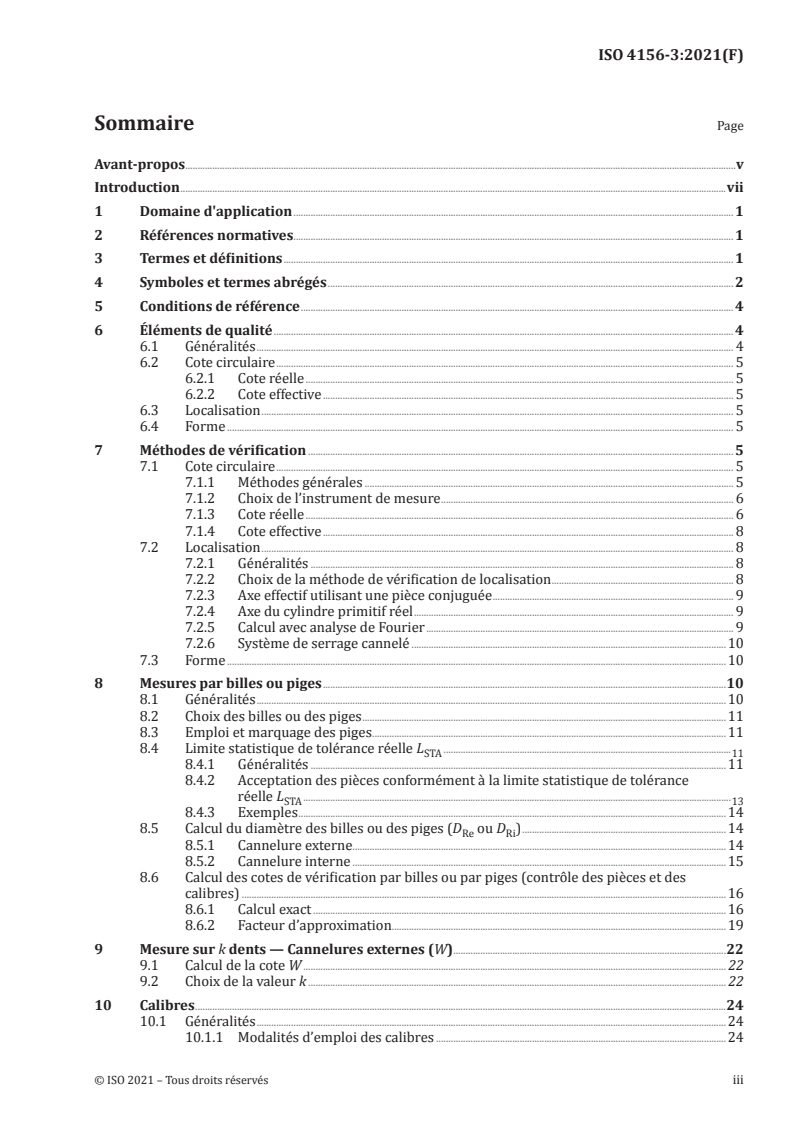
publication ne peut être reproduite ni utilisée sous quelque forme que ce soit et par aucun procédé, électronique ou mécanique,
y compris la photocopie, ou la diffusion sur l’internet ou sur un intranet, sans autorisation écrite préalable. Une autorisation peut
être demandée à l’ISO à l’adresse ci-après ou au comité membre de l’ISO dans le pays du demandeur.
ISO copyright office
Case postale 401 • Ch. de Blandonnet 8
CH-1214 Vernier, Genève
Tél.: +41 22 749 01 11
E-mail: copyright@iso.org
Web: www.iso.org
Publié en Suisse
ii © ISO 2021 – Tous droits réservés
Sommaire Page
Avant-propos .v
Introduction .vii
1 Domaine d'application . 1
2 Références normatives . 1
3 Termes et définitions . 1
4 Symboles et termes abrégés . 2
5 Conditions de référence . 4
6 Éléments de qualité . 4
6.1 Généralités . 4
6.2 Cote circulaire . 5
6.2.1 Cote réelle . 5
6.2.2 Cote effective . 5
6.3 Localisation . 5
6.4 Forme . 5
7 Méthodes de vérification . 5
7.1 Cote circulaire . 5
7.1.1 Méthodes générales . 5
7.1.2 Choix de l’instrument de mesure . 6
7.1.3 Cote réelle . 6
7.1.4 Cote effective . 8
7.2 Localisation . 8
7.2.1 Généralités . 8
7.2.2 Choix de la méthode de vérification de localisation . 8
7.2.3 Axe effectif utilisant une pièce conjuguée . 9
7.2.4 Axe du cylindre primitif réel . 9
7.2.5 Calcul avec analyse de Fourier . 9
7.2.6 Système de serrage cannelé .10
7.3 Forme .10
8 Mesures par billes ou piges .10
8.1 Généralités .10
8.2 Choix des billes ou des piges .11
8.3 Emploi et marquage des piges .11
8.4 Limite statistique de tolérance réelle L .
STA 11
8.4.1 Généralités .11
8.4.2 Acceptation des pièces conformément à la limite statistique de tolérance
réelle L .
STA 13
8.4.3 Exemples .14
8.5 Calcul du diamètre des billes ou des piges (D ou D ) .14
Re Ri
8.5.1 Cannelure externe . .14
8.5.2 Cannelure interne .15
8.6 Calcul des cotes de vérification par billes ou par piges (contrôle des pièces et des
calibres) .16
8.6.1 Calcul exact .16
8.6.2 Facteur d’approximation.19
9 Mesure sur k dents — Cannelures externes (W) .22
9.1 Calcul de la cote W . 22
9.2 Choix de la valeur k . 22
10 Calibres .24
10.1 Généralités .24
10.1.1 Modalités d’emploi des calibres .24
10.1.2 Dimensions limites d'emploi des calibres.24
10.1.3 Poignées des calibres cannelés .24
10.1.4 Nombre de dents pour les calibres «N'ENTRE PAS» à denture à secteur .24
10.2 Longueur de la partie mesurante des calibres .25
10.2.1 Influence de la longueur cannelée utile et de la longueur en prise .25
10.2.2 Calibres «ENTRE» ou «N'ENTRE PAS» .25
10.2.3 Tampons étalons .26
10.2.4 Calibres cannelés de diamètre primitif D > 180 mm .26
10.3 Tolérances de fabrication des calibres cannelés .26
10.4 Valeurs des tolérances de forme des calibres cannelés .29
10.5 Contrôle des calibres .29
10.5.1 Aspect .29
10.5.2 Marquage .29
10.5.3 Diamètre majeur des tampons et diamètre mineur des bagues .29
10.5.4 Diamètre de forme .30
10.5.5 Épaisseur des tampons .30
10.5.6 Intervalles entre les bagues .30
10.5.7 Écarts de forme .31
10.5.8 Contrôle de d'usure des calibres .31
10.5.9 Certificats de contrôle .31
10.6 Dimensions, désignation et marquage des calibres .31
10.6.1 Vérification des cannelures externes .31
10.6.2 Vérification des cannelures internes .38
10.6.3 Vérification avec des calibres lisses pour cannelures internes et externes .41
10.6.4 Marquages de calibres .41
11 Mesure des écarts de forme des cannelures .42
11.1 Généralités .42
11.2 Écart total de profil F .
α 42
11.3 Écart total de division F .
p 42
11.4 Écart total d’hélice F .
β 42
Annexe A (informative) Effets de l'excentrage et de l'écart de divisiontels qu'explicités dans
l’ISO 4156:1981 .43
Bibliographie .48
iv © ISO 2021 – Tous droits réservés
Avant-propos
L'ISO (Organisation internationale de normalisation) est une fédération mondiale d'organismes
nationaux de normalisation (comités membres de l'ISO). L'élaboration des Normes internationales est
en général confiée aux comités techniques de l'ISO. Chaque comité membre intéressé par une étude
a le droit de faire partie du comité technique créé à cet effet. Les organisations internationales,
gouvernementales et non gouvernementales, en liaison avec l'ISO participent également aux travaux.
L'ISO collabore étroitement avec la Commission électrotechnique internationale (IEC) en ce qui
concerne la normalisation électrotechnique.
Les procédures utilisées pour élaborer le présent document et celles destinées à sa mise à jour sont
décrites dans les Directives ISO/IEC, Partie 1. Il convient, en particulier, de prendre note des différents
critères d'approbation requis pour les différents types de documents ISO. Le présent document a été
rédigé conformément aux règles de rédaction données dans les Directives ISO/IEC, Partie 2 (voir www
.iso .org/ directives).
L'attention est attirée sur le fait que certains des éléments du présent document peuvent faire l'objet de
droits de propriété intellectuelle ou de droits analogues. L'ISO ne saurait être tenue pour responsable
de ne pas avoir identifié de tels droits de propriété et averti de leur existence. Les détails concernant
les références aux droits de propriété intellectuelle ou autres droits analogues identifiés lors de
l'élaboration du document sont indiqués dans l'Introduction et/ou dans la liste des déclarations de
brevets reçues par l'ISO (voir www .iso .org/ brevets).
Les appellations commerciales éventuellement mentionnées dans le présent document sont données
pour information, par souci de commodité, à l’intention des utilisateurs et ne sauraient constituer un
engagement.
Pour une explication de la nature volontaire des normes, la signification des termes et expressions
spécifiques de l'ISO liés à l'évaluation de la conformité, ou pour toute information au sujet de l'adhésion
de l'ISO aux principes de l’Organisation mondiale du commerce (OMC) concernant les obstacles
techniques au commerce (OTC), voir www .iso .org/ avant -propos.
Le présent document a été élaboré par le comité technique ISO/TC 14, Arbres pour machines et
accessoires.
Cette deuxième édition annule et remplace la première édition (ISO 4156-3:2005) qui a fait l'objet d'une
révision technique.
Les principales modifications par rapport à l'édition précédente sont les suivantes:
— l'ISO/R 1938-1 a été supprimé de l'Article 2;
— les ISO 268-1 et ISO 1328 (série) ont été déplacées de l'Article 2 vers la Bibliographie;
— les symboles relatifs à la longueur et à la longueur d’arc entre deux points, conformément à
l’ISO 80000-3, ont été adoptés et sont utilisés dans les formules;
— à la Figure 9, les diamètres de contact des billes ou piges, les cannelures internes ont été ajoutés;
— à la Figure 12, la mesure W, les indications relatives au pas de base, à l’épaisseur circulaire de base
et au diamètre de base ont été corrigés;
— le Tableau 10 a été révisé;
— à la Figure 16, la mesure de la valeur A a été corrigée;
— la Formule (A.3) a été corrigée;
— au A.3, les résultats des calculs B et E ont été corrigés;
1 r
— à la Figure A.2, les titres des figures et des sous-figures ont été corrigés.
Une liste de toutes les parties de la série ISO 4156 se trouve sur le site internet de l'ISO.
Il convient que l’utilisateur adresse tout retour d’information ou toute question concernant le présent
document à l’organisme national de normalisation de son pays. Une liste exhaustive desdits organismes
se trouve à l’adresse www .iso .org/ fr/ members .html.
vi © ISO 2021 – Tous droits réservés
Introduction
L'ISO 4156 (série) fournit les données et indications nécessaires à la conception, à la fabrication et à la
vérification des cannelures cylindriques droites (non hélicoïdales) à flancs en développante et centrage
sur flancs.
Les cannelures cylindriques droites à flancs en développante fabriquées conformément à l'ISO 4156
(série) sont utilisées pour le jeu, le coulissement et le serrage des arbres et des moyeux. Elles disposent
de toutes les caractéristiques nécessaires à l’assemblage, la transmission du couple et à une production
économique.
Les angles de pression nominaux sont 30°, 37,5° et 45°. Pour les besoins du traitement électronique des
données, la valeur 37°30′ a été remplacée par 37,5°. L'ISO 4156 (série) fixe des spécifications basées sur
les modules suivants:
— pour des angles de pression de 30° et 37,5° les incréments de module sont:
0,5; 0,75; 1; 1,25; 1,5; 1,75; 2; 2,5; 3; 4; 5; 6; 8; 10
— pour un angle de pression de 45° les incréments de module sont:
0,25; 0,5; 0,75; 1; 1,25; 1,5; 1,75; 2; 2,5
NORME INTERNATIONALE ISO 4156-3:2021(F)
Cannelures cylindriques droites à flancs en
développante — Module métrique, à centrage sur flancs —
Partie 3:
Vérification
1 Domaine d'application
Le présent document fournit les données, les indications et les exigences nécessaires à la vérification
des cannelures cylindriques droites (non hélicoïdales) à flancs en développante et centrage sur flancs.
Les cotes limites, les tolérances, les écarts de fabrication et leurs effets sur l'ajustement entre des
éléments d'accouplement coaxiaux d'une cannelure sont définis et donnés dans des tableaux. Les
dimensions linéaires sont exprimées en millimètres et celles des angles en degrés.
2 Références normatives
Les documents suivants sont cités dans le texte de sorte qu’ils constituent, pour tout ou partie de leur
contenu, des exigences du présent document. Pour les références datées, seule l’édition citée s’applique.
Pour les références non datées, la dernière édition du document de référence s'applique (y compris les
éventuels amendements).
ISO 3, Nombres normaux — Séries de nombres normaux
ISO 1101, Spécification géométrique des produits (GPS) — Tolérancement géométrique — Tolérancement
de forme, orientation, position et battement
ISO 1938-1, Spécification géométrique des produits (GPS) — Équipement de mesure dimensionnel — Partie
1: Calibres lisses à limite de taille linéaire
ISO 4156-1, Cannelures cylindriques droites à flancs en développante — Module métrique, à centrage sur
flancs — Partie 1: Généralités
ISO 4156-2, Cannelures cylindriques droites à flancs en développante — Module métrique, à centrage sur
flancs — Partie 2: Dimensions
ISO 5459, Spécification géométrique des produits (GPS) — Tolérancement géométrique — Références
spécifiées et systèmes de références spécifiées
3 Termes et définitions
Pour les besoins du présent document, les termes et les définitions de l’ISO 4156-1 s’appliquent.
L’ISO et l’IEC tiennent à jour des bases de données terminologiques destinées à être utilisées en
normalisation, consultables aux adresses suivantes:
— ISO Online browsing platform: disponible à l’adresse https:// www .iso .org/ obp
— IEC Electropedia: disponible à l’adresse http:// www .electropedia .org/
4 Symboles et termes abrégés
NOTE Certains des symboles utilisés peuvent avoir deux significations. Les symboles H, Z, Y et W sont
communs aux tolérances des calibres dans d’autres normes ISO et peuvent être associés à des symboles similaires
utilisés dans le présent document. Il n’a par conséquent pas été jugé nécessaire de les différencier dans la mesure
où le contexte du présent document ne révèle aucune ambiguïté.
a Valeur maximale autorisée au-delà de la limite de tolérance réelle µm
autorisée
D Diamètre primitif mm
D Diamètre de base mm
b
D Diamètre majeur, cannelure externe mm
ee
D Diamètre majeur maximal, cannelure externe mm
ee max
D Diamètre majeur minimal, cannelure externe mm
ee min
D Diamètre de forme maximal, cannelure externe mm
Fe max
D Diamètre de forme minimal, cannelure interne mm
Fi min
D Diamètre mineur, cannelure interne mm
ii
D Diamètre mineur minimal, cannelure interne mm
ii min
D Diamètre de la bille ou de la pige de mesure pour cannelure externe mm
Re
D Diamètre de la bille ou de la pige de mesure pour cannelure interne mm
Ri
d Diamètre au point de contact des billes ou piges de mesure, cannelure externe mm
ce
d Diamètre au point de contact des billes ou piges de mesure, cannelure interne mm
ci
E Intervalle théorique, circulaire mm
E Intervalle réel maximal mm
max
E Intervalle réel minimal mm
min
E Excentrage radial mm
r
E Intervalle effectif, circulaire mm
v
E Intervalle effectif maximal mm
v max
E Intervalle effectif minimal mm
v min
F Écart total de division µm
p
F Écart total du profil µm
α
F Écart total d’hélice µm
β
i Entier définissant la dent à l'étude et dont la valeur est 0, 1, 2, …, z-1 (confor- —
mément à l'Annexe A)
inv α Involute de l’angle αα()=−tan/π⋅α 180° —
K Facteur d'approximation pour cannelure externe —
e
2 © ISO 2021 – Tous droits réservés
K Facteur d'approximation pour cannelure interne —
i
k Nombre de dents mesurées —
L Limite de tolérance statistique réelle µm, %
STA
L Limite de tolérance statistique réelle absolue µm, %
STA absolue
L Limite de tolérance statistique réelle relative %
STA relative
l Longueur entre deux points (par exemple, entre le point B et le point A) mm
BA
M Mesure sur deux billes ou piges, cannelure externe mm
Re
M Mesure entre deux billes ou piges, cannelure interne mm
Ri
m Module mm
n Nombre maximal autorisé de valeurs mesurées hors de la limite de tolérance —
autorisée
p Pas de base mm
b
S Épaisseur théorique, circulaire mm
S Épaisseur réelle maximale mm
max
S Épaisseur réelle minimale mm
min
S Épaisseur circulaire de base mm
b
S Épaisseur effective maximale mm
v max
S Épaisseur effective minimale mm
v min
s Longueur d’arc entre deux points (par exemple, entre le point D et le point E) mm
DE
T Tolérance d’usinage µm
T Tolérance sur jeu effectif µm
v
W Mesure sur k dents, cannelure externe mm
z Nombre de dents —
α Angle de pression °
α Angle de pression aux points de contact des billes ou piges, cannelure externe °
ce
α Angle de pression aux points de contact des billes ou piges de mesure, canne- °
ci
lure interne
α Angle de pression normalisé au diamètre primitif °
D
α Angle de pression au diamètre passant par le centre de la bille ou pige, can- °
e
nelure externe
α Angle de pression au diamètre passant par le centre de la bille ou pige de °
i
mesure, cannelure interne
∆ Valeur de la recommandation de sécurité mm
sécurité
λ Écart global de forme µm
τ Pas angulaire °
ψ Angle de phase °
5 Conditions de référence
La température normale de référence des mesures industrielles de longueur est fixée à 20 °C. C’est à
cette température que sont définies les dimensions spécifiées pour les pièces et leurs calibres et que
doit normalement en être effectuée la vérification.
Si la mesure est effectuée à une autre température, le résultat doit être corrigé en fonction des
coefficients de dilatation respectifs des pièces et des calibres.
Sauf spécification contraire, toutes les opérations de mesure doivent être effectuées à une force de
mesure nulle.
Si la mesure est effectuée avec une force de mesure non nulle, le résultat doit être corrigé en
conséquence. Cette correction n’est toutefois pas nécessaire pour les mesures comparatives, effectuées
par les mêmes moyens de comparaison et avec la même force de mesure, entre des éléments semblables
de même matière et de même état de surface.
6 Éléments de qualité
6.1 Généralités
La vérification des cannelures est divisée en trois éléments de qualité, tels que représentés à la Figure 1.
Pour spécifier l'emplacement, l'ISO 1101 et l'ISO 5459 doivent être utilisées. Pour la forme et la cote
circulaire, l'ISO 4156-1 et l'ISO 4156-2 s'appliquent.
a) Cote circulaire b) Localisation c) Forme
NOTE 1 La cote circulaire peut être un élément de qualité (réelle, effective).
NOTE 2 La localisation peut être un élément de qualité (faux-rond, coaxialité, perpendicularité).
NOTE 3 La forme peut être un élément de qualité (profil, hélice, division).
Figure 1 — Éléments de qualité
4 © ISO 2021 – Tous droits réservés
6.2 Cote circulaire
6.2.1 Cote réelle
La cote réelle est
a) l’épaisseur circulaire au diamètre primitif pour les cannelures externes
b) l’intervalle circulaire au diamètre primitif pour les cannelures internes.
6.2.2 Cote effective
L'épaisseur ou l'intervalle effectif est la condition au maximum de matière résultant de la cote réelle et
du cumul des écarts de forme.
6.3 Localisation
La localisation d'une cannelure est déterminée par la localisation de l'axe central par rapport à
n'importe quel autre élément géométrique. L’axe central est déterminé par des méthodes de vérification
du réel ou de l’effectif.
6.4 Forme
Les écarts de forme d'une cannelure sont déterminés par l'écart par rapport à la forme géométrique
vraie de profil, d’hélice et de division.
7 Méthodes de vérification
7.1 Cote circulaire
7.1.1 Méthodes générales
Trois méthodes de vérification sont prévues dans le Tableau 1. Sauf spécification contraire, la méthode
standard doit être utilisée. Si les méthodes variantes A ou B sont exigées, cela doit être stipulé dans le
tableau des données de pièces. Pour le résultat des méthodes générales, voir le Tableau 2.
Tableau 1 — Relation entre paramètres et méthode de contrôle
Minimum de matière Jeu effectif minimal Jeu effectif maximal
Paramètre S /E S /E S /E
min max v max v min v min v max
Méthode standard X X —
Méthode A X X X
Méthode B — X X
Tableau 2 — Résultat des méthodes générales
Méthode de véri- Jeu théorique maximal entre pièces Écart de forme maximal dans chaque
fication conjuguées (écart de forme nulle) pièce (jeu nul)
Standard 2 (T + λ) T + λ
Variante A 2T T + λ
v
Variante B 2T Non déterminée
v
NOTE Le jeu théorique maximal entre pièces conjuguées correspond dans ce tableau aux pièces à l’état neuf. L'usure
augmente le jeu.
7.1.2 Choix de l’instrument de mesure
L'instrument de mesure doit être choisi conformément aux exigences de calcul (voir l'ISO 4156-1). Voir
le Tableau 3 et la Figure 2.
7.1.3 Cote réelle
7.1.3.1 Mesure sur et entre billes
La mesure sur et entre billes permet le calcul de l'épaisseur ou de l'intervalle circulaire théorique réel
au diamètre primitif fondé sur l'épaisseur ou l'intervalle réel au point de contact des billes dans un plan
perpendiculaire. La cote mesurée sur et entre billes correspond à une cote vraie en 2 creux donnés
dans un plan donné.
7.1.3.2 Mesure sur et entre piges
La mesure sur et entre piges permet le calcul de l'épaisseur ou de l'intervalle circulaire théorique réel
au diamètre primitif fondé sur l'épaisseur ou l'intervalle réel au point de contact linéaire des piges.
Tableau 3 — Instruments de mesure de vérification des cotes, méthodes et priorités
Paramètre
Priorité S /E S /E S /E S /E
min max v max v min v min v max max min
Méthode
Priorité la plus Mesure sur et entre Calibre «ENTRE» à Calibre «N'ENTRE Mesure sur et entre
forte billes denture complète PAS» à denture com- billes
plète
Priorités les Mesure sur et entre Calibre à denture com- Calibre à denture com- Mesure sur et entre
plus faibles piges plète variable plète variable piges
Calibre «N'ENTRE Calculs analytiques Calibre à denture à
PAS» à denture à sur la base des cotes secteur variable
secteur et écarts de forme
Calibre à denture à
secteur variable
Cote sur k dents
6 © ISO 2021 – Tous droits réservés
Légende
1 cercle primitif
a
Tampon «N'ENTRE PAS» à denture secteur ou mesure maximale entre billes ou piges.
b
Tampon «N'ENTRE PAS» à denture complète.
c
Mesure minimale entre billes ou piges, auxiliaire.
d
Tampon «ENTRE» à denture complète.
e
Bague «ENTRE» à denture complète.
f
Mesure maximale sur billes ou piges, auxiliaire.
g
Bague «N'ENTRE PAS» à denture complète.
h
Bague «N'ENTRE PAS» à denture secteur ou mesure minimale sur billes ou piges.
Figure 2 — Méthodes de vérification élémentaires des intervalles et des épaisseurs
7.1.3.3 Calibre «N'ENTRE PAS» à denture à secteur
Le calibre «N'ENTRE PAS» à denture à secteur vérifie la limite de tolérance réelle spécifiée de l'épaisseur
ou de l'intervalle circulaire à la condition au minimum de matière de la pièce, lorsque le calibre n'est en
contact qu'avec les extrémités.
7.1.3.4 Cote sur k dents
La mesure de cette cote facilite le calcul de l'épaisseur circulaire réelle théorique des cannelures
externes au diamètre primitif fondé sur la mesure d’une série de dents. Avant d'utiliser cette méthode,
il convient d'en vérifier le caractère approprié.
7.1.3.5 Calibre à denture à secteur variable
Le calibre à denture à secteur variable mesure l'épaisseur ou l'intervalle circulaire réel. La mesure réelle
est obtenue en bloquant radialement les flancs gauche et droit et en comparant à un étalon d’épaisseur
ou d’intervalle connu(e).
7.1.4 Cote effective
7.1.4.1 Calibre «ENTRE» à denture complète
Les calibres «ENTRE» à denture complète vérifient
a) que les limites effectives spécifiées de l'épaisseur ou de l'intervalle ne sont pas dépassées à la
condition au maximum de matière de la pièce,
b) le diamètre de forme spécifié de la pièce, assurant ainsi le respect des tolérances spécifiées sur
toute la longueur de la développante, et
c) la longueur en prise spécifiée, ainsi que le respect de la limite au maximum de matière de la
cannelure.
7.1.4.2 Calibre à denture complète variable
Le calibre à denture complète variable mesure l'épaisseur ou l'intervalle circulaire effectif. La mesure
réelle est obtenue en bloquant radialement les flancs gauche et droit et en comparant à un étalon
d’épaisseur ou d’intervalle connu(e).
7.1.4.3 Calibre «N'ENTRE PAS» à denture complète
Le calibre «N'ENTRE PAS» à denture complète vérifie la limite effective spécifiée de l'épaisseur
minimale ou de l'intervalle maximal, lorsque le calibre n'est en contact qu'avec les extrémités.
7.1.4.4 Vérification du diamètre au sommet des dents (D ou D )
ii ee
Toutes ces méthodes de vérification nécessitent de mesurer le sommet des dents (diamètre mineur
interne, D , ou diamètre majeur externe, D ) par calibres lisses «ENTRE» et «N'ENTRE PAS» (tampon
ii ee
ou bague) ou autres dispositifs de mesure admis.
7.2 Localisation
7.2.1 Généralités
Les cannelures ont des dimensions vraies réelles et effectives d'intervalle et d'épaisseur et elles
disposent également d’un axe réel et d’un axe effectif.
Les tolérances relatives aux localisations (c’est-à-dire les tolérances sur faux-rond, faux-rond total,
concentricité ou coaxialité) doivent être spécifiées sur le dessin du composant. Quand les cannelures
sont utilisées en tant qu’axe de référence, les autres géométries doivent être tolérancées par rapport à
l’axe de la cannelure. Les écarts de forme propres engendrent des difficultés de reproductibilité et de
répétabilité du profil de cannelure si les écarts de forme et les écarts de cylindricité sont nombreux.
7.2.2 Choix de la méthode de vérification de localisation
Le choix de la méthode de vérification de localisation est donné dans le Tableau 4.
8 © ISO 2021 – Tous droits réservés
Tableau 4 — Méthodes de vérification de localisation et priorités
Priorité Méthode
Priorité la plus forte Axe effectif utilisant une pièce conjuguée parfaitement ajustée sans écart de forme
Priorités les plus faibles Axe du cylindre primitif réel
Calcul avec analyse de Fourier
Systèmes de serrage cannelés
7.2.3 Axe effectif utilisant une pièce conjuguée
La localisation de l'axe effectif de la cannelure est définie par l'axe d'une cannelure (sans écart de forme)
conjuguée parfaitement ajustée sans jeu ni serrage. Dans la mesure où cela présente des difficultés
de réalisation dans la pratique, il est admis d'utiliser des systèmes de serrage cannelés ainsi que des
méthodes de calcul mathématique utilisant des écarts de forme individuels calculés par vérification
analytique.
7.2.4 Axe du cylindre primitif réel
La localisation de l'axe réel de la cannelure (voir Figure 3) est définie par la ligne de référence moyenne
de tous les points de mesure sur les flancs des dents. Cet axe représente la position où tous les écarts
sont minimaux (condition des moindres carrés).
Figure 3 — Axe réel de cannelure
7.2.5 Calcul avec analyse de Fourier
Ce calcul peut être réalisé par mesure et analyse de l'écart de division, de l'écart de profil et de l'écart
d'hélice. L'axe obtenu avec cette méthode (voir Figure 4) représente l'axe où les écarts de division, de
profil et d'hélice ont leurs plus petites valeurs.
Légende
1 écarts de division par rapport à l'axe A
2 axe obtenu par analyse de Fourier
3 écarts de division par rapport à l'axe B avec valeur minimale
Figure 4 — Axe obtenu par analyse de Fourier de l'écart de division
7.2.6 Système de serrage cannelé
Dans la pratique, il est très difficile de fabriquer une cannelure conjuguée parfaitement (sans écart
de forme) qui est ajustée sans jeu ni serrage. En alternative, il est possible d'utiliser un système de
serrage cannelé qui fixe les pièces sur les flancs de dents. Un grand nombre de systèmes différents sont
disponibles, mais ils constituent un compromis à la parfaite cannelure conjuguée.
7.3 Forme
Une explication plus complète des écarts de forme se trouve dans l'ISO 1328 (toutes les parties) et dans
l'ISO/TR 10064-1. La référence pour les écarts de forme est le cylindre primitif effectif.
8 Mesures par billes ou piges
8.1 Généralités
L’intervalle ou l’épaisseur réel(le) théorique peut être calculé(e) par la mesure sur ou entre billes ou piges.
Les concepts aux 8.2 à 8.6 et les Formules (1) à (28) s'appliquent quand des billes ou piges sont utilisées.
10 © ISO 2021 – Tous droits réservés
8.2 Choix des billes ou des piges
Le diamètre des billes ou des piges doit de préférence être choisi dans la série Renard R40 de l'ISO 3.
Dans l'idéal, il convient que la bille ou la pige soit en contact du diamètre primitif lorsque la dent ou
l'entredent est égal à S ou E.
Dans la pratique, il peut être nécessaire d’arrondir le diamètre de la bille ou de la pige à la valeur
immédiatement supérieure dans la série.
Lorsqu’il n’est pas possible de choisir une dimension de pige ou de bille à partir de l’ISO 4156-2,
la dimension choisie doit satisfaire les conditions de contact requises pour obtenir des mesures
satisfaisantes. La dimension à utiliser doit faire l’objet d’un accord préalable entre le client et le
fournisseur.
Dans certains cas, il est nécessaire de pratiquer sur la pige ou la bille un méplat pour éviter le contact
avec le diamètre majeur d'une cannelure interne ou le diamètre mineur d'une cannelure externe.
Les différentes géométries des billes ou piges de mesure influencent les résultats mesurés. L'état de
surface et les écarts d'hélice ont également un effet.
L’exactitude des billes et des piges est indiquée dans le Tableau 5 ainsi que la longueur des piges en
fonction du diamètre de la pige.
Tableau 5 — Exactitude des billes et des piges et longueur mesurante des piges
Valeurs en millimètres
Diamètre nominal des billes ou Tolérances sur dia- Longueur mesu-
des piges mètre rante des piges
(D ou D ) (tous défauts compris)
Ri Re
0,3 ≤ D ou D ≤ 1 ±0,001 20 ± 5
Ri Re
1 < D ou D ≤ 5 ±0,001 30 ± 5
Ri Re
5 < D ou D ≤ 15 ±0,001 5 40 ± 5
Ri Re
15 < D ou D ≤ 26 ±0,001 5 50 ± 5
Ri Re
D ou D ≥ 26 ±0,002 60 ± 5
Ri Re
8.3 Emploi et marquage des piges
Les piges doivent pouvoir être employées sur toute leur longueur mesurante en n’importe quelle zone
de la longueur cannelée à vérifier.
Elles doivent être marquées de leur diamètre nominal.
8.4 Limite statistique de tolérance réelle L
STA
8.4.1 Généralités
La vérification de la dimension réelle des cannelures présente toujours des incertitudes. Le résultat de
la vérification est influencé par
— la position angulaire,
— le plan de mesure, et
— la méthode de vérification.
Ces trois éléments influencent les résultats de mesure et réduisent la répétabilité. Sauf spécification
contraire convenue entre le client et le fournisseur, la priorité doit être établie comme suit:
Toutes les méthodes de vérification peuvent être utilisées pour mesurer la dimension réelle, mais en
cas de litige, la mesure entre ou sur billes doit avoir la plus haute priorité pour accepter ou refuser une
pièce. La dimension réelle doit être vérifiée au moins en trois positions angulaires et au moins en trois
plans de mesure également répartis. En cas de litige par rapport aux résultats mesurés à partir d'une
méthode identique, le résultat qui a utilisé le plus grand nombre de positions de mesure angulaire et
longitudinale doit avoir la priorité.
Si des mesures sont effectuées avec un grand nombre de points de mesure, il existe une répartition
statistique de toutes les valeurs réelles vraies mesurées en tout point. En théorie, toutes les valeurs
réelles vraies locales mesurées en tout point doivent être comprises dans la limite de tolérance réelle.
L’analyse statistique de la limite de tolérance réelle utilise deux L (analyse statistique de tolérance)
STA
et permet de prendre une décision sur l’acceptation ou le refus d’une pièce par rapport à la limite de
tolérance réelle. Le présent document permet d’utiliser la limite statistique de tolérance réelle L (voir
STA
Figure 5).
La limite statistique de tolérance réelle L définit 2 limites:
STA
a) L
STA relative
— Nombre de dimensions réelles vraies individuelles locales autorisé hors de la limite de
tolérance réelle.
— Il est exprimé en % de toutes les valeurs mesurées.
b) L
STA absolue
— Valeur maximale des dimensions vraies individuelles locales autorisée hors de la limite de
tolérance.
— Elle est exprimée en micromètres ou en pourcentage de la valeur de tolérance réelle.
12 © ISO 2021 – Tous droits réservés
Légende
1 limite de tolérance maximale effective
2 marque de référence maximale réelle auxiliaire
3 répartition des dimensions mesurées dans une pièce
4 limite de tolérance minimale réelle
5 L
STA absolue
6 L
STA relative
Figure 5 — Limite statistique de tolérance réelle L
STA
8.4.2 Acceptation des pièces conformément à la limite statistique de tolérance réelle L
STA
La moyenne arithmétique de toutes les valeurs locales aussi bien des cercles ou des cylindres compensés
doit toujours s’inscrire dans la limite de tolérance réelle. La limite statistique de tolérance réelle ne
doit être utilisée que pour les dimensions vraies individuelles locales et non pour leur moyenne ou
éléments remplacés. Il est admis qu’un nombre limité de valeurs vraies individuelles dépasse la limite
de tolérance réelle d’une quantité autorisée.
Le nombre maximal autorisé (n )de valeurs mesurées hors de la limite de tolérance est
autorisée
calculé par le nombre de valeurs mesurées n et le pourcentage donné de la L :
STA relative
nn=int⋅⋅L (1)
()
autoriséeSTA relative
Le nombre de valeurs mesurées doit être suffisamment grand pour que l'analyse L fonctionne selon
STA
n .
autorisée
La valeur maximale autorisée au-delà de la limite de tolérance réelle peut être calculée par le
pourcentage de la L lorsque la L = L et la tolérance réelle T:
STA STA absolue STA relative
aT=⋅L (2)
autoriséeSTA absolue
Si l’exigence L = L n’est pas satisfaite, la valeur L peut être donnée sé
...
Questions, Comments and Discussion
Ask us and Technical Secretary will try to provide an answer. You can facilitate discussion about the standard in here.