


ISO 11986
(Main)Ophthalmic optics - Contact lenses and contact lens care products - Determination of preservative uptake and release
Ophthalmic optics - Contact lenses and contact lens care products - Determination of preservative uptake and release
ISO 11986:2017 provides general procedures for the selection of methods, preparation of samples, and the conduct of testing for the uptake and release of preservatives from contact lenses. NOTE 1 Due to the manifest difficulties of reproducibility when coating contact lenses with mineral and organic deposits encountered during lens wear, these methods are only applicable to new and unused contact lenses. NOTE 2 Preservative depletion by a contact lens in the limited volume of a lens case could compromise disinfection performance. This document does not measure disinfection performance.
Optique ophtalmique — Lentilles de contact et produits d'entretien pour lentilles de contact — Détermination de l'absorption et de la libération des conservateurs
ISO 11986:2017 fournit des modes opératoires généraux pour sélectionner les différentes méthodes, préparer les échantillons et réaliser des essais portant sur l'absorption/adsorption et le relargage des conservateurs par les lentilles de contact. NOTE 1 En raison des difficultés évidentes rencontrées pour obtenir de façon reproductible des dépôts minéraux et organiques à la surface des lentilles de contact en cours de port, les présentes méthodes s'appliquent uniquement aux lentilles de contact neuves n'ayant jamais été utilisées. NOTE 2 L'appauvrissement en conservateurs pour une lentille de contact placée dans le volume limité d'un étui à lentilles pourrait altérer les performances de décontamination. Le présent document ne mesure pas les performances de décontamination.
General Information
- Status
- Not Published
- Technical Committee
- ISO/TC 172/SC 7 - Ophthalmic optics and instruments
- Drafting Committee
- ISO/TC 172/SC 7/WG 9 - Contact lenses
- Current Stage
- 6000 - International Standard under publication
- Start Date
- 29-Nov-2025
- Completion Date
- 10-Jan-2026
Relations
- Effective Date
- 10-Aug-2024
Overview
ISO 11986:2025 is an international standard established by ISO for the ophthalmic optics industry that focuses on contact lenses and contact lens care products. This standard specifies general procedures to determine the uptake and release of preservatives by contact lenses. It provides a crucial framework for evaluating the interaction between preservative-containing lens care solutions and new or modified contact lens materials during the development phase.
Preservatives in lens care products are essential for antimicrobial protection; however, their absorption and release by contact lenses can cause ocular irritation or sensitization. This standard equips manufacturers and researchers with reliable test methods to quantify preservative uptake and release, ensuring safe and effective lens materials and disinfecting solutions without compromising user comfort and safety.
Key Topics
- Preservative Uptake Testing: Procedures for selecting contact lenses and care products, preparing samples, and measuring preservative absorption over time at controlled temperature (25 °C ± 2 °C).
- Preservative Release Testing: Guidelines for assessing how contact lenses release preservatives back into a saline solution at body temperature (37 °C ± 2 °C), simulating real-wear conditions.
- Sample Preparation and Selection: Focus on new and unused contact lenses only due to reproducibility issues with soiled lenses. Selection of representative materials across hydrogel and rigid gas-permeable lens groups, including ionic/non-ionic and silicone hydrogel lenses.
- Analytical Methods: Emphasis on choosing appropriate, validated analytical methods for preservative quantification, considering chemical properties, detection limits, and reproducibility.
- Data Expression and Interpretation: Results presented as micrograms of preservative per milligram of dry lens mass, per lens, or per square centimeter of lens surface. Calculation of preservative uptake and release rates over time for comprehensive characterization.
- Limitation Note: Tests do not measure disinfection performance or effects of deposits from lens wear; strictly applicable to new lenses under controlled testing environments.
Applications
- Contact Lens Development: Assisting manufacturers in evaluating new or modified lens materials during product development to assess preservative interaction risks, avoiding potential toxic or irritating effects.
- Formulation of Lens Care Products: Guiding formulation scientists to optimize preservative types and concentrations in solutions to ensure safe preservative uptake profiles.
- Regulatory Compliance and Safety Evaluation: Supporting evidence-based risk assessments for regulatory submissions by providing standardized testing data on preservative retention and release.
- Improving User Comfort: Helping product designers minimize preservative-related ocular irritation or sensitization through better understanding of preservative-lens interactions.
- Quality and Research Laboratories: Serving as a reference for routine research and preclinical testing to monitor preservative behavior in new contact lens or care product prototypes.
Related Standards
- ISO 18369-1:2017 – Ophthalmic optics - Contact lenses - Part 1: Vocabulary. Provides terminology and classification referenced in ISO 11986.
- ISO 18369-3:2017 – Ophthalmic optics - Contact lenses - Part 3: Measurement methods. Specifies the preparation of saline solutions used in preservative release testing according to ISO 11986.
- ISO/IEC Directives, Part 1 and 2 – Guidelines on the development and maintenance of ISO standards.
- US FDA Guidelines on Preservative Analysis – Offers examples of analytical methods suitable for preservative detection and quantification, useful in selecting appropriate test methodologies as per ISO 11986.
By adhering to ISO 11986, stakeholders in the contact lens industry can systematically enhance product safety, efficacy, and wearer comfort through standardized preservative uptake and release testing practices. This ensures the delivery of high-quality ophthalmic optics products compliant with global standards and regulatory expectations.
ISO/FDIS 11986 - Ophthalmic optics — Contact lenses and contact lens care products — Determination of preservative uptake and release Released:19. 09. 2025
REDLINE ISO/FDIS 11986 - Ophthalmic optics — Contact lenses and contact lens care products — Determination of preservative uptake and release Released:19. 09. 2025
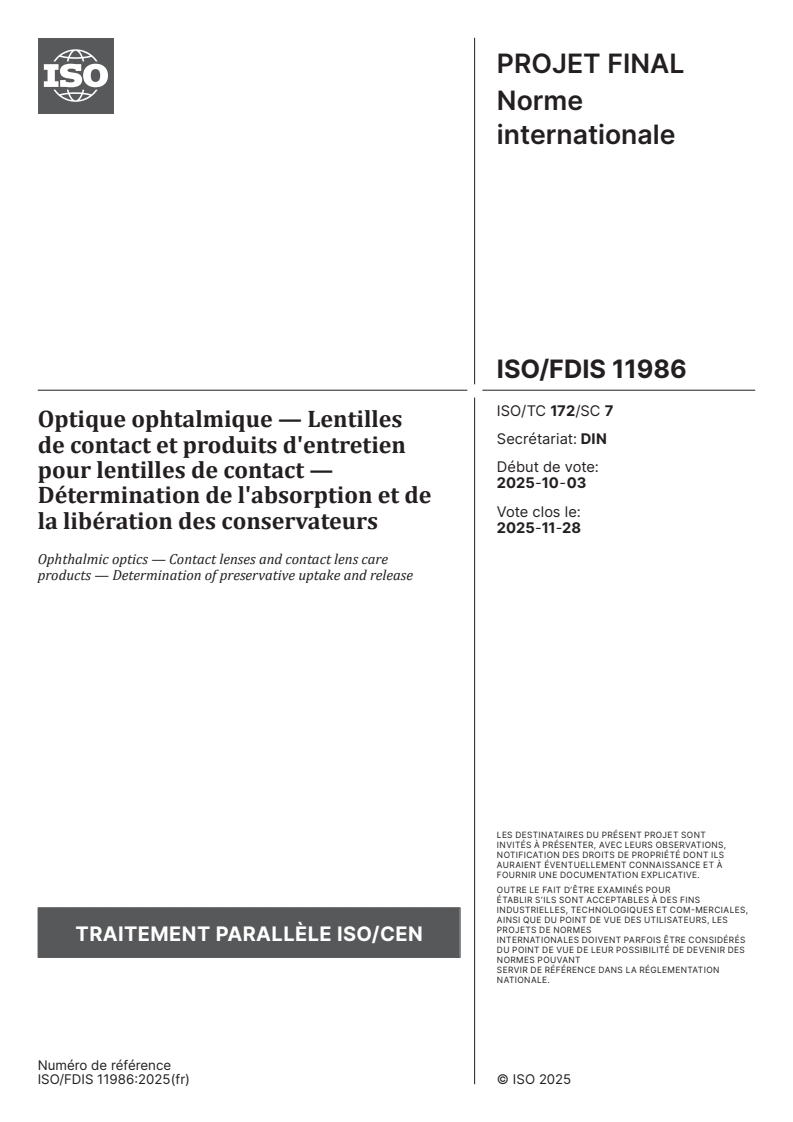
ISO/FDIS 11986 - Optique ophtalmique — Lentilles de contact et produits d'entretien pour lentilles de contact — Détermination de l'absorption et de la libération des conservateurs Released:21. 10. 2025
Frequently Asked Questions
ISO 11986 is a draft published by the International Organization for Standardization (ISO). Its full title is "Ophthalmic optics - Contact lenses and contact lens care products - Determination of preservative uptake and release". This standard covers: ISO 11986:2017 provides general procedures for the selection of methods, preparation of samples, and the conduct of testing for the uptake and release of preservatives from contact lenses. NOTE 1 Due to the manifest difficulties of reproducibility when coating contact lenses with mineral and organic deposits encountered during lens wear, these methods are only applicable to new and unused contact lenses. NOTE 2 Preservative depletion by a contact lens in the limited volume of a lens case could compromise disinfection performance. This document does not measure disinfection performance.
ISO 11986:2017 provides general procedures for the selection of methods, preparation of samples, and the conduct of testing for the uptake and release of preservatives from contact lenses. NOTE 1 Due to the manifest difficulties of reproducibility when coating contact lenses with mineral and organic deposits encountered during lens wear, these methods are only applicable to new and unused contact lenses. NOTE 2 Preservative depletion by a contact lens in the limited volume of a lens case could compromise disinfection performance. This document does not measure disinfection performance.
ISO 11986 is classified under the following ICS (International Classification for Standards) categories: 11.040.70 - Ophthalmic equipment. The ICS classification helps identify the subject area and facilitates finding related standards.
ISO 11986 has the following relationships with other standards: It is inter standard links to ISO 11986:2017. Understanding these relationships helps ensure you are using the most current and applicable version of the standard.
ISO 11986 is available in PDF format for immediate download after purchase. The document can be added to your cart and obtained through the secure checkout process. Digital delivery ensures instant access to the complete standard document.
Standards Content (Sample)
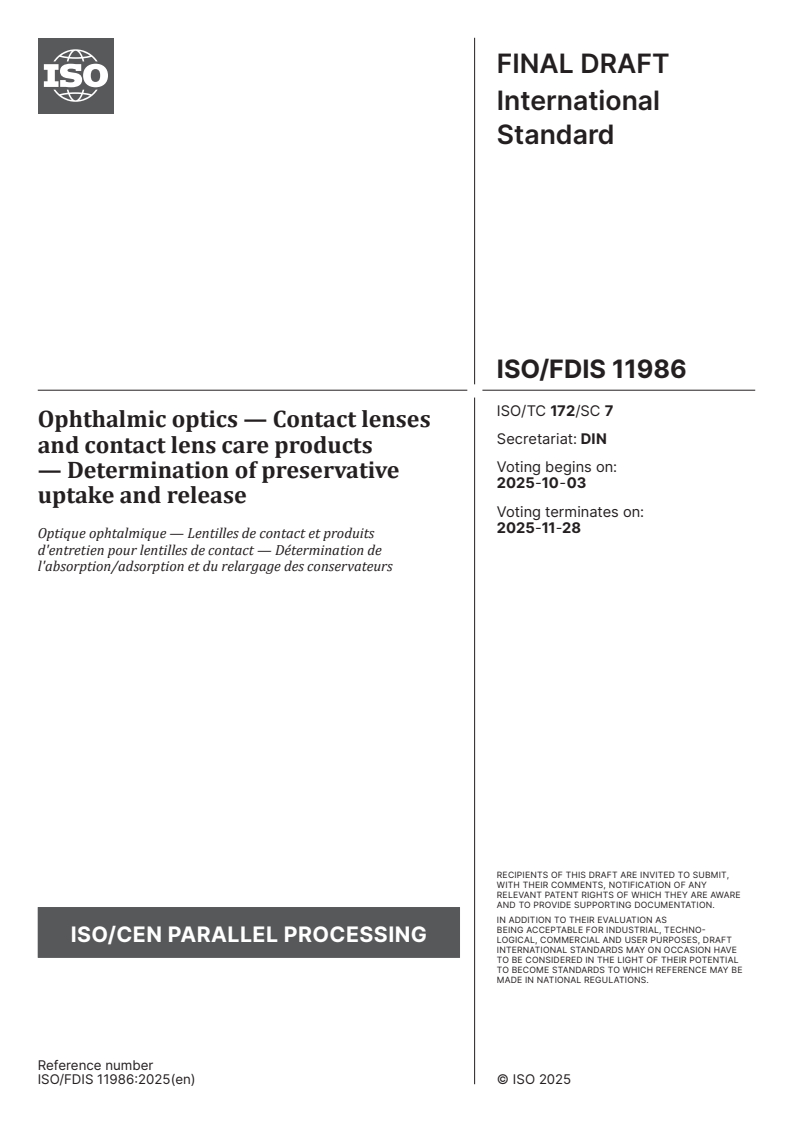
FINAL DRAFT
International
Standard
ISO/FDIS 11986
ISO/TC 172/SC 7
Ophthalmic optics — Contact lenses
Secretariat: DIN
and contact lens care products
Voting begins on:
— Determination of preservative
2025-10-03
uptake and release
Voting terminates on:
2025-11-28
Optique ophtalmique — Lentilles de contact et produits
d'entretien pour lentilles de contact — Détermination de
l'absorption/adsorption et du relargage des conservateurs
RECIPIENTS OF THIS DRAFT ARE INVITED TO SUBMIT,
WITH THEIR COMMENTS, NOTIFICATION OF ANY
RELEVANT PATENT RIGHTS OF WHICH THEY ARE AWARE
AND TO PROVIDE SUPPOR TING DOCUMENTATION.
IN ADDITION TO THEIR EVALUATION AS
BEING ACCEPTABLE FOR INDUSTRIAL, TECHNO
ISO/CEN PARALLEL PROCESSING LOGICAL, COMMERCIAL AND USER PURPOSES, DRAFT
INTERNATIONAL STANDARDS MAY ON OCCASION HAVE
TO BE CONSIDERED IN THE LIGHT OF THEIR POTENTIAL
TO BECOME STAN DARDS TO WHICH REFERENCE MAY BE
MADE IN NATIONAL REGULATIONS.
Reference number
ISO/FDIS 11986:2025(en) © ISO 2025
FINAL DRAFT
ISO/FDIS 11986:2025(en)
International
Standard
ISO/FDIS 11986
ISO/TC 172/SC 7
Ophthalmic optics — Contact lenses
Secretariat: DIN
and contact lens care products
Voting begins on:
— Determination of preservative
uptake and release
Voting terminates on:
Optique ophtalmique — Lentilles de contact et produits
d'entretien pour lentilles de contact — Détermination de
l'absorption/adsorption et du relargage des conservateurs
RECIPIENTS OF THIS DRAFT ARE INVITED TO SUBMIT,
WITH THEIR COMMENTS, NOTIFICATION OF ANY
RELEVANT PATENT RIGHTS OF WHICH THEY ARE AWARE
AND TO PROVIDE SUPPOR TING DOCUMENTATION.
© ISO 2025
IN ADDITION TO THEIR EVALUATION AS
All rights reserved. Unless otherwise specified, or required in the context of its implementation, no part of this publication may
BEING ACCEPTABLE FOR INDUSTRIAL, TECHNO
ISO/CEN PARALLEL PROCESSING
LOGICAL, COMMERCIAL AND USER PURPOSES, DRAFT
be reproduced or utilized otherwise in any form or by any means, electronic or mechanical, including photocopying, or posting on
INTERNATIONAL STANDARDS MAY ON OCCASION HAVE
the internet or an intranet, without prior written permission. Permission can be requested from either ISO at the address below
TO BE CONSIDERED IN THE LIGHT OF THEIR POTENTIAL
or ISO’s member body in the country of the requester.
TO BECOME STAN DARDS TO WHICH REFERENCE MAY BE
MADE IN NATIONAL REGULATIONS.
ISO copyright office
CP 401 • Ch. de Blandonnet 8
CH-1214 Vernier, Geneva
Phone: +41 22 749 01 11
Email: copyright@iso.org
Website: www.iso.org
Published in Switzerland Reference number
ISO/FDIS 11986:2025(en) © ISO 2025
ii
ISO/FDIS 11986:2025(en)
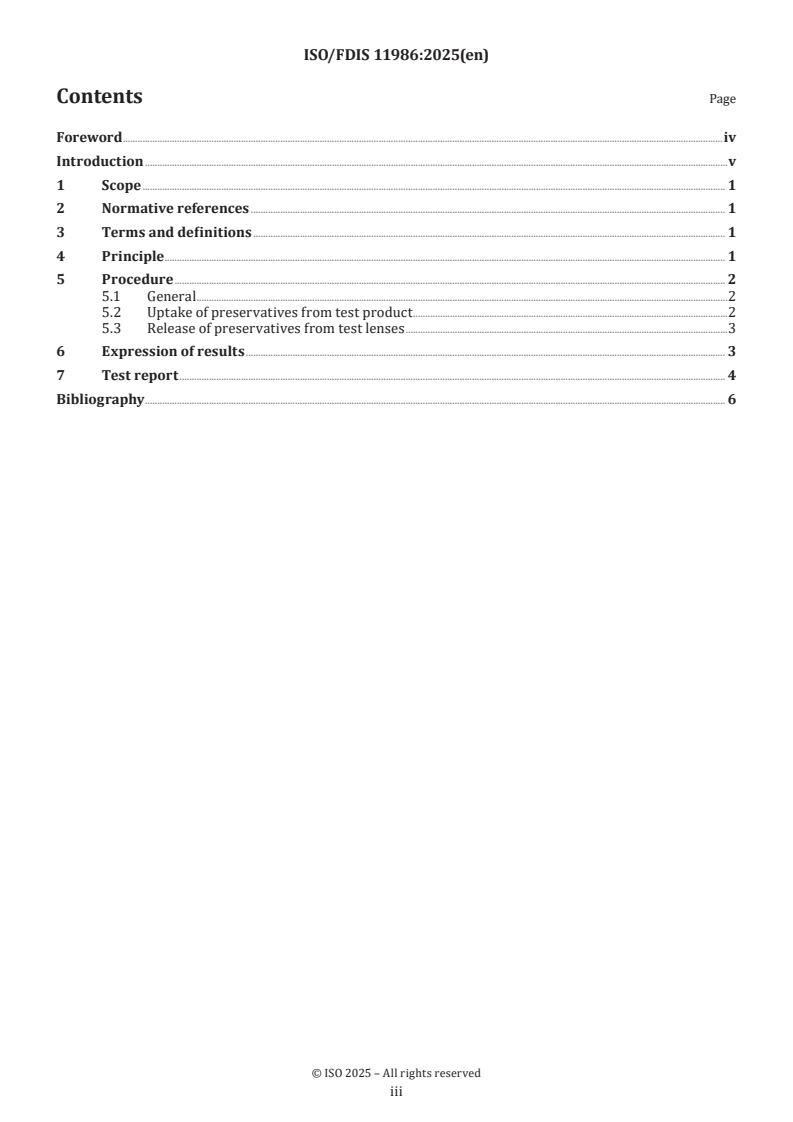
Contents Page
Foreword .iv
Introduction .v
1 Scope . 1
2 Normative references . 1
3 Terms and definitions . 1
4 Principle . 1
5 Procedure . 2
5.1 General .2
5.2 Uptake of preservatives from test product .2
5.3 Release of preservatives from test lenses .3
6 Expression of results . 3
7 Test report . 4
Bibliography . 6
iii
ISO/FDIS 11986:2025(en)
Foreword
ISO (the International Organization for Standardization) is a worldwide federation of national standards
bodies (ISO member bodies). The work of preparing International Standards is normally carried out through
ISO technical committees. Each member body interested in a subject for which a technical committee
has been established has the right to be represented on that committee. International organizations,
governmental and non-governmental, in liaison with ISO, also take part in the work. ISO collaborates closely
with the International Electrotechnical Commission (IEC) on all matters of electrotechnical standardization.
The procedures used to develop this document and those intended for its further maintenance are described
in the ISO/IEC Directives, Part 1. In particular, the different approval criteria needed for the different types
of ISO documents should be noted. This document was drafted in accordance with the editorial rules of the
ISO/IEC Directives, Part 2 (see www.iso.org/directives).
ISO draws attention to the possibility that the implementation of this document may involve the use of
patents. ISO takes no position concerning the evidence, validity or applicability of any claimed patent rights
in respect thereof. As of the date of publication of this document, ISO had not received notice of patents
which may be required to implement this document. However, implementers are cautioned that this
may not represent the latest information, which may be obtained from the patent database available at
www.iso.org/patents. ISO shall not be held responsible for identifying any or all such patent rights.
Any trade name used in this document is information given for the convenience of users and does not
constitute an endorsement.
For an explanation of the voluntary nature of standards, the meaning of ISO specific terms and expressions
related to conformity assessment, as well as information about ISO's adherence to the World Trade
Organization (WTO) principles in the Technical Barriers to Trade (TBT), see www.iso.org/iso/foreword.html.
This document was prepared by Technical Committee ISO/TC 172, Optics and photonics, Subcommittee SC 7,
Ophthalmic optics and photonics.
This fourth edition cancels and replaces the third edition (ISO 11986:2017), which has been technically
revised.
The main changes are as follows:
— Editorial update of the whole document.
— An additional sentence in the Scope clarifies the circumstances when the test method is to be applied. In
particular this test method is only considered for use during the development phase of new or modified
contact lens materials or new contact lens care products.
Any feedback or questions on this document should be directed to the user’s national standards body. A
complete listing of these bodies can be found at www.iso.org/members.html.
iv
ISO/FDIS 11986:2025(en)
Introduction
Contact lens care products are a complex mixture of organic and inorganic substances. For reasons of
microbiological safety, contact lens disinfecting solutions, as well as care products in multi-use containers,
contain substances with antimicrobial activity. From many years of experience in contact lens wear,
it is known that irritation and sensitization problems sometimes occur due to these preservatives being
absorbed and released by the matrix of the contact lens. For these reasons, it is necessary to be able to
estimate the extent of preservative uptake and release by contact lenses.
The preservative uptake and release test provides a general method for measuring the uptake of preservatives
in solution by contact lenses and the release of preservatives from contact lenses in an aqueous medium.
The analytical method to be used for quantification of specific preservatives is not indicated here. Chemical
characteristics of the preservative, as well as concentration in the contact lens care product and degree of
uptake by the contact lens, can be taken into consideration in selecting an appropriate analytical method.
Contact lens uptake and release data can be useful in characterizing the potential for a new or modified
contact lens material to produce a toxic or irritating reaction in the eye from the uptake and binding or
release of preservatives from currently marketed contact lens care products.
v
FINAL DRAFT International Standard ISO/FDIS 11986:2025(en)
Ophthalmic optics — Contact lenses and contact lens care
products — Determination of preservative uptake and release
1 Scope
This document provides general procedures for the selection of methods, preparation of samples, and the
conduct of testing for the uptake and release of preservatives from contact lenses.
Preservative uptake and release testing is not intended as a routine test of production contact lenses or
contact lens care products nor are testing results meant to establish finished goods specifications in any way.
Such testing is carried out when developing new contact lens materials and/or contact lens care products.
NOTE 1 Due to the manifest difficulties of reproducibility when coating contact lenses with mineral and organic
deposits encountered during lens wear, these methods are only applicable to new and unused contact lenses.
NOTE 2 Preservative depletion by a contact lens in the limited volume of a lens case could compromise disinfection
performance. This document does not measure disinfection performance.
2 Normative references
The following documents are referred to in the text in such a way that some or all of their content constitutes
requirements of this document. For dated references, only the edition cited applies. For undated references,
the latest edition of the referenced document (including any amendments) applies.
ISO 18369-3:2017, Ophthalmic optics — Contact lenses — Part 3: Measurement methods
3 Terms and definitions
No terms
...
ISO/FDIS 11986:2025(en)
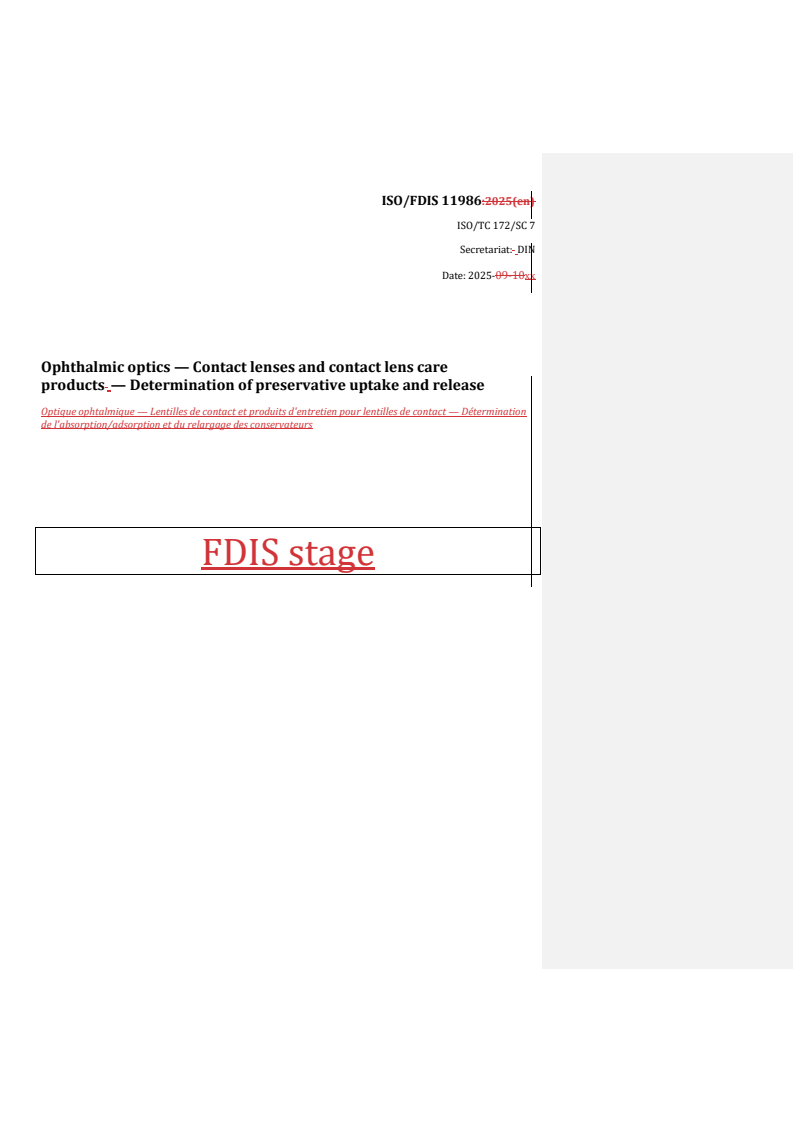
ISO/TC 172/SC 7
Secretariat: DIN
Date: 2025-09-10xx
Ophthalmic optics — Contact lenses and contact lens care
products — Determination of preservative uptake and release
Optique ophtalmique — Lentilles de contact et produits d'entretien pour lentilles de contact — Détermination
de l'absorption/adsorption et du relargage des conservateurs
FDIS stage
ISO/FDIS 11986:2025(en)
All rights reserved. Unless otherwise specified, or required in the context of its implementation, no part of this publication
may be reproduced or utilized otherwise in any form or by any means, electronic or mechanical, including photocopying,
or posting on the internet or an intranet, without prior written permission. Permission can be requested from either ISO
at the address below or ISO’s member body in the country of the requester.
ISO copyright office
CP 401 • Ch. de Blandonnet 8
CH-1214 Vernier, Geneva
Phone: + 41 22 749 01 11
EmailE-mail: copyright@iso.org
Website: www.iso.org
Published in Switzerland
ii
ISO/FDIS 11986:2025(en)
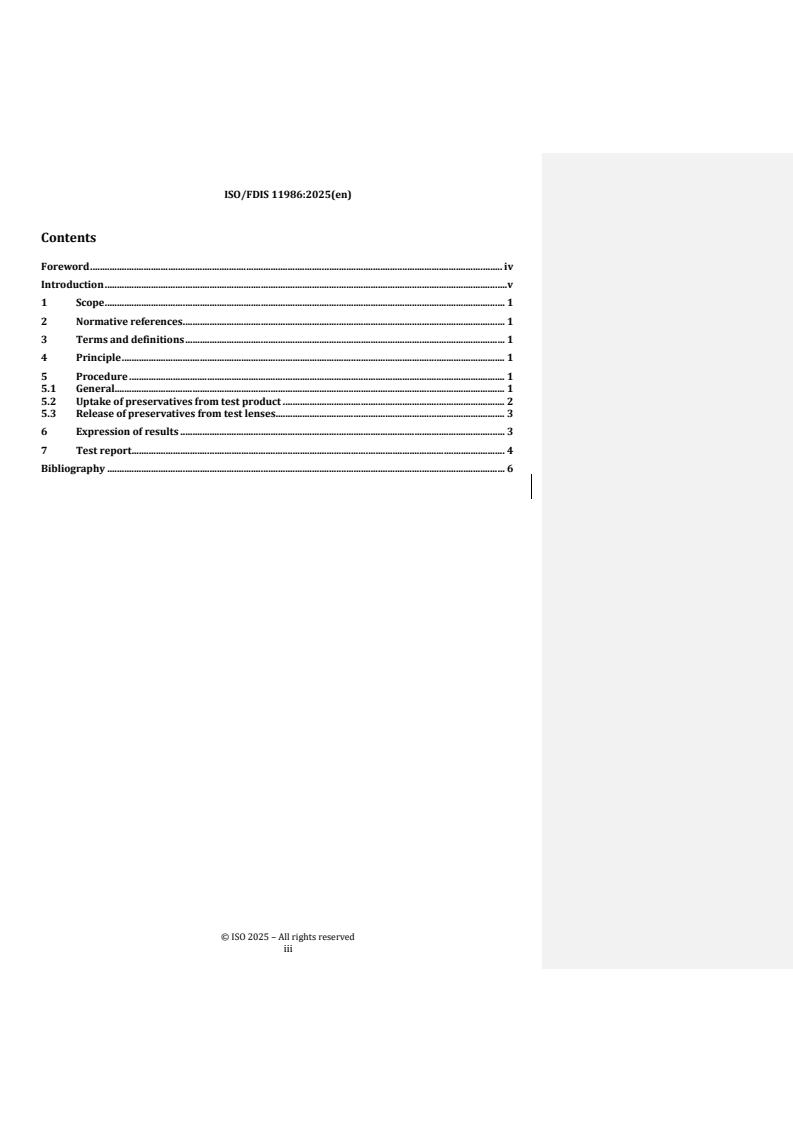
Contents
Foreword . iv
Introduction . v
1 Scope . 1
2 Normative references . 1
3 Terms and definitions . 1
4 Principle . 1
5 Procedure . 1
5.1 General. 1
5.2 Uptake of preservatives from test product . 2
5.3 Release of preservatives from test lenses . 3
6 Expression of results . 3
7 Test report . 4
Bibliography . 6
iii
ISO/FDIS 11986:2025(en)
Foreword
ISO (the International Organization for Standardization) is a worldwide federation of national standards
bodies (ISO member bodies). The work of preparing International Standards is normally carried out through
ISO technical committees. Each member body interested in a subject for which a technical committee has been
established has the right to be represented on that committee. International organizations, governmental and
non-governmental, in liaison with ISO, also take part in the work. ISO collaborates closely with the
International Electrotechnical Commission (IEC) on all matters of electrotechnical standardization.
The procedures used to develop this document and those intended for its further maintenance are described
in the ISO/IEC Directives, Part 1. In particular, the different approval criteria needed for the different types of
ISO documents should be noted. This document was drafted in accordance with the editorial rules of the
ISO/IEC Directives, Part 2 (see www.iso.org/directives).
ISO draws attention to the possibility that the implementation of this document may involve the use of patents.
ISO takes no position concerning the evidence, validity or applicability of any claimed patent rights in respect
thereof. As of the date of publication of this document, ISO had not received notice of patents which may be
required to implement this document. However, implementers are cautioned that this may not represent the
latest information, which may be obtained from the patent database available at www.iso.org/patents. ISO
shall not be held responsible for identifying any or all such patent rights.
Any trade name used in this document is information given for the convenience of users and does not
constitute an endorsement.
For an explanation of the voluntary nature of standards, the meaning of ISO specific terms and expressions
related to conformity assessment, as well as information about ISO's adherence to the World Trade
Organization (WTO) principles in the Technical Barriers to Trade (TBT), see www.iso.org/iso/foreword.html.
This document was prepared by Technical Committee ISO/TC 172, Optics and photonics, Subcommittee SC 7,
Ophthalmic optics and photonics.
This fourth edition cancels and replaces the third edition (ISO 11986:2017), which has been technically
revised.
The main changes are as follows:
— — Editorial update of the whole document;.
— — An additional sentence in the Scope clarifies the circumstances when the test method is to be applied.
In particular this test method is only considered for use during the development phase of new or modified
contact lens materials or new contact lens care products.
Any feedback or questions on this document should be directed to the user’s national standards body. A
complete listing of these bodies can be found at www.iso.org/members.html.
iv
ISO/FDIS 11986:2025(en)
Introduction
Contact lens care products are a complex mixture of organic and inorganic substances. For reasons of
microbiological safety, contact lens disinfecting solutions, as well as care products in multi-use containers,
contain substances with antimicrobial activity. From many years of experience in contact lens wear, it is
known that irritation and sensitization problems sometimes occur due to these preservatives being absorbed
and released by the matrix of the contact lens. For these reasons, it is necessary to be able to estimate the
extent of preservative uptake and release by contact lenses.
The preservative uptake and release test provides a general method for measuring the uptake of preservatives
in solution by contact lenses and the release of preservatives from contact lenses in an aqueous medium. The
analytical method to be used for quantification of specific preservatives is not indicated here. Chemical
characteristics of the preservative, as well as concentration in the contact lens care product and degree of
uptake by the contact lens, can be taken into consideration in selecting an appropriate analytical method.
Contact lens uptake and release data can be useful in characterizing the potential for a new or modified contact
lens material to produce a toxic or irritating reaction in the eye from the uptake and binding or release of
preservatives from currently marketed contact lens care products.
v
ISO/FDIS 11986:2025(en)
Ophthalmic optics — Contact lenses and contact lens care products —
Determination of preservative uptake and release
1 Scope
This document provides general procedures for the selection of methods, preparation of samples, and the
conduct of testing for the uptake and release of preservatives from contact lenses.
Preservative uptake and release testing is not intended as a routine test of production contact lenses or contact
lens care products nor are testing results meant to establish finished goods specifications in any way.
Such testing is carried out when developing new contact lens materials and/or contact lens care products.
NOTE 1 Due to the manifest difficulties of reproducibility when coating contact lenses with mineral and organic
deposits encountered during lens wear, these methods are only applicable to new and unused contact lenses.
NOTE 2 Preservative depletion by a contact lens in the limited volume of a lens case could compromise disinfection
performance. This document does not measure disinfection performance.
2 Normative references
The following documents are referred to in the text in such a way that some or all of their content constitutes
requirements of this document. For dated references, only the edition cited applies. For undated references,
the latest edition of the referenced document (including any amendments) applies.
ISO 18369--3:2017, Ophthalmic optics — Contact lenses — Part 3: Measurement methods
3 Terms and definitions
No terms and definitions are listed in this document.
ISO and IEC maintain terminology databases for use in standardization at the following addresses:
— — ISO Online browsing platform: available at https://www.iso.org/obp
— — IEC Electropedia: available at https://www.electropedia.org/
4 Principle
The contact lenses to be tested are immersed in the test product at 25 °C ± 2 °C and the preservative content
is analysed at regular intervals of time until a steady-state condition has been achieved.
After reaching the steady-state condition, each contact lens is immersed in 1 ml of saline solution for contact
lens testing, the saline solution shall be prepared in accordance with ISO 18369-3:2017, 4.9, at 37 °C ± 2 °C. At
discrete intervals up to and including 16 h, and at intervals until no additional release is observed, if required,
the solution is analysed for the amount of preservative that has been extracted at each time point.
5 Procedure
5.1 General
The following information shall be obtained before commencing the estimation:
ISO/FDIS 11986:2025(en)
a) a) evidence that the selected test method is suitable for the detection and estimation of the
particular preservative;
NOTE 1 Examples of methods suit
...
PROJET FINAL
Norme
internationale
ISO/FDIS 11986
ISO/TC 172/SC 7
Optique ophtalmique — Lentilles
Secrétariat: DIN
de contact et produits d'entretien
Début de vote:
pour lentilles de contact —
2025-10-03
Détermination de l'absorption et de
Vote clos le:
la libération des conservateurs
2025-11-28
Ophthalmic optics — Contact lenses and contact lens care
products — Determination of preservative uptake and release
LES DESTINATAIRES DU PRÉSENT PROJET SONT
INVITÉS À PRÉSENTER, AVEC LEURS OBSERVATIONS,
NOTIFICATION DES DROITS DE PROPRIÉTÉ DONT ILS
AURAIENT ÉVENTUELLEMENT CONNAISSANCE ET À
FOURNIR UNE DOCUMENTATION EXPLICATIVE.
OUTRE LE FAIT D’ÊTRE EXAMINÉS POUR
ÉTABLIR S’ILS SONT ACCEPTABLES À DES FINS
INDUSTRIELLES, TECHNOLOGIQUES ET COM-MERCIALES,
AINSI QUE DU POINT DE VUE DES UTILISATEURS, LES
PROJETS DE NORMES
TRAITEMENT PARALLÈLE ISO/CEN
INTERNATIONALES DOIVENT PARFOIS ÊTRE CONSIDÉRÉS
DU POINT DE VUE DE LEUR POSSI BILITÉ DE DEVENIR DES
NORMES POUVANT
SERVIR DE RÉFÉRENCE DANS LA RÉGLEMENTATION
NATIONALE.
Numéro de référence
ISO/FDIS 11986:2025(fr) © ISO 2025
PROJET FINAL
ISO/FDIS 11986:2025(fr)
Norme
internationale
ISO/FDIS 11986
ISO/TC 172/SC 7
Optique ophtalmique — Lentilles
Secrétariat: DIN
de contact et produits d'entretien
Début de vote:
pour lentilles de contact —
2025-10-03
Détermination de l'absorption et de
Vote clos le:
la libération des conservateurs
2025-11-28
Ophthalmic optics — Contact lenses and contact lens care
products — Determination of preservative uptake and release
LES DESTINATAIRES DU PRÉSENT PROJET SONT
INVITÉS À PRÉSENTER, AVEC LEURS OBSERVATIONS,
NOTIFICATION DES DROITS DE PROPRIÉTÉ DONT ILS
AURAIENT ÉVENTUELLEMENT CONNAISSANCE ET À
FOURNIR UNE DOCUMENTATION EXPLICATIVE.
DOCUMENT PROTÉGÉ PAR COPYRIGHT
OUTRE LE FAIT D’ÊTRE EXAMINÉS POUR
ÉTABLIR S’ILS SONT ACCEPTABLES À DES FINS
© ISO 2025 INDUSTRIELLES, TECHNOLOGIQUES ET COM-MERCIALES,
AINSI QUE DU POINT DE VUE DES UTILISATEURS, LES
Tous droits réservés. Sauf prescription différente ou nécessité dans le contexte de sa mise en œuvre, aucune partie de cette
PROJETS DE NORMES
TRAITEMENT PARALLÈLE ISO/CEN
INTERNATIONALES DOIVENT PARFOIS ÊTRE CONSIDÉRÉS
publication ne peut être reproduite ni utilisée sous quelque forme que ce soit et par aucun procédé, électronique ou mécanique,
DU POINT DE VUE DE LEUR POSSI BILITÉ DE DEVENIR DES
y compris la photocopie, ou la diffusion sur l’internet ou sur un intranet, sans autorisation écrite préalable. Une autorisation peut
NORMES POUVANT
être demandée à l’ISO à l’adresse ci-après ou au comité membre de l’ISO dans le pays du demandeur.
SERVIR DE RÉFÉRENCE DANS LA RÉGLEMENTATION
NATIONALE.
ISO copyright office
Case postale 401 • Ch. de Blandonnet 8
CH-1214 Vernier, Genève
Tél.: +41 22 749 01 11
E-mail: copyright@iso.org
Web: www.iso.org
Publié en Suisse Numéro de référence
ISO/FDIS 11986:2025(fr) © ISO 2025
ii
ISO/FDIS 11986:2025(fr)
Sommaire Page
Avant-propos .iv
Introduction .v
1 Domaine d'application . 1
2 Références normatives . 1
3 Termes et définitions . 1
4 Principe. 1
5 Procédure . 2
5.1 Général .2
5.2 Absorption des conservateurs dans le produit testé .2
5.3 Libération des conservateurs des lentilles d'essai .3
6 Expression des résultats . 3
7 Rapport d'essai . 5
Bibliographie . 6
iii
ISO/FDIS 11986:2025(fr)
Avant-propos
L'ISO (Organisation internationale de normalisation) est une fédération mondiale d'organismes nationaux
de normalisation (organismes membres de l'ISO). Le travail d'élaboration des normes internationales est
normalement effectué par les comités techniques de l'ISO. Chaque organisme membre intéressé par un sujet
pour lequel un comité d'études a été créé a le droit d'être représenté au sein de ce comité. Des organisations
internationales, gouvernementales et non gouvernementales, en liaison avec l'ISO, participent également aux
travaux. L'ISO collabore étroitement avec la Commission électrotechnique internationale (IEC) sur toutes les
questions de normalisation électrotechnique.
Les procédures utilisées pour l'élaboration du présent document et celles destinées à sa mise à jour
ultérieure sont décrites dans les Directives ISO/CEI, Partie 1. Il convient notamment de noter les différents
critères d'approbation requis pour les différents types de documents ISO. Ce document a été rédigé selon les
règles éditoriales des Directives ISO/CEI, Partie 2 (voir www.iso.org/directives).
L'ISO attire l'attention sur le fait que la mise en œuvre du présent document peut impliquer l'utilisation
de brevets. L'ISO ne prend pas position concernant la preuve, la validité ou l'applicabilité de tout droit de
brevet allégué à cet égard (1402, environnement). À la date de publication du présent document, l'ISO n'a
pas reçu de notification de brevets qui pourraient être nécessaires à la mise en œuvre du présent document.
Toutefois, les utilisateurs sont avertis qu'il peut ne pas s'agir des informations les plus récentes, qui peuvent
être obtenues à partir de la base de données des brevets disponible à l'adresse www.iso.org/patents. L'ISO
ne doit pas être tenue responsable de l'identification de tout ou partie de ces droits de brevet.
Tout nom de marque utilisé dans le présent document est une information donnée pour la commodité des
usagers et ne constitue pas une approbation.
Pour une explication de la nature volontaire des normes, de la signification des termes et expressions
spécifiques à l'ISO liés à l'évaluation de la conformité, ainsi que des informations sur l'adhésion de l'ISO aux
principes de l'Organisation mondiale du commerce (OMC) dans le domaine des obstacles techniques au
commerce (OTC), voir www.iso.org/iso/foreword.html.
Ce document a été préparé par le comité technique ISO/TC 172, Optique et photonique, sous-comité SC 7,
Optique et photonique ophtalmiques.
Cette quatrième édition annule et remplace la troisième édition (ISO 11986:2017), qui a fait l'objet d'une
révision technique.
Les principaux changements sont les suivants:
— Mise à jour éditoriale de l'ensemble du document.
— Une phrase supplémentaire dans le Domaine d'application clarifie les circonstances dans lesquelles la
méthode d'essai doit être appliquée. En particulier, cette méthode d'essai ne prend en considération
que l'utilisation pendant la phase de développement de matériaux de lentilles de contact nouveaux ou
modifiés ou de nouveaux produits d'entretien de lentilles de contact.
Tout commentaire ou question sur le présent document doit être adressé à l'organisme national
de normalisation de l'usager. Une liste complète de ces organismes peut être consultée à l'adresse
www.iso.org/members.html.
iv
ISO/FDIS 11986:2025(fr)
Introduction
Les produits d'entretien des lentilles de contact sont un mélange complexe de substances organiques et
inorganiques. Pour des raisons de sécurité microbiologique, les solutions de désinfection des lentilles de
contact, ainsi que les produits d'entretien dans des récipients à usage multiple, contiennent des substances
à activité antimicrobienne. Grâce à de nombreuses années d'expérience dans le domaine du port de lentilles
de contact, on sait que des problèmes d'irritation et de sensibilisation peuvent parfois survenir en raison de
l'absorption et de la libération de ces conservateurs par la matrice de la lentille de contact. Pour ces raisons,
il est nécessaire de pouvoir estimer l'ampleur de l'absorption et de la libération des conservateurs par les
lentilles de contact.
Le test d'absorption et de libération des conservateurs fournit une méthode générale pour mesurer
l'absorption des conservateurs en solution par les lentilles de contact et la libération des conservateurs
des lentilles de contact dans un milieu aqueux. La méthode d'analyse à utiliser pour la quantification des
conservateurs spécifiques n'est pas indiquée ici. Les caractéristiques chimiques du conservateur, ainsi que
sa concentration dans le produit d'entretien des lentilles de contact et son degré d'absorption par les lentilles
de contact, peuvent être prises en considération lors de la sélection d'une méthode d'analyse appropriée.
Les données relatives à l'absorption et à la libération des lentilles de contact peuvent être utiles pour
caractériser le potentiel d'un matériau de lentille de contact nouveau ou modifié à produire une réaction
toxique ou irritante dans l'œil à partir de l'absorption et de la fixation ou de la libération des conservateurs
des produits d'entretien des lentilles de contact actuellement commercialisés.
v
PROJET FINAL Norme internationale ISO/FDIS 11986:2025(fr)
Optique ophtalmique — Lentilles de contact et produits
d'entretien pour lentilles de contact — Détermination de
l'absorption et de la libération des conservateurs
1 Domaine d'application
Ce document fournit des procédures générales pour la sélection des méthodes, la préparation des échantillons
et la réalisation d'essais sur l'absorption et la libération d'agents de conservation par les lentilles de contact.
Le test d'absorption et de libération des conservateurs n'est pas conçu comme un test de routine pour la
production de lentilles de contact ou de produits d'entretien de lentilles de contact, et les résultats du test ne
sont pas censés établir les spécifications des produits finis de quelque manière que ce soit.
Ces tests sont effectués lors du développement de nouveaux matériaux pour lentilles de contact et/ou de
produits d'entretien pour lentilles de contact.
NOTE 1 En raison des difficultés manifestes de reproductibilité lors du revêtement des lentilles de contact avec les
dépôts minéraux et organiques rencontrés lors du port des lentilles, ces méthodes ne sont applicables qu'aux lentilles
de contact neuves et non utilisées.
NOTE 2 L'épuisement du conservateur par une lentille de contact dans le volume limité d'un étui à lentilles peut
compromettre l'efficacité de la désinfection. Le présent document ne mesure pas les performances en matière de
désinfection.
2 Références normatives
Les documents suivants sont mentionnés dans le texte de telle sorte que tout ou partie de leur contenu
constitue des exigences du présent document. Pour les références datées, seule l'édition citée s'applique.
Pour les références non datées, c'est la dernière édition du document référencé (y compris les éventuels
amendements) qui s'applique.
ISO 18369-3:2017, Optique ophtalmique — Lentilles de contact — Partie 3: Méthodes de mesure
3 Termes et définitions
Aucun terme et aucune définition ne figurent dans le présent document.
L'ISO et la CEI tiennent à jour des bases de données terminologiques destinées à être utilisées dans le cadre
de la normalisation aux adresses suivantes:
— ISO Plate-forme de navigation en ligne: disponible
...
Questions, Comments and Discussion
Ask us and Technical Secretary will try to provide an answer. You can facilitate discussion about the standard in here.
Loading comments...