


ISO/FDIS 18490
(Main)Non-destructive testing — Evaluation of vision acuity of NDT personnel
Non-destructive testing — Evaluation of vision acuity of NDT personnel
ISO 18490:2015 specifies the form of the optotype, the quality requirements for the chart, the test procedure, and the acceptance level for near vision acuity of NDT personnel. It also addresses the qualification requirements for personnel permitted to carry out the test. ISO 18490:2015 only addresses near vision acuity under defined conditions similar to those encountered during routine NDT inspection. It does not address an individual's overall visual acuity and users are advised to consider the need for a general eye examination by specialist medical personnel to ensure general vision acuity is appropriate for job function. ISO 18490:2015 does not address colour vision requirements.
Essais non destructifs — Évaluation de l'acuité visuelle du personnel END
L'ISO 18490:2015 spécifie la forme de l'optotype, les exigences de qualité requises de la mire, la procédure d'essai et le niveau d'acceptation pour l'acuité de la vision de près du personnel END. Il aborde également les exigences relatives à la qualification du personnel autorisé à effectuer ces contrôles. L'ISO 18490:2015 traite uniquement de l'acuité de la vision proche dans des conditions définies, similaires à celles rencontrées lors des contrôles END de routine. Elle n'aborde pas l'acuité visuelle générale des individus. Il est conseillé aux utilisateurs d'envisager de procéder à un examen général d'ophtalmologie chez un médecin spécialiste afin de s'assurer que leur acuité visuelle générale est adaptée à leur activité professionnelle. L'ISO 18490:2015 ne contient pas d'exigences relatives à la vision des couleurs.
General Information
- Status
- Not Published
- Technical Committee
- ISO/TC 135/SC 7 - Personnel qualification
- Current Stage
- 5020 - FDIS ballot initiated: 2 months. Proof sent to secretariat
- Start Date
- 26-Dec-2025
- Completion Date
- 26-Dec-2025
Relations
- Effective Date
- 12-Feb-2026
- Consolidates
ISO 12233:2023 - Photography — Electronic still picture imaging — Resolution and spatial frequency responses - Effective Date
- 16-Dec-2023
- Effective Date
- 09-Dec-2023
Overview
ISO/FDIS 18490:2025 is an international standard developed by ISO Technical Committee 135 (Non-destructive Testing) that specifies requirements for evaluating the vision acuity of Non-Destructive Testing (NDT) personnel. This standard outlines the criteria for near, far, and color vision acuity assessments under conditions similar to routine NDT inspections. It standardizes the test charts, procedures, acceptance levels, and qualifications of personnel authorized to administer these vision tests. Its primary purpose is to ensure NDT inspectors possess adequate visual capabilities for precise defect detection during inspections, supporting compliance with ISO 9712 for personnel certification.
Key Topics
- Vision Acuity Scope: Focuses on near, far, and color vision acuity relevant to routine NDT tasks. It excludes general eye health assessments and overall visual acuity, which should be performed by medical professionals.
- Test Charts & Quality: Specifies the use of standardized optotypes including Radner, Snellen, and Landolt charts, with strict quality and print conformity requirements to avoid false test results. Charts should be sourced from approved manufacturers to ensure accuracy.
- Test Procedure: Defines precise illumination levels, luminance, and eye-to-chart distances for vision testing to replicate typical NDT inspection environments. It details instructions on vision correction usage during tests and protocols for near and far vision assessments.
- Acceptance Levels: Establishes minimum vision acuity thresholds for passing the tests, aligned with the demands of NDT inspection tasks. Examples include reading acuity notations and specific visual angle criteria (logMAR and logRAD).
- Personnel Qualifications: Mandates qualifications for individuals who administer vision tests, ensuring they follow the standard’s methodology reliably. Guidance on attestation and verification of trained professionals is included.
- Supplementary Evaluations: Annexes provide additional insights into grey scale perception, low contrast visual acuity, and color discrimination testing (Ishihara and color trade tests), critical for specialized NDT techniques.
Applications
ISO/FDIS 18490 supports organizations and certification bodies involved in:
- NDT Personnel Certification: Ensuring inspectors meet visual acuity standards necessary for quality and safety in non-destructive testing processes.
- Health and Safety Compliance: Implementing vision testing protocols that reduce inspection errors related to visual limitations.
- Training and Qualification: Preparing authorized personnel to carry out vision exams accurately and consistently as part of personnel qualification programs.
- Quality Assurance: Validating the reliability of vision tests through certified charts and standardized procedures to maintain inspection integrity.
- Risk Mitigation: Assisting employers in identifying vision deficiencies early, enabling timely corrective actions or medical referrals to maintain inspection quality.
Related Standards
- ISO 9712:2012 – Non-destructive testing - Qualification and certification of NDT personnel, which mandates vision acuity verification as part of personnel qualification.
- ISO 7921 – Ophthalmic optics and instruments - Specifies near reading charts to ensure consistent test stimuli.
- ISO 8596 – Ophthalmic optics - Visual acuity testing including standardized optotypes and clinical methods for far vision assessment.
- Ishihara Test Standards – For color vision testing, relevant where color differentiation is essential for specific NDT methods.
Keywords: ISO 18490 vision acuity, NDT personnel vision testing, non-destructive testing standards, vision acuity acceptance levels, NDT inspector qualifications, near and far vision test, color vision for NDT, NDT personnel certification, standardized vision testing charts, ISO 9712 compliance.
ISO/FDIS 18490 - Non-destructive testing — Evaluation of vision acuity of NDT personnel Released:12. 12. 2025
REDLINE ISO/FDIS 18490 - Non-destructive testing — Evaluation of vision acuity of NDT personnel Released:12. 12. 2025
ISO/FDIS 18490 - Essais non destructifs — Évaluation de l'acuité visuelle du personnel END Released:14. 01. 2026
Get Certified
Connect with accredited certification bodies for this standard

BSI Group
BSI (British Standards Institution) is the business standards company that helps organizations make excellence a habit.

Bureau Veritas
Bureau Veritas is a world leader in laboratory testing, inspection and certification services.

DNV
DNV is an independent assurance and risk management provider.
Sponsored listings
Frequently Asked Questions
ISO/FDIS 18490 is a draft published by the International Organization for Standardization (ISO). Its full title is "Non-destructive testing — Evaluation of vision acuity of NDT personnel". This standard covers: ISO 18490:2015 specifies the form of the optotype, the quality requirements for the chart, the test procedure, and the acceptance level for near vision acuity of NDT personnel. It also addresses the qualification requirements for personnel permitted to carry out the test. ISO 18490:2015 only addresses near vision acuity under defined conditions similar to those encountered during routine NDT inspection. It does not address an individual's overall visual acuity and users are advised to consider the need for a general eye examination by specialist medical personnel to ensure general vision acuity is appropriate for job function. ISO 18490:2015 does not address colour vision requirements.
ISO 18490:2015 specifies the form of the optotype, the quality requirements for the chart, the test procedure, and the acceptance level for near vision acuity of NDT personnel. It also addresses the qualification requirements for personnel permitted to carry out the test. ISO 18490:2015 only addresses near vision acuity under defined conditions similar to those encountered during routine NDT inspection. It does not address an individual's overall visual acuity and users are advised to consider the need for a general eye examination by specialist medical personnel to ensure general vision acuity is appropriate for job function. ISO 18490:2015 does not address colour vision requirements.
ISO/FDIS 18490 is classified under the following ICS (International Classification for Standards) categories: 03.100.30 - Management of human resources; 19.100 - Non-destructive testing. The ICS classification helps identify the subject area and facilitates finding related standards.
ISO/FDIS 18490 has the following relationships with other standards: It is inter standard links to FprEN ISO 18490, ISO 12233:2023, ISO 18490:2015. Understanding these relationships helps ensure you are using the most current and applicable version of the standard.
ISO/FDIS 18490 is available in PDF format for immediate download after purchase. The document can be added to your cart and obtained through the secure checkout process. Digital delivery ensures instant access to the complete standard document.
Standards Content (Sample)
FINAL DRAFT
International
Standard
ISO/TC 135/SC 7
Non-destructive testing —
Secretariat: SCC
Evaluation of vision acuity of NDT
Voting begins on:
personnel
2025-12-26
Essais non destructifs — Évaluation de l'acuité visuelle du
Voting terminates on:
personnel END
2026-02-20
RECIPIENTS OF THIS DRAFT ARE INVITED TO SUBMIT,
WITH THEIR COMMENTS, NOTIFICATION OF ANY
RELEVANT PATENT RIGHTS OF WHICH THEY ARE AWARE
AND TO PROVIDE SUPPOR TING DOCUMENTATION.
IN ADDITION TO THEIR EVALUATION AS
BEING ACCEPTABLE FOR INDUSTRIAL, TECHNO
ISO/CEN PARALLEL PROCESSING LOGICAL, COMMERCIAL AND USER PURPOSES, DRAFT
INTERNATIONAL STANDARDS MAY ON OCCASION HAVE
TO BE CONSIDERED IN THE LIGHT OF THEIR POTENTIAL
TO BECOME STAN DARDS TO WHICH REFERENCE MAY BE
MADE IN NATIONAL REGULATIONS.
Reference number
FINAL DRAFT
International
Standard
ISO/TC 135/SC 7
Non-destructive testing —
Secretariat: SCC
Evaluation of vision acuity of NDT
Voting begins on:
personnel
Essais non destructifs — Évaluation de l'acuité visuelle du
Voting terminates on:
personnel END
RECIPIENTS OF THIS DRAFT ARE INVITED TO SUBMIT,
WITH THEIR COMMENTS, NOTIFICATION OF ANY
RELEVANT PATENT RIGHTS OF WHICH THEY ARE AWARE
AND TO PROVIDE SUPPOR TING DOCUMENTATION.
© ISO 2025
IN ADDITION TO THEIR EVALUATION AS
All rights reserved. Unless otherwise specified, or required in the context of its implementation, no part of this publication may
BEING ACCEPTABLE FOR INDUSTRIAL, TECHNO
ISO/CEN PARALLEL PROCESSING
LOGICAL, COMMERCIAL AND USER PURPOSES, DRAFT
be reproduced or utilized otherwise in any form or by any means, electronic or mechanical, including photocopying, or posting on
INTERNATIONAL STANDARDS MAY ON OCCASION HAVE
the internet or an intranet, without prior written permission. Permission can be requested from either ISO at the address below
TO BE CONSIDERED IN THE LIGHT OF THEIR POTENTIAL
or ISO’s member body in the country of the requester.
TO BECOME STAN DARDS TO WHICH REFERENCE MAY BE
MADE IN NATIONAL REGULATIONS.
ISO copyright office
CP 401 • Ch. de Blandonnet 8
CH-1214 Vernier, Geneva
Phone: +41 22 749 01 11
Email: copyright@iso.org
Website: www.iso.org
Published in Switzerland Reference number
ii
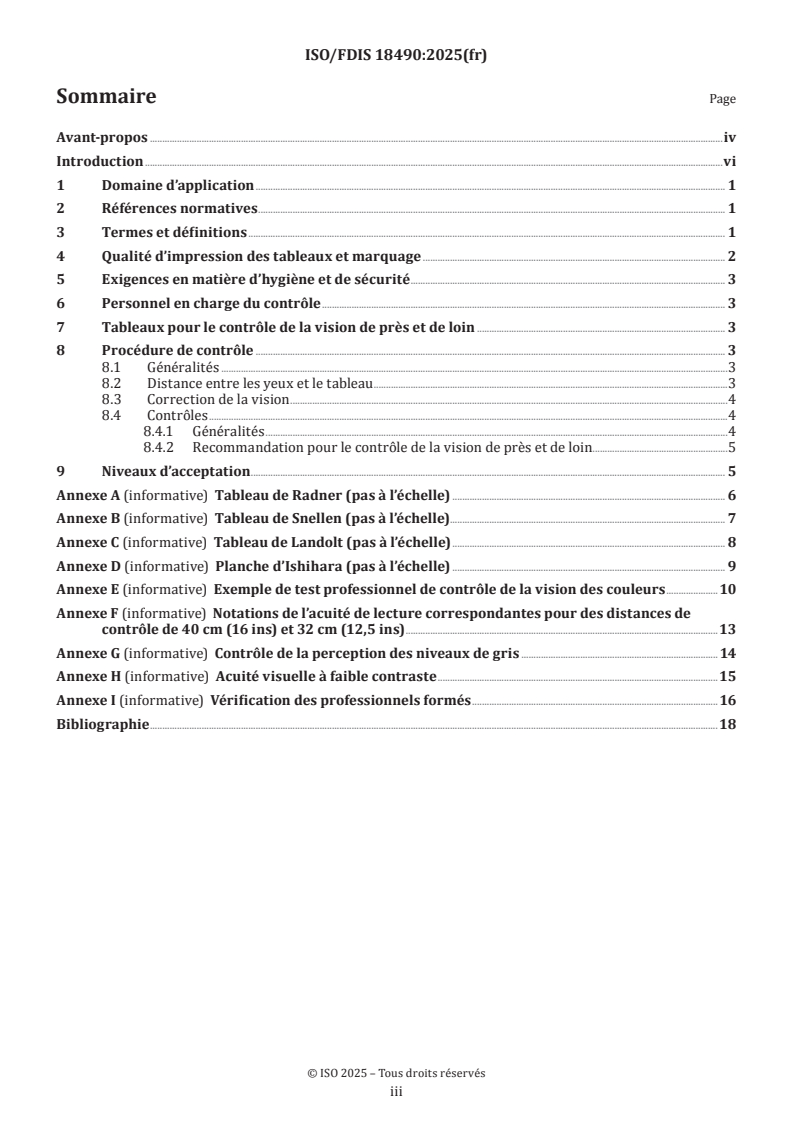
Contents Page
Foreword .iv
Introduction .vi
1 Scope . 1
2 Normative references . 1
3 Terms and definitions . 1
4 Chart print quality and marking . 2
5 Health and safety requirements . 2
6 Personnel administering the test . 2
7 Near and Far Vision Test charts . 3
8 Test procedure . 3
8.1 General .3
8.2 Eye to chart distance .3
8.3 Vision Correction .3
8.4 Tests .4
8.4.1 General .4
8.4.2 Near and Far Guidance .4
9 Acceptance levels. 5
Annex A (informative) Radner Chart (Not to scale) . 6
Annex B (informative) Snellen Chart (Not to scale) . 7
Annex C (informative) Landolt Chart (Not to scale) . 8
Annex D (informative) Ishihara Chart (Not to Scale) . 9
Annex E (informative) Sample Colour Trade Test Exam . 10
Annex F (informative) Corresponding Reading Acuity Notations for Test Distances of 40 cm
(16 inches) and 32 cm (12.5 inches) .13
Annex G (informative) Grey Scale Perception Testing . 14
Annex H (informative) Low Contrast Visual Acuity.15
Annex I (informative) Verification of Trained Professional .16
Bibliography .18
iii
Foreword
ISO (the International Organization for Standardization) is a worldwide federation of national standards
bodies (ISO member bodies). The work of preparing International Standards is normally carried out through
ISO technical committees. Each member body interested in a subject for which a technical committee
has been established has the right to be represented on that committee. International organizations,
governmental and non-governmental, in liaison with ISO, also take part in the work. ISO collaborates closely
with the International Electrotechnical Commission (IEC) on all matters of electrotechnical standardization.
The procedures used to develop this document and those intended for its further maintenance are described
in the ISO/IEC Directives, Part 1. In particular, the different approval criteria needed for the different types
of ISO document should be noted. This document was drafted in accordance with the editorial rules of the
ISO/IEC Directives, Part 2 (see www.iso.org/directives).
ISO draws attention to the possibility that the implementation of this document may involve the use of (a)
patent(s). ISO takes no position concerning the evidence, validity or applicability of any claimed patent
rights in respect thereof. As of the date of publication of this document, ISO had not received notice of (a)
patent(s) which may be required to implement this document. However, implementers are cautioned that
this may not represent the latest information, which may be obtained from the patent database available at
www.iso.org/patents. ISO shall not be held responsible for identifying any or all such patent rights.
Any trade name used in this document is information given for the convenience of users and does not
constitute an endorsement.
For an explanation of the voluntary nature of standards, the meaning of ISO specific terms and expressions
related to conformity assessment, as well as information about ISO's adherence to the World Trade
Organization (WTO) principles in the Technical Barriers to Trade (TBT), see www.iso.org/iso/foreword.html.
This document was prepared by Technical Committee ISO/TC 135, Non-destructive testing, SC 7, Personnel
Qualification, in collaboration with European Committee for Standardization (CEN) CEN/TC 138, Non-
destructive testing, in accordance with the Agreement on technical cooperation between ISO and CEN
(Vienna Agreement).
This second edition cancels and replaces the first edition (ISO 18490:2015), which has been technically
revised.
The main changes are as follows:
— far and colour vision acuity of NDT personnel added to the Scope;
— updated references;
— new terms and definitions added;
— charts for Illumination level and Luminance added;
— chart for Eye to Chart distance for Near, Far and Colour vision added;
— additional provisions for vision correction added;
— test instructions for near, far, and colour vision added;
— guidance on verification of trained professional provided and sample attestation form for NDT Vision
Test Report added as Annexes (Annex I);
— information for grey scale perception and low contrast acuity added as Annexes (Annex G and Annex H);
— for near vision, removed use of Tumbling E and added use of Reading Charts and Snellen chart;
— acceptance level for near, far, colour visions added;
— examples of Radner, Snellen and Landolt charts added as Annexes;
iv
— corresponding Reading Acuity Notations for Test Distances of 40 cm (16 inches) and 32 cm (12.5 inches)
added as Annex.
Any feedback or questions on this document should be directed to the user’s national standards body. A
complete listing of these bodies can be found at www.iso.org/members.html.
v
Introduction
Standards for NDT Personnel qualification and certification require that the visual acuity of inspection
personnel is verified as being appropriate to their function. By meeting the vision acuity level defined in
this document, such requirements of ISO 9712 will be met. The purpose of this document is to provide a
detailed, standardised procedure for the evaluation of vision acuity for such personnel under defined
lighting conditions.
The tests are not medical in nature and are intended to objectively ensure adequate vision perception
without reliance on reading ability or text identification. Because it is extremely difficult to demonstrate any
equivalency in vision tests, this document has been prepared in order that an international system can be
used without any need to demonstrate equivalence and is the recommended method of determining vision
acuity for NDT Personnel.
vi
FINAL DRAFT International Standard ISO/FDIS 18490:2025(en)
Non-destructive testing — Evaluation of vision acuity of NDT
personnel
1 Scope
This document specifies quality requirements for the chart, test procedure and acceptance level for near,
far, and colour vision acuity of NDT personnel. Information for grey scale perception and low contrast can be
found in the annexes. This document also specifies the qualification requirements for personnel permitted
to carry out the test.
This document is only applicable to vision acuity under defined conditions similar to those encountered
during routine NDT inspection. This document does not address an individual’s overall visual acuity and
users are advised to consider the need for a general eye examination by specialist medical personnel to
ensure general vision acuity.
2 Normative references
The following documents are referred to in the text in such a way that some or all of their content constitutes
requirements of this document. For dated references, only the edition cited applies. For undated references,
the latest edition of the referenced document (including any amendments) applies.
ISO 9712, Non-destructive testing — Qualification and certification of NDT personnel
ISO 7921, Ophthalmic optics and instruments- Near reading charts
ISO 8596, Ophthalmic optics — Visual acuity testing — Standard and clinical optotypes and their presentation
3 Terms and definitions
For the purposes of this document, the terms and definitions given in ISO 9712, ISO 7921, ISO 8596 and the
following apply.
ISO and IEC maintain terminology databases for use in standardization at the following addresses:
— ISO Online browsing platform: available at https:// www .iso .org/ obp
— IEC Electropedia: available at https:// www .electropedia .org/
3.1
optotype
letters or symbols shown on an eye chart
3.2
eyewear
form of lens or protective transparent material placed or used between the human eye and the work piece
during routine NDT inspection operations
3.3
trade test
test performed by the employer after failure of the Ishihara Colour test to ensure a candidate can distinguish
and differentiate between the colours used in the NDT methods/ techniques concerned as specified by the
employer.
3.4
x-height
height of a lower case “x”, i.e. the middle height of a font
3.5
logRAD
logarithm of “Reading Acuity Determination” which is determined based upon the x-height
3.6
logMAR
logarithm of the “Minimum Angle of Resolution” based upon the opening, or line thickness
of a Landolt ring (i.e. one fifth of the optotypes)
3.7
decimal
reciprocal proportion of the visual angle as calculated from the test distance and one-fifth of the x-height
(3.4)
3.8
M size
factor used to modify the print size, multiplying it by the letter height at 1 metre (= 1 M- unit)
3.9
N
desktop Publishing (DTP) point size (1 pt = 1/72 inch) of lower-case letters printed in Times Roman
approximately representing correct sizing
3.10
Snellen fraction
relationship between the test distance in feet or metres and the distance at which an optotype subtends five
minutes of an arc (for near vision 1,3/1,3 Snellen for feet or 0,4/0,4 Snellen for metre)
4 Chart print quality and marking
It is recognized that charts produced locally will have varying print quality and resolution. It is recommended
that the charts be purchased directly from suppliers or manufacturers and not printed or copied locally. The
charts supplied shall be permanently marked with a name or trade name of the manufacturer or supplier,
name and model of the chart, reference to documents if the manufacturer or supplier claims conformity with
it (i.e. for Reading Charts see ISO 7921 for details, for far vision see ISO 8596). Failure to meet the defined
level of acuity, in some cases, may be due to the quality of the test chart produced. Care should be exercised
to ensure that
...
ISO/DISFDIS 18490:2025(en)
ISO/TC 135/SC 7/WG 10
Secretariat: SCC
Date: 2025-XX-XX12-11
Non-destructive Testingtesting — Evaluation of vision acuity of NDT
personnel
Essais non destructifs — EvaluationÉvaluation de l'acuité visuelle du personnel END
FDIS stage
TThhiiss d drraft iaft iss su subbmmiitted tted to to a pa parallearallel vl vote ote iinn IS ISOO, CE, CENN.
ISO #####-#:####(X/FDIS 18490:2025(en)
All rights reserved. Unless otherwise specified, or required in the context of its implementation, no part of this publication
may be reproduced or utilized otherwise in any form or by any means, electronic or mechanical, including photocopying,
or posting on the internet or an intranet, without prior written permission. Permission can be requested from either ISO
at the address below or ISO’s member body in the country of the requester.
ISO copyright office
CP 401 • Ch. de Blandonnet 8
CH-1214 Vernier, Geneva
Phone: + 41 22 749 01 11
EmailE-mail: copyright@iso.org
Website: www.iso.orgwww.iso.org
Published in Switzerland
ii © ISO #### 2025 – All rights reserved
ii
ISO/DISFDIS 18490:2025(en)
© ISO 2025 – All rights reserved
iii
ISO #####-#:####(X/FDIS 18490:2025(en)
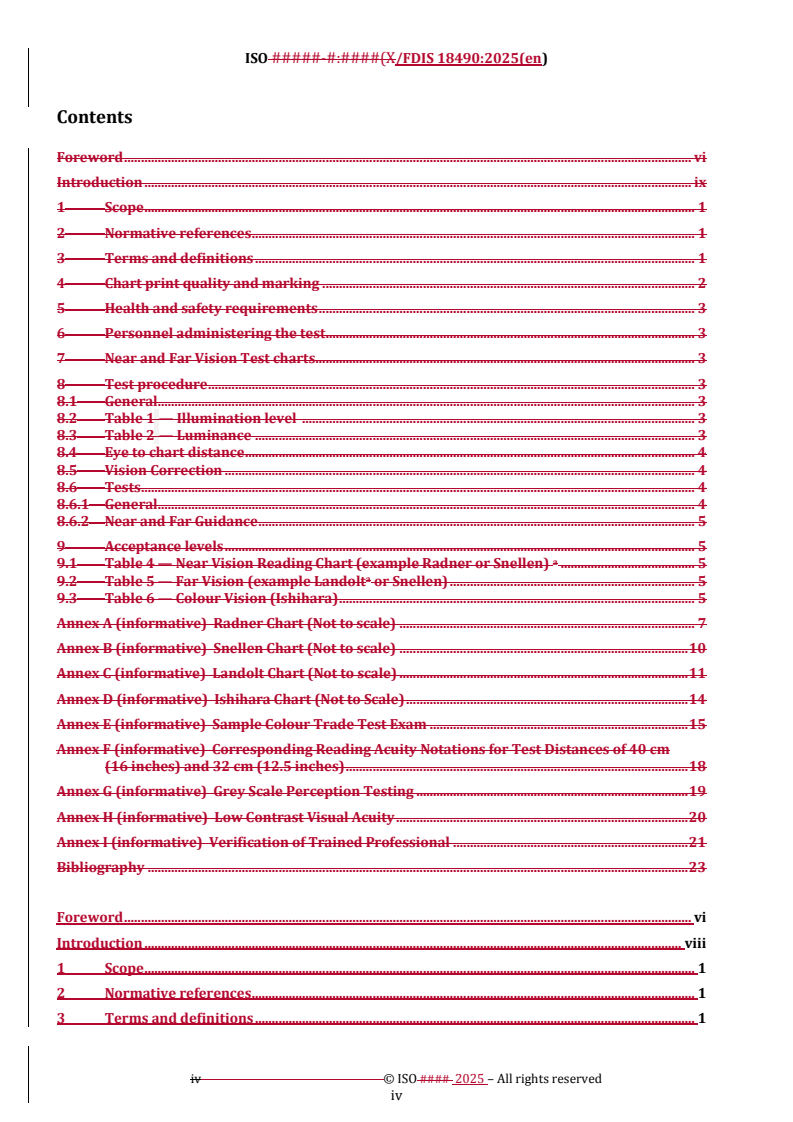
Contents
Foreword . vi
Introduction . ix
1 Scope . 1
2 Normative references . 1
3 Terms and definitions . 1
4 Chart print quality and marking . 2
5 Health and safety requirements . 3
6 Personnel administering the test . 3
7 Near and Far Vision Test charts . 3
8 Test procedure . 3
8.1 General. 3
8.2 Table 1 — Illumination level . 3
8.3 Table 2 — Luminance . 3
8.4 Eye to chart distance . 4
8.5 Vision Correction . 4
8.6 Tests . 4
8.6.1 General. 4
8.6.2 Near and Far Guidance . 5
9 Acceptance levels . 5
a
9.1 Table 4 — Near Vision Reading Chart (example Radner or Snellen) . 5
a
9.2 Table 5 — Far Vision (example Landolt or Snellen) . 5
9.3 Table 6 — Colour Vision (Ishihara) . 5
Annex A (informative) Radner Chart (Not to scale) . 7
Annex B (informative) Snellen Chart (Not to scale) . 10
Annex C (informative) Landolt Chart (Not to scale) . 11
Annex D (informative) Ishihara Chart (Not to Scale) . 14
Annex E (informative) Sample Colour Trade Test Exam . 15
Annex F (informative) Corresponding Reading Acuity Notations for Test Distances of 40 cm
(16 inches) and 32 cm (12.5 inches) . 18
Annex G (informative) Grey Scale Perception Testing . 19
Annex H (informative) Low Contrast Visual Acuity . 20
Annex I (informative) Verification of Trained Professional . 21
Bibliography . 23
Foreword . vi
Introduction . viii
1 Scope . 1
2 Normative references . 1
3 Terms and definitions . 1
iv © ISO #### 2025 – All rights reserved
iv
ISO/DISFDIS 18490:2025(en)
4 Chart print quality and marking . 2
5 Health and safety requirements . 2
6 Personnel administering the test . 3
7 Near and Far Vision Test charts . 3
8 Test procedure . 3
9 Acceptance levels . 5
Annex A (informative) Radner Chart (Not to scale) . 6
Annex B (informative) Snellen Chart (Not to scale) . 8
Annex C (informative) Landolt Chart (Not to scale) . 9
Annex D (informative) Ishihara Chart (Not to Scale) . 11
Annex E (informative) Sample Colour Trade Test Exam . 12
Annex F (informative) Corresponding Reading Acuity Notations for Test Distances of 40 cm
(16 inches) and 32 cm (12.5 inches) . 19
Annex G (informative) Grey Scale Perception Testing . 20
Annex H (informative) Low Contrast Visual Acuity . 21
Annex I (informative) Verification of Trained Professional . 22
Bibliography . 25
© ISO 2025 – All rights reserved
v
ISO #####-#:####(X/FDIS 18490:2025(en)
Foreword
ISO (the International Organization for Standardization) is a worldwide federation of national standards
bodies (ISO member bodies). The work of preparing International Standards is normally carried out through
ISO technical committees. Each member body interested in a subject for which a technical committee has been
established has the right to be represented on that committee. International organizations, governmental and
non-governmental, in liaison with ISO, also take part in the work. ISO collaborates closely with the
International Electrotechnical Commission (IEC) on all matters of electrotechnical standardization.
The procedures used to develop this document and those intended for its further maintenance are described
in the ISO/IEC Directives, Part 1. In particular, the different approval criteria needed for the different types of
ISO document should be noted. This document was drafted in accordance with the editorial rules of the
ISO/IEC Directives, Part 2 (see www.iso.org/directives).
ISO draws attention to the possibility that the implementation of this document may involve the use of (a)
patent(s). ISO takes no position concerning the evidence, validity or applicability of any claimed patent rights
in respect thereof. As of the date of publication of this document, ISO had not received notice of (a) patent(s)
which may be required to implement this document. However, implementers are cautioned that this may not
represent the latest information, which may be obtained from the patent database available at
www.iso.org/patents.www.iso.org/patents. ISO shall not be held responsible for identifying any or all such
patent rights.
Any trade name used in this document is information given for the convenience of users and does not
constitute an endorsement.
For an explanation of the voluntary nature of standards, the meaning of ISO specific terms and expressions
related to conformity assessment, as well as information about ISO's adherence to the World Trade
Organization (WTO) principles in the Technical Barriers to Trade (TBT), see
www.iso.org/iso/foreword.htmlwww.iso.org/iso/foreword.html.
This document was prepared by Technical Committee ISO/TC 135, Non-destructive testing, SC 7, Personnel
Qualification, in collaboration with European Committee for Standardization (CEN) CEN/TC 138, Non-
destructive testing, in accordance with the Agreement on technical cooperation between ISO and CEN (Vienna
Agreement).
This second edition cancels and replaces the first edition (ISO 18490:2015), which has been technically
revised.
The main changes are as follows:
— — Farfar and Colourcolour vision acuity of NDT personnel added to the Scope;
— — updated references;
— — new terms and definitions added;
— — charts for Illumination level and Luminance added; Chart
— chart for Eye to Chart distance for Near, Far and Colour vision added;
— — additional provisions for vision correction added;
— — test instructions for Near, Farnear, far, and Colourcolour vision added;
vi © ISO #### 2025 – All rights reserved
vi
ISO/DISFDIS 18490:2025(en)
— — Guidanceguidance on verification of trained professional provided and sample attestation form for
NDT Vision Test Report added as Annexes (Annex I);(Annex I);
— — information for grey scale perception and low contrast acuity added as Annexes (Annex G(Annex G
and Annex H);Annex H);
— — for Nearnear vision, removed use of Tumbling E and added use of Reading Charts and Snellen chart;
— — acceptance level for Near, Far, Colournear, far, colour visions added;
— — examples of Radner, Snellen and Landolt charts added as Annexes;
— — corresponding Reading Acuity Notations for Test Distances of 40 cm (16 inches) and 32 cm
(12.5 inches) added as Annex.
Any feedback or questions on this document should be directed to the user’s national standards body. A
complete listing of these bodies can be found at www.iso.org/members.htmlwww.iso.org/members.html.
© ISO 2025 – All rights reserved
vii
ISO #####-#:####(X/FDIS 18490:2025(en)
Introduction
Standards for NDT Personnel qualification and certification require that the visual acuity of inspection
personnel is verified as being appropriate to their function. By meeting the vision acuity level defined in this
document, such requirements of ISO 9712 will be met. The purpose of this document is to provide a detailed,
standardised procedure for the evaluation of vision acuity for such personnel under defined lighting
conditions.
The tests are not medical in nature and are intended to objectively ensure adequate vision perception without
reliance on reading ability or text identification. Because it is extremely difficult to demonstrate any
equivalency in vision tests, this document has been prepared in order that an international system can be used
without any need to demonstrate equivalence and is the recommended method of determining vision acuity
for NDT Personnel.
viii © ISO #### 2025 – All rights reserved
viii
DRAFT International Standard ISO/DIS 18490:2025(en)
Non-destructive Testingtesting — Evaluation of vision acuity of NDT
personnel
1 Scope
This document specifies quality requirements for the chart, the test procedure and the acceptance level for
near, far, and colour vision acuity of NDT personnel. Information for grey scale perception and low contrast
can be found in the annexes. This document also specifies the qualification requirements for personnel
permitted to carry out the test.
This document is only applicable to vision acuity under defined conditions similar to those encountered during
routine NDT inspection. This document does not address an individual’s overall visual acuity and users are
advised to consider the need for a general eye examination by specialist medical personnel to ensure general
vision acuity.
2 Normative references
The following documents are referred to in the text in such a way that some or all of their content constitutes
requirements of this document. For dated references, only the edition cited applies. For undated references,
the latest edition of the referenced document (including any amendments) applies.
ISO 9712, Non-destructive testing — Qualification and certification of NDT personnel
IS0 ISO 7921, Ophthalmic optics and instruments- Near reading chartsISOcharts
ISO 8596, Ophthalmic optics — Visual acuity testing — Standard and clinical optotypes and their presentation
3 Terms and definitions
For the purposes of this document, the terms and definitions given in ISO 9712, ISO 7921, ISO 8596 and the
following apply.
ISO and IEC maintain terminology databases for use in standardization at the following addresses:
— — ISO Online browsing platform: available at https://www.iso.org/obphttps://www.iso.org/obp
— — IEC Electropedia: available at https://www.electropedia.org/https://www.electropedia.org/
3.1 3.1
optotype
letters or symbols shown on an eye chart
3.2 3.2
eyewear
form of lens or protective transparent material placed or used between the human eye and the work piece
during routine NDT inspection operations
3.3 3.3
trade test
test performed by the employer after failure of the Ishihara Colour test to ensure a candidate can distinguish
and differentiate between the colours used in the NDT methods/ techniques concerned as specified by the
employer.
3.4 3.4
x-height
height of a lower case “x”, i.e. the middle height of a font
3.5 3.5
logRAD
logarithm of “Reading Acuity Determination” which is determined based upon the x-height
3.6 3.6
logMAR
logarithm of the “Minimum Angle of Resolution” based upon the opening, or line thickness
of a Landolt ring (i.e. one fifth of the optotypes)
3.7 3.7
decimal
reciprocal proportion of the visual angle as calculated from the test distance and one-fifth of the x-height
(3.4)(3.4)
3.8 3.8
M size
factor used to modify the print size, multiplying it by the letter height at 1 metre (= 1 M- unit)
3.9 3.9
N
desktop Publishing (DTP) point size (1 pt = 1/72 inch) of lower-case letters printed in Times Roman
approximately representing correct sizing
3.10 3.10
Snellen fraction
relationship between the test distance in feet or metres and the distance at which an optotype subtends five
minutes of an arc (for near vision 1,3/1,3 Snellen for feet or 0,4/0,4 Snellen for metre)
4 Chart print quality and marking
It is recognized that charts produced locally will have varying print quality and resolution. It is recommended
that the charts be purchased directly from suppliers or manufacturers and not printed or copied locally. The
charts supplied shall be permanently marked with a name or trade name of the manufacturer or supplier,
name and
...
PROJET FINAL
Norme
internationale
ISO/TC 135/SC 7
Essais non destructifs — Évaluation
Secrétariat: SCC
de l'acuité visuelle du personnel
Début de vote:
END
2025-12-26
Non-destructive testing — Evaluation of vision acuity of NDT
Vote clos le:
personnel
2026-02-20
LES DESTINATAIRES DU PRÉSENT PROJET SONT
INVITÉS À PRÉSENTER, AVEC LEURS OBSERVATIONS,
NOTIFICATION DES DROITS DE PROPRIÉTÉ DONT ILS
AURAIENT ÉVENTUELLEMENT CONNAISSANCE ET À
FOURNIR UNE DOCUMENTATION EXPLICATIVE.
OUTRE LE FAIT D’ÊTRE EXAMINÉS POUR
ÉTABLIR S’ILS SONT ACCEPTABLES À DES FINS
INDUSTRIELLES, TECHNOLOGIQUES ET COM-MERCIALES,
AINSI QUE DU POINT DE VUE DES UTILISATEURS, LES
PROJETS DE NORMES
TRAITEMENT PARALLÈLE ISO/CEN
INTERNATIONALES DOIVENT PARFOIS ÊTRE CONSIDÉRÉS
DU POINT DE VUE DE LEUR POSSI BILITÉ DE DEVENIR DES
NORMES POUVANT
SERVIR DE RÉFÉRENCE DANS LA RÉGLEMENTATION
NATIONALE.
Numéro de référence
PROJET FINAL
Norme
internationale
ISO/TC 135/SC 7
Essais non destructifs — Évaluation
Secrétariat: SCC
de l'acuité visuelle du personnel
Début de vote:
END
2025-12-26
Non-destructive testing — Evaluation of vision acuity of NDT
Vote clos le:
personnel
2026-02-20
LES DESTINATAIRES DU PRÉSENT PROJET SONT
INVITÉS À PRÉSENTER, AVEC LEURS OBSERVATIONS,
NOTIFICATION DES DROITS DE PROPRIÉTÉ DONT ILS
AURAIENT ÉVENTUELLEMENT CONNAISSANCE ET À
FOURNIR UNE DOCUMENTATION EXPLICATIVE.
DOCUMENT PROTÉGÉ PAR COPYRIGHT
OUTRE LE FAIT D’ÊTRE EXAMINÉS POUR
ÉTABLIR S’ILS SONT ACCEPTABLES À DES FINS
© ISO 2025 INDUSTRIELLES, TECHNOLOGIQUES ET COM-MERCIALES,
AINSI QUE DU POINT DE VUE DES UTILISATEURS, LES
Tous droits réservés. Sauf prescription différente ou nécessité dans le contexte de sa mise en œuvre, aucune partie de cette
PROJETS DE NORMES
TRAITEMENT PARALLÈLE ISO/CEN
INTERNATIONALES DOIVENT PARFOIS ÊTRE CONSIDÉRÉS
publication ne peut être reproduite ni utilisée sous quelque forme que ce soit et par aucun procédé, électronique ou mécanique,
DU POINT DE VUE DE LEUR POSSI BILITÉ DE DEVENIR DES
y compris la photocopie, ou la diffusion sur l’internet ou sur un intranet, sans autorisation écrite préalable. Une autorisation peut
NORMES POUVANT
être demandée à l’ISO à l’adresse ci-après ou au comité membre de l’ISO dans le pays du demandeur.
SERVIR DE RÉFÉRENCE DANS LA RÉGLEMENTATION
NATIONALE.
ISO copyright office
Case postale 401 • Ch. de Blandonnet 8
CH-1214 Vernier, Genève
Tél.: +41 22 749 01 11
E-mail: copyright@iso.org
Web: www.iso.org
Publié en Suisse Numéro de référence
ii
Sommaire Page
Avant-propos .iv
Introduction .vi
1 Domaine d’application . 1
2 Références normatives . 1
3 Termes et définitions . 1
4 Qualité d’impression des tableaux et marquage . 2
5 Exigences en matière d’hygiène et de sécurité . 3
6 Personnel en charge du contrôle . 3
7 Tableaux pour le contrôle de la vision de près et de loin . 3
8 Procédure de contrôle . 3
8.1 Généralités .3
8.2 Distance entre les yeux et le tableau .3
8.3 Correction de la vision .4
8.4 Contrôles .4
8.4.1 Généralités .4
8.4.2 Recommandation pour le contrôle de la vision de près et de loin . .5
9 Niveaux d’acceptation . 5
Annexe A (informative) Tableau de Radner (pas à l’échelle) . 6
Annexe B (informative) Tableau de Snellen (pas à l’échelle). 7
Annexe C (informative) Tableau de Landolt (pas à l’échelle) . 8
Annexe D (informative) Planche d’Ishihara (pas à l’échelle) . 9
Annexe E (informative) Exemple de test professionnel de contrôle de la vision des couleurs .10
Annexe F (informative) Notations de l’acuité de lecture correspondantes pour des distances de
contrôle de 40 cm (16 ins) et 32 cm (12,5 ins) .13
Annexe G (informative) Contrôle de la perception des niveaux de gris . 14
Annexe H (informative) Acuité visuelle à faible contraste .15
Annexe I (informative) Vérification des professionnels formés .16
Bibliographie .18
iii
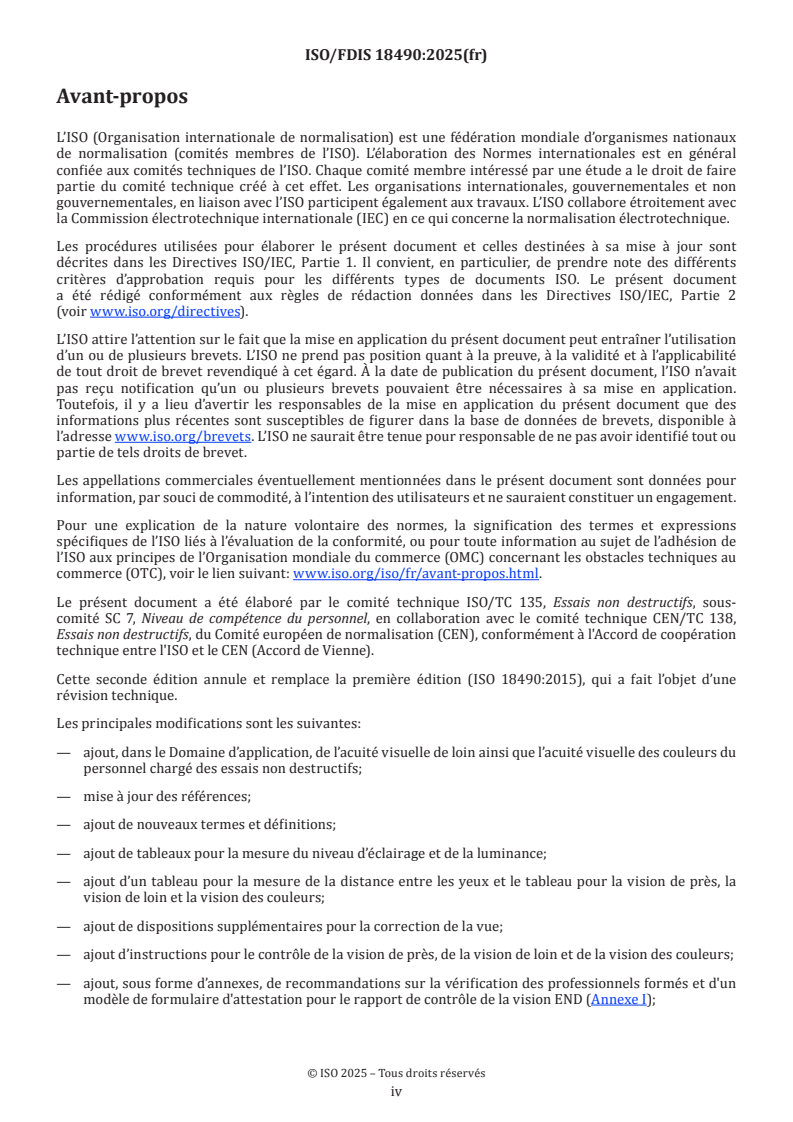
Avant-propos
L’ISO (Organisation internationale de normalisation) est une fédération mondiale d’organismes nationaux
de normalisation (comités membres de l’ISO). L’élaboration des Normes internationales est en général
confiée aux comités techniques de l’ISO. Chaque comité membre intéressé par une étude a le droit de faire
partie du comité technique créé à cet effet. Les organisations internationales, gouvernementales et non
gouvernementales, en liaison avec l’ISO participent également aux travaux. L’ISO collabore étroitement avec
la Commission électrotechnique internationale (IEC) en ce qui concerne la normalisation électrotechnique.
Les procédures utilisées pour élaborer le présent document et celles destinées à sa mise à jour sont
décrites dans les Directives ISO/IEC, Partie 1. Il convient, en particulier, de prendre note des différents
critères d’approbation requis pour les différents types de documents ISO. Le présent document
a été rédigé conformément aux règles de rédaction données dans les Directives ISO/IEC, Partie 2
(voir www.iso.org/directives).
L’ISO attire l’attention sur le fait que la mise en application du présent document peut entraîner l’utilisation
d’un ou de plusieurs brevets. L’ISO ne prend pas position quant à la preuve, à la validité et à l’applicabilité
de tout droit de brevet revendiqué à cet égard. À la date de publication du présent document, l’ISO n’avait
pas reçu notification qu’un ou plusieurs brevets pouvaient être nécessaires à sa mise en application.
Toutefois, il y a lieu d’avertir les responsables de la mise en application du présent document que des
informations plus récentes sont susceptibles de figurer dans la base de données de brevets, disponible à
l’adresse www.iso.org/brevets. L’ISO ne saurait être tenue pour responsable de ne pas avoir identifié tout ou
partie de tels droits de brevet.
Les appellations commerciales éventuellement mentionnées dans le présent document sont données pour
information, par souci de commodité, à l’intention des utilisateurs et ne sauraient constituer un engagement.
Pour une explication de la nature volontaire des normes, la signification des termes et expressions
spécifiques de l’ISO liés à l’évaluation de la conformité, ou pour toute information au sujet de l’adhésion de
l’ISO aux principes de l’Organisation mondiale du commerce (OMC) concernant les obstacles techniques au
commerce (OTC), voir le lien suivant: www.iso.org/iso/fr/avant-propos.html.
Le présent document a été élaboré par le comité technique ISO/TC 135, Essais non destructifs, sous-
comité SC 7, Niveau de compétence du personnel, en collaboration avec le comité technique CEN/TC 138,
Essais non destructifs, du Comité européen de normalisation (CEN), conformément à l'Accord de coopération
technique entre l'ISO et le CEN (Accord de Vienne).
Cette seconde édition annule et remplace la première édition (ISO 18490:2015), qui a fait l’objet d’une
révision technique.
Les principales modifications sont les suivantes:
— ajout, dans le Domaine d’application, de l’acuité visuelle de loin ainsi que l’acuité visuelle des couleurs du
personnel chargé des essais non destructifs;
— mise à jour des références;
— ajout de nouveaux termes et définitions;
— ajout de tableaux pour la mesure du niveau d’éclairage et de la luminance;
— ajout d’un tableau pour la mesure de la distance entre les yeux et le tableau pour la vision de près, la
vision de loin et la vision des couleurs;
— ajout de dispositions supplémentaires pour la correction de la vue;
— ajout d’instructions pour le contrôle de la vision de près, de la vision de loin et de la vision des couleurs;
— ajout, sous forme d’annexes, de recommandations sur la vérification des professionnels formés et d'un
modèle de formulaire d'attestation pour le rapport de contrôle de la vision END (Annexe I);
iv
— ajout, sous forme d’annexes, d’informations relatives à la perception des niveaux de gris et à l’acuité à
faible contraste (Annexe G et Annexe H);
— pour la vision de près, suppression de l’utilisation de l’échelle de Tumbling E et ajout de l’utilisation de
tableaux utilisés pour la mesure de l’acuité de lecture et du tableau de Snellen;
— ajout d’un niveau d’acceptation pour la vision de près, la vision de loin et la vision des couleurs;
— ajout, sous forme d’annexes, d’exemples de tableaux de Radner, de Snellen et de Landolt;
— ajout, sous forme d’une annexe, des notations d’acuité de lecture correspondantes pour des distances de
contrôle de 40 cm (16 pouces) et 32 cm (12,5 pouces).
Il convient que l’utilisateur adresse tout retour d’information ou toute question concernant le présent
document à l’organisme national de normalisation de son pays. Une liste exhaustive desdits organismes se
trouve à l’adresse www.iso.org/fr/members.html.
v
Introduction
Les normes relatives à la qualification et à la certification du personnel chargé de réaliser des essais non
destructifs (END) exigent que l’acuité visuelle du personnel qui pratique les contrôles soit vérifiée et estimée
appropriée à la fonction exercée. Le fait d'être conforme au niveau d'acuité visuelle défini dans le présent
document revient à respecter les exigences de l'ISO 9712. Le présent document a pour but d'indiquer une
procédure normalisée détaillée visant à évaluer l'acuité de la vision de près de ce personnel dans des
conditions d’éclairage définies.
Les contrôles ne sont pas de nature médicale et ils sont destinés à assurer de manière objective une
perception visuelle adéquate sans se fonder sur la capacité à lire ou à identifier des caractères. Étant
donné qu’il est extrêmement difficile de démontrer une équivalence lors des contrôles de vision, le présent
document a été élaboré afin qu’un système international puisse être utilisé sans qu’il soit nécessaire de
démontrer une équivalence; elle correspond à la méthode recommandée pour déterminer l’acuité visuelle
des personnes qui réalisent des contrôles END.
vi
PROJET FINAL Norme internationale ISO/FDIS 18490:2025(fr)
Essais non destructifs — Évaluation de l'acuité visuelle du
personnel END
1 Domaine d’application
Le présent document spécifie les exigences de qualité requises pour le tableau, la procédure de contrôle et le
niveau d’acceptation pour l’acuité de la vision de près, de loin et des couleurs du personnel END. Les annexes
contiennent des informations sur la perception de l’échelle de gris et des faibles contrastes. Le présent
document spécifie également les exigences relatives à la qualification du personnel autorisé à effectuer ces
contrôles.
Le présent document ne s'applique qu'à l’acuité visuelle dans des conditions définies, similaires à celles
rencontrées lors des contrôles END de routine. Le présent document n’aborde pas l’acuité visuelle générale
des individus. Il est conseillé aux utilisateurs d’envisager de procéder à un examen général d’ophtalmologie
chez un médecin spécialiste afin de s’assurer que leur acuité visuelle générale.
2 Références normatives
Les documents suivants sont cités dans le texte de sorte qu’ils constituent, pour tout ou partie de leur
contenu, des exigences du présent document. Pour les références datées, seule l’édition citée s’applique. Pour
les références non datées, la dernière édition du document de référence s'applique (y compris les éventuels
amendements).
ISO 9712, Essais non destructifs — Qualification et certification du personnel END
ISO 7921, Optique et instruments ophtalmiques — Tableaux d’optotypes utilisés pour la mesure de l’acuité de
lecture en vision de près
ISO 8596, Optique ophtalmique — Mesure de l'acuité visuelle — Optotype normalisé et optotypes cliniques et
leur présentation
3 Termes et définitions
Pour les besoins du présent document, les termes et les définitions de l'ISO 9712, de l'ISO 7921, de l'ISO 8596
ainsi que le suivant s'appliquent.
L’ISO et l’IEC tiennent à jour des bases de données terminologiques destinées à être utilisées en normalisation,
consultables aux adresses suivantes:
— ISO Online browsing platform: disponible à l’adresse https:// www .iso .org/ obp
— IEC Electropedia: disponible à l'adresse https:// www .electropedia .org/
3.1
optotype
lettres ou symboles figurant sur un tableau optométrique
3.2
lunetterie
forme de lentille ou de matériau transparent de protection, placé ou utilisé entre l’œil et la pièce, pendant les
opérations de contrôle END de routine
3.3
test professionnel
test effectué par l’employeur après un échec au test chromatique d’Ishihara pour s’assurer que le candidat
peut distinguer et différencier les couleurs utilisées dans les méthodes/techniques END concernées, telles
que spécifiées par l’employeur
3.4
hauteur d’x
hauteur d’un «x» minuscule, c’est-à-dire la hauteur moyenne d’une police
3.5
logRAD
logarithme de la «détermination de l’acuité de lecture» qui est déterminée sur la base de
la hauteur d’x
3.6
logMAR
logarithme de l’«angle minimum de résolution» basé sur l’ouverture ou
l’épaisseur du trait d’un anneau de Landolt (c’est-à-dire un cinquième des optotypes)
3.7
décimale
proportion inverse de l’angle visuel calculée à partir de la distance de contrôle et d’un cinquième de la
hauteur d'x (3.4)
3.8
taille M
facteur utilisé pour modifier la taille de caractère, en la multipliant par la hauteur des lettres à 1 mètre
(= 1 unité M)
3.9
N
taille de point en publication assistée par ordinateur (PAO) (1 pt = 1/72 pouce) des lettres minuscules
imprimées en Times Roman représentant approximativement la taille correcte
3.10
fraction de Snellen
rapport entre la distance de contrôle en pieds ou en mètres et la distance à laquelle un optotype sous-tend
cinq minutes d’un arc (pour la vision de près, 1,3/1,3 Snellen en pied ou 0,4/0,4 Snellen en mètre)
4 Qualité d’impression des tableaux et marquage
On part du principe que les tableaux produits sur place auront une résolution et une qualité d’impression
variables. Il est recommandé d’acheter les tableaux directement auprès des fournisseurs ou des fabricants
et de ne pas les imprimer ou les copier localement. Les tableaux fournis doivent être marqués de façon
permanente avec le nom ou l’appellation commerciale du fabricant ou du fournisseur, le nom et le modèle
du tableau, la référence aux documents auxquels le fabricant ou le fournisseur revendique la conformité,
le cas échéant (par exemple, pour les tableaux utilisés pour la mesure de l’acuité de lecture, voir l’ISO 7921
pour plus de détails; pour la vision de loin, voir l’ISO 8596). Dans certains cas, le non-respect du niveau
d’acuité défini peut être dû à la qualité du tableau de contrôle produit. Il convient de veiller à ce que la qualité
du tableau utilisé pour le contrôle soit appropriée. Lorsque le personnel ne présente pas le niveau d’acuité
requis, il est recommandé d’examiner la qualité du tableau utilisé, avant de déclarer qu’un individu a une vue
inadéquate.
Si nécessaire, les fournisseurs ou fabricants des tableaux peuvent fournir un certificat de conformité.
5 Exigences en matière d’hygiène et de sécurité
Des précautions doivent être prises lors du mesurage ou de la vérification des distances séparant l’œil et le
tableau dans le Tableau 3.
...
Questions, Comments and Discussion
Ask us and Technical Secretary will try to provide an answer. You can facilitate discussion about the standard in here.
Loading comments...