


ISO 13577-1:2012
(Main)Industrial furnaces and associated processing equipment — Safety — Part 1: General requirements
Industrial furnaces and associated processing equipment — Safety — Part 1: General requirements
ISO 13577-1:2012 specifies the general safety requirements common to industrial furnaces and associated processing equipment (TPE). It details significant hazards associated with TPE, and specifies the appropriate preventive measures for reduction or elimination of these hazards. ISO 13577-1:2012 gives general principles and general safety requirements for the reduction of risks associated with TPE. It is not applicable to the risks associated with quenching, vacuums, salt baths, liquid phase treatment and protective or reactive atmospheres. ISO 13577-1:2012 specifies the safety requirements at stages in the life of the equipment, and its design, ordering, construction, use and disposal. It specifies safety requirements for maintenance, provision for indicators and inspection. It deals with the significant hazards, hazardous situations or hazardous events relevant to the equipment, when it is used as intended and under conditions of misuse which are reasonably foreseeable by the manufacturer:
Fours industriels et équipements associés — Sécurité — Partie 1: Exigences générales
General Information
- Status
- Withdrawn
- Publication Date
- 31-May-2012
- Withdrawal Date
- 31-May-2012
- Technical Committee
- ISO/TC 244 - Industrial furnaces and associated processing equipment
- Drafting Committee
- ISO/TC 244/WG 1 - General safety requirements
- Current Stage
- 9599 - Withdrawal of International Standard
- Start Date
- 05-Sep-2016
- Completion Date
- 12-Feb-2026
Relations
- Effective Date
- 05-Nov-2015

Get Certified
Connect with accredited certification bodies for this standard

BSI Group
BSI (British Standards Institution) is the business standards company that helps organizations make excellence a habit.

Bureau Veritas
Bureau Veritas is a world leader in laboratory testing, inspection and certification services.

DNV
DNV is an independent assurance and risk management provider.
Sponsored listings
Frequently Asked Questions
ISO 13577-1:2012 is a standard published by the International Organization for Standardization (ISO). Its full title is "Industrial furnaces and associated processing equipment — Safety — Part 1: General requirements". This standard covers: ISO 13577-1:2012 specifies the general safety requirements common to industrial furnaces and associated processing equipment (TPE). It details significant hazards associated with TPE, and specifies the appropriate preventive measures for reduction or elimination of these hazards. ISO 13577-1:2012 gives general principles and general safety requirements for the reduction of risks associated with TPE. It is not applicable to the risks associated with quenching, vacuums, salt baths, liquid phase treatment and protective or reactive atmospheres. ISO 13577-1:2012 specifies the safety requirements at stages in the life of the equipment, and its design, ordering, construction, use and disposal. It specifies safety requirements for maintenance, provision for indicators and inspection. It deals with the significant hazards, hazardous situations or hazardous events relevant to the equipment, when it is used as intended and under conditions of misuse which are reasonably foreseeable by the manufacturer:
ISO 13577-1:2012 specifies the general safety requirements common to industrial furnaces and associated processing equipment (TPE). It details significant hazards associated with TPE, and specifies the appropriate preventive measures for reduction or elimination of these hazards. ISO 13577-1:2012 gives general principles and general safety requirements for the reduction of risks associated with TPE. It is not applicable to the risks associated with quenching, vacuums, salt baths, liquid phase treatment and protective or reactive atmospheres. ISO 13577-1:2012 specifies the safety requirements at stages in the life of the equipment, and its design, ordering, construction, use and disposal. It specifies safety requirements for maintenance, provision for indicators and inspection. It deals with the significant hazards, hazardous situations or hazardous events relevant to the equipment, when it is used as intended and under conditions of misuse which are reasonably foreseeable by the manufacturer:
ISO 13577-1:2012 is classified under the following ICS (International Classification for Standards) categories: 13.100 - Occupational safety. Industrial hygiene; 25.180 - Industrial furnaces; 25.180.01 - Industrial furnaces in general. The ICS classification helps identify the subject area and facilitates finding related standards.
ISO 13577-1:2012 has the following relationships with other standards: It is inter standard links to ISO 13577-1:2016. Understanding these relationships helps ensure you are using the most current and applicable version of the standard.
ISO 13577-1:2012 is available in PDF format for immediate download after purchase. The document can be added to your cart and obtained through the secure checkout process. Digital delivery ensures instant access to the complete standard document.
Standards Content (Sample)
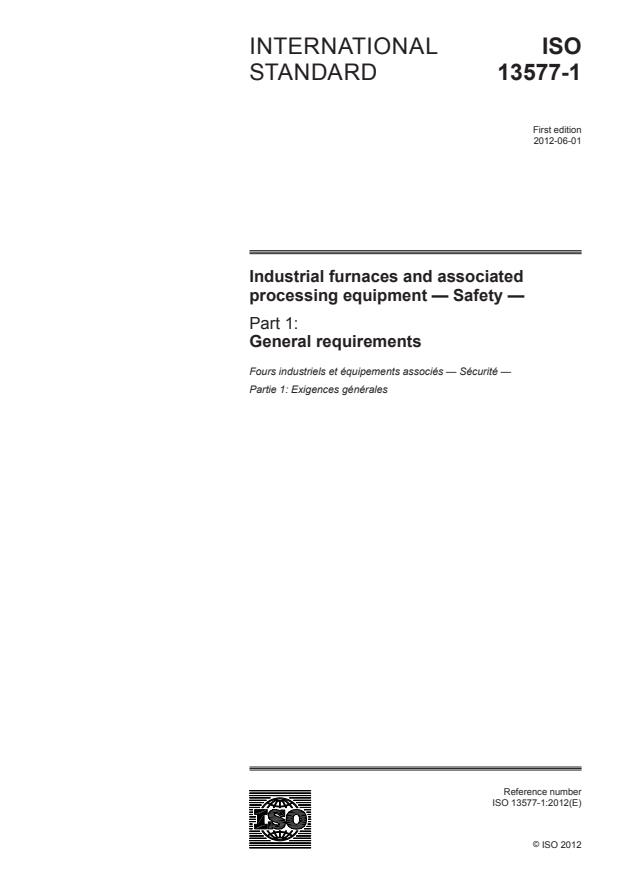
INTERNATIONAL ISO
STANDARD 13577-1
First edition
2012-06-01
Industrial furnaces and associated
processing equipment — Safety —
Part 1:
General requirements
Fours industriels et équipements associés — Sécurité —
Partie 1: Exigences générales
Reference number
©
ISO 2012
All rights reserved. Unless otherwise specified, no part of this publication may be reproduced or utilized in any form or by any means,
electronic or mechanical, including photocopying and microfilm, without permission in writing from either ISO at the address below or ISO’s
member body in the country of the requester.
ISO copyright office
Case postale 56 • CH-1211 Geneva 20
Tel. + 41 22 749 01 11
Fax + 41 22 749 09 47
E-mail copyright@iso.org
Web www.iso.org
Published in Switzerland
ii © ISO 2012 – All rights reserved
Contents Page
Foreword .iv
Introduction . v
1 Scope . 1
2 Normative references . 2
3 Terms and definitions . 3
4 Safety requirements and/or protective measures . 3
4.1 General . 3
4.2 Mechanical safety . 5
4.3 Electrical safety . 7
4.4 Thermal and cryogenic safety . 9
4.5 Noise .10
4.6 Vibration . 11
4.7 Radiation safety . 11
4.8 Materials and substances processed, used or exhausted .12
4.9 Ergonomics .13
4.10 Hazard combination .13
4.11 Malfunction .13
4.12 Missing and incorrectly fitted safety devices .14
5 Verification .14
6 Information for use .16
6.1 General requirements .16
6.2 Location and nature of the information for use .17
6.3 Signals and warning devices .17
6.4 Instruction handbook(s)/installation, commissioning, operation, maintenance, and de-
commissioning manual(s) .18
Annex A (informative) List of significant hazards .20
Annex B (informative) List of common industrial furnaces and associated processing equipment .28
Annex C (informative) Typical test report.32
Annex D (informative) Work-permit authorization .34
Annex E (normative) Requirements specific to Japan .36
Annex F (normative) Requirements specific to the USA .38
Annex G (normative) Requirements specific to the EU and associated countries .41
Bibliography .43
Foreword
ISO (the International Organization for Standardization) is a worldwide federation of national standards bodies
(ISO member bodies). The work of preparing International Standards is normally carried out through ISO
technical committees. Each member body interested in a subject for which a technical committee has been
established has the right to be represented on that committee. International organizations, governmental and
non-governmental, in liaison with ISO, also take part in the work. ISO collaborates closely with the International
Electrotechnical Commission (IEC) on all matters of electrotechnical standardization.
International Standards are drafted in accordance with the rules given in the ISO/IEC Directives, Part 2.
The main task of technical committees is to prepare International Standards. Draft International Standards
adopted by the technical committees are circulated to the member bodies for voting. Publication as an
International Standard requires approval by at least 75 % of the member bodies casting a vote.
Attention is drawn to the possibility that some of the elements of this document may be the subject of patent
rights. ISO shall not be held responsible for identifying any or all such patent rights.
ISO 13577-1 was prepared by Technical Committee ISO/TC 244, Industrial furnaces and associated
processing equipment.
ISO 13577 consists of the following parts, under the general title Industrial furnaces and associated processing
equipment — Safety:
— Part 1: General requirements
— Part 2: Combustion and fuel handling systems
It is intended that generation and use of protective gases will form the subject of a part 3 and protective systems
will form the subject of a part 4.
iv © ISO 2012 – All rights reserved
Introduction
This document is a type-C standard as stated in ISO 12100.
The machinery concerned and the extent to which hazards, hazardous situations or hazardous events are
covered are indicated in the Scope of this document.
When requirements of this type-C standard are different from those which are stated in type-A or -B standards,
the requirements of this type-C standard take precedence over the requirements of the other standards for
machines that have been designed and built according to the requirements of this type-C standard.
Industrial furnaces and associated processing equipment (TPE) generally consists of the following components:
— processing chambers (e.g. steel construction with lining or without lining);
— heating systems;
— protective system;
— control and instrumentation system/operator-control level.
This part of ISO 13577 gives additional requirements for TPE in certain countries or regions. When applying
the requirements specific to a country or region, which are given in the relevant annexes, it is essential that a
level of safety be ensured that is at least equivalent to that provided for by the requirements of the main body
of this part of ISO 13577.
INTERNATIONAL STANDARD ISO 13577-1:2012(E)
Industrial furnaces and associated processing equipment —
Safety —
Part 1:
General requirements
1 Scope
This part of ISO 13577 specifies the general safety requirements common to industrial furnaces and associated
processing equipment (TPE). This part of ISO 13577 details significant hazards associated with TPE (see
Annex B), and specifies the appropriate preventive measures for reduction or elimination of these hazards.
This part of ISO 13577 gives general principles and general safety requirements for the reduction of risks
associated with TPE.
The general safety requirements apply to the other parts of ISO 13577 dealing with specific equipment, unless
an exception is stated in the relevant part. The general principles are used to establish the specific technical
measures in the relevant parts dealing with safety requirements for particular equipment.
For TPE covered by this part of ISO 13577, the provisions of the part of ISO 13577 directly applicable to that
type of TPE, if available, take precedence over the provisions of this part of ISO 13577.
This part of ISO 13577 is not applicable to the risks associated with:
a) quenching;
b) vacuums;
c) salt baths;
d) liquid phase treatment, e.g. ladle refining;
e) protective or reactive atmospheres.
NOTE For similar TPE not covered by another specific part of ISO 13577, this part of ISO 13577 can be used to assist
in the reduction of risk for the hazards identified in Annex A.
Safety requirements in this part of ISO 13577 cover furnaces that are heated by any source, but does not
cover the safety requirements related to solid fuels and electrical heating as a source. For safety requirements
related to electrical heating as a source, see IEC 60519 (all parts).
For a more detailed list of these categories, see Annex B.
This part of ISO 13577 is not applicable to blast furnaces, converters (in steel plants), boilers or equipment
not covered under ISO 12100. This part of ISO 13577 specifies the requirements intended to be met by the
manufacturer to ensure the safety of persons and property during commissioning, start-up, operation, shut-
down, maintenance periods and dismantling, as well as in the event of foreseeable faults or malfunctions which
can occur in the equipment.
This part of ISO 13577 specifies the safety requirements at stages in the life of the equipment, and its design,
ordering, construction, use and disposal. This part of ISO 13577 specifies safety requirements for maintenance,
provision for indicators and inspection. It deals with the following significant hazards, hazardous situations or
hazardous events relevant to TPE, when it is used as intended and under conditions of misuse which are
reasonably foreseeable by the manufacturer:
— mechanical hazards, movement of machinery and material, ejection of parts, material or liquids and gases,
implosion and structural failure;
— electrical hazards;
— thermal hazards: explosion, fire, scalds, contact with hot parts, gases and flames;
— noise and vibration;
— thermal, optical and ionizing and non-ionizing radiation;
— harmful by-products and hazardous substances, poisoning, biological and micro-biological contamination,
pollution and environmental discomfort.
2 Normative references
The following referenced documents are indispensable for the application of this document. For dated
references, only the edition cited applies. For undated references, the latest edition of the referenced document
(including any amendments) applies.
ISO 12100, Safety of machinery — General principles for design — Risk assessment and risk reduction
ISO 13574, Industrial furnaces and associated thermal processing equipment — Vocabulary
ISO 13732-1, Ergonomics of the thermal environment — Methods for the assessment of human responses to
contact with surfaces — Part 1: Hot surfaces
ISO 13850, Safety of machinery — Emergency stop — Principles for design
ISO 13854, Safety of machinery — Minimum gaps to avoid crushing of parts of the human body
ISO 14119, Safety of machinery — Interlocking devices associated with guards — Principles for design and selection
ISO 14120, Safety of machinery ― Guards — General requirements for the design and construction of fixed
and movable guards
ISO 14122-2, Safety of machinery — Permanent means of access to machinery — Part 2: Working
platforms and walkways
ISO 14122-3, Safety of machinery — Permanent means of access to machinery — Part 3: Stairs, stepladders
and guard-rails
IEC 60079-0, Explosive atmospheres — Part 0: Equipment — General requirements
IEC 60204-1, Safety of machinery — Electrical equipment of machines — Part 1: General requirements
IEC 60364-4-41, Low-voltage electrical installations — Part 4-41: Protection for safety — Protection against
electric shock
IEC 60364-4-43, Low-voltage electrical installations — Part 4-43: Protection for safety — Protection
against overcurrent
IEC 60364-4-44, Low-voltage electrical installations — Part 4-44: Protection for safety — Protection against
voltage disturbances and electromagnetic disturbances
IEC 60364-5-53, Electrical installations of buildings — Part 5-53: Selection and erection of electrical equipment
- Isolation, switching and control
IEC 60519 (all parts), Safety in electroheat installations
2 © ISO 2012 – All rights reserved
IEC 60825-1, Safety of laser products — Part 1: Equipment classification and requirements
IEC 62598, Nuclear instrumentation — Constructional requirements and classification of radiometric gauges
EN 1547, Industrial thermoprocessing equipment — Noise test code for industrial thermoprocessing equipment
including its ancillary handling equipment
3 Terms and definitions
For the purposes of this document, the terms and definitions given in ISO 12100 and ISO 13574 apply.
4 Safety requirements and/or protective measures
4.1 General
4.1.1 Requirements
The TPE shall comply with the safety requirements and/or protective measures and be verified in accordance
with Clause 5. In addition, the TPE shall be designed in accordance with the principles of ISO 12100 for
hazards relevant, but not significant, which are dealt with by this part of ISO 13577.
Anticipated significant hazards are listed in Table A.1.
For ease of reference, Table A.1 also indicates the corresponding preventive measures and should be used in
conjunction with Clauses 4, 5 and 6.
Where particular requirements of the other parts of ISO 13577 apply, they shall supplement or modify these
general safety requirements.
For regional standards, see Annexes E, F and G.
4.1.2 General design and construction requirements
The manufacturer shall maintain evidence that all safety requirements of the design have been fulfilled.
The structural assembly, steel sections, auxiliaries and services (utilities) which form part of the TPE shall be
stable, suitable for function and the intended use.
In particular, the design shall include solutions and constructional details relating to:
— static stability of the TPE, including structures intended for containing the processed materials and the
materials entering and leaving the TPE;
— accessibility;
— maintenance and cleaning clearances;
— movement of material and machinery;
— safety in operation;
— health and safety at the workplace;
— protection against fire and prevention of explosion;
— emissions from the process;
— protection against earthquakes where seismic intensity exceeds 325 gal, as determined by the seismic zone.
Cut-off, regulating and measuring devices, pipework and tanks carrying or containing fluids, which are likely to
solidify and/or have high viscosity, shall be protected against the effects of solidification and subsequent blockage.
If internal parts of the TPE require frequent inspection, they shall be either provided with lighting appropriate to
the structure and the nature of the process or the user shall be advised to install suitable lighting.
The design of the TPE and the action of the regulating and safety devices shall prevent:
a) unintended release of flammable or hazardous fluids to the outside of the TPE;
b) a backflow of flammable or hazardous fluids to pipes not intended for such fluids;
c) flashback in the pipework.
The safety devices shall:
— be suitable for the range of adjustment required for the regulation of the TPE;
— not cause one device inadvertently to over-ride another.
Safety devices shall be fitted in such a manner that they are accessible and protected against harmful effects.
In particular, they shall withstand continuous operation in the area in which they are to be used. Auxiliary fluids,
such as lubricants, dielectric, diathermic and dynamic fluids, shall be selected to minimize the hazard of their
products of combustion resulting from a fire.
Drains that form part of the TPE shall discharge into a suitably isolated sump. Means shall be provided for the
collection and removal of such discharges.
Pipework distribution systems forming part of the TPE shall be designed to withstand corrosion.
Pipework distribution systems, which form part of the equipment and can become dangerous if subjected to
extreme temperatures or pressures, wide variations in temperature or pressures, or voltage, shall be marked.
4.1.2.1 Stability
The TPE structures shall be designed to withstand their static and dynamic loads. The TPE shall be designed
for normal and foreseeable accidental thermal static and dynamic working stresses, including those resulting
from overpressurization or operation below atmospheric pressure.
The design shall also take account of vibration, wind pressure, impact and other foreseeable external forces,
including earthquakes.
4.1.2.2 Access
All parts of the TPE to which personnel require to have access for operation and maintenance shall be served
by adequate means of access, preferably fixed. Stairways, platforms and service floors shall be safe and shall
be equipped with adequate safeguards (see 4.2.11). Inspection and service floors of the TPE shall be safe, well
lit, well ventilated, protected against heat radiation and be fire-resistant (see 4.4.3.1).
Account shall be taken of the need for emergency escape routes to avoid the trapping of personnel in the event
of hazardous situations (such as fire or the build up of toxic gases).
4.1.2.3 Roofs and covers
Where the roofs or covers of TPE (e.g. ceramic kilns or melting TPE) have been designed to be walked on, they
shall be accessible by a safe means.
Roofs or covers, to which access is not intended, shall be marked and designated as not accessible or shall be
adequately guarded to prevent access.
Roofs or covers, which have to be walked on for operating, maintenance and inspection purposes and which
are more than 1 m above floor level, shall be accessible through safe ascents and shall be fitted with railings
to prevent falls. Where the heat source is located in the roof, for example in the ceramics or glass industry, one
escape route shall be available in front of, and one behind, the firing zone, one of which shall be a stairway. For
design requirements, see 4.1.3.4.
4 © ISO 2012 – All rights reserved
4.1.2.4 Access channels and stairs
In general, the design of access channels and stairs shall be in accordance with ISO 14122-2 and ISO 14122-3.
For channels intended for repair purposes below tunnel furnaces or kilns the unobstructed passage way shall
be at least 1,80 m high by 0,70 m wide, and be accessible through two stairways, one of which shall be in front
of, and the other behind, the firing zone. If the stairways are in the area of the firing zone, emergency exits shall
be available in front of, and behind, the firing zone.
4.2 Mechanical safety
4.2.1 General
The design shall be such as to avoid injury by movement of machinery parts of TPE, by crushing, shearing,
entanglement, drawing-in or impact. It shall also prevent hazardous situations arising where high pressure
fluids are used or where parts of TPE and processed material are liable to be ejected. The stability of the TPE
during operation and the safety of the access areas around the TPE shall also be considered.
Where the construction of the TPE includes
— corners and projections,
— passages of reduced height,
— manhole covers, drains, etc.
they shall be protected and marked in such a way as to minimize the hazard.
Emergency stop devices shall be in accordance with ISO 13850.
4.2.2 Crushing
The design shall incorporate means to minimize hazard to personnel arising from:
— movement of materials and machinery;
— automation;
— suspended loads;
— falling materials;
— moving parts.
All moving machinery which can present a hazard shall be guarded wherever practicable. Where guarding is
not practicable, audible and/or visual signals shall be provided. Strategically positioned emergency stop shall
be provided to stop potentially hazardous moving machinery.
Guarding, where provided, shall comply with ISO 14119 and ISO 14120.
Any traversing part of the TPE or material carried by it shall not be closer to any fixed structure than the safety
distance requirements given in ISO 13854.
The design of the TPE shall take account of the minimum distance requirement. See ISO 13854, ISO 13857,
ISO 15534-1 and/or ISO 15534-2.
4.2.3 Shearing
Where possible, shear traps shall be eliminated by:
a) filling the gaps or reducing the maximum clearance between the moving parts, such that parts of the body
cannot enter the gap;
b) increasing the minimum clearance between the shearing parts, such that parts of the body can enter the
gap safely (see ISO 13854 and ISO 15534-1).
Where it is not possible to avoid the creation of a shear trap, adequate guarding shall be used (see ISO 14119
and ISO 14120).
Means shall be provided to prevent unintentional closure or opening of moving parts (e.g. doors, conveyors and
elevators) during operation and maintenance.
4.2.4 Entanglement
Design measures shall be taken, or suitable guards shall be provided, to prevent entanglement by rotating
shafts, conveyors and transmission machinery (see ISO 14120).
4.2.5 Drawing-in
Design measures shall be taken, or suitable guards shall be provided, to avoid drawing-in (see ISO 14120).
4.2.6 Impact
Impact hazards are caused by objects which act against the inertia of the body but do not penetrate.
The speed, force or torque, and inertia of the moving parts shall be kept to a minimum by the designer, in order
to reduce the possibility of injury. Where this is not practicable, adequate guarding or safety devices shall be
provided. Where guarding or safety devices cannot be provided, a perimeter fence shall be provided.
4.2.7 High-pressure fluid ejection
In order to minimize the risk of injury caused by the ejection of fluids, such as compressed air, steam and high
pressure hydraulic oil or water:
— all components within the system shall be operated within their manufacturer’s specifications and all parts
of the system shall be protected against overpressure;
— verification of leaktightness shall be achieved by pressure testing to at least the intended operating pressure;
— any pressure relief device shall be verified by testing in accordance with the manufacturer’s instructions.
Piping should be permanent. Where the use of flexible hoses is unavoidable, equipment suitable for the most
arduous duty and operating conditions likely to be experienced shall be used. If flexible hoses are used for
hydraulic oil, they shall be shielded from ignition sources (e.g. hot surfaces). Replacement intervals shall be
defined in the instruction handbook.
ISO 13577-2:—, 5.2.1.5, shall be used for gas and ISO 13577-2:—, 5.3.1.4, for liquids. Special care shall be
taken to guard against flexing or twisting during movement, and thermal damage.
4.2.8 Ejection of parts
In order to minimize the risk that a body can be crushed or penetrated by material or parts of the equipment
ejected unexpectedly or accidentally, adequate guarding shall be provided (see ISO 14120).
4.2.9 Implosion
All parts of the TPE, which operate at pressures lower than atmospheric pressure, shall be constructed in such
a way that implosions are avoided.
Suitable devices shall be provided to neutralize the pressure within the TPE before a door can be opened.
NOTE An interlocked double release device ensures detaching of the door before it is completely open.
6 © ISO 2012 – All rights reserved
4.2.10 Slip/trip
Working platforms shall be designed so as to provide a level standing space of adequate size, with a firm
foothold. Walkways shall be made from materials which remain as slip resistant as practicable under working
conditions, and suitable guard rails, posts and toe boards shall be provided.
Where necessary, a fixed access ladder with handholds or a stairway with handrails or some other suitable
means shall be provided to give safe and convenient access to all equipment needing adjustment, lubrication
or maintenance.
4.2.11 Falls
Where the design of the TPE or the movement of TPE requires floor openings which can constitute a hazard,
automatic guards, safety warning devices (see 6.3) or barriers shall be provided.
4.2.12 Transport
Where applicable, TPE shall be designed for transport. Instructions for transport shall be provided.
4.3 Electrical safety
4.3.1 General
Electrical components and installations for any TPE and services located in the same unit(s) up to the defined
TPE limits shall be suitable for their function and intended use.
The following requirements shall be considered:
a) safety of electrical Installation;
b) the design and operation of electroheat installations shall be in accordance with IEC 60519 (all parts);
c) the design and operation of electric installations in other equipment shall comply with IEC 60364-4-41, IEC
60364-4-43, IEC 60364-4-44 and IEC 60364-5-53 or IEC 60204-1;
d) the energy supply to moving parts of the installation shall be shut off in case of emergency.
An assessment of the electrical installation shall be made, including the following elements:
— electrical power-carrying capacity and insulation characteristics of the conductors in the installed positions;
— temperature rise of conductors and the ambient temperature environment;
— the suitability of connectors and terminations;
— minimization or elimination of undesirable induction heating effects;
— estimated temperature of operation of devices in their installed position;
— minimizing electrical induction or interference between power and control cables, sensors, etc.;
— protection of cables, groups of cables, devices or motors against overload and short circuit;
— prevention of damage to conductors from heat, shearing, trapping, cutting, crushing, fluids or other
contamination;
— prevention of, or protection against, ground faults (short circuits).
— prevention of, or protection against electric arcs;
— safe access or prevention of access to live circuits;
— adequate warning signs (see 6.4.3);
— adequate identification of devices, cables, fuses and distribution boards;
— adequate electrical schematic drawings, cable schedule drawings, software programs and their adequate
provision to TPE engineering, operation and maintenance operatives;
— protection of conductors connecting to movable equipment or protection against cut-off from cycle fatigue.
Verification of preventive measures shall be carried out in accordance with IEC 60204-1 or IEC 60364-4-41,
IEC 60364-4-43, IEC 60364-4-44 and IEC 60364-5-53, as well as with IEC 60519 (all parts), if applicable.
Piping conveying flammable fluids shall not be installed in channels, ducts, pipes or trenches carrying electrical
conductors, unless an explosion-proof method is provided in accordance with IEC 60079-0 suitable for the
applicable hazardous area.
4.3.2 Direct or indirect contact
Measures against direct or indirect contact with live conductors/terminations shall be taken for electroheat
installations in accordance with IEC 60519 (all parts), as appropriate, and for other thermoprocessing equipment
in accordance with IEC 60364-4-41.
Where it is necessary during commissioning, pre-commissioning, maintenance or fault-finding operations to
gain access to live installations appropriate interlocks, protection systems or guarding shall be incorporated
(see ISO 14119 and ISO 14120).
4.3.3 Electrostatics
Suitable grounding (e.g. earthing and/or bonding) or other means shall be provided to minimize hazards caused
by electrostatic effects.
Where electrostatic effects can cause loss of normal control and present a hazardous situation, safety shut-
down or stopping devices shall be fitted to those parts of the TPE affected.
4.3.4 Effects of electrical overload
Measures shall be taken to prevent electrical overload in electroheat installations in accordance with IEC 60519
(all parts) and for other thermoprocessing equipment in accordance with IEC 60364-4-43.
4.3.5 Thermal radiation and heat flow
Electrical conductors and devices shall not be located in areas affected by the discharge of hot components,
opening, exhausts and vents for hot gases, vapours or fluids.
4.3.6 External influences
The TPE shall be designed to minimize hazards resulting from known external influences on the electrical
power, controls and systems.
Disconnection and/or restoration of the electricity supply shall not cancel the safety and interlock conditions.
The electrical control system shall be suitably protected or guarded against mechanical damage from operations
within the TPE environment.
NOTE Such influences can be beyond the boundaries defined within the scope of this part of ISO 13577 and are
intended to be dealt with in contract with/among the supplier, agent importers and/or users of the TPE.
8 © ISO 2012 – All rights reserved
4.4 Thermal and cryogenic safety
4.4.1 General
The manufacturer shall design the TPE to prevent unintended contact with workpieces, flames, surfaces or
devices, which can be at elevated temperatures or below ambient temperatures.
NOTE Such influences can be beyond the boundaries defined within the scope of this part of ISO 13577 and are
intended to be dealt with in contract with/among the supplier, agent importers and/or users of the TPE.
4.4.2 Contact with hot/cold surfaces
Precautions shall be taken to prevent contact with operating controls at elevated temperature either accidentally
or while operating them.
Where it is not possible, for process reasons or other constraints, to maintain surface temperature at an
appropriate level, steps should be taken to prevent hot operating controls being touched. Wherever possible
this shall be by means of guards complying with ISO 14120.
If these measures are not practicable, areas of elevated temperatures shall be indicated by means of suitable
marking, warning signs, etc. (see 6.4). In addition, attention shall be drawn in the technical documentation to
the presence of such hazards.
Where it is not possible to avoid contact with controls, etc., which are at elevated temperatures, requirements
for protective clothing shall be included in the instruction handbook.
4.4.3 Fire/explosion
4.4.3.1 Fire
TPE shall be designed to minimize the fire hazards due to overheating or inherent in operating at elevated
temperatures of the TPE itself.
The design and construction of the TPE shall prevent the leakage of hot gases, combustion products and
flames, other than via designed flues, vents and doors, etc.
In particular, the following shall be considered:
a) discharge of hot gases or flames from openings;
b) loading and unloading of workpieces.
Where the TPE is heated by gaseous, liquid or solid fuel, the fuel circuits shall be designed to prevent leakage.
In addition, the fuel circuits shall be capable of withstanding foreseeable mechanical damage. Further guidance
for gaseous and liquid fuels is given in ISO 13577-2.
Where hydraulic oil-actuated components are used, piping and hydraulic equipment shall be protected from
overheating. Any oil leakage shall be prevented from reaching hot parts by suitable design and location.
Heat-transfer fluids shall be non-toxic and shall not exceed the maximum temperature specified by the
manufacturer. The humidity and oxygen content in the fluid shall not exceed levels specified by the manufacturer.
These values shall be specified in the instruction handbook.
Where considering the maximum level of the heat-transfer fluid, account shall be taken of its expansion during
normal working conditions. The system shall be fitted with safety vents which are protected against the ingress
of hazardous contaminants (e.g. moisture and air).
Heat-transfer fluid systems shall be provided with a safety device to prevent over-temperature.
Suitable safety devices shall be fitted where any one of the following parameters impact safety:
— pressure;
— temperature;
— level (of fluid);
— flow.
For further guidance, see ISO 13577-2.
Where used, fire extinguishing system(s) shall be installed on the TPE at positions where there is the greatest
risk of fire occurring. Particular attention shall be paid to the selection of the type of extinguisher for use.
4.4.3.2 Explosion
The TPE shall be designed and constructed in such a way as to avoid any risk of explosion posed by the TPE
itself or by gases, liquids, dusts, vapours and other substances produced or used by the TPE.
The design shall incorporate means to avoid the explosive co-existence of a flammable substance and an
oxidizing agent (usually air) within the flammability limits with an ignition source (see ISO 13577-2).
Attention shall be given to workpieces, which are not themselves flammable but which may by design or
otherwise be coated with substances, which can give rise to a flammable mixture.
Pressure relief(s) from an ignited flammable mixture shall be provided, unless it can be shown that the mixture
cannot exceed 25 % of the lower flammability limit (LFL), the ignited flammable mixture is safely vented by other
means or an ignited flammable mixture is safely contained.
Pressure reliefs shall be positioned such that they are unimpeded, both inside and outside the TPE, and shall
discharge in such a manner that personnel are not subjected to hazards. The strength of the relief(s) shall be
such as to relieve the pressure before serious damage is caused to the TPE.
Where doors are not designed as pressure reliefs, they shall be fastened in such a manner that they cannot be
opened when subjected to an overpressure condition. Doors shall not open other than in their intended direction.
4.4.4 Ejection of hot particles, workpieces and process liquids
The TPE shall be designed to contain hot particles, workpieces or process liquids within its structure. Attention
shall be paid to the loading/unloading areas. If additional guards or barriers are required, they shall comply
with ISO 14120.
Where liquid metals, oils or salts are being heated, the introduction of moisture into the liquid shall be avoided.
4.4.5 Thermal stress and other physiological effects
The TPE shall be designed so that the effects of thermal stress on human beings are minimized (see ISO 7933).
An estimation shall be made of temperatures which can be reached in areas to which operators have access.
Preventive measures, such as ventilation and operating booths with cooling, shall be provided if necessary.
4.5 Noise
4.5.1 General
Because TPE emits noise to a greater or lesser extent, determined in noise-emission values, the equipment
shall be designed and constructed to reduce the risks resulting from the emission of airborne noise.
The TPE shall be designed to minimize the potential noise hazards. To cope with these noise hazards,
preventive measures, in order of preference, are the following:
a) Noise reduction at source, i.e. reduction of noise by design, for example:
1) choose low noise burners;
10 © ISO 2012 – All rights reserved
2) optimize the burner rating;
3) choose low-noise components;
b) Noise abatement by devices, i.e. reduction of noise using, for example:
1) baffles for ventilators;
2) baffles adjacent to burner(s);
3) encasing of pumps;
4) silencers;
5) noise-absorbing walls and covers (see ISO 11690-2);
6) enclosures;
c) Noise abatement at workstation, i.e. reduction of noise using, for instance, a cabin for the operators.
The TPE shall be designed to reduce the noise generated by the movement of process material.
The measurement and verification of noise emission values shall be in accordance with EN 1547 or a
regional standard.
4.5.2 Interference with communications
The TPE shall be designed to reduce its noise emission so that spoken communications and acoustic signals,
warnings, etc. are audible.
Consideration shall be given to the spectrum of the airborne noise and audible signals as well as the
weighted noise level.
If it is necessary to specify personal hearing protection, the effect of wearing such equipment on communications
shall be considered.
NOTE Visual, instead of audible, communications can be required.
4.6 Vibration
Primary measures shall comprise the reduction of vibration at source.
Where secondary measures are required, use anti-vibration mountings or other measures.
NOTE Guidance on the minimization and reduction of vibration is given in EN 1299.
4.7 Radiation safety
4.7.1 General
Means shall be provided to minimize the harmful effects of radiation emissions, as specified in 4.7.2 and 4.7.3
and, for electrically heated TPE, in IEC 60519 (all parts). Such means shall be appropriate to the circumstances
obtained within the TPE.
4.7.2 Non-ionizing radiation
Any inspection points, where operators are likely to be exposed to harmful infra-red and ultra-violet radiations,
shall be shielded by appropriately tinted sights so as to avoid direct contact.
The design of controls, measuring instruments and monitoring accessories employing non-ionizing radiations,
microwaves, laser, electromagnetic fields and/or radio frequency fields, which are integral parts of the TPE,
shall comply with regulations and directives concerning emission limits.
4.7.2.1 Infra-red/visible/UV radiation
Suitable protection against harmful infra-red, visible and UV radiation shall be provided (see 4.4.5).
Direct sight contact with the radiation source shall be prevented. Inspection sight holes shall be shielded and,
where necessary, control cabinets and rooms integral with the TPE shall have tinted glass windows.
Specific danger warning signs shall be provided (see 6.4.3).
4.7.2.2 Laser beams
Laser equipment and its use shall comply with IEC 60825-1. Where necessary lasers shall be positioned so that
casual operator contact is impossible. Suitable interlock(s) shall be fitted to prevent access to the laser beam.
Specific warning signs shall be provided (see 6.4.3).
4.7.2.3 Electromagnetic fields
Sources of electromagnetic fields sufficient in power to be a hazard shall be separately enclosed and isolated,
as far as is possible, from normal operator working and resting positions.
In areas where electromagnetic fields are operative, warning signs shall be provided prohibiting the entrance of
persons having heart pacemakers, metallic implants or who are wearing metallic rings, bracelets, etc. (see 6.4.3).
4.7.2.4 Microwaves
Microwave equipment shall comply with IEC 60519-6.
4.7.3 Ionizing radiation
Where measuring instruments and monitoring accessories employing X-rays and/or radio nuclydes are used on
the TPE, they shall not constitute a risk to people. Only sealed sources complying with IEC 62598 shall be used.
Such installations and instruments shall be marked with the specific danger sign. Specific hazard warning
signs shall be provided in the area.
If the equipment is likely to be accessible during production and in foreseeable circumstances,
a) interlocks shall be fitted so that access is only obtained if the shutter is closed (sealed source) or the power
is cut off, and
b) clear warnings, indicating the status of the equipment (e.g. shutter open/shutter closed or on/off lights
about to start rays), shall be installed (see 6.4.3).
4.8 Materials and substances processed, used or exhausted
4.8.1 General
Hazardous situations can arise as a result of the nature of the process being undertaken by the TPE, such
as contact with, or inhalation of, dust or harmful liquids, gases, vapours, mists and fumes; therefore, the TPE
shall be designed to remove possible hazards arising from materials and substances by suitable choice of
design features. In addition, the instruction handbook shall clearly specify any particular working practices and
personnel protection, which are necessary to ensure safe use of the TPE (see ISO 14123-1).
4.8.2 Harmful by-products
The TPE shall be designed to minimize the dangers of toxicity and asphyxia. The design shall incorporate devices
for preventing the leakage of dust, fumes and gaseous by-products. Where some leakage is unavoidable,
suitable draught systems shall vent these leakages to an approved location (see ISO 14123-1). Specific hazard
warning signs shall be provided (see 6.4.3).
12 © ISO 2012 – All rights reserved
4.8.3 Fire/explosion
The TPE shall incorporate appropriate measures to prevent or minimize the risk of fire or high pressure from
an ignited flammable mixture.
At least the following measures shall be considered, the fitting of:
— flame guards;
— fuel cut-off devices and interlocks;
— cooling means for TPE or workpieces;
— fire-detection means (for fire extinguishing facilities, see 4.4.3.1.);
— gas detectors;
— purging equipment;
— safety temperature monitoring.
In addition, the fuels as well as the combustion and the controlled atmospheres for use in the process shall
comply with 4.4.3 and ISO 13577-2.
4.9 Ergonomics
The TPE shall be designed to take account of the ergonomic aspects of using, maintaining and servicing the
TPE. ISO 7731, ISO 7933 and ISO 11429, are recommended. Hot surfaces shall comply with ISO 13732-1 (see
also ISO 7243 and ISO 15534-1).
4.10 Hazard combination
4.10.1 General
Provision shall be made to prevent hazards from occurring in combination or cumulatively.
NOTE For instance, the failure of a stop device to operate can cause a series of hazardous events.
Control circuits should
...
Questions, Comments and Discussion
Ask us and Technical Secretary will try to provide an answer. You can facilitate discussion about the standard in here.
Loading comments...