


ISO/TS 10272-3:2010
(Main)Microbiology of food and animal feeding stuffs — Horizontal method for detection and enumeration of Campylobacter spp. — Part 3: Semi-quantitative method
Microbiology of food and animal feeding stuffs — Horizontal method for detection and enumeration of Campylobacter spp. — Part 3: Semi-quantitative method
ISO/TS 10272-3:2010 describes a horizontal method for the semi-quantitative determination of Campylobacter spp. It is applicable to products intended for human consumption or for the feeding of animals, and to environmental samples in the area of food production and food handling. However, it is possible that ISO/TS 10272-3:2010 is not appropriate in every detail for certain products, deviations from it being made necessary for technical reasons. It is possible that ISO/TS 10272-3:2010 is not applicable at all to some other products.
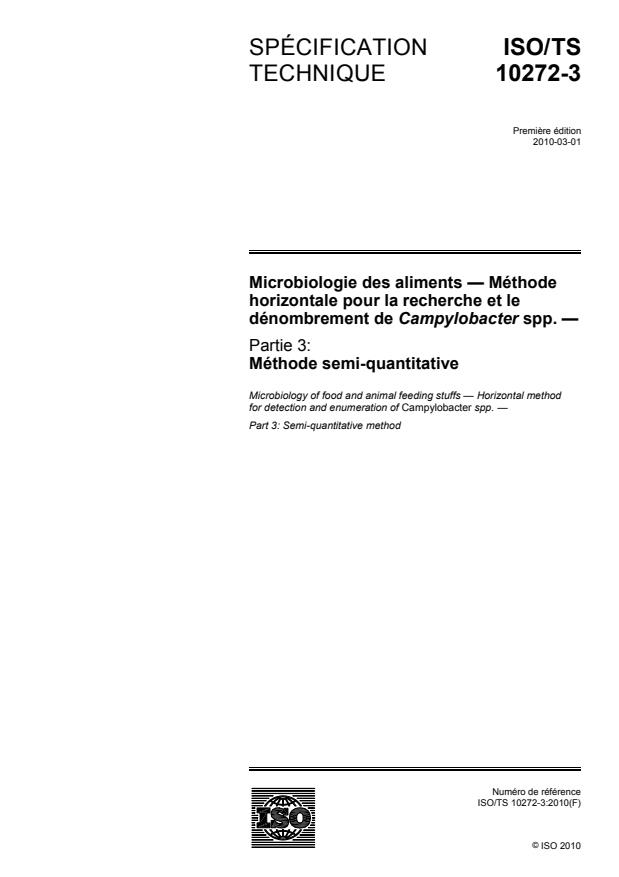
Microbiologie des aliments — Méthode horizontale pour la recherche et le dénombrement de Campylobacter spp. — Partie 3: Méthode semi-quantitative
L'ISO/TS 10272-3:2010 décrit une méthode horizontale pour la détermination semi-quantitative de Campylobacter spp. Elle est applicable aux produits destinés à une consommation humaine ou aux aliments pour animaux et à des échantillons environnementaux dans le domaine de la production alimentaire et de la manipulation des aliments. Toutefois, il est possible que l'ISO/TS 10272-3:2010 ne convienne pas en tout point pour certains produits, des écarts étant rendus nécessaires par des raisons techniques. Il est possible que l'ISO/TS 10272-3:2010 ne s'applique pas du tout à certains autres produits.
General Information
- Status
- Withdrawn
- Publication Date
- 22-Feb-2010
- Withdrawal Date
- 22-Feb-2010
- Technical Committee
- ISO/TC 34/SC 9 - Microbiology
- Drafting Committee
- ISO/TC 34/SC 9 - Microbiology
- Current Stage
- 9599 - Withdrawal of International Standard
- Start Date
- 10-Sep-2013
- Completion Date
- 12-Feb-2026
Relations
- Effective Date
- 12-Feb-2026
- Consolidates
ISO/IEC TR 15846:1998 - Information technology — Software life cycle processes — Configuration Management - Effective Date
- 06-Jun-2022
ISO/TS 10272-3:2010 - Microbiology of food and animal feeding stuffs -- Horizontal method for detection and enumeration of Campylobacter spp.
ISO/TS 10272-3:2010 - Microbiologie des aliments -- Méthode horizontale pour la recherche et le dénombrement de Campylobacter spp.
Frequently Asked Questions
ISO/TS 10272-3:2010 is a technical specification published by the International Organization for Standardization (ISO). Its full title is "Microbiology of food and animal feeding stuffs — Horizontal method for detection and enumeration of Campylobacter spp. — Part 3: Semi-quantitative method". This standard covers: ISO/TS 10272-3:2010 describes a horizontal method for the semi-quantitative determination of Campylobacter spp. It is applicable to products intended for human consumption or for the feeding of animals, and to environmental samples in the area of food production and food handling. However, it is possible that ISO/TS 10272-3:2010 is not appropriate in every detail for certain products, deviations from it being made necessary for technical reasons. It is possible that ISO/TS 10272-3:2010 is not applicable at all to some other products.
ISO/TS 10272-3:2010 describes a horizontal method for the semi-quantitative determination of Campylobacter spp. It is applicable to products intended for human consumption or for the feeding of animals, and to environmental samples in the area of food production and food handling. However, it is possible that ISO/TS 10272-3:2010 is not appropriate in every detail for certain products, deviations from it being made necessary for technical reasons. It is possible that ISO/TS 10272-3:2010 is not applicable at all to some other products.
ISO/TS 10272-3:2010 is classified under the following ICS (International Classification for Standards) categories: 07.100.30 - Food microbiology. The ICS classification helps identify the subject area and facilitates finding related standards.
ISO/TS 10272-3:2010 has the following relationships with other standards: It is inter standard links to CEN ISO/TS 10272-3:2010, ISO/IEC TR 15846:1998. Understanding these relationships helps ensure you are using the most current and applicable version of the standard.
ISO/TS 10272-3:2010 is available in PDF format for immediate download after purchase. The document can be added to your cart and obtained through the secure checkout process. Digital delivery ensures instant access to the complete standard document.
Standards Content (Sample)
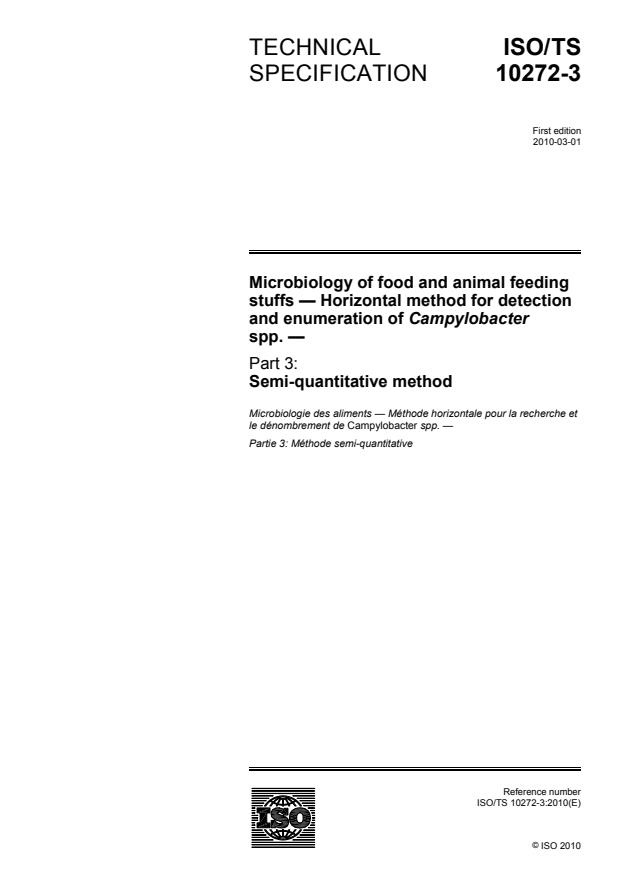
TECHNICAL ISO/TS
SPECIFICATION 10272-3
First edition
2010-03-01
Microbiology of food and animal feeding
stuffs — Horizontal method for detection
and enumeration of Campylobacter
spp. —
Part 3:
Semi-quantitative method
Microbiologie des aliments — Méthode horizontale pour la recherche et
le dénombrement de Campylobacter spp. —
Partie 3: Méthode semi-quantitative
Reference number
©
ISO 2010
PDF disclaimer
This PDF file may contain embedded typefaces. In accordance with Adobe's licensing policy, this file may be printed or viewed but
shall not be edited unless the typefaces which are embedded are licensed to and installed on the computer performing the editing. In
downloading this file, parties accept therein the responsibility of not infringing Adobe's licensing policy. The ISO Central Secretariat
accepts no liability in this area.
Adobe is a trademark of Adobe Systems Incorporated.
Details of the software products used to create this PDF file can be found in the General Info relative to the file; the PDF-creation
parameters were optimized for printing. Every care has been taken to ensure that the file is suitable for use by ISO member bodies. In
the unlikely event that a problem relating to it is found, please inform the Central Secretariat at the address given below.
© ISO 2010
All rights reserved. Unless otherwise specified, no part of this publication may be reproduced or utilized in any form or by any means,
electronic or mechanical, including photocopying and microfilm, without permission in writing from either ISO at the address below or
ISO's member body in the country of the requester.
ISO copyright office
Case postale 56 • CH-1211 Geneva 20
Tel. + 41 22 749 01 11
Fax + 41 22 749 09 47
E-mail copyright@iso.org
Web www.iso.org
Published in Switzerland
ii © ISO 2010 – All rights reserved
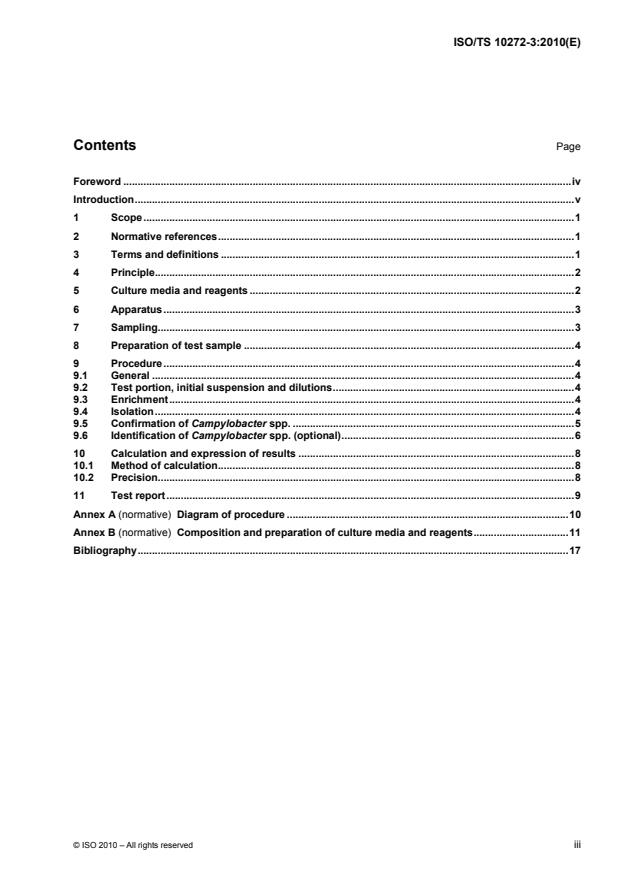
Contents Page
Foreword .iv
Introduction.v
1 Scope.1
2 Normative references.1
3 Terms and definitions .1
4 Principle.2
5 Culture media and reagents .2
6 Apparatus.3
7 Sampling.3
8 Preparation of test sample .4
9 Procedure.4
9.1 General .4
9.2 Test portion, initial suspension and dilutions.4
9.3 Enrichment.4
9.4 Isolation.4
9.5 Confirmation of Campylobacter spp. .5
9.6 Identification of Campylobacter spp. (optional).6
10 Calculation and expression of results .8
10.1 Method of calculation.8
10.2 Precision.8
11 Test report.9
Annex A (normative) Diagram of procedure .10
Annex B (normative) Composition and preparation of culture media and reagents.11
Bibliography.17
Foreword
ISO (the International Organization for Standardization) is a worldwide federation of national standards bodies
(ISO member bodies). The work of preparing International Standards is normally carried out through ISO
technical committees. Each member body interested in a subject for which a technical committee has been
established has the right to be represented on that committee. International organizations, governmental and
non-governmental, in liaison with ISO, also take part in the work. ISO collaborates closely with the
International Electrotechnical Commission (IEC) on all matters of electrotechnical standardization.
International Standards are drafted in accordance with the rules given in the ISO/IEC Directives, Part 2.
The main task of technical committees is to prepare International Standards. Draft International Standards
adopted by the technical committees are circulated to the member bodies for voting. Publication as an
International Standard requires approval by at least 75 % of the member bodies casting a vote.
In other circumstances, particularly when there is an urgent market requirement for such documents, a
technical committee may decide to publish other types of document:
⎯ an ISO Publicly Available Specification (ISO/PAS) represents an agreement between technical experts in
an ISO working group and is accepted for publication if it is approved by more than 50 % of the members
of the parent committee casting a vote;
⎯ an ISO Technical Specification (ISO/TS) represents an agreement between the members of a technical
committee and is accepted for publication if it is approved by 2/3 of the members of the committee casting
a vote.
An ISO/PAS or ISO/TS is reviewed after three years in order to decide whether it will be confirmed for a
further three years, revised to become an International Standard, or withdrawn. If the ISO/PAS or ISO/TS is
confirmed, it is reviewed again after a further three years, at which time it must either be transformed into an
International Standard or be withdrawn.
Attention is drawn to the possibility that some of the elements of this document may be the subject of patent
rights. ISO shall not be held responsible for identifying any or all such patent rights.
ISO/TS 10272-3 was prepared by Technical Committee ISO/TC 34, Food products, Subcommittee SC 9,
Microbiology.
ISO 10272 consists of the following parts, under the general title Microbiology of food and animal feeding
stuffs — Horizontal method for detection and enumeration of Campylobacter spp.:
⎯ Part 1: Detection method
⎯ Part 2: Colony count technique [Technical Specification]
⎯ Part 3: Semi-quantitative method [Technical Specification]
iv © ISO 2010 – All rights reserved
Introduction
Because of the large variety of food and feed products, ISO 10272 may not be appropriate in every detail for
certain products, and for some other products it may be necessary to use different methods.
Nevertheless, in all cases, every attempt should be made to apply ISO 10272 as far as possible, any
deviations being made only if absolutely necessary for technical reasons.
When ISO 10272 is next reviewed, account will be taken of all information then available regarding the extent
to which the methods have been followed and the reasons for deviations from it in the case of particular
products. The harmonization of test methods cannot be immediate and, for certain groups of products,
International Standards and/or national standards may already exist that do not comply with ISO 10272. It is
hoped that, when such standards are reviewed, they will be changed to comply with ISO 10272, so that
eventually the only remaining departures are those necessary for well-established technical reasons.
TECHNICAL SPECIFICATION ISO/TS 10272-3:2010(E)
Microbiology of food and animal feeding stuffs — Horizontal
method for detection and enumeration of Campylobacter spp. —
Part 3:
Semi-quantitative method
1 Scope
This part of ISO 10272 describes a horizontal method for the semi-quantitative determination of
Campylobacter spp.
It is applicable to products intended for human consumption or for the feeding of animals, and to
environmental samples in the area of food production and food handling. However, it is possible that this part
of ISO 10272 is not appropriate in every detail for certain products, deviations from it being made necessary
for technical reasons. It is possible that this part of ISO 10272 is not applicable at all to some other products.
2 Normative references
The following referenced documents are indispensable for the application of this document. For dated
references, only the edition cited applies. For undated references, the latest edition of the referenced
document (including any amendments) applies.
ISO 6887 (all parts), Microbiology of food and animal feeding stuffs — Preparation of test samples, initial
suspension and decimal dilutions for microbiological examination
ISO 7218, Microbiology of food and animal feeding stuffs — General requirements and guidance for
microbiological examinations
ISO/TS 11133-1, Microbiology of food and animal feeding stuffs — Guidelines on preparation and production
of culture media — Part 1: General guidelines on quality assurance for the preparation of culture media in the
laboratory
ISO/TS 11133-2:2003, Microbiology of food and animal feeding stuffs — Guidelines on preparation and
production of culture media — Part 2: Practical guidelines on performance testing of culture media
3 Terms and definitions
For the purposes of this document, the following terms and definitions apply.
3.1
Campylobacter
〈food and feed Campylobacter microbiology〉 genus of microorganisms forming characteristic colonies on solid
selective media when incubated microaerobically at 41,5 °C, but not at 25 °C, and which possess the
characteristic motility and biochemical and growth properties described when the tests are conducted in
accordance with this part of ISO 10272
NOTE The most frequently encountered species are Campylobacter jejuni and C. coli. Other species have, however,
been described (C. lari, C. upsaliensis and some others).
3.2
semi-quantitative determination
〈food and feed Campylobacter microbiology〉 determination of the level of Campylobacter contamination, when
a low number is expected, or if the level of accompanying flora is relatively high
4 Principle
4.1 General. The semi-quantitative determination of Campylobacter spp. requires stages 4.2 to 4.4 (see
Figure A.1).
4.2 Enrichment in selective liquid medium. The test portion and decimal dilutions thereof are inoculated
or diluted in the liquid enrichment medium (Bolton broth) and homogenized.
The enrichment medium is incubated at 37 °C for 4 h to 6 h followed by incubation at 41,5 °C for (44 ± 4) h.
4.3 Isolation and selection for confirmation. From the cultures obtained in 4.2, the selective solid
medium modified charcoal cefoperazone deoxycholate agar (mCCD agar) is inoculated, incubated at 41,5 °C
in a microaerobic atmosphere and inspected after (44 ± 4) h to detect the presence of colonies presumed to
be Campylobacter spp. because of their characteristics.
4.4 Confirmation. The colonies presumed to be Campylobacter spp. are subcultured on the non-selective
Columbia blood agar, then confirmed by means of microscopic examination and appropriate biochemical and
growth tests. Optionally, the Campylobacter spp. are identified by specific biochemical tests and antibiotic
sensitivity tests.
5 Culture media and reagents
5.1 General. For current laboratory practice, see ISO 7218, ISO/TS 11133-1 and ISO/TS 11133-2.
NOTE Because of the large number of culture media and reagents and for the clarity of the text, their compositions
and preparations are given in Annex B.
5.2 Liquid enrichment medium: Bolton broth. See B.1.
5.3 Selective plating medium: modified charcoal cefoperazone deoxycholate agar (mCCD agar).
See B.2.
5.4 Confirmation and identification media and reagents.
5.4.1 Columbia blood agar. See B.3.
5.4.2 Brucella broth. See B.4.
5.4.3 Reagent for the detection of oxidase. See B.5.
5.4.4 Hydrogen peroxide solution, 3 % (volume fraction).
5.4.5 Reagents for the detection of hydrolysis of hippurate. See B.6.
5.4.6 Mueller Hinton blood agar. See B.7.
5.4.7 Nalidixic acid discs and cephalothin discs. Each type of disc contains 30 µg of reagent.
5.4.8 Indoxyl acetate discs. See B.8.
2 © ISO 2010 – All rights reserved
6 Apparatus
Usual microbiological laboratory equipment (see ISO 7218) and, in particular, the following.
6.1 Apparatus for dry sterilization (oven) or wet sterilization (autoclave). See ISO 7218.
6.2 Oven, laminar flow cabinet or incubator, capable of being maintained between 37 °C and 55 °C.
6.3 Incubators, capable of being maintained at (25 ± 1) °C, (37 ± 1) °C and (41,5 ± 1) °C.
6.4 Water bath, capable of being maintained at (37 ± 1) °C.
6.5 Water bath, capable of being maintained between 47 °C and 50 °C.
6.6 pH-meter, accurate to within 0,1 pH units at 25 °C.
6.7 Containers, in particular culture tubes of dimensions 18 mm × 180 mm and 9 mm × 180 mm,
haemolysis tubes of dimensions 13 mm × 75 mm, bottles with non-toxic metal closures and/or flasks of
appropriate capacity with appropriate covers.
6.8 Petri dishes, in glass or plastic, with diameters 90 mm to 100 mm.
6.9 Total-delivery graduated pipettes, with a wide opening, and a nominal capacity of 1 ml and 10 ml,
[1] [2]
graduated in 0,1 ml divisions, ISO 835 class A, and Pasteur pipettes, ISO 7712 .
6.10 Rubber teats, or any other safety system capable of being adapted to the graduated pipettes.
6.11 Sterile loops, of platinum-iridium alloy, nickel-chromium alloy or plastic, approximately 3 mm in
diameter, and wires of the same material, or a glass rod or plastic rod.
A nickel-chromium alloy loop is not suitable for use in the oxidase test (see 9.5.6).
6.12 Forceps, fine, round-ended, of stainless steel.
6.13 Microscope, preferably with phase contrast (for observing the characteristic motility of Campylobacter
spp.).
6.14 Apparatus suitable for achieving a microaerobic atmosphere, with volume fractions of: oxygen,
(5 ± 2) %; carbon dioxide, (10 ± 3) %; optionally hydrogen, u 10 %; the balance being nitrogen. Appropriate
gastight containers are used to hold Petri dishes and/or flasks or bottles of about 350 ml capacity used for the
enrichment broth, e.g. bacteriological anaerobic jars.
NOTE 1 The appropriate microaerobic atmosphere can be obtained using commercially available gas-generating kits,
following precisely the manufacturer's instructions, particularly those relating to the volume of the jar and the capacity of
the gas-generating kit. Alternatively, the jar can be filled with an appropriate gas mixture prior to incubation.
NOTE 2 As an alternative to incubation in a microaerobic atmosphere, the enrichment broth can be incubated in
screw-capped bottles, flasks or tubes filled with enrichment broth, leaving a headspace of less than 20 mm and tightly
screwing on the caps.
7 Sampling
A representative sample should have been sent to the laboratory. It should not have been damaged or
changed during transport or storage.
Sampling is not part of the method specified in this part of ISO 10272. See the specific International Standard
dealing with the product concerned. If no specific International Standard exists, it is recommended that the
parties concerned come to an agreement on this subject.
Since Campylobacter spp. are very sensitive to freezing but survive best at low temperatures, it is
recommended that samples be stored at (+ 3 ± 2) °C and subjected to analysis as rapidly as possible. Also
take care to prevent the samples from drying.
8 Preparation of test sample
Prepare the test sample in accordance with the relevant part of ISO 6887 dealing with the product concerned.
If ISO 6887 is not appropriate, it is recommended that the parties concerned come to an agreement on this
subject.
9 Procedure
9.1 General
See Figure A.1.
9.2 Test portion, initial suspension and dilutions
9.2.1 Introduce a test portion of x g or x ml (minimum 15 g or 15 ml) from the test sample (Clause 8) into
eight times (120 ml minimum) its volume of the enrichment medium Bolton broth (5.2), and homogenize.
This is the initial suspension.
9.2.2 Transfer an amount of 90 ml of the initial suspension (9.2.1) to a 100 ml bottle. This corresponds to
10 g of the test portion. When reading the results, this dilution corresponds to 10 .
9.2.3 Transfer 10 ml of the initial suspension (9.2.1) to a culture tube. When reading the results, this dilution
corresponds to 10 . After the next dilution step (9.2.4), 9 ml of this dilution remains. This corresponds to 1 g of
the test portion.
–4 0
9.2.4 Make an ordinary 10-fold dilution series (e.g. to 10 ) from the 10 dilution (9.2.3) by transferring
1,0 ml to tubes containing 9,0 ml Bolton broth. A quantity of 1,0 ml from the highest dilution is discarded, as all
–1 –2
tubes must contain 9,0 ml. When reading the results, these dilutions correspond to 10 , 10 , etc.
9.3 Enrichment
Incubate the test portions and dilutions (9.2.2, 9.2.3 and 9.2.4) in a microaerobic atmosphere (6.14) at 37 °C
for 4 h to 6 h and then at 41,5 °C for (44 ± 4) h.
9.4 Isolation
9.4.1 Using each of the cultures obtained in the enrichment media (9.3), inoculate with a sterile loop (6.11)
the surface of plates of the selective isolation medium mCCD agar (5.3).
9.4.2 Incubate the plates (9.4.1) at 41,5 °C in a microaerobic atmosphere (6.14).
9.4.3 After (44 ± 4) h of incubation, examine the plates for typical and/or suspect colonies of Campylobacter
spp.
The typical colonies are greyish on mCCD agar, often with a metallic sheen, and are flat and moist, with a
tendency to spread. Colonies spread less on drier agar surfaces. Other forms of colonies may occur.
4 © ISO 2010 – All rights reserved
9.5 Confirmation of Campylobacter spp.
9.5.1 General
As the bacteria rapidly deteriorate in air, follow the procedure described in 9.5.2 to 9.5.6 without any delay.
9.5.2 Selection of colonies for confirmation
9.5.2.1 For confirmation, take from each plate (9.4.3) at least one colony considered to be typical or
suspected as being Campylobacter spp., examine the morphology and motility by microscopic
examination (9.5.3.1) and proceed in the same manner with up to a further four colonies if the first one is
negative.
9.5.2.2 Streak each of the selected colonies on to a Columbia blood agar plate (5.4.1
...
SPÉCIFICATION ISO/TS
TECHNIQUE 10272-3
Première édition
2010-03-01
Microbiologie des aliments — Méthode
horizontale pour la recherche et le
dénombrement de Campylobacter spp. —
Partie 3:
Méthode semi-quantitative
Microbiology of food and animal feeding stuffs — Horizontal method
for detection and enumeration of Campylobacter spp. —
Part 3: Semi-quantitative method
Numéro de référence
©
ISO 2010
PDF – Exonération de responsabilité
Le présent fichier PDF peut contenir des polices de caractères intégrées. Conformément aux conditions de licence d'Adobe, ce fichier
peut être imprimé ou visualisé, mais ne doit pas être modifié à moins que l'ordinateur employé à cet effet ne bénéficie d'une licence
autorisant l'utilisation de ces polices et que celles-ci y soient installées. Lors du téléchargement de ce fichier, les parties concernées
acceptent de fait la responsabilité de ne pas enfreindre les conditions de licence d'Adobe. Le Secrétariat central de l'ISO décline toute
responsabilité en la matière.
Adobe est une marque déposée d'Adobe Systems Incorporated.
Les détails relatifs aux produits logiciels utilisés pour la création du présent fichier PDF sont disponibles dans la rubrique General Info
du fichier; les paramètres de création PDF ont été optimisés pour l'impression. Toutes les mesures ont été prises pour garantir
l'exploitation de ce fichier par les comités membres de l'ISO. Dans le cas peu probable où surviendrait un problème d'utilisation,
veuillez en informer le Secrétariat central à l'adresse donnée ci-dessous.
DOCUMENT PROTÉGÉ PAR COPYRIGHT
© ISO 2010
Droits de reproduction réservés. Sauf prescription différente, aucune partie de cette publication ne peut être reproduite ni utilisée sous
quelque forme que ce soit et par aucun procédé, électronique ou mécanique, y compris la photocopie et les microfilms, sans l'accord écrit
de l'ISO à l'adresse ci-après ou du comité membre de l'ISO dans le pays du demandeur.
ISO copyright office
Case postale 56 • CH-1211 Geneva 20
Tel. + 41 22 749 01 11
Fax + 41 22 749 09 47
E-mail copyright@iso.org
Web www.iso.org
Publié en Suisse
ii © ISO 2010 – Tous droits réservés
Sommaire Page
Avant-propos .iv
Introduction.v
1 Domaine d'application .1
2 Références normatives.1
3 Termes et définitions .1
4 Principe.2
5 Milieux de culture et réactifs .2
6 Appareillage .3
7 Échantillonnage.4
8 Préparation de l'échantillon pour essai .4
9 Mode opératoire.4
9.1 Généralités .4
9.2 Prise d'essai, suspension mère et dilutions.4
9.3 Enrichissement.4
9.4 Isolement.4
9.5 Confirmation des Campylobacter spp. .5
9.6 Identification des Campylobacter spp. (facultatif).6
10 Calcul et expression des résultats .8
10.1 Mode de calcul.8
10.2 Fidélité .8
11 Rapport d'essai.9
Annexe A (normative) Schéma du mode opératoire .10
Annexe B (normative) Composition et préparation des milieux de culture et des réactifs .11
Bibliographie.17
Avant-propos
L'ISO (Organisation internationale de normalisation) est une fédération mondiale d'organismes nationaux de
normalisation (comités membres de l'ISO). L'élaboration des Normes internationales est en général confiée
aux comités techniques de l'ISO. Chaque comité membre intéressé par une étude a le droit de faire partie du
comité technique créé à cet effet. Les organisations internationales, gouvernementales et non
gouvernementales, en liaison avec l'ISO participent également aux travaux. L'ISO collabore étroitement avec
la Commission électrotechnique internationale (CEI) en ce qui concerne la normalisation électrotechnique.
Les Normes internationales sont rédigées conformément aux règles données dans les Directives ISO/CEI,
Partie 2.
La tâche principale des comités techniques est d'élaborer les Normes internationales. Les projets de Normes
internationales adoptés par les comités techniques sont soumis aux comités membres pour vote. Leur
publication comme Normes internationales requiert l'approbation de 75 % au moins des comités membres
votants.
Dans d'autres circonstances, en particulier lorsqu'il existe une demande urgente du marché, un comité
technique peut décider de publier d'autres types de documents normatifs:
⎯ une Spécification publiquement disponible ISO (ISO/PAS) représente un accord entre les experts dans
un groupe de travail ISO et est acceptée pour publication si elle est approuvée par plus de 50 % des
membres votants du comité dont relève le groupe de travail;
⎯ une Spécification technique ISO (ISO/TS) représente un accord entre les membres d'un comité technique
et est acceptée pour publication si elle est approuvée par 2/3 des membres votants du comité.
Une ISO/PAS ou ISO/TS fait l'objet d'un examen après trois ans afin de décider si elle est confirmée pour trois
nouvelles années, révisée pour devenir une Norme internationale, ou annulée. Lorsqu'une ISO/PAS ou
ISO/TS a été confirmée, elle fait l'objet d'un nouvel examen après trois ans qui décidera soit de sa
transformation en Norme internationale soit de son annulation.
L'attention est appelée sur le fait que certains des éléments du présent document peuvent faire l'objet de
droits de propriété intellectuelle ou de droits analogues. L'ISO ne saurait être tenue pour responsable de ne
pas avoir identifié de tels droits de propriété et averti de leur existence.
L'ISO/TS 10272-3 a été élaborée par le comité technique ISO/TC 34, Produits alimentaires, sous-comité SC 9
Microbiologie.
L'ISO 10272 comprend les parties suivantes, présentées sous le titre général Microbiologie des aliments —
Méthode horizontale pour la recherche et le dénombrement de Campylobacter spp.:
⎯ Partie 1: Méthode de recherche
⎯ Partie 2: Technique par comptage des colonies [Spécification technique]
⎯ Partie 3: Méthode semi-quantitative [Spécification technique]
iv © ISO 2010 – Tous droits réservés
Introduction
En raison de la grande diversité des produits alimentaires, l'ISO 10272 peut ne pas convenir en tout point
pour certains produits et, pour certains autres, il peut s'avérer nécessaire de recourir à des méthodes
différentes.
Néanmoins, dans tous les cas, il convient autant que possible d'appliquer l'ISO 10272, tout écart n'étant
justifié que par une absolue nécessité liée à des raisons techniques.
Lors de la prochaine révision de l'ISO 10272, toutes les informations alors disponibles relatives à la mesure
dans laquelle les méthodes ont été suivies, et les raisons des écarts par rapport à celles-ci dans le cas de
certains produits, seront prises en compte. L'harmonisation des méthodes d'essai ne peut pas être immédiate
et, pour certains groupes de produits, des Normes internationales et/ou nationales peuvent déjà exister,
lesquelles ne sont pas en conformité avec l'ISO 10272. Il est souhaitable que, lors de leur révision, de telles
normes soient modifiées pour une mise en conformité avec l'ISO 10272 de sorte que, en fin de compte, les
seules divergences restantes soient celles imposées pour des raisons techniques bien établies.
SPÉCIFICATION TECHNIQUE ISO/TS 10272-3:2010(F)
Microbiologie des aliments — Méthode horizontale pour
la recherche et le dénombrement de Campylobacter spp. —
Partie 3:
Méthode semi-quantitative
1 Domaine d'application
La présente partie de l'ISO 10272 décrit une méthode horizontale relative pour la détermination semi-
quantitative de Campylobacter spp.
Elle est applicable aux produits destinés à une consommation humaine ou aux aliments pour animaux et à
des échantillons environnementaux dans le domaine de la production alimentaire et de la manipulation des
aliments. Toutefois, il est possible que la présente partie de l'ISO 10272 ne convienne pas en tout point pour
certains produits, des écarts étant rendus nécessaires par des raisons techniques. Il est possible que la
présente partie de l'ISO 10272 ne s'applique pas du tout à certains autres produits.
2 Références normatives
Les documents de référence suivants sont indispensables pour l'application du présent document. Pour les
références datées, seule l'édition citée s'applique. Pour les références non datées, la dernière édition du
document de référence s'applique (y compris les éventuels amendements).
ISO 6887 (toutes les parties), Microbiologie des aliments — Préparation des échantillons, de la suspension
mère et des dilutions décimales en vue de l'examen microbiologique
ISO 7218, Microbiologie des aliments — Exigences générales et recommandations
ISO/TS 11133-1, Microbiologie des aliments — Lignes directrices pour la préparation et la production des
milieux de culture — Partie 1: Lignes directrices générales d'assurance qualité pour la préparation des milieux
de culture en laboratoire
ISO/TS 11133-2:2003, Microbiologie des aliments — Guide pour la préparation et la production des milieux de
culture — Partie 2: Guide général pour les essais de performance des milieux de culture
3 Termes et définitions
Pour les besoins du présent document, les termes et définitions suivants s'appliquent.
3.1
Campylobacter
〈Campylobacter en microbiologie des aliments〉 microorganismes formant des colonies caractéristiques sur
des milieux solides sélectifs lorsqu'ils sont incubés en microaérobie à 41,5 °C, et non à 25 °C, et présentant la
mobilité caractéristique ainsi que les propriétés biochimiques et les propriétés de croissance décrites lorsque
les essais sont réalisés conformément à la présente partie de l'ISO 10272
NOTE Les espèces les plus courantes sont Campylobacter jejuni et C. coli. Toutefois, d'autres espèces ont été
décrites (C. lari, C. upsaliensis et quelques autres).
3.2
détermination semi-quantitative
〈Campylobacter en microbiologie des aliments〉 détermination du niveau de contamination par Campylobacter
lorsqu'un faible nombre est attendu ou si le niveau de la flore associée est relativement élevé
4 Principe
4.1 Généralité. La détermination semi-quantitative du Campylobacter spp. implique les étapes 4.2 à 4.4
(voir Figure A.1).
4.2 Enrichissement en milieu liquide sélectif. La prise d'essai et ses dilutions décimales sont inoculées
ou diluées dans le milieu d'enrichissement liquide (bouillon de Bolton) et homogénéisées.
Le milieu d'enrichissement est incubé à 37 °C durant 4 h à 6 h puis à 41,5 °C durant (44 ± 4) h.
4.3 Isolement et sélection pour confirmation. À partir des cultures obtenues en 4.2, le milieu sélectif
solide gélosé modifié à base de céfopérazone, de charbon et de désoxycholate de sodium (gélose mCCD) est
inoculé, incubé à 41,5 °C en atmosphère microaérophile et observé après (44 ± 4) h en vue de détecter la
présence de colonies supposées être des Campylobacter spp. en raison de leurs caractéristiques.
4.4 Confirmation. Les colonies supposées être des Campylobacter ssp. sont ensemencées sur un milieu
non sélectif, une gélose Colombia au sang; la confirmation est ensuite obtenue à l'aide d'un examen
microscopique ainsi que des essais biochimiques et des essais de croissance appropriés. En option, les
espèces Campylobacter spp. sont identifiées par des essais biochimiques spécifiques et par des essais de
sensibilité aux antibiotiques.
5 Milieux de culture et réactifs
5.1 Généralités. Pour la pratique de laboratoire courante, voir l'ISO 7218, l'ISO/TS 11133-1 et
l'ISO/TS 11133-2.
NOTE En raison du grand nombre de milieux de culture et de réactifs et à des fins de clarté du texte, leurs
compositions et préparations sont données dans l'Annexe B.
5.2 Milieu d'enrichissement liquide: bouillon de Bolton. Voir B.1.
5.3 Milieu d'isolement sélectif: gélose modifiée à base de céfopérazone, de charbon et de
désoxycholate de sodium (gélose mCCD). Voir B.2.
5.4 Milieux et réactifs de confirmation et d'identification.
5.4.1 Gélose Colombia au sang. Voir B.3.
5.4.2 Bouillon Brucella. Voir B.4.
5.4.3 Réactif permettant la détection d'oxydase. Voir B.5.
5.4.4 Solution de peroxyde d'hydrogène, 3 % (fraction volumique).
5.4.5 Réactifs permettant de détecter l'hydrolyse de l'hippurate. Voir B.6.
5.4.6 Gélose de Mueller Hinton au sang. Voir B.7.
2 © ISO 2010 – Tous droits réservés
5.4.7 Disques d'acide nalidixique et de céfalotine. Chaque type de disque contient 30 µg de réactif.
5.4.8 Disques d'acétate d'indoxyle. Voir B.8.
6 Appareillage
Matériel de laboratoire de microbiologie courant (voir l'ISO 7218) et, en particulier, ce qui suit.
6.1 Appareil pour la stérilisation par chaleur sèche (étuve) ou stérilisation par voie humide
(autoclave). Voir l'ISO 7218.
6.2 Étuve, hotte à flux laminaire ou incubateur, pouvant être maintenu(e) à des températures comprises
entre 37 °C et 55 °C.
6.3 Incubateurs, pouvant être maintenus à (25 ± 1) °C, (37 ± 1) °C et (41,5 ± 1) °C.
6.4 Bain-marie, pouvant être maintenu à (37 ± 1) °C.
6.5 Bain-marie, pouvant être maintenu à une température comprise entre 47 °C et 50 °C.
6.6 pH-mètre, d'une précision de 0,1 unité de pH à 25 °C.
6.7 Récipients, en particulier des tubes de cultures de 18 mm × 180 mm et 9 mm × 180 mm, des tubes à
hémolyse de 13 mm × 75 mm, des flacons avec des fermetures métalliques non toxiques et/ou des fioles de
contenance adaptée, munies de couvercles appropriés.
6.8 Boîtes de Petri, en verre ou en plastique, de 90 mm à 100 mm de diamètre.
6.9 Pipettes graduées à écoulement total, pourvues d'une large ouverture et d'une capacité nominale de
[1] [2]
1 ml et de 10 ml, graduées par division de 0,1 ml, ISO 835 , classe A, et pipettes Pasteur, ISO 7712 .
6.10 Poires en caoutchouc, ou tout autre système de sécurité pouvant s'adapter aux pipettes graduées.
6.11 Anses stériles, en platine iridié, en alliage nickel-chrome ou en matière plastique, de 3 mm de
diamètre environ et des fils droits constitués des mêmes matériaux, ou une baguette en plastique ou une
baguette en verre.
Ne pas utiliser une anse en alliage nickel-chrome pour l'essai de l'oxydase (voir 9.5.6).
6.12 Pinces, fines, à bouts ronds, en acier inoxydable.
6.13 Microscope, de préférence à contraste de phase (pour observer la mobilité caractéristique de
Campylobacter spp.).
6.14 Appareil approprié pour obtenir une atmosphère microaérophile, avec des fractions volumiques en
oxygène de (5 ± 2) %, en dioxyde de carbone de (10 ± 3) %, en hydrogène u 10 % (facultatif), le complément
étant de l'azote. Des récipients appropriés étanches aux gaz sont utilisés pour placer les boîtes de Petri et/ou
les fioles ou flacons d'une contenance d'environ 350 ml employés pour le bouillon d'enrichissement, par
exemple des jarres bactériologiques anaérobies.
NOTE 1 L'atmosphère microaérophile appropriée peut être obtenue au moyen de kits de génération de gaz disponibles
dans le commerce en respectant scrupuleusement les instructions du fabricant, notamment celles relatives au volume de
la jarre et à la capacité du kit de génération de gaz. La jarre peut également être remplie d'un mélange de gaz approprié
avant l'incubation.
NOTE 2 Au lieu de l'incubation en atmosphère microaérophile, le bouillon d'enrichissement peut être incubé dans des
flacons, fioles ou tubes pourvus d'un bouchon à vis et remplis dudit bouillon, en laissant un espace vide inférieur à 20 mm
et en vissant hermétiquement les bouchons.
7 Échantillonnage
Il convient que le laboratoire reçoive un échantillon représentatif, non endommagé ou modifié lors du transport
ou de la conservation.
L'échantillonnage ne fait pas partie de la méthode spécifiée dans la présente partie de l'ISO 10272. Voir la
Norme internationale spécifique se rapportant au produit concerné. S'il n'existe aucune Norme internationale
spécifique, il est recommandé que les parties concernées parviennent à un accord sur ce sujet.
Campylobacter spp. étant très sensible à la congélation, mais survivant mieux à basses températures, il est
recommandé de conserver les échantillons à une température de (+3 ± 2) °C et de les analyser aussi vite que
possible. Éviter également de laisser les échantillons se dessécher.
8 Préparation de l'échantillon pour essai
Préparer l'échantillon pour essai conformément à la partie pertinente de l'ISO 6887, traitant du produit
concerné. Si l'ISO 6887 n'est pas appropriée, il est recommandé que les parties concernées parviennent à un
accord sur ce sujet.
9 Mode opératoire
9.1 Généralités
Voir Figure A.1.
9.2 Prise d'essai, suspension mère et dilutions
9.2.1 Introduire une prise d'essai de x g ou x ml (minimum 15 g ou 15 ml), prélevée à partir de l'échantillon
pour essai (Article 8), dans 8 fois (minimum 120 ml) son volume de milieu d'enrichissement, le bouillon de
Bolton (5.2), et homogénéiser.
Il s'agit de la suspension mère.
9.2.2 Transférer 90 ml de suspension mère (9.2.1) dans un flacon de 100 ml. Cela représente 10 g de la
prise d'essai. Lors de la lecture des résultats, cette dilution correspond à 10 .
9.2.3 Transférer 10 ml de suspension mère (9.2.1) dans un tube de culture. Lors de la lecture des résultats,
cette dilution correspond à 10 . Après l'étape suivante de dilution (9.2.4), il reste 9 ml de cette dilution. Cela
représente 1 g de la prise d'essai.
−4 0
9.2.4 Procéder à une série de dilutions au 1/10 (par exemple jusqu'à 10 ) à partir de la dilution 10 (9.2.3)
en transférant 1,0 ml dans des tubes contenant 9,0 ml de bouillon de Bolton. Prélever et jeter 1,0 ml de la
dilution la plus élevée, tous les tubes devant contenir 9,0 ml. Lors de la lecture des résultats, ces dilutions
–1 –2
correspondent à 10 , 10 , etc.
9.3 Enrichissement
Incuber les prises d'essai et les dilutions (9.2.2, 9.2.3 et 9.2.4) en atmosphère microaérophile (6.14) à 37 °C
durant 4 h à 6 h puis à 41,5 °C durant (44 ± 4) h.
9.4 Isolement
9.4.1 À partir de chacune des cultures obtenues dans le milieu d'enrichissement (9.3), inoculer la surface
des boîtes de gélose du milieu d'isolement sélectif mCCD (5.3) au moyen d'une anse stérile (6.11).
4 © ISO 2010 – Tous droits réservés
9.4.2 Incuber les boîtes (9.4.1) à 41,5 °C en atmosphère microaérophile (6.14).
9.4.3 Après (44 ± 4) h d'incubation, examiner les boîtes pour détecter des colonies typiques et/ou
supposées de Campylobacter spp.
Sur la gélose mCCD, les colonies typiques sont grisâtres, souvent avec un reflet métallique. Elles sont, en
outre, plates et humides et présentent une tendance à s'étaler. Les colonies s'étalent moins sur des surfaces
de gélose plus sèches. D'autres formes de colonies peuvent apparaître.
9.5 Confirmation des Campylobacter spp.
9.5.1 Généralités
Les bactéries se détériorant rapidement dans l'air, suivre sans délai le mode opératoire décrit de 9.5.2 à 9.5.6.
9.5.2 Sélection de colonies pour confirmation
9.5.2.1 Pour procéder à la confirmation, prélever sur chaque boîte (9.4.3) au moins une colonie
considérée comme étant typique ou supposée être une colonie de Campylobacter spp., en examiner la
morphologie et la mobilité par un examen microscopique (9.5.3.1) et procéder de la même façon avec au
maximum quatre autres colonies si la première se révèle négative.
9.5.2.2 Ensemencer chacune des colonies sélectionnées sur une boîte de gélose Colombia au sang
(5.4.1) afin de permettre le développement de colonies bien isolées. Incuber les boîtes en atmosphère
microaérophile à 41,5 °C durant 24 h à 48 h. Utiliser les cultures pures pour l'examen de la morphologie, la
mobilité, la croissance en microaérobie à 25 °C, la croissance en aérobi
...
ТЕХНИЧЕСКИЕ ISO/TS
УСЛОВИЯ 10272-3
Первое издание
2010-03-01
Микробиология пищевых продуктов и
кормов для животных.
Горизонтальный метод обнаружения и
подсчета бактерий Campylobacter spp.
Часть 3.
Полуколичественный метод
Microbiology of food and animal feeding stuffs — Horizontal method for
detection and enumeration of Campylobacter spp. —
Part 3:
Semi-quantitative method
Ответственность за подготовку русской версии несѐт GOST R
(Российская Федерация) в соответствии со статьѐй 18.1 Устава ISO
Ссылочный номер
©
ISO 2010
Отказ от ответственности при работе в PDF
Настоящий файл PDF может содержать интегрированные шрифты. В соответствии с условиями лицензирования, принятыми
фирмой Adobe, этот файл можно распечатать или смотреть на экране, но его нельзя изменить, пока не будет получена
лицензия на интегрированные шрифты и они не будут установлены на компьютере, на котором ведется редактирование. В
случае загрузки настоящего файла заинтересованные стороны принимают на себя ответственность за соблюдение
лицензионных условий фирмы Adobe. Центральный секретариат ISO или IDF не несут никакой ответственности в этом
отношении.
Adobe – торговый знак фирмы Adobe Systems Incorporated.
Подробности, относящиеся к программным продуктам, использованные для создания настоящего файла PDF, можно найти в
рубрике General Info файла; параметры создания PDF были оптимизированы для печати. Были приняты во внимание все
меры предосторожности с тем, чтобы обеспечить пригодность настоящего файла для использования комитетами-членами
ISO и национальными комитетами IDF. В редких случаях возникновения проблемы, связанной со сказанным выше, просьба
проинформировать Центральный секретариат по адресу, приведенному ниже.
ДОКУМЕНТ ЗАЩИЩЕН АВТОРСКИМ ПРАВОМ
Все права сохраняются. Если не указано иное, никакую часть настоящей публикации нельзя копировать или использовать в
какой-либо форме или каким-либо электронным или механическим способом, включая фотокопии и микрофильмы, без
предварительного письменного согласия ISO, которое должно быть получено после запроса о разрешении, направленного по
адресу, приведенному ниже, или в комитет-член ISO в стране запрашивающей стороны.
ISO copyright office
Case postale 56 CH-1211 Geneva 20
Tel. + 41 22 749 01 11
Fax + 41 22 749 09 47
E-mail copyright@iso.org
Web www.iso.org
Опубликовано в Швейцарии
ii © ISO 2010 – Все права сохраняются
Содержание Страница
Предисловие .iv
Введение .v
1 Область применения .1
2 Нормативные ссылки .1
3 Термины и определения .2
4 Принцип .2
5 Питательные среды и реактивы .2
6 Аппаратура .3
7 Отбор проб .4
8 Приготовление испытуемой пробы .4
9 Методика .4
9.1 Общие положения .4
9.2 Проба для анализа, исходная суспензия и разбавления .4
9.3 Обогащение .5
9.4 Изоляция .5
9.5 Подтверждение вида Campylobacter spp. .5
9.6 Идентификация вида Campylobacter spp. (альтернативная процедура) .6
10 Расчет и выражение результатов .8
10.1 Метод расчета .8
10.2 Прецизионность.9
11 Протокол испытания .9
Приложение A (нормативное) Диаграмма методики . 10
Приложение B (нормативное) Состав и приготовление питательных сред и реактивов . 11
Библиография . 17
Предисловие
Международная организация по стандартизации (ISO) является всемирной федерацией национальных
организаций по стандартизации (комитетов-членов ISO). Разработка международных стандартов
обычно осуществляется техническими комитетами ISO. Каждый комитет-член, заинтересованный в
деятельности, для которой был создан технический комитет, имеет право быть представленным в этом
комитете. Международные правительственные и неправительственные организации, имеющие связи с
ISO, также принимают участие в работах. Что касается стандартизации в области электротехники, ISO
работает в тесном сотрудничестве с Международной электротехнической комиссией (IEC).
Проекты международных стандартов разрабатываются по правилам, приведенным в Директивах
ISO/IEC, Часть 2.
Главная задача технических комитетов состоит в разработке международных стандартов. Проекты
международных стандартов, принятые техническими комитетами, рассылаются комитетам-членам на
голосование. Их опубликование в качестве международных стандартов требует одобрения, по
меньшей мере, 75 % комитетов-членов, принимавших участие в голосовании.
При других обстоятельствах, особенно когда существует срочная потребность рынка в таких
документах, технический комитет может принять решение о публикации других типов нормативного
документа:
общедоступные технические условия ISO (ISO/PAS) представляют собой соглашение между
техническими экспертами в рабочей группе ISO и принимаются к публикации после одобрения
более чем 50 % членов основного комитета, участвующих в голосовании;
технические условия ISO (ISO/TS) представляют собой соглашение между членами технического
комитета и принимаются к публикации после одобрения 2/3 членов комитета, участвующих в
голосовании.
Документы ISO/PAS или ISO/TS рассматриваются спустя три года для принятия решения, в
соответствии с которым они либо утверждаются на последующие три года, либо пересматриваются и
преобразовываются в Международный стандарт, либо аннулируются. Если документ ISO/PAS или
ISO/TS одобряется, то он пересматривается снова через три года, в течение которых документ должен
быть либо преобразован в Международный стандарт, либо аннулирован.
Следует иметь в виду, что некоторые элементы настоящего документа могут быть объектом патентных
прав. ISO не должен нести ответственность за идентификацию какого-либо одного или всех таких
патентных прав.
ISO/TS 10272-3 разработан Техническим комитетом ISO/ТC 34, Пищевые продукты, Подкомитетом
SC 9, Микробиология.
ISO 10272 состоит из следующих частей под общим названием Микробиология пищевых продуктов и
кормов для животных. Горизонтальный метод обнаружения и подсчета бактерий Campylobacter spp.
— Часть 1. Метод обнаружения
— Часть 2. Метод подсчета колоний [Технические условия]
— Часть 3. Полуколичественный метод [Технические условия]
iv © ISO 2010 – Все права сохраняются
Введение
Принимая во внимание большое разнообразие пищевых продуктов и кормов, ISO 10272 не может быть
применим во всех деталях к некоторым видам продукции, а для некоторых других видов продукции
может потребоваться использование других методов.
Вместе с тем во всех случаях следует предпринимать попытки применения, по мере возможности,
ISO 10272, а какие-либо отклонения от него могут быть обоснованы исключительно в силу технических
причин.
При последующем пересмотре ISO 10272 во внимание будет принята вся имеющаяся информация
относительно пределов применения этих методов и доводы в пользу отступления от них в случае
анализа конкретных видов продукции. Гармонизация методов испытаний не может быть осуществлена
в ближайшее время, а в отношении некоторых групп продукции уже существуют международные
стандарты и/или национальные стандарты, которые не согласуются с ISO 10272. Выражается
пожелание, что в период пересмотра этих стандартов в них будут внесены изменения с целью
приведения их в соответствие с ISO 10272 с тем, чтобы в итоге только оставшиеся отклонения были
действительно обоснованы по установленным техническим причинам.
ТЕХНИЧЕСКИЕ УСЛОВИЯ ISO/TS 10272-3:2010(R)
Микробиология пищевых продуктов и кормов для
животных. Горизонтальный метод обнаружения и подсчета
бактерий Campylobacter spp.
Часть 3.
Полуколичественный метод
1 Область применения
Настоящая часть ISO 10272 содержит описание горизонтального метода полуколичественного
определения Campylobacter spp.
Она применима к продукции, предназначенной для потребления человеком или кормления животных,
и к пробам окружающей среды в сфере производства и обращения с пищевой продукцией. Однако
возможно, что данная часть ISO 10272 не применима во всех деталях к некоторым видам продукции,
поэтому отклонения от них по техническим причинам становятся необходимыми. Возможно, что
данная часть ISO 10272 совсем не применима к некоторым другим видам продукции.
2 Нормативные ссылки
Следующие ссылочные нормативные документы являются обязательными при применении данного
документа. Для жестких ссылок применяется только цитированное издание документа. Для плавающих
ссылок необходимо использовать самое последнее издание нормативного ссылочного документа
(включая любые изменения).
ISO 6887 (все части), Микробиология пищевых продуктов и кормов для животных. Приготовление
проб для испытаний, исходных суспензий и десятичных разведений для микробиологических
исследований
ISO 7218, Микробиология пищевых продуктов и кормов для животных. Общие требования и
рекомендации по микробиологическим исследованиям
ISO/TS 11133-1, Микробиология пищевых продуктов и кормов для животных. Руководящие указания
по приготовлению и производству питательных сред. Часть 1. Общие руководящие указания по
обеспечению качества приготовления питательных сред в лаборатории
ISO/TS 11133-2:2003, Микробиология пищевых продуктов и кормов для животных. Руководящие
указания по приготовлению и производству питательных сред. Часть 2. Практические
руководящие указания по определению эффективности питательных сред
3 Термины и определения
В настоящем документе используются следующие термины и определения.
3.1
Campylobacter
Campylobacter
микробиология пищевых и кормовых Campylobacterрод микроорганизмов, образующих характерные
колонии на твердых селективных средах, когда их инкубируют микроаэробным способом при
температуре 41,5 ºC, но не при 25 ºC, и которые обладают характерной подвижностью,
биохимическими свойствами и способностью к росту, описанными в тех случаях, когда испытания
проводятся в соответствии с настоящей частью ISO 10272
ПРИМЕЧАНИЕ Наиболее часто встречающимися видами являются Campylobacter jejuni и C. coli. Вместе с тем,
были описаны и другие виды (C. lari, C. upsaliensis и некоторые другие).
3.2
полуколичественное определение
semi-quantitative determination
микробиология пищевых и кормовых Campylobacter определение уровня загрязнения Campylobacter
в том случае, когда ожидается низкое количество или если уровень сопутствующей флоры
относительно высок
4 Принцип
4.1 Общие положения. Для полуколичественного определения Campylobacter spp. необходимы
операции, описанные в 4.2 – 4.4 (см. Рисунок A.1).
4.2 Обогащение в селективной жидкой среде. Пробу для анализа и ее десятичные разбавления
инокулируют или разбавляют в жидкой обогатительной среде (бульон Болтона) и гомогенизируют.
Обогатительную среду инкубируют при 37 ºC в течение 4 – 6 ч и затем при 41,5ºC в течение (44 ч ± 4) ч.
4.3 Изоляция и отбор для подтверждения. Из культур, полученных в 4.2, твердую селективную
среду, основанную на модифицированном агаре с углем, цефоперазоном и дезоксихолатом
(mCCD агар), инокулируют, инкубируют при 41,5 °C в микроаэробной атмосфере и проверяют после
(44 4) ч с целью обнаружения присутствия колоний, которые по своим характеристикам
предположительно являются Campylobacter spp.
4.4 Подтверждение. Колонии, предположительно являющиеся Campylobacter spp., пересевают на
неселективный колумбийский кровяной агар и затем подтверждают при помощи исследования под
микроскопом и надлежащих биохимических испытаний и испытаний на рост. Дополнительно вид
Campylobacter spp. идентифицируют путем специфических биохимических испытаний и испытаний на
чувствительность к антибиотикам.
5 Питательные среды и реактивы
5.1 Общие положения. Для получения информации об общепринятой лабораторной практике см.
ISO 7218, ISO/TS 11133-1 и ISO/TS 11133-2.
ПРИМЕЧАНИЕ Ввиду наличия большого количества питательных сред и реактивов и для ясности изложения,
их составы и процедуры приготовления приведены в Приложении B.
5.2 Жидкая обогатительная среда: бульон Болтона. См. B.1.
5.3 Селективная среда для чашек Петри: модифицированный агар с углем, цефоперазоном и
дезоксихолатом (mCCD агар). СМ. B.2.
2 © ISO 2010 – Все права сохраняются
5.4 Среды и реактивы для подтверждения и идентификации.
5.4.1 Колумбийский кровяной агар. См. B.3.
5.4.2 Бульон для бруцелл. См. B.4.
5.4.3 Реактив для обнаружения оксидазы. См. B.5.
5.4.4 Раствор пероксида водорода, 3 % (объемная доля).
5.4.5 Реактивы для определения гидролиза гиппурата. См. B.6.
5.4.6 Кровяной агар Мюллера-Хинтона. См. B.7.
5.4.7 Диски с налидиксовой кислотой и цефалотином. Каждый тип диска содержит по 30 мкг
реактива.
5.4.8 Диски с индоксилацетатом. См. B.8.
6 Аппаратура
Используют обычную микробиологическую лабораторную аппаратуру (см. ISO 7218) и, в частности,
нижеприведенную.
6.1 Оборудование для сухой стерилизации (сушильный шкаф) или влажной стерилизации
(автоклав). См. ISO 7218.
6.2 Сушильный шкаф, ламинарный бокс или термостат, способные функционировать в
диапазоне температур от 37 °C до 55 °C.
6.3 Термостат, работающий при (25 1) °C, (37 1) °C и (41,5 1) °C.
6.4 Водяная баня, работающая при (37 1) °C.
6.5 Водяная баня, работающая в диапазоне от 47 °C до 50 °C.
6.6 pH-метр, с точностью до 0,1 pH при 25 °C.
6.7 Емкости, в частности, культуральные пробирки с размерами 18 мм × 180 мм и 9 мм × 180 мм,
пробирки для гемолиза с размерами 13 мм × 75 мм, бутылки с нетоксичными металлическими
крышками и/или колбы подходящей вместимости с соответствующими крышками.
6.8 Чашки Петри, стеклянные или пластиковые, диаметром 90 мм – 100 мм.
6.9 Градуированные пипетки, поставляющие полный объем, с широким отверстием,
[1]
номинальной вместимостью 1 мл и 10 мл, градуированные с ценой деления 0,1 мл, ISO 835 класс A,
[2]
и пастеровские пипетки, ISO 7712 .
6.10 Резиновые соски, или любая другая безопасная система, которую можно адаптировать к
градуированным пипеткам.
6.11 Стерильные петли, из платиново-иридиевого или никелево-хромового сплава либо
пластиковые, диаметром приблизительно 3 мм, и проволоки из того же материала или стеклянная или
пластиковая палочка.
Петля из никелево-хромового сплава не пригодна для использования в испытании на оксидазу (см. 9.5.6).
6.12 Пинцет, тонкий, с закругленными краями, из нержавеющей стали.
6.13 Микроскоп, предпочтительно с фазовым контрастом (для наблюдения характерной подвижности
Campylobacter spp.).
6.14 Надлежащее оборудование для достижения микроаэробной атмосферы с объемными
долями: кислорода (5 2) %, диоксида углерода (10 3) %, альтернативного водорода ≤ 10 %, с
соблюдением баланса азота. Используют надлежащие герметичные контейнеры, чтобы удерживать
чашки Петри и/или колбы или бутылки вместимостью примерно 350 мл, используемые для
обогатительного бульона, например, бактериологические анаэробные сосуды.
ПРИМЕЧАНИЕ 1 Соответствующая микроаэробная атмосфера может быть получена при использовании
имеющихся в продаже газогенераторных комплектов; следует в точности соблюдать инструкции изготовителя,
особенно те из них, которые касаются объема сосуда и вместимости газогенераторного комплекта. В качестве
альтернативы можно использовать заполнение сосуда надлежащей газовой смесью перед инкубацией.
ПРИМЕЧАНИЕ 2 В качестве альтернативы инкубации в микроаэробной атмосфере, обогатительный бульон
можно инкубировать в бутылках с винтовыми крышками, колбах или пробирках, заполнив их обогатительным
бульоном, оставляя свободное пространство величиной менее 20 мм и тщательно закупоривая крышками.
7 Отбор проб
В лабораторию должна поступать репрезентативная проба. Она не должна подвергаться повреждению
или изменению в период транспортировки или хранения.
Отбор проб не является частью метода, установленного в настоящей части ISO 10272. См. конкретный
международный стандарт, распространяющийся на данную продукцию. Если не существует
конкретного международного стандарта, рекомендуется, чтобы заинтересованные стороны достигли
согласия по данному вопросу.
Принимая во внимание, что Campylobacter spp. весьма чувствительны к замораживанию, но лучше
выживают при низких температурах, рекомендуется, чтобы пробы не хранились при температуре
( 3 2) °C и анализировались в кратчайшие сроки. Также принимают меры по предотвращению
высыхания проб.
8 Приготовление испытуемой пробы
Испытуемую пробу приготовляют в соответствии с соответствующей частью ISO 6887,
распространяющейся на определенный вид продукции. Если не существует соответствующей части
ISO 6887, рекомендуется, чтобы заинтересованные стороны достигли согласия по данному вопросу.
9 Методика
9.1 Общие положения
См. Рисунок A.1.
9.2 Проба для анализа, исходная суспензия и разбавления
9.2.1 Вводят пробу для анализа в количестве x г или x мл (минимум 15 г или 15 мл) из испытуемой
пробы (Раздел 8) в восьмикратный объем (120 мл минимум) обогатительной среды – бульон Болтона
(5.2) и гомогенизируют.
Полученная суспензия является исходной суспензией.
9.2.2 Переносят 90 мл исходной суспензии (9.2.1) в бутылку вместимостью 100 мл. Это
соответствует 10 г пробы для анализа. При подсчете результатов это разбавление соответствует 10 .
4 © ISO 2010 – Все права сохраняются
9.2.3 Переносят 10 мл исходной суспензии (9.2.1) в культуральную пробирку. При подсчете
результатов это разбавление соответствует 10 . После следующей стадии разбавления (9.2.4)
остается 9 мл этого разбавления. Это соответствует 1 г пробы для анализа.
–4 0
9.2.4 Делают обычную серию 10-кратных разбавлений (например, до 10 ) из 10 разбавления (9.2.3),
перенося по 1,0 мл в пробирки, содержащие 9,0 мл бульон Болтона. Из наибольшего разбавления
отбрасывается 1,0 мл, поскольку все пробирки должны содержать по 9,0 мл. При подсчете результатов
–1 –2
эти разбавления соответствуют 10 , 10 и т.д.
9.3 Обогащение
Инкубируют пробы для анализа и разбавления (9.2.2, 9.2.3 и 9.2.4) в микроаэробной атмосфере (6.14)
при 37 ºС от 4 ч до 6 ч, затем при 41,5 ºС в течение (44 4) ч.
9.4 Изоляция
9.4.1 Используя каждую из культур, полученных в обогатительной среде (9.2), инокулируют
стерильной петлей (6.11) поверхность слоев с селективной изолирующей средой на основе
mCCD агара (5.3).
9.4.2 Инкубируют слои (9.4.1) при 41,5 ºС в микроаэробной атмосфере (6.14).
9.4.3 После инкубации в течение (44 4) ч исследуют слои с целью выявления типичных и/или
подозрительных колоний Campylobacter spp.
Типичные колонии на mCCD агаре имеют сероватый цвет, часто с металлическим блеском, они
плоские и влажные и имеют тенденцию к разрастанию. Разрастание колоний выражено меньше на
более сухих поверхностях агара. Могут встречаться и другие формы колоний.
9.5 Подтверждение вида Campylobacter spp.
9.5.1 Общие положения
Поскольку рассматриваемые бактерии быстро разрушаются на воздухе, необходимо незамедлительно
следовать процедурам, описанным в 9.5.2 – 9.5.6.
9.5.2 Отбор колонии для подтверждения
9.5.2.1 Для подтверждения с каждого слоя (9.4.3) отбирают по меньшей мере одну колонию,
рассматриваемую в качестве типичной или подозрительной колонии Campylobacter spp., исследуют
морфологию и подвижность с помощью микроскопа (9.5.3.1) и продолжают тем же способом с еще
четырьмя колониями, если первая дала отрицательный результат.
9.5.2.2 Производят посев каждой из отобранных колоний на слой колумбийского кровяного агара
(5.4.1), чтобы дать развиться четко изолированным колониям. Слои инкубир
...
Questions, Comments and Discussion
Ask us and Technical Secretary will try to provide an answer. You can facilitate discussion about the standard in here.
Loading comments...