


ISO/IEC 9506-1:1990
(Main)Industrial automation systems — Manufacturing Message Specification — Part 1: Service definition
Industrial automation systems — Manufacturing Message Specification — Part 1: Service definition
Systèmes d'automatisation industrielle — Spécification de messagerie industrielle — Partie 1: Définition des services
General Information
- Status
- Withdrawn
- Publication Date
- 17-Oct-1990
- Withdrawal Date
- 17-Oct-1990
- Current Stage
- 9599 - Withdrawal of International Standard
- Start Date
- 31-Aug-2000
- Completion Date
- 12-Feb-2026
Relations
- Effective Date
- 06-Jun-2022
- Effective Date
- 06-Jun-2022
- Effective Date
- 06-Jun-2022
- Effective Date
- 06-Jun-2022
- Effective Date
- 15-Apr-2008
- Effective Date
- 15-Apr-2008
- Effective Date
- 15-Apr-2008
- Effective Date
- 15-Apr-2008
- Effective Date
- 15-Apr-2008
ISO/IEC 9506-1:1990 - Industrial automation systems -- Manufacturing Message Specification
ISO/IEC 9506-1:1990 - Systemes d'automatisation industrielle -- Spécification de messagerie industrielle
Get Certified
Connect with accredited certification bodies for this standard

National Aerospace and Defense Contractors Accreditation Program (NADCAP)
Global cooperative program for special process quality in aerospace.
CARES (UK Certification Authority for Reinforcing Steels)
UK certification for reinforcing steels and construction.
DVS-ZERT GmbH
German welding certification society.
Sponsored listings
Frequently Asked Questions
ISO/IEC 9506-1:1990 is a standard published by the International Organization for Standardization (ISO). Its full title is "Industrial automation systems — Manufacturing Message Specification — Part 1: Service definition". This standard covers: Industrial automation systems — Manufacturing Message Specification — Part 1: Service definition
Industrial automation systems — Manufacturing Message Specification — Part 1: Service definition
ISO/IEC 9506-1:1990 is classified under the following ICS (International Classification for Standards) categories: 25.040.40 - Industrial process measurement and control. The ICS classification helps identify the subject area and facilitates finding related standards.
ISO/IEC 9506-1:1990 has the following relationships with other standards: It is inter standard links to ISO/IEC 9506-1:1990/Amd 1:1993, ISO/IEC 9506-1:1990/Amd 2:1995, ISO/IEC 9506-1:1990/Cor 1:1995, ISO/IEC 9506-1:1990/Cor 2:1995, ISO 9506-1:2000; is excused to ISO/IEC 9506-1:1990/Cor 1:1995, ISO/IEC 9506-1:1990/Amd 2:1995, ISO/IEC 9506-1:1990/Amd 1:1993, ISO/IEC 9506-1:1990/Cor 2:1995. Understanding these relationships helps ensure you are using the most current and applicable version of the standard.
ISO/IEC 9506-1:1990 is available in PDF format for immediate download after purchase. The document can be added to your cart and obtained through the secure checkout process. Digital delivery ensures instant access to the complete standard document.
Standards Content (Sample)
INTERNATIONAL
ISO/IEC
STANDARD
9506-1
First edition
1990-10-15
Industrial automation Systems - Manufacturing
Message Specification -
Part 1:
Service definition
S ys tkmes d ‘au toma tisa tion industrielle -
Spbcifica tion de messagerie industrielle -
Partie 7: DHinition de service
Reference number
ISO 9506-1 : 1990 (E)
ISOAEC 95064 : 1990 (E)
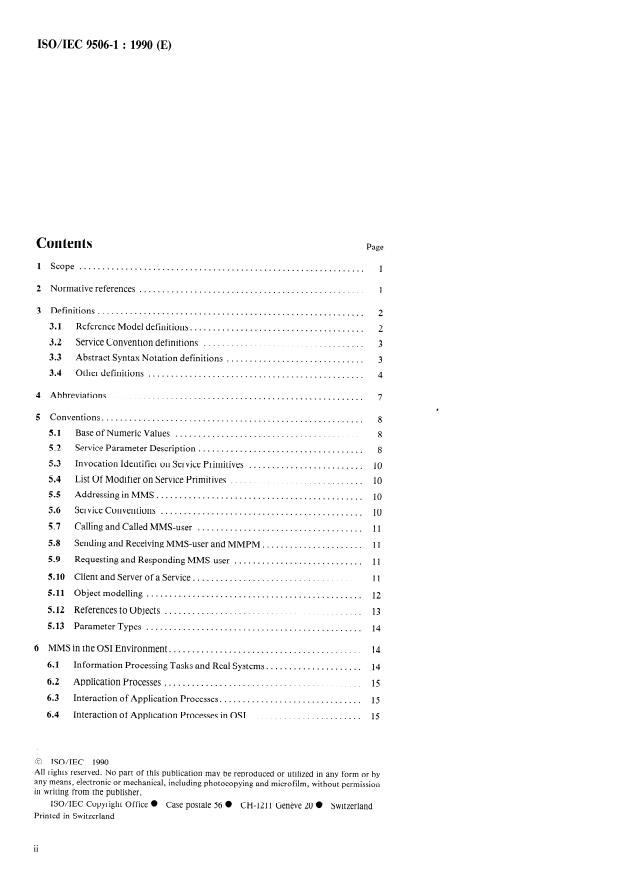
Contents Page
1 Scope . . . . . . . . . . . . . . . . . . . . . . . . . . . . . . . . . . . . . . . . . . . . . . . . . . . . . . . . . . . . . .
Normative references . . . . . . . . . . . . . . . . . . . . . . . . . . . . . . . . . . . . . . . . . . . . . . . . . 1
3 Deineions .
3.1 Reference Model definitions
......................................
3.2 Service Convention definitions 3
...................................
3.3 Abstract Syntax Notation definitions 3
..............................
3.4 Other definitions 4
...............................................
4 Abbreviations . . . . . . . . . . . . . . . . . . . . . . . . . . . . . . . . . . . . . . . . . . . . . . . . . . . . . . . 7
.....................................
5 Conventions.- 8
5.1 Base of Numeric Values 8
.........................................
5.2 Service Parameter Description
....................................
5.3 Invocation Identifier on Service Primitives .
5.4 List Of Modifier on Service Primitives 10
.............................
5.5 Addressing in MMS 10
.............................................
5.6 Service Conventions 10
............................................
5.7 Calling and Called MMS-user
....................................
5.8 Sending and Receiving MMS-user and MMPM .
Requesting and Responding MMS-user 11
5.9 .
5.10 ClientandServerofaService. . 11
5.11 Object modelling 12
...............................................
5.12 References to Objects 13
...........................................
5.13 Parameter Types 14
...............................................
6 MMS in the OS1 Environment. 14
.........................................
6.1 Information Processing Tasks and Real Systems. .
6.2 Application Processes
...........................................
Interaction of Application Processes 15
6.3 .
6.4 Interaction of Application Processes in OS1 15
........................
-
0 ISO/IEC 1990
All rights reserved. No part of this publication may be reproduced or utilized in any form or by
any means, electronie or mechanical, including photocopying and microfilm, without Permission
in writing from the publisher.
ISODEC Copyright Office l Case postale 56 l CH-1211 Geneve 20 l Switzerland
Printed in Switzerland
ii
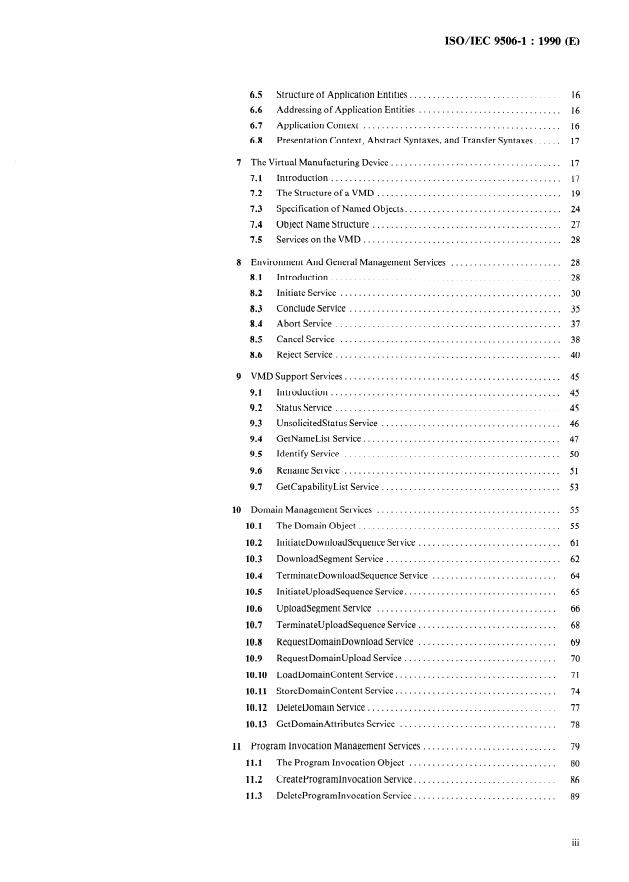
ISOAEC 9506-1 : 1990 (E)
Structure of Application Entities . 16
6.5
6.6 Addressing of Application Entities . 16
Application Context 16
6.7 .
Presentation Context, Abstract Syntaxes, and Transfer Syntaxes. . 17
6.8
7 The Virtual Manufacturing Device . 1’7
Introduction . 17
7.1
7.2 The Structure of a VMD .
7.3 Specification of Named Objects. . 24
7.4 Object Name Structure .
7.5 Services on the VMD .
8 Environment And General Management Services .
.................................................. 28
8.1 Introduction
Initiate Service . 30
8.2
8.3 Conclude Service . 35
8.4 Abort Service . 37
8.5 CancelService .
8.6 Reject Service .
9 VMD Support Services. 45
..............................................
Introduction . 45
9.1
9.2 Statusservice . 45
9.3 UnsolicitedStatus Service . 46
GetNameList Service. 47
9.4 .
Identify Service 50
9.5 .
RenameService . 51
9.6
9.7 GetCapabilityList Service . 53
10 Domain Management Services . . . . , . . . . . . . . . . . . . . . . . . . . . . . . . . . . . . . . . . . 55
10.1 The Domain Object . 55
10.2 InitiateDownloadSequence Service .
10.3 DownloadSegment Service .
TerminateDownloadSequence Service . 64
10.4
InitiateUploadSequence Service. . 65
10.5
UploadSegment Service . 66
10.6
10.7 TerminateUploadSequence Service . 68
..............................
10.8 RequestDomainDownload Service 69
RequestDomainUpload Service . 70
10.9
LoadDomainContent Service. . 71
10.10
StoreDomainContent Service. . 74
10.11
10.12 DeleteDomain Service . 77
..................................
10.13 GetDomainAttributes Service 78
11 Program Invocation Management Services
............................. 79
The Program Invocation Object
11.1 . 80
CreateProgramInvocation Service.
11.2 . 86
11.3 DeleteProgramInvocation Service . 89
. . .
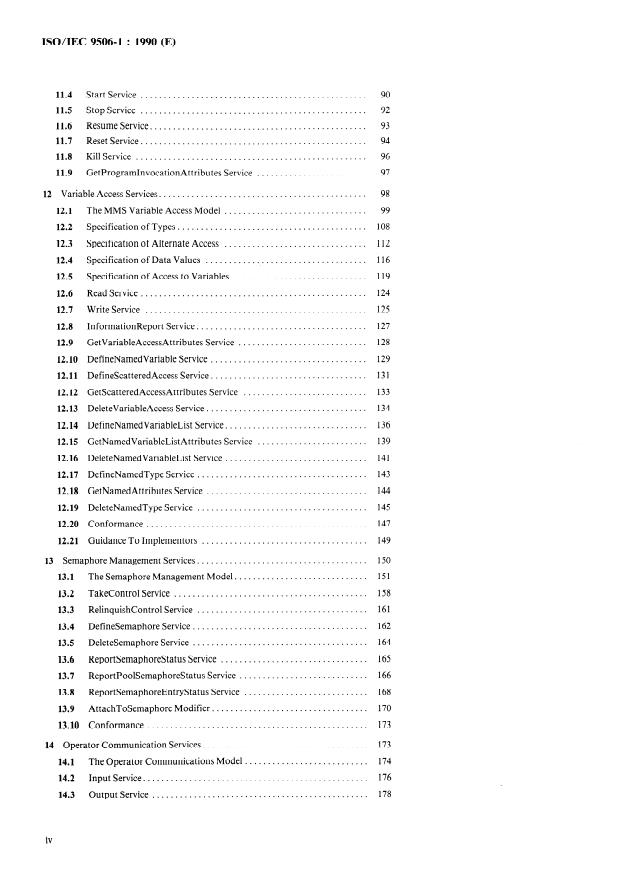
ISO/IEC 9506-1 : 1990 (E)
11.4 Start Service .
11.5 Stopservice . 92
11.6 ResumeService .
11.7 Reset Service. .
.................................................. 96
11.8 KillService
GetProgramInvocationAttributes Service . 97
11.9
Variable Access Services. . 98
The MMS Variable Access Model . 99
12.1
Specification of Types .
12.2
12.3 Specification of Alternate Access .
................................... 116
12.4 Specification of Data Values
............................. 119
12.5 Specification of Access to Variables
12.6 ReadService .
................................................ 125
12.7 Write Service
InformationReport Service. . 127
12.8
12.9 GetVariableAccessAttributes Service . 128
12.10 DefineNamedVariable Service . 129
................................. 13 1
12.11 DefineScatteredAccess Service.
........................... 133
12.12 GetScatteredAccessAttributes Service
................................... 134
12.13 DeleteVariableAccess Service
12.14 DefineNamedVariableList Service. . 136
12.15 GetNamedVariableListAttributes Service . 139
............................... 141
12.16 DeleteNamedVariableList Service
..................................... 143
12.17 DefineNamedType Service
................................... 144
12.18 GetNamedAttributes Service
..................................... 145
12.19 DeleteNamedType Service
12.20 Conformance . 147
12.21 Guidance To Implernentors . 149
.................................... 150
13 Semaphore Management Services.
............................ 15 1
13.1 The Semaphore Management Model.
.......................................... 158
13.2 TakeControl Service
..................................... 161
13.3 RelinquishControl Service
DefineSemaphore Service . 162
13.4
DeleteSemaphore Service . 164
13.5
ReportSemaphoreStatus Service .
13.6
............................ 166
13.7 ReportPoolSemaphoreStatus Service
........................... 168
13.8 ReportSemaphoreEntryStatus Service
................................. 170
13.9 AttachToSemaphore Modifier.
13.10 Conformance .
................................... 173
14 Operator Communication Services.
...........................
The Operator Communications Model 174
14.1
14.2 Input Service. .
............................................... 178
14.3 Output Service
iv
ISOAEC 9506-1 : 1990 (E)
15 Event Management Services .
The Event Management Model . 180
15.1
DefineEventCondition Service. . 198
15.2
DeleteEventCondition Service . 200
15.3
15.4 GetEventConditionAttributes Service . 202
15.5 ReportEventConditionStatus Service .
AlterEventConditionMonitoring Service 205
15.6 .
TriggerEvent Service 207
15.7 .
DefineEventAction Service. . 209
15.8
15.9 DeleteEventAction Service . 210
15.10 GetEventActionAttributes Service . 212
15.11 ReportEventActionStatus Service .
DefineEventEnrollment Service. 214
15.12 .
15.13 DeleteEventEnrollment Service . 218
15.14 GetEventEnrollmentAttributes Service .
15.15 ReportEventEnrollmentStatus Service 226
...........................
15.16 AlterEventEnrollment Service . 227
15.17 EventNotification Service. . 230
15.18 AcknowledgeEventNotification Service . 232
15.19 GetAlarmSummary Service . 234
15.20 GetAlarmEnrollmentSummary Service .
Attach To Event Condition Modifier
15.21 . 241
15.22 Event Management State Diagrams. . 244
15.23 Conformance Requirements Unique to Event Management . 249
16 Journal Management Services. . 250
The Journal Management Model. . 250
16.1
16.2 ReadJournal Service . 253
16.3 WriteJournal Service. .
16.4 InitializeJournal Service . 263
16.5 Report Journalstatus Service . 265
16.6 CreateJournal Service .
DeleteJournal Service . 267
16.7
Conformance Requirements Unique to Journals. . . . . . . . . . . . . . . . . . . 268
16.8
17 Errors . 268
17.1 ErrorType . 269
Description of structure of generic error type : 269
17.2 .
Additional Code. 276
17.3 .
Additional Detail . 276
17.4
17.5 Modifier Position. . 276
18 MMS Standardized Names 276
..........................................
Introduction . 276
18.1
ISO/IEC 95064 : 1990 (E)
18.2 Unique Name Assignment Mechanism . 277
18.3 MMS Standardized Names .
...................................................... 278
19 Conformance
.................................................. 278
19.1 Introduction
19.2 Conformance Building Blocks (CBBs) 278
............................
19.3 Static Conformance Requirements 28 1
...............................
19.4 Calling MMS-user Conformance Requirements . 28 1
19.5 Called MMS-User Conformance Requirements . 282
19.6 Server Conformance Requirements . 282
19.7 Client Conformance Requirements .
19.8 Parameter CBB Conformance Requirements .
19.9 Dynamit Conformance .
Annexes
A Requirements for Companion Standards (normative) . . . . . . . . . . . . . . . . . . . . 285
B File Access Service (normative) . . . . . . . . . . . . . . . . . . . . . . . . . . . . . . . . . . . . . . .
C File Management Services (informative) . . . . . . . . . . . . . . . . . . . . . . . . . . . . . . . 299
Index. 312
ISOAEC 9506-1 : 1990 (E)
Foreword
ISO (the International Organization for Standardization) is a worldwide federation of
national Standards bodies (ISO member bodies). The work of preparing International
Standards is normally carried out through ISO technical committees. Esch member
body interested in a subject for which a technical committee has been established has
the right to be represented on that committee. International organizations, govern-
mental and non-governmental, in liaison with ISO, also take part in the work. ISO
collaborates closely with the International Electrotechnical Commission (IEC) on all
matters of electrotechnical standardization.
Draft International Standards adopted by the technical committees are circulated to
the member bodies for voting. Publication as an International Standard requires
approval by at least 75 % of the member bodies casting a vote.
International Standard ISO/IEC 9506-1 was prepared by Technical Committee ISO/IEC
TC 184, Industrial automation Systems, Sub-Committee SC 5, System integration and
communica tion.
ISO/IEC 9506 consists of the following Parts, under the general title Indus trial automa-
tion Systems - Manufacturing Message Specifica tion :
- Part 7: Service definition
Part 2: Pro tocol specifica tion
ISOAEC 95064 : 1990 (E)
Introduction
This part of ISO/IEC 9506 provides a wide variety of Services useful for various
manufacturing and process control devices. It is designed to be used both by itself and
in conjunction with Companion Standards, which describe the application of subsets
of these Services to particular device types.
The Services provided by the Manufacturing Message Specification (MMS) range from
simple to highly complex. It is not expected that all of these Services will be supported
by all devices. The subset to be supported is limited in some cases by Companion Stan-
dards, and in all cases may be limited by the implernentor. Characteristics important in
selection of a subset of Services to be supported include:
a) applicability of the Service to the device;
b) the complexity of Services and requirements;
c) the complexity of Provision of a particular class of Service via the network ver-
sus the complexity of the device.
Security considerations
When implementing MMS in secure or safety critical applications, features of the OS1
security architecture may need to be implemented. Appropriate features should be
selected from ISO 7498-2 covering safety architectures and features. Those of par-
ticular interest cover the Position (in OSI) of
a) access control;
b) authentication;
c) non-repudiation.
Specific implementation methods shall be at the discretion of the implernentor.
Complexity of Services and requirements
Some MMS Services are quite complex and should be considered as advanced func-
tions. Devices used in very simple applications often will not require such advanced
functions, and hence will not support such MMS Services.
Keywords
Application Interworking
Application Layer Protocol
Information Processing Systems
Manufacturing Communications Network
Manufacturing Message Specification
Numerital Control System
Open Systems Interconnection
OS1 Reference Model
Process Control System
Programmable Controller
Programmable Device
Robotics Control System
Virtual Manufacturing Device
. . .
Vlll
ISOAEC 9506-1 : 1990 (E)
General
This part of ISO/IEC 9506 is one of a set of International Standards developed to
facilitate the interconnection of information processing Systems. It is positioned within
the application layer of the Open Systems Interconnection Environment as an Applica-
tion Service Element (ASE) with respect to other related Standards by the Basic
Reference Model for Open Systems Interconnection (ISO 7498).
The aim of Open Systems Interconnection is to allow, with a minimum of technical
agreement outside the interconnection Standards, the interconnection of information
processing sys tems :
a) from different manufacturers;
b) under different managements;
c) of different levels of complexity;
d) of different ages.
Purpose
The purpose of this part of ISO/IEC 9506 is to define the Service provided by the
Manufacturing Message Specification. The MMS Service is provided by the Manufac-
turing Message Specification Protocol making use of Services available from the
Association Control Service Element (ASCE) and the Presentation layer, as defined in
ISO 8649 and ISO 8822, respectively.
This part of ISO/IEC 9506 is concerned, in particular, with the communication and in-
terworking of programmable manufacturing devices. By using this Standard together
with other Standards positioned within the OS1 Reference Model, otherwise incompati-
ble Systems may work together in any combination.
ISO/IEC 9506-2 specifies the protocol that supports the Manufacturing Message
Specification.
1x
This page intentionalfy lefl blank
INTERN-ATIONAL STANDARD ISO/lEC 95064 : 1990(E)
Industrial automation Systems -
Manufacturing Message Specification -
Part 1: Service definition
1 Scope
The Manufacturing Message Specifkation is an application layer Standard designed to support messaging communications
to and Flom programmahle devices in a Computer Integrated Manufacturing (CIM) environment. This environment is
referred to in ISO/IEC 9506 as the manufacturing environment. This part of ISO/IEC 9506 does not specify a complete
set of Services for remote programming of devices, although Provision of such a set of Services may be the subject of future
standardization efforts.
This part of ISO/IEC 9506 defines the Manufacturing Message Specification within the OS1 application layer in terms of
an abstract model defining the interaction between users of the Service;
the externally visible functionality of implernentations conforming to ISO/IEC 9506, in the ferm of procedural re-
W
quirements associated with the execution of Service requests;
the primitive actions and events of the Service;
d) the Parameter data associated with each primitive action and event;
the relationship between, and the valid sequences of, these actions and events.
e)
The Service defined in this part of ISO/IEC 9506 is that which is provided by the Manufacturing Message Specification
protocol. The Service may be used by other application layer Service elements or by other elements of the application
process.
This part of ISOAEC 9506 does not specify individual implernentations or products, nor doee it constrain the implemen-
This part of ISO/IEC 9506 specifies the externally visible
tation of entities and interfaces within a Computer System.
functionality of implernentations together with conformance requirements for such functionality.
2 Normative References
text, constitute provisions of this part of
The following Standards contain provisions which, through reference in thie
All Standards are subject to revision, and
ISO/IEC 9506. At the time of publication, the editions indicated were valid.
investigate the possibility of applying the
Parties to agreements based on this part of ISO/IEC 9506 are encouraged to
ISO maintain registers of currently valid
most recent editions of the Standards indicated below. Members of IEC and
International Standards.
/SO T-bit coded Character set for information interchange.
ISO 646: 1983, Information processing -
Open Systems lnterconnection - Basic Reference Model.
ISO 7498 : 1984, Information processing Systems -
Open Systems lnterconnection - Basic Reference Model - Part 2: Security
ISO 7498-2 : 1989, Information processing Systems -
Architec ture.
Open Systems lnterconnection - Basic Reference Model - Part 3: Namhg
I S 0 7498-3 : 1989, lnforma tion processing s ystems -
and addressing.
Open Systems In terconnec tion - Basic connec tion orien ted Session Service
ISO 8326 : 1987, Information processing Systems -
de finition.
Open Systems In terconnection - Service conven tions.
ISOITR 8509: 1987, Information processing Systems -
Open Systems In terconnection - File Transfer, Access and Management.
ISO 8571 : 1988, Information processing Systems -
ISOAEC 9506-1: 199O(E)
Service definition for the Associa tion Control
ISO 8649 : 1988, lnforma tion processing s ystems - Open Systems In terconnection -
Service Element.
I S 0 8650 : 1988, lnforma tion processing s ys tems - Open Systems In terconnection - Pro tocol specifica tion for the Associa tion Con-
trol Service Element.
Open Systems In terconnec tion -- Connec tion orien ted presen ta tion Service
ISO 8822 : 1988, lnforma tion processing s ystems -
de finition.
ISO 8824 : 1987, lnforma tion processing s ystems - Open Systems In terconnection - Specifica tion of Abstrac t Syntax Notation One
(ASN. 1).
Open Systems In terconnec tion - Specifica tion of Abstrac t Syntax Nota-
ISO 8824/Add 1: - 11, Information processing Systems -
tion One (ASN. 1) Addendum 7: ASN. 7 Extensions. ,
ISO 8825 : 1987, Information processing Systems - Open Systems In terconnec tion - Specification of Basic Encoding Rules for
Abstract Syntax Notation One (ASN. 7).
Open Systems In terconnec tion - Specification of Basic Encoding Rules
ISO 8825/Add 1: - 11, Information processing s ystems -
for Abstract Syntax Notation One (ASN. 1) Addendum I : ASN. 7 Extensions
ISO 9040: - 11, lnforma tion processing Systems - Open Systems In terconnection - Virtual terminal Service - Basic class.
ISO 9041: - 1 ), lnforma tion processing s ys tems - Open Systems In terconnection - Virtual terminal pro tocol - Basic class.
Manufac turing Message Specifica tion - Part 2: Pro tocol specifica tion.
ISO/IEC 95062 : 1990, Industrial automation Systems -
ISO/IEC 9545-1 : 1989, Information technology - Open Systems In terconnection - Applica tion La yer Structure.
Open Systems lnterconnection - The Directory.
ISO/IEC 9594: - 11, lnforma tion processing Systems -
I E E E 754 : 1985, IEEE Standard for Binary Floating- Point Arithmetic.
3 Definitions
NOTE - The dehitions contained in this clause make use of abbreviations defhed in clause 4.
For the purposes of this part of ISO/IEC 9506, the following definitions apply.
3.1 Reference Model definitions
This part of ISO/IEC 9506 is based on the concepts developed in the Basic Reference Model for Open Systems Intercon-
nection (ISO 7498), and makes use of the following terms defined in that International Standard:
application-entity;
a)
application-process;
W
application Service element;
C)
open system;
e) (NJ-protocol;
(N)-protocol-data-unit;
9) (Nbservice-access-Point;
h) (Nj-layer;
System;
To be published.
ISCMEC 9506-1 r 3 990(E)
.
(N)-user-data.
1)
3.2 Service Convention definitions
This part of ISO/IEC 9506 makes use of the following terms defined in the US1 Service Conventions (ISOBAR 8509) as
they apply to the Manufacturing Message Specification:
tonfirm;
indication;
W
primitive;
request;
response;
0)
Service primitive;
f )
Service provider;
9)
Service User.
hl
3.3 Abstract Syntax Notation definitions
This part of ISO/IEC 9506 makes use of the following terms defined in the Abstract Syntax Notation One (ASN.1) Speci-
fication (ISO 8824):
value;
1)
2) tYPei
simple type;
3)
structure type;
4)
component type;
5)
6) hg;
7) wxe;
type (or value) reference name;
8)
Character string type;
9)
10) boolean type;
11) true;
12) false;
13) integer type;
14) bitstring type;
15) octetstring type;
16) null type;
17) sequence type;
18) sequence-of type;
19) wwd typei
ISWIEC 9506-1: 1990(E)
choice type;
20)
selection type;
21)
real type;
22)
Object identifier type;
23)
module;
24)
production;
25)
ASN. 1 encoding rules;
26)
ASN.l Character set;
27)
extemal type.
28)
3.4 Other definltions
This part of ISO/iEC 9506 makes use of the following terms:
3.4.1 AA-specific (Application Association specific):
An adjective used to describe an Object whose name has a scope that is a Single application association (i.e. the name may
be referenced only on the application association with respect to which the Object was defined).
3.42 attribute:
A data element, having a defined meaning, together with a Statement of the set of possible values it may take.
3.4.3 conformance buiiding block (CBB):
An atomic unit used to describe MMS conformance requirements.
3.4.4 Called MMS-User:
The MMS-user that iss-Jes the Initiate.response Service primitive.
3.4.5 Calling MAAS-User:
The MMS-user that issues the Initiate.request Service primitive.
3.4.6 Client:
The peer communicating entity which makes use of the VMD for some particular purpose via a Service request instance.
3.4.7 data:
Any representation to which meaning is or might be assigned (e.g. Character-s).
ISCMEC 950611: 1990(E)
3.4.8 domain:
An abstract Object that represents a subset of the capabilities of a VMD which is used for a specific purpose.
3.4.9 Domain-specific:
An adjective used to describe an Object whose name has a scope that is a Single domain (i.e. the name tan be referenced
over all application associations established with the VMD that may reference this domain).
3.4.10 download:
The process of transferring the content of a domain, including any subordinate objects, via load data to an MMS-User.
3.4.11 gement:
The management of event conditions, event actions, and event enrollments.
3.4.12 file:
An unambiguously named collection of information having a common set of attributes.
f He Operation :
3.4.13
The transfer of files between open systems, the inspection, modification or replacement of part of a file’s content, or the
management of a file and its attributes.
3.4.14 filestore:
An organized collection of files, including their attributes and names, residing at a particular open System.
3.4.15 information:
The combination of data and the meaning that it conveys.
3.4.16 journal:
A set of recorded, time-tagged event transitions, variable data, and/or comments, which may be logically ordered during
retrieval.
3.4.17 local matter:
A decision made by a System concerning its behaviour in the Manufacturing Message Specification that is not subject to
the requirements of ISO/IEC 9506.
3.4.18 Manufacturing Niessage Protocol Machine (MMPM):
An abstract machine that caties out the procedures specified in this part of ISO/IEC 9506.
ISOAEC 9506-1: 199O(E)
3.4.19 MMS-environment:
A specification of the Service elements of MMS and semantics of communication to be used during the lifetime of an
application association.
3.420 MMSprovider:
That part of the application entity that conceptually provides the MIMS Service through the exchange of MMS PDUs.
3.4.21 MMS-User:
That Portion of the application process which conceptually invokes the Manufacturing Message Specification.
3.4.22 monitored
A detected Change in the state of an event condition.
3.4.23 network-triggered event:
An event which occurs due to an explicit solicitation by a client.
3.4.24 Operator Station:
An abstract Object representing equipment associated with a VMD that provides for inputloutput interaction with an
Operator.
3.4.25 predefined Object:
An Object, whose name is of VMD-specific, Domain-specific or Application Association-specific scope, that is instantiated
through the use of some mechanism other than an MMS Service.
3.4.26 program invocation:
An abstract Object representing a dynamic element which most closely corresponds to an execution thread in a multi-
tasking environment, which is composed of a set of domains.
3.4.27 Recelving MMPM:
The MMPM that receives an MMS PDU.
3.4.28 Receiving MMS-User:
The MMS-user that receives an indication or confirmation Service primitive.
3.4.29 remote device control and monitoring:
device attached to the responder of a Service request.
The manipulation or inspection of the state of a
ISO/lEC 9506-1: 1990(E)
3.4.30 Semaphore:
A conceptual leck associated with a logical or physical resource that permits access to that resource only by an owner of
the leck.
3.4.31 Semaphore management:
The control of semaphores.
3.4.32 Server:
The peer communicating entity which behaves as a VMD for a particular Service request instance.
3.4.33 Sending MMPM:
The MMPM that sends an MMS PDU.
3.4.34 Sending MMS-User:
The MMS-user issues a request or response Service primitive.
3.4.35 standardized Object:
An Object instantiation, whose name is of VMD-specific or Domain-specific scope, whose definition is provided in this part
of ISO/IEC 9506 or an MMS Companion Standard.
3.4.36 type:
An abstract description of a set of values which may be conveyed by the value of a variable.
3.4.37 upload:
The process of transferring the content of a domain, including any subordinate objects, via load data fi-om a remote User,
in such a manner as to allow subsequent download.
3.4.38 variable:
One or more data elements that are referred to together by a Single name or description
3.4.39 variable access:
The inspection or modification of variables or components of variables defined at a VMD.
3.4.40 VMD-specif ic:
An adjective used to describe an Object whose name has a scope that is a Single VMD (i-e. the name may be referenced by
all application associations established with the VMD).
4 Abbreviations
ISWIEC 95064 : 1990(E)
AA : application association
ACSE : Association Control Service Element
AE : application entity
AP : application process
ASE : appiication Service element
ASN.1 : Abstract Syntax Notation One
CBB : conformance building block
FRSM : file read state machine
mAM : File Transfer, Access and Management
MMPM : Manufacturing Message Protocol Machine ’
: Manufacturing Message Specification
MMS
: Numerital Control
NC
OSI : Open Systems Interconnection
PC : Programmable Controller
: protocol data unit
PDU
PSAP : presentation Service access Point
SAP : Service access Point
SDU : Service data unit
ULSM : upioad state machine
VMD : Virtual Manufacturing Device
VT : Virtual Terminal
5 Conventions
5.1 Base of Numeric Values
This part of ISO/IEC 9506 uses a decimal representation for all numeric values unless otherwise noted.
5.2 Service Parameter Description
This part of ISO/IEC 9506 uses a tabular format to describe the component Parameters of the MMS Service primitives.
Esch table consists of up to six columns, containing the name of the Service Parameter, a column each for the request
(“Req”), indication (“Ind”), response (“Rsp”), and tonfirm (“Cnf’) primitives, and a column for conformance building block
specification (“CBB”). The “Rsp” and “Cnf’ columns are absent when the Service is not a confirmed service-
5.2.1 Companion Standard Service Parameters
Some MMS Service procedures which allow extensions to be supplied by Companion Standards. Such Service procedures
allow the specification of extra Parameters in either the request primitive or in the response (+> primitive or both. This
is indicated in the tables by the appearance of “COMP” following the “Argument” or the “Result(+)” entry of the Service
table respectively. Some Service procechres allow the specification of additional Parameters by the Companion Standards
Such occurrences will be indicated by the “COMP” in the columns describing the Service
directly in an Argument list.
primitives.
I!SO/lEC 9506-1: 1990(E)
5.2.2 Service Table Structure
For those tables that require support of particular Parameter conformance building blocks, the required conformance
building blocks are enumerated on the first line in the table. In the remainder of each table, one Parameter (or part of
it) is listed on each horizontal line. Under the appropriate Service primitive co1umns, a code is used to specify the type of
usage of the Parameter on the primitive specified in the vertical column:
M- Parameter is mandatory for the primitive
u - Parameter is a user Option, and may or may not be provided
depending on dynamic usage by the MMS-user
c - Parameter is conditional upon other Parameters or the
environment of the MMS-user
- (blank) Parameter is never present
COMP - Parameter is for definition in MMS Companion Standards. Such
Parameters shall not be used other than as defined in a
Companion Standard (and shall be omitted in the abstract Syntax
defined in Clause 19 of 9506-2). Annex C provides
additional detail on the use of Companion Standards.
s - Parameter is a selection from a collection of two or more
possible Parameters. The Parameters that make up this
collection are indicated in the table as follows:
a) each Parameter in the collection is specified with the
code "S";
b) the name of each Parameter in the collection is at the
Same indentation from the beginning of the Parameter column
in the table;
c) Either
Parameter is at the leftmost (outer)
1) each indentation
in the table; or
2) each Parameter is part of the Same Parameter group. A
Parameter group is a collection of Parameters where each
group member has a common parent Parameter.
The parent
Parameter for any group member is the first Parameter above
the member that is not indented as far as that member. In
the example below,
ParameterA and ParameterB form a Parameter
group:
ParameterX
ParameterA
ParameterB
ParameterY
ParameterC
Informally, for Parameters involved in a selection, the indentation
in the Services tables signifies which Parameters are involved in a
selection. All Parameters at the Same level of indentation that are
under a common "higher level" Parameter are a part of the Same
selection.
The code “(=)” following one of the Codes M, U, C or S indicates that the Parameter is semantically equivalent to the
Parameter in the Service primitive to its immediate 1eR in the table. (For instance, an “M(=)” code in the indication Service
primitive column and an “M” in the request Service primitive column means that the Parameter in the indication primitive
is semantically equivalent to that in the request primitive.)
Some Parameters may contain subparameters. Subparameters are indicated by labelling of the Parameter as M, U or C,
and indenting all subparameters under the Parameter. PrPsence of subparameters is always dependent on presence of the
Parameter that they appear under (for example, an optional Parameter may have subparameters; if the Parameter is not
supplied, then no subparameters may be supplied).
ISOAEC 9506-1: 1990(E)
The CBB column is used to indicate that usage of the Parameter is dependent on support of conformance building blocks,
other than that containing the Service. If no entry exists in the GBB column, then there is no dependency on other
conformance building blocks. If an entry does exist, then the Parameter is available (and permitted for use by this
Standard) if and only if the named conformance building block is supported and negotiated for use.
Some Service Parameters are named using a “List Of . . . ” convention. Unless otherwise noted, all Parameters whose
names begin with “List Of . . e ” specify a list of zero or more of the item specified after the “List Of’ keyword Phrase.
(This type of Parameter corresponds with the sequence-of ASN.l type in ISO/IEC 9506-2.)
The descriptions of Parameters in this part of ISO/IEC 9506 make reference to types, in Order to describe the allowable
The types referenced may either be types defined in ISO 8824 (Abstract Syntax Notation
values for such Parameters.
One), or may be defined in ISO/IEC 9506-2.
5.3 Invocation identifier on Service Primitives
For Services identified in the ConfirmedServiceRequest production in 1.52 of ISO/IEC 9506-2, each MMS Service primitive
contains an “Invoke ID” Parameter, which is mandatory in the request, indication, response, and tonfirm primitives. The
value in the indication, response, and tonfirm primitives is semantically equivalent to that in the request primitive. This
Parameter serves to identify unambiguously the Service invocation from an MMS-user on an application association. This
Parameter is not explicitly shown in the Service primitive tables, nor is it explained separately for each Service.
5.4 List Of Modifier on Service Primitives
Every confirmed MMS Service contains a “List Of Modifier” Parameter, which is a user Option in the request. and indication
primitives. The value in the indication primitive is semantically equivalent to that in the request primitive. This Parameter
serves to specify a list of one or more Service state machine modifiers which add a condition which must be satisfied for
the execution of the Service request to begin. This Parameter is not explicitly shown in the Service primitive tables, nor is
it explained separately for each Service.
MMS defines two modifiers: the AttachToSemaphore modifier and the AttachToEventCondition modifier, which are de-
scribed in clauses 13 and 15, respectively.
The effect of the modifier on the state machine for execution of a confirmed MMS Service is described in clause 7.
5.5 Addressing in MMS
The MMS Standard does not provide the means for naming and addressing of a peer MMS-user or peer Manufacturing
Message Protocol Machine (MMPM). Within OSI, the identification and addressing of peer application entities is carried
out through the use of ACSE Services defined in ISO 8649. After such association of peers has succeeded, all of the MMS
It is therefore not necessary for MMS to
PDUs flow between these peers over the established presentation connection.
carry addressing information. Additional information on naming and addressing may be found in 6.6.
5.6 Service Conventions
Th.& part ofISO/IEC 9506 uses the descriptive conventions contained in the OSI Service Conventions (ISO/TR 8509). The
OS1 Service Conventions define the interactions between the MMS-user and the MMS-provider. Information is passed
between the MMS-user and the MMS-provider by Service primitives, which may convey Parameters. The following apply
to the use of this model:
a) ISOBAR 8509 Diefines a model for the Service provided by a layer of the OS1 Reference Model. The MMS Service does
not correspond to such a layer (it describes a part of the application layer) but the model used is identical in all other
respects;
ISOAEC 95064 : 1990(E)
at any instant in time, an application entity has multiple Service requests outstanding, each proceeding independently
b)
of the others.
NOTE - It should be noted that the MMS-user/MMS-protider distinction is an abstraction, and may not necessarily correspond
to the realization of M-MS in any particular System. Clauses 6 and 7 provide Forther details on the usage of abstract models.
5.7 Calling and Called MMS-user
This part of ISO/IEC 9506 makes use of the terms Calling and Called MMS-users. The Calling MMS-user is the MMS-user
that issues the Initiate.request Service primitive. The Called MMS-user is the MMS-user that issues the Initiate.response
Service primitive.
NOTE - The use of the term “called” in MMS is not the same as the general usage of the term in OSI. The MMS usage of the
term “called” corresponds to the OS1 usage of the term “responding”. This distinction has been introduced in Order to avoid conf&ion
with the RequestingLResponding MMS-user definition given below.
5.8 Sending and Receiving MMS-user and MMPM
This part of ISO/IEC 9506 makes use of the terms Sending and Receiving MMS-users. The Sending MMS-user is the
The Receiving MMS-user is the MMS-user that receives
MMS-user that issues a request or response Service primitive.
an indication or confirmation Service primitive.
NOTE - It is important to note that, in the course of completion of a confkmed MMS Service, both BIMS-users will be Senders
and receivers at one time. The fkst MMS-User sends the request and receives the confkmation, while the second MMS-user receives the
indication and sends the response.
This part of ISO/IEC 9506 makes use of the terms Sending and Receiving MMPMs. The Sending MMPM is the MMPM
that sends an MMS PDU. The Receiving MMPM is the MMPM that receives an MMS PDU.
5.9 Requesting and Responding MMS-user
This part of ISO/IEC 9506 makes use of the terms Requesting and Responding MMS-users. The Requesting MMS-user is
the MMS-user that issues the request Service primitive for a Service, while the Responding MMS-user is the MMS-user
that issues the response Service primitive for a Service.
NOTE - It is important to note that the use of the term Responding MMS-user differs from the use of the term Responding
entity in ACSE and other Standards. In those Standards, the term is used to reference the entity that responds to a connection request.
5.10 Client and Server of a Service
This part of ISO/IEC 9506 makes use of the terms Client and Server in Order to describe the model of the MMS VMD
(The VMD is described in clause 7). The Server is defined as the peer communicating entity which behaves as a VMD for
a particular Service request instance. The Client is the peer communicating entity which makes use of the VMD for some
particular purpose via a Service request instance. The VMD model is primarily useful in describing the actions of the
Server, and thus in describing the commands and responses that a Client may use. A real end System may adopt the Client
role, or the Server role, or both during the lifetime of an application association. Use of MMS in the OS1 environment is
further described in clause 6.
Figure 1 depicts the relationships of the client and server of a Service, the requesting and responding MMS-User, and the
sending and receiving MMS-user and MMPM.
fSO/lEC 9506-1: 1990(E)
Client
Server
. . . . . . . . . . . . . . . . . . . . . . . . .
. . . . . .s.a
. . . . . . . . . . . . . . . . . . . . . . . . .
. . . . .
...
NORME ISO/CEI
INTERNATIONALE 9506- I
Première édition
1990-1 O-? 5
Systèmes d'automatisation industrielle -
Spécification de messagerie industrielle -
Partie I:
Définition des services
Industrial automation systems - Manufacturing Message Specification -
Part 1: Service definition
Numéro de référence
ISOKEI 9506-1 :I 99O(F)
ISO/CEI 9506-1: 199O(F)
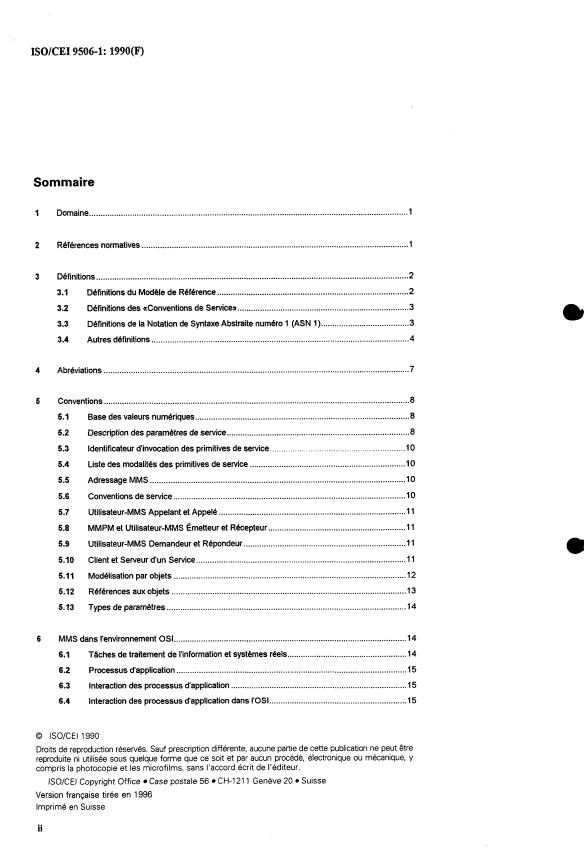
Sommaire
Domaine . 1
Références normatives . 1
Définitions . 2
3.1 Définitions du Modéle de Référence . 2
3.2 Définitions des crConventions de Service, . 3
3.3 Définitions de la Notation de Syntaxe Abstraite numéro 1 (ASN 1) . 3
3.4 Autres définitions . 4
Abréviations . 7
Conventions . 8
5.1 Base des valeurs numériques .
5.2 Description des paramétres de service . 8
5.3 Identificateur d'invocation des primitives de service .
5.4 Liste des modalités des primitives de service . 10
5.5 Adressage MMS . . 10
............................................. 10
5.6 Conventions de service .
5.7 Utilisateur-MMS Appelant et Appelé . 11
MMPM et Utilisateur-MMS Émetteur et Récepteur . 11
5.8
5.9 Utilisateur-MMS Demandeur et Répondeur . 11
5.10 Client et Serveur dun Service . 11
5.11 Modélisation par objets .
5.12 Références aux objets .
...................................................................................... 14
5.13 Types de paramètres .
MMS dans l'environnement OS1 . 14
6.1 Tâches de traitement de l'information et systémes réels . 14
6.2 Processus d'application . . 15
6.3 Interaction des processus d'application . 15
6.4 Interaction des processus d'application dans I'OSI . 15
O ISO/CEi 1990
Droits de reproduction réservés . Sauf prescription différente. aucune partie de cette publication ne peut être
reproduite ni utilisée sous quelque forme que ce soit et par aucun procédé. électronique ou mécanique. y
compris la photocopie et les microfilms. sans l'accord écrit de l'éditeur .
ISO/CEI Copyright Office Case postale 56 CH-121 1 Genève 20 Suisse
Version française tirée en 1996
Imprimé en Suisse
ii
O
ISOKEI 9506-1: 19900
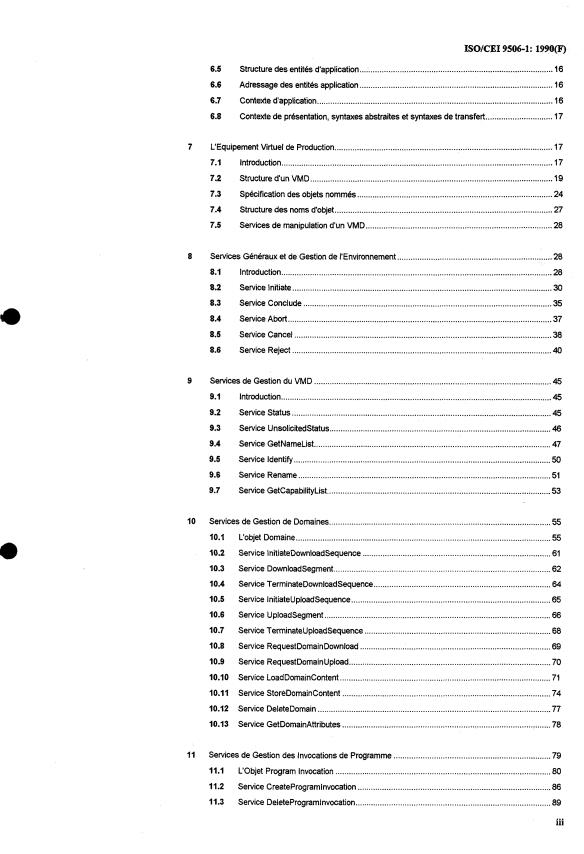
6.5 Structure des entités d'application . . . 16
6.6 Adressage des entités application . 16
6.7 Contexte d'application . 16
6.8 Contexte de présentation, syntaxes abstraites et syntaxes de transfert . 17
7 L'Equipement Virtuel de Production .
7.1 Introduction . 17
7.2 Structure d'un VMD .
7.3 Spécification des objets nommés .
7.4 Structure des noms d'objet . . 27
7.5 Services de manipulation du . . 28
Services Généraux et de Gestion de VEnvironnement . 28
8.1 Introduction .
..
8.2 Service Initiate . 30
8.3 Service Conclude . 35
8.4 Service Abort .
8.5 Service Cancel
8.6 Service Reject .
9 Services de Gestion du VMD
9.1 Introduction .
9.2 Service Status .
9.3 Service Unsolicited
9.4 Service GetNameList .
9.5 Service Identify . 50
9.6 Service Rename .
9.7 Service GetCapabili
Services de Gestion de Domaines .
10.1 L'objet Domaine . 55
10.2 Service IniiiateDownloadSequence . . .61
10.3 Service DownloadSegment. . 62
10.4 Service TerminateDownloadSequence 64
10.5 Service InitiateUploadSequence . 65
10.6 Service Uploadsegment . . 66
10.7 Service TerminateUploadSequence . 68
10.8 Service RequestDo
10.9 Service RequestDo
10.10 Service LoadDomai
10.11 Service StoreDomainContent
10.12 Service DeleteDomain . 77
10.13 Service GetDomainAttributes .
Services de Gestion des Invocations de Programme
11.1 L'Objet Program Invocation
11.2 Service CreateProgramlnvocation . 86
11.3 Service DeletePrograrnlnvocation . 89
iii
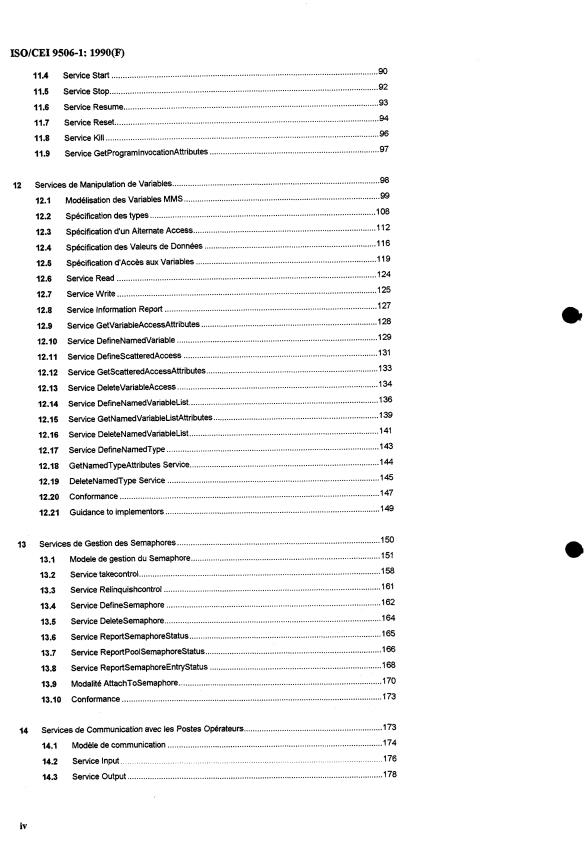
ISO/CEI 9506-1: 1990(F)
...........................
....................
11.6 Service Resume .
....................
........................
12 Services de Manipulation de Variables. . .
.................. ..................
............................................ 112
12.4 Spécification des Valeurs de Donnees . .
12.5 Spécification d'Accès aux Variables . .
.................................................
12.7 Service Write . . 125
.................. ............................. 127
12.10 Service DefineNamedVariable . .
12.11 Service DefineScatteredAccess . . .
12.12 Service GetScatteredAccessAtributes .
......................... ................... 134
12.13 Service DeleteVariableAccess .
12.14 Service DefineNamedVariableList . .
12.15 Service GetNamedVariableListAttributes . .
12.16 Service DeleteNamedVariableList . .
12.17 Service DefineNamedType . . . 143
12.19 DeleteNamedType Service . . .
12.20 Conformance . .
12.21 Guidance to implementors . .
13 Services de Gestion des Semaphores . .
...................
............................
...................
13.3 Service Relinquishcontrol . .
..................
13.4 Service DefineSemaphore .
13.5 Service DeleteSemaphore . .
............................ 165
..............................
13.8 Service ReportSemaphoreEntryStatus .
13.9 Modalité AttachToSemaphore .
...
............................................. 173
...... 1 73
Services de Communication avec les Postes Opérateurs .
14.1 Modèle de communication . . 174
.......................................................................................................
14.2 Service Input. 176
14.3 Service Output . . .178
iv
ISO/CEI 9506-1: 19900
$5 Services de Gestion des Evènements . . 179
.............................
15.1 Modèle de gestion des événements .
15.2 Service DefineEventCondition .
15.3 Service DeleteEventCondition . . . 200
....................
15.4 Service GetEventConditionAttributes .
15.5 Service ReportEventConditionStatus. .
15.6 Service AlterEventConditionMonitonng .
15.7 Service TriggerEvent . . 207
.....................
15.8 Service DefineEventAction .
...........................
15.9 Service DeleteEventAction .
15.10 Service GetEventActionAttnbutes . . . 212
............
15.11 Service ReportEventActionStatus . . 213
..........................
15.13 Service DeleteEventEnrollment . .
15.14 Service GetEventEnrollmentAtributes . .
15.16 Service AlterEventEnrollment . . . 227
............................
......................... 232
........................
15.20 Service GetAlarmEnrollm .
15.21 Modalité AttachToEventCondition . . . 241
..................... 244
15.23
Contraintes de conformité propres & la gestion des événements .
.............
........................
16 Service de Gestion de Journal .
16.1 Modéle de journal . . 250
16.2 Service ReadJournal . .
.............................. .....................
16.3 Service Write Journal . 260
16.4 Service InitializeJournai . .
.....................
16.5 Service ReportJournalStatus .
16.6 Service CreateJournal . . . 266
16.7 Service DeleteJournal. . .
16.8
Contraintes de conformité particulières aux Journaux .
...........................
17 Erreurs . .
............... ..........................
17.1 Type d'erreur .
17.2
Description de la structure générale du type d'une erreur .
17.3 Additional Code . . .
17.4 Additional Description . .
......
17.5 Modifier Position . . 276
18 Noms Normalises . 276
18.1 Introduction . 276
V
ISO/CEI 9506-1: 19900
Mhnisme d'affectation dun Nom Normalisé unique . 277
18.2
Noms Normalis& MMS . 277
18.3
19 Conformité . . 278
19.1 Introduction . . 278
..................
19.2 Blocs de Conformité . . . 278
Contraintes de conformité statique . 281
19.3
................................... 281
Contraintes de conformité de l'utilisateur MMS Appelant .
19.4
Contraintes de conformité de l'utilisateur MMS Appelé . 282
19.5
...............................................................................
19.6 Contraintes de conformité du Seweur 282
Contraintes de conformité du client . 283
19.7
Contraintes de conformité du CBB de Paramètres . 284
19.8
19.9 Conformité dynamique . . 284
Annexes
A Exigences pour les normes d'accompagnement (normative) . 285
Service dacces aux fichiers (normative) . 297
B
Services de gestion de fichiers (informative) . 299
C
Index . 312
vi
ISO/CEI 9506-1: 19900
Avant-propos
LIS0 (Organisation internationale de normalisation) est une fédération mondiale d'organismes
nationaux de normalisation (comités membres de 1ïSO). L'élaboration des Normes inter-
nationales est en général confiée aux comités techniques de l'IS0. Chaque comité membre
intéressé par une étude a le droit de faire partie du comité technique créé à cet effet. Les
organisations internationales, gouvernementales et non gouvernementales, en liaison avec
ITSO participent également aux travaux. L'ISO collabore étroitement avec la Commission
électrotechnique internationale (CEI) en ce qui concerne la normalisation électrotechnique.
Les projets de Normes internationales adoptés par les comités techniques sont soumis aux
comités membres pour vote. Leur publication comme Normes intemationales requiert l'appro-
bation de 75 % au moins des comités membres votants.
La Norme internationale ISO/CEI 9506-1 a été élaborée par le comité technique ISOlTC 184,
Systèmes d'automatisation iruiustrielle, sous-comité SC 5, Intégration de systèmes et communi-
cation.
L'ISO/CEI 9506 comprend les parties suivantes, présentées sous le titre général Systèmes
d'automatisation industrielle - Spécification de messagerie industrielle:
-
Partie I: Définition des services
-
Partie 2: Spécification de protocole
vii
ISOKEI 9506-1: 19900
Introduction
La présente partie de l'ISO/CEI 9506 définit une grande variété de services destinés au pilotage
et au suivi du fonctionnement d'équipements de production et de contrôle de processus.
Elle a été conçue pour être utilisée directement ou en conjonction avec des normes
d'accompagnement qui décrivent l'application de sous-ensembles de ces services à des types
particuliers d'équipements.
Les services défuiis dans la ((Spécification de la messagerie industrielle (MMS))) vont du plus
élémentaire au plus complexe. On ne s'attend pas à ce que tous ces services soient offerts par tous
les équipements. Le sous-ensemble des services qu'il faut utiliser pourra dans certains cas être
limité par une norme d'accompagnement, et, dans tous les cas, il pourra être fixé par
l'implémenteur. Les caractéristiques importantes, lors de la sélection des services à supporter,
incluent:
a) l'applicabilité du service à l'équipement,
b) la complexité des services et des besoins;
c) la complexité des dispositions pour assurer certaines classes de services à
travers le réseau en regard du niveau de complexité de l'équipement.
Considérations relatives à la sécurité
Quand on implémente la nonne MMS pour des applications sécurisées ou sensibles à la sécurité, il
peut être nécessaire d'implémenter des dispositifs de l'architecture de sécurité de 1'0SI. Les
dispositifs appropriés doivent être choisis dans 1230 7498-2 qui couvre l'architecture et les
dispositifs de Sécurité. Ceux qui sont particulièrement intéressants se situent (dans 1'0SI) dans :
a) le contrôle d'accès;
b) l'authentification;
c) la non-répudiation.
Les méthodes spécifiques d'implémentation sont à la discrétion de l'implémenteur.
Complexité des services et des besoins
Certains des services MMS sont plutôt complexes et peuvent être considérés comme des fonctions
de très liaut niveau. Les équipements utilisés pour des applications simples ne nécessitent pas
toujours la nuse en oeuvre de fonctions d'un tel niveau, et ne supporteront pas en conséquence de
tels services MMS.
Motsclés
Autoniate programmable
Equipement de commande de robots
Equipement de commande numérique
Equipeinent de conduite de procédés
Equipement programmable
Equipement virtuel de production (VMD)
interconnexion de systèmes ouverts
Interopérabilité
Modele de référence OS1
Protocole de la couche application
Réseau d'atelier
Spécification de la messagerie industrielle
Systèmes de traitement de I'mformation
Viii
ISO/CEI 9506-1: 19900
Généralités
La présente partie de l'iSO/CEI 9506 fait partie d'un ensemble de normes internationales élaborées
pour faciliter l'interconnexion de systèmes de traitement de l'information. Elle se situe dans la
couche application de l'Environnement d'lnterconnection des Systèmes Ouverts (Opent Systems
Interconnection Environment) en tant que ASE ( Application Service Element = Elément de
Service d'Application) dont les relations avec les autres normes sont définies par le modèle de
référence d'interconnexion des systèmes ouverts (IS0 7498).
L'objectif de la normalisation relative à l'interconnexion des systèmes ouverts est de permettre,
moyennant un minimum d'accords techniques complémentaires hors-normes, l'interconnexion de
systèmes de traitement de l'information hétérogènes qui peuvent être :
a) de différents constructeurs;
b) gérés de manières différentes;
c) de différents niveaux de complexité;
d) de différentes générations.
Objet
O
L'objet de la présente partie de I'ISOICEI 9506 est de définir les services offerts par la spécification
de la messagene industrielle (MMS). Ces services MMS sont délivrés par le protocole de
messagerie industrielle qui utilise les services offerts par l'élément de service d'application (ACSE)
et par la couche présentation, comme définis, respectivement par les normes IS0 8649 et IS0
8822.
La présente partie de l'ISO/CEI 9506 concerne en particulier la communication et l'interopérabilité
d'équipements de production programmables. En recourant à cette norme ainsi qu'à d'autres normes
élaborées dans le cadre du modèle de référence 0.51, on pourra ainsi faire coopérer des systèmes
hétérogènes.
L'ISO/CEI 9506-2 décrit le protocole qui délivre les services offerts par la spécification de'
messagerie industrielle (MMS).
e
ix
- __~
NORME INTERNATIONALE lSOlCEl9506-I : 1990(F)
Systèmes d'automatisation industrielle - Spécification de
-
messagerie industrielle
Partie I:
Définition des services
1 Domaine d'application
La spécification de messagerie industrielle est une norme de la couche application destinée à la communication de messages entre les
équipements programmables dlun système de production intégrée (CIM). Cet environnement sera désigné dans l'iSO/CEI 9506 par
((environnement de production». La présente partie de l'iSO/CEI 9506 ne spécifie pas un jeu complet de services nécessaires à la
programmation à distance d'équipements, la fourniture d'un tel jeu de services pourrait être i'objet de travaux ultérieurs de nonnalisation.
La présente partie de l'iSO/CEI 9506 définit la spécification de la messagerie industrielle dans la couche application du modèle de référence
OS1 en termes :
d'un modèle abstrait définissant les interactions entre utilisateurs du service;
a)
de fonctionnalités des implémentations conformes à l'ISO/CEI 9506 visibles de l'extérieur, sous la forme d'exigences de procédures
0 b)
associées à des demandes d'exécution du service;
d'actions et d'évènements primitives du service;
c)
de données paramètres associées à chaque primitive action ou évènement;
d)
de relations entre actions et événements, et de leurs enchaînements valides.
e)
Les services définis dans la présente partie de 11SO/CEI 9506 sont ceux fournis par le protocole de messagerie industrielle. Ils peuvent être
utilisés par d'autres éléments de service de la couche application, ou par tout autre élément d'un processus d'application.
La présente partie de l'ISO/CEI 9506 ne préconise pas d'implémentation particulière ou de produit spécifique, et n'impose aucune contrainte de
réalisation d'interfaces ou autres constituants d'un équipement informatique. Cette partie de iISO/CEI 9506 spécifie les fonctionnalités
externes (visibles) de telles implémentations et en précise les conditions de conformité.
2 Références normatives
Les normes suivantes contiennent des dispositions qui, par suite de la référence qui en est faite, constituent des dispositions
valables pour la présente partie de I'ISO/CEI 9506. Au moment de la publication, les éditions indiquées étaient en vigueur. Toute
0 norme est sujette à révision et les parties prenantes des accords fondés sur la présente partie de l'ISO/CEI 9506 sont invitées à
rechercher la possibilité d'appliquer les éditions les plus récentes des normes indiquées ci-après. Les membres de la CE1 et de
I'ISO possèdent le registre des Normes internationales en vigueur à un moment donné.
IS0 646: 1983, Traitement de I'info>mation - Jeu de caractères IS0 codés ù 7 élénzentspour l'échange d'infonnations.
IS0 7498-1: 1984, Systèmes de traitement de I'inJomtation - Interconnexion de systèmes ouverts -Modèle de Référence de Base.
IS0 1498-2: 1989, Systèmes de traitement de I'infonnation - Interconnexion de systèmes ouverts - Partie 2: Sécurité OSI.
IS0 7498-3: 1989, Systèmes de traitement de l'infomiation - Interconnexion de systèmes ouverts - Partie 3: Dénomination et adressage.
IS0 8326: 1987, Systèmes de traitement de l'i?lfomiatiori - Interconnexion de systèmes ouverts - Réjînition du service de session en mode
connexion.
ISOîTR 8509: 1987, Systèmes de traitement de l'information - Interconnexion de systèmes ouverts - Conventions de service.
IS0 857 1 : 1988, Systèmes de traitement de I'infonnation - Interconnexion de systèmes ouverts - Transfert, accès et gestion de fichiers.
ISOlCEl9506-1: 1990( F)
IS0 8649: 1988, Sy,&mes de traiternent de l'infomation - Interconnexion de systèmes ouverts - Elément de service de contrôle d'association -
Dé$nition du service.
IS0 8650: 1988, Systèmes de traitement de l'information - Interconnexion de systèmes ouverts - Elément de service de contrôle d'association -
Spécification du protocole.
IS0 8822: 1988, Systèmes de traitement de l'information - Interconnexion de systèmes ouverts - Définition du service de présentation en mode
connexion.
IS0 8824: 1987, Systèmes de traitement de l'information - Interconnexion de systèmes ouverts - Spécification de la notation de la syntaxe
abstraite numéro I (RSN.1).
IS0 8824lAdd 1 : -, Systèntes de traitement de l'information - interconnexion de systèmes ouverts - Spécification de la notation de la syntaxe
abstmite numéro I (MN. I) Addendum I : ASA! I Extensions.
IS0 8825: 1987, Systèmes de traitement de l'information - Interconnexion de systèmes ouverts - Specification des règles de base pour coder la
notation de la syntaxe abstraite numéro I (ASN .I).
IS0 8825lAdd 1: -, Systèmes de traitement de 1Ynfomation - Interconnexion de systèmes ouverts - Specification des règles de base pour
coder la notation de la syntaxe abstraite numéro 1 (ah! 1) Addendum I : RSN.1 Extensions.
IS0 9040: -, Systèmes de traitement de l'infomation - Interconnexion de systèmes ouverts - Service de classe de base de terminal virtuel.
IS0 9041: -, Systèmes de traitement de l'infomation - Interconnexion de systèmes ouverts - Protocole de classe de buse de terminal virtuel.
IS0 9506-2: 1990, Systèmes d'automatisation industkelle - Spéci$cation de la Messagerie Industrielle - Partie 2: Spécification du protocole.
IS0 9545-1: 1989, Systèmes de traitement de l'information - Interconnexion de systèmes ouverts - Structure de la Couche Application.
IS0 9594: -, Systèmes de traitement de l'infomation - Interconnexion de systèmes ouverts - L'Annuaire.
BEE 754: 1985, IEEE Standard for Binaly Floating-Point Arithmetic.
3 Définitions
NOTE - Les défuiitions présentées dans cet article utilisent les abréviations définies à l'article 4.
Pour les besoins de la présente partie de IISOICEI 9506, on applique les définitions suivantes.
3.1 Définitions du Modèle de Référence
La présente partie de lISO/CEI 9506 est fondée SUT les concepts développés dans le modèle de référence d'interconnexion des systèmes
ouverts (IS0 7498), et en utilise les termes suivants définis dans cette norme intemationnaie :
entité d'application;
processus d'application;
élément de service application;
système ouvert,
protocole (N);
unité de donnée de protocole (N);
point d'accès au service (N);
couche (N);
système,
ISO/CEI 9506-1 : 1990( F)
j) donnée utilisateur (N).
3.2 Définitions des «Conventions de Service»
La présente partie de l'ISO/CEI 9506 utilise les termes suivants définis dans lTS0 TR 8509 : Conventions de service OS1 quand elles
s'appliquent à MMS :
a) confirmation;
b) indication;
c) primitive;
d) deinande;
e) réponse;
0 primitive de service;
g) fournisseur de service;
h) utilisateur de service.
3.3 Définitions de la Notation de Syntaxe Abstraite numéro 1 (ASN 1)
La présente partie de IlSO/CEI 9506 utilise les termes suivants définis dans llS0 8824 : Spécification de la notation de syntaxxe abstraite
(ASN I):
I) valeur;
2) type;
3) type simple;
4) type stxucture
5) type composant;
6) étiquette;
7) étiquetage,
noni de référence de type (ou de valeur);
a 8,
-
9) type chaîne de caractères;
10) type booléen,
11) vrai;
12) faux,
13) type entier;
14) type chaîne binaire,
15) type chaîne d'octets;
16) type vide,
17) type séquence;
18) type séquence-de;
19) type étiqueté;
ISO/CEI 9506-1 : 1990( F)
20) îypechoix,
2 1) type sélection;
22) type réel;
23) type identificateur d'objet,
24 niodule,
25) production,
règles de codage de la syntaxe ASN. 1 ;
26)
jeu de caractères de la syntaxe ASN. 1;
27)
28) type externe.
3.4 Autres definitions
La présente partie de I'ISOKEI 9506 utilise les termes suivants
3.4.1 spécifique AA (spécifique à une Association d'Applications) [AA-specific] :
adjectif utilisé pour qualifier un objet dont le nom n'a de signification, et donc ne peut être référencé, que sur une seule association
d'application, celle sur laquelle il a été défmi.
3.4.2 attribut [attribute] :
élément de donnée sémantiquement défini, accompagné de la description de l'ensemble de ses valeurs possibles.
3.4.3 bloc de conformité (CBB) :
élément atomique (indivisible) servant à décrire les conditions de conformité à MMS.
3.4.4 utilisateur MMS Appelé :
utilisateur MMS qui émet la primitive de service initiate.response .
3.4.5 utilisateur MMS Appelant :
utilisateur MMS qui émet la primitive de service initiate.request
3.4.6 Client :
entité conmunicante hoiiiologue qui utilise le VMD dans un but particulier à l'aide d'une demande de service.
3.4.7 donnée :
toute représentation à laquelle on a, ou on peut, attribuer une signification par exemple des caractères).
ISO/CEI 9506-1 : 1990( F)
3.4.8 domaine :
objet abstrait représentant un sous-ensemble de ressources d'un VMD qui utilisé dans un but particulier.
3.4.9 spécifique Domaine [Domain-specific] :
adjectif utilisé pour qualifier un objet dont le nom n'a de signification (portée) que dans un seul Domaine (son nom peut être référencé dans
toutes les Associations d'Applications établies avec le VMD pouvant référencer ce domaine).
3.4.10 téléchargernent :
processus de transfert du contenu d'un domaine, ainsi que de ses objets SUbordoMés, sous la forme d'un chargement de dOMéeS vers un
utilisateur MMS.
3.4.1 1 gestion des événements :
gestion des conditions, des actions et des inscriptions des événements.
O
3.4.12 fichier :
collection d'informations nommée sans ambiguïté, possédant un ensemble d'attributs communs.
3.4.13 manipulation de fichier :
transfert de fichiers entre systèmes ouverts; examen, modification ou remplacement d'une partie du contenu d'un fichier; ou la gestion d'un
fichier et de ses attributs.
3.4.14 bibliothèque de fichiers :
collection organisée de fichiers, avec leurs noms et leurs attributs, résidant dans un système ouvert particulier.
3.4.15 information :
combinaison de données et de la Signification qu'elles véhiculent.
a
3.4.16 journal :
ensemble enregistré d'événements datés, de données, eüou de commentaires, qui peut être logiquement ordonné lors d'une recherche.
3.4.17 choix hors-norme :
prise de décision d'un système relative a son comportement dans MMS, et qui ne fait pas partie des exigences de l'ISO/CEI 9506.
3.4.18 machine protocole de messagerie industrielle (MMPM) :
machine abstraite qui exécute les procédures définies dans la présente partie de l'ISO/CEI 9506.
lSOlCEl9506-I : 1990( F)
3.4.19 environnement-MMS :
spécification des éléments de services de MMS ainsi que de la sémantique de communication utilisées pendant la durée de vie d'une
Association d'Applications.
3.4.20 fournisseur-MMS :
partie de l'entité d'application qui, conceptuellement, délivre les services MMS par l'échange des unités de données du protocole (PDU) MMS.
3.4.21 utilisateur-MMS :
partie d'un processus d'application qui, conceptuellement, invoque MMS.
3.4.22 événement surveillé :
changement d'état d'une condition événementielle détecté.
3.4.23 événement déclenché :
événement qui se produit à la suite d'une sollicitation explicite d'un client.
3.4.24 station opérateur :
objet abstrait représentant un équipement associé à un VMD qui fournit des actions d'entréedsorties avec un opérateur.
3.4.25 objet prédéfini :
objet dont le nom a une portée spécifique à un Domaine, un VMD ou une AA, et qui est instancié par l'utilisation d'un mécanisme non défi
par un service MMS.
3.4.26 invocation de programme :
objet abstrait représentant un élément dynamique composé d'un ensemble de domaines, qui correspond étroitement à l'introduction de
l'exécution d'un programme dans un environnement multi-tâches.
3.4.27 MMPM récepteur :
MMPM qui reçoit un PDU MMS.
3.4.28 utilisateur MMS-récepteur :
utilisateur MMS qui reçoit une primitive de service indication ou confirmation.
3.4.29 pilotage et suivi a distance d'un équipement :
commande ou surveillance à distance de l'état d'un équipement connecté au répondeur à une demande de service.
ISO/CEI 9506-1 1990( F)
3.4.30 sémaphore :
I
verrou conceptuel associé à une ressource logique ou physique et qui garantit l'accès exclusif à cette ressource au propriétaire de ce verrou.
3.4.31 gestion des sémaphores :
correspond au contrôle des sémaphores.
3.4.32 serveur :
entité homologue de communication qui se comporte comme un VMD sur la réception d'une demande particulière de service.
3.4.33 MMPM émetteur :
MMF'M qui émet un PDU MMS.
3.4.34 utilisateur MMSémetteur :
a
utilisateur MMS qui émet une primitive de service requête ou réponse.
3.4.35 objet normalisé :
instanciation d'objet dont le nom a une portée spécifique au VMD ou au Domaine, et dont la définition est fournie dans la présente partie de
l'IS0 9506 ou dans une norme d'accompagnement.
3.4.36 type :
description abstraite d'un ensemble de valeurs qui peuvent être transportées par la valeur d'une variable.
I
3.4.37 télésauvegarde :
processus de transfert du contenu d'un domaine et de ses objets subordonnés, sous la forme d'un chargement de données à partir d'un
utilisateur distant, de façon à permettre son téléchargement ultérieur.
3.4.38 variable :
un ou plusieurs éléments de données regroupés sous une seule appellation ou dans une seule description.
3.4.39 accès a une variable :
examen ou modification d'une variable, ou des composants d'une variable définie dans un VMD.
3.4.40 spécifique VMD :
adjectif utilisé pour qualifier un objet dont le nom a une portée d'un VMD (par exemple, son nom peut être référencé par toutes les
associations d'application établies avec ce VMD).
4 Abréviations
ISO/CEI 9506-1 : 1990( F)
AA : Association d'applications
ACSE : Elément de service de gestion d'une association
A€ : Entité d'application
AP : Processus d'application
APDU : Unité de données du protocole d'application
AS€ : Elément de service d'application
ASN. I : Notation de la syntaxe abstraite numéro 1
CBB : Bloc de conformité
FRSM : Machine d'accès fichier
FTAM : Transfert, accès et gestion de fichier
MMPM : Machine du protocole de messagerie industrielle
: Spécification de la messagerie industrielle
MMS
: Commande numérique
CN
: Services de communication opérateur
ocs
os1 : Interconnexion des systèmes ouverts
PC : Equipement de pilotage programmable
PDU : Unité de données du protocole
PSAP : Point d'entrée du service présentation
: Point d'entrée service
SAP
: Unité de données service
sou
: Machine de sauvegarde
ULSM
VMD : Equipement virtuel de production
: Terminal virtuel
VT
5 Conventions
5.1 Base des valeurs numériques
Sauf indication contraire, la présente partie de ITSOKEI 9506 utilise un système de numérotation décimale pour toutes les valeurs
numériques.
5.2 Description des paramètres de service e
Dans la présente partie de lTSO/CEI 9506, les paramètres transportés par les primitives de chaque service MMS sont présentés dans un
tableau. Chaque tableau peut contenir jusqu'à six colonnes ayant comme en-tête, pour la première «Nom du paramètre de service)), pour les
quatre suivantes &eq» pour (Demande [requête])), dnd» pour dndication)), «Rsp» pour Réponse, «Cnf» pour «Confinnation» et pour la
dernière «CBB» (spécification du Bloc de Conformité). Les colonnes «Rsp» et «Cnf» disparaissent si le service n'est pas confmé.
5.2.1 Paramètres de service définis par les normes d'accompagnement
Certains services MMS peuvent être étendues par des normes d'accompagnement à MMS. Ces extensions se manifestent par l'apposition de
paramètres supplémentaires soit dans la primitive de demande, soit dans la primitive de réponse positive, soit dans les deux. La possibilité
d'introduction des tels paramètres supplémentaires est indiquée dans le tableau du service par la présence de la mention «COMP» à la suite du
titre «Argument» ou du titre «Résult(+)». Dans certains services, la spécification de paramètres supplémentaires par les normes
d'accompagnement figure explicitement dans la liste des paramètres spécifiques transportés par le paramètre «Argument». Un tel cas est
signalé par la inention «COMP» en face de ce paramètre dans les colonnes décrivant les primitives de service concernées.
I
ISO/CEI 9506-1 : 1990( F)
5.2.2 Structure du tableau de présentation des paramètres de Service
Dans les tableaux exigeant l'adoption de blocs particuliers de conformité de paramètre, les blocs requis sont énumérés en première ligne. Dans
le reste de chaque tableau, chaque paramètre (ou partie de paramètre) occupe une ligne horizontale. Dans les colonnes verticales
correspondant aux primitives de service considérées, un code prescrit les conditions d'utilisation du paramètre dans la primitive, à savoir :
M - (mandatory): paramètre obligatoire dans la primitive
ü - (user): paramètre laissé en option à l'utilisateur qui peut à son gré
l'employer ou non selon son utilisation dynamique de MMS
C - (conditional): paramètre conditionnel, dépendant d'autres paramètres ou de
l'environnement MMS de l'utilisateur
- (blanc) le paramètre n'est jamais présent
COMP - paramètre défini dans les normes d'accompagnement de la norme MMS. Ces
paramètres ne peuvent pas être employés à d'autres usages que ceux que
leur réservent les normes d'accompagnement (et doivent être omis si la
syntaxe abstraite utilisée est celle définie dans l'article 19 de
l'ISO/CEI 9506-2). L'annexe A donne des renseignements complémentaires sur
l'emploi des normes d'accompagnement.
S - (Selection): le paramètre est une sélection dans une collection d'au moins
deux paramètres possibles. Les paramètres qui composent cette collection
sont signalés comme suit dans le tableau:
a) chaque paramètre de la collection est accompagné du code S
b) le nom de chaque paramètre de la collection se situe au même niveau
d'indentation par rapport à l'alignement du début de la colonne du
paramètre et
c) Soit
1) chaque paramètre est aligné sur l'indentation (extérieure) la plus
à gauche ; soit
2) chaque paramètre appartient au même groupe de paramètres. Un groupe
de paramètres est une collection de paramètres dont chaque membre
dérive d'un paramètre commun de rang supérieur. Ce paramètre de rang
supérieur est le premier paramètre situé au-dessus de l'indentation.
Dans l'exemple ci-dessous, le paramètre A et le paramètre B forment
un groupe de paramètres :
ParamètreX
ParamètreA
ParamètreB
ParamètreY
ParamètreC
En bref, pour les paramètres impliqués dans une sélection, l'indentation
dans les tableaux de service signale les paramètres sélectionnés. Tous les
paramètres au même niveau d'indentation qui sont sous un paramètre comun
de rang supérieur font partie de la même collection.
Le code «(=)O apposé à l'un des codes M, U, C ou S indique que le paramètre est sémantiquement équivalent au paramètre de la primitive de
service situé immédiatement à sa gauche dans le tableau (ainsi, un code (&I(=)» dans la colonne de la primitive d'indication et un «M» dans la
colonne de la primitive demande signifient-ils que du point de vue sémantique le paramètre de la primitive d'indication est équivalent au
même paramètre de la primitive de demande).
Certains paramètres peuvent comporter des sous-paramètres. Ces sous-paramètres sont étiquetés M, U ou C, et figurent en indentation sous le
paramètre principal. La présence des sous-paramètres est toujours subordonnée à la présence du paramètre qui les inclut. (Ainsi un paramètre
optionnel peut-il avoir des sous-paramètres, mais ces sous-paramètres ne doivent pas être fournis si le paramètre principal n'est pas fourni).
lSOlCEl9506-I : 1990( F)
La colonne CBB sert à indiquer que l'usage du paramètre est subordonne à l'adoption de blocs de conformité (CBB) autres que celui qui
affecte le service lui-même. Si rien ne figure dans la colonne CBB, il n'y a pas subordination à d'autres CBB. Si une mention figure dans ce
tableau le parametre n'est disponible (et d'usage autorisé par la présente norme) que si, et seulement si le bloc de conformité nommé est
adopté et si son emploi est négocié.
Certains paramètres de service sont désignés par «Liste De . » ["List Of."]. Sauf notation contraire, tous les paramètres dont le nom
commence par diste De . » spécifient une liste de zéro, un ou plusieurs des articles indiqués derrière le mot clé ((Liste De . » (ce type de
paramètre correspond au type ASN. 1 "sequence-of' utilisé dans l'ISO/CEI 9506-2).
Les descriptions de paramètres dans la présente partie de I'ISOVCEI 9506 se réfère à des types, en vue de décrire les valeurs que l'on peut
autoriser pour de tels paramètres. Les types référencés sont des types défuiis dans lTS0 8824 (Notation de syntaxe abstraite numéro 1 -
ASN. 1), ou peuvent être définis dans l'ISO/CEI 9506-2.
5.3 identificateur d'invocation des primitives de service
Pour les services identifiés dans la production ConfirmedServiceRequest du 0 7.5.2 de lISO/CEI 9506-2 , chaque primitive de service MMS
contient un paramètre «Invoque ID)) obligatoire dans les primitives de demande, d'indication, de réponse et de confirmation. La valeur de ce
paramètre dans les primitives d'indication, de réponse et de confirmation est sémantiquement équivalente à celle fournie dans la primitive de
demande. Ce paramètre sert à identifier de façon non ambiguë une invocation de service par un utilisateur MMS sur une association
d'applications. Ce paramètre n'est pas mentionné explicitement dans les tableaux des primitives de services, ni expliqué dans la description
de chaque service.
a
Liste des modalités des primitives de service
5.4
Chaque service MMS confnné contient un paramètre "List Of Modifiers" (Liste de Modalités), qui est une option de l'utilisateur pour les
primitives de demande et d'indication. La valeur de ce paramètre dans la primitive d'indication est sémantiquement équivalente à celle dans la
primitive de demande. Ce parametre sert à spécifier une liste d'une ou plusieurs modalités de machine d'état de service, ajoutant des
conditions qui doivent être satisfaites avant d'exécuter la demande de service. Ce paramètre n'est pas mentionné explicitement dans les
tableaux des primitives des services, ni dans la description de chaque service.
MMS définit deux types modalités : AttachToSemaphore et AttachToEventCondition qui sont décrits respectivement dans les articles 13 et
15.
L'effet d'une modalité sur la machine d'état d'un service MMS confirmé est décrit à l'article 7.
5.5 Adressage MMS
La norme MMS ne définit pas de mécanisme pour la dénomination ou l'adressage d'un utilisateur MMS
...
Questions, Comments and Discussion
Ask us and Technical Secretary will try to provide an answer. You can facilitate discussion about the standard in here.
Loading comments...