

IEC 62264-3:2016
(Main)Enterprise-control system integration — Part 3: Activity models of manufacturing operations management
General Information
- Abstract
IEC 62264-3:2016 defines activity models of manufacturing operations management that enable enterprise system to control system integration. The activities defined in this document are consistent with the object models definitions given in IEC 62264-1. The modelled activities operate between business planning and logistics functions, defined as the Level 4 functions and the process control functions, defined as the Level 2 functions of IEC 62264-1. IEC 62264-3:2016 defines activity models of manufacturing operations management that enable enterprise system to control system integration. The activities defined in this document are consistent with the object models definitions given in IEC 62264-1. The modelled activities operate between business planning and logistics functions, defined as the Level 4 functions and the process control functions, defined as the Level 2 functions of IEC 62264-1. This second edition cancels and replaces the first edition published in 2007. This edition constitutes a technical revision. This edition includes the following significant technical changes with respect to the previous edition: a) 4.1 Manufacturing Operations Management was moved to Part 1 and therefore was removed from Part 3; b) 4.2 Functional hierarchy was moved to Part 1 and therefore was removed from Part 3; c) 4.4 Criterion for defining activities below Level 4 was moved to Part 1 and therefore was removed from Part 3; d) 4.5 Categories of production information was moved to Part 1 and therefore was removed from Part 3; e) 4.6 Manufacturing operations information was moved to Part 1 and therefore was removed from Part 3; f) 5.3 Expanded equipment hierarchy model was moved to Part 1 and therefore was removed from Part 3; g) 5.4 Expanded decision hierarchy model was removed from Part 3. The corresponding section was removed from Part 1 and replaced with a reference to ISO 15704; h) Annex A (informative) Other enterprise activities affecting manufacturing operations was moved to Part 1 and therefore was removed from Part 3; i) Annex D (informative) Associated standards was moved to Part 1 and therefore was removed from Part 3; j) Annex F (informative) Applying the decision hierarchy model to manufacturing operations management was removed from Part 3. The corresponding section was removed from Part 1 and replaced with a reference to ISO 15704; k) Annex G (informative) Mapping PSLX ontology to manufacturing operations management was removed from Part 3. The committee felt that this section is more appropriate as a PSLX white paper or TR. The names for data were changed to match the Part 4 standard names. These name changes were made in all figures and in the text.
- Status
- Published
- Publication Date
- 15-Dec-2016
- Current Stage
- 9060 - Close of review
- Completion Date
- 02-Dec-2031
Overview
IEC 62264-3:2016 - Enterprise-control system integration, Part 3: Activity models of manufacturing operations management defines standardized activity models that enable integration between enterprise systems and control systems. Aligned with the object models in IEC 62264‑1, this second edition (2016) models activities that operate between Level 4 (business planning and logistics) and Level 2 (process control) functions. The update (replacing the 2007 edition) reorganized several topics into Part 1, removed or replaced certain annexes, and updated data naming to align with Part 4.
Key Topics and Technical Requirements
- Activity models and structuring concepts: Generic templates for manufacturing operations management activities and how they interact.
- Structuring models: Information flows, resource handling, scheduling interactions and the hierarchy of planning and scheduling.
- Production operations management: Activity models and tasks for product definition management, production resource management, detailed production scheduling, dispatching, execution, data collection, tracking and performance analysis.
- Maintenance operations management: Models for maintenance definitions, resource management, scheduling, dispatching, execution and tracking.
- Quality operations management: Models and workflows for quality test operations, test definitions, capability, scheduling, execution and result data.
- Information exchanges: Standardized definitions for operational commands, responses, equipment/process-specific data, and performance/health data.
- Conformance and alignment: Consistency with IEC 62264‑1 object models and references to ISO 15704 where decision-hierarchy guidance is required.
Practical Applications
- Helps design and implement MES (Manufacturing Execution Systems) and middleware that reliably bridge ERP and automation/control systems.
- Standardizes information flows for scheduling, dispatching, execution, maintenance and quality workflows to reduce integration errors.
- Supports consistent data modeling for production tracking, performance analysis and equipment health monitoring.
- Assists system integrators, automation vendors and operations architects in mapping enterprise requirements to control-level activities for improved interoperability.
Who Uses This Standard
- Manufacturing IT architects and system integrators
- MES, SCADA and automation solution vendors
- Plant operations managers, production planners and maintenance leads
- Consultants implementing Industry 4.0 / smart manufacturing integration projects
Related Standards
- IEC 62264‑1 (Object models and general principles) - foundational alignment for Part 3
- IEC 62264‑4 (data models / naming conventions) - name alignment noted in this edition
- ISO 15704 - referenced for decision hierarchy guidance
IEC 62264‑3:2016 is a practical, standards-based blueprint for defining activity-level processes and information exchanges that enable robust enterprise-control system integration in modern manufacturing environments.
Relations
- Effective Date
- 27-Sep-2014
Get Certified
Connect with accredited certification bodies for this standard

DVS-ZERT GmbH
German welding certification society.
CARES (UK Certification Authority for Reinforcing Steels)
UK certification for reinforcing steels and construction.
EWF/IIW (European/International Welding Federation)
International welding personnel certification.
Sponsored listings
Frequently Asked Questions
IEC 62264-3:2016 is a standard published by the International Organization for Standardization (ISO). Its full title is "Enterprise-control system integration — Part 3: Activity models of manufacturing operations management". This standard covers: IEC 62264-3:2016 defines activity models of manufacturing operations management that enable enterprise system to control system integration. The activities defined in this document are consistent with the object models definitions given in IEC 62264-1. The modelled activities operate between business planning and logistics functions, defined as the Level 4 functions and the process control functions, defined as the Level 2 functions of IEC 62264-1. IEC 62264-3:2016 defines activity models of manufacturing operations management that enable enterprise system to control system integration. The activities defined in this document are consistent with the object models definitions given in IEC 62264-1. The modelled activities operate between business planning and logistics functions, defined as the Level 4 functions and the process control functions, defined as the Level 2 functions of IEC 62264-1. This second edition cancels and replaces the first edition published in 2007. This edition constitutes a technical revision. This edition includes the following significant technical changes with respect to the previous edition: a) 4.1 Manufacturing Operations Management was moved to Part 1 and therefore was removed from Part 3; b) 4.2 Functional hierarchy was moved to Part 1 and therefore was removed from Part 3; c) 4.4 Criterion for defining activities below Level 4 was moved to Part 1 and therefore was removed from Part 3; d) 4.5 Categories of production information was moved to Part 1 and therefore was removed from Part 3; e) 4.6 Manufacturing operations information was moved to Part 1 and therefore was removed from Part 3; f) 5.3 Expanded equipment hierarchy model was moved to Part 1 and therefore was removed from Part 3; g) 5.4 Expanded decision hierarchy model was removed from Part 3. The corresponding section was removed from Part 1 and replaced with a reference to ISO 15704; h) Annex A (informative) Other enterprise activities affecting manufacturing operations was moved to Part 1 and therefore was removed from Part 3; i) Annex D (informative) Associated standards was moved to Part 1 and therefore was removed from Part 3; j) Annex F (informative) Applying the decision hierarchy model to manufacturing operations management was removed from Part 3. The corresponding section was removed from Part 1 and replaced with a reference to ISO 15704; k) Annex G (informative) Mapping PSLX ontology to manufacturing operations management was removed from Part 3. The committee felt that this section is more appropriate as a PSLX white paper or TR. The names for data were changed to match the Part 4 standard names. These name changes were made in all figures and in the text.
IEC 62264-3:2016 defines activity models of manufacturing operations management that enable enterprise system to control system integration. The activities defined in this document are consistent with the object models definitions given in IEC 62264-1. The modelled activities operate between business planning and logistics functions, defined as the Level 4 functions and the process control functions, defined as the Level 2 functions of IEC 62264-1. IEC 62264-3:2016 defines activity models of manufacturing operations management that enable enterprise system to control system integration. The activities defined in this document are consistent with the object models definitions given in IEC 62264-1. The modelled activities operate between business planning and logistics functions, defined as the Level 4 functions and the process control functions, defined as the Level 2 functions of IEC 62264-1. This second edition cancels and replaces the first edition published in 2007. This edition constitutes a technical revision. This edition includes the following significant technical changes with respect to the previous edition: a) 4.1 Manufacturing Operations Management was moved to Part 1 and therefore was removed from Part 3; b) 4.2 Functional hierarchy was moved to Part 1 and therefore was removed from Part 3; c) 4.4 Criterion for defining activities below Level 4 was moved to Part 1 and therefore was removed from Part 3; d) 4.5 Categories of production information was moved to Part 1 and therefore was removed from Part 3; e) 4.6 Manufacturing operations information was moved to Part 1 and therefore was removed from Part 3; f) 5.3 Expanded equipment hierarchy model was moved to Part 1 and therefore was removed from Part 3; g) 5.4 Expanded decision hierarchy model was removed from Part 3. The corresponding section was removed from Part 1 and replaced with a reference to ISO 15704; h) Annex A (informative) Other enterprise activities affecting manufacturing operations was moved to Part 1 and therefore was removed from Part 3; i) Annex D (informative) Associated standards was moved to Part 1 and therefore was removed from Part 3; j) Annex F (informative) Applying the decision hierarchy model to manufacturing operations management was removed from Part 3. The corresponding section was removed from Part 1 and replaced with a reference to ISO 15704; k) Annex G (informative) Mapping PSLX ontology to manufacturing operations management was removed from Part 3. The committee felt that this section is more appropriate as a PSLX white paper or TR. The names for data were changed to match the Part 4 standard names. These name changes were made in all figures and in the text.
IEC 62264-3:2016 is classified under the following ICS (International Classification for Standards) categories: 25.040.40 - Industrial process measurement and control. The ICS classification helps identify the subject area and facilitates finding related standards.
IEC 62264-3:2016 has the following relationships with other standards: It is inter standard links to IEC 62264-3:2007. Understanding these relationships helps ensure you are using the most current and applicable version of the standard.
IEC 62264-3:2016 is available in PDF format for immediate download after purchase. The document can be added to your cart and obtained through the secure checkout process. Digital delivery ensures instant access to the complete standard document.
Standards Content (Sample)
IEC 62264-3
Edition 2.0 2016-12
INTERNATIONAL
STANDARD
NORME
INTERNATIONALE
colour
inside
Enterprise-control system integration –
Part 3: Activity models of manufacturing operations management
Intégration des systèmes entreprise-contrôle –
Partie 3: Modèles d’activités pour la gestion des opérations de fabrication
All rights reserved. Unless otherwise specified, no part of this publication may be reproduced or utilized in any form
or by any means, electronic or mechanical, including photocopying and microfilm, without permission in writing from
either IEC or IEC's member National Committee in the country of the requester. If you have any questions about IEC
copyright or have an enquiry about obtaining additional rights to this publication, please contact the address below or
your local IEC member National Committee for further information.
Droits de reproduction réservés. Sauf indication contraire, aucune partie de cette publication ne peut être reproduite
ni utilisée sous quelque forme que ce soit et par aucun procédé, électronique ou mécanique, y compris la photocopie
et les microfilms, sans l'accord écrit de l'IEC ou du Comité national de l'IEC du pays du demandeur. Si vous avez des
questions sur le copyright de l'IEC ou si vous désirez obtenir des droits supplémentaires sur cette publication, utilisez
les coordonnées ci-après ou contactez le Comité national de l'IEC de votre pays de résidence.
IEC Central Office Tel.: +41 22 919 02 11
3, rue de Varembé Fax: +41 22 919 03 00
CH-1211 Geneva 20 info@iec.ch
Switzerland www.iec.ch
About the IEC
The International Electrotechnical Commission (IEC) is the leading global organization that prepares and publishes
International Standards for all electrical, electronic and related technologies.
About IEC publications
The technical content of IEC publications is kept under constant review by the IEC. Please make sure that you have the
latest edition, a corrigenda or an amendment might have been published.
IEC Catalogue - webstore.iec.ch/catalogue Electropedia - www.electropedia.org
The stand-alone application for consulting the entire The world's leading online dictionary of electronic and
bibliographical information on IEC International Standards, electrical terms containing 20 000 terms and definitions in
Technical Specifications, Technical Reports and other English and French, with equivalent terms in 15 additional
documents. Available for PC, Mac OS, Android Tablets and languages. Also known as the International Electrotechnical
iPad. Vocabulary (IEV) online.
IEC publications search - www.iec.ch/searchpub IEC Glossary - std.iec.ch/glossary
The advanced search enables to find IEC publications by a 65 000 electrotechnical terminology entries in English and
variety of criteria (reference number, text, technical French extracted from the Terms and Definitions clause of
committee,…). It also gives information on projects, replaced IEC publications issued since 2002. Some entries have been
and withdrawn publications. collected from earlier publications of IEC TC 37, 77, 86 and
CISPR.
IEC Just Published - webstore.iec.ch/justpublished
Stay up to date on all new IEC publications. Just Published IEC Customer Service Centre - webstore.iec.ch/csc
details all new publications released. Available online and If you wish to give us your feedback on this publication or
also once a month by email. need further assistance, please contact the Customer Service
Centre: csc@iec.ch.
A propos de l'IEC
La Commission Electrotechnique Internationale (IEC) est la première organisation mondiale qui élabore et publie des
Normes internationales pour tout ce qui a trait à l'électricité, à l'électronique et aux technologies apparentées.
A propos des publications IEC
Le contenu technique des publications IEC est constamment revu. Veuillez vous assurer que vous possédez l’édition la
plus récente, un corrigendum ou amendement peut avoir été publié.
Catalogue IEC - webstore.iec.ch/catalogue Electropedia - www.electropedia.org
Application autonome pour consulter tous les renseignements
Le premier dictionnaire en ligne de termes électroniques et
bibliographiques sur les Normes internationales,
électriques. Il contient 20 000 termes et définitions en anglais
Spécifications techniques, Rapports techniques et autres
et en français, ainsi que les termes équivalents dans 15
documents de l'IEC. Disponible pour PC, Mac OS, tablettes
langues additionnelles. Egalement appelé Vocabulaire
Android et iPad.
Electrotechnique International (IEV) en ligne.
Recherche de publications IEC - www.iec.ch/searchpub
Glossaire IEC - std.iec.ch/glossary
65 000 entrées terminologiques électrotechniques, en anglais
La recherche avancée permet de trouver des publications IEC
en utilisant différents critères (numéro de référence, texte, et en français, extraites des articles Termes et Définitions des
comité d’études,…). Elle donne aussi des informations sur les publications IEC parues depuis 2002. Plus certaines entrées
projets et les publications remplacées ou retirées. antérieures extraites des publications des CE 37, 77, 86 et
CISPR de l'IEC.
IEC Just Published - webstore.iec.ch/justpublished
Service Clients - webstore.iec.ch/csc
Restez informé sur les nouvelles publications IEC. Just
Published détaille les nouvelles publications parues. Si vous désirez nous donner des commentaires sur cette
Disponible en ligne et aussi une fois par mois par email. publication ou si vous avez des questions contactez-nous:
csc@iec.ch.
IEC 62264-3
Edition 2.0 2016-12
INTERNATIONAL
STANDARD
NORME
INTERNATIONALE
colour
inside
Enterprise-control system integration –
Part 3: Activity models of manufacturing operations management
Intégration des systèmes entreprise-contrôle –
Partie 3: Modèles d’activités pour la gestion des opérations de fabrication
INTERNATIONAL
ELECTROTECHNICAL
COMMISSION
COMMISSION
ELECTROTECHNIQUE
INTERNATIONALE
ICS 25.040.40; 35.240.50 ISBN 978-2-8322-3698-7
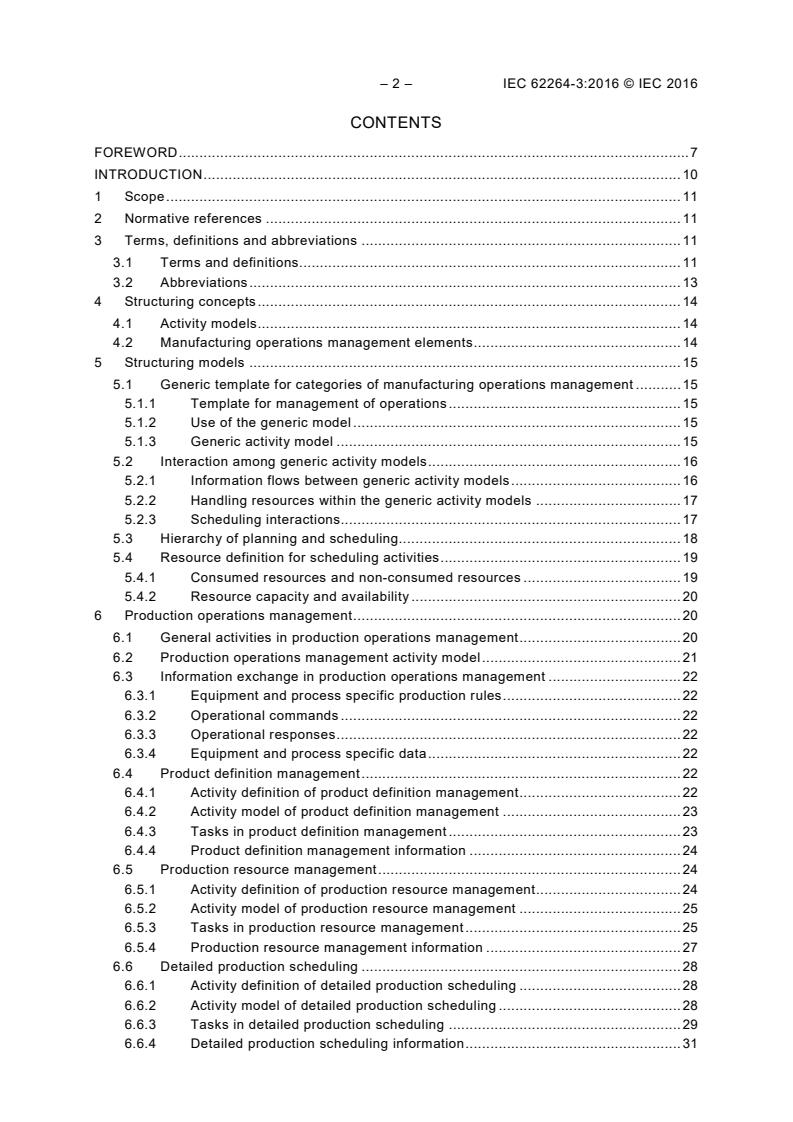
– 2 – IEC 62264-3:2016 © IEC 2016
CONTENTS
FOREWORD . 7
INTRODUCTION . 10
1 Scope . 11
2 Normative references . 11
3 Terms, definitions and abbreviations . 11
3.1 Terms and definitions. 11
3.2 Abbreviations . 13
4 Structuring concepts . 14
4.1 Activity models . 14
4.2 Manufacturing operations management elements . 14
5 Structuring models . 15
5.1 Generic template for categories of manufacturing operations management . 15
5.1.1 Template for management of operations . 15
5.1.2 Use of the generic model . 15
5.1.3 Generic activity model . 15
5.2 Interaction among generic activity models . 16
5.2.1 Information flows between generic activity models . 16
5.2.2 Handling resources within the generic activity models . 17
5.2.3 Scheduling interactions. 17
5.3 Hierarchy of planning and scheduling. 18
5.4 Resource definition for scheduling activities . 19
5.4.1 Consumed resources and non-consumed resources . 19
5.4.2 Resource capacity and availability . 20
6 Production operations management . 20
6.1 General activities in production operations management . 20
6.2 Production operations management activity model . 21
6.3 Information exchange in production operations management . 22
6.3.1 Equipment and process specific production rules . 22
6.3.2 Operational commands . 22
6.3.3 Operational responses . 22
6.3.4 Equipment and process specific data . 22
6.4 Product definition management . 22
6.4.1 Activity definition of product definition management . 22
6.4.2 Activity model of product definition management . 23
6.4.3 Tasks in product definition management . 23
6.4.4 Product definition management information . 24
6.5 Production resource management . 24
6.5.1 Activity definition of production resource management . 24
6.5.2 Activity model of production resource management . 25
6.5.3 Tasks in production resource management . 25
6.5.4 Production resource management information . 27
6.6 Detailed production scheduling . 28
6.6.1 Activity definition of detailed production scheduling . 28
6.6.2 Activity model of detailed production scheduling . 28
6.6.3 Tasks in detailed production scheduling . 29
6.6.4 Detailed production scheduling information . 31
6.7 Production dispatching . 31
6.7.1 Activity definition of production dispatching . 31
6.7.2 Activity model of production dispatching . 32
6.7.3 Tasks in production dispatching . 32
6.7.4 Production dispatching information . 34
6.8 Production execution management . 35
6.8.1 Activity definition of production execution management . 35
6.8.2 Activity model of production execution management . 35
6.8.3 Tasks in production execution management . 36
6.9 Production data collection . 37
6.9.1 Activity definition in production data collection . 37
6.9.2 Activity model of production data collection . 37
6.9.3 Tasks in production data collection . 37
6.10 Production tracking . 38
6.10.1 Activity definition of production tracking . 38
6.10.2 Activity model of production tracking . 38
6.10.3 Tasks in production tracking . 38
6.11 Production performance analysis . 40
6.11.1 Activity definition of production performance analysis . 40
6.11.2 Activity model of production performance analysis . 40
6.11.3 Tasks in production performance analysis . 40
7 Maintenance operations management . 44
7.1 General activities in maintenance operations management . 44
7.2 Maintenance operations management activity model . 44
7.3 Information exchanged in maintenance operations management . 45
7.3.1 Maintenance information . 45
7.3.2 Maintenance definitions . 45
7.3.3 Maintenance capability . 46
7.3.4 Maintenance request . 46
7.3.5 Maintenance response . 46
7.3.6 Equipment-specific maintenance procedures . 46
7.3.7 Maintenance commands and procedures . 46
7.3.8 Maintenance results . 47
7.3.9 Equipment state-of-health data . 47
7.4 Maintenance definition management . 47
7.5 Maintenance resource management . 48
7.6 Detailed maintenance scheduling . 48
7.7 Maintenance dispatching . 49
7.8 Maintenance execution management . 49
7.9 Maintenance data collection . 49
7.10 Maintenance tracking . 49
7.11 Maintenance performance analysis . 50
8 Quality operations management . 51
8.1 General activities in quality operations management . 51
8.1.1 Quality operations management activities . 51
8.1.2 Quality operations scope . 51
8.1.3 Quality test operations management . 51
8.1.4 Types of testing . 52
8.1.5 Testing locations and times . 52
– 4 – IEC 62264-3:2016 © IEC 2016
8.1.6 Quality systems . 53
8.2 Quality test operations activity model . 53
8.3 Information exchanged in quality test operations management . 54
8.3.1 Quality test definitions . 54
8.3.2 Quality test capability . 54
8.3.3 Quality test request . 55
8.3.4 Quality test response . 55
8.3.5 Quality parameters and procedures . 55
8.3.6 Test commands . 55
8.3.7 Test responses . 55
8.3.8 Quality-specific data . 56
8.4 Quality test definition management . 56
8.5 Quality test resource management . 56
8.6 Detailed quality test scheduling . 57
8.7 Quality test dispatching . 58
8.8 Quality test execution management . 58
8.8.1 General . 58
8.8.2 Testing . 58
8.9 Quality test data collection . 59
8.10 Quality test tracking . 59
8.11 Quality test performance analysis . 59
8.11.1 General . 59
8.11.2 Quality resource traceability analysis . 60
8.11.3 Quality indicators . 60
8.12 Supported activities . 60
9 Inventory operations management . 61
9.1 General activities in inventory operations management . 61
9.2 Inventory operations management activity model . 61
9.3 Information exchanged in inventory operations management . 62
9.3.1 Inventory definitions . 62
9.3.2 Inventory capability . 63
9.3.3 Inventory requests . 63
9.3.4 Inventory response . 63
9.3.5 Inventory storage definitions . 63
9.3.6 Inventory commands. 63
9.3.7 Inventory replies . 63
9.3.8 Inventory-specific data . 64
9.4 Inventory definition management . 64
9.5 Inventory resource management . 64
9.6 Detailed inventory scheduling . 65
9.7 Inventory dispatching . 65
9.8 Inventory execution management . 66
9.9 Inventory data collection . 66
9.10 Inventory tracking . 67
9.11 Inventory performance analysis . 67
10 Completeness, compliance and conformance . 68
10.1 Completeness . 68
10.2 Compliance . 68
10.3 Conformance . 68
Annex A (informative) Technical and responsibility boundaries . 69
A.1 General . 69
A.2 Scope of responsibility . 69
A.3 Actual responsibility . 71
A.4 Technical integration . 71
A.5 Defining solutions . 73
Annex B (informative) Scheduling hierarchy . 74
Annex C (informative) Frequently asked questions. 76
C.1 Does this standard apply to more than just manufacturing applications? . 76
C.2 Why are the models more detailed for production operations management
than for the other categories ? . 76
C.3 What are some of the main expected uses of this standard ? . 76
C.4 How does this standard relate to enterprise-control system integration? . 76
C.5 How does this facilitate connection to ERP systems? . 76
C.6 Why is genealogy not discussed? . 76
C.7 Why are only some information flows shown? . 77
C.8 What industry does the standard apply to? . 77
C.9 What is the relation between this standard and MES? . 77
C.10 How does the QA (quality assurance) element in IEC 62264-1 relate to this
standard? . 77
Annex D (informative) Advanced planning and scheduling concepts for manufacturing
operations management. 78
D.1 General . 78
D.2 Fundamental technologies of APS . 78
D.3 Decision-making functions of APS . 79
Bibliography . 82
Figure 1 – Activity relationships . 14
Figure 2 – Generic activity model of manufacturing operations management . 16
Figure 3 – Detailed scheduling interactions . 18
Figure 4 – Schematic relationship of planning and scheduling. 19
Figure 5 –Inventory for a consumable resource . 20
Figure 6 – Activity model of production operations management . 21
Figure 7 – Product definition management activity model interfaces. 23
Figure 8 – Production resource management activity model interfaces . 25
Figure 9 – Resource management capacity reporting . 27
Figure 10 – Detailed production scheduling activity model interfaces . 29
Figure 11 – Splitting and merging production schedules to work schedules . 30
Figure 12 – Work schedule . 31
Figure 13 – Production dispatching activity model interfaces . 32
Figure 14 – Work dispatching for mixed process facility . 34
Figure 15 – Sample job list and job orders . 35
Figure 16 – Production execution management activity model interfaces . 36
Figure 17 – Production data collection activity model interfaces . 37
Figure 18 – Production tracking activity model interfaces . 38
Figure 19 – Merging and splitting production tracking information . 39
– 6 – IEC 62264-3:2016 © IEC 2016
Figure 20 – Production performance analysis activity model interfaces . 40
Figure 21 – Activity model of maintenance operations management . 45
Figure 22 – Activity model of quality test operations management . 54
Figure 23 – Activity model of inventory operations management . 62
Figure 24 – Inventory data collection activity model . 67
Figure A.1 – Different boundaries of responsibility . 70
Figure A.2 – Lines of technical integration . 72
Figure B.1 – Sample hierarchy of schedules and scheduling activities. . 75
Figure D.1 – Levels of decision-making for production . 80
INTERNATIONAL ELECTROTECHNICAL COMMISSION
____________
ENTERPRISE-CONTROL SYSTEM INTEGRATION –
Part 3: Activity models of manufacturing operations management
FOREWORD
1) The International Electrotechnical Commission (IEC) is a worldwide organization for standardization comprising
all national electrotechnical committees (IEC National Committees). The object of IEC is to promote
international co-operation on all questions concerning standardization in the electrical and electronic fields. To
this end and in addition to other activities, IEC publishes International Standards, Technical Specifications,
Technical Reports, Publicly Available Specifications (PAS) and Guides (hereafter referred to as “IEC
Publication(s)”). Their preparation is entrusted to technical committees; any IEC National Committee interested
in the subject dealt with may participate in this preparatory work. International, governmental and non-
governmental organizations liaising with the IEC also participate in this preparation. IEC collaborates closely
with the International Organization for Standardization (ISO) in accordance with conditions determined by
agreement between the two organizations.
2) The formal decisions or agreements of IEC on technical matters express, as nearly as possible, an international
consensus of opinion on the relevant subjects since each technical committee has representation from all
interested IEC National Committees.
3) IEC Publications have the form of recommendations for international use and are accepted by IEC National
Committees in that sense. While all reasonable efforts are made to ensure that the technical content of IEC
Publications is accurate, IEC cannot be held responsible for the way in which they are used or for any
misinterpretation by any end user.
4) In order to promote international uniformity, IEC National Committees undertake to apply IEC Publications
transparently to the maximum extent possible in their national and regional publications. Any divergence
between any IEC Publication and the corresponding national or regional publication shall be clearly indicated in
the latter.
5) IEC provides no marking procedure to indicate its approval and cannot be rendered responsible for any
equipment declared to be in conformity with an IEC Publication.
6) All users should ensure that they have the latest edition of this publication.
7) No liability shall attach to IEC or its directors, employees, servants or agents including individual experts and
members of its technical committees and IEC National Committees for any personal injury, property damage or
other damage of any nature whatsoever, whether direct or indirect, or for costs (including legal fees) and
expenses arising out of the publication, use of, or reliance upon, this IEC Publication or any other IEC
Publications.
8) Attention is drawn to the Normative references cited in this publication. Use of the referenced publications is
indispensable for the correct application of this publication.
9) Attention is drawn to the possibility that some of the elements of this IEC Publication may be the subject of
patent rights. IEC shall not be held responsible for identifying any or all such patent rights.
International Standard IEC 62264-3 has been prepared by subcommittee 65E: Devices and
integration in enterprise systems, of IEC technical committee 65: Industrial-process
measurement, control and automation and ISO SC5, JWG 15, of ISO technical committee
184: Enterprise-control system integration.
It is published as a double logo standard.
This second edition cancels and replaces the first edition published in 2007. This edition
constitutes a technical revision.
This edition includes the following significant technical changes with respect to the previous
edition:
a) 4.1 Manufacturing Operations Management was moved to Part 1 and therefore was
removed from Part 3;
b) 4.2 Functional hierarchy was moved to Part 1 and therefore was removed from Part 3;
– 8 – IEC 62264-3:2016 © IEC 2016
c) 4.4 Criterion for defining activities below Level 4 was moved to Part 1 and therefore was
removed from Part 3;
d) 4.5 Categories of production information was moved to Part 1 and therefore was removed
from Part 3;
e) 4.6 Manufacturing operations information was moved to Part 1 and therefore was removed
from Part 3;
f) 5.3 Expanded equipment hierarchy model was moved to Part 1 and therefore was
removed from Part 3;
g) 5.4 Expanded decision hierarchy model was removed from Part 3. The corresponding
section was removed from Part 1 and replaced with a reference to ISO 15704;
h) Annex A (informative) Other enterprise activities affecting manufacturing operations was
moved to Part 1 and therefore was removed from Part 3;
i) Annex D (informative) Associated standards was moved to Part 1 and therefore was
removed from Part 3;
j) Annex F (informative) Applying the decision hierarchy model to manufacturing operations
management was removed from Part 3. The corresponding section was removed from
Part 1 and replaced with a reference to ISO 15704;
k) Annex G (informative) Mapping PSLX ontology to manufacturing operations management
was removed from Part 3. The committee felt that this section is more appropriate as a
PSLX white paper or TR;
l) The names for data were changed to match the Part 4 standard names. These name
changes were made in all figures and in the text. The following data names were changed
or added:
1) Detailed Production Schedule changed to Work Schedule,
2) Production Dispatch List changed to Job list,
3) Production Work Order changed to Job Order,
4) Work Order changed to Job Order,
5) Detailed Maintenance Schedule changed to Work Schedule,
6) Detailed Inventory Schedule changed to Work Schedule,
7) The addition of Work Masters as objects that define how work is to be done,
8) The addition of the management of Work Calendars as a task in resource management,
9) The addition of the creation of Work Records as a task in tracing.
The text of this standard is based on the following documents:
CDV Report on voting
65E/456/CDV 65E/513/RVC
Full information on the voting for the approval of this standard can be found in the report on
voting indicated in the above table. In ISO, the standard has been approved by 10 P-members
out of 10 having cast a vote.
This publication has been drafted in accordance with ISO/IEC Directives, Part 2.
A list of all parts in the IEC 62264 series, published under the general title Enterprise-Control
system integration, can be found on the IEC website.
The committee has decided that the contents of this publication will remain unchanged until
the stability date indicated on the IEC website under "http://webstore.iec.ch" in the data
related to the specific publication. At this date, the publication will be
• reconfirmed,
• withdrawn,
• replaced by a revised edition, or
• amended.
IMPORTANT – The 'colour inside' logo on the cover page of this publication indicates
that it contains colours which are considered to be useful for the correct
understanding of its contents. Users should therefore print this document using a
colour printer.
– 10 – IEC 62264-3:2016 © IEC 2016
INTRODUCTION
This part of IEC 62264 shows activity models and data flows for manufacturing information
that enables enterprise-control system integration. The modelled activities operate between
Level 4 logistics and planning functions and Level 2 manual and automated process control
functions. The models are consistent with the object models given in IEC 62264-2 and the
Level 3 (manufacturing operations and control) definitions.
The goal of the standard is to reduce the risk, cost and errors associated with implementing
enterprise systems and manufacturing operations systems in such a way that they inter-
operate and easily integrate. The standard may also be used to reduce the effort associated
with implementing new product offerings.
This standard provides models and terminology for defining the activities of manufacturing
operations management. The models and terminology defined in this standard are:
– to emphasize the good practices of manufacturing operations;
– to be used to improve existing manufacturing operations systems;
– to be applied regardless of the degree of automation.
Some potential benefits produced when applying the standard may include:
– reducing the time to reach full production levels for new products;
– enabling vendors to supply appropriate tools for manufacturing operations;
– enabling more uniform and consistent identification of manufacturing needs;
– reducing the cost of automating manufacturing processes;
– optimizing supply chains;
– improving efficiency in life-cycle engineering efforts.
It is not the intent of this part of the standard to:
– suggest that there is only one way of implementing manufacturing operations;
– force users to abandon their current way of handling manufacturing operations;
– restrict development in the area of manufacturing operations;
– restrict use only to manufacturing industries.
ENTERPRISE-CONTROL SYSTEM INTEGRATION –
Part 3: Activity models of manufacturing operations management
1 Scope
This part of IEC 62264 defines activity models of manufacturing operations management that
enable enterprise system to control system integration. The activities defined in this document
are consistent with the object models definitions given in IEC 62264-1. The modelled activities
operate between business planning and logistics functions, defined as the Level 4 functions
and the process control functions, defined as the Level 2 functions of IEC 62264-1. The scope
of this document is limited to:
– a model of the activities associated with manufacturing operations management, Level 3
functions;
– an identification of some of the data exchanged between Level 3 activities.
2 Normative references
The following documents are referred to in the text in such a way that some or all of their
content constitutes requirements of this document. For dated references, only the edition
cited applies. For undated references, the latest edition of the referenced document (including
any amendments) applies.
IEC 62264-1, Enterprise-control system integration – Part 1: Models and terminology
IEC 62264-2, Enterprise-control system integration – Part 2: Object and attributes for
enterprise-control system integration
ISO 22400-1, Automation systems and integration – Key performance indicators (KPIs) for
manufacturing operations management – Part 1: Overview, concepts and terminology
ISO 22400-2, Automation systems and integration – Key performance indicators for
manufacturing operations management – Part 2: Definitions and descriptions
3 Terms, definitions and abbreviations
3.1 Terms and definitions
3.1.1
finite capacity scheduling
scheduling methodology where work is scheduled for production equipment, in such a way
that no production equipment capacity requirement exceeds the capacity available to the
production equipment
3.1.2
inventory operations management
activities within Level 3 of a manufacturing facility which coordinate, direct, manage and track
inventory and material movement within manufacturing operations
– 12 – IEC 62264-3:2016 © IEC 2016
3.1.3
job list
collection of job orders for one or more work centers and/or resources for a specific time
frame
Note 1 to entry: This may take the form of job orders for the set-up instructions for machines, operating conditions
for continuous processes, material movement instructions, or batches to be started in a batch system.
Note 2 to entry: Job lists are applicable to all operations management areas, such as maintenance, quality test
and inventory.
3.1.4
job order
unit of scheduled work that is dispatched for execution
3.1.5
key performance indicator
KPI
quantifiable level of achieving a critical objective
[SOURCE: ISO 22400-1-2014, 2.1.5]
3.1.6
maintenance operations management
activities within Level 3 of a manufacturing facility which coordinate, direct, manage and track
the functions that maintain the equipment, tools and related assets to ensure their availability
for manufacturing and ensure scheduling for reactive, periodic, preventive, or proactive
maintenance
3.1.7
manufacturing facility
site, or area within a site, that includes the resources within the site or area and includes the
activities associated with the use of the resources
3.1.8
manufacturing operations management
activities within Level 3 of a manufacturing facility that coordinate, direct, manage and track
the personnel, equipment and materials in manufacturing
Note 1 to entry: This standard details manufacturing operations management in terms of four categories
(production operations management, maintenance operations management, quality operations management and
inventory operations management) and provides references for other enterprise activities affecting manufacturing
operations.
3.1.9
production operations management
activities within Level 3 of a manufacturing facility which coordinate, direct, manage and track
the functions that use raw materials, energy, equipment, personnel and information to
produce products, with the required costs, qualities, quantities, safety and timeliness
3.1.10
quality operations management
activities within Level 3 of a manufacturing facility which coordinate, direct, manage and track
the functions that measure and report on quality
3.1.11
tracing
activity that provides an organized record of resource and product use from any point, forward
or backward, using tracking information
3.1.12
tracking
activity of recording attributes of resources and products through all steps of instantiation, use,
change and disposition
3.1.13
work center
process cell, production unit, production line, storage zone, or any other equivalent level
equipment element defined as an extension to the equipment hierarchy model
Note 1 to entry: For compatibility with existing schema implementations the defined term “work center” is used in
place of the UK English spelling “work centre”.
3.1.14
work master
type of work definition that is a template for work to be performed for a job order
3.1.15
work schedule
detailed schedule that defines production, maintenance, inventory or quality operations
activities, or any combination of the activities
3.2 Abbreviations
For the purposes of this standard, the following abbreviations apply.
AGV Automated guided vehicles
AMS Asset management system
ASRS Automated storage and retrieval system
CAPE Computer-aided process engineering
CAD Computer-aided d
...
IEC 62264-3
Edition 2.0 2016-12
INTERNATIONAL
STANDARD
NORME
INTERNATIONALE
colour
inside
Enterprise-control system integration –
Part 3: Activity models of manufacturing operations management
Intégration des systèmes entreprise-contrôle –
Partie 3: Modèles d’activités pour la gestion des opérations de fabrication
All rights reserved. Unless otherwise specified, no part of this publication may be reproduced or utilized in any form
or by any means, electronic or mechanical, including photocopying and microfilm, without permission in writing from
either IEC or IEC's member National Committee in the country of the requester. If you have any questions about IEC
copyright or have an enquiry about obtaining additional rights to this publication, please contact the address below or
your local IEC member National Committee for further information.
Droits de reproduction réservés. Sauf indication contraire, aucune partie de cette publication ne peut être reproduite
ni utilisée sous quelque forme que ce soit et par aucun procédé, électronique ou mécanique, y compris la photocopie
et les microfilms, sans l'accord écrit de l'IEC ou du Comité national de l'IEC du pays du demandeur. Si vous avez des
questions sur le copyright de l'IEC ou si vous désirez obtenir des droits supplémentaires sur cette publication, utilisez
les coordonnées ci-après ou contactez le Comité national de l'IEC de votre pays de résidence.
IEC Central Office Tel.: +41 22 919 02 11
3, rue de Varembé Fax: +41 22 919 03 00
CH-1211 Geneva 20 info@iec.ch
Switzerland www.iec.ch
About the IEC
The International Electrotechnical Commission (IEC) is the leading global organization that prepares and publishes
International Standards for all electrical, electronic and related technologies.
About IEC publications
The technical content of IEC publications is kept under constant review by the IEC. Please make sure that you have the
latest edition, a corrigenda or an amendment might have been published.
IEC Catalogue - webstore.iec.ch/catalogue Electropedia - www.electropedia.org
The stand-alone application for consulting the entire The world's leading online dictionary of electronic and
bibliographical information on IEC International Standards, electrical terms containing 20 000 terms and definitions in
Technical Specifications, Technical Reports and other English and French, with equivalent terms in 15 additional
documents. Available for PC, Mac OS, Android Tablets and languages. Also known as the International Electrotechnical
iPad. Vocabulary (IEV) online.
IEC publications search - www.iec.ch/searchpub IEC Glossary - std.iec.ch/glossary
The advanced search enables to find IEC publications by a 65 000 electrotechnical terminology entries in English and
variety of criteria (reference number, text, technical French extracted from the Terms and Definitions clause of
committee,…). It also gives information on projects, replaced IEC publications issued since 2002. Some entries have been
and withdrawn publications. collected from earlier publications of IEC TC 37, 77, 86 and
CISPR.
IEC Just Published - webstore.iec.ch/justpublished
Stay up to date on all new IEC publications. Just Published IEC Customer Service Centre - webstore.iec.ch/csc
details all new publications released. Available online and If you wish to give us your feedback on this publication or
also once a month by email. need further assistance, please contact the Customer Service
Centre: csc@iec.ch.
A propos de l'IEC
La Commission Electrotechnique Internationale (IEC) est la première organisation mondiale qui élabore et publie des
Normes internationales pour tout ce qui a trait à l'électricité, à l'électronique et aux technologies apparentées.
A propos des publications IEC
Le contenu technique des publications IEC est constamment revu. Veuillez vous assurer que vous possédez l’édition la
plus récente, un corrigendum ou amendement peut avoir été publié.
Catalogue IEC - webstore.iec.ch/catalogue Electropedia - www.electropedia.org
Application autonome pour consulter tous les renseignements
Le premier dictionnaire en ligne de termes électroniques et
bibliographiques sur les Normes internationales,
électriques. Il contient 20 000 termes et définitions en anglais
Spécifications techniques, Rapports techniques et autres
et en français, ainsi que les termes équivalents dans 15
documents de l'IEC. Disponible pour PC, Mac OS, tablettes
langues additionnelles. Egalement appelé Vocabulaire
Android et iPad.
Electrotechnique International (IEV) en ligne.
Recherche de publications IEC - www.iec.ch/searchpub
Glossaire IEC - std.iec.ch/glossary
65 000 entrées terminologiques électrotechniques, en anglais
La recherche avancée permet de trouver des publications IEC
en utilisant différents critères (numéro de référence, texte, et en français, extraites des articles Termes et Définitions des
comité d’études,…). Elle donne aussi des informations sur les publications IEC parues depuis 2002. Plus certaines entrées
projets et les publications remplacées ou retirées. antérieures extraites des publications des CE 37, 77, 86 et
CISPR de l'IEC.
IEC Just Published - webstore.iec.ch/justpublished
Service Clients - webstore.iec.ch/csc
Restez informé sur les nouvelles publications IEC. Just
Published détaille les nouvelles publications parues. Si vous désirez nous donner des commentaires sur cette
Disponible en ligne et aussi une fois par mois par email. publication ou si vous avez des questions contactez-nous:
csc@iec.ch.
IEC 62264-3
Edition 2.0 2016-12
INTERNATIONAL
STANDARD
NORME
INTERNATIONALE
colour
inside
Enterprise-control system integration –
Part 3: Activity models of manufacturing operations management
Intégration des systèmes entreprise-contrôle –
Partie 3: Modèles d’activités pour la gestion des opérations de fabrication
INTERNATIONAL
ELECTROTECHNICAL
COMMISSION
COMMISSION
ELECTROTECHNIQUE
INTERNATIONALE
ICS 25.040.40; 35.240.50 ISBN 978-2-8322-3698-7
– 2 – IEC 62264-3:2016 © IEC 2016
CONTENTS
FOREWORD . 7
INTRODUCTION . 10
1 Scope . 11
2 Normative references . 11
3 Terms, definitions and abbreviations . 11
3.1 Terms and definitions. 11
3.2 Abbreviations . 13
4 Structuring concepts . 14
4.1 Activity models . 14
4.2 Manufacturing operations management elements . 14
5 Structuring models . 15
5.1 Generic template for categories of manufacturing operations management . 15
5.1.1 Template for management of operations . 15
5.1.2 Use of the generic model . 15
5.1.3 Generic activity model . 15
5.2 Interaction among generic activity models . 16
5.2.1 Information flows between generic activity models . 16
5.2.2 Handling resources within the generic activity models . 17
5.2.3 Scheduling interactions. 17
5.3 Hierarchy of planning and scheduling. 18
5.4 Resource definition for scheduling activities . 19
5.4.1 Consumed resources and non-consumed resources . 19
5.4.2 Resource capacity and availability . 20
6 Production operations management . 20
6.1 General activities in production operations management . 20
6.2 Production operations management activity model . 21
6.3 Information exchange in production operations management . 22
6.3.1 Equipment and process specific production rules . 22
6.3.2 Operational commands . 22
6.3.3 Operational responses . 22
6.3.4 Equipment and process specific data . 22
6.4 Product definition management . 22
6.4.1 Activity definition of product definition management . 22
6.4.2 Activity model of product definition management . 23
6.4.3 Tasks in product definition management . 23
6.4.4 Product definition management information . 24
6.5 Production resource management . 24
6.5.1 Activity definition of production resource management . 24
6.5.2 Activity model of production resource management . 25
6.5.3 Tasks in production resource management . 25
6.5.4 Production resource management information . 27
6.6 Detailed production scheduling . 28
6.6.1 Activity definition of detailed production scheduling . 28
6.6.2 Activity model of detailed production scheduling . 28
6.6.3 Tasks in detailed production scheduling . 29
6.6.4 Detailed production scheduling information . 31
6.7 Production dispatching . 31
6.7.1 Activity definition of production dispatching . 31
6.7.2 Activity model of production dispatching . 32
6.7.3 Tasks in production dispatching . 32
6.7.4 Production dispatching information . 34
6.8 Production execution management . 35
6.8.1 Activity definition of production execution management . 35
6.8.2 Activity model of production execution management . 35
6.8.3 Tasks in production execution management . 36
6.9 Production data collection . 37
6.9.1 Activity definition in production data collection . 37
6.9.2 Activity model of production data collection . 37
6.9.3 Tasks in production data collection . 37
6.10 Production tracking . 38
6.10.1 Activity definition of production tracking . 38
6.10.2 Activity model of production tracking . 38
6.10.3 Tasks in production tracking . 38
6.11 Production performance analysis . 40
6.11.1 Activity definition of production performance analysis . 40
6.11.2 Activity model of production performance analysis . 40
6.11.3 Tasks in production performance analysis . 40
7 Maintenance operations management . 44
7.1 General activities in maintenance operations management . 44
7.2 Maintenance operations management activity model . 44
7.3 Information exchanged in maintenance operations management . 45
7.3.1 Maintenance information . 45
7.3.2 Maintenance definitions . 45
7.3.3 Maintenance capability . 46
7.3.4 Maintenance request . 46
7.3.5 Maintenance response . 46
7.3.6 Equipment-specific maintenance procedures . 46
7.3.7 Maintenance commands and procedures . 46
7.3.8 Maintenance results . 47
7.3.9 Equipment state-of-health data . 47
7.4 Maintenance definition management . 47
7.5 Maintenance resource management . 48
7.6 Detailed maintenance scheduling . 48
7.7 Maintenance dispatching . 49
7.8 Maintenance execution management . 49
7.9 Maintenance data collection . 49
7.10 Maintenance tracking . 49
7.11 Maintenance performance analysis . 50
8 Quality operations management . 51
8.1 General activities in quality operations management . 51
8.1.1 Quality operations management activities . 51
8.1.2 Quality operations scope . 51
8.1.3 Quality test operations management . 51
8.1.4 Types of testing . 52
8.1.5 Testing locations and times . 52
– 4 – IEC 62264-3:2016 © IEC 2016
8.1.6 Quality systems . 53
8.2 Quality test operations activity model . 53
8.3 Information exchanged in quality test operations management . 54
8.3.1 Quality test definitions . 54
8.3.2 Quality test capability . 54
8.3.3 Quality test request . 55
8.3.4 Quality test response . 55
8.3.5 Quality parameters and procedures . 55
8.3.6 Test commands . 55
8.3.7 Test responses . 55
8.3.8 Quality-specific data . 56
8.4 Quality test definition management . 56
8.5 Quality test resource management . 56
8.6 Detailed quality test scheduling . 57
8.7 Quality test dispatching . 58
8.8 Quality test execution management . 58
8.8.1 General . 58
8.8.2 Testing . 58
8.9 Quality test data collection . 59
8.10 Quality test tracking . 59
8.11 Quality test performance analysis . 59
8.11.1 General . 59
8.11.2 Quality resource traceability analysis . 60
8.11.3 Quality indicators . 60
8.12 Supported activities . 60
9 Inventory operations management . 61
9.1 General activities in inventory operations management . 61
9.2 Inventory operations management activity model . 61
9.3 Information exchanged in inventory operations management . 62
9.3.1 Inventory definitions . 62
9.3.2 Inventory capability . 63
9.3.3 Inventory requests . 63
9.3.4 Inventory response . 63
9.3.5 Inventory storage definitions . 63
9.3.6 Inventory commands. 63
9.3.7 Inventory replies . 63
9.3.8 Inventory-specific data . 64
9.4 Inventory definition management . 64
9.5 Inventory resource management . 64
9.6 Detailed inventory scheduling . 65
9.7 Inventory dispatching . 65
9.8 Inventory execution management . 66
9.9 Inventory data collection . 66
9.10 Inventory tracking . 67
9.11 Inventory performance analysis . 67
10 Completeness, compliance and conformance . 68
10.1 Completeness . 68
10.2 Compliance . 68
10.3 Conformance . 68
Annex A (informative) Technical and responsibility boundaries . 69
A.1 General . 69
A.2 Scope of responsibility . 69
A.3 Actual responsibility . 71
A.4 Technical integration . 71
A.5 Defining solutions . 73
Annex B (informative) Scheduling hierarchy . 74
Annex C (informative) Frequently asked questions. 76
C.1 Does this standard apply to more than just manufacturing applications? . 76
C.2 Why are the models more detailed for production operations management
than for the other categories ? . 76
C.3 What are some of the main expected uses of this standard ? . 76
C.4 How does this standard relate to enterprise-control system integration? . 76
C.5 How does this facilitate connection to ERP systems? . 76
C.6 Why is genealogy not discussed? . 76
C.7 Why are only some information flows shown? . 77
C.8 What industry does the standard apply to? . 77
C.9 What is the relation between this standard and MES? . 77
C.10 How does the QA (quality assurance) element in IEC 62264-1 relate to this
standard? . 77
Annex D (informative) Advanced planning and scheduling concepts for manufacturing
operations management. 78
D.1 General . 78
D.2 Fundamental technologies of APS . 78
D.3 Decision-making functions of APS . 79
Bibliography . 82
Figure 1 – Activity relationships . 14
Figure 2 – Generic activity model of manufacturing operations management . 16
Figure 3 – Detailed scheduling interactions . 18
Figure 4 – Schematic relationship of planning and scheduling. 19
Figure 5 –Inventory for a consumable resource . 20
Figure 6 – Activity model of production operations management . 21
Figure 7 – Product definition management activity model interfaces. 23
Figure 8 – Production resource management activity model interfaces . 25
Figure 9 – Resource management capacity reporting . 27
Figure 10 – Detailed production scheduling activity model interfaces . 29
Figure 11 – Splitting and merging production schedules to work schedules . 30
Figure 12 – Work schedule . 31
Figure 13 – Production dispatching activity model interfaces . 32
Figure 14 – Work dispatching for mixed process facility . 34
Figure 15 – Sample job list and job orders . 35
Figure 16 – Production execution management activity model interfaces . 36
Figure 17 – Production data collection activity model interfaces . 37
Figure 18 – Production tracking activity model interfaces . 38
Figure 19 – Merging and splitting production tracking information . 39
– 6 – IEC 62264-3:2016 © IEC 2016
Figure 20 – Production performance analysis activity model interfaces . 40
Figure 21 – Activity model of maintenance operations management . 45
Figure 22 – Activity model of quality test operations management . 54
Figure 23 – Activity model of inventory operations management . 62
Figure 24 – Inventory data collection activity model . 67
Figure A.1 – Different boundaries of responsibility . 70
Figure A.2 – Lines of technical integration . 72
Figure B.1 – Sample hierarchy of schedules and scheduling activities. . 75
Figure D.1 – Levels of decision-making for production . 80
INTERNATIONAL ELECTROTECHNICAL COMMISSION
____________
ENTERPRISE-CONTROL SYSTEM INTEGRATION –
Part 3: Activity models of manufacturing operations management
FOREWORD
1) The International Electrotechnical Commission (IEC) is a worldwide organization for standardization comprising
all national electrotechnical committees (IEC National Committees). The object of IEC is to promote
international co-operation on all questions concerning standardization in the electrical and electronic fields. To
this end and in addition to other activities, IEC publishes International Standards, Technical Specifications,
Technical Reports, Publicly Available Specifications (PAS) and Guides (hereafter referred to as “IEC
Publication(s)”). Their preparation is entrusted to technical committees; any IEC National Committee interested
in the subject dealt with may participate in this preparatory work. International, governmental and non-
governmental organizations liaising with the IEC also participate in this preparation. IEC collaborates closely
with the International Organization for Standardization (ISO) in accordance with conditions determined by
agreement between the two organizations.
2) The formal decisions or agreements of IEC on technical matters express, as nearly as possible, an international
consensus of opinion on the relevant subjects since each technical committee has representation from all
interested IEC National Committees.
3) IEC Publications have the form of recommendations for international use and are accepted by IEC National
Committees in that sense. While all reasonable efforts are made to ensure that the technical content of IEC
Publications is accurate, IEC cannot be held responsible for the way in which they are used or for any
misinterpretation by any end user.
4) In order to promote international uniformity, IEC National Committees undertake to apply IEC Publications
transparently to the maximum extent possible in their national and regional publications. Any divergence
between any IEC Publication and the corresponding national or regional publication shall be clearly indicated in
the latter.
5) IEC provides no marking procedure to indicate its approval and cannot be rendered responsible for any
equipment declared to be in conformity with an IEC Publication.
6) All users should ensure that they have the latest edition of this publication.
7) No liability shall attach to IEC or its directors, employees, servants or agents including individual experts and
members of its technical committees and IEC National Committees for any personal injury, property damage or
other damage of any nature whatsoever, whether direct or indirect, or for costs (including legal fees) and
expenses arising out of the publication, use of, or reliance upon, this IEC Publication or any other IEC
Publications.
8) Attention is drawn to the Normative references cited in this publication. Use of the referenced publications is
indispensable for the correct application of this publication.
9) Attention is drawn to the possibility that some of the elements of this IEC Publication may be the subject of
patent rights. IEC shall not be held responsible for identifying any or all such patent rights.
International Standard IEC 62264-3 has been prepared by subcommittee 65E: Devices and
integration in enterprise systems, of IEC technical committee 65: Industrial-process
measurement, control and automation and ISO SC5, JWG 15, of ISO technical committee
184: Enterprise-control system integration.
It is published as a double logo standard.
This second edition cancels and replaces the first edition published in 2007. This edition
constitutes a technical revision.
This edition includes the following significant technical changes with respect to the previous
edition:
a) 4.1 Manufacturing Operations Management was moved to Part 1 and therefore was
removed from Part 3;
b) 4.2 Functional hierarchy was moved to Part 1 and therefore was removed from Part 3;
– 8 – IEC 62264-3:2016 © IEC 2016
c) 4.4 Criterion for defining activities below Level 4 was moved to Part 1 and therefore was
removed from Part 3;
d) 4.5 Categories of production information was moved to Part 1 and therefore was removed
from Part 3;
e) 4.6 Manufacturing operations information was moved to Part 1 and therefore was removed
from Part 3;
f) 5.3 Expanded equipment hierarchy model was moved to Part 1 and therefore was
removed from Part 3;
g) 5.4 Expanded decision hierarchy model was removed from Part 3. The corresponding
section was removed from Part 1 and replaced with a reference to ISO 15704;
h) Annex A (informative) Other enterprise activities affecting manufacturing operations was
moved to Part 1 and therefore was removed from Part 3;
i) Annex D (informative) Associated standards was moved to Part 1 and therefore was
removed from Part 3;
j) Annex F (informative) Applying the decision hierarchy model to manufacturing operations
management was removed from Part 3. The corresponding section was removed from
Part 1 and replaced with a reference to ISO 15704;
k) Annex G (informative) Mapping PSLX ontology to manufacturing operations management
was removed from Part 3. The committee felt that this section is more appropriate as a
PSLX white paper or TR;
l) The names for data were changed to match the Part 4 standard names. These name
changes were made in all figures and in the text. The following data names were changed
or added:
1) Detailed Production Schedule changed to Work Schedule,
2) Production Dispatch List changed to Job list,
3) Production Work Order changed to Job Order,
4) Work Order changed to Job Order,
5) Detailed Maintenance Schedule changed to Work Schedule,
6) Detailed Inventory Schedule changed to Work Schedule,
7) The addition of Work Masters as objects that define how work is to be done,
8) The addition of the management of Work Calendars as a task in resource management,
9) The addition of the creation of Work Records as a task in tracing.
The text of this standard is based on the following documents:
CDV Report on voting
65E/456/CDV 65E/513/RVC
Full information on the voting for the approval of this standard can be found in the report on
voting indicated in the above table. In ISO, the standard has been approved by 10 P-members
out of 10 having cast a vote.
This publication has been drafted in accordance with ISO/IEC Directives, Part 2.
A list of all parts in the IEC 62264 series, published under the general title Enterprise-Control
system integration, can be found on the IEC website.
The committee has decided that the contents of this publication will remain unchanged until
the stability date indicated on the IEC website under "http://webstore.iec.ch" in the data
related to the specific publication. At this date, the publication will be
• reconfirmed,
• withdrawn,
• replaced by a revised edition, or
• amended.
IMPORTANT – The 'colour inside' logo on the cover page of this publication indicates
that it contains colours which are considered to be useful for the correct
understanding of its contents. Users should therefore print this document using a
colour printer.
– 10 – IEC 62264-3:2016 © IEC 2016
INTRODUCTION
This part of IEC 62264 shows activity models and data flows for manufacturing information
that enables enterprise-control system integration. The modelled activities operate between
Level 4 logistics and planning functions and Level 2 manual and automated process control
functions. The models are consistent with the object models given in IEC 62264-2 and the
Level 3 (manufacturing operations and control) definitions.
The goal of the standard is to reduce the risk, cost and errors associated with implementing
enterprise systems and manufacturing operations systems in such a way that they inter-
operate and easily integrate. The standard may also be used to reduce the effort associated
with implementing new product offerings.
This standard provides models and terminology for defining the activities of manufacturing
operations management. The models and terminology defined in this standard are:
– to emphasize the good practices of manufacturing operations;
– to be used to improve existing manufacturing operations systems;
– to be applied regardless of the degree of automation.
Some potential benefits produced when applying the standard may include:
– reducing the time to reach full production levels for new products;
– enabling vendors to supply appropriate tools for manufacturing operations;
– enabling more uniform and consistent identification of manufacturing needs;
– reducing the cost of automating manufacturing processes;
– optimizing supply chains;
– improving efficiency in life-cycle engineering efforts.
It is not the intent of this part of the standard to:
– suggest that there is only one way of implementing manufacturing operations;
– force users to abandon their current way of handling manufacturing operations;
– restrict development in the area of manufacturing operations;
– restrict use only to manufacturing industries.
ENTERPRISE-CONTROL SYSTEM INTEGRATION –
Part 3: Activity models of manufacturing operations management
1 Scope
This part of IEC 62264 defines activity models of manufacturing operations management that
enable enterprise system to control system integration. The activities defined in this document
are consistent with the object models definitions given in IEC 62264-1. The modelled activities
operate between business planning and logistics functions, defined as the Level 4 functions
and the process control functions, defined as the Level 2 functions of IEC 62264-1. The scope
of this document is limited to:
– a model of the activities associated with manufacturing operations management, Level 3
functions;
– an identification of some of the data exchanged between Level 3 activities.
2 Normative references
The following documents are referred to in the text in such a way that some or all of their
content constitutes requirements of this document. For dated references, only the edition
cited applies. For undated references, the latest edition of the referenced document (including
any amendments) applies.
IEC 62264-1, Enterprise-control system integration – Part 1: Models and terminology
IEC 62264-2, Enterprise-control system integration – Part 2: Object and attributes for
enterprise-control system integration
ISO 22400-1, Automation systems and integration – Key performance indicators (KPIs) for
manufacturing operations management – Part 1: Overview, concepts and terminology
ISO 22400-2, Automation systems and integration – Key performance indicators for
manufacturing operations management – Part 2: Definitions and descriptions
3 Terms, definitions and abbreviations
3.1 Terms and definitions
3.1.1
finite capacity scheduling
scheduling methodology where work is scheduled for production equipment, in such a way
that no production equipment capacity requirement exceeds the capacity available to the
production equipment
3.1.2
inventory operations management
activities within Level 3 of a manufacturing facility which coordinate, direct, manage and track
inventory and material movement within manufacturing operations
– 12 – IEC 62264-3:2016 © IEC 2016
3.1.3
job list
collection of job orders for one or more work centers and/or resources for a specific time
frame
Note 1 to entry: This may take the form of job orders for the set-up instructions for machines, operating conditions
for continuous processes, material movement instructions, or batches to be started in a batch system.
Note 2 to entry: Job lists are applicable to all operations management areas, such as maintenance, quality test
and inventory.
3.1.4
job order
unit of scheduled work that is dispatched for execution
3.1.5
key performance indicator
KPI
quantifiable level of achieving a critical objective
[SOURCE: ISO 22400-1-2014, 2.1.5]
3.1.6
maintenance operations management
activities within Level 3 of a manufacturing facility which coordinate, direct, manage and track
the functions that maintain the equipment, tools and related assets to ensure their availability
for manufacturing and ensure scheduling for reactive, periodic, preventive, or proactive
maintenance
3.1.7
manufacturing facility
site, or area within a site, that includes the resources within the site or area and includes the
activities associated with the use of the resources
3.1.8
manufacturing operations management
activities within Level 3 of a manufacturing facility that coordinate, direct, manage and track
the personnel, equipment and materials in manufacturing
Note 1 to entry: This standard details manufacturing operations management in terms of four categories
(production operations management, maintenance operations management, quality operations management and
inventory operations management) and provides references for other enterprise activities affecting manufacturing
operations.
3.1.9
production operations management
activities within Level 3 of a manufacturing facility which coordinate, direct, manage and track
the functions that use raw materials, energy, equipment, personnel and information to
produce products, with the required costs, qualities, quantities, safety and timeliness
3.1.10
quality operations management
activities within Level 3 of a manufacturing facility which coordinate, direct, manage and track
the functions that measure and report on quality
3.1.11
tracing
activity that provides an organized record of resource and product use from any point, forward
or backward, using tracking information
3.1.12
tracking
activity of recording attributes of resources and products through all steps of instantiation, use,
change and disposition
3.1.13
work center
process cell, production unit, production line, storage zone, or any other equivalent level
equipment element defined as an extension to the equipment hierarchy model
Note 1 to entry: For compatibility with existing schema implementations the defined term “work center” is used in
place of the UK English spelling “work centre”.
3.1.14
work master
type of work definition that is a template for work to be performed for a job order
3.1.15
work schedule
detailed schedule that defines production, maintenance, inventory or quality operations
activities, or any combination of the activities
3.2 Abbreviations
For the purposes of this standard, the following abbreviations apply.
AGV Automated guided vehicles
AMS Asset management system
ASRS Automated storage and retrieval system
CAPE Computer-aided process engineering
CAD Computer-aided d
...