

ISO 14813-1:2024
(Main)Intelligent transport systems — Reference model architecture(s) for the ITS sector — Part 1: ITS service domains, service groups and services
General Information
- Abstract
This document provides a description of the primary services that have been internationally defined to promote consistency among implementations. Implementations can provide any of these services in combination with any other services that are appropriate. This document organizes ITS services by defining service groups, which are placed into one of several service domains. Each service group contains one or more individual services, each of which is described. This document is intended for use by at least two groups of people involved in the ITS sector: a) those who are looking for ideas about the services that ITS implementations can provide, and b) those who are developing International Standards. For the first group, this document provides service descriptions that can act as the catalyst for more detailed descriptions. The level of detail can differ from one ITS implementation to another, depending on whether or not a national ITS architecture is involved, and whether or not this architecture is based directly on services, or on groups of functions. The service descriptions in this document are pitched at a high-level as too much detail can be prescriptive and reduces flexibility. For standards developers, this document is applicable to Technical Committees who are developing International Standards for the ITS sector. This document is designed to provide information and explanations of services that can form the basis and reason for developing standards. Due to its nature, this document is largely advisory and informative with minimal requirements. It is designed to assist the integration of services into a cohesive reference architecture, thereby promoting interoperability and the use of common data definitions. Specifically, services defined within the service groups can be the basis for defining “use cases”, “user needs” or "user service requirements” depending on the methodology being used to develop the resultant ITS architecture functionality. They can also assist with defining applicable data within data dictionaries, and applicable communications and data exchange standards.
- Status
- Published
- Publication Date
- 01-Aug-2024
- Technical Committee
- ISO/TC 204 - Intelligent transport systems
- Drafting Committee
- ISO/TC 204 - Intelligent transport systems
- Current Stage
- 6060 - International Standard published
- Start Date
- 02-Aug-2024
- Due Date
- 18-Oct-2024
- Completion Date
- 02-Aug-2024
Overview
ISO 14813-1:2024 - Intelligent transport systems (ITS) - Reference model architecture(s) for the ITS sector - Part 1: ITS service domains, service groups and services - provides a high‑level catalogue of ITS services to promote consistent, interoperable implementations. The third edition (2024) organises ITS functionality into service domains, service groups and individual services, and describes each service at a non‑prescriptive level. The document is largely advisory and informative and is intended as a common reference for architects, implementers and standards developers.
Key topics
- Service model structure: Definitions and characteristics of ITS service domains, service groups and individual ITS services to create a consistent reference architecture.
- Domain coverage: Descriptions include major domains such as traveller information, traffic management and operations, vehicle services, and freight transport services (and related cooperative ITS topics).
- High‑level service descriptions: Non‑prescriptive overviews that enable flexibility across national or local ITS architectures.
- Interoperability focus: Guidance to support common data definitions, use cases, user needs/user service requirements, and object identifiers for data concepts.
- Support for standards development: Intended as input for Technical Committees when creating standards for ITS communications, data exchange and architecture.
Practical applications
- Use ISO 14813-1:2024 to:
- Define use cases and user requirements for ITS projects.
- Create or align national ITS architectures with an international reference model.
- Develop data dictionaries and identify common data elements and object identifiers for interoperable data exchange.
- Inform procurement specifications and solution designs for ITS vendors and system integrators.
- Typical implementations include traveller information systems, real‑time route guidance, traffic signal control integrations, automated vehicle services, commercial vehicle administration and freight management platforms.
Who should use this standard
- National and local transport authorities and ITS programme managers
- Systems architects and integrators designing ITS solutions
- ITS product vendors and service providers
- Standards developers and ISO Technical Committees working on ITS communications, data and architecture
- Researchers and consultants producing ITS business or technical requirements
Related standards (context)
ISO 14813-1 complements other ITS and communications standards that define data formats, messaging and protocol specifications. It is best used together with domain‑specific ITS standards for data exchange, telemetry and cooperative ITS communications to achieve full interoperability.
Keywords: ISO 14813-1:2024, intelligent transport systems, ITS service domains, service groups, ITS services, reference model architecture, interoperability, data exchange, use cases.
Relations
- Effective Date
- 22-Oct-2022
Get Certified
Connect with accredited certification bodies for this standard

BSI Group
BSI (British Standards Institution) is the business standards company that helps organizations make excellence a habit.

Great Wall Tianjin Quality Assurance Center
Established 1993, first batch to receive national accreditation with IAF recognition.
Hong Kong Quality Assurance Agency (HKQAA)
Hong Kong's leading certification body.
Sponsored listings
Frequently Asked Questions
ISO 14813-1:2024 is a standard published by the International Organization for Standardization (ISO). Its full title is "Intelligent transport systems — Reference model architecture(s) for the ITS sector — Part 1: ITS service domains, service groups and services". This standard covers: This document provides a description of the primary services that have been internationally defined to promote consistency among implementations. Implementations can provide any of these services in combination with any other services that are appropriate. This document organizes ITS services by defining service groups, which are placed into one of several service domains. Each service group contains one or more individual services, each of which is described. This document is intended for use by at least two groups of people involved in the ITS sector: a) those who are looking for ideas about the services that ITS implementations can provide, and b) those who are developing International Standards. For the first group, this document provides service descriptions that can act as the catalyst for more detailed descriptions. The level of detail can differ from one ITS implementation to another, depending on whether or not a national ITS architecture is involved, and whether or not this architecture is based directly on services, or on groups of functions. The service descriptions in this document are pitched at a high-level as too much detail can be prescriptive and reduces flexibility. For standards developers, this document is applicable to Technical Committees who are developing International Standards for the ITS sector. This document is designed to provide information and explanations of services that can form the basis and reason for developing standards. Due to its nature, this document is largely advisory and informative with minimal requirements. It is designed to assist the integration of services into a cohesive reference architecture, thereby promoting interoperability and the use of common data definitions. Specifically, services defined within the service groups can be the basis for defining “use cases”, “user needs” or "user service requirements” depending on the methodology being used to develop the resultant ITS architecture functionality. They can also assist with defining applicable data within data dictionaries, and applicable communications and data exchange standards.
This document provides a description of the primary services that have been internationally defined to promote consistency among implementations. Implementations can provide any of these services in combination with any other services that are appropriate. This document organizes ITS services by defining service groups, which are placed into one of several service domains. Each service group contains one or more individual services, each of which is described. This document is intended for use by at least two groups of people involved in the ITS sector: a) those who are looking for ideas about the services that ITS implementations can provide, and b) those who are developing International Standards. For the first group, this document provides service descriptions that can act as the catalyst for more detailed descriptions. The level of detail can differ from one ITS implementation to another, depending on whether or not a national ITS architecture is involved, and whether or not this architecture is based directly on services, or on groups of functions. The service descriptions in this document are pitched at a high-level as too much detail can be prescriptive and reduces flexibility. For standards developers, this document is applicable to Technical Committees who are developing International Standards for the ITS sector. This document is designed to provide information and explanations of services that can form the basis and reason for developing standards. Due to its nature, this document is largely advisory and informative with minimal requirements. It is designed to assist the integration of services into a cohesive reference architecture, thereby promoting interoperability and the use of common data definitions. Specifically, services defined within the service groups can be the basis for defining “use cases”, “user needs” or "user service requirements” depending on the methodology being used to develop the resultant ITS architecture functionality. They can also assist with defining applicable data within data dictionaries, and applicable communications and data exchange standards.
ISO 14813-1:2024 is classified under the following ICS (International Classification for Standards) categories: 03.220.01 - Transport in general; 35.240.60 - IT applications in transport. The ICS classification helps identify the subject area and facilitates finding related standards.
ISO 14813-1:2024 has the following relationships with other standards: It is inter standard links to ISO 14813-1:2015. Understanding these relationships helps ensure you are using the most current and applicable version of the standard.
ISO 14813-1:2024 is available in PDF format for immediate download after purchase. The document can be added to your cart and obtained through the secure checkout process. Digital delivery ensures instant access to the complete standard document.
Standards Content (Sample)
International
Standard
ISO 14813-1
Third edition
Intelligent transport systems —
2024-08
Reference model architecture(s) for
the ITS sector —
Part 1:
ITS service domains, service groups
and services
Systèmes intelligents de transport (ITS) — Architecture(s) de
modèle de référence pour le secteur ITS —
Partie 1: Domaines de service, groupes de service et services ITS
Reference number
© ISO 2024
All rights reserved. Unless otherwise specified, or required in the context of its implementation, no part of this publication may
be reproduced or utilized otherwise in any form or by any means, electronic or mechanical, including photocopying, or posting on
the internet or an intranet, without prior written permission. Permission can be requested from either ISO at the address below
or ISO’s member body in the country of the requester.
ISO copyright office
CP 401 • Ch. de Blandonnet 8
CH-1214 Vernier, Geneva
Phone: +41 22 749 01 11
Email: copyright@iso.org
Website: www.iso.org
Published in Switzerland
ii
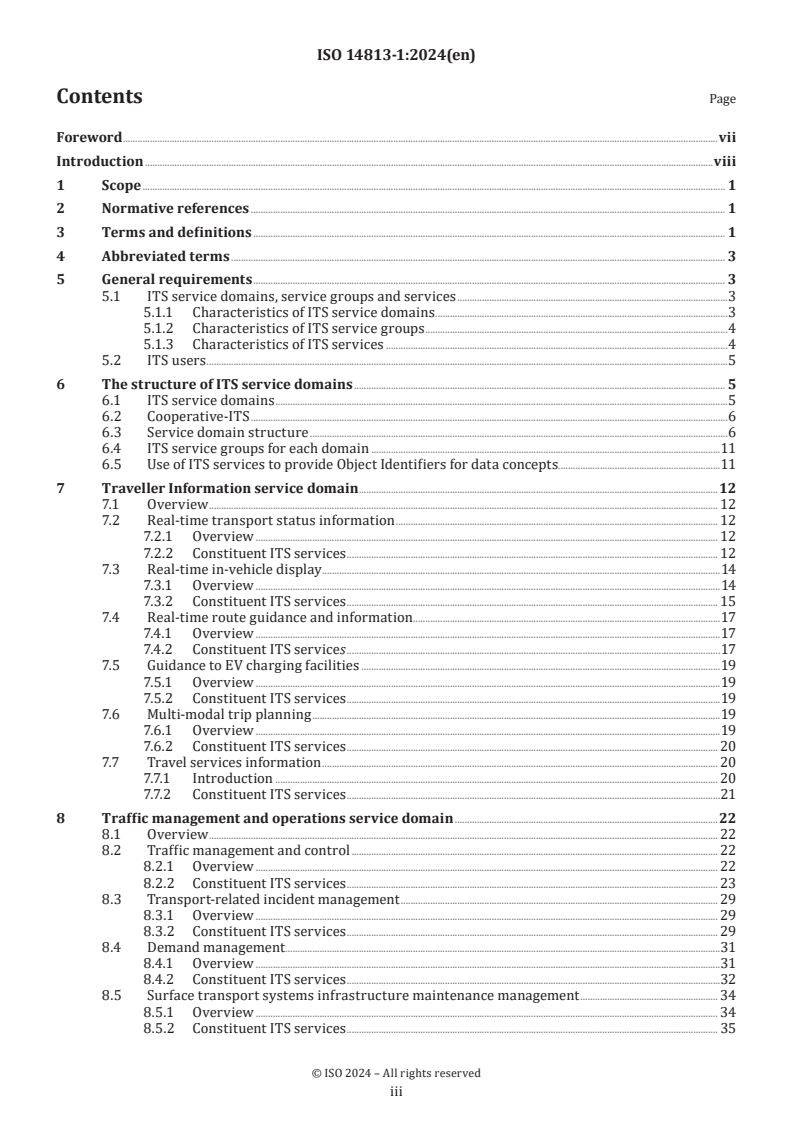
Contents Page
Foreword .vii
Introduction .viii
1 Scope . 1
2 Normative references . 1
3 Terms and definitions . 1
4 Abbreviated terms . 3
5 General requirements . 3
5.1 ITS service domains, service groups and services .3
5.1.1 Characteristics of ITS service domains .3
5.1.2 Characteristics of ITS service groups .4
5.1.3 Characteristics of ITS services .4
5.2 ITS users .5
6 The structure of ITS service domains . 5
6.1 ITS service domains .5
6.2 Cooperative-ITS .6
6.3 Service domain structure .6
6.4 ITS service groups for each domain .11
6.5 Use of ITS services to provide Object Identifiers for data concepts.11
7 Traveller Information service domain .12
7.1 Overview . 12
7.2 Real-time transport status information . 12
7.2.1 Overview . 12
7.2.2 Constituent ITS services . 12
7.3 Real-time in-vehicle display .14
7.3.1 Overview .14
7.3.2 Constituent ITS services . 15
7.4 Real-time route guidance and information .17
7.4.1 Overview .17
7.4.2 Constituent ITS services .17
7.5 Guidance to EV charging facilities .19
7.5.1 Overview .19
7.5.2 Constituent ITS services .19
7.6 Multi-modal trip planning .19
7.6.1 Overview .19
7.6.2 Constituent ITS services . 20
7.7 Travel services information . 20
7.7.1 Introduction . 20
7.7.2 Constituent ITS services .21
8 Traffic management and operations service domain .22
8.1 Overview . 22
8.2 Traffic management and control . 22
8.2.1 Overview . 22
8.2.2 Constituent ITS services . 23
8.3 Transport-related incident management . 29
8.3.1 Overview . 29
8.3.2 Constituent ITS services . 29
8.4 Demand management .31
8.4.1 Overview .31
8.4.2 Constituent ITS services .32
8.5 Surface transport systems infrastructure maintenance management . 34
8.5.1 Overview . 34
8.5.2 Constituent ITS services . 35
iii
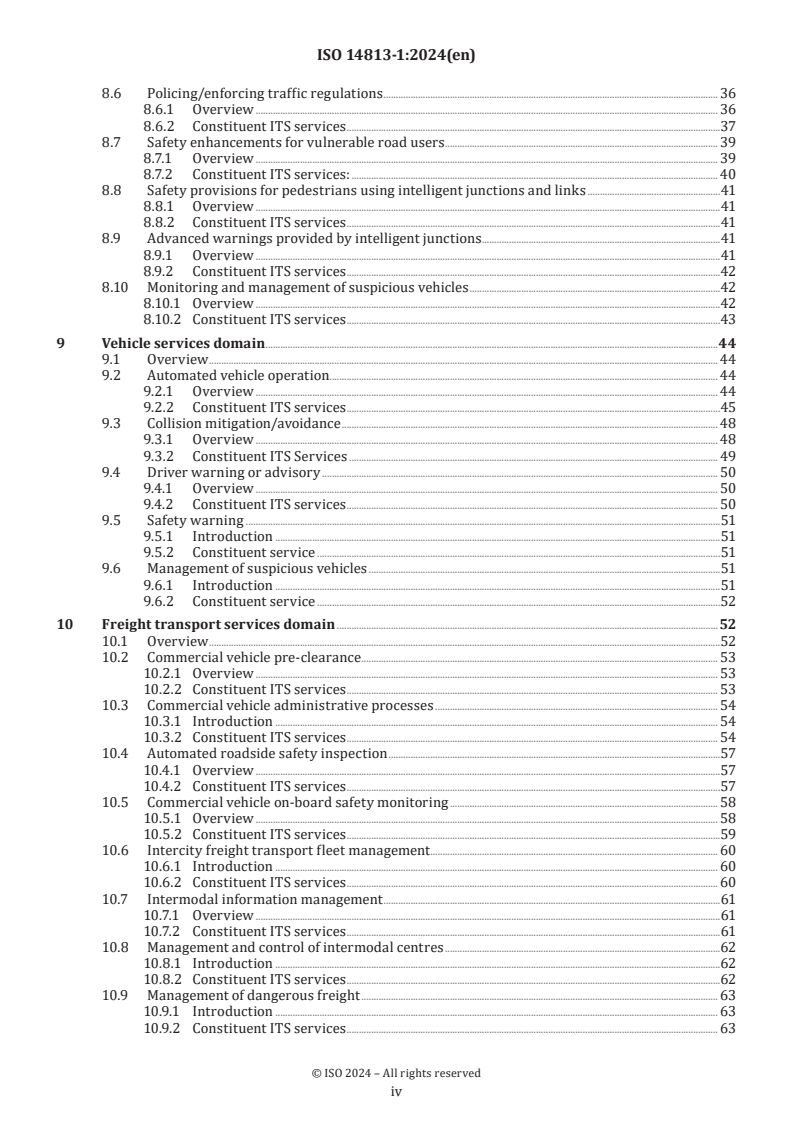
8.6 Policing/enforcing traffic regulations . 36
8.6.1 Overview . 36
8.6.2 Constituent ITS services .37
8.7 Safety enhancements for vulnerable road users . 39
8.7.1 Overview . 39
8.7.2 Constituent ITS services: . 40
8.8 Safety provisions for pedestrians using intelligent junctions and links .41
8.8.1 Overview .41
8.8.2 Constituent ITS services .41
8.9 Advanced warnings provided by intelligent junctions .41
8.9.1 Overview .41
8.9.2 Constituent ITS services .42
8.10 Monitoring and management of suspicious vehicles .42
8.10.1 Overview .42
8.10.2 Constituent ITS services .43
9 Vehicle services domain .44
9.1 Overview . 44
9.2 Automated vehicle operation . 44
9.2.1 Overview . 44
9.2.2 Constituent ITS services .45
9.3 Collision mitigation/avoidance . 48
9.3.1 Overview . 48
9.3.2 Constituent ITS Services . 49
9.4 Driver warning or advisory . 50
9.4.1 Overview . 50
9.4.2 Constituent ITS services . 50
9.5 Safety warning .51
9.5.1 Introduction .51
9.5.2 Constituent service .51
9.6 Management of suspicious vehicles .51
9.6.1 Introduction .51
9.6.2 Constituent service .52
10 Freight transport services domain .52
10.1 Overview .52
10.2 Commercial vehicle pre-clearance . 53
10.2.1 Overview . 53
10.2.2 Constituent ITS services . 53
10.3 Commercial vehicle administrative processes . 54
10.3.1 Introduction . 54
10.3.2 Constituent ITS services . 54
10.4 Automated roadside safety inspection .57
10.4.1 Overview .57
10.4.2 Constituent ITS services .57
10.5 Commercial vehicle on-board safety monitoring . 58
10.5.1 Overview . 58
10.5.2 Constituent ITS services .59
10.6 Intercity freight transport fleet management . 60
10.6.1 Introduction . 60
10.6.2 Constituent ITS services . 60
10.7 Intermodal information management .61
10.7.1 Overview .61
10.7.2 Constituent ITS services .61
10.8 Management and control of intermodal centres .62
10.8.1 Introduction .62
10.8.2 Constituent ITS services .62
10.9 Management of dangerous freight . 63
10.9.1 Introduction . 63
10.9.2 Constituent ITS services . 63
iv
10.10 Management of heavy goods vehicles . 65
10.10.1 Overview . 65
10.10.2 Constituent ITS services . 65
10.11 Management of local delivery vehicles . 66
10.11.1 Overview . 66
10.11.2 Constituent ITS services . 66
10.12 Telematics applications for regulated commercial freight vehicles (TARV) .67
10.12.1 Overview .67
10.12.2 Constituent ITS services . 68
10.13 Freight transport content management .70
10.13.1 Overview .70
10.13.2 Constituent ITS services .70
11 Public transport service domain .71
11.1 Overview .71
11.2 Public transport management .71
11.2.1 Introduction .71
11.2.2 Constituent ITS services . 72
11.3 Demand responsive and shared transport .74
11.3.1 Introduction .74
11.3.2 Constituent ITS services .74
11.4 Automated vehicle operation . 75
11.4.1 Overview . 75
11.4.2 Constituent ITS services . 75
11.5 Public travel security . 75
11.5.1 Overview . 75
11.5.2 Constituent ITS services .76
12 Emergency services service domain.77
12.1 Overview . 77
12.2 Transport-related emergency notification and personal security . 77
12.2.1 Overview . 77
12.2.2 Constituent ITS services . 77
12.3 After theft vehicle recovery . 79
12.3.1 Overview . 79
12.3.2 Constituent ITS services . 79
12.4 Emergency vehicle management . 80
12.4.1 Introduction . 80
12.4.2 Constituent ITS services . 80
12.5 Hazardous materials and incident notification . 81
12.5.1 Overview . 81
12.5.2 Constituent ITS services . 81
13 Payment for transport-related services domain .82
13.1 Overview . 82
13.2 Transport infrastructure usage . 82
13.2.1 Overview . 82
13.2.2 Constituent ITS services . 82
13.3 Mobility service usage . 84
13.3.1 Overview . 84
13.3.2 Constituent ITS services . 84
13.4 Transport-related services . 85
13.4.1 Overview . 85
13.4.2 Constituent ITS services . 85
14 Weather and environmental conditions monitoring services domain .86
14.1 Introduction . 86
14.2 Weather monitoring. 87
14.2.1 Overview . 87
14.2.2 Constituent ITS services . 87
14.3 Environmental conditions monitoring . 88
v
14.3.1 Overview . 88
14.3.2 Constituent ITS services . 88
15 Disaster response management and co-ordination services domain .89
15.1 Overview . 89
15.2 Disaster data management . 89
15.2.1 Overview . 89
15.2.2 Constituent ITS services . 89
15.3 Disaster response and evacuation management . 90
15.3.1 Overview . 90
15.3.2 Constituent ITS services .91
15.4 Coordination with emergency agencies . 93
15.4.1 Introduction . 93
15.4.2 Constituent ITS services . 93
16 Traffic management performance domain .93
16.1 Overview . 93
16.2 Data storage . 94
16.2.1 Introduction . 94
16.2.2 Constituent ITS services . 94
16.3 Simulation . 94
16.3.1 Overview . 94
16.3.2 Constituent ITS services . 95
Annex A (informative) Mapping of services to the US National ITS Architecture (ARC-IT) Service
Packages .97
Annex B (informative) Mapping of services to the European ITS Framework Architecture
(FRAME) User Needs Services and Topics .108
Bibliography .121
vi
Foreword
ISO (the International Organization for Standardization) is a worldwide federation of national standards
bodies (ISO member bodies). The work of preparing International Standards is normally carried out through
ISO technical committees. Each member body interested in a subject for which a technical committee
has been established has the right to be represented on that committee. International organizations,
governmental and non-governmental, in liaison with ISO, also take part in the work. ISO collaborates closely
with the International Electrotechnical Commission (IEC) on all matters of electrotechnical standardization.
The procedures used to develop this document and those intended for its further maintenance are described
in the ISO/IEC Directives, Part 1. In particular, the different approval criteria needed for the different types
of ISO document should be noted. This document was drafted in accordance with the editorial rules of the
ISO/IEC Directives, Part 2 (see www.iso.org/directives).
ISO draws attention to the possibility that the implementation of this document may involve the use of (a)
patent(s). ISO takes no position concerning the evidence, validity or applicability of any claimed patent
rights in respect thereof. As of the date of publication of this document, ISO had not received notice of (a)
patent(s) which may be required to implement this document. However, implementers are cautioned that
this may not represent the latest information, which may be obtained from the patent database available at
www.iso.org/patents. ISO shall not be held responsible for identifying any or all such patent rights.
Any trade name used in this document is information given for the convenience of users and does not
constitute an endorsement.
For an explanation of the voluntary nature of standards, the meaning of ISO specific terms and expressions
related to conformity assessment, as well as information about ISO's adherence to the World Trade
Organization (WTO) principles in the Technical Barriers to Trade (TBT), see www.iso.org/iso/foreword.html.
This document was prepared by Technical Committee ISO/TC 204, Intelligent transport systems.
This third edition cancels and replaces the second edition (ISO 14813-1:2015), which has been technically
revised.
The main changes are as follows:
— the list of services has been reorganized (to reduce redundancy) and updated:
— in Clauses 7 to 16 some services have been added and others deleted, whilst others have been modified
to reflect the continual evolution of ITS; this has been reflected in Table 2;
— in Clauses 7 to 16, the structure of the description of each service has been revised to create a more
consistent representation of the services;
— as a result of the above changes, the Introduction and content of Clauses 1 to 5 have been updated;
— a mapping of the services to the US ITS reference architecture reference [Architecture Reference for
Cooperative and Intelligent Transportation (ARC-IT)], has been provided in Annex A;
— a mapping of the services to the European ITS Framework Architecture (FRAME), has been provided in
Annex B.
A list of all parts in the ISO 14813 series can be found on the ISO website.
Any feedback or questions on this document should be directed to the user’s national standards body. A
complete listing of these bodies can be found at www.iso.org/members.html.
vii
Introduction
Intelligent transport systems (ITS) service domains and groups reflect the evolution of technology-oriented
transportation practices and applications. So far, this has been in the surface transport systems domain, but
ITS is also beginning to appear in other domains, such as maritime and rail transport. This has become of
increasing importance and interest as the scope of ITS expands beyond its original range of services in road
traffic management, traveller information and electronic payment systems.
ITS addresses services in the following areas of the surface transport systems domain:
— transport network operations and maintenance activities;
— freight mobility and inter-modal connectivity;
— multi-modal travel, including both pre-trip and on-trip information and journey planning where the trip
starts and/or finishes in the surface transport systems domain;
— variable road pricing strategies for freight and personal travel;
— response activities and coordination related to emergencies and natural disasters;
— national security needs related to transportation infrastructure;
— cooperative-ITS (sometimes referred to as “connected vehicles” or “connected vehicle/highway
systems”).
Services in some of these areas also interface with more generalized activities and environments outside the
surface transport systems domain. For example, it is possible for road pricing and revenue systems activities
to interface with electronic commerce (eCommerce) activities, and thus utilize standards and principles
associated with the banking industry along with generally accepted accounting principles. The addressing
of national security and coordination issues also requires that specific national standards related to civil
defence, emergency communications, and other procedures be addressed. These interfaces, while largely
outside the scope of ISO/TC 204, are nevertheless critical external influences on the functionality of the
various services supported by ITS service domains and groups.
This document has been developed to define ITS service domains, service groups and services into which
ISO/TC 204 documents can be mapped for a more structured context. This structure can then assist in the
identification of areas that are not yet fully addressed by the documents created and managed by ISO/TC 204.
To this end, the ITS servic
...