

ISO/TS 20955:2024
(Main)Footwear — Performance requirements for components for footwear — Insoles
General Information
- Abstract
This document establishes the performance requirements for insole components for footwear in order to assess the suitability for the end use and/or fitness for purpose. It also establishes the test methods to be used to evaluate the compliance with the requirements. This document applies to insoles for all kinds of footwear as defined in Clause 4. This document can be used as a reference by the manufacturer and the supplier.
- Status
- Published
- Publication Date
- 18-Nov-2024
- Technical Committee
- ISO/TC 216 - Footwear
- Drafting Committee
- ISO/TC 216 - Footwear
- Current Stage
- 6060 - International Standard published
- Start Date
- 19-Nov-2024
- Due Date
- 17-Nov-2024
- Completion Date
- 19-Nov-2024
Overview
ISO/TS 20955:2024 is an essential technical specification established by the International Organization for Standardization (ISO) that defines the performance requirements for insole components used in all kinds of footwear. This standard aims to assess the suitability and fitness for purpose of insoles to ensure quality, durability, and functionality for various footwear applications. Additionally, it specifies the test methods necessary to evaluate insoles' compliance with these requirements.
Intended as a reliable reference for footwear manufacturers and suppliers, ISO/TS 20955:2024 helps standardize insole performance criteria, supporting consistency in product quality and consumer satisfaction across the footwear industry.
Key Topics
Scope and Classification
The standard applies to insoles for all footwear types, classified into four exposure classes based on intended use:- Class A: Infant shoes, slippers, indoor, fashion shoes
- Class B: Casual shoes including children’s, school shoes, adult work shoes (non-PPE)
- Class C: General sports shoes, heavy work shoes, trekking and hiking footwear
- Class D: Purpose-specific heavy-duty sports shoes
Performance Requirements
ISO/TS 20955 outlines essential and additional requirements for insoles, including:- Delamination resistance to ensure structural integrity of different insole layers under dry and wet conditions
- Resistance to stitch tear for sewn insoles to prevent mechanical failure
- Abrasion resistance mainly for rigid insole components like shank boards, tested to withstand wear cycles
- Heel pin holding strength crucial for stability and attachment of heel components, with thresholds tied to heel height
- Dimensional stability, limiting shrinkage and size increase to within 2% during use
- Water absorption and desorption as an additional criterion evaluating moisture management
Test Methods
The specification references ISO-standardized test methods such as ISO 20866 (delamination), ISO 20867 (heel pin holding strength), ISO 20868 (abrasion), ISO 20876 (stitch tear), and ISO 22651 (dimensional stability), ensuring uniform evaluation practices.Marking and Labelling
Products meeting all essential requirements can be optionally marked with the manufacturer’s identification, intended footwear class, and reference to ISO/TS 20955:2024 - enabling traceability and consumer confidence while maintaining discretion in finished footwear.
Applications
ISO/TS 20955:2024 is vital for a broad range of stakeholders in the footwear industry, including:
Footwear Manufacturers
Use this standard to verify insole components meet performance and durability criteria, improving product reliability and reducing returns or warranty claims.Component Suppliers
Adopting ISO/TS 20955 allows suppliers to align product specifications with industry best practices, facilitating smoother collaboration with footwear brands and enhancing market competitiveness.Quality Assurance and Testing Labs
Provides a validated framework for consistent testing and certification of insoles, ensuring compliance with international benchmarks and facilitating global trade.Design and Engineering Teams
Guides material selection and design decisions based on performance thresholds for different footwear categories, optimizing comfort, safety, and longevity.
This standard supports the development of footwear optimized for specific activities, environments, or user requirements by ensuring the insole performs as intended under expected conditions.
Related Standards
ISO/TS 20955:2024 complements several other ISO standards related to footwear components and testing, including:
- ISO 17709 - Sampling location and preparation of samples, ensuring uniformity in test specimen selection
- ISO 19952 - Footwear vocabulary, providing consistent terminology
- ISO 20866 to ISO 20868 - Various test methods for insoles covering delamination, heel pin strength, abrasion, and stitch tear
- ISO 22649 and ISO 22651 - Water absorption and dimensional stability testing for insoles and insocks
- ISO 80000-1 - Quantities and units, standardizing measurement and rounding procedures
Compliance with ISO/TS 20955:2024 alongside these standards helps manufacturers maintain comprehensive quality and performance adherence throughout the footwear production process.
By following ISO/TS 20955:2024, footwear industry professionals ensure insole components meet rigorous performance benchmarks, enhancing product quality and consumer satisfaction while supporting international market access through standardized testing and documentation.
Frequently Asked Questions
ISO/TS 20955:2024 is a technical specification published by the International Organization for Standardization (ISO). Its full title is "Footwear — Performance requirements for components for footwear — Insoles". This standard covers: This document establishes the performance requirements for insole components for footwear in order to assess the suitability for the end use and/or fitness for purpose. It also establishes the test methods to be used to evaluate the compliance with the requirements. This document applies to insoles for all kinds of footwear as defined in Clause 4. This document can be used as a reference by the manufacturer and the supplier.
This document establishes the performance requirements for insole components for footwear in order to assess the suitability for the end use and/or fitness for purpose. It also establishes the test methods to be used to evaluate the compliance with the requirements. This document applies to insoles for all kinds of footwear as defined in Clause 4. This document can be used as a reference by the manufacturer and the supplier.
ISO/TS 20955:2024 is classified under the following ICS (International Classification for Standards) categories: 61.060 - Footwear. The ICS classification helps identify the subject area and facilitates finding related standards.
ISO/TS 20955:2024 is available in PDF format for immediate download after purchase. The document can be added to your cart and obtained through the secure checkout process. Digital delivery ensures instant access to the complete standard document.
Standards Content (Sample)
Technical
Specification
ISO/TS 20955
First edition
Footwear — Performance
2024-11
requirements for components for
footwear — Insoles
Chaussures — Exigences de performance pour les composants des
chaussures — Premières de montage
Reference number
© ISO 2024
All rights reserved. Unless otherwise specified, or required in the context of its implementation, no part of this publication may
be reproduced or utilized otherwise in any form or by any means, electronic or mechanical, including photocopying, or posting on
the internet or an intranet, without prior written permission. Permission can be requested from either ISO at the address below
or ISO’s member body in the country of the requester.
ISO copyright office
CP 401 • Ch. de Blandonnet 8
CH-1214 Vernier, Geneva
Phone: +41 22 749 01 11
Email: copyright@iso.org
Website: www.iso.org
Published in Switzerland
ii
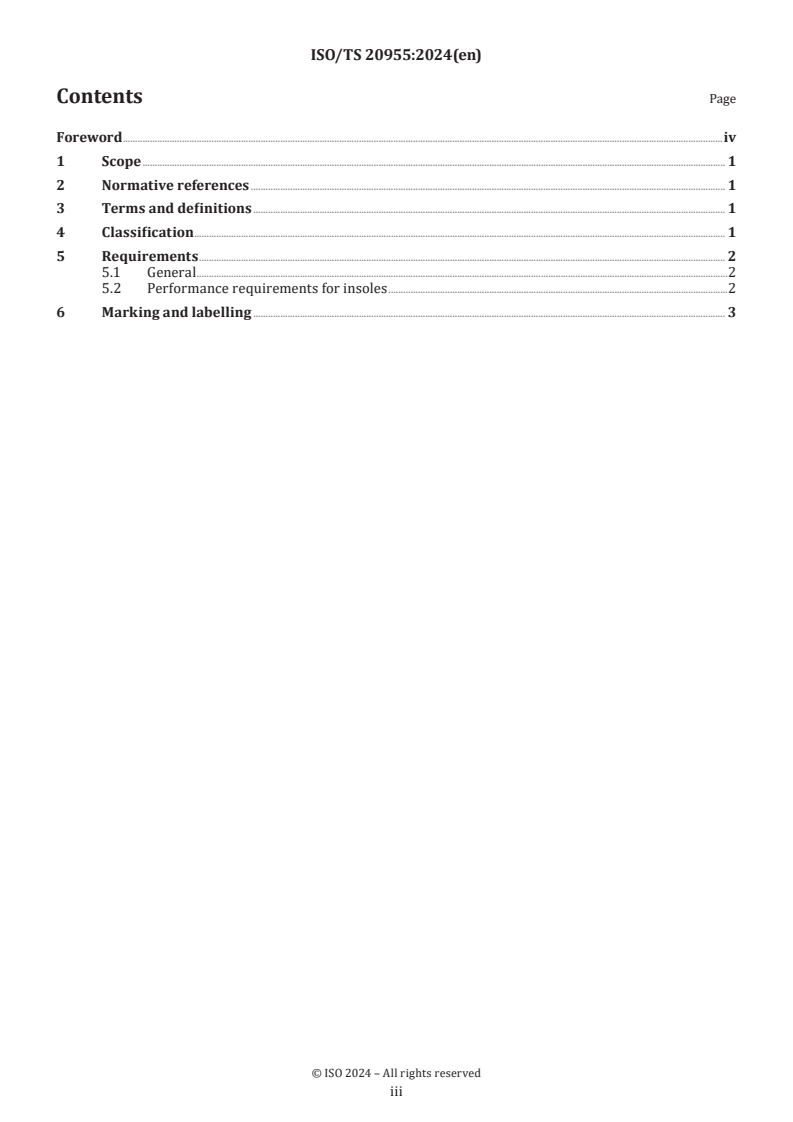
Contents Page
Foreword .iv
1 Scope . 1
2 Normative references . 1
3 Terms and definitions . 1
4 Classification . 1
5 Requirements . 2
5.1 General .2
5.2 Performance requirements for insoles .2
6 Marking and labelling . 3
iii
Foreword
ISO (the International Organization for Standardization) is a worldwide federation of national standards
bodies (ISO member bodies). The work of preparing International Standards is normally carried out through
ISO technical committees. Each member body interested in a subject for which a technical committee
has been established has the right to be represented on that committee. International organizations,
governmental and non-governmental, in liaison with ISO, also take part in the work. ISO collaborates closely
with the International Electrotechnical Commission (IEC) on all matters of electrotechnical standardization.
The procedures used to develop this document and those intended for its further maintenance are described
in the ISO/IEC Directives, Part 1. In particular, the different approval criteria needed for the different types
of ISO documents should be noted. This document was drafted in accordance with the editorial rules of the
ISO/IEC Directives, Part 2 (see www.iso.org/directives).
ISO draws attention to the possibility that the implementation of this document may involve the use of (a)
patent(s). ISO takes no position concerning the evidence, validity or applicability of any claimed patent
rights in respect thereof. As of the date of publication of this document, ISO had not received notice of (a)
patent(s) which may be required to implement this document. However, implementers are cautioned that
this may not represent the latest information, which may be obtained from the patent database available at
www.iso.org/patents. ISO shall not be held responsible for identifying any or all such patent rights.
Any trade name used in this document is information given for the convenience of users and does not
constitute an endorsement.
For an explanation of the voluntary nature of standards, the meaning of ISO specific terms and expressions
related to conformity assessment, as well as information about ISO's adherence to the World Trade
Organization (WTO) principles in the Technical Barriers to Trade (TBT), see www.iso.org/iso/foreword.html.
This document was p
...