

ISO/TS 20953:2024
(Main)Footwear — Performance requirements for components for footwear — Lining and insocks
General Information
- Abstract
This document establishes the performance requirements for lining and insock components for footwear, irrespective of the material, in order to assess the suitability for the end use and/or fitness for purpose. It also establishes the test methods to be used to evaluate compliance with these requirements. This document applies to lining and insocks for all kinds of footwear as defined in Clause 4. This document can be used as a reference by the manufacturer and the supplier.
- Status
- Published
- Publication Date
- 18-Nov-2024
- Technical Committee
- ISO/TC 216 - Footwear
- Drafting Committee
- ISO/TC 216 - Footwear
- Current Stage
- 6060 - International Standard published
- Start Date
- 19-Nov-2024
- Due Date
- 17-Nov-2024
- Completion Date
- 19-Nov-2024
Overview
ISO/TS 20953:2024 is a technical specification established by the International Organization for Standardization (ISO) that sets performance requirements for footwear components-specifically linings and insocks. This standard applies regardless of the material used and aims to ensure the components' suitability for their intended use and overall fitness for purpose. It provides manufacturers and suppliers with uniform test methods to evaluate compliance with essential and additional performance criteria. The document covers all types of footwear, including infant, casual, work, sport, trekking, and heavy-duty shoes, making it a comprehensive reference for footwear component quality standards.
Key Topics
- Classification of Footwear Components: The standard classifies footwear into four exposure categories (Classes A to D), ranging from slight to heavy use, covering infant slippers to heavy-purpose sports shoes.
- Performance Requirements:
- Essential requirements must always be met and include tear strength, seam strength, abrasion resistance, color fastness, water vapor permeability, and resistance to staining.
- Additional requirements, such as perspiration resistance and flex resistance, can be agreed upon between component suppliers and manufacturers.
- Test Methods: ISO/TS 20953:2024 references numerous test methods for evaluating lining and insock performance, including:
- Tear strength (ISO 17696)
- Seam strength (ISO 17697)
- Abrasion resistance (ISO 17704)
- Water vapor permeability (ISO 17699)
- Color fastness to rubbing (ISO 17700)
- Water absorption and desorption (ISO 22649)
- Perspiration resistance (ISO 22652)
- Flex resistance for coated materials (ISO 17694)
- Marking and Labelling: Optional marking to indicate compliance with this standard must include the manufacturer's identification, the footwear class, and a reference to ISO/TS 20953:2024. The markings should not be visible on the finished footwear.
Applications
ISO/TS 20953:2024 is crucial for both footwear component manufacturers and footwear producers who aim to guarantee the quality and durability of linings and insocks across multiple footwear categories:
- Footwear Manufacturing: Ensures components meet rigorous performance criteria, preventing failures common in linings and insocks that affect user comfort and product longevity.
- Quality Assurance: Provides standardized test procedures to audit and verify component quality consistently.
- Material Selection: Helps in selecting suitable materials for linings and insocks based on the class of footwear and expected usage conditions.
- Product Development: Supports innovation by defining baseline performance parameters for new footwear designs and technologies.
- Supplier Verification: Offers suppliers a benchmark to demonstrate compliance and reliability to manufacturers.
- Customer Confidence: Facilitates clear communication about product quality and durability, enhancing brand reputation and consumer trust.
Related Standards
ISO/TS 20953:2024 aligns with and references a suite of other ISO standards that provide detailed test methods and terminology supporting footwear component performance evaluation:
- ISO 17694: Test methods for flex resistance of uppers and linings
- ISO 17696: Tear strength testing for uppers, linings, and insocks
- ISO 17697: Seam strength testing of uppers, linings, and insocks
- ISO 17699: Water vapor permeability and absorption tests for uppers and linings
- ISO 17700: Color fastness to rubbing and bleeding for upper components and insocks
- ISO 17704: Abrasion resistance of uppers, linings, and insocks
- ISO 17709: Sampling, preparation, and conditioning of samples for testing
- ISO 19952: Footwear vocabulary and definitions
- ISO 22649: Water absorption and desorption tests for insoles and insocks
- ISO 22652: Perspiration resistance tests for insoles, linings, and insocks
- ISO 80000-1: General quantities and units for consistent measurement reporting
By integrating these standards, ISO/TS 20953:2024 ensures a holistic approach to evaluating footwear lining and insock components, providing a robust quality framework for the footwear industry.
Keywords: ISO/TS 20953:2024, footwear performance requirements, footwear lining standards, insock quality, footwear component testing, abrasion resistance, tear strength, water vapor permeability, footwear classification, footwear manufacturing standards, lining and insock test methods.
Frequently Asked Questions
ISO/TS 20953:2024 is a technical specification published by the International Organization for Standardization (ISO). Its full title is "Footwear — Performance requirements for components for footwear — Lining and insocks". This standard covers: This document establishes the performance requirements for lining and insock components for footwear, irrespective of the material, in order to assess the suitability for the end use and/or fitness for purpose. It also establishes the test methods to be used to evaluate compliance with these requirements. This document applies to lining and insocks for all kinds of footwear as defined in Clause 4. This document can be used as a reference by the manufacturer and the supplier.
This document establishes the performance requirements for lining and insock components for footwear, irrespective of the material, in order to assess the suitability for the end use and/or fitness for purpose. It also establishes the test methods to be used to evaluate compliance with these requirements. This document applies to lining and insocks for all kinds of footwear as defined in Clause 4. This document can be used as a reference by the manufacturer and the supplier.
ISO/TS 20953:2024 is classified under the following ICS (International Classification for Standards) categories: 61.060 - Footwear. The ICS classification helps identify the subject area and facilitates finding related standards.
ISO/TS 20953:2024 is available in PDF format for immediate download after purchase. The document can be added to your cart and obtained through the secure checkout process. Digital delivery ensures instant access to the complete standard document.
Standards Content (Sample)
Technical
Specification
ISO/TS 20953
First edition
Footwear — Performance
2024-11
requirements for components for
footwear — Lining and insocks
Chaussures — Exigences de performance pour les composants des
chaussures — Doublures et premières de propreté
Reference number
© ISO 2024
All rights reserved. Unless otherwise specified, or required in the context of its implementation, no part of this publication may
be reproduced or utilized otherwise in any form or by any means, electronic or mechanical, including photocopying, or posting on
the internet or an intranet, without prior written permission. Permission can be requested from either ISO at the address below
or ISO’s member body in the country of the requester.
ISO copyright office
CP 401 • Ch. de Blandonnet 8
CH-1214 Vernier, Geneva
Phone: +41 22 749 01 11
Email: copyright@iso.org
Website: www.iso.org
Published in Switzerland
ii
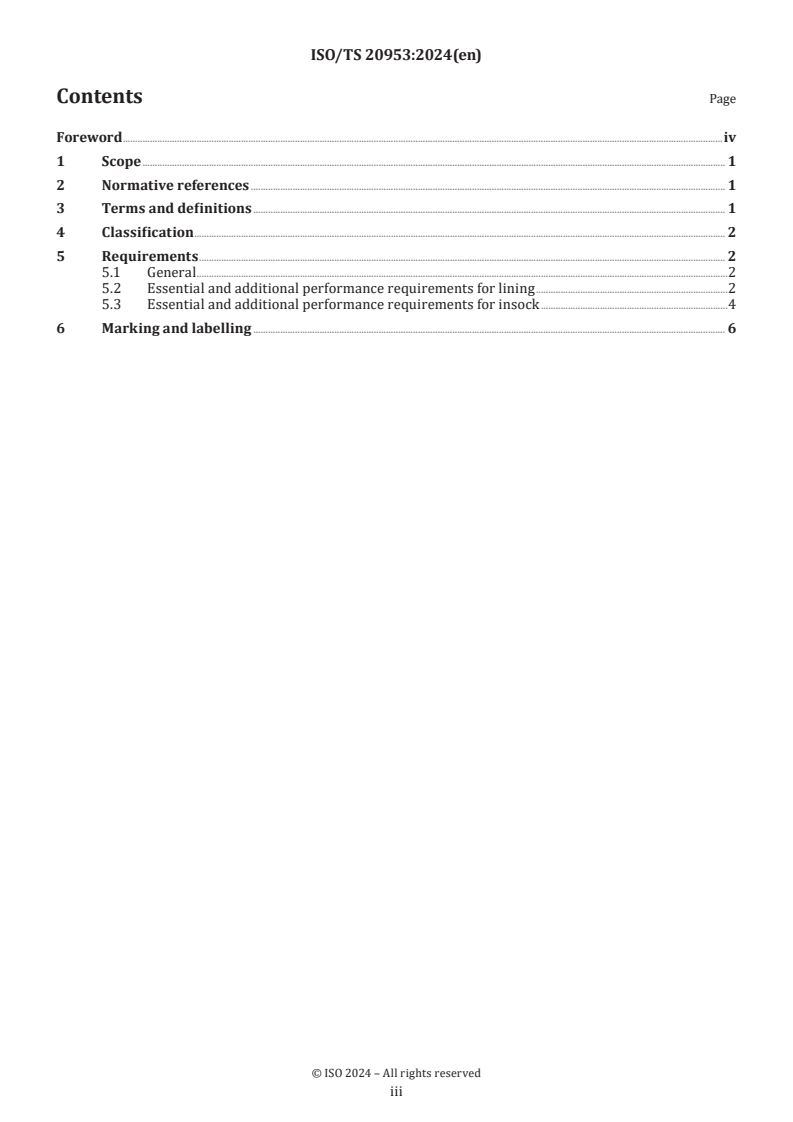
Contents Page
Foreword .iv
1 Scope . 1
2 Normative references . 1
3 Terms and definitions . 1
4 Classification . 2
5 Requirements . 2
5.1 General .2
5.2 Essential and additional performance requirements for lining .2
5.3 Essential and additional performance requirements for insock .4
6 Marking and labelling . 6
iii
Foreword
ISO (the International Organization for Standardization) is a worldwide federation of national standards
bodies (ISO member bodies). The work of preparing International Standards is normally carried out through
ISO technical committees. Each member body interested in a subject for which a technical committee
has been established has the right to be represented on that committee. International organizations,
governmental and non-governmental, in liaison with ISO, also take part in the work. ISO collaborates closely
with the International Electrotechnical Commission (IEC) on all matters of electrotechnical standardization.
The procedures used to develop this document and those intended for its further maintenance are described
in the ISO/IEC Directives, Part 1. In particular, the different approval criteria needed for the different types
of ISO documents should be noted. This document was drafted in accordance with the editorial rules of the
ISO/IEC Directives, Part 2 (see www.iso.org/directives).
ISO draws attention to the possibility that the implementation of this document may involve the use of (a)
patent(s). ISO takes no position concerning the evidence, validity or applicability of any claimed patent
rights in respect thereof. As of the date of publication of this document, ISO had not received notice of (a)
patent(s) which may be required to implement this document. However, implementers are cautioned that
this may not represent the latest information, which may be obtained from the patent database available at
www.iso.org/patents. ISO shall not be held responsible for identifying any or all such patent rights.
Any trade name used in this document is information given for the convenience of users and does not
constitute an endorsement.
For an explanation of the voluntary nature of standards, the meaning of ISO specific terms and expressions
related to conformity assessment, as well as information about ISO's adherence to the World Trade
Organization (WTO) principles in the Technical Barriers to Trade (TBT), see www.iso.org/iso/foreword.html.
This document was prepared by Technical Committee ISO/TC 216, Footwear.
Any feedback or questions on this document should be directed to the user’s national standards body. A
complete listing of these bodies can be found at www.iso.org/members.html.
iv
Technical Specification ISO/TS 20953:2024(en)
Footwear — Performance requirements for components for
footwear — Lining and insocks
1 Scope
This document establishes the performance requirements for lining and insock components for footwear,
irrespective of the material, in order to assess the suitability for the end use and/or fitness for purpose. It
also establishes the test methods to be used to evaluate compliance with these requirements.
This document applies to lining and insocks for all kinds of footwear as defined in Clause 4.
This document can be used as a reference by the manufacturer and the supplier.
2 Normative references
The following documents are referred to in the text in such a way that some or all of their content constitutes
requirements of this document. For dated references, only the edition cited applies. For undated references,
the
...