

ISO/TS 20995:2024
(Main)Footwear — Performance requirements for components for footwear — Stiffeners and toe puffs
General Information
- Abstract
This document establishes the performance requirements for stiffener and toe puff components for footwear, in order to assess the suitability for the end use and/or fitness for purpose. It also establishes the test methods to be used to evaluate the compliance with the requirements. This document applies to stiffeners and toe puffs for all kinds of footwear as defined in Table 1. This document can be used as a reference by the manufacturer and the supplier. This document does not establish the degrees of hardness, that are to be chosen by the manufacturer.
- Status
- Published
- Publication Date
- 18-Nov-2024
- Technical Committee
- ISO/TC 216 - Footwear
- Drafting Committee
- ISO/TC 216 - Footwear
- Current Stage
- 6060 - International Standard published
- Start Date
- 19-Nov-2024
- Due Date
- 17-Nov-2024
- Completion Date
- 19-Nov-2024


Overview
ISO/TS 20995:2024 specifies performance requirements and test methods for stiffeners and toe puffs used in footwear. The Technical Specification is intended as a reference for manufacturers and suppliers to assess component suitability for end use and fitness for purpose. It applies to stiffeners and toe puffs for all kinds of footwear as classified in the document and defines when and how samples shall be prepared and tested.
Key Topics
- Classification: Components are classified by exposure and shoe type (Classes A–D), ranging from slight (infant and fashion shoes) to heavy (trekking, work and similar sports shoes).
- Test methods: The document references established test procedures including ISO 20863 (bondability), ISO 20864 (mechanical characteristics and resilience), and ISO 48-4 (Shore hardness). Sample preparation and conditioning follow ISO 17709.
- Performance requirements: Table 2 in the specification lists class-specific requirements addressing:
- Bondability: Minimum bond strength thresholds in dry and wet conditions, with different criteria when a lining is present or absent.
- Mechanical characteristics: Shape retention after repeated deformations and collapsing-load resilience requirements to ensure durability and function.
- Hardness: Class-based hardness ranges as determined by ISO 48-4 (Shore):
- Class A: ≤ 30 N
- Class B: 30 N to 80 N
- Class C: 80 N to 130 N
- Class D: ≥ 130 N
- Resilience (ISO 20864): Minimum resilience percentages increase by class (e.g., Class A higher than Class D).
- Moisture resistance: Minimum moisture-resistance requirements are specified per class to reflect intended use and exposure.
Applications
This Technical Specification is practical for:
- Footwear component manufacturers validating bondability, shape retention, resilience, hardness, and moisture resistance of stiffeners and toe puffs.
- Suppliers providing traceable data to footwear brands and converters to demonstrate component fitness for specific shoe classes.
- Product development and quality control teams integrating standardized test methods into acceptance criteria and supplier specifications.
By following ISO/TS 20995:2024, organizations can align component evaluation with international test methods and class-based performance expectations, reducing risk of premature failure and ensuring consistent product performance.
Related Standards
- ISO 20863 - Footwear - Test methods for stiffeners and toepuffs - Bondability
- ISO 20864 - Footwear - Test methods for stiffeners and toepuffs - Mechanical characteristics
- ISO 48-4 - Rubber - Determination of hardness (Shore)
- ISO 17709 - Footwear - Sampling location, preparation and conditioning
Note: Marking and labelling of compliant stiffeners and toe puffs is optional. If used, references to ISO/TS 20995:2024 and the intended footwear class must be clearly indicated by the manufacturer as specified in the document.
Frequently Asked Questions
ISO/TS 20995:2024 is a technical specification published by the International Organization for Standardization (ISO). Its full title is "Footwear — Performance requirements for components for footwear — Stiffeners and toe puffs". This standard covers: This document establishes the performance requirements for stiffener and toe puff components for footwear, in order to assess the suitability for the end use and/or fitness for purpose. It also establishes the test methods to be used to evaluate the compliance with the requirements. This document applies to stiffeners and toe puffs for all kinds of footwear as defined in Table 1. This document can be used as a reference by the manufacturer and the supplier. This document does not establish the degrees of hardness, that are to be chosen by the manufacturer.
This document establishes the performance requirements for stiffener and toe puff components for footwear, in order to assess the suitability for the end use and/or fitness for purpose. It also establishes the test methods to be used to evaluate the compliance with the requirements. This document applies to stiffeners and toe puffs for all kinds of footwear as defined in Table 1. This document can be used as a reference by the manufacturer and the supplier. This document does not establish the degrees of hardness, that are to be chosen by the manufacturer.
ISO/TS 20995:2024 is classified under the following ICS (International Classification for Standards) categories: 61.060 - Footwear. The ICS classification helps identify the subject area and facilitates finding related standards.
ISO/TS 20995:2024 is available in PDF format for immediate download after purchase. The document can be added to your cart and obtained through the secure checkout process. Digital delivery ensures instant access to the complete standard document.
Standards Content (Sample)
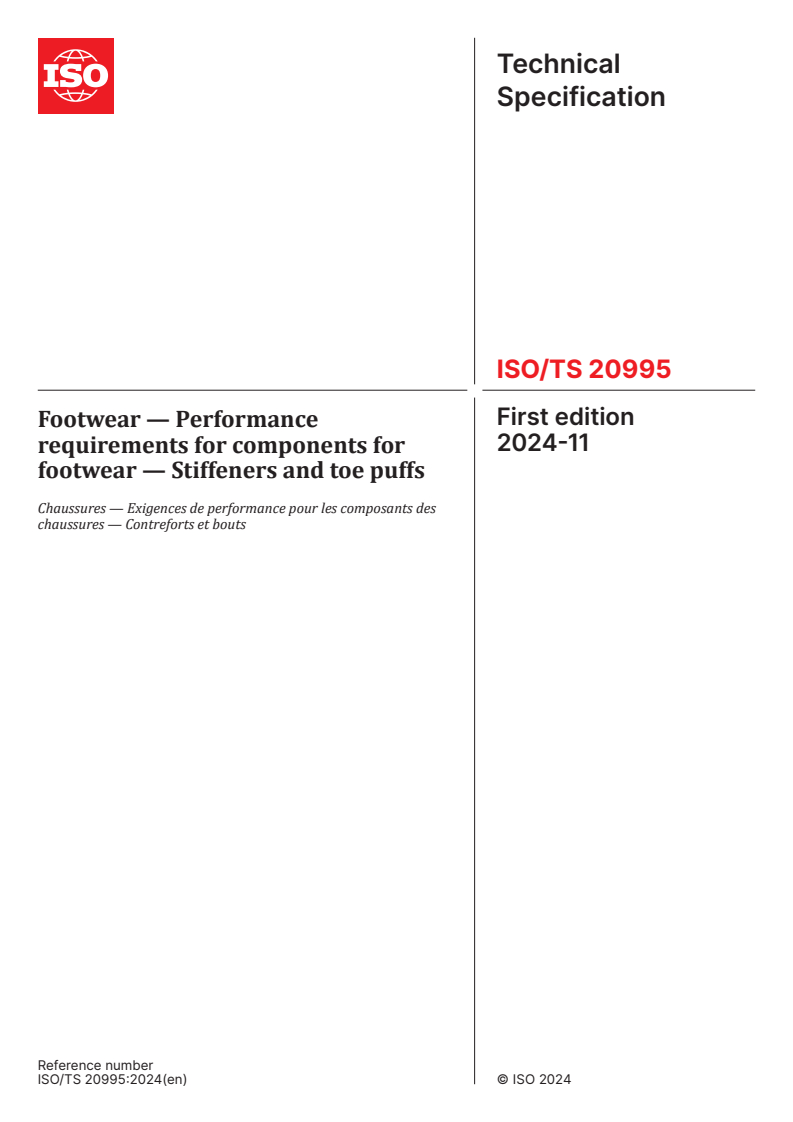
Technical
Specification
ISO/TS 20995
First edition
Footwear — Performance
2024-11
requirements for components for
footwear — Stiffeners and toe puffs
Chaussures — Exigences de performance pour les composants des
chaussures — Contreforts et bouts
Reference number
© ISO 2024
All rights reserved. Unless otherwise specified, or required in the context of its implementation, no part of this publication may
be reproduced or utilized otherwise in any form or by any means, electronic or mechanical, including photocopying, or posting on
the internet or an intranet, without prior written permission. Permission can be requested from either ISO at the address below
or ISO’s member body in the country of the requester.
ISO copyright office
CP 401 • Ch. de Blandonnet 8
CH-1214 Vernier, Geneva
Phone: +41 22 749 01 11
Email: copyright@iso.org
Website: www.iso.org
Published in Switzerland
ii
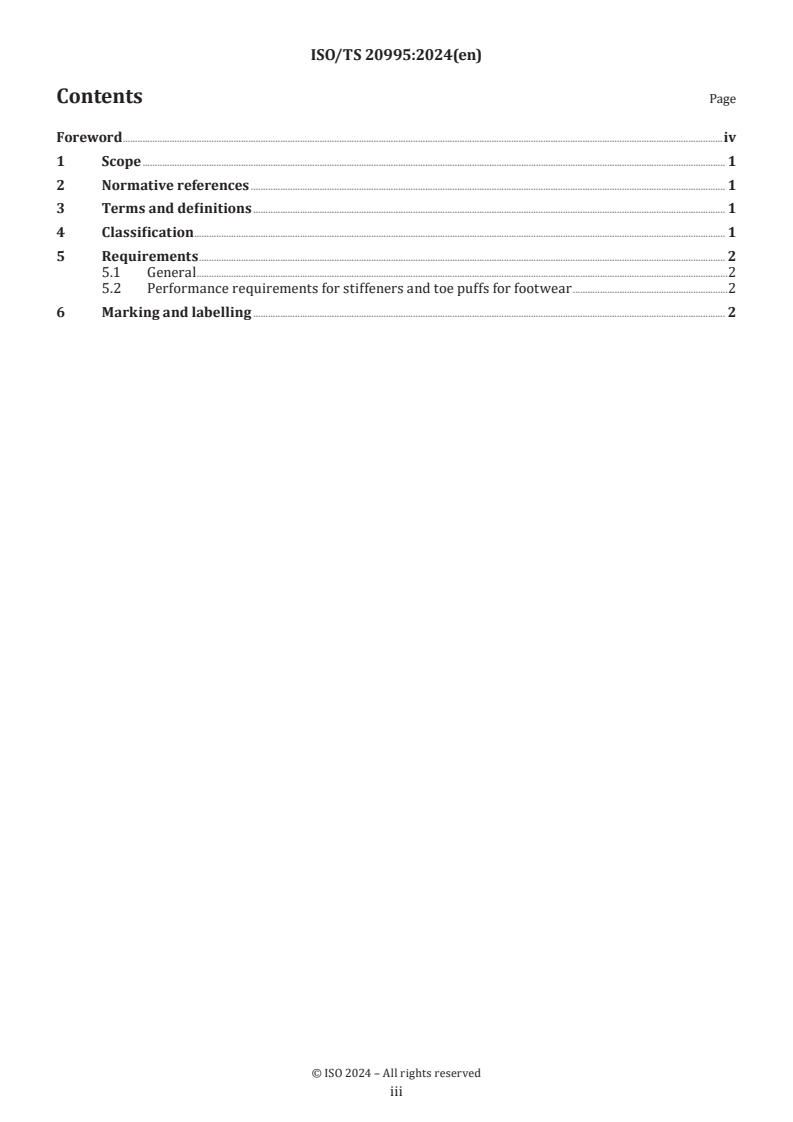
Contents Page
Foreword .iv
1 Scope . 1
2 Normative references . 1
3 Terms and definitions . 1
4 Classification . 1
5 Requirements . 2
5.1 General .2
5.2 Performance requirements for stiffeners and toe puffs for footwear .2
6 Marking and labelling . 2
iii
Foreword
ISO (the International Organization for Standardization) is a worldwide federation of national standards
bodies (ISO member bodies). The work of preparing International Standards is normally carried out through
ISO technical committees. Each member body interested in a subject for which a technical committee
has been established has the right to be represented on that committee. International organizations,
governmental and non-governmental, in liaison with ISO, also take part in the work. ISO collaborates closely
with the International Electrotechnical Commission (IEC) on all matters of electrotechnical standardization.
The procedures used to develop this document and those intended for its further maintenance are described
in the ISO/IEC Directives, Part 1. In particular, the different approval criteria needed for the different types
of ISO documents should be noted. This document was drafted in accordance with the editorial rules of the
ISO/IEC Directives, Part 2 (see www.iso.org/directives).
ISO draws attention to the possibility that the implementation of this document may involve the use of (a)
patent(s). ISO takes no position concerning the evidence, validity or applicability of any claimed patent
rights in respect thereof. As of the date of publication of this document, ISO had not received notice of (a)
patent(s) which may be required to implement this document. However, implementers are cautioned that
this may not represent the latest information, which may be obtained from the patent database available at
www.iso.org/patents. ISO shall not be held responsible for identifying any or all such patent rights.
Any trade name used in this document is information given for the convenience of users and does not
cons
...