

ISO/TS 20961:2024
(Main)Footwear — Performance requirements for components for footwear — Shanks
General Information
- Abstract
This document establishes the performance requirements for shank components for footwear, irrespective of the material, in order to assess the suitability for the end use and/or fitness for purpose. It also establishes the test methods to be used to evaluate the compliance with the requirements. This document applies to shanks for all kinds of footwear as defined in Clause 4. This document can be used as a reference by the manufacturer and the supplier.
- Status
- Published
- Publication Date
- 18-Nov-2024
- Technical Committee
- ISO/TC 216 - Footwear
- Drafting Committee
- ISO/TC 216 - Footwear
- Current Stage
- 6060 - International Standard published
- Start Date
- 19-Nov-2024
- Due Date
- 17-Nov-2024
- Completion Date
- 19-Nov-2024

Overview
ISO/TS 20961:2024 specifies performance requirements and associated test methods for shank components used in footwear, irrespective of material. The Technical Specification is intended to help manufacturers and suppliers assess the suitability of shanks for end use and to verify fitness for purpose. It establishes essential performance thresholds and references the relevant test methods and sampling procedures.
Key Topics
- Scope and purpose: Applies to shanks for all kinds of footwear as defined in the document and can be used as a reference by manufacturers and suppliers.
- Classification: Footwear is classified by exposure into four classes to reflect intended use:
- A (slight) - infant shoes, slippers, indoor and fashion shoes
- B (medium) - casual shoes, school shoes, some adult work shoes (not PPE)
- C (high) - sport shoes, heavy work shoes (not PPE), trekking/hiking
- D (heavy) - purpose sports shoes
- Performance requirements: Two primary properties are specified with mandated test methods:
- Fatigue resistance (ISO 18895) - required minimum cycles depend on heel height (measured vertically at the back):
- < 50 mm: ≥ 3 000 cycles
- 50 mm to 74 mm: ≥ 8 000 cycles
- 75 mm to 99 mm: ≥ 20 000 cycles
- ≥ 100 mm: ≥ 60 000 cycles
- Longitudinal stiffness (ISO 18896) - minimum stiffness values vary by heel height (unit as in the Technical Specification):
- < 50 mm: ≥ 400 kN · mm²
- 50 mm to 74 mm: ≥ 800 kN · mm²
- 75 mm to 99 mm: ≥ 1 200 kN · mm²
- ≥ 100 mm: ≥ 1 600 kN · mm²
- Fatigue resistance (ISO 18895) - required minimum cycles depend on heel height (measured vertically at the back):
- Sampling and preparation: When samples are taken from finished footwear they shall be prepared according to ISO 17709; results are rounded per ISO 80000-1.
- Marking and labelling: Optional. If referenced, only shanks that comply with all requirements may be marked. Required marking details include manufacturer identification, heel height (mm) and a reference to ISO/TS 20961:2024. Such references should not be placed on parts of the insole visible after finishing.
Applications
- Quality control and incoming inspection for shank components
- Product development and material selection to meet durability and stiffness targets
- Supplier specifications and procurement requirements
- Demonstrating fitness for purpose in footwear categories from infant fashion shoes to heavy outdoor and sport footwear
Related Standards
- ISO 17709 - Sampling location, preparation and conditioning of samples and test pieces
- ISO 18895 - Test methods for shanks - Fatigue resistance
- ISO 18896 - Test methods for shanks - Longitudinal stiffness
- ISO 19952 - Footwear vocabulary
- ISO 80000-1 - Quantities and units - General rules for rounding and units
This overview highlights the practical value of ISO/TS 20961:2024 for stakeholders in footwear manufacturing and supply chains seeking reproducible test methods and clear pass/fail criteria for shank components.
Frequently Asked Questions
ISO/TS 20961:2024 is a technical specification published by the International Organization for Standardization (ISO). Its full title is "Footwear — Performance requirements for components for footwear — Shanks". This standard covers: This document establishes the performance requirements for shank components for footwear, irrespective of the material, in order to assess the suitability for the end use and/or fitness for purpose. It also establishes the test methods to be used to evaluate the compliance with the requirements. This document applies to shanks for all kinds of footwear as defined in Clause 4. This document can be used as a reference by the manufacturer and the supplier.
This document establishes the performance requirements for shank components for footwear, irrespective of the material, in order to assess the suitability for the end use and/or fitness for purpose. It also establishes the test methods to be used to evaluate the compliance with the requirements. This document applies to shanks for all kinds of footwear as defined in Clause 4. This document can be used as a reference by the manufacturer and the supplier.
ISO/TS 20961:2024 is classified under the following ICS (International Classification for Standards) categories: 61.060 - Footwear. The ICS classification helps identify the subject area and facilitates finding related standards.
ISO/TS 20961:2024 is available in PDF format for immediate download after purchase. The document can be added to your cart and obtained through the secure checkout process. Digital delivery ensures instant access to the complete standard document.
Standards Content (Sample)
Technical
Specification
ISO/TS 20961
First edition
Footwear — Performance
2024-11
requirements for components for
footwear — Shanks
Chaussures — Exigences de performance pour les composants des
chaussures — Cambrions
Reference number
© ISO 2024
All rights reserved. Unless otherwise specified, or required in the context of its implementation, no part of this publication may
be reproduced or utilized otherwise in any form or by any means, electronic or mechanical, including photocopying, or posting on
the internet or an intranet, without prior written permission. Permission can be requested from either ISO at the address below
or ISO’s member body in the country of the requester.
ISO copyright office
CP 401 • Ch. de Blandonnet 8
CH-1214 Vernier, Geneva
Phone: +41 22 749 01 11
Email: copyright@iso.org
Website: www.iso.org
Published in Switzerland
ii
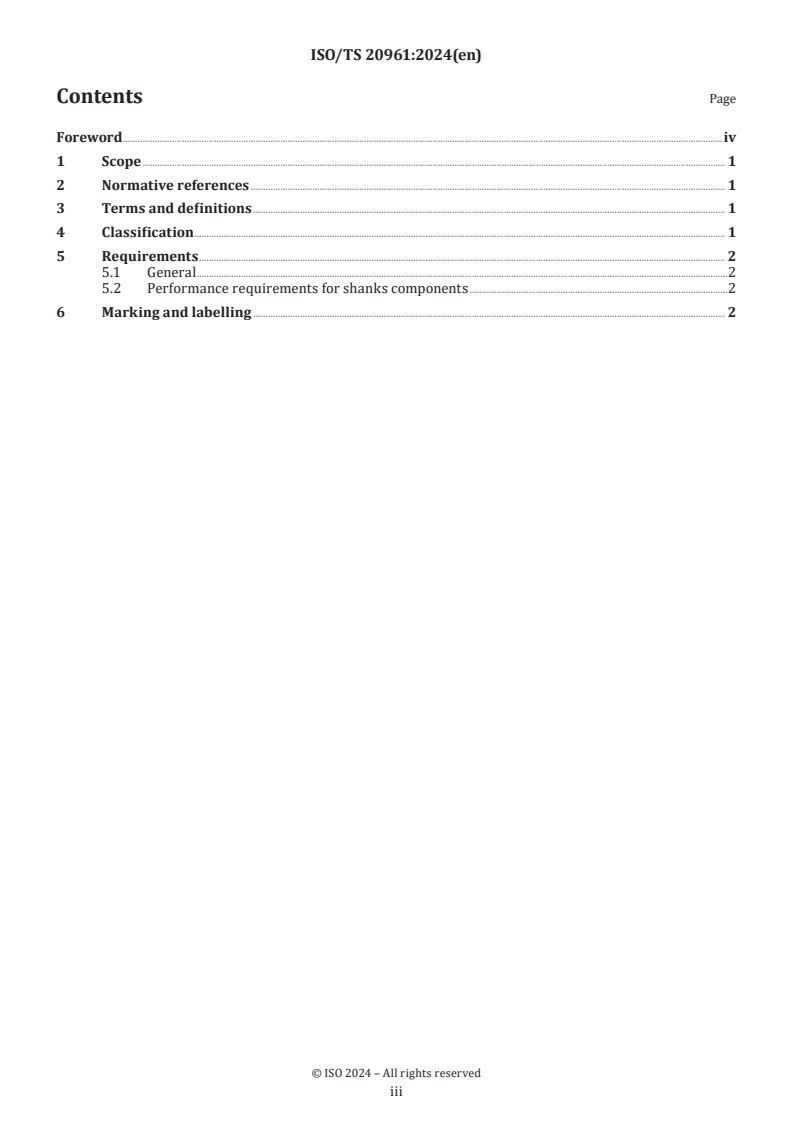
Contents Page
Foreword .iv
1 Scope . 1
2 Normative references . 1
3 Terms and definitions . 1
4 Classification . 1
5 Requirements . 2
5.1 General .2
5.2 Performance requirements for shanks components .2
6 Marking and labelling . 2
iii
Foreword
ISO (the International Organization for Standardization) is a worldwide federation of national standards
bodies (ISO member bodies). The work of preparing International Standards is normally carried out through
ISO technical committees. Each member body interested in a subject for which a technical committee
has been established has the right to be represented on that committee. International organizations,
governmental and non-governmental, in liaison with ISO, also take part in the work. ISO collaborates closely
with the International Electrotechnical Commission (IEC) on all matters of electrotechnical standardization.
The procedures used to develop this document and those intended for its further maintenance are described
in the ISO/IEC Directives, Part 1. In particular, the different approval criteria needed for the different types
of ISO document should be noted. This document was drafted in accordance with the editorial rules of the
ISO/IEC Directives, Part 2 (see www.iso.org/directives).
ISO draws attention to the possibility that the implementation of this document may involve the use of (a)
patent(s). ISO takes no position concerning the evidence, validity or applicability of any claimed patent
rights in respect thereof. As of the date of publication of this document, ISO had not received notice of (a)
patent(s) which may be required to implement this document. However, implementers are cautioned that
this may not represent the latest information, which may be o
...