

ISO/TS 20952:2024
(Main)Footwear — Performance requirements for components for footwear — Uppers
General Information
- Abstract
This document establishes the performance requirements for upper components for footwear (not for the finished footwear), irrespective of the material, in order to assess the suitability for the end use. It also establishes the test methods to be used to evaluate the compliance with the requirements. This document applies to uppers for all kinds of footwear as defined in Clause 4. This document can be used as a reference by the footwear manufacturer and the supplier.
- Status
- Published
- Publication Date
- 18-Nov-2024
- Technical Committee
- ISO/TC 216 - Footwear
- Drafting Committee
- ISO/TC 216 - Footwear
- Current Stage
- 6060 - International Standard published
- Start Date
- 19-Nov-2024
- Due Date
- 17-Nov-2024
- Completion Date
- 19-Nov-2024
Buy Documents

ISO/TS 20952:2024 - Footwear — Performance requirements for components for footwear — Uppers Released:11/19/2024

ISO/TS 20952:2024 - Footwear — Performance requirements for components for footwear — Uppers
Overview
ISO/TS 20952:2024 - Footwear - Performance requirements for components for footwear - Uppers defines performance criteria and test methods for upper components (not finished shoes), regardless of material. The Technical Specification helps assess whether uppers are suitable for their intended end use and provides a common reference for footwear manufacturers, component suppliers and testing laboratories.
Key topics and requirements
- Scope and classification: Applies to uppers for all kinds of footwear and classifies products by exposure/use: Class A (slight), B (medium), C (high) and D (heavy).
- Essential vs additional requirements: Essential requirements must always be met; additional requirements are optional and agreed between supplier and manufacturer.
- Core performance tests (examples):
- Flex resistance: Specified cycle counts without visible damage (e.g., Class A dry: 15 000 cycles; Class B leather dry: 50 000 cycles; higher levels for coated materials and Classes C/D).
- Tear strength: Minimum average tear forces (e.g., ≥ 15 N for Class A; ≥ 25 N for Class B; ≥ 30 N for Classes C/D).
- Colour fastness: Requirements for inside/outside staining and colour change after defined rubbing cycles, with special provisions for velour, nubuck and suede.
- Common additional tests: lastability, seam strength, bondability (adhesive strength), delamination resistance, water vapour permeability and absorption, water resistance (penetration time & absorption), abrasion resistance, breaking strength and elongation.
- Marking and labelling: Optional. If used, only uppers meeting all essential requirements may reference ISO/TS 20952 and must include manufacturer ID and intended shoe class.
Practical applications and users
- Footwear manufacturers: specify component acceptance criteria for design, quality control and supplier contracts.
- Component/material suppliers: demonstrate compliance and support product datasheets.
- Testing laboratories and QA teams: perform the referenced test methods to verify conformity before lasting and assembly.
- Procurement and compliance managers: use the standard to compare materials and reduce warranty/failure risk.
Related standards
ISO/TS 20952 references and harmonizes with multiple test-method standards, notably:
- ISO 17693, ISO 17694, ISO 17696, ISO 17697, ISO 17698, ISO 17699, ISO 17700–17706, ISO 17709
- ISO 19952 (vocabulary), ISO 20870 (ageing conditioning)
- EN 1392, EN 15307 (adhesives/sole-upper bond testing)
ISO/TS 20952:2024 is a practical tool for ensuring consistent, testable performance of uppers components across materials and shoe types, improving product reliability and supplier communication.
Buy Documents
ISO/TS 20952:2024 - Footwear — Performance requirements for components for footwear — Uppers Released:11/19/2024
ISO/TS 20952:2024 - Footwear — Performance requirements for components for footwear — Uppers
Frequently Asked Questions
ISO/TS 20952:2024 is a technical specification published by the International Organization for Standardization (ISO). Its full title is "Footwear — Performance requirements for components for footwear — Uppers". This standard covers: This document establishes the performance requirements for upper components for footwear (not for the finished footwear), irrespective of the material, in order to assess the suitability for the end use. It also establishes the test methods to be used to evaluate the compliance with the requirements. This document applies to uppers for all kinds of footwear as defined in Clause 4. This document can be used as a reference by the footwear manufacturer and the supplier.
This document establishes the performance requirements for upper components for footwear (not for the finished footwear), irrespective of the material, in order to assess the suitability for the end use. It also establishes the test methods to be used to evaluate the compliance with the requirements. This document applies to uppers for all kinds of footwear as defined in Clause 4. This document can be used as a reference by the footwear manufacturer and the supplier.
ISO/TS 20952:2024 is classified under the following ICS (International Classification for Standards) categories: 61.060 - Footwear. The ICS classification helps identify the subject area and facilitates finding related standards.
ISO/TS 20952:2024 is available in PDF format for immediate download after purchase. The document can be added to your cart and obtained through the secure checkout process. Digital delivery ensures instant access to the complete standard document.
Standards Content (Sample)
Technical
Specification
ISO/TS 20952
First edition
Footwear — Performance
2024-11
requirements for components for
footwear — Uppers
Chaussures — Exigences de performance pour les composants des
chaussures — Tiges
Reference number
© ISO 2024
All rights reserved. Unless otherwise specified, or required in the context of its implementation, no part of this publication may
be reproduced or utilized otherwise in any form or by any means, electronic or mechanical, including photocopying, or posting on
the internet or an intranet, without prior written permission. Permission can be requested from either ISO at the address below
or ISO’s member body in the country of the requester.
ISO copyright office
CP 401 • Ch. de Blandonnet 8
CH-1214 Vernier, Geneva
Phone: +41 22 749 01 11
Email: copyright@iso.org
Website: www.iso.org
Published in Switzerland
ii
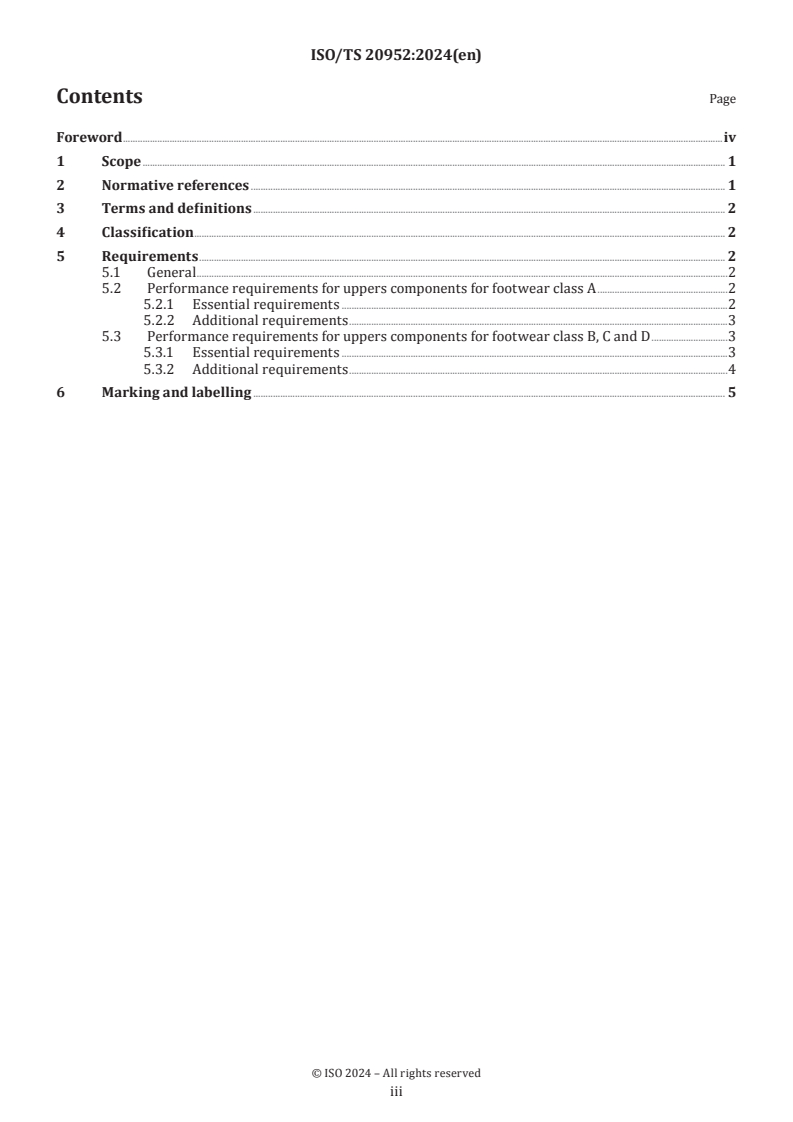
Contents Page
Foreword .iv
1 Scope . 1
2 Normative references . 1
3 Terms and definitions . 2
4 Classification . 2
5 Requirements . 2
5.1 General .2
5.2 Performance requirements for uppers components for footwear class A .2
5.2.1 Essential requirements .2
5.2.2 Additional requirements .3
5.3 Performance requirements for uppers components for footwear class B, C and D .3
5.3.1 Essential requirements .3
5.3.2 Additional requirements .4
6 Marking and labelling . 5
iii
Foreword
ISO (the International Organization for Standardization) is a worldwide federation of national standards
bodies (ISO member bodies). The work of preparing International Standards is normally carried out through
ISO technical committees. Each member body interested in a subject for which a technical committee
has been established has the right to be represented on that committee. International organizations,
governmental and non-governmental, in liaison with ISO, also take part in the work. ISO collaborates closely
with the International Electrotechnical Commission (IEC) on all matters of electrotechnical standardization.
The procedures used to develop this document and those intended for its further maintenance are described
in the ISO/IEC Directives, Part 1. In particular, the different approval criteria needed for the different types
of ISO document should be noted. This document was drafted in accordance with the editorial rules of the
ISO/IEC Directives, Part 2 (see www.iso.org/directives).
ISO draws attention to the possibility that the implementation of this document may involve the use of (a)
patent(s). ISO takes no position concerning the evidence, validity or applicability of any claimed patent
rights in respect thereof. As of the date of publication of this document, ISO had not received notice of (a)
patent(s) which may be required to implement this document. However, implementers are cautioned that
this may not represent the latest information, which may be obtained from the patent database available at
www.iso.org/patents. ISO shall not be held responsible for identifying any or all such patent rights.
Any trade name used in this document is information given for the convenience of users and does not
constitute an endorsement.
For an explanation of the voluntary nature of standards, the meaning of ISO specific terms and expressions
related to conformity assessment, as well as information about ISO's adherence to the World Trade
Organization (WTO) principles in the Technical Barriers to Trade (TBT), see www.iso.org/iso/foreword.html.
This document was prepared by Technical Committee ISO/TC 216, Footwear.
Any feedback or questions on this document should be directed to the user’s national standards body. A
complete listing of these bodies can be found at www.iso.org/members.html.
iv
Technical Specification ISO/TS 20952:2024(en)
Footwear — Performance requirements for components for
footwear — Uppers
1 Scope
This document establishes the performance requirements for upper components for footwear (not for the
finished footwear), irrespective of the material, in order to assess the suitability for the end use. It also
establishes the test methods to be used to evaluate the compliance with the requirements.
This document applies to uppers for all kinds of footwear as defined in Clause 4.
This document can be used as a reference by the footwear manufacturer and the supplier.
2 Normative references
The following documents are referred to in the text in such a way that some or all of their content constitutes
requirements of this document. For dated references, only the edition cited applies. For undated references,
the latest edition of the referenced document (including any amendments) applies.
ISO 17693, Footwear — Test methods for uppers — Resistance to damage on lasting
ISO 17694, Footwear — Test methods for uppers and lining — Flex resistance
ISO 17696, Footwear — Test methods for uppers, linings and insocks — Tear strength
ISO 17697, Footwear — Test methods for uppers, lining and insocks — Seam strength
ISO 17698, Footwear — Test methods for uppers — Delamination resistance
ISO 17699, Footwear — Test methods for uppers and lining — Water vapour permeability and absorption
ISO 17700, Footwear — Test methods for upper components and insocks — Colour fastness to rubbing and
bleeding
ISO 17701, Footwear — Test methods for uppers, lining and insocks — Colour migration
ISO 17702, Footwear — Test methods for uppers — Water resistance
ISO 17704, Footwear — Test methods for uppers, linings and insocks — Abrasion resistance
ISO 17706, Footwear — Test methods for uppers — Tensile strength and elongation
ISO 17709, Footwear — Sampling location, preparation and duration of conditioning of samples and test pieces
ISO 19952, Footwear — Vocabulary
ISO 20870, Footwear — Ageing conditioning
ISO 80000-1, Quantities and units — Part 1: General
EN 1392, Adhesives for leather and footwear materials — Solvent-based and
...
Technical
Specification
ISO/TS 20952
First edition
Footwear — Performance
2024-11
requirements for components for
footwear — Uppers
Corrected version
2026-03
Chaussures — Exigences de performance pour les composants des
chaussures — Tiges
Reference number
© ISO 2024
All rights reserved. Unless otherwise specified, or required in the context of its implementation, no part of this publication may
be reproduced or utilized otherwise in any form or by any means, electronic or mechanical, including photocopying, or posting on
the internet or an intranet, without prior written permission. Permission can be requested from either ISO at the address below
or ISO’s member body in the country of the requester.
ISO copyright office
CP 401 • Ch. de Blandonnet 8
CH-1214 Vernier, Geneva
Phone: +41 22 749 01 11
Email: copyright@iso.org
Website: www.iso.org
Published in Switzerland
ii
Contents Page
Foreword .iv
1 Scope . 1
2 Normative references . 1
3 Terms and definitions . 2
4 Classification . 2
5 Requirements . 2
5.1 General .2
5.2 Performance requirements for uppers components for footwear class A .2
5.2.1 Essential requirements .2
5.2.2 Additional requirements .3
5.3 Performance requirements for uppers components for footwear class B, C and D .3
5.3.1 Essential requirements .3
5.3.2 Additional requirements .4
6 Marking and labelling . 5
iii
Foreword
ISO (the International Organization for Standardization) is a worldwide federation of national standards
bodies (ISO member bodies). The work of preparing International Standards is normally carried out through
ISO technical committees. Each member body interested in a subject for which a technical committee
has been established has the right to be represented on that committee. International organizations,
governmental and non-governmental, in liaison with ISO, also take part in the work. ISO collaborates closely
with the International Electrotechnical Commission (IEC) on all matters of electrotechnical standardization.
The procedures used to develop this document and those intended for its further maintenance are described
in the ISO/IEC Directives, Part 1. In particular, the different approval criteria needed for the different types
of ISO document should be noted. This document was drafted in accordance with the editorial rules of the
ISO/IEC Directives, Part 2 (see www.iso.org/directives).
ISO draws attention to the possibility that the implementation of this document may involve the use of (a)
patent(s). ISO takes no position concerning the evidence, validity or applicability of any claimed patent
rights in respect thereof. As of the date of publication of this document, ISO had not received notice of (a)
patent(s) which may be required to implement this document. However, implementers are cautioned that
this may not represent the latest information, which may be obtained from the patent database available at
www.iso.org/patents. ISO shall not be held responsible for identifying any or all such patent rights.
Any trade name used in this document is information given for the convenience of users and does not
constitute an endorsement.
For an explanation of the voluntary nature of standards, the meaning of ISO specific terms and expressions
related to conformity assessment, as well as information about ISO's adherence to the World Trade
Organization (WTO) principles in the Technical Barriers to Trade (TBT), see www.iso.org/iso/foreword.html.
This document was prepared by Technical Committee ISO/TC 216, Footwear.
Any feedback or questions on this document should be directed to the user’s national standards body. A
complete listing of these bodies can be found at www.iso.org/members.html.
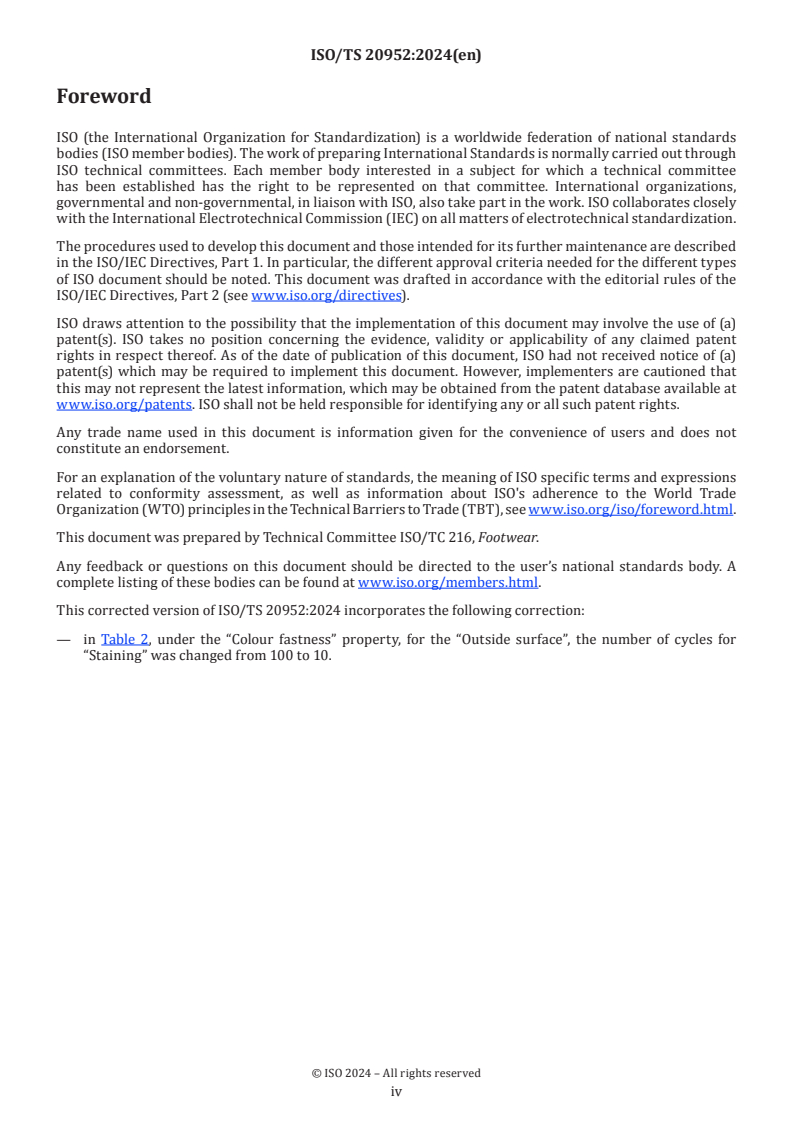
This corrected version of ISO/TS 20952:2024 incorporates the following correction:
— in Table 2, under the “Colour fastness” property, for the “Outside surface”, the number of cycles for
“Staining” was changed from 100 to 10.
iv
Technical Specification ISO/TS 20952:2024(en)
Footwear — Performance requirements for components for
footwear — Uppers
1 Scope
This document establishes the performance requirements for upper components for footwear (not for the
finished footwear), irrespective of the material, in order to assess the suitability for the end use. It also
establishes the test methods to be used to evaluate the compliance with the requirements.
This document applies to uppers for all kinds of footwear as defined in Clause 4.
This document can be used as a reference by the footwear manufacturer and the supplier.
2 Normative references
The following documents are referred to in the text in such a way that some or all of their content constitutes
requirements of this document. For dated references, only the edition cited applies. For undated references,
the latest edition of the referenced document (including any amendments) applies.
ISO 17693, Footwear — Test methods for uppers — Resistance to damage on lasting
ISO 17694, Footwear — Test methods for uppers and lining — Flex resistance
ISO 17696, Footwear — Test methods for uppers, linings and insocks — Tear strength
ISO 17697, Footwear — Test methods for uppers, lining and insocks — Seam strength
ISO 17698, Footwear — Test methods for uppers — Delamination resistance
ISO 17699, Footwear — Test methods for uppers and lining — Water vapour permeability and absorption
ISO 17700, Footwear — Test methods for upper components and insocks — Colour fastness to rubbing and
bleeding
ISO 17701, Footwear — Test methods for uppers, lining and insocks — Colour migration
ISO 17702, Footwear — Test methods for uppers — Water resistance
ISO 17704, Footwear — Test methods for uppers, linings and insocks — Abrasion resistance
ISO 17706, Footwear — Test methods for uppers — Tensile strength and elongation
ISO 17709, Footwear — Sampling location, preparation and duration of conditioning of samples and test pieces
ISO 19952, Footwear — Vocabulary
ISO 20870, Footwear — Ageing conditionin
...