

ISO/IEC 22505:2019
(Main)Information technology — Method for the determination of ink cartridge yield for monochrome inkjet printers and multi-function devices that contain inkjet printer components
General Information
- Abstract
The scope of this document is limited to the evaluation of black ink cartridge page yield for ink-containing cartridges (i.e. integrated ink cartridges and ink cartridges without integrated printheads) for monochrome inkjet print systems. This document can also be applied to the printer component of any multifunctional device that has a digital input printing path, including multi-function devices that contain inkjet printer components. Both liquid and solid ink products can be tested using this document. This document is only intended for the measurement of ink cartridge page yield when printing on plain paper. No other claims can be made from this testing regarding quality, reliability, etc. This document can be used to measure the yield of any cartridge that is used in a significant amount during the printing of the test page defined in ISO/IEC 19752. This document is not for use with printers whose minimum printable size is equal to or greater than A3 or for printers designed or configured to print photos (for example, maximum printable size less than A4 or a printer configuration intended for photo only printing). In addition, this document only applies to drop on demand printing systems. NOTE Integrated ink cartridge is a cartridge that includes at least: an ink containment part, an ink deposition mechanism and an ink transport part (see ISO/IEC 29142-1).
- Status
- Published
- Publication Date
- 15-Dec-2019
- Technical Committee
- ISO/IEC JTC 1/SC 28 - Office equipment
- Drafting Committee
- ISO/IEC JTC 1/SC 28/WG 2 - Consumables
- Current Stage
- 9093 - International Standard confirmed
- Start Date
- 15-May-2026
- Completion Date
- 29-Aug-2026
Buy Documents


ISO/IEC 22505:2019 - Information technology -- Method for the determination of ink cartridge yield for monochrome inkjet printers and multi-function devices that contain inkjet printer components

ISO/IEC 22505:2019 - Information technology — Method for the determination of ink cartridge yield for monochrome inkjet printers and multi-function devices that contain inkjet printer components/16/2019
Overview
ISO/IEC 22505:2019 defines a standardized method for determining ink cartridge yield for black (monochrome) inkjet cartridges and the printer components of multifunction devices that include inkjet printing. The standard covers both liquid and solid ink cartridges used in drop-on-demand monochrome inkjet systems, and is intended exclusively for measuring page yield when printing on plain paper. It provides a reproducible test method manufacturers, test laboratories and purchasers can use to report and compare page yield and support cost-per-page analyses.
Key topics and technical requirements
- Scope and limitations
- Applies to black ink cartridges (integrated or without integrated printheads) for monochrome inkjet printers and multifunction devices with a digital printing path.
- Not intended for A3-or-larger minimum-print-size printers or printers configured primarily for photo printing.
- Only for drop-on-demand systems and plain-paper printing.
- Test setup and parameters
- Defines test environment, printer setup, driver usage, paper selection and maintenance procedures.
- Specifies sample handling, print mode, and reporting of driver and test conditions.
- Test methodology
- Stepwise procedure: preparation, cartridge installation, continuous printing of the standardized test page (referenced to ISO/IEC 19752), monitoring, and end-of-life determination.
- End-of-life is reached by either fade (observable lightening; e.g., a ≥3 mm gap in defined areas) or an ink out condition.
- Rules for handling streaks, maintenance cleaning and allowable streak-removal operations (cleaning actions count toward page count; alignment pages may be excluded).
- Yield calculation and declaration
- Individual cartridge yield = pages printed between installation and end-of-life.
- Declared cartridge yield is set at or below the lower 90% confidence bound of the sample mean (see Clause 6).
- Test reporting requirements and data forms are defined to ensure transparency.
- Restrictions on claims
- Results measure page yield only; the standard does not support claims about print quality, reliability or other performance metrics.
Practical applications and who uses it
- Printer and cartridge manufacturers - standardized yield testing for product specifications and marketing claims.
- Independent test labs and certification bodies - reproducible methodology for third‑party evaluations.
- Procurement and enterprise IT - objective data for cost-per-page (CPP) comparisons and purchasing decisions.
- Consumer organizations and reviewers - fair comparisons of cartridge lifetime across brands/models.
- R&D and quality assurance - verifying cartridge designs and firmware ink-management behavior.
Related standards
- ISO/IEC 19752 - test page referenced for monochrome toner/print tests.
- ISO/IEC 29142-1 - definitions for integrated ink cartridge elements.
Keywords: ISO/IEC 22505:2019, ink cartridge yield, monochrome inkjet printers, page yield, test methodology, declared cartridge yield, fade, streaks, cost per page.
Buy Documents
ISO/IEC 22505:2019 - Information technology -- Method for the determination of ink cartridge yield for monochrome inkjet printers and multi-function devices that contain inkjet printer components
ISO/IEC 22505:2019 - Information technology — Method for the determination of ink cartridge yield for monochrome inkjet printers and multi-function devices that contain inkjet printer components/16/2019
Frequently Asked Questions
ISO/IEC 22505:2019 is a standard published by the International Organization for Standardization (ISO). Its full title is "Information technology — Method for the determination of ink cartridge yield for monochrome inkjet printers and multi-function devices that contain inkjet printer components". This standard covers: The scope of this document is limited to the evaluation of black ink cartridge page yield for ink-containing cartridges (i.e. integrated ink cartridges and ink cartridges without integrated printheads) for monochrome inkjet print systems. This document can also be applied to the printer component of any multifunctional device that has a digital input printing path, including multi-function devices that contain inkjet printer components. Both liquid and solid ink products can be tested using this document. This document is only intended for the measurement of ink cartridge page yield when printing on plain paper. No other claims can be made from this testing regarding quality, reliability, etc. This document can be used to measure the yield of any cartridge that is used in a significant amount during the printing of the test page defined in ISO/IEC 19752. This document is not for use with printers whose minimum printable size is equal to or greater than A3 or for printers designed or configured to print photos (for example, maximum printable size less than A4 or a printer configuration intended for photo only printing). In addition, this document only applies to drop on demand printing systems. NOTE Integrated ink cartridge is a cartridge that includes at least: an ink containment part, an ink deposition mechanism and an ink transport part (see ISO/IEC 29142-1).
The scope of this document is limited to the evaluation of black ink cartridge page yield for ink-containing cartridges (i.e. integrated ink cartridges and ink cartridges without integrated printheads) for monochrome inkjet print systems. This document can also be applied to the printer component of any multifunctional device that has a digital input printing path, including multi-function devices that contain inkjet printer components. Both liquid and solid ink products can be tested using this document. This document is only intended for the measurement of ink cartridge page yield when printing on plain paper. No other claims can be made from this testing regarding quality, reliability, etc. This document can be used to measure the yield of any cartridge that is used in a significant amount during the printing of the test page defined in ISO/IEC 19752. This document is not for use with printers whose minimum printable size is equal to or greater than A3 or for printers designed or configured to print photos (for example, maximum printable size less than A4 or a printer configuration intended for photo only printing). In addition, this document only applies to drop on demand printing systems. NOTE Integrated ink cartridge is a cartridge that includes at least: an ink containment part, an ink deposition mechanism and an ink transport part (see ISO/IEC 29142-1).
ISO/IEC 22505:2019 is classified under the following ICS (International Classification for Standards) categories: 37.100.10 - Reproduction equipment. The ICS classification helps identify the subject area and facilitates finding related standards.
ISO/IEC 22505:2019 is available in PDF format for immediate download after purchase. The document can be added to your cart and obtained through the secure checkout process. Digital delivery ensures instant access to the complete standard document.
Standards Content (Sample)
INTERNATIONAL ISO/IEC
STANDARD 22505
First edition
2019-12
Information technology — Method
for the determination of ink cartridge
yield for monochrome inkjet printers
and multi-function devices that
contain inkjet printer components
Reference number
©
ISO/IEC 2019
© ISO/IEC 2019
All rights reserved. Unless otherwise specified, or required in the context of its implementation, no part of this publication may
be reproduced or utilized otherwise in any form or by any means, electronic or mechanical, including photocopying, or posting
on the internet or an intranet, without prior written permission. Permission can be requested from either ISO at the address
below or ISO’s member body in the country of the requester.
ISO copyright office
CP 401 • Ch. de Blandonnet 8
CH-1214 Vernier, Geneva
Phone: +41 22 749 01 11
Fax: +41 22 749 09 47
Email: copyright@iso.org
Website: www.iso.org
Published in Switzerland
ii © ISO/IEC 2019 – All rights reserved
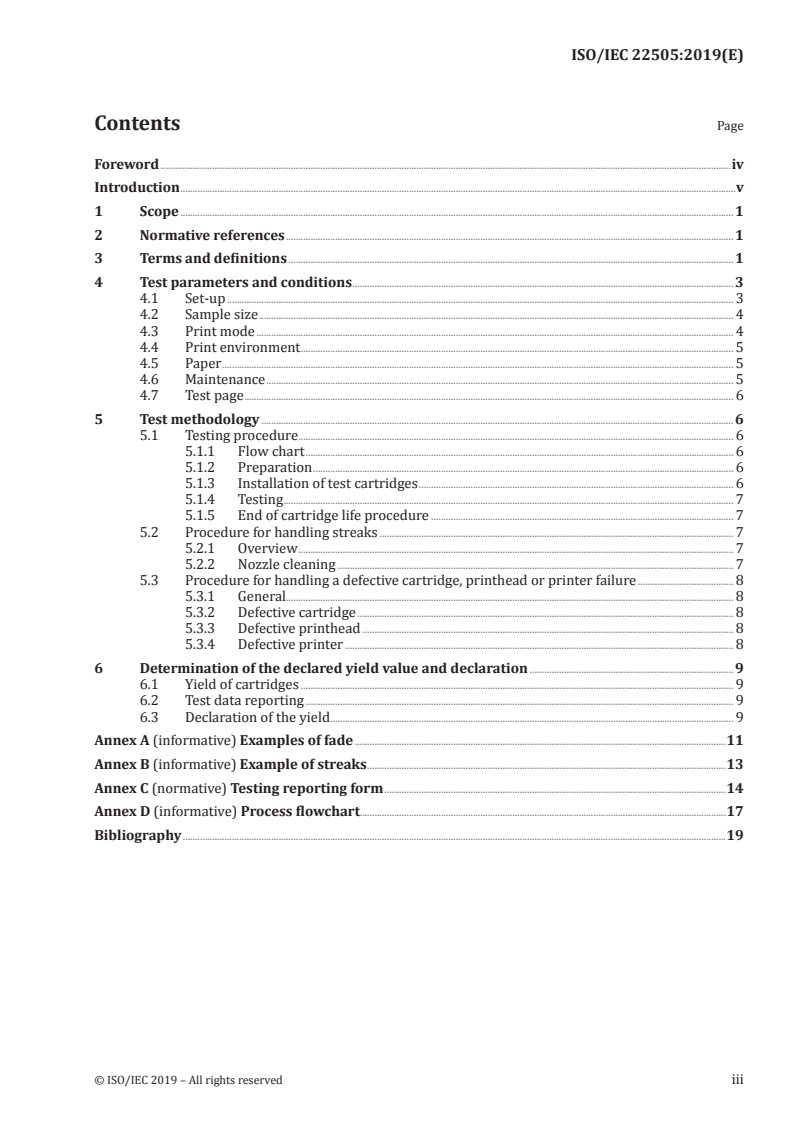
Contents Page
Foreword .iv
Introduction .v
1 Scope . 1
2 Normative references . 1
3 Terms and definitions . 1
4 Test parameters and conditions . 3
4.1 Set-up . 3
4.2 Sample size . 4
4.3 Print mode . 4
4.4 Print environment . 5
4.5 Paper . 5
4.6 Maintenance . 5
4.7 Test page . 6
5 Test methodology . 6
5.1 Testing procedure . 6
5.1.1 Flow chart . 6
5.1.2 Preparation . 6
5.1.3 Installation of test cartridges . 6
5.1.4 Testing . 7
5.1.5 End of cartridge life procedure . 7
5.2 Procedure for handling streaks . 7
5.2.1 Overview . 7
5.2.2 Nozzle cleaning . 7
5.3 Procedure for handling a defective cartridge, printhead or printer failure . 8
5.3.1 General. 8
5.3.2 Defective cartridge . 8
5.3.3 Defective printhead . 8
5.3.4 Defective printer . 8
6 Determination of the declared yield value and declaration . 9
6.1 Yield of cartridges . 9
6.2 Test data reporting . 9
6.3 Declaration of the yield . 9
Annex A (informative) Examples of fade .11
Annex B (informative) Example of streaks .13
Annex C (normative) Testing reporting form .14
Annex D (informative) Process flowchart.17
Bibliography .19
© ISO/IEC 2019 – All rights reserved iii
Foreword
ISO (the International Organization for Standardization) and IEC (the International Electrotechnical
Commission) form the specialized system for worldwide standardization. National bodies that
are members of ISO or IEC participate in the development of International Standards through
technical committees established by the respective organization to deal with particular fields of
technical activity. ISO and IEC technical committees collaborate in fields of mutual interest. Other
international organizations, governmental and non-governmental, in liaison with ISO and IEC, also
take part in the work.
The procedures used to develop this document and those intended for its further maintenance are
described in the ISO/IEC Directives, Part 1. In particular, the different approval criteria needed for
the different types of document should be noted. This document was drafted in accordance with the
editorial rules of the ISO/IEC Directives, Part 2 (see www .iso .org/ directives).
Attention is drawn to the possibility that some of the elements of this document may be the subject
of patent rights. ISO and IEC shall not be held responsible for identifying any or all such patent
rights. Details of any patent rights identified during the development of the document will be in the
Introduction and/or on the ISO list of patent declarations received (see www .iso .org/ patents) or the IEC
list of patent declarations received (see http:// patents .iec .ch).
Any trade name used in this document is information given for the convenience of users and does not
constitute an endorsement.
For an explanation of the voluntary nature of standards, the meaning of ISO specific terms and
expressions related to conformity assessment, as well as information about ISO's adherence to the
World Trade Organization (WTO) principles in the Technical Barriers to Trade (TBT) see www .iso .org/
iso/ foreword .html.
This document was prepared by Joint Technical Committee ISO/IEC JTC 1, Information technology,
Subcommittee SC 28, Office equipment.
Any feedback or questions on this document should be directed to the user’s national standards body. A
complete listing of these bodies can be found at www .iso .org/ members .html.
iv © ISO/IEC 2019 – All rights reserved
Introduction
The purpose of this document is to provide a process for determining the ink cartridge yield for a given
monochrome inkjet print system (i.e. integrated ink cartridges and ink cartridges without integrated
printheads) using a standard test page.
In the case where a cartridge set can be used in multiple printer models, only one yield test needs to be
performed as long as the difference between printer models does not impact yield.
NOTE A cartridge supplier can choose to use more than one market identifier for a single physical cartridge.
In this case, only one yield test is performed as long as there are no differences in the cartridges other than
market identifiers.
This document prescribes the following:
— the test method that manufacturers, test labs, etc., use to determine ink cartridge yield;
— the method for determination of allowable declared yield value from the test results;
— the appropriate method of describing the yield of cartridges in documentation supplied to the
consumer by the manufacturer.
The cartridge yield is determined by an end of life judgement, or signalled with either of two
phenomena: fade, caused by depletion of ink in the cartridge or automatic printing stop caused by an ink
out detection function.
It is envisioned that one of the uses of this document is for the calculation of cost per page (CPP). While
this document measures a portion of this cost, it is not used as the sole component of CPP calculation.
Additional factors are considered for CPP calculations.
© ISO/IEC 2019 – All rights reserved v
INTERNATIONAL STANDARD ISO/IEC 22505:2019(E)
Information technology — Method for the determination
of ink cartridge yield for monochrome inkjet printers
and multi-function devices that contain inkjet printer
components
1 Scope
The scope of this document is limited to the evaluation of black ink cartridge page yield for ink-
containing cartridges (i.e. integrated ink cartridges and ink cartridges without integrated printheads)
for monochrome inkjet print systems. This document can also be applied to the printer component of
any multifunctional device that has a digital input printing path, including multi-function devices that
contain inkjet printer components. Both liquid and solid ink products can be tested using this document.
This document is only intended for the measurement of ink cartridge page yield when printing on plain
paper. No other claims can be made from this testing regarding quality, reliability, etc.
This document can be used to measure the yield of any cartridge that is used in a significant amount
during the printing of the test page defined in ISO/IEC 19752.
This document is not for use with printers whose minimum printable size is equal to or greater than A3
or for printers designed or configured to print photos (for example, maximum printable size less than
A4 or a printer configuration intended for photo only printing). In addition, this document only applies
to drop on demand printing systems.
NOTE Integrated ink cartridge is a cartridge that includes at least: an ink containment part, an ink deposition
mechanism and an ink transport part (see ISO/IEC 29142-1).
2 Normative references
The following documents are referred to in the text in such a way that some or all of their content
constitutes requirements of this document. For dated references, only the edition cited applies. For
undated references, the latest edition of the referenced document (including any amendments) applies.
ISO/IEC 19752, Information technology — Office equipment — Method for the determination of toner
cartridge yield for monochromatic electrophotographic printers and multi-function devices that contain
printer components
3 Terms and definitions
For the purposes of this document, the following terms and definitions apply.
ISO and IEC maintain terminological databases for use in standardization at the following addresses:
— ISO Online browsing platform: available at https:// www .iso .org/ obp
— IEC Electropedia: available at http:// www .electropedia .org/
© ISO/IEC 2019 – All rights reserved 1
3.1
fade
phenomenon in which a significant reduction in uniformity occurs due to ink depletion
Note 1 to entry: In this test, fade is defined as a noticeably lighter, 3 mm or greater, gap located in the text, in
the bar chart, or in the boxes around the periphery of the test page (3.9). The determination of the change in
th
lightness is to be made referenced to the 25 page printed for each cartridge in testing. For examples of fade,
please consult Annex A.
Note 2 to entry: In some printer systems, fade can occur prematurely due to the way that ink is provided to
the printing system. If a printer exhibits fade, a five-minute pause is allowed to provide for recovery of the ink
delivery system and printing can continue. If fade appears on the next page, then the cartridge is judged at end
of life (3.7) and the additional page printed is not counted in the yield calculation. If fade does not appear on the
next page, then printing can continue until the next fade or ink out (3.6) is encountered and the additional page
shall be counted.
3.2
streaks
very thin lines of colourant or missing colourant, other than intended in the test document
Note 1 to entry: Streaks differ from fade (3.1) in the width and severity of increase in lightness, L*, or reduction
in density. Streaks can appear due to a number of reasons, thermal issues and clogged nozzles being two of the
main causes. If these streaks occur in three consecutive test pages (3.9), then a streak removal operation (3.2) is
required. For examples of streaks, please consult Annex B.
3.3
streak removal operation
procedure used to restore the print performance by removing streaks (3.2)
Note 1 to entry: If streaks are observed on 15 consecutive test pages (3.9), first the printer can be left idle for five
minutes. Then an additional 15 test pages are printed. If the streaks are still observed, then a streak removal
operation is conducted according to the latest printer manufacturer documentation. Due to the significant
amount of ink that is used for cleaning, the maximum permissible number of times that the streak removal
operation can be used on a given cartridge is prescribed in 5.2.2.
Note 2 to entry: All test pages printed during this process are included in the page count for determining the yield.
3.4
printhead alignment operation
function that aligns newly installed printheads
Note 1 to entry: If it is mandatory according to the latest printer manufacturer documentation, this operation is
performed during testing. The pages used in the alignment procedure are not counted in the measurement of yield.
3.5
ink low
warning generated by the printing system when it has determined that the amount of ink is such that a
cartridge change may be required soon
Note 1 to entry: It does not indicate that the system is out of ink.
3.6
ink out
signal generated by the printing system when the useable ink in the system is depleted and the printer
stops printing
3.7
end of life
condition determined by one of two mechanisms: fade (3.1) or ink out (3.6)
Note 1 to entry: In the event that the printer can continue printing after ink out is reported, the cartridge is still
considered at end of life.
2 © ISO/IEC 2019 – All rights reserved
3.8
monochrome inkjet printer
printer only capable of printing black and not configurable to print another colourant
Note 1 to entry: More than one black cartridge can be installed simultaneously if they have the same cartridge
identifier.
3.9
test page
test file that is printed as a single job
Note 1 to entry: The test page refers to ISO/IEC 19752.
3.10
individual cartridge yield
value determined by counting the number of test pages (3.9) printed between cartridge installation and
end of life (3.7)
3.11
declared cartridge yield
value at or below the lower 90 % confidence bound of the mean as prescribed in 6.1
3.12
non-colourant ink
material designed for liquid state deposition on a substrate, such as gloss optimizers and fixatives, not
containing a colourant
3.13
black ink cartridge
cartridge containing black colourant and no other colourant
Note 1 to entry: Black ink cartridge may contain non-colourant ink (3.12).
4 Test parameters and conditions
4.1 Set-up
Place the printer on a horizontal surface and set-up the printer according to the installation
guide provided in the printer user’s manual. Use the most recent printer driver available from the
manufacturer's website or the supplied driver with the printer. The driver version shall be specified
on the test report. Cartridge installation shall be completed following the instructions in the cartridge
installation guide. If there is a contradiction between the printer and cartridge manuals for the
cartridge installation, the cartridge manual shall take precedence except if changes are recommended
for printer or driver settings.
At the start of the test, all printers shall be set-up using a priming cartridge to ensure that the ink used
in testing is primarily for printing, not for initial priming/cleaning. After the printer is set-up according
to the manufacturer's instructions, the priming cartridge shall be used to print a minimum of 25 copies
of the standard test page. The priming cartridge shall be removed and replaced with a new cartridge
that is used for testing yield. The pages printed during this step are not counted towards yield. Even if
required by the printer, printhead alignment does not have to be performed on the priming cartridges.
The number of pages used in the priming operation shall be included in the test report.
All image and print quality modifiers shall be at their factory pre-set configuration for the printer and
default- installed condition for the driver. If auto media detection is available on the printer, it shall be
disabled and media-type set to plain paper. This is to avoid inaccurate sensing of the media. If the printer
and driver settings differ, then the driver defaults shall be used. Any user selectable ink conservation
modes, (e.g. draft) shall be disabled during testing.
© ISO/IEC 2019 – All rights reserved 3
For printers that default to duplex printing, the default shall be overridden and the printer shall be set
to simplex for yield testing.
To assure that the test page is printed correctly, any page size modifiers such as Fit to Page and font
substitution shall be turned off. The test page shall be printed using the fonts embedded in the test
page and shall be printed on the page in a size corresponding to the dimensions in the test page defined
by ISO/IEC 19752. Page placement modifiers such as page centering can be used to place the image
properly on the page.
To facilitate automated testing, the test page may be pre-generated using the printer driver. This is
often accomplished using a print to file command. This method is only valid if it does not affect the
measured yield. If a pre-generated file is used, it shall be noted on the test report.
If the printer under test uses an internal PDF interpreter, it is ok to use it as long as the printer defaults
are set to not substitute fonts. If the internal interpreter is used, this shall be noted on the report.
©1)
The application software (for example, Adobe Acrobat Reader ), printer driver and printer can have
page size modifier functions, such as Fit to Page. Ensure that all of these functions are disabled.
4.2 Sample size
The sample size shall be determined such that a minimum of three physical cartridges are tested in each
of three printers. Therefore, the minimum number of tested cartridges is 9 (3 cartridges × 3 printers)
...
INTERNATIONAL ISO/IEC
STANDARD 22505
First edition
2019-12
Information technology — Method
for the determination of ink cartridge
yield for monochrome inkjet printers
and multi-function devices that
contain inkjet printer components
Reference number
©
ISO/IEC 2019
© ISO/IEC 2019
All rights reserved. Unless otherwise specified, or required in the context of its implementation, no part of this publication may
be reproduced or utilized otherwise in any form or by any means, electronic or mechanical, including photocopying, or posting
on the internet or an intranet, without prior written permission. Permission can be requested from either ISO at the address
below or ISO’s member body in the country of the requester.
ISO copyright office
CP 401 • Ch. de Blandonnet 8
CH-1214 Vernier, Geneva
Phone: +41 22 749 01 11
Fax: +41 22 749 09 47
Email: copyright@iso.org
Website: www.iso.org
Published in Switzerland
ii © ISO/IEC 2019 – All rights reserved
Contents Page
Foreword .iv
Introduction .v
1 Scope . 1
2 Normative references . 1
3 Terms and definitions . 1
4 Test parameters and conditions . 3
4.1 Set-up . 3
4.2 Sample size . 4
4.3 Print mode . 4
4.4 Print environment . 5
4.5 Paper . 5
4.6 Maintenance . 5
4.7 Test page . 6
5 Test methodology . 6
5.1 Testing procedure . 6
5.1.1 Flow chart . 6
5.1.2 Preparation . 6
5.1.3 Installation of test cartridges . 6
5.1.4 Testing . 7
5.1.5 End of cartridge life procedure . 7
5.2 Procedure for handling streaks . 7
5.2.1 Overview . 7
5.2.2 Nozzle cleaning . 7
5.3 Procedure for handling a defective cartridge, printhead or printer failure . 8
5.3.1 General. 8
5.3.2 Defective cartridge . 8
5.3.3 Defective printhead . 8
5.3.4 Defective printer . 8
6 Determination of the declared yield value and declaration . 9
6.1 Yield of cartridges . 9
6.2 Test data reporting . 9
6.3 Declaration of the yield . 9
Annex A (informative) Examples of fade .11
Annex B (informative) Example of streaks .13
Annex C (normative) Testing reporting form .14
Annex D (informative) Process flowchart.17
Bibliography .19
© ISO/IEC 2019 – All rights reserved iii
Foreword
ISO (the International Organization for Standardization) and IEC (the International Electrotechnical
Commission) form the specialized system for worldwide standardization. National bodies that
are members of ISO or IEC participate in the development of International Standards through
technical committees established by the respective organization to deal with particular fields of
technical activity. ISO and IEC technical committees collaborate in fields of mutual interest. Other
international organizations, governmental and non-governmental, in liaison with ISO and IEC, also
take part in the work.
The procedures used to develop this document and those intended for its further maintenance are
described in the ISO/IEC Directives, Part 1. In particular, the different approval criteria needed for
the different types of document should be noted. This document was drafted in accordance with the
editorial rules of the ISO/IEC Directives, Part 2 (see www .iso .org/ directives).
Attention is drawn to the possibility that some of the elements of this document may be the subject
of patent rights. ISO and IEC shall not be held responsible for identifying any or all such patent
rights. Details of any patent rights identified during the development of the document will be in the
Introduction and/or on the ISO list of patent declarations received (see www .iso .org/ patents) or the IEC
list of patent declarations received (see http:// patents .iec .ch).
Any trade name used in this document is information given for the convenience of users and does not
constitute an endorsement.
For an explanation of the voluntary nature of standards, the meaning of ISO specific terms and
expressions related to conformity assessment, as well as information about ISO's adherence to the
World Trade Organization (WTO) principles in the Technical Barriers to Trade (TBT) see www .iso .org/
iso/ foreword .html.
This document was prepared by Joint Technical Committee ISO/IEC JTC 1, Information technology,
Subcommittee SC 28, Office equipment.
Any feedback or questions on this document should be directed to the user’s national standards body. A
complete listing of these bodies can be found at www .iso .org/ members .html.
iv © ISO/IEC 2019 – All rights reserved
Introduction
The purpose of this document is to provide a process for determining the ink cartridge yield for a given
monochrome inkjet print system (i.e. integrated ink cartridges and ink cartridges without integrated
printheads) using a standard test page.
In the case where a cartridge set can be used in multiple printer models, only one yield test needs to be
performed as long as the difference between printer models does not impact yield.
NOTE A cartridge supplier can choose to use more than one market identifier for a single physical cartridge.
In this case, only one yield test is performed as long as there are no differences in the cartridges other than
market identifiers.
This document prescribes the following:
— the test method that manufacturers, test labs, etc., use to determine ink cartridge yield;
— the method for determination of allowable declared yield value from the test results;
— the appropriate method of describing the yield of cartridges in documentation supplied to the
consumer by the manufacturer.
The cartridge yield is determined by an end of life judgement, or signalled with either of two
phenomena: fade, caused by depletion of ink in the cartridge or automatic printing stop caused by an ink
out detection function.
It is envisioned that one of the uses of this document is for the calculation of cost per page (CPP). While
this document measures a portion of this cost, it is not used as the sole component of CPP calculation.
Additional factors are considered for CPP calculations.
© ISO/IEC 2019 – All rights reserved v
INTERNATIONAL STANDARD ISO/IEC 22505:2019(E)
Information technology — Method for the determination
of ink cartridge yield for monochrome inkjet printers
and multi-function devices that contain inkjet printer
components
1 Scope
The scope of this document is limited to the evaluation of black ink cartridge page yield for ink-
containing cartridges (i.e. integrated ink cartridges and ink cartridges without integrated printheads)
for monochrome inkjet print systems. This document can also be applied to the printer component of
any multifunctional device that has a digital input printing path, including multi-function devices that
contain inkjet printer components. Both liquid and solid ink products can be tested using this document.
This document is only intended for the measurement of ink cartridge page yield when printing on plain
paper. No other claims can be made from this testing regarding quality, reliability, etc.
This document can be used to measure the yield of any cartridge that is used in a significant amount
during the printing of the test page defined in ISO/IEC 19752.
This document is not for use with printers whose minimum printable size is equal to or greater than A3
or for printers designed or configured to print photos (for example, maximum printable size less than
A4 or a printer configuration intended for photo only printing). In addition, this document only applies
to drop on demand printing systems.
NOTE Integrated ink cartridge is a cartridge that includes at least: an ink containment part, an ink deposition
mechanism and an ink transport part (see ISO/IEC 29142-1).
2 Normative references
The following documents are referred to in the text in such a way that some or all of their content
constitutes requirements of this document. For dated references, only the edition cited applies. For
undated references, the latest edition of the referenced document (including any amendments) applies.
ISO/IEC 19752, Information technology — Office equipment — Method for the determination of toner
cartridge yield for monochromatic electrophotographic printers and multi-function devices that contain
printer components
3 Terms and definitions
For the purposes of this document, the following terms and definitions apply.
ISO and IEC maintain terminological databases for use in standardization at the following addresses:
— ISO Online browsing platform: available at https:// www .iso .org/ obp
— IEC Electropedia: available at http:// www .electropedia .org/
© ISO/IEC 2019 – All rights reserved 1
3.1
fade
phenomenon in which a significant reduction in uniformity occurs due to ink depletion
Note 1 to entry: In this test, fade is defined as a noticeably lighter, 3 mm or greater, gap located in the text, in
the bar chart, or in the boxes around the periphery of the test page (3.9). The determination of the change in
th
lightness is to be made referenced to the 25 page printed for each cartridge in testing. For examples of fade,
please consult Annex A.
Note 2 to entry: In some printer systems, fade can occur prematurely due to the way that ink is provided to
the printing system. If a printer exhibits fade, a five-minute pause is allowed to provide for recovery of the ink
delivery system and printing can continue. If fade appears on the next page, then the cartridge is judged at end
of life (3.7) and the additional page printed is not counted in the yield calculation. If fade does not appear on the
next page, then printing can continue until the next fade or ink out (3.6) is encountered and the additional page
shall be counted.
3.2
streaks
very thin lines of colourant or missing colourant, other than intended in the test document
Note 1 to entry: Streaks differ from fade (3.1) in the width and severity of increase in lightness, L*, or reduction
in density. Streaks can appear due to a number of reasons, thermal issues and clogged nozzles being two of the
main causes. If these streaks occur in three consecutive test pages (3.9), then a streak removal operation (3.2) is
required. For examples of streaks, please consult Annex B.
3.3
streak removal operation
procedure used to restore the print performance by removing streaks (3.2)
Note 1 to entry: If streaks are observed on 15 consecutive test pages (3.9), first the printer can be left idle for five
minutes. Then an additional 15 test pages are printed. If the streaks are still observed, then a streak removal
operation is conducted according to the latest printer manufacturer documentation. Due to the significant
amount of ink that is used for cleaning, the maximum permissible number of times that the streak removal
operation can be used on a given cartridge is prescribed in 5.2.2.
Note 2 to entry: All test pages printed during this process are included in the page count for determining the yield.
3.4
printhead alignment operation
function that aligns newly installed printheads
Note 1 to entry: If it is mandatory according to the latest printer manufacturer documentation, this operation is
performed during testing. The pages used in the alignment procedure are not counted in the measurement of yield.
3.5
ink low
warning generated by the printing system when it has determined that the amount of ink is such that a
cartridge change may be required soon
Note 1 to entry: It does not indicate that the system is out of ink.
3.6
ink out
signal generated by the printing system when the useable ink in the system is depleted and the printer
stops printing
3.7
end of life
condition determined by one of two mechanisms: fade (3.1) or ink out (3.6)
Note 1 to entry: In the event that the printer can continue printing after ink out is reported, the cartridge is still
considered at end of life.
2 © ISO/IEC 2019 – All rights reserved
3.8
monochrome inkjet printer
printer only capable of printing black and not configurable to print another colourant
Note 1 to entry: More than one black cartridge can be installed simultaneously if they have the same cartridge
identifier.
3.9
test page
test file that is printed as a single job
Note 1 to entry: The test page refers to ISO/IEC 19752.
3.10
individual cartridge yield
value determined by counting the number of test pages (3.9) printed between cartridge installation and
end of life (3.7)
3.11
declared cartridge yield
value at or below the lower 90 % confidence bound of the mean as prescribed in 6.1
3.12
non-colourant ink
material designed for liquid state deposition on a substrate, such as gloss optimizers and fixatives, not
containing a colourant
3.13
black ink cartridge
cartridge containing black colourant and no other colourant
Note 1 to entry: Black ink cartridge may contain non-colourant ink (3.12).
4 Test parameters and conditions
4.1 Set-up
Place the printer on a horizontal surface and set-up the printer according to the installation
guide provided in the printer user’s manual. Use the most recent printer driver available from the
manufacturer's website or the supplied driver with the printer. The driver version shall be specified
on the test report. Cartridge installation shall be completed following the instructions in the cartridge
installation guide. If there is a contradiction between the printer and cartridge manuals for the
cartridge installation, the cartridge manual shall take precedence except if changes are recommended
for printer or driver settings.
At the start of the test, all printers shall be set-up using a priming cartridge to ensure that the ink used
in testing is primarily for printing, not for initial priming/cleaning. After the printer is set-up according
to the manufacturer's instructions, the priming cartridge shall be used to print a minimum of 25 copies
of the standard test page. The priming cartridge shall be removed and replaced with a new cartridge
that is used for testing yield. The pages printed during this step are not counted towards yield. Even if
required by the printer, printhead alignment does not have to be performed on the priming cartridges.
The number of pages used in the priming operation shall be included in the test report.
All image and print quality modifiers shall be at their factory pre-set configuration for the printer and
default- installed condition for the driver. If auto media detection is available on the printer, it shall be
disabled and media-type set to plain paper. This is to avoid inaccurate sensing of the media. If the printer
and driver settings differ, then the driver defaults shall be used. Any user selectable ink conservation
modes, (e.g. draft) shall be disabled during testing.
© ISO/IEC 2019 – All rights reserved 3
For printers that default to duplex printing, the default shall be overridden and the printer shall be set
to simplex for yield testing.
To assure that the test page is printed correctly, any page size modifiers such as Fit to Page and font
substitution shall be turned off. The test page shall be printed using the fonts embedded in the test
page and shall be printed on the page in a size corresponding to the dimensions in the test page defined
by ISO/IEC 19752. Page placement modifiers such as page centering can be used to place the image
properly on the page.
To facilitate automated testing, the test page may be pre-generated using the printer driver. This is
often accomplished using a print to file command. This method is only valid if it does not affect the
measured yield. If a pre-generated file is used, it shall be noted on the test report.
If the printer under test uses an internal PDF interpreter, it is ok to use it as long as the printer defaults
are set to not substitute fonts. If the internal interpreter is used, this shall be noted on the report.
©1)
The application software (for example, Adobe Acrobat Reader ), printer driver and printer can have
page size modifier functions, such as Fit to Page. Ensure that all of these functions are disabled.
4.2 Sample size
The sample size shall be determined such that a minimum of three physical cartridges are tested in each
of three printers. Therefore, the minimum number of tested cartridges is 9 (3 cartridges × 3 printers)
...