

ISO 2959:2011
(Main)Textiles — Woven fabric descriptions
General Information
- Abstract
- Status
- Published
- Publication Date
- 30-Oct-2011
- Technical Committee
- ISO/TC 38/SC 20 - Fabric descriptions
- Drafting Committee
- ISO/TC 38/SC 20 - Fabric descriptions
- Current Stage
- 9093 - International Standard confirmed
- Start Date
- 26-Jan-2023
- Completion Date
- 29-Aug-2026



Overview
ISO 2959:2011, titled Textiles – Woven fabric descriptions, is an international standard developed by the International Organization for Standardization (ISO). This standard specifies a systematic approach for characterizing woven fabrics, focusing on essential parameters that define fabric properties throughout manufacturing and processing stages. It applies broadly to all woven textiles except textile floor coverings, providing a standardized framework for fabric description to ensure clarity and consistency in the textile industry.
The document is a key resource for manufacturers, quality controllers, and researchers involved in textile production, enabling precise communication of fabric characteristics such as composition, weave, and processing details.
Key Topics
ISO 2959:2011 outlines important parameters for woven fabric descriptions including:
- State of Fabric: Describes the condition of the fabric, such as loomstate, bleached, dyed, or printed.
- Composition: Specifies the generic fiber names (based on ISO 2076) and their percentages by mass, including detailed identification when warp and weft use different fibers. The composition must be expressed in order of predominance.
- Yarn Designation: Yarn details must comply with ISO 1139 guidelines, providing standardized yarn identification.
- Threads per Unit Length: Quantifies thread density in both warp and weft directions, an essential parameter for fabric quality and performance.
- Weave: Defined according to ISO 3572, describing the type and structure of fabric weaves.
- Warp and Weft Arrangement: Specifies configuration details if applicable.
- Fabric Width: Outlines overall and usable widths relevant for application and production.
- Mass per Unit Area: Indicates fabric weight, a critical factor for technical and commercial evaluation.
- Processing Particulars: Covers additional treatments such as dyeing, printing, shrinking, or heat setting that affect fabric properties.
An example description from the standard includes a dyed polyester/cotton poplin with detailed parameters like composition (67% polyester, 33% cotton), yarn specifications, thread counts per centimeter, plain weave, width, mass, and finishing treatments.
Applications
ISO 2959:2011 is invaluable in various practical contexts within the textile sector:
- Textile Manufacturing: Assists manufacturers in accurately specifying raw fabrics to meet product requirements and facilitate quality control.
- Quality Assurance: Provides a uniform language for fabric testing and inspection, ensuring that fabrics meet designated standards.
- Product Development: Supports designers and technologists in selecting fabrics with precise characteristics suited for garments, upholstery, or industrial uses.
- Trade and Compliance: Offers a transparent basis for commercial transactions, enabling clear communication between suppliers and buyers.
- Research and Education: Serves as an authoritative reference for textile science studies and training programs.
By adopting this standard, companies improve consistency in fabric identification, streamline documentation, and reduce ambiguities in specifications, which enhances supply chain efficiency.
Related Standards
ISO 2959:2011 aligns with several complementary ISO standards to provide a comprehensive textile framework:
- ISO 2076 – Man-made fibres: Generic names for standardized fiber identification.
- ISO 1139 – Designation of yarns: Guidelines for consistent yarn description.
- ISO 3572 – Weaves: Definitions and classification of basic weave types.
- ISO 1833 (all parts) – Quantitative chemical analysis: Methods for determining fiber composition within fabrics.
These related standards work together to harmonize textile terminology and testing methods, facilitating international trade and technical collaboration across the textile industry.
By integrating ISO 2959:2011, textile professionals gain a robust, standardized vocabulary and characterization system for woven fabrics, enhancing communication, product quality, and market competitiveness worldwide.
Relations
- Effective Date
- 06-Jun-2022
- Effective Date
- 26-Mar-2011
Get Certified
Connect with accredited certification bodies for this standard

Control Union Certifications
Global certification for agriculture and sustainability.

Hohenstein Institut
Textile testing and certification.

Bureau Veritas Bangladesh
Bureau Veritas certification services in Bangladesh.
Sponsored listings
Frequently Asked Questions
ISO 2959:2011 is a standard published by the International Organization for Standardization (ISO). Its full title is "Textiles — Woven fabric descriptions". This standard covers: L'ISO 2959:2011 donne certains paramètres caractéristiques des tissus et de leurs constituants, à différents stades de fabrication ou de finition servant à la désignation d'un tissu. Elle ne donne pas une liste exhaustive des paramètres; d'autres informations peuvent être données si nécessaire. Elle est applicable à tous les tissus, à l'exception des revêtements de sol textiles.
L'ISO 2959:2011 donne certains paramètres caractéristiques des tissus et de leurs constituants, à différents stades de fabrication ou de finition servant à la désignation d'un tissu. Elle ne donne pas une liste exhaustive des paramètres; d'autres informations peuvent être données si nécessaire. Elle est applicable à tous les tissus, à l'exception des revêtements de sol textiles.
ISO 2959:2011 is classified under the following ICS (International Classification for Standards) categories: 59.080.30 - Textile fabrics. The ICS classification helps identify the subject area and facilitates finding related standards.
ISO 2959:2011 has the following relationships with other standards: It is inter standard links to ISO 25649-3:2017, ISO 2959:1973. Understanding these relationships helps ensure you are using the most current and applicable version of the standard.
ISO 2959:2011 is available in PDF format for immediate download after purchase. The document can be added to your cart and obtained through the secure checkout process. Digital delivery ensures instant access to the complete standard document.
Standards Content (Sample)
INTERNATIONAL ISO
STANDARD 2959
Second edition
2011-11-01
Textiles — Woven fabric descriptions
Textiles — Désignation des tissus
Reference number
©
ISO 2011
ISO 2959:2011(E)
COPYRIGHT PROTECTED DOCUMENT
All rights reserved. Unless otherwise specified, no part of this publication may be reproduced or utilized in any form or by any means,
electronic or mechanical, including photocopying and microfilm, without permission in writing from either ISO at the address below or ISO’s
member body in the country of the requester.
ISO copyright office
Case postale 56 • CH-1211 Geneva 20
Tel. + 41 22 749 01 11
Fax + 41 22 749 09 47
E-mail copyright@iso.org
Web www.iso.org
Published in Switzerland
ii © ISO 2011 – All rights reserved
ISO 2959:2011(E)
Foreword
ISO (the International Organization for Standardization) is a worldwide federation of national standards bodies
(ISO member bodies). The work of preparing International Standards is normally carried out through ISO
technical committees. Each member body interested in a subject for which a technical committee has been
established has the right to be represented on that committee. International organizations, governmental and
non-governmental, in liaison with ISO, also take part in the work. ISO collaborates closely with the International
Electrotechnical Commission (IEC) on all matters of electrotechnical standardization.
International Standards are drafted in accordance with the rules given in the ISO/IEC Directives, Part 2.
The main task of technical committees is to prepare International Standards. Draft International Standards
adopted by the technical committees are circulated to the member bodies for voting. Publication as an
International Standard requires approval by at least 75 % of the member bodies casting a vote.
Attention is drawn to the possibility that some of the elements of this document may be the subject of patent
rights. ISO shall not be held responsible for identifying any or all such patent rights.
ISO 2959 was prepared by Technical Committee ISO/TC 38, Textiles, Subcommittee SC 20, Fabric descriptions.
This second edition cancels and replaces the first edition (ISO 2959:1973), of which it constitutes a minor
revision to address the addition of a normative reference (ISO 3572) in 3.5. Minor editorial changes have also
been made.
INTERNATIONAL STANDARD ISO 2959:2011(E)
Textiles — Woven fabric descriptions
1 Scope
This International Standard gives a numbe
...
NORME ISO
INTERNATIONALE 2959
Deuxième édition
2011-11-01
Textiles — Désignation des tissus
Textiles — Woven fabric descriptions
Numéro de référence
©
ISO 2011
ISO 2959:2011(F)
DOCUMENT PROTÉGÉ PAR COPYRIGHT
Droits de reproduction réservés. Sauf prescription différente, aucune partie de cette publication ne peut être reproduite ni utilisée sous
quelque forme que ce soit et par aucun procédé, électronique ou mécanique, y compris la photocopie et les microfilms, sans l’accord écrit
de l’ISO à l’adresse ci-après ou du comité membre de l’ISO dans le pays du demandeur.
ISO copyright office
Case postale 56 • CH-1211 Geneva 20
Tel. + 41 22 749 01 11
Fax + 41 22 749 09 47
E-mail copyright@iso.org
Web www.iso.org
Publié en Suisse
ii © ISO 2011 – Tous droits réservés
ISO 2959:2011(F)
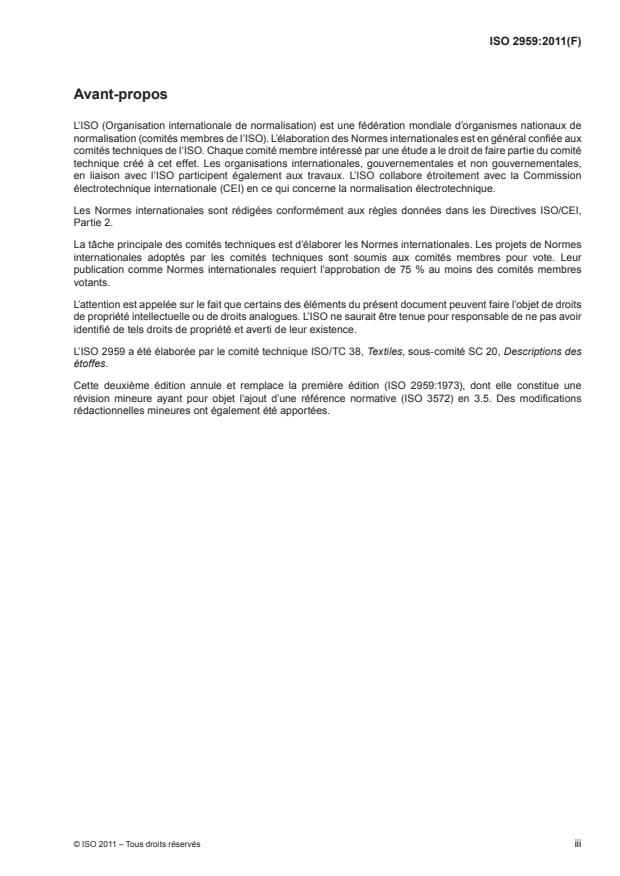
Avant-propos
L’ISO (Organisation internationale de normalisation) est une fédération mondiale d’organismes nationaux de
normalisation (comités membres de l’ISO). L’élaboration des Normes internationales est en général confiée aux
comités techniques de l’ISO. Chaque comité membre intéressé par une étude a le droit de faire partie du comité
technique créé à cet effet. Les organisations internationales, gouvernementales et non gouvernementales,
en liaison avec l’ISO participent également aux travaux. L’ISO collabore étroitement avec la Commission
électrotechnique internationale (CEI) en ce qui concerne la normalisation électrotechnique.
Les Normes internationales sont rédigées conformément aux règles données dans les Directives ISO/CEI,
Partie 2.
La tâche principale des comités techniques est d’élaborer les Normes internationales. Les projets de Normes
internationales adoptés par les comités techniques sont soumis aux comités membres pour vote. Leur
publication comme Normes internationales requiert l’approbation de 75 % au moins des comités membres
votants.
L’attention est appelée sur le fait que certains des éléments du présent document peuvent faire l’objet de droits
de propriété intellectuelle ou de droits analogues. L’ISO ne saurait être tenue pour responsable de ne pas avoir
identifié de tels droits de propriété et averti de leur existence.
L’ISO 2959 a été élaborée par le comité technique ISO/TC 38, Textiles, sous-comité SC 20, Descriptions des
étoffes.
Cette deuxième édition annule et remplace la première édition (ISO 2959:1973), dont elle constitue une
révision mineure ayant pour objet l’ajout d’une référence normative (ISO 3572) en 3.5. Des modifications
rédactionnelles mineures ont également été apportées.
NORME INTERNATIONALE ISO 2959:2011(F)
Textiles — Désignation des tissus
1 Domaine d’application
La présente Norme internationale donne
...