


ISO 13702:2015
(Main)Petroleum and natural gas industries — Control and mitigation of fires and explosions on offshore production installations — Requirements and guidelines
Petroleum and natural gas industries — Control and mitigation of fires and explosions on offshore production installations — Requirements and guidelines
ISO 13702:2015 describes the objectives and functional requirements for the control and mitigation of fires and explosions on offshore installations used for the development of hydrocarbon resources. ISO 13702:2015 is applicable to the following: fixed offshore structures; floating systems for production, storage, and offloading; petroleum and natural gas industries.
Industries du pétrole et du gaz naturel — Contrôle et atténuation des feux et des explosions dans les installations en mer — Exigences et lignes directrices
General Information
- Status
- Withdrawn
- Publication Date
- 15-Jul-2015
- Technical Committee
- ISO/TC 67/SC 6 - Processing equipment and systems
- Drafting Committee
- ISO/TC 67/SC 6/WG 1 - Offshore platform systems
- Current Stage
- 9599 - Withdrawal of International Standard
- Start Date
- 14-Mar-2024
- Completion Date
- 12-Feb-2026
Relations
- Effective Date
- 09-Feb-2026
- Effective Date
- 09-Feb-2026
- Effective Date
- 09-Feb-2026
- Effective Date
- 09-Feb-2026
- Effective Date
- 09-Feb-2026
- Effective Date
- 12-Feb-2026
- Effective Date
- 06-Jun-2022
- Effective Date
- 06-Jun-2022
- Effective Date
- 02-Oct-2010

Get Certified
Connect with accredited certification bodies for this standard

ABS Quality Evaluations Inc.
American Bureau of Shipping quality certification.

Element Materials Technology
Materials testing and product certification.

ABS Group Brazil
ABS Group certification services in Brazil.
Sponsored listings
Frequently Asked Questions
ISO 13702:2015 is a standard published by the International Organization for Standardization (ISO). Its full title is "Petroleum and natural gas industries — Control and mitigation of fires and explosions on offshore production installations — Requirements and guidelines". This standard covers: ISO 13702:2015 describes the objectives and functional requirements for the control and mitigation of fires and explosions on offshore installations used for the development of hydrocarbon resources. ISO 13702:2015 is applicable to the following: fixed offshore structures; floating systems for production, storage, and offloading; petroleum and natural gas industries.
ISO 13702:2015 describes the objectives and functional requirements for the control and mitigation of fires and explosions on offshore installations used for the development of hydrocarbon resources. ISO 13702:2015 is applicable to the following: fixed offshore structures; floating systems for production, storage, and offloading; petroleum and natural gas industries.
ISO 13702:2015 is classified under the following ICS (International Classification for Standards) categories: 75.180.10 - Exploratory, drilling and extraction equipment. The ICS classification helps identify the subject area and facilitates finding related standards.
ISO 13702:2015 has the following relationships with other standards: It is inter standard links to EN ISO 19904-1:2019, EN ISO 17349:2016, EN ISO 10418:2019, EN ISO 18647:2019, EN ISO 19901-3:2024, EN ISO 13702:2015, ISO 2380-1:2004, ISO 13702:2024, ISO 13702:1999. Understanding these relationships helps ensure you are using the most current and applicable version of the standard.
ISO 13702:2015 is available in PDF format for immediate download after purchase. The document can be added to your cart and obtained through the secure checkout process. Digital delivery ensures instant access to the complete standard document.
Standards Content (Sample)
INTERNATIONAL ISO
STANDARD 13702
Second edition
2015-08-01
Petroleum and natural gas
industries — Control and mitigation
of fires and explosions on offshore
production installations —
Requirements and guidelines
Industries du pétrole et du gaz naturel — Contrôle et atténuation des
feux et des explosions dans les installations en mer — Exigences et
lignes directrices
Reference number
©
ISO 2015
© ISO 2015, Published in Switzerland
All rights reserved. Unless otherwise specified, no part of this publication may be reproduced or utilized otherwise in any form
or by any means, electronic or mechanical, including photocopying, or posting on the internet or an intranet, without prior
written permission. Permission can be requested from either ISO at the address below or ISO’s member body in the country of
the requester.
ISO copyright office
Ch. de Blandonnet 8 • CP 401
CH-1214 Vernier, Geneva, Switzerland
Tel. +41 22 749 01 11
Fax +41 22 749 09 47
copyright@iso.org
www.iso.org
ii © ISO 2015 – All rights reserved
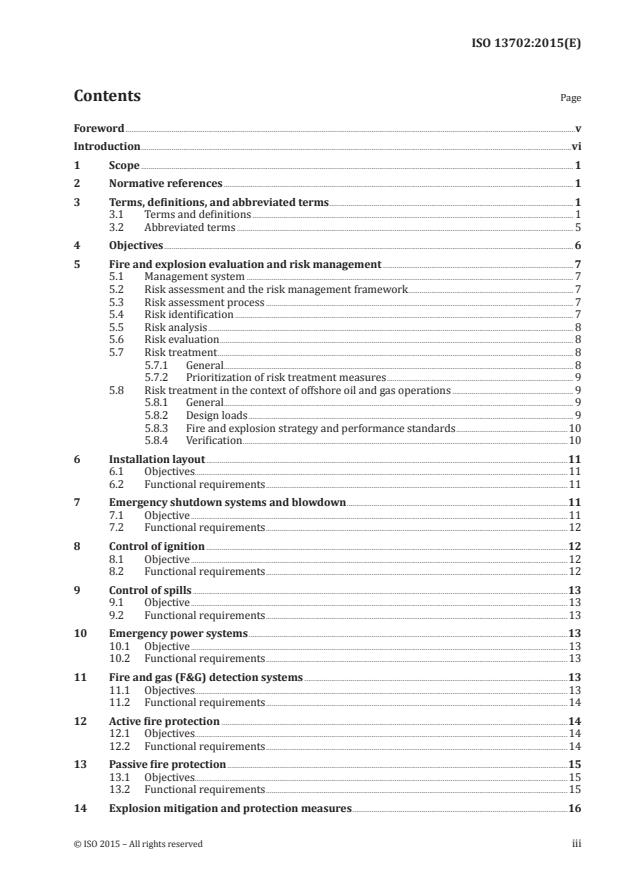
Contents Page
Foreword .v
Introduction .vi
1 Scope . 1
2 Normative references . 1
3 Terms, definitions, and abbreviated terms . 1
3.1 Terms and definitions . 1
3.2 Abbreviated terms . 5
4 Objectives . 6
5 Fire and explosion evaluation and risk management . 7
5.1 Management system . 7
5.2 Risk assessment and the risk management framework . 7
5.3 Risk assessment process . 7
5.4 Risk identification . 7
5.5 Risk analysis . 8
5.6 Risk evaluation . 8
5.7 Risk treatment . 8
5.7.1 General. 8
5.7.2 Prioritization of risk treatment measures . 9
5.8 Risk treatment in the context of offshore oil and gas operations . 9
5.8.1 General. 9
5.8.2 Design loads . 9
5.8.3 Fire and explosion strategy and performance standards .10
5.8.4 Verification .10
6 Installation layout .11
6.1 Objectives.11
6.2 Functional requirements .11
7 Emergency shutdown systems and blowdown .11
7.1 Objective .11
7.2 Functional requirements .12
8 Control of ignition .12
8.1 Objective .12
8.2 Functional requirements .12
9 Control of spills .13
9.1 Objective .13
9.2 Functional requirements .13
10 Emergency power systems .13
10.1 Objective .13
10.2 Functional requirements .13
11 Fire and gas (F&G) detection systems .13
11.1 Objectives.13
11.2 Functional requirements .14
12 Active fire protection .14
12.1 Objectives.14
12.2 Functional requirements .14
13 Passive fire protection .15
13.1 Objectives.15
13.2 Functional requirements .15
14 Explosion mitigation and protection measures .16
14.1 Objective .16
14.2 Functional requirements .16
15 Response to fires and explosions .17
15.1 Objectives.17
15.2 Functional requirements .17
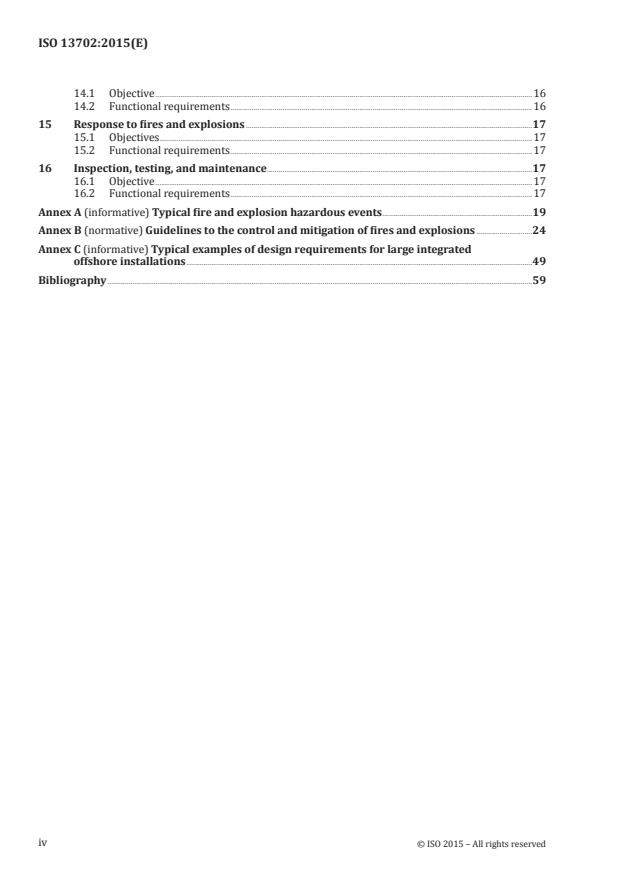
16 Inspection, testing, and maintenance .17
16.1 Objective .17
16.2 Functional requirements .17
Annex A (informative) Typical fire and explosion hazardous events .19
Annex B (normative) Guidelines to the control and mitigation of fires and explosions .24
Annex C (informative) Typical examples of design requirements for large integrated
offshore installations .49
Bibliography .59
iv © ISO 2015 – All rights reserved
Foreword
ISO (the International Organization for Standardization) is a worldwide federation of national standards
bodies (ISO member bodies). The work of preparing International Standards is normally carried out
through ISO technical committees. Each member body interested in a subject for which a technical
committee has been established has the right to be represented on that committee. International
organizations, governmental and non-governmental, in liaison with ISO, also take part in the work.
ISO collaborates closely with the International Electrotechnical Commission (IEC) on all matters of
electrotechnical standardization.
The procedures used to develop this document and those intended for its further maintenance are
described in the ISO/IEC Directives, Part 1. In particular the different approval criteria needed for the
different types of ISO documents should be noted. This document was drafted in accordance with the
editorial rules of the ISO/IEC Directives, Part 2 (see www.iso.org/directives).
Attention is drawn to the possibility that some of the elements of this document may be the subject of
patent rights. ISO shall not be held responsible for identifying any or all such patent rights. Details of
any patent rights identified during the development of the document will be in the Introduction and/or
on the ISO list of patent declarations received (see www.iso.org/patents).
Any trade name used in this document is information given for the convenience of users and does not
constitute an endorsement.
For an explanation on the meaning of ISO specific terms and expressions related to conformity
assessment, as well as information about ISO’s adherence to the WTO principles in the Technical Barriers
to Trade (TBT) see the following URL: Foreword - Supplementary information.
This second edition cancels and replaces the first edition (ISO 13702:1999), which has been
technically revised.
The committee responsible for this document is ISO/TC 67, Materials, equipment and offshore structures for
petroleum, petrochemical and natural gas industries, Subcommittee SC 6, Processing equipment and systems.
Introduction
The successful development of the arrangements required to promote safety and environmental
protection during the recovery of hydrocarbon resources requires a structured approach to the
identification and management of health, safety, and environmental hazards applied during the design,
construction, operation, inspection, maintenance, and decommissioning of a facility.
This International Standard has been prepared primarily to assist in the development of new installations
through their lifecycle. For existing installations that predate this International Standard, not all
requirements are necessarily appropriate. Retrospective application of this International Standard can
be undertaken where it is reasonably practicable to do so. During the planning for a major change to an
installation, there will be more opportunity to implement the requirements. A careful review of this
International Standard will determine those sections which can be utilized in the change.
The technical content of this International Standard is arranged as follows.
— Objectives: lists the goals to be achieved by the control and mitigation measures being described.
— Functional requirements: represent the minimum criteria to meet the stated objectives. The functional
requirements are performance-orientated measures and, as such, are applicable to the variety of
offshore installations utilized for the development of hydrocarbon resources throughout the world.
— Annex A (informative): typical fire and explosion hazardous events.
— Annex B (informative): describes recognized practices to be considered in conjunction with
statutory requirements, industry standards, and individual operator philosophy to determine that
the measures necessary are implemented for the control and mitigation of fires and explosions.
The guidelines are limited to principal elements and are intended to provide specific guidance
which, due to the wide variety of offshore operating environments, cannot be applicable in some
circumstances.
— Annex C (informative): typical examples of design requirements for large integrated offshore
installations.
— Bibliography: lists documents to which informative reference is made in this International Standard.
vi © ISO 2015 – All rights reserved
INTERNATIONAL STANDARD ISO 13702:2015(E)
Petroleum and natural gas industries — Control and
mitigation of fires and explosions on offshore production
installations — Requirements and guidelines
1 Scope
This International Standard describes the objectives and functional requirements for the control and
mitigation of fires and explosions on offshore installations used for the development of hydrocarbon
resources.
This International Standard is applicable to the following:
— fixed offshore structures;
— floating systems for production, storage, and offloading;
— petroleum and natural gas industries.
Mobile offshore units as defined in this International Standard and subsea installations are excluded,
although many of the principles contained in this International Standard can be used as guidance.
This International Standard is based on an approach where the selection of control and mitigation
measures for fires and explosions is determined by an evaluation of hazards on the offshore installation.
The methodologies employed in this assessment and the resultant recommendations will differ
depending on the complexity of the production process and facilities, type of facility (i.e. open or
enclosed), manning levels, and environmental conditions associated with the area of operation.
NOTE Statutory requirements, rules, and regulations can, in addition, be applicable for the individual offshore
installation concerned.
2 Normative references
The following documents, in whole or in part, are normatively referenced in this document and are
indispensable for its application. For dated references, only the edition cited applies. For undated
references, the latest edition of the referenced document (including any amendments) applies.
ISO/IEC Guide 73, Risk management — Vocabulary
3 Terms, definitions, and abbreviated terms
3.1 Terms and definitions
For the purposes of this document, the terms and definitions given in ISO/IEC Guide 73 and the
following apply.
3.1.1
abandonment
act of personnel onboard leaving an installation in an emergency
3.1.2
accommodation
place where personnel onboard sleep and spend their off-duty time
Note 1 to entry: It can include dining rooms, recreation rooms, lavatories, cabins, offices, sickbay, living quarters,
galley, pantries, and similar permanently enclosed spaces.
3.1.3
active fire protection
AFP
equipment, systems, and methods which, following initiation, can be used to control, mitigate, and
extinguish fires
3.1.4
area classification
division of an installation into hazardous areas and non-hazardous areas and the sub-division of
hazardous areas into zones
Note 1 to entry: This classification is based on the materials which can be present and the probability of a
flammable atmosphere developing. Area classification is primarily used in the selection of electrical equipment
to minimize the likelihood of ignition if a release occurs.
3.1.5
cellulosic fire
CF
fire involving combustible material such as wood, paper, furniture, etc.
3.1.6
class of fire
type of fire
classification of fires, based on the nature of the fuel
Note 1 to entry: ISO 3941 describes the classes of fires.
3.1.7
control
limiting the extent or duration of a hazardous event
Note 1 to entry: The definition of control is specific in this International Standard and other definitions are used
in other standards.
3.1.8
control station
place on the installation from which personnel can monitor the status of the installation, initiate
appropriate shutdown actions, and undertake any emergency communication
3.1.9
deluge system
system to apply fire-water through an array of open spray nozzles by operation of a valve on the inlet
to the system
3.1.10
embarkation area
place from which personnel leave the installation during evacuation
EXAMPLE Helideck and associated waiting area or a lifeboat/liferaft boarding area.
3.1.11
emergency depressurization
EDP
controlled disposal of pressurized fluids to a flare or vent system when required to avoid or minimize a
hazardous situation
2 © ISO 2015 – All rights reserved
3.1.12
emergency response
action taken by personnel on or off the installation to control or mitigate a hazardous event or initiate
and execute abandonment
3.1.13
emergency response team
group of personnel who have designated duties in an emergency
3.1.14
emergency shutdown
ESD
control actions undertaken to shut down equipment or processes in response to a hazardous situation
3.1.15
escalation
spread of impact from fires, explosions, toxic gas releases to equipment or other areas thereby causing
an increase in the consequences of a hazardous event
3.1.16
escape
act of personnel moving away from a hazardous event to a place where its effects are reduced or removed
3.1.17
escape route
route from an area of an installation leading to a muster area, temporary refuge (TR), embarkation area,
or means of escape to the sea
3.1.18
critical safety system
any system which has a major role in the control and mitigation of fires and explosions and in any
subsequent evacuation, escape, and rescue activities
3.1.19
evacuation
planned method of leaving the installation in an emergency
3.1.20
evacuation, escape, and rescue
EER
range of possible actions including escape, muster, refuge, evacuation, escape to the sea, and
rescue/recovery
3.1.21
evacuation route
escape route which leads from the temporary refuge (TR) to the place(s) used for evacuation from
the installation
3.1.22
explosion
3.1.22.1
gas explosion
combustion of a flammable gas or mist which generates blast waves due to confinement of the combustion-
induced flow or the acceleration of the flame front by obstacles in the flame path
3.1.22.2
physical explosion
explosion arising from the sudden release of stored energy such as from failure of a pressure vessel
3.1.23
fire and explosion strategy
FES
results of the process that uses information from the fire and explosion evaluation to determine the
measures required to manage these hazardous events and the role of these measures
3.1.24
functional requirements
minimum criteria which shall be satisfied to meet the stated health, safety, and environmental objectives
3.1.25
hazard
potential source of harm
Note 1 to entry: Hazard can be a risk source for potential for human injury, damage to the environment, damage
to property, or a combination of these.
[SOURCE: ISO/IEC Guide 51:2014]
3.1.26
hazardous area
three-dimensional space in which a flammable atmosphere can be expected to be present at such
frequencies as to require special precautions for the control of potential ignition sources
3.1.27
hazardous event
event that can cause harm
EXAMPLE The incident which occurs when a hazard is realized such as release of gas, fire, loss of buoyancy.
[SOURCE: ISO/IEC Guide 51:2014]
3.1.28
human factors
environmental, organisational, and job factors which influence behaviour of work in a way that can
affect health and safety
3.1.29
ignition sources
any source with sufficient energy to initiate combustion
3.1.30
integrated installation
offshore installation which contains, on the same structure, accommodation, and utilities in addition to
process or wellhead facilities
3.1.31
jet fire
JF
turbulent diffusion flame resulting from the combustion of a fuel continuously released with momentum
in a particular direction
3.1.32
manned installation
installation on which people are routinely accommodated
4 © ISO 2015 – All rights reserved
3.1.33
mobile offshore unit
mobile platform, including drilling ships, equipped for drilling for subsea hydrocarbon deposits and
mobile platform for purposes other than production and storage of hydrocarbon deposits
Note 1 to entry: Includes mobile offshore drilling units, including drillships, accommodation units, construction
and pipelay units, and well servicing and well stimulation vessels.
3.1.34
muster area
designated area where personnel report when required to do so
3.1.35
operator
individual, partnership, firm, or corporation having control or management of operations on the leased
area or a portion thereof
Note 1 to entry: The operator can be a lessee, designated agent of the lessee(s), or holder of operating rights under
an approved operating agreement.
3.1.36
passive fire protection
PFP
coating or cladding arrangement or free-standing system which, in the event of fire, will provide thermal
protection to restrict the rate at which heat is transmitted to the object or area being protected
3.1.37
pool fire
turbulent diffusion fire burning above a horizontal pool of vaporizing hydrocarbon fuel under conditions
where the fuel has zero or very low initial momentum
3.1.38
risk
combination of the probability of occurrence of harm and the severity of that harm
[SOURCE: ISO/IEC Guide 51:2014]
3.1.39
running liquid fire
fire involving a flammable liquid flowing over a surface
3.1.40
temporary refuge
TR
place provided where personnel can take refuge for a predetermined period while investigations,
emergency response, and evacuation preplanning are undertaken
3.1.41
zone
part of a hazardous area based upon the frequency of the occurrence and duration of an explosive
gas atmosphere
3.2 Abbreviated terms
AB accommodation block
AFP active fire protection
API American Petroleum Institute
BA breathing apparatus
BOP blowout preventer
CCR central control room
CF cellulosic fire
CS control station
EDP emergency depressurization
EER evacuation, escape, and rescue
ESD emergency shutdown
FES fire and explosion strategy
F&G fire and gas
GOR gas oil ratio
HC hydrocarbon
HMI human machine interface
HVAC heating, ventilation, and air conditioning
IEC International Electrotechnical Commission
IMO International Maritime Organization
JF jet fire
PA public address
PFP passive fire protection
PLC programmable logic controllers
SSIV sub-sea isolation valve
SSSV sub-surface safety valve
TEMPSC totally enclosed motor-propelled survival craft
TR temporary refuge
UA utility area
UPS uninterruptable power supply
WH wellhead area
4 Objectives
The following are the principal objectives of this International Standard, in order of priority:
— safety of personnel;
— protection of the environment;
6 © ISO 2015 – All rights reserved
— protection of assets;
— minimization of financial and consequential losses of fires and explosions.
5 Fire and explosion evaluation and risk management
5.1 Management system
All companies associated with the offshore recovery of hydrocarbons shall have, or conduct their
activities in accordance with, an effective management system which addresses environmental issues
such as described in ISO 14001 or similar (for example, operators should have an effective management,
contractors should have either their own management system or conduct their activities consistently
with the operators management system) and additionally addresses issues relating to health and safety.
One key element of such management systems shall be a process of evaluation and risk management
which shall take place in a framework which provides the policies, procedures, and organizational
arrangements that will embed risk management throughout the organization.
5.2 Risk assessment and the risk management framework
This International Standard assumes that the risk assessment is performed within the principles and
guidelines for risk management described in ISO 31000.
In particular, those carrying out risk assessments shall be clear about the following:
a) organization’s risk management policy, its objectives, and the context in which the organization operates;
b) extent and type of risks that are tolerable and how to treat any risks that are deemed not to be tolerable;
c) how risk assessment integrates into organizational processes;
d) methods and techniques to be used for risk assessment and their contribution to the risk
management process;
e) accountability, both for performing risk assessment and for making decisions taking account of the
results;
f) resources required to carry out risk assessment;
g) how the risk assessment will be reported and reviewed.
5.3 Risk assessment process
Risk assessment provides decision-makers and responsible parties with an improved understanding of
risks that could affect achievement of objectives and the adequacy and effectiveness of controls already
in place. This provides a basis for decisions about the most appropriate approach to be used to treat the
risks. The output of risk assessment is an input to the decision-making processes of the organization.
Risk assessment is the overall process of risk identification, risk analysis, and risk evaluation. The
manner in which this process is applied is dependent not only on the context of the risk management
process but also on the methods and techniques used to carry out the risk assessment.
5.4 Risk identification
The starting point for risk management is the systematic identification of the sources of risk and their
potential consequences which can be dependent on the location, activities, and materials which are used
or encountered in them.
The risk identification process shall be applied to all stages in the life cycle of an installation and to all
types of hazards encountered as a consequence of the development of hydrocarbon resources.
5.5 Risk analysis
Risk analysis involves developing an understanding of the risks. Risk analysis provides an input to
risk evaluation and to decisions on whether risks need to be treated, and on the most appropriate risk
treatment strategies and methods. Risk analysis can also provide an input into making decisions where
choices are made and the options involve different types and levels of risk.
Risk analysis involves consideration of the causes and sources of risk, their positive and negative
consequences, and the likelihood that those consequences can occur. Factors that affect consequences
and likelihood shall be identified. An event can have multiple consequences and can affect multiple
objectives. Existing controls and their effectiveness and efficiency shall also be taken into account.
5.6 Risk evaluation
The purpose of risk evaluation is to assist decision-making and shall be based on the outcomes of risk analysis.
Risk evaluation involves comparing the level of risk found during the analysis process with qualitative
or quantitative criteria established when the context was considered. Based on this comparison, the
need for treatment shall be considered.
Decisions shall take account of the wider context of the risk and include consideration of the tolerance
of the risks borne by parties other than the organization that get benefits from the risk. Decisions shall
be made in accordance with legal, regulatory, and other requirements.
In some circumstances, the risk evaluation can lead to a decision to undertake further analysis. The risk
evaluation can also lead to a decision not to treat the risk in any way other than maintaining existing
controls. This decision will be influenced by the organization’s risk attitude and the criteria that have
been established.
5.7 Risk treatment
5.7.1 General
Risk treatment involves selecting one or more options for modifying risks and implementing those
options. Once implemented, treatments provide or modify the controls.
Risk treatment involves a cyclical process of
— assessing a risk treatment,
— deciding whether residual risk levels are tolerable,
— generating a new risk treatment, if risk levels are not tolerable, and
— assessing the effectiveness of that treatment.
Risk treatment options are not necessarily mutually exclusive or appropriate in all circumstances. The
options can include the following:
a) avoiding the risk by deciding not to start or continue with the activity that gives rise to the risk;
b) taking or increasing the risk in order to pursue an opportunity;
c) removing the risk source;
d) changing the likelihood;
e) changing the consequences;
f) retaining the risk by informed decision.
8 © ISO 2015 – All rights reserved
The process of selecting risk treatment measures predominantly entails the use of sound engineering
judgement, but it can be necessary to supplement this by recognition of the particular circumstances
which can require deviation from past practices and previously applied codes and standards.
5.7.2 Prioritization of risk treatment measures
Preventative measures, such as using inherently safer designs and ensuring asset integrity, shall be
emphasized wherever practicable. Based on the results of the evaluation, detailed health, safety and
environmental objectives, and functional requirements shall be set at appropriate levels.
5.8 Risk treatment in the context of offshore oil and gas operations
5.8.1 General
The above is general and applies to all hazards and potentially hazardous events. In the context of fires and
explosions, the evaluation of these events may be part of an overall installation evaluation or may be treated
as a separate process which provides information to the overall evaluation. For further requirements and
guidelines related to hazard identification and risk assessment, reference is made to ISO 17776.
In developing the risk treatment measures, there are a wide range of issues which shall be considered
to ensure that the measures selected are capable of performing their function when required to do so.
These issues include the following:
a) nature of the fires and explosions which might occur (see Annex A);
b) risks of fires and explosions;
c) marine environment;
d) nature of the fluids to be handled;
e) anticipated ambient conditions;
f) temperature and pressure of fluids to be handled;
g) quantities of flammable materials to be processed and stored;
h) flammability and toxicity of materials in non-hazardous areas including accommodation and
control station;
i) amount, complexity, and layout of equipment on the installation;
j) location of the installation with respect to external assistance/support;
k) emergency response strategy;
l) production and manning philosophy;
m) human factors;
n) interaction with adjacent facilities and vessels, e.g. jack-up, flotel, offtake tankers.
Clause 6 to Clause 16 identify requirements and provide guidance on a range of measures which can
have a role in either the control and mitigation of the potential fire or explosion hazardous events on an
installation.
5.8.2 Design loads
The evaluation of the fire and explosion hazards on the installation shall define the fire and explosion
loads. The loads shall be summarized into a form to provide suitable input to the design process and
thereby constitute the minimum loads that the installation shall be designed to withstand, unless
regulatory requirements require a higher resistance. It is often possible to provide a higher degree of
resistance to fires and explosions and thus, the maximum reasonable resistance to fire and explosion
shall be used in the design.
5.8.3 Fire and explosion strategy and performance standards
The results of the evaluation process and the decisions taken with respect to the need for, and role of,
any risk reduction measures shall be recorded so that they are easily available for those who operate the
installation and for those involved in any subsequent change to the installation. For convenience in the
remainder of this International Standard, the term fire and explosion strategy (FES) has been adopted
for this record.
NOTE Matters related to evacuation, escape, and rescue is covered in ISO 15544.
The FES does not have to be separately documented and the relevant information may be included
with other health, safety, and environmental information as part of the management of all hazardous
events on an installation. For many existing installations, the FES may be contained in previous risk
assessments or may be restricted to a simple statement of the standards and/or procedures, which are
applied to deal with fire and explosion aspects of the installation.
The strategies shall be updated whenever there is a change to the installation which affects the
management of the fire and explosion hazardous events.
The level of detail in a FES can vary depending on the scale and complexity of the installation and the
stage in the installation life cycle when the risk management process is undertaken.
EXAMPLE 1 Complex installations, e.g. a large production platform incorporating complex facilities, drilling
modules, and large accommodation modules, are likely to require detailed studies to address the fire and explosion
hazardous events. Typical examples of some of the issues that can be necessary to address for such installations
are given in Annex C.
EXAMPLE 2 For simpler installations, e.g. a wellhead platform or other small platforms with limited process
facilities, it can be possible to rely on application of recognized codes and standards as a suitable base which
reflects industry experience for this type of facility.
EXAMPLE 3 For installations which are a repeat of earlier designs, evaluations undertaken for the original
design can be reviewed to judge if they are sufficient to determine the measures needed to manage the fire
and explosion hazardous events, considering new knowledge, new technology, the environment, reservoir
characteristics, etc.
EXAMPLE 4 For installations in the early design phases, the evaluations will be less detailed than those
undertaken during later design phases.
The strategies shall describe the role and main functional requirements for each of the systems required
to manage possible hazardous events on the installation. Based on the strategies, performance standards
shall be developed considering the following:
a) functional parameters of the particular system, e.g. essential duties that the system is expected to
perform;
b) integrity, reliability, and availability of the system;
c) survivability of the system under the emergency conditions which might be present when it is
required to fulfil its role;
d) dependency on other systems or operational factors that might have an influence on the performance
of the safety function when needed.
5.8.4 Verification
The performance of the critical safety systems shall be verified for the life of the installation in order to
ensure that the strategies remain valid and to identify the need for any remedial action.
10 © ISO 2015 – All rights reserved
6 Installation layout
6.1 Objectives
The objectives of the layout on the installation are the following:
— minimize the possibility of hazardous accumulations of flammable liquids and gases and to provide
for the rapid removal of any accumulations which do occur;
— minimize the probability of ignition;
— minimize the spread of flammable liquids and gases which might result in a hazardous event;
— separate areas required to be non-hazardous from those designated as being hazardous;
— minimize the consequences of fire and explosions;
— provide for adequate arrangements for escape and evacuation.
6.2 Functional requirements
The layout of an installation can have a major effect on the consequences of fires and explosions and
on the arrangements required for EER. Consequently, for a new installation or the modification of an
existing installation, the impact of layout options on the FES shall be fully evaluated as a basis for the
selection of the design which, as far as reasonable, minimizes the risks of fire and explosion.
In developing the layout of the installation, consideration shall be given to maximizing, as far as
reasonable, the separation by distance of the temporary refuge (TR), accommodation and evacuation,
escape and rescue (EER) facilities from areas containing equipment handling hydrocarbons.
Either separation by distance or the use of barriers (floors and walls) can prevent the escalation of fire
or explosion to another area. The provision of such barriers influences ventilation, access/escape routes,
ESD/EDP system design, explosion resistance, and firewater demands. The interdependency of safety
systems shall be considered during the design of the installation. Any penetration of a barrier provided
to prevent escalation of a fire or explosion shall not jeopardize the integrity of the barrier.
Critical safety systems (such as control stations, temporary refuge, muster areas, fire water pumps, and
local control panels) shall be located where they are least likely to be affected by fires and explosions in
order to maintain their integrity and availability of the safety functions. In some situations, such systems
should be designed to withstand fire and explosions and be protected from the ingress of smoke, at least
until people on board have been safely evacuated or the situation has been brought under control.
The blowout preventer (BOP) diverter assemblies shall be able to perform their functions under
emergency conditions. This shall include the ability to initiate and operate this equipment during these
conditions. Considerations shall also be given to location and operation of well kill equipment in order
to allow it to be used under emergency conditions.
The installation layout can result in equipment being at risk from impact of dropped objects or collisions.
The need to protect critical items of process equipment, especially where failure can result in a major
loss of inventory, shall be considered to determine whether impact protection is required.
7 Emergency shutdown systems and blowdown
7.1 Objective
The objective of the emergency shutdown system is to initiate appropriate shutdown, isolation, and
blowdown actions to prevent escalation of abnormal conditions into a major hazardous event and to
limit the extent and duration of any such events which do occur.
7.2 Functional requirements
Depending on the severity of the event and level of the alarm, an emergency shutdown (ESD) system
shall be provided, in accordance with the requirements of the FES, in order to
— isolate the installation from the majo
...
Questions, Comments and Discussion
Ask us and Technical Secretary will try to provide an answer. You can facilitate discussion about the standard in here.
Loading comments...