

ISO 13703-3:2023
(Main)Oil and gas industries including lower carbon energy — Piping systems on offshore production platforms and onshore plants — Part 3: Fabrication
General Information
- Abstract
This document specifies requirements for the fabrication, installation, welding, inspection, examination and testing of new, metallic piping systems , within temperature range limits for the materials meeting the requirements of ASME B31.3, on fixed and floating offshore production facilities and onshore production, processing and gas liquefaction plants. For piping systems above pressure class 2500, the requirements of chapter IX of ASME B31.3 shall be complied with, in addition to the requirements stated in this standard. This document is applicable to all pressure retaining components and any non-pressure retaining component, such as a member of a pipe support, welded directly to a pressure retaining component. This document is not applicable to the following: — marine-related piping systems, e.g. ballasting piping systems, systems covered by classification societies; — metallic tubing used for subsea umbilical systems; NOTE 1 Reference can be made to ISO 13628-5 or API Spec 17E for welding and examination of these components. — piping systems with corrosion resistant cladding (either integrally clad or mechanically lined) or weld overlay, including buttering and associated dissimilar welds; NOTE 2 Reference can be made to DNV-RP-B204 for welding and examination of these systems. — refractory alloys [with exception of CP titanium Grade 1 (UNS R50250) or Grade 2 (UNS R50400)]; — non-metallic piping assemblies; — transportation pipeline systems, including flow-lines, designed in accordance with a recognized pipeline design code.
- Status
- Published
- Publication Date
- 28-Sep-2023
- Technical Committee
- ISO/TC 67/SC 6 - Processing equipment and systems
- Drafting Committee
- ISO/TC 67/SC 6/WG 5 - Piping systems
- Current Stage
- 6060 - International Standard published
- Start Date
- 29-Sep-2023
- Due Date
- 12-Aug-2023
- Completion Date
- 29-Sep-2023
Buy Documents

ISO 13703-3:2023 - Oil and gas industries including lower carbon energy — Piping systems on offshore production platforms and onshore plants — Part 3: Fabrication Released:29. 09. 2023

ISO 13703-3:2023 - Industries du pétrole et du gaz, y compris les énergies a faible émission de carbone — Conception et installation des systemes de tuyauterie sur les plates-formes de production en mer et les installations a terre — Partie 3: Fabrication Released:29. 09. 2023
Overview
ISO 13703-3:2023 specifies requirements for the fabrication, installation, welding, inspection, examination and testing of new, metallic piping systems on fixed and floating offshore production platforms and onshore production, processing and gas liquefaction plants. The standard is aligned with ASME B31.3 material limits and requires compliance with Chapter IX of ASME B31.3 for piping above pressure class 2500. It applies to all pressure‑retaining components and non‑pressure parts welded directly to them, but excludes certain marine systems, subsea umbilicals, cladded or overlayed piping, refractory alloys (with limited titanium exceptions), non‑metallic piping and transmission pipelines.
Key Topics
- Scope & applicability: metallic process piping on offshore and onshore facilities; interface with ASME B31.3.
- Health, safety & quality: mandatory HSE and quality control provisions for fabrication and testing.
- Welding requirements: approved processes, preparation, welder/operator qualification and record keeping.
- Welding consumables: material‑specific requirements (carbon steels, stainless and duplex steels, high alloys, dissimilar welds).
- Procedure qualification: essential variables, special provisions for sour service, titanium and high‑alloy materials.
- Preheat and PWHT: preheating practices and post‑weld heat treatment requirements for integrity and metallurgical control.
- Bending of pipe: cold and hot induction bending requirements and heat treatment of bends.
- Installation: threaded and bolted connection practices for field assembly.
- Inspection, NDT & testing: visual, magnetic particle, liquid penetrant, radiographic, ultrasonic, PMI, production testing, ferrite testing and repair criteria.
- Cleaning, leak & tightness testing, preservation: procedures to prepare systems for commissioning and long‑term preservation.
- Annexes & guidance: visual oxidation references, cold/hot bending details and EU PED guidance.
Applications
ISO 13703-3:2023 is used by:
- Piping and welding engineers specifying fabrication practices for oil, gas and lower‑carbon energy projects.
- Fabrication shops, welding supervisors and welders for qualification and process control.
- EPC contractors and site construction teams for offshore production platforms and onshore processing plants.
- NDT inspectors and QA/QC teams to establish inspection and testing regimes.
- Regulators and owners seeking harmonized, internationally recognized fabrication criteria tied to ASME B31.3.
Benefits include improved safety and reliability of process piping systems, reduced rework, and clearer alignment between international fabrication practices and project specifications.
Related Standards (if applicable)
- ASME B31.3 (process piping) - normative reference and base code
- ISO 13703-1 and ISO 13703-2 (design and materials)
- ISO 13628-5, API Spec 17E (subsea umbilicals)
- DNV‑RP‑B204 (cladded/overlay welding guidance)
- Directive 2014/68/EU (PED) - for European compliance
Keywords: ISO 13703-3:2023, piping systems, fabrication, welding, inspection, offshore production platforms, onshore plants, ASME B31.3, pressure retaining components.
Relations
- Effective Date
- 12-Feb-2026
- Effective Date
- 12-Oct-2020
Buy Documents
ISO 13703-3:2023 - Oil and gas industries including lower carbon energy — Piping systems on offshore production platforms and onshore plants — Part 3: Fabrication Released:29. 09. 2023
ISO 13703-3:2023 - Industries du pétrole et du gaz, y compris les énergies a faible émission de carbone — Conception et installation des systemes de tuyauterie sur les plates-formes de production en mer et les installations a terre — Partie 3: Fabrication Released:29. 09. 2023
Get Certified
Connect with accredited certification bodies for this standard

Element Materials Technology
Materials testing and product certification.

ABS Group Brazil
ABS Group certification services in Brazil.

ABS Quality Evaluations Inc.
American Bureau of Shipping quality certification.
Sponsored listings
Frequently Asked Questions
ISO 13703-3:2023 is a standard published by the International Organization for Standardization (ISO). Its full title is "Oil and gas industries including lower carbon energy — Piping systems on offshore production platforms and onshore plants — Part 3: Fabrication". This standard covers: This document specifies requirements for the fabrication, installation, welding, inspection, examination and testing of new, metallic piping systems , within temperature range limits for the materials meeting the requirements of ASME B31.3, on fixed and floating offshore production facilities and onshore production, processing and gas liquefaction plants. For piping systems above pressure class 2500, the requirements of chapter IX of ASME B31.3 shall be complied with, in addition to the requirements stated in this standard. This document is applicable to all pressure retaining components and any non-pressure retaining component, such as a member of a pipe support, welded directly to a pressure retaining component. This document is not applicable to the following: — marine-related piping systems, e.g. ballasting piping systems, systems covered by classification societies; — metallic tubing used for subsea umbilical systems; NOTE 1 Reference can be made to ISO 13628-5 or API Spec 17E for welding and examination of these components. — piping systems with corrosion resistant cladding (either integrally clad or mechanically lined) or weld overlay, including buttering and associated dissimilar welds; NOTE 2 Reference can be made to DNV-RP-B204 for welding and examination of these systems. — refractory alloys [with exception of CP titanium Grade 1 (UNS R50250) or Grade 2 (UNS R50400)]; — non-metallic piping assemblies; — transportation pipeline systems, including flow-lines, designed in accordance with a recognized pipeline design code.
This document specifies requirements for the fabrication, installation, welding, inspection, examination and testing of new, metallic piping systems , within temperature range limits for the materials meeting the requirements of ASME B31.3, on fixed and floating offshore production facilities and onshore production, processing and gas liquefaction plants. For piping systems above pressure class 2500, the requirements of chapter IX of ASME B31.3 shall be complied with, in addition to the requirements stated in this standard. This document is applicable to all pressure retaining components and any non-pressure retaining component, such as a member of a pipe support, welded directly to a pressure retaining component. This document is not applicable to the following: — marine-related piping systems, e.g. ballasting piping systems, systems covered by classification societies; — metallic tubing used for subsea umbilical systems; NOTE 1 Reference can be made to ISO 13628-5 or API Spec 17E for welding and examination of these components. — piping systems with corrosion resistant cladding (either integrally clad or mechanically lined) or weld overlay, including buttering and associated dissimilar welds; NOTE 2 Reference can be made to DNV-RP-B204 for welding and examination of these systems. — refractory alloys [with exception of CP titanium Grade 1 (UNS R50250) or Grade 2 (UNS R50400)]; — non-metallic piping assemblies; — transportation pipeline systems, including flow-lines, designed in accordance with a recognized pipeline design code.
ISO 13703-3:2023 is classified under the following ICS (International Classification for Standards) categories: 75.180.10 - Exploratory, drilling and extraction equipment. The ICS classification helps identify the subject area and facilitates finding related standards.
ISO 13703-3:2023 has the following relationships with other standards: It is inter standard links to EN ISO 13703-3:2023, ISO 13703:2000. Understanding these relationships helps ensure you are using the most current and applicable version of the standard.
ISO 13703-3:2023 is available in PDF format for immediate download after purchase. The document can be added to your cart and obtained through the secure checkout process. Digital delivery ensures instant access to the complete standard document.
Standards Content (Sample)
INTERNATIONAL ISO
STANDARD 13703-3
First edition
2023-09
Oil and gas industries including lower
carbon energy — Piping systems on
offshore production platforms and
onshore plants —
Part 3:
Fabrication
Industries du pétrole et du gaz, y compris les énergies à faible
émission de carbone — Conception et installation des systèmes
de tuyauterie sur les plates-formes de production en mer et les
installations à terre —
Partie 3: Fabrication
Reference number
© ISO 2023
All rights reserved. Unless otherwise specified, or required in the context of its implementation, no part of this publication may
be reproduced or utilized otherwise in any form or by any means, electronic or mechanical, including photocopying, or posting on
the internet or an intranet, without prior written permission. Permission can be requested from either ISO at the address below
or ISO’s member body in the country of the requester.
ISO copyright office
CP 401 • Ch. de Blandonnet 8
CH-1214 Vernier, Geneva
Phone: +41 22 749 01 11
Email: copyright@iso.org
Website: www.iso.org
Published in Switzerland
ii
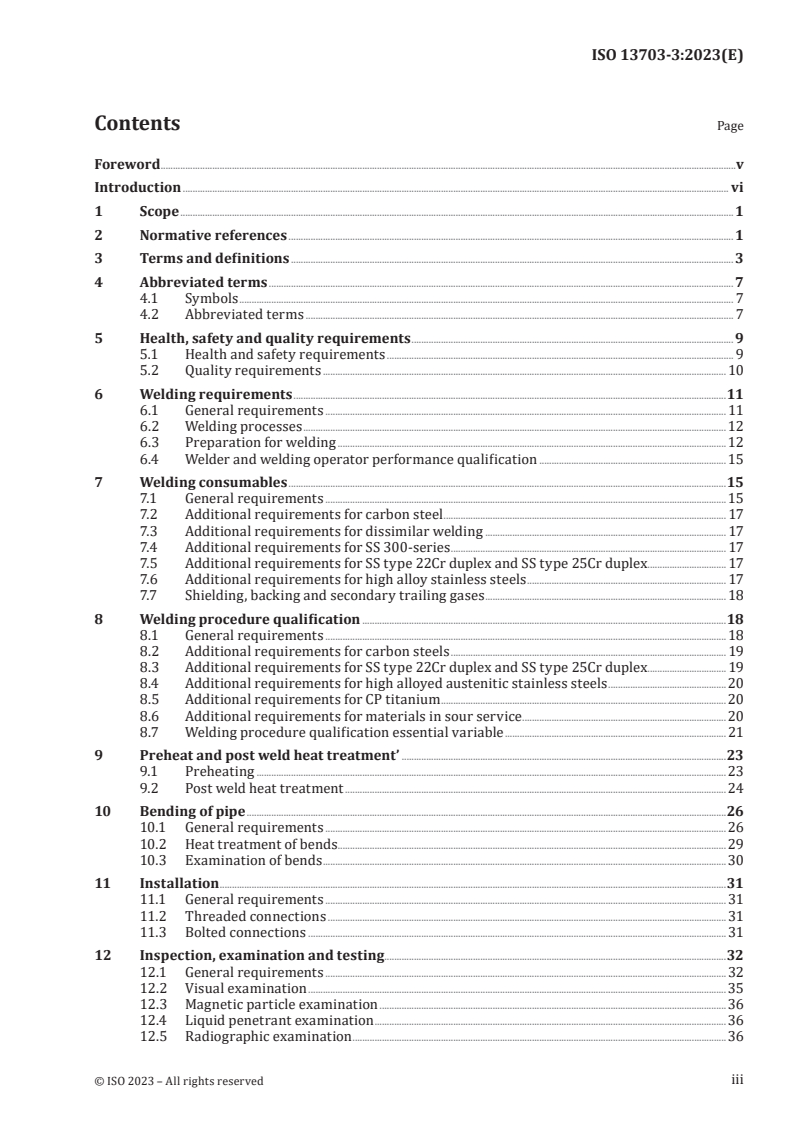
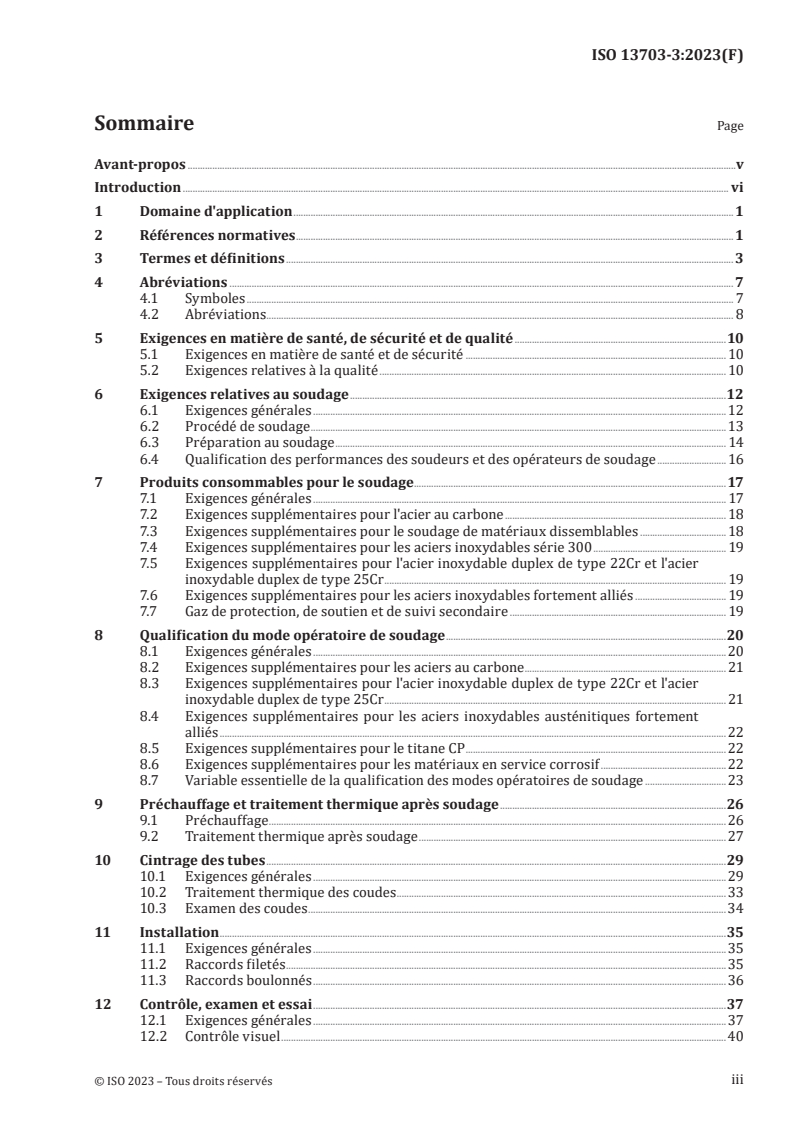
Contents Page
Foreword .v
Introduction . vi
1 Scope . 1
2 Normative references . 1
3 Terms and definitions . 3
4 Abbreviated terms . 7
4.1 Symbols . 7
4.2 Abbreviated terms . 7
5 Health, safety and quality requirements . 9
5.1 Health and safety requirements . 9
5.2 Quality requirements . 10
6 Welding requirements .11
6.1 General requirements . 11
6.2 Welding processes . 12
6.3 Preparation for welding .12
6.4 Welder and welding operator performance qualification . 15
7 Welding consumables .15
7.1 General requirements .15
7.2 Additional requirements for carbon steel . 17
7.3 Additional requirements for dissimilar welding . 17
7.4 Additional requirements for SS 300-series . 17
7.5 Additional requirements for SS type 22Cr duplex and SS type 25Cr duplex . 17
7.6 Additional requirements for high alloy stainless steels . 17
7.7 Shielding, backing and secondary trailing gases . 18
8 Welding procedure qualification .18
8.1 General requirements . 18
8.2 Additional requirements for carbon steels . 19
8.3 Additional requirements for SS type 22Cr duplex and SS type 25Cr duplex . 19
8.4 Additional requirements for high alloyed austenitic stainless steels .20
8.5 Additional requirements for CP titanium . 20
8.6 Additional requirements for materials in sour service . 20
8.7 Welding procedure qualification essential variable . 21
9 Preheat and post weld heat treatment’ .23
9.1 Preheating . 23
9.2 Post weld heat treatment . 24
10 Bending of pipe .26
10.1 General requirements . 26
10.2 Heat treatment of bends . . 29
10.3 Examination of bends .30
11 Installation .31
11.1 General requirements . 31
11.2 Threaded connections . 31
11.3 Bolted connections . 31
12 Inspection, examination and testing .32
12.1 General requirements . 32
12.2 Visual examination . 35
12.3 Magnetic particle examination .36
12.4 Liquid penetrant examination . 36
12.5 Radiographic examination .36
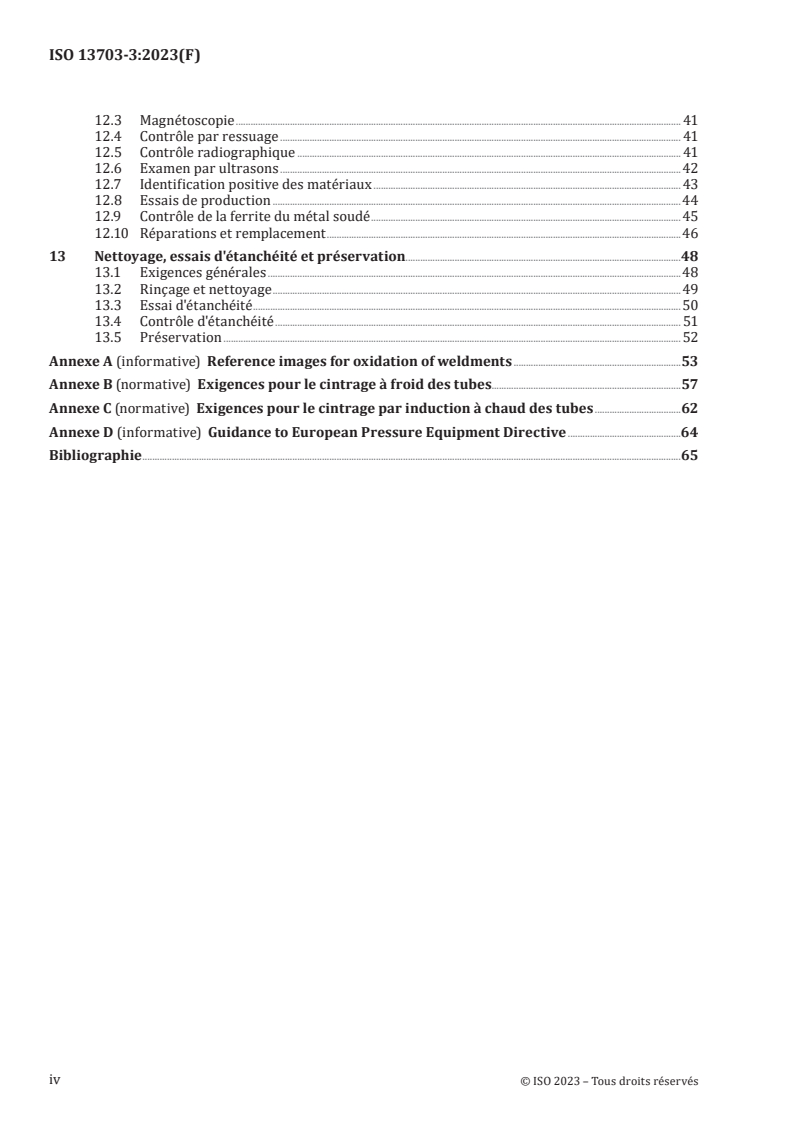
iii
12.6 Ultrasonic examination . 37
12.7 Positive materials identification .38
12.8 Production testing . 39
12.9 Weld metal ferrite testing .40
12.10 Repairs and replacement . 41
13 Cleaning, leak testing and preservation.42
13.1 General requirements . 42
13.2 Flushing and cleaning. 43
13.3 Leak testing .44
13.4 Tightness testing . 45
13.5 Preservation .46
Annex A (informative) Reference images for oxidation of weldments .47
Annex B (normative) Requirements for cold bending of pipes .51
Annex C (normative) Requirements for hot induction bending of pipes .54
Annex D (informative) Guidance to European Pressure Equipment Directive .56
Bibliography .57
iv
Foreword
ISO (the International Organization for Standardization) is a worldwide federation of national standards
bodies (ISO member bodies). The work of preparing International Standards is normally carried out
through ISO technical committees. Each member body interested in a subject for which a technical
committee has been established has the right to be represented on that committee. International
organizations, governmental and non-governmental, in liaison with ISO, also take part in the work.
ISO collaborates closely with the International Electrotechnical Commission (IEC) on all matters of
electrotechnical standardization.
The procedures used to develop this document and those intended for its further maintenance are
described in the ISO/IEC Directives, Part 1. In particular, the different approval criteria needed for the
different types of ISO document should be noted. This document was drafted in accordance with the
editorial rules of the ISO/IEC Directives, Part 2 (see www.iso.org/directives).
ISO draws attention to the possibility that the implementation of this document may involve the use
of (a) patent(s). ISO takes no position concerning the evidence, validity or applicability of any claimed
patent rights in respect thereof. As of the date of publication of this document, ISO had not received
notice of (a) patent(s) which may be required to implement this document. However, implementers are
cautioned that this may not represent the latest information, which may be obtained from the patent
database available at www.iso.org/patents. ISO shall not be held responsible for identifying any or all
such patent rights.
Any trade name used in this document is information given for the convenience of users and does not
constitute an endorsement.
For an explanation of the voluntary nature of standards, the meaning of ISO specific terms and
expressions related to conformity assessment, as well as information about ISO's adherence to
the World Trade Organization (WTO) principles in the Technical Barriers to Trade (TBT), see
www.iso.org/iso/foreword.html.
This document was prepared by Technical Committee ISO/TC 67, Oil and gas industries including lower
carbon energy, Subcommittee SC 6, Process equipment, piping, systems, and related safety, in collaboration
with the European Committee for Standardization (CEN) Technical Committee CEN/TC 12, Materials,
equipment and offshore structures for petroleum, petrochemical and natural gas industries, in accordance
with the Agreement on technical cooperation between ISO and CEN (Vienna Agreement).
This first edition of ISO 13703-3, together with ISO 13703-1 and ISO 13703-2, cancels and replaces
ISO 13703:2000. It also incorporates the Technical Corrigendum ISO 13703:2000/Cor.1:2002.
The main changes compared to the previous edition are as follows:
— deletion of the installation and quality control requirements of Clause 10;
— deletion of previous Annex C as requirements are addressed in ASME B31.3.
A list of all parts in the ISO 13703 series can be found on the ISO website.
Any feedback or questions on this document should be directed to the user’s national standards body. A
complete listing of these bodies can be found at www.iso.org/members.html.
v
Introduction
The aim of this document is to establish common requirements for the fabrication, welding, inspection,
examination and testing of new, metallic process piping systems designed in accordance with the
requirements of ISO 13703-1, and using bulk piping materials in accordance with ISO 13703-2.
This document makes normative reference to ASME B31.3 as the base code for process piping.
Alternative codes to ASME B31.3 exist for the fabrication, welding, inspection, examination and testing
of process piping systems along with the potential need to comply with local or national regulatory/
jurisdictional requirements. The user of this document is expected to assess the implications arising
from local or national regulatory/jurisdictional requirements in implementing the requirements
herein, including the need to specify additional requirements to those stated. ASME B31.3, Appendix N
provides guidance on its use internationally, and specifically its use within the European Union
for which additional requirements to those specified in ASME B31.3 will be necessary to meet the
requirements of Directive 2014/68/EU on the harmonization of the laws of the Member States relating
to the making available on the market of pressure equipment (PED).
This document is not intended to inhibit a user from accepting alternative fabrication, welding,
examination or testing solutions for the individual application. This can be particularly appropriate
where there is innovative or developing technology. Where an alternative to the requirements in
this document is offered, the user is expected to review the implications in meeting the performance
requirements within this document.
vi
INTERNATIONAL STANDARD ISO 13703-3:2023(E)
Oil and gas industries including lower carbon energy —
Piping systems on offshore production platforms and
onshore plants —
Part 3:
Fabrication
1 Scope
This document specifies requirements for the fabrication, installation, welding, inspection, examination
and testing of new, metallic piping systems , within temperature range limits for the materials meeting
the requirements of ASME B31.3, on fixed and floating offshore production facilities and onshore
production, processing and gas liquefaction plants. For piping systems above pressure class 2500,
the requirements of chapter IX of ASME B31.3 shall be complied with, in addition to the requirements
stated in this standard.
This document is applicable to all pressure retaining components and any non-pressure retaining
component, such as a member of a pipe support, welded directly to a pressure retaining component.
This document is not applicable to the following:
— marine-related piping systems, e.g. ballasting piping systems, systems covered by classification
societies;
— metallic tubing used for subsea umbilical systems;
NOTE 1 Reference can be made to ISO 13628-5 or API Spec 17E for welding and examination of these
components.
— piping systems with corrosion resistant cladding (either integrally clad or mechanically lined) or
weld overlay, including buttering and associated dissimilar welds;
NOTE 2 Reference can be made to DNV-RP-B204 for welding and examination of these systems.
— refractory alloys [with exception of CP titanium Grade 1 (UNS R50250) or Grade 2 (UNS R50400)];
— non-metallic piping assemblies;
— transportation pipeline systems, including flow-lines, designed in accordance with a recognized
pipeline design code.
2 Normative references
The following documents are referred to in the text in such a way that some or all of their content
constitutes requirements of this document. For dated references, only the edition cited applies. For
undated references, the latest edition of the referenced document (including any amendments) applies.
ISO 3834-2, Quality requirements for fusion welding of metallic materials — Part 2: Comprehensive quality
requirements
ISO 8249, Welding — Determination of Ferrite Number (FN) in austenitic and duplex ferritic-austenitic Cr-
Ni stainless steel weld metals
ISO 9015-1, Destructive tests on welds in metallic materials — Hardness testing — Part 1: Hardness test on
arc welded joints
ISO 9606 (all parts), Qualification testing of welders — Fusion welding
ISO 9712, Non-destructive testing — Qualification and certification of NDT personnel
ISO 10474, Steel and steel products — Inspection documents
ISO 11666:2018, Non-destructive testing of welds — Ultrasonic testing — Acceptance levels
ISO 11699-1, Non-destructive testing — Industrial radiographic film — Part 1: Classification of film
systems for industrial radiography
ISO 14175, Welding consumables — Gases and gas mixtures for fusion welding and allied processes
ISO 14344, Welding consumables — Procurement of filler materials and fluxes
ISO 14731, Welding coordination — Tasks and responsibilities
ISO 14732, Welding personnel — Qualification testing of welding operators and weld setters for mechanized
and automatic welding of metallic materials
ISO 15156-2, Petroleum and natural gas industries — Materials for use in H2S containing environments in
oil and gas production — Part 2: Cracking-resistant carbon and low alloy steels, and the use of cast irons
ISO 15156-3, Petroleum and natural gas industries — Materials for use in H2S containing environments in
oil and gas production — Part 3: Cracking-resistant CRAs (corrosion-resistant alloys) and other alloys
ISO 15609-1, Specification and qualification of welding procedures for metallic materials — Welding
procedure specification — Part 1: Arc welding
ISO 15614-1, Specification and qualification of welding procedures for metallic materials — Welding
procedure test — Part 1: Arc and gas welding of steels and arc welding of nickel and nickel alloys
ISO 15614-5, Specification and qualification of welding procedures for metallic materials — Welding
procedure test — Part 5: Arc welding of titanium, zirconium and their alloys
ISO 15614-6, Specification and qualification of welding procedures for metallic materials — Welding
procedure test — Part 6: Arc and gas welding of copper and its alloys
ISO/IEC 17025, General requirements for the competence of testing and calibration laboratories
ISO 17636-2, Non-destructive testing of welds — Radiographic testing — Part 2: X- and gamma-ray
techniques with digital detectors
ISO 17781:2017, Petroleum, petrochemical and natural gas industries — Test methods for quality control
of microstructure of ferritic/austenitic (duplex) stainless steels
ISO 18265, Metallic materials — Conversion of hardness values
ISO 22825, Non-destructive testing of welds — Ultrasonic testing — Testing of welds in austenitic steels
and nickel-based alloys
ANSI Z49.1, Safety in Welding, Cutting and Allied Processes
API RP 686, Machinery Installation and Installation Design
ASME B31.3, Process Piping
ASME Boiler and Pressure Vessel Code, Section II, Materials, Part C:2019, Specifications for welding
rods, electrodes, and filler metals
ASME Boiler and Pressure Vessel Code, Section V:2019, Non Destructive Testing
ASME Boiler and Pressure Vessel Code, Section IX: 2019, Welding and Brazing Qualifications
ASNT CP-189, Standard for Qualification and Certification of Nondestructive Testing Personnel
ASNT SNT-TC-1A, Personnel Qualification and Certification in Nondestructive Testing
ASTM A380/A380M, Standard Practice for Cleaning, Descaling, and Passivation of Stainless Steel Parts,
Equipment, and Systems
ASTM E140, Standard Hardness Conversion Tables for Metals Relationship Among Brinell Hardness, Vickers
Hardness, Rockwell Hardness, Superficial Hardness, Knoop Hardness, Scleroscope Hardness, and Leeb
Hardness
ASTM E1815, Standard Test Method for Classification of Film Systems for Industrial Radiography
ASTM G48, Standard Test Methods for Pitting and Crevice Corrosion Resistance of Stainless Steels and
Related Alloys by Use of Ferric Chloride Solution
AWS A4.2M, Standard Procedures for Calibrating Magnetic Instruments to Measure the Delta Ferrite
Content of Austenitic and Duplex Ferritic-Austenitic Stainless Steel
AWS D10.10/D10.10M, Recommended Practices for Local Heating of Welds in Piping and Tubing
EN 10204, Metallic products — Types of inspection documents
PFI ES-3, Fabricating Tolerances
3 Terms and definitions
For the purposes of this document, the following terms and definitions apply.
ISO and IEC maintain terminology databases for use in standardization at the following addresses:
— ISO Online browsing platform: available at https:// www .iso .org/ obp
— IEC Electropedia: available at https:// www .electropedia .org/
3.1
alkaline service
service environments containing alkaline compounds such as amines, caustic, carbonates
3.2
bolted connection
connections with bolts, to allow assembly and disassembly, that uses flanges or clamps as connectors.
3.3
carbon equivalent
C
E
numerical value for a steel’s composition that represents the contribution of the relevant elements to
the hydrogen cracking susceptibility of steel
Note 1 to entry: The carbon equivalent is based on:
%%Mn Cr++%%Mo V %%Ni+ Cu
CC=+% + +
E
65 15
where all mass fractions are expressed in percent.
3.4
closure weld
final weld connecting piping systems, assemblies or sub-assemblies that have been successfully leak
tested, but that itself is not subject to leak testing
Note 1 to entry: Closure welds include any welds made after leak or tightness testing, such as seal welds to
threaded connections, or repair welds made in the event of a leak that are not subject to further leak test.
Note 2 to entry: Closure welds are often also referred to as ‘golden welds’.
3.5
computerized imaging technique
CIT
manual or encoded ultrasonic examination technique with capability for computer processed display
or analysis and display of ultrasonic data to provide two or three dimensional surfaces
3.6
confined space
space that is substantially but not necessarily entirely enclosed, and where serious injury can occur
from hazardous substances or conditions within the space or nearby (e.g. lack of oxygen)
Note 1 to entry: Confined space includes access into the internal bore of pipes to install, inspect and remove
internal backing gas dams, and during cleaning, flushing, leak and tightness testing activities.
3.7
cryogenic service
service environments with a minimum design temperature lower than –104 °C
3.8
low-alloy steel
steel with significant alloy additions (e.g. Groups 4 to 6 according to ISO 15608, or P-No. 3 to P-No 5 and
P-No. 15E according to ASME B31.3)
3.9
extrados
outer curved portion of a bend
3.10
fabricator
organization responsible for the fabrication, welding, examination and testing of piping systems
including any externally provided products or services
Note 1 to entry: For the purposes of this document, “fabricator” is considered interchangeable with
“manufacturer”, “erector”, “employer” or “purchaser” where these terms are used in referenced documents.
3.11
fibre elongation
elongation during bending or forming calculated as 100 r/R expressed as percentage
Note 1 to entry: Fibre elongation can be determined by physical measurement or calculation.
3.12
heat input
energy introduced into the weld region during welding per unit run length
Note 1 to entry: The reference for the calculation of heat input is ASME Boiler and Pressure Vessel Code,
Section IX: 2019 for the specific welding process.
3.13
high alloyed stainless steel
austenitic stainless steel typically having PREN ≥ 40 or [% Ni + 2 (% Mo)] > 30 where % Mo > 2, where
all mass fractions are expressed as percent
EXAMPLE SS type 6Mo or SS type 565.
3.14
intrados
inner curved portion of a bend
3.15
leak testing
application of a pressure load greater than the design load to demonstrate the integrity of a piping
assembly to safely withstand the design load
Note 1 to entry: Leak testing is also referred to as “hydrostatic leak testing” or “pneumatic leak testing”, or
combination thereof, as defined in ASME B31.3.
3.16
lot
totality of welds completed by all welders, and accepted by visual examination on any one day, unless
otherwise defined in the engineering design
[SOURCE: PFI ES48: 2015]
3.17
low sulfur oil
heating oil with maximum sulfur content of 1 000 ppm
3.18
nepheleometric turbidity units
NTU
measurement of water turbidity
3.19
owner
person, partnership, organization or business ultimately responsible for design, construction,
operation, and maintenance of a facility
3.20
pitting resistance equivalent number
number indicating the resistance of stainless steels to pitting corrosion and related to chemical
composition
Note 1 to entry: PREN is calculated from one of the following formulas:
PREN = % Cr + 3,3 % Mo + 16 % N
PREN = % Cr + 3,3 % (Mo + 0,5 W) + 16 % N
where all mass fractions are expressed as percent.
Note 2 to entry: All PREN limits are absolute limits based upon the heat analysis. The calculated value shall not
be rounded.
3.21
sour service
service environments that contain sufficient H S to cause cracking of materials
Note 1 to entry: For the purpose of the document, the mechanisms that result in cracking are addressed in
ISO 15156-2 or ISO 15156-3.
Note 2 to entry: For the purpose of this document, ANSI/NACE MR0175 is equivalent to ISO 15156-2 and
ISO 15156-3, respectively.
3.22
stainless steel 300-series
SS 300-seriesaustenitic stainless steel with at least 16 % Cr (mass fraction) and 8 % Ni (mass fraction)
possibly with other elements added to secure special properties
Note 1 to entry: Low carbon grades are typically used where welding is required.
EXAMPLE UNS S30400, UNS S30403, UNS S31600, UNS S31603.
3.23
stainless steel type 22Cr duplex
SS type 22Cr duplex
ferritic/austenitic stainless steel alloys with 30,0 < PREN < 40,0 and Cr ≥ 19 % (mass fraction)
EXAMPLE UNS S31803, UNS S32205.
3.24
stainless steel type 25Cr duplex
SS type 25Cr duplex
ferritic/austenitic stainless steel alloys with 40,0 ≤ PREN < 48,0
Note 1 to entry: This alloy is often referred to as “super duplex”.
EXAMPLE UNS S S32505, UNS S32550, UNS S32750, UNS S32760, UNS S39274, UNS S39277.
3.25
stainless steel type 6Mo
SS type 6Mo
austenitic stainless steel with PREN ≥ 40 and a nominal Mo alloying content of 6 % (mass fraction) and
nickel alloys with Mo content in the range 6 % to 8 % (mass fraction)
EXAMPLE UNS S31254, UNS N08367, UNS N08926.
3.26
stainless steel type 565
SS type 565
manganese austenitic stainless steel with Mn content in the range 4 % to 12 % (mass fraction) and
PREN ≥ 40
EXAMPLE UNS S34565.
3.27
tangent
straight section at the end of a bend
3.28
tightness testing
application of a pressure differential to a piping assembly to detect leakage paths or rates
Note 1 to entry: Tightness testing includes testing of mechanically completed piping systems as part of pre-
commissioning activities, and sensitive leak tests as defined in ASME B31.3.
3.29
transition zone
areas of the start and stop points of induction heating, which include material that extends from the
unheated mother pipe to the material that has been heated to the full bending temperature
3.30
weave bead
weld bead formed using weaving. See also stringer bead.
3.31
weaving
welding technique in which the energy source is oscillated transversely as it progresses along the weld
path
3.32
weld zone
grouping of weld passes with similar parameters and function, e.g. root, fill and cap
3.33
stringer bead
weld bead formed without appreciable weaving
4 Abbreviated terms
4.1 Symbols
D nominal pipe diameter, expressed in millimetres
H heated band width, expressed in millimetres
BW
h Maximum misalignment at a buttweld seam
L length, expressed in millimetres
R nominal bending radius to centreline of pipe, expressed in millimetres
r nominal outside radius of the pipe, expressed in millimetres
t nominal material thickness at the weld, expressed in millimetres
U Geometric unsharpness
g
4.2 Abbreviated terms
AUT Automatic Ultrasonic Testing
AWS American Welding Society
aMDEA activated MDEA
CMTR certified material test report
CP commercially pure (in relation to titanium materials)
CRA corrosion resistant alloy
CSWIP certification scheme for weldment inspection personnel
CWEng certified welding engineer
DGA di-glycol amine
DIPA di-iso propyl amine
ECA engineering critical assessment
EEA European economic area
EWE European welding engineer
EWF European Welding Federation
FCAW-G flux cored arc welding – gas shielded
FCAW-S flux cored arc welding – self shielded
FMC/TFM full matrix capture/total focussing method
FN ferrite number
GMAW gas metal arc welding
GMAW-S gas metal arc welding – short circuiting mode of transfer
GTAW gas tungsten arc welding
HAZ heat affected zone
HBW heated band width (of PWHT)
HIP hot isostatic pressed
HRC Rockwell C hardness number
HV Vickers hardness number
IIW International Institute of Welding
ITP inspection and test plan
IWE international welding engineer
MDEA methyldiethanolamine
MDMT minimum design metal temperature (synonymous with design minimum temperature
as defined in ASME B31.3)
MEA mono ethanolamine
MT magnetic particle testing (for use on magnetic materials)
NDT non-destructive testing
NTU neophelemetric turbidity units
OES optical emission spectrometry
PAUT phased array ultrasonic testing technique
PCN Personal Certification for Non-Destructive Testing
PED Pressure Equipment Directive (European Directive 2014/68/EU) see Annex D
PMI positive materials identification
PREN pitting resistance equivalent number
PT liquid penetrant testing (for use on non-magnetic materials)
PQR procedure qualification record
PWHT post weld heat treatment
QL quality level
QMS quality management system
RT radiographic testing
SAW submerged arc welding
SMAW shielded metal arc welding
SMYS specified minimum yield stress
SS stainless steel
SSC sulphide stress cracking
SWPS standard welding procedure specification
TOFD time of flight diffraction
WPS welding procedure specification
UNS unified numbering system
UT ultrasonic testing
5 Health, safety and quality requirements
5.1 Health and safety requirements
5.1.1 The fabricator shall at least provide the following safety equipment and systems:
a) ventilation and extraction facilities for welding-related activities or work in a confined space;
b) personal protective equipment including eye, breathing and hearing protection;
c) access/scaffolding/working platforms and fall-arrest protective equipment for working at height;
d) access and secure, temporary formwork for working below-grade;
e) protective systems to prevent electric shock, build-up or discharge of static electricity, and earthing
of welding current through susceptible components in the piping assembly;
f) ‘whip checks’ on test hoses for flushing, cleaning, leak testing/tightness testing.
5.1.2 All work undertaken in a confined space shall be managed using a permit-to-work system.
NOTE 1 ISO 45001 specifies requirements for an occupational health and safety management system, and
gives guidance for its use, to enable organizations to provide safe and healthy workplaces by preventing work-
related injury and ill health, as well as by proactively improving its occupational health and safety performance.
IOGP Report 423 describes a process by which clients can select suitable contractors, set out expectations and
requirements, award contracts, and manage all the phases of the contracting process with a view to improving
client and contractor management of health, safety and environmental risks for contracted activities.
Note 2 ANSI Z49.1 and ISO/TR/18786 give specific requirements and guidance on safety in Welding
fabrication activities.
5.2 Quality requirements
5.2.1 The fabricator shall operate in accordance with a QMS that meets an internationally recognized
standard.
NOTE ISO 29001 and API Spec Q1 give sector-specific requirements and guidance on quality management
systems.
5.2.2 The QMS of the fabricator shall include the following requirements related to the responsibilities
for welding, inspection and testing personnel specified:
a) the organization shall meet the comprehensive welding quality requirements of ISO 3834-2;
b) welding coordination personnel shall demonstrate that they meet the requirements of ISO 14731
by either comprehensive level of competency or specific level of competency as appropriate for the
relevant essential welding-related tasks described in ISO 3834-2;
NOTE 1 For the purposes of this provision, personnel with AWS CWEng certification in conformance to
AWS B5.16 can be considered equivalent to personnel holding EWF European welding engineer (EWE) or
IIW international welding engineer (IWE) certification as explained in EWF Publication EWF-663-19 and
IIW publication IAB-362-19, respectively.
c) welding inspection personnel competencies shall be demonstrated in accordance with one of the
following schemes:
— IIW international welding inspector – standard or IIW international welding inspector –
comprehensive;
— AWS QC1 certified welding inspector or AWS QC1 senior certified welding inspector;
— CSWIP 3.1 welding inspector or CSWIP 3.2 senior welding inspector;
— PCN (British Institute of Non-Destructive Testing [BINDT], UK) - Weld inspection level 2.
NOTE 2 Welding inspection personnel with lower levels of certification can only be employed
under the direct supervision of personnel having the required certification.
d) NDT personnel competencies shall be demonstrated in accordance with one of the following
schemes:
— Personnel responsible for NDT activities, in accordance with ISO 9712, Level III, or equivalent.
— NDT operator, including visual inspection, in accordance with ISO 9712 level II, or equivalent.
Operators simply producing radiographs and not performing evaluation, do not require level II,
but shall have training comparable to ISO 9712 Level I for radiographic testing.
— UT operators performing inspection of welds in duplex and austenitic stainless steel material in
accordance with ISO 9712.
— In addition, the use of AUT shall require training in operating the specific equipment and a
procedure shall be established to demonstrate the ability of the operator to detect the relevant
defects.
NOTE 3 Equivalent 3rd party certification scheme may for example be PCN or SNT-TC- 1A
certified by ACCP.
e) Personnel responsible for undertaking PMI, hardness or ferrite testing, tightening of bolted
connections, flushing/cleaning and subsequent leak testing/tightness testing activities shall
demonstrate appropriate competency using industry-recognized or employer-based assurance
schemes.
5.2.3 The QMS of the fabricator shall address the following activities:
a) traceability, storage and handling of piping system components, including bends, welding
consumables, NDT and testing consumables to avoid damage or degradation
b) traceability and verification of each pressure retaining weld and direct attachment weld to the
piping components, WPS(s) and welding consumables used, the responsible welder/welding
operator, and the relevant PWHT, examination and production test records;
c) integrity management of bolted connections, including traceability and verification of bolted
connections;
d) flushing, cleaning, leak testing/tightness testing and preservation, including division of piping
systems into individual test packs;
e) development and implementation of an ITP for the systematic and sequential control of all
fabrication, welding, examination, inspection and testing activities (including any sub-contractor
activity, if applicable), and the level of fabricator and owner personnel involvement in each activity;
f) Workshop organization to prevent CRA contamination.
5.2.4 The welding consumable manufacturer shall operate in accordance with a QMS meeting an
internationally recognized standard.
5.2.5 The test laboratory shall meet the requirements of ISO/IEC 17025 or another agreed
internationally recognized standard, for the applicable test methods.
5.2.6 The fabricator shall maintain and retain the following documented information:
a) any documented information required by ASME B31.3;
b) all additional documented information to demonstrate that the requirements of this document
have been met.
The fabricator shall hand over all relevant documented information to the owner as specified in
ASME B31.3, the engineering design and this document.
5.2.7 All equipment and instruments used in support of the activities within the scope of this
document shall have a valid and verified calibration certificate at time of use.
5.2.8 Heat treatment furnaces for post-bending heat treatment or PWHT shall be
a) configured to ensure that uniform heating, with or without forced circulation, is achieved, and
b) equipped with automatic temperature controlling and recording devices with an accuracy of ±1 %
of their full-scale range.
NOTE Good practice for heat treatment is given in ISO 17663 and API RP 6HT.
6 Welding requirements
6.1 General requirements
6.1.1 WPSs shall include all information required by ASME Boiler and Pressure Vessel Code, Section IX
or ISO 15609-1. Welding procedures shall be present at the welding station at all times and readable in
a language understandable to the welder or welding operator and in English.
6.1.2 SWPSs or welding procedures that have not been qualified by the fabricator shall not be used.
6.1.3 Fabrication and welding of CRAs in a fabricator’s shop shall be performed in an area reserved
exclusively for these materials.
6.1.4 The fabricator shall protect CRA components or piping assembly from iron contamination,
if it is impractical to segregate CRAs from carbon steels, such as during dissimilar welding at site
construction.
6.1.5 Protection, such as windshields or temporary shelters, shall be provided if weather conditions
can adversely affect the ability to meet the requirements of this document.
6.1.6 Pressure-retaining groove and fillet welds shall be welded with a minimum of two layers. Not
applicable for mechanized orbital welding of tubing.
6.1.7 Arc strikes and stops/starts shall be confined to the weld groove. If arc strikes and stops/starts
occur outside of the weld groove, they shall be removed by light grinding and the affected area shall be
examined by MT or PT in accordance with 12.3 or 12.4.
6.1.8 All flux, slag and spatter shall be removed from welds and adjacent surfaces.
6.1.9 The application of peening on welds, either during or on completion of welding, shall be
approved by the owner.
NOTE The use of needle guns to remove welding flux or slag is not considered to result in peening of the
weld.
6.2
...
NORME ISO
INTERNATIONALE 13703-3
Première édition
2023-09
Industries du pétrole et du gaz,
y compris les énergies à faible
émission de carbone — Conception
et installation des systèmes de
tuyauterie sur les plates-formes de
production en mer et les installations
à terre —
Partie 3:
Fabrication
Oil and gas industries including lower carbon energy — Piping
systems on offshore production platforms and onshore plants —
Part 3: Fabrication
Numéro de référence
DOCUMENT PROTÉGÉ PAR COPYRIGHT
© ISO 2023
Tous droits réservés. Sauf prescription différente ou nécessité dans le contexte de sa mise en œuvre, aucune partie de cette
publication ne peut être reproduite ni utilisée sous quelque forme que ce soit et par aucun procédé, électronique ou mécanique,
y compris la photocopie, ou la diffusion sur l’internet ou sur un intranet, sans autorisation écrite préalable. Une autorisation peut
être demandée à l’ISO à l’adresse ci-après ou au comité membre de l’ISO dans le pays du demandeur.
ISO copyright office
Case postale 401 • Ch. de Blandonnet 8
CH-1214 Vernier, Genève
Tél.: +41 22 749 01 11
E-mail: copyright@iso.org
Web: www.iso.org
Publié en Suisse
ii
Sommaire Page
Avant-propos .v
Introduction . vi
1 Domaine d'application .1
2 Références normatives .1
3 Termes et définitions . 3
4 Abréviations . 7
4.1 Symboles . 7
4.2 Abréviations. 8
5 Exigences en matière de santé, de sécurité et de qualité .10
5.1 Exigences en matière de santé et de sécurité . 10
5.2 Exigences relatives à la qualité . 10
6 Exigences relatives au soudage .12
6.1 Exigences générales .12
6.2 Procédé de soudage .13
6.3 Préparation au soudage . 14
6.4 Qualification des performances des soudeurs et des opérateurs de soudage . 16
7 Produits consommables pour le soudage .17
7.1 Exigences générales . 17
7.2 Exigences supplémentaires pour l'acier au carbone . 18
7.3 Exigences supplémentaires pour le soudage de matériaux dissemblables . 18
7.4 Exigences supplémentaires pour les aciers inoxydables série 300 . 19
7.5 Exigences supplémentaires pour l'acier inoxydable duplex de type 22Cr et l'acier
inoxydable duplex de type 25Cr . 19
7.6 Exigences supplémentaires pour les aciers inoxydables fortement alliés . 19
7.7 Gaz de protection, de soutien et de suivi secondaire . 19
8 Qualification du mode opératoire de soudage .20
8.1 Exigences générales .20
8.2 Exigences supplémentaires pour les aciers au carbone . 21
8.3 Exigences supplémentaires pour l'acier inoxydable duplex de type 22Cr et l'acier
inoxydable duplex de type 25Cr . 21
8.4 Exigences supplémentaires pour les aciers inoxydables austénitiques fortement
alliés . 22
8.5 Exigences supplémentaires pour le titane CP . 22
8.6 Exigences supplémentaires pour les matériaux en service corrosif .22
8.7 Variable essentielle de la qualification des modes opératoires de soudage .23
9 Préchauffage et traitement thermique après soudage .26
9.1 Préchauffage . 26
9.2 Traitement thermique après soudage . 27
10 Cintrage des tubes .29
10.1 Exigences générales .29
10.2 Traitement thermique des coudes . 33
10.3 Examen des coudes .34
11 Installation .35
11.1 Exigences générales . 35
11.2 Raccords filetés . 35
11.3 Raccords boulonnés . 36
12 Contrôle, examen et essai .37
12.1 Exigences générales . 37
12.2 Contrôle visuel .40
iii
12.3 Magnétoscopie . 41
12.4 Contrôle par ressuage . 41
12.5 Contrôle radiographique . 41
12.6 Examen par ultrasons . 42
12.7 Identification positive des matériaux . 43
12.8 Essais de production .44
12.9 Contrôle de la ferrite du métal soudé . 45
12.10 Réparations et remplacement .46
13 Nettoyage, essais d'étanchéité et préservation.48
13.1 Exigences générales .48
13.2 Rinçage et nettoyage .49
13.3 Essai d'étanchéité .50
13.4 Contrôle d'étanchéité . 51
13.5 Préservation . 52
Annexe A (informative) Reference images for oxidation of weldments .53
Annexe B (normative) Exigences pour le cintrage à froid des tubes.57
Annexe C (normative) Exigences pour le cintrage par induction à chaud des tubes .62
Annexe D (informative) Guidance to European Pressure Equipment Directive .64
Bibliographie .65
iv
Avant-propos
L'ISO (Organisation internationale de normalisation) est une fédération mondiale d'organismes
nationaux de normalisation (comités membres de l'ISO). L'élaboration des Normes internationales est
en général confiée aux comités techniques de l'ISO. Chaque comité membre intéressé par une étude
a le droit de faire partie du comité technique créé à cet effet. Les organisations internationales,
gouvernementales et non gouvernementales, en liaison avec l'ISO participent également aux travaux.
L'ISO collabore étroitement avec la Commission électrotechnique internationale (IEC) en ce qui
concerne la normalisation électrotechnique.
Les procédures utilisées pour élaborer le présent document et celles destinées à sa mise à jour sont
décrites dans les Directives ISO/IEC, Partie 1. Il convient, en particulier de prendre note des différents
critères d'approbation requis pour les différents types de documents ISO. Le présent document
a été rédigé conformément aux règles de rédaction données dans les Directives ISO/IEC, Partie 2
(voir www.iso.org/directives).
L'attention est attirée sur le fait que certains des éléments du présent document peuvent faire l'objet de
droits de propriété intellectuelle ou de droits analogues. L'ISO ne saurait être tenue pour responsable
de ne pas avoir identifié tout ou partie de tels droits de brevet. Les détails concernant les références aux
droits de propriété intellectuelle ou autres droits analogues identifiés lors de l'élaboration du document
sont indiqués dans l'Introduction et/ou dans la liste des déclarations de brevets reçues par l'ISO (voir
www.iso.org/brevets).
Les appellations commerciales éventuellement mentionnées dans le présent document sont données
pour information, par souci de commodité, à l'intention des utilisateurs et ne sauraient constituer un
engagement.
Pour une explication de la signification des termes et expressions spécifiques de l'ISO liés à l'évaluation
de la conformité, ou pour toute information au sujet de l'adhésion de l'ISO aux principes de l'Organisation
mondiale du commerce (OMC) concernant les obstacles techniques au commerce (OTC), voir le lien
suivant: www.iso.org/iso/fr/avant-propos.
Le présent document a été élaboré par le comité technique ISO/TC 67, Industries du pétrole et du gaz, y
compris les énergies à faible teneur en carbone, sous-comité SC 6, Équipements des procédés, tuyauterie,
systèmes, et sécurité qui y est rattachée, en collaboration avec le comité technique CEN/TC 12, Matériel,
équipement et structures en mer pour les industries du pétrole, de la pétrochimie et du gaz naturel du
Comité européen de normalisation (CEN), conformément à l'Accord de coopération technique entre
l'ISO et le CEN (Accord de Vienne).
Cette première édition de l'ISO 13703-3, ainsi que l'ISO 13703-1 et l'ISO 13703-2, annule et remplace
l'ISO 13703:2000. Elle incorpore également le Rectificatif technique ISO 13703:2000/Cor.1:2002.
Les principales modifications par rapport à l'édition précédente sont les suivantes:
— suppression des exigences relatives à l'installation et au contrôle de la qualité de l'Article 10;
— suppression de l'Annexe C, ces exigences étant traitées dans la norme ASME B31.3.
Une liste de toutes les parties de la série ISO 13703 se trouve sur le site web de l'ISO.
Il convient que l'utilisateur adresse tout retour d'information ou toute question concernant le présent
document à l'organisme national de normalisation de son pays. Une liste exhaustive desdits organismes
se trouve à l'adresse www.iso.org/fr/members.html.
v
Introduction
Le présent document a pour objet de définir des exigences communes pour la fabrication, le soudage,
l'inspection, l'examen et l'essai de nouveaux systèmes de tuyauteries industrielles métalliques
conçus dans le respect des exigences de l'ISO 13703-1 et utilisant des matériaux de tuyauterie en vrac
conformément à l'ISO 13703-2.
Le présent document fait référence à la norme ASME B31.3 en tant que code de base pour les
tuyauteries industrielles. Outre l'ASME B31.3, il existe d'autres codes pour la fabrication, le soudage,
l'inspection, l'examen et l'essai des systèmes de tuyauteries industrielles, ainsi que la nécessité
éventuelle de se conformer aux exigences réglementaires/juridictionnelles locales ou nationales.
Dans le cadre de la mise en œuvre des exigences du présent document, l'utilisateur est censé évaluer
les implications découlant des exigences réglementaires ou juridictionnelles locales ou nationales, y
compris la nécessité de spécifier des exigences supplémentaires par rapport à celles qui sont énoncées.
L'Annexe N de la norme ASME B31.3 fournit des indications sur son utilisation à l'échelle internationale,
et plus particulièrement sur son utilisation au sein de l'Union européenne pour laquelle des exigences
supplémentaires à celles spécifiées dans la norme ASME B31.3 seront nécessaires afin de satisfaire aux
exigences de la directive 2014/68/UE relative à l'harmonisation des législations des États membres
concernant la mise à disposition sur le marché des équipements sous pression.
Le présent document n'est pas destiné à empêcher un utilisateur d'accepter d'autres solutions de
fabrication, de soudage, d'examen ou d'essai pour l'application individuelle. De telles solutions
alternatives peuvent notamment être appropriées lorsqu'il s'agit de technologies innovantes ou en
cours de développement. En cas de solution alternative aux exigences du présent document, l'utilisateur
est tenu d'en examiner les implications en termes de respect des exigences de performance énoncées
dans le présent document.
vi
NORME INTERNATIONALE ISO 13703-3:2023(F)
Industries du pétrole et du gaz, y compris les énergies à
faible émission de carbone — Conception et installation
des systèmes de tuyauterie sur les plates-formes de
production en mer et les installations à terre —
Partie 3:
Fabrication
1 Domaine d'application
Le présent document spécifie les exigences relatives à la fabrication, à l'installation, au soudage, à
l'inspection, à l'examen et aux essais de nouveaux systèmes de tuyauteries métalliques, dans les limites
de la plage de température pour les matériaux répondant aux exigences de la norme ASME B31.3,
sur les installations de production en mer fixes et flottantes et sur les installations de production, de
traitement et de liquéfaction du gaz à terre. Pour les systèmes de tuyauterie dont la classe de pression
est supérieure à 2500, les exigences du chapitre IX de la norme ASME B31.3 doivent être respectées,
ainsi que les exigences énoncées dans la présente norme.
Le présent document s'applique à tous les composants sous pression et à tout composant sans pression,
tel qu'un élément d'un support de tuyauterie, soudé directement à un composant sous pression.
Le présent document ne s'applique pas aux éléments suivants:
— les systèmes de tuyauterie marins, par exemple les systèmes de tuyauterie de ballast, systèmes
couverts par des sociétés de classification;
— les tubes métalliques utilisés pour les faisceaux de câbles immergés;
NOTE 1 Pour le soudage et l'examen de ces composants, il est possible de se référer à l'ISO 13628-5 ou à la
norme API Spec 17E.
— les systèmes de tuyauteries avec un revêtement résistant à la corrosion (soit intégralement revêtu,
soit mécaniquement revêtu) ou un recouvrement par soudage, y compris le beurrage et les soudures
dissemblables associées;
NOTE 2 Pour le soudage et l'examen de ces systèmes, il est possible de se référer à la norme DNV-RP-B204.
— les alliages réfractaires [à l'exception du titane CP Grade 1 (UNS R50250) ou Grade 2 (UNS R50400)];
— les assemblages de tuyauteries non métalliques;
— les systèmes de conduite de transport, y compris les conduites d'écoulement, conçus conformément
à un code de conception de conduites reconnu.
2 Références normatives
Les documents suivants sont cités dans le texte de sorte qu'ils constituent, pour tout ou partie de leur
contenu, des exigences du présent document. Pour les références datées, seule l'édition citée s'applique.
Pour les références non datées, la dernière édition du document de référence s'applique (y compris les
éventuels amendements).
ISO 3834-2, Exigences de qualité en soudage par fusion des matériaux métalliques — Partie 2: Exigences de
qualité complète
ISO 8249, Soudage — Détermination de l'indice de ferrite (FN) dans le métal fondu en acier inoxydable
austénitique et duplex ferritique-austénitique au chrome-nickel
ISO 9015-1, Essais destructifs des soudures sur matériaux métalliques — Essais de dureté — Partie 1: Essai
de dureté des assemblages soudés à l'arc
ISO 9606 (toutes les parties), Épreuve de qualification des soudeurs — Soudage par fusion
ISO 9712, Essais non destructifs — Qualification et certification du personnel END
ISO 10474, Aciers et produits sidérurgiques — Documents de contrôle
ISO 11666:2018, Essais non destructifs des assemblages soudés — Contrôle par ultrasons — Niveaux
d'acceptation
ISO 11699-1, Essais non destructifs — Film pour radiographie industrielle — Partie 1: Classification des
systèmes films pour radiographie industrielle
ISO 14175, Produits consommables pour le soudage — Gaz et mélanges gazeux pour le soudage par fusion
et les techniques connexes
ISO 14344, Produits consommables pour le soudage — Approvisionnement en matériaux d'apport et flux
ISO 14731, Coordination en soudage — Tâches et responsabilités
ISO 14732, Personnel en soudage — Épreuve de qualification des opérateurs soudeurs et des régleurs en
soudage pour le soudage mécanisé et le soudage automatique des matériaux métalliques
ISO 15156-2, Industries du pétrole et du gaz naturel — Matériaux pour utilisation dans des environnements
contenant de l'hydrogène sulfuré (H2S) dans la production de pétrole et de gaz — Partie 2: Aciers au
carbone et aciers faiblement alliés résistant à la fissuration, et utilisation de fontes
ISO 15156-3, Industries du pétrole et du gaz naturel — Matériaux pour utilisation dans des environnements
contenant de l'hydrogène sulfuré (H2S) dans la production de pétrole et de gaz — Partie 3: ARC (alliages
résistants à la corrosion) et autres alliages résistant à la fissuration
ISO 15609-1, Descriptif et qualification d'un mode opératoire de soudage pour les matériaux métalliques —
Descriptif d'un mode opératoire de soudage — Partie 1: Soudage à l'arc
ISO 15614-1, Descriptif et qualification d'un mode opératoire de soudage pour les matériaux métalliques —
Épreuve de qualification d'un mode opératoire de soudage — Partie 1: Soudage à l'arc et aux gaz des aciers
et soudage à l'arc du nickel et des alliages de nickel
ISO 15614-5, Descriptif et qualification d’un mode opératoire de soudage pour les matériaux métalliques —
Épreuve de qualification d’un mode opératoire de soudage — Partie 5: Soudage à l’arc sur titane, zirconium
et leurs alliages
ISO 15614-6, Descriptif et qualification d'un mode opératoire de soudage pour les matériaux métalliques —
Épreuve de qualification d'un mode opératoire de soudage — Partie 6: Soudage à l'arc et aux gaz du cuivre
et de ses alliages
ISO/IEC 17025, Exigences générales concernant la compétence des laboratoires d'étalonnages et d'essais
ISO 17636-2, Essais non destructifs des assemblages soudés — Contrôle par radiographie — Partie 2:
Techniques par rayons X ou gamma à l'aide de détecteurs numériques
ISO 17781:2017, Industries du pétrole, de la pétrochimie et du gaz naturel — Méthodes d'essai pour le
contrôle de la qualité de la microstructure des aciers inoxydables austénitiques/ferritiques (duplex)
ISO 18265, Matériaux métalliques — Conversion des valeurs de dureté
ISO 22825, Essais non destructifs des assemblages soudés — Contrôle par ultrasons — Contrôle des
soudures en aciers austénitiques et en alliages à base nickel
ANSI Z49.1, Safety in Welding, Cutting and Allied Processes
API RP 686, Machinery Installation and Installation Design
ASME B31.3, Process Piping
ASME Boiler and Pressure Vessel Code, Section II, Materials, Part C:2019, Specifications for welding
rods, electrodes, and filler metals
ASME Boiler and Pressure Vessel Code, Section V:2019, Non Destructive Testing
ASME Boiler and Pressure Vessel Code, Section IX: 2019, Welding and Brazing Qualifications
ASNT CP-189, Standard for Qualification and Certification of Nondestructive Testing Personnel
ASNT SNT-TC-1A, Personnel Qualification and Certification in Nondestructive Testing
ASTM A380/A380M, Standard Practice for Cleaning, Descaling, and Passivation of Stainless Steel Parts,
Equipment, and Systems
ASTM E140, Standard Hardness Conversion Tables for Metals Relationship Among Brinell Hardness, Vickers
Hardness, Rockwell Hardness, Superficial Hardness, Knoop Hardness, Scleroscope Hardness, and Leeb
Hardness
ASTM E1815, Standard Test Method for Classification of Film Systems for Industrial Radiography
ASTM G48, Standard Test Methods for Pitting and Crevice Corrosion Resistance of Stainless Steels and
Related Alloys by Use of Ferric Chloride Solution
AWS A4.2M, Standard Procedures for Calibrating Magnetic Instruments to Measure the Delta Ferrite
Content of Austenitic and Duplex Ferritic-Austenitic Stainless Steel
AWS D10.10/D10.10M, Recommended Practices for Local Heating of Welds in Piping and Tubing
EN 10204, Produits métalliques — Types de documents de contrôle
PFI ES-3, Fabricating Tolerances
3 Termes et définitions
Pour les besoins du présent document, les termes et définitions suivants s'appliquent.
L'ISO et l'IEC tiennent à jour des bases de données terminologiques destinées à être utilisées en
normalisation, consultables aux adresses suivantes:
— ISO Online browsing platform: disponible à l'adresse https:// www .iso .org/ obp
— IEC Electropedia: disponible à l'adresse https:// www .electropedia .org/
3.1
service alcalin
environnements de service contenant des composés alcalins tels que les amines, les caustiques, les
carbonates
3.2
raccordement boulonné
assemblage à l'aide de boulons, permettant le montage et le démontage, qui utilise des brides ou des
colliers comme connecteurs
3.3
carbone équivalent
C
E
valeur numérique de la composition d'un acier qui représente la contribution des éléments pertinents à
la sensibilité de l'acier à la fissuration par l'hydrogène
Note 1 à l'article: Le carbone équivalent est basé sur:
%%Mn Cr++%%Mo V %%Ni+ Cu
CC=+% + +
E
65 15
où toutes les fractions de masse sont exprimées en pourcentage.
3.4
soudure de fermeture
soudure finale reliant des systèmes de tuyauterie, des assemblages ou des sous-ensembles qui ont été
soumis avec succès à un essai d'étanchéité, mais qui n'est pas elle-même soumise à un essai d'étanchéité
Note 1 à l'article: Les soudures de fermeture comprennent toutes les soudures effectuées après l'essai ou contrôle
d'étanchéité, telles que les soudures d'étanchéité des raccords filetés, ou les soudures de réparation effectuées en
cas de fuite et qui ne sont pas soumises à un nouvel essai d'étanchéité.
Note 2 à l'article: Les soudures de fermeture sont souvent appelées «soudures dorées».
3.5
technique d'imagerie informatisée
CIT
technique d'examen par ultrasons, manuelle ou codée, permettant l'affichage ou l'analyse par
ordinateur et l'affichage des données ultrasoniques afin de fournir des surfaces bidimensionnelles ou
tridimensionnelles
3.6
espace confiné
espace qui est en grande partie, mais pas nécessairement entièrement clos, et où des blessures graves
peuvent être causées par des substances ou des conditions dangereuses à l'intérieur de l'espace ou à
proximité de celui-ci (par exemple, manque d'oxygène)
Note 1 à l'article: L'espace confiné comprend l'accès à l'alésage interne des conduites afin d'installer, d'inspecter
et d'enlever les barrières de gaz internes, ainsi que pendant les activités de nettoyage, de rinçage, d'essai et de
contrôle d'étanchéité et de contrôle de l'étanchéité.
3.7
service cryogénique
environnements de service dont la température minimale de calcul est inférieure à −104 °C
3.8
acier faiblement allié
acier contenant des ajouts significatifs d'alliages (par exemple, groupements 4 à 6 selon l'ISO 15608, ou
P-No. 3 à P-No. 5 et P-No. 15E selon l'ASME B31.3)
3.9
extrados
partie extérieure courbe d'un coude
3.10
fabricant
organisme responsable de la fabrication, du soudage, de l'examen et de l'essai des systèmes de
tuyauterie, y compris tout produit ou service fourni par un prestataire externe
Note 1 à l'article: Aux fins du présent document, le terme «fabricant» est considéré comme interchangeable
avec les termes «producteur», «monteur», «employeur» ou «acheteur» lorsque ces termes sont utilisés dans les
documents cités en référence.
3.11
allongement des fibres
allongement observé lors du cintrage ou du formage, calculé comme 100 r/R et exprimé en pourcentage
Note 1 à l'article: L'allongement des fibres peut être déterminé par mesure physique ou par calcul.
3.12
apport de chaleur
énergie introduite dans la zone de soudure pendant le soudage, par unité de longueur
Note 1 à l'article: Pour le calcul de l'apport de chaleur, la référence est le code ASME Boiler and Pressure Vessel,
section IX: 2019 pour le procédé de soudage spécifique.
3.13
acier inoxydable fortement allié
acier inoxydable austénitique ayant typiquement un PREN ≥ 40 ou [% Ni + 2 (% Mo)] > 30 où % Mo > 2,
où toutes les fractions de masse sont exprimées en pourcentage
EXEMPLE Acier inoxydable de type 6 Mo ou de type 565.
3.14
intrados
partie intérieure courbe d'un coude
3.15
essai d'étanchéité
application d'une charge de pression supérieure à la charge de calcul afin de démontrer l'intégrité d'un
assemblage de tuyauterie à supporter en toute sécurité la charge de calcul
Note 1 à l'article: L'essai d'étanchéité est également appelé «essai d'étanchéité hydrostatique» ou «essai
d'étanchéité pneumatique», ou une combinaison des deux, selon la définition de la norme ASME B31.3.
3.16
lot
ensemble des soudures réalisées par tous les soudeurs et acceptées par examen visuel au cours d'une
même journée, sauf définition contraire lors de la conception
[SOURCE: PFI ES48: 2015]
3.17
fioul à faible teneur en soufre
fioul domestique d'une teneur en soufre maximale de 1 000 ppm
3.18
unités de turbidité néphélémétriques
mesure de la turbidité de l'eau
3.19
propriétaire
personne, partenariat, organisme ou entreprise responsable en dernier ressort du calcul, de la
construction, de l'exploitation et de la maintenance d'une installation
3.20
indice de résistance à la corrosion par piqûres
nombre indiquant la résistance des aciers inoxydables à la corrosion par piqûres et lié à la composition
chimique
Note 1 à l'article: Le PREN est calculé à partir de l'une des formules suivantes:
PREN = % Cr + 3,3 % Mo + 16 % N
PREN = % Cr + 3,3 % (Mo + 0,5 W) + 16 % N
où toutes les fractions de masse sont exprimées en pourcentage.
Note 2 à l'article: Toutes les limites PREN sont des limites absolues basées sur l'analyse thermique. La valeur
calculée ne doit pas être arrondie.
3.21
service corrosif
environnements de service contenant suffisamment de H S pour provoquer la fissuration des matériaux
Note 1 à l'article: Aux fins du présent document, les mécanismes qui entraînent une fissuration sont traités dans
l'ISO 15156-2 ou l'ISO 15156-3
Note 2 à l'article: Aux fins du présent document, la norme ANSI/NACE MR0175 est équivalente aux normes
ISO 15156-2 et ISO 15156-3, respectivement.
3.22
acier inoxydable série 300
acier inoxydable austénitique série SS 300 caractérisé par une teneur en chrome d'au moins 16 %
(fraction massique) et en nickel d'au moins 8 % (fraction massique), auquel sont éventuellement ajoutés
d'autres éléments pour obtenir des propriétés particulières
Note 1 à l'article: Les nuances à faible teneur en carbone sont généralement utilisées lorsque le soudage est
nécessaire.
EXEMPLE UNS S30400, UNS S30403, UNS S31600, UNS S31603.
3.23
acier inoxydable duplex de type 22Cr
SS duplex de type 22Cr
alliages en acier inoxydable ferritique/austénitique caractérisés par un PREN > 30,0 et < 40,0 et par une
teneur en chrome > 19 % (fraction de masse)
EXEMPLE UNS S31803, UNS S32205.
3.24
acier inoxydable duplex de type 25Cr
SS duplex de type 25Cr
alliages en acier inoxydable ferritique/austénitique caractérisés par un PREN ≥ 40,0 et < 48,0
Note 1 à l'article: Cet alliage est souvent appelé «super duplex».
EXEMPLE UNS S S32505, UNS S32550, UNS S32750, UNS S32760, UNS S39274, UNS S39277.
3.25
acier inoxydable de type 6 Mo
SS de type 6 Mo
acier inoxydable austénitique caractérisé par un PREN ≥ 40 et une teneur nominale en alliage de Mo
de 6 % (fraction de masse) et alliages de nickel dont la teneur en Mo est comprise entre 6 % et 8 %
(fraction de masse)
EXEMPLE UNS S31254, UNS N08367, UNS N08926.
3.26
acier inoxydable de type 565
SS de type 565
acier inoxydable austénitique au manganèse caractérisé par une teneur en Mn comprise entre 4 % et
12 % (fraction massique) et un PREN ≥ 40
EXEMPLE UNS S34565.
3.27
tangente
section droite aux extrémités d'un coude
3.28
contrôle d'étanchéité
application d'une pression différentielle à un ensemble de tuyauterie afin de détecter les voies ou les
taux de fuite
Note 1 à l'article: Les contrôles d'étanchéité comprennent les essais des systèmes de tuyauterie achevés
mécaniquement dans le cadre des activités préalables à la mise en service, et les essais d'étanchéité sensibles tels
que définis dans la norme ASME B31.3.
3.29
zone de transition
zones couvrant les points de début et de fin du chauffage par induction, incluant la matière qui s'étend
du tube principal non chauffé jusqu'à la matière portée à la température de cintrage complet
3.30
passe large
passe de soudure réalisée par la technique du balayage Voir également passe étroite
3.31
balayage
technique de soudage dans laquelle la source d'énergie oscille transversalement au fur et à mesure de la
progression du soudage
3.32
zone de soudure
regroupement de passes de soudure présentant des paramètres et une fonction similaires, par exemple
racine, remplissage et passe terminale
3.33
passe étroite
une passe de soudure réalisée sans balayage notable Voir également passe large
4 Abréviations
4.1 Symboles
D diamètre nominal du tube, exprimé en millimètres
H largeur de la bande chauffée, exprimée en millimètres
BW
h désalignement maximal au niveau d'une soudure bout à bout
L longueur, exprimée en millimètres
R rayon de courbure nominal par rapport à l'axe du tuyau, exprimé en millimètres
r rayon extérieur nominal du tuyau, exprimé en millimètres
t épaisseur nominale du matériau au niveau de la soudure, exprimée en millimètres
U Manque de netteté géométrique
g
4.2 Abréviations
AUT essai aux ultrasons automatique
AWS Société américaine de soudage (American Welding Society)
aMDEA MDEA activé
CIC compressé isostatique à chaud
CMTR rapport d'essai certifié des matériaux
CP commercialement pur (en ce qui concerne les matériaux en titane)
CRA alliage résistant à la corrosion
CSWIP programme de certification du personnel chargé de l'inspection des pièces soudées
CWEng ingénieur en soudage certifié
DGA diglycolamine
DIPA diisopropylamine
ECA évaluation critique de l'ingénierie
EEE espace économique européen
EWE ingénieur européen en soudage
EWF Fédération européenne de soudage (European Welding Federation)
FCAW-G soudage au fil fourré - protection gazeuse
FCAW-S soudage au fil fourré - autoprotection
FMC/TFM acquisition de la matrice intégrale/technique de focalisation en tous points
FN indice de ferrite
GMAW soudage à l'arc sous protection gazeuse
GMAW-S soudage à l'arc sous protection gazeuse – mode de transfert en court-circuit
GTAW soudage à l'électrode de tungstène
HAZ zone affectée thermiquement
HBW largeur de la bande chauffée (du PWHT)
HRC numéro de dureté Rockwell C
HV numéro de dureté Vickers
IIW Institut international de la soudure (International Institute of Welding)
ITP plan de contrôles et d'essais
IWE international welding engineer
MDEA méthyldiéthanolamine
MDMT température minimale de calcul du métal (synonyme de température minimale de calcul
telle que définie dans la norme ASME B31.3)
MEA monoéthanolamine
MT contrôle par magnétoscopie (pour matériaux magnétiques)
NDT essai non destructif
NTU unités de turbidité néophélémétriques
OES spectrométrie d'émission optique
PAUT contrôle par ultrasons multiéléments
PCN certification personnelle pour les essais non destructifs
DESP Directive équipements sous pression (Directive européenne 2014/68/UE)
PMI identification positive des matériaux
PREN indice de résistance à la corrosion par piqûres
PT essai par ressuage (pour les matériaux non magnétiques)
PV-QMO procès-verbal de qualification de mode opératoire
PWHT traitement thermique après soudage
QL niveau de qualité
SMQ système de management de la qualité
RT essai radiographique
SAW soudage à l'arc sous flux
SMAW soudage à l'arc sous protection
SMYS limite spécifiée d'élasticité minimale
SS acier inoxydable
SSC fissuration sous contrainte par sulfure
SWPS spécification de mode opératoire de soudage normalisé
TOFD diffraction des temps de vol
UNS système de désignation unifié
UT essai aux ultrasons
WPS spécification du mode opératoire de soudage
5 Exigences en matière de santé, de sécurité et de qualité
5.1 Exigences en matière de santé et de sécurité
5.1.1 Le fabricant doit au moins fournir l'équipement et les systèmes de sécurité suivants:
a) des installations de ventilation et d'extraction pour les activités liées au soudage ou le travail dans
un espace confiné;
b) un équipement de protection individuelle incluant une protection des yeux, de la respiration et des
oreilles;
c) des accès/échafaudages/plates-formes de travail et des équipements de protection contre les
chutes en cas de travaux en hauteur;
d) un accès et des coffrages temporaires sécurisés pour les travaux en sous-sol;
e) des systèmes de protection destinés à prévenir les chocs électriques, l'accumulation ou la décharge
d'électricité statique et la mise à la terre du courant de soudage à travers les composants sensibles
de l'assemblage de tuyauterie;
f) des «câbles de sécurité» pour le rinçage, le nettoyage, les essais/contrôles d'étanchéité.
5.1.2 Tous les travaux effectués dans un espace confiné doivent être gérés à l'aide d'un système de
permis de travail.
NOTE 1 L'ISO 45001 spécifie les exigences relatives à un système de gestion de la santé et de la sécurité au
travail, et fournit des recommandations concernant son utilisation, afin de permettre aux organismes de fournir
des lieux de travail sûrs et sains en prévenant les blessures et les problèmes de santé liés au travail, ainsi qu'en
améliorant de manière proactive ses performances en matière de santé et de sécurité au travail. Le rapport 423
de l'IOGP présente un processus permettant aux clients de choisir des contractants appropriés, de définir leurs
attentes et leurs exigences, de passer des contrats et de gérer toutes les phases du processus contractuel en vue
d'améliorer la gestion par le client et le contractant des risques liés à la santé, à la sécurité et à l'environnement
dans le cadre des activités sous-traitées.
NOTE 2 L'ANSI Z49.1 et l'ISO/TR/18786 fournissent des exigences et des recommandations spécifiques sur la
sécurité dans les activités de fabrication par soudage.
5.2 Exigences relatives à la qualité
5.2.1 Le fabricant doit exercer ses activités conformément à un système de management de la qualité
(SMQ) qui répond à une norme reconnue à l'échelle internationale.
NOTE L'ISO 29001 et l'API Spec 01 apportent des recommandations pour chaque secteur sur les systèmes de
management de la qualité.
5.2.2 Le SMQ du fabricant doit comprendre les exigences suivantes relatives aux responsabilités du
personnel de soudage, d'inspection et d'essais spécifiées:
a) l'organisme doit répondre aux exigences globales de qualité en matière de soudage énoncées dans
l'ISO 3834-2;
b) le personnel chargé de la coordination du soudage doit démontrer qu'il satisfait aux exigences de
l'ISO 14731, soit par un niveau de compétence global, soit par un niveau de compétence spécifique,
selon le cas, pour les tâches essentielles liées au soudage décrites dans l'ISO 3834-2;
NOTE 1 Aux fins de la présente disposition, le personnel titulaire de la certification AWS CWEng
conformément à la norme AWS B5.16 peut être considéré comme équivalent au personnel titulaire de
la certification «EWF European welding engineer» (EWE) ou «IIW international welding engineer»
IWE) comme expliqué dans la publication de l'EW «EWF-663-19» et la publication de l'IIW «IAB-362-19,»
respectivement.
c) Les compétences du personnel d'inspection en soudage doivent être démontrée conformément à
l'une des procédures suivantes:
— inspecteur international en soudage de l'IIW - standard ou inspecteur international en soudage
de l'IIW - complet;
— inspecteur en soudage certifié AWS QC1 ou inspecteur senior en soudage certifié AWS QC1;
— inspecteur en soudage CSWIP 3.1 ou inspecteur senior en soudage CSWIP 3.2;
— PCN (British Institute of Non-Destructive Testing [BINDT], Royaume-Uni) - Inspection des
soudures niveau 2.
NOTE 2 Le personnel d'inspection en soudage possédant des niveaux de certification inférieurs
ne peut être employé que sous la supervision directe du personnel possédant la certification requise.
d) Les compétences du personnel en charge des essais non destructifs doivent être démontrée
conformément à l'une des procédures suivantes:
— Personnel en charge des activité d'essais non destructifs, conformément à l'ISO 9712, niveau III,
ou équivalent.
— L'opérateur chargé des essais non destructifs, y compris l'inspection visuelle, conformément
à l'ISO 9712, niveau II, ou équivalent. Les opérateurs chargés de produire des radiographies
sans effectuer d'évaluation n'ont pas besoin du niveau II, mais doivent avoir reçu une formation
comparable au niveau I
...