


IEC/DTR 61400-4-2
(Main)Wind energy generation systems — Part 4-2: Lubrication of drivetrain components in wind turbines
Wind energy generation systems — Part 4-2: Lubrication of drivetrain components in wind turbines
Systèmes de génération d'énergie éolienne — Partie 4-2: Lubrification des composants de la chaîne cinématique des éoliennes
General Information
- Status
- Not Published
- Technical Committee
- ISO/TC 60 - Gears
- Drafting Committee
- ISO/TC 60 - Gears
- Current Stage
- 5060 - Close of voting Proof returned by Secretariat
- Start Date
- 27-Dec-2025
- Completion Date
- 26-Dec-2025
Overview
IEC/DTR 61400-4-2, titled Wind Energy Generation Systems - Part 4-2: Lubrication of Drivetrain Components in Wind Turbines, is a forthcoming technical report published by the International Organization for Standardization (ISO) in collaboration with the International Electrotechnical Commission (IEC). Scheduled for voting from October to December 2025, this non-binding guidance document focuses on the lubrication needs of drivetrain components, primarily oil-lubricated gearboxes with rolling bearings, within wind turbines.
As part of the IEC 61400 series on wind energy generation systems, this report aims to harmonize lubrication practices in the wind power industry and support designers, manufacturers, and operators by addressing key lubrication aspects necessary for reliability and efficiency in turbine drivetrain systems.
Key Topics
Lubricant Types and Characteristics
The report details criteria for selecting appropriate lubricants, highlighting essential properties:- Viscosity and viscosity grades suitable for varying temperature conditions
- Low temperature performance for cold climates
- Shear stability and filterability to maintain lubricant integrity under operational stresses
- Compatibility with gearbox materials and filtration systems
Lubrication System Design and Components
Guidelines cover the optimum layout and specification of lubrication systems, including:- Oil reservoir volume considerations and circulation paths
- Filtration systems such as inline, offline, and pressure strainers with details on filter and oil compatibility
- Cooling and heating elements to maintain thermal stability of lubricants
- Pumps (mechanically and electrically driven) that ensure consistent lubricant flow
- Sensors for monitoring lubricant flow, oil levels, condition, and presence of contaminants such as particles and debris
- Auxiliary components like magnetic plugs, fluid lines, and valves essential for servicing and maintenance
Lubricant Life and Condition Monitoring
Emphasized are appropriate strategies to monitor lubricant condition both offline and online, with procedures including:- Oil sampling protocols for used and fresh oil
- Analytical parameters and threshold limits to detect degradation or contamination
- Trend analysis to proactively schedule maintenance or lubricant replacement
- Guidelines for oil topping, additive concentration, and change intervals to maximize gearbox reliability
- Remedial actions addressing abnormal lubricant conditions and cross-contamination risks
Applications
IEC/DTR 61400-4-2 functions as a crucial reference for:
- Wind Turbine Designers and Engineers: Incorporating lubrication requirements early in gearbox design to improve drivetrain durability and performance.
- Manufacturers: Standardizing lubrication systems to enhance industrial, technological, and commercial consistency across products.
- Operators and Maintenance Teams: Implementing condition monitoring practices for predictive maintenance, reducing downtime, and extending equipment operational life.
- Certification Bodies: Referencing lubrication practices during conformity assessments to align with global standards and regulations.
This practical guide ensures lubrication systems contribute effectively to drivetrain reliability, supporting the broader goals of sustainable wind energy production.
Related Standards
IEC/DTR 61400-4-2 complements and references other international standards and technical reports, including:
- ISO/TR 18792: Guidance on lubrication for industrial gearboxes, providing foundational knowledge shared with this report.
- IEC 61400 Series: Covering comprehensive standards for wind energy systems design, safety, and performance.
- Industry standards for lubricant testing, performance evaluation, and condition monitoring techniques.
By integrating with these documents, IEC/DTR 61400-4-2 helps promote harmonized practices and supports regulatory frameworks globally for the wind energy sector.
Keywords: IEC 61400-4-2, wind turbine lubrication, drivetrain lubrication, gearbox oil lubrication, lubrication system design, lubricant condition monitoring, wind energy standards, wind turbine maintenance, lubrication best practices
Get Certified
Connect with accredited certification bodies for this standard

DNV
DNV is an independent assurance and risk management provider.

Lloyd's Register
Lloyd's Register is a global professional services organisation specialising in engineering and technology.
DNV Energy Systems
Energy and renewable energy certification.
Sponsored listings
Frequently Asked Questions
IEC/DTR 61400-4-2 is a draft published by the International Organization for Standardization (ISO). Its full title is "Wind energy generation systems — Part 4-2: Lubrication of drivetrain components in wind turbines". This standard covers: Wind energy generation systems — Part 4-2: Lubrication of drivetrain components in wind turbines
Wind energy generation systems — Part 4-2: Lubrication of drivetrain components in wind turbines
IEC/DTR 61400-4-2 is classified under the following ICS (International Classification for Standards) categories: 27.180 - Wind turbine energy systems. The ICS classification helps identify the subject area and facilitates finding related standards.
IEC/DTR 61400-4-2 is available in PDF format for immediate download after purchase. The document can be added to your cart and obtained through the secure checkout process. Digital delivery ensures instant access to the complete standard document.
Standards Content (Sample)
FINAL DRAFT
Technical
Report
ISO/DTR 61400-4-2
ISO/TC 60
Wind energy generation systems —
Secretariat: ANSI
Part 4-2:
Voting begins on:
2025-10-31
Lubrication of drivetrain
components in wind turbines
Voting terminates on:
2025-12-26
Systèmes de génération d'énergie éolienne —
Partie 4-2: Lubrification des composants de la chaîne
cinématique des éoliennes
RECIPIENTS OF THIS DRAFT ARE INVITED TO SUBMIT,
WITH THEIR COMMENTS, NOTIFICATION OF ANY
RELEVANT PATENT RIGHTS OF WHICH THEY ARE AWARE
AND TO PROVIDE SUPPOR TING DOCUMENTATION.
IN ADDITION TO THEIR EVALUATION AS
BEING ACCEPTABLE FOR INDUSTRIAL, TECHNO-
LOGICAL, COMMERCIAL AND USER PURPOSES, DRAFT
This draft is submitted to a parallel vote in ISO and in IEC.
INTERNATIONAL STANDARDS MAY ON OCCASION HAVE
TO BE CONSIDERED IN THE LIGHT OF THEIR POTENTIAL
TO BECOME STAN DARDS TO WHICH REFERENCE MAY BE
MADE IN NATIONAL REGULATIONS.
Reference number
ISO/DTR 61400-4-2:2025(en) © ISO 2025
FINAL DRAFT
ISO/DTR 61400-4-2:2025(en)
Technical
Report
ISO/DTR 61400-4-2
ISO/TC 60
Wind energy generation systems —
Secretariat: ANSI
Part 4-2:
Voting begins on:
Lubrication of drivetrain 2025-10-31
components in wind turbines
Voting terminates on:
2025-12-26
Systèmes de génération d'énergie éolienne —
Partie 4-2: Lubrification des composants de la chaîne
cinématique des éoliennes
RECIPIENTS OF THIS DRAFT ARE INVITED TO SUBMIT,
WITH THEIR COMMENTS, NOTIFICATION OF ANY
RELEVANT PATENT RIGHTS OF WHICH THEY ARE AWARE
AND TO PROVIDE SUPPOR TING DOCUMENTATION.
© ISO 2025
IN ADDITION TO THEIR EVALUATION AS
All rights reserved. Unless otherwise specified, or required in the context of its implementation, no part of this publication may
BEING ACCEPTABLE FOR INDUSTRIAL, TECHNO-
LOGICAL, COMMERCIAL AND USER PURPOSES, DRAFT
be reproduced or utilized otherwise in any form or by any means, electronic or mechanical, including photocopying, or posting on
This draft is submitted to a parallel vote in ISO and in IEC.
INTERNATIONAL STANDARDS MAY ON OCCASION HAVE
the internet or an intranet, without prior written permission. Permission can be requested from either ISO at the address below
TO BE CONSIDERED IN THE LIGHT OF THEIR POTENTIAL
or ISO’s member body in the country of the requester.
TO BECOME STAN DARDS TO WHICH REFERENCE MAY BE
MADE IN NATIONAL REGULATIONS.
ISO copyright office
CP 401 • Ch. de Blandonnet 8
CH-1214 Vernier, Geneva
Phone: +41 22 749 01 11
Email: copyright@iso.org
Website: www.iso.org
Published in Switzerland Reference number
ISO/DTR 61400-4-2:2025(en) © ISO 2025
ii
IEC DTR 61400-4-2 © IEC 2025
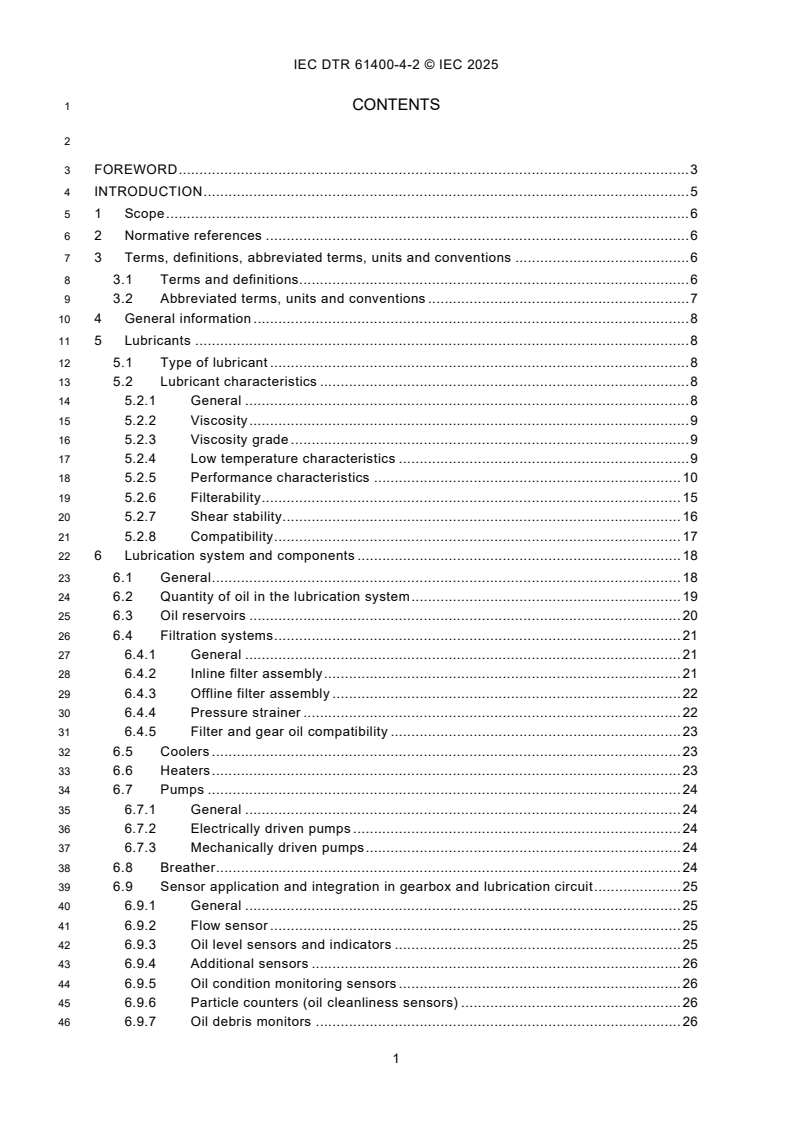
1 CONTENTS
3 FOREWORD . 3
4 INTRODUCTION . 5
5 1 Scope . 6
6 2 Normative references . 6
7 3 Terms, definitions, abbreviated terms, units and conventions . 6
8 3.1 Terms and definitions. 6
9 3.2 Abbreviated terms, units and conventions . 7
10 4 General information . 8
11 5 Lubricants . 8
12 5.1 Type of lubricant . 8
13 5.2 Lubricant characteristics . 8
14 5.2.1 General . 8
15 5.2.2 Viscosity . 9
16 5.2.3 Viscosity grade . 9
17 5.2.4 Low temperature characteristics . 9
18 5.2.5 Performance characteristics . 10
19 5.2.6 Filterability . 15
20 5.2.7 Shear stability . 16
21 5.2.8 Compatibility . 17
22 6 Lubrication system and components . 18
23 6.1 General . 18
24 6.2 Quantity of oil in the lubrication system . 19
25 6.3 Oil reservoirs . 20
26 6.4 Filtration systems . 21
27 6.4.1 General . 21
28 6.4.2 Inline filter assembly . 21
29 6.4.3 Offline filter assembly . 22
30 6.4.4 Pressure strainer . 22
31 6.4.5 Filter and gear oil compatibility . 23
32 6.5 Coolers . 23
33 6.6 Heaters . 23
34 6.7 Pumps . 24
35 6.7.1 General . 24
36 6.7.2 Electrically driven pumps . 24
37 6.7.3 Mechanically driven pumps . 24
38 6.8 Breather . 24
39 6.9 Sensor application and integration in gearbox and lubrication circuit . 25
40 6.9.1 General . 25
41 6.9.2 Flow sensor . 25
42 6.9.3 Oil level sensors and indicators . 25
43 6.9.4 Additional sensors . 26
44 6.9.5 Oil condition monitoring sensors . 26
45 6.9.6 Particle counters (oil cleanliness sensors) . 26
46 6.9.7 Oil debris monitors . 26
IEC DTR 61400-4-2 © IEC 2025
47 6.10 Auxiliary components . 27
48 6.10.1 Ports . 27
49 6.10.2 Magnetic plugs . 27
50 6.10.3 Fluid lines . 27
51 6.10.4 Valves . 27
52 6.11 Serviceability . 28
53 7 Lubricant life and condition monitoring . 28
54 7.1 Lubricant condition monitoring . 28
55 7.2 Offline condition monitoring . 29
56 7.2.1 Sampling of used oil . 29
57 7.2.2 Sampling of fresh oil from containers . 30
58 7.2.3 Analysis parameters . 31
59 7.2.4 Limit values for used oil analyses . 32
60 7.2.5 Possible causes for changes of selected oil characteristics . 34
61 7.2.6 Trend analyses . 35
62 7.2.7 Remedial actions . 36
63 7.3 Online condition monitoring . 37
64 7.3.1 General . 37
65 7.3.2 Analysis parameters . 37
66 7.3.3 Limit values . 39
67 7.3.4 Trending . 40
68 7.4 Top treat of oil with additive concentrate . 40
69 7.5 Topping up . 41
70 7.6 Oil changes. 41
71 7.6.1 General . 41
72 7.6.2 First fill . 41
73 7.6.3 Change intervals and change criteria . 41
74 7.6.4 Oil change procedures . 42
75 7.6.5 Application of cleaning and flushing fluids . 42
76 7.6.6 Cross contamination . 43
77 Bibliography . 44
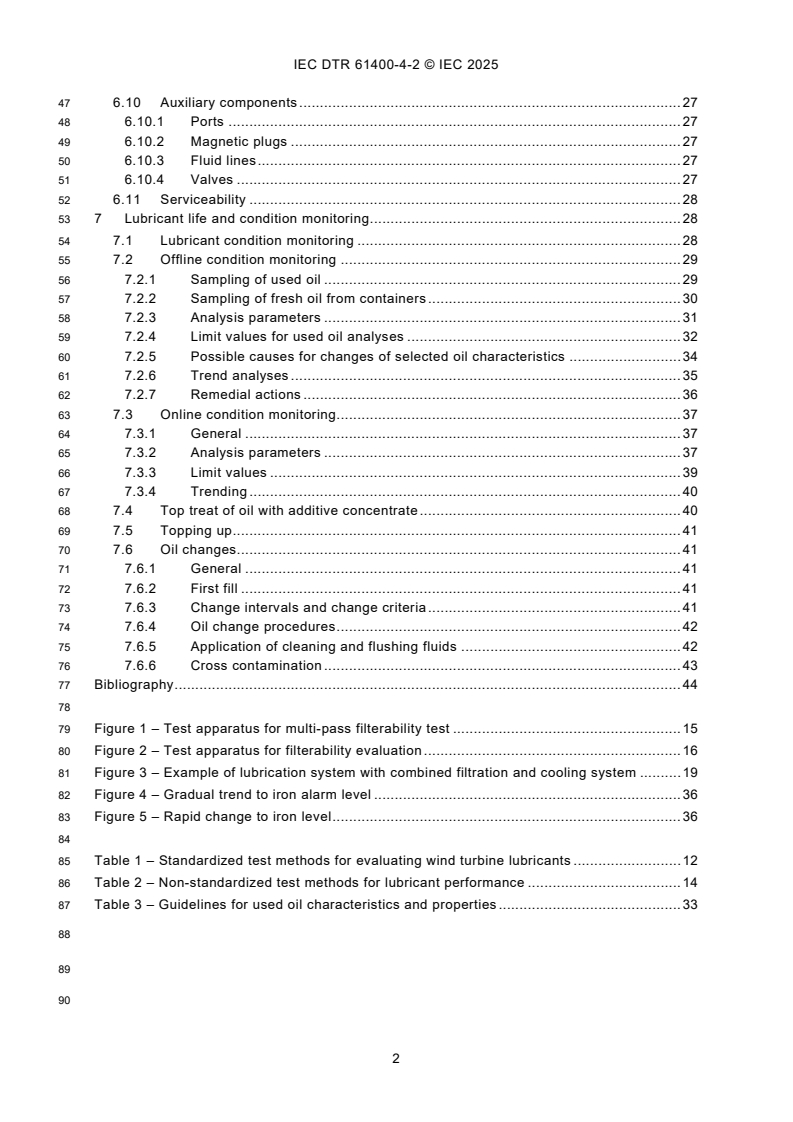
79 Figure 1 – Test apparatus for multi-pass filterability test . 15
80 Figure 2 – Test apparatus for filterability evaluation . 16
81 Figure 3 – Example of lubrication system with combined filtration and cooling system . 19
82 Figure 4 – Gradual trend to iron alarm level . 36
83 Figure 5 – Rapid change to iron level . 36
85 Table 1 – Standardized test methods for evaluating wind turbine lubricants . 12
86 Table 2 – Non-standardized test methods for lubricant performance . 14
87 Table 3 – Guidelines for used oil characteristics and properties . 33
IEC DTR 61400-4-2 © IEC 2025
91 INTERNATIONAL ELECTROTECHNICAL COMMISSION
92 ____________
94 Wind energy generation systems -
95 Wart 4-2: Lubrication of drivetrain components in wind turbines
97 FOREWORD
98 1) The International Electrotechnical Commission (IEC) is a worldwide organization for standardization comprising
99 all national electrotechnical committees (IEC National Committees). The object of IEC is to promote international
100 co-operation on all questions concerning standardization in the electrical and electronic fields. To this end and
101 in addition to other activities, IEC publishes International Standards, Technical Specifications, Technical Reports,
102 Publicly Available Specifications (PAS) and Guides (hereafter referred to as “IEC Publication(s)”). Their
103 preparation is entrusted to technical committees; any IEC National Committee interested in the subject dealt with
104 may participate in this preparatory work. International, governmental and non-governmental organizations liaising
105 with the IEC also participate in this preparation. IEC collaborates closely with the International Organization for
106 Standardization (ISO) in accordance with conditions determined by agreement between the two organizations.
107 2) The formal decisions or agreements of IEC on technical matters express, as nearly as possible, an international
108 consensus of opinion on the relevant subjects since each technical committee has representation from all
109 interested IEC National Committees.
110 3) IEC Publications have the form of recommendations for international use and are accepted by IEC National
111 Committees in that sense. While all reasonable efforts are made to ensure that the technical content of IEC
112 Publications is accurate, IEC cannot be held responsible for the way in which they are used or for any
113 misinterpretation by any end user.
114 4) In order to promote international uniformity, IEC National Committees undertake to apply IEC Publications
115 transparently to the maximum extent possible in their national and regional publications. Any divergence between
116 any IEC Publication and the corresponding national or regional publication shall be clearly indicated in the latter.
117 5) IEC itself does not provide any attestation of conformity. Independent certification bodies provide conformity
118 assessment services and, in some areas, access to IEC marks of conformity. IEC is not responsible for any
119 services carried out by independent certification bodies.
120 6) All users should ensure that they have the latest edition of this publication.
121 7) No liability shall attach to IEC or its directors, employees, servants or agents including individual experts and
122 members of its technical committees and IEC National Committees for any personal injury, property damage or
123 other damage of any nature whatsoever, whether direct or indirect, or for costs (including legal fees) and
124 expenses arising out of the publication, use of, or reliance upon, this IEC Publication or any other IEC
125 Publications.
126 8) Attention is drawn to the Normative references cited in this publication. Use of the referenced publications is
127 indispensable for the correct application of this publication.
128 9) IEC draws attention to the possibility that the implementation of this document may involve the use of (a)
129 patent(s). IEC takes no position concerning the evidence, validity or applicability of any claimed patent rights in
130 respect thereof. As of the date of publication of this document, IEC had not received notice of (a) patent(s), which
131 may be required to implement this document. However, implementers are cautioned that this may not represent
132 the latest information, which may be obtained from the patent database available at https://patents.iec.ch. IEC
133 shall not be held responsible for identifying any or all such patent rights.
134 IEC TR 61400-4-2 has been prepared by IEC technical committee 88: Wind energy generation
135 systems. It is a Technical Report.
136 The text of this Technical Report is based on the following documents:
Draft Report on voting
88/XX/DTR 88/XX/RVDTR
138 Full information on the voting for its approval can be found in the report on voting indicated in
139 the above table.
140 The language used for the development of this Technical Report is English.
141 This document was drafted in accordance with ISO/IEC Directives, Part 2, and developed in
142 accordance with ISO/IEC Directives, Part 1 and ISO/IEC Directives, IEC Supplement, available
IEC DTR 61400-4-2 © IEC 2025
143 at www.iec.ch/members_experts/refdocs. The main document types developed by IEC are
144 described in greater detail at www.iec.ch/publications.
145 A list of all parts of the IEC 61400 series, published under the general title Wind energy
146 generation systems, can be found on the IEC website.
147 The committee has decided that the contents of this document will remain unchanged until the
148 stability date indicated on the IEC website under webstore.iec.ch in the data related to the
149 specific document. At this date, the document will be
150 – reconfirmed,
151 – withdrawn, or
152 – revised.
IEC DTR 61400-4-2 © IEC 2025
154 INTRODUCTION
155 The purpose of this IEC Technical Report (TR) is to provide a common reference for lubrication
156 related matters for wind turbine drive trains. ISO/TR 18792 provides information for lubrication
157 of industrial gearboxes. Some information is similar or identical to this document.
158 The contents are non-normative but useful to wind turbine system and component designers,
159 wind turbine manufacturers, and owners/operators to ensure that lubricant related matters are
160 addressed in the gearbox design and operation phases.
161 This current edition of the document covers oil lubricated gearboxes and is developed based
162 on experience with predominantly gearboxes with rolling bearings. It can be applied to
163 gearboxes with plain bearings, but possibly does not yet address all aspects of this technology.
164 The document structure is prepared to receive further content related to other components in
165 the wind turbine drivetrain and include additional types of lubricants.
IEC DTR 61400-4-2 © IEC 2025
167 1 Scope
168 This document, which is a Technical Report, provides non-binding information regarding the
169 lubricant, lubrication system layout, and performance for wind turbine gearboxes. This
170 document covers oil lubricated gearboxes. Additionally, guidance for selected lubricant
171 parameters as well as for monitoring and maintaining lubricant characteristics is offered.
172 2 Normative references
173 The following documents are referred to in the text in such a way that some or all of their content
174 constitutes requirements of this document. For dated references, only the edition cited applies.
175 For undated references, the latest edition of the referenced document (including any
176 amendments) applies.
177 IEC 61400-1, Wind energy generation systems - Part 1: Design requirements
178 IEC 61400-3 (all parts), Wind energy generation systems - Part 3: Design requirements
179 IEC 61400-4, Wind energy generation systems - Part 4: Design requirements for wind turbine
180 gearboxes
181 3 Terms, definitions, abbreviated terms, units and conventions
182 3.1 Terms and definitions
183 For the purposes of this document, the terms and definitions given in IEC 61400-1,
184 IEC 61400-3 series, IEC 61400-4 and the following apply.
185 NOTE In case of conflict, the definitions in this document take precedence.
186 3.1.1
187 lubricant supplier
188 entity supplying lubricants for the wind turbine gearbox
189 Note 1 to entry: The lubricant supplier is responsible for the performance of the lubricant and the blending
190 specifications, but will not necessarily produce any of the components, or blend the final product.
191 3.1.2
192 nacelle
193 turbine structure above the tower that holds the drivetrain, generator, other subcomponents,
194 and parts of the controls and actuation systems
195 3.1.3
196 oil
197 fluid used to lubricate, flush away debris, and regulate heat transfer in the gearbox
198 Note 1 to entry: The word oil is ambiguous but is used in this document in addition to other common terms such as:
199 lubricant, lubricating oil, fluid, gear oil.
200 3.1.4
201 line
202 rigid or flexible means to convey fluids, such as pipes, tubes or hoses, including related fixtures,
203 fittings, couplings, valves or connectors
IEC DTR 61400-4-2 © IEC 2025
204 3.2 Abbreviated terms, units and conventions
205 This document uses equations and relationships from several engineering specialties. As a
206 result, there are, in some cases, conflicting definitions for the same symbol. All the symbols
207 used in the document are nevertheless listed, but, if there is ambiguity, the specific definition
208 is presented in the clause where they are used in equations, graphs, or text.
F
flow circulation (or dwell time) min
c
L
basic reference rating life at 50% reliability h
Q
minimum oil flow l/min
min
P
generated mechanical power losses kW
G
power dissipated by natural convection through the gearbox
P
kW
cn
surface
kJ/(kg
C
specific heat capacity of the oil
oil
K)
V
minimum oil volume L
min
ρ oil density kg/m
temperature difference between oil sump and oil inlet to the
∆T K
gearbox
mass loss of roller caused by wear or fatigue during loading phase
m
w50 mg
in FE8 test
210 AGMA American Gear Manufacturers Association
211 ANSI American National Standards Institute
212 ASTM American Society for Testing and Materials
213 CEC Commission of the European Communities
214 DIN Deutsches Institut für Normung
215 EP extreme pressure, refers to a type of additive
216 GFT “Graufleckentragfähigkeit”, micropitting resistance
217 FTIR Fourier transform infrared spectroscopy
218 FZG “Forschungsstelle für Zahnräder und Getriebebau” TU Munich
219 IBC international bulk container tote for liquids
220 IEC International Electrotechnical Commission
221 IR Infrared
222 ISO International Organization for Standardization
223 PAG poly-alkylene-glycol or polyglycol, synthetic lubricants
224 PAO poly-alpha-olefin, fully paraffinic synthetic lubricant based on synthesized
225 hydrocarbons
226 PQ particle quantifier (index)
227 PTO power take off
228 VG (ISO) viscosity grade
IEC DTR 61400-4-2 © IEC 2025
229 4 General information
230 Wind turbines, including their drive trains and gearboxes, operate in extreme environments with
231 highly variable load conditions, for example:
232 – temperatures from arctic to hot climates;
233 – humidity from dry deserts to humid marine conditions;
234 – sudden load variations, long periods of high loads and long periods under no-load
235 conditions;
236 – short start-up and shut-down situations;
237 – unmanned operation with extended time between service (typically between 6 months and
238 12 months).
239 Lubricant and lubrication system elements can be selected and balanced for these sometimes
240 conflicting needs. Information is provided in Clause 5 for lubricant selection, Clause 6 for
241 system design, and Clause 7 for maintenance. The following clauses provide information in
242 addition to IEC 61400-4, which supports designers, manufacturers, end users and service
243 personnel to develop, manufacture, operate and maintain lubricants and lubrication systems in
244 wind turbines.
245 5 Lubricants
246 5.1 Type of lubricant
247 Compared to most other gearbox applications, gearboxes in wind turbines are exposed to high
248 percentage of utilization, though with high variation between periods of partial and full load.
249 During full load operation, gears operate at low to moderate pitch line velocity with high to very
250 high contact loads, whereas bearings are exposed to moderate contact loads. Lubricants
251 fortified with performance enhancing additives and of the highest practical viscosity can be used
252 to improve operation under these conditions. The base fluids of these lubricants can be chosen
253 from highly refined mineral oils, full synthetic fluids, or semi-synthetic blends (mixtures of highly
254 refined mineral oils and synthetic fluids). The choice of a finished lubricant depends on many
255 factors including viscosity, viscosity index, pour point, additives, and overall lubrication costs.
256 Site specific operating conditions, wind turbine performance, cold start and operating
257 temperature within the nacelle as well as serviceability influence the selection of the most cost-
258 effective gearbox lubricant.
259 5.2 Lubricant characteristics
260 5.2.1 General
261 Most large modern wind turbines are equipped with multistage gearboxes that convert the low
262 rotor speed to high generator speed for high efficiency. Ideally, each stage of the gearbox would
263 benefit from a different oil viscosity, but this is not practical. Additionally, the gears and bearings
264 in each stage would benefit from different performance chemicals such as higher anti-scuff
265 (also known as extreme pressure (EP)) levels and higher anti-wear at the input stages.
266 Oxidation stability is important because of the potential risk of deposit formation such as varnish
267 and sludge that can clog filters, small oil passages and oil spray nozzles, as well as create
268 deposit on critical surfaces. Using multiple additives with different characteristics can have
269 synergistic or antagonistic effects. Therefore, it is common to make some compromise in the
270 choice of additives and final lubricant characteristics.
271 The key functions of the lubricant are to minimize friction and wear between surfaces in relative
272 motion, to remove heat generated by the mechanical action of the system and to protect internal
273 parts of the gearbox against corrosion. Sufficient viscosity to separate the mating surfaces as
274 well as appropriate chemical additive systems can help to accomplish these tasks and minimize
275 thermal and oxidative degradation and promote anti-wear performance.
IEC DTR 61400-4-2 © IEC 2025
276 The choice of the appropriate lubricant depends in part on matching its properties to the
277 application. Therefore, a detailed elasto-hydrodynamic analysis of the gearbox components
278 with reference to ISO/TS 6336-20, ISO/TS 6336-21, ISO/TS 6336-22 and ISO 281 has proven
279 useful.
280 Identifying selected performance attributes for the gearbox helps the user to make a reasonable
281 lubricant selection. This can, amongst others, include:
282 – the type of gearing used in the gearbox;
283 – selected operating conditions, such as:
284 • ambient temperature;
285 • operating temperature;
286 • operating speed range;
287 – any critical special circumstances, such as:
288 • low temperature start-up;
289 • ambient temperatures above 50 °C;
290 • high transient loads.
291 5.2.2 Viscosity
292 Viscosity is the most important physical property of a lubricant, and it has a direct impact on
293 gearbox performance and its service life. It is the property of a lubricating oil to resist against
294 flow and contributes to the development of a protective lubricating film.
295 5.2.3 Viscosity grade
296 IEC 61400-4 specifies that the correct viscosity grade of the lubricating oil for a gearbox is
297 selected based on operating, not start-up, conditions. The viscosity grade in the context of this
298 document is the kinematic viscosity grade, ISO VG, according to ISO 3448.
299 Additional operating parameters of importance are the viscosity index of the oil, the viscosity
300 ratio for rolling bearings and the pitch line velocity of the gears.
301 If the viscosity of the lubricating oil is too low, the application can suffer from wear. Too high
302 viscosity can cause excessive losses which can lead to temperature increase, resulting in a
303 decreased lifetime of the lubricant. Furthermore, too high viscosity can lead to oil starvation
304 when the oil is cold, e.g. during start-up conditions. Where there is a large difference between
305 the input and output shaft speeds (as in typical multistage wind turbine gearboxes), it is
306 beneficial to base the viscosity grade on the low-speed input gear to ensure development of an
307 adequate lubricant film.
308 General information on viscosity grade can be found in ISO/TR 18792. The most common
309 viscosity grade used in wind turbine gearboxes is ISO VG320, but other grades between
310 ISO VG220 and ISO VG460 are also in use.
311 5.2.4 Low temperature characteristics
312 Sufficient lubricant flow to all gear and bearing contacts at the coldest start-up temperature can
313 help to avoid starvation which could lead to premature damage. There are no published low
314 temperature requirements for ISO viscosity grades for wind or industrial applications. Oils with
315 viscosity grade ISO VG320 (ISO 3448) can cope with the typical ambient temperature ranges
316 in wind turbine applications, if the chosen oils provide a sufficiently low pour point.
317 NOTE The pour point of oils used in wind turbine gearboxes is typically significantly below the maximum value
318 specified in ISO 12925-1 for CKMSP lubricants.
IEC DTR 61400-4-2 © IEC 2025
319 Heaters (see 6.6) can be used to adjust sump temperature at start-up. VDMA 23901 provides
320 additional information regarding cold weather applications.
321 5.2.5 Performance characteristics
322 The minimum requirements for gear oils are defined in IEC 61400-4. In addition, as part of the
323 lubricant selection process, the oil typically satisfies additional selected performance
324 characteristics to improve long-term reliability of the gearbox. This is primarily a function of the
325 chemical additive system used in the lubricant. Additives are essential for fulfilling predicted
326 gearbox design life. Some additives are surface active substances that protect the surface from
327 specific damage types by building chemical and/or physical reaction layers. However, surface
328 size and reactivity are limited and can be considered when selecting additional performance
329 characteristics. For example, measures to increase wear protection can lead to a lower level of
330 corrosion protection and vice versa. Likewise, measures to improve paint compatibility can
331 decrease the seal compatibility.
332 Evaluation of following characteristics has proven useful to predict lubricant performance in
333 wind turbine gearboxes:
334 – gear scuffing;
335 – gear micropitting;
336 – bearing wear and bearing fatigue in mixed friction regime;
337 – oxidation of oil;
338 – corrosion protection (ferrous and non-ferrous);
339 – foaming and air release;
340 – filterability;
341 – shear stability;
342 – compatibility with materials (ferrous and non-ferrous metals, elastomers, seals, gaskets,
343 sealants, paints and coatings, adhesives or plastics);
344 – compatibility with auxiliary components (e.g. filter media, desiccant used in breather vent
345 devices, electronic sensors, or connectors);
346 – compatibility with utilities such as run-in oils or corrosion preservatives.
347 Acceptance of lubricant performance is commonly based on results from standardized test
348 methods. For some critical performance characteristics, no standardized test methods exist at
349 date of publication of this document. Test methods with documented data for repeatability and
350 reproducibility are preferable.
351 Table 1 and Table 2 summarize an exemplary and non-exhaustive set of commonly used
352 standardized and non-standardized test methods and typical performance levels with relevance
353 for wind turbine gearboxes. Some of the methods mentioned in Table 2 are possibly reviewed
354 for standardization at this time or in future.
355 NOTE For elastomer and paint compatibility, the table provides example values since various materials can be
356 used.
357 Wind turbines are one of the bearing applications where early premature failures associated
358 with white etching cracks are observed. IEC 61400-4 discusses potential causes and possible
359 means to reduce the risk of occurrence. Lubricant interaction is a potential contributor to the
360 failure mode. However, at the time of publication of this document, there are no test methods
361 for lubricants which predict the risk of this failure mode, and where test results correlate
362 consistently with field experience.
363 Regardless of the method chosen to determine specific lubricant performance, it can be useful
364 to compare the results with those obtained with a reference oil, preferably one with a positive
365 field service history.
IEC DTR 61400-4-2 © IEC 2025
366 It has proven useful to demonstrate lubricant performance by field experience of at least 1 to 2
367 years.
IEC DTR 61400-4-2 © IEC 2025
Table 1 – Standardized test methods for evaluating wind turbine lubricants
Property Procedure name Test method Test conditions Typical performance
characteristics
a
Gear – adhesive wear (scuffing) FZG scuffing test ISO 14635-1 A/8,3/90
Fail load stage ≥ 14
A/8,3/60 (additional)
a
Fail load stage ≥ 12
Alternatively: A/16,6/90
Additional: A/8,3/60 bearing
Fail load stage ≥ 12
a
Mdf
d
Bearing - anti-wear protection DIN 51819-3 D-7,5/100-80 Roller wear:
FE8
c
7,5 r/min; 100 kN
under extreme mixed friction
m ≤ 30 mg
w50
80 h: 80 °C
No microspalled areas according
to ISO 15243
e
Bearing - fatigue under moderate DIN 51819-3 D-75/90-70 Roller wear:
FE8
c
mixed friction 75 r/min
m ≤ 30 mg
w50
90 kN
800 h No surface damages
a
70 °C
Gear micropitting FZG micropitting test DIN 3990-16 GT-C/8,3 /90 Failure load stage ≥ 10
and GFT-high
GT-C/8,3/60 Failure load stage ≥ 10
and GFT-high
Shear stability Tapered roller bearing shear test ISO 26422 20 h, 60 °C, 5 000 N Stay in ISO VG class
b, c
ISO 1817 Example: Volume change −5 % to +9 %
Static elastomer compatibility
duration for PAO-oils: 1 008 h
Hardness change ± 10 %
Example:
Elongation change < 50 %
temperature for nitrile butadiene
rubber (NBR) elastomers: 95 °C
Tensile strength change < 60 %
Example:
temperature for fluorocarbon-
based elastomers: 120 °C
Example:
temperature for hydrogenated
nitrile butadiene rubber (HNBR)
elastomers: 120 °C
IEC DTR 61400-4-2 © IEC 2025
Property Procedure name Test method Test conditions Typical performance
characteristics
b
Hardness testing ISO 1522 Example for test duration: Visual inspection: No blistering
Compatibility of paint system
ISO 2409 - 168 h for primers
(consisting of primers and top
For film thickness up to 250 µm: Cross-cut ≤ 1
ISO 2812-1 - 504 h for top coat
coat)
cross-cut testing
ISO 2812-3
Pull-off force > 5 MPa
Example for test temperatures:
ISO 16276-1
For film thickness larger than:
- 95 °C for mineral oils;
ISO 16276-2
250 µm: pull-off testing
- 130 °C for synthetic oils
Compatibility of adhesives and Static immersion test ISO 10123 672 h at 80 °C To be specified dependent on
b
product type (different for
sealants
ISO 4587
adhesives and sealants)
Foaming Flender foam test ISO 12152 25 °C ≤ 15 % after 1 min,
≤ 10 % after 5 min
40 °C ≤ 13 % after 1 min,
≤ 9 % after 5 min
60 °C ≤ 10 % after 1 min,
≤ 7 % after 5 min
b
ISO 2160 Example: Max. 2
Copper Corrosion
100 °C, 24 h
b, f
Collapse burst rating ISO 2943 According to ISO 2943 According to ISO 2943
Filter element compatibility
a
Modified test conditions.
b
To address the needs of the specific applications and/or wind turbine manufacturer requirements, the methods, performance characteristics and test conditions can be
modified considering the lubricant and the material type. The choice of test temperature is dependent upon the stability of the material and/or the stability of the oil.
c
To address specific end user applications, the method can vary depending on the elastomer in use.
d
Sometimes referred to as Schaeffler wind energy 4 stage test stage 1 found in Schaeffler TPI 176.
e
Sometimes referred to as Schaeffler wind energy 4 stage test stage 2 found in Schaeffler TPI 176.
f
This test is typically executed once for a family of filter elements using the same filter media and other materials.
IEC DTR 61400-4-2 © IEC 2025
Table 2 – Non-standardized test methods for lubricant performance
Property Procedure name Test method Test conditions Typical performance
characteristics
a
Corrosion
SKF Emcor Distilled water Rating max. 1
ISO 11007
(non-ferrous)
Salt water (0,5 % NaCl) Rating max. 2
Bearing - additive reactions Schaeffler wind energy 4 stage Schaeffler wind energy stage 3 Test bearing: 6 206 L ≥ 550 h
b
under EHD conditions test, stage 3 Test speed: 9 000 r/min
on L11 test rig
Test load: 8,5 kN
Run time: 700 h
No temperature control
Bearing - oil behaviour at Schaeffler wind energy 4 stage Schaeffler wind energy stage 4 Test bearing: 81 212 MPB
Filter blocking < 2
b
increased temperature and with test, stage 4 Test speed: 750 r/min
on FE8 test rig
Roller wear < 30 mg
addition of water Test load: 60 kN
Fatigue damage: no
Run time: >600 h
Preheating system/ water /
Residue at bearing:
Temperature control: 100 °C
moderate/heavy
Residue at preheat system:
moderate/heavy
Chemical and thermal stability SKF roller test SKF 8 weeks at 100 °C Corrosion attack max. 2
Viscosity change max 10 %
No sludge
No incrustation
Filterability Multi-pass with oil analysis and CC Jensen Filter the oil in a test rig through Foam same as fresh oil
foam test the filter 100 to 10 000 times
HYDAC multi-pass HN 30-08 Additive change – define %
Define secondary additive %
change
Filterability Single-pass HYDAC single-pass HN 30-04 Application filter media Filterability index:
a – ≥ 80 % for stage 1
(ISO 13357-2 )
– ≥ 60 % for stage 2.
a
Modified test conditions.
b
Information on Schaeffler wind energy 4 stage test can be found in Schaeffler TPI 176.
IEC DTR 61400-4-2 © IEC 2025
5.2.6 Filterability
5.2.6.1 General
The filterability test according to ISO 13357-1:2017 is not applicable for the oils of the ISO VGs
typically used in wind turbines . Non standardized test procedures can be applied instead as
described in the following subclauses.
5.2.6.2 Multi-pass filterability test
The filterability of the oil and its additive package can be tested by means of an accelerated
multi-pass filterability test. In this test, a small oil volume passes through the test filter multiple
times to assess the filterability. The intention of the test is to investigate the compatibility of the
gear oil with the filter media. A filterability test is usually carried out with a fresh oil sample.
Used oil, preferably from the field, can also be considered. As an example, the Hydac
Filterability Test HN 30-8 (schematically shown in Figure 1) is based on a test rig design with
an integrated Flender Foam Tester, which serves as an oil reservoir. The test oil is pumped
through a test filter typically 1 000 passes of the oil over the filter (also 100 or 10 000 times can
be considered). Before and after filtration, a Flender Foam Test, ISO 12152 is carried out to
assess the foaming tendencies of the oil. Before and after filtration (0, 10, 100, 1 000 cycles),
an oil sample is taken to provide oil analysis data such as viscosity (ISO 3104) and additive
elements (ASTM D5185). The foam test is commenced after the pump has been stopped, the
foam has settled, and the oil is de-aerated. The pressure drop at the filter is measured as a
function of testing time to allow detection of any change. Other multi-pass filterability test rigs
can be designed to address offline filtration or other specific field conditions, for example higher
or lower test temperatures or flow rates.
Figure 1 – Test apparatus for multi-pass filterability test
5.2.6.3 Single-pass filterability test
This test serves to evaluate the general ability of the oil to pass through the filter media in a
reasonable time and to evaluate premature filter blockage caused by components of the oil.
The test rig is similar to the apparatus described in ISO 13357-2:2017 (see Key
___________
A new edition of this document exists but the cited edition applies.
The methods described in ISO 13357-1:2017 and ISO 13357-2:2017 are designed for mineral oils up to
ISO VG 100 and can be applied for mineral oils up to ISO VG 220. Future revisions of these standards can include
methods for higher viscosity grades.
IEC DTR 61400-4-2 © IEC 2025
1 source of compressed air or nitrogen
2 pressure regulator
3 pressure gauge
4 ball valve
5 pressure vessel with membrane support
6 measuring cylinder
Figure 2) .
Key
1 source of compressed air or nitrogen
2 pressure regulator
3 pressure gauge
4 ball valve
5 pressure vessel with membrane support
6 measuring cylinder
Figure 2 – Test apparatus for filterability evaluation
Compared to ISO 13357-2:2017, test procedures, parameters, and interpretation can be
adapted for gear oils of higher ISO VG (e.g. the use of coarser filter media can be used in the
in-house test procedure).
5.2.7 Shear stability
In order to maintain the functionality of the lubricant, it has proven useful to evaluate the
potential for viscosity loss due to breakdown of polymeric components. ISO 26422 has already
been proven suitable to evaluate this characteristic in other applications and can be used. From
experience, a wind turbine lubricant works well when its viscosity is maintained within the initial
ISO VG class. Maintaining proper viscosity by using shear stable lubricant over the entire
operating temperature range of the gearbox can also help to minimize the potential for foaming
and air entrainment.
IEC DTR 61400-4-2 © IEC 2025
5.2.8 Compatibility
5.2.8.1 General
Wind turbine gearboxes use many different materials that come in contact with the lubricant.
These materials can be laboratory tested for compatibility. These tests typically include:
– compatibility with materials of construction (e.g. ferrous and non-ferrous metals, paints,
coatings, elastomers, seals, sealants, and adhesives);
– compatibility with auxiliary and peripheral components (e.g. filter media, desiccant used in
breathers, electronic sensors, or connectors);
– compatibility of process media used during manufacturing and assembly (e.g. run-in oils,
test oils), if they remain inside the gearbox in relevant quant
...
Questions, Comments and Discussion
Ask us and Technical Secretary will try to provide an answer. You can facilitate discussion about the standard in here.
Loading comments...