

IEC 61400-4:2012
(Main)Wind turbines — Part 4: Design requirements for wind turbine gearboxes
General Information
- Abstract
IEC 61400-4:2012(E) is applicable to enclosed speed increasing gearboxes for horizontal axis wind turbine drivetrains with a power rating in excess of 500 kW. This standard applies to wind turbines installed onshore or offshore. It Standard provides guidance on the analysis of the wind turbine loads in relation to the design of the gear and gearbox elements. The gearing elements covered by this standard include such gears as spur, helical or double helical and their combinations in parallel and epicyclic arrangements in the main power path. The standard is based on gearbox designs using rolling element bearings. Also included is guidance on the engineering of shafts, shaft hub interfaces, bearings and the gear case structure in the development of a fully integrated design that meets the rigours of the operating conditions. Lubrication of the transmission is covered along with prototype and production testing. Finally, guidance is provided on the operation and maintenance of the gearbox.
- Status
- Withdrawn
- Publication Date
- 04-Dec-2012
- Technical Committee
- ISO/TC 60 - Gears
- Drafting Committee
- ISO/TC 60 - Gears
- Current Stage
- 9599 - Withdrawal of International Standard
- Start Date
- 02-Apr-2025
- Completion Date
- 29-Aug-2026
Overview
IEC 61400-4:2012 - Wind turbines - Part 4: Design requirements for wind turbine gearboxes is an IEC international standard that specifies design, analysis, testing and maintenance guidance for enclosed, speed‑increasing gearboxes used in horizontal‑axis wind turbine drivetrains with rated power above 500 kW. Applicable to both onshore and offshore turbines, the standard focuses on gearbox elements in the main power path and on creating integrated, reliable gearbox designs suitable for wind‑specific operating loads and environments.
Key topics and technical requirements
The standard addresses the full gearbox lifecycle with emphasis on reliability and validation. Major technical topics include:
Drivetrain loads and operating conditions
- Wind turbine load derivation (time series, fatigue and extreme loads)
- Interface definitions and environmental/operational scenarios
Gear and gearbox element design
- Gearing types covered: spur, helical, double helical, and combinations in parallel and epicyclic (planetary) arrangements
- Gear rating, accuracy, materials, subsurface fatigue and manufacturing considerations
Bearings, shafts and interfaces
- Design and reliability guidance for rolling‑element bearings, bearing steel quality, lubrication, mounting and loads
- Shaft design, shaft‑hub interfaces, splines, seals and fasteners
Gearbox structural elements
- Housing strength, deflection analysis, static and fatigue assessment, material testing
Lubrication and thermal management
- Lubricant selection, quantity, cleanliness, filtration, temperature control and condition monitoring
Design verification and testing
- Prototype/workshop testing, field validation, production and acceptance testing, robustness checks, vibration and sound emission considerations
Operation, maintenance and documentation
- Commissioning, inspections, run‑in, repairs, condition monitoring and O&M documentation requirements
Practical applications - who uses this standard
IEC 61400-4:2012 is essential for:
- Wind turbine gearbox designers and OEMs to define design criteria and validation plans
- Drivetrain engineers performing load analysis, gear and bearing selection
- Certification bodies and test labs executing prototype and type tests
- Wind farm operators and maintenance teams for service, lubricant and condition‑monitoring practices
- Procurement and quality teams specifying gearbox acceptance and production testing
Related standards
- Part of the IEC 61400 series of wind turbine standards; used alongside other IEC 61400 parts that cover site assessment, design, testing and certification of wind turbines.
Keywords: IEC 61400-4:2012, wind turbine gearboxes, gearbox design, drivetrain loads, bearings, lubrication, prototype testing, gearbox reliability, onshore offshore.
Relations
- Effective Date
- 06-Jun-2022
- Effective Date
- 15-Apr-2008
- Effective Date
- 15-Apr-2008
Get Certified
Connect with accredited certification bodies for this standard

DNV
DNV is an independent assurance and risk management provider.

Lloyd's Register
Lloyd's Register is a global professional services organisation specialising in engineering and technology.
DNV Energy Systems
Energy and renewable energy certification.
Sponsored listings
Frequently Asked Questions
IEC 61400-4:2012 is a standard published by the International Organization for Standardization (ISO). Its full title is "Wind turbines — Part 4: Design requirements for wind turbine gearboxes". This standard covers: IEC 61400-4:2012(E) is applicable to enclosed speed increasing gearboxes for horizontal axis wind turbine drivetrains with a power rating in excess of 500 kW. This standard applies to wind turbines installed onshore or offshore. It Standard provides guidance on the analysis of the wind turbine loads in relation to the design of the gear and gearbox elements. The gearing elements covered by this standard include such gears as spur, helical or double helical and their combinations in parallel and epicyclic arrangements in the main power path. The standard is based on gearbox designs using rolling element bearings. Also included is guidance on the engineering of shafts, shaft hub interfaces, bearings and the gear case structure in the development of a fully integrated design that meets the rigours of the operating conditions. Lubrication of the transmission is covered along with prototype and production testing. Finally, guidance is provided on the operation and maintenance of the gearbox.
IEC 61400-4:2012(E) is applicable to enclosed speed increasing gearboxes for horizontal axis wind turbine drivetrains with a power rating in excess of 500 kW. This standard applies to wind turbines installed onshore or offshore. It Standard provides guidance on the analysis of the wind turbine loads in relation to the design of the gear and gearbox elements. The gearing elements covered by this standard include such gears as spur, helical or double helical and their combinations in parallel and epicyclic arrangements in the main power path. The standard is based on gearbox designs using rolling element bearings. Also included is guidance on the engineering of shafts, shaft hub interfaces, bearings and the gear case structure in the development of a fully integrated design that meets the rigours of the operating conditions. Lubrication of the transmission is covered along with prototype and production testing. Finally, guidance is provided on the operation and maintenance of the gearbox.
IEC 61400-4:2012 is classified under the following ICS (International Classification for Standards) categories: 21.200 - Gears; 27.180 - Wind turbine energy systems. The ICS classification helps identify the subject area and facilitates finding related standards.
IEC 61400-4:2012 has the following relationships with other standards: It is inter standard links to IEC 61400-4:2025, ISO 81400-4:2005/Cor 1:2005, ISO 81400-4:2005. Understanding these relationships helps ensure you are using the most current and applicable version of the standard.
IEC 61400-4:2012 is available in PDF format for immediate download after purchase. The document can be added to your cart and obtained through the secure checkout process. Digital delivery ensures instant access to the complete standard document.
Standards Content (Sample)
IEC 61400-4
Edition 1.0 2012-12
INTERNATIONAL
STANDARD
colour
inside
Wind turbines –
Part 4: Design requirements for wind turbine gearboxes
All rights reserved. Unless otherwise specified, no part of this publication may be reproduced or utilized in any form
or by any means, electronic or mechanical, including photocopying and microfilm, without permission in writing from
either IEC or IEC's member National Committee in the country of the requester.
If you have any questions about IEC copyright or have an enquiry about obtaining additional rights to this publication,
please contact the address below or your local IEC member National Committee for further information.
IEC Central Office Tel.: +41 22 919 02 11
3, rue de Varembé Fax: +41 22 919 03 00
CH-1211 Geneva 20 info@iec.ch
Switzerland www.iec.ch
About the IEC
The International Electrotechnical Commission (IEC) is the leading global organization that prepares and publishes
International Standards for all electrical, electronic and related technologies.
About IEC publications
The technical content of IEC publications is kept under constant review by the IEC. Please make sure that you have the
latest edition, a corrigenda or an amendment might have been published.
Useful links:
IEC publications search - www.iec.ch/searchpub Electropedia - www.electropedia.org
The advanced search enables you to find IEC publications The world's leading online dictionary of electronic and
by a variety of criteria (reference number, text, technical electrical terms containing more than 30 000 terms and
committee,…). definitions in English and French, with equivalent terms in
It also gives information on projects, replaced and additional languages. Also known as the International
withdrawn publications. Electrotechnical Vocabulary (IEV) on-line.
IEC Just Published - webstore.iec.ch/justpublished Customer Service Centre - webstore.iec.ch/csc
Stay up to date on all new IEC publications. Just Published If you wish to give us your feedback on this publication
details all new publications released. Available on-line and or need further assistance, please contact the
also once a month by email. Customer Service Centre: csc@iec.ch.
IEC 61400-4
Edition 1.0 2012-12
INTERNATIONAL
STANDARD
colour
inside
Wind turbines –
Part 4: Design requirements for wind turbine gearboxes
INTERNATIONAL
ELECTROTECHNICAL
COMMISSION
PRICE CODE
XG
ICS 27.180 ISBN 978-2-83220-506-8
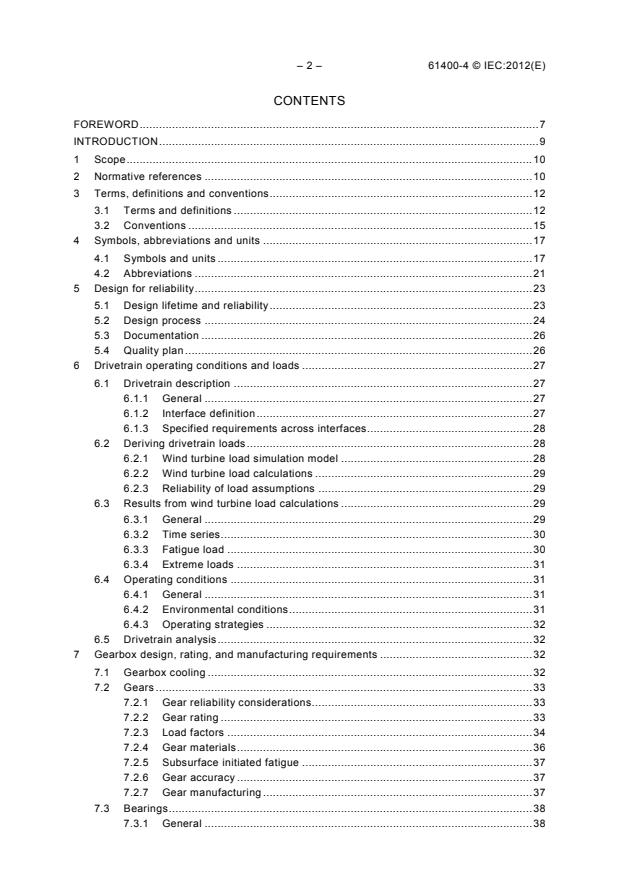
– 2 – 61400-4 © IEC:2012(E)
CONTENTS
FOREWORD . 7
INTRODUCTION . 9
1 Scope . 10
2 Normative references . 10
3 Terms, definitions and conventions . 12
3.1 Terms and definitions . 12
3.2 Conventions . 15
4 Symbols, abbreviations and units . 17
4.1 Symbols and units . 17
4.2 Abbreviations . 21
5 Design for reliability . 23
5.1 Design lifetime and reliability . 23
5.2 Design process . 24
5.3 Documentation . 26
5.4 Quality plan . 26
6 Drivetrain operating conditions and loads . 27
6.1 Drivetrain description . 27
6.1.1 General . 27
6.1.2 Interface definition . 27
6.1.3 Specified requirements across interfaces. 28
6.2 Deriving drivetrain loads . 28
6.2.1 Wind turbine load simulation model . 28
6.2.2 Wind turbine load calculations . 29
6.2.3 Reliability of load assumptions . 29
6.3 Results from wind turbine load calculations . 29
6.3.1 General . 29
6.3.2 Time series . 30
6.3.3 Fatigue load . 30
6.3.4 Extreme loads . 31
6.4 Operating conditions . 31
6.4.1 General . 31
6.4.2 Environmental conditions . 31
6.4.3 Operating strategies . 32
6.5 Drivetrain analysis . 32
7 Gearbox design, rating, and manufacturing requirements . 32
7.1 Gearbox cooling . 32
7.2 Gears . 33
7.2.1 Gear reliability considerations. 33
7.2.2 Gear rating . 33
7.2.3 Load factors . 34
7.2.4 Gear materials . 36
7.2.5 Subsurface initiated fatigue . 37
7.2.6 Gear accuracy . 37
7.2.7 Gear manufacturing . 37
7.3 Bearings . 38
7.3.1 General . 38
61400-4 © IEC:2012(E) – 3 –
7.3.2 Bearing reliability considerations . 38
7.3.3 Bearing steel quality requirements . 39
7.3.4 General design considerations . 39
7.3.5 Bearing interface requirements . 42
7.3.6 Bearing design issues. 43
7.3.7 Bearing lubrication . 46
7.3.8 Rating calculations . 47
7.4 Shafts, keys, housing joints, splines and fasteners . 50
7.4.1 Shafts . 50
7.4.2 Shaft-hub connections . 50
7.4.3 Flexible splines . 51
7.4.4 Shaft seals . 51
7.4.5 Fasteners . 51
7.4.6 Circlips (snap rings) . 52
7.5 Structural elements . 52
7.5.1 Introduction . 52
7.5.2 Reliability considerations . 53
7.5.3 Deflection analysis . 53
7.5.4 Strength verification. 53
7.5.5 Static strength assessment . 54
7.5.6 Fatigue strength assessment . 58
7.5.7 Material tests . 62
7.5.8 Documentation . 63
7.6 Lubrication . 63
7.6.1 General considerations . 63
7.6.2 Type of lubricant . 64
7.6.3 Lubricant characteristics . 65
7.6.4 Method of lubrication . 66
7.6.5 Oil quantity . 67
7.6.6 Operating temperatures . 68
7.6.7 Temperature control . 68
7.6.8 Lubricant condition monitoring . 69
7.6.9 Lubricant cleanliness . 69
7.6.10 Lubricant filter . 70
7.6.11 Ports . 71
7.6.12 Oil level indicator . 71
7.6.13 Magnetic plugs . 71
7.6.14 Breather . 72
7.6.15 Flow sensor . 72
7.6.16 Serviceability . 72
8 Design verification . 72
8.1 General . 72
8.2 Test planning . 72
8.2.1 Identifying test criteria . 72
8.2.2 New designs or substantive changes . 73
8.2.3 Overall test plan . 73
8.2.4 Specific test plans . 73
8.3 Workshop prototype testing . 74
8.3.1 General . 74
– 4 – 61400-4 © IEC:2012(E)
8.3.2 Component testing . 74
8.3.3 Workshop testing of a prototype gearbox . 74
8.3.4 Lubrication system testing . 75
8.4 Field test . 75
8.4.1 General . 75
8.4.2 Validation of loads . 75
8.4.3 Type test of gearbox in wind turbine . 76
8.5 Production testing . 77
8.5.1 Acceptance testing . 77
8.5.2 Sound emission testing . 77
8.5.3 Vibration testing . 77
8.5.4 Lubrication system considerations . 77
8.5.5 System temperatures . 77
8.6 Robustness test . 77
8.7 Field lubricant temperature and cleanliness . 77
8.8 Bearing specific validation . 78
8.8.1 Design reviews . 78
8.8.2 Prototype verification/validation . 78
8.9 Test documentation . 79
9 Operation, service and maintenance requirements . 79
9.1 Service and maintenance requirements . 79
9.2 Inspection requirements . 79
9.3 Commissioning and run-in . 79
9.4 Transport, handling and storage . 80
9.5 Repair . 80
9.6 Installation and exchange . 80
9.7 Condition monitoring . 80
9.8 Lubrication . 80
9.8.1 Oil type requirements . 80
9.8.2 Lubrication system. 80
9.8.3 Oil test and analysis . 81
9.9 Operations and maintenance documentation . 81
Annex A (informative) Examples of drivetrain interfaces and loads specifications . 82
Annex B (informative) Gearbox design and manufacturing considerations . 93
Annex C (informative) Bearing design considerations . 96
Annex D (informative) Considerations for gearbox structural elements . 122
Annex E (informative) Recommendations for lubricant performance in wind turbine
gearboxes . 125
Annex F (informative) Design verification documentation . 140
Annex G (informative) Bearing calculation documentation . 143
Bibliography . 151
Figure 1 – Shaft designation in 3-stage parallel shaft gearboxes . 15
Figure 2 – Shaft designation in 3-stage gearboxes with one planet stage . 16
Figure 3 – Shaft designation in 3-stage gearboxes with two planet stages . 17
Figure 4 – Design process flow chart . 25
Figure 5 – Examples of bearing selection criteria . 39
61400-4 © IEC:2012(E) – 5 –
Figure 6 – Blind bearing assembly . 45
Figure 7 – Definition of section factor n of a notched component . 56
pl,σ
Figure 8 – Idealized elastic plastic stress-strain curve . 57
Figure 9 – Synthetic S/N curve (adapted from Haibach, 2006) . 60
Figure A.1 – Modular drivetrain . 82
Figure A.2 – Modular drivetrain with 3-point suspension . 83
Figure A.3 – Integrated drivetrain . 83
Figure A.4 – Reference system for modular drivetrain . 85
Figure A.5 – Rear view of drivetrain . 86
Figure A.6 – Reference system for modular drivetrain with 3-point suspension . 87
Figure A.7 – Reference system for integrated drivetrain . 88
Figure A.8 – Example of rainflow counting per DLC . 90
Figure A.9 – Example of load revolution distribution (LRD) . 91
Figure C.1 – Load bin reduction by lumping neighbouring load bins . 97
Figure C.2 – Consumed life index (CLI) . 99
Figure C.3 – Time share distribution . 99
Figure C.4 – Effects of clearance and preload on pressure distribution in radial roller
bearings (from Brandlein et al, 1999) . 102
Figure C.5 – Nomenclature for bearing curvature . 103
Figure C.6 – Stress distribution over the elliptical contact area . 105
Figure C.7 – Examples of locating and non-locating bearing arrangements . 114
Figure C.8 – Examples of locating bearing arrangements . 114
Figure C.9 – Examples of accommodation of axial displacements . 114
Figure C.10 – Examples of cross-locating bearing arrangements . 115
Figure C.11 – Examples of bearing arrangements with paired mounting . 115
Figure D.1 – Locations of failure for local (A) and global (B) failure . 123
Figure D.2 – Local and global failure for two different notch radii . 123
Figure D.3 – Haigh-diagram for evaluation of mean stress influence (Haibach, 2006) . 124
Figure E.1 – Viscosity requirements versus pitch line velocity . 126
Figure E.2 – Test apparatus for filterability evaluation . 134
Figure E.3 – Example for circuit design of combined filtration and cooling system . 138
Table 1 – Symbols used in the document . 18
Table 2 – Abbreviations . 21
Table 3 – Mesh load factor K for planetary stages . 35
γ
Table 4 – Required gear accuracy . 37
Table 5 – Temperature gradients for calculation of operating clearance . 44
Table 6 – Bearing lubricant temperature for calculation of viscosity ratio, κ . 46
Table 7 – Guide values for maximum contact stress at Miner’s sum dynamic
equivalent bearing load . 49
Table 8 – Minimum safety factors for the different methods . 50
Table 9 – Partial safety factors for materials . 55
Table 10 – Partial safety factors γ for synthetic S/N-curves of cast iron materials . 61
m
Table 11 – Recommended cleanliness levels . 70
– 6 – 61400-4 © IEC:2012(E)
Table A.1 – Drivetrain elements and local coordinate systems . 84
Table A.2 – Drivetrain element interface dimensions . 85
Table A.3 – Interface requirements for modular drivetrain . 86
Table A.4 – Interface requirements for modular drivetrain with 3-point suspension . 87
Table A.5 – Interface requirements for integrated drivetrain . 88
Table A.6 – Engineering data and required design load descriptions . 89
Table A.7 – Rainflow matrix example . 89
Table A.8 – Example of load duration distribution (LDD) . 91
Table A.9 – Extreme load matrix example . 92
Table B.1 – Recommended gear tooth surface roughness. 94
Table C.1 – Guide values for basic rating life L for preliminary bearing selection . 96
h10
Table C.2 – Static load factors for radial bearings . 101
Table C.3 – Bearing types for combined loads with axial loads in double directions . 110
Table C.4 – Bearing types for combined loads with axial loads in single direction . 111
Table C.5 – Bearing types for pure radial load . 112
Table C.6 – Bearing types for axial load . 113
Table C.7 – Bearing selection: Legend . 116
Table C.8 – Bearing selection: Low speed shaft (LSS) / planet carrier . 117
Table C.9 – Bearing selection: Low speed intermediate shaft (LSIS) . 118
Table C.10 – Bearing selection: High speed intermediate shaft (HSIS) . 119
Table C.11 – Bearing selection: High speed shaft (HSS) . 120
Table C.12 – Bearing selection: Planet bearing . 121
Table D.1 – Typical material properties . 122
Table E.1 – Viscosity grade at operating temperature for oils with VI = 90 . 127
Table E.2 – Viscosity grade at operating temperature for oils with VI = 120 . 128
Table E.3 – Viscosity grade at operating temperature for oils with VI = 160 . 129
Table E.4 – Viscosity grade at operating temperature for oils with VI = 240 . 130
Table E.5 – Standardized test methods for evaluating WT lubricants (fresh oil) . 132
Table E.6 – Non-standardized test methods for lubricant performance (fresh oil) . 133
Table E.7– Guidelines for lubricant parameter limits . 136
Table F.1 – Design validation and verification documentation . 140
61400-4 © IEC:2012(E) – 7 –
INTERNATIONAL ELECTROTECHNICAL COMMISSION
____________
WIND TURBINES –
Part 4: Design requirements for wind turbine gearboxes
FOREWORD
1) The International Electrotechnical Commission (IEC) is a worldwide organization for standardization comprising
all national electrotechnical committees (IEC National Committees). The object of IEC is to promote
international co-operation on all questions concerning standardization in the electrical and electronic fields. To
this end and in addition to other activities, IEC publishes International Standards, Technical Specifications,
Technical Reports, Publicly Available Specifications (PAS) and Guides (hereafter referred to as “IEC
Publication(s)”). Their preparation is entrusted to technical committees; any IEC National Committee interested
in the subject dealt with may participate in this preparatory work. International, governmental and non-
governmental organizations liaising with the IEC also participate in this preparation. IEC collaborates closely
with the International Organization for Standardization (ISO) in accordance with conditions determined by
agreement between the two organizations.
2) The formal decisions or agreements of IEC on technical matters express, as nearly as possible, an international
consensus of opinion on the relevant subjects since each technical committee has representation from all
interested IEC National Committees.
3) IEC Publications have the form of recommendations for international use and are accepted by IEC National
Committees in that sense. While all reasonable efforts are made to ensure that the technical content of IEC
Publications is accurate, IEC cannot be held responsible for the way in which they are used or for any
misinterpretation by any end user.
4) In order to promote international uniformity, IEC National Committees undertake to apply IEC Publications
transparently to the maximum extent possible in their national and regional publications. Any divergence
between any IEC Publication and the corresponding national or regional publication shall be clearly indicated in
the latter.
5) IEC itself does not provide any attestation of conformity. Independent certification bodies provide conformity
assessment services and, in some areas, access to IEC marks of conformity. IEC is not responsible for any
services carried out by independent certification bodies.
6) All users should ensure that they have the latest edition of this publication.
7) No liability shall attach to IEC or its directors, employees, servants or agents including individual experts and
members of its technical committees and IEC National Committees for any personal injury, property damage or
other damage of any nature whatsoever, whether direct or indirect, or for costs (including legal fees) and
expenses arising out of the publication, use of, or reliance upon, this IEC Publication or any other IEC
Publications.
8) Attention is drawn to the Normative references cited in this publication. Use of the referenced publications is
indispensable for the correct application of this publication.
9) Attention is drawn to the possibility that some of the elements of this IEC Publication may be the subject of
patent rights. IEC shall not be held responsible for identifying any or all such patent rights.
International Standard IEC 61400-4 has been prepared by IEC technical committee 88: Wind
turbines, in co-operation with ISO technical committee 60: Gears.
It is published as a double logo standard.
This first edition cancels and replaces ISO 81400-4 published in 2005. It constitutes a
technical revision of ISO 81400-4 with extended content and changes in all pertinent sections.
This edition includes the following significant technical changes with respect to the previous
edition:
a) extension of the scope to wind turbines above 2 MW rated power;
b) considerations for converging differing approaches to reliability in gear, bearing and wind
turbine standards;
c) a new clause on wind turbine loads specific to drivetrains;
d) new clause on testing and validation of new gearbox designs;
– 8 – 61400-4 © IEC:2012(E)
e) updated bearing selection tables for different locations in a wind turbine gearbox;
f) expanded design considerations on the use of bearings based on avoiding standard
failures;
g) a new clause on considerations and requirements in the design and analysis of gearbox
structural elements;
h) updated considerations and requirements on lubricants and lubrication systems.
The text of this standard is based on the following documents of IEC:
FDIS Report on voting
88/438/FDIS 88/441/RVD
Full information on the voting for the approval of this standard can be found in the report on
voting indicated in the above table. In ISO, the standard has been approved by 11 P-members
out of 12 having cast a vote.
This publication has been drafted in accordance with the ISO/IEC Directives, Part 2.
A list of all parts in the IEC 61400 series, published under the general title Wind turbines, can
be found on the IEC website.
The committee has decided that the contents of this publication will remain unchanged until
the stability date indicated on the IEC web site under "http://webstore.iec.ch" in the data
related to the specific publication. At this date, the publication will be
• reconfirmed,
• withdrawn,
• replaced by a revised edition, or
• amended.
A bilingual edition of this document may be issued at a later date.
IMPORTANT – The 'colour inside' logo on the cover page of this publication indicates
that it contains colours which are considered to be useful for the correct
understanding of its contents. Users should therefore print this document using a
colour printer.
61400-4 © IEC:2012(E) – 9 –
INTRODUCTION
IEC 61400-4 outlines minimum requirements for specification, design and verification of
gearboxes in wind turbines. It is not intended for use as a complete design specification or
instruction manual, and it is not intended to assure performance of assembled drive systems.
It is intended for use by experienced gear designers capable of selecting reasonable values
for the factors, based on knowledge of similar designs and the effects of such items as
lubrication, deflection, manufacturing tolerances, metallurgy, residual stress and system
dynamics. It is not intended for use by the engineering public at large.
Any of the requirements of this standard may be altered if it can be suitably demonstrated that
the safety and reliability of the system is not compromised. Compliance with this standard
does not relieve any person, organization, or corporation from the responsibility of observing
other applicable regulations.
– 10 – 61400-4 © IEC:2012(E)
WIND TURBINES –
Part 4: Design requirements for wind turbine gearboxes
1 Scope
This part of the IEC 61400 series is applicable to enclosed speed increasing gearboxes for
horizontal axis wind turbine drivetrains with a power rating in excess of 500 kW. This standard
applies to wind turbines installed onshore or offshore.
This International Standard provides guidance on the analysis of the wind turbine loads in
relation to the design of the gear and gearbox elements.
The gearing elements covered by this standard include such gears as spur, helical or double
helical and their combinations in parallel and epicyclic arrangements in the main power path.
This standard does not apply to power take off gears (PTO).
The standard is based on gearbox designs using rolling element bearings. Use of plain
bearings is permissible under this standard, but the use and rating of them is not covered.
Also included is guidance on the engineering of shafts, shaft hub interfaces, bearings and the
gear case structure in the development of a fully integrated design that meets the rigours of
the operating conditions.
Lubrication of the transmission is covered along with prototype and production testing. Finally,
guidance is provided on the operation and maintenance of the gearbox.
2 Normative references
The following documents, in whole or in part, are normatively referenced in this document and
are indispensable for its application. For dated references, only the edition cited applies. For
undated references, the latest edition of the referenced document (including any
amendments) applies.
IEC 60050 (all parts), International Electrotechnical Vocabulary
Available at
IEC 61400-1:2005, Wind turbines – Part 1: Design requirements
IEC 61400-3, Wind turbines – Part 3: Design requirements for offshore wind turbines
IEC/TS 61400-13:2001, Wind turbine generator systems – Part 13: Measurement of
mechanical loads
IEC 61400-22:2010, Wind turbines – Part 22: Conformity testing and certification
ISO 76, Rolling bearings – Static load ratings
ISO 281:2007, Rolling bearings – Dynamic load ratings and rating life
ISO 683 (all parts), Heat-treatable steels, alloy steels and free-cutting steels
61400-4 © IEC:2012(E) – 11 –
ISO 1328-1, Cylindrical gears – ISO system of accuracy – Part 1: Definitions and allowable
values of deviations relevant to corresponding flanks of gear teeth
ISO 4287, Geometrical Product Specifications (GPS) – Surface texture: Profile method –
terms, definitions and surface texture parameters
ISO 4288, Geometrical Product Specifications (GPS) – Surface texture: Profile method – rules
and procedures for the assessment of surface texture
ISO 4406, Hydraulic fluid power – Fluids– Method for coding the level of contamination by
solid particles
ISO 5725-2, Accuracy (trueness and precision) of measurement methods and results – Part 2:
Basic methods for the determination of repeatability and reproducibility of a standard
measurement method
ISO 6336 (all parts), Calculation of load capacity of spur and helical gears
ISO 6336-1:2006, Calculation of load capacity of spur and helical gears – Part 1: Basic
principles, introduction and general influence factors
ISO 6336-2:2006, Calculation of load capacity of spur and helical gears – Part 2: Calculation
of surface durability (pitting)
ISO 6336-3:2006, Calculation of load capacity of spur and helical gears – Part 3: Calculation
of tooth bending strength
ISO 6336-5:2003, Calculation of load capacity of spur and helical gears – Part 5: Strength and
quality of materials
ISO 6336-6:2006, Calculation of load capacity of spur and helical gears – Part 6: Calculation
of service life under variable load
ISO/TR 10064-3, Cylindrical gears – Code of inspection practice – Part 3: Recommendations
relative to gear blanks, shaft centre distance and parallelism of axes
ISO 12925-1, Lubricants, industrial oils and related products (class L). Family C (Gears) –
Part 1: Specifications for lubricants for enclosed gear systems
ISO/TR 13593, Enclosed gear drives for industrial applications
ISO/TR 13989-1, Calculation of scuffing load capacity of cylindrical, bevel and hypoid gears –
Part 1: Flash temperature method
ISO/TR 13989-2, Calculation of scuffing load capacity of cylindrical, bevel and hypoid gears –
Part 2: Integral temperature method
ISO 14104, Gears – Surface temper etch inspection after grinding
ISO 14635-1:2000, Gears – FZG test procedures – Part 1: FZG test method A/8,3/90 for
relative scuffing load-carrying capacity of oils
ISO 15243:2004, Rolling bearings – Damage and failures – Terms, characteristics and causes
ISO/TS 16281:2008, Rolling bearings – Methods for calculating the modified reference rating
life for universally loaded bearings
– 12 – 61400-4 © IEC:2012(E)
AGMA 9005, Industrial Gear Lubrication
ANSI/AGMA 925-A02, Effect of lubrication on gear surface distress
ANSI/AGMA 6001-E10, Design and selection of components for enclosed gear drives
ANSI/AGMA 6123, Design manual for enclosed epicyclic gear drives
ASTM E1049-85, Standard practices for cycle counting in fatigue analysis
DIN 471, Circlips (retaining rings) for shafts: Normal type and heavy type
DIN 472, Circlips (retaining rings) for bores: Normal type and heavy type
DIN 743:2000, Shafts and axles, calculations of load capacity, Parts 1,2, 3
DIN 3990-4, Calculation of load capacity of cylindrical gears: calculation of scuffing load
capacity
DIN 6885-2, Parallel Key Geometries
DIN 6892, Mitnehmerverbindungen ohne Anzug – Passfedern – Berechnung und Gestaltung
(available in German only)
DIN 7190, Interference fits – Calculation and design rules
DIN 51517-3, Lubricants: Lubricating oils – Part 3: Lubricating oils CLP; Minimum
requirements
EN 12680-3:2003, Ultrasonic examination. Spheroidal graphite cast iron castings
3 Terms, definitions and conventions
3.1 Terms and definitions
For the purposes of this document, the terms and definitions given in IEC 61400-1:2005 and
IEC 60050-415 as well as the following apply.
NOTE The definitions in this standard take precedence.
3.1.1
bearing manufacturer
legal entity supplying bearings for the wind turbine gearbox, and who is responsible for the
design and the application engineering of the bearing
Note 1 to entry: Typically, the bearing supplier will also manufacture the bearing.
3.1.2
certification body
entity that conducts certification of conformity of the wind turbine gearbox in accordance with
IEC 61400-22
3.1.3
characteristic load
load value having a prescribed probability of not being exceeded
61400-4 © IEC:2012(E) – 13 –
Note 1 to entry: See also 3.1.5, design load.
3.1.4
design lifetime
specified duration for which strength verification shall be performed
Note 1 to entry: Some serviceable components and wear parts may have a lower design lifetime than the one
specified for the entire gearbox.
3.1.5
design load
load for which the strength of any component has to be documented
Note 1 to entry: It consists of the characteristic load multiplied by the appropriate partial safety factor for load.
Note 2 to entry: See also IEC 61400-1 and Clause 6.
3.1.6
double-row bearings
rolling bearings with two rows of rolling elements
3.1.7
equivalent load
load which when repeated for a specified number of cycles causes the same damage as the
actual load variation if a specified life exponent applies
Note 1 to entry: When applied to load ranges, the equivalent load does not take the mean-stress level of the load
cycles into account.
3.1.8
extreme load
that design load from any source, either operating or non-operating, that is the largest
absolute value of the respective load component
Note 1 to entry: This component can be a force, a moment, a torque or a combination of these.
3.1.9
gearbox manufacturer
the entity responsible for designing the gearbox, and specifying manufacturing requirements
for the gearbox and its components
Note 1 to entry: In reality, several legal entities may be involved in this process, which is not further reflected in
this standard.
3.1.10
interface
defined boundary of the gearbox that is either a physical mount to another wind turbine
subcomponent or a path of exchange such as control signals, hydraulic fluid, or lubricant
3.1.11
load reserve factor
LRF
ratio of the design load to the maximum allowable load on a specific component
Note 1 to entry: LRF can be determined separately for both the ultimate and fatigue strength calculation.
3.1.12
local failure
failure which occurs when at a critical location, the maximum allowable strain is exceeded
– 14 – 61400-4 © IEC:2012(E)
3.1.13
locating bearing
fixed bearing
bearing supporting axial forces in both directions
3.1.14
lubricant supplier
legal entity supplying lubricants for the wind turbine gearbox through either the wind turbine
manufacturer, the gearbox manufacturer, or the wind turbine owner
Note 1 to entry: The lubricant supplier is responsible for the performance of the lubricant and the blending
specifications, but
...