


ISO/DTS 21569-10.2
(Main)Horizontal methods for molecular biomarker analysis — Methods of analysis for the detection of genetically modified organisms and derived products — Part 10: Construct- and event-specific detection methods for genetically modified salmon expressing CS-GHc2 growth hormone
Horizontal methods for molecular biomarker analysis — Methods of analysis for the detection of genetically modified organisms and derived products — Part 10: Construct- and event-specific detection methods for genetically modified salmon expressing CS-GHc2 growth hormone
This International Standard describes a procedure for the detection of a DNA sequence of a construct used to (genetically) enhance the growth of fish commonly found in aquaculture. The genetically modified AquAdvantage Atlantic salmon (Salmo salar) carries this construct and can be detected based on a real-time PCR targeting the border between the growth hormone coding sequence (CS-GHc2) of Oncorhynchus tshawytscha (Chinook salmon) and the antifreeze terminator (T-AFP) of (Macro-) Zoarces americanus (ocean pout). This method can be applied to identify the GM fish or for screening purposes. This part of the ISO 21569 series is applicable for the analysis of DNA extracted from foodstuffs. It may also be suitable for the analysis of DNA extracted from other products such as feedstuffs. The application of these methods requires the extraction of an adequate amount of amplifiable DNA from the relevant matrix.
Méthodes horizontales pour l'analyse de biomarqueurs moléculaires — Méthodes d'analyse pour la détection des organismes génétiquement modifiés et des produits dérivés — Partie 10: Méthodes de détection spécifiques à la construction et à l'événement pour le saumon génétiquement modifié exprimant l'hormone de croissance CS-GHc2
General Information
- Status
- Not Published
- Technical Committee
- ISO/TC 34/SC 16 - Horizontal methods for molecular biomarker analysis
- Current Stage
- 5020 - FDIS ballot initiated: 2 months. Proof sent to secretariat
- Start Date
- 02-Feb-2026
- Completion Date
- 02-Feb-2026
Relations
- Effective Date
- 12-Feb-2026
- Consolidates
ISO 4980:2023 - Benefit-risk assessment for sports and recreational facilities, activities and equipment - Effective Date
- 07-Sep-2024
- Effective Date
- 31-Aug-2024
Overview
ISO/DTS 21569-10.2 establishes internationally recognized procedures for the detection of genetically modified (GM) salmon, specifically AquAdvantage Atlantic salmon (Salmo salar) expressing the CS-GHc2 growth hormone. Developed by the International Organization for Standardization (ISO), this standard is a part of the broader ISO 21569 series on the detection of genetically modified organisms (GMOs) and derived products.
The standard details real-time PCR methods for the construct- and event-specific detection of genetically modified salmon, focusing on the unique DNA junctions created by the genetic modification. These robust horizontal methods enable the accurate identification and screening of AquAdvantage salmon and their derived products in the food and feed supply chain.
Key Topics
- Genetically Modified Salmon Detection: Specifies PCR methods that target DNA borders unique to AquAdvantage Atlantic salmon, such as the CS-GHc2 growth hormone sequence and antifreeze gene elements.
- Real-Time PCR Application: Outlines the use of real-time polymerase chain reaction (PCR) with hydrolysis probes (TaqMan chemistry) for sensitive and specific detection.
- Sample Preparation and DNA Extraction: Describes the processes for homogenizing food or feed samples and extracting amplifiable DNA, referencing related standards for these procedures.
- Method Validation: Summarizes interlaboratory trials that confirm the reliability, sensitivity (low limits of detection), specificity (no cross-reactivity with other species), and robustness of the methods.
- Accept/Reject Criteria: Provides guidance on data analysis, threshold settings, and criteria for interpreting positive and negative results.
Applications
The procedures outlined in ISO/DTS 21569-10.2 are applicable across various areas within the food safety and biotechnology sectors:
- Food Safety Testing: Enables regulatory authorities, laboratories, and food manufacturers to reliably detect and identify AquAdvantage GM salmon and derived products in foodstuffs.
- Feedstuff Analysis: Useful for verifying the presence or absence of genetically modified salmon in animal feeds.
- Screening and Compliance: Supports monitoring for unintentional or unauthorized presence of GM salmon in the food chain, aiding in compliance with labeling and import regulations.
- Risk Management: Assures consumers and stakeholders about the authenticity and traceability of fish products through molecular biomarker analysis.
- Environmental Monitoring: Facilitates the identification of GM salmon in wild or farmed populations during surveillance activities.
Related Standards
For consistent and harmonized GMO detection, ISO/DTS 21569-10.2 should be used alongside other relevant standards, including:
- ISO 21569: Methods of analysis for GMO detection-qualitative nucleic acid-based methods.
- ISO 21571: Nucleic acid extraction methods from foodstuffs for the detection of GMOs.
- ISO 24276: General requirements and definitions for GMO testing.
- ISO 16577: Vocabulary for molecular biomarker analytical methods in agriculture and food production.
Adopting these standards together helps laboratories maintain quality, reliability, and international comparability in molecular analysis and reporting.
Keywords: genetically modified salmon detection, AquAdvantage Atlantic salmon, GMO testing, CS-GHc2 growth hormone, real-time PCR, DNA extraction, food safety, ISO 21569 series, molecular biomarker analysis, feed analysis, event-specific detection.
Buy Documents

ISO/DTS 21569-10 - Horizontal methods for molecular biomarker analysis — Methods of analysis for the detection of genetically modified organisms and derived products — Part 10: Construct- and event-specific detection methods for genetically modified salmon expressing CS-GHc2 growth hormone Released:27. 06. 2025
REDLINE ISO/DTS 21569-10 - Horizontal methods for molecular biomarker analysis — Methods of analysis for the detection of genetically modified organisms and derived products — Part 10: Construct- and event-specific detection methods for genetically modified salmon expressing CS-GHc2 growth hormone Released:27. 06. 2025

ISO/DTS 21569-10.2 - Horizontal methods for molecular biomarker analysis — Methods of analysis for the detection of genetically modified organisms and derived products — Part 10: Construct- and event-specific detection methods for genetically modified salmon expressing CS-GHc2 growth hormone Released:19. 01. 2026
REDLINE ISO/DTS 21569-10.2 - Horizontal methods for molecular biomarker analysis — Methods of analysis for the detection of genetically modified organisms and derived products — Part 10: Construct- and event-specific detection methods for genetically modified salmon expressing CS-GHc2 growth hormone Released:19. 01. 2026
Get Certified
Connect with accredited certification bodies for this standard

BSI Group
BSI (British Standards Institution) is the business standards company that helps organizations make excellence a habit.

Bureau Veritas
Bureau Veritas is a world leader in laboratory testing, inspection and certification services.

DNV
DNV is an independent assurance and risk management provider.
Sponsored listings
Frequently Asked Questions
ISO/DTS 21569-10.2 is a draft published by the International Organization for Standardization (ISO). Its full title is "Horizontal methods for molecular biomarker analysis — Methods of analysis for the detection of genetically modified organisms and derived products — Part 10: Construct- and event-specific detection methods for genetically modified salmon expressing CS-GHc2 growth hormone". This standard covers: This International Standard describes a procedure for the detection of a DNA sequence of a construct used to (genetically) enhance the growth of fish commonly found in aquaculture. The genetically modified AquAdvantage Atlantic salmon (Salmo salar) carries this construct and can be detected based on a real-time PCR targeting the border between the growth hormone coding sequence (CS-GHc2) of Oncorhynchus tshawytscha (Chinook salmon) and the antifreeze terminator (T-AFP) of (Macro-) Zoarces americanus (ocean pout). This method can be applied to identify the GM fish or for screening purposes. This part of the ISO 21569 series is applicable for the analysis of DNA extracted from foodstuffs. It may also be suitable for the analysis of DNA extracted from other products such as feedstuffs. The application of these methods requires the extraction of an adequate amount of amplifiable DNA from the relevant matrix.
This International Standard describes a procedure for the detection of a DNA sequence of a construct used to (genetically) enhance the growth of fish commonly found in aquaculture. The genetically modified AquAdvantage Atlantic salmon (Salmo salar) carries this construct and can be detected based on a real-time PCR targeting the border between the growth hormone coding sequence (CS-GHc2) of Oncorhynchus tshawytscha (Chinook salmon) and the antifreeze terminator (T-AFP) of (Macro-) Zoarces americanus (ocean pout). This method can be applied to identify the GM fish or for screening purposes. This part of the ISO 21569 series is applicable for the analysis of DNA extracted from foodstuffs. It may also be suitable for the analysis of DNA extracted from other products such as feedstuffs. The application of these methods requires the extraction of an adequate amount of amplifiable DNA from the relevant matrix.
ISO/DTS 21569-10.2 is classified under the following ICS (International Classification for Standards) categories: 67.120.30 - Fish and fishery products. The ICS classification helps identify the subject area and facilitates finding related standards.
ISO/DTS 21569-10.2 has the following relationships with other standards: It is inter standard links to FprCEN ISO/TS 21569-10, ISO 4980:2023, ISO 21569:2005. Understanding these relationships helps ensure you are using the most current and applicable version of the standard.
ISO/DTS 21569-10.2 is available in PDF format for immediate download after purchase. The document can be added to your cart and obtained through the secure checkout process. Digital delivery ensures instant access to the complete standard document.
Standards Content (Sample)
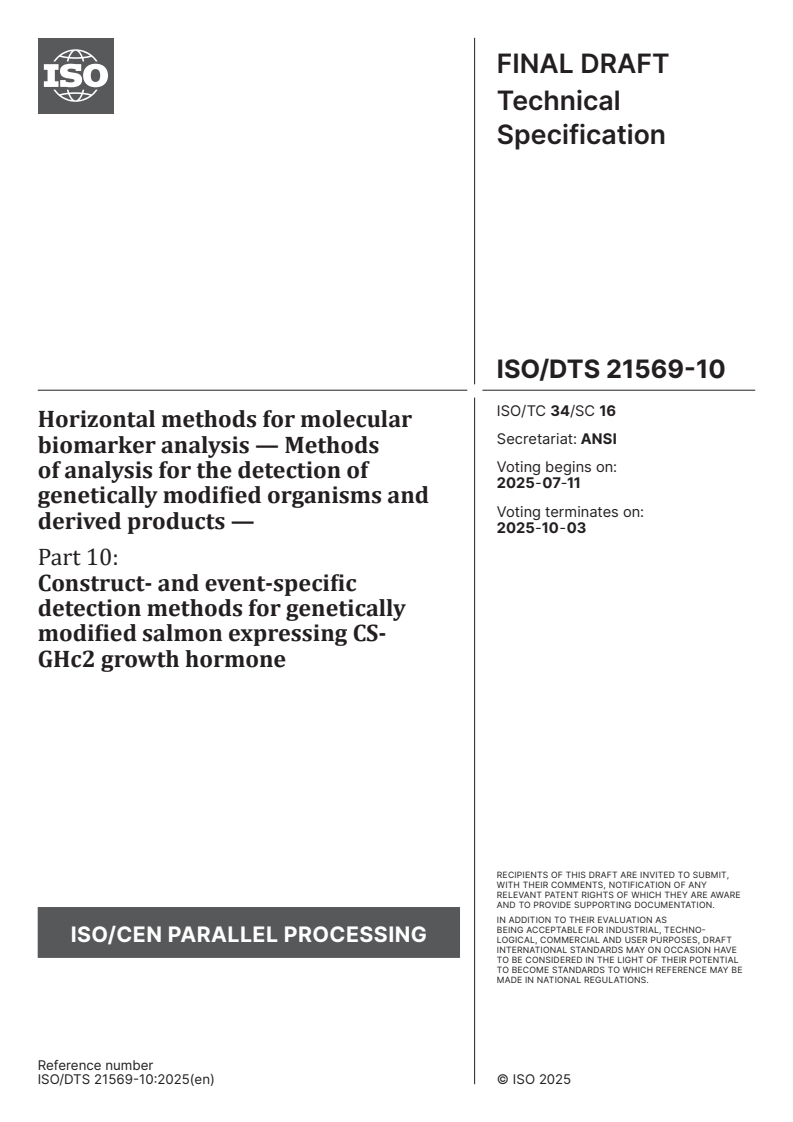
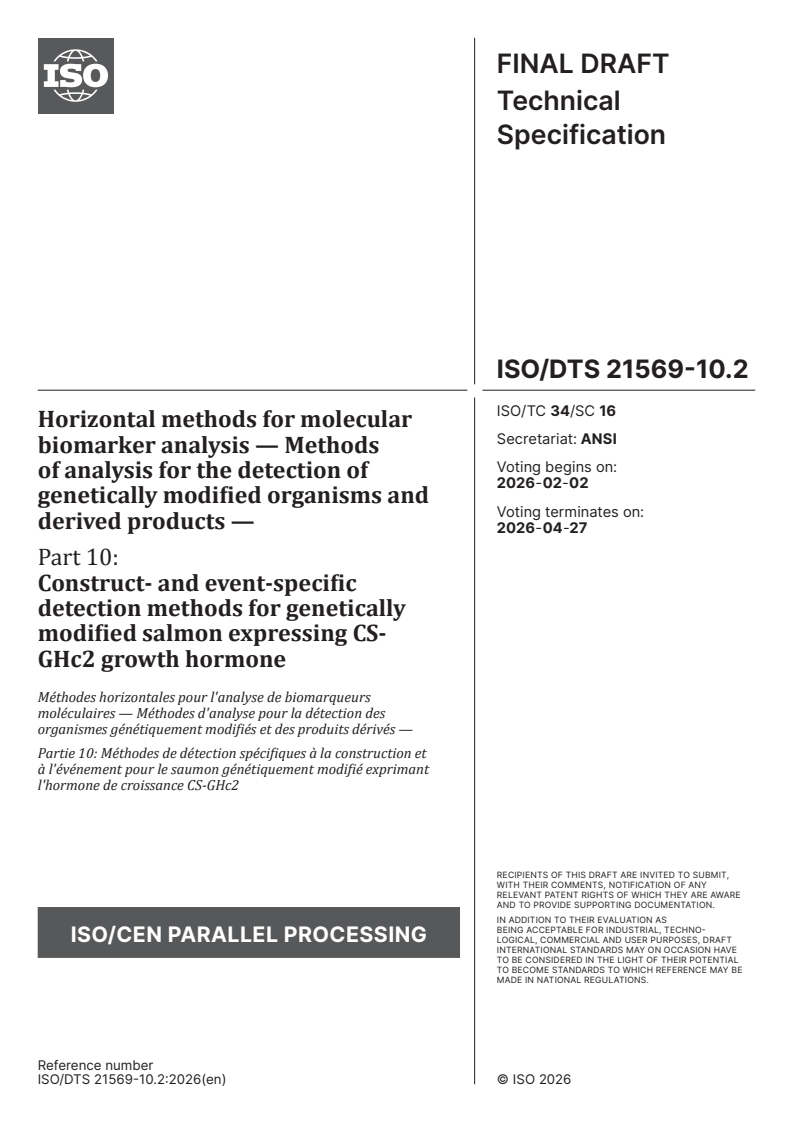
FINAL DRAFT
Technical
Specification
ISO/DTS 21569-10
ISO/TC 34/SC 16
Horizontal methods for molecular
Secretariat: ANSI
biomarker analysis — Methods
Voting begins on:
of analysis for the detection of
2025-07-11
genetically modified organisms and
Voting terminates on:
derived products —
2025-10-03
Part 10:
Construct- and event-specific
detection methods for genetically
modified salmon expressing CS-
GHc2 growth hormone
RECIPIENTS OF THIS DRAFT ARE INVITED TO SUBMIT,
WITH THEIR COMMENTS, NOTIFICATION OF ANY
RELEVANT PATENT RIGHTS OF WHICH THEY ARE AWARE
AND TO PROVIDE SUPPOR TING DOCUMENTATION.
IN ADDITION TO THEIR EVALUATION AS
BEING ACCEPTABLE FOR INDUSTRIAL, TECHNO-
ISO/CEN PARALLEL PROCESSING LOGICAL, COMMERCIAL AND USER PURPOSES, DRAFT
INTERNATIONAL STANDARDS MAY ON OCCASION HAVE
TO BE CONSIDERED IN THE LIGHT OF THEIR POTENTIAL
TO BECOME STAN DARDS TO WHICH REFERENCE MAY BE
MADE IN NATIONAL REGULATIONS.
Reference number
ISO/DTS 21569-10:2025(en) © ISO 2025
FINAL DRAFT
ISO/DTS 21569-10:2025(en)
Technical
Specification
ISO/DTS 21569-10
ISO/TC 34/SC 16
Horizontal methods for molecular
Secretariat: ANSI
biomarker analysis — Methods
Voting begins on:
of analysis for the detection of
genetically modified organisms and
Voting terminates on:
derived products —
Part 10:
Construct- and event-specific
detection methods for genetically
modified salmon expressing CS-
GHc2 growth hormone
RECIPIENTS OF THIS DRAFT ARE INVITED TO SUBMIT,
WITH THEIR COMMENTS, NOTIFICATION OF ANY
RELEVANT PATENT RIGHTS OF WHICH THEY ARE AWARE
AND TO PROVIDE SUPPOR TING DOCUMENTATION.
© ISO 2025
IN ADDITION TO THEIR EVALUATION AS
All rights reserved. Unless otherwise specified, or required in the context of its implementation, no part of this publication may
BEING ACCEPTABLE FOR INDUSTRIAL, TECHNO-
ISO/CEN PARALLEL PROCESSING
LOGICAL, COMMERCIAL AND USER PURPOSES, DRAFT
be reproduced or utilized otherwise in any form or by any means, electronic or mechanical, including photocopying, or posting on
INTERNATIONAL STANDARDS MAY ON OCCASION HAVE
the internet or an intranet, without prior written permission. Permission can be requested from either ISO at the address below
TO BE CONSIDERED IN THE LIGHT OF THEIR POTENTIAL
or ISO’s member body in the country of the requester.
TO BECOME STAN DARDS TO WHICH REFERENCE MAY BE
MADE IN NATIONAL REGULATIONS.
ISO copyright office
CP 401 • Ch. de Blandonnet 8
CH-1214 Vernier, Geneva
Phone: +41 22 749 01 11
Email: copyright@iso.org
Website: www.iso.org
Published in Switzerland Reference number
ISO/DTS 21569-10:2025(en) © ISO 2025
ii
ISO/DTS 21569-10:2025(en)
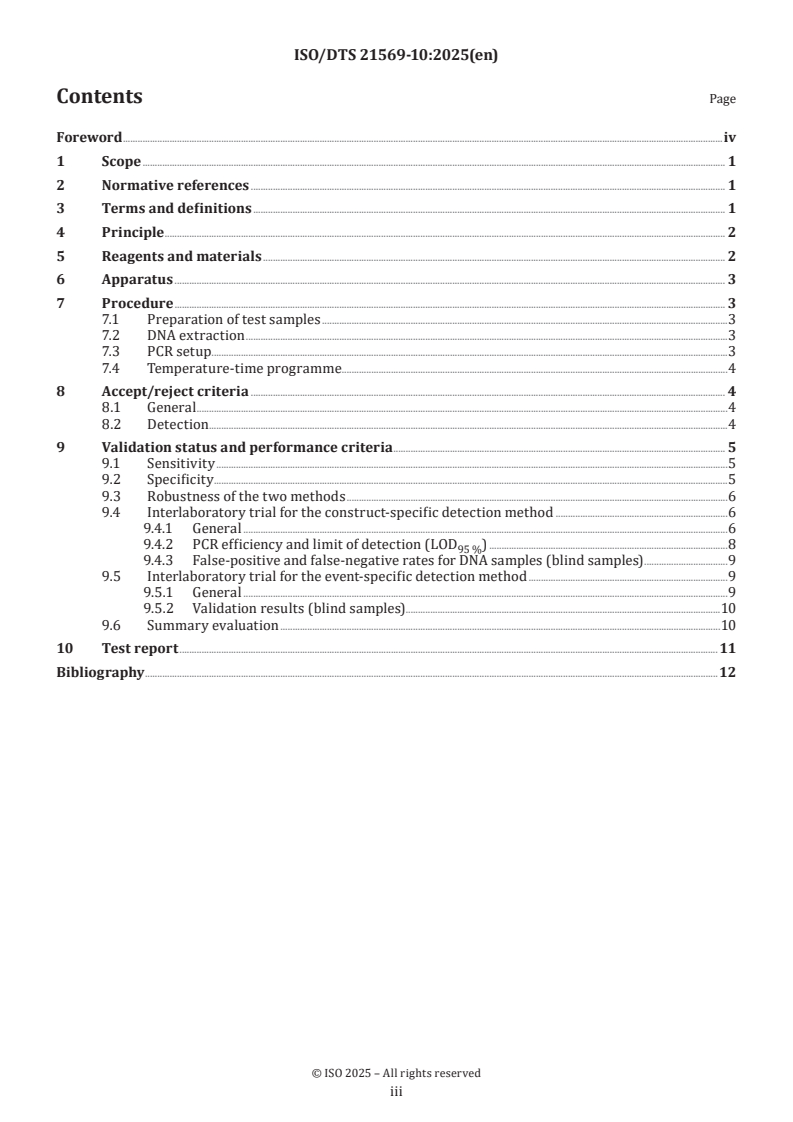
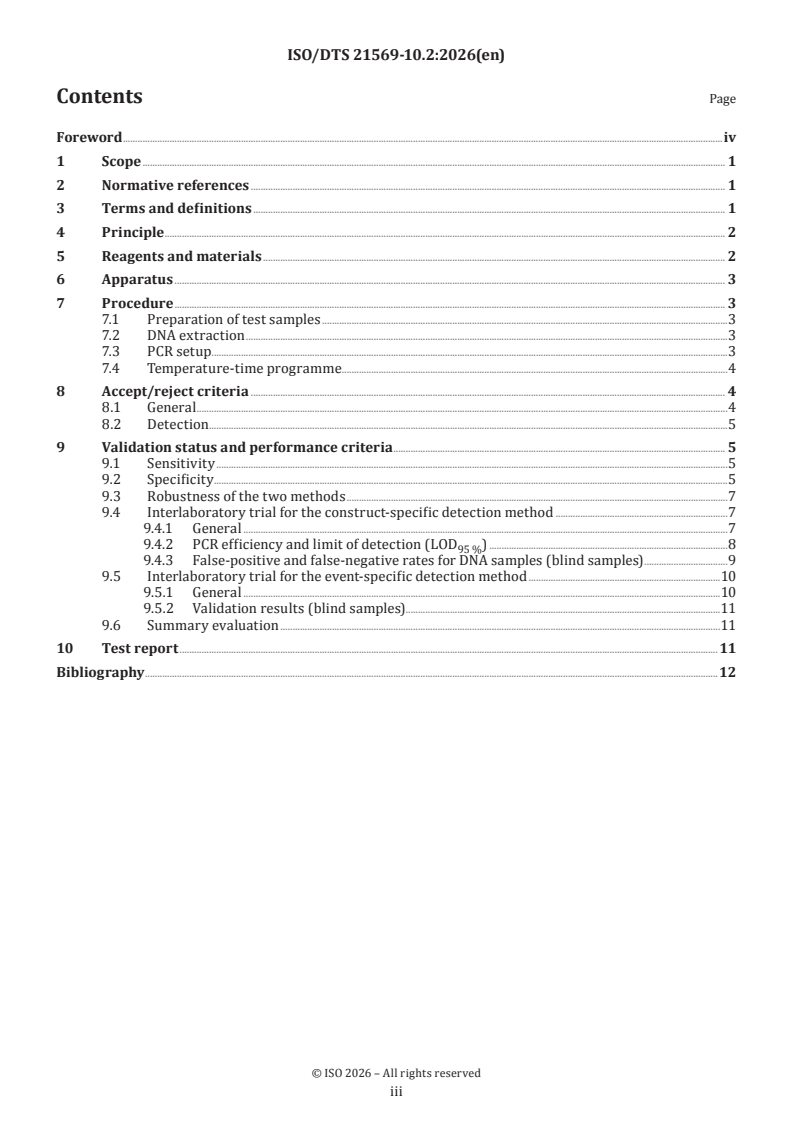
Contents Page
Foreword .iv
1 Scope . 1
2 Normative references . 1
3 Terms and definitions . 1
4 Principle . 2
5 Reagents and materials . 2
6 Apparatus . 3
7 Procedure . 3
7.1 Preparation of test samples .3
7.2 DNA extraction .3
7.3 PCR setup.3
7.4 Temperature-time programme.4
8 Accept/reject criteria . 4
8.1 General .4
8.2 Detection .4
9 Validation status and performance criteria . 5
9.1 Sensitivity .5
9.2 Specificity .5
9.3 Robustness of the two methods .6
9.4 Interlaboratory trial for the construct-specific detection method .6
9.4.1 General .6
9.4.2 PCR efficiency and limit of detection (LOD ) .8
95 %
9.4.3 False-positive and false-negative rates for DNA samples (blind samples) .9
9.5 Interlaboratory trial for the event-specific detection method .9
9.5.1 General .9
9.5.2 Validation results (blind samples) . .10
9.6 Summary evaluation .10
10 Test report .11
Bibliography .12
iii
ISO/DTS 21569-10:2025(en)
Foreword
ISO (the International Organization for Standardization) is a worldwide federation of national standards
bodies (ISO member bodies). The work of preparing International Standards is normally carried out through
ISO technical committees. Each member body interested in a subject for which a technical committee
has been established has the right to be represented on that committee. International organizations,
governmental and non-governmental, in liaison with ISO, also take part in the work. ISO collaborates closely
with the International Electrotechnical Commission (IEC) on all matters of electrotechnical standardization.
The procedures used to develop this document and those intended for its further maintenance are described
in the ISO/IEC Directives, Part 1. In particular, the different approval criteria needed for the different types
of ISO document should be noted. This document was drafted in accordance with the editorial rules of the
ISO/IEC Directives, Part 2 (see www.iso.org/directives).
ISO draws attention to the possibility that the implementation of this document may involve the use of (a)
patent(s). ISO takes no position concerning the evidence, validity or applicability of any claimed patent
rights in respect thereof. As of the date of publication of this document, ISO had not received notice of (a)
patent(s) which may be required to implement this document. However, implementers are cautioned that
this may not represent the latest information, which may be obtained from the patent database available at
www.iso.org/patents. ISO shall not be held responsible for identifying any or all such patent rights.
Any trade name used in this document is information given for the convenience of users and does not
constitute an endorsement.
For an explanation of the voluntary nature of standards, the meaning of ISO specific terms and expressions
related to conformity assessment, as well as information about ISO’s adherence to the World Trade
Organization (WTO) principles in the Technical Barriers to Trade (TBT), see www.iso.org/iso/foreword.html.
This document was prepared by Technical Committee ISO/TC 34, Food products, Subcommittee SC 16,
Horizontal methods for molecular biomarker analysis, in collaboration with the European Committee for
Standardization (CEN) Technical Committee CEN/TC 275, Food analysis - Horizontal methods, in accordance
with the Agreement on technical cooperation between ISO and CEN (Vienna Agreement).
A list of all parts in the ISO 21569 series can be found on the ISO website.
Any feedback or questions on this document should be directed to the user’s national standards body. A
complete listing of these bodies can be found at www.iso.org/members.html.
iv
FINAL DRAFT Technical Specification ISO/DTS 21569-10:2025(en)
Horizontal methods for molecular biomarker analysis —
Methods of analysis for the detection of genetically modified
organisms and derived products —
Part 10:
Construct- and event-specific detection methods for genetically
modified salmon expressing CS-GHc2 growth hormone
1 Scope
This document specifies procedures for the detection of a DNA sequence of a construct used to (genetically)
enhance the growth of fish commonly found in aquaculture. The genetically modified AquAdvantage
Atlantic salmon (Salmo salar) carries this construct and can be detected based on a real-time polymerase
chain reaction (PCR) targeting either the border between the growth hormone coding sequence (CS-GHc2)
of Oncorhynchus tshawytscha (Chinook salmon) and the antifreeze terminator (T-AFP) of (Macro-) Zoarces
americanus (ocean pout), i.e. with the construct-specific method, or the border between the Atlantic salmon
genomic DNA and the antifreeze promoter (P-AFP) of ocean pout, i.e. with the event-specific method. These
methods can be applied to identify the genetically modified (GM) fish or for screening purposes.
This document is applicable for the analysis of DNA extracted from foodstuffs. It can also be suitable for the
analysis of DNA extracted from other products such as feedstuffs. The application of these methods requires
the extraction of an adequate amount of amplifiable DNA from the relevant matrix.
2 Normative references
The following documents are referred to in the text in such a way that some or all of their content constitutes
requirements of this document. For dated references, only the edition cited applies. For undated references,
the latest edition of the referenced document (including any amendments) applies.
ISO 16577, Molecular biomarker analysis — Vocabulary for molecular biomarker analytical methods in
agriculture and food production
ISO 21569, Foodstuffs — Methods of analysis for the detection of genetically modified organisms and derived
products — Qualitative nucleic acid based methods
ISO 21571:2005, Foodstuffs — Methods of analysis for the detection of genetically modified organisms and
derived products — Nucleic acid extraction
ISO 24276, Foodstuffs — Methods of analysis for the detection of genetically modified organisms and derived
products — General requirements and definitions
3 Terms and definitions
For the purposes of this document, the terms and definitions given in ISO 16577 apply.
ISO and IEC maintain terminology databases for use in standardization at the following addresses:
— ISO Online browsing platform: available at https:// www .iso .org/ obp
— IEC Electropedia: available at https:// www .electropedia .org/
ISO/DTS 21569-10:2025(en)
4 Principle
DNA is extracted from the test sample by applying a suitable method with performance characteristics in
accordance with ISO 21571:2005.
The DNA analysis consists of the following two parts:
a) verification of the amount, quality and amplifiability of the extracted DNA (not part of this method);
b) analysis using the real-time PCR detection methods targeting the CS-GHc2 - T-AFP construct inserted in
the AquAdvantage salmon genome (construct-specific method, Accession AY594644, 75 bp amplicon)
[1][2]
or targeting the border between Atlantic salmon genome and P-AFP event in the AquAdvantage
[3]
salmon genome (event-specific method, Accession AY687640.1, 156 bp amplicon) .
Detection of PCR products is done using a specific hydrolysis probe labelled with fluorescent dyes (FAM as
reporter dye and a quencher) that binds the respective target sequence between the two primers (commonly
[4]
called “TaqMan chemistry” ).
5 Reagents and materials
Chemicals of recognized analytical grade, appropriate for molecular biology, shall be used. The water used
shall be double distilled or PCR grade water (i.e. nuclease and nucleic acid free). For all operations in which
gloves are used, it should be ensured that these are powder-free. The use of aerosol-protected pipette tips as
protection against cross contamination should be used.
5.1 Interlaboratory trial and control material.
5.1.1 DNA extracted from different salmon (Salmo salar) samples, taken in the context of official
control by the Institute for Hygiene and Environment in Hamburg, Germany for the construct-specific
method, or the National Institute for Health Sciences in Japan for the event-specific method.
5.1.2 Plasmid DNA, containing the target sequences of the AquAdvantage salmon construct-specific PCR
[1][2] [3]
methods, or event-specific PCR methods .
5.2 PCR reagents.
5.2.1 PCR master mix, contains thermostable DNA polymerase (for hot-start PCR), MgCl and
deoxyribonucleoside triphosphates (dNTPs).
5.2.2 TE buffer, c(Tris-HCl) = 1 mmol/l, c(EDTA) = 0,1 mmol/l (pH = 8,0).
5.2.3 Oligonucleotides (see Table 1).
Table 1 — Oligonucleotides
Final concentration
Name DNA sequence of oligonucleotide
in PCR
[1][2]
CS-GHc2 - T-AFP construct as the target sequence
GH-tFreeze-F 5' - CTC CAC Agg TTT TgA CAT gTT CA - 3' 340 nmol/l
GH-tFreeze-R 5' - gCC AgC AAg AgC CCA TCT C - 3' 340 nmol/l
GH-tFreeze-P 5' –(6-FAM)- TTC CTA ATC TgT ATC Tgg gAA ACC gAA CCC T –(TAMRA)- 3' 540 nmol/l
[3]
Atlantic salmon genome - P-AFP event as the target sequence
AquAd-F 5' – TgC TgA TgC CTC TgA TAC CAC - 3' 800 nmol/l
Equivalent reporter dyes and/or (internal) quencher can be used for the probe if they can be shown to yield similar or better
results.
ISO/DTS 21569-10:2025(en)
TTaabblle 1 e 1 ((ccoonnttiinnueuedd))
Final concentration
Name DNA sequence of oligonucleotide
in PCR
AquAd-R 5' – ATg CCT CTA gTg CAA gTT CAg TC - 3' 800 nmol/l
AquAd-P 5' –(6-FAM)– CAg TAg TAC AAC gTT ggC AgA TgT ATg AgA ACT –(BHQ1)- 3' 100 nmol/l
FAM: 6-Carboxyfluorescein; TAMRA: 5-Carboxytetramethylrhodamin; BHQ1: black hole quencher 1
Equivalent reporter dyes and/or (internal) quencher can be used for the probe if they can be shown to yield similar or better
results.
6 Apparatus
Requirements concerning apparatus and materials shall be in accordance with ISO 21569. The usual
laboratory apparatus and, in particular, the following shall be used.
6.1 Real-time PCR device, suitable for the excitation of fluorescent molecules and the detection of
fluorescence signals generated during PCR. In the interlaboratory trial, the real-time PCR devices listed in
Table 6 and 10 were used.
7 Procedure
7.1 Preparation of test samples
It should be ensured that the test sample used for DNA extraction is representative of the laboratory
sample (e.g. by grinding or homogenizing of the samples). Measures and operational steps to be taken into
consideration shall be as described in ISO 21571:2005 and ISO 24276.
7.2 DNA extraction
For the extraction of DNA from the test portion, the general instructions and requirements described in
ISO 21571 shall be followed.
7.3 PCR setup
The methods are described for a total volume of 25 μl per reaction mixture with the set-up given in Table 2.
Table 2 — Reaction set-up for PCR
Reagent Final concentration in 25 µl PCR reaction
Sample DNA (up to 200 ng for construct-specific, and 5 µl diluted DNA
50 ng for event-specific detection method) or controls
a
PCR master mix (including MgCl , dNTPs and DNA poly- 1× concentrated
merase)
Forward and reverse primer see Table 1
Probe see Table 1
Water add to obtain 25 µl
a TM TM
In the interlaboratory trial for the construct-specific method, the TaqMan Universal PCR Master Mix, no AmpErase UNG
(Thermo Fisher Scientific) was used. In the interlaboratory trial for the event-specific method, the FastStart Universal Probe
Master (Roche) was used. This information is given for the convenience of users of this document and does not constitute an
endorsement by ISO of the product named. Equivalent products from other manufacturers may be used if they yield similar or
better results. If necessary, adapt the amounts of the reagents and the temperature-time programme.
Completely thaw reagents at suitable conditions. Each reagent should be carefully mixed and briefly
centrifuged immediately before pipetting. Prepare a PCR reagent mixture which contains all components
except for the sample DNA. The required amount of the PCR reagent mixture depends on the number of
ISO/DTS 21569-10:2025(en)
reactions to be performed, including at least two additional reactions as a pipetting reserve. Add 5 µl of the
respective sample DNA to each reaction.
Mix the PCR reagent mixture, centrifuge briefly and pipette 20 µl into each reaction vial. For the amplification
reagent control, add 5 µl water into the respective reaction set-up. Pipette either 5 µl of sample DNA or 5 µl
of the respective control solution (extraction blank control, positive DNA target control, negative control)
into the respective well and seal the reaction compartments. A PCR inhibition control should be carried out
as described in ISO 24276:2006 (e.g. using a 1:4 dilution of the extracted DNA).
Transfer the reaction set-ups into the real-time PCR device and start the temperature-time programme (see
Table 3).
7.4 Temperature-time programme
The temperature-time programme as outlined in Table 3 has been used in the validation study. The use of
different reaction conditions and real-time PCR cyclers can require specific optimization. Depending on the
PCR instrument or PCR master mix used, the temperature-time programme can require adjustments.
Table 3 — Temperature-time programm
...
ISO/DTS 21569-10
ISO/TC 34/SC 16
ISO/CD TS 21569-10(en)
Secretariat: ANSI
Date: 2025-06-26
Horizontal methods for molecularMolecular biomarker analysis —
Methods of analysis for the detection of genetically modified
organisms and derived products —
Part 10:
Construct- and event-specific detection methods for genetically
modified salmon expressing CS-GHc2 growth hormone
ISO/DTS 21569-10:2025(en)
All rights reserved. Unless otherwise specified, or required in the context of its implementation, no part of this publication
may be reproduced or utilized otherwise in any form or by any means, electronic or mechanical, including photocopying,
or posting on the internet or an intranet, without prior written permission. Permission can be requested from either ISO
at the address below or ISO’s member body in the country of the requester.
ISO copyright office
CP 401 • Ch. de Blandonnet 8
CH-1214 Vernier, Geneva
Phone: + 41 22 749 01 11
E-mail: copyright@iso.org
Website: www.iso.org
Field Code Changed
Published in Switzerland
ii
ISO/DTS 21569-10:2025(en)
Contents
Foreword . iv
1 Scope . 1
2 Normative references . 1
3 Terms and definitions . 1
4 Principle . 2
5 Reagents and materials . 2
6 Apparatus . 3
7 Procedure . 3
7.1 Preparation of test samples . 3
7.2 DNA extraction . 3
7.3 PCR setup . 3
7.4 Temperature-time programme . 4
8 Accept/reject criteria . 5
8.1 General . 5
8.2 Detection . 5
9 Validation status and performance criteria. 5
9.1 Sensitivity . 5
9.2 Specificity . 6
9.3 Robustness of the two methods . 10
9.4 Interlaboratory trial for the construct-specific detection method . 10
9.5 Interlaboratory trial for the event-specific detection method . 13
9.6 Summary evaluation . 15
10 Test report . 15
Bibliography . 16
iii
ISO/DTS 21569-10:2025(en)
Foreword
ISO (the International Organization for Standardization) is a worldwide federation of national standards
bodies (ISO member bodies). The work of preparing International Standards is normally carried out through
ISO technical committees. Each member body interested in a subject for which a technical committee has been
established has the right to be represented on that committee. International organizations, governmental and
non-governmental, in liaison with ISO, also take part in the work. ISO collaborates closely with the
International Electrotechnical Commission (IEC) on all matters of electrotechnical standardization.
The procedures used to develop this document and those intended for its further maintenance are described
in the ISO/IEC Directives, Part 1. In particular, the different approval criteria needed for the different types of
ISO documentsdocument should be noted. This document was drafted in accordance with the editorial rules
of the ISO/IEC Directives, Part 2 (see www.iso.org/directives).
Field Code Changed
Attention is drawnISO draws attention to the possibility that some of the elementsimplementation of this
document may beinvolve the subjectuse of (a) patent(s). ISO takes no position concerning the evidence,
validity or applicability of any claimed patent rights in respect thereof. As of the date of publication of this
document, ISO had not received notice of (a) patent(s) which may be required to implement this document.
However, implementers are cautioned that this may not represent the latest information, which may be
obtained from the patent database available at www.iso.org/patents. ISO shall not be held responsible for
identifying any or all such patent rights. Details of any patent rights identified during the development of the
document will be in the Introduction and/or on the ISO list of patent declarations received (see ).
Any trade name used in this document is information given for the convenience of users and does not
constitute an endorsement.
For an explanation onof the voluntary nature of standards, the meaning of ISO specific terms and expressions
related to conformity assessment, as well as information about ISO’s adherence to the World Trade
Organization (WTO) principles in the Technical Barriers to Trade (TBT)), see
www.iso.org/iso/foreword.htmlthe following URL: .
This document was prepared by Technical Committee ISO/TC 34, Food products, Subcommittee SC 16,
Horizontal methods for molecular biomarker analysis., in collaboration with the European Committee for
Standardization (CEN) Technical Committee CEN/TC 275, Food analysis - Horizontal methods, in accordance
with the Agreement on technical cooperation between ISO and CEN (Vienna Agreement).
A list of all parts in the ISO 21569 series can be found on the ISO website.
Any feedback or questions on this document should be directed to the user’s national standards body. A
complete listing of these bodies can be found at www.iso.org/members.html.
Field Code Changed
iv
ISO/DTS 21569-10:2025(en)
MolecularHorizontal methods for molecular biomarker analysis —
Methods of analysis for the detection of genetically modified
organisms and derived products —
Part 10:
Construct- and event-specific detection methods for genetically
modified salmon expressing CS-GHc2 growth hormone
1 Scope
This International Standard describesdocument specifies procedures for the detection of a DNA sequence of a
construct used to (genetically) enhance the growth of fish commonly found in aquaculture. The genetically
modified AquAdvantage Atlantic salmon (Salmo salar) carries this construct and can be detected based on a
real-time polymerase chain reaction (PCR) targeting either the border between the growth hormone coding
sequence (CS-GHc2) of Oncorhynchus tshawytscha (Chinook salmon) and the antifreeze terminator (T-AFP) of
(Macro-) Zoarces americanus (ocean pout), i.e.,. with the construct-specific method, or the border between the
Atlantic salmon genomic DNA and the antifreeze promoter (P-AFP) of ocean pout, i.e.,. with the event-specific
method. These methods can be applied to identify the genetically modified (GM) fish or for screening purposes.
This part of the ISO 21569 seriesdocument is applicable for the analysis of DNA extracted from foodstuffs. It
maycan also be suitable for the analysis of DNA extracted from other products such as feedstuffs. The
application of these methods requires the extraction of an adequate amount of amplifiable DNA from the
relevant matrix.
2 Normative references
The following documents are referred to in the text in such a way that some or all of their content constitutes
requirements of this document. For dated references, only the edition cited applies. For undated references,
the latest edition of the referenced document (including any amendments) applies.
ISO 16577, Molecular biomarker analysis — Vocabulary for molecular biomarker analytical methods in
agriculture and food production
ISO 21569:2005, Foodstuffs — Methods of analysis for the detection of genetically modified organisms and
derived products — Qualitative nucleic acid based methods
ISO ISO 21569, Foodstuffs — Methods of analysis for the detection of genetically modified organisms and derived
products — Qualitative nucleic acid based methods
ISO 21571:2005, Foodstuffs — Methods of analysis for the detection of genetically modified organisms and
derived products — Nucleic acid extraction
ISO 24276, Foodstuffs — Methods of analysis for the detection of genetically modified organisms and derived
products — General requirements and definitions
3 Terms and definitions
For the purposes of this document, the terms and definitions given in ISO 16577apply 16577 apply.
ISO and IEC maintain terminologicalterminology databases for use in standardization at the following
addresses:
ISO/DTS 21569-10:2025(en)
— IEC Electropedia: available at ISO Online browsing platform: available at https://www.iso.org/obp
— IEC Electropedia: available at https://www.electropedia.org/
4 Principle
DNA is extracted from the test sample by applying a suitable method with performance characteristics
according toin accordance with ISO 21571:2005.
The DNA analysis consists of the following two parts:
a) verification of the amount, quality and amplifiability of the extracted DNA (not part of this method);
b) analysis using the real-time PCR detection methods targeting the CS-GHc2 - T-AFP construct inserted in
[1][2
the AquAdvantage salmon genome (construct-specific method, Accession AY594644, 75 bp amplicon) )
]
or targeting the border between Atlantic salmon genome and P-AFP event in the AquAdvantage salmon
[3 ]
genome (event-specific method, Accession AY687640.1, 156 bp amplicon) ) . .
Detection of PCR products is done using a specific hydrolysis probe labelled with fluorescent dyes (FAM as
reporter dye and a quencher) that binds the respective target sequence between the two primers (commonly
[4 ]
called “TaqMan chemistry” 'TaqMan chemistry' ). ).
5 Reagents and materials
5.11.1 General
Chemicals of recognized analytical grade, appropriate for molecular biology, shall be used, as a rule. The water
used shall be double distilled or PCR grade water (i.e. nuclease and nucleic acid free). For all operations in
which gloves are used, it should be ensured that these are powder-free. The use of aerosol-protected pipette
tips as protection against cross contamination is recommendedshould be used.
5.25.1 Interlaboratory trial and control material.
5.2.15.1.1 5.2.1 DNA extracted from different salmon (Salmo salar) samples, taken in the context of
official control by the Institute for Hygiene and Environment in Hamburg, HamburgGermany for the
construct-specific method, or the National Institute for Health Sciences in Japan for the event-specific method.
5.2.25.1.2 5.2.2 Plasmid DNA, containing the target sequences of the AquAdvantage salmon construct-
[1][2 ] [3 ]
specific PCR methods, , or event-specific PCR methods . .
5.35.2 PCR reagents.
5.3.15.2.1 5.3.1 PCR master mix, contains thermostable DNA polymerase (for hot-start PCR), MgCl2 and
deoxyribonucleoside triphosphates (dNTPs).
5.3.25.2.2 5.3.2 TE buffer, c(Tris-HCl) = = 1 mmol/l, c(EDTA) = = 0,1 mmol/l (pH = = 8,0).
5.3.35.2.3 5.3.3 Oligonucleotides (see Table 1Table 1).).
Table 1 — Oligonucleotides
Final concentration
Name DNA sequence of oligonucleotide
in PCR
[1][2]
CS-GHc2 - T-AFP construct as the target sequence
GH-tFreeze-F 5' - CTC CAC Agg TTT TgA CAT gTT CA - 3' 340 nmol/l
ISO/DTS 21569-10:2025(en)
Final concentration
Name DNA sequence of oligonucleotide
in PCR
GH-tFreeze-R 5' - gCC AgC AAg AgC CCA TCT C - 3' 340 nmol/l
GH-tFreeze-P 5' –(6-FAM)- TTC CTA ATC TgT ATC Tgg gAA ACC gAA CCC T –(TAMRA)- 3' 540 nmol/l
[3]
Atlantic salmon genome - P-AFP event as the target sequence
AquAd-F 5' – TgC TgA TgC CTC TgA TAC CAC - 3' 800 nmol/l
AquAd-R 5' – ATg CCT CTA gTg CAA gTT CAg TC - 3' 800 nmol/l
AquAd-P 5' –(6-FAM)– CAg TAg TAC AAC gTT ggC AgA TgT ATg AgA ACT –(BHQ1)- 3' 100 nmol/l
FAM: 6-Carboxyfluorescein; TAMRA: 5-Carboxytetramethylrhodamin; BHQ1: black hole quencher 1
Equivalent reporter dyes and/or (internal) quencher can be used for the probe if they can be shown to yield similar or better results.
6 Apparatus
Requirements concerning apparatus and materials shall be according toin accordance with ISO 21569. In
addition to theThe usual laboratory equipmentapparatus and, in particular, the following equipment is
required:shall be used.
6.1 6.1 Real-time PCR device, suitable for the excitation of fluorescent molecules and the detection of
fluorescence signals generated during PCR. In the interlaboratory trial, the real-time PCR devices listed in
Table 6Table 6 and 1010 were used.
7 Procedure
7.1 Preparation of test samples
It should be ensured that the test sample used for DNA extraction is representative of the laboratory sample,
(e.g. by grinding or homogenizing of the samples.). Measures and operational steps to be taken into
consideration shall be as described in ISO 21571:2005and2005 and ISO 24276.
7.2 DNA extraction
For the extraction of DNA from the test portion, the general instructions and requirements described in
ISO 21571 shall be followed.
7.3 PCR setup
The methods are described for a total volume of 25 μl per reaction mixture with the set-up given in
Table 2Table 2.
Table 2 — Reaction set-up for PCR
Reagent Final concentration in 25 µl PCR reaction
Sample DNA (up to 200 ng for construct-specific, and 5 µl diluted DNA
50 ng for event-specific detection method) or controls
a
PCR master mix (including MgCl , dNTPs and DNA 1× concentrated
polymerase)
Forward and reverse primer see Table 1
Probe see Table 1
Water add to obtain 25 µl
ISO/DTS 21569-10:2025(en)
Reagent Final concentration in 25 µl PCR reaction
TM TM
a In the interlaboratory trial for the construct-specific method, the TaqMan Universal PCR Master Mix, no AmpErase UNG
(Thermo Fisher Scientific) was used. In the interlaboratory trial for the event-specific method, the FastStart Universal Probe Master
(Roche) was used. This information is given for the convenience of users of this document and does not constitute an endorsement
by ISO of the product named. Equivalent products from other manufacturers may be used if they yield similar or better results. If
necessary, adapt the amounts of the reagents and the temperature-time programme.
Completely thaw reagents at suitable conditions. Each reagent should be carefully mixed and briefly
centrifuged immediately before pipetting. Prepare a PCR reagent mixture which contains all components
except for the sample DNA. The required amount of the PCR reagent mixture depends on the number of
reactions to be performed, including at least two additional reactions as a pipetting reserve. Add 5 µl of the
respective sample DNA to each reaction.
Mix the PCR reagent mixture, centrifuge briefly and pipette 20 µl into each reaction vial. For the amplification
reagent control, add 5 µl water into the respective reaction set-up. Pipette either 5 µl of sample DNA or 5 µl of
the respective control solution (extraction blank control, positive DNA target control, negative control) into
the respective well and seal the reaction compartments. A PCR inhibition control should be carried out as
described in (ISO 24276:2006 (e.g. using a 1:4 dilution of the extracted DNA).
Table 2 — Reaction set-up for PCR
Reagent Final concentration in 25 µl PCR reaction
Sample DNA (up to 200 ng for construct-specific, and 5 µl diluted DNA
50 ng for event-specific detection method) or controls
a
PCR master mix (including MgCl2, dNTPs and DNA
1× concentrated
polymerase)
Forward and reverse primer see Table 1
Probe see Table 1
Water add to obtain 25 µl
a TM
In the interlaboratory trial for the construct-specific method, the TaqMan Universal PCR Master Mix, no
TM
AmpErase UNG (Thermo Fisher Scientific) was used. In the interlaboratory trial for the event-specific method, the
FastStart Universal Probe Master (Roche) was used. This information is given for the convenience of users of this
document and does not constitute an endorsement by ISO. Equivalent products from other manufacturers may be
used if they yield similar or better results. If necessary, adapt the amounts of the reagents and the temperature-time
program.
Transfer the reaction set-ups into the real-time PCR device and start the temperature-time programme (see
Table 3program (Table 3).).
7.4 Temperature-time programprogramme
The temperature-time programprogramme as outlined in Table 3Table 3 has been used in the validation
study. The use of different reaction conditions and real-time PCR cyclers maycan require specific optimization.
Depending on the PCR instrument or PCR master mix used, the temperature-time program mayprogramme
can require adjustments.
Table 3 — Temperature-time programprogramme
Method Step Parameter Temperature Time Fluorescence Cycles
Inserted Cells
measurement
Construct-specific detection method
1 Initial denaturation 95 °C 10 min no 1 Inserted Cells
Con
stru
ct-
spe
ISO/DTS 21569-10:2025(en)
Method Step Parameter Temperature Time Fluorescence Cycles
Inserted Cells
measurement
Denaturation 95 °C 15 s no
2 Amplification 45
Annealing and
60 °C 60 s yes
elongation
Event-specific detection method
1 Initial denaturation 95 °C 10 min no 1
Denaturation 95 °C 15 s no Inserted Cells
2 Amplification 45
Annealing and
57 °C 60 s yes
elongation
8 Accept/Rejectreject criteria
8.1 General
8.1.11.1.1 General
The evaluation of PCR amplification results is performed with the respective device-specific data analysis
programprogramme. If the amplification of the target sequence is successful in a sample (positive result), the
cycle number of interest will occur when the accumulated fluorescence signal exceeds a specified threshold
for the first time (C value).
q
8.2 Detection
The target sequence is considered as detected in a sample, if all of the following apply:
— — a sigmoid-shaped amplification curve and typical increase in the measured fluorescence is detected
with the primers and probe specific for the CS-GHc2 – T-AFP construct or the Atlantic salmon genome – P-
AFP event, and;
— — no amplification and increase in fluorescence have occurred in the PCR control reactions with no DNA
added (PCR reagent control, extraction blank control), and);
— — the expected Cq values are achieved in the amplification controls (positive DNA target control for the
CS-GHc2 – T-AFP construct, the Atlantic salmon genome – P-AFP event, PCR inhibition control). In the case
of event-specific detection method, reactions with a C value of < 43 were determined as positive.
q
NOTE In the case of event-specific detection method, reactions with a Cq value of < 43 were determined as
positive.
9 Validation status and performance criteria
9.1 Sensitivity
Within the framework of the single-laboratory validation that involved dilution series with linearized plasmid
DNA containing the target sequence, absolute limits of detection (LOD ) of at least 10 copies (for the
95 %
[1 ] [3 ]
construct-specific detection method) ) and 25 copies (for the event-specific detection method) ) were
determined. For the construct-specific method, an interlaboratory trial was then performed, leading to a
[2]
detection limit of at least 5 copies (for the construct-specific detection method) (see Table 7) (Table 7).).
[5 ]
The determination of the LOD followed the guideline of Reference, , where the LOD is set at the concentration
where 59 out of 60 replicates are positive. This criterion is met at 5 copies per Reactionreaction (113 out of
114 replicates positive).
Event-
specific
detection
ISO/DTS 21569-10:2025(en)
9.2 Specificity
Table 4 — Specificity tests for the construct-specific and event-specific real-time PCR methods
(underlined: construct donor species)
Target Experimental confirmation
Positive: AquAdvantage Salmon
Negative:
Fish:
— Salmoidae: Atlantic salmon, Trout, Rainbow trout, Coho salmon, Sockeye salmon,
Pink salmon, Brook trout, Chinook salmon
— Ammodytidae: Sand eel
— Carangidae: Atlantic horse mackerel
— Cichlidae: Nile tilapia
— Clup
...
FINAL DRAFT
Technical
Specification
ISO/TC 34/SC 16
Horizontal methods for molecular
Secretariat: ANSI
biomarker analysis — Methods
Voting begins on:
of analysis for the detection of
2026-02-02
genetically modified organisms and
Voting terminates on:
derived products —
2026-04-27
Part 10:
Construct- and event-specific
detection methods for genetically
modified salmon expressing CS-
GHc2 growth hormone
Méthodes horizontales pour l'analyse de biomarqueurs
moléculaires — Méthodes d'analyse pour la détection des
organismes génétiquement modifiés et des produits dérivés —
Partie 10: Méthodes de détection spécifiques à la construction et
à l'événement pour le saumon génétiquement modifié exprimant
l'hormone de croissance CS-GHc2
RECIPIENTS OF THIS DRAFT ARE INVITED TO SUBMIT,
WITH THEIR COMMENTS, NOTIFICATION OF ANY
RELEVANT PATENT RIGHTS OF WHICH THEY ARE AWARE
AND TO PROVIDE SUPPOR TING DOCUMENTATION.
IN ADDITION TO THEIR EVALUATION AS
BEING ACCEPTABLE FOR INDUSTRIAL, TECHNO-
ISO/CEN PARALLEL PROCESSING LOGICAL, COMMERCIAL AND USER PURPOSES, DRAFT
INTERNATIONAL STANDARDS MAY ON OCCASION HAVE
TO BE CONSIDERED IN THE LIGHT OF THEIR POTENTIAL
TO BECOME STAN DARDS TO WHICH REFERENCE MAY BE
MADE IN NATIONAL REGULATIONS.
Reference number
FINAL DRAFT
Technical
Specification
ISO/TC 34/SC 16
Horizontal methods for molecular
Secretariat: ANSI
biomarker analysis — Methods
Voting begins on:
of analysis for the detection of
genetically modified organisms and
Voting terminates on:
derived products —
Part 10:
Construct- and event-specific
detection methods for genetically
modified salmon expressing CS-
GHc2 growth hormone
Méthodes horizontales pour l'analyse de biomarqueurs
moléculaires — Méthodes d'analyse pour la détection des
organismes génétiquement modifiés et des produits dérivés —
Partie 10: Méthodes de détection spécifiques à la construction et
à l'événement pour le saumon génétiquement modifié exprimant
l'hormone de croissance CS-GHc2
RECIPIENTS OF THIS DRAFT ARE INVITED TO SUBMIT,
WITH THEIR COMMENTS, NOTIFICATION OF ANY
RELEVANT PATENT RIGHTS OF WHICH THEY ARE AWARE
AND TO PROVIDE SUPPOR TING DOCUMENTATION.
© ISO 2026
IN ADDITION TO THEIR EVALUATION AS
All rights reserved. Unless otherwise specified, or required in the context of its implementation, no part of this publication may
BEING ACCEPTABLE FOR INDUSTRIAL, TECHNO-
ISO/CEN PARALLEL PROCESSING
LOGICAL, COMMERCIAL AND USER PURPOSES, DRAFT
be reproduced or utilized otherwise in any form or by any means, electronic or mechanical, including photocopying, or posting on
INTERNATIONAL STANDARDS MAY ON OCCASION HAVE
the internet or an intranet, without prior written permission. Permission can be requested from either ISO at the address below
TO BE CONSIDERED IN THE LIGHT OF THEIR POTENTIAL
or ISO’s member body in the country of the requester.
TO BECOME STAN DARDS TO WHICH REFERENCE MAY BE
MADE IN NATIONAL REGULATIONS.
ISO copyright office
CP 401 • Ch. de Blandonnet 8
CH-1214 Vernier, Geneva
Phone: +41 22 749 01 11
Email: copyright@iso.org
Website: www.iso.org
Published in Switzerland Reference number
ii
Contents Page
Foreword .iv
1 Scope . 1
2 Normative references . 1
3 Terms and definitions . 1
4 Principle . 2
5 Reagents and materials . 2
6 Apparatus . 3
7 Procedure . 3
7.1 Preparation of test samples .3
7.2 DNA extraction .3
7.3 PCR setup.3
7.4 Temperature-time programme.4
8 Accept/reject criteria . 4
8.1 General .4
8.2 Detection .5
9 Validation status and performance criteria . 5
9.1 Sensitivity .5
9.2 Specificity .5
9.3 Robustness of the two methods .7
9.4 Interlaboratory trial for the construct-specific detection method .7
9.4.1 General .7
9.4.2 PCR efficiency and limit of detection (LOD ) .8
95 %
9.4.3 False-positive and false-negative rates for DNA samples (blind samples) .9
9.5 Interlaboratory trial for the event-specific detection method .10
9.5.1 General .10
9.5.2 Validation results (blind samples) . .11
9.6 Summary evaluation .11
10 Test report .11
Bibliography .12
iii
Foreword
ISO (the International Organization for Standardization) is a worldwide federation of national standards
bodies (ISO member bodies). The work of preparing International Standards is normally carried out through
ISO technical committees. Each member body interested in a subject for which a technical committee
has been established has the right to be represented on that committee. International organizations,
governmental and non-governmental, in liaison with ISO, also take part in the work. ISO collaborates closely
with the International Electrotechnical Commission (IEC) on all matters of electrotechnical standardization.
The procedures used to develop this document and those intended for its further maintenance are described
in the ISO/IEC Directives, Part 1. In particular, the different approval criteria needed for the different types
of ISO document should be noted. This document was drafted in accordance with the editorial rules of the
ISO/IEC Directives, Part 2 (see www.iso.org/directives).
ISO draws attention to the possibility that the implementation of this document may involve the use of (a)
patent(s). ISO takes no position concerning the evidence, validity or applicability of any claimed patent
rights in respect thereof. As of the date of publication of this document, ISO had not received notice of (a)
patent(s) which may be required to implement this document. However, implementers are cautioned that
this may not represent the latest information, which may be obtained from the patent database available at
www.iso.org/patents. ISO shall not be held responsible for identifying any or all such patent rights.
Any trade name used in this document is information given for the convenience of users and does not
constitute an endorsement.
For an explanation of the voluntary nature of standards, the meaning of ISO specific terms and expressions
related to conformity assessment, as well as information about ISO’s adherence to the World Trade
Organization (WTO) principles in the Technical Barriers to Trade (TBT), see www.iso.org/iso/foreword.html.
This document was prepared by Technical Committee ISO/TC 34, Food products, Subcommittee SC 16,
Horizontal methods for molecular biomarker analysis, in collaboration with the European Committee for
Standardization (CEN) Technical Committee CEN/TC 275, Food analysis - Horizontal methods, in accordance
with the Agreement on technical cooperation between ISO and CEN (Vienna Agreement).
A list of all parts in the ISO 21569 series can be found on the ISO website.
Any feedback or questions on this document should be directed to the user’s national standards body. A
complete listing of these bodies can be found at www.iso.org/members.html.
iv
FINAL DRAFT Technical Specification ISO/DTS 21569-10.2:2026(en)
Horizontal methods for molecular biomarker analysis —
Methods of analysis for the detection of genetically modified
organisms and derived products —
Part 10:
Construct- and event-specific detection methods for
genetically modified salmon expressing CS-GHc2 growth
hormone
1 Scope
This document specifies procedures for the detection of a DNA sequence of a construct used to (genetically)
enhance the growth of fish commonly found in aquaculture. The genetically modified AquAdvantage Atlantic
salmon (Salmo salar) carries the construct expressing CS-GHc2 growth hormone and can be detected based
on a real-time polymerase chain reaction (PCR) targeting either the border between the growth hormone
coding sequence (CS-GHc2) of Oncorhynchus tshawytscha (Chinook salmon) and the antifreeze terminator
(T-AFP) of (Macro-) Zoarces americanus (ocean pout), i.e. with the construct-specific method, or the border
between the Atlantic salmon genomic DNA and the antifreeze promoter (P-AFP) of ocean pout, i.e. with the
event-specific method. These methods can be applied to identify the genetically modified (GM) fish or for
screening purposes.
This document is applicable for the analysis of DNA extracted from foodstuffs. It can also be suitable for the
analysis of DNA extracted from other products such as feedstuffs. The application of these methods requires
the extraction of an adequate amount of amplifiable DNA from the relevant matrix.
2 Normative references
The following documents are referred to in the text in such a way that some or all of their content constitutes
requirements of this document. For dated references, only the edition cited applies. For undated references,
the latest edition of the referenced document (including any amendments) applies.
ISO 16577, Molecular biomarker analysis — Vocabulary for molecular biomarker analytical methods in
agriculture and food production
ISO 21569, Foodstuffs — Methods of analysis for the detection of genetically modified organisms and derived
products — Qualitative nucleic acid based methods
ISO 21571:2005, Foodstuffs — Methods of analysis for the detection of genetically modified organisms and
derived products — Nucleic acid extraction
ISO 24276, Foodstuffs — Methods of analysis for the detection of genetically modified organisms and derived
products — General requirements and definitions
3 Terms and definitions
For the purposes of this document, the terms and definitions given in ISO 16577 apply.
ISO and IEC maintain terminology databases for use in standardization at the following addresses:
— ISO Online browsing platform: available at https:// www .iso .org/ obp
— IEC Electropedia: available at https:// www .electropedia .org/
4 Principle
DNA is extracted from the test sample by applying a suitable method with performance characteristics in
accordance with ISO 21571:2005.
The DNA analysis consists of the following two parts:
a) verification of the amount, quality and amplifiability of the extracted DNA (not part of this method);
b) analysis using the real-time PCR detection methods targeting the CS-GHc2 - T-AFP construct inserted in
the AquAdvantage salmon genome (construct-specific method, Accession AY594644, 75 bp amplicon)
[1][2]
or targeting the border between Atlantic salmon genome and P-AFP event in the AquAdvantage
[3][4]
salmon genome (event-specific method, 156 bp amplicon) .
Detection of PCR products is done using a specific hydrolysis probe labelled with fluorescent dyes (FAM as
reporter dye and a quencher) that binds the respective target sequence between the two primers (commonly
[5]
called “TaqMan chemistry” ).
5 Reagents and materials
Chemicals of recognized analytical grade, appropriate for molecular biology, shall be used. The water used
shall be double distilled or PCR grade water (i.e. nuclease and nucleic acid free). For all operations in which
gloves are used, it should be ensured that these are powder-free. The use of aerosol-protected pipette tips as
protection against cross contamination should be used.
5.1 Interlaboratory trial and control material.
5.1.1 DNA extracted from different salmon (Salmo salar) samples, taken in the context of official
control by the Institute for Hygiene and Environment in Hamburg, Germany for the construct-specific
method, or the National Institute for Health Sciences in Japan for the event-specific method.
5.1.2 Plasmid DNA, containing the target sequences of the AquAdvantage salmon construct-specific PCR
[1][2] [3]
methods , or event-specific PCR methods .
5.2 PCR reagents.
5.2.1 PCR master mix, contains thermostable DNA polymerase (for hot-start PCR), MgCl and
deoxyribonucleoside triphosphates (dNTPs).
5.2.2 TE buffer, c(Tris-HCl) = 1 mmol/l, c(EDTA) = 0,1 mmol/l (pH = 8,0).
5.2.3 Oligonucleotides (see Table 1).
Table 1 — Oligonucleotides
Final concentration
Name DNA sequence of oligonucleotide
in PCR
[1][2]
CS-GHc2 - T-AFP construct as the target sequence
GH-tFreeze-F 5' - CTC CAC Agg TTT TgA CAT gTT CA - 3' 340 nmol/l
GH-tFreeze-R 5' - gCC AgC AAg AgC CCA TCT C - 3' 340 nmol/l
GH-tFreeze-P 5' – FAM - TTC CTA ATC TgT ATC Tgg gAA ACC gAA CCC T – TAMRA - 3' 540 nmol/l
[3]
Atlantic salmon genome - P-AFP event as the target sequence
AquAd-F 5' – TgC TgA TgC CTC TgA TAC CAC - 3' 800 nmol/l
AquAd-R 5' – ATg CCT CTA gTg CAA gTT CAg TC - 3' 800 nmol/l
AquAd-P 5' – FAM – CAg TAg TAC AAC gTT ggC AgA TgT ATg AgA ACT – BHQ1 - 3' 100 nmol/l
FAM: 6-Carboxyfluorescein; TAMRA: 5-Carboxytetramethylrhodamin; BHQ1: black hole quencher 1
Equivalent reporter dyes and/or (internal) quencher can be used for the probe if they can be shown to yield similar or better
results.
6 Apparatus
Requirements concerning apparatus and materials shall be in accordance with ISO 21569. The usual
laboratory apparatus and, in particular, the following shall be used.
6.1 Real-time PCR device, suitable for the excitation of fluorescent molecules and the detection of
fluorescence signals generated during PCR. In the interlaboratory trial, the real-time PCR devices listed in
Table 6 and 10 were used.
7 Procedure
7.1 Preparation of test samples
It should be ensured that the test sample used for DNA extraction is representative of the laboratory
sample (e.g. by grinding or homogenizing of the samples). Measures and operational steps to be taken into
consideration shall be as described in ISO 21571:2005 and ISO 24276.
7.2 DNA extraction
For the extraction of DNA from the test portion, the general instructions and requirements described in
ISO 21571 shall be followed.
7.3 PCR setup
The methods are described for a total volume of 25 μl per reaction mixture with the set-up given in Table 2.
Table 2 — Reaction set-up for PCR
Reagent Final concentration in 25 µl PCR reaction
Sample DNA (up to 200 ng for construct-specific, and 5 µl diluted DNA
50 ng for event-specific detection method) or controls
a
PCR master mix (including MgCl , dNTPs and DNA poly- 1 × concentrated
merase)
Forward and reverse primer see Table 1
Probe see Table 1
Water add to obtain 25 µl
a TM TM
In the interlaboratory trial for the construct-specific method, the TaqMan Universal PCR Master Mix, no AmpErase UNG
(Thermo Fisher Scientific) was used. In the interlaboratory trial for the event-specific method, the FastStart Universal Probe
Master (Roche) was used. This information is given for the convenience of users of this document and does not constitute an
endorsement by ISO of the product named. Equivalent products from other manufacturers may be used if they yield similar or
better results. If necessary, adapt the amounts of the reagents and the temperature-time programme.
Completely thaw reagents at suitable conditions. Each reagent should be carefully mixed and briefly
centrifuged immediately before pipetting. Prepare a PCR reagent mixture which contains all components
except for the sample DNA. The required amount of the PCR reagent mixture depends on the number of
reactions to be performed, including at least two additional reactions as a pipetting reserve. Add 5 µl of the
respective sample DNA to each reaction.
Mix the PCR reagent mixture, centrifuge briefly and pipette 20 µl into each reaction vial. For the amplification
reagent control, add 5 µl water into the respective reaction set-up. Pipette either 5 µl of sample DNA or 5 µl
of the respective control solution (extraction blank control, positive DNA target control, negative control)
into the respective well and seal the reaction compartments. A PCR inhibition control should be carried out
as described in ISO 24276:2006 (e.g. using a 1:4 dilution of the extracted DNA).
Transfer the reaction set-ups into the real-time PCR device and start the temperature-time programme (see
Table 3).
7.4 Temperature-time programme
The temperature-time programme as outlined in Table 3 has been used in the validation study. The use of
different reaction conditions and real-time PCR cyclers can require specific optimization. Depending on the
PCR instrument or PCR master mix used, the temperature-time programme can require adjustments.
Table 3 — Temperature-time
...
ISO/TC 34/SC 16
Secretariat: ANSI
Date: 2025-06-262026-01-19
Horizontal methods for molecular biomarker analysis — Methods of
analysis for the detection of genetically modified organisms and
derived products —
Part 10:
Construct- and event-specific detection methods for genetically
modified salmon expressing CS-GHc2 growth hormone
Méthodes horizontales pour l'analyse de biomarqueurs moléculaires — Méthodes d'analyse pour la détection
des organismes génétiquement modifiés et des produits dérivés —
Partie 10: Méthodes de détection spécifiques à la construction et à l'événement pour le saumon génétiquement
modifié exprimant l'hormone de croissance CS-GHc2
TTTTTThihhihhhiiiis drs drs drs drss d drraaaaaafffffftttttt i i i i i is s s s ss sssusususuububbbbbmmmmmmiiiiiitttttttttttteeeeeeddd d d d ttttttoooooo aaaaaa ppppppaaaaaarrrrrraaaaaallellellellellellel l l l l l vvvvvvooooootttttteeeeee i i i i i innnnnn IIIIIISSSSSSOOOOOO,,,,,, CCCCCCEEEEEEN.N.N.N.N.N.
All rights reserved. Unless otherwise specified, or required in the context of its implementation, no part of this publication
may be reproduced or utilized otherwise in any form or by any means, electronic or mechanical, including photocopying,
or posting on the internet or an intranet, without prior written permission. Permission can be requested from either ISO
at the address below or ISO’s member body in the country of the requester.
ISO copyright office
CP 401 • Ch. de Blandonnet 8
CH-1214 Vernier, Geneva
Phone: + 41 22 749 01 11
E-mail: copyright@iso.org
Website: www.iso.org
Published in Switzerland
ii
Contents
Foreword . iv
1 Scope . 1
2 Normative references . 1
3 Terms and definitions . 1
4 Principle . 2
5 Reagents and materials . 2
6 Apparatus . 3
7 Procedure . 3
7.1 Preparation of test samples . 3
7.2 DNA extraction . 3
7.3 PCR setup . 3
7.4 Temperature-time programme . 4
8 Accept/reject criteria . 4
8.1 General . 4
8.2 Detection . 4
9 Validation status and performance criteria . 5
9.1 Sensitivity . 5
9.2 Specificity . 5
9.3 Robustness of the two methods . 7
9.4 Interlaboratory trial for the construct-specific detection method . 7
9.5 Interlaboratory trial for the event-specific detection method . 10
9.6 Summary evaluation . 12
10 Test report . 12
Bibliography . 13
iii
Foreword
ISO (the International Organization for Standardization) is a worldwide federation of national standards
bodies (ISO member bodies). The work of preparing International Standards is normally carried out through
ISO technical committees. Each member body interested in a subject for which a technical committee has been
established has the right to be represented on that committee. International organizations, governmental and
non-governmental, in liaison with ISO, also take part in the work. ISO collaborates closely with the
International Electrotechnical Commission (IEC) on all matters of electrotechnical standardization.
The procedures used to develop this document and those intended for its further maintenance are described
in the ISO/IEC Directives, Part 1. In particular, the different approval criteria needed for the different types of
ISO document should be noted. This document was drafted in accordance with the editorial rules of the
ISO/IEC Directives, Part 2 (see www.iso.org/directives).
ISO draws attention to the possibility that the implementation of this document may involve the use of (a)
patent(s). ISO takes no position concerning the evidence, validity or applicability of any claimed patent rights
in respect thereof. As of the date of publication of this document, ISO had not received notice of (a) patent(s)
which may be required to implement this document. However, implementers are cautioned that this may not
represent the latest information, which may be obtained from the patent database available at
www.iso.org/patents. ISO shall not be held responsible for identifying any or all such patent rights.
Any trade name used in this document is information given for the convenience of users and does not
constitute an endorsement.
For an explanation of the voluntary nature of standards, the meaning of ISO specific terms and expressions
related to conformity assessment, as well as information about ISO’s adherence to the World Trade
Organization (WTO) principles in the Technical Barriers to Trade (TBT), see www.iso.org/iso/foreword.html.
This document was prepared by Technical Committee ISO/TC 34, Food products, Subcommittee SC 16,
Horizontal methods for molecular biomarker analysis, in collaboration with the European Committee for
Standardization (CEN) Technical Committee CEN/TC 275, Food analysis - Horizontal methods, in accordance
with the Agreement on technical cooperation between ISO and CEN (Vienna Agreement).
A list of all parts in the ISO 21569 series can be found on the ISO website.
Any feedback or questions on this document should be directed to the user’s national standards body. A
complete listing of these bodies can be found at www.iso.org/members.html.
iv
Horizontal methods for molecular biomarker analysis — Methods of
analysis for the detection of genetically modified organisms and
derived products —
Part 10:
Construct- and event-specific detection methods for genetically
modified salmon expressing CS-GHc2 growth hormone
1 Scope
This document specifies procedures for the detection of a DNA sequence of a construct used to (genetically)
enhance the growth of fish commonly found in aquaculture. The genetically modified AquAdvantage Atlantic
salmon (Salmo salar) carries the construct expressing CS-GHc2 growth hormone and can be detected based on
a real-time polymerase chain reaction (PCR) targeting either the border between the growth hormone coding
sequence (CS-GHc2) of Oncorhynchus tshawytscha (Chinook salmon) and the antifreeze terminator (T-AFP) of
(Macro-) Zoarces americanus (ocean pout), i.e. with the construct-specific method, or the border between the
Atlantic salmon genomic DNA and the antifreeze promoter (P-AFP) of ocean pout, i.e. with the event-specific
method. These methods can be applied to identify the genetically modified (GM) fish or for screening purposes.
This document is applicable for the analysis of DNA extracted from foodstuffs. It can also be suitable for the
analysis of DNA extracted from other products such as feedstuffs. The application of these methods requires
the extraction of an adequate amount of amplifiable DNA from the relevant matrix.
2 Normative references
The following documents are referred to in the text in such a way that some or all of their content constitutes
requirements of this document. For dated references, only the edition cited applies. For undated references,
the latest edition of the referenced document (including any amendments) applies.
ISO 16577, Molecular biomarker analysis — Vocabulary for molecular biomarker analytical methods in
agriculture and food production
ISO 21569, Foodstuffs — Methods of analysis for the detection of genetically modified organisms and derived
products — Qualitative nucleic acid based methods
ISO 21571:2005, Foodstuffs — Methods of analysis for the detection of genetically modified organisms and
derived products — Nucleic acid extraction
ISO 24276, Foodstuffs — Methods of analysis for the detection of genetically modified organisms and derived
products — General requirements and definitions
3 Terms and definitions
For the purposes of this document, the terms and definitions given in ISO 16577 apply.
ISO and IEC maintain terminology databases for use in standardization at the following addresses:
— ISO Online browsing platform: available at https://www.iso.org/obp
— IEC Electropedia: available at https://www.electropedia.org/
4 Principle
DNA is extracted from the test sample by applying a suitable method with performance characteristics in
accordance with ISO 21571:2005.
The DNA analysis consists of the following two parts:
a) verification of the amount, quality and amplifiability of the extracted DNA (not part of this method);
b) analysis using the real-time PCR detection methods targeting the CS-GHc2 - T-AFP construct inserted in
[1][2]
the AquAdvantage salmon genome (construct-specific method, Accession AY594644, 75 bp amplicon)
or targeting the border between Atlantic salmon genome and P-AFP event in the AquAdvantage salmon
[3][4]
genome (event-specific method, 156 bp amplicon) .
Detection of PCR products is done using a specific hydrolysis probe labelled with fluorescent dyes (FAM as
reporter dye and a quencher) that binds the respective target sequence between the two primers (commonly
[5]
called “TaqMan chemistry” ).
5 Reagents and materials
Chemicals of recognized analytical grade, appropriate for molecular biology, shall be used. The water used
shall be double distilled or PCR grade water (i.e. nuclease and nucleic acid free). For all operations in which
gloves are used, it should be ensured that these are powder-free. The use of aerosol-protected pipette tips as
protection against cross contamination should be used.
5.1 Interlaboratory trial and control material.
5.1.1 DNA extracted from different salmon (Salmo salar) samples, taken in the context of official control
by the Institute for Hygiene and Environment in Hamburg, Germany for the construct-specific method, or the
National Institute for Health Sciences in Japan for the event-specific method.
5.1.2 Plasmid DNA, containing the target sequences of the AquAdvantage salmon construct-specific PCR
[1][2] [3]
methods , or event-specific PCR methods .
5.2 PCR reagents.
5.2.1 PCR master mix, contains thermostable DNA polymerase (for hot-start PCR), MgCl and
deoxyribonucleoside triphosphates (dNTPs).
5.2.2 TE buffer, c(Tris-HCl) = 1 mmol/l, c(EDTA) = 0,1 mmol/l (pH = 8,0).
5.2.3 Oligonucleotides (see Table 1).
Table 1 — Oligonucleotides
Final concentration
Name DNA sequence of oligonucleotide
in PCR
[1][2]
CS-GHc2 - T-AFP construct as the target sequence
GH-tFreeze-F 5' - CTC CAC Agg TTT TgA CAT gTT CA - 3' 340 nmol/l
GH-tFreeze-R 5' - gCC AgC AAg AgC CCA TCT C - 3' 340 nmol/l
GH-tFreeze-P 5' – FAM - TTC CTA ATC TgT ATC Tgg gAA ACC gAA CCC T – TAMRA - 3' 540 nmol/l
[3]
Atlantic salmon genome - P-AFP event as the target sequence
AquAd-F 5' – TgC TgA TgC CTC TgA TAC CAC - 3' 800 nmol/l
Final concentration
Name DNA sequence of oligonucleotide
in PCR
AquAd-R 5' – ATg CCT CTA gTg CAA gTT CAg TC - 3' 800 nmol/l
AquAd-P 5' – FAM – CAg TAg TAC AAC gTT ggC AgA TgT ATg AgA ACT – BHQ1 - 3' 100 nmol/l
FAM: 6-Carboxyfluorescein; TAMRA: 5-Carboxytetramethylrhodamin; BHQ1: black hole quencher 1
Equivalent reporter dyes and/or (internal) quencher can be used for the probe if they can be shown to yield similar or better results.
6 Apparatus
Requirements concerning apparatus and materials shall be in accordance with ISO 21569. The usual
laboratory apparatus and, in particular, the following shall be used.
6.1 Real-time PCR device, suitable for the excitation of fluorescent molecules and the detection of
fluorescence signals generated during PCR. In the interlaboratory trial, the real-time PCR devices listed in
Table 6 and 10 were used.
7 Procedure
7.1 Preparation of test samples
It should be ensured that the test sample used for DNA extraction is representative of the laboratory sample
(e.g. by grinding or homogenizing of the samples). Measures and operational steps to be taken into
consideration shall be as described in ISO 21571:2005 and ISO 24276.
7.2 DNA extraction
For the extraction of DNA from the test portion, the general instructions and requirements described in
ISO 21571 shall be followed.
7.3 PCR setup
The methods are described for a total volume of 25 μl per reaction mixture with the set-up given in Table 2.
Table 2 — Reaction set-up for PCR
Reagent Final concentration in 25 µl PCR reaction
Sample DNA (up to 200 ng for construct-specific, and 5 µl diluted DNA
50 ng for event-specific detection method) or controls
a
PCR master mix (including MgCl , dNTPs and DNA 1 × concentrated
polymerase)
Forward and reverse primer see Table 1
Probe see Table 1
Water add to obtain 25 µl
TM TM
a In the interlaboratory trial for the construct-specific method, the TaqMan Universal PCR Master Mix, no AmpErase UNG
(Thermo Fisher Scientific) was used. In the interlaboratory trial for the event-specific method, the FastStart Universal Probe Master
(Roche) was used. This information is given for the convenience of users of this document and does not constitute an endorsement
by ISO of the product named. Equivalent products from other manufacturers may be used if they yield similar or better results. If
necessary, adapt the amounts of the reagents and the temperature-time programme.
Completely thaw reagents at suitable conditions. Each reagent should be carefully mixed and briefly
centrifuged immediately before pipetting. Prepare a PCR reagent mixture which contains all components
except for the sample DNA. The required amount of the PCR reagent mixture depends on the number of
reactions to be performed, including at least two additional reactions as a pipetting reserve. Add 5 µl of the
respective sample DNA to each reaction.
Mix the PCR reagent mixture, centrifuge briefly and pipette 20 µl into each reaction vial. For the amplification
reagent control, add 5 µl water into the respective reaction set-up. Pipette either 5 µl of sample DNA or 5 µl of
the respective control solution (extraction blank control, positive DNA target control, negative control) into
the respective well and seal the reaction compartments. A PCR inhibition control should be carried out as
described in ISO 24276:2006 (e.g. using a 1:4 dilution of the extracted DNA).
Transfer the reaction set-ups into the real-time PCR device and start the temperature-time programme (see
Table 3).
7.4 Temperature-time programme
The temperature-time programme as outlined in Table 3 has been used in the validation study. The use of
different reaction conditions and real-time PCR cyclers can require specific optimization. Depending on the
PCR instrument or PCR master mix used, the temperature-time programme can require adjustments.
Table 3 — Temperature-time programme
Method Step Parameter Temperature Time Fluorescence Cycles
measurement
1 Initial denaturation 95 °C 10 min no 1
Denaturation 95 °C 15 s no
2 Amplification 45
Annealing and
60 °C 60 s yes
elongation
1 Initial denaturation 95 °C 10 min no 1
Denaturation 95 °C 15 s no
2 Amplification 45
Annealing and
57 °C 60 s yes
elongation
8 Accept/reject criteria
8.1 General
The evaluation of PCR amplification results is performed with the respective device-specific data analysis
programme. If the amplification of the target sequence is successful in a sample (positive result), the cycle
number of interest will occur when the accumulated fluorescence signal exceeds a specified threshold for the
first time (C value).
q
8.2 Detection
The target sequence is considered as detected in a sample, if all of the following apply:
— a sigmoid-shaped amplification curve and typical increase in the measured fluorescence is detected with
the primers and probe specific for the CS-GHc2 – T-AFP construct or the Atlantic salmon genome – P-AFP
event;
— no amplification and increase in fluorescence have occurred in the PCR control reactions with no DNA
added (PCR reagent control, extraction blank control);
Event- Construct-
specific specific
detection detection
— the expected C values are achieved in the amplification controls (positive DNA target control for the CS-
q
GHc2 – T-AFP construct, the Atlantic salmon genome – P-AFP event, PCR inhibition control).
NOTE In the case of event-specific detection method, reactions with a Cq value of < 43 were determined as
positive.
9 Validation status and performance criteria
9.1 Sensitivity
Within the framework of the single-laboratory validation that involved dilution series with linearized plasmid
DNA containing the target sequence,
...
Questions, Comments and Discussion
Ask us and Technical Secretary will try to provide an answer. You can facilitate discussion about the standard in here.
Loading comments...