

ISO/TR 20526:2017
(Main)Account-based ticketing state of the art report
General Information
- Abstract
ISO/TR 20526:2017 provides a state of the art of the components that make up account-based ticketing as currently understood. This state of the art can be used to identify those aspects where international standardization or coordination can lead to benefits. These will then be proposed as normal ISO work items, independent of this document.
- Status
- Published
- Publication Date
- 30-Jul-2017
- Technical Committee
- ISO/TC 204 - Intelligent transport systems
- Drafting Committee
- ISO/TC 204/WG 8 - Public transport/emergency
- Current Stage
- 6060 - International Standard published
- Start Date
- 31-Jul-2017
- Due Date
- 09-Dec-2017
- Completion Date
- 09-Dec-2017
Buy Documents
ISO/TR 20526:2017 - Account-based ticketing state of the art report
ISO/TR 20526:2017 - Account-based ticketing state of the art report/31/2017
Overview
ISO/TR 20526:2017 - Account-based ticketing state of the art report is a Technical Report from ISO that surveys the current landscape of account-based ticketing (ABT) systems. It documents architectures, business roles, operational concepts and the benefits and challenges of ABT (also called server‑based ticketing). The report is intended to identify aspects where international standardization or coordination could deliver tangible benefits and to propose follow‑up ISO work items.
Key topics
The report examines practical and technical elements of ABT including:
- Business roles and actors: customer, media provider, identity provider, service operator, product owner, account provider and payment provider-how responsibilities are split in ABT deployments.
- Token authentication models: contrasts token authentication by the reader (offline/local validation) with token authentication by the account server (online/server‑centric validation).
- Revenue protection & journey recording: purposes for recording journeys, typical data flows, inspection implications, and fraud control approaches.
- Data privacy and security: considerations for storing travel entitlement and journey data in back‑office accounts rather than on media.
- Multi‑token management and BYOD: handling multiple token credentials, third‑party media (e.g., contactless payment cards, government IDs, smartphones) and their impacts on authentication and trust models.
- Operational impacts: benefits (reduced issuing media cost, simplified equipment, flexible business rules) and disadvantages (dependence on connectivity, transaction upload requirements, supporting diverse front‑office technologies).
- Interoperability & migration: integration across urban and long‑distance systems, hub‑based interoperability approaches, and considerations for migrating existing systems to ABT.
- Payment provider considerations: interaction of payment networks and transport fare management, including certification and identity/provider roles.
Applications and users
ISO/TR 20526:2017 is practical for:
- Public transport authorities and service operators planning ABT deployments
- Fare management system suppliers and integrators designing server‑centric or hybrid solutions
- Payment providers and card issuers assessing interaction with transport ABT systems
- ITS architects, policy makers and auditors evaluating privacy, revenue protection and interoperability risks and benefits
This report assists stakeholders in choosing architectures (reader‑based vs server‑based), designing risk‑managed offline/online modes, and planning migration and interoperability strategies.
Related standards
- ISO 24014‑1 (role model for interoperable fare management systems) - referenced as a foundational model in the report
- Work developed under ISO/TC 204 (Intelligent transport systems)
Keywords: ISO/TR 20526:2017, account‑based ticketing, ABT, server‑based ticketing, fare management, token authentication, contactless payment, interoperability, revenue protection, journey recording.
Buy Documents
ISO/TR 20526:2017 - Account-based ticketing state of the art report
ISO/TR 20526:2017 - Account-based ticketing state of the art report/31/2017
Get Certified
Connect with accredited certification bodies for this standard

BSI Group
BSI (British Standards Institution) is the business standards company that helps organizations make excellence a habit.

Great Wall Tianjin Quality Assurance Center
Established 1993, first batch to receive national accreditation with IAF recognition.
Hong Kong Quality Assurance Agency (HKQAA)
Hong Kong's leading certification body.
Sponsored listings
Frequently Asked Questions
ISO/TR 20526:2017 is a technical report published by the International Organization for Standardization (ISO). Its full title is "Account-based ticketing state of the art report". This standard covers: ISO/TR 20526:2017 provides a state of the art of the components that make up account-based ticketing as currently understood. This state of the art can be used to identify those aspects where international standardization or coordination can lead to benefits. These will then be proposed as normal ISO work items, independent of this document.
ISO/TR 20526:2017 provides a state of the art of the components that make up account-based ticketing as currently understood. This state of the art can be used to identify those aspects where international standardization or coordination can lead to benefits. These will then be proposed as normal ISO work items, independent of this document.
ISO/TR 20526:2017 is classified under the following ICS (International Classification for Standards) categories: 03.220.01 - Transport in general; 35.240.60 - IT applications in transport. The ICS classification helps identify the subject area and facilitates finding related standards.
ISO/TR 20526:2017 is available in PDF format for immediate download after purchase. The document can be added to your cart and obtained through the secure checkout process. Digital delivery ensures instant access to the complete standard document.
Standards Content (Sample)
TECHNICAL ISO/TR
REPORT 20526
First edition
2017-07
Account-based ticketing state of the
art report
Rapport de l’état de la technique concernant la billettique centrée sur
le compte usager
Reference number
©
ISO 2017
© ISO 2017, Published in Switzerland
All rights reserved. Unless otherwise specified, no part of this publication may be reproduced or utilized otherwise in any form
or by any means, electronic or mechanical, including photocopying, or posting on the internet or an intranet, without prior
written permission. Permission can be requested from either ISO at the address below or ISO’s member body in the country of
the requester.
ISO copyright office
Ch. de Blandonnet 8 • CP 401
CH-1214 Vernier, Geneva, Switzerland
Tel. +41 22 749 01 11
Fax +41 22 749 09 47
copyright@iso.org
www.iso.org
ii © ISO 2017 – All rights reserved
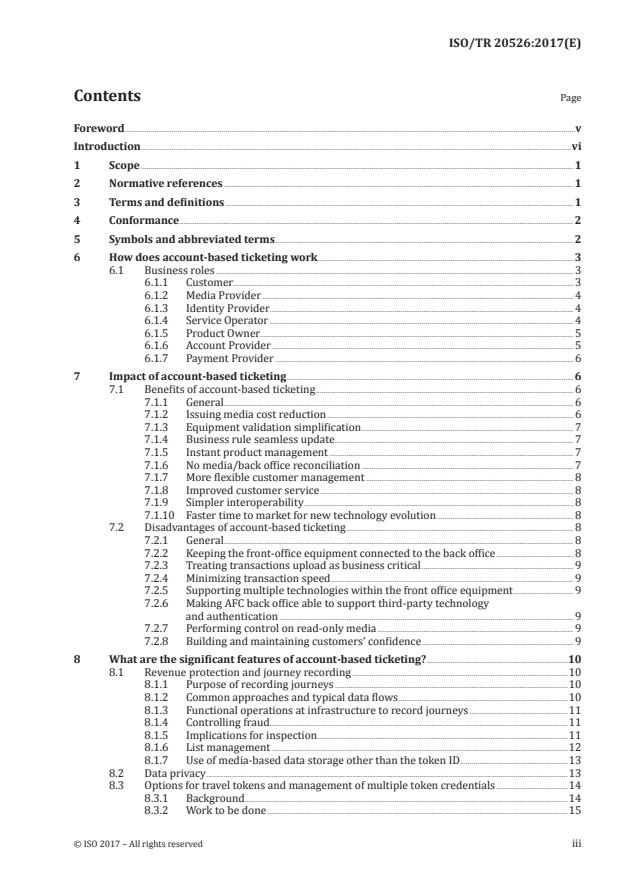
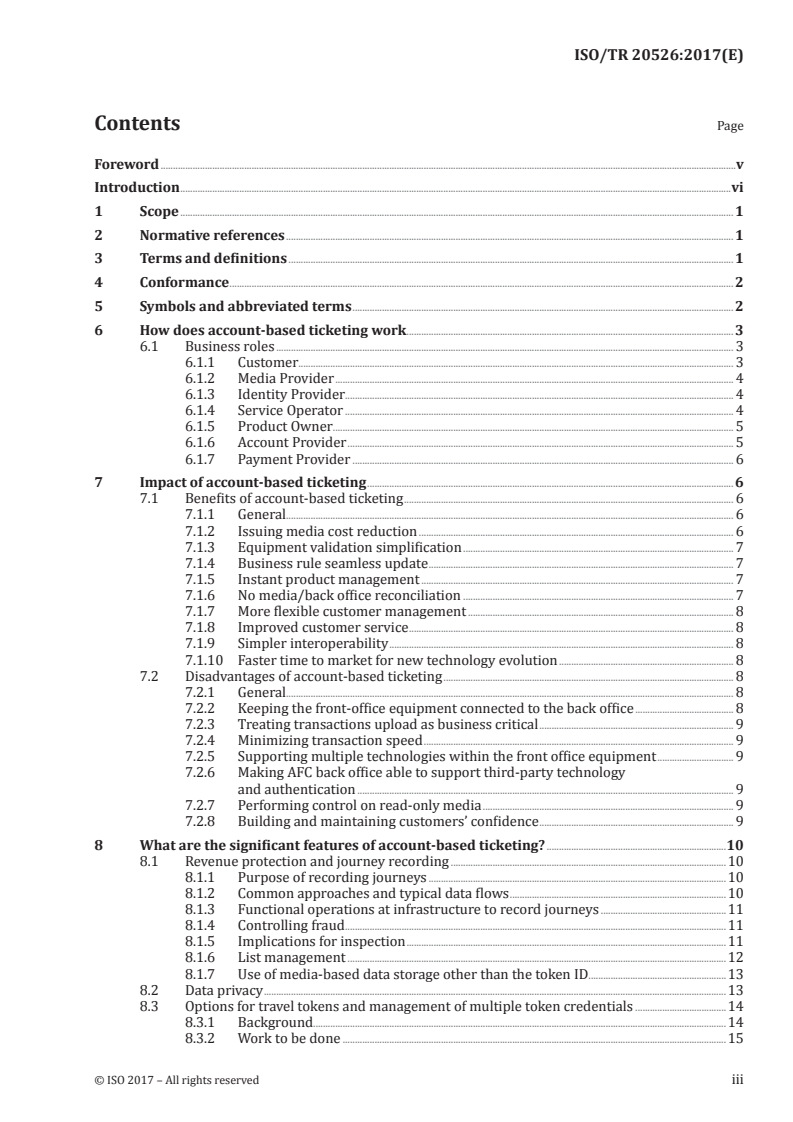
Contents Page
Foreword .v
Introduction .vi
1 Scope . 1
2 Normative references . 1
3 Terms and definitions . 1
4 Conformance . 2
5 Symbols and abbreviated terms . 2
6 How does account-based ticketing work . 3
6.1 Business roles . 3
6.1.1 Customer . . 3
6.1.2 Media Provider . 4
6.1.3 Identity Provider. 4
6.1.4 Service Operator . 4
6.1.5 Product Owner. 5
6.1.6 Account Provider . 5
6.1.7 Payment Provider . 6
7 Impact of account-based ticketing . 6
7.1 Benefits of account-based ticketing . 6
7.1.1 General. 6
7.1.2 Issuing media cost reduction . 6
7.1.3 Equipment validation simplification . 7
7.1.4 Business rule seamless update . 7
7.1.5 Instant product management . 7
7.1.6 No media/back office reconciliation . 7
7.1.7 More flexible customer management . 8
7.1.8 Improved customer service . 8
7.1.9 Simpler interoperability . 8
7.1.10 Faster time to market for new technology evolution . 8
7.2 Disadvantages of account-based ticketing . 8
7.2.1 General. 8
7.2.2 Keeping the front-office equipment connected to the back office . 8
7.2.3 Treating transactions upload as business critical . 9
7.2.4 Minimizing transaction speed . 9
7.2.5 Supporting multiple technologies within the front office equipment . 9
7.2.6 Making AFC back office able to support third-party technology
and authentication . 9
7.2.7 Performing control on read-only media . 9
7.2.8 Building and maintaining customers’ confidence . 9
8 What are the significant features of account-based ticketing? .10
8.1 Revenue protection and journey recording .10
8.1.1 Purpose of recording journeys .10
8.1.2 Common approaches and typical data flows .10
8.1.3 Functional operations at infrastructure to record journeys .11
8.1.4 Controlling fraud .11
8.1.5 Implications for inspection .11
8.1.6 List management .12
8.1.7 Use of media-based data storage other than the token ID .13
8.2 Data privacy .13
8.3 Options for travel tokens and management of multiple token credentials .14
8.3.1 Background.14
8.3.2 Work to be done .15
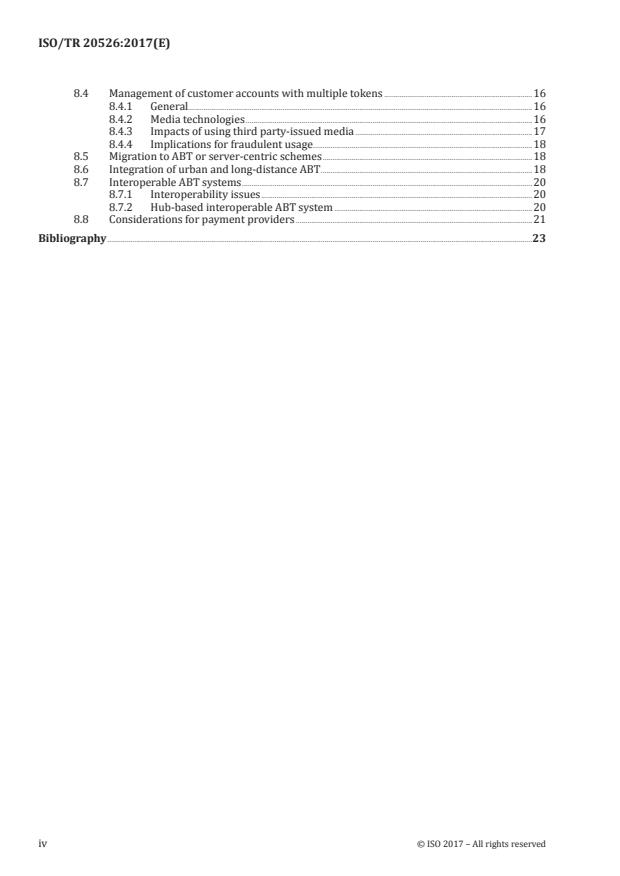
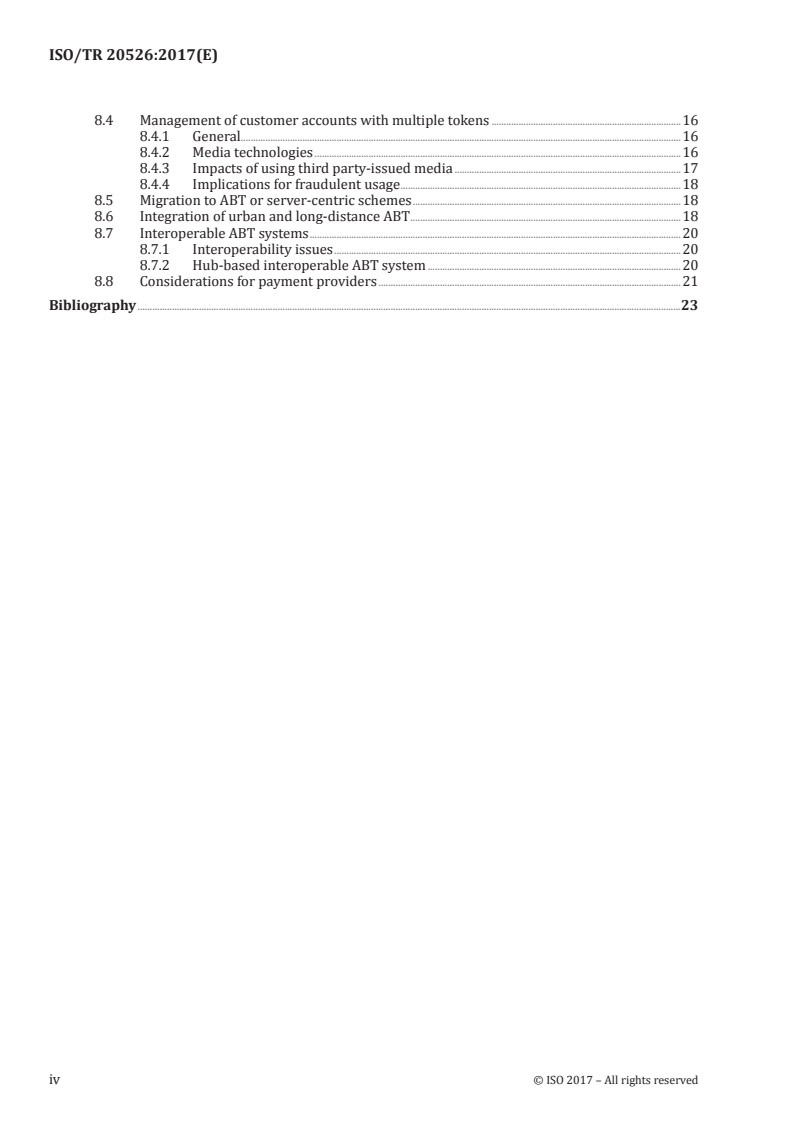
8.4 Management of customer accounts with multiple tokens .16
8.4.1 General.16
8.4.2 Media technologies .16
8.4.3 Impacts of using third party-issued media .17
8.4.4 Implications for fraudulent usage .18
8.5 Migration to ABT or server-centric schemes .18
8.6 Integration of urban and long-distance ABT .18
8.7 Interoperable ABT systems .20
8.7.1 Interoperability issues .20
8.7.2 Hub-based interoperable ABT system .20
8.8 Considerations for payment providers .21
Bibliography .23
iv © ISO 2017 – All rights reserved
Foreword
ISO (the International Organization for Standardization) is a worldwide federation of national standards
bodies (ISO member bodies). The work of preparing International Standards is normally carried out
through ISO technical committees. Each member body interested in a subject for which a technical
committee has been established has the right to be represented on that committee. International
organizations, governmental and non-governmental, in liaison with ISO, also take part in the work.
ISO collaborates closely with the International Electrotechnical Commission (IEC) on all matters of
electrotechnical standardization.
The procedures used to develop this document and those intended for its further maintenance are
described in the ISO/IEC Directives, Part 1. In particular the different approval criteria needed for the
different types of ISO documents should be noted. This document was drafted in accordance with the
editorial rules of the ISO/IEC Directives, Part 2 (see www .iso .org/ directives).
Attention is drawn to the possibility that some of the elements of this document may be the subject of
patent rights. ISO shall not be held responsible for identifying any or all such patent rights. Details of
any patent rights identified during the development of the document will be in the Introduction and/or
on the ISO list of patent declarations received (see www .iso .org/ patents).
Any trade name used in this document is information given for the convenience of users and does not
constitute an endorsement.
For an explanation on the voluntary nature of standards, the meaning of ISO specific terms and
expressions related to conformity assessment, as well as information about ISO’s adherence to the
World Trade Organization (WTO) principles in the Technical Barriers to Trade (TBT) see the following
URL: w w w . i s o .org/ iso/ foreword .html.
This document was prepared by Technical Committee ISO/TC 204, Intelligent transport systems.
Introduction
Account-based ticketing (ABT) is a subject of wide interest. It is used and is being considered for use by
many transport operators and authorities across the world. The system supplier market is international.
There may be benefits to transport operators and authorities from some element of international
standardization. There may also be benefits from some overall international coordination, for example,
with regard to reference data.
ABT is a method of ticketing where the proof of entitlement to travel and any records of travel are held
in an ABT back office and not in any physical media held by the passenger. ABT is also known as server-
based ticketing or Security in System. ABT can operate in both an online and offline world using risk-
managed revenue protection techniques as appropriate.
ABT is widely used for long-distance ticketing such as coach, rail and airlines and there are field
deployments of ABT systems in urban ticketing associated, for example, with usage-based best-value
tariffs. Although an account is always technically required, entirely anonymous travel is possible and
accounts do not need to persist after travel, save for fiscal reasons.
Concepts for implementation of ABT
There are several concepts for the implementation of ABT which have quite different characteristics
and value propositions for the public transport operator. The following examples demonstrate this
variety.
a) Token authentication by the reader
There are several field deployments of classical interoperable fare management systems (IFMS)
systems where the customer’s fare media is used as authenticator/token but not for storing fare
products. In these known cases, the authentication is done by the readers which have to be equipped
with the credentials needed to perform the token authentication. The reader will need then to
connect to the account server or to hold a list of authorized accounts before validating access to the
user. The implementation follows the role model as given in ISO 24014-1. The customer’s account
is hosted by the product retailer, who is the only financial interface between the customer and the
other roles in ISO 24014’s model. In this concept, the payment provider is just a subordinate role
to the product retailer and has no relevant influence on the processes and technologies of the fare
management system.
Strengths: These systems are also able to perform the authentication also if the reader is offline.
The security level may support high-value products and the vulnerability to denial of service
attacks is low.
Weaknesses: These concepts support typically the fare media which are explicitly released by the
system owner. Use of third-party media [offering the passenger a bring-your-own-device (BYOD)
facility] may require integration of the authentication methods defined by the third-party media or
application issuer.
b) Token authentication by the account server
This concept is known from access or ticketing systems where a high-performance online
connection to the account server is provided. The authentication of the token is performed directly
between online server and media. The reader is just transparent or not even necessary if the
media is equipped with an online connection like in the case of a mobile phone. The systems can be
established based on the ISO 24014-1 role model as described in Concept 1.
Strengths: The concept is very cost efficient and flexible because security functions and credentials
are only necessary in the central online server. This reduces cost for the reader infrastructure
dramatically and provides the flexibility for the introduction of new types of media. If this concept
is combined with the use of asymmetric cryptography (in order to avoid the need to distribute
cryptographic secrets to external media providers), the introduction of third-party media is a
practical option.
vi © ISO 2017 – All rights reserved
Weaknesses: The concept will not work at all if the media is not connected to the online server
and/or performance is worse than authentication by a local reader. However, with improving
connectivity and performance of servers and connections, it may become practical in classical fare
management environments. If so, it will probably be the most efficient and future-proof way to
implement ABT.
Today, concepts are evolving that try to get as close as possible to example 2 (token authentication
by the account server) by implementing list-based risk management where truly online connections
are not supported. The feasibility for specific fare management systems is subject to an individual
risk assessment.
Use of third-party media
An increasing number of fare management deployments are using third-party media for account-based
ticketing. This development is driven by contactless payment cards and government-issued cards which
are becoming common globally. In addition, where there is use in one ABT scheme of media issued by an
external transport organization not involved in the scheme, this also can be seen as third-party media
as it generates similar requirements as non-transport third party-issued media.
The payment networks deployed strict technical and certification requirements to their reader
infrastructure in order to achieve global interoperability. The ISO 24014-1 role model has to be extended
to ensure cooperation with the payment card issuers as identity providers and as payment providers.
Strengths: The public transport service provider can rely on third party media and does not have to
equip customers who have their own media. For payment cards branded from the major payment
networks, interoperability across ABT systems can be achieved. In this way, even foreign visitors can
use their contactless payment card to obtain a public transport service.
Weaknesses: Existing public transport contactless infrastructures need to be replaced or adapted in
order to fulfil the requirements of third-party media suppliers, particularly the payment networks.
Real-world implementations typically use classical contactless fare media and contactless payment
cards in parallel. Certain categories of customers like season cardholders or unbanked people
may be served by fare media issued by the public transport service provider. In an ABT scheme, the
implementation of the public transport system owner’s internal processes is typically still based on the
role model from ISO 24014-1. An example is that of the product owner (which is a role in ISO 24014-1)
that calculates fares for all customers including those with contactless payment cards.
Therefore, there is a need to make sure that IFMS concepts defined in ISO 24014-1 can coexist with
concepts based on contactless payment and other third-party media. This requires an eventual
integration of the role models and a harmonization of the technical requirements, as well as related
testing and certification of the reader infrastructure.
viii © ISO 2017 – All rights reserved
TECHNICAL REPORT ISO/TR 20526:2017(E)
Account-based ticketing state of the art report
1 Scope
This document provides a state of the art of the components that make up account-based ticketing as
currently understood. This state of the art can be used to identify those aspects where international
standardization or coordination can lead to benefits. These will then be proposed as normal ISO work
items, independent of this document.
2 Normative references
There are no normative references in this document.
3 Terms and definitions
For the purposes of this document, the following terms and definitions apply.
ISO and IEC maintain terminological databases for use in standardization at the following addresses:
— IEC Electropedia: available at http:// www .electropedia .org/
— ISO Online browsing platform: available at http:// www .iso .org/ obp
3.1
access control
control of access to a means of transport, e.g. gates or check-in
Note 1 to entry: See also ticket control (3.10).
3.2
card-centric
where the travel contract is represented by data in the media
Note 1 to entry: See also server-centric (3.8).
3.3
credentials
elements that provide secure access to the data in media
Note 1 to entry: Credentials will include keys and cryptographic methods used to encrypt or digitally seal the data.
3.4
EMV
Europay MasterCard Visa standards for payment cards
3.5
media
machine-readable device able to store data
3.6
Near Field Communications
NFC
radio communications interface defined by the NFC Forum and largely interoperable with ISO/IEC 14443
and ISO/IEC 18092
3.7
revenue protection
business processes established to minimize ticket fraud
3.8
server-centric
where the travel contract is represented by data in the back office
Note 1 to entry: See also card-centric (3.2).
3.9
tap
presenting media to readers to identify the passenger itinerary
Note 1 to entry: The reader reads the token held in the media.
3.10
ticket control
checking a ticket or a token for revenue protection purposes
Note 1 to entry: See also access control (3.1).
3.11
token
secure machine-readable instantiation in media of an identity
3.12
tokenization
secure process of substituting a sensitive data element with a non-sensitive equivalent, used in the
creation of a token
3.13
usage-based products
transport contracts where the calculation of price is made after travel
4 Conformance
Not applicable to this document.
5 Symbols and abbreviated terms
ABT account-based ticketing
AFC automated fare collection
PAN primary account number
BLE bluetooth low energy
PAYG pay as you go
PCI-DSS Payment Card Industry Data Security Standard
PII Personally Identifiable Information
2 © ISO 2017 – All rights reserved
6 How does account-based ticketing work
6.1 Business roles
An important objective of this document is to identify the need for update or extension of existing
technical specifications and standards or the development of new ones.
ABT concepts include new functionalities in addition to those based on the established ISO 24014-1
model. These concepts lead to the identification of significant new roles that support these new
functionalities and may require the combination of functionalities of the new roles and IFM-roles in
ISO 24014-1.
There are several ABT schemes in operation today based on IFMs which are compliant with ISO 24014-1.
These schemes serve as practical examples of the coexistence of account-based and media-centric
system concepts.
The new roles identified in this document should be mapped to those in the ISO 24014 series, together
with those coming from the other technical reports that have addressed various developments in IFM
systems. It is essential to maintain a practical basis for the seamless implementation of media-centric,
back-office-centric/account-based and hybrid solutions based on the ISO 24014 series.
The following business role model is described to suit this objective and should be used as input for a
revision of ISO 24014.
6.1.1 Customer
There is a difference between a Customer and a Passenger. The Passenger travels and has entitlements.
The Customer has the commercial relationship with the Account Provider (as Product Retailer) and is
responsible for payment using a Payment Provider. The role diagram above combines the two roles for
simplification.
The Customer can hold one or more accounts. Each Customer holds transport products in the account
that are purchased from the Account Provider as an agent of the Product Owner. Each account is
associated with one or more active tokens, although the associated media can be changed on the fly
if the original token used for a product is lost or damaged. Accounts can be explicitly opened by the
Customer or can be implicitly opened on first sight of a token.
The set of tokens that a Passenger may use with a product is set by the Product Owner in agreement
primarily with Service Operator. The Passenger should make sure that s/he has the correct token for
the product.
The Passenger travels using the products in the account and uses the token on the media for access
control and ticket control. The Customer pays the Account Provider for travel according to the rules of
the contracted products. The Customer and Passenger can expect to receive support from the Account
Provider, the Service Operator and the Payment Provider.
Where the token is associated with a payment account, for example, with payment cards, suitable
usage-based products can be automatically added to the account on first sight of the token.
6.1.2 Media Provider
Media in the ABT context is a physical support containing a machine-readable/writable data/processor
application. This can include transport industry smartcards, payment industry contactless cards,
public sector issued cards, mobile phones or paper (for barcodes), new formats such as watches and key
fobs, plus NFC mobiles.
Media Providers can be not only transport authorities and service operators, but also non-transport
organizations such as governments central and local, mobile handset vendors and banks.
The Media Provider is responsible for managing all the pre-issuance production processes culminating
in media personalized for a Passenger or supplied anonymously. The Media Provider is also responsible
for many post-issuance processes, including final decommissioning.
The Media Provider is responsible for the security method employed by the media and for ensuring that
the Service Operator equipment is provided with the relevant media security credentials, methods and
keys. In the ABT world, unlike the card-centric world, only the Service Operator needs to participate
in the Media Provider’s security scheme as only the Service Operator has the equipment that is used to
read the Customer’s media.
6.1.3 Identity Provider
The Identity Provider creates and provides a token that can be trusted to be associated with a Passenger.
Product Owners and Service Operators will use this trust relationship as the basis for authenticating
the Passenger. Identify Providers can be not only transport authorities and service operators, but also
non-transport organizations such as governments central and local, mobile network operators, online
service providers (e.g. Google, Facebook) and banks. It may provide to the Account Provider a validation
service that can be used to check the validity of the token and all processes for customer support like
for trustworthy registration, blocking in case of loss or theft, revocation or re-issuing.
The token used in ABT is a secure instantiation of a trusted identity stored on a media. In some cases,
the token and the media are provided together at personalization, for example, with a contactless
payment card. In others, the token can be supplied later for storage on the media. An anonymous token
can also be supplied for use by passengers concerned about their privacy.
The Identity Provider is responsible for the provision and maintenance of tokens that can be related to
a specific Passenger (where a non-anonymous ID is required). An Identity Provider may also provide
trusted details of entitlements linked to the Passenger. A secure but anonymous identity can be
provided in the case where anonymous travel is permitted.
The Identity Provider may be responsible for the security method employed for identity tokenization
and if so, for ensuring that the Service Operator equipment is provided with the relevant security
credentials, methods and keys. In the ABT world, only the Service Operator needs to participate in the
Identify Provider’s security scheme as only the Service Operator has equipment that is used to read the
Customer’s token. It is common practice that the Identity Provider provides a token (e.g. as certificate)
which is stored in a specific token application which come from an Application Provider for eID.
6.1.4 Service Operator
The Service Operator is responsible for providing the transport service to the Passenger.
4 © ISO 2017 – All rights reserved
The Service Operator contracts with Product Owners for the right to sell transport products. These
contracts define the travel services to be provided, the prices and conditions of carriage and the tokens
and media that can be used for travel.
The Service Operator is sent Deny and Accept lists by the Product Owner and ensures that these are
used by access control equipment and ticket control staff.
Taps will be generated from access control and ticket control processes depending upon the fare
calculation rules defined by the Product Owner. The Service Operator sends the taps to the Product
Owner, although in some cases, related to usage-based travel, it may be efficient to additionally forward
the tap to the Account Provider. This is the only party able to correctly determine the best product
for the Passenger to use. For example, the customer may have purchased a long-distance product that
includes travel across a city. The Product Owner may not know this explicitly and raise a charge to the
Account Provider for the cross-city travel. If the Account Provider received the taps, it would be able to
advise the Product Owner not to raise a charge (that had subsequently to be backed out).
Rules are needed in the ABT scheme to accommodate late and missing taps.
The Passenger travels using a suitable token as defined by the Product Owner. Taps on reader equipment
or other checks of the token are sent to the Product Owner or Account Provider who selects the best
product for the travel undertaken and if necessary calculates the price. Each tap contains information
of the token, service and the reader equipment. It can also contain additional other specific information
such as the time and location of the tap.
The Service Operator receives payment from the Product Owner for the travel provided.
6.1.5 Product Owner
The Product Owner specifies products based on travel services provided by Service Operators. The
definition of a product includes the specific travel service, pricing, billing and clearing rules, acceptable
tokens, conditions of carriage, conditions of sale, etc. A Product Owner contracts with an Account
Provider to sell their products to Customers. Product Owners will know which of their products an
Account Provider has sold and to whom but will not know all the products held by each Customer.
Product Owners reimburse Service Operators for the journeys travelled with one of their products and
settle the money with Account Providers for the product instances sold and changed.
Account-based ticketing supports conventional tickets bought in advance together with usage-based
products with the price calculated after travel, either using payment on entry or payment based on
the itinerary. Where not banned for regulatory or safety reasons, passengers should be able to travel
anonymously. ABT products that support this requirement can be provided.
Some forms of travel, such as in groups, do not sit well with ABT, as there can be significant effort to
associate the tokens of all the travellers to the group transport product. For this and similar cases, it
can be expected that there will always be a residual level of conventional ticketing even if regular travel
is priced using a usage-based method.
6.1.6 Account Provider
The Account Provider in this model includes the role of the Product Retailer and has the commercial
relationship with the Customer. The Account Provider role can also include that of Technical Distributor
(as used in the rail and air businesses). The role model in this document is therefore a simplification of a
complete role model such as required for interface development.
The Account Provider sells products as an agent of a Product Owner. Products are sold to Customers.
Products can include conventional tickets booked in advance of travel- or usage-based products.
For all product types, payment from the Customer can be before travel or after travel, based on the
requirements of the Product Owner and the credit-worthiness of the Customer as assessed by the
Account Provider.
Products can be sold to anonymous Customers as long as there is a link to a Payment Provider. In order
to provide entire anonymity, ABT requires that for all usage-based products, there should be a Payment
Provider role that accepts cash and an Identity Provider that can provide an anonymous token.
ABT allows accounts to be created before travel, where the link to the Payment Provider is established
in advance, but also upon travel, where the token used should provide a trusted link to an active account
held by a Payment Provider.
Where an Account Provider sells a usage-based product, it is necessary for the Account Provider to
know of all the other relevant products held by the Customer and their product usage, even in principle
held by other Account Providers, in order that the Account Provider can determine from the Passenger’s
itinerary (as evidenced by the taps) the extent of travel not covered by conventional products which is
therefore to be charged to the usage-based product. There is an issue where Customers hold usage-
based products that overlap geographically as this can lead to ambiguity over which product is used in
which case. The sharing of product information and the best party to calculate the price of usage-based
travel products, as identified above for the benefit of the Customer, is a complex subject not yet fully
addressed or resolved.
Account Providers will ensure that Customers can create and manage their accounts, verify the
authenticity of the presented identities and entitlements, verify the authenticity and integrity of the
transactions between Customers and Service Operators, protect the privacy of the customers and
service providers, and allow Customers to configure their digital identity including the registration of
tokens and the purchase of products.
In the case of usage-based products, Account Providers will receive notifications of product use and cost
from Product Owners, provide the Customer with an overview of all services that they have consumed
and the associated costs and (together with Product Owners in a manner not yet fully addressed or
resolved) manage the Accept list and Deny list for all the tokens of all their customers.
The Account Provider will inform Product Owners of the usage of their products and through Product
Owners reimburse Service Operators for the journeys travelled, both conventional and usage-based.
6.1.7 Payment Provider
A Payment Provider is the party that provides funds for travel and particularly usage-based travel. This
can, for example, be a bank account accessed by direct debit or credit transfer, a payment card account
accessed through an acquirer, a transport purse held by a transport authority or a mobile network
operator.
Each product will be associated with one or more Payment Providers and the Customer will choose
one best suited for his/her purposes. The Account Provider makes payment requests to the Payment
Provider on the basis of the travel consumed by the Passenger. The funds received are passed, subject
to commission, to the Product Owner.
7 Impact of account-based ticketing
7.1 Benefits of account-based ticketing
7.1.1 General
Account-based ticketing systems are based on a different architecture than legacy media-centric
ticketing systems, but once in place, they offer a wide range of benefits as described below.
7.1.2 Issuing media cost reduction
Tokens used in ABT can be hosted in a very large range of customer media and applications: transit
contactless cards, paper ticket with barcode, EMV contactless cards, PIV (Personal Identity Verification)
6 © ISO 2017 – All rights reserved
cards, mobile application communicating with Bluetooth Low Energy beacons, with barcode readers or
via NFC with validators. The trend is often called the Bring Your Own Device (BYOD) philosophy.
Media issuance can be much simpler and cost effective to implement than in media-centric ticketing
systems because media will only bear a token that aims to provide a secure identifier.
There is no longer a need for complex card data layouts required to deal with all complex fare structure.
However, tokens should be able to support a strong authentication process. As mentioned before, tokens
should be only accepted in the system if they are authenticated.
As a result, the media issuance costs can be reduced compared to media-centric systems.
— Where media has to be provided by a transport service operator or a product owner, passengers can
be supplied with smaller capacity smartcards. They only need to hold tokens, which require small
memory size.
— Media manufacturers are introducing simpler and cheaper token-only devices into the market.
— Third-party media such as PIV and EMV contactless cards can be easily accepted at no issuance cost
for the service operator. This as a result cuts operational costs for the service operator.
7.1.3 Equipment validation simplification
Validation equipment can be much simpler: it does not need to hold transactions for collection, complex
fare data nor acceptance rules. Open standards for data exchange between readers and the back office
become practicable and an opportunity to break away from supplier tie-in.
The validation equipment’s main features then become reduced to the following:
— authenticate the media and its token (locally or via a back office request);
— manage secure communication with back-office to transmit on the fly validation data;
— handle lists of denied and/or accepted tokens to enable offline decision when connection is too slow
or not available.
7.1.4 Business rule seamless update
It is no longer a requirement to download all the fare management business rules to the reader
equipment. A further advantage of this feature is the possibility to change business rules: changes are
immediate (which cannot be the case with media-centric systems) because there is no request to have
each piece of equipment to be downloaded with the new version of the application logic implementing
the business rules. As a consequence, AFC system operators have a great flexibility in order to change
business rules depending upon any event they want to manage. It is emphasized that all existing
business rules remain fully applicable. New products based on customer usage can be easily added. It
brings a strong customer benefit: users can automatically pay the best fare according to their trips.
7.1.5 Instant product management
Any product purchased by a traveller can be immediately used: the customer account is immediately
updated and there is no delay for him to use his/her newly purchased product. Therefore, products can
be added, changed and removed easily without being updated by a reader and without changes to the
equipment used by the customer to travel.
7.1.6 No media/back office reconciliation
Because all the transactions are managed at the back-office level, there is no longer a need to reconcile
the customer media and the image in back office. Customer service and back-office account changes do
not require card update and reconciliation.
In addition, passenger usage information is available in nearly real-time, which was never the case in
media centric systems.
7.1.7 More flexible customer management
Both anonymous and enrolled customers can be managed in ABT systems just like in media-centric
systems. Multiple tokens can be associated with each customer where service operators have different
validation equipment.
7.1.8 Improved customer service
ABT simplifies customer service and makes it more efficient.
Tokens can be substituted immediately: there is no longer a need for card reconstruction. This removes
the complexity of lost/stolen/bad media and the delays related to that kind of operation: the customer
can immediately recover his/her media. It is also no longer necessary to update the back-office card
status according to registered transaction because all transactions are only made at back office.
No fulfilment equipment is needed to issue or print or load data on to physical media. This removes
the need for customers to go anywhere or do anything to be able to travel on a product, specifically the
unhelpful obligation with media-centric technologies to load the product on a smartcard.
Only service operators need to have the security credentials from identity providers and media
suppliers. With card-centric technologies, the security credentials are also needed by retailers and
fulfillers, adding to costs and risks.
7.1.9 Simpler interoperability
ABT makes simpler interoperability because all information is stored at back office and, therefore,
nothing has to be done on the token.
7.1.10 Faster time to market for new technology evolution
ABT system allows easier evolution when technology evolves. Therefore, the consumer market can
interact more quickly with the ticketing system and promote ticketing system usage.
7.2 Disadvantages of account-based ticketing
7.2.1 General
Setting up, operating and updating an ABT system has a cost. System operators should be aware that
while there are indeed possible cost reductions as indicated in the previous subclause, there are also
new costs, and that both should be assessed. The main disadvantages inducing new costs are listed
hereafter, equally with some already identified mitigation recommendations.
7.2.2 Keeping the front-office equipment connected to the back office
Transaction processing changes from end-of-shift/traffic day processing to continuous triggers based
on tap receipt. This is more susceptible to ICT service interruption.
Front-office equipment has to be connected permanently to th
...
TECHNICAL ISO/TR
REPORT 20526
First edition
2017-07
Account-based ticketing state of the
art report
Rapport de l’état de la technique concernant la billettique centrée sur
le compte usager
Reference number
©
ISO 2017
© ISO 2017, Published in Switzerland
All rights reserved. Unless otherwise specified, no part of this publication may be reproduced or utilized otherwise in any form
or by any means, electronic or mechanical, including photocopying, or posting on the internet or an intranet, without prior
written permission. Permission can be requested from either ISO at the address below or ISO’s member body in the country of
the requester.
ISO copyright office
Ch. de Blandonnet 8 • CP 401
CH-1214 Vernier, Geneva, Switzerland
Tel. +41 22 749 01 11
Fax +41 22 749 09 47
copyright@iso.org
www.iso.org
ii © ISO 2017 – All rights reserved
Contents Page
Foreword .v
Introduction .vi
1 Scope . 1
2 Normative references . 1
3 Terms and definitions . 1
4 Conformance . 2
5 Symbols and abbreviated terms . 2
6 How does account-based ticketing work . 3
6.1 Business roles . 3
6.1.1 Customer . . 3
6.1.2 Media Provider . 4
6.1.3 Identity Provider. 4
6.1.4 Service Operator . 4
6.1.5 Product Owner. 5
6.1.6 Account Provider . 5
6.1.7 Payment Provider . 6
7 Impact of account-based ticketing . 6
7.1 Benefits of account-based ticketing . 6
7.1.1 General. 6
7.1.2 Issuing media cost reduction . 6
7.1.3 Equipment validation simplification . 7
7.1.4 Business rule seamless update . 7
7.1.5 Instant product management . 7
7.1.6 No media/back office reconciliation . 7
7.1.7 More flexible customer management . 8
7.1.8 Improved customer service . 8
7.1.9 Simpler interoperability . 8
7.1.10 Faster time to market for new technology evolution . 8
7.2 Disadvantages of account-based ticketing . 8
7.2.1 General. 8
7.2.2 Keeping the front-office equipment connected to the back office . 8
7.2.3 Treating transactions upload as business critical . 9
7.2.4 Minimizing transaction speed . 9
7.2.5 Supporting multiple technologies within the front office equipment . 9
7.2.6 Making AFC back office able to support third-party technology
and authentication . 9
7.2.7 Performing control on read-only media . 9
7.2.8 Building and maintaining customers’ confidence . 9
8 What are the significant features of account-based ticketing? .10
8.1 Revenue protection and journey recording .10
8.1.1 Purpose of recording journeys .10
8.1.2 Common approaches and typical data flows .10
8.1.3 Functional operations at infrastructure to record journeys .11
8.1.4 Controlling fraud .11
8.1.5 Implications for inspection .11
8.1.6 List management .12
8.1.7 Use of media-based data storage other than the token ID .13
8.2 Data privacy .13
8.3 Options for travel tokens and management of multiple token credentials .14
8.3.1 Background.14
8.3.2 Work to be done .15
8.4 Management of customer accounts with multiple tokens .16
8.4.1 General.16
8.4.2 Media technologies .16
8.4.3 Impacts of using third party-issued media .17
8.4.4 Implications for fraudulent usage .18
8.5 Migration to ABT or server-centric schemes .18
8.6 Integration of urban and long-distance ABT .18
8.7 Interoperable ABT systems .20
8.7.1 Interoperability issues .20
8.7.2 Hub-based interoperable ABT system .20
8.8 Considerations for payment providers .21
Bibliography .23
iv © ISO 2017 – All rights reserved
Foreword
ISO (the International Organization for Standardization) is a worldwide federation of national standards
bodies (ISO member bodies). The work of preparing International Standards is normally carried out
through ISO technical committees. Each member body interested in a subject for which a technical
committee has been established has the right to be represented on that committee. International
organizations, governmental and non-governmental, in liaison with ISO, also take part in the work.
ISO collaborates closely with the International Electrotechnical Commission (IEC) on all matters of
electrotechnical standardization.
The procedures used to develop this document and those intended for its further maintenance are
described in the ISO/IEC Directives, Part 1. In particular the different approval criteria needed for the
different types of ISO documents should be noted. This document was drafted in accordance with the
editorial rules of the ISO/IEC Directives, Part 2 (see www .iso .org/ directives).
Attention is drawn to the possibility that some of the elements of this document may be the subject of
patent rights. ISO shall not be held responsible for identifying any or all such patent rights. Details of
any patent rights identified during the development of the document will be in the Introduction and/or
on the ISO list of patent declarations received (see www .iso .org/ patents).
Any trade name used in this document is information given for the convenience of users and does not
constitute an endorsement.
For an explanation on the voluntary nature of standards, the meaning of ISO specific terms and
expressions related to conformity assessment, as well as information about ISO’s adherence to the
World Trade Organization (WTO) principles in the Technical Barriers to Trade (TBT) see the following
URL: w w w . i s o .org/ iso/ foreword .html.
This document was prepared by Technical Committee ISO/TC 204, Intelligent transport systems.
Introduction
Account-based ticketing (ABT) is a subject of wide interest. It is used and is being considered for use by
many transport operators and authorities across the world. The system supplier market is international.
There may be benefits to transport operators and authorities from some element of international
standardization. There may also be benefits from some overall international coordination, for example,
with regard to reference data.
ABT is a method of ticketing where the proof of entitlement to travel and any records of travel are held
in an ABT back office and not in any physical media held by the passenger. ABT is also known as server-
based ticketing or Security in System. ABT can operate in both an online and offline world using risk-
managed revenue protection techniques as appropriate.
ABT is widely used for long-distance ticketing such as coach, rail and airlines and there are field
deployments of ABT systems in urban ticketing associated, for example, with usage-based best-value
tariffs. Although an account is always technically required, entirely anonymous travel is possible and
accounts do not need to persist after travel, save for fiscal reasons.
Concepts for implementation of ABT
There are several concepts for the implementation of ABT which have quite different characteristics
and value propositions for the public transport operator. The following examples demonstrate this
variety.
a) Token authentication by the reader
There are several field deployments of classical interoperable fare management systems (IFMS)
systems where the customer’s fare media is used as authenticator/token but not for storing fare
products. In these known cases, the authentication is done by the readers which have to be equipped
with the credentials needed to perform the token authentication. The reader will need then to
connect to the account server or to hold a list of authorized accounts before validating access to the
user. The implementation follows the role model as given in ISO 24014-1. The customer’s account
is hosted by the product retailer, who is the only financial interface between the customer and the
other roles in ISO 24014’s model. In this concept, the payment provider is just a subordinate role
to the product retailer and has no relevant influence on the processes and technologies of the fare
management system.
Strengths: These systems are also able to perform the authentication also if the reader is offline.
The security level may support high-value products and the vulnerability to denial of service
attacks is low.
Weaknesses: These concepts support typically the fare media which are explicitly released by the
system owner. Use of third-party media [offering the passenger a bring-your-own-device (BYOD)
facility] may require integration of the authentication methods defined by the third-party media or
application issuer.
b) Token authentication by the account server
This concept is known from access or ticketing systems where a high-performance online
connection to the account server is provided. The authentication of the token is performed directly
between online server and media. The reader is just transparent or not even necessary if the
media is equipped with an online connection like in the case of a mobile phone. The systems can be
established based on the ISO 24014-1 role model as described in Concept 1.
Strengths: The concept is very cost efficient and flexible because security functions and credentials
are only necessary in the central online server. This reduces cost for the reader infrastructure
dramatically and provides the flexibility for the introduction of new types of media. If this concept
is combined with the use of asymmetric cryptography (in order to avoid the need to distribute
cryptographic secrets to external media providers), the introduction of third-party media is a
practical option.
vi © ISO 2017 – All rights reserved
Weaknesses: The concept will not work at all if the media is not connected to the online server
and/or performance is worse than authentication by a local reader. However, with improving
connectivity and performance of servers and connections, it may become practical in classical fare
management environments. If so, it will probably be the most efficient and future-proof way to
implement ABT.
Today, concepts are evolving that try to get as close as possible to example 2 (token authentication
by the account server) by implementing list-based risk management where truly online connections
are not supported. The feasibility for specific fare management systems is subject to an individual
risk assessment.
Use of third-party media
An increasing number of fare management deployments are using third-party media for account-based
ticketing. This development is driven by contactless payment cards and government-issued cards which
are becoming common globally. In addition, where there is use in one ABT scheme of media issued by an
external transport organization not involved in the scheme, this also can be seen as third-party media
as it generates similar requirements as non-transport third party-issued media.
The payment networks deployed strict technical and certification requirements to their reader
infrastructure in order to achieve global interoperability. The ISO 24014-1 role model has to be extended
to ensure cooperation with the payment card issuers as identity providers and as payment providers.
Strengths: The public transport service provider can rely on third party media and does not have to
equip customers who have their own media. For payment cards branded from the major payment
networks, interoperability across ABT systems can be achieved. In this way, even foreign visitors can
use their contactless payment card to obtain a public transport service.
Weaknesses: Existing public transport contactless infrastructures need to be replaced or adapted in
order to fulfil the requirements of third-party media suppliers, particularly the payment networks.
Real-world implementations typically use classical contactless fare media and contactless payment
cards in parallel. Certain categories of customers like season cardholders or unbanked people
may be served by fare media issued by the public transport service provider. In an ABT scheme, the
implementation of the public transport system owner’s internal processes is typically still based on the
role model from ISO 24014-1. An example is that of the product owner (which is a role in ISO 24014-1)
that calculates fares for all customers including those with contactless payment cards.
Therefore, there is a need to make sure that IFMS concepts defined in ISO 24014-1 can coexist with
concepts based on contactless payment and other third-party media. This requires an eventual
integration of the role models and a harmonization of the technical requirements, as well as related
testing and certification of the reader infrastructure.
viii © ISO 2017 – All rights reserved
TECHNICAL REPORT ISO/TR 20526:2017(E)
Account-based ticketing state of the art report
1 Scope
This document provides a state of the art of the components that make up account-based ticketing as
currently understood. This state of the art can be used to identify those aspects where international
standardization or coordination can lead to benefits. These will then be proposed as normal ISO work
items, independent of this document.
2 Normative references
There are no normative references in this document.
3 Terms and definitions
For the purposes of this document, the following terms and definitions apply.
ISO and IEC maintain terminological databases for use in standardization at the following addresses:
— IEC Electropedia: available at http:// www .electropedia .org/
— ISO Online browsing platform: available at http:// www .iso .org/ obp
3.1
access control
control of access to a means of transport, e.g. gates or check-in
Note 1 to entry: See also ticket control (3.10).
3.2
card-centric
where the travel contract is represented by data in the media
Note 1 to entry: See also server-centric (3.8).
3.3
credentials
elements that provide secure access to the data in media
Note 1 to entry: Credentials will include keys and cryptographic methods used to encrypt or digitally seal the data.
3.4
EMV
Europay MasterCard Visa standards for payment cards
3.5
media
machine-readable device able to store data
3.6
Near Field Communications
NFC
radio communications interface defined by the NFC Forum and largely interoperable with ISO/IEC 14443
and ISO/IEC 18092
3.7
revenue protection
business processes established to minimize ticket fraud
3.8
server-centric
where the travel contract is represented by data in the back office
Note 1 to entry: See also card-centric (3.2).
3.9
tap
presenting media to readers to identify the passenger itinerary
Note 1 to entry: The reader reads the token held in the media.
3.10
ticket control
checking a ticket or a token for revenue protection purposes
Note 1 to entry: See also access control (3.1).
3.11
token
secure machine-readable instantiation in media of an identity
3.12
tokenization
secure process of substituting a sensitive data element with a non-sensitive equivalent, used in the
creation of a token
3.13
usage-based products
transport contracts where the calculation of price is made after travel
4 Conformance
Not applicable to this document.
5 Symbols and abbreviated terms
ABT account-based ticketing
AFC automated fare collection
PAN primary account number
BLE bluetooth low energy
PAYG pay as you go
PCI-DSS Payment Card Industry Data Security Standard
PII Personally Identifiable Information
2 © ISO 2017 – All rights reserved
6 How does account-based ticketing work
6.1 Business roles
An important objective of this document is to identify the need for update or extension of existing
technical specifications and standards or the development of new ones.
ABT concepts include new functionalities in addition to those based on the established ISO 24014-1
model. These concepts lead to the identification of significant new roles that support these new
functionalities and may require the combination of functionalities of the new roles and IFM-roles in
ISO 24014-1.
There are several ABT schemes in operation today based on IFMs which are compliant with ISO 24014-1.
These schemes serve as practical examples of the coexistence of account-based and media-centric
system concepts.
The new roles identified in this document should be mapped to those in the ISO 24014 series, together
with those coming from the other technical reports that have addressed various developments in IFM
systems. It is essential to maintain a practical basis for the seamless implementation of media-centric,
back-office-centric/account-based and hybrid solutions based on the ISO 24014 series.
The following business role model is described to suit this objective and should be used as input for a
revision of ISO 24014.
6.1.1 Customer
There is a difference between a Customer and a Passenger. The Passenger travels and has entitlements.
The Customer has the commercial relationship with the Account Provider (as Product Retailer) and is
responsible for payment using a Payment Provider. The role diagram above combines the two roles for
simplification.
The Customer can hold one or more accounts. Each Customer holds transport products in the account
that are purchased from the Account Provider as an agent of the Product Owner. Each account is
associated with one or more active tokens, although the associated media can be changed on the fly
if the original token used for a product is lost or damaged. Accounts can be explicitly opened by the
Customer or can be implicitly opened on first sight of a token.
The set of tokens that a Passenger may use with a product is set by the Product Owner in agreement
primarily with Service Operator. The Passenger should make sure that s/he has the correct token for
the product.
The Passenger travels using the products in the account and uses the token on the media for access
control and ticket control. The Customer pays the Account Provider for travel according to the rules of
the contracted products. The Customer and Passenger can expect to receive support from the Account
Provider, the Service Operator and the Payment Provider.
Where the token is associated with a payment account, for example, with payment cards, suitable
usage-based products can be automatically added to the account on first sight of the token.
6.1.2 Media Provider
Media in the ABT context is a physical support containing a machine-readable/writable data/processor
application. This can include transport industry smartcards, payment industry contactless cards,
public sector issued cards, mobile phones or paper (for barcodes), new formats such as watches and key
fobs, plus NFC mobiles.
Media Providers can be not only transport authorities and service operators, but also non-transport
organizations such as governments central and local, mobile handset vendors and banks.
The Media Provider is responsible for managing all the pre-issuance production processes culminating
in media personalized for a Passenger or supplied anonymously. The Media Provider is also responsible
for many post-issuance processes, including final decommissioning.
The Media Provider is responsible for the security method employed by the media and for ensuring that
the Service Operator equipment is provided with the relevant media security credentials, methods and
keys. In the ABT world, unlike the card-centric world, only the Service Operator needs to participate
in the Media Provider’s security scheme as only the Service Operator has the equipment that is used to
read the Customer’s media.
6.1.3 Identity Provider
The Identity Provider creates and provides a token that can be trusted to be associated with a Passenger.
Product Owners and Service Operators will use this trust relationship as the basis for authenticating
the Passenger. Identify Providers can be not only transport authorities and service operators, but also
non-transport organizations such as governments central and local, mobile network operators, online
service providers (e.g. Google, Facebook) and banks. It may provide to the Account Provider a validation
service that can be used to check the validity of the token and all processes for customer support like
for trustworthy registration, blocking in case of loss or theft, revocation or re-issuing.
The token used in ABT is a secure instantiation of a trusted identity stored on a media. In some cases,
the token and the media are provided together at personalization, for example, with a contactless
payment card. In others, the token can be supplied later for storage on the media. An anonymous token
can also be supplied for use by passengers concerned about their privacy.
The Identity Provider is responsible for the provision and maintenance of tokens that can be related to
a specific Passenger (where a non-anonymous ID is required). An Identity Provider may also provide
trusted details of entitlements linked to the Passenger. A secure but anonymous identity can be
provided in the case where anonymous travel is permitted.
The Identity Provider may be responsible for the security method employed for identity tokenization
and if so, for ensuring that the Service Operator equipment is provided with the relevant security
credentials, methods and keys. In the ABT world, only the Service Operator needs to participate in the
Identify Provider’s security scheme as only the Service Operator has equipment that is used to read the
Customer’s token. It is common practice that the Identity Provider provides a token (e.g. as certificate)
which is stored in a specific token application which come from an Application Provider for eID.
6.1.4 Service Operator
The Service Operator is responsible for providing the transport service to the Passenger.
4 © ISO 2017 – All rights reserved
The Service Operator contracts with Product Owners for the right to sell transport products. These
contracts define the travel services to be provided, the prices and conditions of carriage and the tokens
and media that can be used for travel.
The Service Operator is sent Deny and Accept lists by the Product Owner and ensures that these are
used by access control equipment and ticket control staff.
Taps will be generated from access control and ticket control processes depending upon the fare
calculation rules defined by the Product Owner. The Service Operator sends the taps to the Product
Owner, although in some cases, related to usage-based travel, it may be efficient to additionally forward
the tap to the Account Provider. This is the only party able to correctly determine the best product
for the Passenger to use. For example, the customer may have purchased a long-distance product that
includes travel across a city. The Product Owner may not know this explicitly and raise a charge to the
Account Provider for the cross-city travel. If the Account Provider received the taps, it would be able to
advise the Product Owner not to raise a charge (that had subsequently to be backed out).
Rules are needed in the ABT scheme to accommodate late and missing taps.
The Passenger travels using a suitable token as defined by the Product Owner. Taps on reader equipment
or other checks of the token are sent to the Product Owner or Account Provider who selects the best
product for the travel undertaken and if necessary calculates the price. Each tap contains information
of the token, service and the reader equipment. It can also contain additional other specific information
such as the time and location of the tap.
The Service Operator receives payment from the Product Owner for the travel provided.
6.1.5 Product Owner
The Product Owner specifies products based on travel services provided by Service Operators. The
definition of a product includes the specific travel service, pricing, billing and clearing rules, acceptable
tokens, conditions of carriage, conditions of sale, etc. A Product Owner contracts with an Account
Provider to sell their products to Customers. Product Owners will know which of their products an
Account Provider has sold and to whom but will not know all the products held by each Customer.
Product Owners reimburse Service Operators for the journeys travelled with one of their products and
settle the money with Account Providers for the product instances sold and changed.
Account-based ticketing supports conventional tickets bought in advance together with usage-based
products with the price calculated after travel, either using payment on entry or payment based on
the itinerary. Where not banned for regulatory or safety reasons, passengers should be able to travel
anonymously. ABT products that support this requirement can be provided.
Some forms of travel, such as in groups, do not sit well with ABT, as there can be significant effort to
associate the tokens of all the travellers to the group transport product. For this and similar cases, it
can be expected that there will always be a residual level of conventional ticketing even if regular travel
is priced using a usage-based method.
6.1.6 Account Provider
The Account Provider in this model includes the role of the Product Retailer and has the commercial
relationship with the Customer. The Account Provider role can also include that of Technical Distributor
(as used in the rail and air businesses). The role model in this document is therefore a simplification of a
complete role model such as required for interface development.
The Account Provider sells products as an agent of a Product Owner. Products are sold to Customers.
Products can include conventional tickets booked in advance of travel- or usage-based products.
For all product types, payment from the Customer can be before travel or after travel, based on the
requirements of the Product Owner and the credit-worthiness of the Customer as assessed by the
Account Provider.
Products can be sold to anonymous Customers as long as there is a link to a Payment Provider. In order
to provide entire anonymity, ABT requires that for all usage-based products, there should be a Payment
Provider role that accepts cash and an Identity Provider that can provide an anonymous token.
ABT allows accounts to be created before travel, where the link to the Payment Provider is established
in advance, but also upon travel, where the token used should provide a trusted link to an active account
held by a Payment Provider.
Where an Account Provider sells a usage-based product, it is necessary for the Account Provider to
know of all the other relevant products held by the Customer and their product usage, even in principle
held by other Account Providers, in order that the Account Provider can determine from the Passenger’s
itinerary (as evidenced by the taps) the extent of travel not covered by conventional products which is
therefore to be charged to the usage-based product. There is an issue where Customers hold usage-
based products that overlap geographically as this can lead to ambiguity over which product is used in
which case. The sharing of product information and the best party to calculate the price of usage-based
travel products, as identified above for the benefit of the Customer, is a complex subject not yet fully
addressed or resolved.
Account Providers will ensure that Customers can create and manage their accounts, verify the
authenticity of the presented identities and entitlements, verify the authenticity and integrity of the
transactions between Customers and Service Operators, protect the privacy of the customers and
service providers, and allow Customers to configure their digital identity including the registration of
tokens and the purchase of products.
In the case of usage-based products, Account Providers will receive notifications of product use and cost
from Product Owners, provide the Customer with an overview of all services that they have consumed
and the associated costs and (together with Product Owners in a manner not yet fully addressed or
resolved) manage the Accept list and Deny list for all the tokens of all their customers.
The Account Provider will inform Product Owners of the usage of their products and through Product
Owners reimburse Service Operators for the journeys travelled, both conventional and usage-based.
6.1.7 Payment Provider
A Payment Provider is the party that provides funds for travel and particularly usage-based travel. This
can, for example, be a bank account accessed by direct debit or credit transfer, a payment card account
accessed through an acquirer, a transport purse held by a transport authority or a mobile network
operator.
Each product will be associated with one or more Payment Providers and the Customer will choose
one best suited for his/her purposes. The Account Provider makes payment requests to the Payment
Provider on the basis of the travel consumed by the Passenger. The funds received are passed, subject
to commission, to the Product Owner.
7 Impact of account-based ticketing
7.1 Benefits of account-based ticketing
7.1.1 General
Account-based ticketing systems are based on a different architecture than legacy media-centric
ticketing systems, but once in place, they offer a wide range of benefits as described below.
7.1.2 Issuing media cost reduction
Tokens used in ABT can be hosted in a very large range of customer media and applications: transit
contactless cards, paper ticket with barcode, EMV contactless cards, PIV (Personal Identity Verification)
6 © ISO 2017 – All rights reserved
cards, mobile application communicating with Bluetooth Low Energy beacons, with barcode readers or
via NFC with validators. The trend is often called the Bring Your Own Device (BYOD) philosophy.
Media issuance can be much simpler and cost effective to implement than in media-centric ticketing
systems because media will only bear a token that aims to provide a secure identifier.
There is no longer a need for complex card data layouts required to deal with all complex fare structure.
However, tokens should be able to support a strong authentication process. As mentioned before, tokens
should be only accepted in the system if they are authenticated.
As a result, the media issuance costs can be reduced compared to media-centric systems.
— Where media has to be provided by a transport service operator or a product owner, passengers can
be supplied with smaller capacity smartcards. They only need to hold tokens, which require small
memory size.
— Media manufacturers are introducing simpler and cheaper token-only devices into the market.
— Third-party media such as PIV and EMV contactless cards can be easily accepted at no issuance cost
for the service operator. This as a result cuts operational costs for the service operator.
7.1.3 Equipment validation simplification
Validation equipment can be much simpler: it does not need to hold transactions for collection, complex
fare data nor acceptance rules. Open standards for data exchange between readers and the back office
become practicable and an opportunity to break away from supplier tie-in.
The validation equipment’s main features then become reduced to the following:
— authenticate the media and its token (locally or via a back office request);
— manage secure communication with back-office to transmit on the fly validation data;
— handle lists of denied and/or accepted tokens to enable offline decision when connection is too slow
or not available.
7.1.4 Business rule seamless update
It is no longer a requirement to download all the fare management business rules to the reader
equipment. A further advantage of this feature is the possibility to change business rules: changes are
immediate (which cannot be the case with media-centric systems) because there is no request to have
each piece of equipment to be downloaded with the new version of the application logic implementing
the business rules. As a consequence, AFC system operators have a great flexibility in order to change
business rules depending upon any event they want to manage. It is emphasized that all existing
business rules remain fully applicable. New products based on customer usage can be easily added. It
brings a strong customer benefit: users can automatically pay the best fare according to their trips.
7.1.5 Instant product management
Any product purchased by a traveller can be immediately used: the customer account is immediately
updated and there is no delay for him to use his/her newly purchased product. Therefore, products can
be added, changed and removed easily without being updated by a reader and without changes to the
equipment used by the customer to travel.
7.1.6 No media/back office reconciliation
Because all the transactions are managed at the back-office level, there is no longer a need to reconcile
the customer media and the image in back office. Customer service and back-office account changes do
not require card update and reconciliation.
In addition, passenger usage information is available in nearly real-time, which was never the case in
media centric systems.
7.1.7 More flexible customer management
Both anonymous and enrolled customers can be managed in ABT systems just like in media-centric
systems. Multiple tokens can be associated with each customer where service operators have different
validation equipment.
7.1.8 Improved customer service
ABT simplifies customer service and makes it more efficient.
Tokens can be substituted immediately: there is no longer a need for card reconstruction. This removes
the complexity of lost/stolen/bad media and the delays related to that kind of operation: the customer
can immediately recover his/her media. It is also no longer necessary to update the back-office card
status according to registered transaction because all transactions are only made at back office.
No fulfilment equipment is needed to issue or print or load data on to physical media. This removes
the need for customers to go anywhere or do anything to be able to travel on a product, specifically the
unhelpful obligation with media-centric technologies to load the product on a smartcard.
Only service operators need to have the security credentials from identity providers and media
suppliers. With card-centric technologies, the security credentials are also needed by retailers and
fulfillers, adding to costs and risks.
7.1.9 Simpler interoperability
ABT makes simpler interoperability because all information is stored at back office and, therefore,
nothing has to be done on the token.
7.1.10 Faster time to market for new technology evolution
ABT system allows easier evolution when technology evolves. Therefore, the consumer market can
interact more quickly with the ticketing system and promote ticketing system usage.
7.2 Disadvantages of account-based ticketing
7.2.1 General
Setting up, operating and updating an ABT system has a cost. System operators should be aware that
while there are indeed possible cost reductions as indicated in the previous subclause, there are also
new costs, and that both should be assessed. The main disadvantages inducing new costs are listed
hereafter, equally with some already identified mitigation recommendations.
7.2.2 Keeping the front-office equipment connected to the back office
Transaction processing changes from end-of-shift/traffic day processing to continuous triggers based
on tap receipt. This is more susceptible to ICT service interruption.
Front-office equipment has to be connected permanently to th
...