

ISO 10631:2021
(Main)Industrial valves - Metallic butterfly valves
General Information
- Abstract
This document specifies the general requirements for design, materials (e.g. steel, cast iron, ductile iron, copper alloy), pressure/temperature ratings and testing for butterfly valves having metallic bodies for use in flanged or butt-welding piping systems. This document applies to metallic butterfly valves used for all industrial applications. Additional requirements given in the relevant application standards can apply to butterfly valves used for more specific applications (e.g. for the water industry, the chemical and petrochemical process industry, the oil and gas industry). This document covers butterfly valves of the following nominal sizes, DN and NPS: — DN 40; 50; 65; 80; 100; 125; 150; 200; 250; 300; 350; 400; 450; 500; (550); 600; (650); 700; 750; 800; 900; 1 000; 1 050; 1 200; 1 400; 1 500; 1 600; 1 800; 2 000; 2 200; 2 400. — NPS 1 ½; 2; 2 ½; 3; 4; 5; 6; 8; 10; 12; 14; 16; 18; 20; (22); 24; (26); 28; 30; 32; 36; 40; 42; 48; 54; 56; 60; 64; 66; 72; 78; 80; 84; 88; 90; 96. This document is applicable to butterfly valves of the following pressure designations, PN and Class: — PN 2,5; PN 6; PN 10; PN 16; PN 25; PN 40; PN 63; PN 100; — Class 25, 125; 150; 250; 300; 600. NOTE 1 It is possible that the nominal sizes listed are not available for all pressure designations. NOTE 2 Nominal sizes listed in parenthesis are not common industry sizes, but are used in some application standards.
- Status
- Published
- Publication Date
- 03-May-2021
- Technical Committee
- ISO/TC 153 - Valves
- Drafting Committee
- ISO/TC 153 - Valves
- Current Stage
- 9093 - International Standard confirmed
- Start Date
- 03-Sep-2026
- Completion Date
- 12-Sep-2026
Buy Documents

ISO 10631:2021 - Industrial valves - Metallic butterfly valves

ISO 10631:2021 - Industrial valves - Metallic butterfly valves/4/2021
Overview - What ISO 10631:2021 Covers
ISO 10631:2021 establishes general requirements for metallic butterfly valves used in industrial piping systems with flanged or butt-weld ends. The standard covers design, materials (examples: steel, cast iron, ductile iron, copper alloy), pressure/temperature ratings, testing, marking, inspection and preparation for dispatch. It applies broadly across industrial sectors while allowing additional, application-specific requirements (water, chemical/petrochemical, oil & gas) to be added by relevant industry standards.
The standard addresses a wide range of nominal sizes and pressure designations:
- DN (metric): DN 40 … DN 2 400 (selected sizes and some less common sizes in parentheses)
- NPS (inch): NPS 1 ½ … NPS 96 (selected sizes; some in parentheses are less common)
- Pressure designations: PN 2,5; PN 6; PN 10; PN 16; PN 25; PN 40; PN 63; PN 100 and Class 25, 125, 150, 250, 300, 600
Key Topics and Technical Requirements
ISO 10631:2021 covers these essential technical areas:
- Design requirements: wall thickness, construction examples, face-to-face dimensions and tolerances, end connections (double-flanged, wafer, butt-welded), disc and shaft design, and optional features.
- Operation and actuation: direction of rotation, actuating devices, manual actuation forces/torques and secure adjustable stops.
- Materials: body, disc, shaft and seat material guidance consistent with pressure/temperature service.
- Safety features: requirements to prevent shaft ejection if a shaft or shaft-to-disc connection fails.
- Performance: allowable leakage rates, flow velocity guidance, pressure/temperature ratings and marking of any reduced limits.
- Testing and inspection: pressure testing, functional checks, marking and preparation for dispatch; includes example valve data sheet and test requirements.
Notable updates in the 2021 (third) edition include extended pressure ratings (PN 63, PN 100 and additional Class ratings), new disc and shaft safety requirements, and clarification of face-to-pipe clearances.
Practical Applications - Who Uses ISO 10631
ISO 10631 is used by:
- Valve manufacturers designing and certifying metallic butterfly valves
- Specifiers and procurement engineers in water treatment, chemical, petrochemical, oil & gas, power, and general industry
- Inspectors and testing laboratories performing pressure and leakage testing
- Piping and pipeline engineers selecting valves for compatibility with flange standards and pressure classes
Benefits include improved interchangeability, predictable performance, and reduced procurement risk.
Related Standards (selection)
Standards commonly referenced alongside ISO 10631:
- ISO 5208 (pressure testing of metallic valves)
- ISO 5211 (actuator attachments)
- ISO 5752 (face-to-face dimensions)
- ISO 5209 (marking)
- EN 1092 / ASME B16 series (flange dimensions and classes)
Using ISO 10631 ensures a consistent, traceable approach to metallic butterfly valve design, testing and specification for industrial piping systems.
Relations
- Effective Date
- 09-Feb-2026
- Effective Date
- 23-Apr-2020
Buy Documents
ISO 10631:2021 - Industrial valves - Metallic butterfly valves
ISO 10631:2021 - Industrial valves - Metallic butterfly valves/4/2021
Get Certified
Connect with accredited certification bodies for this standard

Institut za varilstvo d.o.o. (Welding Institute)
Slovenia's leading welding institute since 1952. ISO 3834, EN 1090, pressure equipment certification, NDT personnel, welder qualification. Only IIW Au
Sponsored listings
Frequently Asked Questions
ISO 10631:2021 is a standard published by the International Organization for Standardization (ISO). Its full title is "Industrial valves - Metallic butterfly valves". This standard covers: This document specifies the general requirements for design, materials (e.g. steel, cast iron, ductile iron, copper alloy), pressure/temperature ratings and testing for butterfly valves having metallic bodies for use in flanged or butt-welding piping systems. This document applies to metallic butterfly valves used for all industrial applications. Additional requirements given in the relevant application standards can apply to butterfly valves used for more specific applications (e.g. for the water industry, the chemical and petrochemical process industry, the oil and gas industry). This document covers butterfly valves of the following nominal sizes, DN and NPS: — DN 40; 50; 65; 80; 100; 125; 150; 200; 250; 300; 350; 400; 450; 500; (550); 600; (650); 700; 750; 800; 900; 1 000; 1 050; 1 200; 1 400; 1 500; 1 600; 1 800; 2 000; 2 200; 2 400. — NPS 1 ½; 2; 2 ½; 3; 4; 5; 6; 8; 10; 12; 14; 16; 18; 20; (22); 24; (26); 28; 30; 32; 36; 40; 42; 48; 54; 56; 60; 64; 66; 72; 78; 80; 84; 88; 90; 96. This document is applicable to butterfly valves of the following pressure designations, PN and Class: — PN 2,5; PN 6; PN 10; PN 16; PN 25; PN 40; PN 63; PN 100; — Class 25, 125; 150; 250; 300; 600. NOTE 1 It is possible that the nominal sizes listed are not available for all pressure designations. NOTE 2 Nominal sizes listed in parenthesis are not common industry sizes, but are used in some application standards.
This document specifies the general requirements for design, materials (e.g. steel, cast iron, ductile iron, copper alloy), pressure/temperature ratings and testing for butterfly valves having metallic bodies for use in flanged or butt-welding piping systems. This document applies to metallic butterfly valves used for all industrial applications. Additional requirements given in the relevant application standards can apply to butterfly valves used for more specific applications (e.g. for the water industry, the chemical and petrochemical process industry, the oil and gas industry). This document covers butterfly valves of the following nominal sizes, DN and NPS: — DN 40; 50; 65; 80; 100; 125; 150; 200; 250; 300; 350; 400; 450; 500; (550); 600; (650); 700; 750; 800; 900; 1 000; 1 050; 1 200; 1 400; 1 500; 1 600; 1 800; 2 000; 2 200; 2 400. — NPS 1 ½; 2; 2 ½; 3; 4; 5; 6; 8; 10; 12; 14; 16; 18; 20; (22); 24; (26); 28; 30; 32; 36; 40; 42; 48; 54; 56; 60; 64; 66; 72; 78; 80; 84; 88; 90; 96. This document is applicable to butterfly valves of the following pressure designations, PN and Class: — PN 2,5; PN 6; PN 10; PN 16; PN 25; PN 40; PN 63; PN 100; — Class 25, 125; 150; 250; 300; 600. NOTE 1 It is possible that the nominal sizes listed are not available for all pressure designations. NOTE 2 Nominal sizes listed in parenthesis are not common industry sizes, but are used in some application standards.
ISO 10631:2021 is classified under the following ICS (International Classification for Standards) categories: 23.060.99 - Other valves. The ICS classification helps identify the subject area and facilitates finding related standards.
ISO 10631:2021 has the following relationships with other standards: It is inter standard links to EN ISO 28921-1:2022, ISO 10631:2013. Understanding these relationships helps ensure you are using the most current and applicable version of the standard.
ISO 10631:2021 is available in PDF format for immediate download after purchase. The document can be added to your cart and obtained through the secure checkout process. Digital delivery ensures instant access to the complete standard document.
Standards Content (Sample)
INTERNATIONAL ISO
STANDARD 10631
Third edition
2021-05
Industrial valves - Metallic butterfly
valves
Robinetterie industrielle - Robinets métalliques à papillon
Reference number
©
ISO 2021
© ISO 2021
All rights reserved. Unless otherwise specified, or required in the context of its implementation, no part of this publication may
be reproduced or utilized otherwise in any form or by any means, electronic or mechanical, including photocopying, or posting
on the internet or an intranet, without prior written permission. Permission can be requested from either ISO at the address
below or ISO’s member body in the country of the requester.
ISO copyright office
CP 401 • Ch. de Blandonnet 8
CH-1214 Vernier, Geneva
Phone: +41 22 749 01 11
Email: copyright@iso.org
Website: www.iso.org
Published in Switzerland
ii © ISO 2021 – All rights reserved
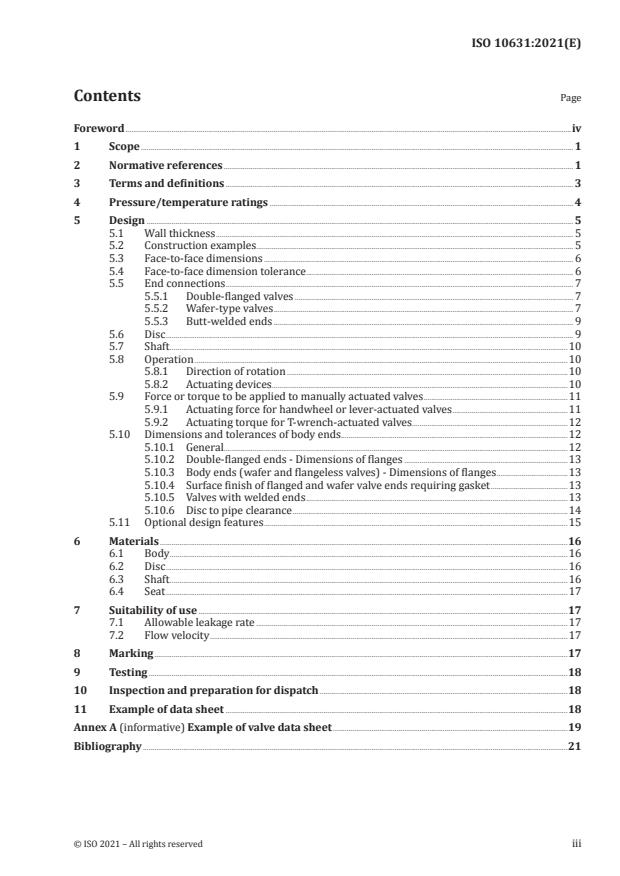
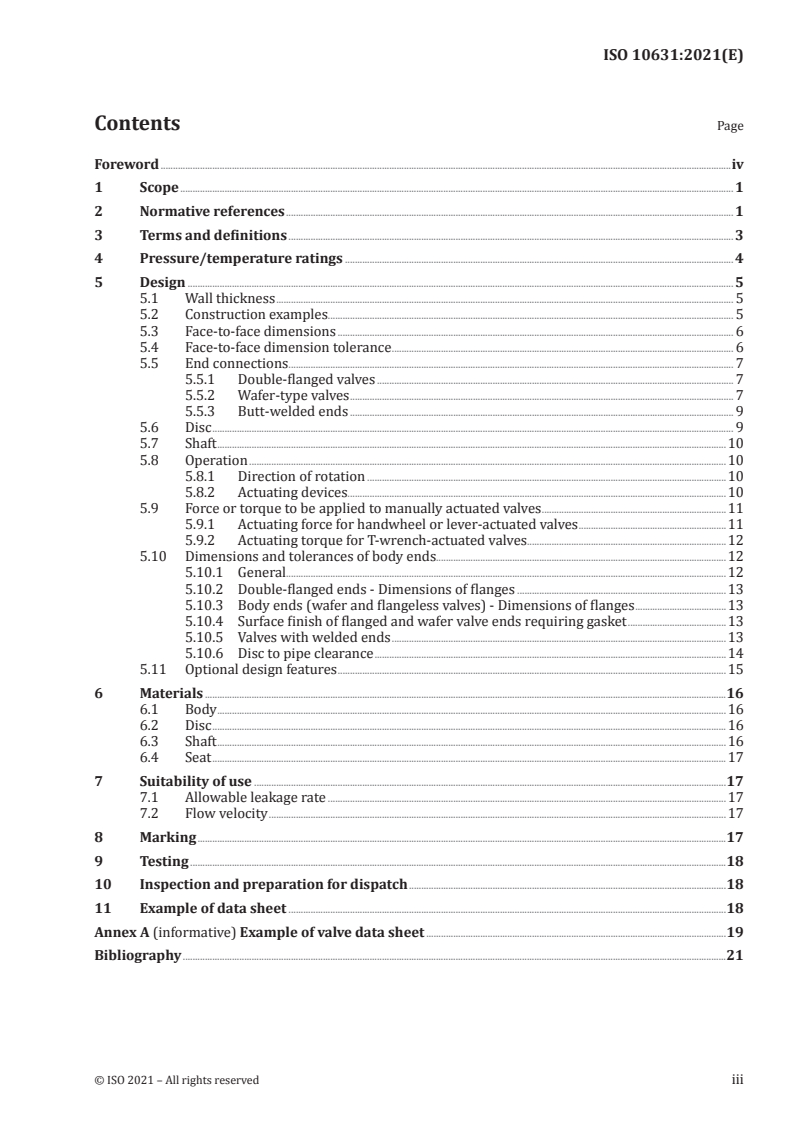
Contents Page
Foreword .iv
1 Scope . 1
2 Normative references . 1
3 Terms and definitions . 3
4 Pressure/temperature ratings . 4
5 Design . 5
5.1 Wall thickness . 5
5.2 Construction examples. 5
5.3 Face-to-face dimensions . 6
5.4 Face-to-face dimension tolerance . 6
5.5 End connections . 7
5.5.1 Double-flanged valves . 7
5.5.2 Wafer-type valves . 7
5.5.3 Butt-welded ends . 9
5.6 Disc . 9
5.7 Shaft .10
5.8 Operation .10
5.8.1 Direction of rotation .10
5.8.2 Actuating devices.10
5.9 Force or torque to be applied to manually actuated valves .11
5.9.1 Actuating force for handwheel or lever-actuated valves .11
5.9.2 Actuating torque for T-wrench-actuated valves .12
5.10 Dimensions and tolerances of body ends.12
5.10.1 General.12
5.10.2 Double-flanged ends - Dimensions of flanges .13
5.10.3 Body ends (wafer and flangeless valves) - Dimensions of flanges .13
5.10.4 Surface finish of flanged and wafer valve ends requiring gasket .13
5.10.5 Valves with welded ends .13
5.10.6 Disc to pipe clearance .14
5.11 Optional design features .15
6 Materials .16
6.1 Body .16
6.2 Disc .16
6.3 Shaft .16
6.4 Seat .17
7 Suitability of use .17
7.1 Allowable leakage rate .17
7.2 Flow velocity .17
8 Marking .17
9 Testing .18
10 Inspection and preparation for dispatch .18
11 Example of data sheet .18
Annex A (informative) Example of valve data sheet .19
Bibliography .21
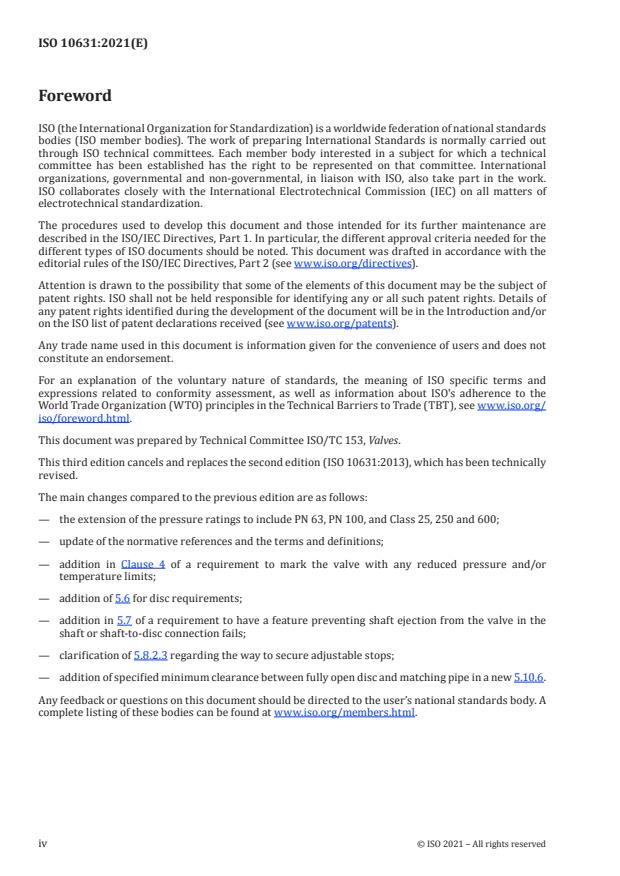
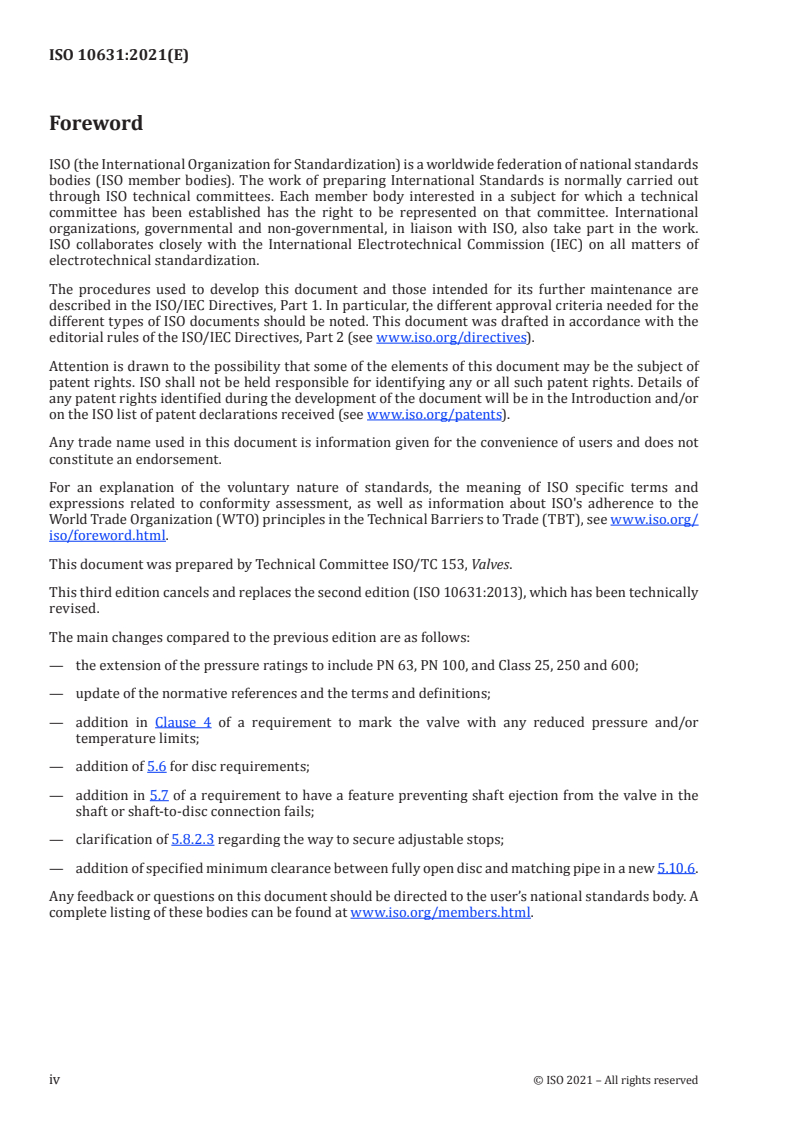
Foreword
ISO (the International Organization for Standardization) is a worldwide federation of national standards
bodies (ISO member bodies). The work of preparing International Standards is normally carried out
through ISO technical committees. Each member body interested in a subject for which a technical
committee has been established has the right to be represented on that committee. International
organizations, governmental and non-governmental, in liaison with ISO, also take part in the work.
ISO collaborates closely with the International Electrotechnical Commission (IEC) on all matters of
electrotechnical standardization.
The procedures used to develop this document and those intended for its further maintenance are
described in the ISO/IEC Directives, Part 1. In particular, the different approval criteria needed for the
different types of ISO documents should be noted. This document was drafted in accordance with the
editorial rules of the ISO/IEC Directives, Part 2 (see www .iso .org/ directives).
Attention is drawn to the possibility that some of the elements of this document may be the subject of
patent rights. ISO shall not be held responsible for identifying any or all such patent rights. Details of
any patent rights identified during the development of the document will be in the Introduction and/or
on the ISO list of patent declarations received (see www .iso .org/ patents).
Any trade name used in this document is information given for the convenience of users and does not
constitute an endorsement.
For an explanation of the voluntary nature of standards, the meaning of ISO specific terms and
expressions related to conformity assessment, as well as information about ISO's adherence to the
World Trade Organization (WTO) principles in the Technical Barriers to Trade (TBT), see www .iso .org/
iso/ foreword .html.
This document was prepared by Technical Committee ISO/TC 153, Valves.
This third edition cancels and replaces the second edition (ISO 10631:2013), which has been technically
revised.
The main changes compared to the previous edition are as follows:
— the extension of the pressure ratings to include PN 63, PN 100, and Class 25, 250 and 600;
— update of the normative references and the terms and definitions;
— addition in Clause 4 of a requirement to mark the valve with any reduced pressure and/or
temperature limits;
— addition of 5.6 for disc requirements;
— addition in 5.7 of a requirement to have a feature preventing shaft ejection from the valve in the
shaft or shaft-to-disc connection fails;
— clarification of 5.8.2.3 regarding the way to secure adjustable stops;
— addition of specified minimum clearance between fully open disc and matching pipe in a new 5.10.6.
Any feedback or questions on this document should be directed to the user’s national standards body. A
complete listing of these bodies can be found at www .iso .org/ members .html.
iv © ISO 2021 – All rights reserved
INTERNATIONAL STANDARD ISO 10631:2021(E)
Industrial valves - Metallic butterfly valves
1 Scope
This document specifies the general requirements for design, materials (e.g. steel, cast iron, ductile iron,
copper alloy), pressure/temperature ratings and testing for butterfly valves having metallic bodies for
use in flanged or butt-welding piping systems.
This document applies to metallic butterfly valves used for all industrial applications.
Additional requirements given in the relevant application standards can apply to butterfly valves used
for more specific applications (e.g. for the water industry, the chemical and petrochemical process
industry, the oil and gas industry).
This document covers butterfly valves of the following nominal sizes, DN and NPS:
— DN 40; 50; 65; 80; 100; 125; 150; 200; 250; 300; 350; 400; 450; 500; (550); 600; (650); 700; 750; 800;
900; 1 000; 1 050; 1 200; 1 400; 1 500; 1 600; 1 800; 2 000; 2 200; 2 400.
— NPS 1 ½; 2; 2 ½; 3; 4; 5; 6; 8; 10; 12; 14; 16; 18; 20; (22); 24; (26); 28; 30; 32; 36; 40; 42; 48; 54; 56;
60; 64; 66; 72; 78; 80; 84; 88; 90; 96.
This document is applicable to butterfly valves of the following pressure designations, PN and Class:
— PN 2,5; PN 6; PN 10; PN 16; PN 25; PN 40; PN 63; PN 100;
— Class 25, 125; 150; 250; 300; 600.
NOTE 1 It is possible that the nominal sizes listed are not available for all pressure designations.
NOTE 2 Nominal sizes listed in parenthesis are not common industry sizes, but are used in some application
standards.
2 Normative references
The following documents are referred to in the text in such a way that some or all of their content
constitutes requirements of this document. For dated references, only the edition cited applies. For
undated references, the latest edition of the referenced document (including any amendments) applies.
ISO 185, Grey cast irons — Classification
ISO 1083, Spheroidal graphite cast irons — Classification
ISO 4991, Steel castings for pressure purposes
ISO 5208, Industrial valves — Pressure testing of metallic valves
ISO 5209:2019, General purpose industrial valves — Marking
ISO 5211, Industrial valves — Part-turn actuator attachments
ISO 5752, Metal valves for use in flanged pipe systems — Face-to-face and centre-to-face dimensions
ISO 5922, Malleable cast iron
ISO 7005-3, Metallic flanges — Part 3: Copper alloy and composite flanges
ISO 9327-1, Steel forgings and rolled or forged bars for pressure purposes — Technical delivery conditions —
Part 1: General requirements
ISO 9327-2, Steel forgings and rolled or forged bars for pressure purposes — Technical delivery conditions —
Part 2: Non-alloy and alloy (Mo, Cr and CrMo) steels with specified elevated temperature properties
ISO 9327-3, Steel forgings and rolled or forged bars for pressure purposes — Technical delivery conditions —
Part 3: Nickel steels with specified low temperature properties
ISO 9327-4, Steel forgings and rolled or forged bars for pressure purposes — Technical delivery conditions —
Part 4: Weldable fine grain steels with high proof strength
ISO 9327-5, Steel forgings and rolled or forged bars for pressure purposes — Technical delivery conditions —
Part 5: Stainless steels
ISO 9328-1, Steel flat products for pressure purposes — Technical delivery conditions — Part 1: General
requirements
ISO 9328-2, Steel flat products for pressure purposes — Technical delivery conditions — Part 2: Non-alloy
and alloy steels with specified elevated temperature properties
ISO 9328-3, Steel flat products for pressure purposes — Technical delivery conditions — Part 3: Weldable
fine grain steels, normalized
ISO 9328-4, Steel flat products for pressure purposes — Technical delivery conditions — Part 4: Nickel-
alloy steels with specified low temperature properties
ISO 9328-5, Steel flat products for pressure purposes — Technical delivery conditions — Part 5: Weldable
fine grain steels, thermomechanically rolled
ISO 10497, Testing of valves — Fire type-testing requirements
ISO 14737, Carbon and low alloy cast steels for general applications
EN 1092-1, Flanges and their joints — Circular flanges for pipes, valves, fittings and accessories, PN
designated — Part 1: Steel flanges
EN 1092-2, Flanges and their joints — Circular flanges for pipes, valves, fittings and accessories, PN
designated — Part 2: Cast iron flanges
EN 1092-3, Flanges and their joints — Circular flanges for pipes, valves, fittings and accessories, PN
designated — Part 3: Copper alloy flanges
EN 12516-1, Industrial valves — Shell design strength — Part 1: Tabulation method for steel valve shells
EN 12516-2, Industrial valves — Shell design strength — Part 2: Calculation method for steel valve shells
EN 12516-4, Industrial valves — Shell design strength — Part 4: Calculation method for valve shells
manufactured in metallic materials other than steel
ASME B1.1, Unified Inch Screw Threads, (UN and UNR Thread Form)
ASME B16.1, Gray Iron Pipe Flanges and Flanged Fittings: Classes 25, 125, and 250
ASME B16.5, Pipe Flanges and Flanged Fittings: NPS 1/2 through NPS 24 Metric/Inch Standard
ASME B16.24, Cast Copper Alloy Pipe Flanges, Flanged Fittings, and Valves: Classes 150, 300, 600, 900,
1500, and 2500
ASME B16.34, Valves Flanged, Threaded, and Welding End
ASME B16.42, Ductile Iron Pipe Flanges and Flanged Fittings: Classes 150 and 300
ASME B16.47, Large Diameter Steel Flanges: NPS 26 through NPS 60 Metric/Inch Standard
2 © ISO 2021 – All rights reserved
3 Terms and definitions
For the purposes of this document, the following terms and definitions apply.
ISO and IEC maintain terminological databases for use in standardization at the following addresses:
— ISO Online browsing platform: available at https:// www .iso .org/ obp
— IEC Electropedia: available at http:// www .electropedia .org/
3.1
DN
nominal size
alphanumeric designation of size for components of a pipework system, which is used for reference
purposes, comprising the letters DN followed by a dimensionless whole number which is indirectly
related to the physical size, in millimetres, of the bore or outside diameter of the end connections
3.2
PN
nominal pressure
numerical designation relating to pressure that is a convenient rounded number for reference purposes,
and which comprises the letters PN followed by the appropriate reference number
Note 1 to entry: It is intended that all equipment of the same nominal size (DN) (3.1) designated by the same PN
number have compatible mating dimensions.
Note 2 to entry: The maximum allowable pressure depends on materials, design and working temperature, and is
to be selected from the tables of pressure/temperature ratings given in the appropriate standards.
3.3
NPS
alphanumeric designation of size for components of a pipework system, which is used for reference
purposes, and which comprises the letters "NPS" followed by a dimensionless number indirectly related
to the physical size of the bore or outside diameter of the end connections
Note 1 to entry: The number following the letters "NPS" does not represent a measurable value and is not
intended to be used for calculation purposes except where specified in the relevant standard.
3.4
Class
alphanumeric designation used for reference purposes related to a combination of mechanical and
dimensional characteristics of a component of a pipework system, which comprises the word “Class”
followed by a dimensionless whole number
Note 1 to entry: The number following the word “Class” does not represent a measurable value and is not intended
to be used for calculation purposes except where specified in the relevant standard.
3.5
face-to-face dimension
distance between the two planes perpendicular to the valve axis located at the extremities of the body
end ports in the installed condition
Note 1 to entry: Face-to-face dimension is expressed in millimetres.
3.6
design differential pressure
Δp
limiting pressure difference across the upstream and downstream sides of the closure element seals
when the valve is in the closed position
1)
Note 1 to entry: Differential pressure is expressed in bar.
Note 2 to entry: While the standard is for this to be equal to the cold working pressure (CWP) (3.7), there may be
circumstances that dictate a lesser pressure difference.
3.7
CWP
cold working pressure
maximum fluid pressure assigned to a valve for operation at a fluid temperature between -20 °C and 38 °C
3.8
resilient seat
broad category of materials that make up a pliable seat, including elastomeric, polymeric, and graphitic
seals, either used individually, in combination(s), or in conjunction with mating metallic component(s)
3.9
bidirectional valve
valve designed for blocking the flow in both directions
3.10
unidirectional valve
valve designed for blocking the flow in one direction only
4 Pressure/temperature ratings
The pressure/temperature ratings of the valve shall meet the specification given in the appropriate
pressure/temperature tables of the standards listed in Table 1.
Table 1 — Pressure/temperature rating standards
Class-designated valve
Body material PN-designated valve
Standard Class ratings
EN 12516-1
Steel EN 12516-1 150, 300, 600
ASME B16.34
Cast iron ASME B16.1 25, 125, 250
EN 1092-2
Ductile iron ASME B16.42 150, 300
Copper alloy EN 1092-3 ASME B16.24 150, 300, 600
The maximum allowable temperature and/or the design differential pressure may be limited by
restrictions in the pressure/temperature ratings of materials used for certain components.
Where components in the valve limit the pressure or temperature capability below the rating in the
specified standard, the maximum allowable pressure and/or temperature shall be marked on the valve
(see Clause 8).
For temperatures below the lowest temperature listed in the pressure/temperature tables, the working
pressure shall be no greater than the pressure for the lowest listed temperature. The use of valves
at lower temperatures is the responsibility of the user. Consideration should be given to the loss of
ductility and impact strength of materials at low temperature.
5 2
1) 1 bar = 0,1 MPa = 10 Pa; 1 MPa = 1 N/mm .
4 © ISO 2021 – All rights reserved
5 Design
5.1 Wall thickness
The minimum wall thickness shall be determined using the standards indicated in Table 2.
For pressure-temperature ratings of the valve bodies outside the size ranges of the referenced standards
of Table 2, design and calculations for pressure-containing elements shall be in accordance with an
internationally recognised design code or standards with consideration of pipe loads, operating forces,
etc. The choice of standard shall be by agreement between the manufacturer and the purchaser.
NOTE Examples of internationally recognised de
...
INTERNATIONAL ISO
STANDARD 10631
Third edition
2021-05
Industrial valves - Metallic butterfly
valves
Robinetterie industrielle - Robinets métalliques à papillon
Reference number
©
ISO 2021
© ISO 2021
All rights reserved. Unless otherwise specified, or required in the context of its implementation, no part of this publication may
be reproduced or utilized otherwise in any form or by any means, electronic or mechanical, including photocopying, or posting
on the internet or an intranet, without prior written permission. Permission can be requested from either ISO at the address
below or ISO’s member body in the country of the requester.
ISO copyright office
CP 401 • Ch. de Blandonnet 8
CH-1214 Vernier, Geneva
Phone: +41 22 749 01 11
Email: copyright@iso.org
Website: www.iso.org
Published in Switzerland
ii © ISO 2021 – All rights reserved
Contents Page
Foreword .iv
1 Scope . 1
2 Normative references . 1
3 Terms and definitions . 3
4 Pressure/temperature ratings . 4
5 Design . 5
5.1 Wall thickness . 5
5.2 Construction examples. 5
5.3 Face-to-face dimensions . 6
5.4 Face-to-face dimension tolerance . 6
5.5 End connections . 7
5.5.1 Double-flanged valves . 7
5.5.2 Wafer-type valves . 7
5.5.3 Butt-welded ends . 9
5.6 Disc . 9
5.7 Shaft .10
5.8 Operation .10
5.8.1 Direction of rotation .10
5.8.2 Actuating devices.10
5.9 Force or torque to be applied to manually actuated valves .11
5.9.1 Actuating force for handwheel or lever-actuated valves .11
5.9.2 Actuating torque for T-wrench-actuated valves .12
5.10 Dimensions and tolerances of body ends.12
5.10.1 General.12
5.10.2 Double-flanged ends - Dimensions of flanges .13
5.10.3 Body ends (wafer and flangeless valves) - Dimensions of flanges .13
5.10.4 Surface finish of flanged and wafer valve ends requiring gasket .13
5.10.5 Valves with welded ends .13
5.10.6 Disc to pipe clearance .14
5.11 Optional design features .15
6 Materials .16
6.1 Body .16
6.2 Disc .16
6.3 Shaft .16
6.4 Seat .17
7 Suitability of use .17
7.1 Allowable leakage rate .17
7.2 Flow velocity .17
8 Marking .17
9 Testing .18
10 Inspection and preparation for dispatch .18
11 Example of data sheet .18
Annex A (informative) Example of valve data sheet .19
Bibliography .21
Foreword
ISO (the International Organization for Standardization) is a worldwide federation of national standards
bodies (ISO member bodies). The work of preparing International Standards is normally carried out
through ISO technical committees. Each member body interested in a subject for which a technical
committee has been established has the right to be represented on that committee. International
organizations, governmental and non-governmental, in liaison with ISO, also take part in the work.
ISO collaborates closely with the International Electrotechnical Commission (IEC) on all matters of
electrotechnical standardization.
The procedures used to develop this document and those intended for its further maintenance are
described in the ISO/IEC Directives, Part 1. In particular, the different approval criteria needed for the
different types of ISO documents should be noted. This document was drafted in accordance with the
editorial rules of the ISO/IEC Directives, Part 2 (see www .iso .org/ directives).
Attention is drawn to the possibility that some of the elements of this document may be the subject of
patent rights. ISO shall not be held responsible for identifying any or all such patent rights. Details of
any patent rights identified during the development of the document will be in the Introduction and/or
on the ISO list of patent declarations received (see www .iso .org/ patents).
Any trade name used in this document is information given for the convenience of users and does not
constitute an endorsement.
For an explanation of the voluntary nature of standards, the meaning of ISO specific terms and
expressions related to conformity assessment, as well as information about ISO's adherence to the
World Trade Organization (WTO) principles in the Technical Barriers to Trade (TBT), see www .iso .org/
iso/ foreword .html.
This document was prepared by Technical Committee ISO/TC 153, Valves.
This third edition cancels and replaces the second edition (ISO 10631:2013), which has been technically
revised.
The main changes compared to the previous edition are as follows:
— the extension of the pressure ratings to include PN 63, PN 100, and Class 25, 250 and 600;
— update of the normative references and the terms and definitions;
— addition in Clause 4 of a requirement to mark the valve with any reduced pressure and/or
temperature limits;
— addition of 5.6 for disc requirements;
— addition in 5.7 of a requirement to have a feature preventing shaft ejection from the valve in the
shaft or shaft-to-disc connection fails;
— clarification of 5.8.2.3 regarding the way to secure adjustable stops;
— addition of specified minimum clearance between fully open disc and matching pipe in a new 5.10.6.
Any feedback or questions on this document should be directed to the user’s national standards body. A
complete listing of these bodies can be found at www .iso .org/ members .html.
iv © ISO 2021 – All rights reserved
INTERNATIONAL STANDARD ISO 10631:2021(E)
Industrial valves - Metallic butterfly valves
1 Scope
This document specifies the general requirements for design, materials (e.g. steel, cast iron, ductile iron,
copper alloy), pressure/temperature ratings and testing for butterfly valves having metallic bodies for
use in flanged or butt-welding piping systems.
This document applies to metallic butterfly valves used for all industrial applications.
Additional requirements given in the relevant application standards can apply to butterfly valves used
for more specific applications (e.g. for the water industry, the chemical and petrochemical process
industry, the oil and gas industry).
This document covers butterfly valves of the following nominal sizes, DN and NPS:
— DN 40; 50; 65; 80; 100; 125; 150; 200; 250; 300; 350; 400; 450; 500; (550); 600; (650); 700; 750; 800;
900; 1 000; 1 050; 1 200; 1 400; 1 500; 1 600; 1 800; 2 000; 2 200; 2 400.
— NPS 1 ½; 2; 2 ½; 3; 4; 5; 6; 8; 10; 12; 14; 16; 18; 20; (22); 24; (26); 28; 30; 32; 36; 40; 42; 48; 54; 56;
60; 64; 66; 72; 78; 80; 84; 88; 90; 96.
This document is applicable to butterfly valves of the following pressure designations, PN and Class:
— PN 2,5; PN 6; PN 10; PN 16; PN 25; PN 40; PN 63; PN 100;
— Class 25, 125; 150; 250; 300; 600.
NOTE 1 It is possible that the nominal sizes listed are not available for all pressure designations.
NOTE 2 Nominal sizes listed in parenthesis are not common industry sizes, but are used in some application
standards.
2 Normative references
The following documents are referred to in the text in such a way that some or all of their content
constitutes requirements of this document. For dated references, only the edition cited applies. For
undated references, the latest edition of the referenced document (including any amendments) applies.
ISO 185, Grey cast irons — Classification
ISO 1083, Spheroidal graphite cast irons — Classification
ISO 4991, Steel castings for pressure purposes
ISO 5208, Industrial valves — Pressure testing of metallic valves
ISO 5209:2019, General purpose industrial valves — Marking
ISO 5211, Industrial valves — Part-turn actuator attachments
ISO 5752, Metal valves for use in flanged pipe systems — Face-to-face and centre-to-face dimensions
ISO 5922, Malleable cast iron
ISO 7005-3, Metallic flanges — Part 3: Copper alloy and composite flanges
ISO 9327-1, Steel forgings and rolled or forged bars for pressure purposes — Technical delivery conditions —
Part 1: General requirements
ISO 9327-2, Steel forgings and rolled or forged bars for pressure purposes — Technical delivery conditions —
Part 2: Non-alloy and alloy (Mo, Cr and CrMo) steels with specified elevated temperature properties
ISO 9327-3, Steel forgings and rolled or forged bars for pressure purposes — Technical delivery conditions —
Part 3: Nickel steels with specified low temperature properties
ISO 9327-4, Steel forgings and rolled or forged bars for pressure purposes — Technical delivery conditions —
Part 4: Weldable fine grain steels with high proof strength
ISO 9327-5, Steel forgings and rolled or forged bars for pressure purposes — Technical delivery conditions —
Part 5: Stainless steels
ISO 9328-1, Steel flat products for pressure purposes — Technical delivery conditions — Part 1: General
requirements
ISO 9328-2, Steel flat products for pressure purposes — Technical delivery conditions — Part 2: Non-alloy
and alloy steels with specified elevated temperature properties
ISO 9328-3, Steel flat products for pressure purposes — Technical delivery conditions — Part 3: Weldable
fine grain steels, normalized
ISO 9328-4, Steel flat products for pressure purposes — Technical delivery conditions — Part 4: Nickel-
alloy steels with specified low temperature properties
ISO 9328-5, Steel flat products for pressure purposes — Technical delivery conditions — Part 5: Weldable
fine grain steels, thermomechanically rolled
ISO 10497, Testing of valves — Fire type-testing requirements
ISO 14737, Carbon and low alloy cast steels for general applications
EN 1092-1, Flanges and their joints — Circular flanges for pipes, valves, fittings and accessories, PN
designated — Part 1: Steel flanges
EN 1092-2, Flanges and their joints — Circular flanges for pipes, valves, fittings and accessories, PN
designated — Part 2: Cast iron flanges
EN 1092-3, Flanges and their joints — Circular flanges for pipes, valves, fittings and accessories, PN
designated — Part 3: Copper alloy flanges
EN 12516-1, Industrial valves — Shell design strength — Part 1: Tabulation method for steel valve shells
EN 12516-2, Industrial valves — Shell design strength — Part 2: Calculation method for steel valve shells
EN 12516-4, Industrial valves — Shell design strength — Part 4: Calculation method for valve shells
manufactured in metallic materials other than steel
ASME B1.1, Unified Inch Screw Threads, (UN and UNR Thread Form)
ASME B16.1, Gray Iron Pipe Flanges and Flanged Fittings: Classes 25, 125, and 250
ASME B16.5, Pipe Flanges and Flanged Fittings: NPS 1/2 through NPS 24 Metric/Inch Standard
ASME B16.24, Cast Copper Alloy Pipe Flanges, Flanged Fittings, and Valves: Classes 150, 300, 600, 900,
1500, and 2500
ASME B16.34, Valves Flanged, Threaded, and Welding End
ASME B16.42, Ductile Iron Pipe Flanges and Flanged Fittings: Classes 150 and 300
ASME B16.47, Large Diameter Steel Flanges: NPS 26 through NPS 60 Metric/Inch Standard
2 © ISO 2021 – All rights reserved
3 Terms and definitions
For the purposes of this document, the following terms and definitions apply.
ISO and IEC maintain terminological databases for use in standardization at the following addresses:
— ISO Online browsing platform: available at https:// www .iso .org/ obp
— IEC Electropedia: available at http:// www .electropedia .org/
3.1
DN
nominal size
alphanumeric designation of size for components of a pipework system, which is used for reference
purposes, comprising the letters DN followed by a dimensionless whole number which is indirectly
related to the physical size, in millimetres, of the bore or outside diameter of the end connections
3.2
PN
nominal pressure
numerical designation relating to pressure that is a convenient rounded number for reference purposes,
and which comprises the letters PN followed by the appropriate reference number
Note 1 to entry: It is intended that all equipment of the same nominal size (DN) (3.1) designated by the same PN
number have compatible mating dimensions.
Note 2 to entry: The maximum allowable pressure depends on materials, design and working temperature, and is
to be selected from the tables of pressure/temperature ratings given in the appropriate standards.
3.3
NPS
alphanumeric designation of size for components of a pipework system, which is used for reference
purposes, and which comprises the letters "NPS" followed by a dimensionless number indirectly related
to the physical size of the bore or outside diameter of the end connections
Note 1 to entry: The number following the letters "NPS" does not represent a measurable value and is not
intended to be used for calculation purposes except where specified in the relevant standard.
3.4
Class
alphanumeric designation used for reference purposes related to a combination of mechanical and
dimensional characteristics of a component of a pipework system, which comprises the word “Class”
followed by a dimensionless whole number
Note 1 to entry: The number following the word “Class” does not represent a measurable value and is not intended
to be used for calculation purposes except where specified in the relevant standard.
3.5
face-to-face dimension
distance between the two planes perpendicular to the valve axis located at the extremities of the body
end ports in the installed condition
Note 1 to entry: Face-to-face dimension is expressed in millimetres.
3.6
design differential pressure
Δp
limiting pressure difference across the upstream and downstream sides of the closure element seals
when the valve is in the closed position
1)
Note 1 to entry: Differential pressure is expressed in bar.
Note 2 to entry: While the standard is for this to be equal to the cold working pressure (CWP) (3.7), there may be
circumstances that dictate a lesser pressure difference.
3.7
CWP
cold working pressure
maximum fluid pressure assigned to a valve for operation at a fluid temperature between -20 °C and 38 °C
3.8
resilient seat
broad category of materials that make up a pliable seat, including elastomeric, polymeric, and graphitic
seals, either used individually, in combination(s), or in conjunction with mating metallic component(s)
3.9
bidirectional valve
valve designed for blocking the flow in both directions
3.10
unidirectional valve
valve designed for blocking the flow in one direction only
4 Pressure/temperature ratings
The pressure/temperature ratings of the valve shall meet the specification given in the appropriate
pressure/temperature tables of the standards listed in Table 1.
Table 1 — Pressure/temperature rating standards
Class-designated valve
Body material PN-designated valve
Standard Class ratings
EN 12516-1
Steel EN 12516-1 150, 300, 600
ASME B16.34
Cast iron ASME B16.1 25, 125, 250
EN 1092-2
Ductile iron ASME B16.42 150, 300
Copper alloy EN 1092-3 ASME B16.24 150, 300, 600
The maximum allowable temperature and/or the design differential pressure may be limited by
restrictions in the pressure/temperature ratings of materials used for certain components.
Where components in the valve limit the pressure or temperature capability below the rating in the
specified standard, the maximum allowable pressure and/or temperature shall be marked on the valve
(see Clause 8).
For temperatures below the lowest temperature listed in the pressure/temperature tables, the working
pressure shall be no greater than the pressure for the lowest listed temperature. The use of valves
at lower temperatures is the responsibility of the user. Consideration should be given to the loss of
ductility and impact strength of materials at low temperature.
5 2
1) 1 bar = 0,1 MPa = 10 Pa; 1 MPa = 1 N/mm .
4 © ISO 2021 – All rights reserved
5 Design
5.1 Wall thickness
The minimum wall thickness shall be determined using the standards indicated in Table 2.
For pressure-temperature ratings of the valve bodies outside the size ranges of the referenced standards
of Table 2, design and calculations for pressure-containing elements shall be in accordance with an
internationally recognised design code or standards with consideration of pipe loads, operating forces,
etc. The choice of standard shall be by agreement between the manufacturer and the purchaser.
NOTE Examples of internationally recognised de
...