

ISO/TS 23520:2025
(Main)Road vehicles — EQuipment eXchange (EQX) — Data format specification for operational information relevant for equipment exchange and test conduction
General Information
- Abstract
This document defines a data format to exchange data that is relevant for exchanging and using measurement equipment between calibration service providers, laboratories and requestors in vehicle safety testing. Additional content found on https://standards.iso.org/iso/ts/23520/ed-1/en defines standard exchange for equipment grouping and metadata definitions for test documentation. Related electronic documents are available for detailed reference based on examples. This document is applicable for all equipment manufacturers, calibration service providers, laboratories and their customers. This document excludes the exchange of test results or test documentation itself which is extensively defined in ISO/TS 13499.
- Status
- Published
- Publication Date
- 24-Apr-2025
- Technical Committee
- ISO/TC 22/SC 36 - Safety and impact testing
- Drafting Committee
- ISO/TC 22/SC 36 - Safety and impact testing
- Current Stage
- 6060 - International Standard published
- Start Date
- 25-Apr-2025
- Due Date
- 13-Nov-2026
- Completion Date
- 25-Apr-2025


Overview
ISO/TS 23520:2025 - EQuipment eXchange (EQX) specifies an XML-based data format to exchange operational and calibration information for measurement equipment used in vehicle safety testing. The Technical Specification defines structure, character encoding, physical unit usage and accuracy rules to enable automated, interoperable exchange of equipment metadata between equipment manufacturers, calibration service providers, laboratories and requestors. The standard focuses on equipment and test metadata exchange and explicitly excludes test results/test documentation (see ISO/TS 13499).
Key Topics
- Data format and schema: EQX is an XML format with a defined XML Schema (EquipmentExchange.XSD) that prescribes elements, structure and allowed values.
- Character encoding: Uses Universal Coded Character Set (UCS) per ISO/IEC 10646; XML root “encoding” attribute must be set according to W3C XML rules.
- Physical units: Quantities should use SI units consistent with ISO 80000; any deviations must be explicitly declared using the element
PhysicalUnit. - Numeric accuracy: Guidance on significant digits:
- Linear sensitivities (
Sensitivity) - at least five significant digits. - Nonlinear sensitivities (
Sensitivity2…Sensitivity5) - up to nine significant digits depending onScalingMethodand application (examples reference ISO/TS 17242 and SAE J2517).
- Linear sensitivities (
- Logical structure - three layers:
- Layer 1 (Equipment): Single- or multi-axis sensors and device details (e.g., sensor axis IDs, UUIDs, calibration history, wiring, offsets, attachments).
- Layer 2 (Channel group): Bundles of equipment with group-level calibration/certification info (categories like
TestBenchorDummy). - Layer 3 (Test setup): Test metadata (title, test type, laboratory/customer data) and nested sensor/group definitions (
TestSetup).
- Header and metadata: Every EQX file contains header
FileInfoincluding creator, software, recipient andDataFormatEdition. - Extensibility: Additional metadata carried as key/value pairs (
EqxAttribute); UUIDs allow referencing between elements. - Related electronic documents: XML schema, sample data (EQX_sampledata.zip) and change history are provided as related electronic documents.
Applications
- Automating exchange of calibration and equipment metadata between calibration service providers, test laboratories and customers.
- Transferring equipment and channel group definitions when moving equipment between labs or test benches.
- Reducing manual data entry and errors by enforcing a common, machine-readable format for equipment operational info.
- Supporting vendors and tool vendors to implement interoperable import/export of equipment configurations and metadata.
Who should use it
- Equipment manufacturers and suppliers
- Calibration service providers
- Crash and impact testing laboratories
- Test system integrators and software developers handling test metadata
Related Standards
- ISO/TS 13499 - Multimedia data exchange format for impact tests (covers test results and descriptors)
- ISO/TS 17242 - Quasi-static calibration for belt force transducers (referenced for polynomial coefficient precision)
- SAE J2517 - Nonlinear chest potentiometer calibration guidance
Keywords: ISO/TS 23520, EQX, equipment exchange, data format, XML, vehicle safety testing, calibration metadata, laboratories, measurement equipment.
Get Certified
Connect with accredited certification bodies for this standard

TÜV Rheinland
TÜV Rheinland is a leading international provider of technical services.

TÜV SÜD
TÜV SÜD is a trusted partner of choice for safety, security and sustainability solutions.

DEKRA Certification Inc.
DEKRA US certification services.
Sponsored listings
Frequently Asked Questions
ISO/TS 23520:2025 is a technical specification published by the International Organization for Standardization (ISO). Its full title is "Road vehicles — EQuipment eXchange (EQX) — Data format specification for operational information relevant for equipment exchange and test conduction". This standard covers: This document defines a data format to exchange data that is relevant for exchanging and using measurement equipment between calibration service providers, laboratories and requestors in vehicle safety testing. Additional content found on https://standards.iso.org/iso/ts/23520/ed-1/en defines standard exchange for equipment grouping and metadata definitions for test documentation. Related electronic documents are available for detailed reference based on examples. This document is applicable for all equipment manufacturers, calibration service providers, laboratories and their customers. This document excludes the exchange of test results or test documentation itself which is extensively defined in ISO/TS 13499.
This document defines a data format to exchange data that is relevant for exchanging and using measurement equipment between calibration service providers, laboratories and requestors in vehicle safety testing. Additional content found on https://standards.iso.org/iso/ts/23520/ed-1/en defines standard exchange for equipment grouping and metadata definitions for test documentation. Related electronic documents are available for detailed reference based on examples. This document is applicable for all equipment manufacturers, calibration service providers, laboratories and their customers. This document excludes the exchange of test results or test documentation itself which is extensively defined in ISO/TS 13499.
ISO/TS 23520:2025 is classified under the following ICS (International Classification for Standards) categories: 43.040.15 - Car informatics. On board computer systems. The ICS classification helps identify the subject area and facilitates finding related standards.
ISO/TS 23520:2025 is available in PDF format for immediate download after purchase. The document can be added to your cart and obtained through the secure checkout process. Digital delivery ensures instant access to the complete standard document.
Standards Content (Sample)
Technical
Specification
ISO/TS 23520
First edition
Road vehicles — EQuipment
2025-04
eXchange (EQX) — Data format
specification for operational
information relevant for equipment
exchange and test conduction
Véhicules routiers — EQuipment eXchange (EQX) — Spécification
du format de données pour les informations opérationnelles
relatives à l'échange d'équipements et à la réalisation d'essais
Reference number
© ISO 2025
All rights reserved. Unless otherwise specified, or required in the context of its implementation, no part of this publication may
be reproduced or utilized otherwise in any form or by any means, electronic or mechanical, including photocopying, or posting on
the internet or an intranet, without prior written permission. Permission can be requested from either ISO at the address below
or ISO’s member body in the country of the requester.
ISO copyright office
CP 401 • Ch. de Blandonnet 8
CH-1214 Vernier, Geneva
Phone: +41 22 749 01 11
Email: copyright@iso.org
Website: www.iso.org
Published in Switzerland
ii
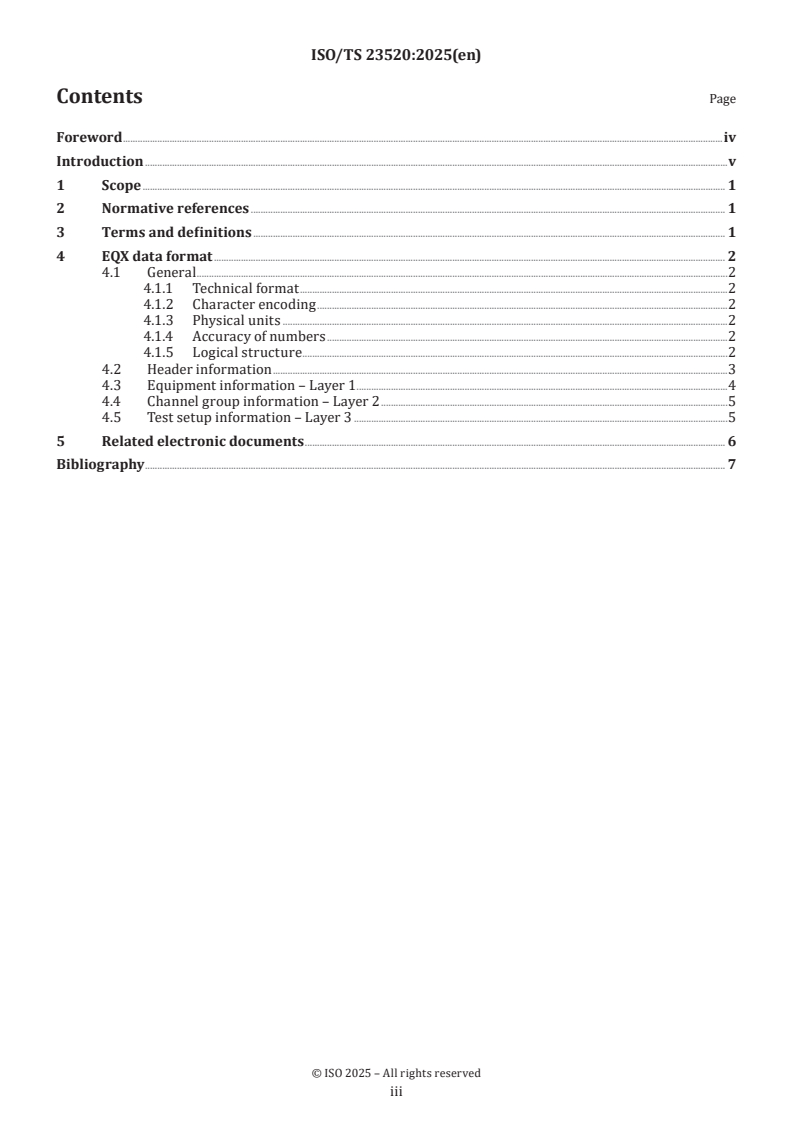
Contents Page
Foreword .iv
Introduction .v
1 Scope . 1
2 Normative references . 1
3 Terms and definitions . 1
4 EQX data format . 2
4.1 General .2
4.1.1 Technical format .2
4.1.2 Character encoding .2
4.1.3 Physical units .2
4.1.4 Accuracy of numbers .2
4.1.5 Logical structure .2
4.2 Header information .3
4.3 Equipment information – Layer 1 .4
4.4 Channel group information – Layer 2 .5
4.5 Test setup information – Layer 3 .5
5 Related electronic documents . 6
Bibliography . 7
iii
Foreword
ISO (the International Organization for Standardization) is a worldwide federation of national standards
bodies (ISO member bodies). The work of preparing International Standards is normally carried out through
ISO technical committees. Each member body interested in a subject for which a technical committee
has been established has the right to be represented on that committee. International organizations,
governmental and non-governmental, in liaison with ISO, also take part in the work. ISO collaborates closely
with the International Electrotechnical Commission (IEC) on all matters of electrotechnical standardization.
The procedures used to develop this document and those intended for its further maintenance are described
in the ISO/IEC Directives, Part 1. In particular, the different approval criteria needed for the different types
of ISO document should be noted. This document was drafted in accordance with the editorial rules of the
ISO/IEC Directives, Part 2 (see www.iso.org/directives).
ISO draws attention to the possibility that the implementation of this document may involve the use of (a)
patent(s). ISO takes no position concerning the evidence, validity or applicability of any claimed patent
rights in respect thereof. As of the date of publication of this document, ISO had not received notice of (a)
patent(s) which may be required to implement this document. However, implementers are cautioned that
this may not represent the latest information, which may be obtained from the patent database available at
www.iso.org/patents. ISO shall not be held responsible for identifying any or all such patent rights.
Any trade name used in this document is information given for the convenience of users and does not
constitute an endorsement.
For an explanation of the voluntary nature of standards, the meaning of ISO specific terms and expressions
related to conformity assessment, as well as information about ISO's adherence to the World Trade
Organization (WTO) principles in the Technical Barriers to Trade (TBT), see www.iso.org/iso/foreword.html.
This document was prepared by Technical Committee ISO/TC 22, Road vehicles, Subcommittee SC 36, Safety
and impact testing.
Any feedback or questions on this document should be directed to the user’s national standards body. A
complete listing of these bodies can be found at www.iso.org/members.html.
iv
Introduction
The use of the EQuipment eXchange (EQX) data format simplifies exchange of data related to operation and
calibration of equipment and channel groups, such as transducers and anthropomorphic test devices (ATDs).
An extended option is to transport additional metadata information like test number and test types between
different laboratories and to calibration service providers to deliver an easy option to automatically fulfil
customer specific naming rules and metadata definitions.
The purpose of this document is to help users save time and prevent errors by not having to manually input
data in different systems when:
— exchanging calibration information between customer and calibration service provider;
— exchanging equipment between test laboratories;
— exchanging test meta data information between laboratories.
v
Technical Specification ISO/TS 23520:2025(en)
Road vehicles — EQuipment eXchange (EQX) — Data format
specification for operational information relevant for
equipment exchange and test conduction
1 Scope
This document defines a data format to exchange data that is relevant for exchanging and using measurement
equipment between
...