

ISO/PAS 21779-1:2025
(Main)Road vehicles — Test method to evaluate the performance of acceleration control pedal error (ACPE) — Part 1: Car-to-car from standstill
General Information
- Abstract
This document specifies test methods to evaluate the behaviour of a vehicle equipped with an acceleration control pedal error (ACPE) system according to ISO/PAS 19486. Those forward and reverse accidents occur during a straight-line acceleration when the vehicle under test (VUT) accelerates due to driver misapplication of accelerator pedal instead of intended brake pedal. This document is limited to ACPE systems of light vehicles only classified in UN-ECE (TRANS/WP.29/1045) Vehicle: “Category 1-1 vehicle” and does not apply to such devices installed in vehicles of other categories, such as heavy vehicles or motorcycles. This document focuses on an important part of the vehicle behaviour during these collision scenarios, which is the capacity to avoid or mitigate the collision especially to the other vehicle.
- Status
- Published
- Publication Date
- 26-May-2025
- Technical Committee
- ISO/TC 22/SC 33 - Vehicle dynamics and chassis components
- Drafting Committee
- ISO/TC 22/SC 33/WG 3 - Driver assistance and active safety functions
- Current Stage
- 6060 - International Standard published
- Start Date
- 27-May-2025
- Due Date
- 06-Dec-2026
- Completion Date
- 27-May-2025
Overview
ISO/PAS 21779-1:2025 establishes standardized test methods for evaluating the performance of acceleration control pedal error (ACPE) systems in road vehicles. The scope of this international standard is limited to light vehicles, specifically those classified as "Category 1-1 vehicles" under the UN-ECE regulations. The document focuses on car-to-car collision scenarios from a standstill, where unintended acceleration due to driver pedal misapplication can lead to forward or reverse accidents. The test methods outlined in this specification help manufacturers and safety organizations objectively assess ACPE system effectiveness in preventing or mitigating collisions.
Key Topics
Test Scope and Applicability
- Applies to ACPE systems as defined in ISO/PAS 19486
- Limited to light vehicles (passenger cars under UN-ECE Category 1-1)
- Excludes heavy vehicles and motorcycles
Accident Scenarios
- Evaluates vehicle behavior during straight-line acceleration from standstill
- Focused on incidents caused by drivers unintentionally pressing the accelerator instead of the brake pedal
Test Environmental Conditions
- Standardizes ambient temperature (-5°C to 40°C), wind speed (≤5 m/s), and test surface (dry, paved, minimal slope)
- Specifies acceptable visibility and environmental factors to ensure consistent test results
Vehicle and System Preparation
- Requirements for tire pressure, brake system condition, drive shaft selection, and ACPE device settings
- Details on pre-test vehicle initialization and brake system break-in procedures
Measurement and Validation
- Key measurements: braking-off time, accelerator-on time, vehicle position, speed, and brake temperature
- Data capture requires high-accuracy instrumentation for position, speed, and temperature
- Validation criteria to ensure consistency and repeatability of test outcomes
Documentation and Reporting
- Recording of environmental and vehicle data, test results, and collision speeds
- Calculation of rate-of-speed-change to quantify ACPE system performance
Applications
- Automotive Manufacturers: Facilitates repeatable and objective evaluation of ACPE systems, supporting design validation, supplier selection, and regulatory compliance for passenger cars.
- Vehicle Safety Organizations: Provides an international benchmark for certifying or auditing vehicles equipped with ACPE functions to reduce pedal misapplication accidents.
- Regulatory Bodies: Enables the establishment and enforcement of vehicle safety requirements related to unintended acceleration incidents.
- Research and Development: Useful for the development and refinement of ACPE technologies and driver assistance systems aimed at improving vehicle safety in low-speed car-to-car collision scenarios.
Related Standards
- ISO/PAS 19486 - Specifies definitions and system requirements for ACPE systems.
- ISO 8855 - Road vehicles - Vehicle dynamics and road-holding ability - Vocabulary.
- ISO 15037-1:2019 - General test methods for vehicle dynamics in passenger cars.
- ISO 19206-1 & ISO 19206-3 - Requirements for test targets used in the evaluation of active safety functions.
- ISO 22733-1 - Advanced emergency braking systems (AEBS) testing methods.
Practical Value
Adoption of ISO/PAS 21779-1:2025 supports industry-wide consistency in evaluating ACPE effectiveness, directly contributing to the reduction of common parking and low-speed accidents associated with pedal confusion. By providing clear procedures for testing and reporting, this standard enhances consumer safety, streamlines compliance processes, and supports the global harmonization of vehicle safety assessments related to unintended acceleration control technologies.
Get Certified
Connect with accredited certification bodies for this standard

BSI Group
BSI (British Standards Institution) is the business standards company that helps organizations make excellence a habit.

TÜV Rheinland
TÜV Rheinland is a leading international provider of technical services.

TÜV SÜD
TÜV SÜD is a trusted partner of choice for safety, security and sustainability solutions.
Sponsored listings
Frequently Asked Questions
ISO/PAS 21779-1:2025 is a technical specification published by the International Organization for Standardization (ISO). Its full title is "Road vehicles — Test method to evaluate the performance of acceleration control pedal error (ACPE) — Part 1: Car-to-car from standstill". This standard covers: This document specifies test methods to evaluate the behaviour of a vehicle equipped with an acceleration control pedal error (ACPE) system according to ISO/PAS 19486. Those forward and reverse accidents occur during a straight-line acceleration when the vehicle under test (VUT) accelerates due to driver misapplication of accelerator pedal instead of intended brake pedal. This document is limited to ACPE systems of light vehicles only classified in UN-ECE (TRANS/WP.29/1045) Vehicle: “Category 1-1 vehicle” and does not apply to such devices installed in vehicles of other categories, such as heavy vehicles or motorcycles. This document focuses on an important part of the vehicle behaviour during these collision scenarios, which is the capacity to avoid or mitigate the collision especially to the other vehicle.
This document specifies test methods to evaluate the behaviour of a vehicle equipped with an acceleration control pedal error (ACPE) system according to ISO/PAS 19486. Those forward and reverse accidents occur during a straight-line acceleration when the vehicle under test (VUT) accelerates due to driver misapplication of accelerator pedal instead of intended brake pedal. This document is limited to ACPE systems of light vehicles only classified in UN-ECE (TRANS/WP.29/1045) Vehicle: “Category 1-1 vehicle” and does not apply to such devices installed in vehicles of other categories, such as heavy vehicles or motorcycles. This document focuses on an important part of the vehicle behaviour during these collision scenarios, which is the capacity to avoid or mitigate the collision especially to the other vehicle.
ISO/PAS 21779-1:2025 is classified under the following ICS (International Classification for Standards) categories: 35.240.60 - IT applications in transport; 43.040.15 - Car informatics. On board computer systems. The ICS classification helps identify the subject area and facilitates finding related standards.
ISO/PAS 21779-1:2025 is available in PDF format for immediate download after purchase. The document can be added to your cart and obtained through the secure checkout process. Digital delivery ensures instant access to the complete standard document.
Standards Content (Sample)
Publicly
Available
Specification
ISO/PAS 21779-1
First edition
Road vehicles — Test method
2025-05
to evaluate the performance of
acceleration control pedal error
(ACPE) —
Part 1:
Car-to-car from standstill
Véhicules routiers — Méthode d'essai pour évaluer la
performance du contrôle de l'accélération en cas d'erreur de
pédale (ACPE) —
Partie 1: Véhicule-véhicule à partir de l'arrêt
Reference number
© ISO 2025
All rights reserved. Unless otherwise specified, or required in the context of its implementation, no part of this publication may
be reproduced or utilized otherwise in any form or by any means, electronic or mechanical, including photocopying, or posting on
the internet or an intranet, without prior written permission. Permission can be requested from either ISO at the address below
or ISO’s member body in the country of the requester.
ISO copyright office
CP 401 • Ch. de Blandonnet 8
CH-1214 Vernier, Geneva
Phone: +41 22 749 01 11
Email: copyright@iso.org
Website: www.iso.org
Published in Switzerland
ii
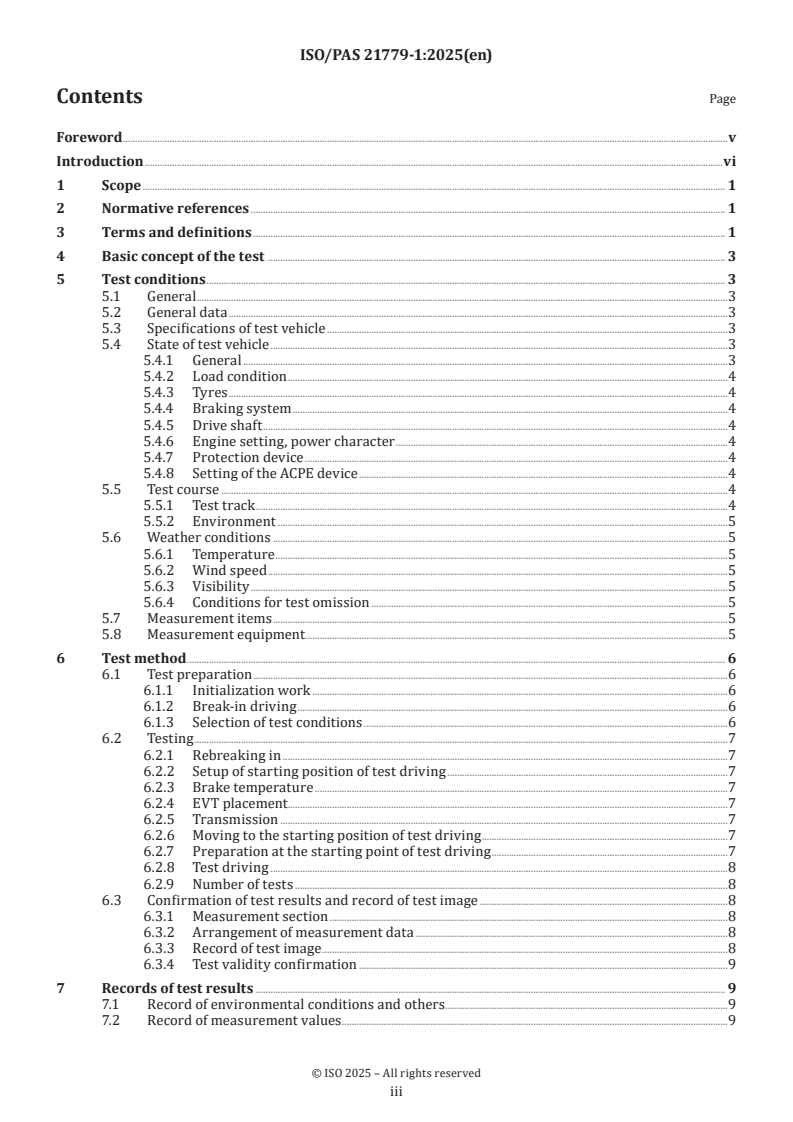
Contents Page
Foreword .v
Introduction .vi
1 Scope . 1
2 Normative references . 1
3 Terms and definitions . 1
4 Basic concept of the test . 3
5 Test conditions . 3
5.1 General .3
5.2 General data .3
5.3 Specifications of test vehicle .3
5.4 State of test vehicle .3
5.4.1 General .3
5.4.2 Load condition .4
5.4.3 Tyres .4
5.4.4 Braking system .4
5.4.5 Drive shaft .4
5.4.6 Engine setting, power character .4
5.4.7 Protection device .4
5.4.8 Setting of the ACPE device .4
5.5 Test course .4
5.5.1 Test track .4
5.5.2 Environment .5
5.6 Weather conditions .5
5.6.1 Temperature .5
5.6.2 Wind speed .5
5.6.3 Visibility .5
5.6.4 Conditions for test omission .5
5.7 Measurement items .5
5.8 Measurement equipment.5
6 Test method . 6
6.1 Test preparation .6
6.1.1 Initialization work .6
6.1.2 Break-in driving .6
6.1.3 Selection of test conditions .6
6.2 Testing .7
6.2.1 Rebreaking in .7
6.2.2 Setup of starting position of test driving .7
6.2.3 Brake temperature .7
6.2.4 EVT placement.7
6.2.5 Transmission .7
6.2.6 Moving to the starting position of test driving .7
6.2.7 Preparation at the starting point of test driving .7
6.2.8 Test driving .8
6.2.9 Number of tests .8
6.3 Confirmation of test results and record of test image .8
6.3.1 Measurement section .8
6.3.2 Arrangement of measurement data .8
6.3.3 Record of test image .8
6.3.4 Test validity confirmation .9
7 Records of test results . 9
7.1 Record of environmental conditions and others.9
7.2 Record of measurement values .9
iii
7.3 Test outcomes .9
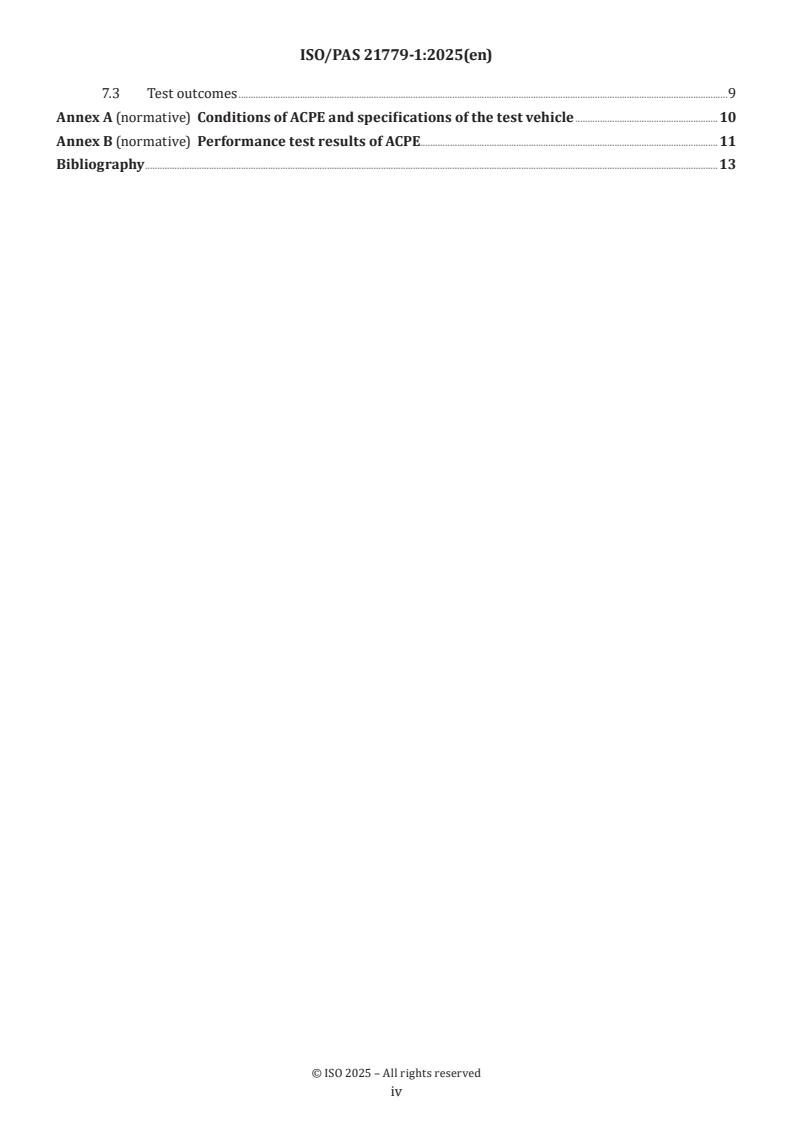
Annex A (normative) Conditions of ACPE and specifications of the test vehicle .10
Annex B (normative) Performance test results of ACPE.11
Bibliography .13
iv
Foreword
ISO (the International Organization for Standardization) is a worldwide federation of national standards
bodies (ISO member bodies). The work of preparing International Standards is normally carried out through
ISO technical committees. Each member body interested in a subject for which a technical committee
has been established has the right to be represented on that committee. International organizations,
governmental and non-governmental, in liaison with ISO, also take part in the work. ISO collaborates closely
with the International Electrotechnical Commission (IEC) on all matters of electrotechnical standardization.
The procedures used to develop this document and those intended for its further maintenance are described
in the ISO/IEC Directives, Part 1. In particular, the different approval criteria needed for the different types
of ISO document should be noted. This document was drafted in accordance with the editorial rules of the
ISO/IEC Directives, Part 2 (see www.iso.org/directives).
ISO draws attention to the possibility that the implementation of this document may involve the use of (a)
patent(s). ISO takes no position concerning the evidence, validity or applicability of any claimed patent
rights in respect thereof. As of the date of publication of this document, ISO had not received notice of (a)
patent(s) which may be required to implement this document. However, implementers are cautioned that
this may not represent the latest information, which may be obtained from the patent database available at
www.iso.org/patents. ISO shall not be held responsible for identifying any or all such patent rights.
Any trade name used in this document is information given for the convenience of users and does not
constitute an endorsement.
For an explanation of the voluntary nature of standards, the meaning of ISO specific terms and expressions
related to conformity assessment, as well as information about ISO's adherence to the World Trade
Organization (WTO) principles in the Technical Barriers to Trade (TBT), see www.iso.org/iso/foreword.html.
This document was prepared by Technical Committee ISO/TC 22, Road vehicles, Subcommittee SC 33, Vehicle
dynamics, chassis components and driving automation systems testing.
A list of all parts in the ISO 21779 series can be found on the ISO website.
Any feedback or questions on this document should be directed to the user’s national standards body. A
complete listing of these bodies can be found at www.iso.org/members.html.
v
Introduction
The aim of the acceleration control for pedal error (ACPE) is to prevent a car accident at a low speed due to
driver’s pedal misapplication. The standard of the system definition is developed on ISO/PAS 19486, and
this document is intended to assess the complete performance of ACPE fitted in a road vehicle based on JASO
C307 published in 2023.
vi
Publicly Available Specification ISO/PAS 21779-1:2025(en)
Road vehicles — Test method to evaluate the performance of
acceleration control pedal error (ACPE) —
Part 1:
Car-to-car from standstill
1 Scope
This document specifies test methods to evaluate the behaviour of a vehicle equipped with an acceleration
control pedal error (ACPE) system according to ISO/PAS 19486. Those forward and reverse accidents occur
during a straight-line acceleration when the vehicle under test (VUT) accelerates due to driver misapplication
of accelerator pedal instead of intended brake pedal. This document is limited to ACPE systems of light
vehicles only classified in UN-ECE (TRANS/WP.29/1045) Vehicle: “Category 1-1 vehicle” and does not
apply to such devices installed in vehicles of other categories, such as heavy vehicles or motorcycles. This
document focuses on an important part of the vehicle behaviour during these collision scenarios, which is
the capacity to avoid or mitigate the collision especially to the other vehicle.
2 Normative references
The following documents are referred to in the text in such a way that some or all of their content constitutes
requirements of this document. For dated references, only the edition cited applies. For undated references,
the latest edition of the referenced document (including any amendments) applies.
ISO 8855, Road vehicles — Vehicle dynamics and road-holding ability — Vocabulary
ISO 15037-1:2019, Road vehicles — Vehicle dynamics test methods — Part 1: General conditions for passenger cars
ISO 19206-1, Road vehicles — Test devices for target vehicles, vulnerable road users and other objects, for
assessment of active safety functions — Part 1: Requirements for passenger vehicle rear-end targets
ISO 19206-3, Road vehicles — Test devices for target vehicles, vulnerable road users and other objects, for
assessment of active safety functions — Part 3: Requirements for passenger vehicle 3D targets
3 Terms and definitions
For the purposes of this document, the terms and definitions given in ISO 8855, ISO 15037-1, ISO 19206-1,
ISO 19206-3 and the following apply.
ISO and IEC maintain terminology databases for use in standardization at the following addresses:
— ISO Online browsing platform: available at https:// www .iso .org/ obp
— IEC Electropedia: available at https:// www .electropedia .org/
3.1
reference track
target track for a test vehicle
3.2
vehicle mass at the time of delivery
mass of the test vehicle, which is loaded with full capacity of fuel, lubricating oil, cooling water, etc. in the
motor and fuel systems, including vehicle-mounted tools, spare tyres and other standard equipment
3.3
brake temperature before test driving
highest temperature of the brake linings/pads of each wheel of the test vehicle to be measured while the test
vehicle is stationary immediately before starting each test run
3.4
EVT
equivalent vehicle target
vehicle target designed to be detectable by sensors
Note 1 to entry: Such sensors are, for example, lidar, millimetre wave radar, cameras able to detect a typical segment-C
passenger car.
3.5
VUT
vehicle under test
vehicle tested with the accelerator pedal control error (APCE) system
3.6
virtual collision location
location where a collision is assumed to occur on the reference track (3.1)
Note 1 to entry: See Figure 1.
3.7
distance from the virtual collision location
d
distance between the virtual collision location (3.6) on the reference track (3.1) and the front-centre (for F
off
or F testing in Table 1) or back-centre (for R or R testing in Table 1) of the vehicle under test (VUT) (3.5)
on off on
Note 1 to entry: See Figure 1.
3.8
lateral deviation amount
amount of lateral shift of the front-centre of the vehicle under test (VUT) (3.5) relative to the reference track (3.1)
Note 1 to entry: See Figure 1.
3.9
braking-off
point when the foot of the driver of the vehicle under test (VUT) (3.5) is not pressed and removed from the
brake pedal during the test driving
3.10
accelerator-on
point when the accelerator pedal starts moving during the test driving
3.11
accelerator-full
point when the accelerator pedal is fully pressed during the test driving
3.12
starting position for test driving
target position on the reference track (3.1) to begin test driving, which is set for each test
Key
1 vehicle under test (VUT)
2 lateral deviation amount of test vehicle
3 virtual collision location
4 equivalent vehicle target (EVT)
5 reference track
6 distance from the virtual collision location (d)
7 lateral deviation angle
Figure 1 — Concept diagram for definitions
4 Basic concept of the test
The purpose of this test method is to evaluate performance of the sudden acceleration control function of the
ACPE device which aims at the prevention or mitigation of a collision that may occur as a result of driver’s
error, i.e. depressing the accelerator pedal instead of the brake pedal. Therefore, this document specifies
environmental conditions, vehicle states, test preparation, test methods, and relevant records which are
necessary to objectively measure system performance. To es
...